HL7 Common Terminology Services 2
1Service Functional Model (SFM)
2Service Functional Model Specification 3
4
Common Terminology Services Release 2 (CTS 2) 5 6 Version 1.0 7 8 23-July-2008 9 10 Project Leads
Russell Hamm [email protected] (Apelon, Inc.)
Craig Stancl [email protected] (Mayo Clinic/Foundation)
Principal Contributors
Davera Gabriel [email protected] (University of California, Davis) Russell Hamm [email protected] (Apelon, Inc.)
Senthil Nachimuthu [email protected](3M Health Information Systems)
Craig Stancl [email protected] (Mayo Clinic/Foundation)
Contributors
John Carter [email protected] (Apelon, Inc.)
Kristi Eckerson [email protected] (Emory University) Sundak Ganesan [email protected](CDC)
Stanley Huff, M.D. [email protected] (Intermountain Health Care)
HL7 Vocabulary Co-Chairs
Heather Grain [email protected] () Russell Hamm [email protected] (Apelon, Inc.) Ted Klein [email protected] (Klein Consulting)
Beverly Knight [email protected] (Canada Health Infoway)
11
Preface 12
Notes to Readers 13
This document is the Service Functional Model for the Common Terminology Services 2 14
specification, which is specified under the Service Development Framework process under the 15
auspices of the Healthcare Services Specification Project (HSSP). Further context is given in the 16
overview section below, but one key point to note is that the SFM provides a Service Interface 17
specification, NOT the specification of a Service implementation. This is a critical distinction in 18
terms of Service Oriented Architecture. There could be many different ways of implementing all 19
or part of the functionality to support the behavior described in this specification. 20
21
NOTE:For the purposes of this specification, the terms vocabulary and terminology are 22
used interchangeably. 23
24
Changes from Previous Release 25
This is the first public release of this document. 26
27
Acknowledgments 28
This document is the result of the collaboration of many individuals and organizations. The 29
terminology and standards community - all involved in the numerous meetings and 30
teleconferences are to be thanked for their contributions and support. In addition to the listed 31
authors, the following individuals are acknowledged for their contributions and support during 32
the development of this specification. 33
• The HL7 Vocabulary Technical Committee
34
• Christopher Chute, M.D., PhD. (Mayo Clinic/Foundation)
35
• John Koisch (OCTL Consulting)
36
• Ken Rubin (EDS)
37
• Tony Weida, PhD. (Apelon, Inc.)
38 39
Note: Sections of this document in blue indicate text that is consistent across HSSP 40
specifications. 41
Contents
• 1 Overview
o 1.1 Introduction and Scope
1.1.1 HL7-OMG Healthcare Services Specification Project (HSSP) 1.1.2 Service Definition Principles
o 1.2 Overall disclaimers
o 1.3 Context of this SFM within HSSP Roadmap
• 2 Service Overview and Business case
o 2.1 Service Overview
2.1.1 CTS 2 Service Description and Purpose 2.1.2 Scope
o 2.2 The reason why the service is necessary o 2.3 Structure of the CTS 2 Service
o 2.4 Implementation Considerations
2.4.1 Interface Interoperability Considerations 2.4.2 Terminology Structure Considerations
2.4.2.1 Code System
2.4.2.2 Code System Version 2.4.2.3 Concept 2.4.2.4 Designation 2.4.2.5 Concept Property 2.4.2.6 Concept Association 2.4.2.7 Value Set • 3 Business Scenarios o 3.1 Scenario Actors o 3.2 Primary Scenarios 3.2.1 Administrative Scenarios 3.2.1.1 Import Content 3.2.1.2 Export Content 3.2.1.3 Remove Content 3.2.1.4 Change Content Status 3.2.1.5 Update Notification
3.2.1.6 Update Notification Management 3.2.1.7 Content Dependency Notification 3.2.2 Search / Query Scenarios
3.2.2.1 Code System Search / Query
3.2.2.1.1 Resolve Available Code Systems
3.2.2.1.2 Retrieve Coded Concepts from Code System 3.2.2.1.3 Validate Concept in Code System
3.2.2.1.4 Identify Concept Language Translations 3.2.2.1.5 Resolve Concept Representations 3.2.2.1.6 Compare Code System Versions 3.2.2.2 Value Set Search / Query
3.2.2.2.1 Resolve Available Value Sets
3.2.2.2.3 Validate Coded Concept in Value Set 3.2.2.2.4 Compare Value Set Versions
3.2.2.2.5 Resolve Concept Representations 3.2.3 Authoring / Curation Scenarios
3.2.3.1 Code System Authoring / Curation 3.2.3.1.1 Create Code System 3.2.3.1.2 Maintain Code System 3.2.3.1.3 Create Concept
3.2.3.1.4 Maintain Concept 3.2.3.1.5 Deprecate Concept 3.2.3.2 Value Set Authoring / Curation
3.2.3.2.1 Create Value Set by Intension 3.2.3.2.2 Create Value Set by Extension 3.2.3.2.3 Maintain Value Set (Definition) 3.2.3.2.4 Maintain Value Set (Enumeration) 3.2.3.3 Change Request Processing
3.2.3.3.1 Create Change Request 3.2.3.3.2 Edit Change Request 3.2.3.3.3 Submit Change Request 3.2.3.3.4 Package Change Request 3.2.4 Association Scenarios
3.2.4.1 Association Administrative Scenarios
3.2.4.1.1 Enumerate Code System Coded Concept Relationship Types
3.2.4.1.2 Identify / Retrieve Concept Associations for a Single Concept
3.2.4.1.3 Identify / Retrieve Associations Between Two or More Coded Concepts
3.2.4.1.4 Import Coded Concept Associations 3.2.4.1.5 Export Coded Concept Associations 3.2.4.1.6 Remove Coded Concept Associations
3.2.4.1.7 Change Status of Coded Concept Associations 3.2.4.1.8 Register for Association Update Notification 3.2.4.2 Association Search / Query Scenarios
3.2.4.2.1 Resolve Available Associations 3.2.4.2.2 Validate Associations
3.2.4.2.3 Retrieve Association Metadata 3.2.4.2.4 Compare Association Versions
3.2.4.2.5 Request / Retrieve Association Instance 3.2.4.3 Association Author / Curation Scenarios
3.2.4.3.1 Create / Maintain an Association between Coded Concepts
3.2.4.3.2 Create Relationship Type 3.2.4.3.3 Create Lexical Association 3.2.4.3.4 Create Rules Based Association
Concepts
3.2.4.3.6 Validate Map Associations Between Coded Concepts
• 4 Assumptions and Dependencies
o 4.1 Dependencies on other Service Frameworks o 4.2 CTS Backwards Compatibility
4.2.1 Message API Support (MAPI) 4.2.2 General CTS API Support 4.2.3 HL7 Datatypes
• 5 Functional Overloading and Metadata Discovery
o 5.1 Functional Overloading o 5.2 Metadata Discovery
• 6 Detailed Functional Model for each Interface
o 6.1 Administration Functions
6.1.1 Import Terminology
6.1.2 Import Terminology Revision 6.1.3 Export Terminology
6.1.4 Remove Terminology / Terminology Version 6.1.5 Change Terminology Status
6.1.6 Convert Terminology Format 6.1.7 Register for Update Notification 6.1.8 Revise or Remove Update Notification
6.1.9 Register for Concept Dependency Notification
6.1.10 Revise or Remove Concept Dependency Notification
o 6.2 Search / Access
6.2.1 Code System Search / Access 6.2.2 Resolve Available Code Systems 6.2.3 Resolve Code System Metadata 6.2.4 Resolve Code System Concepts 6.2.5 Resolve Concept Details
6.2.6 Resolve Coded Concept from Code System 6.2.7 Resolve Relations Between Coded Concepts 6.2.8 Compare Code Systems
6.2.9 Compare Code System Contents
o 6.3 Value Set Search / Access
6.3.1 Compare Value Sets
6.3.2 Compare Value Set Contents 6.3.3 Resolve Available Value Sets 6.3.4 Resolve Value Set Metadata 6.3.5 Resolve Value Set Entries 6.3.6 Resolve Value Set Entry
o 6.4 Authoring/Curation
6.4.1 Code System Authoring/Curation 6.4.1.1 Create Code System 6.4.1.2 Maintain Code System 6.4.1.3 Create Concept
6.4.1.4 Maintain Concept 6.4.1.5 Deprecate Concept 6.4.1.6 Create Relationship Type 6.4.2 Value Set Authoring/Curation
6.4.2.1 Create Value Set by Intension 6.4.2.2 Create Value Set by Extension 6.4.2.3 Maintain Value Set (Intension) 6.4.2.4 Maintain Value Set (Extension) 6.4.3 Change Request Processing
6.4.3.1 Create Change Request 6.4.3.2 Edit Change Request 6.4.3.3 Submit Change Request 6.4.3.4 Package Change Request
o 6.5 Code System Relationships and Maps
6.5.1 Concept Relationships
6.5.1.1 Resolve Available Concept Relationships
6.5.1.2 Retrieve Concept Relationships for a Single Coded Concept
6.5.1.3 Retrieve Concept Relationships Between Two Coded Concepts
6.5.1.4 Retrieve Concept Relationship Metadata 6.5.1.5 Import Concept Relationship
6.5.1.6 Import Concept Relationship Revision 6.5.1.7 Export Concept Relationship
6.5.1.8 Import Concept Relationship Metadata 6.5.1.9 Remove Concept Relationship Version 6.5.1.10 Change Concept Relationship Status
6.5.1.11 Create Concept Relationship Between Coded Concepts 6.5.1.12 Create Lexical Relationship Between Coded Concepts 6.5.1.13 Create Rules Based Relationship Between Coded
Concepts
6.5.1.14 Compare Relationships Between Coded Concepts 6.5.1.15 Compare Metadata Between Relationships
6.5.1.16 Validate Relationships Between Coded Concepts 6.5.1.17 Validate Lexical Based Relationships Between Coded
Concepts
6.5.1.18 Validate Rules Based Relationships Between Coded Concepts
6.5.1.19 Register For Concept Relationship Update Notification 6.5.1.20 Revise or Remove Concept Relationship Update
Notification
6.5.1.21 Register For Concept Dependency Relationship Notification
6.5.1.22 Revise or Remove Concept Dependency Relationship Notification
6.5.2.1 Resolve Available Concept Maps
6.5.2.2 Retrieve Concept Maps for a Specified Coded Concept 6.5.2.3 Retrieve Concept Maps Between Multiple Coded Concepts 6.5.2.4 Retrieve Map Metadata
6.5.2.5 Import Map
6.5.2.6 Import Concept Map Metadata 6.5.2.7 Convert Mapping Format 6.5.2.8 Import Map Revision 6.5.2.9 Export Map
6.5.2.10 Export Map Metadata 6.5.2.11 Remove Map Version 6.5.2.12 Change Map Status
6.5.2.13 Create Map Between Coded Concepts
6.5.2.14 Create Lexical Mapping Between Coded Concepts 6.5.2.15 Create Rules Based Mapping Between Coded Concepts 6.5.2.16 Compare Maps Between Coded Concepts
6.5.2.17 Compare Metadata Between Maps
6.5.2.18 Validate Mappings Between Coded Concepts 6.5.2.19 Validate Lexical Based Mappings Between Coded
Concepts
6.5.2.20 Validate Rules Based Mappings Between Coded Concepts 6.5.2.21 Register for Concept Dependency Map Notification 6.5.2.22 Revise or Remove Map Update Notification
6.5.2.23 Register For Concept Dependency Map Notification 6.5.2.24 Revise or Remove Concept Dependency Map Notification
• 7 Profiles
o 7.1 Introduction
o 7.2 CTS 2 Functional Profiles
7.2.1 Minimal CTS 2 Profile 7.2.2 Vocabulary Facilitator Profile 7.2.3 Terminology Administration Profile 7.2.4 Terminology Authoring Profile
o 7.3 CTS 2 Semantic Profiles
7.3.1 Mature Terminology Profile 7.3.2 Developing Terminology Profile
o 7.4 CTS 2 Conformance Profiles
7.4.1 Conformance Interoperability 7.4.2 Conformance Assertion
• 8 The Services Framework Functional Model • 9 Relationship to Information Content
• 10 Recommendations for Technical RFP Issuance
o 10.1 Semantic Signifiers: Disparate Terminologies
10.1.1 Semantic Signifiers: HL7 Terminologies
o 10.2 Conformance Profiles and Service Level Agreements
o 10.3 Operationalizing CTS 2: Considerations in Implementation
10.3.2 Internationalization
o 10.4 Service Description and Discovery o 10.5 Federated Terminologies
o 10.6 Terminology Structure Considerations o 10.7
• 11 Appendix A - Relevant Standards
o 11.1 HL7 Common Terminology Services o 11.2 The Lexical Grid
• 12 Appendix B – Glossary
o 12.1 Actor
o 12.2 Code System o 12.3 Concept Map
o 12.4 Concept Relationship o 12.5 Nested Value Sets o 12.6 Value Set
o 12.7 Value Set Specification o 12.8 Nested Value Sets
• 13 Appendix C - HL7 EHR Functional Model Traceability
Overview
43Introduction and Scope
44The Service Specification Development Framework Methodology is the methodology followed 45
to define HSSP specifications. The methodology sets out an overall process, and also defines the 46
responsibilities of the Service Functional Model (SFM). Section 2 sets out the business context 47
for this particular specification, but firstly it is important to understand the overall context within 48
which this specification is written, i.e. its purpose from a methodology standpoint. 49
50
HL7-OMG Healthcare Services Specification Project (HSSP)
51The Healthcare Services Specification Project (HSSP) [http://hssp.wikispaces.com] is a joint 52
endeavor between Health Level Seven (HL7) [http://www.hl7.org] and the Object Management 53
Group (OMG) [http://www.omg.org]. The HSSP was chartered at the January 2005 HL7 meeting 54
under the Electronic Health Records Technical Committee, and the project was subsequently 55
validated by the Board of Directors of both organizations. 56
The HSSP has several objectives. These objectives include the following: 57
• To stimulate the adoption and use of standardized “plug-and-play” services by healthcare
58
software product vendors 59
• To facilitate the development of a set of implementable interface standards supporting
60
agreed-upon services specifications to form the basis for provider purchasing and 61
procurement decisions. 62
• To complement and not conflict with existing HL7 work products and activities,
63
leveraging content and lessons learned from elsewhere within the organization. 64
Within the process, HL7 has primary responsibility for (1) identifying and prioritizing services as 65
candidates for standardization; (2) specifying the functional requirements and conformance 66
criteria for these services in the form of Service Functional Model (SFM) specifications such as 67
this document; and (3) adopting these SFMs as balloted HL7 standards. These activities are 68
coordinated by the HL7 Services Oriented Architecture SIG in collaboration with other HL7 69
committees, which currently include the Vocabulary TC and the Clinical Decision Support TC. 70
Based on the HL7 SFMs, OMG will develop “Requests for Proposals” (RFPs) that are the basis 71
of the OMG standardization process. This process allows vendors and other submitters to 72
propose solutions that satisfy the mandatory and optional requirements expressed in the RFP 73
while leaving design flexibility to the submitters and implementation flexibility to the users of 74
the standard. The result of this collaboration is an RFP Submission, which will be referred to in 75
the HSSP process as a Service Technical Model (STM). HL7 members, content, and concerns 76
are integral to this process, and will explicitly included in the RFP creation and evaluation 77
process. 78
It is important to note that the HL7 SFMs specify the functional requirements of a service, the 79
OMG RFPs specify the technical requirements of a service, and the STM represents the resulting 80
technical model, except as specified below. In many cases, SFMs describe an overall coherent 81
set of functional capabilities and / or define a minimum set of behaviors necessary to guarantee a 82
minimal level of service in a deployment scenario. These capabilities may be specialized or 83
subdivided from both functional and informational (semantic) perspectives to provide 84
conformance “profiles” that may be used as the basis for the OMG RFP process and/or 85
implemented. 86
87
Service Definition Principles
88The high level principles regarding service definition that have been adopted by the Services 89
Specification Project are as follows: 90
• Service Specifications shall be well defined and clearly scoped and with well understood
91
requirements and responsibilities. 92
• Services should have a unity of purpose (e.g., fulfilling one domain or area) but services
93
themselves may be composable. 94
• Services will be specified sufficiently to address functional, semantic, and structural
95
interoperability. 96
• It must be possible to replace one conformant service implementation with another
97
meeting the same service specification while maintaining functionality of the system. 98
A Service at the SFM level is regarded as a system component; the meaning of the term 99
“(system) component” in this context is consistent with UML usage[1].A component is a modular 100
unit with well-defined interfaces that is replaceable within its environment. A component can 101
always be considered an autonomous unit within a system or subsystem. It has one or more 102
provided and/or required interfaces, and its internals are hidden and inaccessible other than as 103
provided by its interfaces. 104
Each Service’s Functional Model defines the interfaces that the service exposes to its 105
environment, and the service’s dependencies on services provided by other components in its 106
environment. Dependencies in the Functional Model relate to services that have or may in future 107
have a Functional Model at a similar level; detail dependencies on low-level utility services 108
should not be included, as that level of design is not in scope for the Functional Model. 109
The manner in which services and interfaces are deployed, discovered, and so forth is outside the 110
scope of the Functional Model. However, HSSP Functional Models may reference content from 111
other areas of HSSP work that deals with architecture, deployment, naming and so forth. Except 112
where explicitly specified, these references are to be considered informative only. All other 113
interactions within the scope of the scenarios identified above are in the scope of the Functional 114
Model. 115
Reference may be made to other specifications for interface descriptions, for example where an 116
interface is governed by an existing standard. 117
Overall disclaimers
118• Examples are illustrative and not normative unless otherwise specified
119
• The scope of information content of HSSP service specifications is not limited to HL7
120
content models. At a minimum, however, specifications should provide a semantic profile 121
as part of its conformance profile to provide support for HL7 content models where 122
applicable. 123
Context of this SFM within HSSP Roadmap
124As described above, the purpose of an HL7 SFM is to identify and document the functional 125
requirements of services important to healthcare. Accordingly, the CTS 2 service provides a 126
critical component within the larger context of service specifications in that it defines both the 127
expected behaviors of a terminology service and a standardized method of accessing terminology 128
content. This consistent approach to terminology interaction will benefit other business context 129
services by providing a level of terminology interoperability that currently only exists in a 130
limited form. 131
Once adopted as an HL7 standard, it is anticipated that the CTS 2 service will serve as the basis 132
for one or more OMG technical specifications. It is expected that CTS 2 will effectively leverage 133
other HSSP specifications to enhance overall functionality in integration environments. In 134
particular, the CTS 2 service is expected to interact with one or more infrastructure services as 135
outlined below. 136
At a minimum, it is expected that CTS 2 will be made available via an Entity Identification 137
Service, which in turn references a set of Security Services. CTS 2 itself will make use of the 138
Security Services to implement its own functional profile restrictions. Additionally, services such 139
as a Decision Support Service, Clinical Research Functional Query, and Resource Locate and 140
Update Service may find the use of the CTS 2 service a key resource in improving content 141 disambiguation. 142 143 144 145
This specification will provide an important foundation component for many healthcare 146
interoperability scenarios, both within and across organizations. Although in many business 147
scenarios CTS 2 may be used in conjunction with other services, it has been specified to provide 148
stand alone capabilities when referenced solely for terminology access and management 149
purposes. 150
Service Overview and Business case
151Service Overview
152CTS 2 Service Description and Purpose
153The goal of the Common Terminology Services 2 (CTS 2) Specification is to expand on the 154
original functionality outlined in HL7’s Common Terminology Service (CTS) Specification. 155
CTS 2 defines the functional requirements of a set of service interfaces to allow the 156
representation, access, and maintenance of terminology content either locally, or across a 157
federation of terminology service nodes. 158
The CTS 2 specification strives to expand on the original functionality outlined in HL7’s 159
Common Terminology Service specification, specifically looking to: 160
1. Establish the minimal common structural model for terminology behavior, and how it is 161
related to meta-data (information about data) and data (the information itself) 162
2. Integrate into CTS 2 the functional coverage outlined in the existing CTS specification. 163
3. Specify both an information and functional model that addresses the relationships and use 164
of terminology, e.g. how value sets are built and queried, and how terminological 165
information is validated. 166
4. Specify the interactions between terminology providers and consumers – how 167
terminology users can submit unambiguous requests for corrections and extensions and 168
how revisions to content are identified, distributed and integrated into running systems. 169
5. Specify how mapping between compatible terminologies and data models is defined, 170
exchanged and revised. 171
6. Specify how logic-based terminologies can be queried about subsumption and inferred 172
relationships. 173
7. Engage broad community participation to describe the dimensions of use and purpose for 174
vocabularies and value sets. This aim will attempt to harmonize these efforts in terms of 175
models, use cases, and requirements for creating a functional model for CTS 2. 176
Scope
177To address the above stated purpose of CTS2, the scope of functionality addresses several broad 178
categories. 179
Terminology services represent functions necessary to manage, search, and access terminology 180
content. Terminology services provide a consistent specification for using terminology content 181
independent of the terminology content and underlying technology stack. Terminology content 182
represents various resources including lists, value sets, taxonomies, and formal description logic 183
based ontologies. The following thematic areas are considered in scope for CTS 2. 184
185
• Administration: This is a set of functionality that provides the ability to manage content
186
as part of a terminology service. Administration functions include the ability to load 187
terminologies, export terminologies, activate terminologies, and retire terminologies. 188
These functions are generally protected and accessible by service administrators with 189
appropriate authorization. 190
• Search / Query: This is a set of functionality that provides the ability to find concepts
191
based on some search criteria. This includes restrictions to specific associations or other 192
attributes of the terminology, including navigation of associations for result sets. This 193
represents the primary utility for using terminology content in a number of application 194
contexts. 195
• Authoring / Maintenance: This is a set of functionality that provides the ability to create
196
and maintain content. From a terminology service perspective, this would include the 197
appropriate APIs to add, change, or delete concepts and associations. This would also 198
include the processing of change events from various terminology providers. 199
• Associations: This is a set of functionality that provides the ability to map concepts and
200
the concept's associated attributes from a source terminology to a concept in a target 201
terminology, or create relationships between concepts within a single code system. 202
203
CTS 2 is intended to allow the look up and management of a wide variety of terminology 204
components, including, but not limited to, Concepts, Associations, and Value Sets. At the 205
functional level, the service interface will explicitly allow the query, definition, publication, and 206
modification of the different terminology components that are required of terminologies and 207
terminology services. 208
Conformance profiles will be defined which may limit specific implementations of CTS 2 to a 209
specific class of functionality and pre-define minimum trait sets for each specified functionality 210
class, such as query, authoring and mapping. This will also allow for performance optimizations 211
to be defined for terminology searches and queries (which are implementation considerations 212
which will be considered in the technical specification arising from the OMG RFP process.) The 213
scope of this functional specification covers support for multiple terminology sources and a 214
federated terminology environment. 215
The reason why the service is necessary
216The original HL7 CTS specification deliberately steered clear of developing a generic model of 217
terminology, and avoided issues related to terminology distribution and versioning. The value 218
set, or sub-setting section of CTS focused on static value sets and didn’t fully address the 219
definition or resolution of value sets that define post-coordinated expressions – issues that are 220
now in scope due to the maturing Terminfo/SNOMED Concept Model Working Group 221
(CMWG) model. 222
Adopting organizations have recognized the existing HL7 CTS standard serves an important role 223
in defining the common functional characteristics that a terminology service (either internal or 224
external) must be able to provide. However, these organizations are also realizing that CTS fails 225
to address many of the issues that are required for a truly interoperable terminology service. 226
While CTS defined a standard API to access terminology source content, in practice it is often 227
necessary to implement those APIs specific to the target source terminology being accessed. This 228
is necessary because CTS does not – by intention - define a “normal form” model that the 229
terminology content can be represented in. Controlled terminologies are developed with specific 230
purposes and use cases in mind. As such, different terminology sources define different model 231
attributes and structure, specific to the purpose and intent of each source. 232
CTS 2 as a commonly accepted standard for terminology services, will enhance the capabilities 233
of the initial CTS specification for sub-setting and mapping, and extend the specification into 234
domains such as terminology distribution, authoring, versioning, and classification. 235
Standardizing the functionality at this level will allow applications using terminology services to 236
build on a common infrastructure, and improve interoperability at the terminology layer across 237
applications. 238
CTS 2 will provide the terminology community with a defined set of standards interfaces that 239
can be used to evaluate terminology source structure, terminology source content, and 240
terminology tools. 241
Structure of the CTS 2 Service
242In order to provide for the maximum implementation flexibility, this functional model defines 243
several enumerated functional profiles for CTS 2. These profiles each identify a subset of the 244
CTS 2 available functionality as pertinent to a specific semantic profile. These profiles include: 245
• Minimal CTS 2 Profile - The minimal functional coverage necessary for a service to
246
declare itself as being a conformant CTS 2 service. The minimal CTS 2 includes 247
capabilities for searching and query terminology content, representing terminology 248
content in the appropriate HL7 Datatypes, and structuring terminology content 249
appropriately when HL7 Datatypes are not available for representing the necessary 250
terminology content being queried (i.e. value sets.) 251
• Vocabulary Facilitator Profile - The ability for Vocabulary Facilitators to create,
252
modify, package and submit change requests to a Terminology Provider. Change requests 253
to the terminology do not modify the terminology content directly, but result in a 254
collaborative community consensus recommendation to the Terminology Provider that 255
outlines a requested modification to the source terminology. These change requests can 256
then be reviewed by the Terminology Provider, and when appropriate, included in the 257
next release of the source terminology. 258
• Terminology Administration Profile - The functional operations necessary for
259
terminology administrators to be able to access and make available terminology content 260
obtained from a Terminology Provider. Terminology Administrators are required to 261
interface with Terminology Provider systems in order to obtain the terminology content, 262
then load that terminology content on local Terminology Servers. 263
• Terminology Authoring Profile - The functional operations necessary for terminology
264
authors to analyze the existing terminology content, as well as directly edit terminology 265
content. 266
267
The degree to which an organization’s interoperability deployment supports a conformance 268
profile, then, is directly related to the other agreements implemented with a business partner. A 269
single CTS 2 service may respond to different real-world business partners depending on the 270
underlying agreements and needs. For example, an organization may implement a CTS 2 271
(Authoring) compliant service with a trusted partner (i.e., a Terminology Provider). A separate 272
partner may only be allowed CTS 2 (Minimal) access to the content from that Terminology 273
Provider as dictated by other factors. 274
Additionally, CTS 2 explicitly makes no distinctions at the functional level regarding semantics 275
of the underlying systems. Instead, it provides for a semantic profile as part of CTS 2 276
conformance profiles. This allows definition, publication, and discovery of vital semantic 277
artifacts between sharing partners through CTS 2 interfaces without requiring strict, tightly 278
coupled integration. Thus, CTS 2 does not preclude a strategy for semantic interoperability to be 279
realized, though it would likely depend on other factors (for example, a security service and / or 280
an entity identification service). This improves CTS 2 as an interoperability mechanism by 281
relegating the issue of semantic interoperability to the trading partners, allowing semantic 282
transformations to be performed at the least cost for the most derived value. 283
Implementation Considerations
284Interface Interoperability Considerations
285CTS 2 is an interface specification, not an implementation specification. As such, it is intended 286
to be an interoperability mechanism for terminology resources between applications. There is 287
nothing inherent in the CTS 2 specification that restricts its use to be within a single 288
organization. To the contrary, CTS 2 is intended to expose a single or multiple terminology 289
sources for use by various applications that may or may not be within the same organization, 290
providing a standardized method for terminology access. 291
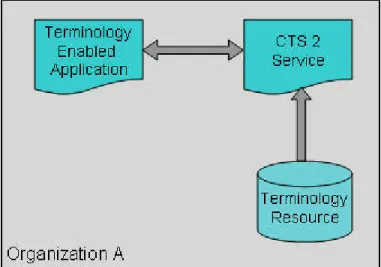
292
293
Figure 2.4-1 CTS 2 Service Accessed by a Single Organization 294
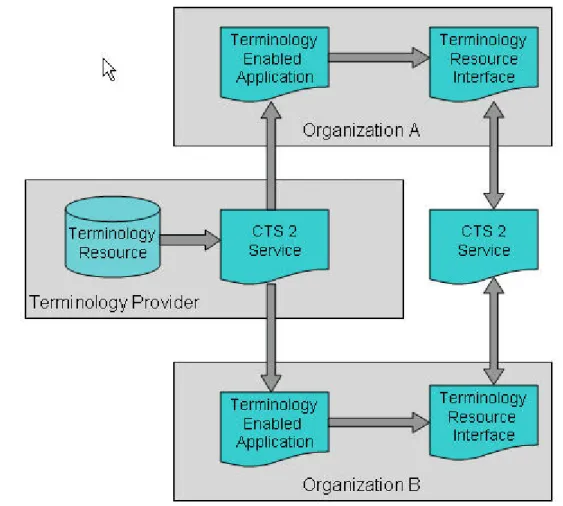
295
CTS 2 will provide for terminology interoperability between organizations. While coded 296
concepts from structured terminology can unambiguously identify the concept(s) being 297
communicated, a standard way of structuring and communicating those coded entries is required. 298
299
CTS 2 can be used in an inter-organizational setting where each organization maintains its own 300
security and application specific provisions. CTS 2 will enable consistent access to a high 301
availability or international standard terminology resource, made available to subscribers via a 302
CTS 2 interface. 303
304
305
Figure 2.4-2 Multi Organizational access to a CTS 2 Service 306
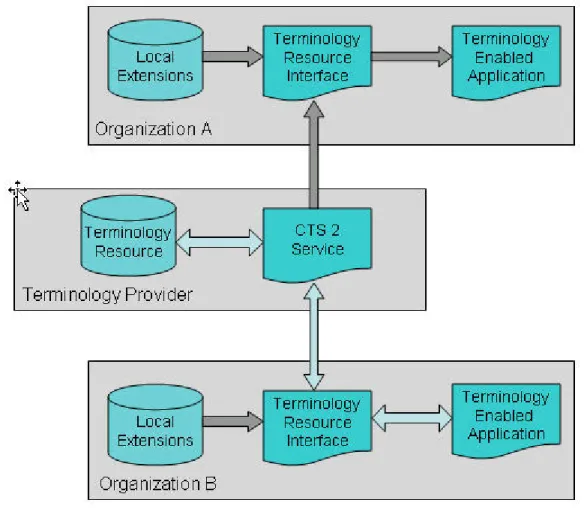
307
Since terminology content is not static, CTS 2 will also provide functionality to maintain and 308
update terminology content. Updates and update requests to terminology sources need to be 309
reviewable and traceable over time. Often, a terminology source provider will want to maintain 310
the “gold standard” or master release of a code system, as to maintain a consistent standard 311
terminology that can be used across multiple organizations and realms. Notwithstanding, users of 312
any given source terminology may wish to extend that terminology for their own use, and may 313
even wish to recommend the addition of those “local” extensions to the terminology provider to 314
be included as part of the release. 315
CTS 2 will provide a mechanism to allow for terminology usersto extend a given terminology, 316
share those extensions with others, or feed those extensions back to the source provider in a 317
structured format to be reviewed, modified as necessary, and fed into a CTS 2 server as input to 318
update the source terminology with the content contained in the change request. As depicted in 319
Figure 2.4-3, Organization A is applying its own local extensions to a terminology resource 320
being served by a CTS 2 service. In addition to applying its own local extensions, Organization 321
B is feeding some of those local extensions back to the terminology provider as suggestions to be 322
included in the next release of the code system. 323
324
325
Figure 2.4-3 Multi Organization Access with Write Permissions by One Organization 326
Terminology Structure Considerations
327Terminologies are created for many purposes, and as such are often structured very differently, 328
from a flat list of concepts, to complex poly-hierarchies. The attributes of the entities of code 329
systems vary as well. Even the formats of the identifiers are different, with some concept 330
identifiers being meaningless identifiers, to others which have explicit or implied meaning. 331
332
The functional components of CTS 2 must be able to operate on this broad spectrum of 333
terminology sources. At a minimum, CTS 2 must specify a concept based terminology model 334
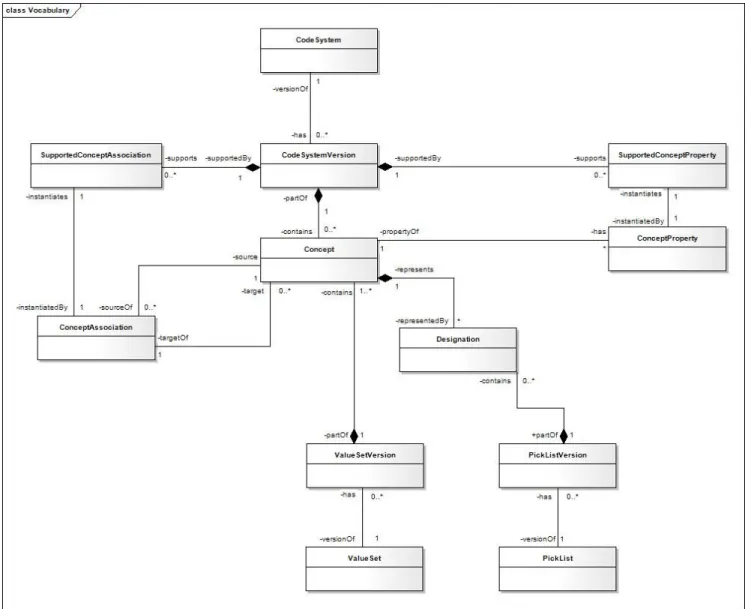
that is capable of representing most varieties of structured terminologies. The basic structure of 335
the code system is illustrated in the CTS 2 Upper Level Class Model below. This model 336
outlines the various components and the cardinality between them but does not dictate particular 337
levels of data normalization or other technical details of implementation. 338
This model is intended to assist with outlining the minimal functional behaviors of a 339
terminology that is served by a CTS 2 terminology service, and is informative. An 340
implementation model will be necessary as a response to the RFP for CTS 2. 341
342
343 344
Figure 1 CTS 2 Upper Level Class Model 345
Code System 347
348
A code system is defined as a collection of uniquely identifiable concepts with associated 349
designations, associations and meanings. Examples of code systems include ICD-9 CM, 350
SNOMED CT, LOINC, and CPT. To meet the requirements of a code system as defined by HL7, 351
a given code must resolve to one and only one meaning within the code system. 352
In the terminology model, a code system is represented by the CodeSystem class. Code systems 353
themselves can be concepts and each can be represented by a Concept class with a unique 354
identifier. 355
At a minimum, Code Systems have the following attributes: 356
• An identifier (id) that uniquely identified the Code System
357
• A name (localName) that the Code system is normally referred to
358
• A name (fullName) that is the official name of the code system as assigned by the
359
terminology provider. 360
• A description (description) that describes the Code System. This may include the code
361
system uses and intent. 362
• Copyright information (copyright) pertaining to the Code System
363 364 365
Code System Version 366
367 368
Code systems are not generally static entities and change over time. A CodeSystemVersion is a 369
static snapshot of a CodeSystem at a given point of time, and specifies the version of the code 370
system in which any given concept can be found. 371
A CodeSystemVersion are represented by attributes including: 372
• A version identifier (releaseVersion) that uniquely identifies each version of a Code
373
System 374
• A date (releaseDate) that represents the date when the version of the Code System
375
became available 376
• The format (releaseFormat) that indicates the format(s) that the version of the Code
377
System is available in. 378
• The official location (releaseLocation) where the version of the code system is available
379
from 380
• An optional ordering parameter (versionOrder) that identifies the order which the
381
version should be applied (used for version deltas). 382
• The start date (effectiveDate) when the version is deemed to be valid for use.
383
• An flag (isComplete) indicating that the version in question is complete (i.e. standalone)
384
or requires other previous or later versions to be complete. 385
• The different languages (supportedLanguages) supported by the Code System
386 387
388
Concept 389
390 391
A concept defines a unitary mental representation of a real or abstract thing; an atomic unit of 392
thought. Concepts should be unique within a given code system, but may have synonyms in 393
terms of representation. Concept may be primitive or compositional in nature. For example, the 394
concept of “hypertension” evokes the same meaning to all clinicians even though it may be 395
expressed as “high blood pressure,” “hypertensive disorder,” or “HTN.” 396
Each CodeSystem entity will have a set of Concepts associated with it. Each Concept is 397
associated with a CodeSystem through a specific CodeSystemVersion in a one-to-one manner. 398
Concepts are represented by attributes including: 399
• A unique concept identifier (conceptCode)
400
• A concept status flag (conceptStatus)
401
Terminology best practices dictate that concepts are not deleted from code systems, but are 402
instead deprecated or retired from use. 403
404 405
Designation 406
407
Concept designations are representations of concepts. The designation identifier must uniquely 408
map to a given text string, bitmap, etc. within the context of the containing concept. 409
In some terminologies, every unique text string will have exactly one presentation identifier, 410
which means that the same presentation identifier may occur under more than one concept. 411
In other terminologies, there may be more than one identifier for a given text string, meaning that 412
the presentation identifier uniquely determines the concept. Service software must not assume 413
either model. 414
For example, in SNOMED CT, the concept of “fever” has the fully specified name of “fever 415
(finding),” a preferred name of “fever,” and synonyms of “febrile” and “pyrexia.” These are all 416
designations for the concept of “fever.” 417
In the terminology model, designations are represented by the Designation class. Each 418
Designation is a representation of the Concept and is assigned a unique designation identifier. 419
In most instances, concept designations are human readable forms, but machine readable forms 420
may also be present. 421
The Designation class is minimally defined by the following attributes: 422
• A unique identifier (id) for the designation
423
• A name (name) for the designation
424
• A description (description) for the designation
425
• A format (format) for the designation
426
• A flag (isPreferred) indicating if the designation is preferred for the concept
428 429 Concept Property 430 431 432
A concept property is a named characteristic of a concept that can be assigned a value. In the 433
terminology model a concept property is represented by the ConceptProperty' class. The 434
allowable or supported concept properties for any given CodeSystem are specified by the 435
SupportedConceptProperty class, and specific to CodeSystemVersion'. 436
437
For example, the result of Hematocrit with a LOINC code of 11271-4 has a specimen property 438
with the value of “blood” and a method property with the value of “automated count.” 439
440
In the above example, the specimen and method properties are part of how LOINC assigns the 441
code and, when these properties change, a different LOINC code will be assigned. This implies 442
that concept properties do not change over time. However, exceptions may be possible when the 443
addition of a new property does not change the concept and code. For example, if LOINC 444
decides to add “analyte chemical structure” as a new property, there may not be a need to change 445
the existing LOINC codes since the new information can apply to all of the LOINC concepts. 446
447
Each Concept may have zero to many concept properties, and each CodeSystem may have its 448
own unique set of concept properties associated with its Concepts for any specific 449
CodeSystemVersion. 450
451
Concept properties are represented with attributes including: 452
• A code (propertyCode) that uniquely identifies the property
453
• A name (name) for the property
454
• A description (description) of the property
455
• A value (value) of the property.
456 457 458 Concept Association 459 460
Associations define the relationships or linkages between concepts. For example, in SNOMED 461
CT, the concept of “pneumonia” has an “is-a” relationship to the concept of “lung 462
consolidation,” and “lung consolidation” has an “is-a” relationship to the concept of “disorder of 463
lung.” This represents the logical conclusion that “pneumonia” is a “disorder of lung.” 464
In the terminology model, relationships are represented by the ConceptAssociation entity and 465
are defined as a directed semantic relationship triples between two concepts. The allowable or 466
supported concept associations for any given CodeSystem are specified by the 467
SupportedConceptAssociation class, and specific to CodeSystemVersion. 468
It is not necessary for concepts to have associations to other concepts. However, when 469
associations exist, the cardinality and the explicit declaration of source and target would indicate 470
the directionality that restricts the designation of the association. For example, from the concept 471
relationship (an association between concepts within a single code system) in the above example, 472
we can infer that “pneumonia” is a “disorder of lung,” but the inverse concept relationship of 473
“disorder of lung” is-a “pneumonia” cannot be inferred. If we want the inverse concept 474
relationship, it must be explicitly stated, that is, there has to be a specific relation of “disorder of 475
lung” “is-a” “pneumonia. In the case of Concept Maps (where the source and target concepts are 476
from different code systems) the direction and designation of the relationship have similar 477
restrictions, except in the case where the Concept Map indicates semantic equivalence. The equal 478
association in this case obviates the requirement for interpreting the association direction. 479
A ConceptAssociation links a source Concept to a target Concept. The supported 480
ConceptAssociations define the relationships that can be instantiated between any two concepts 481
for a given CodeSystemVersion. 482
Concept associations are minimally defined by attributes including: 483
• A code (associationCode) that uniquely identifies either the association instance (for
484
concept maps) or type (for concept relationships). 485
• A name (forwardName) that represents how the association should be represented when
486
reading from source concept to target concept. 487
• A name (reverseName) that represents how the association should be represented when
488
reading from target concept to source concept. 489
• The unique identifier of the code system (sourceCodeSystem) where the source concept
490
originated. 491
• The unique identifier of the code system (targetCodeSystem) where the target concept
492
originated. 493
Value Set 494
495 496 497
A value set represents a uniquely identifiable set of valid concept representations (codes), where 498
any concept representation can be tested to determine whether or not it is a member of the value 499
set. 500
Value set complexity may range from a simple flat list of concept codes drawn from a single 501
code system, to an unbounded hierarchical set of possibly post-coordinated expressions drawn 502
from multiple code systems. 503
In the terminology model, a value set is represented by the ValueSet class. Value sets have 504
identifiers and is a collection of codes for a given Concept. 505
A ValueSet is represented by a given ValueSetVersion. The ValueSetVersion concepts that are 506
available in the value set for any specific version of the value set. As discussed above, Concepts 507
are represented by Designations. Designations for the concepts in a value set are housed in a 508
PickList. The designations available for a given pick list is controlled by the PickListVersion 509
class. The PickListVersion represents the Concepts available to a ValueSet for a given 510
ValueSetVersion. 511
Value sets are represented by attributes including: 512
• An identifier (id) that uniquely identifies the value set.
513
• A name (name) for the value Set
514
• A description (description) for the value set.
515
• An optional expression (definingExpression) that defines the value set
516
• A version (ValueSetVersion.version) for the value set
517
• An optional order (ValueSetVersion.versionOrder) that identifies the order of which
518
the version should be applied 519
• A date (ValueSetVersion.releaseDate) when the version of the value set was released
520
• An effective date (ValueSetVersion.effectiveDate) that identifies when the value set
521
version became effective 522
• A flag (ValueSetVersion.isComplete) that indicates whether the version of the value set
523
is complete or not. 524
525
Pick lists are represented by attributes including: 526
• An identifier (id) that uniquely identifies the pick list.
527
• A flag (isDefault) that identifies whether the pick list in question is the default pick list
528
for the value set. 529
• The human language (language) that the pick list is using.
530
• A version (PickListVersion.version) for the pick list
531
• An optional order (PickListVersion.versionOrder) that identifies the order of which the
532
version should be applied 533
• A date (PickLIst.releaseDate) when the version of the pick list was released
534
• An effective date (PickListVersion.effectiveDate) that identifies when the pick list
535
version became effective 536
• A flag (PickLIstVersion.isComplete) that indicates whether the version of the pick list
537 is complete or not. 538
Business Scenarios
539Scenario Actors
540Actors will use the CTS 2 service for different purposes. These different actors can be 541
generalized into a basic Terminology User actor that is simply an individual, organization, or 542
application that requires access to terminology content for some purpose. Specializations of the 543
Terminology User actor participate in additional operational specific scenarios that are defined 544
by this Service Functional Model to address the Scope that is outlined in section 2.1.2. Actors 545
described in this section are not necessarily human actors, but also include organizations and 546
systems Figure3.1-1 outlines the specializations and composition of the different actors used in 547
this specification. These actors are described below. 548 549 550 Figure 3.1-2 551 552
The following actors take a role in the CTS 2 scenarios. 553
554
• CTS 2 Service
555
The CTS 2 Service is a specific implementation of the CTS 2 Terminology Server. 556
• Terminology User
558
A Terminology User is an actor such as a subject matter expert, terminologist or terminology 559
enabled application. Terminology User activities include, but are not limited to, querying for 560
specific concept codes and browsing or comparing value sets. Specializations of the Terminology 561
User actor follow below. 562
563
• Terminology Administrator
564
The Terminology Administrator is an actor responsible for ensuring the availability and overall 565
maintenance of the terminology server. This includes, but is not limited to loading content into 566
the terminology server, and making available the required functionality to address the specific 567
conformance profiles implemented by the Terminology Server instance. 568
569
• Terminology Enabled Application Developer
570
A Terminology Enabled Application Developer is an actor who is responsible for the 571
development of software applications that make explicit use of controlled terminologies. 572
573
• Terminology Author / Curator
574
A Terminology Author / Curator is an actor who is responsible maintaining terminology content, 575
including but not limited to, the development of new concepts that may be submitted to the 576
Terminology Provider or the extension of an existing terminology with local concepts. This may 577
also who can validation and quality control of terminology content. Terminology Authors / 578
Curators may not necessarily belong to the Terminology Provider's organization. 579
580
• Terminology Human Language Translator
581
A Terminology Human Language Translator is an actor with domain knowledge who is also 582
familiar with the languages and dialects which they are responsible for translating. 583
584
• Terminology Mapper
A Terminology Mapper is an actor (human or system) that is responsible for creating or 586
maintaining specialized associations, or "mappings" between concepts from different code 587 systems. 588 589 • Terminology Provider 590
The Terminology Provider is the actor the individuals or organization that is responsible for the 591
development of Terminology Content. 592
593
• Terminology Value Set Developer
594
A Terminology Value Set Developer is an actor with specific domain knowledge, as well as 595
expertise in controlled terminologies who develops and maintains domain-or application-specific 596
terminology value sets. 597
Primary Scenarios
598Primary scenarios are tied to one or more conformance profiles. Note, that as an aid to reading 599
this specification, Actors that are identified in the text are italicized. In addition, when a scenario 600
references another scenario, that referenced scenario is in bolded italics. 601
602
Administrative Scenarios
603The administration scenarios are intended to provide the functional operations necessary for 604
terminology administrators to be able to access and make available terminology content obtained 605
from a Terminology Provider. Terminology Administrators are required to interface with 606
Terminology Provider systems in order to obtain the terminology content, then load that 607
terminology content on local Terminology Servers. 608
Import Content 609
A Terminology Administrator is required to make available new terminology content from a 610
Terminology Provider available to Terminology Users through a Terminology Server. This may 611
or may not include the removal of previously loaded terminology content from the terminology 612
server. To accomplish this, the Terminology Administrator may be required to convert the 613
content from the format provided by the Terminology Provider to a format that the Terminology 614
Server is capable of importing. Example of terminology content that may be available for 615
loading into the Terminology Server include but is not limited to: 616
• Source terminologies (complete sources and deltas)
• Value sets
618 619
These content sources may either be new sources, or updated versions of a previously existing 620
content sources. 621
Associated Functional Models: Import Terminology, Import Terminology Revision, Convert 622
Terminology Format 623
Export Content 624
A Terminology Administrator wants to be required to export a terminology or terminology subset 625
from the Terminology Server. This may require filtering of the content and converting the format 626
of the export. 627
Associated Functional Models: Export Terminology 628
Remove Content 629
A Terminology Administrator is required to remove a terminology or terminology version from 630
the terminology service, rendering it unavailable for subsequent access by other service 631
functions. 632
Associated Functional Models: Remove_Terminology / Terminology Version 633
Change Content Status 634
A Terminology Administrator is required to activate or inactivate a given terminology, thus 635
changing its availability for access by other terminology service functions. 636
Associated Functional Models: Change Terminology Status 637
Update Notification 638
A Terminology User has a dependency on a specific terminology element that is available to a 639
Terminology Server. The Terminology User is interested in knowing when this terminology 640
element is modified in any way, and would like to receive an electronic notification in the event 641
of that change to that terminology element Associated Functional Models: Register for Update 642
Notification 643
Update Notification Management 644
A Terminology User is required to update the notification information pertinent to their 645
notification account. 646
Associated Functional Models: Revise or Remove Update Notification 647
Content Dependency Notification 648
A Terminology Administrator wants is required to run a dependency check to compare updated 649
content for a given code system, against the version of that code system currently used by the 650
Terminology Administrator’s organization. For example, to provide a list of all terminology 651
elements which are somehow affected by upgrading to a newer version of a terminology. 652
Associated Functional Models: Register for Concept Dependency Notification, Revise or 653
Remove Concept Dependency Notification 654
Search / Query Scenarios
655The scenarios in this section describe the ability to query code system and value set. These 656
scenarios attempt to outline the information requirements for querying. The detailed function 657
models in section 5.2 call out the distinct functional requirements. 658
A given CTS 2 implementation will be required to advertise the specific search algorithms that is 659
supports. 660
In each scenario below, the Terminology User may need to specify additional information 661
pertaining to the query. This information may include: 662
• The ability to determine the status of metadata or contents of a code system, value set as
663
it existed in a specified version, where version represents a meta-data component used to 664
filter the result set of the query. 665
NOTE: Details of the available meta-data requirements will be identified as part of the Binding 666
Document and Model harmonization activity. 667
668
Code System Search / Query 669
This section outlines Search / Query operations pertaining to Code Systems. 670
Resolve Available Code Systems 671
A Terminology User wants to determine what code systems are available through a specific 672
instance of a Terminology Service. The Terminology User is interested in seeing a listing of the 673
available code systems, as well as the details pertaining to each code systems available through a 674
specific Terminology Service instance. 675
Associated Functional Models: Resolve Available Code Systems, Resolve Code System 676
Metadata 677
Retrieve Coded Concepts from Code System 678
A Terminology User wants to browse or query the content of a specific code system. The 679
Terminology User is interested in seeing a listing of specific coded concepts, associated 680
attributes, as well as the metadata pertaining to each coded concept that meets some search 681
criteria. For example, after a retrieval of concepts has been performed, the result set could be fed 682
to a terminology browsing GUI 683
Associated Functional Models: Resolve Code System Concepts, Resolve Coded Concept from 684
Code System, Resolve Concept Details 685
Validate Concept in Code System 686
A Terminology User wants to validate that a given concept exists in a given code system. 687
Associated Functional Models: Resolve Coded Concept from Code System 688
689
Identify Concept Language Translations 690
A Terminology User wants to determine what (if any) alternate language representations exist for 691
a given Concept. 692
Associated Functional Models: Resolve Concept Details 693
Resolve Concept Representations 694
A Terminology User wants to determine what (if any) alternate representations exist for a given 695
Coded Concept. Examples of alternate representations for a concept may include abbreviations, 696
or synonyms. 697
Associated Functional Models: Resolve Concept Details 698
Compare Code System Versions 699
A Terminology User wants to determine what differences exist between different versions or 700
instances of a code system. 701
Associated Functional Models: Compare Code Systems, Compare Code System Contents 702
Value Set Search / Query 703
This section outlines Search / Query operations pertaining to Value Sets. 704
705
Resolve Available Value Sets 706
A Terminology User wants to determine what value sets are available through a specific instance 707
of a Terminology Service. The Terminology User is interested in seeing a listing of the available 708
value sets that match some search criteria, as well as the details pertaining to each value set 709
available through a specific CTS 2 Service instance. 710
Associated Functional Models: Resolve Available Value Sets, Resolve Value Set Metadata 711
Retrieve Coded Concepts from Value Set 712
A Terminology User wants to browse or query the content of one or more value sets. The 713
Terminology User is interested in seeing a listing of specific coded concepts, as well as the 714
details pertaining to each coded concept in any of the given value sets. For example, the 715
Terminology User may want to search for some criteria over a set of value sets. 716
Associated Functional Models: Resolve Value Set Entries, Resolve Concept Details 717
Validate Coded Concept in Value Set 718
A Terminology User wants to validate that a given concept exists in a given value set. 719
Associated Functional Models: Resolve Value Set Entry 720
Compare Value Set Versions 721
A Terminology User wants to determine what differences exist between different versions of a 722
value set. 723
Value Sets can be defined as either enumerations of concepts (Enumerated Value Set), or by 724
expression syntax that defines the content of the Value Set. 725
In the case of an Enumerated Value Set, the specific Value Set version identifier can be used as a 726
compare point for the two value sets. 727
For Intensionally defined Value Sets, the compare point is either the Code System version when 728
the Value Set definition is bound to a specific Code System version, or the date when the Value 729
Set definition is bound to a code system with no specific version specified. 730
Associated Functional Models: Compare Value Sets, Compare Value Set Contents 731
Resolve Concept Representations 732
A Terminology User wants to determine what (if any) alternate representations exist for a given 733
Coded Concept in a value set. Examples of alternate representations for a concept may include 734
abbreviations, or synonyms. 735
Associated Functional Models: Resolve Concept Details 736
Authoring / Curation Scenarios
737This section outlines the requirements of terminology systems that provide the capability of 738
making changes to terminology elements such as code system or value sets. This includes both 739
the direct modification of terminology content for use by individuals responsible for terminology 740
authoring and curation. Such functionality includes: 741
• adding new concepts into a code system
742
• adding new relationships into a code system
743
• extending a code system with local terms
744
• creating or modifying value sets
745
• modifying other code system content and attributes
746
In addition to direct modification of terminology content, this section also specifies functionality 747
with the capability of creating structured change requests for consideration by terminology 748
maintainers. This functionality is key in allowing Terminology Providers to solicit feedback 749
pertaining to terminology structure and content from Terminology Users in a controlled and 750
structured manner. 751
Code System Authoring / Curation 752
This section outlines the business scenarios specific to terminology systems that provide the 753
capability of making changes to code system components which include coded concepts, 754
representations (textual), Associations or Relationships, and value sets. 755
Create Code System 756
A Terminology Author is required to create a new Code System to contain a set of new coded 757
concepts. The Code System is created by defining the set of meta-data properties that describe it. 758
Associated Functional Models: Create Code System 759
Maintain Code System 760
As part of ongoing terminology maintenance, a Terminology Author is required to perform 761
maintenance to the defining characteristics of an existing code system. 762
763
Associated Functional Models: Maintain Code System 764
Create Concept 765
A Terminology Author is required to create concept to be included in a Code System. 766
For example, as part of providing Terminology Service infrastructure to another department, a 767
Terminology Author is required to add additional concept codes to a code system to represent the 768
domain concepts that are important to the new department. 769
The new concept is defined by the set of meta-data properties that describe it, which may include 770
its proper placement via association binding within the hierarchy of the Code System. 771
772
Associated Functional Models: Create Concept 773
Maintain Concept 774
A Terminology Author is required to maintain a concept. This includes but is not limited to 775
functionality such as: 776
• making updates to the associated concept attributes,
777
• changing the presentation,
778
• changing preferred name,
779
• changing synonymy,
780
• technical corrections to the concept
781
• modifying the associations bound to concepts
782
These types of changes result in a new version of the of the code system being modified. 783
784
Associated Functional Models: Maintain Concept 785
Deprecate Concept 786
A Terminology Author is required to deprecate a coded concept. Concepts may be required to be 787
deprecated if they become obsolete or are ambiguous. In many cases, the deprecated concept is 788
replaced with other new concepts. 789
NOTE: In keeping with good vocabulary practice, codes or identifiers for concepts cannot be 790
reused. Additionally, in hierarchical Code Systems, it may be necessary to re-associate any 791
concepts related to the concept being deprecated to prevent a part of the code system hierarchy 792
from being orphaned. 793
794
Associated Functional Models: Deprecate Concept 795
Value Set Authoring / Curation 796
This section outlines the business scenarios specific to terminology systems that provide the 797
capability of creating and maintaining sub-sets of a code system, otherwise known as value sets. 798
Create Value Set by Intension 799
A Terminology User is required to create a dynamic value set that is defined by a computable 800
expression that can be resolved to an exact list of coded concepts at any given point in time. 801
For example, an intensional value set might be expressed as, “SNOMED CT concepts that are 802
children of the SNOMED CT concept “Diabetes Mellitus.” 803
Note: When creating an intensionally defined value set, the Terminology User may or may not 804
bind the value set definition to a specific version of the Code System(s) from which the concepts 805
are being drawn. 806
If the value set expression is bound to a specific version of the Code System(s), the value set will 807
always resolve the same set of concept codes for any given version of the value set. 808
If the value set expression is not bound to a specific version of the Code System(s), the value set 809
will resolve a different set of concept codes as the version of the Code System changes. 810
Associated Functional Models: Create Value Set by Intension 811
Create Value