Biofuel Sustainability Performance Guidelines
Acknowledgments
NRDC thanks the Packard Foundation and the Energy Foundation for the generous contributions that made this report
possible.
NRDC acknowledges the role of LMI in preparing this report and thanks LMI for its impartial insights and key role in its
analysis, design and production. LMI is a McLean, Va.-based 501(c)(3) not-for-profit government management consultancy.
About NRDC
The Natural Resources Defense Council (NRDC) is an international nonprofit environmental organization with more than 1.4 million members and online activists. Since 1970, our lawyers, scientists, and other environmental specialists have worked to protect the world's natural resources, public health, and the environment. NRDC has offices in New York City, Washington, D.C., Los Angeles, San Francisco, Chicago, Bozeman, MT, and Beijing. Visit us at www.nrdc.org and follow us on Twitter @NRDC.
NRDC’s policy publications aim to inform and influence solutions to the world’s most pressing environmental and public health issues. For additional policy content, visit our online policy portal at www.nrdc.org/policy.
NRDC Director of Communications: Lisa Benenson
NRDC Deputy Director of Communications: Lisa Goffredi
Introduction ... 4
Guidelines ... 6
Key Sustainability Indicators of Protective Performance ... 10
Key Attributes of Credible Standards and Systems ... 15
Appendix A: References and Resources ... 18
Appendix B: Evaluation Materials ... 19
table B-1. Standard review and evaluation Worksheet ... 20
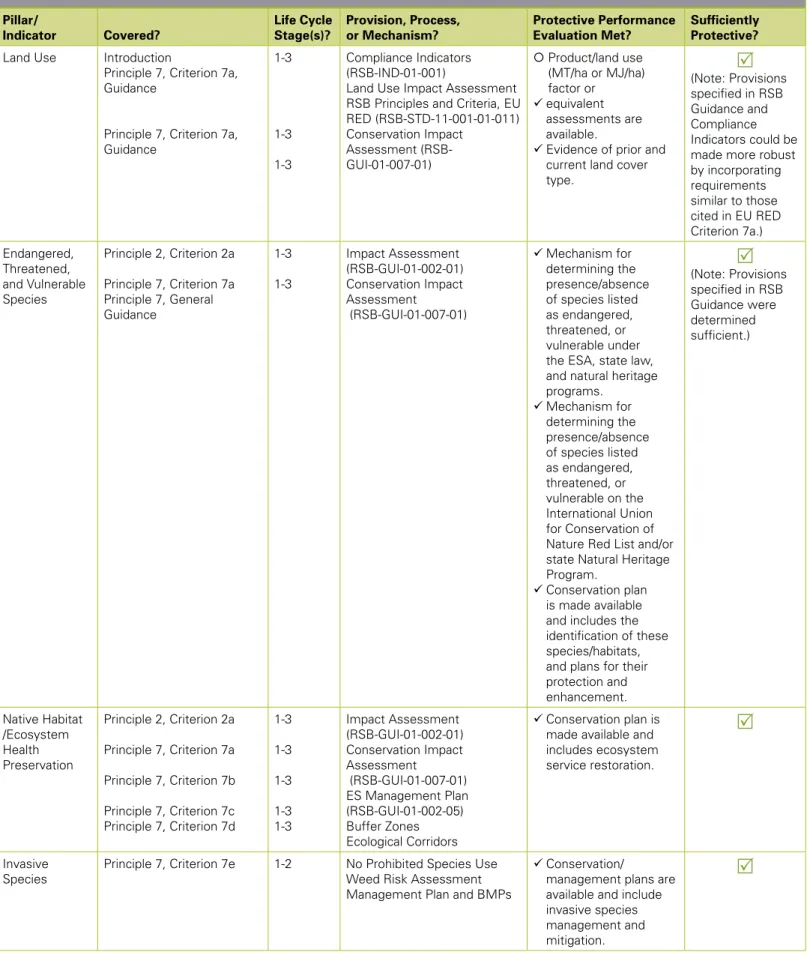
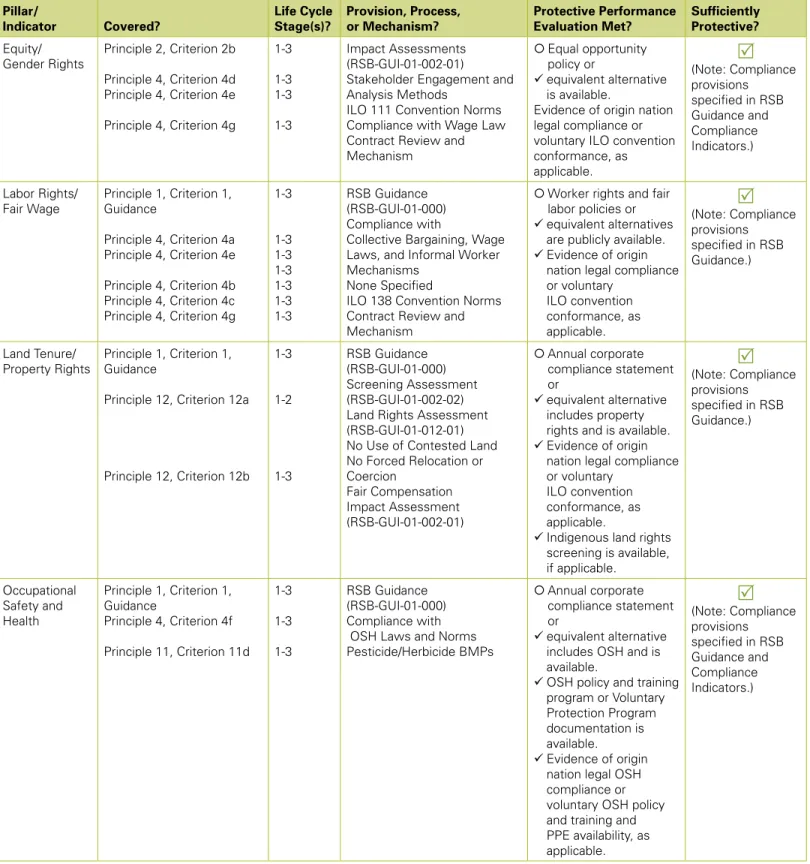
table B-2. rSB review and evaluation Worksheet ... 23
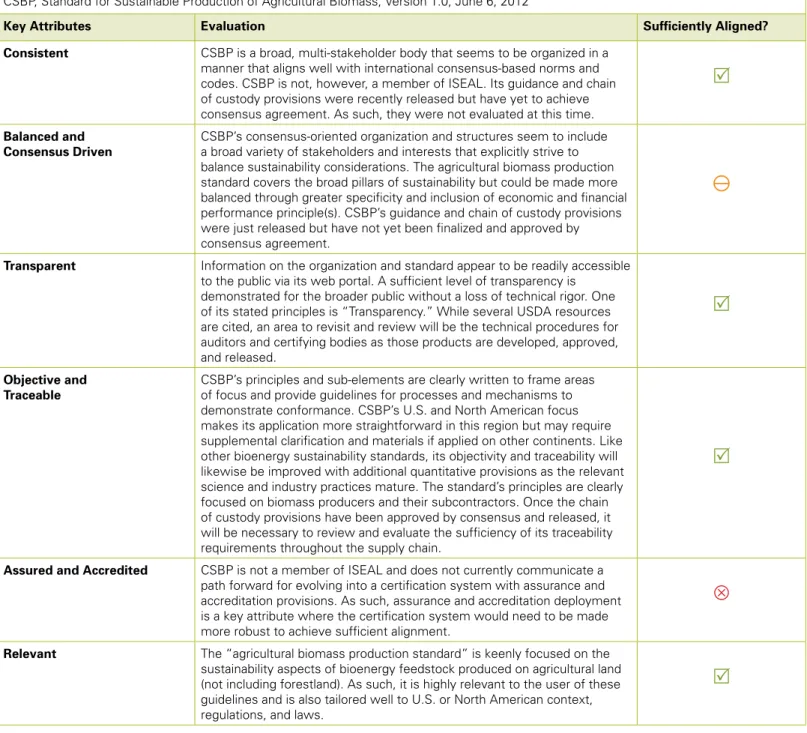
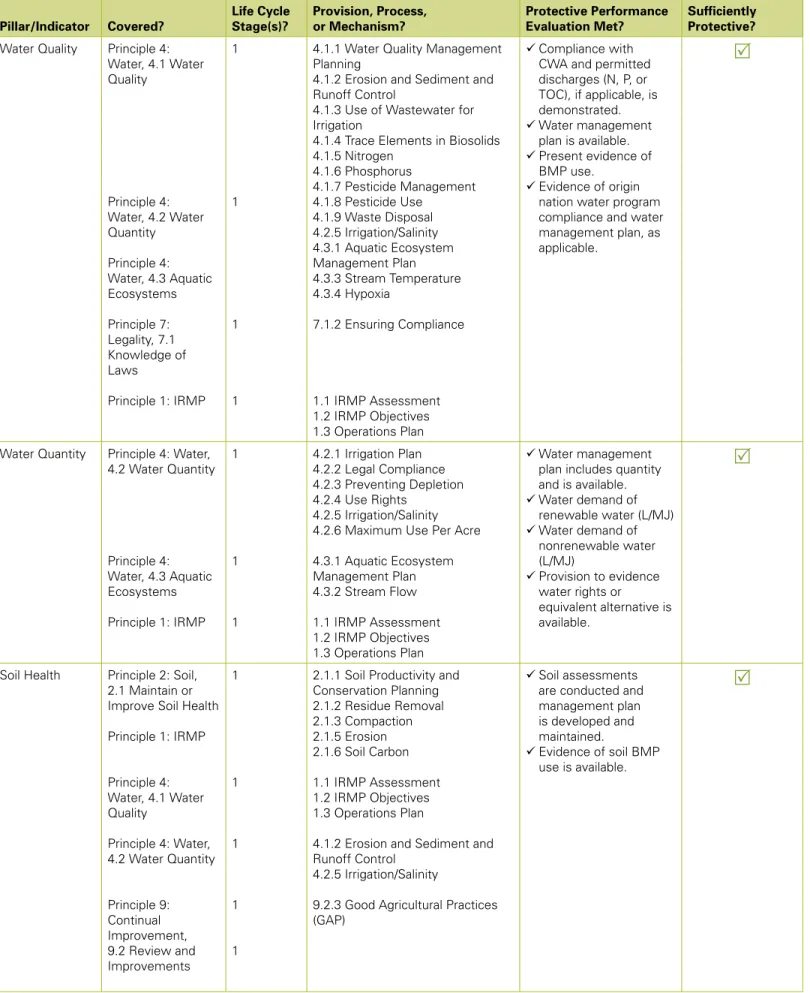
table B-3. CSBp producer Standard review and evaluation Worksheet ... 30
table B-4. ISCC review and evaluation Worksheet ... 40
table B-5. rSpo review and evaluation Worksheet ... 49
table B-6. rtrS Standards review and evaluation Worksheet ... 62
table B-7. Bonsucro Standard review and evaluation Worksheet ... 71
table B-8. FSC Standard review and evaluation Worksheet ... 80
INtRoDuCtIoN
F
ederal agencies and commercial entities are increasingly exploring opportunities to
use alternative fuels, including biofuels, which can effectively displace conventional
petroleum products. In doing so, they’ve recognized that increased biofuel use can
help achieve sustainability benefits. However, these fuels also pose significant environmental
risks that need to be considered and managed throughout the supply chain. as experience
with these alternative fuel options has grown, it has become clear that the decision to
purchase and use biofuel products should involve a proactive and thoughtful consideration of
the product’s upstream environmental and social aspects and impacts. Because of potential
harm to air quality, water, soil, and wildlife habitat as well as rural development and food
security concerns, improving biofuel sustainability performance is widely desired but has been
challenging to put into practice, particularly from the perspective of government and corporate
procurement agents. Moreover, many of the aspects and impacts of biofuels may not be
intuitive or fully understood by the traditional-fuel technical and procurement communities
across industry and the public sector.
the assessment of biofuel sustainability performance is a rapidly developing field but is
currently underutilized in weighing alternative fuel purchases in a manner that maximizes
their benefits and mitigates potential negative impacts. Fortunately, feedstock and biofuel
sustainability standards and third-party certification systems are now emerging as practical
options for informing best-value procurement evaluations.
1this, however, raises questions of
whether particular certification systems cover the entire biofuel life cycle; are comprehensive
in their economic, social, and environmental coverage and in their implementation; achieve
their intended outcomes; and are sufficiently protective.
by proposing guidelines that define a suite of voluntary
biofuel sustainability performance indicators and can be
used to inform best-value procurement decisions. These
guidelines propose a sustainability framework composed
of pillars, criteria, and indicators of protective performance
reflective of the relevant U.S. laws, regulations, best practices,
and policies as well as international norms (in the case of
imported products).
2Key attributes of credible standards and
systems are introduced and later applied to evaluate existing
biofuel sustainability certification schemes. The results
of an initial evaluation of existing biofuel feedstock and
production sustainability certification systems are presented
at the conclusion of these guidelines as a quick reference
for consideration in public and private sector biofuel
investments and procurements.
SCoPE
These guidelines seek to leverage and build on existing
analytical foundations and best practices in standards
development. First, this document’s approach focuses on
biofuel life cycle aspects and impacts. For consistency,
we sought to conform with the understanding of life
cycle conveyed in the International Organization for
Standardization (ISO) 14040:2006E standard as well as to
reflect the boundaries identified within the U.S. federal
interagency Aviation Fuel Life-Cycle Analysis Working Group’s
Framework and Guidance for Estimating Greenhouse Gas
Footprints of Aviation Fuels. In doing so, we defined the scope
of these guidelines as covering the following five life cycle
stages:
n
Stage 1: Raw material acquisition
3n
Stage 2: Raw material preprocessing and transport
nStage 3: Liquid fuels production
n
Stage 4: Product transport and refueling
nStage 5: Use
n
Stage 6: End of life /disposal
Stages 1–5 represent our functional life cycle; we do not
include stage 6 (disposal) because biofuel products are
assumed to be completely consumed during their use in
stage 5. These are the boundaries used when evaluating
standards applicability across the biofuel supply chain life
cycle.
assess and understand the economic, environmental, and
social sustainability performance of their biofuel choices. In
particular, the proposed model guidelines were developed
and tailored for the following intended users:
n
Federal, state, or commercial (e.g., airlines, utilities)
bulk fuel procurement officers
n
Contracts professionals supporting federal or state
biofuel grant programs or government biofuel bid
requests or proposals
n
Corporate sustainability, responsibility, and risk
management officers
These guidelines have been developed so they can
be easily understood and readily employed by the
intended users. They are first meant to enable grant and
procurement professionals to confidently utilize these
biofuel sustainability performance indicators in the context
of a best-value selection process. Second, our evaluation of
the relevant standards provides these same users with an
option to simply specify third-party certification to mitigate
their risk of purchasing biofuels with poor environmental or
social performance, where such systems provide adequate
protection levels. This document is also meant to support a
broader discussion on putting into practice sustainable
best-value procurements of commercial-scale alternative fuels.
t
hese sustainability performance guidelines were developed to introduce a proposed
sustainability framework that is relevant across the applicable stages of a biofuel life
cycle. the framework is designed as a manageable starting point for the intended users.
However, organizations may have other aspect/impact concerns, priorities, or performance
goals that may certainly be included as additional criteria and performance indicators, as
desired and needed. In making such additions, users should ensure that performance
indicators selected can be adequately evaluated and documented throughout the chain of
custody (CoC) so as to maintain the credibility of the best-value decisions made using this
framework.
fRAMEwoRK
What is sustainability within the context of biofuel life cycles?
What is the analytical framework that should be considered
by procurement officers to maximize value and be proactive
supply chain risk managers? The proposed framework in
Figure 1 was initially developed through a review of federal
U.S. “green” product programs, biofuel sustainability
standards, and broader corporate and federal sustainability
efforts. First we reviewed green product programs, such
as the Department of Agriculture’s BioPreferred®, USDA
Organic, and the Environmental Protection Agency’s
EnergyStar, as they represent highly successful voluntary
standards used by both public and private sector consumers.
Second, we reviewed existing biomass feedstock and biofuel
producer sustainability certification standards that generally
embody our “key attributes for credible standard” (presented
GuIDElINES
and elaborated later in this document) and identified a
relevant breadth of sustainability principles and criteria
areas. Finally, corporate and federal sustainability focus areas
were considered, augmented, and used to draft the proposed
framework.
The three traditional pillars of sustainability are
represented within this framework. The economic pillar
reflects not only the critical importance of biofuels’ financial
viability but also the key management function of keeping
compliant with U.S. laws and regulations. Likewise, the
environmental and social pillars and their respective criteria
are covered in additional detail to truly reflect federal policy
mandates, such as Executive Orders 13423 and 13514,
but also incorporate corporate social and environmental
commitments, goals, practices, and reporting that go beyond
minimum requirements.
Additional analysis of existing “green” product, sustainable
feedstock, and biofuel certification standards yielded quite
consistent criteria, highlighted in the following section. The
broad applicability and inclusion of the proposed principles
and criteria suggest a strong consensus on the importance
of these challenges. The consistent focus on these priority
criteria areas also speaks to their legitimacy and suitability as
part of this proposed framework. The comparative analysis
process used also provided additional detailed input on
implementation and informed the development of the
unbranded set of draft biofuel sustainability performance
indicators presented later in Table 1.
CRItERIA
The proposed framework covers criteria across all three
pillars. These guideline categories are defined in a manner
that is descriptive, emphasizes relevance to federal
figure 1. Sustainability framework, Pillars, and Criteria
ECoNoMIC Viability Management Air water Soil Productivity food Security Human Rights Safety & Health
Participation Management land use Biodiversity waste Management ENVIRoNMENtAl SoCIAl
as an introduction to the applicable regulatory compliance
requirements. While legal and regulatory compliance is
a necessary prerequisite, it, by itself, does not provide a
structure for proactive supply chain risk management
or guarantee continual improvement in sustainability
performance. Compliance is a required minimum, but
this document’s ultimate intent is to help users effectively
mitigate the risks and enhance the potential benefits of
commercial-scale biofuel production, purchase, and end use.
Viability
Financial viability of a biofuel feedstock or production
venture is a foundational sustainability element. Many
significant procurement activities already consider the
ability of a business entity to cost effectively obtain the
necessary inputs, labor, and capital to produce products at
an affordable and market competitive price. While it should
be acknowledged that new technologies and producers
face start-up barriers, this explicit or implicit criterion can
effectively represent a go/no-go gate for commercial-scale
production as subsidies or justifications to purchase at a
premium become a challenge to continued operation over
the long term. This criterion considers the financial costs of
biofuels compared with traditional fuel sources, but decision
makers should, as much as possible, consider the life cycle
costs and supply chain externalities elaborated in subsequent
criteria to evaluate best value, subject to their organization’s
goals and mandates. Likewise, it is worth noting that
environmental and financial risks are often closely linked.
Unintended environmental consequences can give rise
to regulatory restrictions, political perception challenges,
or even branding risks that might affect a product’s
marketability and a producer’s future economic success and
viability.
Air
Biofuel supply chains have two potential areas of impact
on the atmosphere: local/regional air quality and global
greenhouse gas (GHG) emissions. Across all stages of the
biofuel life cycle, physical disturbance, chemical processes,
and combustion activities can generate air pollutants and
GHG emissions.
4The Clean Air Act (CAA) of 1990 places
regulations on activities in the United States that generate
air pollutants (criteria or toxic) that have been identified
as harmful to human health. For example, criteria air
pollutants include carbon monoxide, ground level ozone,
and particulate matter less than 2.5 μm in size (PM 2.5) and
less than 10 μm in size (PM 10). To comply with existing
federal and state air quality regulations, feedstock producers,
processors, or biorefinery operators may be required to
obtain air permits and be subject to pollutant emission
reporting. Furthermore, the EPA has been authorized to
regulate GHG emissions under Section 202(a) of the CAA.
GHG emissions are considered to include carbon dioxide
mandates, such as Section 201 and 526 of the Energy Security
and Independence Act (EISA) of 2007, require federal biofuels
programs to consider “direct emissions and significant
indirect GHG emissions such as significant emissions
from land use changes.”
5EISA 2007 also defines categories
of biofuel according to their percentage of reductions
in life cycle GHG emissions relative to a petroleum fuel
baseline, which provide the guidelines utilized by the EPA
Renewable Fuels Standard (RFS2).
6This criterion reflects and
acknowledges GHG emissions as an important regulatory
consideration for biofuels, their potential contribution to
climate impacts, and the precautionary need to consider and
adapt to the supply chain risks posed by a changing climate.
water
Freshwater is a requisite natural resource for human
sustenance, agricultural production, industrial processes,
natural system sustainment, and provision of ecological
services. Federal and state laws cover and regulate two
aspects and impacts of this criterion: quality and quantity.
Activities managing or impacting water quality are regulated
under federal statutes, such as the Clean Water Act (CWA)
of 1990, and under numerous state and local regulations on
the basis of riparian or prior appropriation water-rights laws.
While some industrial activities are permitted, monitored,
and reported to ensure human and ecosystem health, there
are differing regulatory authorities and requirements for
point and nonpoint source pollution. For example, many
agricultural activities, as nonpoint sources, are not subject
to the same CWA regulatory provisions and scrutiny as
permitted industrial sources. Compliance with CWA and
applicable state laws are the minimum requirement but
do not alone ensure the environmental sustainability of
feedstock production activities. Water quantity or availability
is also a critical element but is largely managed via
decentralized state laws that regulate water access and rights,
along with some regional cooperative agreements. Water
demand for biomass and biofuel production operations
has been a focus of concern as its scale has increased over
the past decade. Failure to consider the water requirements
of a biofuel pathway and local availability can greatly
compromise its viability and negatively impact the economic
health of local communities. Sustained water overdraw can
damage aquatic ecosystems and even aquifer water resources
in extreme cases.
Soil
Agricultural production of any crop food, feed, fiber, or fuel
requires sufficient and healthy soil. It is a natural resource
required for biomass production and plays a key role in
cultivation by providing structural stability, regulating water,
storing nutrients, filtering harmful substances, and serving
as a habitat.
…7Soil heath can either be well managed and
mismanagement. For example, overgrazing, slash-and-burn,
intensive tillage cropping methods, or overuse of agricultural
chemicals can break down organic matter, expose soils to
rain and wind, and damage beneficial soil organisms.
8,
9Direct loss of topsoil through erosion is often a result of
mismanagement. However, a loss of nutrients, fertility, and
soil ecosystem health can undermine sustainable production.
In particular, this criterion focuses on biomass production
ventures promoting best practices that build soil organic
matter, improve nutrient levels, minimize degradation, and
proactively manage soil health so as to maintain productive
and economic viability and reduce spillover negative
impacts in other criterion areas, such as water quality and
biodiversity.
Productivity
Productivity is a key benefit and impact multiplier across
numerous criteria. It refers largely to the efficiency of the
biofuel production life cycle. Higher efficiency in each life
cycle stage is generally a net benefit, except where cultivation
intensity gains require a large increase in inputs per marginal
improvement (excessive cultivation, herbicide or pesticide
use) or generate downstream impacts (eutrophication from
increased fertilizer application, erosion, or nutrient export),
often due to the use of poor management practices. While
productivity is not required by law or regulation, it inherently
drives natural resource demand, input and production
costs, financial viability, waste production, and downstream
environmental impacts and benefits.
land use
Aside from biomass production, advanced biofuel supply
chains are largely analogous to or even co-located with
conventional petroleum fuel production and distribution
infrastructure. However, the land area needed to cultivate
biofuel feedstocks at commercial scale and the necessary
site preprocessing facilities are a significant consideration.
Biomass and intermediate feedstock materials could
effectively require no or little additional land use (waste
grease), may be integrated into existing cropping systems
(cover crops, coproducts), or may require significant
conversion of existing or fallow cropping areas. As such,
land use changes resulting from feedstock cultivation
must be quantified and considered. In discussing land
use, an important distinction is made between direct land
use change (DLUC) and indirect land use change (ILUC).
DLUC is the conversion of one land use type directly to
biomass production.
10ILUC focuses more on the regional-,
national-, or international-scale economic market-driven
displacement of existing products and land use change
resulting from biofuel feedstock or intermediate commodity
demand. Section 201 of EISA 2007 cites the need to consider
both “direct emissions and significant indirect emissions
such as significant emissions from land use change” and
places restrictions on certain types of land use conversion
critical to avoid virgin or sensitive lands and the conversion
of native ecosystems for the purpose of increasing biomass
production, given potential impacts on biodiversity, air,
water, and food security criteria.
Biodiversity
Conservation of species diversity, native habitats, and the
broader terrestrial, aquatic, and marine ecosystems is a
core federal mandate and responsibility dating back more
than 100 years. Greater diversity and habitat preservation
directly equate to healthier, more productive, and more
resilient biological resources, which provide society with
greater ecosystem services. Moreover, existing statutes, such
as the National Environmental Policy Act (NEPA) of 1969
and the Endangered Species Act of 1974, and numerous
federal policies emphasize the importance of conserving
biodiversity and, by extension, the need to consider this
criterion. The imperative to maintain biodiversity is not just
limited to protecting endangered and threatened species or
preventing the introduction of invasive species. Managing
and protecting native habitats and their inherent biodiversity
ensure their resilience, such as from drought or pests, and
the continued provision of ecosystem services, such as water
filtration, fisheries commodity production, and carbon
sequestration. Loss of native habitat and diversity can
contribute to significant economic losses or disasters, such as
floods and wildfires.
waste
As with any agricultural and industrial production life
cycle, inputs, intermediates, coproducts, by-products, and
waste are intricately linked to productivity, management
practices, and ultimately the financial viability of any biofuel
supply chain. This criterion focuses on effective materials
management and minimization of wastes. Furthermore,
given U.S. laws and regulations that govern waste materials,
such as the Resource Conservation and Recovery Act
(RCRA), legal compliance for biofuel production facilities is
a significant consideration. Chemical inputs, coproducts,
by-products, and wastes are subject to regulatory planning,
monitoring, and reporting requirements mandated by
provisions of the Oil Pollution Act (OPA), the Emergency
Planning and Community Right to Know Act (EPCRA), and
the Pollution Prevention Act (PPA). Consequences of failing to
manage wastes range from community relations challenges
to substantial fines, permit and operating license revocations,
or even public health catastrophes.
food Security
First-generation biofuels derived from commodity crops
were encouraged by government mandates in numerous
countries. In the United States, time-bound renewable fuel
production mandates incentivized the use of readily available
agricultural crops to meet those mandates. However,
and increased commodity prices make this a high visibility
criterion, particular in supply chains involving trade between
developed and developing markets.
13According to the World
Health Organization (WHO), “Food security is built on three
pillars.” They are:
n
Food availability: having nutritious food available on a
consistent basis
n
Food access: having nutritious food resources readily
available for use
n
Food use: having a balanced diet, in addition to water and
sanitation
14Biofuels can be linked to food security either directly
or indirectly. Food crop feedstocks can be directly related
to food security as a function of availability and access.
However, indirect food security is a function of price and
market-driven displacement of food crops by either food or
nonfood biomass feedstock production, which exacerbates
food access and use challenges in developing countries.
Direct food security concerns have generated rapid advances
in nonfood biofuel feedstocks, and indirect impacts are
important to quantify and mitigate to the full extent possible.
Human Rights
While technology types and production systems are largely
neutral in this regard, the human rights protection provisions
that are implemented within the production supply chain are
of utmost importance. For U.S.-based biofuel feedstock and
production, this criterion is primarily a matter of compliance
with the U.S. Constitution, the Civil Rights Act of 1964,the
Fair Labor Standards Act (FLSA) of 1938, and state-level
property and labor laws. However, for imported feedstocks,
intermediate products, and biofuels, basic human rights
may not be covered by laws or legal means by which to seek
relief. Human rights provisions and protections should
include—but are not limited to—land tenure/property
rights, cultural and spiritual freedoms, gender equity and
nondiscrimination, labor rights, and fair wages. Core
conventions of the International Labour Organization (ILO)
elaborate on accepted international norms.
Safety and Health
Biomass cultivation and biofuel production operations
should consider and manage hazards applicable to internal
worker occupational safety and health as well as external
environmental health impacts on the broader community. All
U.S. agricultural and petrochemical production activities are
covered by the Occupational Safety and Health (OSH) Act of
1970, which regulates working conditions for men, women,
and children, citizen or temporary workers. Current biomass
feedstock and biofuel production systems are inherently no
less hazardous than other work activities in these sectors.
Imported feedstock and intermediate materials would be
to safety and health in the workplace, this criterion includes
external impacts of biofuel production on public health,
which would be covered by provisions of EPCRA. In addition,
federal agency users should consider whether large-scale
procurement actions or grants include the potential for
environmental justice considerations.
15Participation
As an aspect of corporate social responsibility, good business
practices, or community membership, biofuel feedstock
and production operations benefit from appropriate levels
of public outreach and participation. In particular with
new businesses and technologies, operators with proactive
transparency and community engagement can build a
foundation and constructive dialog with employees and the
broader community. If a federal grant or financial support is
involved, NEPA may require official and procedural hearings
regarding a planned facility or operation.
Management
This is a core topic of leadership that is ubiquitous across all
three pillars of sustainability. The first element is ensuring
initial and continued compliance with all applicable
financial, environmental, safety, health, and participation
laws and regulations. The second is the setup and
maintenance of internal management systems, such as ISO
9001–modeled quality management systems or ISO 14001–
modeled environmental management systems (EMS). The
third is the management of the biofuel production supply
chain that ensures product chain of custody and ongoing
certification of the biofuel products being purchased.
e
ach of the above criteria provides a context and focus area for sustainability
performance. However, indicators of protective performance are needed to more
precisely address the various aspects/impacts, framing them in a practical manner
that reduces supply chain hazards, drives a higher-level sustainability performance through
continual improvement, and provides sufficient detail to evaluate and ensure this performance.
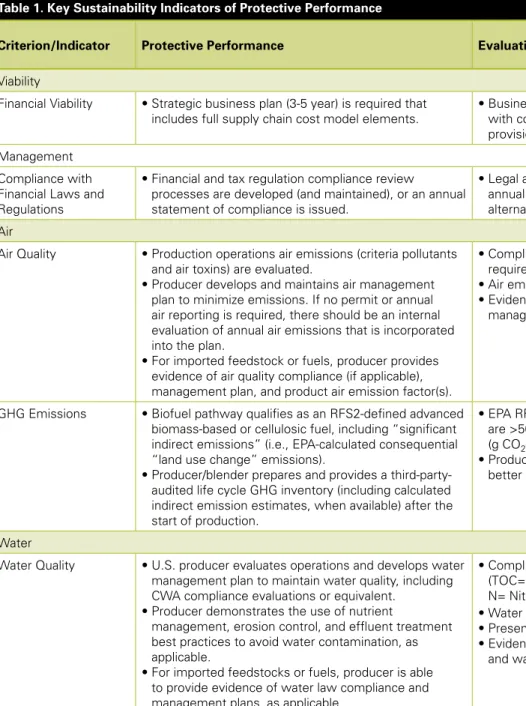
table 1 presents all 15 criteria areas, their requisite indicators, and brief notes on how
certification standards and systems may evaluate them.
table 1. Key Sustainability Indicators of Protective Performance
Criterion/Indicator Protective Performance Evaluation
Viability
Financial Viability • Strategic business plan (3-5 year) is required that
includes full supply chain cost model elements. • Business plan is required and available for review with confidential business information (CBI) provisions.
Management Compliance with Financial Laws and regulations
• Financial and tax regulation compliance review
processes are developed (and maintained), or an annual statement of compliance is issued.
• Legal and regulatory compliance review process, annual corporate compliance statement, or equivalent alternative is required.
air
air Quality • Production operations air emissions (criteria pollutants and air toxins) are evaluated.
• Producer develops and maintains air management plan to minimize emissions. If no permit or annual air reporting is required, there should be an internal evaluation of annual air emissions that is incorporated into the plan.
• For imported feedstock or fuels, producer provides evidence of air quality compliance (if applicable), management plan, and product air emission factor(s).
• Compliance with air permitting and reporting requirements, if applicable, is demonstrated. • Air emissions management plan is available. • Evidence of origin nation compliance or air
management plan, as applicable.
GHG emissions • Biofuel pathway qualifies as an RFS2-defined advanced biomass-based or cellulosic fuel, including “significant indirect emissions” (i.e., epa-calculated consequential “land use change” emissions).
• Producer/blender prepares and provides a third-party-audited life cycle GHG inventory (including calculated indirect emission estimates, when available) after the start of production.
• EPA RFS2 program life cycle GHG emissions are >50% better than 2005 petroleum baseline (g Co2-e/MJ).
• Producer/blender life cycle GHG emissions are >50% better than 2005 petroleum baseline (g Co2-e/MJ).
Water
Water Quality • U.S. producer evaluates operations and develops water management plan to maintain water quality, including CWa compliance evaluations or equivalent.
• Producer demonstrates the use of nutrient
management, erosion control, and effluent treatment best practices to avoid water contamination, as
• Compliance with CWA and permitted discharges (toC= total organic Carbon; p= phosphorous; N= Nitrate), if applicable, is demonstrated. • Water management plan is available.16 • Present evidence of BMP use.
• Evidence of origin nation water program compliance
KEy SuStAINABIlIty INDICAtoRS of PRotECtIVE
PERfoRMANCE
Criterion/Indicator Protective Performance Evaluation
Water Quantity • Producer water management plan includes water quantity demand and local supply estimates.
• Producer is water neutral or positive. If water negative, producer’s needs are met though renewable water consumption (not pumped [or mined] groundwater). • Producer demonstrates sufficient water rights or
purchased capacity to meet estimated demand. If purchased, these should not be disproportionate or a burden on local community.
• Water management plan includes quantity and is available.
• Water demand of renewable water (L/MJ). • Water demand of nonrenewable water (L/MJ). • Provision to evidence water rights or equivalent
alternative is available.
Soil
Soil Health • Feedstock producer soil management plan includes provisions to reduce or eliminate erosion, enhance soil quality, and monitor health.
• Feedstock producer demonstrates the use of soil erosion control and building best practices, as applicable.
• Soil assessments are conducted and management plan is developed and maintained.
• Evidence of soil BMP use is available.
productivity
Nutrient requirements/
Fertilizer Use • Feedstock producer assesses and monitors nutrient levels to optimize nutrient management and reduce loss off-site to air and water.
• Soil and nutrient management plan or equivalent alternative.
pesticides/Herbicide Use/Management practices
• Feedstock producer adopts practices that minimize pesticide and herbicide use.
• Feedstock producer and workers are trained and licensed in pesticide application.
• Pest control and chemical management plan(s) or equivalent alternatives are available.
Sustainable Harvest
rates/Biomass Yield • Feedstock producer rate of production is not higher than sustainable yield applicable for local conditions. • Actual yield (MT/ha): Sustainable yield (MT/ha) < 1 or equivalent assessments are available. Land Use
Land Use - Direct • Feedstock producer operations do not divert productive cropland or require the conversion of critical habitat for threatened, endangered, or vulnerable species; native grasslands and forests; and federal or protected lands. • Feedstock producer maximizes productivity and
minimizes land use within the constraints of sustainable yields.
• Product/land use (MT/ha or MJ/ha) factor or equivalent assessments are available. • Evidence of prior and current land cover type.
Biodiversity endangered, threatened and Vulnerable Species
• Prior to converting feedstock cultivation lands and/ or biofuel production facilities, proposed areas are surveyed for endangered or threatened species listed under the endangered Species act (eSa) or relevant state law, and vulnerable species identified by state natural heritage programs. areas identified are managed to protect and enhance habitat values for these species.
• For imported feedstocks, producer provides evidence that cultivation lands have been surveyed for species listed as endangered, threatened, and vulnerable under the United Nations Convention on Biological Diversity. areas identified are managed to protect and enhance habitat values for these species.
• Mechanism for determining the presence/ absence of species listed as endangered, threatened, or vulnerable under the eSa, state law, and Natural Heritage programs.
• Mechanism for determining the presence or absence of species listed as endangered, threatened, or vulnerable on the International Union for Conservation of Nature red List and/or state Natural Heritage programs.
• Conservation plan is made available and includes the identification of these species/habitats, and plans for their protection and enhancement.
Native Habitat/ ecosystem Health preservation
• Producer protects native habitat from conversion. • Producer develops conservation plans that include best
practices to maintain and restore ecosystem services.
• Conservation plan is made available and includes ecosystem service restoration.
table 1. Key Sustainability Indicators of Protective Performance
Criterion/Indicator Protective Performance Evaluation
Invasive Species • Feedstock producer does not introduce or cultivate cultivars identified by knowledgeable authorities as a high or potential invasive risk.
• Feedstock producer conservation and management plans include invasive species management and mitigation safeguards.
• Conservation/management plans are available and include invasive species management and mitigation.
Genetically Modified
organisms • GMO crop cultivars are not introduced until cultivation and management practices are approved and released by USDA or origin country’s appropriate agricultural authorities.
• GMO plant cultivars are handled conservatively and for potentially invasive and cross-hybridization risks.
• Cultivation and management practices are available. • Management plan is available and includes protocols
for GMo monitoring and control.
Waste
Minimization, reuse,
and recycle • Producer develops and maintains material efficiency plan and “zero waste” goals. • Producer generates only primary and coproducts.
• Material efficiency plan is available.
• Primary product %: co-product % ratio > 1 or equivalent assessments are available. Hazardous Waste • Producer monitors production of all hazardous wastes
and adheres to all applicable regulations, such as rCra and epCra.
• Producer demonstrates progress on green chemistry or process improvement to minimize or eliminate waste.
• Evidence of hazardous material and waste compliance is demonstrated.
Management Compliance with
environmental Laws • Comprehensive compliance review process is developed (and maintained) as part of the producer environmental Management System (eMS).
• Producer issues and publishes and annual statement of compliance.
• Regulatory compliance review process or equivalent alternative is required.
• Annual corporate compliance statement is required.
planning, Monitoring and Continual Improvement (e.g., ISo 14001)
• Producer develops, maintains, and uses an EMS based
on industry standards, such as ISo 14001. • EMS documentation or equivalent alternative (based on the scale of the operation) is available.
Supply Chain Management, CoC, and product Certification
• Producers/blenders develop, maintain, and fund a robust supply chain management system and chain-of-custody (CoC) program to track product from the field through use.
• Producer/blender contractually requires COC and the relevant data requirements so as to support life cycle analysis.
• Producer/blender of biofuel product is third-party certified.
• Supply chain and COC program documentation is available.
• Product certification is achieved and maintained.
Food Security
Food Security • Producer does not use human-consumption-grade food feedstocks.
• Producer performs initial food security impacts screening in local community and makes annual updates.
• For imported feedstock or fuels, producer provides a copy of food security impact screening and participation provisions, if applicable.
• Food security screening is available. • If screening indicates need, a food security
assessment is performed and available.
Criterion/Indicator Protective Performance Evaluation
equity/Gender rights • U.S. producers have an equal opportunity policy compliant with the Civil rights act of 1964. • For imported feedstock or fuels, producer provides
evidence of compliance with national laws or, in their absence, voluntary conformance with ILo convention norms regarding discrimination.
• For imported feedstock or fuels, producer
demonstrates use of similar flow-down requirements in supplier subcontracts.
• Equal opportunity policy or equivalent alternative is available.
• Evidence of origin nation legal compliance or voluntary ILo convention conformance, as applicable.
Labor rights/Fair Wage • U.S. producers have worker rights and fair labor standards compliant with provisions of Fair Labor Standards act (FLSa) of 1938 (as amended) and state-level labor laws.
• For imported feedstock or fuels, producer provides evidence of compliance with national laws or, in their absence, voluntary conformance with ILo convention norms regarding forced labor, child labor, freedom of association, and fair wage.
• For imported feedstock or fuels, producer
demonstrates use of similar flow-down requirements in supplier subcontracts.
• Worker rights and fair labor policies or equivalent alternatives are publicly available.
• Evidence of origin nation legal compliance or voluntary ILo convention conformance, as applicable.
Land tenure/property rights
• U.S. producers include compliance with state property laws in annual corporate compliance statement. • For imported feedstock or fuels, producer provides
evidence of compliance with national law on property rights and indigenous land rights.
• If imported feedstock or fuels, producer documents screening for informal or cultural access rights of indigenous people, if applicable.
• Annual corporate compliance statement or equivalent alternative includes property rights and is available. • Evidence of origin nation legal compliance or
voluntary ILo convention conformance, as applicable. • Indigenous land rights screening is available, if
applicable.
Safety and Health occupational Safety
and Health • U.S. producers include OSH compliance in annual corporate compliance statement. • U.S. producers demonstrate commitment to worker
safety and health risk reduction.
• For imported feedstock or fuels, producer provides evidence of compliance and commitment to worker safety and health.
• Annual corporate compliance statement or equivalent alternative includes oSH and is available.
• OSH policy and training program or Voluntary protection program documentation is available. • Evidence of origin nation legal OSH compliance or
voluntary oSH policy and training and ppe availability, as applicable.
public Health/
environmental Justice • U.S. producers include EPCRA compliance in annual corporate compliance statement. If epCra reporter, producer demonstrates screening for disproportionate environmental burdens.
• For imported feedstock or fuels, producer provides evidence of legal air quality, water quality, and toxics compliance.
• For imported feedstock or fuels, producer provides evidence of screening for disproportionate environmental burdens.
• Annual corporate compliance statement or equivalent alternative includes epCra and is available.
• Environmental justice screening is available and integrated with internal eMS, as applicable. • Evidence of origin nation legal air quality, water
quality, and toxics regulatory compliance is available, as applicable.
• Evidence of origin nation environmental burden screening is available and integrated with internal eMS.
participation public outreach/ Stakeholder participation
• U.S. producers issue a public corporate social and environmental responsibility (CSer) report annually. If subject to NEPA, producer demonstrates compliance with public meeting requirements, as appropriate. • For imported feedstock or fuels, producer provides
evidence of local community stakeholder engagement program and similar supplier subcontract requirements.
• CSER report or equivalent alternative is available. • Annual corporate compliance statement or equivalent
alternative includes Nepa, if applicable, and is available.
• Evidence of origin nation public notification or access program is available or documented in CSer.
table 1. Key Sustainability Indicators of Protective Performance
Criterion/Indicator Protective Performance Evaluation
transparency • U.S. producers ensure public access, appropriate to location, to all compliance statements, business plan, and public summaries of certification process documentation, where not CBI.
• For imported feedstock or fuels, producer provides evidence of public access, appropriate to location, to all compliance statements, business plan, and certification process documentation, where not CBI. this should include similar supplier subcontract requirements.
• Annual corporate compliance statement, business plan, certification documentation, or equivalent alternatives are available.
• Evidence of origin nation public notification or access program is available or documented in CSer.
Management Compliance with Safety, Health, and participation Laws
• U.S. producers include OSH (and, if applicable, NEPA) compliance in annual corporate compliance statement. • Producers include their transparency and public access
policies in their CSer report or public website.
• Annual corporate compliance statement or equivalent alternative includes oSH (and, if applicable, Nepa) provisions and is available.
• Annual CSER or company website includes transparency and public access provisions.
W
hat makes a certification standard and system credible? We synthesized six key
attributes based on best practice principles and used them to guide our evaluation
of existing feedstock production and biofuel certification systems. In doing so, we
drew heavily from broader international codes of good practice, such as the ISeaL Credibility
principles, 0.1 public Draft, the Code of Good practice, Setting Social and environmental
Standards, v5.0, and the Code of Good practice, assuring Compliance with Social and
environment Standards, v1.0.
17,18,19We also drew from applicable topic-specific protocol
principles, such as the World resource Institute (WrI)/World Business Council for Sustainable
Development (WBCSD), GHG protocol, Corporate Value Chain (Scope 3) accounting and
reporting Standard and the product Life Cycle accounting and reporting Standard.
20,21these
attributes were developed in this manner to reflect our first attribute, consistency. But this
will need to be revisited annually as bioenergy sustainability standards are rapidly evolving,
including the anticipated 2014 release of the ISo 13065, Sustainability Criteria for Bioenergy.
Standards are requisite foundations but do not alone make
for a credible certification system, particularly one that will
be useful for our intended decision-making audiences. These
guidelines focus on how certification standards and systems
reflect these key attributes and also how they demonstrate
excellence in market-ready implementation mechanisms
to assure and oversee conformance. Certification systems
incorporating these key attributes and assurance practices,
such as those found in the ISEAL Assurance Code, can
achieve broader conformity and acceptance by international
and national accreditation bodies, such as the International
Accreditation Forum (IAF), Accreditation Services
International (ASI), and American National Standards
Institute–American Society of Quality National Accreditation
Board (ANAB).
Given the anticipated evolution of biofuel sustainability
standards in the near future, these guidelines describe six key
attributes of credible standards and systems that reflect the
core principles compiled in this context. Credible standards
and systems should be:
n
Consistent
n
Balanced and Consensus Driven
nTransparent
n
Objective and Traceable
nAssured and Accredited
nRelevant
These key certification standard and system attributes
are elaborated below but are likewise complemented and
reinforced by the ISEAL Credibility Principles.
CoNSIStENt
Robust standards are structured to be consistent with
consensus-based international standards and codes for
assuring conformance and certification. The structure of the
standard-setting process should parallel and comply with
existing international norms, such as those developed by ISO
and ISEAL. Certification standards should provide indicators
and evaluative methodologies representative of good
practice, accessibility, and interoperability.
BAlANCED AND CoNSENSuS DRIVEN
The certification standard includes a comprehensive
and balanced consideration of economic, social, and
environmental factors. The standard-setting process is
participatory and consensus driven; convenes representative
groups of economic, environmental, and social stakeholders
in both formal and informal manners; and creates a
representative steering committee, technical working
group(s), and advisory group(s). Recommended standards
should be provided for broad stakeholder review and
consensus (but not necessarily unanimity). These inclusive
efforts should be continued with the relevant stakeholders
during the later development of verification mechanisms and
the evolution of the certification system and its protocols.
tRANSPARENt
A credible certification standard must have clear, accessible,
and transparent processes. The standards-development
process should include stakeholder engagement and public
comment mechanisms. Approved summaries, standards, and
protocols should be made available in the public domain.
Documentation should include and present all relevant
issues, data sources, assumptions, and references in a
technically correct and accessible manner.
oBjECtIVE AND tRACEABlE
Guidelines should be science based, provide clear targets to
reach, and support demonstrable means of evaluation. The
targets must conform with national laws and be linked with
economic, environmental, and social performance. These
requirements should identify principles, criteria, indicators,
and evaluation benchmarks or outputs. Conformance with
existing standards and demonstrable chain of custody needs
to be verifiable by independent third parties.
ASSuRED AND ACCREDItED
Credible certification systems should not only demonstrate
the aforementioned key attributes but have oversight
mechanisms to assure knowledgeable and rigorous
compliance of national interpretations and of audit providers
in the field. Both Accreditation and Assurance are key
attributes that establish trust in the certification standard and
the system overseeing its application. An accreditation body
carries out independent checks on auditing firms ensuring
an auditing firm's performance is consistent and competent.
ISEAL's Assurance Code provides guidance for high quality
assurance that supports sustainability and improves the
effectiveness of different verification and certification
models. Certification bodies should demonstrate conformity
by achieving ISEAL full membership and international
accreditation within the scope of the relevant standard.
22RElEVANt
Reflecting the primary purpose of these guidelines,
applicable biofuel sustainability certification standards and
systems should clearly communicate what is evaluated and
directly serve the decision-making needs of the intended
audience, namely procurement officers; contract or grant
specialists; and sustainability, responsibility, and risk
management officers. In short, they should provide credible
verification and clearly add value in serving these users’
supply chain risk needs.
StANDARDS REVIEw AND EVAluAtIoN
To best serve the intended audiences of this guidance, we’ve
taken the next step of reviewing several existing biomass
and biofuel standards, both native to the United States and
applicable globally.
23The certification standards reviewed
include:
n
Roundtable on Sustainable Biomaterials (RSB), Principles
and Criteria for Sustainable Biofuel Production, Global
Standard, RSB-STD-01-001, Version 1.0, May 11, 2010
nCouncil on Sustainable Biomass Production (CSBP),
Standard for Sustainable Production of Agricultural
Biomass, Version 1.0, June 6, 2012
24n
International Sustainability and Carbon Certification
(ISCC), ISCC 202 Sustainability Requirements for the
Production of Biomass, ISCC 11-03-15, V 2.3-EU, March 15,
2011
n
Roundtable on Sustainable Palm Oil (RSPO), Principles
and Criteria for Sustainable Palm Oil Production, October
2007
n
Roundtable on Responsible Soy (RTRS), Standard for
Responsible Soy Production, Version 1.0 (RTRS Standard)
nBonsucro Production Standard, Including Bonsucro EU
Production Standard, Version 3.0, March 2011
n
Forest Stewardship Council (FSC), International Standard,
FSC Principles and Criteria for Forest Stewardship,
FSC-STD-01-001, Version 5-0
Our approach for evaluating these certification standards and
systems was twofold. First, each certification standard and
system was evaluated against the six key attributes. Second,
each standard was reviewed in detail and evaluated on the
basis of its topical coverage of each performance indicator
described in Table 1. We then examined and evaluated
each standard, its principles, and its criteria against our
performance indicators. Table 2 summarizes the results of
this two-step evaluation and rates each standard for each key
attribute and indicator using the following legend:
Not Addressed/Insufficient
Topic Covered, but Weak Provisions
Sufficiently Addressed
Detailed review and evaluation materials citing each
standard’s relevant provisions are included in Appendix B.
life Cycle focus* 1-3 1 1 1-2 1 1-2 1
Key Attributes
Consistent
Balanced and Consensus Driven
transparent
Objective and Traceable
assured and accredited
relevant
Economic Pillar
Financial Viability
Compliance with Financial Laws and regulations
Environmental Pillar air Quality
GHG emissions
Water Quality
Water Quantity
Soil Health
Nutrient Requirements /Fertilizer Use
Pesticides/Herbicide Use and Management Practices
Sustainable Harvest rates/Biomass Yield
Land Use—Direct
endangered, threatened, and Vulnerable Species
Native Habitat /ecosystem Health preservation
Invasive Species
Genetically Modified organisms
Minimization, reuse, and recycling
Hazardous Waste
Compliance with environmental Laws
planning, Monitoring, and Continual Improvement
Supply Chain Management, CoC, and product Certification
Social Pillar
Food Security
equity/Gender rights
Labor rights/Fair Wage
Land tenure/property rights
occupational Safety and Health
public Health /environmental Justice
public outreach/ Stakeholder participation
transparency
Compliance with Safety, Health, and participation Laws
Not addressed/Insufficient
topic Covered, but Weak provisions
Sufficiently addressed* the the numbers in this row represent the different stages of the biofuel product life cycle. Stage 1 represents feedstock production and collection. Stage 2 signifies feedstock processing and transport. Stage 3 represents fuel production. Stage 4 represents product transport and refueling.
These evaluation findings are intended to aid procurement
officers, contract or grant specialists, and sustainability,
responsibility, and risk management officers in their efforts to
thoughtfully include sustainability considerations in biofuel
investment and procurement decisions. Product certification
granted on the basis of the standards and systems evaluated
can potentially provide a defendable basis and input for use
in best value decision making.
Bonsucro Production Standard, Including Bonsucro EU Production Standard, Version 3.0, March 2011, www.bonsucro.com/assets/Bonsucro_production_Standard_March_2011_3.pdf.
CSBp, Standard for Sustainable production of agricultural Biomass, Version 1.0, June 6, 2012, www.csbp.org/portals/0/Documents/CSBp%20 Standard%20For%20Sustainable%20production%20of%20agricultural%20Biomass%2006122012_1.pdf.
Forest Stewardship Council (FSC ), International Standard, FSC principles and Criteria for Forest Stewardship, FSC-StD-01-001, Version 5-0, https://ic.fsc.org/download.fsc-std-01-001-v5-0-revised-principles-and-criteria-for-forest-stewardship.a-1780.pdf.
ISCC, ISCC 201 System Basics for the Certification of Sustainable Biomass and Bioenergy, ISCC 11-03-15, V 2.3-EU, www.iscc-system.org/en/certification-process/certification/basics/.
ISCC, ISCC 202 Sustainability Requirements for the Production of Biomass, ISCC 11-03-15, V 2.3-EU, March 15, 2011, www.iscc-system.org/en/certification process/certification/basics/.
rSB, principles and Criteria for Sustainable Biofuel production, Global Standard, rSB-StD-01-001, Version 1.0, May 11, 2010, rsb.epfl.ch/files/content/sites/rsb2/files/Biofuels/Version%202/pCs%20V2/11-03-08%20rSB%20pCs%20Version%202.pdf.
RSB, RSB Guidance on Principles and Criteria for Sustainable Biofuel Production, Global Standard, RSB-GUI-01-000, Version 2.0, May 11, 2010, rsb.epfl.ch/files/content/sites/rsb2/files/Biofuels/Version%202/Guidance%20V2/10-11-12%20rSB%20Guidance%20for%20pCs%20Version%202.pdf. rSB, Indicators of Compliance for the rSB principles and Criteria, rSB-IND-01-001, Version 2.0, January 20, 2010,
rsb.epfl.ch/files/content/sites/rsb2/files/Biofuels/Version%202/Indicators/11-03-08%20rSB%20Indicators%202-0.pdf. rSpo, principles and Criteria for Sustainable palm oil production, october 2007,
www.rspo.org/sites/default/files/rSpo%20principles%20and%20Criteria.pdf. rtrS, Standard for responsible Soy production, Version 1.0 (rtrS Standard),
www.responsiblesoy.org/index.php?option=com_docmanandtask=doc_downloadandgid=290andItemid=19andlang=en.
As introduced previously, our evaluation approach consists
of reviewing standards, systems, and supplemental guidance
documents where available. After a detailed review of
publicly available materials on each standard and existing
certification system, we apply the performance criteria,
indicators, and evaluation guidelines elaborated in Table 1.
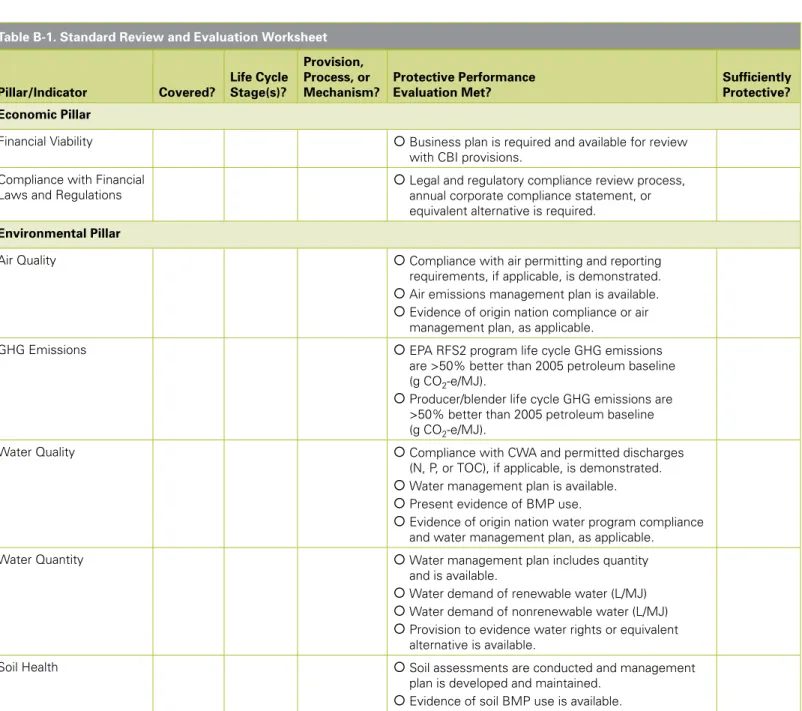
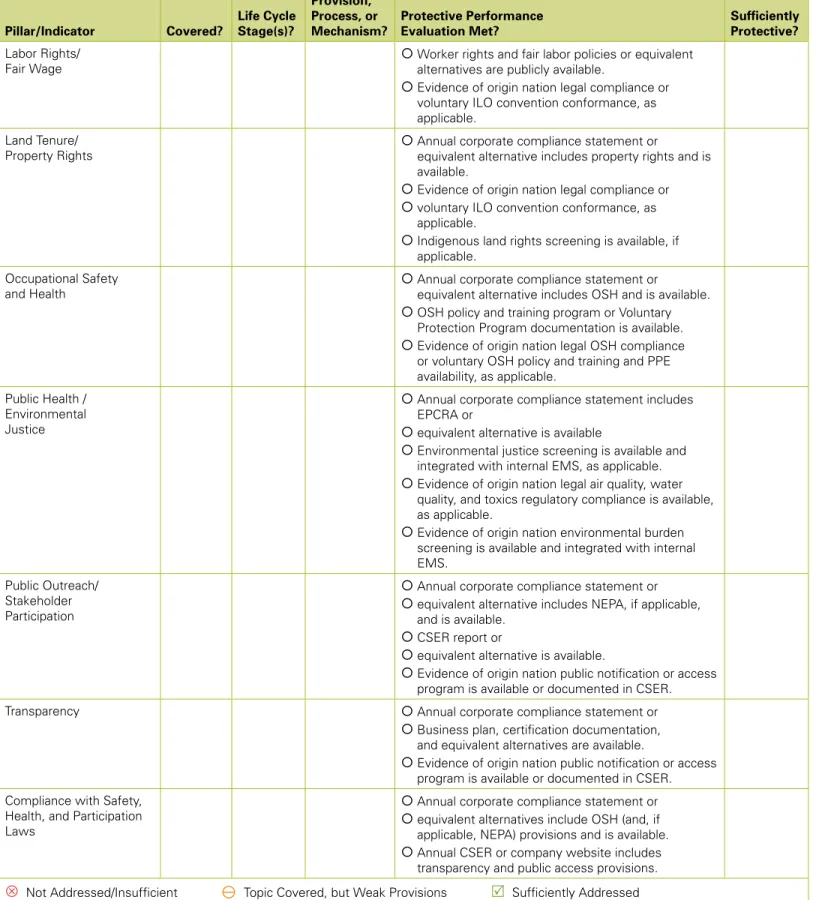
To do so effectively and consistently, we developed and used
the Standard Review and Evaluation Worksheet reproduced
in Table B-1. The first section of this worksheet captures
introductory information on the certification standard
evaluated, document(s) reviewed, and how the standard
and its certification system reflect our six key attributes. The
worksheet’s second section provides a step-by-step structure
to consistently perform an evaluation of a standard against
the biofuel sustainability guidelines and its established
pillars, indicators, and performance evaluation (Table 1).
The worksheet includes elements that are used during the
detailed evaluation of the following:
Pillar/Indicator
Identifies the guideline’s pillar and performance
indicator being evaluated.
Covered?
Cites the standard’s principle(s) (and in some cases
criteria) found to have applicability to the specified
performance indicator.
Life Cycle Stage(s)?
Identifies the standard’s applicable parties and their life
cycle stage applicability, such as feedstock producer
covering stage 1.
Provision, Process, or Mechanism?
Cites the standard’s identified criteria, guidance, procedures,
verification mechanisms, etc. found applicable to and
meeting one or more of the protective performance
evaluation requirements.
Protective Performance Evaluation Met?
Using the cited provisions, processes, or mechanisms in
the previous column, applicable protective performance
evaluation elements are reviewed and classified as:
met (sufficient provisions, processes,
or mechanisms to ensure protection)
not met (or insufficient to ensure protection)
Sufficiently Protective?
These results provide the basis for rating the standard’s
performance with each indicator.
We applied the following ratings:
Not Addressed/Insufficient
(attribute not aligned or topic not mentioned)
Topic Covered, but Weak Provisions
(evaluation element[s] not met)
Sufficiently Addressed
(indicator covered and all evaluation elements met)
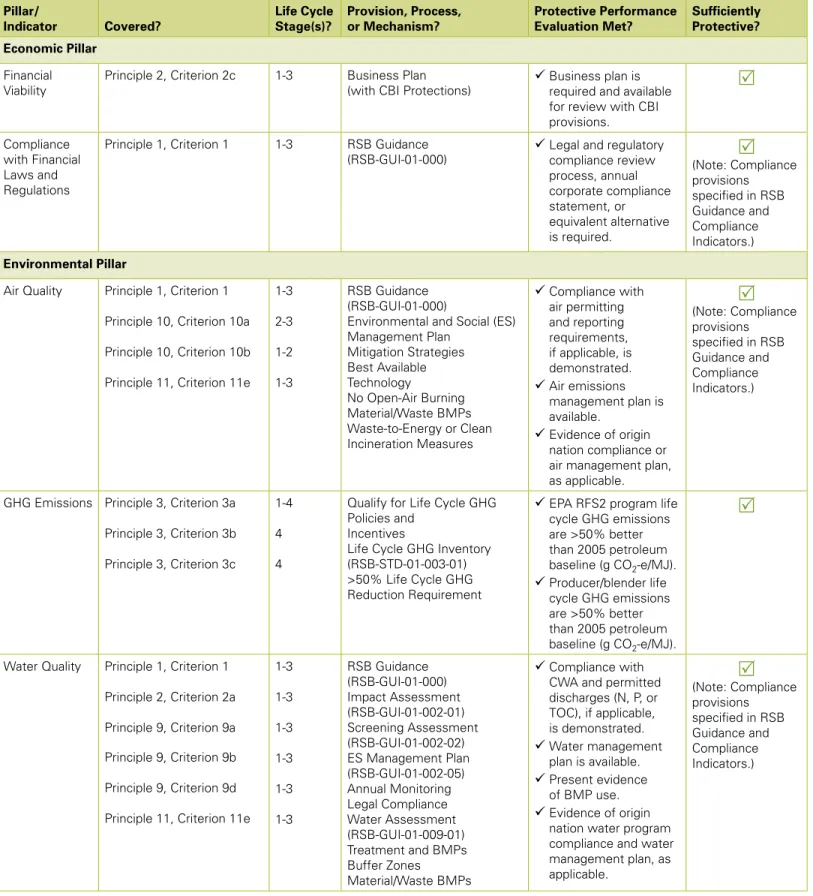
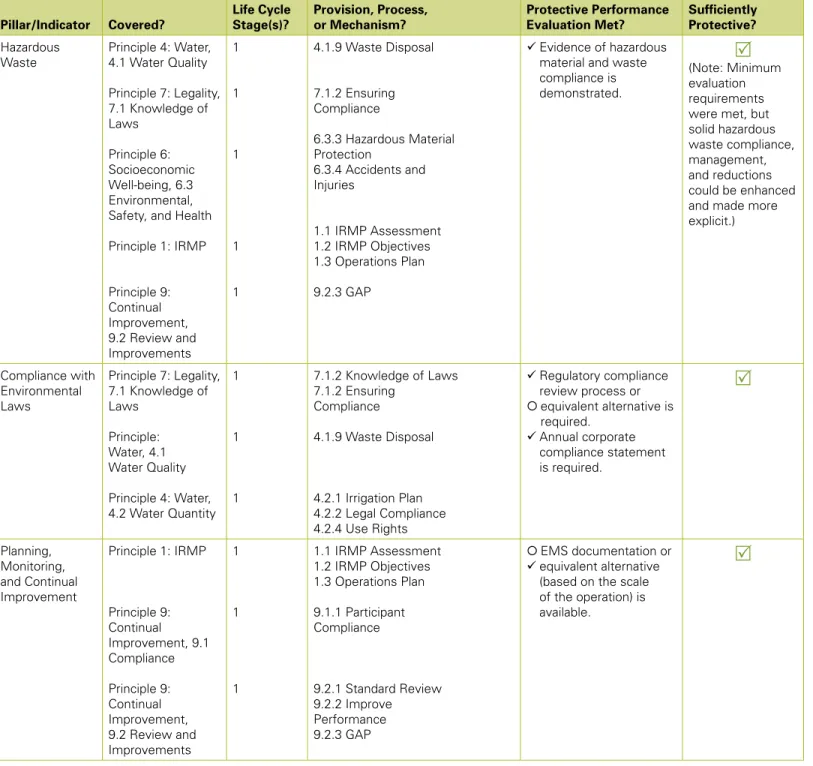
The detailed review and evaluation worksheet for each
standard is provided in Tables B-2 through B-8. These
evaluation worksheets were used to prepare the summary
evaluation results presented in Table 2.
table B-1. Standard Review and Evaluation worksheet Standard Review and Evaluation worksheet
Key Attributes Evaluation Sufficiently Aligned?
Consistent
Balanced and Consensus Driven
transparent
objective and traceable Assured and
Accredited Relevant
table B-1. Standard Review and Evaluation worksheet
Pillar/Indicator Covered? life Cycle Stage(s)?
Provision, Process, or
Mechanism? Protective Performance Evaluation Met? Sufficiently Protective? Economic Pillar
Financial Viability
Business plan is required and available for review with CBI provisions.Compliance with Financial
Laws and regulations
Legal and regulatory compliance review process, annual corporate compliance statement, or equivalent alternative is required.Environmental Pillar
air Quality
Compliance with air permitting and reporting requirements, if applicable, is demonstrated.
air emissions management plan is available.
evidence of origin nation compliance or air management plan, as applicable.GHG emissions
epa rFS2 program life cycle GHG emissions are >50% better than 2005 petroleum baseline (g Co2-e/MJ).
producer/blender life cycle GHG emissions are >50% better than 2005 petroleum baseline (g Co2-e/MJ).Water Quality
Compliance with CWa and permitted discharges (N, p, or toC), if applicable, is demonstrated.
Water management plan is available.
present evidence of BMp use.
evidence of origin nation water program compliance and water management plan, as applicable.Water Quantity
Water management plan includes quantity and is available.
Water demand of renewable water (L/MJ)
Water demand of nonrenewable water (L/MJ)
provision to evidence water rights or equivalent alternative is available.Soil Health
Soil assessments are conducted and management plan is developed and maintained.Pillar/Indicator Covered? life Cycle Stage(s)? Process, or Mechanism? Protective Performance Evaluation Met? Sufficiently Protective?
Nutrient requirements/
Fertilizer Use
Soil and nutrient management plan or equivalent alternative. Pesticides/Herbicide Use/Management practices
pest control and chemical management plan(s) or equivalent alternatives are available. Sustainable Harvestrates/Biomass Yield
Actual yield (MT/ha): Sustainable yield (MT/ha) < 1 or equivalent assessments are available. Land Use
product/land use (Mt/ha or MJ/ha) factor or
equivalent assessments are available.
evidence of prior and current land cover type. endangered,threatened, and Vulnerable Species
Mechanism for determining the presence/absence of species listed as endangered, threatened, or vulnerable under the eSa, state law, and natural heritage programs.
Mechanism for determining the presence/absence of species listed as endangered, threatened, or vulnerable on the International Union forConservation of Nature red List and/or state Natural Heritage program.
Conservation plan is made available and includes the identification of these species/habitats, and plans for their protection and enhancement.Native Habitat /ecosystem
Health preservation
Conservation plan is made available and includes ecosystem service restoration. Invasive Species
Conservation/management plans are available andinclude invasive species management and mitigation. Genetically Modified
organisms
Cultivation and management practices are available. Management plan is available and includes protocols for GMo monitoring and control.Minimization, reuse, and recycling
Material efficiency plan is available.
primary product %: coproduct % ratio > 1 or
equivalent assessments are available. Hazardous Waste
evidence of hazardous material and wastecompliance is demonstrated. Compliance with
environmental Laws
regulatory compliance review process or equivalent alternative is required.
annual corporate compliance statement is required. planning, Monitoring, andContinual Improvement
eMS documentation or equivalent alternative (based on the scale of the operation) is available.Supply Chain
Management, CoC, and product Certification
Supply chain and CoC program documentation is available.
product certification is achieved and maintained.Social Pillar
Food Security
Food security screening is available.
If screening indicates need, a food security assessment is performed and available. equity/Gender rights
equal opportunity policy or equivalent alternative is available.
evidence of origin nation legal compliance or voluntary ILo convention conformance, as applicable.table B-1. Standard Review and Evaluation worksheet
Pillar/Indicator Covered? life Cycle Stage(s)?
Provision, Process, or
Mechanism? Protective Performance Evaluation Met? Sufficiently Protective?
Labor rights/
Fair Wage
Worker rights and fair labor policies or equivalent alternatives are publicly available.
evidence of origin nation legal compliance or voluntary ILo convention conformance, as applicable.Land tenure/
property rights
annual corporate compliance statement or equivalent alternative includes property rights and is available.
evidence of origin nation legal compliance or
voluntary ILo convention conformance, as applicable.
Indigenous land rights screening is available, if applicable.occupational Safety
and Health
annual corporate compliance statement or equivalent alternative includes oSH and is available.
oSH policy and training program or Voluntary protection program documentation is available.
evidence of origin nation legal oSH compliance or voluntary oSH policy and training and ppe availability, as applicable.public Health / environmental Justice
annual corporate compliance statement includes epCra or
equivalent alternative is available
Environmental justice screening is available and integrated with internal eMS, as applicable.
evidence of origin nation legal air quality, water quality, and toxics regulatory compliance is available, as applicable.
evidence of origin nation environmental burden screening is available and integrated with internal eMS.public outreach/ Stakeholder participation
annual corporate compliance statement or
equivalent alternative includes Nepa, if applicable, and is available.
CSer report or
equivalent alternative is available.
evidence of origin nation public notification or access program is available or documented in CSer. transparency
annual corporate compliance statement or
Business plan, certification documentation, and equivalent alternatives are available.
evidence of origin nation public notification or access program is available or documented in CSer. Compliance with Safety,Health, and participation Laws
annual corporate compliance statement or
equivalent alternatives include oSH (and, if applicable, Nepa) provisions and is available.
annual CSer or company website includes transparency and public access provisions.rSB, principles and Criteria for Sustainable Biofuel production, Version 2.0
Key Attributes Evaluation Sufficiently Aligned?
Consistent rSB structures, processes, and mechanisms build on and align well with ISo guidelines and ISeaL code. rSB is a Ful