Thread-Specific Storage for C/C++
An Object Behavioral Pattern for Accessing per-Thread State Efficiently
Douglas C. Schmidt
Nat Pryce
Timothy H. Harrison
fschmidt, [email protected] [email protected] Dept. of Computer Science Department of Computing Washington University, St. Louis1
Imperial College2
St. Louis, MO, USA London, UK
This paper will appear at the4 th
annual Pattern Languages of Programming conference held in Allerton Park, Illinois, September, 1997. Permission is granted to make copies of this paper for the PLoP ’97 conference proceedings.
Abstract
In theory, multi-threading an application can improve per-formance (by executing multiple instruction streams simul-taneously) and simplify program structure (by allowing each thread to execute synchronously rather than reactively or asynchronously). In practice, multi-threaded applications often perform no better, or even worse, than single-threaded applications due to the overhead of acquiring and releasing locks. In addition, multi-threaded applications are hard to program due to the complex concurrency control protocols required to avoid race conditions and deadlocks.
This paper describes the Thread-Specific Storage pattern, which alleviates several problems with multi-threading per-formance and programming complexity. The Thread-Specific Storage pattern improves performance and simplifies multi-threaded applications by allowing multiple threads to use one logically global access point to retrieve thread-specific data without incurring locking overhead for each access.
1
Intent
Allows multiple threads to use one logically global access point to retrieve thread-specific data without incurring lock-ing overhead for each access.
2
Motivation
2.1
Context and Forces
The Thread-Specific Storage pattern should be applied to multi-threaded applications that frequently access objects that are logically global but physically specific to each thread. For instance, operating systems like UNIX and Win32 report error information to applications usingerrno.
1
This research is supported in part by a grant from Siemens AG.
2
This research is funded by British Telecom, plc.
When an error occurs in a system call, the OS setserrno to report the problem and returns a documented failure sta-tus. When the application detects the failure status it checks errnoto determine what type of error occurred.
For instance, consider the following typical C code frag-ment that receives buffers from a non-blocking TCP socket:
// One global errno per-process. extern int errno;
void *worker (SOCKET socket) {
// Read from the network connection
// and process the data until the connection // is closed.
for (;;) {
char buffer[BUFSIZ];
int result = recv (socket, buffer, BUFSIZ, 0); // Check to see if the recv() call failed. if (result == -1) {
if (errno != EWOULDBLOCK)
// Record error result in thread-specific data. printf ("recv failed, errno = %d", errno); } else
// Perform the work on success. process_buffer (buffer);
} }
If recv returns ,1 the code checks that errno != EWOULDBLOCKand prints an error message if this is not the case (e.g., iferrno==EINTR), otherwise it processes the buffer it receives.
2.2
Common Traps and Pitfalls
Although the “global error variable” approach shown above works reasonably3
well for single-threaded applications, subtle problems occur in multi-threaded applications. In par-ticular, race conditions in preemptively multi-threaded sys-tems can cause an errno value set by a method in one thread to be interpreted erroneously by applications in other
3
The Appendix discusses the tradeoffs of reporting errors using alterna-tive techniques (such as exceptions and passing an explicit error parameter to each call).
result = recv (socket, buffer, BUFSIZ, 0);
Thread T1 Thread T2
T1 preempted
if (errno == EWOULDBLOCK) // T1 falsely assumes its // recv() was interrupted! // sets errno = EWOULDBLOCK
result = recv (socket, buffer, BUFSIZ, 0); // sets errno = EINTR
T2 preempted
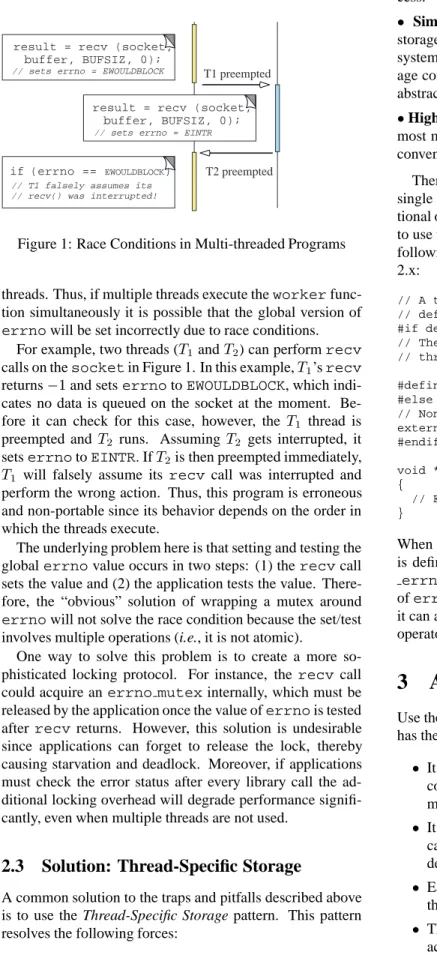
Figure 1: Race Conditions in Multi-threaded Programs
threads. Thus, if multiple threads execute theworker func-tion simultaneously it is possible that the global version of errnowill be set incorrectly due to race conditions.
For example, two threads (T 1and
T
2) can performrecv calls on thesocketin Figure 1. In this example,T
1’srecv returns,1and setserrnotoEWOULDBLOCK, which indi-cates no data is queued on the socket at the moment. Be-fore it can check for this case, however, the T
1 thread is preempted andT
2 runs. Assuming T
2 gets interrupted, it setserrnotoEINTR. IfT
2is then preempted immediately, T
1 will falsely assume its recv call was interrupted and perform the wrong action. Thus, this program is erroneous and non-portable since its behavior depends on the order in which the threads execute.
The underlying problem here is that setting and testing the globalerrnovalue occurs in two steps: (1) therecvcall sets the value and (2) the application tests the value. There-fore, the “obvious” solution of wrapping a mutex around errnowill not solve the race condition because the set/test involves multiple operations (i.e., it is not atomic).
One way to solve this problem is to create a more so-phisticated locking protocol. For instance, the recv call could acquire anerrno mutexinternally, which must be released by the application once the value oferrnois tested after recv returns. However, this solution is undesirable since applications can forget to release the lock, thereby causing starvation and deadlock. Moreover, if applications must check the error status after every library call the ad-ditional locking overhead will degrade performance signifi-cantly, even when multiple threads are not used.
2.3
Solution: Thread-Specific Storage
A common solution to the traps and pitfalls described above is to use the Thread-Specific Storage pattern. This pattern resolves the following forces:
Efficiency: Thread-specific storage allows sequential methods within a thread to access thread-specific objects
atomically without incurring locking overhead for each ac-cess.
Simplify application programming: Thread-specific storage is simple for application programmers to use because system developers can make the use of thread-specific stor-age completely transparent at the source-code level via data abstraction or macros.
Highly portable: Thread-specific storage is available on most multi-threaded OS platforms and can be implemented conveniently on platforms (such as VxWorks) that lack it.
Therefore, regardless of whether an application runs in a single thread or multiple threads, there should be no addi-tional overhead incurred and no changes to the code required to use the Thread-Specific Storage pattern. For example, the following code illustrates howerrnois defined on Solaris 2.x:
// A thread-specific errno definition (typically // defined in <sys/errno.h>).
#if defined (_REENTRANT)
// The _errno() function returns the // thread-specific value of errno. #define errno (*_errno())
#else
// Non-MT behavior is unchanged. extern int errno;
#endif /* REENTRANT */ void *worker (SOCKET socket) {
// Exactly the same implementation shown above. }
When the REENTRANTflag is enabled theerrnosymbol is defined as a macro that invokes a helper function called errno, which returns a pointer to the thread-specific value oferrno. This pointer is dereferenced by the macro so that it can appear on either the left or right side of an assignment operator.
3
Applicability
Use the Thread-Specific Storage pattern when an application has the following characteristics:
It was originally written assuming a single thread of control and is being ported to a multi-threaded environ-ment without changing existing APIs; or
It contains multiple preemptive threads of control that can execute concurrently in an arbitrary scheduling or-der, and
Each thread of control invokes sequences of methods that share data common only to that thread, and The data shared by objects within each thread must be
accessed through a globally visible access point that is “logically” shared with other threads, but “physically” unique for each thread; and
TS Object Collection set_object (key) get_object (key) TS Object Proxy setspecific () getspecific() key TS Object Application Thread
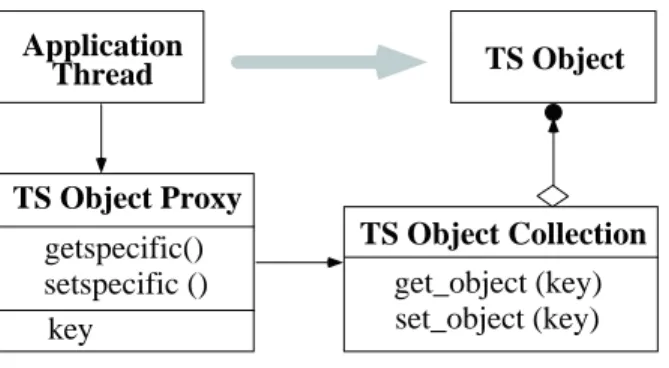
Figure 2: Structure of Participants in the Thread-Specific Storage Pattern
The data is passed implicitly between methods rather than being passed explicitly via parameters.4
Understanding the characteristics described above is crucial to using (or not using) the Thread-Specific Storage pattern. For example, the UNIX errnovariable is an example of data that is (1) logically global, but physically thread-specific and (2) passed implicitly between methods.
Do not use the Thread-Specific Storage pattern when an application has the following characteristics:
Multiple threads are collaborating on a single task that requires concurrent access to shared data. For instance, a multi-threaded application may perform reads and writes concurrently on an in-memory database. In this case, threads must share records and tables that are not thread-specific. If thread-specific storage was used to store the database, the threads could not share the data. Thus, access to the database records must be controlled with synchronization primitives (e.g., mutexes) so that the threads can collaborate on the shared data.
It is more intuitive and efficient to maintain both a physical and logical separation of data. For instance, it may be possible to have threads access data visible only within each thread by passing the data explicitly as parameters to all methods. In this case, the Thread-Specific Storage pattern may be unnecessary.
4
Structure and Participants
Figure 2 illustrates the structure of the following participants in the Thread-Specific Storage pattern:
Application Threads
Application threads use TS Object Proxies to access TS Objectsresiding in thread-specific stor-age. As shown in Section 9, an implementation of the Thread-Specific Storage pattern can use smart pointers to hide the TS Object Proxyso that applications appear to access theTS Objectdirectly.
4
This situation is common when porting single-threaded APIs to multi-threaded systems.
Thread-Specific (TS) Object Proxy (errnomacro) The TS Object Proxy defines the interface of a
TS Object. It is responsible for providing access to a unique object for each application thread via the getspecificandsetspecificmethods. For in-stance, in the error handling example from Section 2, theerrno TS Objectis anint.
ATS Object Proxyinstance is responsible for a type of object, i.e., it mediates access to a thread-specificTS Objectfor every thread that accesses the proxy. For example, multiple threads may use the same TS Object Proxyto access thread-specificerrno values. The key value stored by the proxy is as-signed by theTS Object Collectionwhen the proxy is created and is passed to the collection by the getspecificandsetspecificmethods. The purpose of TS Object Proxies is to hide keysandTS Object Collections. Without the proxies, the Application Threads would have to obtain the collections and usekeysexplicitly. As shown in Section 9, most of the details of thread-specific storage can be completely hidden via smart pointers for theTS Object Proxy.
Thread-Specific (TS) Object (* errno()value) A TS Object is a particular thread’s instance of a
thread-specific object. For instance, a thread-specific errno is an object of type int. It is managed by the TS Object Collection and accessed only through aTS Object Proxy.
Thread-Specific (TS) Object Collection
In complex multi-threaded applications, a thread’s errnovalue may be one of many types of data resid-ing in thread-specific storage. Thus, for a thread to re-trieve its thread-specific error data it must use akey. Thiskeymust be associated witherrno to allow a thread to access the correct entry in theTS Object Collection.
The TS Object Collection contains a set of all thread-specific objects associated with a particular thread, i.e., every thread has a unique TS Object Collection. The TS Object Collection mapskeys to thread-specific TS Objects. ATS Object Proxyuses thekeyto retrieve a specificTS Object from the TS Object Collection via the get object(key) and set object(key) methods.
5
Collaborations
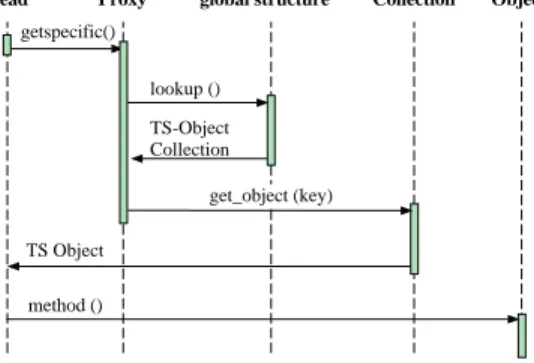
The interaction diagram in Figure 3 illustrates the following collaborations between participants in the Thread-Specific Storage pattern:
Application Thread OBJECT OPERATION Thread state or global structure TS Proxy getspecific() COLLECTION LOOKUP TS-Object Collection TS Object RETURN COLLECTION TS-Object Collection RETURN TS-OBJECT OBJECT OPERATION OBJECT LOOKUP get_object (key) TS Object method () lookup ()
Figure 3: Interactions Among Participants in the Thread-Specific Storage Pattern
Locate the TS Object Collection: Methods in each Application Threadinvoke the getspecificand setspecific methods on the TS Object Proxyto access theTS Object Collection, which is stored in-side the thread or in a global structure indexed by the thread ID.5
Acquire the TS Object from thread-specific storage: Once theTS Object Collectionhas been located, the TS Object Proxyuses itskeyto retrieve the correctTS Objectfrom the collection.
Set/get TS Object state: At this point, the application thread operates on the TS Object using ordinary C++ method calls. No locking is necessary since the object is ref-erenced by a pointer that is accessed only within the calling thread.
6
Consequences
6.1
Benefits
There are several benefits of using the Thread-Specific Stor-age pattern, including:
Efficiency: The Thread-Specific Storage pattern can be implemented so that no locking is needed to thread-specific data. For instance, by placingerrno into thread-specific storage, each thread can reliably set and test the completion status of methods within that thread without using complex synchronization protocols. This eliminates locking overhead for data shared within a thread, which is faster than acquiring and releasing a mutex [1].
Ease of use: Thread-specific storage is simple for appli-cation programmers to use because system developers can make the use of thread-specific storage completely transpar-ent at the source-code level via data abstraction or macros.
5
Every thread in a process contains a unique identifying value called a “thread ID,” which is similar to the notion of a process ID.
6.2
Liabilities
There are also the following liabilities to using the Thread-Specific Storage pattern:
It encourages the use of (thread-safe) global variables: Many applications do not require multiple threads to access thread-specific data via a common access point. When this is the case, the data should be stored so that only the thread owning the data can access it. For example, consider a net-work server that uses a pool of net-worker threads to handle in-coming requests from clients. These threads may log the number and type of services performed. This logging mech-anism could be accessed as a globalLoggerobject utiliz-ing Thread-Specific Storage. A simpler approach, however, would represent each worker thread as an Active Object [2] with an instance of theLogger stored internally. In this case, no overhead is required to access theLogger, as long as it is passed as a parameter to all functions in the Active Object.
It hides the structure of the system: The use of thread-specific storage hides the relationships between objects in an application, potentially making the application harder to un-derstand. Explicitly representing relationships between ob-jects can eliminate the need for thread-specific storage in some cases, as described in Appendix A.2.
7
Implementation
The Thread-Specific Storage pattern can be implemented in various ways. This section explains each step required to implement the pattern. The steps are summarized as follows: 1. Implement the TS Object Collections: If the OS does not provide an implementation of thread-specific storage, it can be implemented using whatever mechanisms are avail-able to maintain the consistency of the data structures in the TS Object Collections.
2. Encapsulate details of thread-specific storage: As shown in Section 8, interfaces to thread-specific storage are typically weakly-typed and error-prone. Thus, once an im-plementation of thread-specific storage is available, use C++ programming language features (such as templates and over-loading) to hide the low-level details of thread-specific stor-age behind OO APIs.
The remainder of this section describes how to implement the low-level thread-specific storage APIs. Section 8 pro-vides complete sample code and Section 9 examines several ways to encapsulate low-level thread-specific storage APIs with C++ wrappers.
7.1
Implement the TS Object Collections
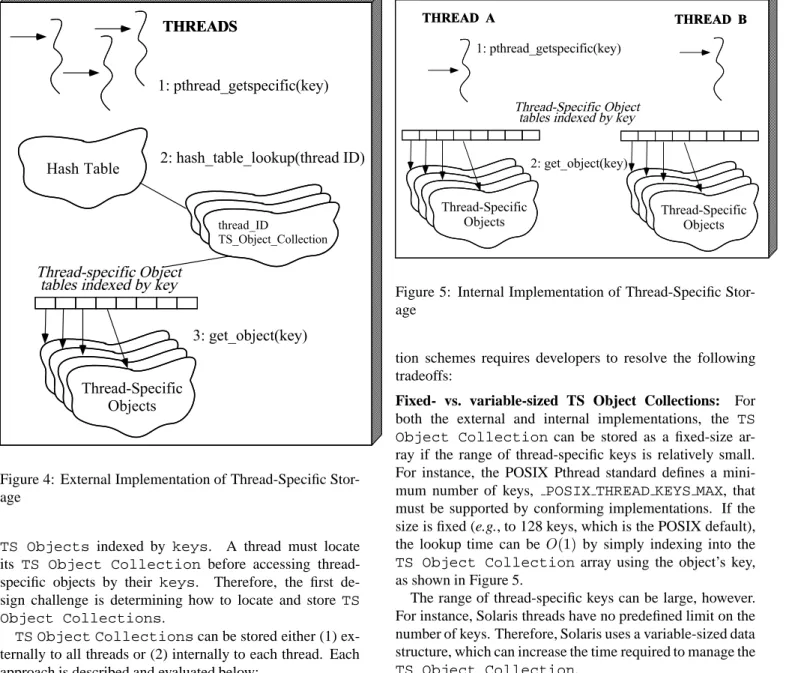
The TS Object Collectionshown in Figure 2 con-tains allTS Objectsbelonging to a particular thread. This collection can be implemented using a table of pointers toThread-Specific Objects thread_ID TS_Object_Collection THREADS THREADS 1: pthread_getspecific(key) 3: get_object(key) 2: hash_table_lookup(thread ID) Hash Table Thread-specific Object tables indexed by key
Figure 4: External Implementation of Thread-Specific Stor-age
TS Objects indexed by keys. A thread must locate its TS Object Collection before accessing thread-specific objects by their keys. Therefore, the first de-sign challenge is determining how to locate and store TS Object Collections.
TS Object Collectionscan be stored either (1) ex-ternally to all threads or (2) inex-ternally to each thread. Each approach is described and evaluated below:
1. External to all threads: This approach defines a global mapping of each thread’s ID to its TS Object Collectiontable (shown in Figure 4). Locating the right collection may require the use of a readers/writer lock to pre-vent race conditions. Once the collection is located, however, no additional locking is required since only one thread can be active within aTS Object Collection.
2. Internal to each thread: This approach requires each thread in a process to store aTS Object Collection with its other internal state (such as a run-time thread stack, program counter, general-purpose registers, and thread ID). When a thread accesses a thread-specific object, the object is retrieved by using the correspondingkeyas an index into the thread’s internalTS Object Collection(shown in Figure 5). This approach requires no additional locking.
Choosing between the external and internal
implementa-Thread-Specific
Objects Thread-SpecificObjects
THREAD A
THREAD A THREAD BTHREAD B
Thread-Specific Object tables indexed by key 1: pthread_getspecific(key)
2: get_object(key)
Figure 5: Internal Implementation of Thread-Specific Stor-age
tion schemes requires developers to resolve the following tradeoffs:
Fixed- vs. variable-sized TS Object Collections: For both the external and internal implementations, the TS Object Collectioncan be stored as a fixed-size ar-ray if the range of thread-specific keys is relatively small. For instance, the POSIX Pthread standard defines a mini-mum number of keys, POSIX THREAD KEYS MAX, that must be supported by conforming implementations. If the size is fixed (e.g., to 128 keys, which is the POSIX default), the lookup time can beO(1) by simply indexing into the TS Object Collectionarray using the object’s key, as shown in Figure 5.
The range of thread-specific keys can be large, however. For instance, Solaris threads have no predefined limit on the number of keys. Therefore, Solaris uses a variable-sized data structure, which can increase the time required to manage the TS Object Collection.
Fixed- vs. variable-sized mapping of thread IDs to TS Object Collections: Thread IDs can range from very small to very large values. This presents no problem for inter-nal implementations since the thread ID is implicitly asso-ciated with the correspondingTS Object Collection contained in the thread’s state.
For external implementations, however, it may be imprac-tical to have a fixed-size array with an entry for every possi-ble thread ID value. Instead, it is more space efficient to have threads use a dynamic data structure to map thread IDs toTS Object Collections. For instance, one approach is to use a hash function on the thread ID to obtain an offset into a hash table bucket containing a chain of tuples that map thread IDs to their correspondingTS Object Collection(as shown in Figure 4).
Global vs. local TS Object Collections: The internal approach stores theTS Object Collectionslocally
with the thread, whereas the external approach stores them globally. Depending on the implementation of the exter-nal table, the global location can allow threads to access other threads’ TS Object Collections. Although this seems to defeat the whole point of thread-specific stor-age, it is useful if the thread-specific storage implementation provides automatic garbage collection by recycling unused keys. This feature is particularly important on implemen-tations that limit the number of keys to a small value (e.g., Windows NT has a limit of 64 keys per process).
However, using an external table increases the access time for every thread-specific object since synchronization mech-anisms (such as readers/writer locks) are required to avoid race conditions if globally accessible table is modified (e.g., when creating new keys). On the other hand, keeping theTS Object Collectionlocally in the state of each thread requires more storage per-thread, though no less total mem-ory consumption.
8
Sample Code
8.1
Implementing
the
POSIX
Pthreads
Thread-Specific Storage API
The following code shows how thread-specific storage can be implemented whenTS Objects are stored “internally” to each thread using a fixed-sized array of keys. This exam-ple is adapted from a publically available imexam-plementation [3] of POSIX Pthreads [4].
Thethread statestructure shown below contains the state of a thread:
struct thread_state {
// The thread-specific error number. int errno_;
// Thread-specific data values. void *key_[_POSIX_THREAD_KEYS_MAX]; // ... Other thread state.
};
In addition toerrnoand the array of thread-specific storage pointers, this structure also includes a pointer to the thread’s stack and space to store data (e.g., the program counter) that is saved/restored during a context switch.
For a particular thread-specific object, the same key value is used to set and get thread-specific values for all threads. For instance, ifLoggerobjects are being registered to keep track of thread-specific logging attributes, the thread-specific Logger proxy will be assigned some key value N. All threads will use this valueN to access their thread-specific logging object. A count of the total number of keys currently in use can be stored globally to all threads, as follows:
typedef int pthread_key_t;
// All threads share the same key counter. static pthread_key_t total_keys_ = 0;
Thetotal keys count is automatically incremented ev-ery time a new thread-specific key is required, as shown in thepthread key createfunction below:
// Create a new global key and specify // a "destructor" function callback. int
pthread_key_create (pthread_key_t *key,
void (*thread_exit_hook) (void *)) {
if (total_keys_ >= _POSIX_THREAD_KEYS_MAX) { // pthread_self() refers to the context of the // currently active thread.
pthread_self ()->errno_ = ENOMEM; return -1; } thread_exit_hook_[total_keys_] = thread_exit_hook; *key = total_keys_++; return 0; }
Thepthread key createfunction allocates a new key value that uniquely identifies a thread-specific data ob-ject. In addition, it allows an application to associate a thread exit hook with a key. This hook is a pointer to a function that is called automatically when (1) a thread exits and (2) there is a thread-specific object registered for a key. An array of function pointers to “thread exit hooks” can be stored globally, as follows:
// Exit hooks to cleanup thread-specific keys. static void
(*thread_exit_hook_[_POSIX_THREAD_KEYS_MAX]) (void);
Thepthread exit function below shows how thread exit hook functions are called in the implementation of pthread exit:
// Terminate the thread and call thread exit hooks. void pthread_exit (void *status)
{ // ...
for (i = 0; i < total_keys; i++) if (pthread_self ()->key_[i]
&& thread_exit_hook_[i])
// Indirect pointer to function call. (*thread_exit_hook_[i])
(pthread_self ()->key_[i]); // ...
}
Applications can register different functions for each thread-specific data object, but for each object the same func-tion is called for each thread. Registering dynamically allo-cated thread-specific objects is a common use-case. There-fore, thread exit hooks typically look like the following:
static void
cleanup_tss_Logger (void *ptr) {
// This cast is necessary to invoke // the destructor (if it exists). delete (Logger *) ptr;
}
This function deallocates a dynamically allocatedLogger object.
Thepthread setspecificfunction binds avalue to the givenkeyfor the calling thread:
// Associate a value with a data key // for the calling thread.
int pthread_setspecific (int key, void *value) {
if (key < 0 || key >= total_keys) { pthread_self ()->errno_ = EINVAL; return -1;
}
pthread_self ()->key_[key] = value; return 0;
}
Likewise, pthread getspecific stores into value the data bound to the givenkeyfor the calling thread:
// Retrieve a value from a data key // for the calling thread.
int pthread_getspecific (int key, void **value) {
if (key < 0 || key >= total_keys) { pthread_self ()->errno_ = EINVAL; return -1;
}
*value = pthread_self ()->key_[key]; return 0;
}
Because data are stored internally in the state of each thread, neither of these functions requires any additional locks to access thread-specific data.
8.2
Using Thread-Specific Storage in
Applica-tions
The example below illustrates how to use the thread-specific storage APIs from the POSIX Pthread specification in a C function that can be called from more than one thread with-out having to call an initialization function explicitly:
// Local to the implementation. static pthread_mutex_t keylock =
PTHREAD_MUTEX_INITIALIZER; static pthread_key_t key; static int once = 0; void *func (void) {
void *ptr = 0;
// Use the Double-Checked Locking pattern // (described further below) to serialize // key creation without forcing each access // to be locked.
if (once == 0) {
pthread_mutex_lock (&keylock); if (once == 0) {
// Register the free(3C) function // to deallocation TSS memory when // the thread goes out of scope. pthread_key_create (&key, free); once = 1;
}
pthread_mutex_unlock (&keylock); }
pthread_getspecific (key, (void **) &ptr);
if (ptr == 0) { ptr = malloc (SIZE); pthread_setspecific (key, ptr); } return ptr; }
8.3
Evaluation
The solution above directly invokes the thread-specific li-brary functions (such as pthread getspecific and pthread setspecific) in application code. However, these APIs, which are written in C, have the following limi-tations:
Non-portable: The interfaces of POSIX Pthreads, So-laris threads, and Win32 threads are very similar. However, the semantics of Win32 threads are subtly different since they do not provide a reliable means of cleaning up ob-jects allocated in thread-specific storage when a thread exits. Moreover, there is no API to delete a key in Solaris threads. This makes it hard to write portable code among UNIX and Win32 platforms.
Hard to use: Even with error checking omitted, the lock-ing operations shown by thefuncexample in Section 8.2 are complex and non-intuitive. This code is a C implementa-tion of the Double-Checked Locking pattern [5]. It’s instruc-tive to compare this C implementation to the C++ version in Section 9.2.1 to observe the greater simplicity, clarity, and type-safety resulting from the use of C++ wrappers.
Non-type-safe: The POSIX Pthreads, Solaris, and Win32 thread-specific storage interfaces store pointers to thread-specific objects as void *’s. Although this ap-proach is flexible, it’s easy to make mistakes sincevoid *’s eliminate type-safety.
9
Variations
Section 8 demonstrated how to implement and use the Thread-Specific Storage pattern via POSIX pthread inter-faces. However, the resulting solution was non-portable, hard to use, and not type-safe. To overcome these limita-tions, additional classes and C++ wrappers can be developed to program thread-specific storage robustly in a type-safe manner.
This section illustrates how to encapsulate low-level thread-specific storage mechanisms provided by Solaris threads, POSIX Pthreads, or Win32 threads using C++ wrap-pers. Section 9.1 describes how to encapsulate the POSIX Pthread library interfaces with hard-coded C++ wrappers and Section 9.2 describes a more general solution using C++ template wrappers. The example used for each alternative approach is a variant of theLoggerabstraction described in Section 6.2.
9.1
Hard-coded C++ Wrapper
One way to make all instances of a class be thread-specific is to use thread-specific library routines directly. The steps required to implement this approach are described below. Er-ror checking has been minimized to save space.
9.1.1 Define the Thread-Specific State Information The first step is to determine the object’s state information that must be stored or retrieved in thread-specific storage. For instance, aLoggermight have the following state:
class Logger_State { public: int errno_; // Error number. int line_num_;
// Line where the error occurred. // ...
};
Each thread will have its own copy of this state information. 9.1.2 Define an External Class Interface
The next step is to define an external class interface that is used by all application threads. The external class interface of theLoggerbelow looks just like an ordinary non-thread-specific C++ class:
class Logger {
public:
// Set/get the error number. int errno (void);
void errno (int);
// Set/get the line number. int line_num (void); void line_num (int); // ...
};
9.1.3 Define a Thread-Specific Helper Method
This step uses the thread-specific storage functions provided by the thread library to define a helper method that returns a pointer to the appropriate thread-specific storage. Typically, this helper method performs the following steps:
1. Key initialization: Initialize a key for each thread-specific object and use this key to get/set a thread-thread-specific pointer to dynamically allocated memory containing an in-stance of the internal structure. The code could be imple-mented as follows: class Logger { public: // ... Same as above ... protected:
Logger_State *get_tss_state (void); // Key for the thread-specific error data. pthread_key_t key_;
// "First time in" flag. int once_;
};
Logger_State *Logger::get_tss_state (void) {
// Check to see if this is the first time in // and if so, allocate the key (this code // doesn’t protect against multi-threaded // race conditions...).
if (once_ == 0) {
pthread_key_create (this->key_, free); once_ = 1;
}
Logger_State *state_ptr;
// Get the state data from thread-specific // storage. Note that no locks are required... pthread_getspecific (this->key_,
(void **) &state_ptr); if (state_ptr == 0) {
state_ptr = new Logger_State; pthread_setspecific (this->key_,
(void *) state_ptr); }
// Return the pointer to thread-specific storage. return state_ptr;
};
2. Obtain a pointer to the thread-specific object: Every method in the external interface will call the get tss statehelper method to obtain a pointer to the Logger Stateobject that resides in thread-specific stor-age, as follows:
int Logger::errno (void) {
return this->get_tss_state ()->errno_; }
3. Perform normal operations: Once the external inter-face method has the pointer, the application can perform op-erations on the thread-specific object as if it were an ordinary (i.e., non-thread-specific) C++ object:
Logger logger; int
recv_msg (HANDLE socket, char *buffer, size_t bufsiz)
{
if (recv (socket, buffer, bufsiz, 0) == -1) { logger->errno () = errno;
return -1; }
// ... }
int main (void) {
// ...
if (recv_msg (socket, buffer, BUFSIZ) == -1 && logger->errno () == EWOULDBLOCK) // ...
};
9.1.4 Evaluation of the Hard-coded Wrapper
The advantage of using a hard-coded wrapper is that it shields applications from the knowledge of the thread-specific library functions. The disadvantage of this approach is that it does not promote reusability, portability, or flexibil-ity. In particular, for every thread-specific class, the devel-oper needs to reimplement the thread-specific helper method within the class.
Moreover, if the application is ported to a platform with a different thread-specific storage API, the code internal to each thread-specific class must be altered to use the new thread library. In addition, making changes directly to the thread-specific class makes it hard to change the threading policies. For instance, changing a thread-specific class to a global class would require intrusive changes to the code, which reduces flexibility and reusability. In particular, each access to state internal to the object would require changes to the helper method that retrieves the state from thread-specific storage.
9.2
C++ Template Wrapper
A more reusable, portable, and flexible approach is to im-plement a TS Object Proxytemplate that is responsi-ble for all thread-specific methods. This approach allows classes to be decoupled from the knowledge of how thread-specific storage is implemented. This solution improves the reusability, portability, and flexibility of the code by defin-ing a proxy class calledTSS. As shown below, this class is a template that is parameterized by the class whose objects reside in thread-specific storage:
// TS Proxy template template <class TYPE> class TSS { public: // Constructor. TSS (void); // Destructor ˜TSS (void);
// Use the C++ "smart pointer" operator to // access the thread-specific TYPE object. TYPE *operator-> ();
private:
// Key for the thread-specific error data. pthread_key_t key_;
// "First time in" flag. int once_;
// Avoid race conditions during initialization.
Thread_Mutex keylock_;
// Cleanup hook that deletes dynamically // allocated memory.
static void cleanup_hook (void *ptr); };
The methods in this class are described below. As before, error checking has been minimized to save space.
9.2.1 The C++ Delegation Operator
Applications can invoke methods on aTSSproxy as if they were calling the target class by overloading the C++ delega-tion operator (operator->). The C++ delegadelega-tion operator used in this implementation controls all access to the thread-specific object of classTYPE. Theoperator->method receives special treatment from the C++ compiler. As de-scribed in Section 9.2.3, it first obtains a pointer to the ap-propriateTYPEfrom thread-specific storage and then redel-egates the original method invoked on it.
Most of the work in the TSS class is performed in the operator->method shown below:
template <class TYPE> TYPE * TSS<TYPE>::operator-> () {
TYPE *tss_data = 0;
// Use the Double-Checked Locking pattern to // avoid locking except during initialization. // First check.
if (this->once_ == 0) {
// Ensure that we are serialized (constructor // of Guard acquires the lock).
Guard <Thread_Mutex> guard (this->keylock_); // Double check
if (this->once_ == 0) {
pthread_key_create (&this->key_,
&this->cleanup_hook); // *Must* come last so that other threads // don’t use the key until it’s created. this->once_ = 1;
}
// Guard destructor releases the lock. }
// Get the data from thread-specific storage. // Note that no locks are required here... pthread_getspecific (this->key_,
(void **) &tss_data); // Check to see if this is the first time in // for this thread.
if (tss_data == 0) {
// Allocate memory off the heap and store // it in a pointer in thread-specific // storage (on the stack...).
tss_data = new TYPE;
// Store the dynamically allocated pointer in // thread-specific storage.
pthread_setspecific (this->key_,
(void *) tss_data); }
return tss_data; }
TheTSStemplate is a proxy that transparently transforms ordinary C++ classes into type-safe, thread-specific classes. It combines theoperator->method with other C++ fea-tures like templates, inlining, and overloading. It also utilizes patterns like Double-Checked Locking Optimization [5] and Proxy [6, 7]).
The Double-Checked Locking Optimization pattern is used inoperator->to test theonce flag twice in the code. Although multiple threads could access the same in-stance ofTSS simultaneously, only one thread can validly create a key (i.e., viapthread key create). All threads will then use this key to access a thread-specific object of the parameterized classTYPE. Therefore,operator->uses a Thread Mutex keylock to ensure that only one thread executespthread key create.
The first thread that acquires keylock sets once to 1 and all subsequent threads that call operator-> will find once != 0 and therefore skip the initialization step. The second test of once handles the case where multi-ple threads executing in parallel queue up at keylock before the first thread has set once to 1. In this case, when the other queued threads finally obtain the mutex keylock, they will find once equal to 1 and will not executepthread key create.
Once the key is created, no further locking is nec-essary to access the thread-specific data. This is be-cause the pthreadfgetspecific,setspecificg functions retrieve theTS Objectof classTYPEfrom the state of the calling thread. No additional locks are needed since this thread state is independent from other threads.
In addition to reducing locking overhead, the implemen-tation of classTSS shown above shields application code from knowledge of the fact that objects are specific to the calling thread. To accomplish this, the implementation uses C++ features such as templates, operator overloading, and the delegation operator (i.e.,operator->).
9.2.2 The Constructor and Destructor
The constructor for theTSSclass is minimal, it simply ini-tializes the local instance variables:
template <class TYPE>
TSS<TYPE>::TSS (void): once_ (0), key_ (0) {}
Note that we do not allocate the TSS key or a newTYPE instance in the constructor. There are several reasons for this design:
Thread-specific storage semantics: The thread that ini-tially creates theTSSobject (e.g., the main thread) is often not the same thread(s) that use this object (e.g., the worker threads). Therefore, there is no benefit from pre-initializing a newTYPEin the constructor since this instance will only be accessible by the main thread.
Deferred initialization: On some OS platforms, TSS keys are a limited resource. For instance, Windows NT only allows a total of 64 TSS keys per-process. Therefore, keys should not be allocated until absolutely necessary. In-stead, the initialization is deferred until the first time the operator->method is called.
The destructor forTSSpresents us with several tricky de-sign issues. The obvious solution is to release the TSS key allocated inoperator->. However, there are several prob-lems with this approach:
Lack of features: Win32 and POSIX pthreads define a function that releases a TSS key. However, Solaris threads do not. Therefore, writing a portable wrapper is hard. Race conditions: The primary reason that Solaris threads do not provide a function to release the TSS key is that it is costly to implement. The problem is that each thread separately maintains the objects referenced by that key. Only when all these threads have exited and the memory reclaimed is it safe to release the key.
As a result of the problems mentioned above, our destruc-tor is a no-op:
template <class TYPE> TSS<TYPE>::˜TSS (void) {
}
Thecleanup hookis a static method that casts itsptr argument to the appropriateTYPE *before deleting it:
template <class TYPE> void
TSS<TYPE>::cleanup_hook (void *ptr) {
// This cast is necessary to invoke // the destructor (if it exists). delete (TYPE *) ptr;
}
This ensures that the destructor of each thread-specific object is called when a thread exits.
9.2.3 Use-case
The following is a C++ template wrapper-based solution for our continuing example of a thread-specific Logger ac-cessed by multiple worker threads:
// This is the "logically" global, but
// "physically" thread-specific logger object, // using the TSS template wrapper.
static TSS<Logger> logger; // A typical worker function. static void *worker (void *arg) {
// Network connection stream. SOCK_Stream *stream =
static_cast <SOCK_Stream *> arg; // Read from the network connection
// and process the data until the connection // is closed.
for (;;) {
char buffer[BUFSIZ];
int result = stream->recv (buffer, BUFSIZ); // Check to see if the recv() call failed. if (result == -1) {
if (logger->errno () != EWOULDBLOCK) // Record error result.
logger->log ("recv failed, errno = %d", logger->errno ());
} else
// Perform the work on success. process_buffer (buffer);
} }
Consider the call tologger->errnoabove. The C++ compiler replaces this call with two method calls. The first is a call toTSS::operator->, which returns aLogger instance residing in thread-specific storage. The compiler then generates a second method call to theerrnomethod of the logger object returned by the previous call. In this case,TSSbehaves as a proxy that allows an application to access and manipulate the thread-specific error value as if it were an ordinary C++ object.6
TheLoggerexample above is a good example where us-ing a logically global access point is advantageous. Since theworkerfunction is global, it is not straightforward for threads to manage both a physical and logical separation of Loggerobjects. Instead, a thread-specificLoggerallows multiple thread to use a single logical access point to manip-ulate physically separate TSS objects.
9.2.4 Evaluation
TheTSSproxy design based on the C++operator->has the following benefits:
Maximizes code reuse by decoupling thread-specific methods from application-specific classes (i.e., the formal parameter class TYPE) it is not necessary to rewrite the sub-tle thread-specific key creation and allocation logic.
Increases portability: Porting an application to another thread library (such as theTLS interfaces in Win32) only require changing theTSSclass, not any applications using the class.
Greater flexibility and transparency: Changing a class to/from a thread-specific class simply requires changing how an object of the class is defined. This can be decided at compile-time, as follows:
#if defined (_REENTRANT) static TSS<Logger> logger; #else
// Non-MT behavior is unchanged. Logger logger;
#endif /* REENTRANT */
6
Note that C++operator->does not work for built-in types likeint
since there are no methods that can be delegated to, which is why we cannot useintin place of theLoggerclass used above.
Note that the use-case for logger remains unchanged regard-less of whether the thread-specific or non-thread-specific form ofLoggeris used.
10
Known Uses
The following are known uses of the Thread-Specific Storage pattern:
Theerrnomechanism implemented on OS platforms that support the POSIX and Solaris threading APIs are widely-used examples of the Thread-Specific Storage pattern [1]. In addition, the C runtime library pro-vided with Win32 supports thread-specificerrno. The Win32GetLastError/SetLastErrorfunctions also implement the Thread-Specific Storage pattern. In the Win32 operating system, windows are owned
by threads [8]. Each thread that owns a window has a private message queue where the OS enqueues user-interface events. API calls that retrieve the next mes-sage waiting to be processed dequeue the next mesmes-sage on the calling thread’s message queue, which resides in thread-specific storage.
OpenGL [9] is a C API for rendering three-dimensional graphics. The program renders graphics in terms of polygons that are described by making repeated calls to theglVertexfunction to pass each vertex of the polygon to the library. State variables set before the vertices are passed to the library determine precisely what OpenGL draws as it receives the vertices. This state is stored as encapsulated global variables within the OpenGL library or on the graphics card itself. On the Win32 platform, the OpenGL library maintains a unique set of state variables in thread-specific storage for each thread using the library.
Thread-specific storage is used within the ACE net-work programming toolkit [10] to implement its error handling scheme, which is similar to theLogger ap-proach described in Section 9.2.3. In addition, ACE im-plements the type-safe thread-specific storage template wrappers described in Section 9.2.
11
Related Patterns
Objects implemented with thread-specific storage are often used as per-thread Singletons [7], e.g.,errnois a per-thread Singleton. Not all uses of thread-specific storage are Single-tons, however, since a thread can have multiple instances of a type allocated from thread-specific storage. For instance, eachTaskobject implement in ACE [10] stores a cleanup hook in thread-specific storage.
The TSStemplate class shown in Section 8 serves as a Proxy [7, 6] that shields the libraries, frameworks, and appli-cations from the implementation of thread-specific storage provided by OS thread libraries.
The Double-Checked Locking Optimization pattern [5] is commonly used by applications that utilize the Thread-Specific Storage pattern to avoid constraining the order of initialization for thread-specific storage keys.
12
Concluding Remarks
Multi-threading an existing application often adds signifi-cant complexity to the software due to the additional con-currency control protocols needed to prevent race conditions and deadlocks [11]. The Thread-Specific Storage pattern al-leviates some of synchronization overhead and programming complexity by allowing multiple threads to use one logically global access point to retrieve thread-specific data without incurring locking costs for each access.
Application threads use TS Object Proxiesto ac-cessTS Objects. The proxies delegate toTS Object Collections to retrieve the objects corresponding to each application thread. This ensures that different appli-cation threads do not share the sameTS Object.
Section 9.2 showed how theTS Object Proxy par-ticipant of the Thread-Specific Storage pattern can be im-plemented to ensure threads only access their own data through strongly-typed C++ class interfaces. When com-bined with other patterns (such as Proxy, Singleton, and Double-Checked Locking) and C++ language features (such as templates and operator overloading), theTS Proxycan be implemented so that objects using the Thread-Specific Storage pattern can be treated just like conventional objects.
Acknowledgements
Thanks to Peter Sommerlad and Hans Rohnert for their in-sightful comments on earlier versions of this paper.
References
[1] J. Eykholt, S. Kleiman, S. Barton, R. Faulkner, A. Shivalin-giah, M. Smith, D. Stein, J. Voll, M. Weeks, and D. Williams, “Beyond Multiprocessing... Multithreading the SunOS Ker-nel,” in Proceedings of the Summer USENIX Conference, (San Antonio, Texas), June 1992.
[2] R. G. Lavender and D. C. Schmidt, “Active Object: an Object Behavioral Pattern for Concurrent Programming,” in Pattern
Languages of Program Design (J. O. Coplien, J. Vlissides,
and N. Kerth, eds.), Reading, MA: Addison-Wesley, 1996. [3] F. Mueller, “A Library Implementation of POSIX Threads
Under UNIX,” in Proceedings of the Winter USENIX
Con-ference, (San Diego, CA), pp. 29–42, Jan. 1993.
[4] IEEE, Threads Extension for Portable Operating Systems
(Draft 10), February 1996.
[5] D. C. Schmidt and T. Harrison, “Double-Checked Locking – An Object Behavioral Pattern for Initializing and Access-ing Thread-safe Objects Efficiently,” in Pattern Languages of
Program Design (R. Martin, F. Buschmann, and D. Riehle,
eds.), Reading, MA: Addison-Wesley, 1997.
[6] F. Buschmann, R. Meunier, H. Rohnert, P. Sommerlad, and M. Stal, Pattern-Oriented Software Architecture - A System of
Patterns. Wiley and Sons, 1996.
[7] E. Gamma, R. Helm, R. Johnson, and J. Vlissides, Design
Pat-terns: Elements of Reusable Object-Oriented Software.
Read-ing, MA: Addison-Wesley, 1995.
[8] C. Petzold, Programming Windows 95. Microsoft Press, 1995. [9] J. Neider, T. Davis, and M. Woo, OpenGL Programming
Guide: The Official Guide to Learning OpenGL, Release 1.
Addison-Wesley, Reading, MA, 1993.
[10] D. C. Schmidt, “ACE: an Object-Oriented Framework for Developing Distributed Applications,” in Proceedings of the
6 th
USENIX C++ Technical Conference, (Cambridge,
Mas-sachusetts), USENIX Association, April 1994.
[11] J. Ousterhout, “Why Threads Are A Bad Idea (for most purposes),” in USENIX Winter Technical Conference, (San Diego, CA), USENIX, Jan. 1996.
[12] H. Mueller, “Patterns for Handling Exception Handling Suc-cessfully,” C++ Report, vol. 8, Jan. 1996.
[13] N. Pryce, “Type-Safe Session: An Object-Structural Pattern,” in Submitted to the2
nd
European Pattern Languages of Pro-gramming Conference, July 1997.
[14] J. Gosling and F. Yellin, The Java Application Programming
Interface Volume 2: Window Toolkit and Applets.
Addison-Wesley, Reading, MA, 1996.
A
Alternative Solutions
In practice, thread-specific storage is typically used to re-solve the following two use-cases for object-oriented soft-ware:
1. To implicitly communicate information (e.g., error in-formation) between modules.
2. To adapt legacy single-threaded software written in a procedural style to modern multi-threaded operating systems and programming languages.
It is often a good idea, however, to avoid thread-specific storage for use-case #1 because it can increase coupling be-tween modules and reduce reusability. In the case of error handling, for instance, thread-specific storage can often be avoided by using exceptions, as described in Section A.1.
The use of thread-specific storage for use-case #2 can not be avoided except through redesign. When designing new software, however, thread-specific storage can often be avoided by using exception handling, explicit intercompo-nent communication contexts, or reified threads, as described below.
A.1
Exception Handling
An elegant way of reporting errors between modules is to use exception handling. Many modern languages, such as C++ and Java, use exception handling as an error reporting mechanism. It is also used in some operating systems, such as Win32. For example, the following code illustrates a hy-pothetical OS whose system calls throw exceptions:
void *worker (SOCKET socket) {
// Read from the network connection
// and process the data until the connection // is closed.
for (;;) {
char buffer[BUFSIZ]; try {
// Assume that recv() throws exceptions. recv (socket, buffer, BUFSIZ, 0); // Perform the work on success. process_buffer (buffer);
} catch (EWOULDBLOCK) { continue;
} catch (OS_Exception error) {
// Record error result in thread-specific data. printf ("recv failed, error = %s",
error.reason); }
}
There are several benefits to using exception handling: It is extensible: Modern OO languages facilitate the ex-tension of exception handling policies and mechanisms via features (such as using inheritance to define a hierarchy of exception classes) that have minimal intrusion on existing interfaces and usage.
It cleanly decouples error handling from normal
pro-cessing: For example, error handling information is not passed explicitly to an operation. Moreover, an application cannot accidentally “ignore” an exception by failing to check function return values.
It can be type-safe: In a strongly typed languages, such as C++ and Java, exceptions are thrown and caught in a strongly-typed manner to enhance the organization and cor-rectness of error handling code. In contrast to checking a thread-specific error value explicitly, the compiler ensures that the correct handler is executed for each type of excep-tion.
However, there are several drawbacks to the use of excep-tion handling:
It is not universally available: Not all languages pro-vide exception handling and many C++ compilers do not im-plement exceptions. Likewise, when an OS provides excep-tion handling services, they must be supported by language extensions, thereby reducing the portability of the code. It complicates the use of multiple languages: Since languages implement exceptions in different ways, or do not implement exceptions at all, it can be hard to integrate com-ponents written in different languages when they throw ex-ceptions. In contrast, reporting error information using inte-ger values or structures provides a universal solution. It complicates resource management: e.g., by increas-ing the number of exit paths from a block of C++ code [12]. If garbage collection is not supported by the language or pro-gramming environment, care must be taken to ensure that dynamically allocated objects are deleted when an exception is thrown.
It is potentially time and/or space inefficient: Poor im-plements of exception handling incur time and/or space head even when exceptions are not thrown [12]. This over-head can be particularly problematic for embedded systems that must be small and efficient.
The drawbacks of exception handling are particularly problematic for system-level frameworks (such as kernel-level device drivers or low-kernel-level communication subsystems) that must run portably on many platforms. For these types of systems, a more portable, efficient, and thread-safe way to handle errors is to define an error handler abstraction that maintains information about the success or failure of opera-tions explicitly.
A.2
Explicit Contexts for Intercomponent
Communication
Thread-specific storage is usually used to store per-thread state to allow software components in libraries and frame-works to communicate efficiently. For example, errno is used to pass error values from a called component to the caller. Likewise, OpenGL API functions are called to pass information to the OpenGL library, which are stored in thread-specific state. The use of thread-specific storage can be avoided by explicitly representing the information passed between components as an object.
If the type of information that must be stored by the com-ponent for its users is known in advance, the object can be created by the calling thread and passed to the component as an extra argument to its operations. Otherwise, the com-ponent must create an object to hold context information in response to a request from the calling thread and return an identifier for the object to the thread before the thread can make use of the component. These types of objects are of-ten called context objects; context objects that are created on demand by a software component are often called sessions.
A simple example of how a context object can be created by a calling thread is illustrated by the following error han-dling scheme, which passes an explicit parameter to every operation:
void *worker (SOCKET socket) {
// Read from the network connection and // process the data until the connection // is closed.
for (;;) {
char buffer[BUFSIZ]; int result;
int errno;
// Pass the errno context object explicitly. result = recv (socket, buffer, BUFSIZ,
0, &errno);
// Check to see if the recv() call failed. if (result == -1) {
if (errno != EWOULDBLOCK)
} else
// Perform the work on success. process_buffer (buffer);
}
Context objects created by components can be imple-mented by using the Type-Safe Session pattern [13]. In this pattern, the context object stores the state required by the component and provides an abstract interface that can be in-voked polymorphically. The component returns a pointer to the abstract interface to the calling thread that subsequently invokes operations of the interface to use the component.
An example of how Type-Safe Sessions are used is il-lustrated by the difference between OpenGL and the in-terface provided by the Java AWT library [14] for ren-dering graphics onto devices such as windows, printers or bitmaps. In the AWT, a program draws onto a device by requesting a GraphicsContextfrom the device. The GraphicsContextencapsulates the state required to ren-der onto a device and provides an interface through which the program can set state variables and invoke drawing op-erations. MultipleGraphicsContextobjects can be cre-ated dynamically, thereby removing any need to hold thread-specific state.
The benefits of using context objects compared with thread-local storage and exception handling are the follow-ing:
It is more portable: It does not require language features that may not be supported universally;
It is more efficient: The thread can store and access the context object directly without having to perform a look-up in the thread-specific storage table. It does not require the compiler to build additional data structures to handle excep-tions.
It is thread-safe: The context object or session handle can be stored on the thread’s stack, which is trivially thread-safe.
There are several drawbacks with using context objects created by the calling thread, however:
It is obtrusive: The context object must be passed to every operation and must be explicitly checked after each operation. This clutters the program logic and may require changes to existing component interfaces to add an error han-dler parameter.
Increased overhead per invocation: Additional over-head will occur for each invocation since an additional pa-rameter must be added to every method call, regardless of whether the object is required. Although this is acceptable in some cases, the overhead may be noticeable for methods that are executed very frequently. In contrast, an error han-dling scheme based on thread-specific storage need not be used unless an error occurs.
Compared to creating context objects in the calling thread, using sessions created by the component has the following benefits:
It is less obtrusive: A thread does not have to explicitly pass the context object to the component as an argument to its operations. The compiler arranges for a pointer to con-text object to be passed to its operations as the hiddenthis pointer.
It automates initialization and shutdown: A thread cannot start using a session until it has acquired one from a component. Components can therefore ensure that opera-tions are never called when they are in inconsistent states. In contrast, if a component uses hidden state, a caller must ex-plicitly initialize the library before invoking operations and shutdown the component when it has finished. Forgetting to do so can cause obscure errors or waste resources.
Structure is explicit: The relationships between differ-ent modules of code is explicitly represdiffer-ented as objects, which makes it easier to understand the behavior of the sys-tem.
Creating context objects within the component has the following drawback compared to creating them upon the caller’s stack:
Allocation overhead: The component must allocate the session object on the heap or from some encapsulated cache. This will be usually be less efficient than allocating the object on the stack.
A.3
Objectified Threads
In an object-oriented language, an application can explicitly represent threads as objects. Thread classes can be defined by deriving from an abstract base class that encapsulates any state required to run as a concurrent thread and invokes an in-stance method as the entry point into the thread. The thread entry method would be defined as a pure virtual function in the base class and defined in derived classes. Any required thread-specific state (such as session contexts) can be de-fined as object instance variables, making it available to any method of the thread class. Concurrent access to these vari-ables can be prevented through the use of language-level ac-cess control mechanisms rather than explicit synchronization objects.
The following illustrates this approach using a variant of the ACETask[10], which can be used to associate a thread of control with an object.
class Task {
public:
// Create a thread that calls the svc() hook. int activate (void);
// The thread entry point. virtual void svc (void) = 0; private:
// ... };
{ public:
Animation_Thread (Graphics_Context *gc) : device_ (gc) {}
virtual void svc (void) {
device_->clear ();
// ... perform animation loop... }
private:
Graphics_Context *device_; };
The use of objectified threads has the following advan-tages:
It is more efficient: A thread does not need to perform a look-up in a hidden data structure to access thread-specific state.
It is not obtrusive: When using an objectified thread, a pointer to the current object is passed as an extra argument to each function call. Unlike the explicit session context, the argument is hidden in the source code and managed automat-ically by the compiler, keeping the source code uncluttered. The use of objectified threads has the following disadvan-tages:
Thread-specific storage is not easily accessible: In-stance variables cannot be accessed except by class methods. This makes it non-intuitive to use instance variables to com-municate between reusable libraries and threads. However, using thread-specific storage in this way increases coupling between components. In general, exceptions provide a more decoupled way of reporting errors between modules, though they have their own traps and pitfalls in languages like C++ [12].
Overhead: The extra, hidden parameter passed to every operation will cause some overhead. This may be noticeable in functions that are executed very frequently.