Section 1. Project Overview
This section of the correctional master plan provides an overview of the current correctional planning effort including an overview of the County’s facilities, prior planning efforts, and factors that place individuals at risk of being brought into the criminal justice system. This document is organized into the following sections:
• Section 1. Project Overview, which provides project background information,
• Section 2. County Population Trends, which provides population numbers for the County and the region, • Section 3. Crime and Crime Rates, which provides information about reported index crimes in the County,
• Section 4. Jail Population Trends, which provides summary information about admissions, average daily population, and length of stay in Hamilton County’s Jail system.
• Section 5. Court Activity Trends, which provides information about case processing in Hamilton County,
• Section 6. Intermediate Sanctions, which provides information about alternatives to incarceration and criminal justice interventions currently used in the County,
• Section 7. Inmate Profile, which provided information about Hamilton County inmates, including demographics, charges, in custody characteristics, and dispositions.
• Section 8. Facility Evaluation, which provides summary information about the Hamilton County Justice Center, Reading Road, and Turning Point and detailed information about the Queensgate facility,
• Section 9. Population Projections, which provides scenarios for short and long-term population needs, and • Section 10. Conclusions and Recommendations.
County Facilities
Hamilton County has access to four correctional facilities, which will be discussed in greater detail in Section Eight. All are operated by the County.
1. The Hamilton County Justice Center (HCJC), located at 1000 Sycamore Street, is the primary detention facility. The HCJC opened in 1985 and was originally designed to accommodate 848 inmates. HCJC has a direct connection with the Courts facilitating its use as the County’s primary pretrial detention facility. After a period when the population of this facility grew to approximately 1,400, the Hamilton County Sheriff’s Office approached the Federal District Court to set a fixed capacity for this facility. The fixed cap of 1,240 includes double occupancy housing. The County owns this facility.
2. The Hamilton County Queensgate Correctional Facility (Queensgate), located at 516 Linn Street, is a minimum security facility, which was intended to accommodate the sentenced population. This facility is operated and maintained by the County, but is owned by a private vendor. Queensgate opened in 1992 and was viewed as a short-term facility which was to last 2-3 years while the County developed a more permanent solution. The capacity of this facility is fixed at 822. The Prison Realty Trust section of the Corrections Corporation of America owns this facility.
3. The Hamilton County Reading Road Facility (Reading Road), located at 1617 Reading Road, has a capacity of 150 male and female offenders. This facility opened in 1991 and was renovated in 1999. The facility was designed to serve extended substance abuse offenders. Talbert House owns this facility and provides treatment staff; the County is responsible for security staff and operations.
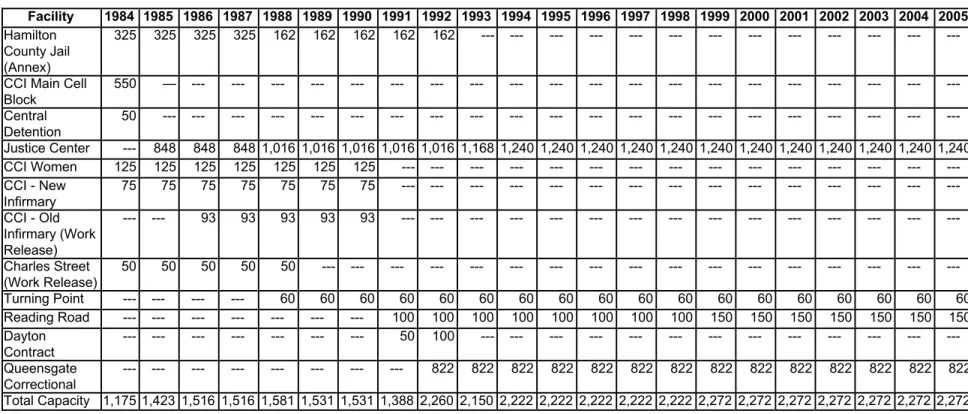
4. The Hamilton County Turning Point Facility (Turning Point), located at 2605 Woodburn Avenue, houses up to 60 minimum security inmates. This facility opened in 1988 and is operated by Talbert House. This facility was intended for multiple DUI offenders. Talbert House owns this facility and provides treatment staff; the County is responsible for security staff and operations. Hamilton County is one of the largest local correctional systems in the United States with current capacity of 2,272. As a result, it is not surprising that there are multiple facilities, with different missions, at different locations. In fact, the current situation represents a consolidation of multiple facilities which were previously operated by the City of Cincinnati and Hamilton County. Table 1.1 provides a summary of the multiple facilities with their associated capacities.
Facility 1984 1985 1986 1987 1988 1989 1990 1991 1992 1993 1994 1995 1996 1997 1998 1999 2000 2001 2002 2003 2004 2005 Hamilton
County Jail (Annex)
325 325 325 325 162 162 162 162 162 --- --- --- --- --- --- --- --- --- --- --- --- ---CCI Main Cell
Block 550 — --- --- --- --- --- --- --- --- --- --- --- --- --- --- --- --- --- --- --- ---Central Detention 50 --- --- --- --- --- --- --- --- --- --- --- --- --- --- --- --- --- --- --- --- ---Justice Center --- 848 848 848 1,016 1,016 1,016 1,016 1,016 1,168 1,240 1,240 1,240 1,240 1,240 1,240 1,240 1,240 1,240 1,240 1,240 1,240 CCI Women 125 125 125 125 125 125 125 --- --- --- --- --- --- --- --- --- --- --- --- --- --- ---CCI - New Infirmary 75 75 75 75 75 75 75 --- --- --- --- --- --- --- --- --- --- --- --- --- --- ---CCI - Old Infirmary (Work Release) --- --- 93 93 93 93 93 --- --- --- --- --- --- --- --- --- --- --- --- --- --- ---Charles Street (Work Release) 50 50 50 50 50 --- --- --- --- --- --- --- --- --- --- --- --- --- --- --- --- ---Turning Point --- --- --- --- 60 60 60 60 60 60 60 60 60 60 60 60 60 60 60 60 60 60 Reading Road --- --- --- --- --- --- --- 100 100 100 100 100 100 100 100 150 150 150 150 150 150 150 Dayton Contract --- --- --- --- --- --- --- 50 100 --- --- --- --- --- --- --- --- --- --- --- --- ---Queensgate Correctional --- --- --- --- --- --- --- --- 822 822 822 822 822 822 822 822 822 822 822 822 822 822 Total Capacity 1,175 1,423 1,516 1,516 1,581 1,531 1,531 1,388 2,260 2,150 2,222 2,222 2,222 2,222 2,222 2,272 2,272 2,272 2,272 2,272 2,272 2,272 Table 1.1 Hamilton County Facilities and Capacity by Year
Information in Table 1.1 was assembled from previous studies completed by Voinovich Companies and URS, updated with the assistance of the Sheriff’s Office and County Administration. It is very difficult to track capacity in the early years and the numbers in this table had to be extracted from a variety of studies. There are also periods when capacity was available for only a portion of the year; 1992, when Queensgate opened is a good example. However, this table clearly shows an initial period of expansion (1985-1991) associated with the development of the Justice Center (HCJC) and consolidation of CCI (the Work House) housing, the Charles Street Work Release Center, the County Jail and Central Detention into the Queensgate Correctional. Since 1999, capacity within the system has remained constant at 2,272 inmates. Table 1.2 provides a summary of the sequence of events represented by capacities in Table 1.1.
Year Comments
1976 Federal Court orders closure of the Work House (CCI) within two years.
1978 Federal Court orders closure of the Work House (CCI), but allowed to continue operations with 79 court orders
1979 Gruzen and Partners estimated correctional population of 1,000 - 1,100. Proposed a major downtown facility adjacent to the Courthouse and a minimum security facility. Proposed the replacement of the Work House and Charles Street Work Release by the two proposed facilities.
1979 City corrections costs results in their rescinding ordinances and charging all inmates under State Statute
1979 City proposes 1010 Broadway for County minimum security facility. County counters with Drake Hospital as minimum security facility. 1979 Friedlander Pavilion renovated for first time DUI offender program
1979 Architects retained for HCJC
1981 County takes over City Corrections in August
1982 Drawings for HCJC complete in May, with construction following immediately
1985 Hamilton County Jail was court ordered to single cell after years of double and triple celling. 1985 Justice Center opened August 1985 and CCI main cellblock and Central Detention closed. 1986 County remodeled Womens' Section and Old Infirmary
1987 County obtains Federal Court population cap for old jail 1987 Early release of inmates begins
1988 Charles Street Work Release Center closed in September 1988
1988 Turning Point relocates to present location from Rollman Psychiatric Hospital 1988 Phase I of double celling the Justice Center begins in June
1991 Reading Road opens May 1991 to house intermediate and extended treatment DUI offenders 1991 CCI closed June 1991 to prepare for minimum security facility construction
1991 Dayton contract initiated in May 1991 - February 1992 1992 Queensgate opens in August 1992
1993 Hamilton County Jail closed January 1993 1993 Phase II double celling begins in March 93 1994 Phase II double celling completed
1999 Reading Road renovated third floor to add capacity for male treatment program
Review of Table 1.1 and Table 1.2 suggests that Hamilton County has considerable experience with the problems associated with correctional crowding and conducting contemporary correctional operations and programs in older facilities, which are challenging and expensive to maintain. To some degree, the current situation is somewhat reminiscent of the situation in which the County found itself in the late 1980's. For the last 10 years, correctional institutional capacity has remained constant while correctional populations have continued to increase. While the County and its criminal justice partners have implemented a variety of alternatives to incarceration, which will be discussed in section six of this document, in 2005, the County once again has the need to examine the needs of its correctional system.
Year Comment
1978 Cincinnati Institute of Justice developed a community corrections planning study for the City, recommending a combined City and County capacity of 1,000, raising the issue of an integrated system and identifying alternatives (1)
1979 Gruzen and Partners develops program and master plan for HCJC. This included a 160 bed low security facility. Analysis includes potential use of 1010 Broadway as a minimum security alternative with potential start up of construction in 1980.
1980 Cincinnati Institute of Justice prepares an inmate population study for Hamilton County. 1981 Planning for HCJC begins with target capacity of 750 beds
1982 Planning firm indicates 848 + 300 (1,148) would last to 2000, reached within 3 years. State of Ohio approved this plan contingent upon the construction of an additional 300 bed minimum security facility.
1983 Local study indicates increases in inmates held on felony charges, longer sentences and 100% increase in presentenced inmates 1985 HCJC opens
1985-86 Alternatives to Incarceration Committee met to examine alternatives(2) 1986-87 Focus on convicted misdemeanor productivity (3)
1986 County develops jail overcrowding reduction plan (4)
1986 URS indicates a need for 500-700 additional jail beds in the short-term and 800 additional during the next two decades
1986 Voinovich Consultants retained to analyze correctional needs. They recommend a new minimum security facility addition to HCJC of 1,414 beds.
1987 Voinovich Consultants studies several sites for a facility with final recommendation accepted in August 1987. Most notable site is Drake Hospital.
1987 County selects architectural firm and initiates planning and approval process with the State of Ohio. 1988 Final approval of construction documents scheduled for September 1988.
1989 KZF & Voinovich indicates that a total of 2,108 beds would last until 2010, exceeded within 5 years 1991 County bids a 1,500 bed facility, but facility is not built
1991 County submits Phase I and II Report to Bureau of Adult Detention (BAD) for approval of Queensgate. Design objectives indicate "due to the temporary nature of the facility, all building components will be designed to be functional in the most economical means possible.” Aesthetics will be minimized in order to provide proper emphasis on health and safety issues." Architectural character states that the warehouse was abandoned at this time. Conclusion of this report provides insight into the nature of the planning process and assumptions about the future. (5)
1991 Negotiations with CCA to modify a 100 year old warehouse to lease back to the County for minimum security inmates 1992 Hamilton County Criminal Justice Task Force submits final report (6)
Year Comment
1994 County Administration recommends expansion of the system by 85 jail alternative beds, 300 bed justice center expansion, 100 beds from double celling expansion, 200 beds in a community corrections facility and 50 slots in CHIPS (electronic monitoring) expansion.
This internal memo anticipated that Queensgate would be phased out by 1999. (7)
1996 Senate Bill 2 returns 4th and 5th degree felons to the county rather than prison, resulting in 1,000 added inmates (estimate by URS) 1999 County renews lease at Queensgate facility for three years, then three years more on an annual basis
2004 County solicits consultants for master planning/systems study
Table 1.3 Summary of Correctional Planning Initiatives (1) Community Corrections Study Alternatives (1978)
1. Alcohol Safety Action Project (ASAP) established in 1972 to address DUI issues at 18 capacity. This program has been replaced by a broad spectrum of statutorily required programs that address driving and drinking issues.
2. Alcohol Detoxification Center was in place at this time with a capacity of 12. This facility was closed between 1985 and 1991.
3. Greater Cincinnati Bail Project began in 1974 to provide pretrial release information to the court. Continues today with significant level of services.
4. Stationhouse release program began as a police diversion program in 1973. This process has continued and has been expanded. Although there are variations among law enforcement agencies, stationhouse release is used through lower level felony offenses. In addition, cases are sometimes “booked and released” for purposes of identification and “process only” cases occur, resulting in a broad spectrum of physical arrests which do not result in a defendant’s remaining in custody.
(2) Alternatives Committee Recommendations (1985-1986)
1. Expansion of Bail Information and Bail Review by Greater Cincinnati Bail Project. Adopted
2. Recommended reduction in weekend sentencing and split sentencing. Partially adopted
3. Recommended hiring court expediter. Adopted
4. Recommended implementing jail statistics gathering. Adopted
5. Recommended analysis of home incarceration. Adopted current electronic monitoring program
6. Recommended multiple DUI Offender program. Talbert House operates this program. (3) Productivity Actions (1986-1987)
1. Contracted with Talbert House for female work release. Adopted but work release has been replaced by electronic monitoring today.
2. Expanded work release in the Old Infirmary at CCI by 1992. Eliminated by 1991, using less restrictive alternatives like electronic monitoring for this population
(4) Jail Overcrowding Reduction Plan (1986)
1. Build or renovate minimum security facility. Not adopted, in spite of two planning efforts to do this.
2. Reduce "cot" population immediately by options including work details, multiple DUI program (Guardian Interlock) and home incarceration. Adopted
3. Double cell 2 floors of the Justice Center. Adopted
4. Assembly of project team. Adopted
(5) Conclusion of Phase I and II Bureau of Adult Detention Submittal (1991)
“When the new 1500 bed minimum security facility opens, Hamilton County will have the capacity to house at least 2,400 inmates. In addition to the new facility, the Justice Center which opened in 1985 with a capacity of 848 will remain operational as will “Turning Point” a multiple DUI treatment program with a capacity of 52. The “Old County Jail” located on the sixth and seventh floors of the County Courthouse with a capacity of 162 is scheduled to close with the opening of the new facility.
The other facilities, “Queensgate” and “Reading Road” which were renovated to ease inmate overcrowding pending the completion of the new minimum security facility may remain open if the need for additional inmate beds exists at the time. The Queensgate and Reading Road facilities have capacities of 800 and 100 respectively.” Emphasis added. Capacity of both of these facilities has been expanded since this submittal and both have remained open.
(6) Hamilton County Criminal Justice Task Force Final Report Recommendations (1992)
1. Establish a criminal justice coordinating council to coordinate all the efforts of the criminal justice system in order to better utilize its resources, avoid duplication, set priorities, establish a budget and provide oversight for the entire system.
Council exists and provides some of these functions.
2. Provide additional training to law enforcement in the areas of sensitivity and cultural diversity. Status unknown
3. Police officers should be given more authority to exercise individual judgment and discretion as to if and when to effectuate an arrest. Status unknown
4. Police officers should be encouraged to divert individuals and arrestees with special needs from the criminal justice system and a facility should be established to assist in this effort. Some programs targeting the mentally ill and substance abusers appear to address this.
5. Increase use of mediation and diversion programs prior to criminal prosecutions. Implemented
6. Judges should place greater reliance upon the recommendation of pretrial services with regard to the setting of bonds.
Pretrial services is clearly well developed
7. The County Prosecutor should assume responsibility for all felony prosecutions from arraignment through final disposition, while the City Prosecutor (Solicitor) should be responsible for all misdemeanor prosecutions. The County has assumed responsibility for all felony prosecutions; the City is responsible for misdemeanor prosecutions for the City of Cincinnati.
9. Cases bound over to the Grand Jury from preliminary hearing should ordinarily be presented to the grand jury on the same day as the preliminary hearing. Preliminary hearings have been eliminated in Municipal Court.
10. Improve and increase the use of the plea bargain process. Difficult to assess, although plea bargains are used effectively.
11. Encourage judges to make better use of current alternatives to incarceration. Alternatives are widely used.
12. The Probation Office and County Correctional facilities should seek accreditation under the auspices of the American Correctional Association. Only jail health accreditation has been completed.
13. Update and modernize the criminal justice information system so that all components of the system have equal access to information. Adopted for CMS and JMS, but not for CLEAR.
(7) 1994 County Expansion Recommendations (1994)
1. Justice Center expansion of 300 beds on Board of Education Parking Lot at a cost of $21.5 million. Phasing out part of Queensgate, to deal with higher risk inmates. Not adopted.
2. 100 bed community corrections facility was to be state funded, with work release and then intensive supervision, planned to be expanded to 200 beds. Adopted (River City Facility, diverts Department of Corrections bound inmates). 3. Talbert House contract to be developed for 100 beds for chemical dependency services. Adopted.
4. Turning Point contract to be developed for 52 beds for multiple DUI offenders. Adopted with a capacity of 60 beds.
5. Women's Residential probation program provides 16 beds. Status unclear.
6. Intermediate DUI was implemented and was funded through the Drake Tax levy. Adopted, provided by Talbert House.
7. Jail Alternative programs - 85 slots for a voluntary pre-indictment program, run in conjunction with Drug Court. - Adopted by Health Department as a part of Alcohol and Drug Abuse Programs now 35 beds at Rollman Psychiatric Hospital and 16 beds at Talbert House.
Table 1.3 summarizes correctional planning initiatives completed for Hamilton County during this time period. It is clear that the County has participated in a number of correctional planning initiatives - all of which have had to grapple with the same issues:
• Correctional population exceeds capacity, and predictions regarding future population are often not accurate in the long-term. • The cost of building and operating correctional facilities is significant.
• The time required to plan, design, and build facilities is significant.
• By the time that the situation approaches the threshold of becoming an emergency, the time required to develop a facility solution is past.
• The relationship of facilities and programmatic alternatives is not straightforward. In spite of the best intentions, it is often possible to implement alternatives for a population that is unlikely to remain in jail on a long-term basis.
• Correctional projects are not “popular projects,” and it is sometimes difficult to develop the consensus needed for their support. • There is a strong tendency to look toward immediate solutions to criminal justice issues. This occurs in all jurisdictions for multiple reasons ranging from the emergent nature of the catalyst for the planning effort to the length of facility planning cycles in relation to the political process.
• It is clear that the County has implemented a significant number of the recommendations that deal with alternatives to incarceration and methods to increase the efficiency of the justice system.
It is likely that this project will experience some of the same constraints as these are typical of most correctional planning projects. As a result, this assessment will attempt to focus on developing a clear understanding of how the justice system currently uses its correctional facilities and alternatives, identifying the know changes which are likely to occur, and developing a strategy to address the issues that compensates for known changes while providing flexibility to deal with the unknown.
Risk and Protective Factors
When communities are involved in criminal justice planning projects, they focus on the community’s institutional and systematic response to criminal behavior. In the consultant’s opinion, this is natural, pragmatic, and appropriate. Hamilton County can not address its very pressing correctional problems effectively by implementing crime prevention programs. However, in evaluating future criminal justice needs, it is quite useful to understand the factors which place individuals at risk of becoming involved in criminal behavior and evaluating the degree to which these factors are present in the local environment.
Risk Factors
Extensive research has identified risk factors for crime, violence, and substance abuse. While much of the research has focused on juvenile offenders, it is important to remember that many jail inmates are not much older than juveniles. These factors exist within a communities as a whole, families, schools, peer groups, and within individuals. Some of these risk factors can be modified; others can not. The Office of Juvenile Justice has identified 19 risk factors which place youth at risk.
• Risk Factor 1. Availability of Drugs. The more easily available that drugs and alcohol are in a community, the greater the risk that drug abuse will occur in that community. Perceived availability of drugs in school is also associated with increased risk.
• Risk Factor 2. Availability of Firearms. Firearms, primarily handguns, are the leading mechanisms of violent injury and death in the United States. The easy availability of firearms in a community can escalate an exchange of angry words and fists into an exchange of gunfire. Research has found that communities with greater availability of firearms experience high rates of violent crime, including homicide.
• Risk Factor 3. Community Laws and Norms Favoring Drug Use, Firearms, and Crime. Community norms - the attitudes and policies a community holds concerning drug use, violence, and crime - are communicated through laws, written policies, informal social practices, the media and the expectations that parents, teachers and other members of the community have for young people. Laws, tax rates, and community standards that favor or are unclear about substance abuse or crime put young people at higher risk of delinquency.
• Risk Factor 4. Media Portrayals of Violence. There is growing evidence that media violence can influence community acceptance of violence and rates of violent or aggressive behavior.
• Risk Factor 5. Transitions and Mobility. Communities with high rates of mobility appear to have increased drug and crime problems. The more frequently people within an area move, the greater the risk of criminal behavior.
• Risk Factor 6. Low Neighborhood Attachment and Community Disorganization. Higher rates of drug problems, crime and delinquency occur in neighborhoods where people have little attachment to the community, where rates of vandalism are high, and where there is low surveillance of public places. Perhaps the most significant issue affecting community attachment is whether residents feel they can make a difference in their lives. If the neighborhood’s key players, such as merchants, teachers, police, and human and social service personnel, live outside the neighborhood, residents’ sense of commitment will be less.
• Risk Factor 7. Extreme Economic and Social Deprivation. People who live in deteriorating neighborhoods characterized by extreme poverty, poor living conditions and high unemployment are more likely to develop problems with crime and substance abuse and are more likely to engage in violence toward others during both adolescence and adulthood.
• Risk Factor 8. Family History of High Risk Behavior. Children raised in families with a history of addiction are at increased risk of having drug and/or alcohol problems, and children raised in families with a history of criminal activity are at increased risk of delinquency.
• Risk Factor 9. Family Management Problems. Poor family management practices, such as not having clear expectations for behavior, failure to supervise and monitor children, as well as excessively harsh or inconsistent punishment, are at higher risk. • Risk Factor 10. Family Conflict. Conflict between family members is more important for predicting criminal behavior than family
structure.
• Risk Factor 11. Parental Attitudes and Involvement in Problem Behaviors. Parental attitudes and behavior toward drugs and crime influence the attitudes and behavior of children. Children in families in which these behaviors are present are at greater risk of the same behavior - particularly if parents involve children in the behavior.
• Risk Factor 12. Early and Persistent Antisocial Behavior. The earlier that aggressive behavior appears, the higher the risk of substance abuse, delinquency and violence.
• Risk Factor 13. Academic Failure Beginning in Late Elementary School. Academic failure increases the risk of all of the problems listed above. The experience of failure - regardless of the reason - increases the level of risk.
• Risk Factor 14. Lack of Commitment to School. Children who are not committed to school are at higher risk of problem behaviors. • Risk Factor 15. Rebelliousness. Young people who are alienated or actively rebellious are at higher risk of drug abuse and
delinquency.
• Risk Factor 16. Friends who Engage in the Problem Behavior. Young people who associated with peers who present the problem behaviors are at higher risk of the same behavior.
• Risk Factor 17. Favorable Attitudes toward the Problem Behavior. In elementary school, most children express drug, anti-crime and pro-social attitudes. However, by middle school, their attitudes shift toward greater acceptance of the problem behaviors as others they know participate in these activities. This acceptance places them at higher risk.
• Risk Factor 18. Early Initiation of Problem Behaviors. The earlier that young people exhibit the problem behaviors, the more likely they will have chronic problems with the behavior later in life.
• Risk Factor 19. Constitutional Factors. Some constitutional factors (biological or physiological) contribute to the problem behaviors. These factors, such as sensation seeking, low harm avoidance and lack of impulse control, increase the risk of young people participating in the problem behaviors.
Protective Factors
These materials are taken from the OJJDP Publication, “Risk Factors for Delinquency: An Overview” by Michael Shader. Research also suggests that there are influences that can “buffer” the impact of risk factors. These risk factors exist in four domains.
• Protective Factor Domain: The Individual. There are at least five factors which relate directly to the individual and appear to mediate risk.
• The individual has an intolerant attitude toward deviance. • The individual has a high IQ.
• The individual is female.
• The individual has a positive social orientation. • The individual perceives sanctions for transgressions
• Protective Factor Domain: The Family. There are at least three factors which relate directly to the family and appear to mediate risk.
• There are warm, supportive relationships with parents or other adults. • The parents see the individuals peers as a positive influence.
• Parents monitor individual behavior.
• Protective Factor Domain: The School. There are at least two factors which relate directly to the individual’s involvement in school. • The school promotes the individual’s commitment to school.
• The school recognizes the individual’s involvement in conventional activities.
• Protective Factor Domain: Peer Group. There is one factor associated with the peer group. The individual has friends who engage in conventional behavior.
Recidivism and the Risk and Protective Factors
One of the underlying themes in much recent criminal justice research focuses on the prevention of recidivism - both from an effectiveness and a cost-efficiency perspective. There is considerable evidence that incarceration by itself does little to change future criminal behavior. Most studies of general recidivism have focused on recidivism in prison settings. The Bureau of Justice Statistics Special Report, “Recidivism of Prisoners Released in 1994" found that among nearly 300,000 prisoners released in 15 states in 1994, 67.5% were re-arrested within three years. A similar 1983 study found that 62.5% were re-re-arrested within the same period.
There is little research in jail environments, and the research that the consultant has found is primarily evaluation of specific programs. However, in systems in which the consultant has been able to identify recidivism within a specific jail, it has generally ranged between
50% - 60% within a one year period. As a result, a reasonable starting position would be that jail inmates are equally prone to recidivism. It also seems equally clear that the factors which place an individual at risk of criminal behavior relate to recidivism.
As Hamilton County considers how to address its correctional facility needs, it may be useful to think about criminal behavior from two perspectives:
• The degree to which the risk factors are present in the community - or communities - which comprise the County will be a good indicator of the degree to which future criminal behavior can be expected.
• The County may need to think about criminality in much the same way that drug and alcohol treatment providers think about an individual’s potential to relapse. If we “treat” the criminal behavior by what occurs as a part of a court imposed sanction, then to prevent recidivism, there must be a strategy to prevent relapse.
Conclusion
1. Over the past thirty years, Hamilton County has spent a great deal of time, effort and resources studying criminal justice facility and programmatic needs. It is clear that recommendations which resulted in the development of both programmatic and procedural alternatives to incarceration have, for the most part, been implemented. However, recommendations for the construction of facility-based solutions have not been implemented. Specifically, two prior recommendations for the development of a minimum security facility have been rejected. These choices have led to the current situation the County faces at the Queensgate facility and to the current capacity limitations.
2. In reality, effective criminal justice solutions require a balance of facility-based and community-based solutions. Alternatives inevitably fail if the system lacks facility capacity for those who are non-compliant with alternatives or who require a period of stabilization to succeed in alternative programs. Programs which are confined to facilities fail when they do not include a strong linkage through re-entry planning to a continuum of services, which includes some less secure residential options.
3. This document is not intended to direct the crime and delinquency prevention activities of Hamilton County, and the consultant is not suggesting that the County attack these larger social issues before it addresses its more immediate correctional facility needs. However, the degree to which these risk factors exist within the various communities in the County ultimately, to a large degree, determines future demand on both the criminal justice and human service systems in the County. All communities experience these risk factors to a greater or lesser degree. As the County develops a plan to meet its correctional facility needs, it may be wise to consider the degree to which these factors will continue to affect them.