Industrial Design Conference Presentations, Posters
and Proceedings Industrial Design
6-14-2015
Exploring the Effects of Problem Framing on
Solution Shifts: A Case Study
Samuelina M. Wright
University of Michigan-Ann Arbor
Eli M. Rutgers
The State University of New Jersey
Shanna R. Daly
University of Michigan-Ann Arbor
Kathryn W. Jablokow
Pennsylvania State University, Great Valley
Seda Yilmaz
Iowa State University, [email protected]
Follow this and additional works at:http://lib.dr.iastate.edu/industrialdesign_conf
Part of theEngineering Education Commons, and theIndustrial and Product Design Commons
This Conference Proceeding is brought to you for free and open access by the Industrial Design at Iowa State University Digital Repository. It has been accepted for inclusion in Industrial Design Conference Presentations, Posters and Proceedings by an authorized administrator of Iowa State University Digital Repository. For more information, please [email protected].
Recommended Citation
Wright, Samuelina M.; Rutgers, Eli M.; Daly, Shanna R.; Jablokow, Kathryn W.; and Yilmaz, Seda, "Exploring the Effects of Problem Framing on Solution Shifts: A Case Study" (2015).Industrial Design Conference Presentations, Posters and Proceedings. 11.
Exploring the Effects of Problem Framing on Solution Shifts: A Case Study
Abstract
Exploring the Effects of Problem Framing on Solution Shifts: A Case Analysis Both students in engineering and practicing engineers are continually challenged with new problems to solve. We propose that the way the problem is presented will influence the engineer’s ideation processes, and eventually, the design outcomes. In our previous research, we developed three categories of framings for design problem statements based on Kirton’s Adaption-Innovation theory: (1) neutral framing, (2) adaptive framing, and (3) innovative framing. The neutral framing is intended to leave designers uninfluenced with respect to their natural ideation processes. The adaptive framing offers additional constraints to the problem,encouraging designers to generate practical solutions based on pre-existing designs. The innovative framing is constructed to push designers towards radical solutions that are not based on pre-existing designs. In this paper, we aimed to test to what extent and in what ways students shift their design ideas based on how the design problems were
framed.A study was conducted with 36 prospective engineering students participating in a high school summer outreach program at a large Midwestern university. Students were first given a neutrally framed problem statement and asked to generate solutions to the problem using visual and verbal depictions. After this ideation session, they were given either an adaptively or innovatively framed problem statement for a different design problem. Following each ideation session,students were asked to complete a reflection survey to provide some insight into how they perceived their own ideation during the session.We used the concept of paradigm relatedness as our primary lens to explore how students’ ideas were influenced by different problem framings. Paradigm relatedness was defined as the extent to which an idea preserves the focus, assumptions, elements, and relationships associated with the problem definition. Based on these four facets of paradigm relatedness, ideas from the study were coded into one of two general types of paradigm relatedness: paradigm preserving and paradigm modifying. Using the coded results, we analyzed the effect of problem framing on the paradigm relatedness of individual solutions. We identified students whose ideas shifted between paradigm modifying and paradigm preserving when framing changed, as well as students whose ideas remained consistent within one type of paradigm relatedness despite framing changes. We analyzed cases of students of each type, using their generated idea sets and reflection surveys to describe the influence of the framed design problem statements on their ideation approaches.
Disciplines
Engineering Education | Industrial and Product Design Comments
This is a proceedings from2015 ASEE Annual Conference and Exposition, June 14-17, 2015. Posted with permission.
Rights
© 2015 American Society for Engineering Education. Other scholars may excerpt or quote from these materials with the same citation. When excerpting or quoting from Conference Proceedings, authors should, in addition to noting the ASEE copyright, list all the original authors and their institutions and name the host city of the conference
Paper ID #11638
Exploring the Effects of Problem Framing on Solution Shifts: A Case Study
Ms. Samuelina M. Wright, University of MichiganSamuelina Wright is a senior in Mechanical Engineering at the University of Michigan. She has worked in design and ideation research for over a year. Her focus has been on quantifying the diversity of so-lution sets, studying design problem framing, and exploring paradigm relatedness. She is interested in engineering education, which is where her passion for teaching and her technical background in engineer-ing overlap. As an engineerengineer-ing designer herself, she is interested in understandengineer-ing individuals’ ideation processes and how those processes can be improved and expanded.
Eli M. Silk, Rutgers, The State University of New Jersey Dr. Shanna R. Daly, University of Michigan
Dr. Kathryn W. Jablokow, Pennsylvania State University, Great Valley
Dr. Kathryn Jablokow is an Associate Professor of Mechanical Engineering and Engineering Design at Penn State University. A graduate of Ohio State University (Ph.D., Electrical Engineering), Dr. Jablokow’s teaching and research interests include problem solving, invention, and creativity in science and engineer-ing, as well as robotics and computational dynamics. In addition to her membership in ASEE, she is a Senior Member of IEEE and a Fellow of ASME. Dr. Jablokow is the architect of a unique 4-course mod-ule focused on creativity and problem solving leadership and is currently developing a new methodology for cognition-based design. She is one of three instructors for Penn State’s Massive Open Online Course (MOOC) on Creativity, Innovation, and Change, and she is the founding director of the Problem Solving Research Group, whose 50+ collaborating members include faculty and students from several universities, as well as industrial representatives, military leaders, and corporate consultants.
Prof. Seda Yilmaz, Iowa State University
Dr. Yilmaz is an Assistant Professor of Industrial Design. She teaches design studios and lecture courses on developing creativity and research skills. Her current research focuses on identifying impacts of differ-ent factors on ideation of designers and engineers, developing instructional materials for design ideation, and foundations of innovation. She often conducts workshops on design thinking to a diverse range of groups including student and professional engineers and faculty member from different universities. She received her PhD degree in Design Science in 2010 from University of Michigan. She is also a faculty in Human Computer Interaction Graduate Program and the ISU Site Director for Center for e-Design.
c
American Society for Engineering Education, 2015
P
Exploring the Effects of Prob
lem Framing on Solution Shifts:
A Case Analysis
Abstract
The way design problems are presented may influence an engineer’s ideation process, and eventually, the design outcomes. We aimed to explore the ways in which pre-engineering students shift their design ideas based on different framings of design problems. We evaluated ideas with respect to the metric of paradigm-relatedness, which refers to the extent to which an idea works within the explicitly stated and commonly understood bounds of a problem, versus moves beyond those bounds. Thirteen prospective engineering students participated in the study. Students were first given a problem statement framed in a way that didn’t encourage any
particular type of solution. The students were asked to generate solutions to the problem using visual and verbal depictions. Subsequently, they were given a second problem framed either to encourage practical solutions based on pre-existing designs or framed to encourage radical solutions not based on pre-existing designs. Ideas were coded as either paradigm-preserving or paradigm-modifying. We identified students whose ideas shifted from more of one type to more of another from their first ideation session to their second, as well as students whose ideas remained consistent. We analyzed their generated idea sets and reflection questionnaires to describe the influence of the framed design problem statements on their ideation approaches. The findings illustrate that problem framing can influence the paradigm-relatedness of ideas
generated in a design tasks, both in more adaptive directions and in more innovative directions. However, our findings also illustrate that problem framing is not always successful in causing an individual to shift in their ideation approach, and so additional factors such as individuals’ cognitive styles should also be taken into account.
Introduction
The importance of the design process as a key to innovation is well established.1,2 However, simply implementing a design process is not guaranteed to lead to innovative outcomes. Innovative solutions are more likely to result when designers are more explicit about the way a problem is framed or scoped, and choose to either work deliberately within that frame or to seek out alternative frames.3–5 By working within given or well-understood frames for understanding a problem, one can utilize the design process to improve existing ideas incrementally and optimize their value.6 Alternatively, a designer can change the given frame and look at the problem in way that hasn’t been used before, potentially leading to radically new solutions to consider. Successful and experienced designers are proactive in problem framing, and use those different frames to direct their search for possible solutions.7 Schön8 described how designers
frame a problematic design situation by setting its boundaries and selecting particular objects and relations for attention, and then use that frame to impose a coherence that guides their subsequent design activities. In sum, how designers frame a problem can have a productive influence on the kinds of solutions they will consider.
There is some evidence to suggest that individuals have stable, natural tendencies when it comes to generating ideas to solve problems. Kirton9,10 describes these stable, natural tendencies as
one’s cognitive style. According to the theory underlying cognitive style, some individuals prefer to generate more incremental ideas (referred to as adaptive ideas), while others prefer to generate
P
more radical ideas (referred to as innovative ideas). Still others may prefer to generate ideas somewhere along the continuum from incremental to radical. Designers may choose to actively frame a problem in ways that are consistent with their cognitive style, and thus reinforce their preference to generate ideas of one type or another.
Although designers may use their own experience or cognitive style to guide their problem framing, situational factors may ultimately determine what sort of framing is best suited for generating innovative solutions in a particular problem context. In some cases, the ideal outcome is a radical shift from the current state, and in other instances, the ideal outcome is an
improvement that better optimizes the way it is currently done.11 In still other cases, the ideal outcome may lie somewhere in the middle of a radical or incremental change. Since the ideal outcome depends so much on the particulars of the situation, there is no inherent or absolute greater or lesser value attached to a solution that shifts far from the existing paradigm versus one that stays close within the existing paradigm. Radical change and incremental change are likely both valuable for innovation as each is necessary in specific situations.
As one’s natural ideation style may not always match what is necessary in a particular situation, there exists a need for tools or strategies that facilitate one’s flexibility in generating ideas that are different than their natural approaches. One such tool is actively reframing the problem for the designer by re-wording, re-describing or re-emphasizing features of the written problem statement. For example, Spradlin12 relates how a clear statement of the core issues of a problem can help make the problem accessible to a diverse range of individuals, including those with expertise far outside the problem’s domain. Problem statements can be framed in many different ways, as there are many different features of a problem, including what sorts of details or
examples are given or what the goals for the designer should be. In this paper, we consider how problem framings may specifically encourage more radical or more incremental ways of
approaching a problem. Our goal was to look at specific cases in which engineering students did or did not make shifts in the types of solutions they generated based on a different framing of the problem. Through analysis of these situations, we can better understand how problem framing can serve as a tool to facilitate flexibility in how individual designers approach design problems and generate innovative solutions.
This work is part of a larger series of studies with goals to understand and improve the flexibility with which engineering students approach idea generation. Students may come to engineering programs with their own preferences for how to approach design problems, or may develop those preferences in their engineering programs. But in order to maximize their innovative capacity, there may be value in helping those students to develop comfort and skills to deviate from their preferred ideation when other approaches may be better suited to a particular problem. Our larger project13 considers a range of ideation interventions—such as ideation tools and teaming—and a range of ideation outcomes—such as variety and elaboration. However, this current study was primarily focused on one such intervention – problem framing – and one such outcome –
paradigm-relatedness. To that end, the research question guiding this present study was: In what ways do different problem framings influence the paradigm-relatedness of design ideas
generated by beginning engineering students?
P
Background Idea Generation
Idea generation is part of any open-ended problem-solving process where there are multiple options that could be pursued. Idea generation occurs most notably in the early stages of design, when designers propose solution options that they will later explore and refine (or reject). The goal in idea generation is to find and explore those possible options, in which some options are obvious, and others require more time and effort to find. Innovative outcomes are often traced to this idea generation phase of design, as the range and quality of those early concepts structure and limit which ideas can be developed further into final solutions.14,15
Design research indicates that successful ideation involves both divergent and convergent thinking, meaning there are times in the process when designers generate multiple ideas for consideration, as well as times when designers narrow down the selection of ideas and elaborate on the details of one (or a few) of them.16–18 More, and more varied, ideas increase the potential for more innovative design outcomes as a designer is considering a larger portion of the solution space and increasing the number of possibilities available during concept evaluation and
selection.14,15 This, in turn, increases the potential for generating a design solution that best meets a problem’s given constraints. However, it may also be the case that particular types of solutions are more productive for particular types of problems, and so simply considering more ideas and more diverse ideas may not be effective if those ideas aren’t especially suited for the particular problem. Regardless of whether there is one ideal approach to idea generation or different approaches suited for different problems, idea generation plays a valuable role in achieving innovative outcomes to complex design problems.
Paradigm-Relatedness
Researchers interested in supporting creative idea generation seek to evaluate different tools and methods to help designers come up with creative ideas. However, at a more basic level, they need to be able to identify what counts as a creative idea in order to properly evaluate those tools and methods. Different metrics and ways to analyze creative products and ideas have
emerged,19,20 but there is not a consensus about which one dimension or characteristic of an idea is the most important. Some researchers suggest that in order for an idea to be creative it has to be both useful and novel.21,22 It turns out that both usefulness and novelty are difficult to
precisely define and likely have a number of sub-constructs or dimensions.
Dean et al.21 reviewed many different studies of idea evaluation and concluded that novelty can best be understood as two related constructs, originality and paradigm-relatedness. Paradigm-relatedness refers to the extent to which an idea either works within or challenges the currently prevailing paradigms, frames or habitual routines used to constrain and think about a particular problem. On one end of the paradigm-relatedness construct are paradigm-preserving ideas, which emerge from and operate within existing ways of thinking about a problem. Paradigm-preserving ideas are evolutionary in their nature. On the other end are paradigm-modifying ideas, which are revolutionary in that they emerge from and operate within redefined boundaries or
modifying ideas have their own benefits and are equally valuable in an exploration of the solution space.
Paradigm-relatedness is often related to cognitive style9,10 as paradigm-preserving ideas are thought to be consistent with a more adaptive cognitive style, and paradigm-modifying ideas are thought to be consistent with a more innovative cognitive style. Providing some support for the relationship between cognitive style and relatedness, research that assessed paradigm-relatedness in idea generation found that more innovative individuals did tend to generate more paradigm-modifying ideas than more adaptive individuals.23 However, the same study found that cognitive style was not the only aspect that influenced paradigm-relatedness, as exposing
individuals to either paradigm-preserving or paradigm-modifying example ideas also influenced those individuals to generate more ideas of that particular type.23 So although cognitive style
may play a role in the types of ideas that designers generate, there is still opportunity for interventions or situational characteristics to have an influence as well.
Design Problem Framing
Much of the prior research on paradigm-relatedness has focused on the influence of example ideas as stimuli to encourage designers to generate ideas of one type or another.23–25 To the best of our knowledge, the role of the problem statement itself has not been studied directly. As we have detailed in our previous research,26 there are many features of problem statements that can be framed in different ways to influence the approach taken by the designer. Problem framing basically refers to the alternative ways a problem can be stated or communicated, even when the underlying problem is the same. Framing effects can have a large effect on decision-making generally,27,28 but are equally relevant for studying design ideation in particular. For example, there is evidence that it is possible to frame design problems to emphasize ideation goals such as quantity,29 novelty,30 or creativity31 of ideas. What is not as well studied is whether design problem statements can be framed in ways that impact the paradigm-relatedness of ideas. In our prior work,26 we suggested that it is theoretically likely that manipulating the constraints and the criteria of a given problem statement will influence paradigm-relatedness. In particular, we proposed that in order to encourage more paradigm-preserving ideas, design problems should include more specified constraints, along with criteria that place more value on solutions that build on already existing solutions to the same or similar problems. In contrast, to encourage more paradigm-modifying ideas, design problems should include criteria that place more value on solutions that are radically different from existing solutions, and should explicitly instruct the designer not to be bound by specific constraints. The influence of alternative problem framings on the paradigm-relatedness of generated ideas is now the subject of this current study. We take the next step toward understanding empirically whether individuals actually respond to
alternative problem framings in the ways that we hypothesized. Methods
As an overview, our study was designed to provide us with case data of the influence of problem framing on the paradigm-relatedness of generated ideas. We conducted the study with pre-engineering students who each participated in two ideation sessions. In the first session, the students all generated ideas with a design problem framed in a neutral way so as not to
encourage generating ideas of one type or another. In the second session, students were randomly
P
assigned to either a design problem framed to encourage paradigm-preserving ideas or a design problem framed to encourage paradigm-modifying ideas. After each session, the students completed a reflection questionnaire. We then coded the ideas the students generated with respect to paradigm-relatedness and looked for cases that demonstrated when the problem framing did have an impact and when it did not. Finally, the cases were used to illustrate and better understand how problem framing influenced the paradigm-relatedness of the generated ideas.
Participants
The participants of the study were 13 high school students (2 female, 11 male) attending a summer outreach program for prospective engineering students at a large Midwestern university. All of the students had just completed their eleventh grade year of high school and were either 16 or 17 years of age. All had expressed a desire to major in engineering in college.
Materials
Design Problems
There were two design problem contexts used in the study so that students would be able to generate ideas in a different problem context for each of their ideation sessions. Since we aimed to understand the effect of framing on the initial set of ideas that students generate, we chose to expose the students to a new problem in each session. This approach provides a bigger separation between the ideation sessions and allows for a potentially larger impact of the change in framing. The two problem contexts were titled Lids and Snow, and both were adapted from prior design research.32–34 In our prior work,26 we developed a design problem framework that included a
more detailed description of the development of the problem statements. For the purposes of the current study, we review some of the critical points. The Lids problem challenged students to design a way for individuals who have limited or no use of one upper extremity to open a lidded food container with one hand. The Snow problem challenged students to design a way for individuals without lots of skill and experience skiing or snowboarding to transport themselves on snow.In addition to a needs statement, each problem included a paragraph for background context and brief instructions. Both problem contexts were modified into three different framings: (1) neutral framing, (2) adaptive framing, and (3) innovative framing. The neutral framing was intended to leave designers uninfluenced with respect to their natural ideation processes. In theory, the neutral framing would provide designers the freedom to generate whatever types of ideas that they most preferred. The adaptive framing imposed additional constraints to the problem, and explicitly encouraged designers to generate practical solutions based on pre-existing designs. We hypothesized that students given an adaptively framed problem would be more likely to generate a greater proportion of their ideas as paradigm-preserving. The innovative framing was constructed to encourage the designers to generate radical solutions that were not based on pre-existing designs. We hypothesized that students given an innovatively framed problem would be more likely to generate a greater proportion of their ideas as paradigm-modifying. The complete set of problems is included in Appendix A. The problem descriptions used in the study were not explicitly labeled as neutral, adaptive, or
innovative when they were presented to the students, however the bolded statements did attempt to make explicit and salient the particular types of ideas that were being encouraged.
P
Reflection Questionnaire
We used a post-ideation reflection questionnaire to assess how students perceived the concepts they generated and their perception about the framing of the design problem statement. The questionnaire included both Likert scales and open-ended questions. For example, questions included: “On a scale from 1 to 7, how creative do you feel that your ideas were?” and “Imagine that you asked a co-worker to generate additional solution ideas for this same design problem. In a few sentences, explain to your co-worker what to focus on when coming up with their own solution ideas.” The full list of questions is included in Appendix B.
Procedure
The study included two sequential ideation sessions, which lasted approximately 90 minutes in total. After a brief introduction to the role of idea generation in the design process, each student was randomly given a neutrally framed version of one of the two design problems. The students had 20 minutes to generate ideas individually. The students were instructed to record each new idea on a separate page using a structured idea sheet with designated space for visual sketches and for verbal descriptions. Following this first ideation session, the students responded to the post-activity reflection questionnaire individually. They were given 10 minutes to complete the questionnaire. After a short break, the students were randomly assigned to either an adaptively or an innovatively framed design problem for the second ideation session. They were given
whichever problem context they had not been given in the first session. To minimize the potential for an order effect, we counterbalanced the order of the problem contexts, such that some participants received the Snow problem first and the Lids problem second, and others received them in the reverse order. Students were again given 20 minutes to generate ideas. At the conclusion of the second ideation session, students completed another post-activity reflection questionnaire.
Analysis Plan
In order to analyze cases that illustrate the influence of problem framing on
paradigm-relatedness, we first coded all of the generated ideas with respect to paradigm-paradigm-relatedness, and then were intentional in how we selected cases that illustrated both when problem framing did impact paradigm-relatedness as well as when it did not. We utilized the actual ideas that students generated to be the primary data source for assessing whether a change occurred. We then utilized students’ responses on the reflection questionnaire as the primary data source for determining to what extent and in what ways the students were aware of the influence of the problem framing on the types of ideas they generated.
Paradigm-Relatedness Coding
Each idea generated by the participants was coded for paradigm-relatedness. Our coding scheme was consistent with prior studies on idea generation and paradigm-relatedness.23–25 In their review of the literature on idea evaluation, Dean et al.21 found that paradigm-relatedness can best be evaluated by considering the elements of the problem and the relationships between those elements. Paradigm-preserving ideas use elements commonly found in the problem context, and maintain the relationships between those elements. For example, in our Snow problem context
P
typical solutions include skis, snowboards, and other common modes of transportation on snow. For each common element there are usually typical ways that the element relates to other
elements or to the user. For example, skis are usually placed on the user’s feet and controlled by the user’s shifting weight. In contrast, paradigm-modifying ideas may introduce new elements not commonly found in the problem context, or alter the relationships between elements in a problem, or both. Staying with the Snow problem context, an uncommon element could be a something like a harpoon that a user shoots and then pulls them along. Harpoons are not
commonly used in transportation generally or in snow transportation specifically. An example of change in relationships could be an idea that has the user orient themselves differently with respect to a common element, such as designing a way for user to kneel on skis and use their hands to shift their weight and the angles of the skis for control. Dean et al.21 found that using a
context-specific coding scheme was required to effectively evaluate paradigm-relatedness. To that end, we developed a coding manual specific for the Lids problem and another for the Snow
problem that included examples of both paradigm-preserving and paradigm-modifying elements and relationships in each context.
In addition to elements and relationships, other research has looked at the focus and assumptions of the problem context to identify the paradigm-relatedness of ideas.24 Focus and assumptions refer to whether an idea solves the problem as explicitly stated in the problem statement, or rather, solves a larger problem or violates a given assumption. For example, a
paradigm-preserving idea for the Snow problem would include an individual transporter, as asked for in the problem statement. In contrast, a paradigm-modifying idea could recognize that a larger problem is moving a user from one location to another, and so it may not be necessary to have the user control the transporter individually. For example, skis and snowboards and modifications thereof are paradigm-preserving as they rely on the individual user to provide the primary means of control. However, a paradigm-modifying idea could include a solution that uses some sort of public transportation or shared solution that still moves individuals from one place to another, but doesn’t require the user to learn how to control the device. This kind of idea effectively solves a larger problem while violating one of the stated assumptions of the problem. For this study, an idea was coded as paradigm-preserving if both the elements and the relationships were considered common to that sort of problem and the idea works within the focus and assumptions as explicitly stated in the problem statement. Ideas were coded as
paradigm-modifying if the elements or relationships were uncommon, or if the solution violates a stated assumption of the problem while still solving a larger problem. Coding of ideas included coding each separate sub-dimension (elements, relationships, focus, assumptions), and then using those four sub-codes to determine an overall paradigm-relatedness code. In general, if an idea was coded as paradigm-modifying on more than one of the four sub-dimensions then it was coded overall as paradigm-modifying.
Two undergraduate research assistants applied the paradigm-relatedness coding scheme. The pool of ideas was blinded and randomly sorted so that the coders did not know from which participant or from which problem framing each idea was generated. The two coders trained on a subset of the ideas until they achieved an understanding of the coding scheme and general
agreement about how to apply the coding scheme between them. Then, each coder coded the entire set of ideas independently. After training, the inter-rater agreement for each sub-dimension and the overall paradigm-relatedness ranged from 92% to 96%. The Cohen’s Kappa values were
P
0.74, 0.85, 0.81, 0.67, 0.77 for focus, assumptions, elements, relationships, and overall
respectively. All disagreements were then resolved through discussion between the two coders to arrive at an overall paradigm-relatedness code for each idea. This consensus code was the one used in our analysis.
Selecting Case Examples
Our goal for the case examples was to select examples that illustrated a change in the types of ideas that were generated from the neutral framing to the second framing, as well as examples where a change was not evident. We started by looking at the number and proportion of each participant’s total ideas that were paradigm-preserving versus paradigm-modifying and how that changed from the first ideation session to the second. For participants given the adaptive
framing, we would expect that the number and proportion of paradigm-preserving ideas would be increased relative to the neutral framing. Conversely, for participants given the innovative framing, we would expect that the number and proportion of paradigm-modifying ideas would be increased relative to the neutral framing.
There were 79 total ideas generated by participants in the study so on average, each participant generated a total of three ideas per ideation session (SD = 1.3). Sixteen of the total ideas (20%) in our dataset were coded as paradigm-modifying, so that on average each participant generated either zero or one paradigm-modifying ideas (SD = 0.9) per ideation session. This means that the large majority of ideas were coded as paradigm-preserving. Another way to look at that summary of statistics, is that for most participants generating more than one paradigm-modifying idea out of five ideas would be considered a high proportion of paradigm-modifying ideas, but generating zero out of five ideas would be considered a low proportion. Thus, we attempted to identify some cases in which the participants generated a higher proportion of paradigm-modifying ideas in the second ideation session compared to the neutral problem framing session, and other cases in which the participants generated a lower proportion of paradigm-modifying ideas. We also looked for cases in which the participants didn’t change the proportion of paradigm-modifying ideas, since that may indicate the problem framing did not have an influence on that participant. In addition to examining the positive, negative, or lack of change in number and proportion of paradigm-preserving ideas versus paradigm-modifying ideas, we were also interested in the participants’ perceptions of the influence of the problem statement on the types of ideas they generated. Regardless of whether the participant changed the types of ideas they generated, each participant may or may not have been explicitly aware of the influence of the problem framing. Although not a complete record of participants’ thinking during the ideation session, the reflection questionnaire provided us some data to assess the impact of the problem framing for each individual case. Again, we attempted to identify cases in which the influence of the problem framing was evident in the student’s reflection questionnaire responses and other cases in which there was not evidence that the student was influenced by the problem framing.
With a small sample size, we realized that it was likely not possible to find all the cases that were of interest to us. However, each case that we would be able to identify would provide useful data for helping us to better understand and illustrate the influence of problem framing on the
Findings
We identified three cases to explore in more depth. Two of the cases were participants who seemed to be aware of the different problem framings and whose ideas seemed to be actively influenced by those problem framings. One of these two cases was given an adaptively framed problem second and generated more paradigm-preserving ideas in the second session, so we labeled this case as an Adaptive Shifter. The other case was given an innovatively framed problem second and generated more paradigm-modifying ideas in the second session, and so we labeled this case as an Innovative Shifter. Finally, we chose a third case of a participant who was given an innovatively framed problem second, but although he seemed to be aware of the change in framing, he was not able to generate more paradigm-modifying ideas in the second session. We labeled this case as an Innovative Non-Shifter. This last case illustrates how problem framing may not always be successful in influencing the types of ideas that are generated.
Case 1: Adaptive Shifter
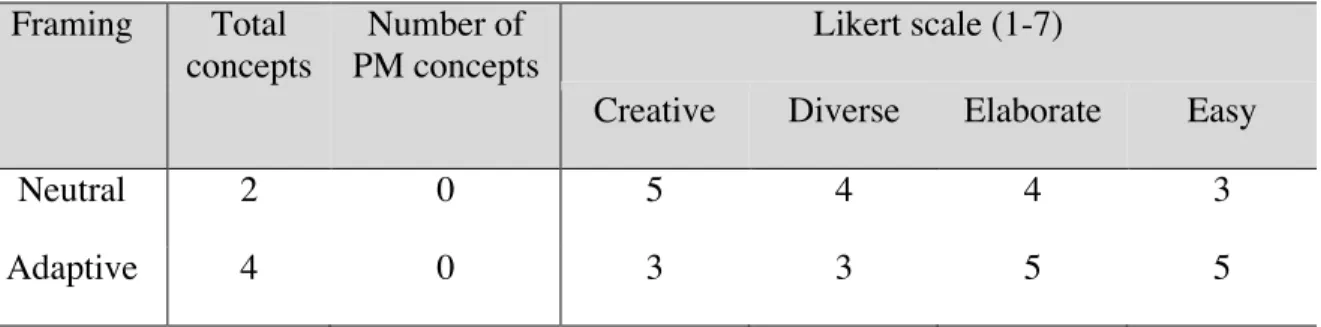
The first case study, Participant A, was one of the students who received an adaptively framed problem during the second session. We labeled Participant A is an Adaptive Shifter. This label may not seem appropriate given that he generated the same proportion of paradigm-preserving ideas in both the neutral framing and the adaptive framing ideation sessions (Table 1). He generated all preserving ideas in both ideation sessions, but generated more paradigm-preserving ideas when he received the adaptively framed problem. In addition, there was
considerable evidence in his reflection questionnaire that he was actively aware of the adaptive framing and that the framing influenced how he generated his ideas. This is what we would expect because adaptive framing encourages paradigm-preserving ideas.
Table 1: Participant A’s concept count and reflection questionnaire ranking choices. Framing Total concepts Number of PM concepts Likert scale (1-7)
Creative Diverse Elaborate Easy
Neutral 2 0 5 4 4 3
Adaptive 4 0 3 3 5 5
P
Table 2: Participant A’s Likert scale selections regarding the problem description.
Framing Written description encouraged: new ideas (1) – familiar ideas (7)
Amount of information in written description made generating ideas:
difficult (1) – easy (7)
Neutral 3 4
Adaptive 6 4
Neutral Framing Session
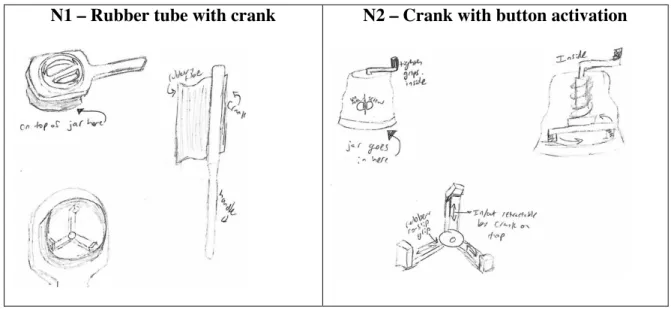
Participant A generated two ideas for the neutral Lids problem statement (Figure 1). His first concept (N1) features a rubber tube that extends over the jar to secure it. The crank can be turned to twist the lid off with one hand while the user’s torso keeps the handle from rotating. Concept N2 is a device that clamps onto the jar’s lid using a crank. The “un-screw” button causes the clamps to rotate to either remove or replace the lid.
N1 – Rubber tube with crank N2 – Crank with button activation
Figure 1: Participant A’s concepts from the neutrally framed Lids problem.
Both of Participant A’s solutions were coded as paradigm-preserving. Neither of the concepts modifies the focus of the problem, introduce uncommon elements, nor disregard any underlying assumptions of the problem. Concept N1 introduces an unusual relationship regarding how the user interacts with the device by requiring them to use their torso to keep the handle from
rotating. However, this user-device interaction was not significant enough to be coded
paradigm-modifying. P
Adaptive Framing Session
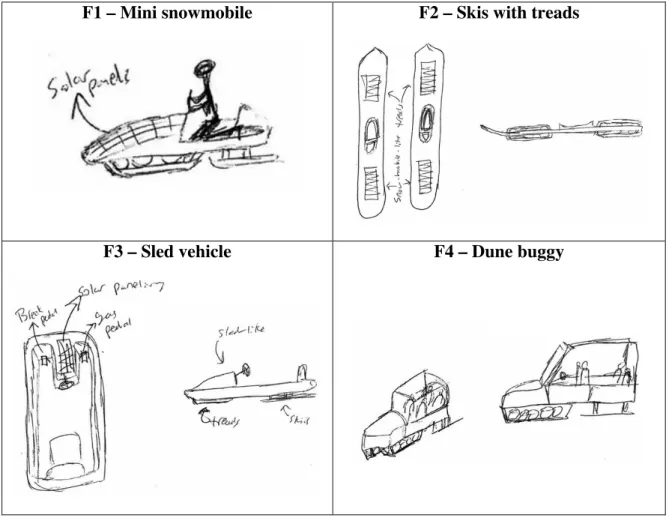
Participant A created four concepts for the adaptively framed Snow problem (Figure 2). Concept F1 is a small snowmobile that has a light frame and is powered by solar panels. Concept F2 is skis with “snowmobile-like treads” and is lightweight and easily transportable. Concept F3 is a “sled-like vehicle” controlled by a steering wheel and pedals. Concept F3 also features solar panels, skis, and treads. Finally, concept F4 is a dune buggy that is “adapted for snow with treads in front and skis in back.”
All four ideas were coded as paradigm-preserving. None of them include especially uncommon elements to the context of snow travel, nor do they violate any underlying assumptions of the problem. All of them maintain the focus of traveling on snow. The various uses of treads and skis are not notably significant modifications to the relationships between the elements in each design.
F1 – Mini snowmobile F2 – Skis with treads
F3 – Sled vehicle F4 – Dune buggy
Figure 2: Participant A’s concepts from the adaptively framed Snow problem.
Influence of Framing Discussion
Participant A consistently generated paradigm-preserving ideas across both the neutral and adaptive sessions. This is not surprising because adaptive framing is designed to promote
P
paradigm-preserving ideas so we would not expect ideas to shift towards paradigm-modifying. However, he did generate more paradigm-preserving ideas in the adaptive framing ideation session compared to the neutral-framing ideation session (4 vs. 2), and so this seems to be some evidence that the problem framing did influence his ideation approach.
Participant A’s reflection responses indicated that he actively sought to design paradigm-preserving concepts and was cognizant of the adaptive framing. In his questionnaire he noted that the written prompt encouraged familiar ideas, selecting 6 on the 1 to 7 Likert scale (Table 2). This is precisely the intent of the adaptive framing. He wrote that the written description of the design task “brought up skis and snowboards, forcing you to think along those lines, getting similar ideas.” As Participant A pointed out, the context paragraph begins by referencing skis and snowboards and then the participants are asked to focus on improving existing designs, so it likely seemed logical to him to adapt the use of skis, an element which is incorporated into three of his four ideas. He seemed to notice the adaptive framing and as a result avoided introducing uncommon elements, keeping the focus strictly on modifying snowboards, skis and sleds. This approach resulted in no paradigm-modifying ideas, an indication that the adaptive framing affected Participant A’s design outcomes.
In describing the problem to a fictitious co-worker Participant A wrote, “Focus on keeping it small, lightweight, and easy to transport, which gets tough when it needs to stay affordable as well.” The design requirements he identifies are all considerations included directly in the adaptive problem statement, which is further evidence he was very aware of the problem statement content. In particular, size, weight, and transportability all influenced Participant A’s designs.
Case 2: Innovative Shifter
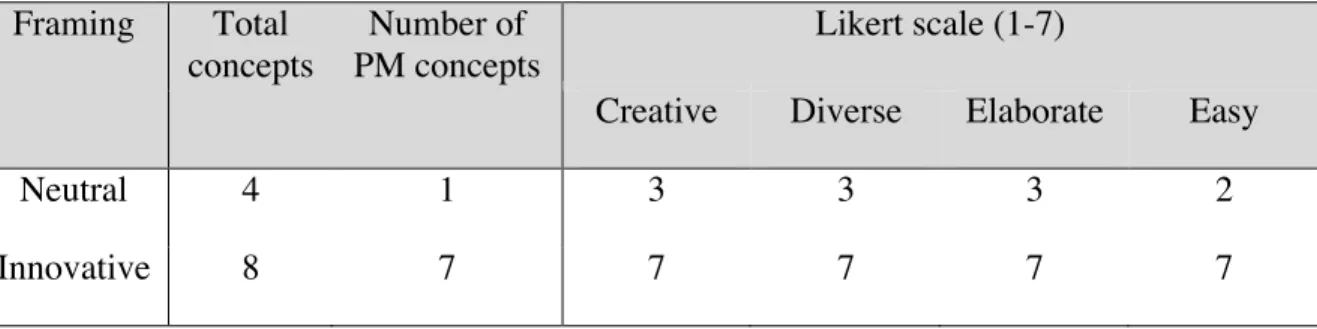
Participant B is an Innovative Shifter. That is, he was actively aware of the framing change from neutral to innovative, and his concepts from the neutral to innovative framing markedly shifted from mostly paradigm-preserving to mostly paradigm-modifying.
Table 3: Participant B’s concept count and reflection questionnaire ranking choices. Framing Total concepts Number of PM concepts Likert scale (1-7)
Creative Diverse Elaborate Easy
Neutral 4 1 3 3 3 2
Innovative 8 7 7 7 7 7
P
Table 4: Participant B’s Likert scale selections regarding the problem description.
Framing Written description encouraged: new ideas (1) – familiar ideas (7)
Amount of information in written description made generating ideas:
difficult (1) – easy (7)
Neutral 4 2
Innovative 4 6
Neutral Framing Session
During the first ideation session, Participant B generated four concepts for the neutrally framed
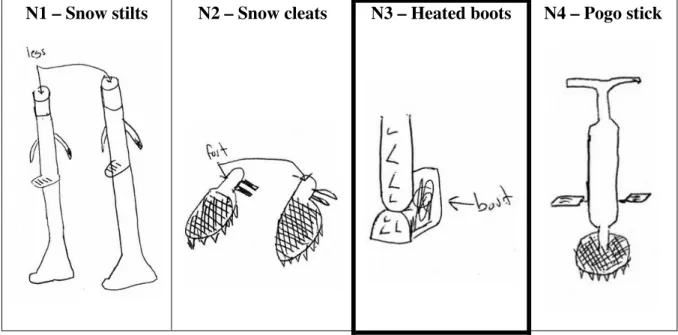
Snow problem (Figure 3). He described his first concept (N1) as, “Snow stilts. Essentially this idea is just stilts that are designed specifically for walking on snow.” Concept N2 features “spikes to provide traction,” called “snow cleats.” Concept N3 is heated boots, which melt the snow as the user walks forward. Finally, concept N4 is a “snow pogo stick.”
N1 – Snow stilts N2 – Snow cleats N3 – Heated boots N4 – Pogo stick
Figure 3: Participant B’s concepts from the neutrally framed Snow problem (the bold border indicates a paradigm-modifying concept).
All but one of these concepts were coded as paradigm-preserving. Concepts N1, N2, and N4 do not change the focus of the problem (i.e. an individual traveling on or through snow), nor do they violate any of the assumptions of the problem (e.g. the snow cannot be removed). While concept N4 introduces an uncommon element to the paradigm, namely a pogo stick, the concept
preserves the focus and assumptions of the problem. That is, concept N4 is paradigm-preserving
P
because it features an individual traveling on snow and the pogo stick’s overall function is not modified despite the change to the design of the base. Concept N3 melts the snow, breaking the assumption that the snow cannot be removed and resulting in a paradigm-modifying
classification.
As indicated in his reflection responses, Participant B’s overall impression of his own solution set was that his ideas lacked creativity, diversity, and elaborateness. For example, Participant B noted that he did not believe his ideas were especially creative, rating them a 3 on the Creativity
Likert scale (Table 3). Additionally, in describing his concepts he used the phrase “just stilts,” implying he believed the concept was fairly simple or ordinary.
Participant B reflected that it was fairly difficult to come up with ideas, circling a 2 on the
Easiness Likert scale (Table 3), and commenting that, “This problem already has solutions and the prompt is too narrow.” It should be noted that the neutral framing does not intend to actively constrain or narrow the problem. Following this comment, he listed a series of design constraints in his own words that he felt made the problem appear narrow or constricted: “unique [sic], easy to use, good uphill, hasn’t been thought of yet.” Both the ease of use and the ability to travel uphill requirements were part of the neutral problem statement that the participant was given. The requirement that the generated concepts must not be thought of or invented yet is an assumption added by the participant. This assumption reappears in his notes regarding how he would describe the problem to a co-worker. To his fictitious co-worker he wrote, “Focus on a solution that is easy to use, effective uphill, and unique. Try to stay away from already invented ideas.” The neutral prompt does not state that the generated concepts must not be based on pre-existing ideas, yet Participant B made it clear he struggled to avoid pre-pre-existing inventions. More importantly, he was aware of the difficulty he experienced in doing so as indicated by his
reflection responses. Furthermore, Participant B was aware of an existing solution, which put self-imposed limitations on his solution space. He wrote, “The snow-spiked shoes I was already familiar with, so that idea pretty much predominated my ideas.” These self-imposed restrictions and internalization of the neutral prompt significantly changed for Participant B during the innovatively framed ideation session.
Innovative Framing Session
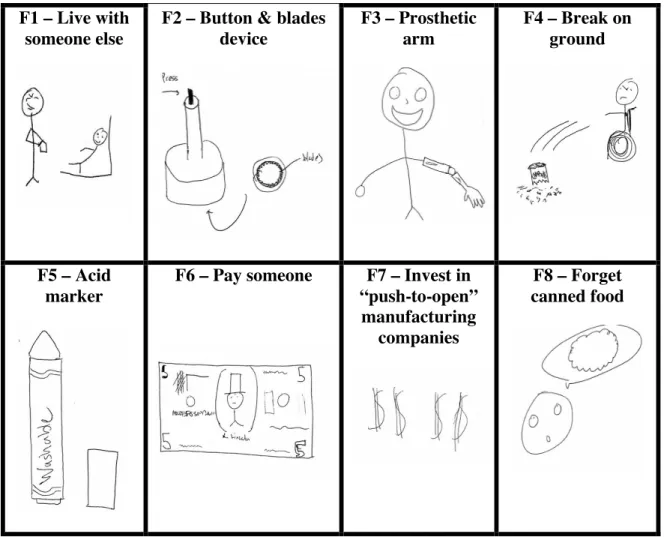
During the second ideation session, Participant B received an innovatively framed Lids problem statement and generated eight concepts (Figure 4). This is twice the number of concepts as the first session. This larger solution set is also very diverse. It not only includes typical approaches to the Lids problem such as concept F2 featuring a device with blades, but also includes atypical ideas such as F5, which uses an acid marker to draw on the container and erode sections of it. Concept F3 solves the problem by providing the one-armed user with a prosthetic arm. Concept F4 is to break the container by throwing it on the ground. Concept F6 is to pay someone else to open the container. Concept F7 is to invest in companies that will manufacture “push-to-open” containers. Concept F8 is to forget canned food altogether and find an alternate way to store food. Some of Participant B’s concepts are simple yet effective, such as F1, which he described as, “Live with someone. It’s amazing how easy it can be to open a jar if you have someone else
do it for you.” P
The simple yet effective solutions, such as F1 and F4, contributed to the high percentage of paradigm-modifying ideas for this solution set. Seven of the eight concepts were coded as overall paradigm-modifying. Concept F2 is the only design that preserves the focus, assumptions,
elements, and relationships of the problem. The remaining seven concepts solve a larger
problem, (e.g. the user is missing an arm), alter an assumption (e.g. the container must be opened independently), introduce an uncommon element (e.g. an acid marker), or introduce an atypical relationship (e.g. acid markers and containers).
F1 – Live with someone else
F2 – Button & blades device F3 – Prosthetic arm F4 – Break on ground F5 – Acid marker
F6 – Pay someone F7 – Invest in “push-to-open”
manufacturing companies
F8 – Forget canned food
Figure 4: Participant B’s concepts from the innovatively framed Lids problem (bold borders indicate paradigm-modifying concepts)
Influence of Framing Discussion
Participant B’s innovative framing reflection responses revealed a drastic shift in perception of his second solution set. He indicated that his second set of ideas were very creative, very diverse, and very elaborate in contrast to perceiving his first set of ideas as not very creative, diverse, nor elaborate (Table 3). Also in contrast to the neutrally framed session, the participant indicated he did not feel influenced by any existing solutions. According to the participant, the written description of the innovatively framed design prompt “encouraged wild ideas.” Feeling much
P
less constrained with the innovatively framed design statement, Participant B wrote to his
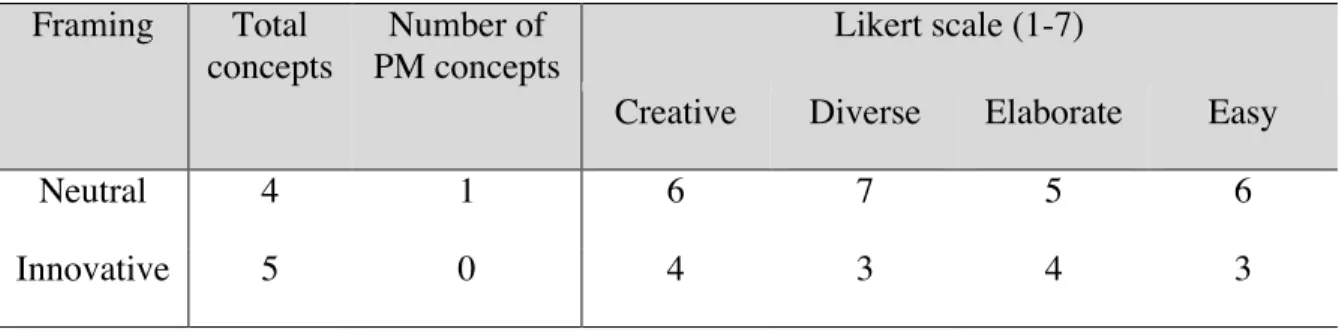
fictitious coworker, “get craaaazaaay [sic] don’t focus on anything. Let your mind wander and let the creative juices flow freely and [illegible].” The drastic increase in number of paradigm-modifying ideas from the neutrally to innovatively framed problem coupled with Participant B’s reflection questionnaires are evidence that a shift occurred in the participant’s ideation
experience and that he was cognizant of that shift.
Case 3: Innovative Non-Shifter
Participant C is an Innovative Non-Shifter, meaning that although he appeared to be aware of the framing change from neutral to innovative, his concepts did not shift from paradigm-preserving to paradigm-modifying when the problem framing changed. We would expect to see shifts towards paradigm-modifying solutions under innovative framing, however Participant C’s ideas remained predominantly paradigm-preserving across both ideation sessions. If anything, his ideas became even more preserving given that he had generated one paradigm-modifying idea with the neutral problem framing, but then generated zero with the innovative problem framing.
Table 5: Participant C’s concept count and reflection questionnaire ranking choices. Framing Total concepts Number of PM concepts Likert scale (1-7)
Creative Diverse Elaborate Easy
Neutral 4 1 6 7 5 6
Innovative 5 0 4 3 4 3
Table 6: Participant C’s Likert scale selections regarding the problem description.
Framing Written description encouraged: new ideas (1) – familiar ideas (7)
Amount of information in written description made generating ideas:
difficult (1) – easy (7)
Neutral 4 4
Innovative 1 4
P
Neutral Framing Session
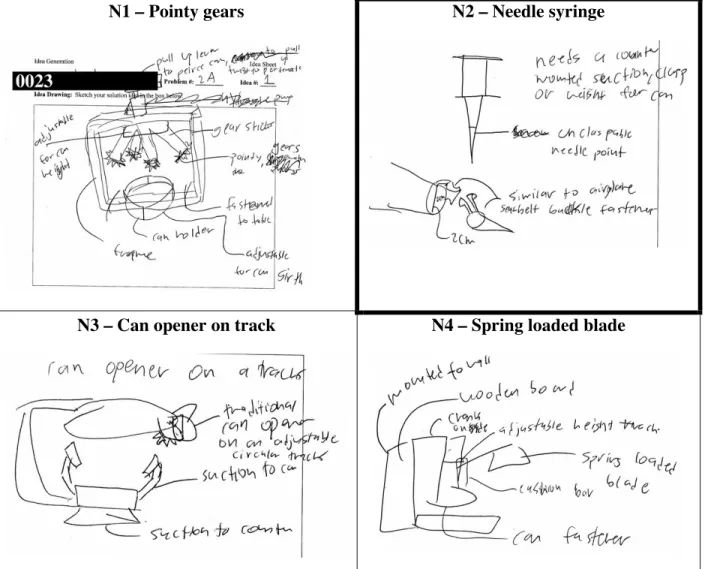
Participant C generated four concepts in response to the neutrally framed Lids problem (Figure 5). His first concept (N1) is a contraption that secures the can and features a user-operated lever to pull the “pointy gears” into the can. Twisting the lever turns the gears around the can, opening it. Concept N2 uses a sharp syringe with a needle to puncture the can and remove the contents. The participant noted that this design is “only for liquids.” Concept N3 holds the can in place while a traditional can opener on a circular track cuts off the lid. The final concept (N4) uses a spring-loaded blade to chop off the top of the can.
N1 – Pointy gears N2 – Needle syringe
N3 – Can opener on track N4 – Spring loaded blade
Figure 5: Participant C’s concepts from the neutrally framed Lids problem (the bold border indicates a paradigm-modifying concept).
Of Participant C’s four ideas, only concept N2 was coded as paradigm-modifying. Needles and syringes are uncommon elements that are not typically associated with opening containers or
and instead punctures it and extracts the contents. The other three designs all focus on cutting the lid in relatively common ways, similar to that of a can opener in their use of blades.
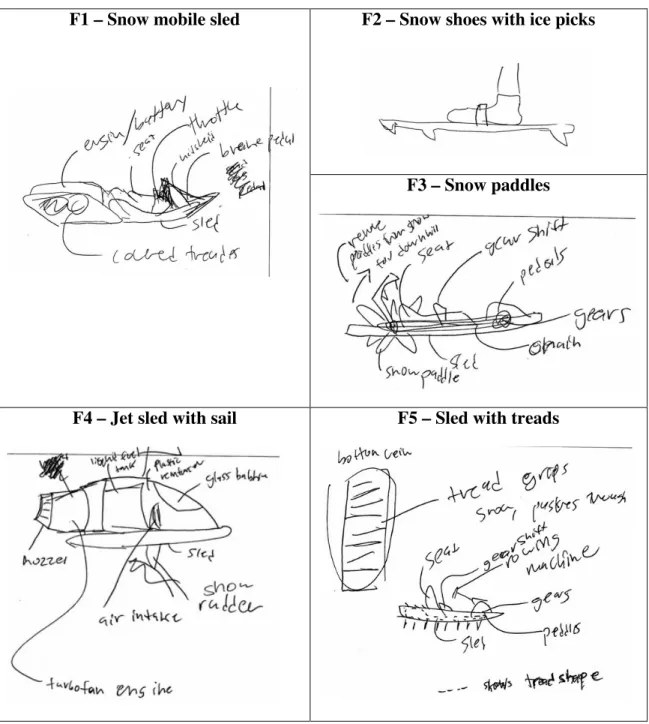
F1 – Snow mobile sled F2 – Snow shoes with ice picks
F3 – Snow paddles
F4 – Jet sled with sail F5 – Sled with treads
Figure 6: Participant C’s concepts from the innovatively framed Snow problem (this solution set does not include any paradigm-modifying concepts).
Similar to Participant B, Participant C introduced additional constraints to the problem that were not given in the neutral problem statement. For example, in describing the problem to a fictitious co-worker he listed that the device must not be installed to the counter, that it should not require electricity, and that it should have the same cost as a traditional can-opener. None of these were requirements imposed by the neutral problem description because the neutrally framed problem
P
purposefully includes only enough information to define the context, the need, and the goals of the problem.26 While Participant B felt the neutral Snow problem he was given was already too narrow, Participant C seemed to indicate that his neutral Lids problem was not narrow enough and required a list of additional constraints to better define the problem.
Innovative Framing Session
Participant C generated five solutions to the innovatively framed Snow problem (Figure 6, previous page). His first concept (F1) is an electric sled with treads, similar to a snow mobile. Next, he generated a snowshoe idea featuring ice picks on the bottom (F2). Concept F3 is a sled with user-operated pedals that drive the “snow paddles.” The participant wrote that the snow paddle axel can be raised to minimize downhill friction, and he also added the comment “two person?” to his idea description. Concept F4 is a jet sled with a rudder and sail for steering. Finally, concept F5 is a sled with treads that the user advances using pedals.
None of Participant C’s ideas in this second solution set were coded as paradigm-modifying. They are all paradigm-preserving because in general they include common elements to snow travel such as snowshoes and sleds, and they do not break any underlying assumptions of the problem statement. Furthermore, they do not shift the focus of the problem away from traveling through snow to solve a larger problem such as removing the snow altogether or bypassing the need to travel in snow at all.
Influence of Framing Discussion
Participant C was cognizant of the framing change during the second session. He wrote that the description of the Snow design task encouraged “radical, new” ideas with “no attention to cost or materials.” The words ‘radical’ and ‘new’ were both bolded in the innovatively framed problem statement, and the participant’s comment about disregard for cost and materials also came directly from the problem statement.
Although Participant C was aware that the Snow problem encouraged new and innovative ideas, he struggled a little with generating concepts, selecting an easiness level of 3 on the 1 to 7 Likert scale (Table 5). To explain his selection he wrote, “most [ideas] have been taken, and most are not easy to learn because humans have been traveling over snow for thousands of years, so we’ve got most of the good ideas figured out.” The innovatively framed problem states “solutions should focus on creating totally new designs or developing totally new ways of
approaching the problem.” Participant C seems to treat this as a limitation. Instead of viewing the problem as encouragement to freely generate ideas that may modify the problem paradigm, he may feel that he does not have a good place to begin ideating. Three of his four ideas from the neutral Lids problem had similarities to a opener, a common existing solution. Using a can-opener as a benchmark may have been what he needed to begin generating concepts. Based on his comments from the second session, Participant C likely felt he wasn’t allowed to start with a pre-existing “taken” idea, improving upon it or using it to iterate off of. As a result, he had a more difficult time ideating during the second session and the innovative framing did not appear to help him generate paradigm-modifying concepts even though he was cognizant of the framing
Discussion
Summary of Findings
Through this study we found that problem framing can indeed influence the
paradigm-relatedness of the ideas that students generate. In the cases of both Participant A and Participant B, there was evidence that they were aware of the change in problem framing and that the framing shifted the way they generated ideas. The shift in ideation approach was stark for Participant B, as he was given an innovatively-framed problem and generated many more paradigm-modifying ideas with that framing compared to the neutral framing (7 vs. 1). The shift in ideation approach was harder to quantify for Participant A. He was given an adaptively framed problem, and did generate more paradigm-preserving ideas in that framing compared to the neutral framing (4 vs. 2). However, because he did not generate any paradigm-modifying ideas in either ideation session, there was no change in the proportion of paradigm-preserving ideas. Despite this, evidence from his reflection questionnaire suggested that the difference in problem framing was noticeable and did influence his ideation approach.
We did also find that not all students are influenced by problem framing in the ways that we might expect. Participant C was given an innovatively framed problem, but in that framing generated less paradigm-modifying ideas compared to the neutral framing (0 vs. 1). In that case, we were able to identify possible reasons why a student’s ideas may not shift. In Participant C’s case, it appeared that he was cognizant of the innovative framing, so it was not a matter of
simply not recognizing the change in framing. However, Participant C was not able to implement the more innovative ideation approach because he felt that the “totally new ideas” encouraged by the innovative framing already exist. For him, the innovative framing was not straightforward to implement. This suggests that even though students may be cognizant of the intentions of either adaptive or innovative framing, there may be other factors affecting their ability to shift their ideation process. Although our data are not sufficient to conclusively identify those other factors, we can conjecture about some possibilities. For example, students’ background or prior
experience in a particular problem context may limit their ability to generate new ideas. As another possibility, a student’s cognitive style may be so strong that their ideation preferences are not easily changed from one situation to the next. That is, they may not be very flexible in their problem solving approach.
Limitations and Future Work
The study we conducted was able to illustrate how problem framing may influence the paradigm-relatedness of ideas. However, because of the small numbers of participants in our sample and the case study approach, we cannot determine the prevalence of these cases. Future work with more participants could help to identify how reliably each problem framing impacts the number and proportion of either paradigm-preserving or paradigm-modifying ideas. More participants may also help to identify other interesting cases. For example, there may cases where the students are not even aware of the difference in problem framing or choose to disregard the framing so that they can pursue whichever approach they naturally prefer.
Another potential issue to consider with this study is about the low numbers of paradigm-modifying ideas throughout the dataset. Since ideas were coded as paradigm-paradigm-modifying only
P
20% of the time, it may have been hard to detect some shifts in ideation approach. For example, since most ideas for most participants in the neutral framing are paradigm-preserving, cases like Participant A may be common. Since Participant A generated only paradigm-preserving ideas in both ideation sessions, it was not straightforward to conclude that the adaptive problem framing actually influenced his ideation approach. However, by also considering the reflection
questionnaire responses, we were still able to justify that the framing did indeed influence his ideation approach. There may be other cases in which the influence of the framing is harder to detect. One possibility to help with this issue would be to develop finer-grained measures of paradigm-relatedness that could detect more subtle shifts. It may also be helpful to look at some of the sub-codes of paradigm-relatedness rather than simply the overall code.
Future work using alternative methods has the potential to extend and elaborate our findings. For example, one potentially useful study modification could be to give students the same design problem during both sessions, first neutrally framed and then either adaptively or innovatively framed. That would allow us to study shifts that occur after the students had generated their initial ideas for a given problem context. As another example, the reflection questionnaire could be modified to better understand students’ awareness of the influence of the problem framings on their ideation approaches. In the current questionnaire, some of the students’ responses were not articulated well enough to gain a good understanding of their perception of the framing. It may be possible to revise the questionnaire and add more targeted reflection questions, such as asking the participants to more definitively identify whether they were aware of the framing. Although data intensive, another possibility would be to have students think aloud while generating their ideas.
Our goal for the present study was to focus on the influence of problem framing on the paradigm-relatedness of ideas. Our framing manipulation approach was intentionally aligned with paradigm-relatedness and so it was on that measure that we expected to see changes. The influence of framing on other measures of ideation20,21 would also be worth pursuing and may yield interesting findings. In our other work we have investigated the different factors that may influence the variety of ideas students generate.35 In our future work, we will also analyze the quality of ideas, which may very well be the most critical metric for successful ideation. Conclusion
The cases we studied help us identify when a student’s ideas shift with respect to a design problem paradigm. We now know that just detecting a change in proportion or quantity of paradigm-modifying or paradigm-preserving ideas is not always enough to understand the shifts that take place. We also have to look at where the student’s ideation approach started under neutral framing and look at their perception of the framing, which we analyzed using the
reflection questionnaires. As a result, the reflection questionnaires were crucial in understanding the effects of framing on paradigm-relatedness. Our case studies also revealed the importance of quantifying shifts in both directions, towards modifying and towards
paradigm-preserving. While paradigm-preserving shifts were more difficult to detect, in our future work we will be exploring other methods of identifying and quantifying both types of shifts.
Overall, our study provided some evidence that problem framing can influence paradigm-relatedness of generated ideas. The reported cases for both adaptive framing and innovative
P
framing illustrate how modifying problem statements can encourage designers to adopt a
different ideation approach than their neutral approach, and thus generate design ideas they may not have considered otherwise. As such, problem framing is a tool for encouraging ideation flexibility. In the context of the classroom, it is important to consider how design problems are framed when presented to students because framing can be responsible for shifts in the types of ideas that occur early in the design process. Furthermore, problem framing is a factor of ideation that instructors and designers have control over and can manipulate relatively easily. As a result, problem framing is a promising method for enabling instructors to encourage shifts in paradigm-relatedness that could lead students’ to explore areas of the design solution space they may not normally consider.
Acknowledgements
This research was supported by the National Science Foundation through Research in Engineering Education (REE) Grants #1264715, #1265018, and #1264551.
References
1. Ottosson, S. (2001). Dynamic concept development - A key for future profitable innovations and new product variants. In International Conference on Engineering Design (pp. 331–338). Glasgow.
2. Soosay, C. A., & Hyland, P. W. (2004). Driving innovation in logistics: Case studies in distribution centres.
Creativity and Innovation Management, 13(1), 41–51. http://doi.org/10.1111/j.1467-8691.2004.00292.x 3. Csikszentmihalyi, M., & Getzels, J. W. (1971). Discovery-oriented behavior and the originality of creative
products: A study with artists. Journal of Personality and Social Psychology, 19(1), 47–52. http://doi.org/10.1037/h0031106
4. Ecker, D. W. (1963). The artistic process as qualitative problem solving. Journal of Aesthetics and Art Criticism, 21(3), 283–290. http://doi.org/10.2307/427437
5. Dewey, J. (1910). How We Think. Boston: D. C. Heath and Co.
6. Norman, D. A., & Verganti, R. (2014). Incremental and radical innovation: Design research vs. technology and meaning change. Design Issues, 30(1), 78–96. http://doi.org/10.1162/DESI_a_00250
7. Cross, N. (2004). Expertise in design: An overview. Design Studies, 25(5), 427–441. http://doi.org/10.1016/j.destud.2004.06.002
8. Schön, D. A. (1987). Educating the Reflective Practitioner: Toward a New Design for Teaching and Learning in the Professions. San Francisco: Jossey-Bass.
9. Kirton, M. J. (2011). Adaption-Innovation in the Context of Diversity and Change. London, UK: Routledge. 10. Kirton, M. J. (1976). Adaptors and innovators: A description and measure. Journal of Applied Psychology,
61(5), 622–629. http://doi.org/10.1037/0021-9010.61.5.622
11. Abernathy, W. J., & Utterback, J. M. (1978). Patterns of industrial innovation. Technology Review, 80(7), 41– 47.
12. Spradlin, D. (2012, September). Are you solving the right problem? Harvard Business Review, 84–93. 13. Yilmaz, S., Daly, S. R., Jablokow, K. W., Silk, E. M., & Rosenberg, M. N. (2014, June). Investigating impacts
on the ideation flexibility of engineers. Paper presented at the American Society for Engineering Education (ASEE) Annual Conference, Indianapolis, IN, USA.
14. Brophy, D. R. (2001). Comparing the attributes, activities, and performance of divergent, convergent, and combination thinkers. Creativity Research Journal, 13(3-4), 439–455.
http://doi.org/10.1207/S15326934CRJ1334_20
15. Liu, Y.-C., Chakrabarti, A., & Bligh, T. (2003). Towards an “ideal” approach for concept generation. Design