Social Inclusion (ISSN: 2183-2803) 2016, Volume 4, Issue 2, Pages 65-76 Doi: 10.17645/si.v4i2.487 Article
Secularities, Diversities and Pluralities: Understanding the Challenges of
Religious Diversity in Latin America
Edgar Zavala-Pelayo * and Manuel Góngora-Mera
Lateinamerika-Institut, Freie Universität Berlin, 14197 Berlin, Germany; E-Mails: [email protected] (E.Z.-P.), [email protected] (M.G.-M.)
* Corresponding author
Submitted: 26 October 2015 | Accepted: 18 February 2016 | Published: 19 April 2016 Abstract
Latin America is experiencing today the greatest religious diversity in its entire history. However, it must also be noted that a large number of the growing religious minorities may be classified into types of Christianity with conservative overtones. In this paper we will suggest that the literature streams on multiple secularities in contemporary (Western) societies and religious diversity in Latin America do offer insightful perspectives yet fail to adequately convey the chal-lenges raised by the religious across contemporary Latin America. Addressing Latin America’s historical background, we will distinguish conceptually and empirically among different degrees of secularities, diversities and pluralities and will construct with these distinctions a descriptive-normative model that can guide future analyses of secular and religious phenomena in Latin America. It is only through a comprehensive understanding of diversities, pluralities and seculari-ties that the debates on those human rights crucial for social inclusion—from sexual and reproductive rights to gender and religious equality—can be fruitfully conducted in and beyond Latin America.
Keywords
Christian hegemony; multiple secularities; pluralism; religious diversity Issue
This article is part of the issue “Religious Diversity and Social Inclusion”, edited by Gary Bouma (Monash University, Australia).
© 2016 by the authors; licensee Cogitatio (Lisbon, Portugal). This article is licensed under a Creative Commons Attribu-tion 4.0 InternaAttribu-tional License (CC BY).
1. Introduction
Different realities require different analytical ap-proaches and policy responses. Latin America,1 like any
other macro-region, has a complex religious history, ranging from the colonial predominance of Catholicism between the 16th and 19th centuries to a manifest
mul-tiplicity of religions in the last decades. However, whereas other world regions might have similar
1 In this paper the term “Latin America” encompasses only
Spanish and Portuguese-speaking countries on the mainland. The Caribbean requires a separate analysis due to its diverse historical experiences (e.g. the Cuban path towards state athe-ism in the aftermath of the Revolution).
ries of colonial evangelizing regimes and comparable landscapes of religious diversity, the complexity of the Latin American experiences cannot be equated with the complexity of those regions’ religious histories and configurations. In this paper we argue that perspectival biases in the idea of multiple secularities and concep-tual inaccuracies in the analysis of religious diversities in Latin America may be contributing to misunder-standings of the challenges associated with social in-clusion that the region faces today.
Firstly, we will offer a legal historical overview of Latin America’s colonial background. We will argue that such a background and its religious dogmatism cannot be neglected in comprehensive accounts of contempo-rary religious issues in Latin America. In our view, such
accounts must also include reflections about the fact that the growing religious minorities in Latin America are mostly Christian minorities. We will then address the literature that deals with “multiple secularities” across the globe and the literature that analyses reli-gious diversity in Latin America. We will point out the former’s underrating of post-colonial cases and the lat-ter’s conceptual imprecisions regarding Christian mi-norities, religious diversity and pluralism. Our analysis will suggest how these gaps are detrimental to the un-derstanding of secular and religious phenomena in Lat-in America. After these preparatory discussions, we will present a descriptive-normative analytical model that can be used to provide a more comprehensive under-standing of the complexity of the religious fields in Lat-in America and their multiple degrees of secularities, diversities and pluralities. We will conclude with the observation that, by identifying and reflecting upon those complexities and degrees, it is possible to discuss with more precision the impact of religious phenomena on human rights and, by extension, on social inclusion. 2. Religious Diversity in Latin America: A Legal Historical Overview
In 1493 (shortly after receiving news about the West Indies), the Pope granted to the Spanish kings the ad-ministrative control of the Catholic Church in the new territories, later confirming this decision with the Papal Bulls of 1501 and 1508; in 1514 he extended this privi-lege to the Portuguese kings. The system was called Royal Patronage (Patronato Real or Padroado Real). Iberian crowns enjoyed the prerogative of appointing bishops in their colonies; hence, the civil and ecclesias-tical administrations often overlapped. The Iberian empires throughout the colony banned non-Catholic religions (particularly Judaism, Islam and Protestant-ism) in the Americas with relative success. The Span-iards adopted a cross-and-sword policy of expulsion and forced Christianization in both the Iberian Peninsu-la and the Americas (Prien, 2013, pp. 3-11). Small num-bers of Jews and Muslims fled to America after being expelled from Spain (1492) and Portugal (1497), but many of them converted to Christianity to avoid perse-cution from the Inquisition. A few native peoples (e.g. Cunas, Mapuches, Amazonian Indians) managed to es-cape from Iberian rule and were able to maintain, to a great extent, their cultural identity; similarly, Africans who escaped slavery and formed autonomous settle-ments could partially preserve their religious traditions. But most African and indigenous peoples (were) con-verted to Christianity—though some of their beliefs and religious practices remained, hidden, through syn-cretism (Rauhut, 2012). The absence of competing reli-gions resulted in an absolute religious intolerance. While in Europe the Augsburg principle cuius regio, eius
religio could not be effectively enforced, leading to a
proliferation of edicts of religious tolerance throughout the continent, the Iberian empires in America imple-mented the Inquisition’s goal of the systematic control and extermination of sects, heretics and nonbelievers (Chuchiak, 2012). The region became the ultimate ex-pression of the Iberian Counter-Reformation and was unable to develop any significant form of social conviv-iality with other religions for almost four centuries.
After the wars of independence (early 19th century),
relations between church and state became a central dispute between the emergent political factions: liber-als, who usually advocated for religious tolerance and encouraged secular authorities, and conservatives, who aligned themselves with the Catholic Church as a rule. Although liberals dominated the new govern-ments, they were aware that religion was a powerful force for social cohesion in the effort to build a nation-al identity in the politicnation-al chaos of the post-independence era. Thus, they assured the clergy that the Catholic Church would preserve its privileges. As a matter of fact, all the new nations were confessional states, and the Roman curia was forced to allow the new countries patronage rights (Prien, 2013, pp. 277-278, 291-297). All Latin American Constitutions of the early nineteenth century declared their unrestricted, and in some cases perpetual, devotion to Catholicism as the state religion; in some cases, even private wor-ship in other faiths was banned.2 All Latin American
Constitutions adopted shortly after the Spanish
Recon-quista and restoration (1814–1820) maintained
confes-sional clauses, excluding any other religion.3 Two
cen-turies later, Costa Rica remains as the only confessional State in Latin America. Non-confessional constitutions in the mid-nineteenth introduced freedom of worship and religious tolerance, allowing missionary Protes-tantism and immigration by Protestants,4 especially in
Brazil and the Southern Cone. Nevertheless, Catholi-cism was preserved as the state religion.5 In 1910, at
2 Cf. e.g. Article 1 (Chapter I) of the 1811 Federal Constitution
of Venezuela; Article 4 (Title I) of the 1812 Constitution of the Republic of Cundinamarca; Article 10 of the 1823 Constitution of Chile.
3 Cf. e.g. Article 8 of the 1823 Constitution of Peru; Article 5 of
the 1824 Constitution of the Empire of Brazil; Article 5 of the 1824 Constitution of El Salvador; Article 11 of the 1824 Consti-tution of the Federal Republic of Central America; Article 3 of the 1824 Constitution of Mexico; Article 45 of the 1825 Consti-tution of Guatemala; Article 5 of the 1825 ConstiConsti-tution of Hon-duras; Article 3 of the 1828 Constitution of Chile; Article 8 of the 1830 Constitution of Ecuador; Article 6 of the 1831 Consti-tution of Bolivia.
4 Mostly from German-speaking countries, Denmark and the
Netherlands.
5 According to Prien (2013, p. 360), several constitutions
grant-ed religious tolerance, while preserving Catholicism as the state religion; for instance, in the Provincias Unidas del Río de
la Plata’s (1819), and later in those of Argentina (1853), Brazil
least 94% of Latin Americans were Roman Catholics; this percentage remained practically unchanged until the 1980s (Pew Research Center, 2014a, p. 26).
Today, non-confessional constitutions represent the absolute majority in the region. Nevertheless, there are notable differences, resulting from dissimilar his-torical paths and domestic political dynamics. Nine constitutions make at least a passing reference to God in their preambles (Argentina, Colombia, Ecuador, El Salvador, Honduras, Nicaragua, Panama, Paraguay and Peru). The concept of morals, which is invoked as a re-striction on some rights and freedoms connected with religion, explicitly derives from one single religious tra-dition (Catholicism) in Costa Rica, Panama, and Peru. In some countries (e.g. Nicaragua, Panama, and Peru) re-ligious instruction in public schools is based on Chris-tian values. The right to conscientious objection to mili-tary service for religious beliefs is not recognized in several countries. In sum, when comparing Latin Amer-ica’s contemporary challenges associated with religious diversity and social inclusion to those in other world regions, one should consider the crucial role of the co-lonial experience in understanding the absolute pre-dominance of one religion to the exclusion of any oth-er; this background yielded divergent secularization processes, with specific regional and national paths, dynamics and targets.
3. Religious Diversity in Contemporary Latin America Latin American nominal Catholics amount to nearly 40% of the world Catholic population (Pew Research Center, 2014a, p. 4; Parker, 2005, p. 36). However, the percentage of people identifying as Catholic has fallen significantly. According to Latinobarómetro (2014, p. 4), the percentage of Roman Catholics fell from 80% in 1995 to 67% in 2013. A recent report by the Pew Re-search Center (2014a, p. 14) suggests that there are some countries in Latin America whose nominal Catho-lics may amount to half (El Salvador, Guatemala, Nica-ragua) or less than half (Honduras and Uruguay) of the total population. Atheism, however, has not necessari-ly increased.6 The emergence of non-Catholic religions
and organizations in Latin America has been acknowl-edged and studied in a number of works by social sci-entists (e.g., Beltran, 2011; Bidegain & Demera, 2005; De la Torre & Gutiérrez, 2007, 2008; Fediakova, 2007; Ferre, Gerstenblüth, & Rossi, 2009; Forni, Mallimaci, & Cárdenas, 2003; Freston, 2011; Garma, 2007; Garvin, 2005; Parker, 2005, 2012). In these works the concept of religious diversity has been put forward as an
Ley Interpretativa (1865), Bolivia (1906), Peru (1915),
Venezue-la (1874), Honduras (1848, 1865, 1873) and Costa Rica (1860).
6 In countries like Chile and Uruguay, however, the numbers of
atheists, agnostics and religiously unaffiliated has remarkably increased (Pew Research Center, 2014a).
takable fact in contemporary Latin America. The reli-gious predominance that Catholicism enjoyed until the second half of the twentieth century has indeed been challenged by expanding religious minorities.
However, there is a factual particularity that is worth pointing out. The growing non-Catholic minori-ties in Latin America are mostly Christian7 minorities.
Describing Latin America as “the world center of Chris-tianity” (Freston, 2012, p. 80; our translation) might perhaps be an over-statement, but it is an unequivocal fact that the majority of the non-Catholic minorities spreading across Latin America are historical or emer-gent forms of Protestantism. In this sense, we observe two complimentary processes of religious migration: an inter-American flow of religious denominations and a conversion from Catholicism to Protestantism. The former is a process that spreads from the United States and Brazil towards the rest of the continent. Apart from the historical Protestants who arrived starting in the 19th century, the first agents of this migration wave
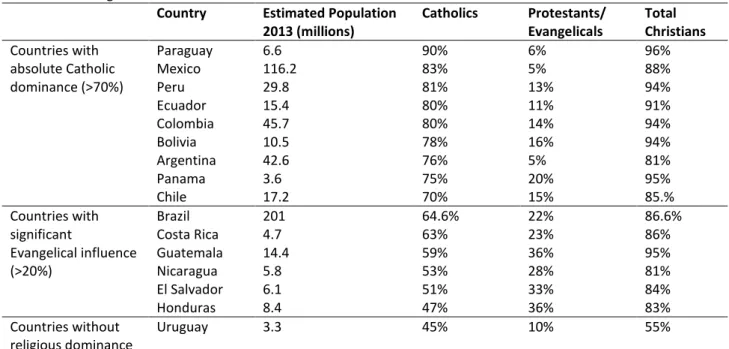
were U.S. missionaries who were no longer allowed to travel to China after 1949 and were sent instead to Lat-in America (Prien, 2013, p. 553). With the exception of Uruguay, a wide spectrum of Anglo-American denomi-nations has achieved a remarkable presence in all Latin American countries, in particular, in Brazil and Central America (Table 1); these include Baptists, Pentecostals, Presbyterians, Methodists, and Adventists. Additional-ly, several Brazilian Pentecostal and neo-Pentecostal churches have also penetrated the Andean region and other Latin American countries—e.g. the Igreja
Univer-sal do Reino de Deus and Deus é Amor.
It could be said that the migration process above is being consolidated or extended through a complimen-tary process of conversion. That is, current religious minorities are also the result of individuals who decide to convert (Freston, 2012) to another Christian religion. At least a third of current Protestants were raised as Catholic and half or more say they were baptized as Catholics. Interestingly, 60% of converts to Evangelical-ism said that one reason they left the Catholic Church was their desire for a more assertive teaching on moral questions and greater commitment, reflected in con-servative positions on typical hot-button issues (Pew Research Center, 2014a, pp. 5-6). The resulting reli-gious landscape is a particular one.
If figures from the latest survey by the Pew Re-search Center (2014a) are considered, only 8% of the total population in Latin America would be religiously unaffiliated, and 88% would be Christian (19% Protestants and 69% Catholics). Results from the World
7 By referring to this comprehensive category, we want to
con-vey not an idea of hierarchical “varieties” of a single religion (Catholicism) but their theological, ritualistic and socio-political coincidences—regardless of whether these are seen as deriva-tive or independent.
Table 1. Percentage of Catholics and Protestants.
Country Estimated Population 2013 (millions) Catholics Protestants/ Evangelicals Total Christians Countries with absolute Catholic dominance (>70%) Paraguay 6.6 90% 6% 96% Mexico 116.2 83% 5% 88% Peru 29.8 81% 13% 94% Ecuador 15.4 80% 11% 91% Colombia 45.7 80% 14% 94% Bolivia 10.5 78% 16% 94% Argentina 42.6 76% 5% 81% Panama 3.6 75% 20% 95% Chile 17.2 70% 15% 85.% Countries with significant Evangelical influence (>20%) Brazil 201 64.6% 22% 86.6% Costa Rica 4.7 63% 23% 86% Guatemala 14.4 59% 36% 95% Nicaragua 5.8 53% 28% 81% El Salvador 6.1 51% 33% 84% Honduras 8.4 47% 36% 83% Countries without religious dominance Uruguay 3.3 45% 10% 55%
Source: Bureau of Democracy, Human Rights and Labor, U.S. International Religious Freedom Report for 2013. Table 2. Percentage of Christians and non-Christians.
Affiliation/Country Argentina Brazil Chile Colombia Ecuador Peru Uruguay
Total Christians* 71.2 78.9 75 77.1 76.1 86.8 31.2
Total non-Christians 10.9 5.6 0.2 1.1 0.3 1.7 7.5
Other; Not specific 9.7 1.2 0 0.9 0.3 1.4 7.3
Spiritist 0 3.5 0 0 0 0 0 Espirit, candomble, umbanda, esoterism, occultism 0 0.5 0 0 0 0 0 Buddhist 0.5 0.2 0 0.1 0 0 0 Hindu 0.2 0 0.1 0 0 0.2 0 Jew 0.3 0.1 0.1 0 0 0 0.2 Muslim 0.2 0.1 0 0.1 0 0.1 0 None 16.9 15 23.1 21.4 23.5 10.1 60.7
Don't know/No answer 0.9 0.6 1.7 0.3 0.1 1.5 0.6
N= 1,030 1,486 1,000 1,512 1,202 1,210 1,000
Source: Adapted from figures obtained through World Values Survey’s online-analysis tool, wave 6, 2010–2014. * Ro-man Catholics, Protestants, Christians, Evangelicals, Pentecostals, Jehovah Witnesses, Mormons, 7th Day Adventists and Orthodox.
Values Survey are somewhat more conservative, but the pattern is also noticeable. Table 2 presents the most recent figures (waves 2011–2014) from the World Values Survey on religious denominations in some countries in Latin America. Although there are excep-tional cases like Uruguay, this survey suggests that more than 70% of the population in Latin America is nominally Christian even in countries such as Argentina and Brazil, where non-Christian minorities are compar-atively significant.
If the figures in Table 2 are compared, for example, to the more even distribution in the Asia-Pacific zone of Christians (7%), Muslims (24%), Unaffiliated (21%), Hindus (25%), Buddhists (12%), Folk religions (9%),
Other religions (1%) and Jews (<1%) (Pew Research Center, 2014b), it is possible to state that the “religious diversity” label might have been used in Latin America too liberally and without the necessary nuances. Granted, the unique institutional/group identity, the doctrinal-theological specificities, and the particular socio-political histories of Christian minorities—as well as the diversity within Catholicism8—must be
8 Catholicism, as a global religion, is not only a mirror of the
di-verse societies where it can be found (Levine 2014), it also comprises a number of sub-institutions (e.g. religious orders, convents, schools, charities, etc.) and hierarchical structures (e.g. parishes, dioceses, bishoprics) whose direction by differ-ent individuals or groups across a multiplicity of historical
peri-edged and carefully reflected upon. However, it would be misleading to assume that there are no similarities between some of these minorities’ theological princi-ples and moral-political stances and those found in Lat-in America’s Catholicisms. From a global perspective, Latin America still exhibits low levels of diversity, com-prising, as it does, a majority of Christian, mostly con-servative, confessions. Notwithstanding the theological antagonisms and mutual distrust among Protestants, Evangelicals and Catholics, it is not unusual to find co-inciding conservative stances among them on social is-sues such as marriage, family, sexual orientation, re-productive choices, gender relations, education and personal autonomy. In these areas crucial for social in-clusion one could speak of a Christian hegemony. This is characterized by the persistence of unequal rules of the game in the religious market; high control by churches over the educational system; promotion of traditional (Christian) values and views on personal au-tonomy (which leads to discrimination in workplaces and in schools, for instance); legitimation of sexism, homophobia, transphobia and other forms of discrimi-nation; and/or the criminalization of abortion and stigmatization of women. From a legal point of view, such a framework creates inconsistencies with interna-tional human rights standards.
From this brief overview we can conclude that Latin America’s religious fields diverge from those in the U.S. and Europe, where challenges arise instead from large waves of immigrants bringing with them their Christian
and non-Christian religions. Similarly, Latin America’s
challenges are not those of African and Asian states, which have adopted Islam as an official religion and where minority faiths are discriminated against, con-version is punished, and several forms of religious-related violence are common. The challenges in Latin America are different. While all Latin American coun-tries ban religious discrimination, recognize religious freedom, and protect indigenous religiosity, most of them remain countries where Christian denominations prevail and where religious equality is far from being achieved outside of constitutional texts.
4. Perspectival and Conceptual Shortcomings
In our view, there are two sets of literature on secular and religious diversities that are crucial to understand-ing Latin America’s religious fields. The first offers a comparative framework of multiple secularities across the globe; and the second refers to the religious diver-sity/pluralism in Latin America. We will argue that there are critical shortcomings in both sets and also po-tential contributions between them if those very short-comings are worked out. We will argue that
ods and world regions yields greater diversity in performative and ideological terms.
secularities approaches do not necessarily overcome the west-and-rest discourse and can be further im-proved by considering the case of Latin America, yet without the conceptual overlapping between the ideas of religious diversity, plurality and pluralism that can be found in some scholarly works on this region.
Modernity in the west-and-rest discourse is con-ceived as a European innovation that has been globally transferred and whose European standards are the ar-rival point of every modern society (Hall, 1996). For decades, postcolonial authors have deconstructed this discourse (Boatcă, 2015, pp. 201-226; Costa, 2006, pp. 83-97; see also Bhambra, 2007; Chakrabarty, 2000). Recently, some debates on secularisms and religious diversity have considered the postcolonial critique of Occidentalism and have adopted a “multiple moderni-ties” approach. A group of scholars, for instance, has proposed a model of “multiple secularities” which “ac-quire different shapes in different countries”, for they operate “according to different cultural logics that document specific social histories of conflict”; these secularities, in a sense, “‘respond’ to specif-ic…reference problems and offer ‘solutions’ to them” (Schuh, Burchardt, & Wohlrab-Sahr, 2012, p. 358; see also Wohlrab-Sahr & Burchardt, 2012). In a later publi-cation, Burchardt, Wohlrab-Sahr and Middell (2015) accounted for these problems and distinguished four analytically ideal (not normative) types of secularities (see Table 3).
Table 3. Multiple secularities.
Reference Problems Ideal types (Secularity for the sake of…)
Individual freedom vis-à-vis dominant social units
…individual rights and liberties
Religious
heterogeneity and the resulting potential or actual conflictuality …balancing/pacifying religious diversity Social or national integration and development …societal or national integration and development Independent development of institutional domains …the independent development of functional domains of society
Source: Own elaboration based on Burchardt et al. (2015).
To these four problem-secularity type combinations the authors add four accompanying groups of “guiding ideas”: freedom and individuality, toleration and re-spect, progress and modernity, and rationality and au-tonomy, respectively. These guiding notions are nor-mative “reference point[s]” that legitimize
“religious-secular distinctions” (Burchardt, Wohlrab-Sahr & We-gert, 2013, p. 615) and are held by individuals, groups, states or functional domains. We agree with the au-thors as to the convenience of separating the notion of the secular from linear narratives of modernity and underlining the historically contingent meanings of the secular and the different starting and arrival points of the societies studied. We also prefer the concept of “secularity” over “secularism” (which is usually re-stricted to the relationships between organized reli-gions and the state) as a way to extend the analysis to the relations between the triad of state, organized reli-gions, and society with its functional domains, e.g. ed-ucation, science, media, business. In this sense, the concept serves to remedy what Frigerio and Wynarczyk call the “dominant model” (2008, p. 248) in analyses of religious fields—the exclusivist emphasis on the churches and the state alone that can be found in the specialized literature on Latin America (e.g. Amuchastegui, Cruz, Aldaz, & Mejia, 2010; Blancarte, 1994; Levine, 2009; Masferrer, 2013; Moran, 2013; Parker, 2012; Sawchuck, 2004) and beyond (e.g. Lavinia & Turcescu, 2011; Robbers, 2005). Nevertheless, this model may not overcome the west-rest bias. The groups of “guiding ideas” in each combination above are analytically useful but include complex concepts which, at least in some post-colonial societies, consti-tute implicit or explicit (quasi)epistemologies—e.g. progress, modernity and rationality—that have guided secular and non-secular individuals, states, groups and functional domains alike in a variety of projects, con-troversies and disputes. It is therefore not surprising that the authors find difficulties in inserting the case of South Africa into their model. They acknowledge that whereas modernity in the West meant a “struggle be-tween Christianity and secularizing and secularist forc-es,” Christianity in South Africa “became fundamentally intertwined with modernity” (Burchardt et al., 2013, p. 621). What would happen then to the model if it were constructed from the outset with this type of “excep-tional” (postcolonial) cases? The case of Latin America is a useful one because it represents, first off, a region where “cultures of secularity” (Wohlrab-Sahr & Bur-chardt, 2012, p. 888) as well as religious cultures and phenomena—emerging religious minorities included— fill the social landscape and the discursive space.
However, in our view, some scholarly debates about Latin America’s religious diversity do not neces-sarily offer a sound analytical platform upon which an alternative model—aimed at understanding not just multiple secularities but multiple religious phenomena beyond those of the West—could be constructed. In some scholarly works on Latin America’s religious phe-nomena the concepts of diversity, plurality and plural-ism are used interchangeably either as descriptors of the simultaneous presence of different religious de-nominations or as counterparts to concepts such as
re-ligious monopoly, hegemony, uniformity or majority. For instance, in a work on religious diversity in Latin America, an author asserts that “there is already a Lat-in American religious pluralism which is based Lat-in a growing diversity of heterogeneous cultural expres-sions.” Later on, however, he explains this “religious pluralism” by referring circularly to the “diversity of be-liefs” (Garma, 2007, p. 50). In a major work on religious diversity in Mexico, the introductory chapter points to the need to study the scope of “the diversification and the religious plurality” in Mexican indigenous localities (De la Torre & Gutiérrez, 2007, p. 14), thus implying the occurrence of two different realities, yet no conceptual distinction between these two concepts is provided in the text—instead the terms religious pluralism, plurality, diversity and diversification seem to be used inter-changeably (2007, pp. 7, 9, 11, 14, 15). Similarly, in an in-troduction to a co-edited volume on religious diversity in Colombia, “religious plurality” is accounted for by the “religious diversity” (African religions, Sephardic Juda-ism, Islam) reportedly found in Latin America during co-lonial and postcoco-lonial times (Bidegain, 2005, p. 15).
These conceptual-analytical imprecisions have been pointed out by other authors. Frigerio and Wynarczyk (2008) refer to the importance of Beckford’s conceptual distinction between pluralism as i) “the magnitude” of religious diversity, ii) the extent to which religious minor-ities are “accepted” in a society and iii) the acknowl-edgement of the “moral and political value” of religious diversity (2008, pp. 233-234). In the view of these au-thors, the mere presence or growth of religious diversity does not necessarily equate to pluralism in sense ii) and, more importantly, in sense iii), that is, pluralism as the positive sanction of the moral and political relevance of new religious expressions and organizations. For plural-ism to exist, the authors assert, there must be a fair “regulation” of the “religious market” (2008, p. 248), where the state as well as non-state institutions, such as NGOs and mass media, sanction the extra-religious im-portance of religious minorities. Frigerio and Wynar-czyk’s conceptual distinctions are similar in principle to Levine’s. Levine (2009) distinguishes between religious plurality and religious pluralism. The former equates to the existence of religious diversity, that is, the quantita-tive presence of religious groups, denominations, and churches; religious pluralism goes beyond this presence and amounts to “the construction of rules of the game” (2009, p. 407; see also Freston, 2012, pp. 87-88) that give equal rights and legitimacy to the newcomers in the religious field. For Levine plurality serves as a necessary, though insufficient, condition of pluralism. From a stronger normative position, Eck (2001) had suggested earlier a similar clarification of religious pluralism. For this author, as well, religious pluralism does not amount to religious diversity. Firstly, whereas religious diversity is just “an observable fact,” religious pluralism, in the author’s view, must be “real engagement” with the
re-ligious other; secondly, whereas rere-ligious diversity en-tails only tolerance, religious pluralism also demands the understanding of the religious other and the overcoming of “stereotypes and prejudices”; thirdly pluralism must not become “valueless relativism” but must rather strengthen “the health of religious faith” (2001, pp. 69-71). Eck notes as well that pluralism does not refer to a given state of affairs but to “the ongoing work of each generation” (2001, p. 72).
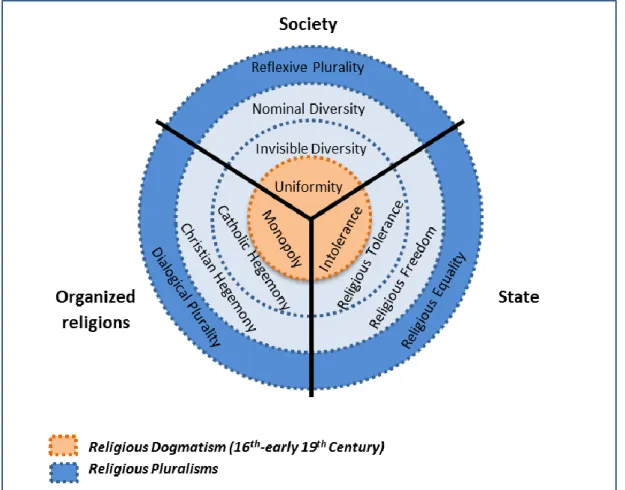
With the above shortcomings and conceptual guide-lines in mind, we now propose an analytical frame fo-cused on the concrete hegemonic framework of Latin America and the conceptual distinctions between, and degrees of, secularities, diversities and pluralities. 5. A Three-Dimensional Model of Religious Pluralisms In this section we describe both a series of key dimen-sions and a scale of degrees by which those dimendimen-sions can be analysed and referred to in debates on religious diversity, religious plurality and social inclusion, as de-picted in Figure 1.
Firstly, we propose three key dimensions as axial categories that represent, in our view, the most im-portant subfields in a given region’s religious field/s: society, organized religions and the state. What we suggest is to regard them as institutions but also as
in-terdependent sub-fields of forces; that is, partly auton-omous and partly dependent axial spaces where sym-metric and asymsym-metric relations of power between in-dividuals, groups and institutions take place either in manifest or latent forms (Lukes, 2005). By referring to them as currently existing sub-fields we do not mean clear-cut spaces whose analysis concerns only present-time phenomena. These are dimensions whose consti-tution is to varying degrees related to their historicity. Thus we understand the organized religions dimension as one of the religious field’s subfields, where historical churches and emergent organized religions and syn-cretic cults can be found either separate from each other or connected through symmetric or asymmetric links. In the same fashion, we suggest looking at the state not as a macro-institution but as a dimension where struggles for, and the granting of, religious rights take place. Similar to Frigerio and Wynarczyk’s pro-posal (2008), our axial spaces include the society
di-mension. Yet we do not understand “society” as
partic-ular organizations and mass media that regulate the religious market (2008, pp. 228-229), but more gener-ally as a subfield that is constituted by a wide range of individuals and groups that interact or not in a given context and can range from the atheist or the non-believer to the religiously-unaffiliated and the reli-giously-(multi)affiliated.
The second particularity of our model is aimed at over-coming the implicit and explicit binarisms in the litera-ture on the emerging religious diversity in Latin Ameri-ca by adding degrees which Ameri-can further qualify the three dimensions above. Like Eck (2001), Frigerio and Wynarczyk (2008) and Levine (2009), we sustain the analytical relevance of distinguishing between the quantitative emergence of religious diversity, the con-figuration of religious plurality, and religious pluralism as a combined and ceaseless process. Following this logic, instead of conveying in our model the idea of so-cieties that are “uniform” or “diverse” in terms of reli-gious (un)affiliation; “hegemonic” or “plural” in the subfield of organized religions, and “confessional” or “secular” with regard to the state, we want to convey multiple degrees of diversity, plurality and secularity that can be found in society, organized religions and state dimensions respectively. These degrees are not cumulative stages towards religious pluralisms; they are societal features that do not, and should not, nec-essarily unfold sequentially. Each degree is meant to be analysed qualitatively, quantitatively or both, to assess how much of, and which specific manifestations of, the degree in question can be empirically verifiable in a given case. We consider it important to point out as well that the degrees, which we will expand on below, are based mostly on descriptive analytics but also on a cautious normative standpoint, upon which a flexible concept of ideal religious pluralisms will be conveyed. These ideal religious pluralisms amount to the degrees illustrated in Figure 1’s outer circular layer and are based on the idea that complete and permanent har-mony, ecumenism and cooperation in societies (Mouffe, 2000) and religious fields might stand as de-sirable teleologies and even practical goals but should not be regarded as necessary requirements for a sound religious pluralism. We will expand on these realistic expectations in the sub-sections below.
5.1. The State Dimension
As observed, secularity in Latin America mainly relates to the state protection of the rights of religious minori-ties and the demise of the institutional privileges en-joyed by the Catholic Church, rather than to the decline of religiosity or the retreat of religion from public spac-es. Due to the secular paths taken in Latin America (i.e. usually from Catholic confessionality to impartial but non-atheist states) we basically distinguish between: 1)
religious intolerance: confessional states where
non-adherents to the state religion are socially excluded and even private non-Catholic worship is expressly for-bidden, creating favorable conditions for structural dis-crimination against persons who do not accept the of-ficial ideology or who oppose it; 2) religious tolerance: confessional states where religious minorities, alt-hough being socially excluded to different extents, are
allowed (rather than entitled) to hold religious cere-monies in public, and the Catholic Church is supported by the government and enjoys other legal and political prerogatives; 3) religious freedom: confessional and non-confessional states that recognize the freedom to choose a religion or belief, consistently maintain a cer-tain church-state separation and allow the legal recog-nition of non-Catholic religions (including their rights to possess properties, land and media; to form political parties; and to declare political positions), but where the Catholic Church might retain some privileges in consid-eration of its majoritarian status or cultural relevance for the nation; and 4) religious equality: non-confessional states that revoke the Catholic Church’s privileges and establish principles of state evenhandedness vis-à-vis theistic, non-theistic and atheistic beliefs.
5.2. The Society Dimension
We suggest qualifying the degree of religious hetero-geneity in society by contrasting the previous religious uniformity of Latin American colonial societies with their contemporary diversity and by breaking down the latter into a) invisible diversity, b) nominal diversity and c) reflexive plurality. Our starting point is the idea that a plural society should first and foremost know about the actual existence of the religious alternatives that can actually render that society plural. By proposing
in-visible diversity as an analytical distinction, we want to
bring attention to the fact that there have been, and surely still are and will be, non-Catholic individuals and groups in Latin America whose religious or non-religious profile is unknown beyond limited circles of state and/or religious experts. When the religious oth-ers’ local presence is ignored by the majority of indi-viduals and major groups (e.g. media, educational insti-tutions, business, political parties, civic organizations, etc.), we can speak about a situation of invisible
diversi-ty. Individuals and groups in one of Mexico’s
western-central states may be aware of the presence of publicly active Jehovah’s Witnesses in the vicinity but individu-als at large, and perhaps the local media or business sector, might not necessarily know about the presence of members of the “Marian Trinitarian Spiritualism” church (Sanchez, 2009). In such a case quantitative and qualitative assessments of what/how much religious diversity has been detected in a region can give a bet-ter sense of how much invisible diversity prevails there.
By nominal diversity we mean societies where there is both a factual presence of religious minorities as well as some major institutions, and/or individuals within those institutions, that do know about the presence and basic constitution of alternative religions and reli-gious groups in that society. These are social institu-tions and individuals, beyond limited circles of religious or state experts, which are relatively knowledgeable about general facts of those religious alternatives—
their main doctrinal tenets or organizational character-istics, for instance. Within this category it is also possi-ble to distinguish between a) actively hostile scenari-os—where religious minorities are discriminated against or attacked (Dias, 2012; Vallverdu, 2005, p. 62); and b) passive scenarios—where individuals affiliated to the majority religion are aware of the presence and basics of the religious others but have little or no desire to understand them further—and vice versa (Mendoza, 2008, p. 202).
We suggest reserving the term reflexive plurality for societies where individuals from different religious groups—as well as atheists—know about the presence, the basics and at least some of the substantial views and background of their religious counterparts. These societies may or may not enter into cooperative rela-tions based upon such knowledge. We do not see soci-eties with reflexive plurality from a radical idealistic viewpoint, that is, as perfect societies where every-body knows with precision the history and doctrinal configuration of each religious alternative and where cooperation is therefore the norm (cf. Eck, 2001). For us, reflexive plurality does require openness and toler-ance in order to be aware of prejudice (Eck, 2001), but such an openness can well remain as the base of a de-tached understanding.
5.3. The Organized-Religions Dimension
As to the plurality of churches and other organized re-ligions, Latin America is characterized by the historical monopolistic position of the Catholic Church. In some cases, this monopoly remained uncontested even after the post-independence secular reforms that took place at different points in time across the region. What has followed, after the nominal challenge of this monopoly over the last two centuries, are different types of non-monopolistic dimensions of organized religion. From a descriptive position we distinguish two types: Catholic
hegemony and Christian hegemony; from a normative
position we distinguish one further type: dialogical
plu-rality. Catholic hegemony describes dimensions where
the Catholic Church, as an internally-diverse majority church in most countries, co-exists with Christian mi-nority churches as well as other religious groups, asso-ciations or communities whose collective identity is not necessarily that of a church (as in the case of the Um-banda; Prandi, 2004, p. 229). Notwithstanding this co-existence, the Catholic Church and its ensemble of reli-gious orders, Catholic groups and associations retain a clear religious and extra-religious (political, cultural, educational) pre-eminence (Levine, 2014; Levy, 1996). This Catholic hegemony is better apprehended if it is seen as the outcome of the historical religious and ex-tra-religious activism of this church and its organiza-tions. Regarding the case of Argentina, Carbonelli and Jones refer to such an outcome as a “cultural matrix”
that has the capacity “to confer meaning on national identity and to shape state structures” (2015, p. 160; our translation).
Similar to a duopoly, a Christian hegemony could be described as a religious field where the Catholic Church and Christian denominations share a dominant posi-tion, which can result from various forms of coopera-tion or unintended alignment on moral and extra-religious issues (e.g. against reproductive rights, homo-sexuality, same-sex marriage, euthanasia, etc.). Through extra-religious activism, direct intervention in politics and the operation of media channels and radio stations, Christian morals, values and worldviews thus continue to shape social relations and define the rules of the game. Brazil illustrates this case. According to Freston (1998), Brazilian Pentecostal churches—which themselves seek a hegemony within the Brazilian Protestant milieu—tend to have no united political front but do have an active presence in the country’s politics. Brazilian Pentecostal politicians have been elected as governors, federal deputies and city officials; in the most recent legislative period, they accounted for 12% of the seats in the Brazilian Congress (Macha-do & Burity, 2014, p. 601).
Dialogues are a main component of what we con-sider as an organized-religions dimension with
dialogi-cal plurality. This is a plurality that describes religious
fields where majority and minority religions and reli-gious groups not only value (Frigerio & Wynarczyk, 2008) their different or similar contributions to the re-ligious and extra-rere-ligious dimensions but do so by openly communicating with each other (Vallverdu, 2005, p. 63). This particular type of religious plurality may include interfaith dialogues as well as other (socio-political) dialogues among the religious denominations’ lay members or non-“authorized” voices (Levine, 2009, p. 406). Nevertheless, dialogical plurality, just as reflex-ive plurality in the society dimension, is not necessarily expected to produce cooperative engagement (cf. Eck, 2001) or a harmonious ecumenism (cf. Hagopian, 2009; Parker, 2005). Even less are such dialogues likely to be an effective means of overcoming asymmetries of power. Nonetheless, we consider dialogues as condu-cive to the creations of conditions of competence, dis-sent and negotiation that may well contribute signifi-cantly to progress towards more inclusive rules of the game. Here Frigerio and Wynarczyk’s notes on the role of social institutions are relevant. A sound level of dia-logical plurality is manifested when majority and mi-nority religions/religious groups alike are able to dia-logue, under equal conditions of openness, with state institutions as well as with society’s civic groups, mass media, NGOs and other non-state organizations. 6. Conclusions
diver-sity and the multiple-secularities approach, the analyti-cal model we propose is aimed at overcoming Eurocen-tric categorizations and conceptual imprecisions. The model above contains both descriptive and normative analytical categories whose even and balanced distri-bution in Figure 1 is meant to represent neither sym-metric dimensions in actual societies nor degrees of di-versity, plurality and secularity that develop jointly in a linear fashion. Although the model does propose nor-mative scenarios in the dimensions of state, religion and society, it is not meant to suggest a method which Latin American societies would have to undertake in order to develop and/or consolidate religious plural-ism. The model above clarifies key concepts that can be used in specialized discussions and problematizes the interpretations of contemporary realities regarding the religious fields in Latin America. It is also a flexible ana-lytical tool that can be adapted to local, national or transnational contexts and approaches. For instance, it can enable multi- or inter-disciplinary comparisons of degrees of secularities, diversities and pluralities that can be empirically observed across multiple local con-texts—e.g. across Chiapas in Mexico, Chimborazo in Ec-uador and Cauca in Colombia, where Protestant com-munities have apparently developed in comparable terms (Gros, 1999). Once operationalized, the model can also be used as a framework for comparative analyses of the degrees of religious pluralism across different Latin American countries or regions; these comparisons can be quantitative or qualitative and generate, for in-stance, indexes or typologies of religious pluralism. If the model is properly adapted—particularly the model’s departure point, i.e. the region’s historical background— it can also assist comparative analyses of the develop-ment of religious diversities/pluralisms, or other reli-gious/secular dynamics, within and across postcolonial regions beyond Latin America. In any case, adaptations in our view would have to be cautious and preferably follow the non-Eurocentric, non-linear, complex (mul-tiple dimensions and degrees) and realist rationale of the original model.
Above all, we consider both the discussion and the analytical proposal above to be key inputs for contem-porary debates on social inclusion. As suggested in this paper, there are conceptual and empirical links be-tween the consolidation of reflexive plurality in society at large, the development of dialogical plurality among organized religions and atheist organizations and the attainment of religious equality in terms of equal rights granted by the state to organized religions. More im-portantly, it can also be said that the development of reflexive and dialogical pluralities in the first two sub-fields may facilitate not only the consolidation of reli-gious equality among organized religions but also the de-centering of Christian values in public education and the granting by the state of gender equality, as well as comprehensive sexual and reproductive rights for all
individuals regardless of their sexual orientation— some of the crucial inclusive rights where there has been important progress on the legal and judicial fronts, but whose de facto fulfillment, and political de-bate at times, has been somewhat hindered by hege-monic churches and individuals’ religious beliefs alike. The decrease of Catholic or Christian hegemony and the increase of dialogical plurality among organized re-ligions, coupled with the presence of a reflexively plu-ral society, may not be sufficient yet remains a neces-sary condition for the attainment of the aforementioned rights. A dialogical field of organized religions, together with societies whose reflexive plurality is high, may al-so facilitate the legal application and extra-legal conal-sol- consol-idation of those inclusive rights. The resulting religious pluralisms—or the reflexive and dialogical cultures, and legal frames, of equality, understanding and dissent— provide, in principle, effective conditions for social in-clusion.
Acknowledgements
We should like to thank the Social Inclusion journal’s anonymous reviewers, the editor of this special issue as well as Paul Talcott and Carlos N. Mora, for their valuable comments on an earlier version of this paper. Conflicts of Interest
The authors declare no conflicts of interest. References
Amuchastegui, A., Cruz, G., Aldaz, E., & Mejia, M. (2010). Politics, religion and gender equality in contempo-rary Mexico: Women’s sexuality and reproductive rights in a contested secular state. Third World
Quar-terly, 31(6), 989-1005.
Beltran, W. (2011). Descripción cuantitativa de la plurali-zación religiosa en Colombia. Universitas
Humanísti-ca, 73, 201-237.
Bhambra, G. (2007). Rethinking modernity
postcolonial-ism and the sociological imagination. Basingstoke
and New York: Palgrave Macmillan.
Bidegain, A., & Demera, J. (2005). Globalización y
diver-sidad religiosa en Colombia. Bogotá: Univerdiver-sidad
Na-cional de Colombia.
Blancarte, R. (1994). Iglesia y Estado en México: Seis
dé-cadas de acomodo y de conciliación imposible.
Méxi-co: IMDOSOC.
Boatcă, M. (2015). Global inequalities beyond
Occiden-talism. Farnham: Ashgate.
Burchardt, M., Wohlrab-Sahr, M., & Wegert, U. (2013). “Multiple secularities”: Postcolonial variations and guiding ideas in India and South Africa. International
Sociology, 28(6), 612-628.
(2015). Multiple secularities beyond the West:
Reli-gion and modernity in the global age. Boston, Berlin
and Munich: De Gruyter.
Carbonelli, M., & Jones, D. (2015). Igualdad religiosa y reconocimiento estatal: Instituciones y líderes evan-gélicos en los debates sobre la regulación de las acti-vidades religiosas en Argentina 2002–2010. Revista
Mexicana de Ciencias Políticas y Sociales, LX(225),
139-168.
Chakrabarty, D. (2000). Provincializing Europe.
Postcolo-nial thought and historical difference. Princeton:
Princeton University Press.
Chuchiak, J. (2012). The Inquisition in New Spain, 1536–
1820: A documentary history. Baltimore: John
Hopkins University Press.
Costa, S. (2006). Dois Atlânticos. Teoria social,
anti-racismo, cosmopolitismo. Belo Horizonte: UFMG.
De la Torre, R., & Gutiérrez, C. (Eds.) (2007). Atlas de la
diversidad religiosa en México. México: CIESAS,
COL-JAL, COLEF, COLMICH, UQROO, SEGOB, CONACYT. De la Torre, R., & Gutiérrez, C. (2008). Tendencias a la
pluralidad y la diversificación del paisaje religioso en el México contemporáneo. Sociedade e Estado,
23(2), 381-424.
Dias de Oliveira, I. (2012). Religião e etnicidade: Novas sensibilidades num mundo multicultural. In C. Parker (Ed.), Religión, política y cultura en América Latina.
Nuevas miradas (pp. 285-295). Santiago de Chile:
Ins-tituto de Estudios Avanzados, Universidad de Santia-go de Chile.
Eck, D. (2001). A new religious America. How a “Christian
country” has become the world’s most religiously di-verse nation. New York: Harper Collins.
Fediakova, E. (2007). Religión, política, ciudadanía: Cam-bio de paradigmas, iglesias evangélicas en Chile post-guerra fría. Bicentenario. Revista de Historia de Chile
y América, 6(2), 71-98.
Ferre, Z., Gerstenblüth, M., & Rossi, M. (2009). Religión y religiosidad en Uruguay. Cuadernos del CLAEH, 32(99), 19-34.
Forni, F., Mallimaci, F., & Cárdenas, L. (Eds.) (2003). Guía
de la diversidad religiosa de Buenos Aires. Buenos
Aires: Biblos.
Freston, P. (1998). Pentecostalism in Latin America: Characteristics and controversies. Social Compass,
42(3), 335-358.
Freston, P. (2011). Religious pluralism, democracy, and human rights in Latin America. In T. Banchoff & R. Wuthnow (Eds.), Religion and the global politics of
human rights (pp. 101-128). New York: Oxford
Uni-versity Press.
Freston, P. (2012). Las dos transiciones futuras: Católi-cos, Protestantes y sociedad en América Latina. In C. Parker (Ed.). Religión, política y cultura en América
Latina. Nuevas miradas (pp. 77-97). Santiago de
Chi-le: Instituto de Estudios Avanzados, Universidad de Santiago de Chile.
Frigerio, A., & Wynarczyk, H. (2008). Diversidad no es lo mismo que pluralismo: Cambios en el campo religio-so argentino (1985–2000) y lucha de los evangélicos por sus derechos religiosos. Sociedade e Estado,
23(2), 227-260.
Garma, C. (2007). Diversidad religiosa y políticas públicas en América Latina. Revista Cultura y religión, 1(1), 48-60.
Garvin, N. (2005). Conversion & conflict Muslims in Me-xico. International Institute for the study of Islam in
the Modern World, 15, 18-19.
Gros, C. (1999). Evangelical Protestantism and indige-nous populations. Bulletin of Latin American
Re-search, 18(2), 175-197.
Hagopian, F. (2009). The Catholic Church in a plural Latin America. In F. Hagopian (Ed.), Religious pluralism,
democracy and the Catholic Church in Latin America
(pp. 429-466). Notre Dame: University of Notre Dame.
Hall, S. (1996). The West and the rest: Discourse and power. In S. Hall (Ed.), Modernity: Introduction to the
modern societies (pp. 185-227). Oxford: Blackwell.
Latinobarómetro. (2014). Las religiones en tiempos del Papa Francisco. Retrieved from http://www.sciences po.fr/opalc/sites/sciencespo.fr.opalc/files/LAS_RELIG IONES_EN_TIEMPOS_DEL_PAPA_FRANCISCO%20-%2 0copie.pdf
Lavinia, S., & Turcescu, L. (2011). Church, State, and
de-mocracy in expanding Europe. New York: Oxford
University Press.
Levine, D. (2009). Pluralism as challenge and opportuni-ty. In F. Hagopian (Ed.), Religious pluralism,
democ-racy and the Catholic Church in Latin America (pp.
405-428). Notre Dame: University of Notre Dame. Levine, D. (2014). Popular voices in Latin American
Ca-tholicism. Princeton: Princeton University Press.
Levy, D. (1996). Building the third sector: Latin America’s
private research centers and nonprofit development.
Pittsburgh: University of Pittsburgh Press.
Lukes, S. (2005). Power. A radical view (2nd ed.). New York: Palgrave Macmillan.
Machado, M., & Burity, J. (2014). A ascensão política dos pentecostais no Brasil na avaliação de líderes religio-sos. DADOS: Revista de Ciências Sociais, 57(3), 601-631.
Masferrer, E., (2013). Religión, política y metodologías. Buenos Aires: Libros de la Araucaria.
Mendoza, M. (2008). La Nueva Jerusalén y su relación con la población otomí de Querétaro. Estudios de
Cultura Otopame, 6(1), 199-211.
Moran, J. (2013). Feminismo, Iglesia Católica y derechos sexuales y reproductivos en el Chile post-dictatorial.
Estudos Feministas, 21(2), 485-508.
Mouffe, C. (2000). The democratic paradox. London and New York: Verso.
Parker, C. (2005). ¿América Latina ya no es católica? Plu-ralismo cultural y religioso creciente. América Latina
Hoy, 41, 35-56.
Parker, C. (Ed.) (2012). Religión, política y cultura en
América Latina. Nuevas miradas. Santiago de Chile:
Instituto de Estudios Avanzados, Universidad de San-tiago de Chile.
Pew Research Center. (2014a). Religion in Latin America:
Widespread change in a historically Catholic region.
Retrieved from http://www.pewforum.org/files/2014 /11/Religion-in-Latin-America-11-12-PM-full-PDF.pdf Pew Research Center. (2014b). Global religious diversity.
Retrieved from http://www.pewforum.org/2014/04/ 04/global-religious-diversity/#fn-20155-2
Prandi, R. (2004). O Brasil com axé: Candomblé e um-banda no mercado religioso. Estudos Avançados,
18(52), 223-238.
Prien, H. J. (2013). Christianity in Latin America (revised and expanded edition). Leiden and Boston: Brill. Rauhut, C. (2012): Santería und ihre Globalisierung in
Kuba. Tradition und Innovation in einer afrokubani-schen Religion. Würzburg: Ergon.
Robbers, G. (2005). State and Church in the European
Union. Baden-Baden: Nomos.
Sanchez, O. (2009). Vivir entre dos religiones. In S. Benard & O. Sanchez (Eds.), Vivir juntos en una
ciu-dad en transicion. Aguascalientes frente a la diversi-dad social (pp. 189-212). Aguascalientes: Universidiversi-dad
Autónoma de Aguascalientes.
Sawchuk, D. (2004). The Costa Rican Catholic Church,
so-cial justice and the right of workers 1979–1996.
Wa-terloo: Wilfrid Laurier University Press.
Schuh, C., Burchardt, M., & Wohlrab-Sahr, M. (2012). Contested secularities: Religious minorities and secu-lar progressivism in the Netherlands. Journal of
Reli-gion in Europe, 5, 349-383.
Vallverdú, J. (2005). Violencia religiosa y conflicto políti-co en Chiapas, Méxipolíti-co. Nueva Antropología, 65, 55-74.
Wohlrab-Sahr, M., & Burchardt, M. (2012). Multiple sec-ularities: Towards a cultural sociology of secular mo-dernities. Comparative Sociology, 11, 875-909.
About the Authors
Dr. Edgar Zavala-Pelayo
Edgar Zavala-Pelayo is a postdoctoral researcher based at the Institute for Latin American Studies and the Center for Area Studies of the Free University of Berlin. He holds a master’s and doctoral degree in sociology from the University of Edinburgh. His theoretical and empirical research focuses on sci-ence-and-religions and politics-and-religions entanglements and their relations to the paradigms of modernity/ies, rationality/ies and secularisms/secularities.
Dr. Manuel Góngora-Mera
Manuel Eduardo Góngora-Mera is a postdoctoral researcher and lecturer at the Institute for Latin American Studies of the Free University of Berlin. He obtained his doctoral degree in Public Law from Humboldt University of Berlin. His publications deal mainly with constitutional and human rights is-sues, including international human rights law, inter-American constitutionalism, social rights, and categorical inequalities.