Durham Research Online
Deposited in DRO: 08 April 2015
Version of attached le: Accepted Version
Peer-review status of attached le: Peer-reviewed
Citation for published item:
Pal, R. and Saha, B. (2016) 'Entry threats and ineciency in `ecient bargaining'.', Scottish journal of political economy., 63 (3). pp. 258-277.
Further information on publisher's website:
http://dx.doi.org/10.1111/sjpe.12091 Publisher's copyright statement:
This is the accepted version of the following article: Pal, R. Saha, B. (2015), Entry Threats and Ineciency in `Ecient Bargaining'. Scottish Journal of Political Economy, 63(3): 258-277, which has been published in nal form at http://dx.doi.org/10.1111/sjpe.12091. This article may be used for non-commercial purposes in accordance With Wiley Terms and Conditions for self-archiving.
Additional information:
Use policy
The full-text may be used and/or reproduced, and given to third parties in any format or medium, without prior permission or charge, for personal research or study, educational, or not-for-prot purposes provided that:
• a full bibliographic reference is made to the original source
• alinkis made to the metadata record in DRO
• the full-text is not changed in any way
The full-text must not be sold in any format or medium without the formal permission of the copyright holders. Please consult thefull DRO policyfor further details.
Entry Threats and Inefficiency in ‘Efficient Bargaining’
Rupayan Pal† and Bibhas Saha‡
†Indira Gandhi Institute of Development Research (IGIDR), India
‡ Durham University Business School, University of Durham, UK
Abstract
We study limit pricing in a model of entry with asymmetric information where the incumbent firm’s wage is endogenously determined through ‘efficient bargaining’ with its union. In the presence of entry threat the incumbent firm-union pair may face a conflict between rent sharing and transmitting its cost information. When the wage is not observable to outsiders and employment is the only signalling instrument, over-employment features in all entry deterring contracts. When the wage is also observable, information transmission becomes easier. Then most of the time, but not always, the efficient contract deters (induces) entry against the low (high) cost incumbent.
Keywords: Efficient Bargaining, Entry Threat, Signalling, Inefficiency
JEL Classifications: J51, L12, D43, J58
− − − − − − − − − − − − − − −−
Corresponding author: Rupayan Pal, Indira Gandhi Institute of Development Research (IGIDR), Film City Road, Santosh Nagar, Goregaon (East), Mumbai 400065, India. E-mails: †[email protected], [email protected]; ‡[email protected]. Telephone: +91-22-28416545, Fax: +91-22-28402752.
Acknowledgment: We gratefully acknowledge helpful comments from the editor and two anonymous referees. Remaining errors, if any, are our responsibility.
Entry Threats and Inefficiency in ‘Efficient Bargaining’
Abstract
We study limit pricing in a model of entry with asymmetric information where the incumbent firm’s wage is endogenously determined through ‘efficient bargaining’ with its union. In the presence of entry threat the incumbent firm-union pair may face a conflict between rent sharing and transmitting its cost information. When the wage is not observable to outsiders and employment is the only signalling instrument, over-employment features in all entry deterring contracts. When the wage is also observable, information transmission becomes easier. Then most of the time, but not always, the efficient contract deters (induces) entry against the low (high) cost incumbent.
Keywords: Efficient Bargaining, Entry Threat, Signalling, Inefficiency
1
Introduction
In recent years, due to greater integration of product and labour markets, entry of new firms has increased by manifolds in most industries around the world. Empirical studies also suggest that threat of entry significantly affects outcomes of both product and labour markets by influencing investment and/or export (Abraham et al., 2009; Boulhol et al., 2011; Ahsan and Mitra, 2014). Hence, studying the effects of entry threats assumes greater importance in the era of increasing globalization. It is not hard to see that entry threat affects the existing firms’ strategic postures in the product market, and yet at the same time it creates frictions in the process of rent allocation within the firm, particularly with crucial input suppliers, such as the labour unions. Both sides need to cooperate to achieve a common goal of deterring entry in future, but that also requires giving up individual rents at present. Whether they would succeed in achieving their common goal is the central question of this paper.
We adapt the classic model of limit pricing due to Milgrom and Roberts (1982) by in-troducing wage bargaining. In the Milgrom-Roberts model, the entrant does not know the true marginal cost of the incumbent, which is either high or low, and entry is prof-itable only if the incumbent’s marginal cost is high. The entrant, however, can infer the incumbent’s marginal cost from the pre-entry price by invoking game-theoretic reasoning. Generally two types of equilibrium are highlighted – separating (i.e. information revealing) and pooling (i.e. information non-revealing). The first equilibrium occurs when the
en-trant is optimistic about post-entry profit.1 In this case, the low cost incumbent signals his competitiveness by charging a sufficiently low price. The second equilibrium occurs when the entrant is pessimistic about his post-entry profit. The high cost incumbent then can pretend to be the low cost type. For not being to able to extract any new information the entrant would stay away. Thus, there are two alternative scenarios of limit pricing both resulting in entry deterrence.
In this framework, we introduce a labour union in the incumbent firm and allow simulta-neous bargaining over both wage and employment, which is known as efficient bargaining (McDonald and Solow, 1981). The entrant does not know the true reservation wage of the union, which can be high or low; he has some priors about these reservation wages.
Introduction of wage bargaining immediately complicates the Milgrom-Roberts model by requiring limit pricing to be jointly incentive compatible for the firm and the union. A second issue concerns decoupling of bargaining from surplus creation. Ordinarily under efficient bargaining this decoupling is achieved seamlessly, because bargaining is shifted only to the surplus part, while the production decision is based on the reservation wage, which is a key requirement for efficiency.2 Under asymmetric information whether that
will still be the case is not obvious. We know from the existing literature that when
1Optimism refers to the entrants’ expected profit being positive, where the expected profit is calculated
on the basis of his priors about the entrant’s marginal cost. Pessimism refers to negative expected profit.
2Efficiency remains intact even with sequential bargaining, provided that the union’s (and, hence,
firm’s) bargaining power at the stage of bargaining over wage does not differ from that at the stage of employment bargaining (Manning, 1987).
other bargaining protocols are used such as the right-to-manage bargaining (Nickell and Andrews, 1983), not only is employment distorted, but also bargaining frictions can render signalling difficult (see, for example, Dewatripont, 1987, 1988; Ohnishi, 2001; Pal and Saha, 2006, 2008). But as these papers have used inefficient bargaining protocols, it is difficult to ascertain how much of the production inefficiency is attributable to limit pricing and how much to bargaining frictions.3 By using the efficient bargaining protocol one may gain
further insight into inefficiency.
Though bargaining and limit pricing are intertwined, conceptually they can be separated. Bargaining frictions are likely to arise when the surplus is to be sacrificed for strategic reasons. On the other hand, the scope for limit pricing depends on what is observable to the entrant and what is not. More specifically, whether the entrant observes the wage in addition to price is crucial. If the wage is observable, the incumbent firm-union pair has an additional instrument of signalling. As such, disclosure of wage agreement may not be mandatory by law.4 Firms may still disclose it voluntarily or strategically. To capture 3It has been noted that inefficient bargaining protocols can also produce efficient outcomes if
profit-sharing is introduced (Anderson and Devereux, 1989; Pohjola, 1987). But the workers’ incomes in that case will be more volatile and even the risk of unemployment may rise (Koskela and Stenbacka, 2006; Schmidt-Sorensen, 1992; Holmlund, 1990). Therefore, simultaneous bargaining over both wage and employment, which is sufficient to generate efficient outcome under complete information, remains a superior protocol than any other.
4Note that in many countries, including continental European countries, Anglo-Saxon countries and
developing countries like India, union-firm bargaining is a widespread phenomenon (Flanagan, 1999; Alesina et al., 2006; Pal, 2010). Also, note that disclosure of wage rates is not mandatory by law in most
different institutional settings we need to consider two alternative scenarios of unobservable and observable wage, and see to what extent limit pricing is carried out and how it affects wage and employment.
In the scenario of unobservable wage, as employment is the only avenue for information transmission, it may need to be sufficiently distorted for the purpose of information rev-elation (as in a separating equilibrium) or information suppression (as in a pooling equi-librium). It turns out that the union’s interest is aligned with the firm’s, so that if it is incentive compatible for the firm to limit price, it is also incentive compatible for the union to limit price. Hence, the standard result of Milgrom and Roberts (1982), as discussed above, go through with the modification that both the firm and the union accept lower payoffs. The limit pricing contracts feature over employment and lower wage, and entry is deterred either via a separating equilibrium or via a pooling equilibrium.5 But the extent
of over employment does not depend on the bargaining power of the union. That is to say, over employment is induced by limit pricing and not by bargaining frictions. The entry outcome, however, is efficient under a separating equilibrium, and inefficient under a pooling equilibrium.
In the second scenario, where wage is also an instrument of signalling, information transmis-sion becomes easier. Consequently, separation of the types occurs with the first best levels of wage and employment, unless the union’s bargaining power is greater than a critical
of the developing countries including India, unlike as in Western countries like the US.
level. When the union’s bargaining power is greater than a critical level, separation of the low type calls for over employment and lower wage as in the first scenario. Thus, efficiency of employment is preserved most often, despite entry threats. The entry outcome is also efficient. Equally, information suppression is difficult in this environment and therefore, the pooling equilibrium will not exist, which means that the high cost union will not be able to deter entry, – again a socially efficient outcome. But there is a caveat: information suppression is not optimal as long as the union’s bargaining power is below a critical level. Here bargaining friction comes into play. As long as the union does not expect a large share of the surplus, it does not care much about the effect of entry. So it does not find information suppression optimal, as much as the firm does. Hence, the pooling equilibrium (i.e. the act of information suppression) fails. But if the union is sufficiently powerful, it will see substantial gains from deterring entry and its interest then will be aligned with the firm’s. Consequently, the pooling equilibrium will be feasible, and the high cost union-firm pair will pretend to be low cost type and prevent entry. Their chosen employment level will then be inefficiently large and wage rate will be sufficiently low. Though as before the extent of over employment will not depend on the union’s bargaining power, it can be argued that the bargaining frictions determine when information suppression will be jointly incentive compatible and when it will not.
Results of this paper indicate that historical data on wage-employment contracts between union-firm pairs need not necessarily satisfy the condition for Pareto efficiency, even if there was simultaneous bargaining over both wage and employment. In other words, the
model of simultaneous bargaining over both wage and employment can not be rejected purely on the basis of negative results of tests for Pareto efficiency criteria, as commonly envisaged in the existing empirical literature (see, for example, Brown and Ashenfelter, 1986; Alogoskoufis and Manning, 1991; Vannetelbosch, 1996). Clearly, results of this paper have implications to empirical tests of alternative union-firm bargaining models.
The remainder of the paper is organized as follows. The next section presents the basic setup of the model. The main analysis is presented in section 3. Section 4 concludes.
2
The setup
There is an incumbent firm (labeled firm 1) and a potential entrant (labeled firm 2) in a market for homogeneous products. Firm 1 simultaneously negotiates both wage (w) and employment (l) with its labour union. The labour union is sufficiently large to meet labour requirements of firm 1, but it does not supply labour to firm 2. The only feasible alternative to the union is to supply workers to the alternative sector. Also, firm 1 cannot hire workers from any other source. In other words, we consider a scenario in which firm 1 and its labour union are locked-in, which is plausible in many real life situations.6 We 6Existing institutional setup often restricts a firm to hire non-union workers. Inability of a firm’s
labour union to serve its rival firm(s) can be well justified in the following situations: (a) production units of firms are located in different countries, but they serve the same market (the case of international trade); (b) production units of firms are located in different sates/counties of a country and labour unions operate within a state/county (the case of localized labour unions); (c) firms differ in terms of production
assume that the bargaining power of the union isγ, which is exogenously given, and that of firm 1 is 1−γ, 0 ≤γ ≤1. For simplicity, we assume that no other payments, covert or overt, outside the wage-employment contract can be made to the union or firm 1.
Firm 2’s cost of production is assumed to be exogenously determined: it incurs a fixed cost
F in the case of entry and its marginal cost of production is constant, c.7 For simplicity,
we consider that firm 2’s marginal cost of production is known to all before it takes entry decision, unlike as in Melitz (2003). The production technology of firm 1 is given byx=l, wherexis the output of firm 1. The product market demand curve is linear: p=A−x−y; wherep is the price andy is the output of firm 2 in the case of entry. Thus, firm 1’s profit is Π = (p−w)l. The union tries to maximize its net wage bill U = (w−θ)l, where θ is the time-invariant reservation wage of workers. Clearly, higher value of θ would lead to higher marginal cost of firm 1, which is equal to the bargained wage. We consider thatθ is drawn by Mother Nature and it could be high (θ2) or low (θ1);θ2 > θ1. The true value of
θ is known only to firm 1 and the union, but not to firm 2 until it enters. Firm 2 believes that θ1 occurs with probability ρ and θ2 occurs with probability (1−ρ). We assume that
entry is profitable only if the reservation wage is high (θ =θ2). Both firm 1 and the union
technologies (e.g. traditional vis-a-vis modern) and, thus, they differ in terms of skill requirements to produce (almost) homogeneous goods, e.g. cloths (the case of skill mismatch), etc. Nonetheless, it can be shown that qualitative results of this paper will hold true, if we relax this assumption, as long as bargaining is decentralized and marginal costs of firm 1 and firm 2 are weakly correlated. See Pal and Saha (2006) and Pal and Saha (2008) for cost-correlation and entry deterrence under monopoly union and right-to-manage bargaining, respectively.
dislike entry.8
Stages of the game involved are as follows. Period 1
Stage 1: Mother Nature chooses the reservation wage, θ ∈ {θ1, θ2}. (The same
reservation wage prevails in both periods)
Stage 2: Simultaneous bargaining over w and l takes place in firm 1.
Stage 3: Production takes place. Firm 2, the entrant, observes the incumbent’s price (p), output (x) and employment (l). However, firm 2 may or may not observe the incumbent’s wage (w).
Period 2
Stage 1: Firm 2 decides whether to enter or not. If it enters, it must incur a fixed cost F. It also learns the true value ofθ.
Stage 2: Bargaining over w and l takes place in firm 1. If entry has occurred, Cournot competition takes place; otherwise monopoly prevails.
Note that, since labour is considered to be the only factor of production and both the production function and the market demand function are deterministic and known to all, observing price (p) is equivalent to observing output (x), which is equivalent to observing employment (l). In other words, price, output and employment carry the same
informa-8As the union can not supply workers to firm 2 and firm 2 has no impact onθ or γ, its entry reduces
tion regarding the incumbent firm’s cost.9 In the original Milgrom-Roberts model also, observation of output (in addition to price) does not yield any further information.
Since employment, output and price carry the same information, it is sufficient to consider any one of these (either price or employment or output) as the signalling device. This is true regardless of whether wage is observable or not. Without any loss of generality, we consider that in Stage 3 of Period 1 the entrant observes only the price (p) or both price (p) and wage (w).
The benchmark cases: We begin by considering two benchmark scenarios of symmetric information – monopoly and duopoly. Under monopoly the bargaining problem between firm 1 and the union, for any θi (i= 1,2), is as follows.
max wi,li Zi =U γ i Π 1−γ i = [(wi−θi)li]γ[(A−li−wi)li]1−γ.
Solving the above problem we get the monopoly wage and employment as
wMi =γA−θi 2 +θi, l M i = A−θi 2 , i= 1,2, (1) It is noteworthy that the contract curve is a vertical straight line on the (l, w) plain. Since it is independent of the bargaining power γ, employment is efficient.10 The payoffs of the
9We mention here that, in the case of multiple factors of production, the observation of output does not
necessarily imply the observation of employment unless inputs are perfect complements. In such a scenario, trying to signal through price and wage, or through price alone would require distorting labour and other factors of production. Employment in that case can be informative. We sidestep such possibilities in this paper.
bargain-union and firm 1 are, respectively, UiM =γ(A−θi) 2 4 , Π M i = (1−γ) (A−θi)2 4 , which are proportional to the (monopoly) surplus.
In the case of symmetric information duopoly, which would emerge in the post-entry sce-nario, the contract curve will again be vertical, but will correspond to a lower level of efficient output: wDi =γA−2θi+c 3 +θi, l D i = A−2θi +c 3 ,
and the consequent payoffs are
UiD =γ(A−2θi+c) 2 9 , Π D i = (1−γ) (A−2θi+c)2 9 Firm 2’s profit is Ri = (A −2c+θi)2
9 −F. We assume entry to be profitable only against θ2,
and hence we set R1 <0< R2, i.e. (A
−2c+θ1)2
9 < F <
(A−2c+θ2)2
9 .
3
Asymmetric information
Now we analyze the case of asymmetric information. Firm 2 decides on its entry based on whether its expected profit is positive or negative11, where the expected profit is calculated
based on its rational belief about true θ. By rational belief we mean the beliefs that are
ing, employment is chosen by the firm from its labour demand curve and the resultant bargaining outcome is inefficient (Nickell and Andrews, 1983).
formed using all the available information. The entrant’s prior about θ1 is ρ, which may
be revised upward or downward, if he receives a signal about θ to be θ1 or θ2. While
allowing such Bayesian updating, we will restrict our attention only to full updating or no updating. That is to say, either his belief aboutθ1will be revised to 1 or 0, or it will remain
unchanged atρ. The equilibrium concept we will use is perfect Bayesian equilibrium, which is standard for signalling models.
In equilibrium the incumbent firm-union pair will also act with rational expectation that the entrant will update his belief (if he can) and accordingly the pair will decide to reveal information (i.e. send an informative signal) or suppress information (i.e. send no signal or a non-informative signal). Let us first examine their incentive to send an informative signal. If the entrant’s prior is such that ER =ρR1+ (1−ρ)R2 >0, he will enter unless
there is a signal that θ =θ1. Knowing this, the firm-union pair would indeed like to send
an informative signal, if its θ is truly θ1. By doing this they avoid an unnecessary loss of
profit (resulting from mistaken entry). This is where the separating equilibrium occurs. On the other hand, if the entrant’s prior is such that ER =ρR1 + (1−ρ)R2 ≤ 0, he will
stay away, unless he receives an informative signal that θ =θ2. If indeed the true θ is θ2,
the firm-union pair would like to send an uninformative signal (or suppress information) so that the entrant cannot update his prior and stays away. This is the idea of pooling equilibrium.
Clearly, whether information revelation will be possible or not depends on, among other things, how many instruments are used to transmit information. As discussed earlier, this
depends on whether only price is observable, or whether both wage and price are observable to the entrant. We consider these two cases separately.
3.1
The case of unobservable wage
We first consider the scenario where the entrant, firm 2, does not observe the wage and it tries to infer the type of the union (i.e., the value ofθ) from the observed price, output and employment of Period 1. However, since price, output and employment carry the same information regarding union’s type, without any loss of generality, we can consider the Period 1’s price as the only instrument of signalling in this scenario. We begin with the discussion of separating equilibrium, which is relevant whenER =ρR1+ (1−ρ)R2 >0 as
discussed above.
Separating equilibrium: If the union’s reservation wage isθ1 the firm-union pair would
like to let the entrant know that it is truly facing a low cost incumbent and hence it is unwise to enter. The pair can signal its low cost only through price, and their posted price should be such that the θ2 type union could not possibly choose that. This essentially
means that the pair would set a sufficiently low price ifθ =θ1, and a high price if θ =θ2.
the following incentive compatibility conditions: Π1(p1;w1) +δΠM1 ≥Π M 1 +δΠ D 1, (2) U1(p1;w1) +δU1M ≥U1M +δU1D, (3) Π2(p1;w2) +δΠM2 ≤Π M 2 +δΠ D 2, (4) U2(p1;w2) +δU2M ≤U M 2 +δU D 2 . (5)
Condition (2) states that, for θ = θ1, by setting p1 entry is deterred and firm 1’s profit
(discounted and summed over two periods) is greater than what it would have been had the monopoly price pM
1 (=
A+θ1
2 ) been set and entry occurred. Condition (4) states that
for θ = θ2 by setting p2 = pM2 (= A+2θ2) entry is accommodated and thereby firm 1’s
profit becomes greater than what it would have been, had p1 been set and deterred entry.
Conditions (3) and (5) state the same for union of θ1 and θ2 types respectively. These
conditions say that setting p1 is incentive compatible only forθ1, but not for θ2.
Now it is important to note that since wage is not observed by the entrant, bargaining remains entirely internal to the incumbent firm without any signalling value. Hence, wage bargaining would be merely a rent-sharing arrangement, as is dictated by the efficient bargaining protocol. Once pi is decided for the purpose of information revelation, the
joint surplus is determined, and then that is divided between the firm and the union. That is to say, both profit and net wage bill will be proportional to the joint surplus
Si = (A−pi)(pi−θi), conditional onpiwhich satisfies the incentive compatibility conditions
In particular whenp1 is set, we get wi =γ(p1−θi) +θi and U(p1, wi) = (wi−θi)(A−p1) =
γ(p1−θi)(A−p1) = γSi(p1), which in turn gives Πi(p1, wi) = (p1 −wi)(A−p1) = (1−
γ)(p1−θi)(A−p1) = (1−γ)Si(p1). Similarly, it can be shown that UiM =γSiM =γ
(A−θi)2
2
and ΠMi = (1−γ)(A−θi)2
2 . Similar relation holds for U
D
i and ΠDi . Because both parties’
payoffs are proportional to the joint surplus, we can compress four incentive compatibility conditions into two as follows.
(p1−θ1)(A−p1)≥ (A−θ1)2 4 −δ[ (A−θ1)2 4 − (A−2θ1+c)2 9 ], (6) (p1−θ2)(A−p1)≤ (A−θ2)2 4 −δ[ (A−θ2)2 4 − (A−2θ2+c)2 9 ]. (7)
Nash bargaining over wi and li must satisfy the constraints (6) and (7), if the resulting
prices are to reveal true θ. Formally, in this case, the bargaining problem is: maxwi,liZi =
[(wi−θi)li]γ[(A−wi−li)]1−γ subject to (6) and (7).
It can be checked that condition (6) is satisfied if
p1 ∈[p1 = A+θ1 2 − p 41, p¯1 = A+θ1 2 + p 41]
and condition (7) is satisfied if
p1 6∈[pL1 = A+θ2 2 − p 42, pU1 = A+θ2 2 + p 42], where 4i =δ[(A−θi) 2 4 − (A−2θi+c)2 9 ], i= 1,2. Clearly, p1 < p L 1 < pM1 , assuming 41 >42 > (θ2−θ1)2 4 . 12 Therefore, any p
1 ∈[p1, pL1] and p2 =pM2 will satisfy both constraints. 12Which holds for a wide range of parametric configurations: 4
1 > 42 ⇒ c < 2A+716θ1+7θ2 , and (θ −θ )2 (θ −θ)2 (A−θ )2 (A−2θ +c)2
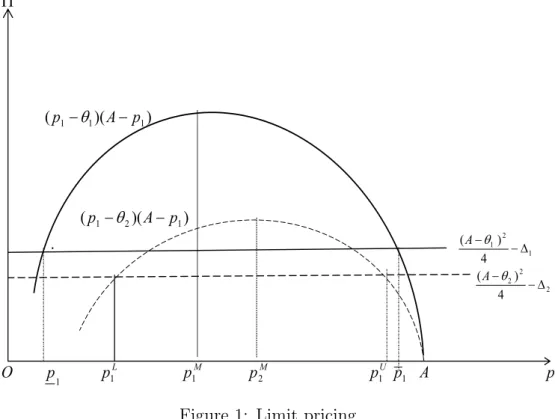
Figure 1 gives a diagrammatic exposition of the incentive compatibility conditions (6) and (7). The solid curve represents the left hand side (i.e. the joint surplus) of (6), and the solid flat line represents the right hand side of (6). All prices belonging to the interval [p1,p¯1] are incentive compatible forθ1 type to reveal its type. The broken curve represents
the left hand side of (7), while the broken flat line stands for the right hand side of (7). Any price less than (or equal to)pL
1 or greater thanpU1 are not incentive compatible for type θ2
to charge. The interval [p1, pL1] falls in the overlapping region so that any price from this
interval can only be charged by theθ1 type. The highest price from this set, pL1, gives the
largest joint surplus, and hence this is the optimal information revealing price forθ1. The
θ2 type then does its best simply by settingpM2 . Thus, pL1 is the limit price for θ1, which
is lower than the monopoly price pM
1 , which implies over employment. To support this
proposed (perfect Bayesian) equilibrium we can specify suitable out-of-equilibrium beliefs.
Pooling equilibrium: If the entrant’s priors are such that its expected profit is negative (ER <0), entry will not take place unless the entrant is sure that the incumbent is high cost type. Therefore, by not signalling the true θ the union-firm pair can prevent entry and be better off when the true θ is θ2. Formally, both types will quote the same price
and it must satisfy the incentive compatibility conditions of the low type, which is given by condition (6), and the following condition for the high type
(p1−θ2)(A−p1)≥ (A−θ2)2 4 −δ[ (A−θ2)2 4 − (A−2θ2+c)2 9 ]. (8)
3 ) )( (p1T1 Ap1 ) )( (p1T2 Ap1 . 2 1 1 4 ) ( ' T A 2 2 2 4 ) (AT ' O p1 pL 1 p1M p2M p1U p1 A p
Figure 1: Limit pricing behaviour is preferred. In Figure 1 the interval [pL
1, pU1] is the interval of such prices
optimal for the θ2 price. The monopoly price for the low cost type, pM1 , falls in the range
that satisfies both (6) and (8). Therefore, it is optimal to setpM
1 and deter entry, regardless
of θ1 or θ2.
Proposition 1: When wage is not observable to the entrant, entry threat causes inef-ficiency in the form of over employment, which results in downward distortion of price. Under separating equilibrium the low type is over-employed and entry is deterred only by the low type. Under pooling equilibrium the high type is over-employed, entry is deterred by both types. When price is distorted, wage is also distorted – both downwardly.
The proof of the Proposition is obvious from the graph.13 The inefficiency results from the fact that without distorting price the low type cannot distinguish itself from the high type, and nor can the high type pretend to be a low type. The limit pricing result and the entry implications are similar to that in Milgrom and Roberts (1982).
Efficient bargaining helps to base the incentive constraints on the joint surplus, and this ensures the existence of separating equilibrium. Pal and Saha (2008) have shown that under right-to-manage bargaining entry threat can create frictions in rent-sharing and may render signalling impossible.14 Here that problem is averted, but still the firm-union pair
has only one instrument of signalling, which limits information transmission. Consequently inefficiency occurs, despite efficient bargaining.
Having said that, we should note that the extent of over employment does not depend on the bargaining power of the union. Recall the expression ofpL
1 involving ∆2which does not
depend onγ. Therefore, it is fair to say that bargaining frictions do not worsen inefficiency. The over employment can be said entirely due to limit pricing.
13For the wage reduction part, note that under separating equilibriumwL
1 =γ(pL1 −θ1) +θ1< w1M =
γ(pM
1 −θ1) +θ1. Under pooling equilibrium,w2=wM1 < wM2 .
14Regardless of the bargaining protocol, limit pricing requires the incumbent firm to commit to a high
level of employment. However, under right-to-manage bargaining anticipation of such commitment enables the union to bargain for a very high wage and to shift the cost of signalling largely to the firm. This can disrupt the firm’s incentive constraints and separating equilibrium may not exist. Under efficient bargaining such hard bargaining by the union is not possible, because wage and employment are determined simultaneously.
For empirical work, our results suggest that inefficient wage-employment contracts can be consistent with the efficient bargaining model. Therefore, even if the null hypothesis ‘bar-gaining model is efficient’ is rejected, the model of simultaneous bar‘bar-gaining over wage and employment can still be valid. The existing empirical literature has treated efficiency and the efficient bargaining protocol synonymously (see, for example, Brown and Ashenfelter, 1986; Alogoskoufis and Manning, 1991; Vannetelbosch, 1996), which perhaps needs to be reviewed.
3.2
The case of observable wage
We now turn to the scenario where wage is also observed by the entrant. Clearly, there are two distinct signalling instruments, price (via output) and wage, and therefore, information revelation is likely to be easier, while information suppression may be harder. In either case, less distortions may be required in the wage and employment and hence inefficiency should diminish. This will surely benefit the entrant, but may or may not benefit the incumbent union-firm pair.
Separating equilibrium: First consider the case of ER > 0. As before, wage and employment must satisfy incentive constraints for the firm-union pair. But, since wage is also observable now, we need to consider individual incentive constraints, rather than the joint surplus.
met: (a) Both firm 1 and the θ1 union find it profitable to choose (l1, w1) and deter entry,
instead of choosing (lM
1 , wM1 ) and induce entry. (b) Either firm 1,or the θ2 union, or both
must be worse off by choosing (l1, w1) instead of choosing (lM2 , wM2 ).
Note the difference in the second requirement. For separation of the low type, it is necessary that the high type does not mimic the low type. If the high type were to mimic the low type, the entrant must reason that it must be in the interest of both parties; otherwise one party would veto such a proposal. Suppose, the firm benefits from such mimicking, but the union does not; then the only way the firm can make the union agree to this is by making a side-payment. But side-payments are ruled out by assumption.15 Therefore, firm 1 will
have no choice but to stick to the status quo corresponding to θ =θ2, which is (lM2 , wM2 ).
In other words, we are invoking an ‘intuitive rule’ that the entrant will apply in its reasoning about the bargaining. Unless both parties stand to gain, no deviation from the symmetric information contract will be agreed upon. We take the symmetric information contract as a status quo and enforce in the case of a disagreement. The following assumptions are imposed for this part of the analysis.
Assumption 1: If any wage and/or employment are distorted from their symmetric in-formation level, it must be agreed upon by both parties.
Assumption 2: When a proposed distortion does not benefit both parties, the symmetric
15Side-payments between the union and the firm are ruled out, as has been done in other work (see, for
example, Pal and Saha, 2008; Ishiguro and Shirai, 1998). Institutional mechanisms governing industrial relations and trade union agreements commonly bar such side payments in most countries.
information wage and employment will be agreed upon.
Formally, the incentive compatibility conditions of firm 1 and the union are given by (9) and (10) respectively, if the union isθ1 type, and by (11) and (12) respectively, if the union
is θ2 type. (A−l1−w1)l1 ≥(1−γ)[(1−δ) (A−θ1)2 4 +δ (A−2θ1+c)2 9 ]≡Π¯1 (9) (w1−θ1)l1 ≥γ[(1−δ) (A−θ1)2 4 +δ (A−2θ1+c)2 9 ]≡u¯1 (10) (A−l1−w1)l1 ≤(1−γ)[(1−δ) (A−θ2)2 4 +δ (A−2θ2+c)2 9 ]≡ ¯ Π2 (11) (w1−θ2)l1 ≤γ[(1−δ) (A−θ2)2 4 +δ (A−2θ2+c)2 9 ]≡u¯2 (12)
Note that (9) and (11) cannot be satisfied simultaneously, because ¯Π1 >Π¯2 due toθ2 > θ1.
So we can ignore condition (11). But we must satisfy both (10) and (12). That is to say, the θ2 type must not find it optimal to mimic the θ1 type, and the θ1 type must find it
optimal to distort the wage if necessary. The union’s incentives are now more critical than the firm’s incentives. Furthermore, two constraints (10) and (12) cannot bind at the same time, because of the following inequality:
(w1−θ1)l1 ≥u¯1 >u¯2 ≥(w1−θ2)l1.
Formally, the separating equilibrium pair (l1, w1) solves the following problem:
maxw1,l1Z1 =U
γ
1Π 1−γ
1 = [(w1−θ1)l1]γ[(A−l1−w1)l1]1−γ
w
2 u u1 B 2 L w1 K E u2 1 K / D u1 1 2 O l1 M l A 1 1 2 E l1 l1l
Figure 2: Observable wage
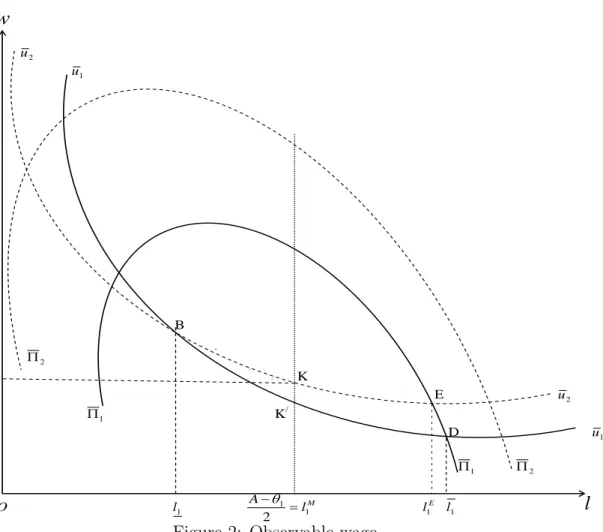
Consider Figure 2 for a graphical illustration, where we plot the union’s indifference curves and firm’s iso-profit curves. The iso-profit curve ¯Π1Π¯1 maps all (l, w) that ensures equality
in condition (9). The ¯u1u¯1 curve corresponds to theθ1union’s utility such that (w1−θ1)l1 =
¯
u1 (i.e. constraint (10) binds). The ¯u2u¯2 curve corresponds to the utility of of theθ2 union
being exactly equal to ¯u2, when it chooses w1 instead of wM2 (i.e. constraint (12) binds).
Since ¯u2u¯2 is flatter than ¯u1u¯1 on the (l, w) plane, the set of (l, w) satisfying (10) and (12)
is non-empty. From the insight of information theory, we can say that if one of the two constraints binds, it must be (12). Moreover, as shown in the figure, l1 will be strictly less
Then it is obvious that any (l1, w1) pair that lies above the indifference curve ¯u1u¯1 but
below ¯u2u¯2 satisfies both (10) and (12). Hence in Figure 2 any (l1, w1) belonging to the
region BKED can credibly signal that the union is θ1 type.
Now to solve for optimal (l1, w1) we may invoke the idea of contract curve in the spirit of
efficiency bargaining. Due to linear production technology, contract curve in this setup will be vertical. At any given choice ofl1, we can draw a vertical line and stretch it all the way
up to the zero profit curve, and that would be a contract curve. In Figure 2, the vertical lines atlM
1 , orl1E, orl1 are just some contract curves. If there were no incentive constraints,
the bargaining would result in the selection of a wage that sets γΠ1(l1) = (1−γ)u1(l1) to
split the pie (conditional on the choice of l1). With the incentive constraints in place that
wage, however, may not be feasible.
Let us now first see if the standard monopoly wage and employment are feasible. That means, in the pair’s optimization problem none of the constraints binds. Straightforward maximization of Z1 then yields, as shown earlier, lM1 = A
−θ1
2 . The contract curve for l
M
1
runs through the regionBKED (see Appendix 2 for proof).
Now it remains to check ifwM
1 =γ (A−θ1)2
4 falls within pointsK andK
0. We can show that
if the union’s bargaining power γ is below a critical level, say ˆγ, then indeed wM1 will lie betweenK and K0 (see Appendix 3 for proof).16 When γ = ˆγ, wM
1 is exactly equal towL1,
where wL
1 is the wage rate at point K. 16wL 1 =θ2+A−2θ 1γ[(1−δ) (A−θ2)2 4 +δ (A−2θ2+c)2 9 ], ˆγ= (θ2−θ1)A−2θ1 [(A−θ1 )2 4 − (A−θ2 )2 4 ]+δ[ (A−θ2 )2 4 − (A−2θ2 +c)2 9 ] .
Therefore, we can say that at allγ ≤γˆ, the symmetric information wage and employment (lM
1 , w1M) occurs at the separating equilibrium. This is an interesting and novel finding.
This shows that with two signals, the incumbent pair can reveal their type costlessly.
When γ > γˆ, the powerful union’s high wage claim violates the θ2 type’s incentive
con-straint. It becomes too attractive for the θ2 type to switch to lM1 from l2M. Therefore,
costless signalling is not possible. We have to make the constraint (12) bind. Substituting
w1 =θ2 +u¯l2
1 into U1 and Π1 we write Z1 as
Z1 = θ2+ ¯ U2 l1 −θ1 γ A−l1−θ2 − ¯ U2 l1 1−γ l1.
Differentiating this with respect to l1 we get
∂Z1
∂l1
= 0 ⇐⇒[γΠ1−(1−γ)U1] (θ2−θ1) + (1−γ)U1(A−θ1−2l1) = 0. (13)
Note that (A−θ1−2l1) = 0 yields l1 =lM1 , and we should also haveγΠ1−(1−γ)U1 = 0
which in turn yields wM
1 ; but we know for γ > ˆγ that is not feasible. So we must have
(A−θ1−2l1) <0 implying l1 > l1M, which in turn requires [γΠ1−(1−γ)U1] >0. That
is, l1 must be such that atw1 =w1L(l1) and γΠ1(l1)>(1−γ)U1(l1).17
Thus, for γ >ˆγ, the separating equilibrium consists of (˜l1,w˜1) where ˜l1(> l1M) solves (13),
and ˜w1 =θ2+u¯l˜12. Type θ2 union and firm 1 will stick to (lM2 , w2M). 17It can be seen that (A−θ
1−2l1)>0 in conjunction with [γΠ1−(1−γ)U1]<0 will not be optimal. If
it were so, by lowering the wage, while maintaining the same employment, profit can be raised and union’s utility can be lowered to setγΠ1= (1−γ)U1 which will improve the value of the maximandZ1. In that
The general message is that information revelation is not entirely costless. If the union is sufficiently powerful to claim a lion’s share of the surplus, then the rent sharing issue is less important and firm’s role is nearly irrelevant. Signalling then becomes the main objective of the union, and it must bear the cost of doing so.
Pooling equilibrium: Now we consider the case of ER <0. As the θ2 type union would
like to mimic a θ1 type union, the firm and the union both must find it optimal to set
(w1M, l1M) and deter entry, instead of sticking to the status quo (lM2 , wM2 ) and induce entry. Therefore, the incentive constraints (11) and (12) must both be reversed as follows.
(A−l1−w1)l1 ≥(1−γ)[(1−δ) (A−θ2)2 4 +δ (A−2θ2+c)2 9 ]≡ ¯ Π2, (11a) (w1−θ2)l1 ≥γ[(1−δ) (A−θ2)2 4 +δ (A−2θ2+c)2 9 ]≡u¯2. (12a) Other incentive constraints, namely (9) and (10) remain unchanged. Note if (9) is satisfied, then (11a) is automatically satisfied (as ¯Π2 <Π¯1). So condition (11a) is redundant.
We need to verify if (l1M, wM1 ) satisfy (9), (10) and (12a). Of the three constraints, (9) is generally not a problem; the other two are. In reference to Figure 2, we can say that
w1 now must be above point K to satisfy both (10) and (12a), and from our previous
discussion we know that this will be so if γ >ˆγ. On the other hand, ifγ ≤ˆγ, w1M will lie between points K and K0, which means condition (12a) will be violated. So the pooling equilibrium does not exist whenγ <γˆ.
union has much more to gain from preventing entry (by suppressing information), while its bargaining partner, a weak firm, does not have much to lose. Once again, over employment occurs for theθ2 type union. In this case also we can suitably specify the out-of-equilibrium
beliefs of the entrant to support the proposed equilibrium.
Proposition 2: When wage and price are both observable, the following equilibria occur.
(a) Separating equilibrium: Full information employment and wage (lM
1 , wM1 ) credibly
sig-nals theθ1 type, as long as the union’s bargaining power is below a critical level (i.e. γ ≤γˆ).
When γ >γˆ, there will be over-employment as well as a wage cut for type θ1; equilibrium
employment and wage will be (˜l1,w˜1). Type θ2 will set (lM2 , wM2 ) at all γ.
(b) Pooling equilibrium: Pooling equilibrium exists only if the union’s bargaining power
exceeds γˆ, with both types setting (lM
1 , wM1 ); the θ2 type union will be over-employed.
Comparing Proposition 1 and Proposition 2 we can say that the possibility of inefficient employment choice is much less when wage is observable, simply because information revelation becomes easier, or information suppression becomes difficult, barring the case of a very powerful union which manages to fool the entrant. In a nutshell, the availability of an additional signalling device largely mitigates the inefficiency problem endemic to entry threats under asymmetric information.
Finally, a brief comment on sequential bargaining is in order. How do our results of si-multaneous bargaining relate to the case of sequential bargaining? There is a well known
result due to (Manning, 1987) that under symmetric information the sequentiality of bar-gaining does not matter, as long as the players’ barbar-gaining powers do not change between the stages of bargaining; the outcome is always efficient. Then a natural question to ask is: does asymmetric information force the sequential bargaining to produce a different out-come to the simultaneous bargaining outout-come? The answer is ‘no’. It can be shown that, as long as employment is negotiated first and wage next, we will be able to reproduce the same results as Propositions 1 and 2. The reason is, when employment is chosen first, the bargaining pie is determined right away; wage largely then allocates rent, and in addition maintains consistency with the incentive constraints. This replicates the spirit of efficient bargaining. Therefore, signalling through employment alone or through both employment and wage (sequentially) will take the same course as the case of simultaneous bargaining.18
4
Concluding remarks
Analysis of this paper suggests that for the purpose of improving efficiency it is not suffi-cient to induce the firms and unions, by appropriate institutional mechanism, to bargain over both employment and wage simultaneously or sequentially. When there are entry threats, the incumbent firms may be required to disclose wage agreements (and similar agreements with other input suppliers). Though the rule of mandatory disclosure of wage agreements will not directly give away the incumbent’s private cost information, it will certainly improve the entrant’s ability to process information, and yet at the same time
will save the incumbents from taking costly signalling measures. The society will also be better off by encouraging right level of entry. To what extent this can be done in reality remains an open issue, as it has bearing on both industrial relations regulation and anti-trust policies. Moreover, it can be argued that models of union-firm bargaining over both wage and employment cannot be rejected purely on the basis of negative results of tests for Pareto efficiency criteria.
References
Abraham, F., Konings, J., and Vanormelingen, S. (2009). The effect of gobalization on union bargaining and price-cost margins of firms.Review of World Economics, 145(1):13– 36.
Ahsan, R. and Mitra, D. (2014). Trade liberalisation and labor’s slice of the pie: Evidence from Indian firms. Journal of Development Economics, 108:1–16.
Alesina, A. F., Glaeser, E. L., and Sacerdote, B. (2006). Work and leisure in the U.S. and
Europe: Why so different? NBER Chapters, in: NBER Macroeconomics Annual 2005,
Volume 20, pages 1-100 National Bureau of Economic Research, Inc. .
Alogoskoufis, G. and Manning, A. (1991). Tests of alternative wage employment bargaining models with an application to the UK aggregate labour market. European Economic
Anderson, S. P. and Devereux, M. (1989). Profit-sharing and optimal labour contracts.
Canadian Journal of Economics, 22(2):425–433.
Boulhol, H., Dobbelaere, S., and Maioli, S. (2011). Import as product and labour market discipline. British Journal of Labour Relations, 49(2):331–361.
Brown, J. N. and Ashenfelter, O. (1986). Testing the efficiency of employment contracts.
Journal of Political Economy, 94(Supp.)(3):S40–S87.
Dewatripont, M. (1987). Entry deterrence under trade unions.European Economic Review, 31(1/2):149–156.
Dewatripont, M. (1988). The impact of trade unions on incentives to deter entry. Rand
Journal of Economics, 19(2):191–199.
Flanagan, R. (1999). macroeconomic performance and collective bargaining: An interna-tional perspective. Journal of Economic Literature, 37(3):1150–1175.
Holmlund, B. (1990). Profit sharing, wage bargaining, and unemployment. Economic
Inquiry, 28(2):257–268.
Ishiguro, S. and Shirai, Y. (1998). Entry deterrence in a unionized oligopoly. Japanese
Economic Review, 49(2):210–221.
Koskela, E. and Stenbacka, R. (2006). Flexible and committed profit sharing with wage bar-gaining: Implications for equilibrium unemployment. Journal of Economics, 87(2):159– 180.
Manning, A. (1987). An integration of trade union models in a sequential bargaining framework. Economic Journal, 97(385):121–139.
McDonald, I. M. and Solow, R. M. (1981). Wage bargaining and employment. American
Economic Review, 71(5):896–908.
Melitz, M. J. (2003). The impact of trade on intra-industry reallocations and aggregate industry productivity. Econometrica, 71(6):1695–1725.
Milgrom, P. and Roberts, J. (1982). Limit pricing and entry under incomplete information: An equilibrium analysis. Econometrica, 50(2):443–459.
Nickell, S. J. and Andrews, M. (1983). Unions, real wages and employment in Britain 1951-79. Oxford Economic Papers, 35(Supplement):183–206.
Ohnishi, K. (2001). Lifetime employment contract and strategic entry deterrence: Cournot and Bertrand. Australian Economic Papers, 40(1):30–43.
Pal, R. (2010). Impact of communist parties on the individual decision to join a trade union: Evidence from India. The Developing Economies, 48(4):496–528.
Pal, R. and Saha, B. (2006). Wage commitment, signalling and entry deterrence or accom-modation. LABOUR:Review of Labour Economics and Industrial Relations,, 20(4):625– 650.
Pal, R. and Saha, B. (2008). Union-oligopoly bargaining and entry deterrence: A reasses-ment of limit pricing. Journal of Economics, 95(2):121–147.
Pohjola, M. (1987). Profit-sharing, collective bargaining and employment. Journal of
Institutional and Theoretical Economics, 143(2):334–342.
Schmidt-Sorensen, J. B. (1992). The profit share rate, wages and employment in collective bargaining. European Journal of Political Economy, 8(1):105–113.
Vannetelbosch, V. J. (1996). Testing between alternative wage-employment bargaining models using Belgian aggregate data. Labour Economics, 3(1):43–64.
Appendix
Appendix 1: The point B always lies to the left of point D as shown in Figure 2
Proof: We have, ∂w1 ∂l1 |u¯1u¯1=− w1−θ1 l1 <− w1−θ2 l1 = ∂w1
∂l1 |u¯2u¯2. That is, the union’s indifference curve
¯
u1u¯1 is steeper than ¯u2u¯2 in the l−w plane. Therefore, these two indifference curves intersect only once. Clearly, it is sufficient to prove that the level of employment corresponding to point B (l1) is less than the level of employment corresponding to point D ( ¯l1): l1<l¯1.
Solving the equations of ¯u1u¯1 and ¯u2u¯2, we get l1 = ¯uθ21−−uθ¯12, where ¯u1 = γ[(1−δ)
(A−θ1)2 4 + δ(A−2θ1+c)2 9 ] and ¯u2 = γ[(1−δ) (A−θ2)2 4 +δ (A−2θ2+c)2
9 ]. And, solving the equations of ¯u1u¯1 and ¯
Π1Π1, we get¯ l1 = 12[A−θ1± q
(A−θ1)2−4γu¯1]. We discard the root 12[A−θ1− q
(A−θ1)2−4γu¯1], since it corresponds to the point of intersection of ¯u1u¯1 and ¯Π1Π¯1 that is closer to the w-axis. Hence, ¯l1 = 12[A−θ1+
q
(A−θ1)2− 4
γu¯1].
Now, it is sufficient to check that
l1 <l¯1⇒ ¯ u1−u¯2 θ2−θ1 < 1 2[A−θ1+ r (A−θ1)2− 4 γu¯1] ⇒γ[(1−δ)2A−θ1−θ2 4 + 4δ 9 (A−θ1−θ2+c)< 1 2[A−θ1+ r δ(A−θ1)2− 4δ 9 (A−2θ1+c) 2],
which is obvious for γ = 0. Since the LHS is increasing in γ and the RHS does not depend on
γ, it is sufficient to show that the above inequality is true for γ = 1. Now, if γ = 1, the above inequality implies that
2A−θ1−θ2 4 − δ 36(2A+ 7θ1+ 7θ2−16c)< A−θ1 2 + r δ{(A−θ1) 2 4 − (A−2θ1+c)2 9 }, which is obvious, since 2A−θ1−θ2
4 <
A−θ1
2 ⇒θ1< θ2 and c <
2A+7θ1+7θ2
Appendix 2: The point B always lies to the left, while points E and D always lie to the right, of the contract curve of the low state l1 = A−2θ1:
Proof: We need to prove thatl1 < A−2θ1 < lE1 <l¯1, wherel1,lE1 and ¯l1 denote employment levels at pointsB,E and D, respectively.
(a) Note that
l1< A−θ1 2 ⇒u¯1−u¯2 θ2−θ1 < A−θ1 2 ⇒γ[(1−δ)2A−θ1−θ2 4 + 4δ 9 (A−θ1−θ2+c)]< A−θ1 2 , which is obvious forγ = 0. If the above is true for γ = 1, then it is true∀γ.
Now, if γ = 1, l1 < A−θ1 2 ⇒ −θ2−θ1 4 < δ 36[2A+ 7θ1+ 7θ2−16c], which is true since θ2> θ1 and c < 2A+716θ1+7θ2 (by construction).
(b) PointE is the right most point of intersection of ¯u2u¯2 and ¯Π1Π¯1 curves:
¯ u2u¯2:(w1−θ2)l1 =γ (A−θ2)2 4 −γ∆2, (i) ¯ Π1Π¯1:(A−l1−w1)l1= (1−γ) (A−θ1)2 4 −(1−γ)∆1, (ii) where ∆i=δ{ (A−θi)2 4 − (A−2θi+c)2 9 }, i= 1,2. From (i) and (ii) we get
(w1−θ2) = (A−l1−θ2){γ(A−θ2) 2 4 −γ∆2} H , (iii) (A−θ )2 (A−θ )2
From (i) and (iii), we get l1 = A−2θ2 ± q
(A−θ2)2
4 −H. We discard the root l1 =
A−θ2
2 − q
(A−θ2)2
4 −H, since it is closer to thew−axis. Therefore,
lE1 = A−θ2 2 + r (A−θ2)2 4 −H Now, A−θ1 2 < l E 1 ⇒(θ2−θ1) 2 4 <∆2−(1−γ)[(1−δ){ (A−θ1)2 4 − (A−θ2)2 4 }+δ{ (A−2θ1+c)2 9 − (A−2θ2+c)2 9 }] ⇒(θ2−θ1) 2
4 <∆2, which is true by construction.
(c) Note that ¯u1u¯1 and ¯u2u¯2 are downward sloping curves in thel-wplane, ¯u2u¯2 curve lies above the ¯u1u¯1 curve on the right of pointB, and pointsEandDare on the downward sloping segment of the ¯Π1Π1¯ curve. Therefore, it is evident thatl1E <l¯1.
From (a), (b) and (c) we can writel1 < A−2θ1 < lE1 <l¯1. [QED]
Appendix 3: If γ >ˆγ, w1M > wL1
Proof: w1Lis given by the solution of (w1−θ2)l1= ¯u2 andl1 = A−2θ1, where ¯u2=γ[(1−δ)(A−θ2)
2
4 +
δ(A−2θ2+c)2
9 ]. Solving these two equations, we getw1 =θ2+ 2 A−θ1γ[(1−δ) (A−θ2)2 4 +δ (A−2θ2+c)2 9 ] = wL1, say. Now, w1L< w1M ⇒θ2+ 2γ A−θ1 [(1−δ)(A−θ2) 2 4 +δ (A−2θ2+c)2 9 ]< θ1+γ A−θ1 2 ⇒γ > (θ2−θ1) A−θ1 2 [(A−θ1)2 4 − (A−θ2)2 4 ] +δ[ (A−θ2)2 4 − (A−2θ2+c)2 9 ] = ˆγ,