B R ICS R S -02-13 B rod al et al.: S o lvin g th e S trin g S tatistics Pr ob lem in T ime O ( n log n )
BRICS
Basic Research in Computer Science
Solving the String Statistics Problem in
Time
O
(
n
log
n
)
Gerth Stølting Brodal Rune B. Lyngsø Anna ¨Ostlin
Christian N. S. Pedersen
BRICS Report Series RS-02-13
Copyright c2002, Gerth Stølting Brodal & Rune B. Lyngsø & Anna ¨Ostlin & Christian N. S. Pedersen. BRICS, Department of Computer Science University of Aarhus. All rights reserved. Reproduction of all or part of this work is permitted for educational or research use on condition that this copyright notice is included in any copy.
See back inner page for a list of recent BRICS Report Series publications. Copies may be obtained by contacting:
BRICS
Department of Computer Science University of Aarhus Ny Munkegade, building 540 DK–8000 Aarhus C Denmark Telephone: +45 8942 3360 Telefax: +45 8942 3255 Internet: [email protected]
BRICS publications are in general accessible through the World Wide Web and anonymous FTP through these URLs:
http://www.brics.dk ftp://ftp.brics.dk
Solving the String Statistics Problem
in Time
O
(
n
log
n
)
∗Gerth Stølting Brodal†,‡ Rune B. Lyngsø§ Anna ¨Ostlin¶ Christian N. S. Pedersen†,k
March, 2002
Abstract
The string statistics problem consists of preprocessing a string of lengthnsuch that given a query pattern of lengthm, the maximum num-ber of non-overlapping occurrences of the query pattern in the string can be reported efficiently. Apostolico and Preparata introduced the minimal augmented suffix tree (MAST) as a data structure for the string statis-tics problem, and showed how to construct the MAST in timeO(nlog2n) and how it supports queries in time O(m) for constant sized alphabets. A subsequent theorem by Fraenkel and Simpson stating that a string has at most a linear number of distinct squares implies that the MAST requires spaceO(n). In this paper we improve the construction time for the MAST to O(nlogn) by extending the algorithm of Apostolico and Preparata to exploit properties of efficient joining and splitting of search trees together with a refined analysis.
Keywords: Strings, suffix trees, string statistics, periods, search trees
∗A short version of this paper has been published as [5]
†BRICS (Basic Research in Computer Science, www.brics.dk, funded by the Danish
Na-tional Research Foundation), Department of Computer Science, University of Aarhus, Ny Munkegade, DK-8000 ˚Arhus C, Denmark. E-mail: {gerth,cstorm}@brics.dk. Partially supported by the Future and Emerging Technologies programme of the EU under contract number IST-1999-14186 (ALCOM-FT).
‡Supported by the Carlsberg Foundation (contract number ANS-0257/20).
§Department of Statistics, Oxford University, Oxford OX1 3TG, UK. E-mail:
¶IT University of Copenhagen, Glentevej 67, DK-2400 Copenhagen NV. E-mail:
[email protected]. Work done while at BRICS.
kBioinformatics Research Center (BiRC), www.birc.dk, funded by Aarhus University
1
Introduction
The string statistics problem consists of preprocessing a string S of lengthn such that given a query pattern α of length m, the maximum number of non-overlapping occurrences of α in S can be reported efficiently. Without preprocessing the maximum number of non-overlapping occurrences ofα inS can be found in timeO(n), by using a linear time string matching algorithm to find all occurrences of α in S, e.g. the algorithm by Knuth, Morris, and Pratt [14], and then in a greedy fashion from left-to-right compute the maximal number of non-overlapping occurrences.
Apostolico and Preparata in [3] described a data structure for the string statistics problem,the minimal augmented suffix tree MAST(S), with prepro-cessing timeO(nlog2n) and query timeO(m) for constant sized alphabets. In this paper we present an improved algorithm for constructingMAST(S) with preprocessing timeO(nlogn), and prove that MAST(S) requires spaceO(n), which follows from a recent theorem of Fraenkel and Simpson [9].
The basic idea of the algorithm of Apostolico and Preparata and our al-gorithm for constructingMAST(S), is to perform a traversal of the suffix tree of S while maintaining the leaf-lists of the nodes visited in appropriate data structures (see Section 1.1 for definition details). Traversing the suffix tree of a string to construct and examine the leaf-lists at each node is a general technique for finding regularities in a string, e.g. for finding squares in a string (or tandem repeats), [2, 18], for finding maximal quasi-periodic substrings, i.e. substrings that can be covered by a shorter substring, [1, 6], and for finding maximal pairs with bounded gap [4]. All these problems can be solved using this technique in time O(nlogn). Other applications are listed by Gusfield in [10, Chapter 7].
A crucial component of our algorithm is the representation of a leaf list by a collection of search trees, such that the leaf-list of a node in the suffix tree of S can be constructed from the leaf-lists of the children by efficient merging. Hwang and Lin [13] described how to optimally merge two sorted lists of length n1 and n2, where n1 ≤n2, with O(n1logn1+n2
n1 ) comparisons.
Brown and Tarjan [7] described how to achieve the same number of compar-isons for merging two AVL-trees in timeO(n1logn1+n2
n1 ), and Huddleston and
Mehlhorn [12] showed a similar result for level-linked (2,4)-trees. In our algo-rithm we will use a slightly extended version of level-linked (2,4)-trees where each element has an associated weight.
The rest of this section contains basic definitions and lemmas that we will use in the latter sections. In Section 2 we give a precise definition of the string statistics problem andMAST(S). In Section 3 we give all the string properties and definitions enabling us to construct MAST(S) in time O(nlogn), and a self-contained proof of the theorem of Fraenkel and Simpson that any string
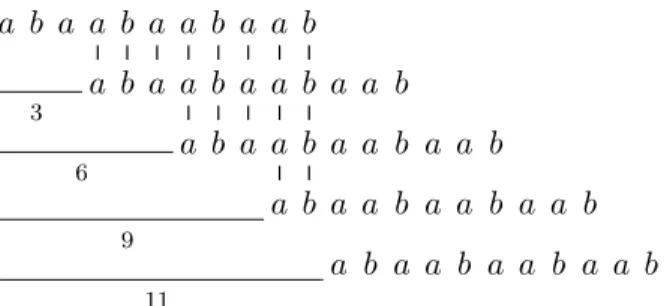
a b a a b a a b a a b a b a a b a a b a a b 3 a b a a b a a b a a b 6 a b a a b a a b a a b 9 a b a a b a a b a a b 11
Figure 1: The string abaabaabaabhas periods 3, 6, 9, and 11, i.e. the period of the string is 3
has at most a linear number of distinct squares as substrings. In Section 4 we describe the variant of level-linked (2,4)-trees used by our algorithm. In Section 5 we present our algorithm, and in Section 6 we prove that the running time of the algorithm isO(nlogn).
1.1 Preliminaries
Some of the terminology and notation used in the following originates from [3], but with minor modifications. We let Σ denote a finite alphabet, and for a string S ∈ Σ∗ we let |S|denote the length of S, S[i] the ith character in S, for 1≤i≤ |S|, and S[i .. j] =S[i]S[i+ 1]· · ·S[j] the substring of S from the ith to thejth character, for 1≤i≤j ≤ |S|. The suffixS[i ..|S|] of S starting at positioniwill be denoted S[i ..].
An integer p, for 1 ≤p ≤ |S|, is denoted a period of S if and only if the suffixS[p+ 1..] of S is also a prefix ofS, i.e. S[p+ 1..] =S[1..|S| −p]. The shortest period p of S is denoted the period of S, and the string S is said to be periodic if and only ifp≤ |S|/2. Figure 1 shows the periods of a string of length 11. A nonempty string S is asquare, ifS=αα for some string α.
In the rest of this paperS denotes the input string with length nand α a substring ofS. A non-empty stringα is said tooccur inS at positioniifα= S[i .. i+|α| −1] and 1≤i≤n− |α|+ 1. E.g. in the stringb a b a a a a b a b a a b the substringb a boccurs at positions 1 and 8. Themaximum number of non-overlapping occurrences of a stringα in a stringS, is the maximum number of occurrences ofαwhere no two occurrences overlap. E.g. the maximum number of non-overlapping occurrences of b a b in b a b a b a b a b a b is three, since the occurrences at positions 1, 5 and 9 do not overlap.
The suffix tree ST(S) of the string S is the compressed trie storing all suffixes of the string S$ where $ ∈/ Σ. Each leaf in ST(S) represents a suf-fix S[i ..]$ of S$ and is annotated with the index i. Each edge in ST(S) is labeled with a nonempty substring of S$, represented by the start and end
positions in S, such that the path from the root to the leaf annotated with indexispells the suffixS[i ..]$. We refer to the substring of S spelled by the path from the root to a nodev as the path-label of v and denote it L(v). We refer to the set of indices stored at the leaves of the subtree rooted at v as the leaf-list of v and denote it LL(v). Since LL(v) is exactly the set of start positionsiwhere L(v) is a prefix of the suffixS[i ..]$, we have Fact 1 below.
Fact 1 If v is an internal node of ST(S), then LL(v) =Sc child ofvLL(c), and
i∈LL(v) if and only if L(v) occurs at position i in S.
Figure 2 shows the suffix tree of a string of length 13. The problem of constructing ST(S) has been studied intensively and several algorithms have been developed which for constant sized alphabets can constructST(S) in time and spaceO(|S|) [8, 16, 19, 20]. For non-constant alphabet sizes the running time of the algorithms becomeO(|S|log|Σ|).
In the following we let the height of a tree T be denoted h(T) and be defined as the maximum number of edges in a root-to-leaf path inT, and let the size ofT be denoted |T|and be defined as the number of leaves ofT. For a node v in T we let Tv denote the subtree of T rooted at node v, and let
|v| = |Tv| and h(v) = h(Tv). Finally, for a node v in a binary tree we let small(v) denote the child ofv with smaller size (ties are broken arbitrarily).
The basic idea of our algorithm in Section 5 is to process the suffix tree of the input string bottom-up, such that we at each node v spend amortized time O(|small(v)| ·log(|v|/|small(v)|)). Lemma 1 then states that the total time becomesO(nlogn) [17, Exercise 35].
Lemma 1 Let T be a binary tree with n leaves. If for every internal node v,
cv=|small(v)| ·log(|v|/|small(v)|), and for every leaf v, cv = 0, then
X
v∈T
cv ≤nlogn .
Proof. The proof is by induction in the size of T. If |T|= 1, then the lemma holds vacuously. Now assume inductively that the upper bound holds for all trees with at most n−1 leaves. Consider a tree with n leaves where the number of leaves in the subtrees rooted at the two children of the root arek and n−k where 0 < k ≤ n/2. According to the induction hypothesis the sum over all nodes in the two subtrees, is bounded by respectivelyk·logkand (n−k)·log(n−k). The entire sum is thus bounded byklog(n/k) +klogk+ (n−k) log(n−k) = klogn+ (n−k) log(n−k) < nlogn, which proves the
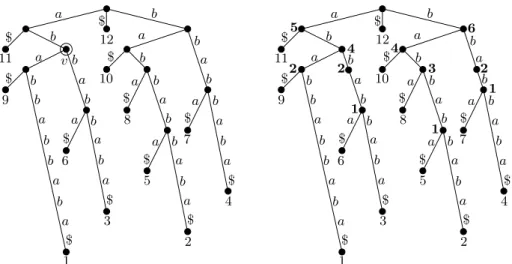
a b a b b a b a $ b a b b a b a $ $ a b b a b a b b $ $ a b a b b b b $ a b $ a a $ $ a $ a b $ a $ 11 9 1 6 12 10 8 5 3 2 4 7 a v a b a b b a b a $ b a b b a b a $ $ a b b a b b b $ $ a b a b b b b $ a b $ a a $ $ a $ a b $ a $ 11 9 1 6 12 10 8 5 3 2 4 7 a 5 1 6 2 4 3 1 1 4 a 2 2
Figure 2: To the left is the suffix treeST(S) of the stringS =a b a b b a b b a b a. The node v has path-label L(v) = a b and leaf-list LL(v) = {1,3,6,9}. To the right is the minimal augmented suffix tree MAST(S) for the string S = a b a b b a b b a b a. Internal nodes are labelled with thec-values.
2
The String Statistics Problem
Given a stringS of lengthnand a patternα of lengthmthe following greedy algorithm will compute the maximum number of non-overlapping occurrences of α inS. Find all occurrences of α in S by using an exact string matching algorithm. Choose the leftmost occurrence. Continue to choose greedily the leftmost occurrence not overlapping with any so far chosen occurrence. This greedy algorithm will compute the maximum number of occurrences of α in S in time O(n), since all matchings can be found in time O(n), e.g. by the algorithm by Knuth, Morris, and Pratt [14].
In the string statistics problem we want to preprocess a string S such that queries of the following form are supported efficiently: Given a query string α, what is the maximum number of non-overlapping occurrences of α inS? The maximum number of non-overlapping occurrences ofαis called the c-value ofα, denotedc(α). The preprocessing will be to compute theminimal augmented suffix tree described below. Given the minimal augmented suffix tree, string statistics queries can be answered in timeO(m).
For any substring,α, ofS there is exactly one path from the root ofST(S) ending in a node or on an edge of ST(S) spelling out the string α. This node or edge is called the locus of α. In a suffix tree ST(S) the number of leaves in the subtree below the locus of α in ST(S) tells us the number of occurrences of α in S. These occurrences may overlap, hence the suffix tree is not immediately suitable for the string statistics problem. The minimal augmented suffix tree for S, denoted MAST(S) can be constructed from the
suffix tree ST(S) as follows. A minimum number of new auxiliary nodes are inserted intoST(S) in such a way that thec-value for all substrings with locus on an edge (u, v), where u is the parent of v, have c-value equal to c(L(v)), i.e. thec-value only changes at internal nodes along a path from a leaf to the root. Each internal node v in the augmented tree is then labeled by c(L(v)) to get the minimal augmented suffix tree. Figure 2 shows the suffix tree and the minimal augmented suffix tree for the stringa b a b b a b b a b a.
The space needed to storeMAST(S) isO(n), since by Lemma 6 the minimal augmented suffix tree has at most 3n internal nodes.
3
String Properties
Lyndon and Schutzenberger [15] proved the following periodicity lemma for periodic strings.
Lemma 2 If a stringS has two periods p, q ≤ |S|/2, then gcd(p, q) is also a period ofS.
If S is periodic, then by Lemma 2 the periodp of S divides all periods of S less than or equal to |S|/2. Any prefixS0 of S with length at least p also has periodp. IfS0 has length at least 2p, then the period of S0 by Lemma 2 dividesp, implying that the period of S0 also is a period of S.
Corollary 1 If S has period p ≤ |S|/2, then p is also the period of the pre-fixesS[1.. k] for 2p≤k≤ |S|.
The lemma below gives a characterization of how the occurrences of a stringα can appear inS.
Lemma 3 Let S be a string and α a substring of S. If the occurrences of α
in S are at positions i1 <· · ·< ik, then for all 1≤j < k either ij+1−ij =p
or ij+1−ij >max{|α| −p, p}, where p denotes the period of α.
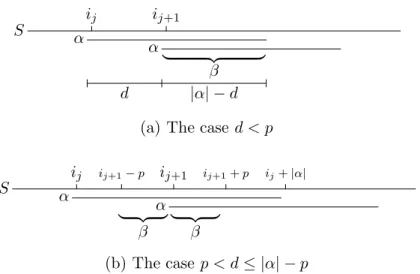
Proof. Consider two consecutive and overlapping occurrences of α at posi-tions ij and ij+1 in S, i.e. there are no occurrences of α at position k for ij < k < ij+1. Let d =ij+1−ij ≥1. We will show that neither of the two cases d < p orp < d ≤ |α| −p are possible. The two cases are illustrated in Figure 3.
Ifd < p, then d <|α| sincep≤ |α|. By definitionα occurs at positions ij and ij +d, implying β = α[1..|α| −d] is both a prefix and suffix of α. See Figure 3(a). By definition,dis then a period of α, contradicting that pis the shortest period ofα.
S α α ij ij+1 | {z } β d |α| −d
(a) The case d < p
S α α ij ij+1−p ij+1 ij+1+p ij+|α| β β | {z } | {z } (b) The case p < d≤ |α| −p
Figure 3: The two cases considered in the proof of Lemma 3
If p < d ≤ |α| −p, then we have the inequalities ij < ij+1−p < ij+1 < ij+1 +p ≤ ij +|α|. If α has period p, then α is a prefix of the infinite string βββ . . ., where β = α[1.. p]. It follows that β = S[ij+1.. ij+1 +p − 1] =S[ij+1−p .. ij+1−1], implying that α occurs at positionij+1−p, which contradicts the assumption that there is no occurrence ofαbetween positions
ij and ij+1. 2
A consequence of Lemma 3 is that if p ≥ |α|/2, then an occurrence of α in S at position ij can only overlap with the occurrences at positions ij−1 and ij+1. If p < |α|/2, then two consecutive occurrences ij and ij+1, either satisfyij+1−ij =p orij+1−ij >|α| −p.
Corollary 2 Ifij+1−ij ≤ |α|/2, thenij+1−ij =pwherep is the period ofα.
Motivated by the above observations we group the occurrences of α inS into chunks and necklaces. Let p denote the period of α. Chunks can only appear if p < |α|/2. A chunk is a maximal sequence of occurrences con-taining at least two occurrences and where all consecutive occurrences have distancep. The remaining occurrences are grouped into necklaces. A necklace is a maximal sequence of overlapping occurrences, i.e. only two consecutive occurrences overlap at a given position and the overlap of two occurrences is between one and p−1 positions long. Figure 4 shows the occurrences of the string abaabaabain a string of length 55 grouped into chunks and necklaces. By definition two necklaces cannot overlap, but a chunk can overlap with an-other chunk or a necklace at both ends. By Lemma 3 the overlap is at most p−1 positions.
1
abaa5baaba10baaba15abaab20aabab25aabaa30baaba35abaaa40baaba45ababa50abaab55a Figure 4: The grouping of occurrences in a string into chunks and necklaces. Occurrences are shown below the string. Thick lines are occurrences in chunks. The grouping into chunks and necklaces is shown above the string. Necklaces are shown using dashed lines. Note that a necklace can consist of a single occurrence
abababababababababa abababababababababa
Figure 5: Examples of the contribution to thec-values by an isolated necklace (left;α=abaand the contribution is 5 =d9/2e) and an isolated chunk (right; α=ababa,p= 2, and the contribution is 3 =d8/d5/2ee)
In Figure 4 the chunk covering positions 9–23 overlaps with the necklace covering positions 1–9, and the chunk covering positions 23–37.
We now turn to the contribution of chunks and necklaces to the c-values. We first consider the case where chunks and necklaces do not overlap. An
isolated necklace or chunk is a necklace or chunk that does not overlap with other necklaces and chunks. Figure 5 gives an example of the contribution to thec-values by an isolated necklace and chunk.
Lemma 4 An isolated necklace of k occurrences of α contributes to the c -value of α with dk/2e. An isolated chunk of koccurrences of α contributes to the c-value of α with dk/d|α|/pee, where p is the period of α.
Proof. Since only two consecutive occurrences in a necklace overlap, exactly every second occurrence in the necklace can contribute to the c-values (see Figure 5 (left)).
In a chunk ofkoccurrences all occurrences have distance p, implying that only every d|α|/peth occurrence contributes to thec-value ofα and the stated contribution follows (see Figure 5 (right)). 2 Motivated by Lemma 4, we define the nominal contribution of a necklace ofk occurrences ofα to be dk/2e and the nominal contribution of a chunk of koccurrences ofα to bedk/d|α|/pee. The nominal contribution of a necklace or chunk ofα’s is the contribution to thec-value ofα if the necklace or chunk appeares isolated. The actual contribution to thec-value of α as a result of applying the greedy algorithm can at most be one less for each necklace and chunk as argued in the proof of Lemma 5 below.
We define the excess of a necklace of koccurrences to be (k−1) mod 2,
and the excess of a chunk ofk occurrences to be (k−1) modd|α|/pe .
The excess describes the number of occurrences of α[1.. p] which are covered by the necklace or chunk, but not covered by the maximal sequence of non-overlapping occurences.
We group the chunks and necklaces into a collection of chains C by the following two rules:
1. A chunk with excess at least two is a chain by itself.
2. A maximal sequence of overlapping necklaces and chunks with excess zero or one is a chain.
For a chain c∈ C we define #0(c) to be the number of chunks and necklaces with excess zero in the chain.
We are now ready to state our main lemma enabling the efficient compu-tation of thec-values. The lemma gives an alternative to the characterization in [3, Proposition 2].
Lemma 5 The maximum number of non-overlapping occurrences of α in S
equals the sum of the nominal contributions of all necklaces and chunks minus
X
c∈C
b#0(c)/2c .
Proof. We consider the maximum number of non-overlapping occurrences generated by the greedy algorithm described in Section 2.
Let b be a chunk or a necklace of k occurrences, and let z = d|α|/pe if b is chunk, and z = 2 if b is a necklace. From Lemma 3 only the first occurrence inbcan overlap with the occurrence immediately precedingb, and the overlap is at most p −1 positions. If there is no immediate preceding occurrence that overlaps withb, or the immediate preceding occurrence is not reported by the greedy algorithm, then the contribution to the c-value of b equals the nominal contribution. If the immediate preceding occurrence ofb was reported and overlaps with the first occurrence in b, then the 2 +i·zth
occurrences inbare reported for i= 0, . . . ,d(k−1)/ze −1, i.e. the number of non-overlapping occurrences reported in b equals the nominal contribution if and only ifdk/ze=d(k−1)/ze, i.e.bhas nonzero excess. If the excess is zero, then the contribution of the chunk is one less than the nominal contribution. It remains to count how often this last case happens.
Consider a chain consisting of a single chunk with excess at least two. Then the contribution of the chain equals the nominal contribution and #0(c) = 0. None of the two possible ways to report occurrences in the chunk by the greedy algorithm includes the last occurrence of the chunk. This implies that the reporting within a chunk or necklace bof excess zero is only influenced by the necklaces and chunks to the left ofbcontained within the same chain asb. Consider a chaincwhere all necklaces and chunks have excess zero or one. For all chunks and necklaces in the chain with excess one, the last occurrence in the chunk or necklace is reported if and only if the last occurrence in the immediate preceding chunk or necklace in the chain is reported. It follows that the last occurrence is reported for every second chunk or necklace in the chain with excess zero, including the first with excess zero. We conclude that the number of chunks and necklaces with excess zero in the chain c where the contribution to thec-value of α is one less than the nominal contribution
isb#0(c)/2c. 2
To bound the size of a minimal augmented suffix tree we need the following theorem of Fraenkel and Simpson, who proved that a string can at most contain a linear number of distinct squares [9]. The proof given below is a slight simplification of [9, Theorem 1].
Theorem 1 (Fraenkel and Simpson) The number of distinct squares oc-curring in a nonempty stringS is less than 2|S|.
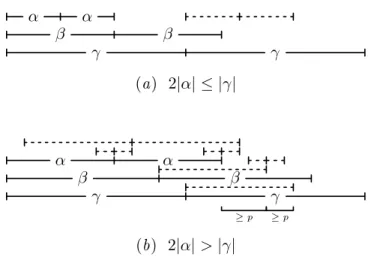
Proof. We prove that any positioniinS can at most be the rightmost occur-rence of two distinct squares in S. Assume for the sake of contradiction that i is the rightmost occurrence of three squares αα, ββ and γγ with a = |α|, b = |β|, c = |γ| and 0 < a < b < c. Without loss of generality we assume s=γγ and i= 1. Figure 6 shows the two cases to be considered.
Ifa≤c/2, thenαα is a prefix of γ. Thereforeααalso occurs at positions c+ 1, which contradicts the assumption that position one is the rightmost occurrence of αα.
Ifa > c/2, then we will show thatααoccurs at positionp+1, wherepis the period ofα. By Lemma 3 the occurrences ofαat positionsa+1,b+1, andc+1 will have distance at leastp(α is a prefix ofβ andγ, which occur respectively at positions b+ 1 and c+ 1), i.e. a+p≤b≤c−p. Since α has periodp and occurs at positions one and a+ 1, it follows that α occurs at positions p+ 1 anda+p+ 1 ifS[a−p+ 1.. a+p] andS[2a−p+ 1..2a+p] are substrings ofα. We have S[a−p+ 1.. a+p] =β[a−p+ 1.. a+p] =S[a+b−p+ 1.. a+b+p] = α[a+b−c−p+ 1.. a+b−c+p] sincea+b−c−p+ 1≥a+a+p−c−p+ 1>1 anda+b−c+p≤a, andS[2a−p+ 1..2a+p] =β[2a−b−p+ 1..2a−b+p] = α[2a−b−p+ 1..2a−b+p] since 2a−b−p+ 1> c−b−p+ 1≥p−p+ 1 = 1 and 2a−b+p≤2a−(a+p) +p=a. We conclude thatααoccurs at positionp+ 1,
α α β β γ γ (a) 2|α| ≤ |γ| α α β β γ γ (b) 2|α|>|γ| ≥p ≥p
Figure 6: The two cases in the proof of Theorem 1. Long dashed lines are occurrences ofα and short dashed lines are occurrences of α[1.. p]
which contradicts the assumption that the rightmost occurrence of αα is at position one. Since no square starts at position|S|the theorem holds. 2
Lemma 6 The minimal augmented suffix tree for a string S has at most3|S|
internal nodes.
Proof. Since the suffix tree for a stringS has |S|internal nodes we only need to show that there are at most 2|S| extra nodes in the minimal augmented suffix tree. If the number of extra nodes are limited by the number of squares in the string the thesis follows from Theorem 1.
Extra nodes are only located on edges when there is a change in the c -value along that edge. Thec-value changes due to two reasons. First, when two substrings become equal as they get shorter and second, when two occurrences of a substring no longer overlap as they get shorter. The first reason only gives rise to changed c-values in nodes already in the suffix tree. If α occurs at position i and i+|α| −1 both occurrences can not be counted in the c -value ofα. However, the occurrences of α0 =α[1..|α| −1], at positionsi and i+|α| −1, do not overlap and the c-value may change. This only happens when there is a squareα0α0 inS. 2
4
Level-Linked (2,4)-Trees
In this section we consider how to maintain a set of sorted lists of elements as a collection of level-linked (2,4)-trees where the elements are stored at the leaves
in sorted order from left-to-right, and each element can have an associated real valued weight. For a detailed treatment of level-linked (2,4)-trees see [12] and [17, Section III.5]. The operations we consider supported are:
NewTree(e, w): Creates a new treeT containing the elementewith associated weight w.
Search(p, e): Searches for the element e starting the search at the leaf of a treeT thatppoints to. Returns a reference to the leaf inT containinge or the immediate predecessor or successor of e.
Insert(p, e, w): Creates a new leaf containing the element e with associated weight wand inserts the new leaf immediate next to the leaf pointed to by p in a treeT, provided that the sorted order is maintained.
Delete(p): Deletes the leaf and element thatp is a pointer to in a tree T.
Join(T1, T2): Concatenates two treesT1 andT2 and returns a reference to the resulting tree. It is required that all elements in T1 are smaller than the elements inT2 w.r.t. the total order.
Split(T, e): Splits the tree T into two trees T1 and T2, such that e is larger than all elements in T1 and smaller than or equal to all elements inT2. Returns references to the two trees T1 and T2.
Weight(T): Returns the sum of the weights of the elements in the tree T. Hoffman et al. [11, Section 3] considered the case where elements are un-weighted, and showed how level-linked (2,4)-trees support all the above oper-ations, except Weight, within the time bounds stated in Theorem 2 below.
Theorem 2 (Hoffmann et al.) Level-linked (2,4)-trees support the opera-tions NewTree, Insert and Delete in amortized constant time, Search in time
O(logd) where d is the number of elements in T between e and p, and Join andSplit in amortized time O(log min{|T1|,|T2|}).
To allow each element to have an associated weight we extend the con-struction from [11, Section 3] such that we for all nodesv in a tree store the sum of the weights of the leaves in the subtreeTv, except for the nodes on the paths to the leftmost and rightmost leaves, in the following denotedextreme nodes. These sums are straightforward to maintain while rebalancing a (2,4)-tree under node splittings and fusions, since the sum at a node is the sum of the weights at the children of the node. For each tree we also store the total weight of the tree.
Theorem 3 Weighted level-linked (2,4)-trees support the operations NewTree and Weight in amortized constant time, Insert and Delete in amortized time
O(log|T|), Search in time O(logd) where d is the number of elements in T
betweene andp, andJoin andSplit in amortized time O(log min{|T1|,|T2|}). Proof. The operations NewTree and Weight take amortized constant time, since the total weight of a tree is explicitly stored, and Search takes time
O(logd) since it is unaffected by the presence of weights. The presence of weights increases the time for Insert and Delete to O(log|T|), since in the worst-case all weights stored on the path from the root to the new/deleted leaf must be recomputed for every insertion and deletion.
For the operationsJoinand Splitwe need to argue that the stored weights can be updated within the claimed time bounds. TheJoinoperation proceeds by first linking the root of the tree of minimal heighth=O(log min{|T1|,|T2|}) as a child of an extreme node with height h+ 1, followed by a sequence of node splittings. The linking causes 2h−1 extreme nodes not to be extreme nodes any longer, forcing the weights to be computed for these nodes. This can be done in time O(h). Since for each node splitting the weights can be updated in constant time and the total weight of T is the sum of the weights of T1 and T2, the amortized time bound for Join follows. A Split consists of a sequence of node splittings, unlinking the subtree rooted a node of heighth=O(log min{|T1|,|T2|}), and a sequence of node fusions. The weights at the involved nodes can similarly toJoinbe updated during the sequence of node splittings and fusions. The unlinking only creates new extreme nodes. Finally the weight of the resulting tree of minimal height can be computed by traversing the extreme nodes of this tree in time O(h). The weight of the larger tree can be computed as the difference between the weight ofT and the weight of the tree of minimal height. 2
5
The Algorithm
In this section we describe the algorithm for constructing the minimal aug-mented suffix tree for a string S of length n. The analysis is presented in Section 6 and shows that the algorithm runs in timeO(nlogn).
5.1 Algorithm idea
The algorithm starts by constructing the suffix tree,ST(S), for S. The suffix tree is then augmented with extra nodes andc-values for all nodes to get the minimal augmented suffix tree, MAST(S), forS. The augmentation ofST(S) to MAST(S) starts at the leaves and the tree is processed in a bottom-up fashion. At each node v encountered on the way up the tree the c-value for
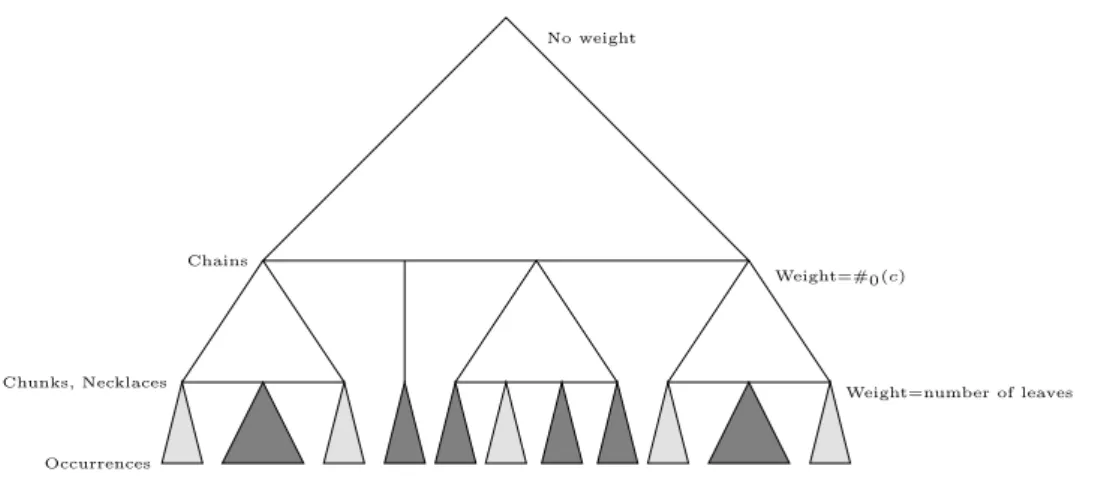
Chains No weight Weight=#0(c) Chunks, Necklaces Occurrences Weight=number of leaves
Figure 7: The data structure is a 3-level search tree.
the path-labelL(v) is added to the tree, and at each edge new nodes and their c-values are added if there is a change in thec-value along the edge. To be able to compute efficiently the c-values and decide if new nodes should be added along edges the indices in the leaf-list ofv,LL(v), are stored in a data structure that keeps track of necklaces, chunks, and chains, as defined in Section 3.
5.2 Data structure
Let α be a substring of S. The data structure D(α) is a search tree for the indices of the occurrences ofαinS. The leaves inD(α) are the leaves inLL(v), wherevis the node inST(S) such that the locus ofαis the edge directly above v or the nodev. The search tree, D(α), will be organized into three levels to keep track of chains, chunks, and necklaces. The top level in the search tree stores chains, the middle level chunks and necklaces, and the bottom level occurrences. See Figure 7.
Top level: Unweighted (2,4)-tree (cf. Theorem 2) with the chains as leaves. The key of a chain is the leftmost index in the chain.
Middle level: One weighted (2,4)-tree (cf. Theorem 3) for each chain, with the chunks and necklaces as leaves. The leftmost indices in the chunks and necklaces are the keys. The weight of a leaf is 1 if the excess of the chunk or necklace is zero, otherwise the weight is 0. The total weight of a tree on the middle level is #0(c), wherecdenotes the chain represented by the tree.
Bottom level: One weighted (2,4)-tree (cf. Theorem 2) for each chunk and necklace, with the occurrences in the chunk or necklace as the leaves.
The weight of a leaf is 1. The total weight of a tree is the number of occurrences in the chunk or the necklace.
Together with each of the 3-level search trees, D(α), some variables are stored. NCS(α) stores the sum of the nominal contribution as defined in Section 3 for all chunks and necklaces, ZS(α) stores the sumPc∈Cd#0(c)/2e, where C is the set of chains. By Lemma 5 the maximum number of non-overlapping occurrences of α is NCS(α) −ZS(α). We also store the total number of indices in D(α) and a list of all chains containing at least one chunk, denotedCHAINLIST(α). The list will keep pointers to the roots of the trees for the chains, and pointers in the opposite direction are kept in the tree.
CHAINLIST(α) will be useful when all chunks are processed at the same time and we do not want to spend time on searching for chunks in chains with no chunks. Finally we store, p(α), which is the smallest difference between the indices of two consecutive occurrences in D(α). Note that, by Corollary 2, p(α) is the period ofα if there is at least one chunk. For convenience, we will sometimes refer to the tree for a chain, chunk, or necklace just as the chain, chunk, or necklace.
For the top level tree inD(α) we will use level-linked (2,4)-trees, according to Theorem 2, and for the middle and bottom level trees in D(α) we will use weighted level-linked (2,4)-trees, according to Theorem 3. In these trees predecessor and successor queries are supported in constant time. We denote by `(e) and r(e) the indices to the left and right of index e. To be able to check fast if there are overlaps between two consecutive trees on the middle and bottom levels we store the first and last index in each tree in the root of the tree. This can easily be kept updated when the trees are joined and split. We will now describe how the suffix tree is processed and how the data structures are maintained during this process.
5.3 Processing events
We want to process edges in the tree bottom-up, i.e. for decreasing length of α, so that new nodes are inserted if the c-value changes along the edge, the c-values for nodes are added to the tree, and the data structure is kept updated. The following events can cause changes in the c-value and the chain, chunk, and necklace structure.
1. Excess change: When |α| becomesi·p(α), for i= 2,3,4, . . . the excess and nominal contribution of chunks changes and we have to update the data structure and possibly add a node to the suffix tree.
2. Chunks become necklaces: When |α| decreases and becomes 2p(α) a chunk degenerates into a necklace. At this point we join all overlapping
chunks and necklaces into one necklace and possibly add a node to the suffix tree.
3. Necklaces and chains break-up: When|α|decreases two consecutive oc-currences at some point no longer overlap. The result is that a necklace or a chain may split, and we have to update the necklace and chain structure and possibly add a node to the suffix tree.
4. Merging at internal nodes: At internal nodes in the tree the data struc-tures for the subtrees below the node are merged into one data structure and thec-value for the node is added to the tree.
To keep track of the events we use an event queue, denoted EQ, that is a common priority queue of events for the whole suffix tree. The priority of an event in EQ is equal to the length of the string α when the event has to be processed. Events of type 1 and 2 store a pointer to any leaf in D(α). Events of type 3, i.e. that two consecutive overlapping occurrences with index e1 and e2, wheree1 < e2, terminate to overlap, store a pointer to the leaf e1 in the suffix tree. For the leaf e1 in the suffix tree a pointer to the event in
EQ is also stored. Events of type 4 stores a pointer to the internal node in the suffix tree involved in the event. When the suffix tree is constructed all events of type 4 are inserted into EQ. For a node v in ST(S) the event has priority|L(v)|and stores a pointer to v. The pointers are used to be able to decide which data structure to update. The priority queueEQis implemented as a table with entries EQ[1]. . .EQ[|S|]. All events with priority x are stored in a linked list in entryEQ[x]. Since the priorities of the events considered are monotonic decreasing, it is sufficient to consider the entries ofEQ in a single scan starting atEQ[|S|].
The events are processed in decreasing order of the priority and for events with the same priority they are processed in the order as above. Events of the same type and with the same priority are processed in arbitrary order. In the following we only look at one edge at the time when events of type 1, 2, and 3 are taken care of.
5.3.1 Excess change
The excess changes for all chunks at the same time, namely when|α|=i·p(α) for i = 2,3,4, . . .. To update the data structure when the excess changes, all chunks are first removed from D(α). Then the new excess and nominal contribution are computed and finally the tree is reconstructed as the re-moved chunks are reinserted into D(α). This is all done for each chain in
1. For each chain in CHAINLIST(α) find the sorted list of chunks in the chain. Note that at least every other element in the chain are chunks, since two necklaces do not overlap.
2. For each chunk remove it from its chain by splitting the tree for the chain. At most two Split-operations per chunk are needed to temporary make each chunk a chain by itself. The chain which the chunk is part of is replaced by the at most three new (overlapping) chains in the top-level tree, unless the chunk already was a chain by itself. KeepCHAINLIST(α) updated by deleting the split chain from the list and inserting the re-sulting chains, if they contain at least one chunk. Keep ZS(α) updated by first subtracting the old contribution of the chain to ZS(α) and then adding the contributions of the resulting chains.
3. Recompute the excess and nominal contribution for all chunks and up-date NCS(α) accordingly by adding the change in nominal contribution to NCS(α) for each chunk. Set the weight of chunks with excess 0 to 1 and set the weight of chunks with excess at least 1 to 0. In the new tree the chain structure may have changed. Chunks for which the excess in-creases to two or more will become separate chains, while chunks where the excess becomes less than two may join two or three chains into a single chain.
4. Now we want to reconstruct the tree by reinserting the chunks into the tree. This is done seperately for each chain in the originalCHAINLIST(α). Let c1, . . . , cm denote the chunks from left to right in a chain and let Ti denote the tree for the chain containing chunk ci and do the following. If ci has excess 2 or more then nothing is done since ci is a chain by itself. If the excess is 0 or 1 we check if the chunk overlaps the chains to the left and right, denotedT` andTr, and in that case if the chains shall be joined.
(a) If ci to the left overlaps with a necklace or a chunk with excess 0 or 1, then remove T` from the top-level tree and join Ti and T`. Denote the resulting tree Ti. Delete fromCHAINLIST(α) the chain containingci and also the chain Tl if it is in the list. Insert the new chain into CHAINLIST(α). Update ZS(α) accordingly.
(b) IfTrto the right overlaps with a necklace then joinTiwithTrafter removing Tr from the top-level tree. Denote the resulting tree Ti. Update ZS(α) accordingly.
IfTr=Ti+1, i.e. it is also a chunk, then the overlap betweenTiandTi+1 will be checked as described above when continuing with Ti+1.
Continue until all chunks are checked and repeat the same procedure for each chains in the original CHAINLIST(α).
If |α|= 2p(α) then insert an event of type 2 with priority 2p(α) into EQ, with a pointer to any leaf in D(α). If |α| = i·p(α) > 2p(α), then insert an event of type 1 with priority (i−1)·p(α) intoEQ, with a pointer to any leaf inD(α).
5.3.2 2. Chunks become necklaces.
When |α| decreases to 2p(α) all chunks become necklaces at the same time. At this point all chunks and necklaces that overlap must be joined into one necklace. Note that all chunks have excess 0 or 1 when|α|= 2p(α) and since we first recompute the excess, all overlapping chunks and necklaces are in the same chain. Hence, what we have to do is to join all chunks and necklaces from left to right, in each chain. The following is done.
1. For each chain in CHAINLIST(α) join all chunks and necklaces from left to right. Note that there are never two consecutive necklaces in the same chain, i.e. there are at most twoJoin-operations per chunk. Update
NCS(α) and ZS(α) by adding the difference in nominal contribution to
NCS(α) and by subtracting #0(c) from ZS(α) for each changed chain and add it for the new chains.
2. SetCHAINLIST(α) to be empty, since there are no chunks left.
5.3.3 Necklaces and chains break-up
When two consecutive occurrences of α with indices e1 and e2 terminate to overlap this may cause a necklace or a chain to break up into two necklaces or chains. Ife1 and e2 belong to the same chain then the chain breaks up in two chains. If e1 and e2 belong to the same necklace then both the necklace and the chain split between e1 and e2. The following is done to update the data structure.
1. Using the pointers stored at the leaves ofST(S), check if the indices e1 and e2 are already in different chains. If they are then nothing is done. 2. Ife1 and e2 are in the same chain, represented in the tree by Tc, thenc
shall be split.
(a) If both indices belong to the same necklace then the necklace shall be split. Remove the tree for the necklace from Tc by perform-ing two Split-operations. The result is three trees, Tc1, Tn, and Tc2. Split the tree for the necklace into two parts by performing
Split(Tn, e2) =Tn1, Tn2. InsertTn1 inTc1 and Tn2 inTc2 using two
Join-operation. Finally, insert the new chain into the top-level tree and updateNCS(α) and ZS(α).
(b) If the two indices belong to two different subtrees at the bottom-level then only the chain has to be split. Insert the new chain into the top-level tree and update ZS(α).
Update CHAINLIST(α) if necessary, by first removing c from the list (if it is in it). Then for the two new chains, check if they contain at least one chunk and in that case insert the chains into CHAINLIST(α).
5.3.4 Merging at internal nodes
Let α be a substring such that the locus of α is a node v in the suffix tree. The leaf-list forv,LL(v), is the union of the leaf-lists for the subtrees belowv. Hence, at the nodes in the suffix tree the data structures for the subtrees should be merged into one. We assume that the edges below v have been processed forα as described above for events 1, 2, and 3.
Let T1, . . . , Tt be the subtrees below v in the suffix tree. We never merge more than two data structures at the time. If there are more than two subtrees, the merging is done in the following order: T =Merge(T, Ti), for i= 2, . . . , t, where T = T1 to start with. This can also be viewed as if the suffix tree is made binary by replacing all nodes of degree larger than 2 by a binary tree with edges with empty labels. We will now describe how to merge the data structures for two subtrees.
The merging will be done by inserting all indices from the smaller of the two leaf-lists into the data structure for the larger one. Let T denote the 3-level search tree to insert new indices in and denote by e1, . . . , em the indices to insert, where ei < ei+1. The insertion is done by first splitting the treeT at all positions ei for increasing i= 1, . . . , m. The tree is then reconstructed, from left to right, at the same time as the new indices are inserted. More exactly the following is done.
1. For all indices ei, i = 1, . . . , m split T (at all levels necessary) by per-forming Split(ei). Denote the resulting 3-level trees T0, . . . , Tm+1 where ei is larger than all indices inTj forj < i, and smaller than all other in-dices. Note that Ti is an empty tree if there are no indices in T between ei andei+1.
When a middle-level tree, for a chain c, is split, update ZS(α) by sub-tracting #0(c) and adding the new #0-values for the two new trees. Update CHAINLIST(α) (from the tree T) if necessary, by first removing c from the list (if it is in it). Then for the two new chains, check if they contain at least one chunk and in that case insert the chains into
CHAINLIST(α). When a bottom-level tree is split, update NCS(α) by subtracting the nominal contribution of the split chunk or necklace and adding the two new nominal contributions.
2. The tree is reconstructed from left to right by inserting the new indices in increasing order. Let T0 be the tree reconstructed for all indices smaller thaneiin the two trees to be merged, i.e. T0 is the union ofe0, . . . , eiand T0, . . . , Ti. Initially T0 equals T0. To proceed, we want to insert ei and all indices between ei andei+1 intoT0. (Ifi=m we insert all remaining indices.) This is done as follows.
Check if the occurrence with index ei overlaps the occurrence for the rightmost index in the tree T0 reconstructed so far and in that case, check if this index is part of a necklace or a chunk.
(a) If the occurrence with index ei does not overlap any occurrence to the left then create a new chain with one necklace with ei as the only index. Insert the chain into T0.
(b) If the occurrence with indexeioverlaps an occurrence with indexe` to the left and the overlap is less than |α|/2 then ife` is part of a necklace then insert ei into this necklace using oneJoin-operation. Ife`is part of a chunk,c`, then create a new chain with one necklace withei as the only index. If the excess ofc` is 2 or more then insert the chain in T0, otherwise join the two chains.
(c) If the occurrence with indexeioverlaps an occurrence with indexe` to the left and the overlap is more than |α|/2 then ife` is part of a necklace remove e` from the necklace and create a new chunk with e` andei as the two indices. Create a new chain for the chunk with two indices e` and ei. Since the excess of the chunk with 2 indices is 1, join the two chains. If e` is part of a chunk then insert ei into the chunk. If the excess increases from 1 to 2 then let the chunk be a chain by itself. If the excess changes to 0 after being 2 or more then join the chunk with the chain to the left if possible.
The tree T0 is at this point the tree reconstructed for all indices up to indexei. The next step is to include also the treeTi. UnlessTi is empty the following is done.
Check if the occurrence with index ei overlaps the leftmost occurrence in Ti, with indexer . If it does not we just join the treesT0 and Ti. If it does overlap the following is done.
(a) The overlap between ei and er is less than |α|/2. If both ei and er are part of necklaces then join the necklaces and the chains they are part of. If at least one of ei ander is part of a chunk, then join
the chains they are part of unless the excess of the chunk is 2 or more.
(b) The overlap between ei and er is more than |α|/2. If bothei and er are part of necklaces then removeei and er from their trees and create a new chunk with the two indices. Since the excess of the new chunk is 1, insert the chunk in one of the chains and join the chains. If one ofei anderis part of a chunk and the other is part of a necklace, then remove the index in the necklace and insert it into the chunk. Let c1 and c2 be the two chains where the two indices were located originally. If the excess of the chunk becomes 0 or 1 then join the chainsc1 andc2, otherwise let the chunk be a chain by itself by splitting the chain for the chunk. If bothei ander are part of chunks then join them. Check the excess of the joined chunk. If the excess is 2 or more, then make the chunk a chain by its own. Keep CHAINLIST(α) updated all the time during the above procedure. Each time a chain is split, joined, or removed, delete the chain from
CHAINLIST(α) (if it is in the list). Each time a new chain is created, e.g. as a result of a split or join, insert the chain into CHAINLIST(α) if it contain at least one chunk.
Update the global variables ZS(α) and NCS(α), respectively, whenever two trees, at the middle or bottom level, respectively, are joined or split.
Every time, during the above described procedure, when two overlapping occurrences with indicesei and ej, where ei < ej, from different subtrees are encountered the event (ei, ej) with priority ej −ei is inserted into the event queue EQ and the previous event, if any, with a pointer to ei is removed fromEQ. Updatep(α) toej−ei if this is smaller than the currentp(α) value. If |α| > 2p(α) then insert an event of type 1 with priority b|α|/p(α)cp(α) intoEQ, with a pointer to any leaf in D(α).
6
Analysis
Theorem 4 The minimal augmented suffix tree, MAST(S), for a stringS of length ncan be constructed in time O(nlogn) and space O(n).
Proof. The algorithm in Section 5 starts by constructing the suffix tree,ST(S), for the input stringS in timeO(nlogn). The leaf-lists of allnleaves inST(S) are created in constant time for each leaf, i.e. in total timeO(n). The proof uses an amortization argument, allowing each edge to be processed in amor-tized constant time, and each binary merge at a node (in the binary version) of ST(S) of two leaf-lists of sizes n1 and n2, with n1 ≥ n2, in amortized
time O(n2logn1+n2
n2 ). From Lemma 1 it follows that the total time for
pro-cessing the internal nodes and edges ofST(S) isO(n). In the following we will first give the time for processing the different events. We will then define a potential for each data structure maintained along an edge or node ofST(S). We will argue that the processing of events of type 1, 2, and 3 release sufficient potential to pay for processing the event, and that a binary merge in an event of type 4 takes time O(n2logn1+n2
n2 ) and increases the potential by at most
the same amount.
When events of type 1 are processed the first step is to find the sorted list of chunks in each chain. For a leaf-list containing m chunks, this is done in timeO(m) since only chains containing at least one chunk are examined and since at least every other element in a chain is a chunk. The next step is to make each chunk a chain by itself by performing at most two split operations per chunk, hence at most 2m split operations. The splitting is done from left to right in each chain. Let |CHAINLIST(α)|= b and let |ci|, for i = 1, . . . , b be the size of chain i in the list. Let sij be the size of the left tree resulting from the jth splitting of chain i inCHAINLIST(α). ThenPib=1|ci| ≤ |LL(v)| and P2j=1ai sij ≤ |ci| where ai is the number of chunks in chain i. Hence,
Pb
i=1
P2ai
j=1sij ≤ |LL(v)|. According to Theorem 2 and 3 a split operation
takes time log(min{|T0|,|T00|}), whereT0 and T00 are the resulting trees. The total time of all splittings is at mostO(Pbi=1P2ai
j=1logsij)≤ O(mlog|LLm(v)|).
Finally the chains for the chunks are joined with other chains. Similarly to the split operations, the joining takes timeO(mlog|LLm(v)|). All other operations, e.g. to recompute the excess and update the global variables, take O(m). Hence, the total time to process an event of type 1 isO(mlog|LLm(v)|).
When an event of type 2 is processed all chunks and necklaces in the same chain are joined into one chain by joining the trees in each chain containing at least one chunk. Since the joining is done from left to right in each chain the total time for all join operations in an event of type 2, like in event of type 1, isO(mlog|LLm(v)|), which is also the total time for processing of type event 2.
When an event of type 3 is processed, it is first checked if the two occur-rences, that terminate to overlap, belong to the same chain. Let e1 and e2 be the indices of the two occurrences and let c be the chain which e1 be-longs to. Denote by|c| the number of occurrences of α inc. Since we have a pointer toe1, walking up the tree for c to decide if e2 also belongs to c takes timeO(log|c|). At the same time it can also be checked if the two indices be-long to the same necklace. If the two indices bebe-long to the same chain and/or necklace the chain and/or necklace is split by using at most two split operation on each level, i.e. at most four split operations. According to Theorem 3, a split operation takes time O(log|c|). According to Theorem 2, inserting the new chain in the top-level tree takes constant time. Hence, the total time to process an event of type 3 isO(log|c|).
For each nodev in ST(S) an event of type 4 is processed, which consists of a sequence of binary mergings as described in Section 5, by viewingST(S) as a binary tree. A binary merging is performed by inserting the indices from the smaller of the two subtrees into the data structure for the larger subtree. Denote by e1, . . . , en1 then1 indices in the smaller subtree. Denote byD(α) the data structure for the larger subtree and letn2 be the number of indices inD(α). When e1, . . . , en1 are inserted into D(α) the tree T forD(α) is split at e1, . . . , en1 into n1 + 1 smaller trees T0, . . . , Tn1+1. Let s0 be the number of indices inD(α) smaller thane1, letsi, for i= 1, . . . , n1−1, be the number of indices larger than ei and smaller than ei+1 in D(α), and let sn1 be the number of indices in D(α) larger than en1. According to Theorems 2 and 3 split takes time O(log min{|T0|,|T00|}), where T0 and T00 are the two resulting trees. It follows that the total time for the splitting at e1, . . . , en1 is
Pn1+1
i=1 O(logsi) =
Pn1+1
i=1 O(logn1n+1n2) =O(n1log
n1+n2
n1 ). After the splitting
the trees and the indices e1, . . . , en1 are joined. The time bound for joining is proportional to the time bound for splitting. All other operations, like updatingNCS(α) andZS(α), take timeO(n1). Since both splitting and joining takes time O(n1logn1+n2
n1 ) it follows from Lemma 1 that the total time for
processing all events of type 4 isO(nlogn).
We now turn to combine the above time bounds for the different events into an amortization argument, showing that the running time of the algorithm is dominated by the time for all events of type 4, i.e. the running time of the algorithm is O(nlogn). Let v be a node in the suffix tree and let α be a string with locus v or locus on the edge immediately above v. The data structureD(α) has potential Φ(D(α)). Let C be the set of chains stored inD(α). For a chain c, let|c|denote the number of occurrences ofα inc. We define the potential ofD(α) by the sum
Φ(D(α)) = Φ1(α) + Φ2(α) +X
c∈C
Φ3(c),
where the rˆole of Φ1, Φ2, and Φ3 is to account for the potential required to be able to process events of type 1, 2, and 3 respectively. Letkdenote the number of chunks inD(α) and letgdenote the number ofgreenchunks (defined below) inD(α). The three potentials Φ1, Φ2, and Φ3, are defined by
Φ1(α) = 7glog|v| ·e g , Φ2(α) = klog|v| ·e
k , Φ3(c) = 2|c| −log|c| −2,
with the exceptions that Φ1(α) = 0 if g = 0, and Φ2(α) = 0 if k = 0. Note that the potential of a leaf of ST(()S) is zero and that Φ1 and Φ2 are
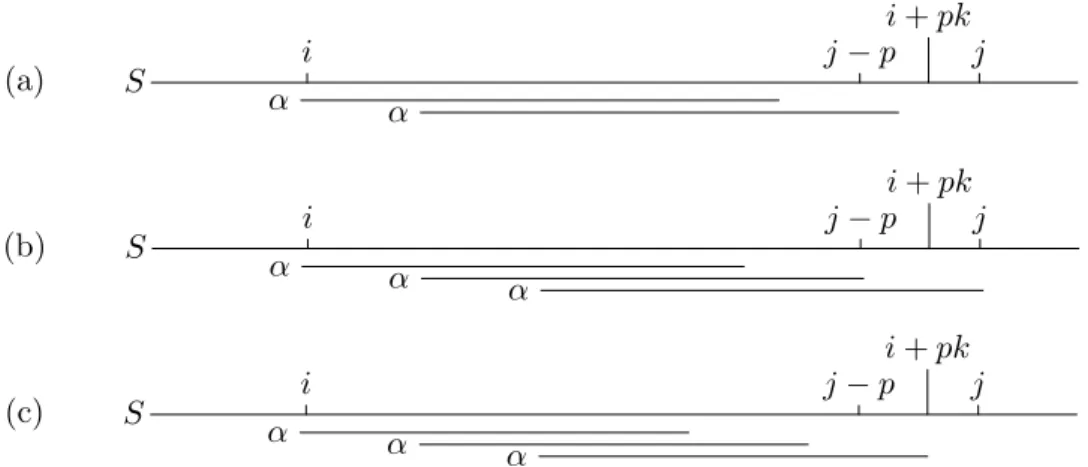
(a) S α α i i+pk j−p j (b) S α α α i i+pk j−p j (c) S α α α i i+pk j−p j
Figure 8: Coloring of chunks while shortening α: (a) red chunk, (b) green chunk, (c) recomputation of excess and green-to-red color change
monotonic increasing for g and k in the range [0..|v|]. For a chunk, with leftmost occurrence of α at position i, consider the substring S[i .. j] with maximal j and S[i .. j] having period p, where p = p(α) is the period of α. Note that the rightmost occurrence at position r in the chunk always covers positionj−p+ 1, since otherwise there is an occurrence ofα at positionr+p. We denote the chunkgreenif and only if|α|modp≤j−i+1 modp. Otherwise the chunk isred.
The important property of the color of chunks is that when a chunk changes color from red to green while shorteningα, then there exists a node in ST(S) where the merging of the leaf lists increases the number of occurrences in the chunk by exactly one occurrence, i.e. it is sufficient to charge each insertion in a binary merge by the creation of one green chunk. The increase in the potential Φ1 can then be charged to the processing of events of type 4. When a chunk becomes green inST(S), then |α|modp=j−i+ 1 modp, implying that the last occurrence ofαin the chunk is at positionj− |α|+ 1 and covers position j but not j+ 1. Since S[j + 1] 6= S[j+ 1−p], it follows that the indices of the occurrences ofα at positionsj− |α|+ 1 andj−α+ 1−pcannot be contained in the same leaf-list of a child, i.e. the locus of α in ST(S) is a node v of degree at least two, and the chunk consists of indices from the leaf-lists of two distinct children of v. Figure 8 illustrates the color changes for a chunk while shorteningα.
Consider an event of type 1 where the excess of allkchunks is recomputed. This event only occurs when|a|modp= 0, i.e. all chunks are green andg=k. After the recomputation of the excess all chunks become red. The change of excess of the k chunks in the worst-case implies that the number of chains is reduced by 2k, because chunks previously having excess ≥2 now have excess