Cache-Aware Real-Time Scheduling Simulator:
Implementation and Return of Experience
Hai Nam Tran, Frank Singhoff, Stéphane Rubini, Jalil Boukhobza
Univ. Bretagne Occidentale, UMR 6285, Lab-STICC, F-29200 Brest, France
{hai-nam.tran,singhoff,rubini,boukhobza}@univ-brest.fr
ABSTRACT
Evaluating cache related preemption delay (CRPD) in pre-emptive scheduling context for Real-Time Embedded Sys-tem (RTES) stays an open issue despite of its practical im-portance. Indeed, various parameters should be taken into account such as cache utilization of tasks, memory layout of tasks, processor utilization and priority assignment algo-rithm. In state-of-the-art work, dependencies amongst those parameters are not investigated with precision because of the lack of scheduling analysis tool taking them into account. In this article, we propose a tool to investigate and eval-uate scheduling analysis of RTES with cache memory and various scheduling parameters. Both modeling guidelines and implementation is detailed. Implementation is made in Cheddar, an open-source scheduling analyzer, which is freely available; Experiments are conducted in order to illustrate performance and applicability of our tool. Furthermore, we discuss about implementation issues, problems raised and lessons learned from those experiments.
1.
INTRODUCTION
Cache memory is a crucial hardware component used to reduce the performance gap between processors and main memories. In the context of real-time embedded system (RTES), the popularization of processors with large size and multi level caches motivates the proposition of verification methods handling this hardware component [14], [5], [2].
Scheduling simulation is a classical verification method performed at design step of RTES. It provides means to in-vestigate that all timing constraints of a RTES are satisfied. To perform scheduling simulation, several assumptions are usually made in order to simplify system modeling. One of them is that preemption costs are negligible. Preemption costis the additional time to process interrupts, manipulate task queues and actually perform context switches.
Integrating cache memory in RTES generally enhances the whole performance in term of execution time, but unfortu-nately it can lead to an increase in preemption cost and execution time variability [15]. When a task is preempted, memory blocks belonging to the task could be removed from the cache. Once the task resumes, previously removed mem-ory blocks have to be reloaded into the cache. Thus, a new preemption cost named Cache Related Preemption Delay (CRPD) is introduced. By definition, CRPD is the addi-tional time to refill the cache with memory blocks evicted
EWiLi’15, October 8th, 2015, Amsterdam, The Netherlands. Copyright retained by the authors.
by the preemption. In [15], the authors showed that the cost of context switching raises from the range of 4.2µs to 8.7µs to the range of 38.6µs to 203.2µs when the size of the data sets of programs is larger than the cache. Thus, tak-ing CRPD into account may be important when performtak-ing scheduling analysis of a RTES.
Problem statement: Scheduling analysis of RTES with cache memory in fixed priority preemptive scheduling con-text is complex because there are many parameters affecting the outcome and dependencies amongst them. For example, CRPD analysis, which is the process of evaluating the im-pact of CRPD on a RTES, cannot be only based on single-task analysis as it depends on correlations amongst single-tasks. For a set of tasks, CRPD analysis has to take into account parameters such as cache utilizations of tasks, memory lay-out of tasks, processor utilization but also priority assign-ment algorithms and WCET tasks.
To address all parameters, many tools are involved, in two domains: WCET/Cache analysis and scheduling analy-sis. Each of those domains is only dedicated to a sub-part of those parameters. Unfortunately, there are no tools ad-dressing the whole problem in state-of-the-art work.
Contributions : We propose a tool to investigate and eval-uate scheduling analysis of RTES with cache memory and various scheduling parameters. The work is implemented in Cheddar, an open-source scheduling analyzer, which is freely available to researchers and practitioners. We propose an approach to use the analysis models and results of WCET/-cache analysis tools into a scheduling analysis tool. The programming model we used is compliant with the existing one in [14], [5], [2] and [17]. Experiments are performed to illustrate performance and applicability of our tool.
The rest of the article is organized as follows. Section 2 presents background of our work. In Section 3, we give an overview of our approach. In Section 4, we present devel-opment process and detailed information about the imple-mentation of our work. In Section 5, an evaluation of our proposed scheduling simulator is given. Section 6 discusses related works and Section 7 concludes the article.
2.
BACKGROUND
In this section, we introduce the system model and we explain how preemption cost and CRPD are computed. We assume an uniprocessor RTES with direct-mapped instruc-tion cache. As far as we know, instrucinstruc-tion cache is popular in practical implementation of RTES. The assumption about direct-mapped is used to simplify the data flow analysis, it could be easily relaxed. There are n independent tasks,
System Model
(Cheddar-ADL) 2. Data Flow Analysis Profile (UCB, ECB)Cache Access 3. Scheduling Simulation 1. Modeling RTES : Input : Output Figure 1: Approach
τ1, τ2, ..., τn scheduled by a preemptive scheduler. CPRD is
bounded byg·BRT, wheregis an upper bound on the num-ber of cache block reloaded due to preemption, andBRT is an upper-bound on the time necessary to reload a memory block in the cache (block reload time). To analyze the effect of preemption on a preempted task, Lee et al.[14] introduced the concept of useful cache block (UCB):
Definition 1. A memory blockmis called a useful cache block (UCB) at program pointP, ifmmay be cached atP
andmmay be reused at program pointP0afterP that may be reached fromP without eviction ofmon this path. The number of UCB at program point P gives an upper bound on the number of additional reloads due to a pre-emption atP. The maximum possible preemption cost for a task is determined by the program point with the highest number of UCB. In [22], the authors exploit the fact that for thei-th preemption, only thei-th highest number of UCB has to be considered. However, as shown in [1] and [3], a significant reduction typically only occurs at a high number of preemptions. Thus, we only consider the program point with highest number of UCB.
The impact of preempting task is given by the number of cache blocks that the task may evict during its execu-tion. Busquet et al.[5] introduce the concept of evicting cache block (ECB):
Definition 2. A memory block of the preempting task is called an evicting cache block (ECB), if it is accessed during the execution of the preempting task.
The notation UCBiand ECBiare used to present the set of UCBs and ECBs of a taskτi. Assume that the sets of UCB
and ECB of each task are preliminary computed, UCB’i is the set of UCBs currently in the cache of the preempted task. γi,j is the preemption cost (i.e. the CRPD) when a
task τj directly preempt task τi. In case of a preemption
between two tasksτi andτj,γi,j is computed by:
γi,j= BRT· |UCB’i ∩ECBj | (1) However, in case of nested preemptions, a taskτj can
pre-empt more than one task. Thus, computation of CRPD must take all preempted tasks into account.
3.
OUR APPROACH
Our approach consists of three steps as shown in Fig. 1. First, we modeled a RTES with components required to ap-ply analysis methods stated in Section 2. Those components include hardware and software parts. Hardware components are processor, core and cache memory. Software components are tasks and control flow graphs of tasks.
Second, from this model, we applied data flow analysis presented in [14] in order to compute the set of UCB and
ECB of each task, which is called cache access profile in the sequel. A detailed description of these first and second steps could be found in [24], which is a preliminary work toward cache integration.
Third, system model with computed cache access profiles are loaded into the scheduling simulator. Scheduling simula-tion is done and provides various outcomes such as feasibility of the system, worst case response time of tasks, number of preemption, CRPD per task and total CRPD.
In our work, the cache utilization of a program at step 1 is modeled at both low level, which is the control flow graph of program produced by a WCET analysis tool, and at high level, which is a pre-computed set of UCB and ECB. We expect the user to re-use results produced by a WCET anal-ysis tool within Cheddar. We can extract all information related to CRPD from the scheduling simulator as written above to fully investigate the impact of CRPD. Detailed im-plementation of each step is presented in the next section.
4.
IMPLEMENTATION
In this section, we present the implementation of our ap-proach. We introduce our framework, discuss about the de-velopment process and point out several implementation is-sues. The source code of the presented work is available under GNU GPL licence at http://beru.univ-brest.fr/ svn/CHEDDAR/trunk/src/.
The work took place in the context of the Cheddar project [21]. Cheddar is an open source real-time scheduling analy-sis tool. Classical feasibility tests, scheduling algorithms and scheduling simulator for real-time systems are implemented in Cheddar. System architecture is defined with Cheddar Architecture Description Language (Cheddar-ADL). Ched-dar class files are automatically generated by the tool Platy-pus [20] through a model-driven process. The Cheddar meta-model defines hardware components such as: processor,core andshared resource; and software components such as: task andtask group[11].
The development process consisted of three steps. First, Cheddar-ADL is extended to model RTES with cache mem-ory and cache access profile. Second, we implemented UCB computation by data flow analysis. Third, a cache-aware scheduling simulator is implemented by extending the schedul-ing simulator of Cheddar. In [24], we presented how Cheddar-ADL is extended to take into account cache memory and how data flow analysis in [14] is implemented. In this arti-cle, we provide a summary of our models and focus more on the implementation of the cache-aware scheduling simulator and its application.
4.1
Cache Model and Cache Access Profile
To support cache aware scheduling analysis, the Cheddar meta-model has been extended with the entities below:
1 ENTITYGeneric Cache
2 cache size : Natural; 3 line size : Natural; 4 associativity : Natural; 5 miss time : Natural;
6 cache category : Cache Type;
7 ENTITYGeneric Task
8 task type : Natural; 9 capacity : Natural; 10 deadline : Natural; 11 priority : Priority Range;
13 cfg name :String;
14 ENTITYCache Access Profile
15 UCBs : Cache Blocks Table; 16 ECBs : Cache Blocks Table;
17 ENTITYCFG
18 nodes : CFG Nodes Table; 19 edges : CFG Edges Table;
20 ENTITYBasic BlockSUBTYPE OF(CFG Node);
21 instruction offset :INTEGER; 22 instruction capacity :INTEGER;
Cache memory is modeled by classical attributes such as cache size, line size, associativity and block reloading time or miss time. From this model of cache and control flow graph of a task, we can compute the memory layout, the memory-to-cache mapping and the set of UCB and ECB of a task.
A task is modeled by an entity with classical attributes such ascapacity,deadline,priorityandof f sets. Thetask type
specifies the type of a task, such as periodic, aperiodic,
sporadicorpoisson[11].
Two attributes, UCBs and ECBs are added to handle caches. They are the set of UCBs and ECBs of a task, re-spectively. The model is designed according to two assump-tions: first, a task is assumed to have a fixed set of UCB and ECB. UCB is computed by the program point with highest number of UCB ; second, any partial execution of a task uses all its ECBs and UCBs ; thus, CRPD achieved from scheduling simulation is always upper-bounded.
In order to compute the set of UCB and ECB of a task, we need its control flow graph (which is modeled by the CFG EXPRESS entity). Each node in the CFG stores informa-tion about the capacity and the locainforma-tion in main memory of its assembly instruction. At the moment, our analysis method takes into account direct mapped instruction cache because instruction access pattern is simpler to be computed from the CFG of a program.
4.2
Computing Cache Access Profile
UCB analysis is implemented following the work in [14]. The input of the algorithm is an annotated CFG of a pro-gram. From the input CFG, our tool analyzes and computes the set of UCB and ECB.
4.3
The Cache-Aware Scheduling Simulator
The scheduling simulation in Cheddar works as follows. First, a system architecture model, including hardware/-software components, is loaded. Then, the scheduling is computed by three successive steps: computing priority, in-serting ready task into queues and electing task. The elected task will receive the processor for the next unit of time.
The scheduling simulator records different events raised during the simulation, such as task releases, task comple-tions and shared resources lockings or unlockings. The re-sult of the scheduling analysis is the set of events produced at simulation time.
We extended the scheduling simulator of Cheddar as fol-lows. First, we extended the set of events Cheddar can produce. For example, an event PREEMPTION, which is raised when a preemption occurs, is added. Second, event RUNNING TASK, which is raised when a task executes, is extended with the assumption about CRPD that any partial execution of a task uses all its ECBs and UCBs.
The pseudo code of the event handler is written below. The notation τi.cUCB represents the set of UCBs of task
τi in the cache. It is computed from a system model at
scheduling simulation time. The function Remove() at line 8 is used to remove an element from a set.
1 event SCHED START 2 foreachtaskτi loop
3 τi.cUCB←τi.U CB
4 end loop
5 event PREEMPTION 6 τj←preempting task
7 foreachtaskτi preemptedloop
8 τi.cUCB←Remove(τi.cUCB,τj.ECB)
9 end loop
10 event RUNNING TASK 11 τi←executing task
12 CRPD←(τi.U CB −τi.cUCB)∗Miss Time
13 τi.cUCB←τi.U CB
At the start of the scheduling simulation, a SCHED START event is raised. The WCET of a task is assumed to in-clude the block reloading time when a task is executed non-preemptively. So, on event SCHED START, the set of UCBs of a task is assumed to be filled.
When a preemption occurs, a PREEMPTION event is raised and the simulator computes the evicted UCBs of pre-empted tasks using the ECBs of preempting task. The scheduler keeps track of the number of UCBs for each task. When a task executes, a RUNNING TASK event is raised. The scheduler firstly checks if all the UCBs of this task are loaded into the cache. If so, the task continues its execu-tion. If not, the task reloads the evicted UCBs. The CRPD is added to the remaining capacity of the task itself. In our implementation, CRPD is not added to the capacity of pre-empted tasks at the preemption point but at the instant at which those tasks resume execution.
4.4
Implementation Issues
Several issues were raised when designing and implement-ing the simulator. Most of them were raised because we need to mix timing specifications of different orders of magnitude. Others are related to tools interoperability.
In practice, cache block reload time is significantly smaller than period or capacity of a task. In Cheddar, we do not prescribe 1 unit of time is equivalent to 1msor 1µs, which are the unit of task period and block reload time. Mixing timing specifications of different orders of magnitude makes complex the computation of thefeasibility interval. We re-call that a feasibility interval is an interval for which testing of task feasibility is needed [10]. The scheduling simula-tion interval needed to verify the schedulability of a task set could be significantly large if aµsis chosen as a time unit. A solution in practice is to design a system with harmonic task set in order to reduce the feasibility interval; however, it is clearly not always possible. In addition, instead of us-ing 1µs, we use the cache block reload time as a base value for 1 unit of time as in our experiment. Furthermore, a long scheduling simulation interval also raises issues regard-ing performance and scalability. Even with harmonic task set, the tool must be able to perform scheduling simulation in a large interval to overcome the different between cache block reload time and task period, which may be CPU and memory expensive. As Cheddar stores scheduling simula-tion results into XML files, it can also be I/O intensive. To reduce memory and I/O overhead, we selected a subset of events the simulator has to handle and store.
The input data of the CRPD analysis in our tool is designed to be compatible with data provided by a WCET analysis tool. We also support import data in XML format. At the moment, we do not enforce tool interoperability and we expect to investigate WCET tools in order to overcome this issue.
5.
EXPERIMENT AND DISCUSSION
In this section, we show that our tool can handle param-eters compliant with the existing works in [14], [5], [2] in the first experiment. In addition, we discuss about the de-pendency between CRPD and scheduling parameters. Fur-thermore, we point out that our tool can run CRPD opti-mization techniques by taking an example of memory layout optimization by simulated annealing following the work of [17] in the second experiment. We also provide performance and scalability tests of the tool in the third experiment.
Task period and cache utilization generation of our ex-periments is based on the existing work in [1]. Task sets are generated with the following configuration. Task peri-ods are uniformly generated from 5 ms to 500 ms, as found in most automotive and aerospace hard real-time applica-tions [1]. Generated task sets are harmonic in order to have a low feasibility interval and scheduling simulation period. Task deadlines are implicit, i.e. ∀i:Di=Ti. Processor
uti-lization values (PU) are generated using the UUniFast algo-rithm [4]. Task execution times are set based on the proces-sor utilizations and the generated periods: ∀i:Ci=Ui·Ti,
whereUiis the processor utilization of taski. Task offsets
are uniformly distributed from 1 to 30 ms.
Cache memory and cache access profile of tasks are gener-ated as follows. The cache is direct mapped. The number of cache blocks is equal to 256. The block-reload time is 8µs. The cache usage of each task is determined by the number of ECBs. They are generated using UUniFast algorithm for a total cache utilization (CU) of 5. UUniFast may produce values larger than 1 which means a task fills the whole cache. ECBs of each tasks are consecutively arranged from a cache set. For each task, the UCBs are generated according to a uniform distribution ranging from 0 to the number of ECB multiplied by a reuse factor (RF). If the set of ECBs gen-erated exceeds the number of cache sets, the set of ECBs is limited to the number of cache sets. For the generation of the UCBs, the original set of ECBs is used.
5.1
CRPD with Priority Assignment and
Pro-cessor Utilization (PU)
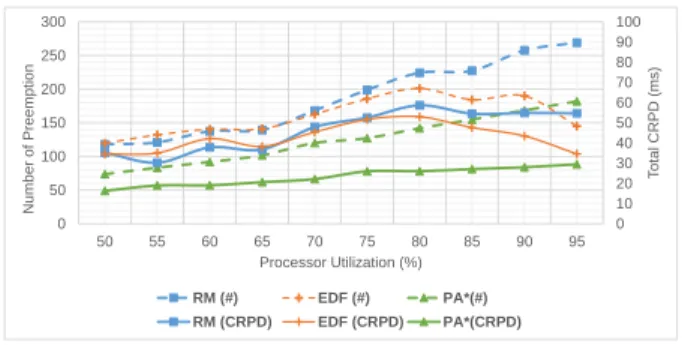
In this experiment, we present CRPD analysis with dif-ferent priority assignments or scheduling algorithms. In ad-dition, we discuss about the impact of changing priority as-signment/scheduling algorithm and increasing PU to CRPD. PU is varied from 0.5 to 0.95 in steps of 0.05. RF is fixed at 0.3. For each value of PU, we performed scheduling sim-ulations with 100 task set and computed the average num-ber of preemptions and average total CRPD in a scheduling interval of 1000 ms. Experiments are conducted with two priority assignment algorithms: Rate Monotonic (RM) and one named PA*, which assigns the highest priority level to the task with the largest set of UCB. In addition, we also take into account Earliest Deadline First (EDF) scheduler.
The result of this experiment is Fig. 2. As the graph illustrates, the number of preemptions and the preemption cost increases steadily from the processor utilization of 50%
0 10 20 30 40 50 60 70 80 90 100 0 50 100 150 200 250 300 50 55 60 65 70 75 80 85 90 95 T o ta l CRPD (m s) N um be r of Pree m pt ion Processor Utilization (%) RM (#) EDF (#) PA*(#) RM (CRPD) EDF (CRPD) PA*(CRPD)
Figure 2: Varying PU, RF=0.3
to 80%. After this point, there is a downward trend in the preemption cost and in the number of preemptions of EDF while there is an upward trend in those data of RM and PA*. Observed from the scheduler, when PU is larger than 80%, many task sets are not schedulable.
In conclusion, first, when PU increases, the total num-ber of preemption and CRPD also increase. However, the change is not linear. Second, a priority assignment algo-rithm with less number of preemption tends to give lower total CRPD. EDF and PA* generate less preemption and CRPD than RM. In fact, to enforce the fixed priority order, the number of preemptions that typically occur under RM is higher than under EDF [6]. From this experiment, we see that CRPD depends on the chosen priority assignment or scheduler.
In addition, this experiment shows that both scheduling analysis and CRPD analysis should be performed jointly. PA*, a priority assignment taking CRPD into account has a significant lower total CRPD. The decrease in total CRPD of PA* with RM and EDF is roughly 30ms on a scheduling interval of 1000ms. However, comparing to RM and DM, feasibility constraints of tasks are not satisfied with PA*, only total CRPD is reduced. In [25], we proposed a priority assignment heuristic to take into account both feasibility constraints and CRPD.
5.2
CRPD with Memory Layout Optimization
by Simulated Annealing
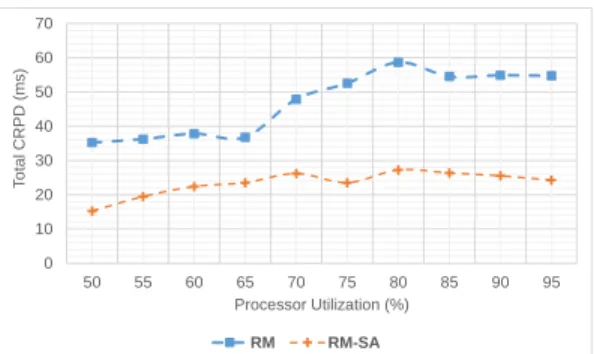
The objective of this experiment is to show that users can use CRPD optimization approaches with our tool. We apply memory layout optimization by simulated annealing (SA) based on the work of [17] with our generated task sets. In our experiment, the objective of SA is to lower the total CRPD after a scheduling simulation over a scheduling interval of 1000 ms.
For each iteration of SA, we perform a swap in memory layout between two random tasks. Changes are made to the layout of tasks in memory, and then mapped to their cache layout for evaluation. The total CRPD is computed by scheduling simulation. The optimum layout is the layout which has the lowest total CRPD. Initial temperature of SA is 1.0, and after every iteration, it is reduced by multiplying it by a cooling rate of 0.5 until it reaches the target tem-perature of 0.2. Number of iteration for each temtem-perature is 10.
The result of this experiment is Fig. 3. From the graph, we can see the impact of memory layout optimization to to-tal CRPD. We can reduce roughly 20-30 ms of toto-tal CRPD. To sum up, this experiment shows that our tool allows users to perform a specific optimization of CRPD.
0 10 20 30 40 50 60 70 50 55 60 65 70 75 80 85 90 95 T o ta l CR P D (m s) Processor Utilization (%) RM RM-SA
Figure 3: Total CRPD with and without memory layout optimization 0 2 4 6 8 10 12 14 16 10 15 20 25 30 35 40 45 50 55 60 65 70 75 80 85 90 95 100 Com p u ta tion T im e ( s) Simulation Interval (x10000)
Average Computation Time Max Computation Time
Figure 4: Computation time of the simulator
5.3
Performance/Scalability Analysis
The objective of this experiment is to test the performance and the scalability of our tool when scheduling simulation interval increases. In general, there are four factors affecting the performance of a scheduling simulator: (1) the number of tasks, (2) the scheduling simulation interval, (3) the cache size and (4) the number of events. The first three factors depend on a chosen RTES. The number of events depends on characteristics of the RTES; for example, a higher processor utilization means a higher number of preemption events. In this experiment, we choose to test a system model of 10 tasks and 256 cache blocks. Processor utilization is set to 70 %. Scheduling simulation is ranging from 100,000 to 1,000,000 units of time where 1 unit = 8µs.
Fig. 4 displays results of our experiment on a PC with Intel Core i5-3360 CPU, running Ubuntu 12.04. For each simulation interval, 100 task sets are generated. We perform scheduling simulation and compute the max and average computation time.
As we can see, while maximum computation time increases slightly when simulation interval increases, average compu-tation time only fluctuates around 6 seconds. This shows that the tool is scalable when simulation interval is high.
6.
RELATED WORKS
In this section, we present several real-time scheduling analysis and WCET analysis tools.
MAST[12] is a modeling and analysis suite for real-time applications. The hardware component abstraction of MAST model is generic and it includes processing resources and shared resources. The shared resource component is not supposed to model a cache memory unit. However, MAST considers the overhead parameters of the components that may be used to model CRPD.
STORM[26] and YARTISS [7] are scheduling simulation
tools mainly designed for evaluating and comparing real-time scheduling algorithm for multiprocessor architectures.
SymTA/S[13] and RealTime-at-Work 1 are model-based scheduling analysis tools targeting automotive industry. The hardware components supported in those tools are specific to their domains (ECU, CAN and AFDX Networks).
To the best of our knowledge, the support for cache mem-ory does not exists in the tools above.
SimSo[8] is a scheduling simulation tool. It supports cache sharing on multi-processor systems. It takes into account impact of the caches through statistical models and also the direct overheads such as context switches and scheduling decisions. The memory behavior of a program is modeled based on Stack Distance Profiles (SDP) - the distribution of the stack distances for all the memory accesses of a task, where a stack distance is by definition the number of unique cache lines accessed between two consecutive accesses to a same line [18]. The difference between SDP and our model is that SDP is achieved by on-line monitored counters such as valgrind [19] while UCB and ECB are achieved by an off-line WCET analysis tools as below. At the moment, there is no archived comparison between the two. UCB analysis with scheduling simulation could be more pessimistic but safer because it takes into account the program point with largest number of UCB.
Several WCET analysis tools allow designers to perform cache analysis. SymTA/P[23], HEPTANE[9], Chronos[16] and aiT2 are examples of them. UCB computation of a program is supported by aiT. The analysis of those tools are based on program path analysis of the control flow graph of the program. It is compliant with the requirement of our proposed tool.
In conclusion, WCET tools focus on the evaluation of pro-gram’s control flow graph to compute the WCET and also a few tools can compute cache access profile. The analysis re-sult could be used as an input for a scheduling analysis tool. In the domain of real-time scheduling analysis, the support for cache and CRPD when performing scheduling analysis is not very well specified. As far as we know, only SimSo clearly supports scheduling simulation with cache analysis based on SDP. Then, we proposed a tool available to the community which can either compute cache access profile of a task from its control flow graph or re-use informa-tion obtained from a WCET/cache analysis tool to perform scheduling analysis. Our model is compliant with existing work in [14], [5], [2] and [17]. In addition, because Cheddar provides a large set of scheduling analysis methods, we can fully investigate the dependency between CRPD and other scheduling parameters in order to either adjust or optimize a RTES design to meet its timing constraints.
7.
CONCLUSIONS
In the article, we presented an approach to implement a cache-aware scheduling simulator. The work was proceeded in the context of the Cheddar real-time scheduling ana-lyzer, which is open-source, freely available to researchers and practitioners that want to investigate scheduling anal-ysis of RTES with cache memory. Our solution consists of three parts: modeling cache memory and cache access pro-file, implementing several cache analysis methods and per-1RealTime-at-Work, http://www.realtimeatwork.com/ 2
forming scheduling simulation. We extended Cheddar to be able to deal with cache memory and illustrated the depen-dency between cache and other scheduling parameters.
There are open problems we are aiming to address in the future. The first one concerns the refinement of other CRPD analysis methods. Several improvements have been proposed in [2] to reduce the upper-bound of the CRPD. In addition, we plan to compare our approach with the ap-proach based on Stack Distance Profile in [8]. Second, we are going to study the problem of feasibility interval of RTES with cache memory.
8.
REFERENCES
[1] S. Altmeyer, R. I. Davis, and C. Maiza. Improved cache related pre-emption delay aware response time analysis for fixed priority pre-emptive systems. Real-Time Systems, 48(5):499–526, 2012.
[2] S. Altmeyer and C. Maiza Burgui`ere. Cache-related preemption delay via useful cache blocks: Survey and redefinition.Journal of Systems Architecture,
57(7):707–719, 2011.
[3] M. Bertogna, O. Xhani, M. Marinoni, F. Esposito, and G. Buttazzo. Optimal selection of preemption points to minimize preemption overhead. InReal-Time Systems (ECRTS), 2011 23rd Euromicro Conference on, pages 217–227. IEEE, 2011.
[4] E. Bini and G. C. Buttazzo. Measuring the performance of schedulability tests.Real-Time Systems, 30(1-2):129–154, 2005.
[5] J. V. Busquets-Mataix, J. J. Serrano, R. Ors, P. Gil, and A. Wellings. Adding instruction cache effect to schedulability analysis of preemptive real-time systems. InProceedings of the2ndIEEE Real-Time
Technology and Applications Symposium (RTAS), pages 204–212, 1996.
[6] G. C. Buttazzo. Rate monotonic vs. edf: judgment day.Real-Time Systems, 29(1):5–26, 2005.
[7] Y. Chandarli, F. Fauberteau, D. Masson, S. Midonnet, M. Qamhieh, et al. Yartiss: A tool to visualize, test, compare and evaluate real-time scheduling algorithms. InProceedings of the 3rd International Workshop on Analysis Tools and Methodologies for Embedded and Real-time Systems, pages 21–26, 2012.
[8] M. Ch´eramy, A.-M. D´eplanche, P.-E. Hladik, et al. Simulation of real-time multiprocessor scheduling with overheads. InInternational Conference on Simulation and Modeling Methodologies, Technologies and Applications (SIMULTECH), 2013.
[9] A. Colin and I. Puaut. Worst-case timing analysis of the rtems real-time operating system.Rapport Nˆa˚Ue, PI1277, IRISA, France, 1999.
[10] L. Cucu and J. Goossens. Feasibility intervals for fixed-priority real-time scheduling on uniform multiprocessors. InIEEE Conference on Emerging Technologies and Factory Automation (ETFA), pages 397–404, 2006.
[11] C. Fotsing, F. Singhoff, A. Plantec, V. Gaudel, S. Rubini, S. Li, H. N. Tran, L. Lemarchand, P. Dissaux, and J. Legrand. Cheddar architecture description language. 2014.
[12] M. Gonz´alez Harbour, J. Guti´errez Garc´ıa, J. Palencia Guti´errez, and J. Drake Moyano. Mast:
Modeling and analysis suite for real time applications. InReal-Time Systems, 13th Euromicro Conference on, 2001., pages 125–134. IEEE, 2001.
[13] R. Henia, A. Hamann, M. Jersak, R. Racu, K. Richter, and R. Ernst. System level performance analysis–the symta/s approach.IEE Proceedings-Computers and Digital Techniques, 152(2):148–166, 2005.
[14] C.-G. Lee, H. Hahn, Y.-M. Seo, S. L. Min, R. Ha, S. Hong, C. Y. Park, M. Lee, and C. S. Kim. Analysis of cache-related preemption delay in fixed-priority preemptive scheduling.IEEE Transactions on Computers, 47(6):700–713, 1998.
[15] C. Li, C. Ding, and K. Shen. Quantifying the cost of context switch. InProceedings of the 2007 workshop on Experimental computer science. ACM, 2007. [16] X. Li, Y. Liang, T. Mitra, and A. Roychoudhury.
Chronos: A timing analyzer for embedded software. Science of Computer Programming, 69(1):56–67, 2007. [17] W. Lunniss, S. Altmeyer, and R. I. Davis. Optimising
task layout to increase schedulability via reduced cache related pre-emption delays. InProceedings of the 20th International Conference on Real-Time and Network Systems, pages 161–170. ACM, 2012. [18] R. L. Mattson, J. Gecsei, D. R. Slutz, and I. L.
Traiger. Evaluation techniques for storage hierarchies. IBM Systems journal, 9(2):78–117, 1970.
[19] N. Nethercote and J. Seward. Valgrind: a framework for heavyweight dynamic binary instrumentation. In ACM Sigplan notices, volume 42, pages 89–100, 2007. [20] A. Plantec and F. Singhoff. Refactoring of an ada 95
library with a meta case tool. InACM SIGAda Ada Letters, volume 26, pages 61–70. ACM, 2006. [21] F. Singhoff, J. Legrand, L. Nana, and L. Marc´e.
Cheddar: a flexible real time scheduling framework. ACM SIGAda Ada Letters, 24(4):1–8, 2004.
[22] J. Staschulat, S. Schliecker, and R. Ernst. Scheduling analysis of real-time systems with precise modeling of cache related preemption delay. InProceedings of the 17th Euromicro Conference on Real-Time Systems (ECRTS), pages 41–48, 2005.
[23] J. Staschulat, S. Schliecker, and R. Ernst. Scheduling analysis of real-time systems with precise modeling of cache related preemption delay. InEuromicro Conference on Real-Time Systems (ECRTS), Palma de Mallorca, Spain, 2005.
[24] H. N. Tran, F. Singhoff, S. Rubini, and J. Boukhobza. Instruction cache in hard real-time systems: modeling and integration in scheduling analysis tools with AADL. InProceedings of the12thIEEE International
Conference on Embedded and Ubiquitous Computing, Milan, Italy, 2014.
[25] H. N. Tran, F. Singhoff, S. Rubini, and J. Boukhobza. Addressing cache related preemption delay in fixed priority assignment. InProceedings of the 20th IEEE International Conference on Emerging Technologies and Factory Automation (ETFA), Luxembourg, 2015. [26] R. Urunuela, A. Deplanche, and Y. Trinquet. Storm, a
simulation tool for real-time multiprocessor scheduling evaluation. InIEEE Conference on Emerging
Technologies and Factory Automation (ETFA), pages 1–8, 2010.