Original Article
Nursing, Pharmacy, and Prescriber Knowledge and
Perceptions of High-Alert Medications in a Large, Academic
Medical Hospital
Melanie J. Engels, PharmD,*,† and Scott L. Ciarkowski, PharmD, MBA*,†
*University of Michigan Health System; †University of Michigan College of Pharmacy, Ann Arbor, Michigan. Corresponding
author: Scott L. Ciarkowski, PharmD, MBA, 1111 E. Catherine, Victor Vaughn 334, Ann Arbor, MI 48109; fax: 734-615-2314; e-mail: [email protected].
ABSTRACT
Background: High-alert medications pose a greater risk of causing significant harm to patients if
used in error. The Joint Commission requires that hospitals define institution-specific high-alert medications and implement processes to ensure safe medication use.
Method: Nursing, pharmacy, and prescribers were asked to voluntarily complete a 34-question
survey to assess their knowledge, experience, and perceptions regarding high-alert medications in an academic hospital.
Results: The majority of respondents identified the organization’s high-alert medications, the
con-sequences of an error involving a high-alert medication, and the reversal agent. Most of the risk-reduction strategies within the institution were viewed as being effective by respondents. Forty-five percent of the respondents utilized a high-alert medication in the previous 24 hours. Only 14.2% had experienced an error with a high-alert medication in the previous 12 months, with 46% being near misses. The survey found the 5 rights for medication administration were not being utilized consistently. Respondents indicated that work experience or hospital orientation is the preferred learning experience for high-alert medications.
Conclusions: This study assessed all disciplines involved in the medication use process. Perceptions
about high-alert medications differ between disciplines. Ongoing discipline-specific education is required to ensure that individuals accept accountability in the medication use process and to close knowledge gaps on high-alert medications and risk-reduction strategies.
Key Words—high-alert medications, nursing, pharmacy, prescribers Hosp Pharm—2015;50:287–295
I
t is estimated that a hospitalized patient is exposed to 1 medication error daily.1 In addition, a lowestimation of 450,000 medication errors result in harm annually to patients in the United States, with approximately 25% of these errors considered pre-ventable.1,2 According to the Institute of Medicine,
7,000 deaths each year are attributed to preventable medication errors.3 The definition of a high-alert
medication is a “medication that bears a heightened risk of causing significant patient harm when used
in error.” This does not imply that errors occur more often with high-alert medications than other medica-tions but rather, when an error does occur, the con-sequences can be severe and even fatal.4 In the mid
1990s, the Institute for Safe Medication Practices (ISMP) examined the drugs that were most likely to cause harm to patients. The results of this study revealed that medication errors resulting in death or serious harm involved only a small number of medi-cations, and this served as the foundation for ISMP’s
list of high-alert medications. The top 5 high-alert medications included insulin, opiates and narcotics, injectable potassium chloride or phosphate concen-trate, intravenous anticoagulants, and concentrated sodium chloride.4
In 2003, ISMP conducted a survey on high-alert medications to assess the differences between nursing and pharmacy perspectives. The majority of respondents agreed on which medications were con-sidered high alert. ISMP repeated the survey in 2007 and 2012. In all 3 surveys, nurses generally identified medications as high alert more often than pharma-cists. In addition, the surveys revealed that there were differences between drugs that participants viewed as high-alert medications and the categorization of these medications as high-alert medications at practice sites. The survey results were used to update ISMP’s list of high-alert medications. In 2014, ISMP’s list of high-alert medications listed 22 classes or categories of medications and 10 specific medications.5 ISMP
urged organizations to discuss internally high-alert medications, to focus on the varying perspectives between professions, and to evaluate gaps in practice site adoption compared to medications employees perceived to be high-alert medications.4
The Joint Commission requires that hospitals have their own list of high-alert medications and a process in place for managing high-alert medications to ensure that patients receive the correct drug and dose, at the appropriate time and route.6 The
Univer-sity of Michigan Health System (UMHS) has a high-alert medications policy that is designed to identify medications that are deemed high-risk by the hospi-tal and steps that need to be taken by health care providers to ensure patient safety when using these medications.
Safeguards have been implemented to control access and potential patient errors, which are also included in the policy and are referred to as risk-reduction strategies. The high-alert medication pol-icy was revised in December 2012 to add parenteral prostacyclins as a high-alert medication due to insti-tution-specific medication errors observed with the ordering, dispensing, and administration of this class of medications.
The UMHS recently evaluated its high-alert med-ication policy along with its risk-reduction strategies. Staff knowledge regarding high-alert medications has not been formally assessed. Following ISMP’s lead, this study will assess the awareness, knowledge, and perceptions of high-alert medications among health care providers at an academic medical center. Previous
ISMP studies have evaluated nursing and pharmacy perspectives; this study will evaluate the prescriber perspective (nurse practitioners, physician assistants, attending physicians, and resident physicians). METHODS
This study was conducted using a survey ques-tionnaire created through Qualtrics. The survey consisted of 34 questions designed to assess demo-graphics and knowledge, experience, and perceptions regarding high-alert medications (eAppendix). The survey was disseminated to prescribers, pharmacy, and nursing throughout UMHS via e-mail commu-nication in order to assess differences across profes-sions. The survey remained open for a period of 2 months between May and July 2013. A reminder e-mail was sent out 2 weeks prior to the close of the survey. To encourage participation, a drawing for one of two $50 iTunesgift cards was available for respon-dents to voluntarily enter after completion of the sur-vey. This survey was deemed exempt by the UMHS Investigational Review Board.
Once the survey closed, the data were analyzed. Participants who did not complete the survey and survey participants who did not fall into 1 of the 3 categories (prescribers, pharmacy, nursing) were excluded from data analysis. Descriptive statistics were used to report the results of the survey: demo-graphics (questions 3-5, 7, 9), knowledge (questions 10-17, 21), experience (questions 19-20, 23-24), and perceptions (questions 18, 28, 30-43). A random number generator was used to select the 2 winners of the iTunes gift cards.
RESULTS
Overall, 1,064 individuals started the survey, but only 786 participants completed the survey. Informa-tion shared is representative of completed surveys. Eight surveys were completed by individuals in pro-fessions outside of nursing, prescribers, and pharmacy and were not included in the results. Table 1 illustrates demographic information regarding the survey par-ticipants’ work experience. Approximately 3.8% of prescribers at UMHS responded, along with 11.9% of nursing and 42.6% of pharmacy. At the time of the survey, there were 3,919 nurses, 319 pharmacy per-sonnel, and 4,656 prescribers at UMHS. Of the sur-vey participants, the majority worked 1 to 5 years or more than 20 years, with approximately half having worked previously at another hospital.
Survey participants were able to correctly define a high-alert medication as a medication that bears
risk of harm when in error (98%), and they also iden-tified the high-alert medications on the organization’s list as being such (Table 2). However, the majority of participants identified intravenous (IV) sedation agents (53.5%), IV antiarrhythmics (51.4%), anes-thetic agents (65.4%), and IV adrenergic agents (61.3%) as high-alert medications, but they do not appear on the organization’s high-alert medication list. Participants were able to identify the correct con-sequence when presented with a scenario regarding an overdose or error with a high-alert medication. The same was true regarding matching the correct rescue medication to the high-alert medication; how-ever only 74.3% identified cardiovascular collapse as the result of prostacyclins, only 74.3% matched neo-stigmine with neuromuscular blocking agents, and 69.2% matched filgrastim with chemotherapy agents.
Table 3 shows the medications from which
partici-pants were to choose when selecting the medications
they believed should be added to the organization’s high-alert medication list. Anesthetic agents were the highest ranked medications on the list, with 44% of participants indicating that these agents have the potential to cause significant harm.
Of the errors involving high-alert medications that survey respondents had experienced, 46 (46%) were near misses that did not reach the patient, 32 (32.3%) reached the patient but resulted in no harm, 12 (12%) resulted in no harm but required monitoring, 6 (6.1%) resulted in temporary harm, 1 (1%) resulted in permanent harm, and 2 (2%) resulted in death. Figure 1 illustrates where the error occurred in the medication use process, with admin-istration receiving the highest number of selections (39 [29.1%]).
When respondents were asked where they were first educated on high-alert medications, 225 (29.3%) reported work experience on the job, 215 (28%)
Table 1. Demographics of survey respondents illustrating work experience (N = 778)
Demographics Composite N (%) Nursing n (%) Pharmacy n (%) Prescribers n (%) Respondents 778 (100) 465 (59.8) 136 (17.5) 177 (22.7)
Years worked in the profession
<1 year 63 (8.1) 25 (5.4) 8 (5.9) 30 (16.9) 1–5 years 245 (31.5) 129 (27.7) 34 (25) 82 (46.3) 6–10 years 106 (13.6) 66 (14.2) 20 (14.7) 20 (11.3) 11–15 years 66 (8.5) 47 (10.1) 8 (5.9) 11 (6.2) 16–20 years 62 (8) 39 (8.4) 8 (5.9) 15 (8.5) >20 years 197 (25.3) 157 (33.8) 25 (18.4) 15 (8.5)
Hospitals where previously employed for
more than 1 year 376 (48.3) 242 (52) 52 (38.2) 76 (42.9)
1 172 (22.1) 114 (24.5) 28 (20.6) 30 (16.9)
2 106 (13.6) 69 (14.8) 13 (9.6) 24 (13.6)
3 50 (6.4) 35 (7.5) 6 (4.4) 9 (5.1)
4 24 (3.1) 14 (3) 4 (2.9) 6 (3.4)
> 5 18 (2.3) 10 (2.2) 1 (0.7) 7 (4)
Years of employment at the study hospital
<1 year 112 (14.4) 43 (9.2) 36 (26.5) 33 (18.6) 1–5 years 290 (37.3) 156 (33.5) 50 (36.8) 84 (47.5) 6–10 years 143 (18.4) 90 (19.4) 26 (19.1) 27 (15.3) 11–15 years 75 (9.6) 55 (11.8) 10 (7.4) 10 (5.6) 16–20 years 45 (5.8) 33 (7.1) 4 (2.9) 8 (4.5) >20 years 108 (13.9) 85 (18.3) 10 (7.4) 13 (7.3)
Table 2. Percentage of survey respondents indicating knowledge of high-alert medications at UMHS (N = 778)
Defined high-alert medication at study
hospital Composite(N = 778) n (%) Nursing (n = 465) n (%) Pharmacy (n = 136) n (%) Prescribers (n = 177) n (%) Concentrated electrolytes 679 (87.3) 410 (88.2) 124 (91.2) 145 (81.9) Chemotherapy agents 647 (83.2) 397 (85.4) 118 (86.8) 132 (74.6) Insulin 640 (82.3) 403 (86.7) 121 (89) 116 (65.5) Neuromuscular agents 626 (80.5) 368 (79.1) 115 (84.6) 142 (80.2) Anticoagulants 608 (78.1) 373 (80.2) 103 (75.7) 132 (74.6) Intrathecal agents 559 (71.9) 331 (71.2) 100 (73.5) 128 (72.3) Opiates (IV) 537 (69) 330 (71) 96 (70.6) 111 (62.7) Anesthetic agents 509 (65.4) 334 (71.8) 62 (45.6) 113 (63.8) Epidural opiates 495 (63.6) 313 (67.3) 85 (62.5) 97 (54.8)
Adrenergic agents (IV) 477 (61.3) 295 (63.4) 53 (39) 129 (72.9)
Sedation agents (IV) 416 (53.5) 269 (57.8) 52 (38.2) 95 (53.7)
Parenteral prostacyclins 409 (52.6) 247 (53.1) 78 (57.4) 84 (47.5)
Antiarrhythmics (IV) 400 (51.4) 274 (58.9) 35 (25.7) 91 (51.4)
Inotropic agents (IV) 354 (45.5) 242 (52) 27 (19.8) 85 (48)
Nitroprusside injection 347 (44.6) 226 (48.6) 31 (22.8) 90 (50.8)
Magnesium sulfate injection 313 (40.2) 232 (49.9) 33 (24.3) 48 (27.1)
Opiates (oral) 286 (36.8) 192 (41.3) 41 (30.1) 53 (29.9)
Adrenergic antagonists (IV) 278 (35.7) 206 (44.3) 18 (13.2) 54 (30.5)
Oxytocin (IV) 274 (35.2) 210 (45.2) 19 (14) 45 (25.4)
Dialysis solutions 254 (32.6) 170 (36.6) 26 (19.1) 58 (32.8)
Promethazine (IV) 214 (27.5) 156 (33.6) 20 (14.7) 38 (21.5)
Note: The shaded cells represent medications on the organization’s high-alert medication list. IV = intravenous.
Table 3. Survey respondents indicating specific medications that should be added to the UMHS high-alert medication list (N = 1,296)a Medication Composite(N = 1,296) n (%) Nursing (n = 864) n (%) Pharmacy (n = 192) n (%) Prescribers (n = 236) n (%)
Anesthetic agents (propofol, ketamine) 412 (31.8) 271 (31.4) 58 (30) 82 (35)
Vasoactives (epinephrine, phenylephrine,
norephinephrine, vasopressin) 356 (27.5) 233 (27) 44 (22.9) 78 (33)
Oxytocin in obstetrics 134 (10.3) 102 (11.8) 10 (5.2) 21 (8.9)
Magnesium sulfate in obstetrics 128 (9.9) 99 (11.5) 14 (7.3) 14 (5.9)
Dialysis solutions (peritoneal, hemodialysis) 120 (9.3) 82 (9.5) 19 (9.9) 19 (8)
Parenteral solutions (TPN) 88 (6.8) 54 (6.3) 21 (11) 13 (5.5)
Sterile water 58 (4.5) 23 (2.7) 26 (13.5) 9 (3.8)
reported during the didactic portion of school, and 145 (18.9%) reported during their clinical/experi-mental portion of school. According to respondents, the most effective method for education on high-alert medications at UMHS was from work experience (242 [31.6%]) followed by at hospital orientation (146 [19.1%]) and at unit meeting/education (104 [13.6%]). Of note, 259 individuals (25%) reported that medica-tion safety, specifically high-alert medicamedica-tions, was not part of their didactic or clinical curriculum.
The 5 rights of medication administration — right patient, right drug, right dose, right route, and right time — are a component of safe medication administration practices. ISMP has highlighted that the 5 rights of medication administration are a goal of safe medication practices and cannot be relied upon as the sole safety guard in the medication use process.7 When evaluating the practice of the 5 rights
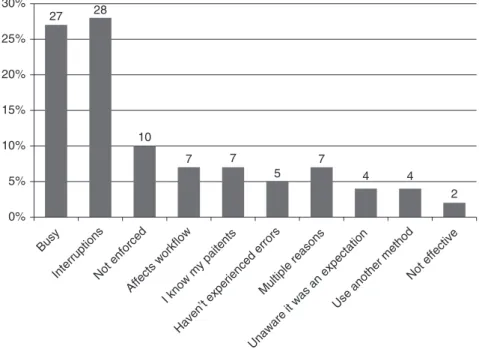
of medication administration at UMHS, 32.7% of participants responded that it has become so routine they no longer are conscious of each step, 27% stated that the 5 rights were not completed because of being busy, and 27.7% stated that the 5 rights were not completed because of interruptions (Figure 2). Four-teen prescribers provided a text response indicat-ing that they were not familiar with the 5 rights. Of the individuals completing the survey, 204 (36.9%) reported being involved with 2 to 5 independent double checks or verifications a week, followed by 146 (26.4%) who were involved with more than 10. During the last week while performing indepen-dent double checks or verifications, 378 (81.3%) of respondents reported that zero errors were found while 18.7% of participants indicated that they had identified at least 1 error with independent double checks or verifications within the last week. Figure 2
29 21 20 18 6 4 1 0% 5% 10% 15% 20% 25% 30% 35%
AdministrationDispensing Preparing
Ordering Storage
ProcurementMonitoring
Figure 1. Type of error involving high-alert medications as reported by survey respondents (N = 133).
27 28 10 7 7 5 7 4 4 2 0% 5% Busy InterruptionsNot enforced Affects workflow I know my paitents Haven’t experienced errors
Multiple reasons Unaware it was an expectation
Use another method Not effective 10% 15% 20% 25% 30%
Figure 2. Percentage of survey respondents indicating reasons why the 5 rights of medication administration are not utilized (N = 1,337).
illustrates the reasons why the 5 rights are not uti-lized, according to participants. The last question of the survey asked participants what was an acceptable risk for error involving a high-alert medication for a patient, knowing that in order to lower the risk, more risk-reduction strategies would be implemented and impact workflow. The majority of the respondents responded that 1:1 million risk of an error with a high-alert medication is acceptable (Figure 3).
DiSCUSSiOn
The survey results identified that a larger per-centage of participants failed to receive education on high-alert medications during didactic or clini-cal schooling. An equal number of participants who were educated on high-alert medications in school reported to have first been educated on high-alert medications with on-the-job training; we believe this is too late to first be learning about high-alert medications. A number of participants reported that they had never been educated on high-alert medica-tions. In fact, 25% of respondents said their didactic or clinical courses did not have high-alert medica-tions as part of their curriculum. Thirty-two percent of respondents thought the job is the most effective arena in which to learn about high-alert medica-tions. We believe that the workplace is where educa-tion about institueduca-tion-specific high-alert medicaeduca-tions and safeguards needs to be reinforced rather than being first introduced. Of note, pharmacy and nurs-ing employees at UMHS are educated on the institu-tion’s high-alert medications list during orientation, whereas prescribers are not.
Studies support that lack of education and knowledge deficiency on high-alert medications con-tribute to medication errors and patient harm.8-10
Moreover, Phillips and colleagues determined that human factors of performance deficit and knowledge deficit were the most common causes of errors when reviewing 469 fatal errors reported to the US Food and Drug Administration (FDA) between 1993 and 1998.11 In an attempt to address this knowledge
defi-ciency, patient safety education is now required by the accreditation bodies for graduate medical, nurs-ing, and pharmacy in doctoral and residency experi-ences to prevent medical errors.12
Our survey results reflect higher nursing and pharmacy participation when compared to prescrib-ers. This was not surprising for a few reasons: lim-ited knowledge and involvement of prescribers in the administration, dispensing, and storage of the medi-cation use process; prescribers’ perceptions that they do not administer high-alert medications and often lack or have limited safety measures for the medi-cation administration in the medimedi-cation use process; and challenges encountered in distributing the sur-vey to prescribers within the study institution. How-ever, several high-alert medications are administered by prescribers to patients (intrathecal chemotherapy, heparin, neuromuscular blocking agents, and opiates in the operating room and procedure areas). Fur-thermore, there are many instances where prescrib-ers assume the sole role of prescribing, dispensing, administering, and monitoring medications without the aid and expertise of other health care providers. The inclusion of prescribers is important, as they are
6 4 9 13 22 46 0% 5% 10% 15% 20% 25% 30% 35% 40% 45% 50% 1 in 10 1 in 100 1 in 1,000 1 in 10,000 100,0001 in 1,000,0001 in
Figure 3. Percentage of survey respondents identifying an accept-able risk ratio for errors involving high-alert medications (N = 721).
part of a multidisciplinary approach to the medica-tion use process and safe use of medicamedica-tions. The ISMP high-alert medication surveys in 2003, 2007, and 2012 did not list prescribers as respondents.4
Moreover, the number of participants in this study (N = 778) is similar to rates of respondents in the national ISMP surveys (2003 [N = 350], 2007 [N = 770]), and 2012 [N = 772]), yet this study was representative of only one institution. Sullivan and colleagues conducted a similar study and utilized a 6-question survey to assess the knowledge of high-alert medications in health care professionals at a small, urban teaching institution. Interventions to increase staff knowledge of high-alert medications included labeling of high-alert infusions and phar-macy storage shelves and utilizing computer tech-nology to provide notification to pharmacists upon medication selection and nursing on medication labels and medication administration work lists. A follow-up survey found that staff knowledge on high-alert medications increased from 57.1% to 92.1% to 70.0% to 97.6%; there was an increase of 30% in the confidence of high-alert medication policies.13
Risk-reduction strategies, barcode medication administration (BCMA), computerized physician order entry (CPOE), and forcing functions failed to resonate with the majority of respondents as effective risk-reduction strategies. These strategies are focused on the systemwide elements that utilize technology as compared to an independent double check or time-out, which relies more on human capabilities that are prone to error. However, the lower ranking by respondents may reflect their lack of knowledge on the effectiveness of the specific strategies, concerns with limiting clinical decision making, and concerns about the impact of these strategies on workflow. The findings from this study indicate that further educa-tion is needed regarding effectiveness of risk-reduc-tion strategies in improving patient safety and their impact on areas of practice.
The 5 rights of medication administration are not being performed, because the tasks have become rou-tine. An observational study on a chemotherapy unit found that nurses were interrupted 22% of the time, often during critical functions such as drug prepara-tion, verificaprepara-tion, and administration.14 Respondents
stated that the 5 rights were not utilized because they viewed them as not effective or not enforced, they were unaware that they are supposed to do them, the rights did not fit into workflow or slowed work-flow, they had not experienced an error, or they knew
their patients and did not need to do them. In addi-tion, several prescribers indicated that they did not even know what the 5 rights were. The 5 rights are controversial when an organization utilizes them in isolation as the sole means of preventing errors and shared accountability is not taken. However, the 5 rights are the foundation in medication safety along with several strategies identified to prevent errors. Macdonald suggests that the 5 rights have limita-tions and that collaborative patient-centered care is required to ensure the correct medication use for patients by nursing, pharmacy and prescribers.15
Additionally, the 5 rights have been suggested to include the right documentation, right action, right form, and right response, making them the 9 rights.16
ISMP has stated that adding more rights is not worth-while unless human factors and system weaknesses are addressed.3 Although the 5 rights or process of
verifying the correction information for medication administration has limitations, administering medi-cations to patients without correctly identifying the intended patient, reviewing the medication order and/or medication administration record, and ensur-ing the intended medication is beensur-ing administered for the intended time, dosage, and route is an at-risk behavior that leads to potential errors.
Limitations
This study reflects the views of staff from one large academic medical center and may not repre-sent the views of other institutions. UMHS’s list of high-alert medications is dynamic and specific for the institution’s needs. The survey results may have been influenced by a desirability bias because of the oppor-tunity to win an iTunes gift card. In addition, commu-nication of the survey relied on health care leadership (eg, nursing, house officer, and attending leadership) to forward the survey via e-mail. We were unable to measure how many health care professionals received an invitation to participate. A low participation from prescribers may be due to their perception that the survey would not be applicable to them because they do not administer or dispense medications. Respon-dent selection bias may have occurred with high per-formers or those who have a personal/professional association with the authors completing the survey. A high response rate from anesthesia providers was noted due to the endorsement of the survey and for-warding of the survey from the anesthesiology qual-ity assurance personnel. Misinterpretation of the questions and possible answers may have affected
knowledge-based questions. The length of the sur-vey and participants’ lack of knowledge of the high-alert medications may have contributed to the partial completion of the survey by 278 individuals.
Future Directions
This study has led to improvements in several areas at our institution. Within a 1-year period, UMHS will implement costly high leverage risk-reduction strate-gies: smart infusion pumps, electronic health record, a new CPOE system, and BCMA. These strategies will force more consistent behavior in many areas and will introduce new obstacles and work-arounds with the new workflow. At UMHS, training of health care providers on high-alert medications will follow a mul-tinodal approach, as survey respondents suggested that delivery of education should be provided in many forms to ensure messages are conveyed. Introduction of mandatory training (discipline specific) and use of case-based learning will be explored. In addition, a revi-sion to our high-alert medication policy and list will utilize a mnemonic to help individuals remember high-alert medications. Further research is needed to evalu-ate how members of the multidisciplinary team interact when utilizing high-alert medications and how those behaviors affect the workflows associated with high-alert medications.
COnCLUSiOnS
Errors involving high-alert medications can cause significant patient harm. Exposure to high-alert medi-cations on a daily basis can lead to complacency, and thus effective strategies for safely using high-alert medi-cations are required. A list of high-alert medimedi-cations is required by The Joint Commission for each institution along with effective risk-reduction strategies to mitigate possible errors. Our study identified knowledge gaps regarding high-alert medications. Other institutions should consider taking the following actions:
• Review your organization’s high-alert medications as per ISMP recommendations. Consider adding or deleting high-alert medications based on your institution’s data (eg, adverse drug events, lack of safety guards). Resist adding medications to your high-alert list without risk-reduction strategies. • Review risk-reduction strategies for your specific
high-alert medications and test them to ensure that the strategies are functioning as intended and not creating unanticipated events.
• Review the training on high-alert medications for your institution and consider revising your policy
and education materials to allow individuals to have a high reliability for identifying high-alert medications (eg, mnemonic).
• Consider developing discipline-specific training on high-alert medications with representatives from respective disciplines (eg, nursing, phar-macy, and prescribers) to ensure you are creating a message that will be heard. Of note, the mes-sage needs to be concise and value-added to the intended audience and instill accountability for the medication use process, as their background and exposure to different workflows are likely limited.
• Follow-up to determine whether the educational efforts are effective in improving employee knowl-edge regarding high-alert medications.
ACKnOWLEDGMEnT
The authors have declared no potential conflicts of interest.
REFEREnCES
1. Aspden P, Wolcott J, Bootman J, Cronenwett LR.
Prevent-ing Medication Errors. WashPrevent-ington, DC: National Academies
Press; 2007.
2. Bates DW, Cullen DJ, Laird N, et al. Incidence of adverse drug events and potential adverse events. Implications for pre-vention. JAMA. 1995;274:29-34.
3. Institute of Medicine. To Err Is Human: Building a Safer
Health System. Washington, DC: National Academies Press;
1999.
4. Institute for Safe Medication Practices. Results of ISMP survey on high-alert medications. ISMP Medication Safety
Alert. 2012;17(3):1-4.
5. ISMP list of high-alert medications. http://www.ismp.org/ tools/highalertmedications.pdf. Accessed April 8, 2014. 6. “High-alert” medications and patient safety. Int J Qual
Health Care. 2001;13(4):339-340.
7. Institute for Safe Medication Practices. The five rights: A destination without a map. ISMP Medication Safety Alert. 2007;12(2):1.
8. Lo TF, Yu S, Chen IJ, Wang KW, Tang FI. Faculties’ and nurses’ perspectives regarding knowledge of high-alert medi-cations. Nurse Educ Today. 2013;33(3):214-221.
9. Hsaio GY, I-Ju C, Yu S, et al. Nurses’ knowledge of high-alert medications: Instrument in development and validation.
J Adv Nurs. 2010;66(1):177-190.
10. Simonsen BO, Johansson I, Daehlin GK, et al. Medication knowledge, certainty, and risk of errors in health care: A cross-sectional study. BMC Heath Serv Res. 2011;11:175.
11. Phillips J. Retrospective analysis of mortalities asso-ciated with medication errors. Am J Health Syst Pharm. 2001;58:1835-1841.
12. Buhrow SM, Buhrow JA. Integrating patient safety in the OMFS curriculum: Survey of 4-year residency programs [pub-lished online ahead of print March 10, 2014]. J Patient Saf. doi: 10.1097/PTS.0000000000000094
13. Sullivan KM, Le PL, Ditoro MJ, Andree JT, et al. Enhancing high alert medication knowledge among phar-macy, nursing, and medical staff [published online ahead
of print September 3, 2013]. J Patient Saf. doi: 10.1097/ PTS.0b013e3182878113
14. Trbovich P, Prakash V, Stewart J, Trip K, Savage P. Inter-ruptions during the delivery of high-risk medications. J Nurs
Admin. 2010;40(5):211-218.
15. Macdonald M. Patient safety: Examining the adequacy of the 5 rights of medication administration. Clin Nurse Spec. 2010;24(4):196-201.
16. Elliott M, Liu Y. The nine rights of medication adminis-tration: An overview. Br J Nurs. 2010;19(5):300-305.