PLEASE SCROLL DOWN FOR ARTICLE
This article was downloaded by: [TIB-Lizenzen - TIB Licence Affairs] On: 18 August 2008
Access details: Access Details: [subscription number 777306420] Publisher Taylor & Francis
Informa Ltd Registered in England and Wales Registered Number: 1072954 Registered office: Mortimer House, 37-41 Mortimer Street, London W1T 3JH, UK
Ferroelectrics
Publication details, including instructions for authors and subscription information:
http://www.informaworld.com/smpp/title~content=t713617887
The electroporation hysteresis Eberhard Neumann a
a Faculty of Chemistry, Department of Physical and Biophysical Chemistry, University of Bielefeld, Bielefeld,
F.R. Germany
Online Publication Date: 01 October 1988
To cite this Article Neumann, Eberhard(1988)'The electroporation hysteresis',Ferroelectrics,86:1,325 — 333 To link to this Article: DOI: 10.1080/00150198808227023
URL: http://dx.doi.org/10.1080/00150198808227023
Full terms and conditions of use: http://www.informaworld.com/terms-and-conditions-of-access.pdf
This article may be used for research, teaching and private study purposes. Any substantial or systematic reproduction, re-distribution, re-selling, loan or sub-licensing, systematic supply or distribution in any form to anyone is expressly forbidden.
The publisher does not give any warranty express or implied or make any representation that the contents will be complete or accurate or up to date. The accuracy of any instructions, formulae and drug doses should be independently verified with primary sources. The publisher shall not be liable for any loss, actions, claims, proceedings, demand or costs or damages whatsoever or howsoever caused arising directly or indirectly in connection with or arising out of the use of this material.
Ferroelectrics, 1988, Vol. 86, pp. 325-333
Reprints available directly from the publisher Photocopying permitted by license only
Printed in the United States of America
THE ELECTROPORATION HYSTERESIS
EBERHARD NEUMANNFaculty of Chemistry, Department of Physical and Biophysical Chemistry, University of Bielefeld, P. 0. Box 8640, 0-4800 Bielefeld 1, F. R . Germany
(Received 25 July 1988)
Electroporation and electrofusion have developed to powerful methods in cell biology and gene technology. However, the molecular mechanisms of the electroporative gene transfer and of the eiectric membrane fusion are still not known. Electroporation renders the membrane transiently porous and at the same time fusiogenic. In the present digression electroporation is discussed in terms of structural rearrangements in the membrane. The onset of electric pore formation is viewed as a critical phenomenon. In order to cover the reversible as well as the irreversible processes of electroporation and electrofusion, the concept of the relaxation hysteresis of membrane electropora- tion is introduced.
1. INTRODUCTION
In physical chemistry and biophysics electric field methods have traditionally been applied to probe the ionic-electric properties and reactivities of molecules and molecular organizations such as biological membranes. 1,2 Nowadays electric field pulse techniques also gain increasing importance in cellular and molecular biology, in gene technology and in medicine. In particular, the methods of electr~poration~ and electrof~sion"~ have developed to powerful tools for cell manipulations (for reviews see references%") and for the physical chemical study of electrically induced structural rearrangements in membranes.'
Until now there is only indirect evidence that the applied electric pulses cause structural reorganizations in the cell membranes; for early reference see Sale and Hamilton," Neumann and Rosenheck,l2 Lindner et al. l3 Although there are a couple of model approaches toward theories for electropermeabilization and e l e c t r o f u ~ i o n ~ ~ ~ ~ ~ " - ' ~ it is fair to say that the detailed mechanisms of field-induced restructuring of membranes in electroporation and electrofusion processes are not known. In addition, in this new field there is still a need to classify the observations in terms of physical concepts and to estabilish an unequivocal terminology based on physical chemical principles. In the present account, electroporation and electrofusion are discussed in terms of field-induced structu- ral rearrangements in the membranes. In particular, electroporation is viewed as a critical phenomenon and the concept of the relaxation hysteresis is introduced to elucidate the reversible and the irreversible aspects of electroporation and electrofusion.
2. THRESHOLD AND STRENGTH-DURATION PARAMETERS
There are several experimental parallels between electroporation and electrofu- sion. Both field effect phenomena show threshold behavior. For a given cell the
325
326 EBERHARD NEUMANN
numerical values of the threshold field strenghts E, are (almost) the same and depend inversely on the cell diameter. No doubt, both cell fusion and electropo- rative material exchange are clearly induced by the external field pulse. But, because of the longevity of the field-induced structural changes, the actual fusion events and the main part of the material exchange are, by and large, after-field effects .3,13,s25
In summary the data suggest that it is one and the same primary field effect on the membrane structure: leading to cell fusion if cell membranes are brought into contact before or after pulsing:3 or causing DNA uptake if the DNA is adsorbed to the cell surface before (or after) pulsing.
Threshold Parameters
The threshold field strength E, for electroporation (electropermeabilization and electrofusion) is a kind of “point of no return”.’* If the electric field E ( z E c ) is maintained, the electropores induced by the supercritical field increase in number and size14.1521 until, at a supercritical number density and pore size, the membrane ruptures (dielectric breakdown). If electric pulses of short duration At are applied, the field is already switched off before rupture can occur and the previous low-permeability state is apparently restored completely.
It is therefore pertinent to view membrane electroporation as a critical phenomenon, characterized by critical values for the extent
Ec
of structural rearrangement, for the field strength E, and for the pulse duration At,. In our structural model the primary requirement for the onset of electroporation is that the thresholdE,
has to be reached; see Figure 1. In this context the subcritical0
FIGURE 1 Electroporation viewed as a critical membrane phenomenon associated with critical values for the field strength Ec, the pulse duration Atc and the degree of structural rearrangement
Ec.
(a) electroporation starts when the threshold 5, is attained; the minimum field strength to reachEc
is E,. At E 2 E, the electroporation process is unidirectional, i.e. irreversible, until the rupture thresholdE,
is reached where the membrane breaks down irreversibly. If however, the field is switched off before 5, is attained, the electroporated membrane reseals (reversible electroporation cycle). (b) The critical pulse duration Atc to trigger the electroporation process atEc
is the smaller the larger the field strength E(>E,). The reversible electroporation cycle requires that the pulse length At is smaller than the rupture time Atr. The changes of E from &, toEc
represent reversible subcritical rearrangements such as, e.g., the increase of size and number of hydrophobic defect sites.p
5,
- - - - ,
F-
FIGURE 2 Strength/duration (Elat,) relationship for the onset of the electroporation urocess at
6
=Ec.
The criticacpulse length At, is-the smaller the larger the field strength: Atc(E,) < Atc(E2), ifEl > E,.
changes from lj,, to lj, represent reversible structural rearrangements such as e.g., the increase in number and size of hydrophobic defect sites and micropores in the bilayer. The minimum field strength to attain the critical value lj, is the critical field E,. Once the threshold lj, is reached ( E Z E , ) the actual electroporation starts and proceeds unidirectionally (no return) until the rupture threshold lj, is attained where the membrane disintegrates. If the field is reduced below E, or switched off before
5,
is reached, the electropores or electrocracks” reseal or anneal such that the original membrane state appears to be completely restored (reversible electroporation). l8Strength-Duration Relationship
Similar to other electric membrane phenomena such as nerve excitation, the onset of electroporation is associated with a strength-duration relationship. Since the threshold lj, is atained faster at a higher field strength (Figure l) , the minimum pulse duration At, that is required for the onset of the electroporation process is the smaller the larger the applied external field (Figure 2).
If indeed the value E, decreases with the independently choosen pulse length At,26 this feature may result from the stochastic nature of electropore formation.18322 The larger At the larger is the probability of nucleation of the electropores at a smaller field strength.
The organization of biological membranes is highly complex: uneven surface distribution and uneven membrane thickness; structural coupling to external matrix and to intracellular cytoskeletal elements. It is therefore not possible to exactly calculate the strength-duration parameter set E,lAt, from first principles.
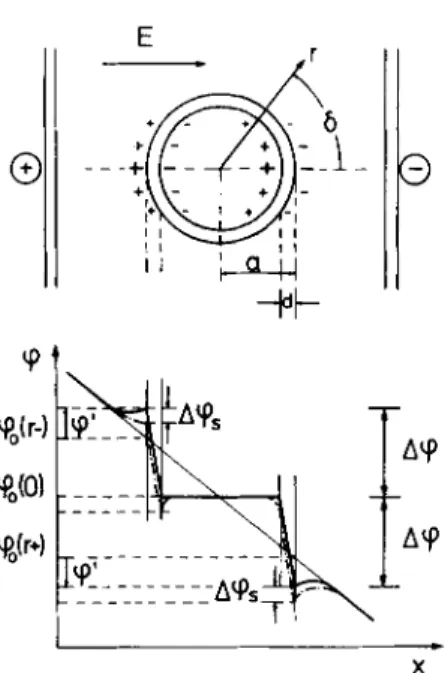
The usual expression given for E, in terms of the cell radius a and the critical transmembrane voltage (V,,,) is only an approximation. The approximation for the maximum value at the pole cap regions (where cos 6 = +1, -1, respectively; see also Figure 3 ) is given by
328 EBERHARD NEUMANN
E
I
I
-
X
FIGURE 3 Interfacial polarization of a spherical nonconducting shell of thickness d and outer radius
r = a in a constant external field E. The stationary electric potentials are given in polar coordinates of the radius vector r and the angle 6, such that the conducting interior of the cell has the constant reference potential qo = 0 for 0 S r 5 (a-d). For r > a , q0 = -E
-
r = - E . r cos 6. The total potential q ( r ) , relative to qo(0) = 0, is given by q ( r , 6) = qo(r, 6)+
q ’ ( r ,a),
where q ‘ ( r , 6) is the contribution of the interfacial polarization. The A q terms are the interfacially induced, cross- membrane potential differences in the absence of fixed ionic groups and adsorbed ions, ( A q s = 0). The dash/point line models schematically the potential profile in the presence of fixed surface charges (here negative).Equation (1) is practically very useful, even for the estimate of the threshold of the initial field strength of exponentially decaying pulses (CD-pulses); Vm,= = 0.5 to 1 V for short duration pulses (At = 10 ,us) and Vm,= = 0.2-0.5 V for longer pulse duration (Ar z 0.1 ms).
3. FIELD AMPLIFICATION BY INTERFACIAL POLARIZATION
The magnitude of the applied field strength and the dependence of the threshold E, on the cell radius indicate that the field effect on the membrane structure is indirect. The data suggest that interfacial polarization precedes the structural transitions.
The actual membrane field affecting the lipids and proteins is strongly amplified by the interfacial p ~ l a r i z a t i o n . ~ ~ . ~ ~ The time constant (z,) of the build-up of the interfacial polarization A q is dependent on a and the conductivities (A) of the cell interior, the cell membrane and of the external medium.” In brief, the electroporation and electrofusion data indicate the sequence of events:28
E + A q + A g (2)
329
t
E
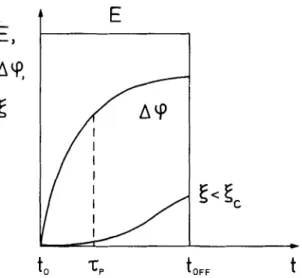
FIGURE 4 Amplified field effect. The external field pulse (E, At) causes the interfacial potential difference Arp. The electric field, equivalent to Arp, in turn induces structural rearrangements E(t) in
the membrane. Thus E ( t ) is delayed with respect to the application of E at to. The time course Arp(t) is represented as a simple exponential process (time constant z,,). If the pulse duration at E is Ar < Arc, the time course E(r) < Cc models a subcritical change.
where E causes the change A q , and A q in turn causes the change in the extent AE of membrane rearrangements. In this sense the E(t) function is delayed with respect to the application of the field pulse (Figure 4).
It is well known that all cell membranes have a natural electric potential difference, A q , ; typically, A q , = -70 to -100mV relative to the outside potential (zero).
The stationary value of the actual transmembrane voltage V,, relative to the direction of the (constant) external field vector
E,
results from contributions from the (diffusion) potential Aq,, from asymmetric surface charges ( A q s ) and the interfacial polarization. The voltage drop V, in the direction of E is given by:28lcos61 3
V, z -Aq,- - -f(A)Eu lcos SI
C O S S 2 (3)
where E is the amount of
E
and the conductivity factor f ( A ) ~ l may be approximated by f ( A ) = 1 for a nonconducting membrane. Equation (3) correctly covers the signs and the angular position dependence of Vm relative toE.
At the pole caps in the E direction, lcos 61 = 1, yielding the maximum values of V,.An average value for the stationary transmembrane electric field strength Em relative to the external field vector may be estimated from:
Em -V,fd (4)
where d is the membrane thickness.
330 EBERHARD NEUMANN
4. THE RELAXATION HYSTERESIS O F ELECTROPORATION
Without doubt, the electroporation and electrofusion data indicate that on the one hand reversible primary processes and on the other hand irreversible secondary events are involved; see Table I.
Ionic-dielectric polarization of the membrane/solution interfaces and structural rearrangements in the membrane are essentially reversible processes. Material exchange and fusion processes are passive, unidirectionally occurring relaxation phenomena of irreversible nature. Furtheron, the data indicate that direct external field effects on the membrane structure are of minor extent. Rather, interfacial polarization at first leads to the strong (amplified) transmembrane field which in turn induces the major structural rearrangemenkZ8
Obviously, a transient permeability increase12 indicates transient membrane
TABLE I
Fundamental processes of the electroporation hysteresis of membranes
Physical-chemical processes Electric terms
I. 1. 1.1 1.2 2. 2.1 2.2 2.3 11. 1. 1.1 1.2 1.3 2. 2.1 2.2 2.3 3. 3.1 3.2 3.3.
Reversible primary processes Primary electric events
Electric dipole induction and dipole orientation Redistribution of mobile ions at phase
boundaries membrane/solution, including (a) ionic atmosphere shifts
(b) local activity changes of effectors, e.g., H+-(pH-changes) or Ca2+-ions. Structural rearrangements
Conformational changes in protein and lipid molecules
Phase transitions in Lipid domains, resulting in pores, cracks (via pore coalescence) and percolation
Annealing and resealing processes Irreversible secondary processes Transient material exchange
Release of internal compounds, e. g. hemolysis Uptake of external material, e.g. drugs, Transfer of genetic material, e.g. DNA,
antibodies
mRNA, viroids, . . .
with stable cell transformation
Membrane reorganizations Cell fusion (if membrane contact) Vesicle formation (budding) Electromechanical rupture Tertiary effects
Temperature increase due to dissipative processes
Metal ion release from metal electrodes Electrode surface H and 0 in statu nascendi
Dielectric polarization Ionic-dielectric interfacial polarization (Maxwell- Wagner, /?-dispersion) Electro-restructuring Electroporation Electropores, electrocracks Electropercolation Electropermeabilization Electrorelease Electroincorporation, Electrosequestering Electrotransfection Electrotransformation, Electroporative gene transfer Electrofusion Electrovesiculation Electrobudding Dielectric breakdown Joule heating, dielectric
losses Electroinjection Electrolysis
“openings”: pores
or
cracks which reseal after pulsing. When the cycle ofpermeability increase and decrease is modelled on the level of e l e c t r o p o r e ~ , ~ ~ ~ ~ ~ ~ ~ ~ the formation-resealing cycle of a pore is represented as a cyclic local change of
the membrane structure. In addition, local deformations of the pore edges may lead to crater-like pore structures.%
Metastable States and Undirectional Transitions
As outlined previously, the apparent dependence of the threshold field strength E, on the pulse lengthz6 indicates a membrane specific critical threshold ljC at which the electroporation process is triggered. Once initiated, the process is unidirectional, i.e., irreversibly running at constant E (>E,). Therefore, the membrane state just before the onset of the electroporation process must be metastable. The minor structural rearrangements before electroporation
(& <
<
&) are apparently reversible but occur on a metastableAt short pulse durations (At
<
At,) such that the rupture threshold ljr was not reached, the electroporated (and fusiogenic) membrane is again metastable with respect to less porous structures. The pore resealing process (at 0<
E<
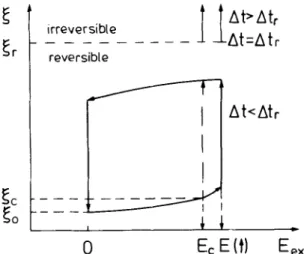
E,) is also unidirectional, i.e. irreversibly running until intact bilayer structures are restored.In this sense membrane electroporation represents a cycle of structural rearrangements (Figure 5 ) , where the intermediate states of the annealing process are probably different from those of the electroporation process in the presence of the external field.
”
1
reversibleFIGURE 5 The relaxation hysteresis of the membrane electroporation. The cyclic change in the extent of structural rearrangements (at E > E, and A t ( E ) < At,) are displayed as a function of the external field (Eex). The cycle comprises reversible as well as irreversible elements. The subcritical changes of 5 between
Eo
andEc
(E < E,) are reversible. At the supercritical field strength E (f)(>E,) the structural rearrangements associated with the electroporation process are unidirectional, i.e. irreversible. If the field duration is larger than the rupture threshold (Ar,), the membrane ruptures. If however the field pulse is switched off at At<Ar,, we remain in the reversible electroporation domain. The (slow) return at E = 0 from the upper branch to 5 = &, is unidirectional;
the resealing or annealing processes are irreversibly occurring relaxations to the initial state Eo.
332 EBERHARD NEUMANN
The physical conception that comprises both (reversible) metastable states and (irreversible) unidirectional transitions in a cyclic manner is called h y ~ t e r e s i s . ~ ~ Therefore the electroporationlresealing cycle may be analyzed and understood in terms of a structural relaxation hysteresis.
Energetics of the Electroporution Hysteresis
The energetics of the field-induced structural rearrangements in the electroporationlresealing cycle can be thermodynamically treated independent of any special mechanism.
The characteristic reaction free enthalpy A,G(E) for the transition from the intact bilayer state to pore configurations is given by
A,G(E) = A,G -
r
A,M d E ,where Em is given by Equations (3) and ( 4 ) and A,G is the reaction free enthalpy in the absence of E. 302 Obviously, pore formation is energetically unfavorable at E = 0; hence A,G
>
0.The reaction dipole moment A,M is related to the difference between the moments M, of the water filled pore and M,,, of the bilayer having the same size as the aqueous pore.
Applying the dielectric continuum model the polarization moments (relative to vacuum) are given by
where e0 is the dielectric permittivity of the vacuum, E the dielectric constant of
the medium and
v
is the volume of the electroporated membrane.The polarization of the water ( E , = 80) near the pore edge in the pore wall l8 is
energetically more favorable (by a factor of about 40) than the polarization of an equal volume of lipid bilayer (E, = 2).14 With ArM = NA (M, - Mm), where NA is the Avogadro constant, we can specify
M = EO( E
-
l ) v E , (6)ArM = N A E O ( E , -
E,)v(~)E,
(7) If d <<a, the electroporated membrane volume v(6) is given by v(6) =4nu2d(l
-
(cos 61) where the fraction of spherical membrane shell affected by a supercritical field is ( 1 - lcos 81) = 1 - E J E (Figure 3).It is seen from Equation (7) that, because of E ,
>
E ~ we obtain , A,M>
0.Therefore, the unidirectional electroporation process is associated with A , G ( E )
<
0; obviously becauseI
A,M d E ,>
A,G; see Equation ( 5 ) . On the same line, the initial driving force for the unidirectional pore resealing process is given by A,G,,,. = -lArG(E)l-In the case of unidirectional transitions, starting from metastable states, the rate equation for the extent
Ei
of the i-th mode of the Structural rearrangements, dgildt = k&i - k & ( l - &) (8) is reduced to the simple formd
5;.
ldt = kii& (9)Because of the irreversibility the reverse process can be neglected. The general
rate coefficient kij represents a combination of the rate constants kj of all elementary steps j contributing to the mode
i.
Finally, the field dependence of the rate constant kj is described by
(10) k j ( E ) = kj(0)elA&*dE’RT
where A,M; is the transition dipole moment of the activated state, R the gas constant, T the absolute temperature and k,(O) the value at E = 0.
The general remarks and the explicit expressions given in this programmatic study may provide a general framework for the thermodynamic and kinetic analysis of the electroporation and electrofusion processes in terms of a hysteresis formalism.
ACKNOWLEDGEMENTS
The technical help by Mrs. A. Tiemann and Mrs. M. Pohlmann in the preparation of the figures and the typing of the manuscript is gratefully acknowledged. I thank the Deutsche Forschungsgemeinsch- aft for the grant DFG Ne 227/4.
REFERENCES
1. M. Eigen and L. DeMaeyer, Techniques of Organic Chemistry, (John Wiley, New York, 1963) 2. E. Neumann, Prog. Biophys. molec. Biol., 47, 197-231 (1986).
3. E. Neumann, M. Schaefer-Ridder, Y. Wang and H . P. Hofschneider, EMBO J., 1, 841-845 8(2) pp. 895-1054.
(1982). (1979).
4. M. Senda, J. Takeda, A. Shunnosuke and T. Nakamura, Plant & Cell Physiol., 20, 1441- 5. E. Neumann, G. Gerisch and K. Opatz, Naturwissensch., 67, 414-415 (1980).
6. U. Zimmermann and P. Scheurich, Pluntu, 151, 26-32 (1981).
7. H. Weber, W. Forster, H.-E. Jacob and H. Berg, Z . Allgem. Mikrobiol., 21, 555-562 (1981 8. H. Berg, studiu biophysica, 119, 17-29 (1987).
9. A. E. Sowers, (ed.), Cell fusion, (Plenum Press, New York, 1987) 540 p. 10. U. Zimmermann, Rev. Physiof. Biochem. Pharmacol., 105, 175-255 (1986).
11. A. J. H. Sale and W. A. Hamilton, Biochim. Biophys. Actu, 163, 37-43 (1968). 12. E. Neumann and K. Rosenheck, J. Membr. Biol. 14, 194-196 (1973).
443
13. P. Lindner, E. Neumann and K. Rosenheck, J. Membr. Biof. 32, 231-254 (1977).
14. I. G. Abidor, V. B. Arakelyan, L. V. Chernomordik, Y. A. Chizmadzhev, V. F. Patushenko and 15. R. Benz, F. Beckers and U. Zimmermann, J . Membr. Biol., 48, 181-204 (1979).
16. J. TeissiC and T. Y. Tsong, Biochem., 20, 1548-1554 (1981).
17. D. S. Dimitrov and R. K. Jain, Biochim. Biophys. Actu, 779, 437-468 (1984). 18. I. P. Sugar and E. Neumann, Biophys. Chem., 19, 211-225 (1984).
19. J. C. Weaver, K. T. Powell, R. A. Mintzer, H. Ling, and S. R. Sloan, Bioelectrochern. Bioenerg., 20. K. T. Powell, E. G. Derrick and J. C. Weaver, Bioelectrochem. Bioenerg. 15, 243-255 (1986). 21. L. V. Chemomordik, S. I. Sukharev, S . V. Popov, V. F. Pastushenko, A. V. Sokirko, I. G. 22. I. P. Sugar, W. Forster and E . Neumann, Biophy. Chem., 26, 321-335 (1987).
23. A. E. Sowers, J. Cell Biol., 99, 1989-1996 (1984).
24. E. Neumann, Bioelectrochem. Bioenerg., 16, 565-567 (1986).
25. E. Neumann, ZiF Proc., University of Bielefeld Press, pp. 6-14 (1986).
26. U. Zimmermann, P. Scheurich, G. Pilwat and R. Benz, Angewundte Chemie, 93,332-351 (1981). 27. H. P. Schwan, A d v . Biol. Med. Physics, Vol. V. (Academic Press, New York, 1957) pp. 28. E. Neumann, Electroporution and electrofusion in cell biology, (Plenum Press, New York, 1988) 29. E. Neumann, Angew. Chem. internut. Edit., 12, 356-369 (1973).
30. G. Schwarz, J. Phys. Chem., 71, 4021-4030 (1967).
M. R. Tarasevich, Bioelectrochem. Bioenerg., 6, 37-52 (1979).
12,393-412 (1984).
Abidor and Y. A. Chizmadzhev, Biochim. Biophys. Actu, 902, 360-373 (1987).
147-209. in press.