Procedia Engineering 00 (2010) 000–000
Engineering
www.elsevier.com/locate/procediaCharacterization of the Changes in Fatty Acids Composition by CG-EM in
Fermented Sausages
Adriana Llorente-Bousquets a*, Ernesto J. Texpa-Hernándeza, Ma. Olivia Noguéz-Córdovab, Jorge López-Pérez c
René Miranda-Ruvalcaba b and Amelia Farrés-González Saravia d
a
Departamento de Ingeniería y Tecnología, ([email protected])
b
Departamento de Química ([email protected])
c
Departamento de Ciencias Pecuarias ([email protected]) Facultad de Estudios Superiores Cuautitlán, Universidad Nacional Autónoma de México, México.
d
Departamento de Biotecnología y Alimentos, Facultad de Química, Universidad Nacional Autónoma de México, México.
Abstract
In the meat processing used lactic acid bacteria (LAB) as starters, which are responsible for improved sensory characteristics and health of these products. Gas chromatography coupled with mass spectrometry (GC-MS) are used to identify the effect of the addition of LAB in the changes they undergo lipid raw cured sausages. Lots were developed as experimental models salamis with or without the addition of Pediococcus acidilactici or Lactobacillus
plantarum. These were kept at room temperature for 24 h and then the first batch stored in a climatic chamber
Binder RH of 90% and 111°C of temperature batch in commercial refrigerator RH of 70% and 102°C. Lipid extraction by soxhlet method and samples of each batch of salami on days 1, 5 and 10, and methyl esters were obtained using 0.2N MeONa react for one hour after 50 ° C. To identify and quantify the fatty acids by GC-MS was used a Varian Saturn GC-MS mod. 3400CX and separated with Saturn IV DB-5 column, by injecting 1μl sample previously dissolved in n-hexane and to calibrate the EM perfluoroterbutilamine (PFTBA). Chromatograms were obtained for each batch. The identification of the fatty acids are made from the mass spectra and were constructed graphs showing the percentages of saturated fatty acids (SFA) and unsaturated fatty acids (UFA). Was found that formulations of frozen beef added with P. acidilactici as starter and fermented at 70% HR, UFA concentration was
about 50% and reached 60% to 90% RH. The concentration of UFA remained at the same intervals, but they declined to 46% when the RH was 90%. The best was fermentation conditions for salamis of fresh meat at 70% RH and at 90% RH when they elaborated with meat frozen. It found 15% more AGI in formulations added with P. acidilactici.
© 2010 Published by Elsevier Ltd.
Keywords: sausages; LAB; starters; CG-MS.
* Corresponding author. Tel.: +5-525-623-1999; ext. 39417 E-mail address: [email protected]
INTRODUCTION
In the development of meat products are applied lactic acid bacteria (LAB) as starters, responsible for better sensory characteristics [1]. LAB Pediococcus and Lactobacillus genera play an essential role as starter cultures in the
production of these sausages [2]. Were used fresh and frozen beef, from various sources (Aguascalientes and Veracruz). During fermentation-ripening of sausages the metabolic activity of the starters allows different reactions in which lipids are involved and as a result may produce different compounds responsible for their characteristic aromas. In this work we employ analytical techniques such as gas chromatography mass spectrometry (GC-MS) for identification of changes experienced by lipids.
MATERIALS & METHODS
Lipid extraction by soxhlet method [3], and samples of each batch of salami on days 1, 5 and 10, and methyl esters were obtained using 0.2N MeONa react for one hour after 50 ° C. To identify and quantify the fatty acids by GC-MS [4-6], was used a Varian Saturn GC-GC-MS mod. 3400CX and separated with Saturn IV DB-5 column, by injecting 1μl sample previously dissolved in n-hexane and then calibrate the EM with perfluoroterbutilamine (PFTBA). Chromatograms were obtained for each batch. The identification of the fatty acids was made from the mass spectra and then constructed graphs showing the percentages of saturated fatty acids (SFA) and unsaturated fatty acids (UFA).
RESULTS & DISCUSSION
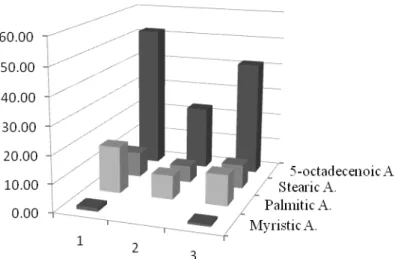
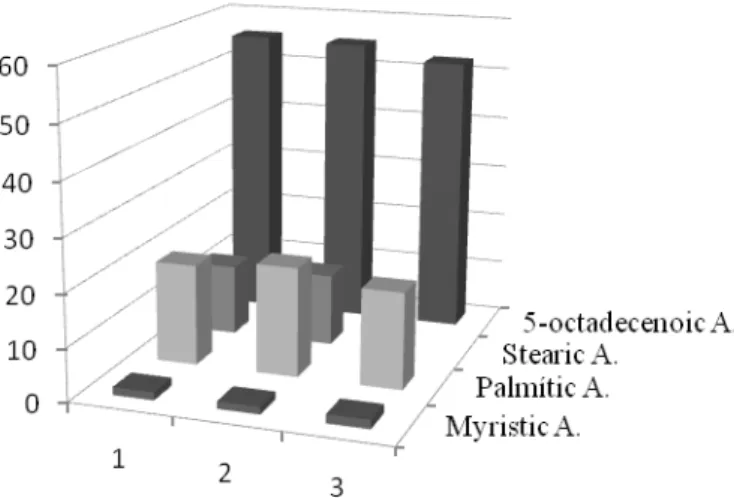
The results of the fatty acid composition of salami are presented in Figures 1-3. The batches made from fresh or frozen beef, showed the following trends. Although the beef used in the manufacture of salamis was of different origin, only traces of stearic acid found in those without inoculum, but in the inoculated it was not found. As myristic acid concentration found in salami, fresh meat or frozen inoculum added or not, and different conditions of temperature and RH during fermentation was only 1.3-2.0%. The batch it was elaborated with fresh beef that inoculated and fermented to 70% RH, palmitic acid concentration was higher (21-25%) than non-inoculated (17-21%). Instead of frozen meat salamis inoculated and fermented to 90% RH led to concentrations of 18-22% for the same acid, being 23-25% in those without inoculum. In the case of AGI only detected 5-octadecenoic acid (60-64%). RH to 90% allowed the highest values, especially in those inoculated salamis. In contrast, the results at 70% RH showed no difference between those made with fresh meat of different origin or influence was observed by the addition of inoculum.
Finally 46 Chromatograms and 184 mass spectra were obtained for all of lots of salami stored both to HR of 70% or 90%. In all of them was observed that They have the same number of peaks that is the same number of Fatty Acids and likewise in the case of the mass spectra, the concentration of UFA was 60-63%. The highest concentration was to 5-octadecenoic Acid, after 10 days of fermentation,.while for the SFA about 26%.
Once you purchase the corresponding chromatograms (Fig. 4), identification of the FA is made from the information displayed by the mass spectra. With the information gathered, later determined the % of each of the FA.
CONCLUSION
The pattern of fatty acids detected by GC-MS in all lots of salamis included the presence of SFA Myristic, Palmitic, Stearic and 5-octadecenoic UFA. The type of meat, the type of storage and inoculum type showed no effect on the changes in the different batches AG. It is worth mentioning that 5-octadecenoic Acid (AGI) compared with other SFA was found in high concentrations in each and every one of the salamis analyzed and its concentration exceeded 50% of FA detected during GC-MS analysis.
Figure 1 Changes in the Fatty acids composition in salami made with fresh beef after 1 day of fermentation. 1) Without starter, 2) with Lactobacillus plantarum, 3) with Pediococcus acidilactici
Figure 2 Changes in the Fatty acids composition in salami made with fresh beef after 5 days of fermentation. 1) Without starter, 2) with Lactobacillus plantarum, 3) with Pediococcus acidilactici
Figure 3 Changes in the Fatty acids composition in salami made with fresh beef after 10 days of fermentation. 1) Without starter, 2) with Lactobacillus plantarum, 3) with Pediococcus acidilactici
Figure 4 Cromatogram of metilic esters of FA of salami with P. acidilactici as starter after 10 days of fermentation
Project Support 7.5.4 “Food processing through microbial processes” in the Macro Project 7 of the UNAM. Project Support PAPIME DGAPA-PE-202706, UNAM.
MSc Lilian Morfin MVZ. Andres Cardona, IBQ. Saturnino Maya, IA. Alicia Pérez, FESC-UNAM.
REFERENCES
[1] Castellano, P., Belfiore, C., Fadda, S., Vignolo, G. 2008. A review of bacteriocinogenic lactic acid bacteria used as bioprotective cultures in fresh meat produced in Argentina. Meat Science79: 483–499.
[2] Cenci-Goga, B.T., Ranucci, D., Miraglia, D., Cioffi, A. 2008. Use of starter cultures of dairy origin in the production of Salame nostrano, and Italian dry-cured sausage. Meat Science. 78: 381-390.
[3] AOAC. 2000. International Official Methods of Analysis. Vol. II 17th Ed. Method. 991.36. USA.
[4] Demeyer, D., Hoozee, J., Mesdom, H. 1974. Specificity of lipolysis dry sausage ripening. J. Food Sci.39: 293-296.
[5] Gray, J., I. 1978. Measurement of lipid oxidation: A review. JAOCS. 55: 539-546.
[6] Doniz, R., M., E. 1994. “Evaluación de ácidos grasos por cromatografía de gases acoplada a espectrometría de masas en n come to learn more.