Article
Applications in Security and Evasions in Machine
Learning: A Survey
Ramani Sagar1,*, Rutvij Jhaveri2and Carlos Borrego3
1 Computer/IT Engineering Department, Gujarat Technological University, Ahmedabad 382424, India 2 Department of Computer Science & Engineering, Pandit Deendayal Petroleum University,
Gandhinagar 382007, India; [email protected]
3 Department of Information and Communications Engineering, Autonomous University of Barcelona, 08193 Barcelona, Spain; [email protected]
* Correspondence: [email protected]; Tel.:+91-9408109793
Received: 4 October 2019; Accepted: 11 December 2019; Published: 3 January 2020 Abstract: In recent years, machine learning (ML) has become an important part to yield security and privacy in various applications. ML is used to address serious issues such as real-time attack detection, data leakage vulnerability assessments and many more. ML extensively supports the demanding requirements of the current scenario of security and privacy across a range of areas such as real-time decision-making, big data processing, reduced cycle time for learning, cost-efficiency and error-free processing. Therefore, in this paper, we review the state of the art approaches where ML is applicable more effectively to fulfill current real-world requirements in security. We examine different security applications’ perspectives where ML models play an essential role and compare, with different possible dimensions, their accuracy results. By analyzing ML algorithms in security application it provides a blueprint for an interdisciplinary research area. Even with the use of current sophisticated technology and tools, attackers can evade the ML models by committing adversarial attacks. Therefore, requirements rise to assess the vulnerability in the ML models to cope up with the adversarial attacks at the time of development. Accordingly, as a supplement to this point, we also analyze the different types of adversarial attacks on the ML models. To give proper visualization of security properties, we have represented the threat model and defense strategies against adversarial attack methods. Moreover, we illustrate the adversarial attacks based on the attackers’ knowledge about the model and addressed the point of the model at which possible attacks may be committed. Finally, we also investigate different types of properties of the adversarial attacks.
Keywords: security; privacy; adversarial attack; machine learning; attackers’ knowledge
1. Introduction
The present-day community accesses advanced technologies, both hardware, and software, at an unprecedented pace in possibly every imaginable field. However, this has resulted in a whole new range of threats in terms of privacy and security. Therefore, there is a demanding need to address the security and privacy perspective of different types of cyber threats which are increasing at a drastic pace with unknown malware [1]. According to a special report [2], out of seven billion population in the world, about six billion rely on mobile phones or other smart gadgets for banking, shopping, financing, healthcare, internet-of-things (IoT), blockchain applications, posts on social media and for professional information and updates [3–7]. Therefore, during downloading of the applications on smart devices, there is a strong chance of data leakage and theft. Apart from that, malware is also triggered by corrupt system routines, unauthorized network access to resources and gather sensitive information. To cope up with these issues, many anti-virus tools, intrusion detection systems [8], defenders, and latest
firewalls with updated security patches are available. However, according to the aforementioned report [9], malware distribution continues to grow at more than 267% per annum worldwide.
From the security perspective, the core research is focused on (1) dynamic vulnerability analysis; (2) static vulnerability analysis and; (3) hybrid vulnerability analysis. Even though static vulnerability analysis techniques have agility, it generates a high false-positive rate which shows less accuracy [10]. Meanwhile, dynamic vulnerability analysis techniques are accurate, but only for the substantial system. At the same time, accuracy gets compromised while adopting these techniques. Hybrid techniques attempt to overcome both these issues addressed in static and dynamic techniques. However, hybrid techniques are able to detect new types of vulnerabilities [11]. In recent times, hardware and software vendors have introduced many new techniques such as data execution protection, space layouts randomization, structured exception handler overwriting protection [12] and mandatory integrity control [13]. We claim that current evasion techniques can be easily bypassed and vendors are still in a developing phase in order to handle severe sophisticated attacks.
Recently some surveys on security applications in the context of machine learning and artificial intelligence have been presented [8] ML techniques for cybersecurity with an emphasis on ML methods and their description. Many other papers represented these methods have been published including many reviews. Also, previous works either focus on adversarial techniques or defense techniques of the machine learning classifiers. While this paper target work comparison of security applications as well as adversarial aspects including its defense techniques also during every phase of the machine learning life cycle from a data-driven view. The fundamental difference between previous surveys which have been proposed by authors, most of them only involve only security threats, internal issues of the machine learning systems in terms of adversarial defense. While in this survey based on that circumstance this survey combines different security applications and studies and carries out comprehensive summery in terms of tables based on the various parameters. Also, this survey highlights adversarial attack properties and attacks defense techniques for security applications in which ML plays an essential role. We emphasize a detailed review of security application with its performance matrices comparison as well as data distribution drifting leads by adversarial samples and private information transgression problem and its defense with attack model. This survey, as a complete summary combines numerous references and provides a macro understanding and interrelationship of security applications and machine learning related fields. This paper is intended for readers who wish to begin research towards the field of security application using ML techniques. As such great emphasis is placed on the thorough description is given about security application as well as the adversarial setting during the ML lifecycle.
With the explosion of data accelerating at an exponential rate, the privacy of data and systems has also come into the foreground. Privacy can be seen as one with a wide scope under a big umbrella [14]. In applications such as banking, healthcare, and defense, not only the issues related to privacy is a serious concern, but also there are legal concerns that need to be considered as mentioned in the Health Insurance Portability and Accountability (HIPAA) act [15]. Within the current technological scenario, there is a well-known discipline called privacy-preserving’ [13] and statistical disclosure control (SDC) [16]. When data is distributed, preserving privacy becomes more challenging. Some of the statistical disclosure control techniques which address risks related to data disclosure [17] and privacy-preserving techniques in the frame of signature-based detection are not really foolproof [18]. In order to preserve data privacy, it becomes imperative to address the issues concerning the balance between false-negative rate, false-positive rate, recall, precision and performance [19].
The remainder of the paper is structured as follows: Section2states survey methodology which describes the taxonomy of the security applications and based on that how survey criteria forms. Section3reviews and analyzes different types of security applications for which ML approaches can be applied in order to prevent security threats on the applications. Apart from this, Section3gives complete information about all types of performance metrics used in the approaches of IDS with the type of different type classifiers with algorithms, limitations and future challenges. Section4presents
a vulnerability analysis threat model different types of adversarial attacks at each level on the ML classifiers from different types of attackers. Also, we review adversarial defense techniques for the different types of adversarial attacks that cover both reactive and proactive types of defense techniques. 2. Survey Methodology for Security Applications
The idea behind conducting a survey is deceptively simple which involves identifying different types of application where machine learning classifier is involved in the applications. This section introduces a taxonomy of different security applications where machine learning can be applied in order to fulfill the desired goal. Several survey machines learning-based survey papers have been proposed but most of them address security-based issues in machine learning applications. Therefore, considering the above circumstances, this survey in addition to that also includes privacy with security aspects and adversarial attacks on machine learning classifiers.
To design the survey for the security-based application we divide the security spectrum comprehensively into different applications which include the comprehensive method analysis for the application in all aspects of security. Also, we expand the spectrum in terms of the type of classifiers where it requires analyzing especially for intrusion detection as well as prevention. Although the scope of the security applications is broad which can not be limited for few applications in the recent technological advancement. In this survey, we have considered security applications in which machine learning plays a vital and essential role in security applications. Because ML algorithms comprise and designated for statistical mechanisms such as decision tree, logistic regression, and function approximations. This type of algorithm is more influential and can be used in that type of situation where classification is essential. The machine learning technique imposes many advantages especially when it applied in security aspects like (1) signature-based attack where subtle changes in the signature can be discovered dynamically, (2) system behavior and identify anomaly from the deviation of the normal system, (3) by stabilizing biased variance, recall verses precision machine learning provides lower sensitivity and reduces false alarm rate, (4) machine learning is highly recommended when the domain of the threat model is changed.
2.1. Study Selections and Search Methods
The study selection process for the survey includes mainly three phases: (1) title and abstract review, (2) classification of security applications, (3) review of security properties and defense techniques. Inclusion criteria for a title and abstract review are security applications where machine learning methods are applicable, weakness of ML models where attackers craft the attacks and identify the methods to defend the attacks. In the second phase of the review process, selection criteria of the survey described are base on machine learning in security applications. Based on the inclusion criteria total of one hundred fourteen papers satisfy the inclusion criteria and classified according to presume array of variables. In the third phase of the review process selection criteria of the survey describe based on “Adversarial attacks on machine learning and defense”. Based on these inclusion criteria total of twenty-three papers satisfies the inclusion criteria.
For the survey, bibliographic databases are explored using an online search interface for paper selection. To achieve precise relevancy to the title in Table1we have described the query format for searching through interfaces.
Table 1.Search queries format for search engine.
Search Engine Query
IEEE Xplore (machine learning AND applications AND security) OR (Adversarial Attacks AND machine learning)1 Springer
(machine learning AND applications AND security) OR (security properties OR defense AND machine learning)
OR (adversarial attacks AND machine learning)2 Web of Science
(machine learning AND application AND security) OR (security properties OR defense AND machine learning)
OR (adversarial attacks AND machine learning)2 Science Direct
(machine learning AND application AND security) OR (security properties OR defense AND machine learning)
OR (adversarial attacks AND machine learning)2
1Searched in Metadata;2Search topics filtered by subjects: Computer Science; Security Applications; Privacy; Machine Learning; Adversarial attacks.
2.2. Variable Definitions
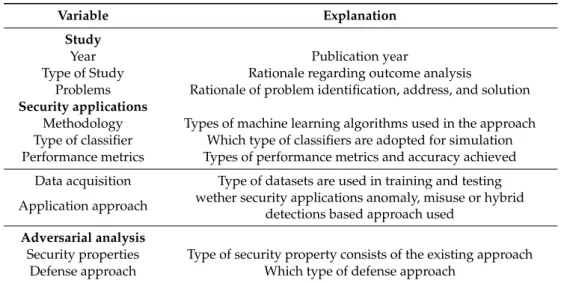
In this review, variables are considered based on general characterization, security properties, and adversarial analysis. Table2characterizes detail criteria regarding study characterization, type of algorithm used for modeling, type of metric used for result analysis, consideration of data acquisition techniques for classifiers training and testing, and type of application approach. While, as per the adversarial point of view, detailed criteria regarding types of security property consists of an existing approach and defense strategy used for the approach. In Table2all criteria are represented in the respective sub-sections.
Table 2.Types of variables considered for paper selection during the review.
Variable Explanation
Study
Year Publication year
Type of Study Rationale regarding outcome analysis
Problems Rationale of problem identification, address, and solution Security applications
Methodology Types of machine learning algorithms used in the approach Type of classifier Which type of classifiers are adopted for simulation Performance metrics Types of performance metrics and accuracy achieved
Data acquisition Type of datasets are used in training and testing Application approach wether security applications anomaly, misuse or hybrid
detections based approach used Adversarial analysis
Security properties Type of security property consists of the existing approach Defense approach Which type of defense approach
2.3. Time Period Considered
In order to analyze the research trends of machine learning in security applications and adversarial attacks, we have divided the time period into five different intervals. We have considered the time period range first interval from 2016 to 2019, for the second interval from 2011 to 2015, for the third interval from 2006 to 2010, for the fourth interval from 2001 to 2005 and for the fifth interval from 2000 and below.
2.4. Studies Characterization
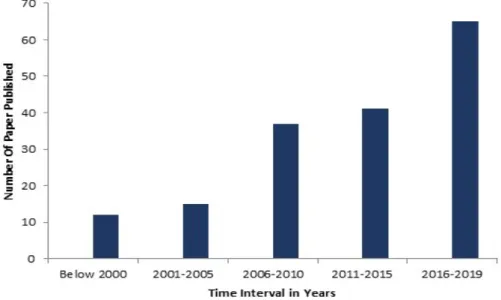
This subsection represents the statistical results retrieved from the search methods and types of variables considered in the variable definition criteria. Figure1illustrates the distribution of published papers for the last 25 years. In the graph, the time period of total years is represented in five different intervals. The result represents an increasing trend of machine learning methods in security applications and adversarial attack techniques. It is observed in Figure1where activity in the machine learning domain is increased since 2006. Apart from this in the period 2016–2019 flourishing trend of the published papers in the area of machine learning-based security applications and adversarial attacks.
Electronics 2019, 8, x FOR PEER REVIEW 5 of 41
five different intervals. The result represents an increasing trend of machine learning methods in
security applications and adversarial attack techniques. It is observed in Figure 1 where activity in
the machine learning domain is increased since 2006. Apart from this in the period 2016–2019
flourishing trend of the published papers in the area of machine learning-based security applications
and adversarial attacks.
Figure 1.
Time interval distribution of published papers focusing based on.the use of machine
learning in security applications and adversarial attacks.
The taxonomy of security applications where machine learning is applied is illustrated in Figure
2.
•
Intrusion can be separately classified into intrusion detection and intrusion prevention
techniques. Further intrusion detection can be classified into an anomaly-based and
signature-based approach.
1.
Anomaly-based intrusion detection detects misuse in a computer or network with the
help of machine learning classifiers either normal or anomalous.
2.
While signature-based detection is identified by the ML classifiers algorithms by
identifying specific patterns such as malicious instruction sequences or byte sequences.
•
Intrusion prevention is a preemptive approach that identifies potential threats with the help
of ML classifiers and responds to them accordingly in order to prevent misuse.
•
Phishing detection intended to detect legitimate or phishing web pages and applications
which mainly exploit computer users’ vulnerability with the use of ML classifiers.
•
Privacy preservation is another important aspect of security where in order to provide
security of sensitive information during communication between different parties. Here ML
classifiers help to prevent leakage of the sensitive data with other collaborative entities.
Linear Means classifier simply computes a multiple of the original LM score function with
the same sign and algorithm made confidential by encoding all real vector coefficients as
integers and encrypts the input vectors coefficient wise and carries out the linear algebra
operations with vectors of ciphertexts. While Fisher’s Linear Discriminant Classifier same
procedure is done like LM classifiers but using gradient descent using different weight
vector.
•
Spam detections like blatant blocking, bulk email filter, category filter, null sender header
tag validation, and null sender disposition ML classifiers are used.
Risk assessment is also an important factor which classifies different information assets that
possibly damaged and identify various risk that could affect the assets with the help of ML classifiers.
Figure 1.Time interval distribution of published papers focusing based on.the use of machine learning in security applications and adversarial attacks.
The taxonomy of security applications where machine learning is applied is illustrated in Figure2. • Intrusion can be separately classified into intrusion detection and intrusion prevention techniques. Further intrusion detection can be classified into an anomaly-based and signature-based approach. 1. Anomaly-based intrusion detection detects misuse in a computer or network with the help
of machine learning classifiers either normal or anomalous.
2. While signature-based detection is identified by the ML classifiers algorithms by identifying specific patterns such as malicious instruction sequences or byte sequences.
• Intrusion prevention is a preemptive approach that identifies potential threats with the help of ML classifiers and responds to them accordingly in order to prevent misuse.
• Phishing detection intended to detect legitimate or phishing web pages and applications which mainly exploit computer users’ vulnerability with the use of ML classifiers.
• Privacy preservation is another important aspect of security where in order to provide security of sensitive information during communication between different parties. Here ML classifiers help to prevent leakage of the sensitive data with other collaborative entities. Linear Means classifier
simply computes a multiple of the original LM score function with the same sign and algorithm made confidential by encoding all real vector coefficients as integers and encrypts the input vectors coefficient wise and carries out the linear algebra operations with vectors of ciphertexts. While Fisher’s Linear Discriminant Classifier same procedure is done like LM classifiers but using gradient descent using different weight vector.
• Spam detections like blatant blocking, bulk email filter, category filter, null sender header tag validation, and null sender disposition ML classifiers are used.
Electronics 2019, 8, x FOR PEER REVIEW 6 of 41
Figure 2. Taxonomy of Security Applications.
• Malware detection, ML classifier formalizes and finds the principals that inhibit the data it examines. If a previously unseen sample is found then it could be the new file and based on the properties it contains the decision has been taken about malware detection. Based on the type of the signature we categorize malware detection techniques into signature-based detection, anomaly-based detection, heuristics based detection.
• Testing Security properties require to ensure the safety and authenticity of the protocol systems. In order to model the testing process in an automated manner, using three techniques namely black-box checking, passive trace minimization, and fuzz testing to fulfill the desired goal of testing security.
Risk assessment is also an important factor which classifies different information assets that possibly damaged and identify various risk that could affect the assets with the help of ML classifiers. • Malware detection, ML classifier formalizes and finds the principals that inhibit the data it examines. If a previously unseen sample is found then it could be the new file and based on the properties it contains the decision has been taken about malware detection. Based on the type of the signature we categorize malware detection techniques into signature-based detection, anomaly-based detection, heuristics based detection.
• Testing Security properties require to ensure the safety and authenticity of the protocol systems. In order to model the testing process in an automated manner, using three techniques namely black-box checking, passive trace minimization, and fuzz testing to fulfill the desired goal of testing security.
3. Machine Learning Applications in Security 3.1. Intrusion Detection and Prevention
In recent years, Internet service has played an important part in business models. Since both the customer and the business use Internet applications, the security of data while utilizing the Internet as a medium has become a prime concern [20]. The intrusion detection system (IDS) provides a defense to counter the attacks [21,22]. In IDS, several approaches are proposed such as packet payload analysis [23], pattern propagation [24] and bro language [25]. In addition, various schemes for ad-hoc networks are proposed to detect attack patterns and to provide a defense mechanism in the network [26–30]. IDS which are passive by nature have a key issue their inability to mount targeted, reliable and adaptive response [31]. Therefore, sometimes host-level IDS does not assure how a packet is processed which may lead to wrong decisions [32] and that is why the adaptive and proactive system is required over IDS. In [33], the authors state anomaly-based and signature-based approaches for IDS as follows. 3.1.1. Intrusion Detection System Approaches
In this Segment, we review types of approaches for IDS. In the IDS, essential factors cause of error in classifier learning due to noise, bias, and variance. Therefore, ensemble and hybrid classifiers are the types of multiclass classifiers that help to minimize these factors due to the bagging, boosting and stacking properties in the classifier models. Based on these criteria we have analyzed a signature-based and anomaly-based approach.
Signature-Based Approach
A signature-based intrusion detection technique uses a pre-defined pattern to identify malicious activity [21] while in the traditional methods, it may not be able to intimate the system about new threats.
1. Single classifier
In this type of intrusion detection technique, only a single ML algorithm is used to detect the intrusion. Akira et al. [34] proposed a decision tree algorithm with the Gini index, which engenders refined data that are used to learn the classifiers for raising the alerts as an output of signature-based IDS. Lippmann et al. [35] represent a theory that detects the signature of a known attack by examining attack-oriented basic keywords in the network. Network sniffing data are used to produce the count of the keywords in each telnet session. Counting of each keyword occurrences is used for detection by the neural network classifier. Wong et al. [36] illustrated an artificial neural network (ANN) as well as a support vector-based classifier approach to predict the types of attacks, which are based on frequency-based encoding techniques. ANN is trained with the backpropagation algorithm to predict the intrusion. Additionally, a support vector machine (SVM) model is also built in order to classify attack. From the observation of both techniques, it shows that SVM gives better results than ANN for the same encoding method of detection.
2. Hybrid classifier
This type of classifier primarily a blend of the heterogeneous environment or/and classifiers as a detection mechanism in which right from the data normalization phase to the final decision phase is covered. Borges et al. [37] presented a communication control module, a monitoring module, a mobile correlator module and, command and control center (C&C) components described to which the command and control center (C&C) center consists of a hybrid classifier. The monitoring module is responsible for monitoring normal and abnormal patterns for file access and usage, content observer and a broadcast receiver. All the information thus gathered is used afterward by the ML classifiers to access if any user or mobile device’s application face any security threats. Karthick et al. [38] presented a two-stage framework: the first stage naïve Bayes classifier is employed to raise a flag that identifies malicious activities in the network and incoming traffic fed as an input to the hidden Markov model (HMM). HMM is an effective approach to blacklist IP addresses based on suspicious characteristics of the traffic. The plot model [36] proposed by Tsai et al. [35] (triangle area-based nearest neighbors) uses K-means clustering to conclude the cluster center corresponding to the attack classes. Two cluster centers and one data among the datasets are used to calculate the area of the triangle and form a signature from that K-Nearest Neighbour classifier which is employed to identify threats.
3. Ensemble Classifier
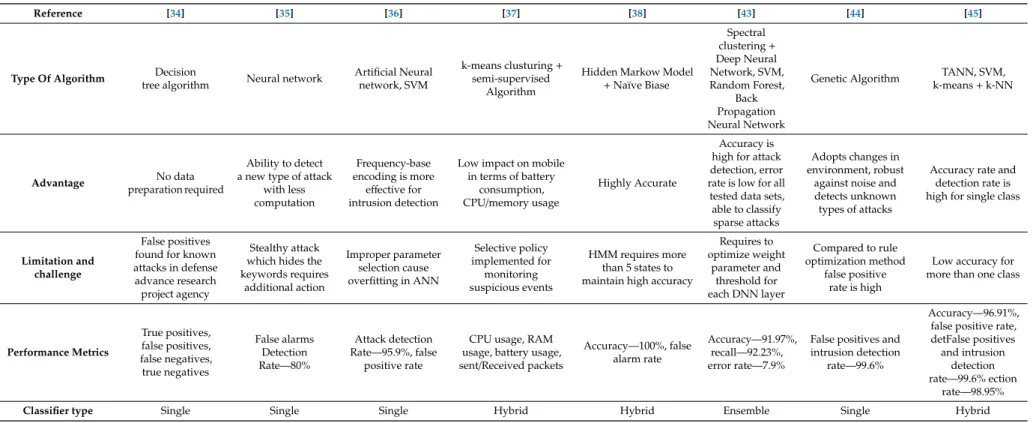
The ensemble is a combined classifier of multiple weak classifiers. In this method, weak learners are trained so that the inclusive action of the model can be adequately alleviated. For improving the performance of the weak learner, adaptive boosting [38], bagging [39], wagging [40], random forest [41] and cross validators committees [42] play a crucial role. Ma et al. [43] proposed a scheme that combines the deep neural network (DNN) and spectral clustering algorithms. Datasets are calved into the K subsets using cluster centers. Based on the similarity features, distance is measured among the data points in training sets and testing sets which are employed into the model of DNN to detect the intrusion. In Table3, we analyze different ML approaches for signature-based intrusion detection applications for all three types of classifiers. Our criteria for Table3for signature-based intrusion detection system based on which type of classifiers are used in the approach from above mentioned three types of classifiers that is single, hybrid or ensemble classifier.
Table 3.Analysis of Signature-based Intrusion Detection Techniques (Notations: SVM-Support Vector Machines, TANN-Triangle Area Based Nearest Neighbor).
Reference [34] [35] [36] [37] [38] [43] [44] [45]
Type Of Algorithm Decision
tree algorithm Neural network
Artificial Neural network, SVM
k-means clusturing+ semi-supervised
Algorithm
Hidden Markow Model +Naïve Biase Spectral clustering+ Deep Neural Network, SVM, Random Forest, Back Propagation Neural Network
Genetic Algorithm TANN, SVM, k-means+k-NN
Advantage No data
preparation required
Ability to detect a new type of attack
with less computation Frequency-base encoding is more effective for intrusion detection
Low impact on mobile in terms of battery
consumption, CPU/memory usage
Highly Accurate
Accuracy is high for attack detection, error rate is low for all tested data sets, able to classify sparse attacks
Adopts changes in environment, robust
against noise and detects unknown types of attacks
Accuracy rate and detection rate is high for single class
Limitation and challenge
False positives found for known attacks in defense advance research project agency
Stealthy attack which hides the keywords requires additional action Improper parameter selection cause overfitting in ANN Selective policy implemented for monitoring suspicious events HMM requires more than 5 states to maintain high accuracy
Requires to optimize weight parameter and threshold for each DNN layer Compared to rule optimization method false positive rate is high
Low accuracy for more than one class
Performance Metrics True positives, false positives, false negatives, true negatives False alarms Detection Rate—80% Attack detection Rate—95.9%, false positive rate
CPU usage, RAM usage, battery usage, sent/Received packets
Accuracy—100%, false alarm rate
Accuracy—91.97%, recall—92.23%, error rate—7.9%
False positives and intrusion detection
rate—99.6%
Accuracy—96.91%, false positive rate, detFalse positives and intrusion
detection rate—99.6% ection
rate—98.95%
Anomaly-Based Approach
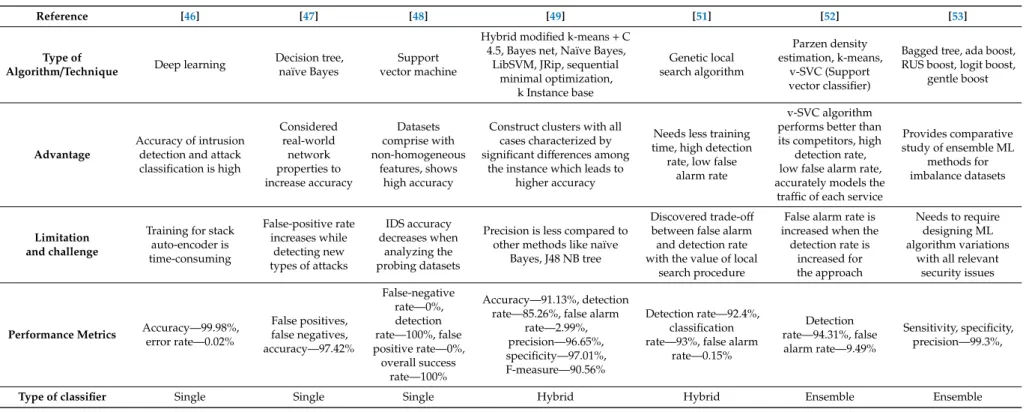
This type of technique observes the system behavior and identifies anomaly from the deviation of the normal system. Hence, this type of system has the ability to detect the zero-day attack [32]. Using this technique normal behavior of the system can be customized so that, for the adversary, it is difficult to figure out the normal behavior of the system. In Table4, we investigated anomaly-based IDS approaches based on the types of classifiers.
1. Single classifier
Van et al. [46] proposed a deep learning technique to implement an anomaly-based network IDS (NIDS). In the proposed model, the deep belief network structure is constructed that consists of components such as stacked auto-encoder and stacked restricted Boltzmann machines (RBM). With the use of auto-encoder, the classifier learns and extracts hierarchical features by unsupervised or semi-supervised learning. The RBM probabilistic model aims to use the natural criteria to maximize the log-likelihood. Therefore, the proposed method can be enabled to detect attacks and classify them into these classes: probe, user to root, normal, remote to user and denial-of-service (DoS). In [47], the authors presented a scheme for creating intrusion database with the main objective to create an easy-to-update database tool which simultaneously produces real traffic data. To make the ML scheme effective, the proposed method is used as a multi-objective feature selection technique that acknowledges substantial network characteristics that yield higher accuracy. Ghanem et al. [48] opined that anomaly-based IDS aims to accomplish an excessive number of false alarms. They constructed an SVM based-machine learning technique that complements the performance of the IDS and also decreases the false alarm rate vigorously. In the performance assessment projected, the unsupervised IDS approach detects all malicious traffic and reduces false alarms compared to one-class and two-class linear and non-linear SVM approaches.
2. Hybrid classifier
Al-Yaseen et al. [49] illustrated a modified k-means algorithm that aims to achieve high-performance and considers all possible eventualities by treating all the divergent points in the datasets as the initial centroid of the cluster instead of selecting a specific set of initial centroid randomly. In addition to this, the modified k-means clustering standard C4.5 technique [50] builds a tree from the clusters which can detect the anomaly by using the maximum information gained from the feature selection. Consequently, minimum information is split to build a tree structure of normal and malicious behaviors. Abadeh et al. [51] proposed a parallel genetic local search algorithm that is capable of generating fuzzy rules for detecting intrusive behavior in the networks. In this approach, the population is divided into subpopulations, which are the number of classes for the classification analysis or problem, and training set for each classifier is different from each other. The fuzzy ruleset evolves independently in a parallel manner and is used as a source of knowledge for each classifier for intrusion detection.
Table 4.Analysis of Anomaly-based Intrusion Detection Techniques.
Reference [46] [47] [48] [49] [51] [52] [53]
Type of
Algorithm/Technique Deep learning
Decision tree, naïve Bayes
Support vector machine
Hybrid modified k-means+C 4.5, Bayes net, Naïve Bayes,
LibSVM, JRip, sequential minimal optimization, k Instance base Genetic local search algorithm Parzen density estimation, k-means, v-SVC (Support vector classifier)
Bagged tree, ada boost, RUS boost, logit boost,
gentle boost
Advantage
Accuracy of intrusion detection and attack classification is high Considered real-world network properties to increase accuracy Datasets comprise with non-homogeneous features, shows high accuracy
Construct clusters with all cases characterized by significant differences among
the instance which leads to higher accuracy
Needs less training time, high detection
rate, low false alarm rate
v-SVC algorithm performs better than its competitors, high
detection rate, low false alarm rate, accurately models the
traffic of each service
Provides comparative study of ensemble ML methods for imbalance datasets Limitation and challenge
Training for stack auto-encoder is time-consuming False-positive rate increases while detecting new types of attacks IDS accuracy decreases when analyzing the probing datasets
Precision is less compared to other methods like naïve
Bayes, J48 NB tree
Discovered trade-off between false alarm and detection rate with the value of local
search procedure
False alarm rate is increased when the
detection rate is increased for the approach Needs to require designing ML algorithm variations
with all relevant security issues
Performance Metrics Accuracy—99.98%,error rate—0.02%
False positives, false negatives, accuracy—97.42% False-negative rate—0%, detection rate—100%, false positive rate—0%, overall success rate—100% Accuracy—91.13%, detection rate—85.26%, false alarm
rate—2.99%, precision—96.65%, specificity—97.01%, F-measure—90.56% Detection rate—92.4%, classification rate—93%, false alarm
rate—0.15% Detection rate—94.31%, false alarm rate—9.49% Sensitivity, specificity, precision—99.3%,
3. Ensemble Classifier
Giacinto et al. [52] proposed an unlabelled network anomaly IDS based on the modular multiple-classifier systems. The aim of this modularized design to develop a batch of homogeneous network or protocol services that grant the designer to choose decision thresholds and different models for the module to enhance the comprehensive performance of the ensemble model. For ensemble classifiers, the posterior probability function is used on which min, max, mean and product rule can be easily applied and, traditional classifiers can be combined using the rules for obtaining the detection result. While [53] uses AdaBoost, RUSBoost, LogiBoost, and gentle boost Bagged tree algorithm for ensemble classifiers and results are compared with each of the referred algorithms. As a result of these algorithms, bagged tree and gentle boost classifiers show notable performance. In Table4, we classify anomaly-based intrusion detection techniques for the aforementioned different types of classifiers. 3.1.2. Intrusion Prevention
Intrusion prevention is a vulnerability prevention technique that monitors network flow to detect and prevent dicey traffic misuse. Intrusion prevention is an extension of IDS however, both investigate malicious activity in network traffic. One critical difference in intrusion prevention over intrusion detection is that intrusion prevention is to construct and design more active protection to enhance intrusion detection. This type of approach is most suitable where it is essential to react in realtime to prevent or block malicious activities. In [54], the authors addressed the issue of cyber terrorism and emphasized that the response and defense mechanism of any system must be robust, adaptive and efficient. They proposed a genetic programming mechanism for the prohibition of cyber-crime. The basic weapons of cyber-terrorists are a modified version of intrusion methods such as spoofing, email bombs, data sniffing, parasites, worms, backdoors, DoS attacks [55], Trojan horse [56]. In the proposed work, the authors used a genetic algorithm to investigate the issues with the use of Knowledge-Data Discovery (KDD)-Cup dataset which was provided by the Massachusetts Institute of Technology (MIT) laboratory and Defense Advanced Research Projects Agency (DARPA). With the use of homologous crossover and machine coded linear genomes operator, the desired result has been found and they have been able to detect and predict the malicious intrusions. The proposed hybrid approach of feedback intrusion prevention system in [52] protects binary code injection attacks. It contains three main units: (1) signature-based filtering scheme; (2) anomaly-based classifier and; (3) supervision framework. The supervision framework utilizes instruction set randomization, which prevents the code injection attacks and identifies malicious code, which can be used to learn the classifiers and filtering scheme as feedback. Consequently, it is capable enough to refuse the zero-day attack or metamorphic types of attacks by nature.
3.2. Phishing Detection
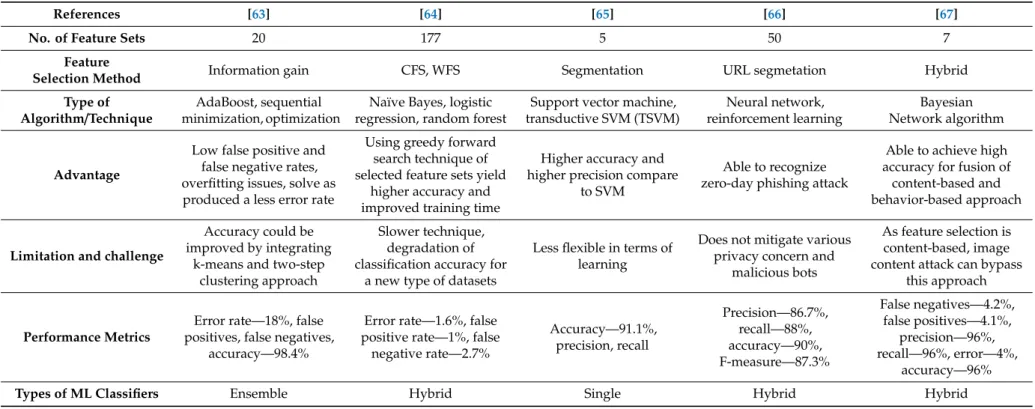
Phishing is a technique to steal personal and sensitive information of the victim by enticing the users to visit a fake email or web pages to mimic the victim’s own page visual identity. Phishing attacks cause damage to a victim’s personal and sensitive information by spoofing email [57], fake social network accounts [58] and hacking [59]. To detect phishing attacks, many approaches have been proposed such as DNS-based blacklist, automated individual whitelist, heuristic, and visual similarity and, ML-based techniques. Out of all these, MLbased techniques can automatically detect zero-hour attacks effectively on a large scale basis [60].
Xiao et al. [61] represent phishing attacks built on the semisupervised ML approach which is implemented on a transductive support vector machine. For the feature extraction of the web page, they used the document object model which also includes a gray histogram, color histogram and spatial relationship among the subgraph to leverage the phishing detection including some web image features. TSVM takes into consideration how the distribution information implicitly exhibits large quantity unlabeled datasets that provide effective performance as compared to SVM. In [62],
it was reported that solutions for discovering phishing attacks in the online mode, which are based on state-of-art techniques, suffer from lack of accuracy. Therefore, authors addressed this issue with the help of a neural network with reinforcement learning. In the preprocessing phase, features were selected from each header, email text, URL and HTML content which are given as an input to feature evaluation and reduction algorithm (FERA). This aims to decide a number of defense features to be applied to the classification process and also accelerates the adaption process in the neural network. The DNN is analyzed and online emails are classified. A reinforcement learning agent is used to acknowledge diversity in the online datasets and to provide a decision about legitimate or phishing emails. The proposed approach is shown to have a false positive rate of 1.8% and an accuracy of 98.6%.
Hamid et al. [63] formulated an approach for clustering techniques and email phishing detection profiling. In the feature selection, information gain is used to give weight to the attribute for a set of training feature vectors. For the profiling, a two-step clustering algorithm is developed to deal with a large set of data for handling continuous and categorical data. In the primary stage, profiles are generated based on the clustering algorithms’ prediction and therefore, a cluster represents the profile of elements in the prediction of phishing emails. In the second stage, profiles are employed to train the classification algorithm for predicting the unrecognized class labels from the input data. For emails categorization, AdaBoost and sequential minimal optimization algorithm are used which are ensemble type classifiers and, their performances vary different datasets and number of clusters.
Basnet et al. [64] discussed that the basic behavior of adversaries can be obtained through email headers. Email filtering is divided into two types: (1) content-based filtering and; (2) origin-based filtering. For feature selection, the authors used the wrapper-based feature selection method and the correlation-based feature selection method. For searching into the feature subset within the time constraint, as a result, they have presented a greedy forward search and genetic algorithm. They showed that the wrapper-based feature selection method is slower related to correlation-based feature selection while wrapper-based feature selection methods have better accuracy over the classifiers as compared to the correlation feature selection method. The mentioned techniques with types of feature selection sets can be bundled up into the classifiers that are shown in Table5.
Table 5. Analysis of phishing detection techniques (notations: feature extraction and reduction, CFS- correlation-based feature selection, WFS- Wrapper Feature Selection).
References [63] [64] [65] [66] [67]
No. of Feature Sets 20 177 5 50 7
Feature
Selection Method Information gain CFS, WFS Segmentation URL segmetation Hybrid
Type of Algorithm/Technique
AdaBoost, sequential minimization, optimization
Naïve Bayes, logistic regression, random forest
Support vector machine, transductive SVM (TSVM) Neural network, reinforcement learning Bayesian Network algorithm Advantage
Low false positive and false negative rates, overfitting issues, solve as produced a less error rate
Using greedy forward search technique of selected feature sets yield
higher accuracy and improved training time
Higher accuracy and higher precision compare
to SVM
Able to recognize zero-day phishing attack
Able to achieve high accuracy for fusion of
content-based and behavior-based approach
Limitation and challenge
Accuracy could be improved by integrating
k-means and two-step clustering approach
Slower technique, degradation of classification accuracy for
a new type of datasets
Less flexible in terms of learning
Does not mitigate various privacy concern and
malicious bots
As feature selection is content-based, image content attack can bypass
this approach
Performance Metrics
Error rate—18%, false positives, false negatives,
accuracy—98.4%
Error rate—1.6%, false positive rate—1%, false
negative rate—2.7% Accuracy—91.1%, precision, recall Precision—86.7%, recall—88%, accuracy—90%, F-measure—87.3% False negatives—4.2%, false positives—4.1%, precision—96%, recall—96%, error—4%, accuracy—96%
3.3. Privacy Preservation
The prime objective of an ML technique is to extract the needful information from the data by its classifiers while preserving privacy by masking/hiding the sensitive data from the adversary [68]. Therefore, there is a need to balance these aspects while sensitive data is to be mined. To analyze the vulnerabilities in the privacy-preservation, several researchers have proposed attacking techniques such as minimal attacks, background knowledge attacks [69], additive data perturbation and homogeneity attacks. To combat the types of attacks, many approaches such as l-diversity [70], t-closeness [71], k-anonymity [72] and double-blinding [73] are represented by the researchers. Even with these types of approaches, one is not able to prevent the adversaries who already have knowledge about the datasets. As a result, it is imperative to protect data during the training phase in the ML techniques which are used for privacy-preserving.
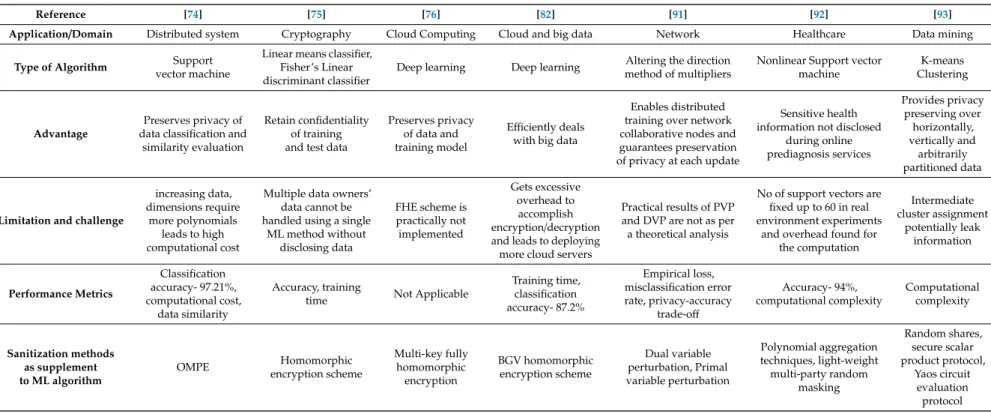
Jia et al. [74] proposed a model that preserves privacy in ML for distributed systems. It is unreasonable for a distributed system to share the datasets between classifiers due to privacy concerns. The proposed approach prevents the leakage of private information from the learned model to other collaborative entities. This work also focuses on the confidentiality of the learning data before processing. To ensure that data classification is performed successfully without exposing to the tester, oblivious evaluation of multivariate polynomial approach is applied to the SVM classifier. In [75], the authors presented an ML algorithm in which estimations are considered as a function of the input data which can be proclaimed as polynomials of the bounded degree. Therefore, classification and training are carried out homomorphically on encrypted data. Table6reviews the performance of this scheme. With the quick evolution and wide-spread applications of cloud computing [76], research works have been published to build an outsourcing computation system over the cloud. However, how to securely outsource the computation to the cloud is a major challenge. Different solutions have been proposed which address this issue [77–80]. In the research of ML, Li et al. [76] discussed theoretical aspects of privacy in the sense of data privacy and privacy in the training model using deep learning. There is also a great need to focus on the computational cost of data owners to keep it to minimal. To preserve privacy when multiple actors engage in the deep learning model, before uploading data to the cloud, a multi-key fully homomorphic encryption (MK-FHE) scheme is proposed. Consequently, the authors proposed an advanced scheme, hybrid multi-key deep learning training system, which uses double decryption and fully homomorphic encryption (FHE). The training phase is executed over the ciphertext under a different public key. Therefore, a theoretical cloud model is able to train a deep learning model privately with additions and multi-functions which are semantically secure. Though the homomorphic cryptography has many important applications in operation for ciphertext and authentication [6,81,82], the efficiency is still a challenge for its practical applications. In [83], it is also proposed that to preserve privacy in the cloud, a deep computation model can be used for the purpose of big data feature learning. To protect sensitive data, the model uses Brakerski–Gentry–Vaikunathan scheme which provides encryption to the private data. This scheme is implemented to the cloud server in order to effectively enumerate the high order backpropagation algorithm to the encrypted data for the model training.
The sigmoid function is processed by the proposed technique as a polynomial function to help secure enumeration of the initiation function of the Brakerski–Gentry–Vaikunathan (BGV) scheme. The results of the illustrated method depict a 1% to 2% higher error rate and less accuracy as compared to the non-privacy preserving deep learning computational model. There are also some other related works that addressed the privacy protection issue in classification [84–87]. Because of the inefficiency problem with cryptographic solutions, there are also several related works presenting more efficient techniques including differential privacy [88–90].
Table 6.Performance comparison of the classifiers [75].
Time for Classifying Test Vector
Classifier Computing Time in
the Training Stage
Time for Data Encryption in the
Training Stage LM classifier
(encrypted data)
Constant with number of
training vector increases Grows linearly Grows linearly Fisher’s Linear
Discriminant classifier (encrypted data)
Constant with number of
training vector increases Grows quadratically Grows linearly
Zhang et al. [91] address a type of regularized observational risk minimization ML problem. The authors presented that alternate direction method of multiplier approach enables distributed training over the network and exchanges the result with its neighbors. During the exchange, the adversary can easily evade the sensitive data which can be protected by using dual variable perturbation and primal variable perturbation in order to guarantee the dynamic differential privacy. Furthermore, the authors showed the trade-offbetween accuracy and privacy. Accuracy is decreased as the privacy requirement increases further. In [92], the authors illustrated the use of the SVM privacy-preserving online medical pre-diagnosis framework. The model resides with the service provider with the main objective that when a query is received from the query engine, privacy and accuracy should not be compromised in response. To achieve this objective, the model uses non-linear SVM with lightweight polynomial aggregation techniques and multi-party random masking techniques. The computational and communicational overhead of the framework needs to be more efficient and suitable for medical pre-diagnosis services.
The authors in [93] proposed a privacy-preserving protocol using k-means clustering which provides cryptographic privacy protection for arbitrarily partitioned data. With the proposed method, two parties can be able to share their data in the arbitrary partition and able to learn k-means clustering of the shared data without exposing their data to each other. The output of the algorithm assigns 1 to k cluster numbers to each object. Both the parties learn the assignments if the bject is shared, otherwise, the assignment is given to the party to which the object belongs to. When the algorithm halts, the final mean of every cluster is shared by both the parties which then learn absolute final centers. Table7 presents the review of privacy-preserving techniques and the type of sanitization methods aligned with the ML algorithm as a supplement to preserve privacy in an existing application.
Table 7.Review of Privacy Preserving techniques (Notations: OPME-Obvious Evaluation of Multivariate Polynomial, BGV-Brakerski-Gentry-Vaikunathan).
Reference [74] [75] [76] [82] [91] [92] [93]
Application/Domain Distributed system Cryptography Cloud Computing Cloud and big data Network Healthcare Data mining
Type of Algorithm Support
vector machine
Linear means classifier, Fisher’s Linear discriminant classifier
Deep learning Deep learning Altering the direction method of multipliers
Nonlinear Support vector machine
K-means Clustering
Advantage
Preserves privacy of data classification and
similarity evaluation
Retain confidentiality of training and test data
Preserves privacy of data and training model
Efficiently deals with big data
Enables distributed training over network collaborative nodes and guarantees preservation of privacy at each update
Sensitive health information not disclosed
during online prediagnosis services Provides privacy preserving over horizontally, vertically and arbitrarily partitioned data
Limitation and challenge
increasing data, dimensions require
more polynomials leads to high computational cost
Multiple data owners’ data cannot be handled using a single
ML method without disclosing data FHE scheme is practically not implemented Gets excessive overhead to accomplish encryption/decryption and leads to deploying more cloud servers
Practical results of PVP and DVP are not as per a theoretical analysis
No of support vectors are fixed up to 60 in real environment experiments
and overhead found for the computation Intermediate cluster assignment potentially leak information Performance Metrics Classification accuracy- 97.21%, computational cost, data similarity Accuracy, training
time Not Applicable
Training time, classification accuracy- 87.2% Empirical loss, misclassification error rate, privacy-accuracy trade-off Accuracy- 94%, computational complexity Computational complexity Sanitization methods as supplement to ML algorithm OMPE Homomorphic encryption scheme Multi-key fully homomorphic encryption BGV homomorphic encryption scheme Dual variable perturbation, Primal variable perturbation Polynomial aggregation techniques, light-weight multi-party random masking Random shares, secure scalar product protocol, Yaos circuit evaluation protocol
3.4. Spam Detection
In the past few years, research interest has been increased for web-based services and systems, social networking and social media that incorporate large-scale data [94]. Several detection techniques have been proposed based on their classification. In [95], the authors proposed a technique to avoid spam distribution. Several algorithms, such as content-based spam detection [96], link-based spam detection [97], trust-based detection in IoT [98], real-time spam detection [99] and click spam detection [100] were proposed for spam detection. Spam detection systems have humongous data to be analyzed which involve multi-dimension attribute space with probably thousands of dimensions and is vigorous by nature [101]. ML grants tickets due to the adaptive capability to learn the patterns for classification of spam and no spam [102]. In Table8, we review some machine learning-based spam detection techniques.
Chen et al. [103] represented ML streaming spam tweet detection technique which fills the gap between data feature and model by deriving performance evaluation. To collect the streaming tweets the author’s used streaming application interface (APIs) with universal resource locator (URL) which provide 1% access to all public tweets and thus, collected 600 million tweets with the URL. To check whether the URL is malicious or not for labeling trend, Micro Web Reputation Services are used. For the feature set preparation, user-based and tweet-based features are extracted. As mentioned in Table8, distinct types of ML algorithms are used for performance evaluation and analysis of the impact of increasing training data, the impact of different sampling methods, the investigation of time-related data in the form of detection rate and the average values of features.
Meanwhile, the authors in [104] presented a semi-supervised approach to detect the tweet spam which uses ensemble classifiers. In the framework, four classifiers perform the task with each having a different method to detect the spam. Classifier 1 uses a blacklist domain detector that checks URL with the use of questions filter. Classifier 2 analyzes the similarity of the tweet with the use of clusters and obtains spam and ham tweets. Classifier 3 uses a reliable ham tweet detector which conducts a content analysis of the posted tweets and text in it. Classifier 4 is preferred for increasing accuracy. The final labeling using classifier 4 is done as follows:
ltwo 4 <−min MKNN(two) MNB(two) MLR(two) , (1) where whereltwo
4 =final label of classifier 4,two=tweet under observation,M
KNN=k-nearest neighbor model,MNB=Naive Bayes model,MLR=logistic regression.
At least two models should have the same label to identify a tweet as a ham or spam. After the final decision is taken using a majority voting approach, the database is updated in the framework. To make an update more adaptive and efficient, Markov bound-based update model is implemented. As per the results of the comparison between classifier1 to 4, classifier 2 has a higher precision rate and, classifier 4 has a higher recall rate and F1 score among all the classifiers.
Table 8.Review of existing spam detection. Techniques.
Reference [103] [104] [105] [106] [107]
Type of ML Algorithm
Random Forest C4.5, Naïve Bayes, KNN Bayes
Network, SVM
KNN, Naïve Bias,
Logistic Regression Neural Network
Multinomial Naïve Bayes, SVM, KNN, Random Forest Adaboost with
a decision tree
SVM
Advantage Enables real-time spam detection
Framework collects timely updates in an effective
and adaptive manner
Detect deceptive review spam by linguistic and
behavioral features
Reduces the overall error rate
Classifiers can be easily retrained as characters
and tactics of sploggers changes
Limitation
Require continuous training and updating
the data sets in order to maintain detection accuracy
As the framework is tested for tweeter only,
other social media platform results may differ as features change
Proposed approach is compared with
off-the-shelf classification algorithms
Due to the lack of real database of SMS a chance
of under performance during the classification
Continuous updating of the feature sets is required
Performance Metrics Precision, recall, F-measure—93.6% Precision—94%, recall—87.66%, F score—88.11% Precision—88.9%, recall—91.3%, F values—90.1% Spams caught—94.47%, blocked ham, accuracy—98.88% Threshold probability, accuracy—95%
Wang et al. [105] explored linguistic and behavioral features to detect the spams. This model’s attention-based neural network model detects the review spam by distinguishingly using linguistic and behavioral features. In the feature extraction module, both behavioral features and linguistic feature vectors are calculated. The feature attention module calculates weighted feature vectors which are used to predict the spam probability. In [106], the authors presented an approach to detect the spam from short message service (SMS) using ML algorithms. For the detection and classification, a total of five models are used: (1) multinomial naïve Bayes; (2) SVM; (3) kth nearest neighbor; (4) random forest and; (5) AdaBoost with decision trees. As per the results, multinomial naïve Bayes spam detected 94.4% of spam which is the highest among all the five models. The block hams rate is 0.51% for Naïve Bayes and AdaBoost with decision trees. The accuracies are 98.88% and 98.86% of the multinomial Naïve Bayes and SVM respectively which are the highest compared to the other ML algorithms. The medium of spam through which it gets spread also performs a vital role in the detection with the use of ML algorithms. Therefore, we review the same for the existing works in Table8.
3.5. Risk Assessment
Risk assessment provides a comprehensive view of the existing organization or system to obtain risk consequences, security risk [108] and countermeasures to deal with them. According to [109], risk assessment techniques are divided into two types of risk: (1) qualitative risk and; (2) quantitative risk. Qualitative risk is realized from policy direction and quantitative information, stakeholder knowledge and the history lessons for the system, risk profile and impact [110]. The conclusion derived from the qualitative assessment is more comprehensive and intellectual. Analytical hierarchy method [111], factor analysis method [112], a ranking method [110] and the delphi method [113] were proposed in the past for risk assessment. While quantitative risk is realized by the number of indicators such as probabilistic risk assessment [114], a number of induced equivalence profiles [115] also has a close connection with the system operability. Therefore, the result obtained by the quantitative risk assessment is more concise, clear and reliable. Correlation method [116], time series method [117] and cluster analysis [118] are the quantitative methods proposed by the researchers. Risk assessment using both the types of methods in the context of information security is subjective, vague and lacks the self-learning ability of the models which can be overcome by ML. In Table9, we show the type of risk associated with the existing approaches and which algorithm is used to address it.
Eminagaoglu et al. [119] survey information security-related risk with the use of ML to prioritize the risk. In the first step, they collect qualitative evaluation regarding risk in the institution. In this survey, a total of six assets, ten threats and nine vulnerabilities are included. Qualitative scores from the respondents are collected from the questionnaires and it is analyzed by the ML classifiers. Overall risk can be identified as ‘NO’ if the scale rank of the respondent is from one to three and ‘YES’ if the scale rank of the respondent is from four to five. Dataset is made of 12 attributes and 1920 instances for learning the binary classifiers. In [120], the authors develop a tool, called RISKMON, which assesses the risk of a mobile application and uses an SVM learning algorithm to assess the risk rank.
Guntamukkala et al. [121] proposed an automated scheme based on integrity which helps the users to obtain online privacy policies. A contextual corpus of the online privacy policies was developed by the authors for training and testing purposes. With the use of text mining and ML techniques, this scheme evaluates the completeness of the online privacy policies and assesses the risk quantitatively. In [122], the authors presented an ML-based mechanism for managing information security with the use of the security metrics model. This model is used to get the arithmetic values for the security level. The results of the model are used in manufacturers’ factories for assessing the security systems and for improving the controlling information risk. The authors in [123] proposed an ML-based approach to secure data in the cloud environment. In this approach, a Cloudsec module is used to reduce the risk of potential disclosure of the medical information. The SVM classifier is used to segment the image and data protection.
3.6. Malware Detection
In modern days, the most common method to launch attacks on modern computers, as well as network infrastructures are to use malware (worms, botnets, viruses, trojans). Antivirus software is the most common tools used to tackle different types of malware. To detect malware, three complementary, approaches are used: (1) signature-based detection; (2) anomaly-based detection and; (3) heuristics-based detection. Based on these three types of malware detection approaches we have analyzed in Table10.
The signature-based detection approach scans and evaluates the type of its information from the file and, maps that information to jargons of virus signature that resides in its repository [124]. In this approach, the code is put under observation and approximate runtime behavior/pattern is predicted to detect the malware. In the static approach, many detection mechanisms are proposed such as annotated context-free graph [125], disassembled code [126], portable executable binary code [127] and honeypots [128]. Using this technique dynamic analysis of the malware is difficult to conceal.
The anomaly-based detection approach detects the malware by inspecting its runtime behavior. Techniques such as file print using n-gram [129], dynamic executable files [130], audit logs [131], function calls [132] and alert correlation framework [23] are used to detect malware based on its behavior. This approach can recognize only the presence of malware after malware code has been executed. Detection of the zero-day malware using this approach is difficult to achieve.
Heuristics-based detection uses ML and data mining techniques for malware detection. This approach overcomes the disadvantages of both the above malware detection approaches. This approach addresses the automatic monitoring of malware behavior and attempts to achieve the desired goal of detection. In the heuristics-based classification, two types of approaches can be identified: (1) clustering of behavior [133] and; (2) classification of behavior [134]. Das et al. [135] proposed an approach to capture malicious behaviors based on high-level semantics. The authors proposed a model based on benign patterns and system call patterns which generates the feature sets of known malware. Field programmable gate arrays allow the sharing of hardware for classifiers and runtime detection. Classifiers are used to identify the unknown samples of malware and benign software. In [136], the authors proposed a mechanism which identifies a malicious application on smartphones. This mechanism, in the static analysis phase, extracts different feature sets from the applications manifest and dalvik executable code, as mentioned in Table10.
Gavrilut et al. [137] proposed an approach in which feature sets are enumerated for each binary file during training and testing datasets. In the ML framework, features are mapped into one side perceptrons and kernelized into one side perceptron. The F1 and F2 scores are used to combine the feature selection and training the ordinary size datasets containing the clean files and malware. In [138], the authors proposed an approach to identify malicious behavior based on the virtual memory access patterns in terms of a function call and system call. For system calls, the feature is selected using the F-score and topmost 10 percentage of F-score features for the training. Memory access in each function call is restricted to some memory, concluding in histograms with less than non-zero bins, which are used to train the classifiers.
Table 9.Review of risk assessment schemes.
Reference [119] [120] [121] [122] [123]
Type of ML Algorithm Random Forest, J48,
K-Nearest Neighbor SVM
Linear SVM, K-Nearest
Neighbor, Random Forest SVM
SVM, Fuzzy c-means clustering
Scheme Importance
Quantifiable risk assessed in a robust
and reliable way
Automatically measure the risk induced
by the user
Automated techniques to enumerate the integrity of the privacy policy and notifying the users about
the important sections
Leads towards effective assistance and assessment
to improve controlling information risk
Secure environment in cloud without revealing
sensitive data
Limitation
Fuzzification, statistical, the numerical method can improve the performance
Doesn’t address third-party applications, unauthorized access possible Low degree of transparency may generate ambiguous results
Approach is designed for a single organization
Pixel texture feature can be added to enhance image segmentation
Performance Metrics Accuracy—100% Risk score Accuracy—75% Classifier Margin Accuracy
Type of Risk Qualitative Risk Qualitative Risk Quantitative Risk Quantitative Risk Qualitative Risk Types of risk
Identification
Security risk of
the institution Android mobile app risk Privacy Policy Risk Information risk
Disclosure of medical information Table 10.Malware Detection Analysis (Notations: LR-Logistic Regression, SMO-Sequential Minimal Optimal, MLP- Multi-Layer Perceptron).
Reference [135] [136] [137] [138] [139]
Type of ML Algorithm J48, naïve bayes, SVM,
LR, SMO, MLP Linear SVM
Cascade one-sided perceptron, Cascade kernelized one-sided
perceptron
Random Forest, Logistic
Regression, SVM SVM
Advantage Able to get the high-level semantics of the malware
Able to protect user to install the application from an untrusted source
Non-stochastic version of algorithm enables parallelized training
process to increase the speed
High detection accuracy against the kernel level
rootkits and user level memory corruption report
Able to identify unknown families and behavior which are not present in
Table 10.Cont.
Reference [135] [136] [137] [138] [139]
Limitation Unable to detect kernel rootkits
When new code is loaded dynamic triggering
is not possible
Accuracy is less when scaling up with the
large datasets
For entire programme, Epochhistogram size should be chosen carefully
which requires human effort
Relies on single program execution of malware binary
Performance Metrics
False positive rate, false negative rate, Accuracy- 99.7%
False detection, missing detection, accuracy- 93%
Sensitivity measure value, specificity measure value, accuracy measure
value-88.84%, True positives, false positives False positives, true positives Accuracy- 88%, confusion matrix Type(s) of Malware detected Backdoors, exploits, user-level rootkits, exploit,
flooder, hack tools, net-Worm, Trojan, virus
Fake installer, DroidKungfu, Palnkton,
opfake, GingerMaster, BaseBridge, Iconosys, Knim, FakeDoc, Geinimi,
Adrd, DroidDream, LinuxLottor, GoldDream,
MobileTx, FakeRun, Sendpay, Gappusin,
Imlog, SMSreg
Backdoor, hack Tool,
rootkit, Trojan, worms Root kits Worm, backdoors, trojans
Type of features employed to the classifiers for detection
Memory, network, file system, process- related
system calls
Suspicious API calls, requests permissions, application components, filtered intents, network
addresses, hardware features, used permission,
restricted API calls
Binary type feature set
Architectural events, memory address,
instruction mix
Frequency of contained string, string features
(name & list of key-value pairs)
3.7. Testing Security Properties
Security properties play a key role in any distributed systems such as military infrastructure, banking, e-commerce, safety-critical autonomous systems, mobile ad-hoc and more [140]. Many analysis and modeling techniques have been proposed to make sure the correctness of the security protocol. These works aimed at validating the protocol specifications. A report [141] shows that errors and bugs during programming are common in the security-critical system which is to be identified and addressed properly. Therefore, automatic test drafting and proper execution methods are enticing to test real-time response and protocols in the security flaws. In addition, black-box testing is also another approach to verify specification and conformance of the protocol implementation, automation and formal modeling [142]. Existing testing techniques depend on human insights and, their skills and strategies, while traditional techniques do not deal beyond what is detailed in the specifications. With the use of ML, accurate testing of the properties would be possible. Vardhan et al. [143] proposed finite a state machine communicating over unbounded first-in–first-out (FIFO) channels with the use of an ML technique in order to verify the safety properties. The idea of the approach is to learn the set of reachable states rather than computing them by assigning transition relations.
ML techniques learn the reachable first states and then verify the safety properties by checking the unsafe states in the reachable states. In the case that the arrangement of states learned closed under the change connection infers. The scholarly arrangement of states contains every single reachable set which does not contain any unsafe state, at that point, it is inferred that framework fulfills the security properties. For learning positive and negative samples, RPNI algorithm [144] is used. Shu et al. [145] proposed a new ML technique to automatically test protocol implementation security characteristics. The security protocol model is a symbolic parameterized extended finite-state model and, message confidentiality is a property to be investigated with the help of this model. If the attacker can obtain a confidential message with the use of prior knowledge, there is a security violation of the proposed model. The goal of the message confidentiality testing is to discover the security contravention with the help of black-box testing. At the time of testing a component of the model is kept under test and so is the anticipated behavior of the component. The behavior is represented in terms of finite state machine (FSM) trace which calculates the estimation, and updates based on the learning algorithm that covers the target implementation. After forming the new estimation, the validation algorithm is executed which calculates the reachability of the graph and searches for the security violation. If the violation is confirmed in the security properties that means false positive introduced and experiment trace on the black box and if the trace is confirmed then it will be a FAIL claim. If no violation is found and evaluation is similar to the black box, the process terminates with the PASS result. In [146], the authors presented a formal fuzz testing and ML-based communication protocol for security flaws detection. Authors adopt the FSM protocol model and examine two conventional techniques for the protocol synthesis: (1) active black box-checking algorithm; (2) passive trace minimization algorithm. As discussed earlier, the behavior of FSM is updated as more traces are covered by the supervised ML algorithm. To take control of input–output (I/O), a proxy has been developed which connects the client to the server. In the login phase, the model has been synthesized with the protocol involving approximately 50 states and 70 transitions. The aim of the fuzzy function is to search the series of inputs that crash the client process.
4. Review of Adversarial Attacks on Machine Learning 4.1. Machine Learning Vulnerabilit

![Table 6. Performance comparison of the classifiers [75].](https://thumb-us.123doks.com/thumbv2/123dok_us/351090.2538638/16.892.138.756.161.315/table-performance-comparison-of-the-classifiers.webp)