Proceedings of the Society for Computation in Linguistics
Volume 2
Article 27
2019
Augmentic Compositional Models for Knowledge
Base Completion Using Gradient Representations
Matthias R. Lalisse
Johns Hopkins University, [email protected]
Paul Smolensky
Johns Hopkins University, [email protected]
Follow this and additional works at:
https://scholarworks.umass.edu/scil
Part of the
Computational Linguistics Commons
This Paper is brought to you for free and open access by ScholarWorks@UMass Amherst. It has been accepted for inclusion in Proceedings of the Society for Computation in Linguistics by an authorized editor of ScholarWorks@UMass Amherst. For more information, please contact [email protected].
Recommended Citation
Lalisse, Matthias R. and Smolensky, Paul (2019) "Augmentic Compositional Models for Knowledge Base Completion Using Gradient Representations,"Proceedings of the Society for Computation in Linguistics: Vol. 2 , Article 27.
DOI: https://doi.org/10.7275/8et8-qd83
Augmenting Compositional Models for Knowledge Base
Completion Using Gradient Representations
Matthias Lalisse
Dept of Cognitive Science
Johns Hopkins University
Baltimore, MD USA
Paul Smolensky
Dept of Cognitive Science
Johns Hopkins University
& Microsoft Research AI
Seattle, WA USA
Abstract
Neural models of Knowledge Base data have typically employed compositional rep-resentations of graph objects: entity and relation embeddings are systematically combined to evaluate the truth of a can-didate Knowedge Base entry. Using a model inspired by Harmonic Grammar, we propose to tokenize triplet embeddings by subjecting them to a process of op-timization with respect to learned well-formedness conditions on Knowledge Base triplets. The resulting model, known as Gradient Graphs, leads to sizable improve-ments when implemented as a compan-ion to compositcompan-ional models. Also, we show that the “supracompositional” triplet token embeddings it produces have in-terpretable properties that prove helpful in performing inference on the resulting triplet representations.
1
Introduction
As they are conventionally analyzed, representa-tions of semantic or linguistic data are “composi-tional”: the meanings of complex representations are built up from the meanings of their constituent parts. This idea has motivated numerous models of graph data deployed in knowledge base com-pletion (KBC), in which embeddings of entities and relations are combined into composite repre-sentations—pairs of entities in a particular rela-tion with one another—that are built up system-atically from the constituent parts. But what hap-pens when the whole is not a simple function of the parts? A natural case arises in the interpre-tation of Noun-Noun compounds. The contrasting senses ofvampire cat(a-cat-that-is-a-vampire) and
vampire stake (a-stake-used-to-kill-a-vampire) has as much to do with the compatibility of the con-tituent nouns occurring in a given relation than with the meanings of the individual constituents.
Pursuing this line of thought, we propose Gra-dient Graphs, a neural network model for
KBC built on the principle that compositionally-obtained representations of semantic objects can be optimized to reflect context-specific aspects of the meanings of their constituents. The issue of context-conditioned, tokenized semantic represen-tations has received little explicit attention in the KBC literature. However, precedents do exist.
Bordes et al.(2011) model context-sensitive entity senses by embedding relations as pairs of matrices (Rlhs, Rrhs) that linearly transform entity
embed-dings into pairs of embedembed-dings defined by the rela-tion and the entities’ posirela-tions within it (the left-hand-side or right-left-hand-side). The distances of the resulting embeddings are then compared. Socher et al.(2013) cope with the context-sensitivity of re-lation meanings by learning ak⇥d⇥d-dimensional tensor embeddings for each relation, letting their model represent polysemy by learningkversions of the relation represented in thek slices of its em-bedding tensor. The intuition underlying this ap-proach is that, for instance, the relationhas part has a di↵erent sense when applied to a biologi-cal organism than when predicated of a company. While the former has parts like organs and limbs, the latter has parts like subsidiaries and workers, which occupy very di↵erent parts of the seman-tic space. Each relational slice is then responsible for learning the compatibility of arguments within particular semantic subspaces.
In contrast to these other works, our approach is more radical in the sense that our context-sensitive representations of knowledge base entries are not just computed from the entries’ constituent ele-ments (entity and relation embeddings), but are instead the result of a representation-optimization procedure that balances compositionally-derived representations with general knowledge about the characteristics of well-formed semantic structures. We show that this additional “supracomposi-tional” processing, in addition to yielding siz-able accuracy improvements over the composi-tional models we apply it to, leads to embeddings of entity tokens with interpretable characteristics.
257
Proceedings of the Society for Computation in Linguistics (SCiL) 2019, pages 257-266. New York City, New York, January 3-6, 2019
1.1 Layout of the paper
Section 2 lays out the general framework, which is compatible with a variety of implementations. Section 3 presents two compositional embedding models proposed in the literature. We adapt these models to construct compositional embeddings, and in Section 4 report evaluations of Gradient versions of these models. Section5 discusses the characteristics of the resulting semantic represen-tations in greater detail, as well as their role in assisting inference. Section6concludes. Technical details about the model and the implementations are given in the Appendices.
2
Optimization of semantic tokens
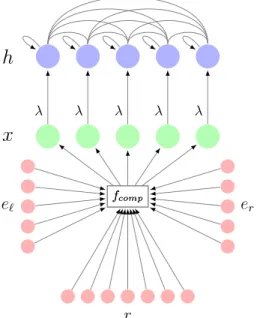
fcomp fcomp
x
h
e
`e
rr
Figure 1: Gradient Graph as a recurrent neural network. In addition to bias terms (omitted in the figure) and self-connections, hidden units are densely connected to one another via a layer of con-nections with symmetric (undirected) weights, and receive constant input weighted by from a single unit in the input layer. The composition function fcomp(e`, r, er), which di↵ers between
implementa-tions, computes acompositional embeddingx, which is fed into a hidden layer h of the work. The continuous-time dynamics of this net-work compute an internal representation ˆhof the input triplet that is optimal with respect to the Harmony(1)—a measure of the triplet’s semantic well-formedness.
The hypothesis underlying the approach we pro-pose is that noncompositional e↵ects in knowledge base data can be modeled by subjecting candi-date facts to a process of optimization with respect to a set of learned semantic coherence conditions.
These semantic coherence conditions, encoded in a symmetric matrix, map out the covariance struc-ture of the semantic space, indicating which seman-tic features are likely to co-occur with one another. The embedding of a given triplet is then the vector obtained by optimizing the semantic coherence of the the triplet embedding.
We first lay out the model in abstract form, be-fore introducing particular implementations. Let x2Rdbe ad-dimensional embedding of a
knowl-edge base triplet (e`, r, er) obtained as some
func-tion fcomp—the composition function—of the
embeddings of the left and right entities as well as the relationr. Section3provides several mod-els for constructing the triplet embeddingx. Also, lethbe ad-dimensional vector giving the internal (“hidden”) state of the network. TheHarmony of an internal stateh of the network with respect to the triplet embeddingxis
(1) H(h, x) =1 2
⇥
h>Wh+b>h (h x)>(h x)⇤ whereWis ad⇥dweight matrix withW=W>
andb is a bias vector, both learned. (1) is com-posed of two terms: Core Harmony, a measure of the semantic coherence of the state vector h, andFaithfulness, a penalty incurred due to the stateh’s deviation from the compositional triplet embeddingx. is a hyperparameter that controls the magnitude of the penalty incurred for straying fromx.
H(h, x) may be rewritten as(2). (2) H(h, x) = 1
2[h>(W I)h+ (b+ 2 x)>h
x>x)]
If is greater than the largest eigenvalue of W, thenV =W I is negative-definite, andH(h, x) has a unique global optimum ˆh= argmaxhH(h, x) for eachx. In closed form, this global optimum is (3) µ(x) = 1
2V 1(b+ 2 x)
which depends only on the network parameters and onx. The expression µ(x) comes from observing that ˆhis the mean of a Gaussian distribution with inverse covariance matrixV, which implies that ˆh is the most probable statehof the network with re-spect to the probability distribution over the state space defined byp(h|x) / exp{H(h, x)}(see Ap-pendix A). We take the token embedding for a triplet x to be µ(x), which is the most semanti-cally coherent triplet embedding given the compo-sitional tripletx. In the limit as ! 1,µ(x) is justxitself. Let W denote the largest eigenvalue ofW; then as ! W,µ(x) becomes independent of the triplet embeddingx.
A Gradient Graph may be viewed as a neural network with weight matrixWand bias vector b
2,
where the synaptic weights Wspecify a feedback layer through which the values of the hidden state units a↵ect one another. The construction is as follows. We stipulate that the hidden state of the network follows the gradient of Harmony over time: (4) dh dt = @H(x,h) @h Therefore, dhi dt = d dhi 1 2 h h>Wh+b>h kx hk2i = d dhi 1 2 2 4X jk hjWjkhk+bihi (xi hi)2 3 5 =1 2 2 4X j hjWji+ X k Wikhk 3 5+bi 2 + xi hi The above specifies the connectivity of a network whose hidden units have the linear transfer func-tion (f(input) = input), bias 2b and external in-putx(weighted by ). Eachhi also receives
self-inhibitory input weighted by , as well as inputs Wijhj from eachhj. The symmetry ofW implies
that each term Wijhj = hjWji occurs twice, so
that the factor of 1
2 cancels. This connectivity
structure is illustrated in Figure1.
2.1 Relation to Harmonic Grammar
In addition to being globally optimal with respect to the Harmony function H(h, x) conditioned on a particular input x, µ(x) is the unique fixed point of this network’s state-evolution dynamics. It is interesting to note that such networks are the connectionist foundation for Harmonic Gram-mar (HG) and Optimality Theory (OT) in Lin-guistics (Smolensky and Legendre, 2006), where the dynamics of a neural network perform opti-mization over internal representations of an input structure. Appropriate output representations are then selected in accordance with well-formedness constraints encoded in the network parameters. There, the output representation balances Faith-fulness to the input (an Underlying Form) and the network’s knowledge about the characteristics of well-formed structures in general.
Similarly, it is appealing to conceptualize the hidden layer of a Gradient Graph network as clean-ing up a knowledge base triplet by subjectclean-ing it to semantic well-formedness conditions. The optimal tripletµ(x) is then the point to which the network converges in the limit of infinite computation time. However, our model di↵ers from typical implemen-tations of HG and OT in that the optimal struc-ture µ(x) does not, in general, decompose into a unique combination of the input constituents (en-tity and relation embeddings). The resulting rep-resentations are in this sense gradient, rather than
being the product of a combination of discrete ob-jects. Furthermore, Gradient Graphs are, to our knowledge, the first application of these ideas to the automatic learning of an appropriate semantic optimization function from a large amount of data.
2.2 Comparison with translation-based approaches
Like a large class of Translation-based models (Bordes et al.,2011;Yoon et al.,2016;Lin et al.,
2015;Ji et al.,2016), our inference procedure con-sists of the application of an affine transformation to an inputx(Equation(3)), which is then scored using some regular operation. In our case, this scoring function is quadratic. A particular close cousin is the bilinearSemantic Matching En-ery(SME) method ofBordes et al.(2014), which learns a global third-order tensor W that, when dotted along the third mode with a relation embed-dingr, yields a relation-specific matrixWr. Along
with learned left and right bias vectorsb` sndbr,
this weight matrix is fed into the bilinear scoring function(5):
(5) scoreSME(e`, r, er) =
(Wre`+b`)>(Wrer+br)
Expanding out this expression, we get(6). (6) e`>Wr>Wrer+b`>Wrer+br>Wrel+b`>br
The relation-specific bilinear formWr>Wr is, like
our globalW matrix, symmetric. The remaining terms, apart from the constant b`>br, compute a
pair of relation-specific bias vectors b`>Wr and
br>Wr applied to the pair of entity embeddings.
The resulting Energy function used to score triplets has more than a passing similarity to our Harmony function(1)when =1and, thus, no optimiza-tion takes place.
A distinctive characteristic of our approach in relation to these structurally similar models is that the transformation undergone by a Gradient Graph triplet is directly connected to the well-formedness criterion according to which triplets are evaluated in inference. As illustrated in the Discussion, our transformation of a compositional triplets using learned well-formedness criteria leads to two kinds of triplet embeddings: composition-ally obtained type embeddings, and contextually optimized token embeddings. In qualitative and quantitative analyses of the learned representation, we see (1) that the space of compositionally ob-tained triplet embeddings has a reasonable struc-ture, independently of the optimizing transforma-tion, that is already sensitive to the context sup-plied by the relation, and (2) that semantic op-timization improves these compositional represen-tations in recognizable ways. Interestingly,
proving triplets with respect to the Harmony func-tion doesnotuniformly place them in regions that are high-Harmony in a global sense. In fact, we find that whereas positive triplets end up close to other positive triplets, plausible but negative triplets tend to be detained in clusters with other negative instances (Tables2and4).
3
Compositional and Gradient
Models
Optimization with respect to H can be imple-mented wherever we can construct a triplet em-bedding x. In our experiments, we apply Har-monic optimization of triplet representations to two compositional embedding models drawn from the knowledge base completion literature: Dist-Mult and HolE. Both models specify a scor-ing function for triplet embeddscor-ings obtained via operations applied to embeddings of the three triplet components—two entity vectors and a re-lation vector—with no additional learned com-ponents apart from these representations of the triplet constituents. We take the terms occurring in these scoring functions to be components of the
representation of the triplet, specifying what in-formation about the triplet elements is important to evaluating the triplet’s quality. Hence, we con-structed Harmonic triplet embeddings according to the desideratum that every term occurring in the basic method’s scoring function should also appear in the triplet representation x in the Harmonic model. For instance, the score of a DistMult triplet is a sum of three-way products of the corre-sponding elements of the embeddingse`,r, ander.
Setting the products [e`]i[r]i[er]i to appear in our
compositional triplet embeddings (as in Eqn(8)) satisfies this desideratum.
DistMult (Yang et al., 2015) is a baseline model for scoring knowledge base triplets using the scoring function(7):
(7) scoreDistMult(e`, r, er) =e`>diag(r)er
where e`, r, er are d-dimensional embeddings and
diag(r) is the d⇥d-dimensional matrix obtained by arranging the elements of r along the diag-onal. Kadlec et al. (2017) have recently shown thatDistMultcan outperform many more com-plicated scoring functions when hyperparameters are properly optimized, making it a strong baseline comparison for the method we propose. In addi-tion,DistMultoften occurs as a subcomponent in state-of-the-art KBC models—e.g. (Schlichtkrull et al., 2017; Toutanova et al., 2015). From this starting-point, we construct Harmonic Dist-Mult(HDistMult) by setting the triplet embed-dingxto the elementwise multiplication of the re-lation and the pair of entity vectors:
(8) xHDM=e` r er
where denotes elementwise multiplication. Holographic Embeddings (HolE) were in-troduced byNickel et al.(2016) building on theo-retical work by (Plate, 1995), as a means of con-structing compressed tensor product representa-tions of relational triplets. The method computes the score for a triplet (e`, r, er) from the similarity
between a relation vector and the circular corre-lation e`? er of the entity vectors and a relation
vector:
(9) scoreHolE(e`, r, er) =r>(e`? er)
where the circular correlation ofe`ander is
com-puted as(10). (10) e`? er=F 1
⇣
F(e`) F(er)
⌘
F andF 1denote the Fourier Transform and its
inverse, and F(e`) is the complex conjugate of
F(e`).1 Circular correlation is asymmetric (e`?
er6=er?e`)—allowing it to model asymmetric
rela-tions—and the result of the operation has the same dimensionality as the input vectors, while still car-rying information about which pair of entities was bound together via correlation.
We construct Harmonic HolE (HHolE) triplet embeddings via elementwise multiplication of relation vectors with the correlated pair of entity vectors:
(11) xHHolE=r (e`? er)
In both Harmonic models, the score for a can-didate triplet (e`, r, er) with embeddingxis
calcu-lated by taking the Harmony of its optimal instan-tiation, ˆh=µ(x), i.e.
(12) score(x) =H(µ(x), x)
In the experiments, we train our networks using the log-softmax objective with negative sampling. For each positive training example (e`, r, er) with
embedding x, we construct N negative examples (˜en
`,˜rn,e˜nr) obtained by deleting either the left or
right entity of the true triplet and replacing it with a randomly sampled entity vector. Let ˜xn denote
the embedding of thenth negatively sample triplet
1
The Fourier transform decomposes a function of time into its frequency components. In the context of holographic embeddings, its utility comes from the
Convolution Theorem, which states that convolution in the time domain corresponds to elementwise multipli-cation in the frequency domain. This is useful in actual computations. The circular correlation—which con-sists of convolution with a time-reversed signal—can also be computed as a sum over o↵-diagonals of the tensor product of vectors, with time complexityO(d2).
In contrast, the Fast Fourier Transform (FFT) has time complexityO(nlogn) (Nickel et al.,2016).
(˜en
`,˜rn,e˜nr). The training objective is then to
min-imize(13):
(13) LH(e`, r, er) =
logexp{H(µ(x),xexp)}+{HPN(µ(x),x)}
n=1exp{H(µ(˜xn),x˜n)} This has the e↵ect of increasing the Harmony of positive examples relative to negative sam-ples. The learning rule is thus Harmony-maximizing: the network parameters maximize the well-formedness of the positive examples relative to negative samples.
4
Experiments
We evaluated Gradient Graphs using the stan-dard WN18 and FB15K datasets (Bordes et al.,
2013)—which are subsets of the WordNet (Miller,
1995) and Freebase (Bollacker et al., 2008) databases—on the Entity Reconstruction task. In Entity Reconstruction, the network ranks comple-tions of triplets (·, r, er) and (e`, r, ·) with deleted
left and right entities. The model is successful if it ranks the true triplet above other candidate com-pletions. We report results in thefiltered evalua-tion setting (Bordes et al., 2013), in which a test triplet is only ranked against triplets that do not occur in the database. The rank of a test triplet is thus the rank of the first correct answer to the query. For both DistMult and HolE, we port the originally reported results alongside re-sults for our reimplementations, comparing these models with our Harmonic variantsHDistMult andHHolEwith and without optimization of hid-den layer representations. The Harmonic models with =1 have the Harmony functionH(x, x), i.e. where the hidden representation is just the compositional embedding itself and the Faithful-ness penalty in(1)is 0.
Our models used 256- to 512-dimensional em-beddings and manually tuned values of the hyper-parameter . In all models, entity and relation embeddings were normalized to kvk = 1. We do not regularize parameters, but instead set an up-per bound ✏(✏a small constant) on thel2norm
of the weight matrixW, which helps constrain the spectral norm (maximum eigenvalue) ofW to re-main lower than . This is equivalent to adopting a uniform prior on weight matrices lying within the n-ball with squared radius ✏. Importantly, this procedure keeps the matrixV =W I negative-definite—a necessary condition for the existence of a unique optimum forH(h, x).
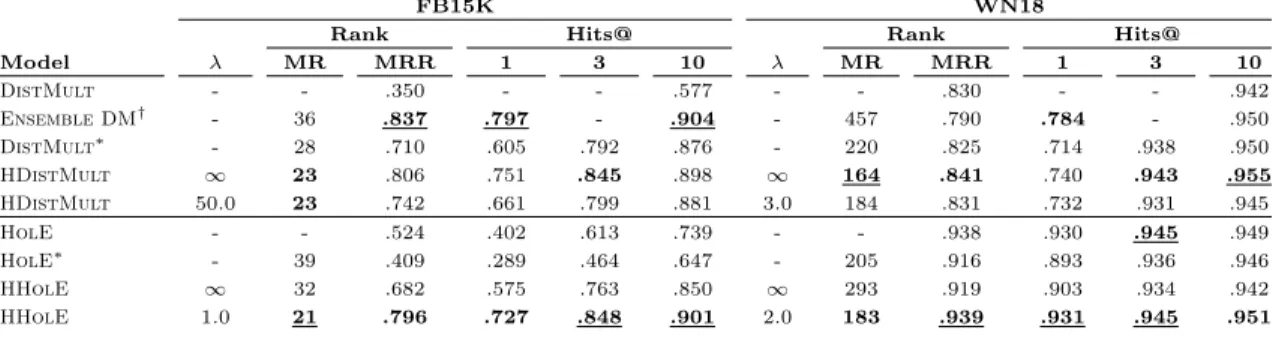
Results from the experiments are reported in Table 1. Overall, we found that models using our quadratic scoring function(1)to perform best across the board. This e↵ect was particularly seen in more stringent evaluation criteria—Hits@1 and
Hits@3—leading to, for instance—a 15% improve-ment in Hits@1 (accuracy) on Freebase between our DistMult reimplementation and quadratic HDistMult( =1). The bestDistMult mod-els were those with high values; however, within-model comparison of HolE shows dramatic im-provements from including the optimization com-ponent—a 32% increase in FB15K accuracy be-tween the results of (Nickel et al.,2016) and our HHolEwith a permissive -criterion of 1.0.
5
Discussion
In part, the appeal of our supracompositional rep-resentations stems from their ability to produce emeddings oftokens of semantic objects—that is, embeddings that take into account the context of a particular instance of a semantic type. Tok-enized embeddings have proven useful in various settings. For instance, Dasigi et al. (2017) con-struct token embeddings by superposing learned vectors for WordNet senses in ratios determined by a probability distribution computed from the context. The resulting representation is a context-weighted sum of discrete senses drawn from a hand-crafted ontology. Closer to our approach,Belanger and Kakade(2015) model text as a linear dynami-cal system that generates texts through transitions of a continuous-state, discrete-time dynamical sys-tem across time. Estimates of the syssys-tem’s most probable internal state can then be extracted as an embedding of the tokens, which prove useful in language modeling and other downstream tasks.
In our framework,typescorrespond to static en-tity and relation embeddings that are the input to fcomp, and the triplet embeddings resulting from
their combination. Token triplet embeddings are produced by optimization of the hidden layer of a GG. To understand the e↵ect of optimizing the hidden layer of a GGraph both on its learned representations and on its performance in infer-ence, we used the best-performing trainedHHolE model to produce token embeddings of database triplets in order to inspect their semantic neigh-borhoods. For a given compositional triplet em-bedding fcomp(e`, r, er) ⌘ x, we first computed
the optimized triplet representation µ(x) ⌘ ˆh using Equation (3). Treating ˆh as the contex-tually optimal (token) embedding of the triplet (e`, r, er), we then examined the semantic
neigh-borhood by computing the 5 closest optimized em-beddings in the context of the same relation. Table
4 shows the semantic neighborhoods of composi-tional tripletsxand optimized triplets ˆhfor di↵er-ent possible completions of a number of queries. Rows 1 and 2 display completions of the query ( · ,office position or title,US President), and Rows 2 and 4 consider the neighborhood of the entity embedding ofBob Dylan in the context of
FB15K WN18
Rank Hits@ Rank Hits@
Model MR MRR 1 3 10 MR MRR 1 3 10 DistMult - - .350 - - .577 - - .830 - - .942 Ensemble DM† - 36 .837 .797 - .904 - 457 .790 .784 - .950 DistMult⇤ - 28 .710 .605 .792 .876 - 220 .825 .714 .938 .950 HDistMult 1 23 .806 .751 .845 .898 1 164 .841 .740 .943 .955 HDistMult 50.0 23 .742 .661 .799 .881 3.0 184 .831 .732 .931 .945 HolE - - .524 .402 .613 .739 - - .938 .930 .945 .949 HolE⇤ - 39 .409 .289 .464 .647 - 205 .916 .893 .936 .946 HHolE 1 32 .682 .575 .763 .850 1 293 .919 .903 .934 .942 HHolE 1.0 21 .796 .727 .848 .901 2.0 183 .939 .931 .945 .951
Table 1: Results on FB15K and WN18. The results from the original DistMult and HolE models are drawn from (Yang et al.,2015) and (Nickel et al., 2016). Our reimplementations⇤ of
DistMultandHolEdi↵er in numerous details from those in the original papers (see Appendix B for technical details). Ensemble DistMult† refers to the hyperparameter-optimized Ensemble
(product of experts) reimplementation of DistMult proposed by Kadlec et al. (2017). For each model, we report Mean Rank (MR) and Mean Reciprocal Rank (MRR), as well as Hits@N for N 2 {1,3,10}. Hits@N denotes the fraction of test instances in which the true triplet completion had rank less than or equal toN. The best results within each category (DistMultandHolE) are marked inbold, and the best results overall are additionally underlined.
queries about his profession (e`=Bob Dylan, r=
has profession) while varying the professioner.
This illustrates how the representation ofBob Dy-lanvaries across his di↵erent professional guises.
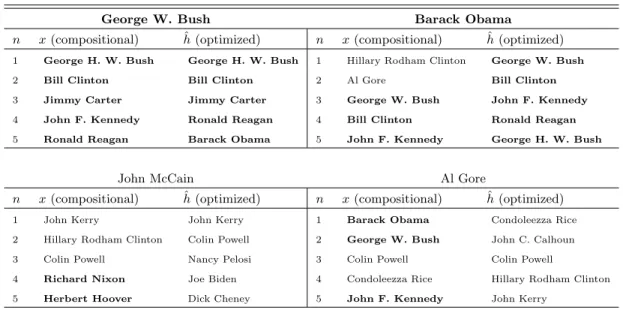
The table illustrates the utility of token embed-dings in inference. Token embedembed-dings ofGeorge W. BushandBarack Obama in the context of a query about their having held the office of U.S. president are in semantic neighborhoods with a greater den-sity of true instances of U.S. Presidents than their type embeddings. The negative examples John McCainandHilary Rodham Clintonhave type em-beddings that are close to actual presidents. This is sensible since, for instance, Hilary Rodham Clin-ton is married to Bill ClinClin-ton—one of her near-est neighbors. But both of the negative exam-ples’ token embeddings have neighborhoods that are mostly cleared of actual presidents—despite having type embedding neighborhoods that are rel-atively dense with presidents.
Turning to the second half of the table, we note that Bob Dylan’s type embedding is already in a neighborhood dense with singer-songwriters. It is appropriate, then, that this neighborhood undergoes no change apart from minor re-ranking when the triplet (Bob Dylan,has profession,singer-songwriter) is optimized. For more difficult cases, however, where Dylan is not a prototypical example, the semantic neighborhoods undergo dramatic reconfiguration. For instance, optimizing the triplet (Bob Dylan,has profession,disc jockey) correctly places Dylan in the neighborhood of other DJs, despite the implausibility of this associ-ation in the neighborhood of his type embedding, which contains no DJs. This places him in the token neighborhood of Moby, who is otherwise
quite unlikeBob Dylan except in respect of their common career as DJs.
Combined with our finding that optimization yields the most dramatic improvements in the more stringent evaluation criteria (Hits@1 and Hits@3), this suggests that our optimization procedure is particularly helpful in arbitrating between diffi-cult cases. This qualitative observation about the neighborhoods of compositional and supracompo-sitional triplets can be quantified. Using the triplet classification dataset introduced by Socher et al.
(2013), which contains an equal number of posi-tive and negaposi-tive triplets, we find (Table2) that positive triplets, on average, end up in supracom-positional neighborhoods that are more dense in positive examples than their compositional coun-terparts. On the other hands, negative triplets suf-fer a decrease in the number of positive triplets in the neighborhoods of their supracompositional em-beddings.
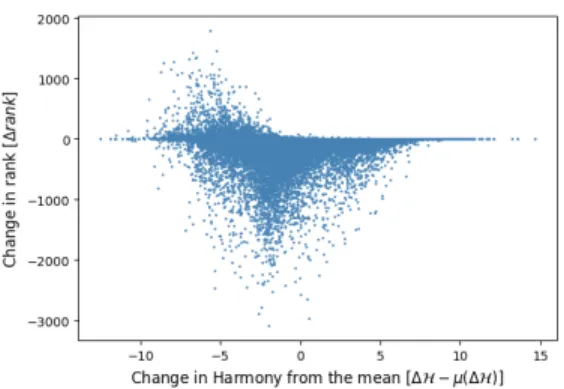
To further quantify the role of semantic opti-mization in inference, we correlated the di↵erence between the Harmony (score) of input triplets pre-and post-optimization with the change in its rank on the FB15K dataset. The change in Harmony is computed as H = H(µ(x), x) H(x, x), i.e. the di↵erence between the Harmony of the token embedding and the Harmony of the type embed-ding. This comparison is model-internal—it does not compare models trained to do token infer-ence with models trained for type inferinfer-ence. How-ever, it serves as a useful index of the performance gains attributable to the optimization procedure. If optimizing a triplet representation indeed im-proves its relative position among all candidate triplets, we expect changes in Harmony to be nega-tively correlated with the change in rank of positive
density tstatistic p
Pos 0.241 t= 99.7 p⌧10 10
Neg -0.059 t= 62.4 p⌧10 10
Table 2: Change in neighborhood (top-5 clos-est neighbors) density of true triplets ( density) for positive and negative triplets drawn from the triplet classification dataset introduced bySocher et al.(2013), which is derived from the FB15K test set and consists of 59,071 positive triplets and the same number of negative triplets. This resulted in N = 118,142 queries for both positive and nega-tive examples (two for each triplet, querying both the left and right entity). After computing each triplet’s neighborhood, we counted the number of triplet neighbors that were in fact in the training, validation, or test sets of FB15K, yielding a mea-sure of the concentration of true and false examples in the neighborhood of both type and token triplet embeddings.
triplets. Consistent with this, we find that opti-mization leads to significant improvements in raw rank in our best trained HHolE model (Spear-man’s ⇢ = 0.0157, p < 10 6, Figure 5). When
considering the change in Mean Reciprocal Rank, a more standard evaluation metric, we find that His positively associated with improvements in MRR ⇢=.1370, p⌧10 10 ,2 particularly when triplets whose ranks do not change at all are omit-ted ⇢=.3746, p⌧10 10 . In other words, when
semantic optimization makes a di↵erence, it does so for the better.
For HDistMult, H is significantly associ-ated with increases in the rank of true triplets ⇢= 0.1226, p⌧10 10 , a result consistent with
our finding that this class of models disprefers low settings of . This illustrates the importance of choices of representational format for embeddings of semantic data. Our optimization procedure can only operate over information that is contained in its compositional input. Hence, choices about how to combine the learned features of entities and rela-tions—i.e. about the manner of composition—are central to our framework.
5.1 Desiderata of a composition function
What factors a↵ect the success of semantic opti-mization in combination with a particular com-position scheme? We suspect that multiplicative interactions across embedding components—which are present in HHolE and absent in HDist-Mult—are essential for our optimization proce-dure to contribute helpfully to inference. Both
2 MRR is computed as MRR(µ(x)) MRR(x), i.e.
the di↵erence between the Mean Reciprocal Rank of the supracompositional and the compositional triplets.
Figure 2: E↵ect of optimization on the rank of FB15K validation set triplets (N = 100,000; 50,000 triplets with two queries per triplet) from the best-performingHHolEmodel (d= 512, = 1.0). The horizontal axis is a triplet’s change in Harmony pre- and post-optimiation ( H ⌘ H(µ(x), x) H(x, x)) minus the mean change in Harmony for all triplets (µ( H)). This is plot-ted against rankq(µ(x)) rankq(x), the triplet’s
change in rank due to optimization for queryq. A negative correlation indicates reductions in rank (improvements) associated with increasing opti-mization of triplet representations.
DistMult and HolE are special cases of con-tracted Tensor Product Representations (TPRs), obtained by summing over (HolE) or discard-ing (DistMult) terms from the three-way tensor producte`⌦r⌦er.3 In particular,DistMult
re-tains only multiplicative interactions within com-ponents, omitting terms with non-matching in-dices. This fact appears to be crucial. In a follow-up experiment, we implemented a series of full TPR models trained on FB15K, using the com-position operation(14):
(14) xHTPR=e`⌦r⌦er
Such models are necessarily small in size due to the rapid growth of dimensionality for TPRs as a function of the dimensionality of entity and re-lation embeddings. Consequently, their perfor-mance is also poor in comparison to our other im-plementations. However, the trend matched that which we observed within theHHolEclass: mod-els including the optimization procedure consis-tently outperformed those with =1(see Table
3). From this, we conclude that other embedding-based KBC models incorporating cross-component multiplicative interactions are likely to see im-provements from the addition of a semantic op-timization step prior to scoring.
3See (Nickel et al., 2016) for discussion of
holo-graphic embeddings as compressed tensor products.
MR MRR H@1 H@3 H@10
1 150 .278 .192 .305 .447 1.0 134 .295 .204 .326 .471 Table 3: Performance of HTPRmodels with and without optimization (controlled by ). For both models, entities were 5-dimensional and relations 20-dimensional. This trend held across other hy-perparameter settings.
6
Conclusion
In this paper, we proposed Gradient Graphs, a general method for augmenting compositional rep-resentations of Knowledge Graphs with a post-composition procedure that optimizes the well-formedness of triplet embeddings, highlighting the model’s connection to Harmonic Grammar and Optimality Theory. The resulting model shows marked improvements over the compositional mod-els it is implemented alongside, and also pro-duces triplet token embeddings with properties that prove useful for inference about knowledge base entities. In future work, we intend to explore the utility of semantically-optimized token embed-dings in other linguistic settings.
References
Abadi, M., Barham, P., Chen, J., Chen, Z., Davis, A., Dean, J., Devin, M., Ghemawat, S., Irv-ing, G., Isard, M., Kudlur, M., Levenberg, J., Monga, R., Moore, S., Murray, D. G., Steiner, B., Tucker, P., Vasudevan, V., Warden, P., Wicke, M., Yu, Y., and Zheng, X. (2016). Ten-sorflow: A system for large-scale machine learn-ing. InProceedings of the 12th USENIX Confer-ence on Operating Systems Design and Imple-mentation, OSDI’16, pages 265–283, Berkeley, CA, USA. USENIX Association.
Belanger, D. and Kakade, S. (2015). A linear dy-namical system model for text. In ICML 32, volume 37.
Bollacker, K., Evans, C., Paritosh, P., Sturge, T., and Taylor, J. (2008). Freebase: A col-laboratively created graph database for struc-turing human knowledge. InProceedings of the 2008 ACM SIGMOD International Conference on Management of Data, SIGMOD ’08, pages 1247–1250, New York, NY, USA. ACM. Bordes, A., Glorot, X., Weston, J., and Bengio, Y.
(2014). A semantic matching energy function for learning with multi-relational data.Machine Learning, 94(2):233–259.
Bordes, A., Usunier, N., Garcia-Duran, A., We-ston, J., and Yakhnenko, O. (2013). Translating embeddings for modeling multi-relational data.
In Burges, C. J. C., Bottou, L., Welling, M., Ghahramani, Z., and Weinberger, K. Q., editors,
Advances in Neural Information Processing Sys-tems 26, pages 2787–2795. Curran Associates, Inc.
Bordes, A., Weston, J., Collobert, R., and Bengio, Y. (2011). Learning structured embeddings of knowledge bases. InAAAI.
Dasigi, P., Ammar, W., Dyer, C., and Hovy, E. (2017). Ontology-aware token embeddings for prepositional phrase attachment. In ACL55, pages 2089–2098.
Ji, G., Liu, K., He, S., and Zhao, J. (2016). Knowl-edge graph completion with adaptive sparse transfer matrix. InAAAI-16, pages 985–991. Kadlec, R., Bajgar, O., and Kleindienst, J. (2017).
Knowledge base completion: Baselines strike back. In 2nd Workshop on Representation Learning for NLP, pages 69–74.
Kingma, D. and Ba, J. (2015). Adam: A method for stochastic optimization. InICLR.
Lin, Y., Liu, Z., Sun, M., Liu, Y., and Zhu, X. (2015). Learning entity and relation embed-dings for knowledge graph completion. InAAAI, pages 2181–2187.
Ling, X. and Weld, D. (2012). Fine-grained entity recognition. InAAAI 26.
Miller, G. A. (1995). Wordnet: A lexical database for english. Commun. ACM, 38(11):39–41. Nickel, M., Rosasco, L., and Poggio, T. (2016).
Holographic embeddings of knowledge graphs. InAAAI.
Nickel, M., Tresp, V., and Kriegel, H.-P. (2011). A three-way model for collective learning on multi-relational data. InProceedings of the 28 th In-ternational Conference on Machine Learning. Plate, T. (1995). Holographic reduced
representa-tions. IEEE Transactions on Neural Networks, 6:623–641.
Schlichtkrull, M., Kipf, T. N., Bloem, P., Berg, R. v. d., Titov, I., and Welling, M. (2017). Model-ing relational data with graph convolutional net-works. arXiv preprint arXiv:1703.06103. Smolensky, P. and Legendre, G. (2006). The
Harmonic Mind: From Neural Computation to Optimality-Theoretic Grammar, volume 1: Cog-nitive Architecture. The MIT Press.
Socher, R., Chen, D., Manning, C. D., and Ng, A. (2013). Reasoning with neural tensor networks for knowledge base completion. InNIPS. Toutanova, K., Chen, D., Pantel, P., Poon, H.,
Choudhury, P., and Gamon, M. (2015). Rep-resenting text for joint embedding of text and knowledge bases. In EMNLP. ACL – Associa-tion for ComputaAssocia-tional Linguistics.
US Presidents
George W. Bush Barack Obama
n x(compositional) ˆh(optimized) n x(compositional) ˆh(optimized)
1 George H. W. Bush George H. W. Bush 1 Hillary Rodham Clinton George W. Bush 2 Bill Clinton Bill Clinton 2 Al Gore Bill Clinton 3 Jimmy Carter Jimmy Carter 3 George W. Bush John F. Kennedy 4 John F. Kennedy Ronald Reagan 4 Bill Clinton Ronald Reagan 5 Ronald Reagan Barack Obama 5 John F. Kennedy George H. W. Bush
John McCain Al Gore
n x(compositional) ˆh(optimized) n x(compositional) ˆh(optimized)
1 John Kerry John Kerry 1 Barack Obama Condoleezza Rice
2 Hillary Rodham Clinton Colin Powell 2 George W. Bush John C. Calhoun
3 Colin Powell Nancy Pelosi 3 Colin Powell Colin Powell
4 Richard Nixon Joe Biden 4 Condoleezza Rice Hillary Rodham Clinton 5 Herbert Hoover Dick Cheney 5 John F. Kennedy John Kerry
Guises of Bob Dylan
Singer-Songwriter Screenwriter
n x(compositional) ˆh(optimized) n x(compositional) ˆh(optimized)
1 Eric Clapton Bonnie Raitt 1 John Lennon John Lennon 2 Bonnie Raitt Eric Clapton 2 Jimi Hendrix Barbara Streisand 3 Van Morrison Van Morrison 3 Barbara Streisand Eric Idle
4 B.B. King B.B. King 4 Eric Clapton Nick Cave 5 Bob Seger Bob Seger 5 Eddie Vedder Alan Bergman
Disc Jockey Writer
n x(compositional) ˆh(optimized) n x(compositional) ˆh(optimized)
1 Tom Petty Steven Van Zandt 1 John Lennon Alanis Morissette
2 Warren Zevon Erykah Badu 2 Alanis Morissette John Lennon
3 Willie Nelson Alice Cooper 3 Paul McCartney Leonard Cohen
4 John Mayer John Mayer 4 Tina Turner Leonard Bernstein
5 Steve Earle Moby 5 Dolly Parton Prince
Table 4: Semantic neighborhoods of type (pre-) and token (post-optimization) triplets output by the best-performing HHolE model (d = 512, = 1.0). US Presidents: E↵ect of optimization on the semantic neighborhoods of entity embeddings in the context of the query (·,office title,US President). Guises of Bob Dylan: E↵ect of optimization on the semantic neighborhood of Bob Dylanin the context of four queries about hisprofession: Bob Dylan as singer-songwriter, screenwriter, disc jockey, and writer. Bob Dylan is a positive instance of each of these professions in FB15K. For each entity, we retrieved the 5 closest (Euclidian Distance) compositional triplet embeddings, as well as the five closest triplets, among all candidate triplets, when all these candidates are optimized. Triplet completions that in fact occur in FB15K are marked inbold. Human-readable entity names were retrieved from a mapping between Freebase machine IDs and names of Wikipedia articles built byLing and Weld(2012). See main text for discussion of the results.
Yang, B., Yih, W., He, X., Gao, J., and Deng, L. (2015). Embedding entities and relations for learning and infer- ence in knowledge bases. In
ICLR.
Yoon, H., Song, H., Park, S., and Park, S. (2016). A translation-based knowledge graph embedding preserving logical property of relations. In Pro-ceedings of NAACL-HLT, pages 907–916.
7
Appendix A: Model details
(15) Claim: µ(x) = 12(W I) 1(b+ 2 x) is
the unique global optimum forH(h, x) for any fixedx.
We define the Harmony of hidden statehwith re-spect to triplet embeddingxas in(1):
H(h, x)⌘12⇥h>Wh+b>h (h x)>(h x)⇤ =1 2 ⇥ h>(W I)h+ (b+ 2 x)>h x>x⇤ ⌘12⇥h>V h+m(x)>h x>x⇤
Completing the square yields: H(h, x) =1 2 "✓ h 1 2V 1 m(x) ◆> V ✓ h 1 2V 1 m(x) ◆# +1 2 x>x 1 4m(x) >V 1 m(x) ⌘12h(h µ(x))>V(h µ(x))i+`(x)
This is valid because V = W I is symmet-ric. `(x) does not depend on h, so it is sufficient to optimize 1 2 h (h µ(x))>V (h µ(x))i. Setting @H(h,x) @h = 0 yields 2V(h µ(x)) = 0;)h=µ(x).
SinceV is negative-definite, this point is a maxi-mum.
The truth of the claim may also be perceived from observing that H(h, x) defines a Gaussian distribution over the hidden state variablehwith meanµ(x) and inverse covariance matrix ⌃ 1⌘V.
The optimality ofµ(x) then follows from the uni-modality of Gaussians.
The training objective(13) may be justified by the following considerations. We take the com-positional triplet data to be generated by hidden states of the gradient graph network, and maxi-mize the log probability of the training data us-ing the maximum a posteriori point estimate of the hidden stateh. The “complete data” are then D ={hˆh, xi} = {hµ(x), xi}. For fixedx, H(h, x) models the conditional distributionp(h|x), with (16) p(h|x) = exp{HZ((xh,x) )}
where Z(x) = Rh0exp{H(h0, x)}dh0 = |2⇡V 1|1
2exp{`(x)} is the partition function
conditioned on x. Let q = {x0} be the set of
candidate triplet embeddings consistent with a given queryq. Choosing the discrete distribution p(x) = P exp{`(x)}
x02 qexp{`(x0)}
over triplet embeddings as the prior probability of the embeddingx, we have that:
p(µ(x), x|q)/ exp{H(µ(x), x)} |2⇡V 1|1
2P
x02 qexp{`(x0)} For given parameters, the denominator is con-stant. So, renormalizing over the discrete triplets
q gives:
p(µ(x), x|q) = P exp{H(µ(x), x)}
x02 qexp{H(µ(x), x)} Approximating the discrete distribution over all of
qwith a negative sample yields the objective(13).
8
Appendix B: Implementation
details
In initial experiments, we searched through a num-ber of candidate models. These included two Har-monic variants of theRescalmodel (Nickel et al.,
2011), as well as models that constructed x as a simple concatenation of entity and relation vectors, as well as three-way tensor products of these vec-tors. These initial experiments led us to focus on DistMultandHolEas the best-performing can-didates. Our Harmonic models and reimplementa-tions of theDistMultandHolEbaselines were written in TensorFlow (Abadi et al.,2016) and esti-mated using the Adam optimizer (Kingma and Ba,
2015). With the exception of theHolE reimple-mentation, we uniformly used the log-softmax loss
(13), which performed best in initial experiments. In contrast,Yang et al.(2015) use a margin-based ranking loss that is linear in the margin between the scores of positive and negative examples up to a threshold, andNickel et al.(2016) use the pairwise linear margin loss applied to the scores squashed by the logistic function. ForHolE, we used the
linearmargin loss, which provided by far the best performance in the experiments. For each model, we trained until performance on the validation set decrease, then chose the best-performing embed-ding size from amongd 2 {256,512}. Batch size (512), negative sampling rate (500), and learning rate (0.001) were kept constant across models. We note in passing that regions of the hyperparame-ter space forDistMultexplored byKadlec et al.
(2017) were inaccessible to us for technical reasons. For the Harmonic models, we manually tuned the
hyperparameter.