Timing of Information Presentation and the
Acquisition of Complex Skills
Interuniversitair centrum voor onderwijsonderzoek
ISBN: 90-9017127-4
Druk: Datawyse Maastricht Omslag: Yvo de Ruiter
© Liesbeth Kester, Heerlen, 2003 Alle rechten voorbehouden.
Timing of Information Presentation and the Acquisition of Complex
Skills
PROEFSCHRIFT
ter verkrijging van de graad van doctor aan de Open Universiteit Nederland
op gezag van de rector magnificus prof. dr. ir. F. Mulder
ten overstaan van een door het
College voor promoties ingestelde commissie in het openbaar te verdedigen
op vrijdag 5 september 2003 te Heerlen om 16:00 uur precies
door Liesbeth Kester
Promotor:
Prof. dr. J. J. G. van Merriënboer, Open Universiteit Nederland Co-promotor:
Prof. dr. P. A. Kirschner, Open Universiteit Nederland Overige leden beoordelingscommissie:
Prof. dr. A Renkl, Universität Freiburg
Prof. dr. J. C. M. M. Moonen, Universiteit Twente Prof. dr. W. H. Gijselaers, Universiteit Maastricht Dr. F. Paas, Open Universiteit Nederland
Voorwoord
And now for something completely different (Monty Python, 1972), zoiets moet ik
gedacht hebben toen ik 30 juni 1999 mijn spullen pakte bij de ABN, in de trein stapte naar Maastricht en de volgende dag mijn Aio-carrière bij de Open Universiteit begon. Het was gelijk feest want juist die dag aanvaardde Jeroen het ambt van hoogleraar in 'Onderwijs Technologie' aan de OU. Dit was voor mij een aangename kennismaking met het academische wereldje dat de komende vier jaar mijn thuis zou zijn.
Inmiddels zijn deze vier jaar alweer voorbij en ligt er een proefschrift getiteld 'Timing of information presentation and the acquisition of complex skills' dat niet tot stand zou zijn gekomen zonder de begeleiding, de hulp, het advies, de gezelligheid, de betrokkenheid en belangstelling van een heleboel mensen.
Allereerst Jeroen en Paul, ik heb met heel veel plezier met jullie samengewerkt en kijk glimlachend terug op onze bijeenkomsten waarin toch eigenlijk altijd wel wat te lachen viel. Jullie vormen een grappig contrast. Jeroen, hoewel ik het me nog als de dag van gisteren kan herinneren dat je één keer, naar eigen zeggen, toch wel een beetje teleurgesteld was in het werk dat ik had geleverd (oei, dat kwam hard aan), heb je me eigenlijk altijd het vertrouwen gegeven dat het wel goed zat. Bedankt voor dit vertrouwen en voor je niet aflatende commentaar op al mijn stukken. Ik heb veel aan je gehad. Paul, jij ging heel anders te werk, naast wat prikkelende,
psychologische zwemles, heb jij mij over menig dipje van faalangst heen geholpen. Ook jou wil ik bedanken voor je vertrouwen en natuurlijk voor de informele
assertiviteitstrainingen. Bovendien heb je me, met je aan genialiteit grenzende invallen, regelmatig uit een impasse getrokken, waarvoor dank.
Hannelore, jij bent me tot enorme steun geweest bij het uitvoeren van mijn eerste experiment in Gent. Heel erg bedankt voor al je raad en hulp! Ik zie ons nog gaan over de Vlaamse wegen waar we in menig file verzeild zijn geraakt. Als onervaren chauffeur was ik vaak nog nerveuzer over de autorit naar Gent dan over de experimentele sessie van die dag. Ook wil ik Katy Goeminne en Willy Hanssens bedanken voor hun medewerking vanuit het Monitoraat FPPW van de Universiteit van Gent en de Gentse psychologie en pedagogiek studenten die mee hebben gedaan aan dit onderzoek. Tot slot, mijn dank aan Ronald en Andrea, de student-assistenten die mij geholpen hebben bij het scoren van de testformulieren.
Ivo, jou heb ik leren kennen als gedreven en enthousiast docent. In de eerste plaats bedankt voor de mogelijkheid die je me geboden hebt mijn tweede en derde experiment uit te voeren met leerlingen van het Sintermeerten college en voor je optreden als inhoudsdeskundige en medeontwikkelaar van het leermateriaal. Ik weet dat je voor het derde experiment alles uit de kast hebt gehaald om leerlingen te
overtuigen zich in te schrijven, dankzij jou is het gelukt genoeg proefpersonen bij elkaar te sprokkelen, waarvoor dank. Deze leerlingen, die gedurende een aantal weken in het najaar van 2001 en het voorjaar van 2002 naar het lab op de eerste verdieping van Chiba zijn gekomen om hun best te doen op de experimentele
ICT-technisch bijgestaan door twee Wimmen, Slot en van der Vegt, die ervoor
hebben gezorgd dat ik mijn gegevens kon verzamelen en bewaren, hartelijk bedankt. Verder bedank ik de collega's die tijdens de parallelle experimenteer sessies hebben opgetreden als surveillant en mijn student-assistenten Femke, Anne en Renée voor het goede werk dat ze hebben geleverd.
Het laatste experiment vond plaats op het Bernardinus College. Robert Bouwens en collega's, ik wil jullie hartelijk bedanken voor de gelegenheid die jullie mij geboden hebben op jullie school te experimenteren en voor het inpassen van mijn experiment in het lesrooster. Stan Wilden en collega's, bedankt voor de technische ondersteuning tijdens het uitvoeren van het experiment en leerlingen van
Bernardinus, bedankt dat jullie de tijd hebben genomen alle problemen in de
elektrische schakelingen naar eer en geweten op te lossen. Anne (nogmaals) en Hans bedankt voor jullie werk aan het ordenen van de ruwe gegevens.
Fred, als enig actief lid van mijn begeleidingscommissie wil ik je bedanken voor je interesse in mijn stukken en je bereidheid er altijd nog even naar te kijken. Het was aan jou altijd wel toevertrouwd nog wat kritische noten toe te voegen aan de noten die ik inmiddels al met Paul en Jeroen gekraakt had. Iedereen uit de
onderzoeksgroep bedank ik voor de waardevolle inhoudelijke discussies die zij met mij gevoerd hebben gedurende mijn Aio-traject. Leden van het secretariaat bedankt voor jullie ondersteuning. Yvo, bedankt voor het ontwerpen van de omslag, ik ben erg blij met het resultaat.
Mijn sociale welzijn heeft een net zo belangrijke rol gespeeld bij het
gereedkomen van dit proefschrift als mijn 'wetenschappelijke welzijn' daarom wil ik tot slot nog even stil staan bij de mensen die in dat opzicht de afgelopen vier jaar belangrijk voor me waren.
Allereerst Dominique en Huib, ik zal nooit vergeten hoe jullie JW, Angela en mij verwelkomd hebben toen we pas begonnen. Door jullie voelde ik me snel thuis. Ik ben blij dat we vrienden zijn geworden en dat jullie mijn paranimfen wilden zijn! Dominique, met jou kan ik lachen en huilen en het blijft leuk met jou van alles en nog wat door te nemen, ik hoop dat we nog lang vriendinnen en collega's zullen blijven. Huib, met jou kan ik eigenlijk vooral veel lachen en ik hoop dat we dat, zij het op afstand en met de nodige miscommunicaties, nog lang blijven doen.
José en Hannelore, een prettige bijkomstigheid van mijn Aio-schap is dat ik jullie heb ontmoet. Ik heb genoten van jullie gezelschap gedurende diverse etentjes bij één van ons thuis. José, ik zal je er niet voor bedanken want daar hou je niet van maar je geeft me het gevoel dat ik altijd bij je terechtkan met wat dan ook. Hannelore, ook ik heb natuurlijk van je fameuze kookkunsten genoten maar ook van je
zorgzaamheid waar je me vaak genoeg mee omringd hebt.
Rob en Doyna, ik denk met plezier terug aan de etentjes die we samen hadden, vooral de laatste waarbij jullie gekookt hebben in onze oude keuken. Rob, bedankt voor al het mannenwerk dat je voor me hebt opgeknapt. Doyna, bedankt voor je hartelijkheid en gastvrijheid en uiteraard voor het mogen lenen van jouw Rob toen ik nog geen eigen Rob had. Roger, bedankt voor het verzorgen van Freek en
Sjaak zodat ik ook nog eens bij familie en vrienden in 'Holland' op bezoek kon! Wilco en Pascal, nog nooit is een verhuizing soepeler verlopen dan mijn verhuizing van Maastricht naar Heerlen, waarvoor hulde. JW, jouw aandeel hierin is natuurlijk ook niet uit te vlakken, mijn dank. Alle OTEC-Aio's, ganggenoten, Iwan, Frans en Bas dankzij jullie is het hier altijd gezellig. Veronica en Liset, we kennen elkaar al vanaf de middelbare school en ik ben blij dat onze vriendschap niet alleen de jaren maar ook de afstand overleefd heeft. Liesbeth, naamgenoot en tante, bedankt voor je niet aflatende belangstelling voor mij en natuurlijk mijn avonturen in het Nederlandse schoolsysteem.
Na het kopen van een huis in Brunssum en mijn aanstelling als
onderwijstechnoloog aan de OU is het inmiddels wel duidelijk dat mijn verblijf hier in het zuiden wel wat langer gaat duren dan de geplande vier jaar. Sorry, pap, mam en Han, ik weet, dit was niet de afspraak maar het vlees is zwak. Bedankt voor alles, jullie betekenen veel voor me en ach, we moeten niet overdrijven, het is maar
tweeënhalf uurtje rijden (in de auto althans) en wat is nu tweeëneenhalf uur op een mensenleven...
Tsja, en wat betreft dat mensenleven... Rob, dat ga ik lekker met jou delen in ons prachtig verbouwde huis!
Contents
Chapter 1 – An introduction to just-in-time information presentation ... 1
Chapter 2 - Just-in-time information presentation and the acquisition of
complex cognitive skills ... 10
Chapter 3 - Timing of information presentation in learning statistics... 21
Chapter 4 - The optimal timing of information presentation during
mastering a complex skill in science... 34
Chapter 5 - The split attention effect in computer simulated
troubleshooting of electrical circuits ... 51
Chapter 6 - Just-in-time information presentation: Improving transfer
performance and learning efficiency of a complex troubleshooting skill64
Chapter 7 – General discussion ... 81
References ... 88
Appendix 1 ... 94
Appendix 2 ... 96
Summary... 98
1
Chapter 1 – An introduction to just-in-time information presentation
1 AbstractThis thesis focuses on just-in-time information presentation during complex cognitive skill acquisition. In this introductory chapter an instructional design model is presented that forms the constructing framework for the just-in-time information presentation model presented in Chapter 2. Modern instructional theories stress authentic, realistic tasks or problems as the driving force for learning, but due to the complexity of those tasks learning may be hampered by the limited processing capacity of the brain. The theoretical and practical implications of the instructional design model presented here, as well as, different strategies for just-in-time information presentation to manage cognitive load, are discussed. Furthermore, a brief overview is given of the rest of the thesis.
Introduction
Modern instructional theories tend to focus on real-life tasks as the driving force for learning (Merrill, 2002; Reigeluth, 1999; van Merriënboer & Kirschner, 2001). The general assumption is that such learning tasks or practice problems help learners to integrate the knowledge, skills and attitudes necessary for effective performance; give them the opportunity to learn to coordinate constituent skills that make up complex performance, and eventually enable them to transfer what is learned to their daily life or work settings. This focus on authentic, realistic tasks can be found in practical educational approaches, such as project-based education, the case method, problem-based learning, and competency-based learning; and in theoretical models, such as Collins, Brown and Newman's (1989) theory of Cognitive Apprenticeship Learning, Jonassen's (1999) theory of Constructive Learning Environments, Nelson's (1999) theory of Collaborative Problem Solving, and Schank's theory of Goal Based Scenario's (Schank, Berman, & MacPerson, 1999).
A severe risk of all these approaches is that, especially novice, learners have difficulties learning from the tasks because they are overwhelmed by the task complexity. This is due to the fact that working memory capacity is limited and exceeding this capacity hampers learning (Baddeley, 1992; Miller, 1956; Sweller, 1988). To avoid this, cognitive overload of working memory should be avoided. Cognitive load theory (Sweller, 1988) provides guidelines to accomplish this goal. Three types of cognitive load are distinguished: intrinsic cognitive load, extraneous cognitive load and germane cognitive load. Intrinsic cognitive load is inherent to the task itself and is determined by the degree of element interactivity of the task. High element
interactivity requires the learner to process several elements and their relationships simultaneously in working memory in order to carry out the task or solve the problem. Low element interactivity allows the learner to serially process a small
1 This chapter is partly based on: Van Merriënboer, J. J. G., Kirschner, P. A., & Kester, L. (2003). Taking the
2 number of elements at a time (Sweller, Van Merriënboer, & Paas, 1998). Extraneous
cognitive load is inherent to the design of the instructional material and arises from processes that a learner engages in during task performance which are not directly
beneficial to learning. For instance, searching for relevant information sources, combining different information sources in order to understand the learning
material, or weak-method problem solving yield extraneous cognitive load that uses up cognitive resources at the cost of learning processes. Germane cognitive load is also inherent to the design of the instructional material but arises from processes that a learner engages in that are beneficial for learning. For instance, attending to
important features of the task or problem (Van Merriënboer, Schuurman, De Croock, & Paas, 2002), or carrying out a variety of learning tasks so as to construct more general and abstract cognitive schemata (Spiro, Coulson, Feltovich, & Anderson, 1988; Sweller et al., 1998) causes germane cognitive load. With a given intrinsic cognitive load, well-designed learning material minimizes extraneous cognitive load and optimizes germane cognitive load within the thresholds of totally available cognitive resources.
The aim of this introductory chapter is to discuss managing cognitive load when realistic learning tasks or practice problems are used in education. First, an instructional design model for complex learning is described. Second, methods for just-in-time information presentation are discussed, including timely presentation of information to support practice on realistic tasks and the direct, step-by-step
presentation of procedural information. These methods are expected to manage cognitive load in an effective way.
A Design Model for Complex Learning
Over the last decade, van Merriënboer (1997; van Merriënboer, Jelsma & Paas, 1992; van Merriënboer, de Croock & Clark, 2002; van Merriënboer, Clark & de Croock, 2002) developed an instructional design model for complex learning. This four-component instructional design model (4C/ID-model) presupposes that well-designed learning environments for complex learning always consist of four components, namely: (1) learning tasks, (2) supportive information, (3) procedural information, and (4) part-task practice. In Figure 1a, learning tasks are represented as circles and organized in an ordered sequence of task classes (dotted lines) that
represent simple-to-complex versions of the whole task (i.e., realistic problems). These learning tasks will typically be performed by the learners in a simulated or real task environment and, ideally, confront them with all constituent skills that make up the whole complex skill. Furthermore, and as indicated by the shaded areas of the circles, each task class starts with one or more learning tasks with a high level of embedded support, continues with learning tasks with a lower level of support, and ends with conventional tasks without support. This is repeated for each subsequent task class, yielding a saw-tooth pattern of support throughout the whole training program.
3
A. Scaffolding whole task practice
B. Just-in-time information presentation
C. Whole task practice
Figure 1. Schematic representation of a training blueprint for complex learning that is fully consistent with cognitive load theory.
The second and third components are depicted in Figure 1b and pertain, in order, to supportive and procedural information. The supportive information (indicated by the gray, L-shaped figures) is presented in a just-in-time fashion to work on the—variable, non-routine aspects of—learning tasks within the same task class. The learning tasks within the same task class are equivalent in the sense that they may be performed on the basis of the same, general knowledge (i.e., mental models and cognitive strategies that allow one to perform a version of the task with a particular complexity). For each subsequent task class, additional supportive
information is presented to enable the learners to perform the more complex version of the whole task. The procedural information (indicated by the vertical black
arrows), in contrast, is presented just-in-time to perform the consistent, routine aspects of the learning tasks. It preferably takes the form of direct, step-by-step or 'how-to' instruction and is quickly faded away for subsequent learning tasks.
The fourth component, part-task practice, is indicated in Figure 1c. This
component is related to a shift from a task to a part-task paradigm. The whole-task approach that is characteristic of our framework and other modern instructional theories implies that routine aspects of performance are not trained separately but only practiced in the context of 'whole' learning tasks. In general, an over-reliance on part-task practice is not helpful to complex learning. But if a very high level of
4 provide enough practice to reach this level because the responsible learning process, strengthening (Anderson, 1993, 1996), requires large amounts of not available
repetition. For those aspects, additional part-task practice may be provided – such as children drilling multiplication tables or musicians practicing music scales.
According to the 4C/ID-model, additional part-task practice only starts after the learners have been introduced to the routine aspects in the context of the learning tasks, so that part-task practice takes place in a fruitful cognitive context that allows learners to identify the activities that are required to integrate the routines in the whole task (Carlson, Khoo & Elliot, 1990).
This thesis is restricted to the components 2 and 3, namely supportive and procedural information, and predominantly concerns the just-in-time presentation of these information types (see Figure 1b).
Just-in-Time Information Presentation
Learners need relevant task-specific information to perform the learning tasks and to learn from them. If, for example, students are confronted with a learning task
requiring them to find relevant research literature for the first time, they need information on how to approach this task (e.g., select one or more appropriate databases, formulate a search query, perform the search using appropriate search tools, and select relevant results), how typical bibliographical databases are
organized (e.g., with separate fields for titles, abstracts, authors, keywords, etc.), and which procedures are useful for operating search programs or composing search queries with Boolean operators. Without such information it will be very difficult, if not impossible, to carry out the learning task(s). This necessary information must be active in working memory when performing the task to guide or influence behavior. Simply stated, there are two ways to reach this goal. One way is to present necessary information before the learners start working on the learning task or series of tasks. They study this information prior to beginning so that it is encoded in schemata in their long-term memory to be subsequently activated in working memory when needed for performing the task. The other way is to present the necessary
information precisely when the learners need it during task performance. They do
not learn it beforehand, but the external information is directly activated in working memory when it is necessary for performing the learning task.
There is no unequivocal answer to the question of which of the two ways is best. For information with high element interactivity, it seems advisable to present the information before the learners start on the learning tasks. Since working on complex tasks with high element interactivity uses much cognitive capacity, learners have little cognitive capacity left for additional processing while working on the tasks. The simultaneous processing of intrinsically complex information can then lead to cognitive overload. If the information is studied beforehand, a cognitive schema may be constructed in long-term memory that can subsequently be activated in working memory during task performance. Information with low element
5 need it during their work on the learning tasks. Because of its low complexity, there is no or little risk for cognitive overload.
In the next sections is argued that the complexity of to-be-presented
information and its optimal timing in instruction are closely related to the nature of different task aspects. The element interactivity of information supporting the performance of variable task aspects is typically higher than that for information specifying the performance of highly consistent, routine task aspects. In the theoretical framework, the first is called 'supportive information' and is best
presented before equivalent learning tasks; the second 'procedural information' and is best presented precisely when it is needed during task performance (Kester, Kirschner, Van Merriënboer & Bäumer, 2001).
Supportive Information
For expert task performers, some task aspects require reasoning and problem solving while other aspects are performed as routines. In order, these are called variable or non-recurrent and routine or recurrent task aspects (van Merriënboer, 1997). Experts can effectively perform non-recurrent task aspects because they have cognitive schemata available to reason about the domain and guide their problem solving. An experienced researcher searching for relevant research literature can, for example, reason about the effectiveness of different queries thanks to a well-developed mental model of the organization of bibliographical databases; and (s)he can effectively approach new search tasks thanks to the availability of cognitive strategies for translating research questions into relevant search terms. Such mental models and cognitive strategies are examples of complex schemata with a general or abstract nature. They allow for multiple use of the same, general knowledge for performing different tasks. Teachers often call this supportive information 'the theory'.
How does one help novice learners construct such helpful mental models and cognitive strategies? Since the information describing mental models (e.g., how bibliographical databases are organized) and cognitive strategies (e.g., phases and rules-of-thumb for translating research questions into relevant search terms) typically has a high element interactivity, it is preferable not to present it to learners while they are working on the learning tasks. Simultaneously performing the tasks and studying the information would almost certainly cause cognitive overload. Instead, supportive information is best presented before learners start working on the learning tasks. Then, a cognitive schema may be constructed in long-term memory that can subsequently be activated in working memory during task performance. Retrieving the already constructed schema is expected to be less cognitively
demanding than activating the externally presented complex information in working memory during task performance.
It is critical that cognitive schemata are constructed in a process of elaboration, whereby non-arbitrary relationships are established between new information
elements and the learner's prior knowledge. This allows for structural understanding and ensures that the schemata provide a bridge between what learners already know
6 and what they need to know to perform the learning tasks. While working on those tasks, the schemata guide the learners in performing the task. At the same time, learners mindfully abstract away from the concrete experiences offered by the learning tasks and thus reconstruct, modify, or embellish the existing schemata to make them more in agreement with their concrete experiences. This process of
induction is important for constructing new knowledge and, especially, for adapting existing schemata to make them more appropriate to the given experiences (Holland, Holyoak, Nisbett & Thagard, 1986).
It is important to note that the presentation of supportive information
followed by elaboration and induction, does not yield an algorithmic description of how to perform particular task aspects, but rather general heuristic knowledge that may be helpful for performing particular non-recurrent aspects of the learning tasks. It does not guarantee that the problem will be solved. It, therefore, makes no sense to couple the presentation of supportive information to one particular learning task. Instead, it should be connected to a task class; a category of equivalent learning tasks which share the same body of underlying knowledge (e.g., mental models and cognitive strategies). The just-in-time presentation of supportive information entails presenting this information just before the task class for which it is relevant using instructional methods that ensure that the information is elaborated. This, in fact, reflects a traditional educational perspective, namely first study for understanding, then practice for application.
This does not preclude the interchange of presentation and practice. The supportive information for each subsequent task class is an addition to, or an embellishment of previous information – allowing learners to do things they could not do before. A continuous mix of presentation and practice arises, where
presentations of supportive information for a task class alternate with practice sessions for learning tasks in the same class. Supportive information is, thus, best presented explicitly just before the task class for which it is relevant. Typically, it is kept available for the learners while working on the learning tasks within this task class. For subsequent task classes, only new (additional) supportive information should be presented – extending the set of interacting elements (Pollock, Chandler & Sweller, 2002). Repeating supportive information from previous task classes may even be harmful. Since it is redundant with what the learners already know, it may increase extraneous cognitive load because learners have to determine whether the presented information is actually identical with their prior knowledge (Kalyuga, Chandler & Sweller, 1998).
Procedural Information
In contrast to supportive information, procedural information pertains to recurrent task aspects that are performed as routines by experts. Experts can perform recurrent task aspects effectively because they have at their disposal more or less automated schemata that associate particular characteristics of the problem situation (i.e., conditions) to particular actions. Experts may even reach a level of performance
7 where they perform routines automatically, without conscious control or the need to invest mental effort. An experienced researcher searching for relevant literature can, for example, operate a familiar search program without consciously paying attention to it; particular low-level goals automatically yield particular key-presses or menu-choices. Such automated schemata connecting particular conditions to particular actions are also called rules or productions (Anderson, 1993, 1996; Newell, 1991). They are highly domain-specific and only allow for the same use of the same
knowledge for performing recurrent aspects of tasks.
How does one help novice learners automate schemata for recurrent task aspects? The procedural information prescribing the performance of recurrent task aspects, and possibly the facts and concepts procedural to correct performance of the procedures, typically exhibits low element interactivity. Furthermore, automated schemata are constructed as a direct result of practice in a learning process known as
knowledge compilation, where the information that is active in working memory is embedded in highly domain-specific representations, followed by strengthening, whereby schemata accumulate strength each time they are successfully applied (Anderson, 1993, 1996). Elaboration of the procedural information beforehand has no added value whatsoever; therefore, it is preferably presented precisely when learners need it. This is what we see when teachers give step-by-step or 'how-to instructions' to their learners during practice, acting as an assistant looking over your shoulder.
Cognitive load theory not only indicates that procedural information is best presented when learners need it, but also raises two related design issues. First, presenting procedural information precisely when it is needed to perform particular actions prevents so-called temporal split attention effects. Information presentation separated in time must be integrated which results in a higher extraneous cognitive load (Mayer & Sims, 1994). Second, presenting procedural information so that it is fully integrated with the task environment prevents spatial split attention effects. Such effects may arise when multiple sources of information must be mentally integrated in order to follow procedural instructions and simultaneously manipulate the task environment. Integrating the multiple sources of information by, for instance, using balloon help for procedural information may reduce extraneous cognitive load (Mayer & Moreno, 2002). If temporal or spatial split attention effects are not fully prevented, the presentation of procedural information before the learning tasks even may be more effective than its presentation during practice.
It is also important to note that procedural information presentation and subsequent knowledge compilation yield an algorithmic description of how to perform recurrent aspects of the learning task. Applying the automated schemata warrants that these aspects are successfully performed. Therefore, procedural
information is best connected to the first learning task for which the recurrent aspect is relevant. This reflects a perspective that is popular in business training: Practice for application and only study when needed ('just in time' learning; Romiszowski, 1997). For subsequent learning tasks, procedural information is quickly faded as the
8 when learners have enough expertise, procedural information will become
redundant and should thus be removed in order to decrease extraneous cognitive load (Kalyuga, Chandler & Sweller, 1998).
In summary, a distinction is made between supportive and procedural
information. Supportive information may be helpful in performing the non-recurrent aspects of learning tasks. It is best presented before a class of equivalent learning tasks, and it is critical that the learners elaborate upon it so that it can be easily retrieved from long-term memory when necessary for the learning tasks. Procedural information specifies the correct performance of recurrent aspects of learning tasks. It is best presented precisely when learners need it during their work on learning tasks, and it is critical to prevent split attention effects when presenting this information.
Overview
In this chapter, an instructional design model (i.e., 4C/ID model) has been described in which just-in-time information presentation is positioned as a method to manage cognitive load during whole task practice. The chapter started from the observation that modern instructional theories tend to focus on real-life tasks as the driving force for learning. Such tasks are typically associated with a very high cognitive load, which makes it more important than ever to take the limited human processing capacity into account. In the next chapters the relations between the components supportive information and procedural information from the 4C/ID model, just-in-time information presentation, cognitive load management and complex skill acquisition are closely examined.
In Chapter 2 a just-in-time information presentation model is described. This model elaborates on just-in-time information presentation as a method to manage cognitive load. A theoretical framework is outlined for the timing of supportive and procedural information. According to the model, supportive information is best presented before practice while procedural information is best presented during practice. The just-in-time information presentation model forms the basis for the studies carried out in Chapters 3, 4, and 6.
Chapter 3 describes a study, in which the 'supportive before, procedural during' information presentation format is compared to three other formats using learning tasks in the domain of statistics (i.e., theory and application of Chi square tests). The assumed superiority of the 'supportive before, procedural during' format was not confirmed. In the domain of statistics it is hard to define strictly limited practice tasks because every topic in statistics elaborates on other topics and this may have influenced the results in this research. Therefore, the study in Chapter 4 is carried out in a domain that allows for well-rounded learning tasks.
In Chapter 4 the same four information presentation formats are compared using practice problems in the domain of physics (i.e., troubleshooting electrical circuits). No differences were found in effectiveness and efficiency between the four formats but, based on search behavior of the learners, information presentation according to the 'supportive before, procedural during' format appeared to be
just-in-9 time. It was hypothesized that the necessity of mentally integrating a text (i.e., the procedural information) and a diagram (i.e., the electrical circuit) interfered with learning. The study in Chapter 5 was set up to find out if these mental integration processes did influence the learning processes.
The study in Chapter 5 compared two information presentation formats in the domain of physics. One in which the procedural information was integrated in the circuit diagram and one in which the procedural information was presented next to the circuit diagram. In both formats the supportive information was presented before practice. This study revealed that presenting the procedural information integrated in the circuit led to better transfer test performance than presenting this information next to the circuit. It was concluded that the necessity of mentally integrating a text and a diagram to some extend hampered learning and should be avoided in future research.
In Chapter 6 a replication of the study in Chapter 4 is described, except that the procedural information was presented integrated in the electrical circuit during practice. In this study the superiority of the 'just-in-time' format over the formats that presented both information types simultaneously before or during practice was supported. Learners who received supportive information before practice and procedural during practice obtained higher transfer test scores and higher efficiency scores than learners in the simultaneous formats.
Finally, in Chapter 7, a review is given of the results presented in the Chapters 3 to 6, some concluding remarks are made on the information content and the
learning tasks or practice problems that were used and the timing of the information. Based on these remarks directions for future research are formulated.
Chapter 2: Just-in-time information presentation and the acquisition of complex cognitive skills 10
Chapter 2 - Just-in-time information presentation and the acquisition of
complex cognitive skills
1Abstract
This chapter describes a model for just-in-time information presentation. Learners receive the information needed to carry out a task precisely at the time it is needed. The model is twofold: Supportive information is best presented before practicing task classes while procedural information is best presented during practice on learning tasks. Just-in-time supportive information presentation promotes schema construction through meaningful learning or elaboration. Just-in-time procedural information presentation promotes schema automation through proceduralization or restricted encoding. This leads to a reduction in extraneous cognitive load because temporal split attention is avoided. This frees up cognitive capacity for learning the non-recurrent aspects of a complex cognitive skill and so enhances transfer performance.
Introduction
In the late 1970s and early 1980s a new concept in inventory management
revolutionized Japanese and American manufacturing companies. The traditional just-in-case inventory systems based on long production runs, stockpiled inventories and uninterrupted production needed to be replaced by more flexible systems in order to meet new competitive and economic challenges. A just in time inventory system was introduced to replace the traditional just-in-case inventory systems (Hoyt, 1996). Just in time inventory management is a result of demand-pull
production. This concept "involves the use of demand for a given product to signal when production should occur. The use of demand-pull allows a company to produce only what is required in the appropriate quantity and at the right time" (Cheng & Podolsky, 1993, pp. 9-10). In this way, the application of demand-pull can prevent unnecessary inventory, which would otherwise stockpile following the traditional just-in-case approach to manufacturing.
Hoyt (1996) argues that a lot of similarities can be found between production systems and educational systems. He draws perfect matching parallels between the traditional just-in-case inventory systems and business education. For example, business education is characterized by a slow response to customer needs, just as just-in-case inventory systems. There is often a time lag between the skills or knowledge a business requires and the education provided. Regularly, graduate students find that newly learned skills do not meet the demands of the workplace. Hoyt (1996) proposes to apply just in time inventory system principles to business education in order to solve this problem. In a just in time educational system, specific
1 A version of this chapter is published as: Kester, L., Kirschner, P. A., & Van Merriënboer, J. J. G. (2001).
Just-in-time information presentation and the acquisition of complex cognitive skills. Computers in Human Behavior, 17, 373-391.
Chapter 2: Just-in-time information presentation and the acquisition of complex cognitive skills 11
business courses should be provided just before students need the skills at work. Applying the earlier definition of demand-pull to educational systems, the demand for given knowledge and skills is used to signal when training should occur. The use of demand-pull allows a student to learn what is required in an appropriate course and at the right time. Just in time education principles are regularly applied in on-the-job training settings. On the Internet numerous just in time training packages can be found. Unfortunately, little can be said about the effectiveness of those just in time courses because of a lack of appropriate research.
In this chapter just in time inventory management principles, the demand-pull principle specifically, are applied to the instructional design of learning tasks that aim at mastering a complex cognitive skill. Within instructional design the demand for given information is used to signal when presentation of that information should occur. The use of demand-pull in instructional design allows a student to have required information available in an appropriate learning task, at the right time. In the Four-Component Instructional Design model (4C/ID model; Van Merriënboer, 1997), guidelines are given for just-in-time information presentation in training
programs for complex cognitive skills. In this chapter these guidelines are outlined in more detail in a just-in-time information presentation model.
In the following sections the just-in-time information presentation model is described. Demand pull implications are different for the supportive and the
procedural information a task requires. Therefore, the difference between supportive and procedural information is explained first. Second, the consequences of this difference with regard to just-in-time presentation are discussed. Finally, implications for research are discussed.
Just-in-time information presentation model
The just-in-time information presentation model presented here is a specification of the 4C/ID model. This specification concerns the instructional design of information related to whole-task practice and is twofold: Supportive information is best presented
before practicing task classes (i.e., categories of learning tasks) and procedural
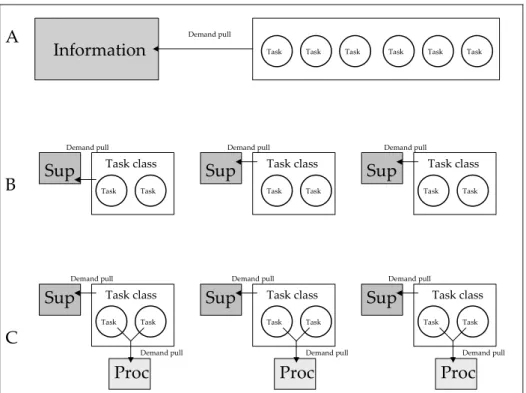
information is best presented during practice on learning tasks. In Figure 1, a schematized overview is given of just in case information presentation (Figure 1a), time supportive information presentation (Figure 1b), and complete just-in-time information presentation (Figure 1c).
Chapter 2: Just-in-time information presentation and the acquisition of complex cognitive skills 12 A B C Task Task Task
Task Task Task Task Task
Task Task Task Task Task Task Task Task Task Task Information
Sup Sup Sup
Sup Sup
Sup
Proc Proc Proc
Task class
Task class Task class Task class
Task class Task class
Demand pull
Demand pull Demand pull Demand pull
Demand pull Demand pull Demand pull
Demand pull Demand pull Demand pull
Figure 1: Three models for information presentation: Traditional just in case
information presentation (A), just-in-time supportive information (Sup) presentation in an elaborative sequence (B), and full, just-in-time supportive and procedural information (Proc) presentation (C).
Procedural vs. supportive knowledge
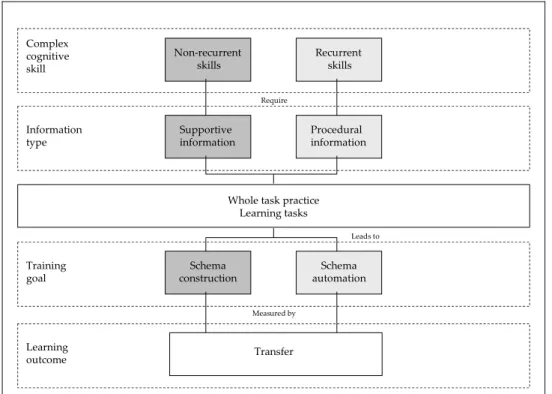
A complex cognitive skill consists of a number of highly interrelated constituent skills that show qualitative differences in performance; at least some of the constituent skills require conscious processing and they all exhibit goal-directed behaviors. With regard to desired exit behavior, a difference can be made between recurrent and recurrent constituent skills (see Figure 2). The application of non-recurrent constituent skills varies from task to task while non-recurrent constituent skills can be applied in the same manner in different tasks. For example, for the complex cognitive skill 'troubleshooting in a alcohol-water distillery', skills related to
reasoning about alcohol-water distillery using the principles underlying this functioning are considered non-recurrent skills. Recurrent skills, for instance, concern the procedures for operating the system and safety procedures. Mastering non-recurrent skills requires the construction of complex cognitive schemata that may guide subsequent problem solving behavior. Schema construction is a process of mindful abstractions from concrete experiences. Mastering recurrent skills requires the automation of schemata that is, highly domain-specific rules or procedures. Schema automation is mainly a function of the amount and quality of practice. In order to design high quality instruction, non-recurrent and recurrent aspects of the complex cognitive skill have to be identified and analyzed. Moreover, an analysis has to be made regarding the information that is supportive to the
performance of the non-recurrent aspects of the complex skill (e.g., causal and conceptual models) and information that is procedural to carry out the recurrent aspects of the skill (e.g., facts, concepts etc.). In the example, information about the
Chapter 2: Just-in-time information presentation and the acquisition of complex cognitive skills 13
working of a valve or about the consequences of temperature fluctuations for the system is considered supportive while information about the names of the different components of the system or about specific operations like switching the alarm off is considered procedural. Once the constituent skills and the appropriate knowledge have been identified, the skills are practiced in learning tasks that promote schema construction for non-recurrent aspects, and schema automation for recurrent aspects. Learning tasks typically provide whole-task practice, which means, most or all of the constituent skills are trained simultaneously. Whole-task practice can be seen as a sequence of simple-to-complex task classes in which concrete learning tasks include all aspects of the complex cognitive skill. The twofold purpose of whole-task practice is the construction of schemata that allow learners to perform unfamiliar task aspects (schema-based behavior) and the automation of schemata that allow learners to effortlessly perform familiar task aspects (rule-based behavior, see Figure 2).
In order to make assumptions about the effectiveness of just-in-time supportive and procedural information presentation, a measurement of desired outcome behavior has to be made. For the mix of schema-based and rule-based behaviors, effectiveness can be measured by the ability to solve transfer tasks. Two mechanisms to explain transfer are distinguished. The first mechanism is schema-based transfer in which the same declarative knowledge is used in a different way in solving transfer tasks. The second mechanism is rule-based transfer in which the
same schemata, automated during practice, are used in the same way in solving transfer tasks. To elaborate on this, a continuum exists from near transfer tasks at the one end to far transfer tasks at the other end. Near transfer tasks are highly similar to the trained tasks while far transfer tasks are more and more different from the
trained tasks. Both mechanisms are used simultaneously in solving transfer tasks. At the near transfer end of the continuum performance relies more on rule-based
transfer than on schema-based transfer and at the far transfer end it is the other way round.
Chapter 2: Just-in-time information presentation and the acquisition of complex cognitive skills 14 Non-recurrent skills Recurrent skills Supportive information Procedural information Schema construction Schema automation Transfer Whole task practice
Learning tasks Complex cognitive skill Information type Training goal Learning outcome Require Leads to Measured by
Figure 2: The distinction between supportive and procedural information in the just-in-time information presentation model.
Just-in-time supportive information presentation
In our model supportive information is sequentially coupled to a range of task classes (see Figure 1b). First, the training program for the complex cognitive skill is divided in task classes in which simple-to-complex categories of learning tasks are identified. Second, for each task class concrete learning tasks are formulated. Before each task class appropriate supportive information is given in order to promote meaningful learning or elaboration that is, learning processes in which the learner connects new information to already existing, relevant cognitive structures. This elaborated supportive information is helpful in performing the non-recurrent aspects of the learning tasks in this particular class. The new information becomes embedded in these structures and because of this anchoring the new information no longer depends on working memory for its existence (Ausubel, 1963). The use of simple-to-complex sequences for supportive information and task classes enhances the
elaboration process that leads to better schema construction. The idea that the use of simple-to-complex sequences of task classes and related information has enhancing effects on learning stems from theories about prose learning which originated in the 1960s. Three of the most relevant theories in this respect are, the Subsumption Theory (Ausubel, 1963), the Assimilation Encoding Theory (Mayer, 1979) and the Elaboration Theory (Reigeluth & Stein, 1983) which are discussed here.
According to Ausubel's Subsumption Theory (1963), our cognitive architecture is hierarchically organized in terms of representations of past experiences. These representations are arranged from greater to lesser inclusiveness; every higher step in the hierarchy is linked to the former through a process of subsumption.
Chapter 2: Just-in-time information presentation and the acquisition of complex cognitive skills 15
cognitive structure. Subsumption Theory thus assumes that meaningful learning only occurs when new material can be appropriately subsumed under a relevant, existing concept. The new material is 'anchored' and becomes more stable by subsuming it under existing cognitive structures (Ausubel, 1963). In order to facilitate the subsumption process, advance organizers can be applied in
instructional design. These organizers are introduced in advance of the learning material and distinguish themselves from summaries and overviews by a higher level of abstraction, generality, and inclusiveness. Moreover, because the content of a given organizer or series of organizers (cf. the proposed elaborative sequence of supportive information and task classes) is selected on the basis of their suitability for explaining, integrating, and interrelating the material they precede, the
organizational strength of the cognitive structure is enhanced. These organizers provide advance ideational scaffolding, that is, when the learner is confronted with unfamiliar material a cognitive structure is available for incorporating the new concepts (Ausubel, 1963; Jonassen, 1982).
However, studies concerning the effectiveness of advance organizers show inconsistent results (Jonassen, 1982). Mayer (1979) blamed this on the basic
assumptions of the Subsumption Theory itself and therefore proposed a different theory, the Assimilation Encoding Theory (AET). The latter assumes that human cognitive structure is heterarchically organized and not hierarchically as Ausubel posits. AET distinguishes three stages of encoding: reception (the receipt of information in working memory), availability (the accessibility of anchoring knowledge in long term memory), and activation (the appropriate transfer of
anchoring knowledge from long term memory to working memory so that it can be actively integrated with the received information and transferred back again to long term memory). Meaningful learning will take place only when these three stages are passed through. Advance organizers only contribute to the learning process when they help the learner to complete all three stages. They have no effect when
anchoring knowledge is already available in and appropriately activated by either the learner or the material presented. Moreover, when the material is badly
structured and consists of isolated facts, an advance organizer cannot even be constructed. Mayer found in a number of studies that the predictions made by the AET regarding advance organizers were fairly supported. In a meta-analysis of 132 studies advance organizers appeared to facilitate learning and retrieval (Jonassen, 1982; Mayer, 1979).
Elaboration Theory (ET; (Reigeluth & Stein, 1983) provides us with another example of simple-to-complex sequences in instructional design, the elaborative sequence. Such a sequence starts with an epitome, which entails the most inclusive and most general principles of a learning task, and gradually progresses to less inclusive, more detailed and more precise principles. The ET is explained by an analogy with a zoom lens that operates in steps. A person starts with a wide-angle view of a picture and sees the major parts and the relationships between those parts, but no detail. By zooming in the person sees more about a certain subpart (in our
Chapter 2: Just-in-time information presentation and the acquisition of complex cognitive skills 16
model, a task class and related supportive information) and learns more about its interrelationships. After viewing all the relevant features of a certain subpart the person can zoom out to the wide-angle view again to review the other subparts (i.e., the next task class and related supportive information) of the whole picture and the context of the subpart in the whole picture. This process of zooming in and zooming out can continue until all subparts are viewed in detail. Similarly, the ET prescribes that the epitome needs to be reviewed, thereby showing relationships between the most recent ideas and the ideas presented earlier. This pattern of elaboration followed by summary and synthesis is continued until the desired level of
complexity is reached for all the aspects of the epitome (Reigeluth & Stein, 1983). The three theories discussed above all expect beneficial effects from
sequencing instructional tasks and related information in a simple-to complex order. However, the effectiveness of sequencing depends on two major factors: The strength of the relationship between task classes and the amount of time involved in
mastering the whole complex cognitive skill. Sequencing becomes more important when the relationship between the constituent skills is stronger and when mastering a complex cognitive skill takes more than a couple of hours. When a cognitive skill is mastered in less time the learner can compensate for weaknesses in sequence
(Reigeluth, 1999). These two basic rules should be kept in mind while designing instruction according to the just-in-time information presentation model.
Just-in-time procedural information presentation
While supportive information is best presented before a new task class, procedural information is best presented during practice on the learning tasks (see Figure 1c). By just-in-time procedural information presentation, the proceduralization process associated with this information is facilitated because the proper information is active in working memory when the skill is practiced. Because the procedural information is directly available during practice, it may be embedded in the automated schemata or rules that constitute the recurrent skill. Moreover, by establishing schema automation for recurrent aspects of whole-task practice, more working memory capacity becomes available which can be allocated to learning the non-recurrent aspects of the complex cognitive skill. Thus, just-in-time information presentation aimed at schema automation is also beneficial to schema construction.
The temporal aspects of information presentation in instructional design, especially those regarding procedural information, have consequences for cognitive load. Cognitive Load Theory (Chandler & Sweller, 1991; Sweller, 1988; Sweller, Van Merriënboer & Paas, 1998) generates guidelines for the development of instructional material, starting from the assumption that working memory is severely limited. Cognitive load theory distinguishes three forms of cognitive load that, together, determine the total cognitive load: Intrinsic cognitive load, extraneous cognitive load and germane cognitive load. Intrinsic cognitive load is determined by the task being learned and the expertise of the learner (e.g., it is high for tasks with high element interactivity and/or learners with low expertise). Extraneous cognitive load is caused
Chapter 2: Just-in-time information presentation and the acquisition of complex cognitive skills 17
by the instructional material itself and refers to all the processes a learner engages in during a task which are not beneficial to learning (e.g., searching for relevant
information sources, combining information sources). Germane cognitive load is a result of the processes directly relevant for learning and therefore appropriate within a learning context (e.g., conscious, mindful abstraction of generalized knowledge). With a given intrinsic cognitive load, the extraneous cognitive load should be minimized and the germane cognitive load should be optimized by instructional design (Cooper, 1998; Sweller et al., 1998). Of course, the total cognitive load should always remain within the boundaries of working memory capacity.
From the perspective of cognitive load theory, just-in-time procedural information presentation can be considered as a means to avoid temporal split attention. Split attention arises when multiple sources of information, separated in space or time, have to be mentally integrated in order to understand the complete picture. For instance, in geometry a diagram is often explained by accompanying text. In order to understand the diagram the text has to be mentally integrated with the diagram. This causes an increase in extraneous cognitive load because of visual search activities. In trying to understand different parts of the picture, the learner continuously has to search for the matching written information. This phenomenon is called the split attention effect (Chandler & Sweller, 1991; Sweller, 1994).
Integrating the multiple conditional sources of information, either in space or time, reduces extraneous cognitive load (see Figure 3 for example in which both spatial and temporal spilt attention are avoided). By integrating the multiple sources of information the need to search for relevant referents and mentally integrating them is diminished, resulting in a decrease of extraneous cognitive load and higher transfer test performance.
Chapter 2: Just-in-time information presentation and the acquisition of complex cognitive skills 18 A B D E C 55 0 45 0
In the above Figure, find a value for Angle DBE.
Solution: Angle ABC = 180o - Angle BAC - Angle BCA (Internal angles of a triangle sum to 180 o) = 180 o - 55 o - 45 o
= 80 o
Angle DBE = Angle ABC (vertically opposite angles are equal)
= 80 o (1) A B D E C 55 0 45 0 80 0 180 0 - 55 0 - 45 0 = 80 0 1 2 (2)
Figure 3: Example demonstrating split attention (1), integrated example with no split attention (2) (Sweller, J., Van Merriënboer, J., & Paas, F., 1998).
Avoidance of temporal split attention in instruction by just-in-time procedural information presentation should also reduce extraneous cognitive load. Analogous to integrating pictures and text, information separated in time is now integrated
resulting in a lower extraneous cognitive load because the learners do not have to 'search-and-match' and mentally integrate the information presented. Mayer carried
Chapter 2: Just-in-time information presentation and the acquisition of complex cognitive skills 19
out several experiments which provide a demonstration of the temporal split
attention effect (Mayer & Anderson, 1991; Mayer & Anderson, 1992; Mayer & Sims, 1994).
In the first two experiments considered here, in an instructive animation on the working of a bicycle tire pump or an automobile braking system, integrated narration and animation was compared to successive presentation of narration and animation, narration only, animation only and no instruction at all. It was found that integrated instruction led to better performances on relevant creative problem
solving tests (Mayer & Anderson, 1991; Mayer & Anderson, 1992). Similar results were found in a third experiment were an instructive animation was given on the working of a bicycle tire pump or the human respiratory system. Integrated
narration and animation was compared to successive presentation of narration and animation or no instruction at all. It appeared that learners in the integrated
condition performed better on the problem solving test than the learners in the other conditions (Mayer & Sims, 1994). According to these results, eliminating temporal split attention leads to more effective learning. From the perspective of cognitive load theory, the reduction of extraneous cognitive load by just-in-time procedural
information presentation (i.e., avoidance of temporal split attention) facilitates the mastering of recurrent constituent skills. This, in turn, further decreases extraneous cognitive load in the acquisition of non-recurrent skills, thereby facilitating schema construction.
Discussion
This chapter described a model for just-in-time information presentation. In a task analysis, the task itself is used to distinct which information is necessary for skill acquisition. The task is analyzed step-by-step to reveal the information that is necessary to understand and carry out the task. The constituent sub skills (i.e., non-recurrent and non-recurrent skills) and the desired exit behavior (i.e., schema
construction or schema automation) are used to distinguish which information is treated as supportive and which is treated as procedural. When a firmer basis for the just-in-time information presentation model is established, we can elaborate our model further by trying to form hypotheses about the manner in which the information presentation takes place. Until now our model is about the 'What?', supportive and procedural information, and the 'When?', before or during practicing task classes. But another set of questions relates to the 'How?'.
Four relevant approaches regarding the 'How?' of information presentation can be distinguished: deductive vs. inductive approaches and expository vs.
inquisitory approaches. First, the deductive and inductive approaches are based on deductive and inductive reasoning respectively. In deductive reasoning the learner uses given generalities to come to conclusions (instances) that can be proven correct. In contrast, in inductive reasoning, learning is viewed as inducing generalities from limited instances and testing them. As long as new information can be predicted by the generality, it is retained. Only when the learner encounters incompatible
Chapter 2: Just-in-time information presentation and the acquisition of complex cognitive skills 20
information are new generalities generated (Mayer, 1983). When a deductive information presentation approach is used, generalities are presented before instances (e.g., illustrative examples). Using the inductive approach to information presentation, the instances are presented prior to the generalities. According to Evans, Homme and Glaser (1962) a generality-instance format is best applied when the concept to be learned can be understood in abstract form while an instance-generality format is best used when this concept is difficult or too abstract for the learner (Fleming & Levie, 1979).
Second, the expository approach is characterized by the explicit presentation of relationships between pieces of information, while in the inquisitory approach the learners are asked to produce these relationships themselves. The inquisitory
approach allows the learner to connect the new information to what is already
known and leaves ample room for elaboration, the opposite is true for the expository approach. The latter should only be used when the available instruction time is severely limited. These four approaches are combined to four information presentation strategies: a deductive-expository strategy, a deductive-inquisitory strategy, an inductive-expository strategy and an inductive-inquisitory strategy. The 4C/ID model proposes that procedural information presentation should preferably be presented according to a deductive-expository strategy, in other words, the
procedural information should contain explicit, rules and facts. But this is not true for all situations. The strategy best used to present the supportive information depends on availability of instructional time, relevant experience of the learner and required level of understanding. In general, an inductive-expository strategy is proposed. But when instructional time is severely limited, the learner has enough relevant
experience and deep understanding is not necessary, the deductive-expository
strategy is recommended. The inductive-inquisitory strategy is suggested when there is ample instructional time and the learners are inexperienced and a deep level of understanding is required.
To conclude this chapter, future research will be aimed at establishing a firm basis for the use of the demand pull principle in the instructional design of learning tasks that aim at mastering a complex cognitive skill. An attempt has to be made to find support for the assumptions that supportive information is best presented before practicing task classes and procedural information is best presented during task practice. When firm support is found for these assumptions, the manner in which the supportive or procedural information is presented can be further studied.
Chapter 3: Timing of information presentation in learning statistics 21
Chapter 3 - Timing of information presentation in learning statistics
1 AbstractIn this chapter the just-in-time information presentation model is tested in the domain of statistics. Four information presentation formats are compared in a 2x2 factorial design: timing of supportive information (before
or during task practice) x timing of procedural information (before or during task practice). Seventy-two psychology and education students (7 maleand 65 female; mean age 18.5 years, SD = 2.85) participated. The effectiveness of the learning material was measured by test performance and the instructional efficiency by a combination of mental effort during practice and test performance. ANOVA showed a main effect for timing of supportive information: presentation during practice leads to more efficient
learning than presentation before practice. Moreover, an interaction effect was found. Simultaneous presentation of procedural information before practice and supportive information during practice leads to the most efficient
learning.
Introduction
In the 1960's and 1970's, meaningfulness came to be seen as a key factor in learning and remembering. According to Johnson (1975), "meaningfulness is potentially the most powerful variable for explaining the learning of complex verbal discourse" (pp. 425-426). Learning is meaningful if learners can relate new learning tasks to their existing cognitive structures (Novak, 1984; Novak & Gowin, 1984; Williams &
Cavallo, 1995). In other words, the more that new learning can be associated with what is already known and with available cognitive schemata, the better it will be learned. This is accomplished by making sure that the new information is both deeply and richly processed, since superficial similarities are not likely to lead to proper encoding. This deliberate manipulation of the relevant aspects of cognitive structure for educational purposes is best accomplished by substantively preparing the learner for the learning tasks that are to come (e.g., with the aid of advance organizers (Ausubel, 1963; Ausubel & Robinson, 1969; Mayer, 1979). In other words, education should create a proper context within which the student can efficiently and effectively elaborate on already available cognitive structures. The success of this approach to learning depends on the availability of the information in long-term memory before the learner starts the practice tasks. A potential pitfall is the time-consumingness of this elaboration process. In practice, a trade-off between time effectiveness and level of elaboration often has to be made.
More recent theories of learning stress the importance of instruction situated in realistic knowledge-rich contexts, above all taking place in a highly interactive environment (Koschman Myers, Feltovich, & Barrows, 1994; Derry & Lesgold, 1996; Salomon & Perkins, 1999). Within these contexts, the learner receives or actively
1 A version of this chapter is submitted as: Kester, L., Kirschner, P. A., & Van Merriënboer, J. J. G. (2003).
Chapter 3: Timing of information presentation in learning statistics 22
seeks the information necessary to carry out practice tasks at the moment the information is needed. This approach implies that what the learner needs should drive the delivery of information. Those who hold with this view often advocate learner-directed modes of instruction. They argue that integrated learning directed by students helps them to understand why, how, and when to use information and tools (Darling-Hammond, 1997; Ruopp et al., 1993). Accepted knowledge is seen as a stockpile of discrete ideas, concepts or tools that can be delivered as needed. In other words, information sources are functionally used. It assumes that ideas only have value in terms of their functional use in solving specified problems.
A consequence of this approach is that learners need to either actively seek or passively accept the information at the moment that it is needed. A potential problem is that the learner must simultaneously carry out a practice task and process the necessary information, which could prove too taxing to the processing capacity of working memory. The fact that human working memory is limited is well accepted (Baddeley, 1992; Miller, 1956). Once the limits are reached, performance deteriorates (Chandler & Sweller, 1991; Sweller, 1988; Sweller, van Merriënboer, & Paas, 1998). When task relevant information is presented simultaneously with the execution of the practice tasks, the risk of overloading working memory is present. The success of this approach, thus, depends on the optimal taxation of the information-processing capacity of working memory. In this study, an attempt is made to develop learning material with an optimal balance between the time-effectiveness of the elaboration process and the level of working memory load by presenting the right information at the right time.
To acquire a complex cognitive skill, the learner needs to practice a series of (sub) skills, which are often different in nature. The performance of some skills is consistent across problem or task situations (i.e., recurrent skills) while the
performance of other skills is highly variable over task situations (i.e., non-recurrent skills). The different nature of these (sub) skills implies a difference in information necessary to master them.
In a process of skill decomposition, task analysis, and knowledge analysis a distinction can be made between two types of information (Fisk & Gallini, 1989). When statistics is considered, the domain of this study, a distinction can be made between skills concerned with the application of formulas (recurrent skills) and skills concerned with when to apply which formulas (non-recurrent skills). To master the correct application of formulas, procedural information about the exact form of the formula and definitions of the elements in the formula is needed. For example, this study uses Chi-square tests and to calculate Chi-square the following formula is needed: χ2 = Σ (o - e)2/ e in which χ2 stands for Chi-square, o for observed frequency,
and e for expected frequency. To master the skills that allow students to make the right choice as to whether the Chi-square test can be used, supportive information is needed about statistical testing in general and circumstances under which a Chi-square test is called for.
Chapter 3: Timing of information presentation in learning statistics 23
Mastering non-recurrent skills requires constructing schemata in long term memory, which can be used in different task situations. This construction involves a process of mindful abstractions from concrete experiences, that is, elaboration
(Proctor & Reeve, 1988). Mastering recurrent skills requires, after construction, the
automation of those schemata used in similar task situations and is accomplished through proceduralization (Anderson, 1993, 1996). For proceduralization to occur, relevant information has to be active in working memory when the skill is practiced. The underlying cognitive processes of the non-recurrent skills and recurrent skills imply that both information types require different optimal moments of presentation.
To facilitate the elaboration process, supportive information should be presented before practice, so that the learner has the opportunity to embed new information in already available cognitive structures. Procedural information, on the contrary, should be presented during practice in order for proceduralization to occur (Kester, Kirschner, van Merriënboer, & Bäumer, 2001).
This view is supported by instructional guidelines b