Aris Angelis
and Panos Kanavos
Multiple Criteria Decision Analysis (MCDA) for
evaluating new medicines in Health
Technology Assessment and beyond: the
Advance Value Framework
Article (Accepted version)
(Refereed)
Original citation: Angelis, Aris and Kanavos, Panos (2017) Multiple Criteria Decision Analysis (MCDA) for evaluating new medicines in Health Technology Assessment and beyond: the Advance Value Framework.Social Science & Medicine. ISSN 0277-9536
DOI: 10.1016/j.socscimed.2017.06.024
Reuse of this item is permitted through licensing under the Creative Commons: © 2017 The Authors
CC BY-NC-ND 4.0
This version available at: http://eprints.lse.ac.uk/82131/ Available in LSE Research Online: June 2017
LSE has developed LSE Research Online so that users may access research output of the School. Copyright © and Moral Rights for the papers on this site are retained by the individual authors and/or other copyright owners. You may freely distribute the URL (http://eprints.lse.ac.uk) of the LSE Research Online website.
1 Abstract ... 2 Key words... 3 1. Background ... 4 2. Theoretical foundations ... 8 3. Methods ... 13
3.1 Model building approaches ... 13
3.2 HTA adaptation process and staging ... 15
4. Results - The Advance Value Tree ... 21
4.1 Primary identification of value dimensions: findings from the systematic literature review and expert consultation in HTA ... 21
4.2 Incorporating the value dimensions into a generic model: The Advance Value Tree ... 22 4.2.1 Burden of Disease ... 24 4.2.2 Therapeutic Impact ... 25 4.2.3 Safety profile ... 29 4.2.4 Innovation Level ... 31 4.2.5 Socioeconomic Impact ... 37
4.3 Dealing with quality of evidence ... 39
5. Discussion ... 42
5.1 Robustness of the Advance Value Tree ... 42
5.2 MCDA Methods and Selection of Modelling Techniques to Operationalize the Advance Value Tree ... 43
5.3 Cognitive and motivational biases ... 48
5.4 Budget constraints, opportunity cost and prioritisation for resource allocation ... 50
5.5 The Advance Value Framework in Perspective ... 52
6. Conclusion ... 54
7. Figures and Tables ... 64
2
Abstract
Escalating drug prices have catalysed the generation of numerous “value frameworks” with the aim of informing payers, clinicians and patients on the assessment process of new medicines for the purpose of coverage and treatment selection decisions. Although this is an important step towards a more inclusive Value Based Assessment (VBA) approach, aspects of these frameworks are based on weak methodologies and could potentially result in misleading recommendations or decisions.
A Multiple Criteria Decision Analysis (MCDA) methodological process based on Multi Attribute Value Theory (MAVT) is adopted for building a multi-criteria evaluation model. A five-stage model-building process is followed, using a top-down “value-focused thinking” approach, involving literature reviews and expert consultations. A generic value tree is structured capturing decision-makers’ concerns for assessing the value of new medicines in the context of Health Technology Assessment (HTA) and in alignment with decision theory.
The resulting value tree (Advance Value Tree) spans three levels of criteria (top level criteria clusters, mid-level criteria, bottom level sub-criteria or attributes) relating to five key domains that can be explicitly measured and assessed: (a) burden of disease, (b) therapeutic impact, (c) safety profile (d) innovation level, and (e) socioeconomic impact. A number of MAVT modelling techniques are introduced for operationalising (i.e. estimating) the model, for scoring the alternative options, assigning relative weights of importance to the criteria, and combining scores and weights.
Overall, the combination of these MCDA modelling techniques for the elicitation and construction of value preferences across the generic value tree provides
3
a new value framework (Advance Value Framework) enabling the comprehensive measurement of value in a transparent and structured way. Given the flexibility to meet diverse requirements and become readily adaptable across different settings, it could be tested as a decision-support tool for decision-makers to aid coverage and reimbursement of new medicines.
Key words
European Health Policy; Multiple Criteria Decision Analysis; New Medicines; Pharmaceuticals; Health Technology Assessment; Value Based Assessment; Value Framework; Decision Theory
4
1.
Background
Scarce resources, rising demand for health services, ageing populations and technological advances threaten the financial sustainability of many health care systems and render efficient and fair resource allocation a cumbersome task (Beauchamp, 2003; Eddy, 1991; Emanuel, 2000; Fleck, 2001; Rawls, 1999). Decision-making in health care is inherently complex as numerous objectives need to be balanced, usually through the involvement of many stakeholders. One set of tools used widely to improve efficiency in resource allocation is Health Technology Assessment (HTA). The use of HTA has expanded significantly over the past 20 years and it is now used to assess and appraise the value of new medical technologies as well as inform coverage decisions.
Evidence-based medicine (G. Guyatt, 1992; Sackett et al., 1996), economic evaluations (Drummond & McGuire, 2001; Drummond et al., 2015), burden of disease estimates (Murray & Lopez, 1996), and budget impact analysis (Mauskopf et al., 2007) can be used to inform decisions on resource allocation. Nevertheless, they offer limited guidance to decision makers, as their results cannot be integrated and judged simultaneously and neither can the associated value trade-offs (Baltussen & Niessen, 2006). The use of economic evaluation techniques such as cost effectiveness analysis (CEA) has become the preferred analytical method adopted by many HTA agencies. However, all value-related concerns of decision-makers are not adequately reflected in a cost effectiveness model (Angelis et al., 2017). For example, the use of cost utility analysis (CUA) and the cost per unit of quality adjusted life year (QALY) has become the metric of choice for many HTA agencies when assessing and appraising value, although by definition the latter only considers length of life in tandem with health related quality of life, and does not adequately capture social
5
value such as the wider innovation and socioeconomic impact (Brouwer et al., 2008; Wouters et al., 2015).
Due to the complexity of these multiple criteria problems, decision-makers tend to adopt intuitive or heuristic approaches for simplification purposes, but as a consequence important information may be under-utilised or be altogether excluded leading to choices based on an ad-hoc priority setting process (Baltussen & Niessen, 2006). Eventually the decision making process tends to be explicitly informed solely by evidence from economic evaluations, with social value concerns being considered on an implicit and ad-hoc basis. As a consequence, when faced with multiple trade-offs across a range of societal values, decision makers seem to not be well equipped to make informed and rational decisions (Bazerman, 1998; McDaniels et al., 1999), therefore diminishing the reasonableness and credibility of the decision outcomes. It is probably the case that a more “rational” approach is needed that can simultaneously take into account the multiplicity of criteria, and that can aggregate the performance of alternative interventions across the criteria of interest while accounting for differences between their relative importance, therefore enabling the overall construction and analysis of decision makers’ preferences in a simple and transparent way (Angelis et al., 2016; Baltussen & Niessen, 2006). The multiple value frameworks initiatives that have emerged over the past few years aiming to aid reimbursement agencies, health care professionals and patients understand the value of new therapies and make better choices about their use serve as a testament to this particular gap (Neumann & Cohen, 2015).
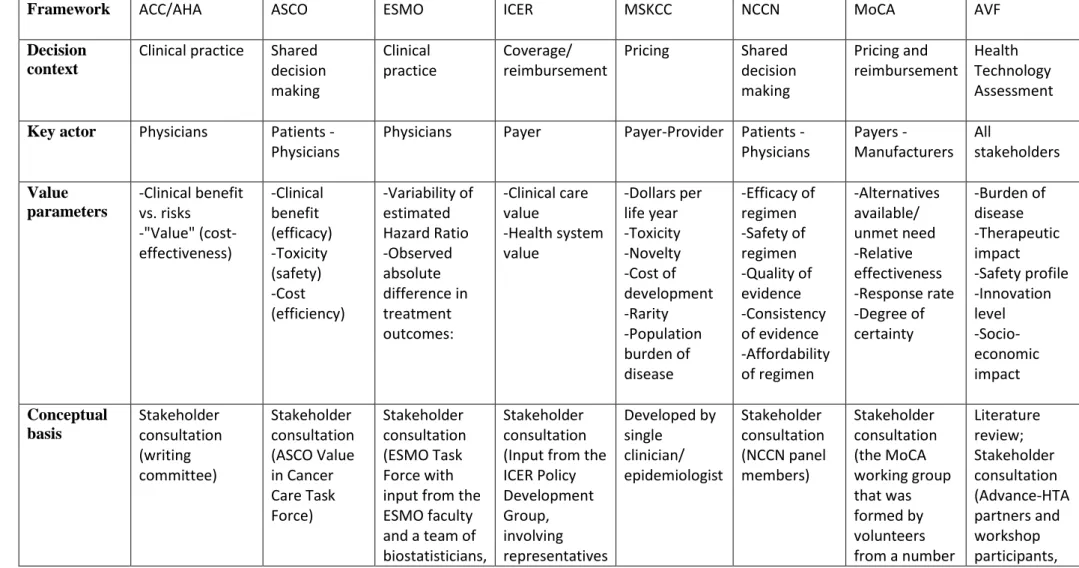
Some of the most prominent and well known value frameworks that have attracted high levels of attention include those proposed by the American College of Cardiology and the American Heart Association (ACC/AHA) (Anderson et al., 2014),
6
the American Society of Clinical Oncology (ASCO) (Schnipper et al., 2015), the European Society of Medical Oncology (ESMO) (Cherny et al., 2015), the Institute for Clinical and Economic Review (ICER) (Pearson, 2015), the Memorial Sloan Kettering Cancer Centre (MSKCC) (Bach, 2015), the National Comprehensive Cancer Network (NCCN) (NCCN, 2015), and the Working Group on Mechanisms of Coordinated Access to Orphan Medicinal Products (MoCA-OMP) (Working Group on Mechanism of Coordinated Access to Orphan Medicinal Products, 2013) among others. These value frameworks adopt multiple criteria approaches in an attempt to decompose complex problems into slightly simpler ones and address these sequentially. As such, they are an important step towards a more inclusive Value Based Assessment (VBA) process despite being perceived as weak and atheoretical and potentially of little value for policy or clinical decision-making (Angelis & Kanavos, 2016a). Despite the proliferation of value frameworks, ‘value’ remains an elusive target and a wider consensus about what dimensions of value to include may still be some way off, with the potential exception of frameworks that are applied in clinical practice (as potential value dimensions are more restricted in nature).
The use of multiple criteria decision analysis (MCDA) methods has been proposed as an alternative methodological approach for assessing the value of health care interventions in different contexts, ranging from licensing decisions at the marketing authorization stage (L. Phillips et al., 2011), to coverage decisions at the HTA stage (Thokala & Duenas, 2012), to treatment selection decisions at prescribing level (Tervonen et al., 2015). MCDA methods can be used for quantifying benefits, risks and uncertainties in order to aid the decision-making process, by considering an explicit set of criteria and their relative importance under a fully transparent process,
7
while incorporating a wide range of stakeholder views to express a more societal perspective.
A methodological process towards the development of a robust MCDA framework observing key principles to ensure methodological robustness, consisting of different phases and stages for implementation in the context of HTA, has already been proposed (Angelis & Kanavos, 2016b). Possibly the most fundamental phase of the MCDA process with the highest impact on the overall outcomes relates to model building and the criteria selection phase, which influences the choice of the value concerns against which the alternative options will be assessed.
In this paper we outline the development of a new value framework focusing on model building and criteria selection, describing the development of a generic value based model taking the form of a value tree for the purpose of assessing the value of new medicines in the context of HTA by capturing value for decision makers. Although in theory such a value tree can be generic for any type of health technology, including drugs, medical devices and other health interventions, for ease of illustration, we focus on new medicines. In Section 2 we discuss the theoretical foundations of MCDA, starting with the theoretical axioms of decision analysis that essentially address the question of “what is the basis of MCDA”. In section 3 we outline the methods for model building and the selection of different evaluation criteria. Section 4 presents the results involving the assembly of decision makers’ concerns into a comprehensive generic value tree, which provides insights into “what is value in the context of HTA”. Section 5 presents the discussion, introducing different MCDA methods, proposes ways to operationalise the value tree through a precise combination of MCDA techniques and addresses the question of “how to
8
apply MCDA in HTA” through the use of a new value framework. Finally, section 6 draws the main conclusions.
2.
Theoretical foundations
Decision analysis was originally defined by Howard as “a logical procedure for the balancing of the factors that influence a decision” incorporating “uncertainties, values, and preferences in a basic structure that models the decision” (Howard, 1966). The logic behind decision analysis was described as divide and conquer whereby a complex problem is decomposed into simpler problems and each individual problem is analysed separately before all analyses are connected together, resulting in a program of action for the complex problem (Raiffa, 1968).
The methodology of decision analysis is simplified to four main steps, notably (a) structure the decision problem; (b) assess possible impacts of each alternative; (c) determine preferences (values) of decision makers; and (d) evaluate and compare alternatives (R. L. Keeney, 1982; Raiffa, 1968).
The main outcome of decision analysis theoretical axioms is that first, the utility of an alternative is the indication of its desirability, and second, that an alternative A with higher utility U(A) should be preferred to an alternative B with lower utility U(B), in other words expressing the rationality rule of utility maximisation, i.e.
(1)
Decision analysis seems to be particularly useful for coping with the complexities arising from uncertainty and multiple conflicting objectives (Raiffa,
9
1968). Uncertainties can be traded-off against some value aspects of the outcomes, formally through the incorporation of probabilities. Similar trade-offs can be made among different objectives and their associated values. These trade-offs are judgements, depending on the decision maker’s assessment of the relative desirability of the available options across their dimensions in tandem with the relative importance of these dimensions. However, given that trade-offs are personal, there are no universal rules for making them, and they are therefore subjective in nature (von Winterfeldt & Edwards, 1986). By definition, decision-making is inherently subjective as it depends on individual utility and preferences. Therefore, the notion of rationality is used with the goal of making rational inferences and decisions. Possibly the most prominent of such criteria rules would be the maximisation of (expected) utility or value (Savage, 1954).
In decision analysis there is a clear conceptual difference between value functions, which assess the marginal benefit of an option, and utility functions, which incorporate preferences, therefore assessing both marginal benefit and risk attitude. The former is employed for riskless choices and the latter for choices under uncertainty. Expectation mainly relates to the concept of probability theory, with expected utility or value being a weighted average of the pay-off for an outcome (utility or value) and its respective probability of actually occurring (von Winterfeldt & Edwards, 1986). Expected utility and expected value are, therefore, calculated in a similar way but the pay-offs in the former case correspond to subjective utilities rather than objective quantities, with their formal terminology being subjectively expected utilities (SEUs): both the utilities and the probabilities incorporated are numbers, but are subjective in nature giving rise to numerical subjectivity, the notion of subjective judgments expressed as numbers (von Winterfeldt & Fasolo, 2009). In the context of
10
HTA, the evaluation of new medical technologies predominantly relates to the evidence-based assessment of their value by measuring their marginal benefits. Therefore we choose to use the value term rather than utility, which reduces the heterogeneity of the value judgements based on expected utility.
The expected value (EV) of an event could then be written as
(2)
Or alternatively as
(3)
Where pi is the probability that event i will take place and vi is the value or pay-off
associated with the event.
Given that the evaluation of health care interventions as part of HTA predominantly relates to the assessment of their value using existing evidence and not expected evidence, for simplicity reasons we choose to detach expectation and the probability concept while assuming the existence of evidence for the measurement of marginal benefit. However, it could also be argued that in various cases absence of (satisfactory or adequate) evidence essentially introduces an expectation variable given the attached probabilities of the respective outcomes to take place (e.g. clinical outcome), especially as part of early-HTA settings, where a new medicine might still be under clinical development.
The same axiomatic rule arising from (expected) value maximization could be adopted in the context of HTA: a medical technology A with higher (expected) value would be preferred over another medical technology B with lower (expected) value.
11
The term ‘preference’ would relate to coverage decisions (i.e. reimbursement) for the health care technology with the higher (expected) value, the aim being to maximise efficiency in resource allocation.
The starting point for this discussion is that the value of new medical technologies is multidimensional and not limited to their clinical effect or benefit. Besides the traditional dual clinical consideration of health benefits and risks, taking the form of efficacy and safety considerations, or the emerging dual economic consideration of health benefits and costs, taking the form of health outcomes and costs per unit of outcome, other factors may also be important in determining the value of a new medicine. The severity and unmet need of the disease, the clinical novelty and convenience to patients, or the wider benefits to society have often been perceived as important considerations of value to decision makers and can contribute to the debate on efficient resource allocation (DH, 2010).
Based on that, the value of new medical technologies can be illustrated as a function of different evaluation parameters, namely:
(4)
where a, b, c, d,… n denote the different parameters of interest, i denotes the perception of a medical technology’s value in regards to a particular parameter based on the views of different stakeholders and j denotes the weight of the same parameter. Additionally, questions remain on how to incorporate the views of all relevant stakeholders and how to derive relative weights for the different parameters.
Given that the value of new medical technologies is based on a multitude of value dimensions and the limitations of current approaches for their assessment in the
12
context of making resource allocation decisions, there is a need for an alternative methodological approach that encompasses multiple value domains explicitly, therefore a decision analysis method that addresses multiple attributes of benefit is required (Angelis et al., 2016).
Among methodological tools for assessing value quantitatively as part of decision-making process, MCDA could be indicated as an ideal method, ordering a set of alternative options based on the degree to which a number of different objectives are achieved (Department for Communities and Local Government, 2009; R. L. Keeney & Raiffa, 1976). One of the main aims of MCDA methods is to enable decision makers to reach a decision by facilitating them to increase their understanding of the problem, objectives, and values being faced, through organising and synthesising information of complex and conflicting nature (Belton & Stewart, 2002). MCDA can facilitate decision making by explicitly integrating objective measurement with value judgement while managing subjectivity in a transparent way, however it cannot act as a substitute to decision-making.
Having introduced the theoretical foundations of decision analysis and the overall MCDA process, the next step is to focus on the model-building phase by applying MCDA principles. As part of the model-building phase, the criteria selection stage is crucial. This involves the identification and assembly of criteria into a hierarchical structure taking the form of a tree (Berkeley & Humphreys, 1982; von Winterfeldt & Fasolo, 2009). The aim is to arrive at a generic value model for new medicines that can be adapted to capture all relevant dimensions of value across different decision-making contexts and therapeutic indications. Criteria represent the key concerns influencing a particular decision. Structuring all criteria in the form of a tree is known as a value tree and provides an organized schematic representation of
13
the various concerns under consideration by the decision-maker. The criteria-based evaluation of options is operationalised through the use of performance descriptors, either of a qualitative or quantitative nature, known as attributes, which essentially measure the fulfillment of the criteria(Box 1).
Box 1: Definitions of decision analysis terminology
3.
Methods
3.1 Model building approaches
The three main steps in building a multi-criteria model are to (a) structure a value tree that identifies and represents the objectives or key concerns of decision makers, (b) define attributes at the bottom level of the value tree to measure the achievement of these objectives, and (c) select decision alternatives (Franco & Montibeller, 2010).
Structuring a value tree can generally be done using two approaches; either through a top-down approach (known as value-focused thinking), which is driven by the overall objective or value concern and is decomposed into lower levels of sub-objectives or sub-concerns; or a bottom-up approach (known as alternative-focused
Criterion:an ‘individual measurable indicator’ of a key value dimension (Department for Communities and Local Government, 2009) or more precisely, a ‘particular perspective according to which alternative technologies may be compared (Belton & Stewart, 2002).
Attribute: a ‘quantitative or qualitative measure of performance associated with a particular criterion’ (Belton & Stewart, 2002), or in other words a descriptor of performance or impact requiring ordering of preference (R. Keeney, 1992).
Value tree: an organized schematic representation of the various objectives, criteria and attributes under consideration.
14
thinking), which is driven by the alternative options under consideration based on attributes used to distinguish between them and which are grouped into higher levels of objectives and concerns (von Winterfeldt & Edwards, 1986).
Given the aim of the study is to build a generic model that can subsequently be adapted and applied across different decision-making contexts, we used the top-down approach (value-focused thinking) (R. Keeney, 1992), so that the model can reflect the overall value concerns of decision makers while being adaptable to different decision problems. In other words we aimed to incorporate the value dimensions of new medicines that decision makers want to capture as part of the evaluation process. With regards to the completion of the remaining two tasks (attribute definition and selection of decision alternatives), we recommend the adoption of the bottom-up approach (alternative-focused thinking) following the definition of the decision problem (Buede, 1986), so that the model can become decision-specific to precisely assess the performance of alternative treatments as needed. As such, we suggest the completion of the two tasks and the model building process as part of particular applications, where the comparison of actual decision options feeds into the selection of precise attributes for distinguishing their value.
Overall, in order to complete the three main steps, we have proposed a “value-alternative hybrid thinking” (Angelis & Kanavos, 2016b), under which the core structure of the value tree takes place as part of a top-down approach, and the definition of attributes is ultimately completed following the selection of the decision alternatives as part of a bottom-up approach.
Importantly, both criteria and attributes of the value tree must possess a number of properties for the results to be robust (Angelis & Kanavos, 2016b); these include being essential, non-overlapping and concise (for the case of criteria);
15
unambiguous, comprehensive and direct (for the case of attributes); understandable, operational, and preference-independent (for both criteria and attributes) (Belton & Stewart, 2002) (Franco & Montibeller, 2010; R. Keeney & Raiffa, 1993; R. L. Keeney & Gregory, 2005). A discussion on these properties as well as the significance of adhering to them in the context of HTA to ensure a robust process for the application of MCDA is provided elsewhere.
3.2 HTA adaptation process and staging
In the context of HTA, it would be reasonable to assume that the value concerns (i.e. the criteria) of decision-makers would encompass all key factors that are necessary for a comprehensive appraisal of value of a new medicine or health care intervention, with their relevant characteristics and impacts acting as descriptors of performance (i.e. attributes) for measuring the extent of satisfying these criteria. However, a universal or common set of decision-makers’ value concerns (i.e. criteria) and their measures (i.e. attributes) are neither clearly defined, nor well-established, both within and across health systems. Therefore, a definition of value in the context of HTA is currently absent (Angelis et al., 2017; Antoñanzas et al., 2016).
In order to capture different decision-makers’ concerns in a comprehensive manner that ultimately would lead to the structuring of a generic value tree, a five-stage iterative model-building process was followed, involving both secondary and primary data collection and adopting a top-down ‘value-focused thinking’ approach. The five steps were as follows, as shown in Figure 1:
16
Firstly, we conducted a systematic review of the peer-reviewed literature to identify what value dimensions are considered in the evaluation processes of HTA bodies in eight EU countries (Angelis et al., 2017). The Centre for Review and Dissemination guidance for undertaking systematic reviews in health care was followed (Centre for Reviews and Dissemination, 2009). A flow diagram of the literature review process is shown in Figure 2. The eight study countries (and their HTA bodies) were France (Haute Autorité de Santé, HAS), Germany (Institut für Qualität und Wirtschaftlichkeit im Gesundheitswesen, IQWiG), Sweden (Tandvårds- och läkemedelsförmånsverket, TLV), England (National Institute of Health and Care Excellence, NICE), Italy (Agenzia Italiana del Farmaco, AIFA), the Netherlands (Zorginstituut Nederland, ZIN (formerly College voor zorgverzekeringen, CVZ)), Poland (The Agency for Health Technology Assessment and Tariff System, AOTMiT) and Spain (Red de Agencias de Evaluación de Tecnologías Sanitarias y Prestaciones del Sistema Nacional de Salud (RedETS) and the Inter-ministerial Committee for Pricing (ICP)).The rationale for their selection was the variation in their health system financing (tax-based vs. social insurance-based), the organisation of the health care system (central vs. regional organisation), the type of HTA in place (predominantly economic evaluation vs. predominantly clinical benefit assessment) and the perspective used in HTA (health system vs societal), so that the sample is representative of different health systems and HTA approaches across Europe. Inclusion criteria for the review were the following: (i) English language, (ii) evidence from the eight study countries of interest (and their respective agencies), (iii) HTA context from a national coverage perspective, and (iv) a publication date between January 2000 and January 2014; product-specific technology appraisals or evaluation studies and conference proceedings or records with no abstract available
17
were excluded. The electronic databases of Medline and Social Science Citation Index were searched for English peer review literature using the keywords “health technology assessment” OR “value assessment” AND “pharmaceuticals” OR “methodologies”. Reference lists of the selected studies were screened, and the HTA bodies’ websites were searched for any published guidelines. Material on the “type of evidence and evaluation criteria considered in HTAs” was collected and analysed, along with material on the “responsibilities and structure of national HTA models and processes”, “methods and techniques applied in HTA”, and “outcomes and implementation of HTAs”. The identified value dimensions sourced from the “evidence and evaluation criteria” component of the review would form the fundamental domains of the model, taking the form of top-level criteria groups (i.e. clusters) and informing their decomposition into lower level criteria, which comprised the core structure of the value tree.
<Figure 2 about here>
Secondly, literature findings were supplemented with expert consultation, where national agency HTA experts from the countries of interest where invited to review and validate the results. This took place because, upon early communication of the preliminary results with the partners of the Advance-HTA project consortium (Advance-HTA, 2013), it became obvious that in a few cases the evidence from the peer review literature may have been outdated and, in some cases contradictory, and did not reflect actual practices. As a result, the findings of the systematic literature review were validated with national experts from the agencies in question.
18
Thirdly, we incorporated findings from other relevant literature on health care intervention evaluation, including grey literature, to identify value concerns of decision makers that might not be reflected as part of the current or formal HTA evaluation criteria in place. We considered studies on the benefit-risk assessment of new drugs from a licensing perspective (EMA, 2007, 2008, 2011, 2012; FDA, 2005; Filip Mussen et al., 2007a; F Mussen et al., 2009; Filip Mussen et al., 2007b; L. Phillips et al., 2011; Walker et al., 2009), value based pricing and assessment from a payer perspective (DH, 2010, 2011; Miners et al., 2013a; Miners et al., 2013b; NICE, 2011, 2014a, b; OHE, 2011), and patient access from a social responsibility perspective (Belgian Presidency, 2010; Working Group on Mechanism of Coordinated Access to Orphan Medicinal Products, 2012, 2013). The findings from this step supplemented the lower level criteria and their decomposition into bottom-level sub-criteria or attributes.
In the penultimate, fourth stage the emerging structure of the value tree and its criteria were subjected to a detailed consultation with 28 HTA experts who provided feedback on the comprehensiveness of the model, but also on its perceived usefulness and practical limitations, as part of the Advance-HTA project (Advance-HTA, 2013). These experts were selected because they acted as partners, Scientific Advisory Board members and affiliated scientists of the Advance-HTA project and included health care professionals (e.g. clinicians, nurses, pharmacologists), methodology experts (e.g. health economists, HTA experts, statisticians) patient representatives and policy-makers/regulators, who were affiliated with a wide range of academic and research institutions at international level, including nine academic-research institutions with health economics and/or HTA centers, four HTA bodies, one HTA research network, one coordinating patient and health care professional organisation and one
19
international public health organization (see Appendix 1). Based on the feedback received from these experts, the structure of the value tree was revised in an iterative manner, mainly informing the bottom-level sub-criteria or attributes.
Finally, following a series of dissemination activities involving presentations and seminars as part of capacity building workshops, feedback was collected from a wide range of stakeholders (mainly decision-makers from ministries of health, health insurance organisations and HTA agencies) and key opinion leaders across settings beyond the eight countries identified originally, where the aim was to validate results and further enhance the encompassing nature of the model by capturing additional expert and wider geographical perspectives (Angelis & Kanavos, 2014, 2015; Kanavos & Angelis, 2014, 2015). Specifically, the value tree was disseminated at four workshops attended by a total of 230 participants from the Latin American (November 2014 and September 2015) and Eastern European regions (September 2014 and 2015), in order to capture perspectives from low-income and middle-income countries in these regions, in the form of smaller focus groups of 10-15 participants.
Throughout the five stages of the model-building process, the various pieces of evidence collected to inform criteria selection and their structuring into a value tree took place in alignment with decision theory principles, aiming to satisfy the required criteria properties so that the model produced is rigorous and the analysis outcome robust (Franco & Montibeller, 2010). For example, an additional criterion would be added if a value concern was not captured in the initial set of criteria so that all the essential value concerns of decision makers could be addressed. Further, if a particular criterion was perceived to reflect the same value concern as another criterion, one of them was removed in order to avoid double counting. Similarly, two individual criteria could be replaced if their underlying concern could be reflected
20
from a single criterion on the basis of conciseness; generally, only the smallest number of criteria required for evaluation should be included, in order to strive for simplicity. Individual criteria could be replaced with other criteria if their meaning was not clear in order to improve comprehension; similarly, individual criteria would be replaced if their measurement was not possible, in order to ensure high levels of function. Finally, if by assessing the value of one criterion it became evident that knowledge on the performance of another criterion would be required, the two criteria would be aggregated into a single one in order to avoid preference-dependence.
Despite this cautionary approach, the value tree aims to capture a comprehensive generic set of value concerns that can be adapted to different decision-making contexts, problems, indications or treatments. As a result, following the completion of the model-building phase involving the precise attribute definition and the selection of alternative treatment options for the case of specific decision problems, some of these criteria might not satisfy the required properties, in which case the underlying issues should be addressed with caution. For example, following the operationalisation of two criteria with specific attributes it might become evident that there is possible double-counting between them, in which case one of the two would have to be excluded. A few cases in which the theoretical properties of some criteria could be put into question have emerged following consultation with experts; these are discussed in the respective sections.
Overall, the five-stage process took place between February 2013 and end-June 2016.
21
4.
Results - The Advance Value Tree
We briefly present the findings from the systematic literature review and expert consultation in HTA, which acted as the first stage of the model-building process, mainly because it informed the primary identification of value dimensions which established the core structure of the value tree. Then we outline the completed value tree and discuss the logic behind its various components and value dimensions, including the overall criteria grouping and decomposition from top-level criteria clusters into lower level criteria and bottom level sub-criteria or attributes. Finally, we briefly suggest how to deal with quality of evidence, and more precisely with clinical validity concerns, using penalty functions.
4.1 Primary identification of value dimensions: findings from the systematic literature review and expert consultation in HTA
In total, 2778 article abstracts were screened. Out of these, 255 articles were selected to be read in full due to their relevance and 101 articles were ultimately used. The main groups of value dimensions that were found to be considered as evaluation criteria among the study group of European countries, identified through the first stage of the model-building process included: (a) burden of disease, (b) therapeutic impact, (c) safety profile, (d) innovation level, (e) socioeconomic impact, (f) efficiency considerations, and (g) others (Angelis et al., 2017). Individual value dimensions falling under the first five groups of evidence (a – e), together with their intensity of use by each country are shown in Table 1; efficiency considerations and other types of concerns were excluded because they would contradict the necessary theoretical properties of criteria as explained below. Based on the available evidence, these five clusters of value dimensions were perceived to comprise the critical aspects
22
of value concerns to decision makers for evaluating the value of new medicines as part of HTA, providing the core foundation of the value tree.
<Table 1 about here>
4.2 Incorporating the value dimensions into a generic model: The Advance Value Tree
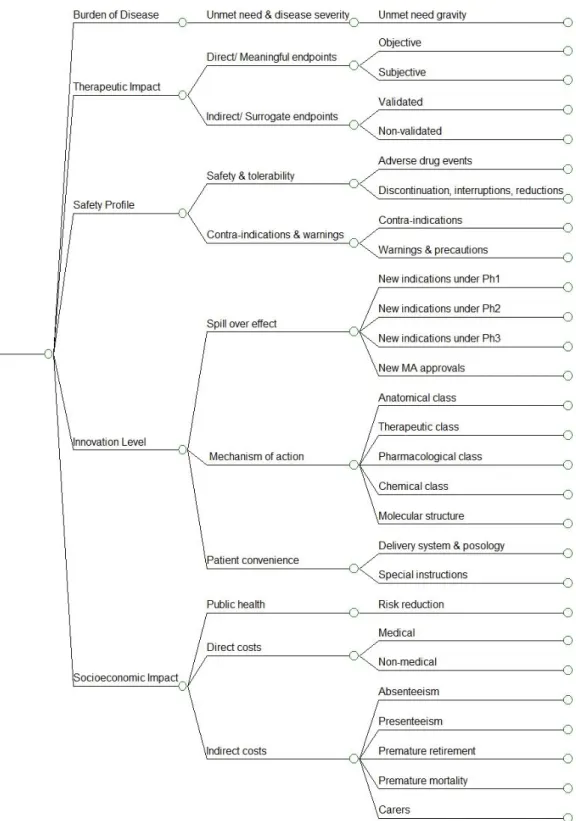
Ultimately, the resulting generic value tree spans three levels of evaluation criteria (top-, middle- and bottom-level), where top-level groups of criteria (i.e. criteria clusters) are decomposed into middle-level criteria and bottom-level sub-criteria or attributes, relating to the five key value domains described above that can be explicitly measured and assessed: (a) burden of disease (BoD), (b) therapeutic impact (THE), (c) safety profile (SAF) (d) innovation level (INN), and (e) socioeconomic impact (SOC). With the exception of the BoD cluster, which relates to the disease or indication of interest, the remaining four clusters relate to the impact or characteristics of the medicine. The hierarchical representation of the three levels of evaluation criteria forms the different components of the value tree, which we called ‘Advance Value Tree’ (Figure 3).
<Figure 3 about here>
Although additional types of value concerns might exist falling under other categories (Guindo et al., 2012; Mirelman et al., 2012; Tanios et al., 2013), such as efficiency (e.g. cost-effectiveness), equity (e.g. priorities, fairness, ethics, etc.) and implementation complexities (e.g. organisational, skill and legislative requirements),
23
they are not included as criteria because they would contradict with the desired criteria properties and the adopted scope of “value”. These dimensions do not represent intrinsic but, instead, extrinsic characteristics that mostly depend on the value tree’s core variables, or other features of the health care systems reflecting a health system’s goals and building block perspective (Tromp & Baltussen, 2012).
For example, efficiency is a composite concept comprising two components, i.e. cost and benefit, with the latter already reflected in the model and thus its inclusion would violate the principle of non-overlap leading to double-counting. Concerns relating to equity, implementation complexities, and other characteristics of the overall health systems’ context (e.g. stakeholder pressure and political power), are usually of subjective nature and not easily quantifiable, therefore making it hard to operationalise. All these extrinsic value dimensions do not relate to the “value” of a new medicine per se, but instead depend on the settings of the particular health system under consideration. They could therefore be considered or incorporated on an optional and as needed basis for the particular decision context and problem in question, possibly through the application of other analytical frameworks in parallel (EUnetHTA; Mireille M. Goetghebeur et al., 2008b).
Examples of iterations in the value tree that have resulted from consultations with experts include the aggregation of ‘safety’ and ‘tolerability’ criteria into a single ‘safety & tolerability’ criterion when a potential overlap between their measures became evident following discussions with clinicians (described in the ‘Safety profile’ section below), or the addition of a ‘Carer’ sub-criterion under the ‘Indirect costs’ criterion to capture the wider socioeconomic impact of a treatment following discussion with patients.
24 4.2.1 Burden of Disease
‘Burden of Disease’ (BoD) forms a special set of value dimensions as they do not relate to the medical technology itself, but to the disease it is indicated for and, as such, could encompass the severity and unmet need of the disease the treatment addresses (Linley & Hughes, 2013; Miners et al., 2013a). Severity of the disease relates to the condition’s degree of seriousness in respect to mortality and morbidity-derived disability, which could be defined on the basis of disability-adjusted life years (DALYs) lost (Murray & Lopez, 1996), or the expected remaining life years adjusted for their quality of life (Hansson et al., 1994). Unmet need reflects the availability of treatments, essentially the degree to which there are existing treatments (DH, 2010) and could relate to methods of diagnosis, prevention or treatment (EC, 2006). Because these dimensions are preference-dependent (i.e. in order to assess the impact of unmet need one needs to consider the severity of the disease) they are operationalised through the use of a single aggregated attribute which could be defined as the gap between the health status that patients with a particular medical condition can attain using existing medical interventions and the health status they could expect if they did not have that medical condition, or in other words “the number of QALYs lost by a patient because of their condition” (Miners et al., 2013a), i.e. unmet need gravity attribute. Therefore, the BoD attribute reflects the difference in the years of life remaining (adjusted) with the respective health-related quality of life (HRQoL) for patients receiving existing technologies, versus the years of life remaining (adjusted) with the respective HRQoL for healthy individuals (of the same age). The larger the difference or the gap between the two (i.e. diseased vs. healthy states), the higher the disease burden. It should be noted that ideally the “existing” medical intervention or
25
treatment should not be one of the options being assessed so that there is no double counting with the Therapeutic Impact cluster.
The size of the population being affected by the disease, and the possible differentiation of a disease on the grounds of high prevalence or low prevalence, is not taken into account because it could be perceived as unethical. The justification of a special status of a disease based on its prevalence would be questionable, as it entails valuing one disease differently to another because they are a more common vs. a less common disorder (McCabe et al., 2005). The only justification for providing special status to rare diseases would be on equity grounds, using the rationale that “patients suffering from rare conditions should be entitled to the same quality of treatments as other patients” (European Parliament, 2000). However, this concern is already addressed through the unmet need criterion and the associated (un-) availability of effective treatments; consequently, the inclusion of a criterion for capturing ‘population size’ would essentially lead to double-counting and, therefore, is not inserted. Valuing a condition ‘more’ or ‘less’ as a result of prevalence would be incompatible with other equity principles and theories of justice (McCabe et al., 2005).
4.2.2 Therapeutic Impact
For most medical conditions there is a set of multidimensional health outcomes that need to be jointly used to capture overall patient benefit including survival, functional status, sustainability of recovery and others, including complications (Porter, 2010). Outcomes are distinct from biologic indicators, the former relating directly to health status in contrast to the latter which acts as predictor of results.
26
The ‘Therapeutic impact’ cluster captures clinical benefit by measuring both direct outcomes and indirect indicators relating to the efficacy and/or the effectiveness of an intervention with the view to reflecting the health status but also disease recovery, progression or prevention (complication outcomes are considered separately in the “Safety Profile” cluster discussed in the next section).
In order to distinguish between the difference in direct outcomes and indirect indicators, based on both the literature and following expert consultation “Therapeutic Impact” criteria have been divided into (a) direct, clinically meaningful endpoints and (b) indirect, surrogate endpoints respectively; the latter are used as substitutes for direct endpoints, and are usually disease-specific in nature (e.g. HbA1c for complications in diabetes mellitus, prostate-specific antigen (PSA) for prostate cancer, blood pressure for cardiovascular disease). Specifically, a direct endpoint is defined as a “characteristic or variable that reflects how a patient feels, functions, or survives” while an indirect endpoint is defined as a “biomarker intended to substitute for a clinical endpoint” which is “expected to predict clinical benefit (or harm or lack of benefit or harm) based on epidemiologic, therapeutic, pathophysiologic, or other scientific evidence” (Biomarkers Definitions Study Group, 2001) (page 91); in turn, the definition of a biomarker states that it is a “characteristic that is objectively measured and evaluated as an indicator of normal biological processes, pathogenic processes, or pharmacologic responses to a therapeutic intervention” (Biomarkers Definitions Study Group, 2001) (page 91). However, both types of endpoints are useful and, for specific indications, a biomarker, (i.e. indirect indicator) might be more directly related to real health status than self-reported outcomes (i.e. direct outcome). Below we propose a further decomposition of direct meaningful endpoints
27
and indirect surrogate endpoints, once again guided by the five-stage evidence collection process.
Direct meaningful endpoints
Direct clinically meaningful endpoints can be divided into objective and subjective endpoints (Sullivan) and, possibly, other health related outcomes (Spahn, 2003). Objective direct endpoints mainly refer to survival, disease exacerbation/alleviation and clinical events. The availability of evidence on different endpoints depends on the study designs adopted by the respective clinical trials for evaluating the clinical benefit of interventions and, therefore, would depend on their type or nature.
Subjective direct endpoints mainly relate to HRQoL and disease symptoms. HRQoL embraces the broader concept of health that includes physical, emotional and social wellbeing (World Health Organisation, 1948), by including both personal health status and social wellbeing (G. H. Guyatt et al., 1993) which are usually “subjectively” assessed through patient reported outcome measures (PROMs). HRQoL is multidimensional (Chen et al., 2005) (Cherepanov et al., 2010) and can generally be measured through the use of generic PROMs that provide a summary of HRQoL attributes through the production of health utilities (G. H. Guyatt et al., 1993), such as SF-36 and EQ-5D instruments. Generic PROM instruments do not target specific population groups and for the case of particular disease states they might not be sensitive enough to adequately capture the impact across all HRQoL dimensions in which case disease specific instruments might be needed. From a societal perspective all of these dimensions should be considered both for the cases of patients and carers.
Importantly, following consultation with experts, it became apparent that the assessment of particular combinations of objective and subjective endpoints as, for
28
example, overall survival (OS) and HRQoL (e.g. through EQ-5D) might be preference dependent. For example, in the context of a metastatic cancer setting, stakeholders highlighted that their preferences related to the performance of different therapies in terms of OS would be meaningful only if the HRQoL performance was also known for the same therapies. Where preference dependence is evident, the dependent attributes should be combined into a single attribute, as for example QALYs, essentially aggregating them into a common attribute capturing both OS and HRQoL considerations.
Indirect surrogate endpoints
Indirect surrogate endpoints can be divided into validated and non-validated. Validation of a surrogate endpoint is the process of retrospectively linking it to the actual clinical endpoint (or outcome), i.e. demonstrating a relationship between the two by evaluating how well the surrogate endpoint predicts the clinical outcome of interest (Biomarkers Definitions Study Group, 2001). Over and above the existence of a strong statistical correlation between the surrogate and the clinical endpoint that is required in order to attain an accurate prognosis of the clinical outcome, i.e. “individual-level surrogacy”, there is also a prerequisite for clinical correlation through the existence of biologic plausibility, i.e. scientific evidence on the causality between the disease, surrogate and outcome; importantly, there is also a need for demonstrating “trial-level surrogacy” which refers to the correlation between a change in the surrogate and a change in outcome due to a therapeutic intervention (Buyse et al., 2000). Although trial-level data are usually coming from multiple trials or units for the same type of intervention, for a surrogate to be validated it means that its “validity is generalizable to include other interventions that affect the surrogate endpoint” (Biomarkers Definitions Study Group, 2001) (page 93). As a result of these
29
requirements, surrogate endpoints are rarely validated. Generally, most only just manage to predict the clinical endpoint or outcome of interest whilst others fail to predict the clinical endpoint and are used simply as a measure of biological activity (Fleming, 2003).
4.2.3 Safety profile
The safety profile of an intervention comprises information relating to the degree of its safety and toxicity for the indicated patient population of interest. It is usually measured through safety and tolerability but can also be reflected through any contra-indications for its use and special warnings (and precautions) for any particular sub-populations.
Safety and tolerability
Safety has been traditionally reflected through the incidence of adverse events. An adverse event (AE) refers to an adverse outcome occurring when a drug is administered to a patient or at some time afterwards, in which case the drug might or might not be the cause of the AE (Aronson & Ferner, 2005). If such outcomes can be attributed with some degree of probability and through a causative link to an action of the drug, then they are known as adverse drug events (ADEs).
The magnitude of both AEs and ADEs is measured through the combination of their seriousness and their frequency (or probability of taking place). Given that seriousness and probability of adverse events seem to be preference dependent, an aggregated attribute reflecting ‘seriousness and frequency’ would be needed. Seriousness could be operationalised through the use of the Common Terminology Criteria for Adverse Events (CTCAE) classification, which contains five grades of adverse events ranging from mild (Grade 1) to death (Grade 5), with three grades in
30
between (moderate, severe, life-threatening) (Institute, 2009). However, for cases that OS is already incorporated in the value tree under the therapeutic impact cluster, then considering Grade 5 adverse events which relate to deaths would constitute double counting and should be excluded. In turn, given that the distinction of adverse events between mild and moderate and between severe and life-threatening is often subjective, they could be aggregated and categorised as “non-serious” versus “serious”, the former comprising Grade 1 and 2, and the latter comprising the Grade 3 and 4 adverse events. Frequency could be operationalised through the use of absolute incidences (percentages), or, alternatively, using a frequency classification system such as the Naranjo scale which expresses frequency in terms of definite, probable, possible or doubtful (Naranjo et al., 1981).
Tolerability refers to the overall ability of the patient to tolerate the intervention, mainly in regards to bearing and enduring any adverse events. It is usually reflected through the variables of treatment discontinuation and treatment interruption or reduction, measured either as the proportion of patients discontinuing the treatment (or interrupting/reducing its dosing) or the time to treatment discontinuation (TTTD) from the treatment.
Importantly however, as became apparent following consultation with clinical experts, in the case of discontinuation (or interruption or reduction) of a treatment being due to the incidence of known ADEs, then incorporation of both measure types could lead to double-counting and therefore caution would be needed to ensure the most appropriate of the two criteria was chosen for inclusion.
Contraindications, special warnings and precautions
Contra-indications refer to
,
usually risk and safety, factors that act as a reason for an intervention to not be used by a patient, which therefore has an impact on the number31
of potential patients using and benefiting from the intervention. Strictly speaking, contraindications can be categorised as absolute and relative. In the former categorization there are no circumstances under which the patient might use the intervention, compared to the latter where the risk might be outweighed in favour of other considerations (e.g. x-rays for a pregnant woman with a risk of having a child with birth defects). Special warnings and precautions for use are designed with the view to notifying potential risks associated with the use of the intervention in regards to specific patient sub-populations with particular characteristics. These characteristics mainly relate to the administration of concomitant medication, the coexistence of other accompanying diseases and the presence of idiosyncratic patient pathological features that, as a result, might influence the expected action of the drug; as a consequence, caution in the form of careful monitoring is usually suggested.
In the real world, some patients with known contra-indications (or special warnings and precautions) for a treatment may receive it, in which case incorporation of any evident ADEs or tolerability consequences that can be related to them as attributes in the value tree, would lead to double counting between the two and should therefore be addressed with caution, similar to the case between ADEs and discontinuation.
4.2.4 Innovation Level
“Innovation” in the context of medical technologies, ranging from biopharmaceuticals and diagnostics to medical devices, is a complicated concept lacking a universal consensus (Kesselheim et al., 2013). From a patient perspective, “innovation” mainly relates to “therapeutic innovation” requiring novelty of effectiveness: value needs to be created by generating improved health outcomes that
32
were previously unattainable, the degree of which could be assessed through the combination of the significance of the unmet medical need the drug addresses and the extent to which it improves the health outcomes for that need (Morgan et al., 2008).
Below we discuss secondary innovation dimensions over and above “therapeutic innovation”, given that the significance of unmet medical need and the extent of health outcomes improvement are captured under the “Burden of Disease” and “Therapeutic Impact” clusters respectively. These dimensions include (a) the mechanism of action, (b) the technology’s spillover effects, and (c) patient usefulness (convenience).
Mechanism of action
The innovativeness of new medicines can be differentiated according to their type or nature, based on whether they offer a novel mechanism of action, or whether they act through more typical mechanisms of action. A relatively practical and objective way of measuring that would be through the use of WHO’s Anatomical Therapeutic Chemical (ATC) Classification System1. In the ATC classification system, the active substances are divided into different groups according to the organ or system on which they act and their therapeutic, pharmacological and chemical properties. Moving from general to specific, drugs are classified in groups at five different levels relating to anatomical, therapeutic, pharmacological, chemical and molecular dimensions which could act as the respective criteria. The drugs are divided into fourteen main groups (1st level), with pharmacological/therapeutic subgroups (2nd
1
In the Anatomical Therapeutic Chemical (ATC) classification system, the active substances are divided into different groups according to the organ or system on which they act and their therapeutic, pharmacological and chemical properties. Drugs are classified in groups at five different levels. The drugs are divided into fourteen main groups (1st level), with pharmacological/therapeutic subgroups (2nd level). The 3rd and 4th levels are chemical/pharmacological/therapeutic subgroups and the 5th level is the chemical substance. The 2nd, 3rd and 4th levels are often used to identify pharmacological subgroups when that is considered more appropriate than therapeutic or chemical subgroups.
33
level). The 3rd and 4th levels are chemical/pharmacological/therapeutic subgroups and the 5th level is the chemical substance.
By this logic, a medicine characterised by a novel therapeutic action, would be more innovative than a medicine with a novel pharmacological action and so on. In other words, the broader the level at which the drug (or combination) differentiates as ‘original’ compared to current existing alternatives, the more innovative the nature of that drug (or combination) would be. As a result, the drug’s relative market entrance in regards to the different innovation subgroups (i.e. ATC levels) could act as the respective attributes, in order to reflect, for example, whether it is first-in-chemical-class (i.e. first entrance of a technology at level 4, chemical subgroup level), second-in-pharmacological-class (i.e. second entrance of a technology at level 3, pharmacological subgroup), and so on.
Spill-over (dynamic efficiency)
Any type of innovation can have R&D spill-over effects that can lead to the development of subsequent innovation(s), entailing a certain degree of diffusion of scientific knowledge and/or technical know-how. Innovation “spill-over effects” could be defined as “the R&D positive externalities that can lead to the development of subsequent innovation(s)”, thus essentially relating to dynamic efficiency in regards to long-term product innovation at future market conditions. These effects could take the form of internal (within the innovator) or external (outside the innovator) effects (OHE, 2005). As Lipsey and Carlow have argued, “major radical innovations never bring new technologies into the world in a fully developed form”, but “appear in a crude and embryonic state with only a few specific uses” (Lipsey & Carlow, 2000). Instead, successive improvements are accumulated through the processes of “learning by doing” and “learning by using” (Mestre-Ferrandiz et al.,
34
2012), the former referring to the improvement of workers’ skills at the manufacturing level (Arrow, 1962), while the latter relating to enhancements of knowledge at the level of utilisation by the final user (Rosenberg, 1982). Subsequent to the market entry of a new drug, new uses (i.e. new indications) for the same drug could be uncovered following its investigation for use by patients with other diseases, or next generation drugs could be successively developed either for the same disease indication or a different one. New scientific knowledge and/or technical know-how could be diffused into other contexts/sectors, leading to innovations therein. Because the impact on future innovation is uncertain, it would be practically challenging if not impossible to be predicted and assessed at a single point in time (Rosenberg, 2001), as for example the rate at which performance improvements take place and the speed at which new uses are discovered. In reality, a significant portion of any such spill-over effects will need time to materialize requiring them to be in the market for a period of time.
Although these effects can relate to new uses for the same technology, new technologies for the same use, or new technologies for new uses, only the first ones are considered here because the latter two are not operational. We choose to exclude the latter two because it would be very hard, if not impossible, to identify whether a new technology has been developed following the R&D process of another technology, hence establishing the causative link required would be challenging. For example, for the case of a new technology developed by the same manufacturer of the parent technology, it could be the case that actually the later technology was the one that drove the development of the first technology, but delays in the regulatory processes caused one to be marketed before the other. Essentially, this criterion would refer to the extent to which the drug has a spill-over effect in the context of expansion
35
into new indications and could be operationalized by examining the number of new indications for which the drug is investigated at each stage of clinical development (e.g. Phase I, Phase II, Phase III, Marketing Authorisation phase).
Patient usefulness (ease and convenience)
Aspects relating to patient usefulness would be another group of innovation-related dimensions. The satisfaction of patients with medical care has been shown to correlate with compliance, i.e. the willingness and ability to follow health-related advice including adherence to prescribed medication, while also acting as a predictor of future compliance (Becker & Maiman, 1980; Nagy & Wolfe, 1984; Smith et al., 1987). Satisfaction can be categorised into a range of different domains, including symptom relief/efficacy, side effects, ease and convenience, impact on HRQL, general satisfaction, and other domains specific to the given question (Shikiar & Rentz, 2004). Given that most of these domains are associated with the health outcomes of the treatment, or are of a generic nature, only ease and convenience are considered here, essentially relating to mode of administration, dosing schedule, medication restrictions, and product-specific designs. Poor compliance has been reported as the most common cause of non-response to medication, with evidence supporting that better health outcomes are produced when patients adhere to treatment recommendations compared to those who do not adhere (Murphy & Coster, 1997). Therefore, any improvements on the above can be translated into greater patient satisfaction and possibly better treatment compliance, which could lead to improved health outcomes, either through an increase in clinical effectiveness or due to a decrease in adverse events. In turn, individualising treatment and minimising its complexity has been proposed in order to encourage adherent behavior (O'Brien et al., 1992); for example, once-daily dosing had been suggested as an important part of
36
enhancing compliance, patient convenience and regimen simplification in hypertension (Rudd, 1995), among others.
Given that patient health outcomes are already incorporated in the value tree, it would be expected that it is necessary to assume an explicit disconnection between better patient satisfaction and improved health outcomes in order to avoid double-counting. This theoretical rationality would support the notion that greater satisfaction through improved ease and convenience is a critical value dimension of new medicines in its own right, contributing to product novelty. Nevertheless, such a strict dissociation between satisfaction and health outcomes might not be required in the first place because of the gap between experimental efficacy data and real world effectiveness (see Appendix 2).
Specific aspects of improved ease and convenience can include less invasive delivery systems, improved posology due to reduced dosing frequency or duration of administration and abolition of special administration instructions (e.g. no instructions vs. “take without food”). An altered delivery system could involve a change in dosage form (e.g. tablet, liquid, spray, gel) or a change in route of administration (RoA) (e.g. oral, subcutaneous, transdermal), but because these two variables are almost always correlated (e.g. a tablet will most probably administered orally, and a gel will most probably administered transdermally), both aspects could be captured through a common ‘delivery system’ attribute reflecting the combination of dosage form and RoA. Differences in posology could be captured by an attribute reflecting the combination of dosing frequency in a given time period and treatment duration of each dose. However, following consultation with patients it became apparent that in order to assess a treatment’s ‘posology’, one might need to consider the treatment’s ‘delivery system’, therefore suggesting for preference dependence between the two.