Future of Humanity Institute
University
of Oxford Centre for the Study of Existential Risk
University of
Cambridge Center for a New American Security Electronic Frontier Foundation OpenAI February 2018
The Malicious Use
of Artificial Intelligence:
Forecasting, Prevention,
and Mitigation
The Malicious Use of Artificial Intelligence: Forecasting, Prevention, and Mitigation
Authors are listed
in order of contribution Design Direction by Sankalp Bhatnagar and Talia Cotton
February 2018
1
Corresponding author miles.brundage@philosophy. ox.ac.ukFuture of Humanity Institute, University of Oxford; Arizona State University
2
Corresponding author, [email protected]Centre for the Study of Existential Risk, University of Cambridge
3
OpenAI4
Open Philanthropy Project5
Electronic Frontier Foundation6
Future of Humanity Institute, University of Oxford7
Future of Humanity Institute, University of Oxford; Yale University8
Center for a New American Security9
American University10
Endgame11
Endgame12
University of Oxford/ Arizona State University/New America Foundation13
Center for a New American Security14
Stanford University15
Future of Humanity Institute, University of Oxford16
Centre for the Study of Existential Risk and Centre for the Future of Intelligence, University of Cambridge17
Centre for the Study of Existential Risk, University of Cambridge18
Centre for the Study of Existential Risk, University of Cambridge19
Future of Humanity Institute, University of Oxford20
Future of Humanity Institute, University of Oxford21
Information Society Project, Yale University22
Future of Humanity Institute, University of Oxford23
OpenAI24
University of Bath25
University of Louisville26
OpenAIMiles Brundage Shahar Avin
Jack Clark
Helen Toner
Peter Eckersley
Ben Garfinkel
Allan Dafoe
Paul Scharre
Thomas Zeitzoff
Bobby Filar
Hyrum Anderson
Heather Roff
Gregory C. Allen
Jacob Steinhardt
Carrick Flynn
Seán Ó hÉigeartaigh
Simon Beard
Haydn Belfield
Sebastian Farquhar
Clare Lyle
Rebecca Crootof
Owain Evans
Michael Page
Joanna Bryson
Roman Yampolskiy
Dario Amodei
Artificial intelligence and machine learning capabilities are growing
at an unprecedented rate. These technologies have many widely
beneficial applications, ranging from machine translation to medical
image analysis. Countless more such applications are being
developed and can be expected over the long term. Less attention
has historically been paid to the ways in which artificial intelligence
can be used maliciously. This report surveys the landscape of
potential security threats from malicious uses of artificial intelligence
technologies, and proposes ways to better forecast, prevent, and
mitigate these threats. We analyze, but do not conclusively resolve,
the question of what the long-term equilibrium between attackers and
defenders will be. We focus instead on what sorts of attacks we are
likely to see soon if adequate defenses are not developed.
p.
3
Executive
Summary
p.
4
Executive Summary
The Malicious Use of Artificial Intelligence
In response to the changing threat landscape we make four high-level
recommendations:
1.
Policymakers should collaborate closely with technical
researchers to investigate, prevent, and mitigate potential
malicious uses of AI.
2.
Researchers and engineers in artificial intelligence should take
the dual-use nature of their work seriously, allowing
misuse-related considerations to influence research priorities and
norms, and proactively reaching out to relevant actors when
harmful applications are foreseeable.
3.
Best practices should be identified in research areas with more
mature methods for addressing dual-use concerns, such as
computer security, and imported where applicable to the case
of AI.
4.
Actively seek to expand the range of stakeholders and domain
experts involved in discussions of these challenges.
p.
5
Executive Summary
The Malicious Use of Artificial Intelligence
As AI capabilities become more powerful and widespread, we expect
the growing use of AI systems to lead to the following changes in the
landscape of threats:
•
Expansion of existing threats. The costs of attacks may be
lowered by the scalable use of AI systems to complete tasks
that would ordinarily require human labor, intelligence and
expertise. A natural effect would be to expand the set of actors
who can carry out particular attacks, the rate at which they can
carry out these attacks, and the set of potential targets.
•
Introduction of new threats. New attacks may arise through the
use of AI systems to complete tasks that would be otherwise
impractical for humans. In addition, malicious actors may
exploit the vulnerabilities of AI systems deployed by defenders.
•
Change to the typical character of threats. We believe there is
reason to expect attacks enabled by the growing use of AI to
be especially effective, finely targeted, difficult to attribute,
and likely to exploit vulnerabilities in AI systems.
p
.6
Executive Summary
The Malicious Use of Artificial Intelligence
We structure our analysis by separately considering three security
domains, and illustrate possible changes to threats within these
domains through representative examples:
•
Digital security. The use of AI to automate tasks involved in
carrying out cyberattacks will alleviate the existing tradeoff
between the scale and efficacy of attacks. This may expand
the threat associated with labor-intensive cyberattacks
(such as spear phishing). We also expect novel attacks that
exploit human vulnerabilities (e.g. through the use of speech
synthesis for impersonation), existing software vulnerabilities
(e.g. through automated hacking), or the vulnerabilities
of AI systems (e.g. through adversarial examples and data
poisoning).
•
Physical security. The use of AI to automate tasks involved in
carrying out attacks with drones and other physical systems
(e.g. through the deployment of autonomous weapons
systems) may expand the threats associated with these
attacks. We also expect novel attacks that subvert
cyber-physical systems (e.g. causing autonomous vehicles to crash)
or involve physical systems that it would be infeasible to direct
remotely (e.g. a swarm of thousands of micro-drones).
•
Political security. The use of AI to automate tasks involved in
surveillance (e.g. analysing mass-collected data), persuasion
(e.g. creating targeted propaganda), and deception (e.g.
manipulating videos) may expand threats associated with
privacy invasion and social manipulation. We also expect novel
attacks that take advantage of an improved capacity to analyse
human behaviors, moods, and beliefs on the basis of available
data. These concerns are most significant in the context of
authoritarian states, but may also undermine the ability of
democracies to sustain truthful public debates.
p
.7
Executive Summary
The Malicious Use of Artificial Intelligence
In addition to the high-level recommendations listed above, we also
propose the exploration of several open questions and potential
interventions within four priority research areas:
•
Learning from and with the cybersecurity community. At the
intersection of cybersecurity and AI attacks, we highlight
the need to explore and potentially implement red teaming,
formal verification, responsible disclosure of AI vulnerabilities,
security tools, and secure hardware.
•
Exploring different openness models. As the dual-use nature
of AI and ML becomes apparent, we highlight the need to
reimagine norms and institutions around the openness of
research, starting with pre-publication risk assessment in
technical areas of special concern, central access licensing
models, sharing regimes that favor safety and security, and
other lessons from other dual-use technologies.
•
Promoting a culture of responsibility. AI researchers and the
organisations that employ them are in a unique position to
shape the security landscape of the AI-enabled world. We
highlight the importance of education, ethical statements and
standards, framings, norms, and expectations.
•
Developing technological and policy solutions. In addition to
the above, we survey a range of promising technologies, as
well as policy interventions, that could help build a safer future
with AI. High-level areas for further research include privacy
protection, coordinated use of AI for public-good security,
monitoring of AI-relevant resources, and other legislative and
regulatory responses.
The proposed interventions require attention and action not just from
AI researchers and companies but also from legislators, civil servants,
regulators, security researchers and educators. The challenge is
daunting and the stakes are high.
Executive Summary
Introduction Scope
Related Literature
General Framework for AI and Security Threats AI Capabilities Security-Relevant Properties of AI General Implications Scenarios Digital Security Physical Security Political Security Security Domains Digital Security Physical Security Political Security Interventions Recommendations
Priority Areas for Further Research
Strategic Analysis
Factors Affecting the Equilibrium of AI and Security Overall Assessment Conclusion Acknowledgements References Appendix A Appendix B 3 9 10 10 12 12 16 18 23 24 27 28 30 31 37 43 50 51 52 58 59 61 64 66 67 75 78
02
03
04
05
Contents
Introduction
p
.9
Artificial intelligence (AI) and machine learning (ML) have progressed rapidly in recent years, and their development has enabled a wide range of beneficial applications. For example, AI is a critical component of widely used technologies such as automatic speech recognition, machine translation, spam filters, and search engines. Additional promising technologies currently being researched or undergoing small-scale pilots include driverless cars, digital assistants for nurses and doctors, and AI-enabled drones for expediting disaster relief operations. Even further in the future, advanced AI holds out the promise of reducing the need for unwanted labor, greatly expediting scientific research, and improving the quality of governance. We are excited about many of these developments, though we also urge attention to the ways in which AI can be used maliciously . We analyze such risks in detail so that they can be prevented or mitigated, not just for the value of
AI refers to the use of digital technology to create systems that are capable of performing tasks commonly thought to require intelligence. Machine learning is variously characterized as either a
sub-field of AI or a separate sub-field, and refers to the development of digital systems that improve their performance on a given task over time through experience.
We define “malicious use” loosely, to include all practices that are intended to compromise the security of individuals, groups, or a society. Note that one could read much of our document under various possible perspectives on what constitutes malicious use, as the interventions and structural issues we discuss are fairly general.
1
p
.1
0
Introduction
preventing the associated harms, but also to prevent delays in the realization of the beneficial applications of AI.
Artificial intelligence (AI) and machine learning (ML) are altering the landscape of security risks for citizens, organizations, and states. Malicious use of AI could threaten digital security (e.g. through criminals training machines to hack or socially engineer victims at human or superhuman levels of performance), physical security (e.g. non-state actors weaponizing consumer drones), and political security (e.g. through privacy-eliminating surveillance, profiling, and repression, or through automated and targeted disinformation campaigns).
The malicious use of AI will impact how we construct and manage our digital infrastructure as well as how we design and distribute AI systems, and will likely require policy and other institutional responses. The question this report hopes to answer is: how can we forecast, prevent, and (when necessary) mitigate the harmful effects of malicious uses of AI? We convened a workshop at the University of Oxford on the topic in February 2017, bringing together experts on AI safety, drones , cybersecurity, lethal autonomous weapon systems, and counterterrorism . This document summarizes the findings of that workshop and our conclusions after subsequent research.
Scope
For the purposes of this report, we only consider AI technologies that are currently available (at least as initial research and
development demonstrations) or are plausible in the next 5 years, and focus in particular on technologies leveraging machine learning. We only consider scenarios where an individual or an organisation deploys AI technology or compromises an AI system with an aim to undermine the security of another individual, organisation or collective. Our work fits into a larger body of work on the social implications of, and policy responses to, AI . There has thus far been more attention paid in this work to unintentional forms of AI misuse such as algorithmic bias , versus the intentional undermining of individual or group security that we consider. We exclude indirect threats to security from the current report, such as threats that could come from mass unemployment, or other second- or third-order effects from the deployment of AI technology in human society. We also exclude system-level threats that would come from the dynamic interaction between non-malicious actors, such as a “race to the bottom” on AI safety
Not all workshop participants
necessarily endorse all the findings discussed herein. See Appendix A for additional details on the workshop and research process underlying this report.
We define drones as unmanned aerial robots, which may or may not have autonomous decision-making features.
2
1
Brynjolfsson and McAfee, 2014; Brundage, 2017; Crawford and Calo, 2016; Calo, 2017; Chessen, 2017a, Executive Office of the President, 2016
Kirkpatrick, 2016
4
3
p.
11
between competing groups seeking an advantage or conflicts spiraling out of control due to the use of ever-faster autonomous weapons. Such threats are real, important, and urgent, and require further study, but are beyond the scope of this document.
Related Literature
Though the threat of malicious use of AI has been highlighted in high-profile settings (e.g. in a Congressional hearing a White House-organized workshop , and a Department of Homeland Security report ), and particular risk scenarios have been analyzed (e.g. the subversion of military lethal autonomous weapon
systems ), the intersection of AI and malicious intent writ large has not yet been analyzed comprehensively.
Several literatures bear on the question of AI and security, including those on cybersecurity, drones, lethal autonomous weapons, “social media bots,” and terrorism. Another adjacent area of
research is AI safety—the effort to ensure that AI systems reliably achieve the goals their designers and users intend without causing unintended harm . Whereas the AI safety literature focuses on unintended harms related to AI, we focus on the intentional use of AI to achieve harmful outcomes (from the victim’s point of view). A recent report covers similar ground to our analysis, with
a greater focus on the implications of AI for U.S. national security. In the remainder of the report, we first provide a high-level view on the nature of AI and its security implications in the section General Framework for AI and Security, with subsections on Capabilities, Security-relevant Properties of AI, and General Implications for the Security Landscape; we then illustrate these characteristics of AI with Scenarios in which AI systems could be used maliciously; we next analyze how AI may play out in the domains of digital, physical, and political security; we propose Interventions to better assess these risks, protect victims from attacks, and prevent malicious actors from accessing and deploying dangerous AI capabilities; and we conduct a Strategic Analysis of the “equilibrium” of a world in the medium-term (5+ years) after more sophisticated attacks and defenses have been implemented. Appendices A and B respectively discuss the
workshop leading up to this report, and describe areas for research that might yield additional useful interventions.
6
7
Amodei and Olah et al., 2016; Soares and Fallenstein, 2014; Taylor, 2016; Russell, Dewey, and Tegmark 2015; Everitt et al., 2017
Allen and Chan, 2017
2
3
4
Moore, 2017
Office of Science and Technology Policy and Carnegie Mellon University, 2016)
Office of Cyber and Infrastructure Analysis, 2017)Technology Policy and Carnegie Mellon University, 2016
5
Scharre, 201602
p.
12
General
Framework
for AI and
Security Threats
AI Capabilities
The field of AI aims at the automation of a broad range of tasks. Typical tasks studied by AI researchers include playing games, guiding vehicles, and classifying images. In principle, though, the set of tasks that could be transformed by AI is vast. At minimum, any task that humans or non-human animals use their intelligence to perform could be a target for innovation.
While the field of artificial intelligence dates back to the 1950s, several years of rapid progress and growth have recently invested it with a greater and broader relevance. Researchers have achieved sudden performance gains at a number of their most commonly studied tasks.
Factors that help to explain these recent gains include the exponential growth of computing power, improved machine learning algorithms
(especially in the area of deep neural networks), development of standard software frameworks for faster iteration and replication of experiments, larger and more widely available datasets, and expanded commercial investments (Jordan and Mitchell, 2015).
p.
13
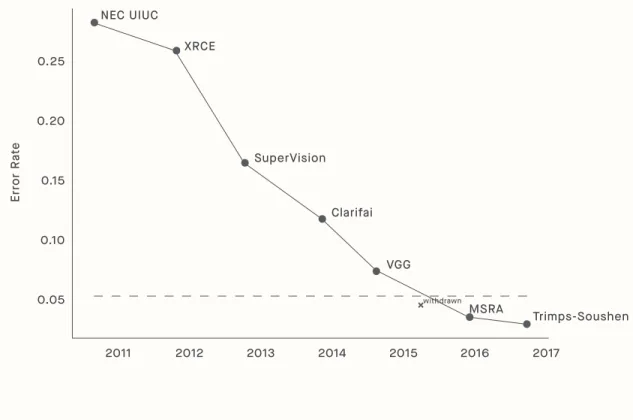
Figure 1 illustrates this trend in the case of image recognition, where over the past half-decade the performance of the best AI systems has improved from correctly categorizing around 70% of images to near perfect categorization (98%), better than the human benchmark of 95% accuracy. Even more striking is the case of image generation. As Figure 2 shows, AI systems can now produce synthetic images that are nearly indistinguishable from photographs, whereas only a few years ago the images they produced were crude and obviously unrealistic.
AI systems are also beginning to achieve impressive performance in a range of competitive games, ranging from chess to Atari to Go to e-sports like Dota 2 . Even particularly challenging tasks within these domains, such as the notoriously difficult Atari game Montezuma’s Revenge, are beginning to yield to novel AI techniques that creatively search for successful long-term strategies , learn from auxiliary rewards such as feature control , and learn from a handful of human demonstrations . Other task areas associated with significant recent progress include speech recognition, language comprehension, and vehicle navigation. From a security perspective, a number of these developments are worth noting in their own right. For instance, the ability to recognize a target’s face and to navigate through space can be applied in autonomous weapon systems. Similarly, the ability to generate synthetic images, text, and audio could be used to impersonate others online, or to sway public opinion by distributing AI-generated content through social media channels. We discuss these applications of AI further in the Security Domains section.
These technical developments can also be viewed as early indicators of the potential of AI. The techniques used to achieve high levels of performance on the tasks listed above have only received significant attention from practitioners in the past decade and are often quite general purpose. It will not be surprising if AI systems soon become competent at an even wider variety of security-relevant tasks.
At the same time, we should not necessarily expect to see significant near-term progress on any given task. Many research areas within AI, including much of robotics, have not changed nearly so dramatically over the past decade. Similarly, the observation that some of the most commonly studied tasks have been associated with rapid progress is not necessarily as significant as it first seems: these tasks are often widely studied in the first place because they are particularly tractable.
1
2
3
4
5
6
7
8
On page 18 On page 19 Mnih et al., 2015Silver and Huang et al., 2016; Silver, Schrittwieser, and Simonyan et al., 2016
OpenAI, 2017a; OpenAI, 2017b Vezhnevets et al., 2017 Jaderberg et al., 2016 Hester et al., 2017
To aid one’s predictions, it can useful to note some systematic difference between tasks which contemporary AI systems are well-suited to and tasks for which they still fall short. In particular, a task is likely to be promising if a perfect mathematical model or simulation of the task exists, if short-term signals of progress are available, if abundant data on the successful performance of that task by humans is available, or if the solution to the task doesn’t require a broader world-model or ``common sense’’.
p
.1
4
General Framework for AI & Security Threats
Figure 1: Recent progress in image recognition on the ImageNet benchmark. Graph from the Electronic Frontier Foundation’s AI Progress
Measurement project (retrieved August 25, 2017).
ImageNet Image Recognition
Human performance Err or Ra te NEC UIUC XRCE SuperVision Clarifai VGG MSRA withdrawn Trimps-Soushen 0.25 2011 2012 2013 2014 2015 2016 2017 0.20 0.15 0.10 0.05
p
.1
5
Figure 2: Increasingly realistic synthetic faces generated by variations on Generative Adversarial Networks (GANs). In order, the
images are from papers by Goodfellow et al. (2014), Radford et al. (2015), Liu and Tuzel (2016), and Karras et al. (2017).
p
.1
6
General Framework for AI & Security Threats
Finally, a few things should be said about the long-term prospects for progress in artificial intelligence. Today, AI systems perform well on only a relatively small portion of the tasks that humans are capable of. However, even before the recent burst of progress, this portion has expanded steadily over time . In addition, it has often been the case that once AI systems reach human-level performance at a given task (such as chess) they then go on to exceed the performance of even the most talented humans. Nearly all AI researchers in one survey expect that AI systems will eventually reach and then exceed human-level performance at all tasks surveyed. Most believe this transition is more likely than not to occur within the next fifty years. The implications of such a transition, should it occur, are difficult to conceptualize, and are outside the primary scope of this report (see Scope, though we briefly revisit this topic in the Conclusion). Nevertheless, one might expect AI systems to play central roles in many security issues well before they are able to outperform humans at everything, in the same way that they are already finding economic applications despite not being able to automate most aspects of humans’ jobs.
Security-Relevant Properties of AI
AI is a dual-use area of technology. AI systems and the knowledge of how to design them can be put toward both civilian and military uses, and more broadly, toward beneficial and harmful ends. Since some tasks that require intelligence are benign and other are not, artificial intelligence is dual-use in the same sense that human intelligence is. It may not be possible for AI researchers simply to avoid producing research and systems that can be directed towards harmful ends (though in some cases, special caution may be warranted based on the nature of the specific research in question - see Interventions). Many tasks that it would be beneficial to automate are themselves dual-use. For example, systems that examine software for vulnerabilities have both offensive and defensive applications, and the difference between the capabilities of an autonomous drone used to deliver packages and the
capabilities of an autonomous drone used to deliver explosives need not be very great. In addition, foundational research that aims to increase our understanding of AI, its capabilities and our degree of control over it, appears to be inherently dual-use in nature. AI systems are commonly both efficient and scalable. Here, we say an AI system is “efficient” if, once trained and deployed, it can complete a certain task more quickly or cheaply than a human could . We say an AI system is “scalable” if, given that it can complete a certain task, increasing the computing power it has access to or making copies of the system would allow it
2
Grace et al., 2017Although trends in performance across a range of domains have historically not been comprehensively tracked or well theorized (Brundage, 2016; Hernández-Orallo, 2017), there have been some recent efforts to track, measure, and compare performance (Eckersley and Nasser et al., 2017).
We distinguish here between task efficiency of a trained system, which commonly exceeds human performance, and training efficiency: the amount of time, computational resources and data, that a system requires in order to learn to perform well on a task. Humans still significantly exceed AI systems in terms of training efficiency for most tasks.
1
p
.1
7
to complete many more instances of the task. For example, a typical facial recognition system is both efficient and scalable; once it is developed and trained, it can be applied to many
different camera feeds for much less than the cost of hiring human analysts to do the equivalent work.
AI systems can exceed human capabilities. In particular, an AI system may be able to perform a given task better than any human could. For example, as discussed above, AI systems are now dramatically better than even the top-ranked players at games like chess and Go. For many other tasks, whether benign or potentially harmful, there appears to be no principled reason why currently observed human-level performance is the highest level of performance achievable, even in domains where peak
performance has been stable throughout recent history, though as mentioned above some domains are likely to see much faster progress than others.
AI systems can increase anonymity and psychological distance. Many tasks involve communicating with other people, observing or being observed by them, making decisions that respond to their behavior, or being physically present with them. By allowing such tasks to be automated, AI systems can allow the actors who would otherwise be performing the tasks to retain their anonymity and experience a greater degree of psychological distance from the people they impact . For example, someone who uses an autonomous weapons system to carry out an assassination, rather than using a handgun, avoids both the need to be present at the scene and the need to look at their victim.
AI developments lend themselves to rapid diffusion. While attackers may find it costly to obtain or reproduce the hardware associated with AI systems, such as powerful computers or drones, it is generally much easier to gain access to software and relevant scientific findings. Indeed, many new AI algorithms are reproduced in a matter of days or weeks. In addition, the culture of AI research is characterized by a high degree of openness, with many papers being accompanied by source code. If it proved desirable to limit the diffusion of certain developments, this would likely be difficult to achieve (though see Interventions for discussion of possible models for at least partially limiting diffusion in certain cases). Today’s AI systems suffer from a number of novel unresolved vulnerabilities. These include data poisoning attacks (introducing training data that causes a learning system to make mistakes ), adversarial examples (inputs designed to be misclassified by machine learning systems ), and the exploitation of flaws in the design of autonomous systems’ goals . These vulnerabilities
1
2
3
4
Cummings, 2004; Scharre, 2018 Biggio et al., 2012 Szegedy et al., 2013 Amodei, Olah, et al., 2016p
.1
8
General Framework for AI & Security Threats
are distinct from traditional software vulnerabilities (e.g. buffer overflows) and demonstrate that while AI systems can exceed human performance in many ways, they can also fail in ways that a human never would.
General Implications for the Threat Landscape
From the properties discussed above, we derive three high-level implications of progress in AI for the threat landscape. Absent the development of adequate defenses, progress in AI will:
•
Expand existing threats•
Introduce new threats•
Alter the typical character of threatsIn particular, we expect attacks to typically be more effective, more finely targeted, more difficult to attribute, and more likely to exploit vulnerabilities in AI systems.
These shifts in the landscape necessitate vigorous responses of the sort discussed under Interventions.
Expanding Existing Threats
For many familiar attacks, we expect progress in AI to expand the set of actors who are capable of carrying out the attack, the rate at which these actors can carry it out, and the set of plausible targets. This claim follows from the efficiency, scalability, and ease of diffusion of AI systems. In particular, the diffusion of efficient AI systems can increase the number of actors who can afford to carry out particular attacks. If the relevant AI systems are also scalable, then even actors who already possess the resources to carry out these attacks may gain the ability to carry them out at a much higher rate. Finally, as a result of these two developments, it may become worthwhile to attack targets that it otherwise would not make sense to attack from the standpoint of prioritization or cost-benefit analysis.
One example of a threat that is likely to expand in these ways, discussed at greater length below, is the threat from spear phishing attacks . These attacks use personalized messages to extract sensitive information or money from individuals, with the
A phishing attack is an attempt to extract information or initiate action from a target by fooling them with a superficially trustworthy facade. A spear phishing attack involves collecting and using information specifically relevant to the target (e.g. name, gender, institutional affiliation, topics of interest, etc.), which allows the facade to be customized to make it look more relevant or trustworthy.
p
.1
9
attacker often posing as one of the target’s friends, colleagues, or professional contacts. The most advanced spear phishing attacks require a significant amount of skilled labor, as the attacker must identify suitably high-value targets, research these targets’ social and professional networks, and then generate messages that are plausible within this context.
If some of the relevant research and synthesis tasks can be automated, then more actors may be able to engage in spear phishing. For example, it could even cease to be a requirement that the attacker speaks the same language as their target. Attackers might also gain the ability to engage in mass spear phishing, in a manner that is currently infeasible, and therefore become less discriminate in their choice of targets. Similar analysis can be applied to most varieties of cyberattacks, as well as to threats to physical or political security that currently require non-trivial human labor.
Progress in AI may also expand existing threats by increasing the willingness of actors to carry out certain attacks. This claim follows from the properties of increasing anonymity and increasing psychological distance. If an actor knows that an attack will not be tracked back to them, and if they feel less empathy toward their target and expect to experience less trauma, then they may be more willing to carry out the attack. The importance of psychological distance, in particular, is illustrated by the fact that even military drone operators, who must still observe their targets and “pull the trigger,” frequently develop post-traumatic stress from their work . Increases in psychological distance, therefore, could plausibly have a large effect on potential attackers’ psychologies.
We should also note that, in general, progress in AI is not the only force aiding the expansion of existing threats. Progress in robotics and the declining cost of hardware, including both computing power and robots, are important too, and discussed further below. For example, the proliferation of cheap hobbyist drones, which can easily be loaded with explosives, has only recently made it possible for non-state groups such as the Islamic State to launch aerial attacks .
Introducing New Threats
Progress in AI will enable new varieties of attacks. These attacks may use AI systems to complete certain tasks more successfully than any human could, or take advantage of vulnerabilities that AI systems have but humans do not.
1
2
Chatterjee, 2015; Dao, 2013; Hawkes, 2015
p
.20
General Framework for AI & Security Threats
First, the property of being unbounded by human capabilities implies that AI systems could enable actors to carry out attacks that would otherwise be infeasible. For example, most people are not capable of mimicking others’ voices realistically or manually creating audio files that resemble recordings of human speech. However, there has recently been significant progress in developing speech synthesis systems that learn to imitate individuals’ voices (a technology that’s already being commercialized ). There is no obvious reason why the outputs of these systems could not become indistinguishable from genuine recordings, in the absence of specially designed authentication measures. Such systems would in turn open up new methods of spreading disinformation and impersonating others .
In addition, AI systems could also be used to control aspects of the behavior of robots and malware that it would be infeasible for humans to control manually. For example, no team of humans could realistically choose the flight path of each drone in a swarm being used to carry out a physical attack. Human control might also be infeasible in other cases because there is no reliable communication channel that can be used to direct the relevant systems; a virus that is designed to alter the behavior of air-gapped computers, as in the case of the ‘Stuxnet’ software used to disrupt the Iranian nuclear program, cannot receive commands once it infects these computers. Restricted communication challenges also arise underwater and in the presence of signal jammers, two domains where autonomous vehicles may be deployed.
Second, the property of possessing unresolved vulnerabilities implies that, if an actor begins to deploy novel AI systems, then they may open themselves up to attacks that specifically exploit these vulnerabilities. For example, the use of self-driving cars creates an opportunity for attacks that cause crashes by presenting the cars with adversarial examples. An image of a stop sign with a few pixels changed in specific ways, which humans would easily recognize as still being an image of a stop sign, might nevertheless be misclassified as something else entirely by an AI system. If multiple robots are controlled by a single AI system run on a centralized server, or if multiple robots are controlled by identical AI systems and presented with the same stimuli, then a single attack could also produce simultaneous failures on an otherwise implausible scale. A worst-case scenario in this category might be an attack on a server used to direct autonomous weapon systems, which could lead to large-scale friendly fire or civilian targeting .
1
2
3
Lyrebird, 2017
Allen and Chan, 2017
p.
21
Altering the Typical Character of Threats
Our analysis so far suggests that the threat landscape will change both through expansion of some existing threats and the emergence of new threats that do not yet exist. We also expect that the typical character of threats will shift in a few distinct ways. In particular, we expect the attacks supported and enabled by progress in AI to be especially effective, finely targeted, difficult to attribute, and exploitative of vulnerabilities in AI systems. First, the properties of efficiency, scalability, and exceeding human capabilities suggest that highly effective attacks will become more typical (at least absent substantial preventive measures). Attackers frequently face a trade-off between the frequency and scale of their attacks, on the one hand, and their effectiveness on the other . For example, spear phishing is more effective than regular phishing, which does not involve tailoring messages to individuals, but it is relatively expensive and cannot be carried out en masse. More generic phishing attacks manage to be profitable despite very low success rates merely by virtue of their scale. By improving the frequency and scalability of certain attacks, including spear phishing, AI systems can render such trade-offs less acute. The upshot is that attackers can be expected to conduct more effective attacks with greater frequency and at a larger scale. The expected increase in the effectiveness of attacks also follows from the potential of AI systems to exceed human capabilities.
Second, the properties of efficiency and scalability, specifically in the context of identifying and analyzing potential targets, also suggest that finely targeted attacks will become more prevalent. Attackers often have an interest in limiting their attacks to targets with certain properties, such as high net worth or association with certain political groups, as well as an interest in tailoring their attacks to the properties of their targets. However, attackers often face a trade-off between how efficient and scalable their attacks are and how finely targeted they are in these regards. This trade-off is closely related to the trade-off with effectiveness, as discussed, and the same logic implies that we should expect it to become less relevant. An increase in the relative prevalence of spear phishing attacks, compared to other phishing attacks, would be an example of this trend as well. An alternative example might be the use of drone swarms that deploy facial recognition technology to kill specific members of crowds, in place of less finely targeted forms of violence.
Third, the property of increasing anonymity suggests that difficult-to-attribute attacks will become more typical. An example, again,
p.
22
General Framework for AI & Security Threats
is the case of an attacker who uses an autonomous weapons system to carry out an attack rather than carrying it out in person. Finally, we should expect attacks that exploit the vulnerabilities of AI systems to become more typical. This prediction follows directly from the unresolved vulnerabilities of AI systems and the likelihood that AI systems will become increasingly pervasive.
Scenarios
p.
23
The following scenarios are intended to illustrate a range of plausible uses toward which AI could be put for malicious ends, in each of the domains of digital, physical, and political security. Examples have been chosen to illustrate the diverse ways in which the security-relevant characteristics of AI introduced above could play out in different contexts. These are not intended to be definitive forecasts (some may not end up being technically possible in 5 years, or may not be realized even if they are possible) or exhaustive (other malicious uses will undoubtedly be invented that we do not currently foresee). Additionally some of these are already occurring in limited form today, but could be scaled up or made more powerful with further technical advances.
p
.24
Digital Security
Automation of social engineering attacks. Victims’ online information is used to automatically generate custom malicious websites/emails/links they would be likely to click on, sent from addresses that impersonate their real contacts, using a writing style that mimics those contacts. As AI develops further, convincing chatbots may elicit human trust by engaging people in longer dialogues, and perhaps eventually masquerade visually as another person in a video chat.
Hypothetical scenario:
Jackie logs into the admin console for the CleanSecure robot that she manages; operating on a verified kernel, it is guaranteed by the manufacturer to be hack-proof. She then uploads photographs of a new employee so the robot will
recognize him when he walks into the building and will not sound the alarm. While she waits for the robot to authenticate its updated person database with the company’s other security systems, Jackie plays with the model train on her desk, allowing herself a couple of runs around the track that encircles her keyboard and monitor. There’s a ping, signaling successful authentication, and she smiles to herself and carries on with her tasks.
Later that afternoon, Jackie is browsing Facebook while idly managing a firmware update of the robot. An ad catches her eye - a model train set sale at a hobbyist shop that, it turns out, is located just a few minutes from her house. She fills out an online form to get a brochure emailed to her, then she opens the brochure when it pops into her inbox. The robot dings, signalling a need for attention, so she minimizes the brochure and logs back into the admin console.
Jackie doesn’t know that the brochure was infected with malware. Based on data from her online profile and other public info, an AI system was used to generate a very personalized vulnerability profile for Jackie - the model train advert - which was then farmed out to a freelancer to create a tailored exploit for this vulnerability. When Jackie logged
p.
2
5
Automation of vulnerability discovery. Historical patterns of code vulnerabilities are used to speed up the discovery of new vulnerabilities, and the creation of code for exploiting them. More sophisticated automation of hacking. AI is used (autonomously or in concert with humans) to improve target selection and prioritization, evade detection, and creatively respond to changes in the target’s behavior. Autonomous software has been able to exploit vulnerabilities in systems for a long time , but more sophisticated AI hacking tools may exhibit much better performance both compared to what has historically been possible and, ultimately (though perhaps not for some time), compared to humans.
into the console, her username and password were exfiltrated to a darknet command and control server. It won’t be long before someone buys them and uses them to subvert the CleanSecure robot with fully privileged access.
Hypothetical scenario:
Progress in automated exploit generation (and mitigation) has begun to accelerate. Previous
fuzzing architectures are augmented by neural network techniques (Blum, 2017) that are used to identify “interesting” states of programs, analogous to the way that AlphaGo uses neural networks to identify “interesting” states in the search space of Go games. These methods increase the security of well-defended systems run by major corporations and some parts of Western governments. But after a year or two, they are also adopted by organized crime groups in eastern Europe, which deploy a piece of ransomware called WannaLaugh.
This malware is continuously updated with dozens of new exploits found by these fuzzing techniques. Though fully patched OSes and browsers are mostly resistant, most older phones, laptops and IoT devices prove enduringly vulnerable. The malware adopts a particularly pernicious life cycle of infecting a vulnerable IoT device on a WiFi network and waiting
p
.26
Scenarios
Human-like denial-of-service. Imitating human-like behavior (e.g. through human-speed click patterns and website navigation), a massive crowd of autonomous agents overwhelms an online service, preventing access from legitimate users and potentially driving the target system into a less secure state.
Automation of service tasks in criminal cyber-offense.
Cybercriminals use AI techniques to automate various tasks that make up their attack pipeline, such as payment processing or dialogue with ransomware victims.
Prioritising targets for cyber attacks using machine learning. Large datasets are used to identify victims more efficiently, e.g. by estimating personal wealth and willingness to pay based on online behavior.
Exploiting AI used in applications, especially in information security. Data poisoning attacks are used to surreptitiously maim or create backdoors in consumer machine learning models. Black-box model extraction of proprietary AI system capabilities. The parameters of a remote AI system are inferred by systematically sending it inputs and observing its outputs.
for vulnerable devices to join that network. Hundreds of millions of devices are infected, and tens of millions of people around the world are forced to pay a EUR 300 ransom in bitcoin in order to recover access to the data on their phones and laptops, and unbrick expensive electronics.
The epidemic is only arrested after active
countermeasures are pushed to a number of modern operating systems and browsers, causing those machines to scan for infected machines and launch remote exploits to remove the malware. Unfortunately, millions more devices are bricked by these
countermeasures, and in around the world there are numerous outages and problems in HVAC, lighting, and other “non critical” infrastructure systems as a result of the malware and countermeasures.
Scenarios Scenarios
p
.27
Physical Security
Terrorist repurposing of commercial AI systems.
Commercial systems are used in harmful and unintended ways, such as using drones or autonomous vehicles to deliver explosives and cause crashes.
Endowing low-skill individuals with previously high-skill attack capabilities. AI-enabled automation of high-skill capabilities — such as self-aiming, long-range sniper rifles - reduce the expertise required to execute certain kinds of attack.
Increased scale of attacks. Human-machine teaming using autonomous systems increase the amount of damage that
/// Incident Interim Report June 3rd BMF HQ Attack ///
As shown by CCTV records, the office cleaning `SweepBot`, entered the underground parking lot of the ministry late at night. The robot - the same brand as that used by the ministry - waited until two of the ministry’s own cleaning robots swept through the parking lot on a regular patrol, then it followed them into a service elevator and parked itself in the utility room alongside the other robots.
On the day of the attack, the intruding robot initially engaged in standard cleaning behaviors with the other robots: collecting litter, sweeping corridors, maintaining windows, and other tasks. Then, following visual detection of the finance minister, Dr. Brenda Gusmile, the intruding robot stopped performing its cleaning tasks and headed directly towards the minister. An explosive device hidden inside the robot was triggered by proximity, killing the minister and wounding nearby staff members.
Several hundred robots of this make are sold in the Berlin area every week. In collaboration with the manufacturer, the point of sale of the specific robot was traced to an office supply store in Potsdam. The transaction was carried out in cash. We have no further leads to explore with regard to the identity of the perpetrator.
p.
2
8
Avinash had had enough. Cyberattacks everywhere, drone attacks, rampant corruption, and what was the government doing about it? Absolutely nothing. Sure, they spoke of forceful responses and deploying the best technology, but when did he last see a hacker being caught or a CEO going to prison? He was reading all this stuff on the web (some of it fake news, though he didn’t realize), and he was angry. He kept thinking: What should I do about it? So he started writing on the internet - long rants about how no one was going to jail, how criminals were running wild, how people should take to the streets and protest. Then he ordered a set of items online to help him assemble a protest sign. He even bought some smoke bombs, planning to let them off as a finale to a speech he was planning to give in a public park. The next day, at work, he was telling one of his colleagues about his planned activism and was launching into a rant when a stern cough sounded from behind him. “Mr. Avinash Rah?”, said the police officer, “our predictive civil disruption system has flagged you as a potential threat.” “But that’s ridiculous!” protested Avinash. “You can’t argue with 99.9% accuracy. Now come along, I wouldn’t like to use force.”
individuals or small groups can do: e.g. one person launching an attack with many weaponized autonomous drones.
Swarming attacks. Distributed networks of autonomous robotic systems, cooperating at machine speed, provide ubiquitous surveillance to monitor large areas and groups and execute rapid, coordinated attacks.
Attacks further removed in time and space. Physical attacks are further removed from the actor initiating the attack as a result of autonomous operation, including in environments where remote communication with the system is not possible.
Political Security
State use of automated surveillance platforms to suppress dissent. State surveillance powers of nations are extended by automating image and audio processing, permitting the collection, processing, and exploitation of intelligence information at massive scales for myriad purposes, including the suppression of debate.
p.
2
9
Fake news reports with realistic fabricated video and audio. Highly realistic videos are made of state leaders seeming to make inflammatory comments they never actually made.
Automated, hyper-personalised disinformation campaigns. Individuals are targeted in swing districts with personalised messages in order to affect their voting behavior.
Automating influence campaigns. AI-enabled analysis of social networks are leveraged to identify key influencers, who can then be approached with (malicious) offers or targeted with disinformation.
Denial-of-information attacks. Bot-driven, large-scale information-generation attacks are leveraged to swamp information channels with noise (false or merely distracting information), making it more difficult to acquire real information.
Manipulation of information availability. Media platforms’ content curation algorithms are used to drive users towards or away from certain content in ways to manipulate user behavior.
p.
3
0
Security
Domains
Here, we analyze malicious uses of AI that would compromise the confidentiality, integrity, and availability of digital systems (threats to Digital Security); attacks taking place in the physical world directed at humans or physical infrastructure (threats to Physical Security); and the use of AI to threaten a society’s ability to engage in truthful, free, and productive discussions about matters of public importance and legitimately implement broadly just and beneficial policies (threats to Political Security). These categories are not mutually exclusive—for example, AI-enabled hacking can be directed at cyber-physical systems with physical harm resulting as a consequence, and physical or digital attacks could be carried out for political purposes—but they provide a useful structure for our analysis.
03
Defined as “engineered systems that are built from, and depend upon, the seamless integration of computational algorithms and physical components” (National Science Foundation, 2017).
p.
31
In each domain of security, we summarize the existing state of play of attack and defense prior to wide adoption of AI in these domains, and then describe possible changes to the nature or severity of attacks that may result from further AI progress and diffusion. The three sections below all draw on the insights discussed above regarding the security-relevant properties of AI, but can be read independently of one another, and each can be skipped by readers less interested in a particular domain.
Digital Security
Absent preparation, the straightforward application of
contemporary and near-term AI to cybersecurity offense can be expected to increase the number, scale, and diversity of attacks that can be conducted at a given level of capabilities, as discussed more abstractly in the General Framework for AI and Security Threats above. AI-enabled defenses are also being developed and deployed in the cyber domain, but further technical and policy innovations (discussed further in Interventions) are needed to ensure that impact of AI on digital systems is net beneficial.
Context
Cybersecurity is an arena that will see early and enthusiastic deployment of AI technologies, both for offense and defense; indeed, in cyber defense, AI is already being deployed for purposes such as anomaly and malware detection. Consider the following:
•
Many important IT systems have evolved over time to be sprawling behemoths, cobbled together from multiple different systems, under-maintained and — as a consequence — insecure. Because cybersecurity today is largely labor-constrained , it is ripe with opportunities for automation using AI. Increased use of AI for cyber defense, however, may introduce new risks, as discussed below.•
In recent years, various actors have sought to mount increasingly sophisticated cyberoperations, including finely targeted attacks from state actors (including the Stuxnet Worm and the Ukrainian power grid “crash override” exploit). The cyber arena also includes a vast and complex world of cybercrime , which sometimes involves a high degree of professionalization and organization . Such groups use DDoS, malware, phishing, ransomware, and other forms of82% of decision-makers surveyed at public and private organizations in eight countries have reported a shortage of needed cybersecurity skills (McAfee and the Center for Strategic and International Studies, 2016).
1
2
3
McAfee and the Center for the
Strategic and International Studies, 2013
p.
32
Security Domains
cyberoperations, and quickly adopt emerging technologies (e.g. Bitcoin for ransomware payments).
Already, AI is being widely used on the defensive side of cybersecurity, making certain forms of defense more effective and scalable, such as spam and malware detection. At the same time, many malicious actors have natural incentives to experiment with using AI to attack the typically insecure systems of others. These incentives include a premium on speed, labor costs, and difficulties in attracting and retaining skilled labor.
To date, the publicly-disclosed use of AI for offensive purposes has been limited to experiments by “white hat” researchers, who aim to increase security through finding vulnerabilities and suggesting solutions. However, the pace of progress in AI suggests the likelihood of cyber attacks leveraging machine learning capabilities in the wild soon, if they have not done so already. Indeed, some popular accounts of AI and cybersecurity include claims based on circumstantial evidence that AI is already being used for offense by sophisticated and motivated adversaries . Expert opinion seems to agree that if this hasn’t happened yet, it will soon: a recent survey of attendees at the Black Hat conference found 62% of respondents believing AI will be used for attacks within the next 12 months . Despite these claims, to our knowledge there is no publicly documented evidence of AI-based attacks, though it should be noted that evidence from many successful attacker techniques (e.g. botnets, email phishing campaigns) may be difficult to attribute to AI versus human labor or simple automation. We are thus at a critical moment in the co-evolution of AI and cybersecurity and should proactively prepare for the next wave of attacks.
Many governments are keenly interested in the combination of AI and cybersecurity. In response to a question from one of the authors of this report, Admiral Mike Rogers, the Director of the National Security Agency, said, “Artificial Intelligence and machine learning — I would argue — is foundational to the future of cybersecurity […] It is not the if, it’s only the when to me.” AI systems are already set to play an expanded role in US military strategy and operations in the coming years as the US DoD puts into practice its vision of a “Third Offset” strategy , in which humans and machines work closely together to achieve military objectives. At the same time, governments are investing in foundational research to expand the scope of capabilities of AI systems. In 2016, DARPA hosted the Cyber Grand Challenge contest , which saw teams of human researchers compete with
1
2
4
3
Dvorsky, 2017 Cylance, 2017 DARPA, 2016p.
3
3
each other to create programs that could autonomously attack other systems while defending themselves. Though the winning AI system fared poorly when facing off against human security experts, we agree with the hosts of the event that AI cybersecurity capabilities will improve rapidly in coming years, especially as recent advances in AI (such as in the area of deep reinforcement learning ) are applied to cybersecurity.
How AI Changes The Digital Security Threat Landscape
A central concern at the nexus of AI and cybersecurity is that AI might enable larger-scale and more numerous attacks to be conducted by an attacker with a given amount of skill and resources compared with the impact such an attacker might currently be able to achieve. Recent years have seen impressive and troubling proofs of concept of the application of AI to offensive applications in cyberspace. For example, researchers at ZeroFox demonstrated that a fully automated spear phishing system could create tailored tweets on the social media platform Twitter based on a user’s demonstrated interests, achieving a high rate of clicks to a link that could be malicious .
There is clearly interest in such larger-scale attacks: Russian hackers sent “expertly tailored messages carrying malware to more than 10,000 Twitter users in the [U.S.] Defense Department” , which likely required significant time and effort, and could have gone even further with automation (assuming it was not involved already in this case). Giaretta and Dragoni (2017) discuss the concept of “community targeted spam” that uses natural language generation techniques from AI to target an entire class of people with common ways of writing; with even more advanced natural language generation, one could envision even more customized approaches, spanning multiple communities. Furthermore, the application of AI to the automation of software vulnerability discovery, while having positive applications (discussed further in the Interventions section), can likewise be used for malicious purposes to alleviate the labor constraints of attackers.
The adaptability of AI systems, too, may change the strategic landscape of cybersecurity, though it is not yet clear how adaptability will affect the offense/defense balance. Many organizations currently adopt security systems called Endpoint Detection and Response (EDR) platforms to counter more advanced threats. The EDR market represents a $500 million industry in the cyber security arena . These tools are built upon a combination of heuristic and machine learning algorithms to provide capabilities such as next-generation anti-virus (NGAV),
1
2
3
4
Arulkumaran et al., 2017
Seymour and Tully, 2016)
Calabresi, 2017
p.
3
4
Security Domains
behavioral analytics, and exploit prevention against sophisticated targeted attacks. Though these systems are fairly effective against typical human-authored malware, research has already shown that AI systems may be able to learn to evade them.
As an example of AI being used to avoid detection, Anderson et al. created a machine learning model to automatically generate command and control domains that are indistinguishable from legitimate domains by human and machine observers. These domains are used by malware to “call home” and allow malicious actors to communicate with the host machines. Anderson et al. also leveraged reinforcement learning to create an intelligent agent capable of manipulating a malicious binary with the end goal of bypassing NGAV detection. Similarly, Kharkar et al. applied adversarial machine learning to craft malicious documents that could evade PDF malware classifiers.
Attackers are likely to leverage the growing capabilities of reinforcement learning, including deep reinforcement learning . In particular, we expect attackers to leverage the ability of AI to learn from experience in order to craft attacks that current technical systems and IT professionals are ill-prepared for, absent additional investments. For example, services like Google’s VirusTotal file analyzer allows users to upload variants to a central site and be judged by 60+ different security tools. This feedback loop presents an opportunity to use AI to aid in crafting multiple variants of the same malicious code to determine which is most effective at evading security tools. Additionally, large-scale AI attackers can accumulate and use large datasets to adjust their tactics, as well as varying the details of the attack for each target. This may outweigh any disadvantages they suffer from the lack of skilled human attention to each target, and the ability of defenders like antivirus companies and IT departments to learn to recognize attack signatures.
While the specific examples of AI applied to offensive
cybersecurity mentioned above were developed by white hat researchers, we expect similar efforts by cybercriminals and state actors in the future as highly capable AI techniques become more widely distributed, as well as new applications of AI to offensive cybersecurity that have not yet been explored.
Points of Control and Existing Countermeasures
Cyber risks are difficult to avert entirely, but not impossible to mitigate, and there are multiple points of control at which interventions can increase security. Below, we highlight different
1
3
4
2
Anderson et al. 2016 Kharkar et al. 2017 Arulkumaran et al., 2017 Anderson et al. 2018p.
3
5
points of control and existing countermeasures for defending at those points, as well as their limitations. Overall, we believe that AI and cybersecurity will rapidly evolve in tandem in the coming years, and that a proactive effort is needed to stay ahead of motivated attackers. We highlight potential but not yet proven countermeasures in the section below on Interventions. Consumer awareness:
More aware users can spot telltale signs of certain attacks, such as poorly crafted phishing attempts, and practice better security habits, such as using diverse and complex passwords and two-factor authentication. However, despite long-standing awareness of the vulnerability of IT systems, most end users of IT systems remain vulnerable to even simple attacks such as the exploitation of unpatched systems . This is concerning in light of the potential for the AI-cybersecurity nexus, especially if high-precision attacks can be scaled up to large numbers of victims.
Governments and researchers:
Various laws and researcher norms pertain to cybersecurity. For example, the Digital Millennium Act and the Computer Fraud and Abuse Act in the US proscribe certain actions in cyberspace . Legal enforcement is particularly difficult across national
boundaries. Norms such as responsible disclosure of vulnerabilities also aid in defense by reducing the likelihood of a newly disclosed vulnerability being used against a large number of victims before it can be patched. AI is not explicitly addressed in such laws and norms, though we discuss their possible applicability to AI below in Interventions.
An important activity that cybersecurity researchers perform is the detection of vulnerabilities in code, allowing vendors to increase the security of their products. Several approaches exist to incentivize such processes and make them easier, including:
•
Payment of “Bug bounties,” in which participants are compensated for finding and responsibly disclosing vulnerabilities.•
“Fuzzing,” an automated method of vulnerability detection by trying out many possible permutations of inputs to a program, which is often used internally by companies to discover vulnerabilities.•
Products (already available) that rely on machine learning to predict whether source code may contain a vulnerability.1
National Cyber Security Crime Centre, 2016Both the DMCA and the CFAA have been criticised for creating risk for computer security researchers and thereby making systems less secure in some cases (EFF, 2014; Timm, 2013), which may either suggest that these tasks are not the right model for legislative action, or that laws and norms are hard to use effectively as an intervention.
p.
3
6
Security Domains
Industry centralization:
Spam filters are a canonical example of where centralization of an IT system aids defense—individuals benefit from the strength of Google’s spam filter and consequently are protected from many very simple attacks, and this filter is stronger because Google uses large amounts of user data to improve it over time. Likewise, many large networks are constantly monitoring for anomalies, protecting those who use the networks if anomalies are correctly identified and acted upon. These systems benefit from economies of scale— it makes more sense to continue iterating a single spam filter for a large number of users than to have every user build their own or have one installed on their computer. Similarly, cloud computing companies may enforce terms of agreement that prevent their hardware from being used for malicious purposes, provided they can identify such behavior. Another example of a system-level defense is blacklisting of IP addresses from which attacks are commonly launched, though skilled attackers can obfuscate the origin of their attacks. Centralization and the associated economies of scale may also facilitate the deployment of AI-based defenses against cybersecurity attacks, by allowing the aggregation of large datasets and the concentration of labor and expertise for defense. This dynamic may be very important for preventing attack from outpacing defense and is discussed further in Interventions and Appendix B.
Centralization is not an unalloyed good, however, as it raises the stakes if central systems are compromised. Another difficulty with this control point is that attackers can learn how to evade system-level defenses. For example, they can purchase commercial antivirus software and analyze changes between updates of the protection protocol to see what is and isn’t being protected against.
Attacker incentives:
Attackers can be deterred from committing future attacks or punished for prior attacks. A necessary (though not sufficient) condition of successfully deterring and punishing attackers is the ability to attribute the source of an attack, a notoriously difficult problem . A compounding problem for those who would attribute an attack is that even if they have high-quality information, they may not want to reveal it, because doing so may compromise a source or method . Finally, some entities may not wish to punish certain actions, so as to avoid creating precedent and thereby preserve leeway to engage in such actions themselves . Technical cybersecurity defenses:
A wide variety of cybersecurity defenses are available, though there is as yet little solid analysis of their relative effectiveness .
1
Rid, 2015For instance, the failure of the United Nations Cybersecurity Group of Governmental Experts to make progress on norms for hacking in international law (Korzak, 2017) appears to be a result of this dynamic.
3
2
4
Libicki, 2016