Open Research Online
The Open University’s repository of research publications
and other research outputs
AI-KG: an Automatically Generated Knowledge Graph
of Artificial Intelligence
Conference or Workshop Item
How to cite:
Dessi’, Danilo; Osborne, Francesco; Reforgiato Recupero, Diego; Buscaldi, Davide; Motta, Enrico and Sack,
Harald (2020). AI-KG: an Automatically Generated Knowledge Graph of Artificial Intelligence. In: The Semantic Web
– ISWC 2020, Springer (In Press).
For guidance on citations see FAQs.
c
[not recorded]
Version: Accepted Manuscript
Copyright and Moral Rights for the articles on this site are retained by the individual authors and/or other copyright
owners. For more information on Open Research Online’s data policy on reuse of materials please consult the policies
page.
Graph of Artificial Intelligence
Danilo Dess`ı1,2, Francesco Osborne3, Diego Reforgiato Recupero4, Davide
Buscaldi5, Enrico Motta3, and Harald Sack1,2
1 FIZ Karlsruhe - Leibniz Institute for Information Infrastructure, Germany 2
Karlsruhe Institute of Technology, Institute AIFB, Germany
{danilo.dessi, harald.sack}@fiz-karlsruhe.de
3
Knowledge Media Institute, The Open University, UK
{francesco.osborne, enrico.motta}@open.ac.uk
4
Department of Mathematics and Computer Science, University of Cagliari, Italy
5
LIPN, CNRS (UMR 7030), Universit´e Sorbonne Paris Nord, Villetaneuse, France
Abstract. Scientific knowledge has been traditionally disseminated and preserved through research articles published in journals, conference pro-ceedings, and online archives. However, this article-centric paradigm has been often criticized for not allowing to automatically process, catego-rize, and reason on this knowledge. An alternative vision is to generate a semantically rich and interlinked description of the content of research publications. In this paper, we present the Artificial Intelligence Knowl-edge Graph (AI-KG), a large-scale automatically generated knowlKnowl-edge graph that describes 820K research entities. AI-KG includes about 14M RDF triples and 1.2M reified statements extracted from 333K research publications in the field of AI, and describes 5 types of entities (tasks, methods, metrics, materials, others) linked by 27 relations. AI-KG has been designed to support a variety of intelligent services for analyzing and making sense of research dynamics, supporting researchers in their daily job, and helping to inform decision-making in funding bodies and research policymakers. AI-KG has been generated by applying an auto-matic pipeline that extracts entities and relationships using three tools: DyGIE++, Stanford CoreNLP, and the CSO Classifier. It then integrates and filters the resulting triples using a combination of deep learning and semantic technologies in order to produce a high-quality knowledge graph. This pipeline was evaluated on a manually crafted gold standard, yielding competitive results. AI-KG is available under CC BY 4.0 and can be downloaded as a dump or queried via a SPARQL endpoint.
Keywords: Artificial Intelligence·Scholarly Data·Knowledge Graph
·Information Extraction·Natural Language Processing
1
Introduction
Scientific knowledge has been traditionally disseminated and preserved through research articles published in journals, conference proceedings, and online archives.
These documents, typically available as PDF, lack an explicit machine-readable representation of the research work. Therefore, this article-centric paradigm has been criticized for not allowing to automatically process, categorize, and rea-son on this knowledge [13]. In recent years, these limitations have been further exposed by the increasing number of publications [6], the growing role of inter-disciplinary research, and the reproducibility crisis [20].
An alternative vision, that is gaining traction in the last few years, is to generate a semantically rich and interlinked description of the content of research publications [13, 29, 7, 24]. Integrating this data would ultimately allow us to produce large scale knowledge graphs describing the state of the art in a field and all the relevant entities, e.g., tasks, methods, metrics, materials, experiments, and so on. This knowledge base could enable a large variety of intelligent services for analyzing and making sense of research dynamics, supporting researchers in their daily job, and informing decision-making in funding bodies and governments.
The research community has been working for several years on different solu-tions to enable a machine-readable representasolu-tions of research, e.g., by creating bibliographic repositories in the Linked Data Cloud [19], generating knowledge bases of biological data [5], encouraging the Semantic Publishing paradigm [27], formalising research workflows [31], implementing systems for managing nano-publications [14] and micronano-publications [26], , automatically annotating research publications [24], developing a variety of ontologies to describe scholarly data, e.g., SWRC6, BIBO7, BiDO8, SPAR [21], CSO9 [25], and generating large-scale
knowledge graphs, e.g., OpenCitation10, Open Academic Graph11, Open
Re-search Knowledge Graph12[13], Academia/Industry DynAmics (AIDA) Knowl-edge Graph13 [3]. Most knowledge graphs in the scholarly domain typically con-tain metadata describing entities, such as authors, venues, organizations, re-search topics, and citations. Very few of them [26, 12, 14, 13] actually include explicit representation of the knowledge presented in the research papers. A re-cent example is the Open Research Knowledge Graph [13] that also offers a web interface for annotating and navigating research papers. Typically, these knowledge graphs are populated either by human experts [14, 13] or by auto-matic pipelines based on Natural Language Processing (NLP) and Information Extraction (IE) [23, 16]. The first solution usually produces an high-quality out-come, but suffers from limited scalability. Conversely, the latter is able to process very large corpora of publications, but may yield a noisier outcome.
The recent advancements in deep learning architectures have fostered the emergence of several excellent tools that extract information from research pub-lications with a fair accuracy [4, 11, 18, 16]. However, integrating the output of
6 http://ontoware.org/swrc 7 http://bibliontology.com 8 http://purl.org/spar/bido 9 http://cso.kmi.open.ac.uk 10 https://opencitations.net/ 11https://www.openacademic.ai/oag/ 12 https://www.orkg.org/orkg/ 13 http://w3id.org/aida/
these tools in a coherent and comprehensive knowledge graph is still an open challenge.
In this paper, we present the Artificial Intelligence Knowledge Graph (AI-KG), a large-scale automatically generated knowledge graph that describes 820K research entities in the field of AI. AI-KG includes about 14M RDF triples and 1.2M reified statements extracted from 333K research publications in the field of AI and describes 5 types of entities (research topics, tasks, methods, metrics, materials) linked by 27 relations. Each statement is also associated to the set of publications it was extracted from and the tools that allowed its detection.
AI-KG was generated by applying an automatic pipeline [9] on a corpus of publications extracted from the Microsoft Academic Graph (MAG). This ap-proach extracts entities and relationships using three state of the art tools: Dy-GIE++ [30], the CSO Classifier [23], and Stanford CoreNLP [2, 17]. It then integrates similar entities and relationships and filters contradicting or noisy triples. AI-KG is available online14 and can be queried via a Virtuoso
triple-store or downloaded as a dump. We plan to release a new version of AI-KG every six months, in order to include new entities and relationships from recent publications.
The remainder of this paper is organized as follows. Section 2 discusses the related work, pointing out the existing gaps. Section 3 describes AI-KG, the pipeline used for its generation, and our plan for releasing new versions. Section 4 reports the evaluation. Finally, Section 5 concludes the paper, discusses the limitations, and defines future directions of research where we are headed.
2
Related Work
Due to its importance in the automatic and semi-automatic building and main-tenance of Knowledge Bases, the area of Information Extraction (IE) comprises a large body of work, which includes a variety of methods for harvesting enti-ties and relationships from text. In many of the proposed solutions, IE relies on Part-Of-Speech (PoS) tagging and various type of patterns, morphological or syntactical [28, 22], often complementing themselves to compensate for reduced coverage. The most recent approaches exploit various resources to develop ensem-ble methodologies [18]. If we consider IE as the combination of two main tasks, extracting entities and identifying relations from text, the latter has proven without doubt the most challenging. The most successful models for relation extraction are either based on knowledge or supervised and, therefore, depend on large annotated datasets, which are rare and costly to produce. Among the knowledge-based ones, it is worth to cite FRED15, a machine reader developed
by [11] on top of Boxer [8]. However, these tools are built for open-domain ex-traction and do not usually performs well on research publications that typically use scientific jargon and domain-dependent terms.
For a number of years, researchers have targeted scientific publications as a challenge domain, from which to extract structured information. The extraction
14
http://w3id.org/aikg
15
of relations from scientific papers has recently raised interest among the NLP re-search community, thanks also to challenges such as SemEval 2017, scienceIE16
and SemEval 2018 Task 7 Semantic Relation Extraction and Classification in Scientific Papers [10], where participants tackled the problem of detecting and classifying domain-specific semantic relations. Since then, extraction methodolo-gies for the purpose of building knowledge graphs from scientific papers started to spread in the literature [15]. For example, authors in [1] employed syntactical patterns to detect entities, and defined two types of relations that may exist between two entities (i.e., hyponymy and attributes) by defining rules on noun phrases. Another attempt to build scientific knowledge graphs from scholarly data was performed by [16], as an evolution of the authors’ work at SemEval 2018 Task 7. First, authors proposed a Deep Learning approach to extract en-tities and relations from the scientific literature; then, they used the retrieved triples for building a knowledge graph on a dataset of 110,000 papers. How-ever, they only used a set of six predefined relations, which might be too generic for the purpose of yielding insights from the research landscape. Conversely, we also detected frequent verbs used on research articles and mapped them to 27 semantic relations, making our results more precise and fine-grained.
3
AI-KG
3.1 AI-KG Overview
The Artificial Intelligence Knowledge Graph (AI-KG) includes about 14M RDF triples and describes a set of 1.2M statements and 820K entities extracted from a collection of 333,609 publications in Artificial Intelligence (AI) in the period 1989-2018. In order to interlink AI-KG with other well-known knowledge bases, we also generated 19,704owl:sameAsrelationships with Wikidata and 6,481 with CSO. The current version of AI-KG was generated and will be regularly updated through an automatic pipeline that integrates and enriches data from Microsoft Academic Graph, the Computer Science Ontology (CSO), and Wikidata.
The AI-KG ontology is available online17and builds on SKOS18, PROV-O19,
and OWL20. Each statement in AI-KG is associated with a triple describing the
relationship between two entities and a number of relevant metadata. Specifi-cally, a statement is described by the following relationships:
– rdf:subject,rdf:predicate, andrdf:object, which provide the statement in stan-dard triple form;
– aikg-ont:hasSupport, which reports the number of publications the statement was derived from;
16https://scienceie.github.io/ 17 http://w3id.org/aikg/aikg/ontology 18https://www.w3.org/2004/02/skos/ 19 https://www.w3.org/TR/prov-o/ 20 https://www.w3.org/OWL/
– PROV-O:wasDerivedFrom, which provides provenance information and lists the IDs of the publications from which the statement was extracted;
– PROV-O:wasGeneratedBy, which provides provenance and versioning infor-mation, listing (i) the tools used to detect the relationship, and (ii) the version of the pipeline that was used;
– aikg-ont:isInverse, which signals if the statement was created by inferring the inverse of a relationship extracted from the text.
– aikg-ont:isInferredByTransitivity, which signals if the statement was inferred by other statements (i.e., via transitive closure).
An example of an AI-KG statement is shown in the following:
aikg:statement_110533 a aikg-ont:Statement, provo:Entity ; aikg-ont:hasSupport 4 ; aikg-ont:isInferredByTransitivity false ; aikg-ont:isInverse false ; rdf:subject aikg:learning_algorithm ; rdf:predicate aikg-ont:usesMethod ; rdf:object aikg:gradient_descent ; provo:wasDerivedFrom aikg:1517004310, aikg:1973720487, aikg:1996503769, aikg:2085159862 ; provo:wasGeneratedBy aikg:DyGIE++, aikg:OpenIE, aikg:pipeline_V1.2 .
The example illustrates the statement <learning algorithm, usesMethod,
gradient descent>and all its relevant information. It declares that this
state-ment was extracted from four publications (usingaikg-ont:hasSupport) and gives the IDs for these publications (using provo:wasDerivedFrom).
It also uses provo: wasGeneratedBy to declare the specific tools that were used to identify the statement, and which version of our pipeline was used to process it.
The AI-KG ontology describes five types of research entities (Method, Task, Material, Metric, OtherEntity). We focused on those types since they are already supported by several information extraction tools [16] and benchmarks [10].
The relations between the instances of these types were instead crafted analysing the main predicates and triples returned by several tools. We se-lected the most frequent predicates extracted by NLP tools and generated a set of candidate relations by combining them with the five supported enti-ties. For example, the predicate uses was used to produce usesMethod, uses-Task, usesMaterial, usesMetric, usesOtherEntity. Theis apredicate was instead mapped to the skos:broader relation, e.g., <neural network , skos:broader, machine learning technique>. This draft was revised in subsequent iterations by four domain experts, who eventually selected 27 relations derived from 9 ba-sic verbs (uses,includes,is,evaluates,provides,supports,improves,requires, and
predicts) and defined their characteristics, such as domain, range, and transitive-ness. Defining the correct domain for each relationship also enabled us to filter
many invalid statements returned by the original tools as discussed in Section 3.3. AI-KG is licensed under a Creative Commons Attribution 4.0 International Li-cense (CC BY 4.0). It can be downloaded as a dump athttp://w3id.org/aikg/ and queried via a Virtuoso triplestore athttp://w3id.org/aikg/sparql/.
In the following subsection, we will discuss the automatic generation of AI-KG triples (Sect. 3.2), how it was assembled (Sect. 3.3), and describe it in more details (Sect. 3.4).
3.2 Research Entities and Relations Extraction
This section illustrates the pipeline for extracting entities and relationships from research papers and generating AI-KG. Figure 1 shows the architecture of the pipeline. This approach first detects sub-strings that refer to research entities, links them by using both pre-defined and verb-based relations, and generates three disjoint sets of triples. Then, it applies NLP techniques to remove too generic entities (e.g., “approach”, “algorithm”) and cleans unusual characters (e.g., hyphens used in text to start a new row). Finally, it merges together triples that have the same subject and object and uses a manually crafted dictionary to generate their relationships.
Fig. 1.Schema of our pipeline to extract and handle entities and relations.
Description of Employed Tools and Methods. The following tools were used to extract research entities and their relations:
– DyGIE++ [30] designed by Wadden et al. was used to perform the first parsing of the input scientific data. It is a framework which exploits BERT embeddings into a neural network model to analyze scientific text. The Dy-GIE++ framework extracts six types of research entitiesTask, Method, Met-ric, Material, Other-Scientific-Term, and Generic and seven types of rela-tions (i.e.,Compare, Part-of, Conjunction, Evaluate-for, Feature-of, Used-for, Hyponym-Of). For the purpose of this work, we discarded all the triples with relationConjunctionandGeneric, since they did not carry sufficient se-mantic information. DyGIE++ exploits a feed-forward neural network that is applied on span representations of the input texts to compute two scoresv1
andv2, which measure the probability of span representations to be research
entities or relations within the predefined types.
– TheCSO Classifier21[23], is a tool built on top of the Computer Science
On-tology, an automatically generated ontology of research areas in the field of Computer Science [25]. It identifies topics by means of two different compo-nents, the syntactic module and the semantic module. Thesyntactic module
adopts syntactical rules in order to detect topics in the text. In particular, on unigrams, bigrams, and trigrams computed on text, it applies the Leven-shtein similarity with the labels of the topics in CSO. If the similarity meets a given threshold the n-gram is recognized as research topic. Thesemantic module exploits the knowledge contained in a Word2Vec model trained on a corpus of scientific papers and a regular expression on PoS tags of the input text to map n-grams to research topics.
– TheOpen Information Extraction (OpenIE) [2] is an annotator provided by the Stanford Core NLP suite. It extracts general entities and relations from a plain text. It detects groups of words (clauses) where there are at least a subject and a verb by exploring a parsing tree of its input. First, clauses that hold this syntactic structure are built. Then, it adopts a multinomial logistic regression classifier to recursively explore the dependency tree of sentences from governor to dependant nodes. The natural logic of clauses is captured by exploiting semantic dictating contexts and, finally, long clauses are segmented into triples. In order to detect only triples that are related to research entities, we removed all OpenIE triples where the string of detected entities did not overlap with the string of the research entities previously found by DyGIE++ and CSO classifier.
– PoS Tagger of Stanford Core NLP22 which annotates PoS tags of an input
text. The PoS tags were used to detect all verbs that might represent a relation between two research entities. More precisely, for each sentencesi
we held all the verbsV ={v0, . . . , vk}between each pair of research entities
(em, en) to create triples in the form <em,v,en> wherev∈V.
From each abstractaiof the input AI papers, the pipeline extracted entities
Ei and relationsRi. More specifically, these sets were firstly extracted by using
the DyGIE++ tool23. Then,E
i was expanded by using all research topics that
were found by the CSO classifier. Subsequently, OpenIE was applied to parse the text, and all triples in the form< subject,verb,object >with both subject and object that overlap research entities in Ei were added to Ri. The set Ri
was finally expanded by using all triples built by exploiting the PoS tagger. The reader notices that between two entities different relations might be detected by the origin tools, therefore, two entities within AI-KG can be at most linked by 3 different relations.
Handling of Research Entities. Research entities extracted from plain text can contain very generic nouns, noisy elements, and wrong representations due
21https://github.com/angelosalatino/cso-classifier 22
https://nlp.stanford.edu/software/tagger.shtml
23
to mistakes in the extraction process. In addition, different text representations might refer to the same research entity. To prevent some of these issues, our approach performed the following steps. First, it cleaned entities from punctu-ation signs (e.g., hyphens and apostrophes) and stop-words. Then, it exploited a manually built blacklist of entities to filter out ambiguous entities, such as “learning”. Then, it applied simple rules to split strings that contained more than one research entity. For example, a research entity like machine learning and data mining was split inmachine learning anddata mining. Subsequently, acronyms were detected and solved within the same abstract by exploiting the fact that they usually appear in brackets next to the extended form of the related entities e.g.,Support Vector Machine (SVM).
In order to discard generic entities (e.g.,approach,method,time, paper), we exploited the Information Content (IC) score computed on our entities by means of the NLTK24 library, and a white-list of entities that had to be preserved.
Specifically, our white-list was composed by all CSO topics and all keywords coming from our input research papers. Our pipeline discarded all entities that were not in the white-list and that had a IC equal or lower than an empirically and manually defined threshold of 15.
Finally, we merged singular and plural forms of the same entities to avoid that many resulting triples expressed the same information. We transformed plural entities in their singular form using the Wordnet lemmatizer and merged entities that refer to the same research topic (e.g., ontology alignment and ontology matching) according to therelevantEquivalent relation in CSO.
Handling of Relations. In this section, we describe how the pipeline identified specific relations between entities.
Best relations selector. Our relations can be divided in three subsets i)RD++:
the set of triples derived by the DyGIE++ framework where relations are pre-defined ii)ROIE: the set of triples detected by OpenIE where each relation is a
verb, and iii) RP oS: the set of triples that were built on top of the PoS tagger
results where each relation is a verb.
In order to integrate these triples and identify one relation for each pair of entities we performed the following operations.
– The set of triples RD++ containing predefined relations was modified as
follows. LetLR= [r1, . . . , rn] the list of relations between a pair of entities
ep, eq such that (ep, ri, eq)∈RD++. Then, the most frequent relation rf req
was selected as the most frequent relation inLRand used to build the triple
< ep, rf req, eq >. The set of triples so built generated the setTD++.
– The set of triplesROIErelations was transformed as follows. For each pair of
research entities (ep, eq) all their relationsLR= [r1, . . . , rn] were collected.
For each relationri, its corresponding word embedding wi was associated
and the listLRwwas built. The word embeddings were built by applying the
Word2Vec algorithm over the titles and abstracts of 4,5M English papers in
24
the field of Computer Science from MAG after replacing spaces with under-scores in all n-grams matching the CSO topic labels and for frequent bigrams and trigrams. Then, all word embeddingswi were averaged yielding wavg,
and by using the cosine similarity the relationrj with word embeddingwj
nearest towavgwas chosen as best predicate label. Triples like< ep, rj, eq>
were used to create the setTOIE. The same process was also applied on the
triplesRP oS yielding the set TP oS.
– Finally, each triple within setsTD++,TOIE, andTP oS was associated to the
list of research papers from which they were extracted in order to preserve the provenance of each statement. Additionally, we refer to the number of re-search papers as thesupport, which is a confidence value about the consensus of the research community over that specific triple.
Relations mapping. Many triples presented relations that were semantically sim-ilar, but syntactically different, such as exploit, use, and adopt. Therefore, we reduced the relation space by building a map M for merging similar relations. All verb relations in setsTOIE andTP oSwere taken into account. We mapped all
verb relations with the corresponding word embeddings and created a hierarchi-cal clustering by exploiting the algorithm provided by the SciKit-learn library. The values 1−cosine similarity were used as distance between elements. Then the silhouette-width measure was used to quantify the quality of the clusters for various cuts. Through an empirical analysis the dendrogram was cut when the average silhouette-width was 0.65. In order to remove noisy elements we manu-ally revised the clusters. Finmanu-ally, using the clusters we created the mapM where elements of the same cluster were mapped to the cluster centroid. In addition,
M was also manually integrated to map the relations of the set TD++ to the
same verb space. The map M was used to transform all relations of triples in setsTD++,TOIE, andTP oS.
Triple Selection. In order to preserve only relevant information about the AI field, we adopted a selection process that labels our triples asvalidandnot-valid.
Valid Triples. In order to define the set of valid triples we considered which method was used for the extraction and the number of papers associated to each triple. In more details, we used the following criteria to consider triples asvalid:
– All triples that were extracted by DyGIE++ and OpenIE (i.e., triples of the sets TD++ and TOIE) were considered valid since the quality of results of
those tools has been already proved by their related scientific publications.
– All triples of the set TP oS that were associated to at least 10 papers with
the goal to hold triples with a fair consensus. We refer to this set asTP oS0 . The setTvalidwas hence composed by the union of TD++, TOIE, andTP oS0 . All
Consistent triples. Several triples in the setT¬valid might still contain relevant
information even if they are not well-supported. For their detection, we exploited the set Tvalid as good examples to move triples from the setT¬valid to Tvalid.
More precisely, we designed a classifier γ : (ep, eq) →l where (ep, eq) is a pair
of research entities and l is a predicted relation. The idea was that a triple consistent with Tvalid would have its relation correctly guessed by γ. In more
details the following steps were performed:
– A Multi-Perceptron Classifier (MLP) to guess the relation between a couple of entities was trained on theTvalidset. The input was made by the
concate-nation of entity word embeddings ep, eq, i.e., wep, weq. The adopted word embeddings model was the same used to cluster verbs.
– We applied γ on entities for each triple < ep, r, eq >∈ T¬valid, yielding a
relationr0. The relations rand r0 were compared. Ifr=r0 then the triple
< ep, r, eq >was considered consistent and included toTvalid. Otherwise we
computed the cosine similaritycos simsimilarity betweenrandr0word em-beddings, and theWu-Palmer wup simsimilarity betweenrandr0Wordnet
synsets. If the average betweencos sim and wup sim was higher than the threshold th = 0.5 then the triple < ep, r, eq > was considered consistent
withTvalid and added to this set.
The setTvalid after these steps contained 1,493,757 triples.
3.3 AI-KG Generation
In this section, we discuss the generation of AI-KG from the triples of the set
Tvalidand describe how it is driven by the AI-KG ontology introduced in Section
3.1. We also report how we materialized several additional statements entailed by the AI-KG schema using inverse and transitive relations. Finally, we describe how we mapped AI-KG to Wikidata and CSO.
Ontology-driven Knowledge Graph Generation As discussed in Section 3.1, the most frequent predicates of the set set Tvalid were given to four
do-main experts associated with several examples of triples. After several iteration, the domain experts produced a final set of 27 relations and defined their range, domain, and transitivity. We mapped the relations in Tvalid to those 27
rela-tions whenever was possible and discarded the inconsistent triples. The latter included both the triples whose predicate was different from the nine predicates adopted for the AI-KG ontology or their synonymous and the ones that did not respect the domain of the relations. For instance, the domain of the relation “includesTask” does not include the class “Material”, since materials cannot in-clude tasks. Therefore, all triples stating that a matarial inin-cludes a task, such as <jaffe face database, includesTask, face detection>, were filtered out.
This step generated 1,075,655 statements from the 1,493,757 triples inTvalid.
These statements were then reified using the RDF reification vocabulary25.
25
Statement Materialization. In order to support users querying AI-KG via SPARQL and allowing them to quickly retrieve all information about a specific entity, we decided to also materialize some of the statements that could be inferred using transitive and inverse relations. Since we wanted for the resulting statements to have a minimum consensus, we computed the transitive closure of all the statements extracted by at least two research articles. This resulted in additional 84,510 inferred statements.
We also materialized the inverse of each statement, e.g., given the statement
<sentiment analysis,usesMaterial,twitter>we materialized the statement
<twitter,materialUsedBy,sentiment analysis>. The final version of the KG,
including all the inverse statements, counts 27,142,873 RDF triples and 2,235,820 reified statements.
Integration with other Knowledge Graphs. We mapped the entities in AI-KG to Wikidata, a well-known knowledge base containing more than 85M of data items, and to CSO. In particular, each entity in AI-KG was searched in Wikidata and, when there was just one corresponding valid Wikidata entry, we generated a owl:sameAs relation between the two entities. The analysis of the correct mapping and the problem of the correct identification of multiple Wikidata entries for a given entity are considered future works as beyond the scope of this paper. Overall, we found 19,704 of such entities. Similarly, we mapped 6,481 research entities to the research topics in CSO.
3.4 AI-KG Statistics
In this section we briefly discuss some analytics about AI-KG.
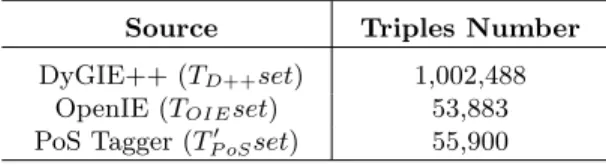
Table 1.Contribution of extracting resources in term of number of statements.
Source Triples Number
DyGIE++ (TD++set) 1,002,488
OpenIE (TOIEset) 53,883
PoS Tagger (TP oS0 set) 55,900
Table 1 shows the number of statements derived from each of the basic tools. DyGIE++ provided the highest number of triples (TD++), while the OpenIE
tool, and the PoS tagger methodology provided a comparable number of triples (TP oS0 + Cons. Triples). However, the set TD++ contains a large majority of
statements that were extracted from a single article.
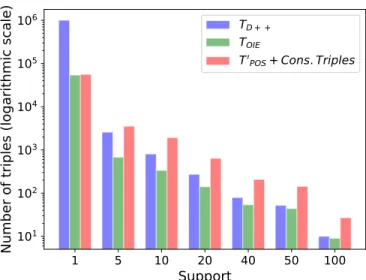
To highlight this trend, in Figure 2 we report the distribution of the state-ments generated byTD++, TOIE andTP oS0 + Cons. Triples according to their
number of associated publications (support). WhileTD++produces the most
siz-able part of those statements, most of them have a very low support. For higher support levels, the set TP oS0 + Cons. Triples contains more statements than
TD++ and TOIE. This suggests that the inclusion of TP oS0 enables to generate
1
5
10
20
40
50
100
Support
10
110
210
310
410
510
6Number of triples (logarithmic scale)
T
D + +T
OIET
0POS+ Cons. Triples
Fig. 2.Distribution of the statements support for each source.
The total number of entities in our KG is 820,732 distributed across the various types as shown by Table 2. The most frequent entities are methods, but we also have a large number of tasks and materials.
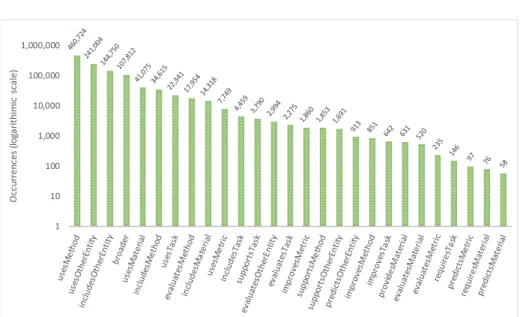
The distribution of relations within the AI-KG is shown in Figure 3. The most frequent relation by a large margin is usesMethod that is used to describe the fact that an entity (Task, Method, or OtherEntity) typically uses a method for a certain purpose. This relation has many practical uses. For example it enables to retrieve all the methods used for a certain task (e.g., computer vision). This can in turn support literature reviews and automatic hypotheses generation tools. Other interesting and frequent relations includeusesMaterial, that could be used to track the usage of specific resources (e.g., DBpedia), includesMethod, which enables to assess which are the components of a method, and evaluatesMethod, that can be used to determine which metrics are used to evaluate a certain approach. A comprehensive analysis of all the information that can be derived from AI-KG is out of the scope of this paper and will be tackled in future work.
Table 2.Distribution of entities over types
Type Number of entities
Method 327,079
OtherEntity 298,777
Task 145,901
Material 37,510
460,724 241,004 144, 750 107, 812 41,07534,615 22,34117,954 14,318 7,749 4,459 3,790 2,994 2,275 1,860 1,853 1,691 913 851 642 631 520 235 146 97 76 58 1 10 100 1,000 10,000 100,000 1,000,000 uses Met hod uses Othe rEnt ity inclu desO ther Entit y broa der uses Mat eria l inclu desM etho d uses Task eval uates Met hod inclu desM ater ial uses Met ric inclu desT ask supp ortsT ask eval uates Other Entit y eval uates Task impr oves Met ric supp ortsM etho d supp ortsO ther Entit y predi ctsO therE ntity impr oves Met hod impr oves Task prov idesM ater ial eval uates Mat eria l eval uates Met ric requ iresT ask predi ctsM etric requ iresM ateri al predi ctsM ater ial Oc cu rr en ce s ( lo ga rit hi m ic s ca le )
Fig. 3.Degree distribution of relations adopted within our statements.
3.5 Generation of New Versions
The pipeline described in this section will be employed on novel research out-comes in order to keep the AI-KG updated with the latest developments in the AI community. Specifically, we plan to run it every 6 months on a recent corpus of articles and release a new version. We are currently working on ingesting a larger set research papers in the AI domain and further improving our charac-terization of research entities. As next step, we plan to release a more granular categorization of the materials by identifying entities such as knowledge bases, textual datasets, image datasets, and others.
4
Evaluation
For annotation purposes, we focused only on statements where the underlying subjects and objects covered at least one of the 24 sub-topics of Semantic Web and at least another topic in the CSO ontology. This set includes 818 statements: 401 from TD++, 102 from TOIE, 170 from TP oS0 (110 of them returned by the
classifier for identifyingCons. Triples), and 212 noisy triples that were discarded by the pipeline as described in Section 3.2. We included the latter to be able to properly calculate the recall. The total number of triples is slightly less than the sum of the sets because some of them have been derived by more than one tool. We asked five researchers in the field of Semantic Web to annotate each triple either astrue orfalse. Their averaged agreement was 0.747±0.036, which indicates a high inter-rater agreement. Then we employed the majority rule strategy to create the gold standard.
– DyGIE++ from Wadden et al. [30] (section 3.2).
– OpenIE, from Angeli et al. [2] (section 3.2).
– the Stanford Core NLP PoS tagger (section 3.2). (TP oS0 ). We considered only the triples with support≥10.
– the Stanford Core NLP PoS tagger enriched by consistent triples. (TP oS0 + Cons. Triples).
– The combination of DyGIE++ and OpenIE (DyGIE++ + OpenIE).
– The combination of DyGIE++ andTP oS0 + Cons. Triples (DyGIE++ +
TP oS0 + Cons. Triples).
– The combination of OpenIE andTP oS0 + Cons. Triples (OpenIE + TP oS0
+ Cons. Triples).
– The final framework that integrates all the previous methods (OpenIE + DyGIE++ + TP oS0 + Cons. Triples).
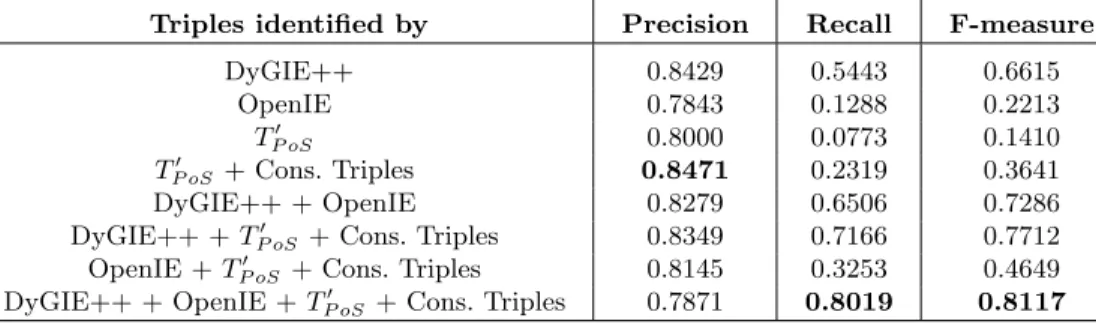
Results are reported in Table 3. DyGIE++ has a very good precision (84.3%) but a relatively low recall, 54.4%. OpenIE and TP oS0 yield a good precision but a very low recall. TP oS0 + Cons. Triples obtains the highest precision (84.7%) of all the tested methods, highlighting the advantages of using a classifier for selecting consistent triples. Combining the basic methods together raises the recall without losing much precision. DyGIE++ + OpenIE yields a F-measure of 72.8% with a recall of 65.1% and DyGIE++ + TP oS0 + Cons. Triples a F-measure of 77.1% with a recall of 71.6%. The final method used to generate AI-KG yields the best recall (80.2%) and F-measure (81.2%) and yields also a fairly good precision (78.7%).
Table 3.Precision, Recall, and F-measure of each method adopted to extract triples.
Triples identified by Precision Recall F-measure
DyGIE++ 0.8429 0.5443 0.6615
OpenIE 0.7843 0.1288 0.2213
TP oS0 0.8000 0.0773 0.1410
TP oS0 + Cons. Triples 0.8471 0.2319 0.3641
DyGIE++ + OpenIE 0.8279 0.6506 0.7286
DyGIE++ +TP oS0 + Cons. Triples 0.8349 0.7166 0.7712
OpenIE +TP oS0 + Cons. Triples 0.8145 0.3253 0.4649
DyGIE++ + OpenIE +TP oS0 + Cons. Triples 0.7871 0.8019 0.8117
5
Conclusions
In this paper we presented AI-KG, a large-scale automatically generated knowl-edge graph that includes about 1,2M statements describing 820K research en-tities in the field of Artificial Intelligence. This novel resource was designed for supporting a variety of systems for analyzing research dynamics, assisting re-searchers, and informing founding bodies. AI-KG is freely available online and we hope that the scientific community will further build on it. In future, we plan to explore more advanced techniques, e.g., graph embeddings for inferring addi-tional triples and cleaning up wrong statements. Moreover, we intend to perform
a comprehensive analysis of AI-KG and assess its ability to support a variety of AI tasks, such as recommending publications, generating new graph embed-dings, and detecting scientific trends. We would also like to allow the scientific community to give feedback and suggest edits on AI-KG as we did for CSO26.
We then plan to apply our pipeline on a even larger set of articles in Computer Science, in order to generate an extensive representation of this field. Finally, we will investigate the application of our approach to other domains, including Life Sciences and Humanities.
References
1. Al-Zaidy, R.A., Giles, C.L.: Extracting semantic relations for scholarly knowledge base construction. In: IEEE 12th ICSC. pp. 56–63 (2018)
2. Angeli, G., Premkumar, M.J.J., Manning, C.D.: Leveraging linguistic structure for open domain information extraction. In: Proceedings of the 53rd Annual Meeting of the ACL and the 7th IJCNLP. vol. 1, pp. 344–354 (2015)
3. Angioni, S., Salatino, A., Osborne, F., Reforgiato Recupero, D., Motta, E.: In-tegrating knowledge graphs for analysing academia and industry dynamics. In: International Workshop of Scientific Knowledge Graphs 2020. (2020)
4. Auer, S., Kovtun, V., Prinz, M., et al.: Towards a knowledge graph for science. In: 8th International Conference on Web Intelligence, Mining and Semantics (2018) 5. Belleau, F., Nolin, M.A., Tourigny, N., Rigault, P., Morissette, J.: Bio2rdf:
to-wards a mashup to build bioinformatics knowledge systems. Journal of biomedical informatics41(5), 706–716 (2008)
6. Bornmann, L., Mutz, R.: Growth rates of modern science: A bibliometric analysis based on the number of publications and cited references. Journal of the Associa-tion for InformaAssocia-tion Science and Technology66(11), 2215–2222 (2015)
7. Buscaldi, D., Dess`ı, D., Motta, E., Osborne, F., Reforgiato Recupero, D.: Mining scholarly publications for scientific knowledge graph construction. In: The Semantic Web: ESWC 2019 Satellite Events. pp. 8–12 (2019)
8. Curran, J.R., Clark, S., Bos, J.: Linguistically motivated large-scale nlp with c&c and boxer. In: Proceedings of the 45th Annual Meeting of the ACL on Interactive Poster and Demonstration Sessions. pp. 33–36 (2007)
9. Dess`ı, D., Osborne, F., Reforgiato Recupero, D., Buscaldi, D., Motta, E.: Gen-erating knowledge graphs by employing natural language processing and machine learning techniques within the scholarly domain. Future Generation Computer Sys-tems (2020)
10. G´abor, K., Buscaldi, D., Schumann, A.K., et al.: Semeval-2018 task 7: Semantic relation extraction and classification in scientific papers. In: Proceedings of The 12th International Workshop on Semantic Evaluation. pp. 679–688 (2018) 11. Gangemi, A., Presutti, V., Reforgiato Recupero, D., et al.: Semantic web machine
reading with fred. Semantic Web8(6), 873–893 (2017)
12. Groth, P., Gibson, A., Velterop, J.: The anatomy of a nanopublication. Information Services & Use30(1-2), 51–56 (2010)
13. Jaradeh, M.Y., Oelen, A., Farfar, K.E., et al.: Open research knowledge graph: Next generation infrastructure for semantic scholarly knowledge. In: Proceedings of the 10th International Conference on Knowledge Capture. pp. 243–246 (2019)
26
14. Kuhn, T., Chichester, C., Krauthammer, M., Queralt-Rosinach, N., Verborgh, R., et al.: Decentralized provenance-aware publishing with nanopublications. PeerJ Computer Science2, e78 (2016)
15. Labropoulou, P., Galanis, D., Lempesis, A., et al.: Openminted: A platform fa-cilitating text mining of scholarly content. In: 11th International Conference on Language Resources and Evaluation (LREC 2018). Paris, France (2018)
16. Luan, Y., He, L., Ostendorf, M., Hajishirzi, H.: Multi-task identification of en-tities, relations, and coreference for scientific knowledge graph construction. In: Proceedings of the EMNLP 2018 Conference. pp. 3219–3232 (2018)
17. Manning, C.D., Surdeanu, M., Bauer, J., Finkel, J.R., et al.: The stanford corenlp natural language processing toolkit. In: Proceedings of 52nd annual meeting of the association for computational linguistics: system demonstrations. pp. 55–60 (2014) 18. Martinez-Rodriguez, J.L., Lopez-Arevalo, I., Rios-Alvarado, A.B.: Openie-based approach for knowledge graph construction from text. Expert Systems with Ap-plications113, 339–355 (2018)
19. Nuzzolese, A.G., Gentile, A.L., Presutti, V., Gangemi, A.: Semantic web conference ontology-a refactoring solution. In: ESWC. pp. 84–87. Springer (2016)
20. Peng, R.: The reproducibility crisis in science: A statistical counterattack. Signifi-cance12(3), 30–32 (2015)
21. Peroni, S., Shotton, D.: The spar ontologies. In: International Semantic Web Con-ference. pp. 119–136. Springer (2018)
22. Roller, S., Kiela, D., Nickel, M.: Hearst patterns revisited: Automatic hypernym detection from large text corpora. In: Proceedings of the 56th Annual Meeting of the ACL. pp. 358–363 (2018)
23. Salatino, A., Osborne, F., Thanapalasingam, T., Motta, E.: The cso classifier: Ontology-driven detection of research topics in scholarly articles (2019)
24. Salatino, A.A., Osborne, F., Birukou, A., Motta, E.: Improving editorial workflow and metadata quality at springer nature. In: International Semantic Web Confer-ence. pp. 507–525 (2019)
25. Salatino, A.A., Thanapalasingam, T., Mannocci, A., Osborne, F., Motta, E.: The computer science ontology: a large-scale taxonomy of research areas. In: ISWC. pp. 187–205 (2018)
26. Schneider, J., Ciccarese, P., Clark, T., Boyce, R.D.: Using the micropublications ontology and the open annotation data model to represent evidence within a drug-drug interaction knowledge base (2014)
27. Shotton, D.: Semantic publishing: the coming revolution in scientific journal pub-lishing. Learned Publishing22(2), 85–94 (2009)
28. Snow, R., Jurafsky, D., Ng, A.: Learning syntactic patterns for automatic hyper-nym discovery. Advances in Neural Information Processing Systems17, 1297–1304 (2005)
29. Tennant, J.P., Crane, H., Crick, T., Davila, J., et al.: Ten hot topics around schol-arly publishing. Publications7(2), 34 (2019)
30. Wadden, D., Wennberg, U., Luan, Y., Hajishirzi, H.: Entity, relation, and event extraction with contextualized span representations. In: Proceedings of the 2019 Joint Conference EMNLP-IJCNLP. pp. 5788–5793 (2019)
31. Wolstencroft, K., Haines, R., et al.: The taverna workflow suite: designing and executing workflows of web services on the desktop, web or in the cloud. Nucleic acids research41(W1), W557–W561 (2013)