
Optimal Object Categorization Under Application Specific Conditions
Steven Puttemans
1,2and Toon Goedem´e
1,21EAVISE, KU Leuven Campus De Nayer, Jan De Nayerlaan 5, 2860 Sint-Katelijne-Waver, Belgium. 2ESAT/PSI-VISICS, KU Leuven, Kasteelpark Arenberg 10, Heverlee, Belgium.
{steven.puttemans, toon.goedeme}@kuleuven.be
1
STAGE OF THE RESEARCH
The main focus of this PhD research is to create a universal object categorization framework that uses the knowledge of application specific scene and ob-ject variation to reach detection rates up to 99.9%. This very high detection rate is one of the many re-quirements of industrial applications, before the in-dustry will even consider using object categorization techniques. Currently the PhD research has been run-ning for one year and has initially focussed on an-alyzing existing state-of-the-art object categorization algorithms like (Viola and Jones, 2001; Gall and Lem-pitsky, 2013; Doll´ar et al., 2009; Felzenszwalb et al., 2010). Besides that, scene and object variation were used to apply pre- and postprocessing on the actual detection output, to reduce the occurance of false pos-itive detections. The next step will be to actually cre-ate a new universal object ccre-ategorization framework based on the experience gathered during the first year of research, using the selected technique of (Doll´ar et al., 2009) as a backbone for further research.
2
RESEARCH PROBLEM
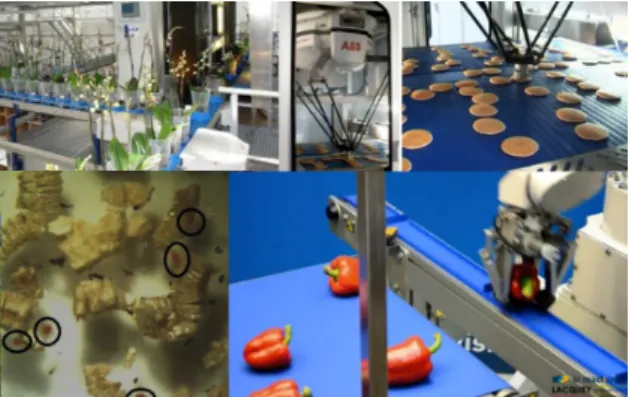
The focus of this research lies in industrial computer vision applications that want to perform object de-tection on object classes with a high intra-class vari-ability. This means that objects have varying size, color, texture, orientation, ... Examples of these spe-cific industrial cases can be seen in Figure 1. These day-to-day industrial applications, such as product in-spection, counting and robot picking, are in desper-ate need of robust, fast and accurdesper-ate object detec-tion techniques which reach detecdetec-tion rates of 99.9% or higher. However, current state-of-the-art object categorization techniques only guarantee a detection rate of±85% when performingin the wilddetections (Doll´ar et al., 2010). In order to reach a higher detec-tion rate, the algorithms impose very strict restricdetec-tions on the actual application environment, e.g. a con-stant and uniform lighting source, a large contrast
be-Figure 1: Examples of industrial object categorization ap-plications: robot picking and object counting of natu-ral products. [checking flower quality, picking pancakes, counting micro-organisms, picking peppers]
tween objects and background, a constant object size and color, ... Compared to these more complex object categorization algorithms, classic thresholding based segmentation techniques require all of these restric-tions to even guarantee a good detection result and are thus unable to cope with variation in the input data.
Looking at the state-of-the-art object categoriza-tion techniques, we see that the evolucategoriza-tion of these techniques is driven by in the wild object detection (see Table 1). The main goal exists in coping with as many variation as possible, achieving a high detec-tion rate in very complex scenery. However, specific industrial applications easily introduce many con-straints, due to the application specific setup of the scenery and the objects. Exploiting that knowledge can lead to smarter and better object categorization techniques. For example, when detecting apples on a transportation system, many parameters like the lo-cation, background and camera position are known. Current object categorization techniques don’t use this information because they do not expect this kind of known variation. However exploiting this infor-mation will lead to a new universal object detection framework that yields high and accurate detection rates, based on the scenery specific knowledge.
Table 1: Evolution in robustness of object recognition and object detection techniques trying to cope with object and scene variation as mentioned in (Puttemans and Goedem´e, 2013) ([1]Illumination differences /[2]Location of objects /[3]Scale changes /[4]Orientation of objects /[5]Occlusions /[6]Clutter in scene /[7]Intra-class variability)
Technique Example Degrees of freedom
1 2 3 4 5 6 7
NCC - based pattern matching (Lewis, 1995) X X – – – – – Edge - based pattern matching (Hsieh et al., 1997) X X X X – – – Global moment invariants for recognition (Mindru et al., 2004) X X X X – – – Object recognition with local keypoints (Bay et al., 2006) X X X X X X – Object categorization algorithms (Felzenszwalb et al., 2010) X X X – X X X
Industrial Applications – – – – X X – X
3
STATE OF THE ART
Object detection is a widly spread research topic, with large interest in current state-of-the-art object catego-rization techniques. (Doll´ar et al., 2009) suggested a framework based on integral channel features, where all object characteristics are captured into feature de-scriptions which are then used as a large pool of train-ing data in a boosttrain-ing process (Freund et al., 1999). In contrast to the original boosted cascade of weak classifiers approach, suggested by (Viola and Jones, 2001), this technique incorporates multiple sources of information to guarantee a higher detection rate and less false positive detections.
In the following years of research, this technique has been a backbone for many well performing ob-ject detection techniques, mainly for into the wild de-tections of pedestrians (Benenson et al., 2012; Be-nenson et al., 2013; Doll´ar et al., 2010) and traffic signs (Mathias et al., 2013). All these recently devel-opped techniques profit from the fact that the integral channel features framework allows to integrate ex-tra application-specific knowledge like stereo vision information, knowledge of camera position, ground plane assumption, ... to obtain higher detection rates. The concept of using application specific scene con-straints to improve these state-of-the-art object cate-gorization techniques was introduced in (Puttemans and Goedem´e, 2013). The paper suggests using the knowledge of the application specific scene and ob-ject conditions as constraints to improve the detec-tion rate, to remove false positive detecdetec-tions and to drastically reduce the number of manual annotations needed for the training of an effective object model.
Aside from effectively using the scene and object variation information to create a more accurate appli-cation specific object detector, the PhD research will focus on reducing the amount of time needed for man-ually annotating gigantic databases of positive and negative training images. This will be done using the technique of active learning, on which a lot of recent research was performed (Li and Guo, 2013; Kapoor
et al., 2007). This research clearly shows that inte-grating multiple sources of information into an active learning strategy can help to isolate the large problem of outliers giving reason to include the wrong exam-ples.
4
OUTLINE OF OBJECTIVES
During this PhD existing state-of-the-art object cat-egorization algoritms will be reshaped into a sin-gle universal semi-automatic object categorization framework for industrial object detection, which ex-ploits the knowledge of application specific object and scene variation to guarantee high detection rates. Exploiting this knowledge will enable three objec-tives, each focussing on another aspect of object de-tection that is important for the industry.
1. A high detection rate of 99.9% or even higher.
Classic techniques reach detection rates of 85% duringin the wilddetections, but for industrial ap-plications a rate of 99.9% and higher is required. By integrating the knowledge of the object and scene variation, the suggested approach will man-age to reach this high demands. Using the frame-work of (Doll´ar et al., 2009) as a backbone for the universal object categorization framework that will be created, these characteristics will be used to include new feature channels to the model train-ing process, focusstrain-ing on this specific object and scene variation.
2. A minimal manual input during the training of an object model. Classic techniques demand many thousands of manual annotations during the collection of training data. By using an inno-vative active learning strategy, which again uses the knowledge of application specific scene and object variation, the number of manual annota-tions will be reduced to a much smaller number of input images. By iteratively annotating only a small part of the trainingset and using that to train
a temporary detector based on the already anno-tated images, the algorithm will decide which new examples will actually lead to a higher detection rate, only offer those for a new annotation phase and omit the others.
3. A faster and more optimized algorithm. By adding all of this extra functionality, resulting in multiple new feature channels, into a new frame-work, a large portion of extra processing is added. Based on the fact that the original algorithm is already time consuming and computational ex-pensive, the resulting framework will most likely be slower than current state-of-the-art techniques. However, by applying CPU and GPU optimaliza-tions wherever possible, the aim of the PhD is to still provide a framework that can supply real time processing.
The use of all this application specific knowledge from the scene and the object, with the aim of reach-ing higher detection rates, is not a new concept. Some approaches already use pre- and postprocessing steps to remove false positive detections based on appli-cation specific knowledge that can be gathered to-gether with the training images. For example, (Be-nenson et al., 2012), use the knowledge of a stereo vi-sion setup and ground plane assumption, to reduce the area where pedestrian candidates are looked for. This PhD research however will take it one step further and will try to integrate all this knowledge into the actual object categorization framework. This leads to sev-eral advantages over the pre- and postprocessing ap-proaches:
• There will be no need for manual defining or cap-turing features that are interesting for this pre- and postprocessing steps.
• Multiple features will be supplied as a large pack-age to the framework. The underlying boosting algorithm will then decide which features are ac-tually interesting to use for model training.
• The algorithm can seperate the input data better than human perception based on combination of features.
• Each possible scene and object variation will be transformed into a new feature channel, in order to capture as much variation as possible. Once a channel is defined, it can be automatically recal-culated for every possible application.
Besides not being able to reach top level detec-tion rates, state-of-the-art object categorizadetec-tion tech-niques face the existence of false positive detections. These detections are classified by the object detector model as actual objects, because they contain enough
discriminating features. However they are no actual objects in the supplied data. By adding a larger set of feature channels to the framework, and thus inte-grating a larger knowledge of scene and object vari-ation during the training phase, the resulting frame-work will effectively reduce the amount of false posi-tive detections.
5
METHODOLOGY
In order to ensure a systematic approach, the overal research problem of the PhD is divided into a set of subproblems, which can be solved one by one in an order of gradual increase in complexity, in order to guarantee the best results possible. Section 5.1 will discuss the integration of the application specific scene and object variation during the model training process, by highlighting different variation aspects of possible applications and how they will be integrated as feature channels. Section 5.2 will illustrate how the use of an innovative active learning strategy can help out with reducing the time consuming job of manual annotation. Finally section 5.3 will discuss how the resulting framework can be optimized using CPU and GPU optimalizations wherever possible.
5.1
Integration of Scene and Object
Variation During Model Training
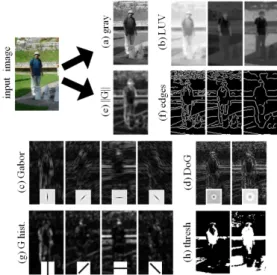
Figure 3: Example of different image channels used in the integral channel features approach of (Doll´ar et al., 2009). (a) Grayscale image (b) LUV color space (c) Gabor orien-tation filters (d) Difference of Gaussians (e) Gradient mag-nitude (f) Edge detector (g) Gradient histogram (h) Thresh-olded image
Figure 2: [Left] Example of a scale-location-rotation lookup function for pedestrians in a fixed and lens deformed camera setup [Right] Example of a fragmented scale space pyramid.
Different properties of application specific scene and object variation allow to design a batch of new feature channels in a smart way, that can be used for a uni-versal object categorization approach. During train-ing the generation of as many extra feature channels (see Figure 3) as possible is stimulated, in order to capture as many variation and knowledge of the ap-plication as possible from the image data. This is no problem, since the boosting algorithm of the training will use all these features to determine which feature channels capture the most variation, in order to prune channels away and only keep the most descriptive fea-ture channels. This immediately ensures that the algo-rithm won’t become extremely slow during the actual detection phase because of the feature channel gener-ation. By integrating all these extra feature channels into the actual object model training process, a bet-ter universal and more accurate object categorization framework will be supplied, which works very appli-cation specific to reach the highest performance and detection rate possible.
In subsection 5.1.1 the influence of the object scale and position in the image will be discussed. Subsection 5.1.2 discusses the influence of lighting, color and texture. Subsection 5.1.3 addresses the in-fluence of background clutter and occlusion. Finally subsection 5.1.4 will handle the object rotation and orientation knowledge.
5.1.1 Influence of Object Scale and Position
In state-of-the-art object categorization an object model is trained, by rescaling all provided training images towards a fixed scale, which results into a sin-gle fixed scale model. Using a sliding window ap-proach, with the window size equal to the size of the resulting model, an object detection is performed at each image position. However, there is only a lim-ited number of applications that have fixed scale ob-jects. In order to detect objects of different scales in all those other applications, an image scale space pyramid is generated. In this scale space pyramid the
original image is down- and upsampled and used with the single scale model. This will generate the possi-bility to detect objects at different scales, depending on the amount of scales that are tested. The larger the pyramid, the more scales that will be tested but the longer the actual detection phase will take. Reducing this scale space pyramid effectively is a hot research topic. (Doll´ar et al., 2010) interpolates between sev-eral predefined images scales, while the detector of (Benenson et al., 2012) uses an approach that inter-polates between different trained scales of the object model. These multiscale approaches are frequently used because the exact range of object scales is un-known beforehand in many applications.
However, many industrial applications have the advantage that the position of the complete camera setup is fixed and known beforehand (e.g. a camera mounted above a conveyor belt). Taking this knowl-edge into account, the scale and position of the objects can actually be computed and described fairly easy as seen in Figure 2). Using this information, new fea-ture channels can be created. Based on manual anno-tation information, a 2D probability distribution can be produced over the image giving a relation between the scale and the position of the object in the image. (Van Beeck et al., 2012) discusses a warping window technique that uses a lookup function defining a fixed rotation and a fixed scale for each position in the im-age. However reducing the detection to a single scale for each position limits the intra-class variability that object categorization wants to maintain. To be sure this is not a problem, instead of using a fixed scale, a probability distribution of possible scales for each po-sition can be modelled. The use of these distribution functions can lead to a serious reduction of the scale space pyramid, resulting in a fragmented scale space pyramid, as seen in Figure 2. This fragmented scale space pyramid can again be used as a seperate feature channel for object model training.
Figure 4: Texture variation based on the Fourier powerspectrum of an orange and a strawberry.
5.1.2 Influence of Lighting, Color and Texture
State-of-the-art object categorization ensures a certain robustness by making training samples and new input images invariant for color and lighting variations. To do so they use a color invariant image form, like a his-togram of oriented gradient representation. Another possible approach is to use Haar-like features, like suggested by (Viola and Jones, 2001). Making the images invariant to lighting and color has a twofold reason. First of all the color variation in academic ap-plication is too large (e.g. the colors of clothing in pedestrian detection). On the other hand the color is too much influenced by the variation in lighting con-ditions. Therefore, academic applications try to re-move as many of this variation as possible by apply-ing techniques like histogram equalization and the use of gradient images.
By choosing a color and light invariant image form, all the information from the RGB color spec-trum is lost which is in fact quite usefull in the in-dustrial applications suggested by this PhD research. In many of these applications a uniform and constant lighting is used, leading to fixed color values. This information cannot be simply ignored when detecting objects with specific color properties like strawber-ries. The advantage of adding this color information has already been proven in (Doll´ar et al., 2009), where color information of the HSV and LUV space is added to optain a better and more robust pedestrian detector. Besides focussing on the color information, it can be interesting to focus on multispectral color data. It is possible that objects cannot be seper-ated in the visual RGB color spectrum, but that there are higher multispectral frequency resolutions that make the seperations of objects and background rather easy. Academic research (Conaire et al., 2006; Yu et al., 2006; Shackelford and Davis, 2003) has al-ready shown great interest in these multispectral ap-proaches, where most of the applications are located in remote sensing and mobile mapping.
Another parameter that is not widely spread for object categorization is the use of relevant texture information in the training objects. Texture can be
described as a unique returning pattern of gradients, which will almost never occur in the background in-formation. In order te derive these patterns from the input data, techniques like Fourier transformations (Cant et al., 2013) (see Figure 4) and Gabor filters (Riaz et al., 2013) are used. These transformations show which frequencies are periodically returning in the image to define application and object specific tex-tures.
5.1.3 Influence of Background Clutter and Occlusion
State-of-the-art object categorization approaches al-ways attempt to detect objects in the wild which means that it can occur in every kind of situation, leading to an infinite number of possible background types, ... In order to build a detector that is robust to all this scene background variation, an enormous amount of negative images samples is needed during model training. This is required to try to model the background variation for correct classification and to ensure that the actual object model will not train back-ground information. Besides that, it is necessary to collect as much positive examples as possible in those varying environments. Doing so ensures that only ob-ject features get selected that describe the obob-ject un-related to the background behind it. This variation in the background is referred to as clutter.
Many industrial applications however have a known background, or at least a background with minimal variation. Combined with occlusion, where the object is partially or completely covered, clutter seems to happen much less frequent than in in the wilddetection tasks. Take for example the taco’s on the conveyor belt in Figure 5. The conveyor belt is moving and changes maybe slightly, but it stays quite constant during processing. Making a good model of that background information, can help to form an extra feature channel defining foreground and back-ground information.
Figure 5: Example of background variation and occlusion in (a) academic cases and (b) industrial cases.
Other cases, like the picking of pears, will have much more variation in background, and will not give the possibility to simply aplly foreground-background segmentation (see Figure 6).
A technique that is widely used for this kind of information is foreground-background segmentation, like in (Yeh et al., 2013). This technique helps us identify regions in the image that can be classified as foreground and thus regions of interest for possi-ble object detections. The masks created by this seg-mentation can be applied as an extra feature channel. Using a dynamic adapting background model (Ham-mami et al., 2013), the application specific back-ground will be modelled and a likelihood map of a region belonging to the foreground will be created. These are referred to as heat maps.
Due to the context of application specific algo-rithms, one can state that the only negative images that need to be used as negative training samples, are images that contain the possible backgrounds. This leads to the conclusion that many case specific ob-ject models can be reduced to having a very lim-ited amount of negative training images, based on the applications scene and background variation, maybe even reducing the negative training images to a single image, if a static background occurs.
Figure 6: Example of pear fruit in an orchard, where more background clutter and occlusion occurs.
5.1.4 Influence of Rotation and Orientation
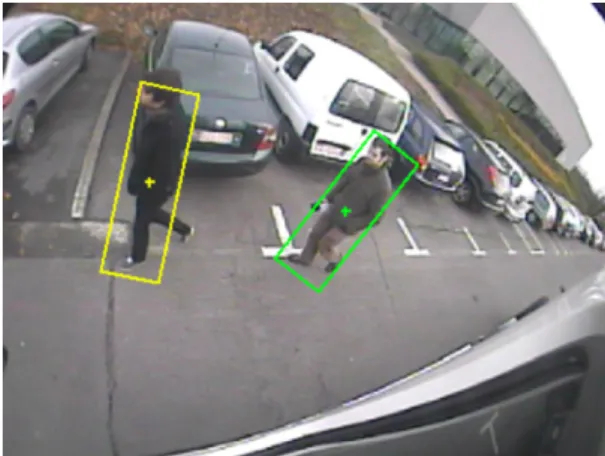
Most state-of-the-art object categorization ap-proaches, e.g. detecting pedestrians, assume that there is no rotation of the actual object, since pedestrians always appear more or less upright. However this is not always the case, like shown in (Van Beeck et al., 2012), where pedestrians occur in other orientations due to the lens deformation and the birdseye viewpoint of the camera input.
Many industrial applications however contain dif-ferent object orientations, which leads to problems when having a fixed orientation object model. Adding all possible orientations to the actual training data for a single model, will lead to a model that is less de-scriptive and which will generate tons of extra false positive detections. A second approach is to test all possible orientations, by taking a fixed angle step, ro-tating the input image and then trying the trained sin-gle orientation model. Once a detection is found, it can be coupled to the currect angle and then used to rotate the detection bounding box, like discussed in (Mittal et al., 2011). However, in order to reach real-time performance using this approach, a lot of GPU optimalizations will be needed, since the process of rotating and performing a detection on each patch is
Figure 8: Example of viewpoint and lens deformation, changing the natural orientation of objects. (Van Beeck et al., 2012)
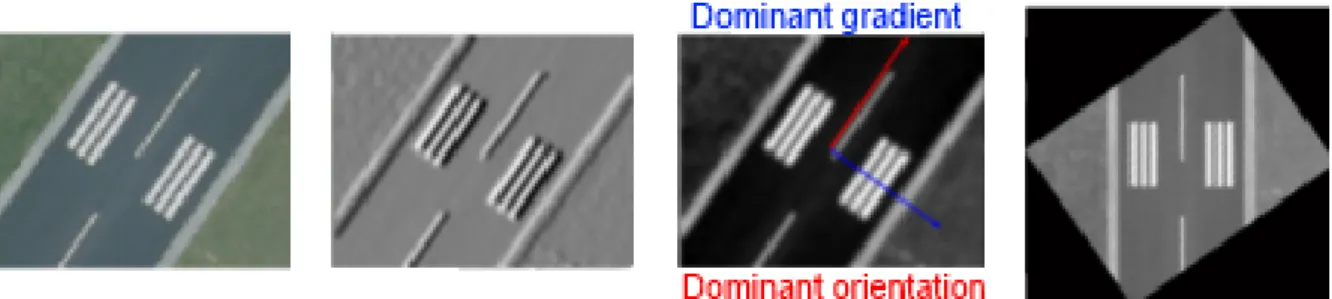
Figure 7: Example of rotation normalization using a dominant gradient technique. From left to right: original image (road marking), gradient image, dominant orientation and rotation corrected image.
computationally intensive. A possible third approach trains a model for each orientation, as suggested in (Huang et al., 2005). However, this will lead to an increase of false positive detections.
The currently used approaches to cope with differ-ent oridiffer-entations do not seem to be the best approaches possible. In this PhD research we want to create an automated orientation normalization step, where each patch is first put through a series of orientation fil-ters that determine the orientation of the current patch and then rotates this patch towards a standard model orientation. A possible approach is the dominant gra-dient approach as illustrated in Figure 7. However, preliminary test results have shown that this approach doesn’t work in every case. Therefore a combina-tion of multiple orientacombina-tion defining techniques will be suggested in our framework. Other techniques that can be included into this approach are eigenvalues of the covariance matrix (Kurz et al., 2013), calcu-lating the geometric moments of a colour channel of the image (Leiva-Valenzuela and Aguilera, 2013) or even defining the primary axis of an ellipse fitted to foreground-background segmentation data (Ascenzi, 2013).
Our suggested orientation normalization filter will use the combination of multiple orientation features to decide which one is the best candidate to actually define the patch orientation. In order to create this ex-tra filter, all manual positive annotations are given an extra parameter, which is the object orientation of the training sample. From that data a mapping function is learned to define a pre-filter that can output a general orientation for any given window. Part of this general idea, where the definition of the orientation is seper-ated from the actual detection phase, is suggested in (Villamizar et al., 2010).
5.2
Innovative Active Learning Strategy
for Minimal Manual Input
Limited scene and object variation can be used to put restrictions on the detector, by supplying extra feature
channels to the algorithm framework, as previously explained. However, we will take it one step further. The same information will be used to optimize the complete training process and to drastically reduce the actual amount of training data that is needed for a robust detector. For state-of-the-art object catego-rization algorithms, the most important way to ob-tain a detector with a high detection rate is increasing the amount of positive and negative training samples enormously. The idea behind it is simple, if you add a lot of extra images, you are bound to have those spe-cific examples that lie close to the decision boundary and that are actually needed to make an even better detector. However, since several industrial applica-tions have a smaller range of variation, it should be possible to create an active learning strategy based on this limited scene and object variatiation, that suc-ceeds in getting a high detection rate with as less ex-amples as possible, by using the variation knowledge to look for those specific examples close to the deci-sion boundary.
Like described in the conclusion of (Mathias et al., 2013), using immense numbers of training samples is currently the only way to reaching the highest pos-sible detection rates. Since all these images need to be manually annotated, which is very time consum-ing job, this extra trainconsum-ing data is a large extra cost for industrial applications. Knowing that the industry wants to focus more and more on flexible automati-zation of several processes, this extra effort to reach high detection rates is a large downside to current object categorization techniques, since companies do not have the time to invest all this manual annotation work. The industry wants to retrieve a robust object model as fast as possible, in order to start using the detector in the actual detection process.
5.2.1 Quantization of Existing Scene and Object Variation
In order to guarantee that the suggested active learn-ing approach will work, it is necessary to have a
Figure 9: Workflow of the suggested active learning strategy. [u= manual input,F= knowledge of scene and object variation is used, TP = true positive detection, TN = true negative detection, FP = false positive detection, FN = false negative detection]
good quantization of the actual variation in object and scene. These measurements are needed to define if new samples are interesting enough to add as extra training data. The main focus is to define how much intra-class variation there is, compared to the amount of variation in the background. Many of these varia-tions, like scale, position, color, ... can be expressed by using a simple 1D probability distribution over all different training samples. However, some variations are a lot harder to quantize correctly. If it is impor-tant to guarantee the intra-class variability, then it can even be extended to a 2D probability distribution, to allow multiple values for a single point in the distribu-tion. However, features like texture and background variation cannot be modelled with a simple 1D prob-ability distribution. A main part of the PhD research will thus go into investigating this specific problem and trying to come up with good quantizations for all these scene and object variations.
5.2.2 Active Learning During Object Model Training
Initial tests have shown that it is possible to build ro-bust object detectors by using only a very limited set of data, as long as the training data is chosen based on application specific knowledge. However, figuring out which examples are actually needed, sometimes turns out to be more time consuming than just simply labeling large batches of training data, if the process is
not automated. Therefore we suggest using an active learning strategy which should make the actual train-ing phase more simple and more interactive. Eventu-ally the algorithm optimizes two aspects: first being a minimal manual intervention and second an as high as possible detection rate. This research will be the first of its kind to integrate the object and scene varia-tion into the actual active learning process, combining many sources of scene and object specific knowledge to select new samples, that can then be annotated in a smart and interactive way.
Figure 9 shows how the suggested active learn-ing strategy based on application specific scene and object variation should look like. As a start a lim-ited set of training data should be selected from a large database of unlabeled images. Since capturing many input images is not the problem in most cases, the largest problem lies in annoting the complete set, which is very time consuming. Once this initial set of data is selected, they are given to the user for anno-tation and a temporarily object model is trained using this limited set of samples. After the training a set of test images is smartly selected from the database using the scene and object variations that are avail-able. By counting the true positives, false positives, true negatives and false negatives, the detector perfor-mance is validated on this test data, by manually su-pervising the output of the initial detector. Based on this output and the knowledge of the variation distri-butions in the current images, an extra set of training
images is selected cleverly. The pure manual anno-tation is now splitted into a part where the operator needs to annotate a small set of images, but after the detection step, needs to validate the detections in or-der to compute the correctness of the detection output. This process is iteratively repeated until the desired detection rate is reached and a final object model is trained.
The above described innovative active learning strategy will yield the possibility to make a well fun-damented guess on how many positive and negative training samples there will actually be needed to reach a predefined detection rate. In doing this, the ap-proach will drastically reduce the amount of manual annotations that need to be provided, since it will only propose to annotate new samples that actually im-prove the detector. Training images that describe fre-quently occuring situations, and are thus being classi-fied as objects with a high certainty are not interesting in this case. On the contrary, it will be more interest-ing tryinterest-ing to select those positive and negative train-ing samples that lie very close to the decision bound-ary, in order to make sure that the boundary will be more stable, more supported by good examples and thus leading to higher detection rates.
It is important to mention that classic active learn-ing strategies are often quite sensitive to outliers (Ag-garwal, 2013) that get selected in the learning process and that lead to overfitting of the training data. How-ever by adding multiple sources of information, being different application specific scene and object varia-tions, the problem of single outliers can be countered, since their influence on the overal data distribution will be minimal. The suggested approach will filter out these outliers quite effectively, making sure that the resulting detector model will not overfit to the ac-tual training set.
5.3
CPU and GPU Optimalization
Towards a Realtime Object
Categorization Algorithm
Once the universal object categorization framework, combined with an innovative active learning strategy, will be finished it will produce a better and more ac-curate detection system for industrial applications and in general, for all applications where the variation in scene and/or object is somehow limited. However ex-panding a framework to cope with all these applica-tion specific scene and object variaapplica-tions will lead to more internal functionality. This will result in a com-putationally more expensive and thus a slower run-ning algorithm.
Since real time processing is essential for most
industrial applications, this problem cannot be sim-ply ignored. The longer the training of a specific ob-ject model takes, the more time a company invests in configuration and not in the actual detection process that generates a cash flow. This is why during this PhD research each step of the processing will be opti-mized using CPU and GPU optimalization. Classical approaches like parallelization and the use of multi-core CPU’s can improve the process (De Smedt et al., 2013), while the influence of general purpose graph-ical processing units (GPGPU) will also be investi-gated. The CUDA language will be used to imple-ment these GPU optimalizations, but the possibility of using OpenCL will be considered.
6
EXPECTED OUTCOME
At the end of this PhD research a complete new inno-vative object categorization framework will be avail-able that uses industrial application specific object and scene constraints, in order to obtain an accurate and high detection rate of 99.9% or higher. The re-sult will be a stimulation for the industry to actively use this technology for robust object detection. The research will lead to new insights in general for ob-ject detection techniques. If this is proved to be successfull, the same approach will be introduced in other frameworks like the deformable parts model of (Felzenszwalb et al., 2010), to reach higher perfor-mances without increasing the number of training ex-amples.
7
ACKNOWLEDGEMENTS
This work is supported by the Institute for the Pro-motion of Innovation through Science and Technol-ogy in Flanders (IWT) via the IWT-TETRA project TOBCAT: Industrial Applications of Object Catego-rization Techniques.
REFERENCES
Aggarwal, C. C. (2013). Supervised outlier detection. In
Outlier Analysis, pages 169–198. Springer.
Ascenzi, M.-G. (2013). Determining orientation of cilia in connective tissue. US Patent 8,345,946.
Bay, H., Tuytelaars, T., and Van Gool, L. (2006). Surf: Speeded up robust features. ECCV, pages 404–417. Benenson, R., Mathias, M., Timofte, R., and Van Gool, L.
InComputer Vision and Pattern Recognition (CVPR), 2012 IEEE Conference on, pages 2903–2910. IEEE. Benenson, R., Mathias, M., Tuytelaars, T., and Van Gool,
L. (2013). Seeking the strongest rigid detector. In
Proceedings of IEEE Conference on Computer Vision and Pattern Recognition.
Cant, R., Langensiepen, C. S., and Rhodes, D. (2013). Fourier texture filtering. InUKSim, pages 123–128. Conaire, C. O., O’Connor, N. E., Cooke, E., and Smeaton,
A. F. (2006). Multispectral object segmentation and retrieval in surveillance video. InImage Processing, 2006 IEEE International Conference on, pages 2381– 2384. IEEE.
De Smedt, F., Van Beeck, K., Tuytelaars, T., and Goedem´e, T. (2013). Pedestrian detection at warp speed: Ex-ceeding 500 detections per second. In Proceedings of IEEE Conference on Computer Vision and Pattern Recognition.
Doll´ar, P., Belongie, S., and Perona, P. (2010). The fastest pedestrian detector in the west. InBMVC, volume 2-3, page 7.
Doll´ar, P., Tu, Z., Perona, P., and Belongie, S. (2009). Inte-gral channel features. InBMVC, volume 2-4, page 5. Felzenszwalb, P., Girshick, R., and McAllester, D. (2010).
Cascade object detection with deformable part mod-els. InCVPR, pages 2241–2248.
Freund, Y., Schapire, R., and Abe, N. (1999). A short in-troduction to boosting. Journal-Japanese Society For Artificial Intelligence, 14(771-780):1612.
Gall, J. and Lempitsky, V. (2013). Class-specific hough forests for object detection. InDecision Forests for Computer Vision and Medical Image Analysis, pages 143–157. Springer.
Hammami, M., Jarraya, S. K., and Ben-Abdallah, H. (2013). On line background modeling for moving object segmentation in dynamic scenes. Multimedia Tools and Applications, pages 1–28.
Hsieh, J., Liao, H., Fan, K., Ko, M., and Hung, Y. (1997). Image registration using a new edge-based approach.
CVIU, pages 112–130.
Huang, C., Ai, H., Li, Y., and Lao, S. (2005). Vector boost-ing for rotation invariant multi-view face detection. In
Computer Vision, 2005. ICCV 2005. Tenth IEEE In-ternational Conference on, volume 1, pages 446–453. IEEE.
Kapoor, A., Grauman, K., Urtasun, R., and Darrell, T. (2007). Active learning with gaussian processes for object categorization. In Computer Vision, 2007. ICCV 2007. IEEE 11th International Conference on, pages 1–8. IEEE.
Kurz, G., Gilitschenski, I., Julier, S., and Hanebeck, U. D. (2013). Recursive estimation of orientation based on the bingham distribution. arXiv preprint arXiv:1304.8019.
Leiva-Valenzuela, G. A. and Aguilera, J. M. (2013). Auto-matic detection of orientation and diseases in blueber-ries using image analysis to improve their postharvest storage quality.Food Control.
Lewis, J. (1995). Fast normalized cross-correlation. In Vi-sion interface, volume 10, pages 120–123.
Li, X. and Guo, Y. (2013). Adaptive active learning for im-age classification. InIEEE Conf. on Computer Vision and Pattern Recognition (CVPR).
Mathias, M., Timofte, R., Benenson, R., and Gool, L. (2013). Traffic sign recognition-how far are we from the solution? InProceedings of IEEE International Joint Conference on Neural Networks.
Mindru, F., Tuytelaars, T., Gool, L., and Moons, T. (2004). Moment invariants for recognition under changing viewpoint and illumination.CVIU, 94:3–27. Mittal, A., Zisserman, A., and Torr, P. (2011). Hand
detec-tion using multiple proposals.BMVC 2011.
Puttemans, S. and Goedem´e, T. (2013). How to exploit scene constraints to improve object categorization al-gorithms for industrial applications? InProceedings of the international conference on computer vision theory and applications (VISAPP 2013), volume 1, pages 827–830.
Riaz, F., Hassan, A., Rehman, S., and Qamar, U. (2013). Texture classification using rotation-and scale-invariant gabor texture features. IEEE Signal Processing Letters.
Shackelford, A. K. and Davis, C. H. (2003). A combined fuzzy pixel-based and object-based approach for clas-sification of high-resolution multispectral data over urban areas. Geoscience and Remote Sensing, IEEE Transactions on, 41(10):2354–2363.
Van Beeck, K., Goedem´e, T., and Tuytelaars, T. (2012). A warping window approach to real-time vision-based pedestrian detection in a truck’s blind spot zone. In
ICINCO, volume 2, pages 561–568.
Villamizar, M., Moreno-Noguer, F., Andrade-Cetto, J., and Sanfeliu, A. (2010). Efficient rotation invariant object detection using boosted random ferns. InComputer Vision and Pattern Recognition (CVPR), 2010 IEEE Conference on, pages 1038–1045. IEEE.
Viola, P. and Jones, M. (2001). Rapid object detection using a boosted cascade of simple features. InCVPR, pages I–511.
Yeh, C.-H., Lin, C.-Y., Muchtar, K., and Kang, L.-W. (2013). Real-time background modeling based on a multi-level texture description. Information Sciences. Yu, Q., Gong, P., Clinton, N., Biging, G., Kelly, M., and Schirokauer, D. (2006). Object-based detailed vegeta-tion classificavegeta-tion with airborne high spatial resoluvegeta-tion remote sensing imagery. Photogrammetric Engineer-ing and Remote SensEngineer-ing, 72(7):799.
![Table 1: Evolution in robustness of object recognition and object detection techniques trying to cope with object and scene variation as mentioned in (Puttemans and Goedem´e, 2013) ([1] Illumination differences / [2] Location of objects / [3] Scale changes](https://thumb-us.123doks.com/thumbv2/123dok_us/9346476.2813110/2.892.120.771.188.337/evolution-robustness-recognition-detection-techniques-puttemans-illumination-differences.webp)
![Figure 2: [Left] Example of a scale-location-rotation lookup function for pedestrians in a fixed and lens deformed camera setup [Right] Example of a fragmented scale space pyramid.](https://thumb-us.123doks.com/thumbv2/123dok_us/9346476.2813110/4.892.118.773.147.298/example-location-rotation-function-pedestrians-deformed-example-fragmented.webp)

![Figure 9: Workflow of the suggested active learning strategy. [ u= manual input, F = knowledge of scene and object variation is used, TP = true positive detection, TN = true negative detection, FP = false positive detection, FN = false negative detection]](https://thumb-us.123doks.com/thumbv2/123dok_us/9346476.2813110/8.892.117.776.157.486/workflow-suggested-knowledge-variation-detection-detection-detection-detection.webp)
