FY 2011-2012
Action Plan
The CPMP First Annual Action Plan includes the SF 424 and Narrative Responses to Action Plan questions that CDBG, HOME, HOPWA, and ESG grantees must respond to each year to comply with the Consolidated Planning Regulations . The Executive Summary narratives are optional .
Executive Summary
Fy 2011-2012 Program Year
The City receives federal funds from the Depart-ment of Housing and Urban DevelopDepart-ment (HUD) from two federal programs as an entitlement community . These entitlement funds include the Community Development Block Grant Program (CDBG) and the HOME Investment Partnership (HOME) affordable housing program . The City does not receive an Emergency Shelter Block Grant . The City also utilizes program income from its Florida State Housing Initiatives Partnership (SHIP) and Pinellas County Housing Trust Fund Programs in support of these programs which are all targeted at assisting the City’s low- to moder-ate-income residents .Affordable housing funds will be administered on a city-wide basis targeted at helping low- to moderate-income families become homeowners, maintain their properties and for housing educa-tion and counseling, primarily for those families assisted with funding through the City . The City will provide assistance to the homeless and those with special needs through the construction of
ad-ditional facilities and the provision of services . The city’s community development improvements will be focused on the its Neighborhood Revitalization Strategy Areas .
The overall goal of the community planning and development programs covered by the Action Plan is to develop viable urban communities by providing decent housing and a suitable living environment and to expand economic opportuni-ties principally for very-low to moderate-income persons/households . The primary means towards this end is to extend and strengthen partnerships among all levels of government and the private sector, including for-profit and non-profit organiza-tions, in the production and operation of affordable housing .
1 . Decent housing includes assisting homeless persons to obtain appropriate housing and assisting persons at risk of becoming homeless; retention of the affordable housing stock; and increasing the availability of permanent housing in good condition and affordable to very low-income and moderate-income families, particularly to members of disadvantaged minorities, without discrimination on the basis of race, color, religion, sex, national origin, marital status, familial status, or disability .
1. Action Plan
2 . Decent housing also includes increasing the supply of supportive housing, which combines structural features and services needed to enable persons with special needs, including persons with physical and mental disabilities, and persons with HIV/AIDS and their families, to live with dignity and independence; and providing affordable housing to low-income persons accessible to job opportunities . 3 . A suitable living environment includes
improving the safety and livability of
neighborhoods; increasing access to quality public and private facilities and services; reducing the isolation of income groups within a community or geographical area through the spatial deconcentration of housing opportunities for persons of lower income and the revitalization of deteriorating or deteriorated neighborhoods; restoring and preserving properties of special historic, architectural, or aesthetic value; and
conservation of energy resources .
4 . The expanded economic opportunities includes job creation and retention; establishment, stabilization and expansion of small businesses (including micro-businesses); the provision of public services concerned with employment; the provision of jobs for low-income persons living in areas affected by those programs and activities under programs covered by the plan; availability of mortgage financing for low-income persons at reasonable rates using non-discriminatory lending practices; access to capital and credit for development activities that promote the long-term economic and social viability of the community; and empowerment and self-sufficiency for low-income persons to reduce generational poverty in federal-assisted housing and public housing .
The City continues to provide funding for a variety of Public Service and Public Facility type activities which include: self-sufficiency, elderly home clean-ing, emergency shelter operations, fair housclean-ing, elderly services, and homeless services . The following Public Service activities are pro-posed for fiscal year 2011-2012:
1 . Willa Carson Community Health Resource Center
2 . WestCare Gulf Coast of Florida, Inc .
3 . Personal Enrichment Through Mental Health Services, Inc .
4 . Pinellas Opportunity Council – Chore Services 5 . Safety Harbor Neighborhood Family Center,
Inc .
6 . Gulf Coast Legal Services, Inc . – Fair Housing 7 . Community Services Foundation, Inc . – Fair
Housing
8 . Kimberly Home, Inc . – Teen Pregnancy Program
9 . Intercultural Advocacy Institute
In terms of Public Facility projects, during the cur-rent fiscal year we propose to provide funding to the following organizations:
1 . Directions for Mental Health, Inc . – Center Improvements
2 . Religious Community Services, Inc . – Food Bank
3 . Religious Community Services, Inc . – The Haven
Managing The Process
The City of Clearwater – Economic Development and Housing Department – Housing Division is the lead agency for administering the City’s Con-solidated Action Plan and ConCon-solidated Planning Document .
The City partners with several not-for-profit agen-cies to implement the goals and objectives the City has established in the Consolidated Planning Doc-ument . To obtain these partners, the City annually publishes a Notice of Funding Availability in the local newspaper and on its website in February . This notice informs the non-profits of the resources the City will make available and the eligible uses of these resources . It also informs them of the ap-plication period for requesting funds .
The City’s Technical Review Committee reviews and ranks the applications . From results of the ranking committee, the City prepared a summary of proposed projects and placed it in the local paper for public comments .
Additionally, the City held a public hearing to obtain any further comments on the proposed FY11-12 Recommended Allocations with the City’s Neighborhood & Affordable Housing Advisory Board in May .
The Draft Consolidated Action Plan Summary was made available in the local newspaper and City’s website for citizens to review . The Plan will be brought before the City’s Neighborhood & Afford-able Housing Advisory Board and City Council for final approval in July .
Consultation for the City’s Housing and Commu-nity Development programs is an ongoing process for departmental staff . Staff stays attuned to hous-ing and community development issues and needs through the following means:
1 . Membership in local and state organizations 2 . Participation by City staff on boards,
committees and agencies
3 . Discussions at committees supported by the City
4 . Technical assistance to agencies and other entities
5 . Working with local lenders on Community Reinvestment Act commitments and requirements
6 . Participation in public forums 7 . Holding public hearings
8 . Preparation of documents, flyers and brochures regarding specific programs 9 . Special studies
Citizen Participation
The City of Clearwater has adopted a Citizen Par-ticipation Plan (and Anti-Displacement Plan) that meets all HUD regulations as part of the approval process for the Five-Year Consolidated Plan . The Cities of Clearwater and Largo and Pinellas County held a public meeting to obtain citizens’ views on housing and community development needs as it relates to the preparation of the Cities’ and County’s Five-Year (FY2011-2016) Consoli-dated Planning Document . The programs covered under the Consolidated Plan are the Community Development Block Grant (CDBG), HOME Invest-ment Partnership Programs (HOME), and NSP 3 . Two public hearings were held on May 5, 2011, and May 6, 2011, to receive public comments from the North Greenwood and Lake Belleview Neigh-borhood Revitalization Strategy Areas .
The City advertised the “Notice of Funding Avail-ability” on March 2, 2011 in the St . Petersburg Times and also posted the Notice on the City’s website . The application period opened on March 7, 2011 and closed on April 7, 2011 .
The City’s Neighborhood and Affordable Housing Advisory Board (NAHAB) met on May 10, 2011, to discuss and approv the Technical Review Commit-tee Recommended Allocations .
The City held a public hearing for the proposed FY11-12 Consolidated Action Plan and FY11-16 Consolidated Plan at the City’s NAHAB on June 14, 2011 . The Draft Consolidated Plan was made available for a 30-day public review and comment period . Instructions for persons with disabilities who required accommodation(s) for participation in all public hearings was contained in all notices . The final FY11-12 Consolidated Action Plan is scheduled to be approved by the City Council on July 21, 2011 .
The City maintains ongoing contact with all its Housing, Homeless and Community Development partners through notices of NAHAB meetings and other areas of interest .
To broaden the public participation process, the City frequently advertises meetings and events on the City’s Web Site . The website also provides a comprehensive listing of the City’s Economic, Housing and Community Development programs . Public Outreach Forums were held throughout the County to discuss goals, objectives, and priorities . The presentation provided detailed information on the Five-Year Consolidated Plan and the process used to distribute funds in the past and how these funds can be utilized in the future . Groups included in this outreach are realtors, contractors, non-profit agencies, government officials, faith-based organi-zations and planning agencies .
Solicitation of input from existing partnerships and organizations in the community, in addition to the public hearing process and public notices in news-papers, was sought to encourage participation in identifying housing needs and needs of the home-less and special populations, and in development of the Consolidated Plan .
Citizens comments
Public comments are inserted in the Appendix of this report .
Resources
The City will utilize its funds to implement the specific objectives established within the City’s adopted FY2011 to FY2016 Consolidated Plan as shown in Figure 46 .
In addition to the entitlement allocations listed above, the City maintains three Revolving Loan Funds which are set up to carry out specific activi-ties . The three individual revolving loan funds are the Housing Rehabilitation Revolving Loan Fund (City Fund #686), the Economic Development Re-volving Loan Fund (City Fund #687) and the Infill Housing Revolving Loan Fund (City Fund #689) . The Housing Rehabilitation Revolving Loan Fund includes payments made by homeowners who participated in the Rehabilitation Program and had their home repaired . The Economic Development Revolving Loan Fund includes payment made by for-profit business owners who participated in the Economic Development Program and obtained funds to start up or maintain their business . The Infill Housing Revolving Loan Fund includes payments made by sub-recipients who borrowed funds to purchase vacant lots to build homes . Funds were repaid when the sub-recipient sold the home to an eligible homebuyer .
Figure 46Clearwater CDBG/HOME Alloca-tions
Entitlement Grant Funds Funding
CDBG $838,241
HOME $500,323
Total Federal Funding Sources $1,338,564
In FY 2011-2012, the City anticipates that the revolving fund balance will be a total of $629,244 . These funds include $282,867 from the Infill Housing Revolving Loan Fund, $150,041 from the Economic Development Revolving Loan Fund, and $196,336 from the Housing Rehabilitation Revolv-ing Loan Fund .
Please note that the amounts listed above are only projected amounts . These amounts may increase or decrease subject to program activity . These funds are restricted to the activities listed above and are not part of budgeted consolidated plan activities .
In addition to the federal funds listed above, the City anticipates that other federal resources will be made available to address the needs identified in the plan . Those funds should include Section 8 funds made available to the local housing author-ity, Low-Income Housing Tax Credits through de-velopers, and competitive McKinney-Vento Home-less Assistance Act funds through local non-profit agencies .
In addition to the federal resources, the City will use other state and local resources to address housing needs . The City will use program income generated through the SHIP and PCHTF programs to provide funding for property acquisition and development, rehabilitation, down payment as-sistance, relocation, demolition, housing counsel-ing, and other related housing activities . The city anticipates that $122,000 will be available for this fiscal year .
ANNUAL OBJECTIVES
The Consolidated Plan is a collaborative process whereby a community establishes a unified vision for community development actions . It offers local jurisdictions the opportunity to shape the various housing and community development programs
into effective, coordinated neighborhood and community development strategies . It also creates the opportunity for strategic planning and citizen participation to take place in a comprehensive context, and to reduce duplication of effort at the local level .
The Consolidated Plan approach is also the means to meet the submission requirements for the Community Development Block Grant (CDBG), HOME Investment Partnerships (HOME), Emer-gency Shelter Grant (ESG), and Housing Oppor-tunities for Persons with AIDS (HOPWA) formula programs . This process replaces prior CPD plan-ning and submission requirements with a single document that satisfies the submission require-ments of the four CPD formula programs for local jurisdictions .
Figure 47 shows the goals and objectives to be carried out during the Action Plan period . The statutes for the formula grant programs set forth three basic goals against which the plan and the jurisdiction’s performance under the plan will be evaluated by HUD . Each jurisdiction’s plan must state how it will pursue these goals for all commu-nity development programs, as well as all housing programs . These statutory program goals are:
Decent Housing:
• Assist homeless persons obtain affordable housing
• Assist persons at risk of becoming homeless • Retain affordable housing stock
• Increase the availability of affordable permanent housing in standard condition to low-income and moderate-income families, particularly to members of disadvantaged minorities without discrimination on the basis of race, color, religion, sex, national origin, familial status, or disability
• Increase the supply of supportive housing which includes structural features and
services to enable persons with special needs (including persons with HIV/AIDS) to live in dignity and independence
• Provide affordable housing that is accessible to job opportunities .
A Suitable Living Environment: • Improve the safety and livability of
neighborhoods
• Eliminate blighting influences and the deterioration of property and facilities
• Increase access to quality public and private facilities and services
• Reduce the isolation of income groups
within areas through spatial deconcentration of housing opportunities for lower income persons and the revitalization of deteriorating neighborhoods
• Restore and preserve properties of special historic, architectural, or aesthetic value; • Conserve energy resources and use of
renewable energy sources .
Expanded Economic Opportunities: • Job creation and retention
• Establishment, stabilization and expansion of small businesses (including micro-businesses) • The provision of public services concerned
with employment
• The provision of jobs to low-income persons
Figure 47Action Plan Goals and Objectives
Goals and objectives to be carried out during the action plan period are indicated by placing a check in the following boxes.
ü
Objective Category:Decent Housingü
Objective Category: Suitable Living Environmnent Objective Category: Expanded Economic Opportunitiesü
assisting homeless persons obtain affordable housingü
improving the safety and livability of neighborhoodsü
job creation and retentionü
assisting persons at risk of be-coming homelessü
eliminating blighting influences and the deterioration of property andfacilities
establishment, stabilization and expan-sion of small business (including micro-businesses)
ü
retaining the affordable housing stockü
increasing the access to quality public and private facilities the provision of public services con-cerned with employmentü
increasing the availability of af-fordable permanent housing in standard condition to low-income and moderate-income fami-lies, particularly to members of disadvantaged minorities without discrimination on the basis of race, color, religion, sex, national origin, familial status, or disability
ü
reducing the isolation of income groups within areas through spatial deconcentration of housing op-portunities for lower income persons and the revitalization of deteriorating
neighborhoods
ü
the provision of jobs to low-income per-sons living in areas affected by those programs and activities under programs covered by the plan
increasing the supply of sup-portive housing which includes structural features and services to enable persons with special needs (including persons with HIV/AIDS) to live in dignity and independence
restoring and preserving properties of special historic, architectural, or aesthetic value
ü
availability of mortgage financing for low income persons at reasonable rates using non-discriminatory lending practices
providing affordable housing that
is accessible to job opportunities
ü
conserving energy resources and use of renewable energy sourcesü
access to capital and credit for de-velopment activities that promote the long-term economic social viability of the communitySource: City of Clearwater, Economic Development and Housing, June 2011 *If not using the CPMP Tool: Complete and submit Table 3A.
living in areas affected by those programs and activities, or jobs resulting from carrying out activities under programs covered by the plan • Availability of mortgage financing for
low-income persons at reasonable rates using non-discriminatory lending practices
• Access to capital and credit for development activities that promote the long-term economic and social viability of the community
• Empowerment and self-sufficiency for low-income persons to reduce generational poverty in federally assisted housing and public housing .
Summary of Specific Annual
Objectives
SL 3.1 - Provide funding in the amount of $8,000 to Community Service Foundation, Inc ., for salary support to operate a fair housing counseling and housing placement program . The program pro-vides housing services to help lower income fami-lies and individuals locate and secure permanent, decent and affordable housing . The program also strives to counsel households on Fair Housing Landlord/Tenant Rights, and to provide emergency food and shelter program rent and mortgage pay-ment assistance . The agency’s goal is to serve 120 households .
SL 3.1 - Provide funding in the amount of $27,256 to Gulf Coast Legal Services, Inc ., for salary support to implement the agency’s Legal Aid to Preservation Housing Project . The project seeks to provide legal assistance for low- and moderate-income residents of Clearwater who are victims of predatory lending practices, foreclosure rescue scams, persons who are experiencing or who have experienced discrimination and/or fraud in housing and to remedy these matters through negotiation,
mediation or litigation and to assist residents in fil-ing complaints regardfil-ing violations of Fair Housfil-ing Laws . The agency anticipates that they will serve 100 people .
SL 2.1 – Provide funding in the amount of $12,000 to The Kimberly Home, Inc ., for salary support to operate a pregnancy counseling program and a transitional housing program . The agency provides housing, education, case management, counsel-ing, life skills training and other supportive services for pregnant youth . The agency’s overall goal is to assist 60 individuals .
SL 2.1 – Provide funding in the amount 0f $9,703 to the Intercultural Advocacy Institute for salary support to implement a Youth Leaders Partnership Program . The program provides leadership and mentoring opportunities to youth in the 6th and 7th grades . The program focus is to provide the tools and resources necessary to help youth develop leadership skills plus a strong sense of identity and in turn grow leaders from within the community to serve as role models for their peers and younger student population .
DH 1.1 - Provide funding in the amount of $3,500 to Personal Enrichment through Mental Health Services, Inc ., for salary support to operate their Family Emergency Treatment Center . The center provides assessment, crisis intervention counsel-ing, individual and/or group support counselcounsel-ing, substance abuse assessment and intervention, medication evaluation and administration, service and treatment planning, referrals and other related services . The agency’s goals are to serve 150 residents of Clearwater .
DH 1.1 - Provide funding in the amount of $30,000 to Pinellas Opportunity Council, Inc ., for salary support to implement the agency’s Chore Services Program . The program promotes better livable
Figure 48Specific Annual Objectives
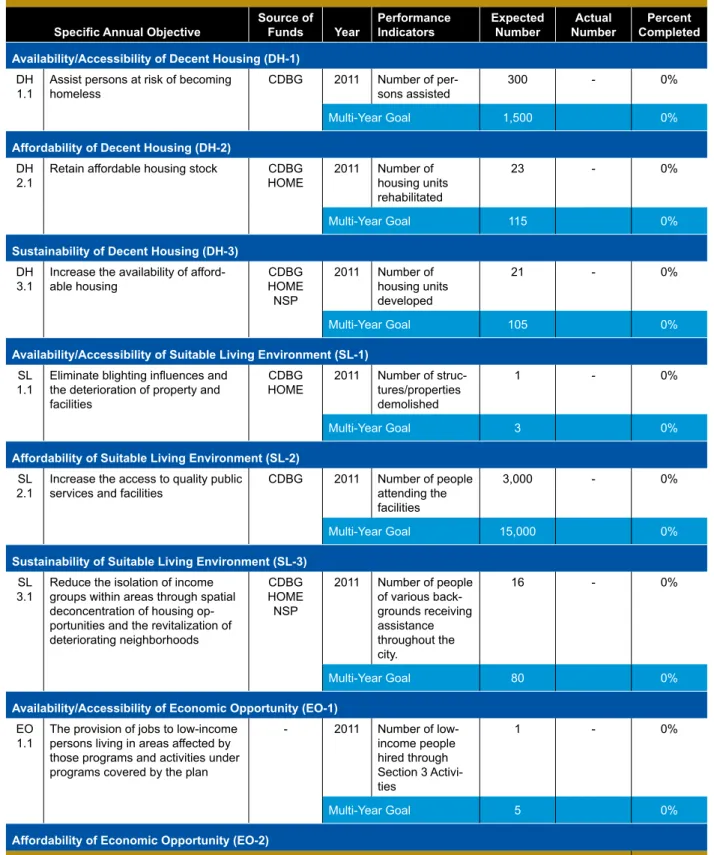
Specific Annual Objective Source of Funds Year PerformanceIndicators ExpectedNumber NumberActual CompletedPercent Availability/Accessibility of Decent Housing (DH-1)
DH
1 .1 Assist persons at risk of becoming homeless CDBG 2011 Number of per-sons assisted 300 - 0%
Multi-Year Goal 1,500 0%
Affordability of Decent Housing (DH-2)
DH
2 .1 Retain affordable housing stock HOMECDBG 2011 Number of housing units rehabilitated
23 - 0%
Multi-Year Goal 115 0%
Sustainability of Decent Housing (DH-3)
DH
3 .1 Increase the availability of afford-able housing HOMECDBG NSP 2011 Number of housing units developed 21 - 0% Multi-Year Goal 105 0%
Availability/Accessibility of Suitable Living Environment (SL-1)
SL
1 .1 Eliminate blighting influences and the deterioration of property and facilities
CDBG
HOME 2011 Number of struc-tures/properties demolished
1 - 0%
Multi-Year Goal 3 0%
Affordability of Suitable Living Environment (SL-2)
SL
2 .1 Increase the access to quality public services and facilities CDBG 2011 Number of people attending the facilities
3,000 - 0%
Multi-Year Goal 15,000 0%
Sustainability of Suitable Living Environment (SL-3)
SL
3 .1 Reduce the isolation of income groups within areas through spatial deconcentration of housing op-portunities and the revitalization of deteriorating neighborhoods CDBG HOME NSP 2011 Number of people of various back-grounds receiving assistance throughout the city . 16 - 0% Multi-Year Goal 80 0%
Availability/Accessibility of Economic Opportunity (EO-1)
EO
1 .1 The provision of jobs to low-income persons living in areas affected by those programs and activities under programs covered by the plan
- 2011 Number of low-income people hired through Section 3 Activi-ties 1 - 0% Multi-Year Goal 5 0%
Affordability of Economic Opportunity (EO-2)
opportunities by providing services to the elderly and frail elderly . The services will help to allevi-ate blight and blighting conditions, reduce crime, and create a sense of pride in their community by providing heavy household cleaning, yard work and minor repairs . The agency’s goal is to assist 82 elderly households .
DH 1.1, EO 1.1 - Provide funding in the amount of $50,000 to Religious Community Services, Inc ., for renovations and development at The Havens of RCS . The Havens of RCS is a facility that offers housing and related support services for victims of domestic abuse . Funding to the Havens will be used to renovate the building . The Havens goal is to serve 15,139 domestic violence victims (women and children) .
SL 2.1 - Provide funding in the amount of $14,892 to the Safety Harbor Neighborhood Family Center for salary support to operate the Neighborhood Family Center . The Bridge the Gap project is a combination of services to help individuals and families survive, stay in their homes and stay together by providing food, clothing, hygiene products, baby needs, job training, and financial assistance . The agency’s goal is to assist 500 families .
SL 2.1 – Provide funding in the amount of $55,000 Directions for Mental Health, Inc ., for renovations to the adult services section of the building . Reno-vations will include demolition, concrete work, millwork, doors, walls, ceiling repair, electrical, plumbing, HVAC repair, and other eligible costs . Directions offers a wide array of services including outpatient therapy and substance abuse treatment to adults, children or families with an identified mental health disability, resource coordination for those who have a diagnosed mental health disabil-ity, and other related services . Directions assists 2,000 individuals and families annually .
SL 2.1 - Provide funding in the amount of $30,000 to the Willa Carson Health Resource Center for salary support to operate a health facility . The cen-ter provides accessible, quality, culturally-sensitive health care to the uninsured and underserved at no cost . The health care services include blood pressure screenings, diabetic screening, choles-terol testing, clinical breast exams, educational programs, school and work physicals, and treat-ment of minor illnesses . The agency’s goal is to assist 730 individuals .
DH 1.1 - Provide funding in the amount of $12,000 to WestCare GulfCoast Florida, Inc ., for salary support to operate the Turning Point overnight shelter . The shelter provides an overnight facility for homeless persons under the influence of drugs and/or alcohol . It operates as an inebriate receiv-ing and intervention program that provides for a 24-hour sobering up area, intensive case manage-ment, and placement service . The agency’s goal is to serve 150 homeless Clearwater individuals .
DH 2.1, DH 3.1, SL 1.1, EO 2.1, EO 3.1 - Provide funding in the amount of $597,308 to agencies in the City’s Housing Pool to acquire and/or develop real property, rehabilitate homes or rental units or provide downpayment and closing cost assis-tance to eligible low- to moderate-income families . Eligible agencies participating in the Housing Pool include Clearwater Neighborhood Housing Services, Inc ., Largo Area Housing Development Corporation, Inc ., Habitat for Humanity of Pinellas County, Inc ., and Tampa Bay Community Develop-ment Corporation .
DH 2.1, DH 3.1, EO 2.1, EO 3.1 - Provide funding in the amount of $84,758 to eligible Community Housing Development Organizations to acquire and/or develop or rehabilitate real property .
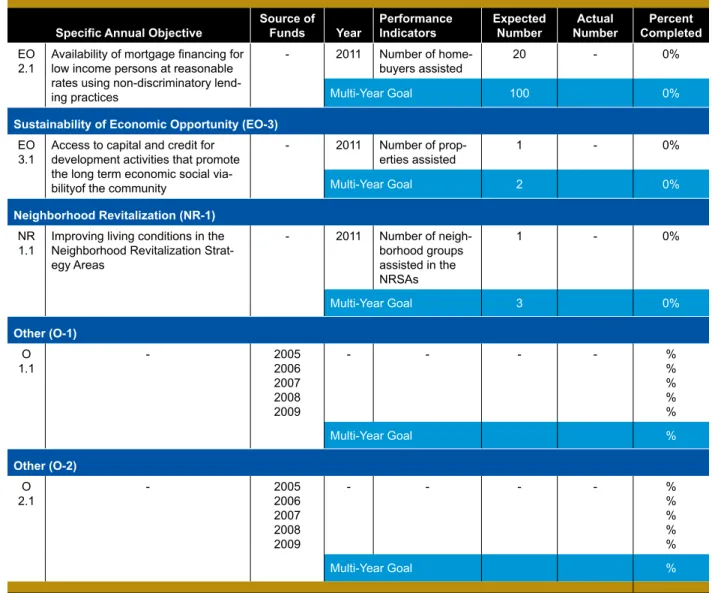
Figure 48Specific Annual Objectives
Specific Annual Objective Source of Funds Year PerformanceIndicators ExpectedNumber NumberActual CompletedPercent
EO
2 .1 Availability of mortgage financing for low income persons at reasonable rates using non-discriminatory lend-ing practices
- 2011 Number of
home-buyers assisted 20 - 0%
Multi-Year Goal 100 0%
Sustainability of Economic Opportunity (EO-3)
EO
3 .1 Access to capital and credit for development activities that promote the long term economic social via-bilityof the community
- 2011 Number of
prop-erties assisted 1 - 0%
Multi-Year Goal 2 0%
Neighborhood Revitalization (NR-1)
NR
1 .1 Improving living conditions in the Neighborhood Revitalization Strat-egy Areas - 2011 Number of neigh-borhood groups assisted in the NRSAs 1 - 0% Multi-Year Goal 3 0% Other (O-1) O 1 .1 - 20052006 2007 2008 2009 - - - - % % % % % Multi-Year Goal % Other (O-2) O 2 .1 - 20052006 2007 2008 2009 - - - - % % % % % Multi-Year Goal %
Source: City of Clearwater, Economic Development and Housing Department, June 2011
Description Of Activities
Figure 48 describes the outcome measures for activities in accordance with Federal Register Notice dated March 7, 2006, i .e ., general objective category (decent housing, suitable living environ-ment, economic opportunity) and general outcome category (availability/accessibility, affordability, sustainability) .Figure 49 shows the proposed activities for the FY 2011-2012 program year .
GEOGRAPHIC DISTRIBUTION/
ALLOCATION PRIORITIES
Areas of Low/Moderate Income Concentrations
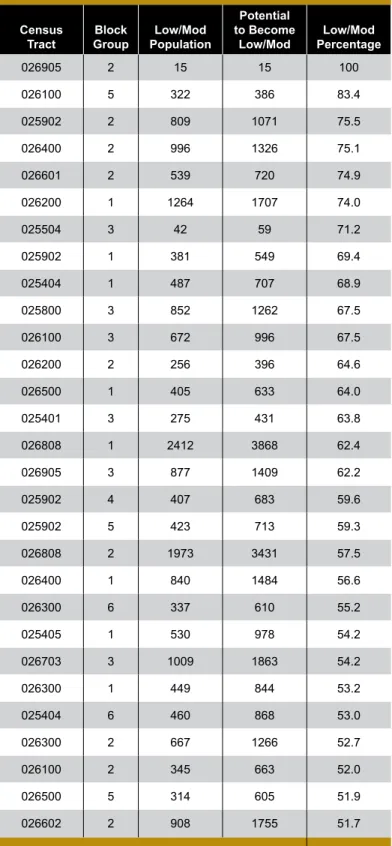
Figure 50 shows all of the Census Tracts and Block Groups located within the City of Clearwa-ter that have a Low/Moderate income percentage above 40 percent .
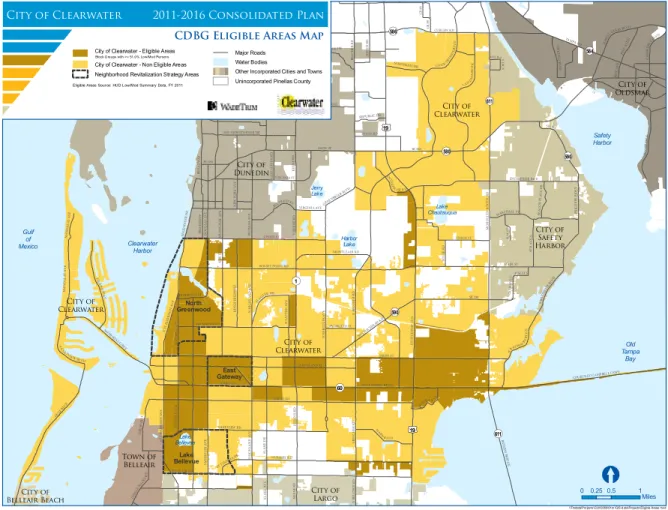
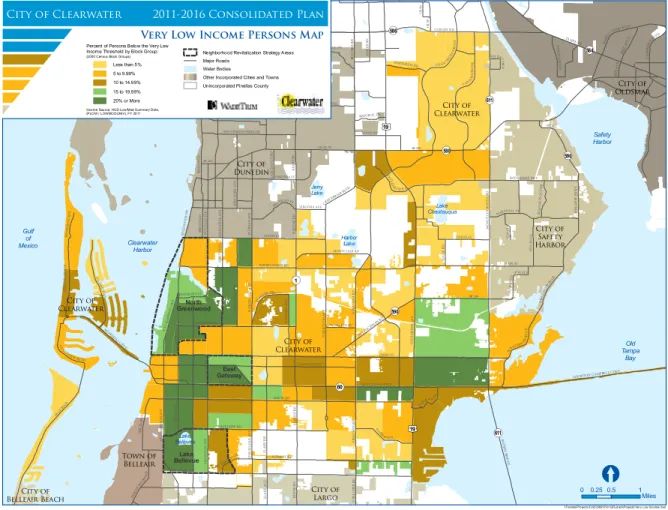
The locations of CDBG eligible areas, very-low income and low-income areas are shown in Figure 51 through Figure 53 .
These eligible block groups can be viewed graphi-cally in the CDBG Eligible Areas Map located in the Appendix of this report . As much as possible, the City of Clearwater aims to target CDBG funds on a community-wide basis with a focus in areas where the funds are most needed .
The City will allocate its affordable housing funds on a city-wide basis . The City will allocate its CDBG funds within the City’s designated low/mod-erate income areas and Neighborhood Strategy Areas .
The City’s priority community development needs will continue to eliminate slum and blighting influences in the City’s two Neighborhood Revi-talization Strategy Areas (North Greenwood and
Figure 49 FY 2011-2012 Proposed Activities
Activity Type Amount
Housing Rehabilitation
City of Clearwater Rehab Program Delivery
Costs $140,000 .00
Program Administration
Community Development Block Grant
Program $167,648 .00
HOME Investment Partnership Program $50,032 .00 Public Services
Willa Carson Community Health Resource
Center $24,000 .00
WestCare Gulf Coast Florida, Inc . $12,000 .00 Pinellas Opportunity Council, Inc . -
Chore Services $30,000 .00
Gulf Coast Legal Services, Inc . -
Fair Housing $27,256 .00
Community Service Foundation, Inc . -
Fair Housing $8,000 .00
Personal Enrichment Through Mental Health
Services, Inc . $3,500 .00
Safety Harbor Neighborhood Family Center,
Inc . $14,892 .00
Intercultural Advocacy Institute $9,703 .00 Kimberly Home, Inc . – Infant & Toddler Care $12,000 .00 Public Facilities and Improvements
Religious Community Services - Food Bank $27,180 .00 Religious Community Services - The Havens $50,000 .00 Directions for Mental Health, Inc . -
Center Improvements $55,000 .00 Economic Development
Economic Development-Program Delivery $10,000 .00 Acquisition/Infill Housing-SF/MF
City of Clearwater Infill Housing-Program
Delivery $25,000 .00
Housing Pool - SF/MF - DPA, Infill,
Rehabilitation, New Construction $597,300 .00 Largo Area Housing Development Corporation
Clearwater Neighborhood Housing Services, Inc . Habitat for Humanity of Pinellas County, Inc . Tampa Bay Community Development Corporation HOME Program - CHDO Set-Aside
(15% of Allocation) $75,053 .00 Total Estimated Funding $1,338,564 .00 **Funding for Housing Counseling will be provided from prior year resources or as a direct result of assistance .
Source: City of Clearwater, Economic Development and Hous-ing Department, June 2011
Figure 50 CDBG Eligible Areas
Census
Tract GroupBlock PopulationLow/Mod
Potential to Become
Low/Mod PercentageLow/Mod
026905 2 15 15 100 026100 5 322 386 83 .4 025902 2 809 1071 75 .5 026400 2 996 1326 75 .1 026601 2 539 720 74 .9 026200 1 1264 1707 74 .0 025504 3 42 59 71 .2 025902 1 381 549 69 .4 025404 1 487 707 68 .9 025800 3 852 1262 67 .5 026100 3 672 996 67 .5 026200 2 256 396 64 .6 026500 1 405 633 64 .0 025401 3 275 431 63 .8 026808 1 2412 3868 62 .4 026905 3 877 1409 62 .2 025902 4 407 683 59 .6 025902 5 423 713 59 .3 026808 2 1973 3431 57 .5 026400 1 840 1484 56 .6 026300 6 337 610 55 .2 025405 1 530 978 54 .2 026703 3 1009 1863 54 .2 026300 1 449 844 53 .2 025404 6 460 868 53 .0 026300 2 667 1266 52 .7 026100 2 345 663 52 .0 026500 5 314 605 51 .9 026602 2 908 1755 51 .7
Source: 2011 HUD Low and Moderate Income Summary Data.
Lake Bellevue- formerly known as South Greenwood) which are both adjacent to the City’s expanded Downtown Commu-nity Redevelopment Area .
This area is known as the East Gateway area and is east of, but contiguous to both downtown and the North and South Greenwood Revitalization Strategy Areas . Needed improvements will include infra-structure, community facilities, signage and streetscaping, landscaping and other public improvements .
Obstacles To Meeting
The Underserved Needs
The lack of available land and rapidly rising housing prices will continue to put constraints on the City’s ability to provide affordable housing . Rapidly rising prices will also increase the need for affordable rental units for households being priced out of the owner market . The need for af-fordable rental projects will also increase as higher-end apartment complexes are converted into condominiums .One obstacle that all communities face with meeting underserved needs is the lack of resources . The City of Clearwa-ter plans to review alClearwa-ternative sources of funds to help address the needs of City residents . Efforts will be made to submit grant applications to Federal, state, and local resources . Specific grant applications could include Neighborhood Stabilization Programs, other Commu-nity Development Initiatives, Economic Development grants, Energy Efficiency grants, infrastructure improvements, and neighborhood enhancement/revitalization .
117
City of Clearwater, Florida 2011-2016 Consolidated Plan
SR 580 DREW ST U S H IGH W AY 1 9 N CURLEW RD DRU ID RD MAIN ST CR 1 BELLEAIR RD SUNSET POINT RD TAMPA RD SR 590 M CM U LL EN B O O TH R D N KEE N E R D GU LF TO BAY BLVD N B EL CH ER R D NURSERY RD GULF BLVD CLEVELAND ST BE LC H ER R D LAKEVIEW RD C O UNTR YSID E BLVD N B ET T Y LN ENTERPRISE RD E COURT ST L AND MA RK D R S K EE N E RD BAYS HORE BLVD D O U G LA S AV E S L A KE D R N H ER CU LE S A V E PH IL LI PP E PK W Y S M IS SO U RI A VE VIRGINIA ST S H IG H LA N D A V E S B EL C H ER R D BA YSID E BRID G E N H IG H LA N D A V E ISLA N D W AY SHO RE D R E MARSHALL ST PA TR IC IA A V E FI SH ER R D EDG EWAT ER D R CAUSEWAY BLVD S F T H A RR IS O N AVE NE CO ACHM AN RD UNION ST KI N G S H IG H W AY MEMO RIAL C SW Y MICHIGAN BLVD PI N EH U R ST R D HARN B LVD N M YR TL E AV E
COURTNEY CAMPBELL CSWY
N FT H ARRIS ON A VE BELTREES ST N EW Y O RK A V E SOLON AVE MONTCLAIR RD S M YR TL E AV E EVANS RD D RUID R D S 9TH A V E N FORE ST LA KES BLVD N S AT U RN A V E KE A V E SAN CHRISTOPHER DR FLAG LER DR EL M S T BRO A D W AY PA L M BLVD M ILW AU K EE A V E N BAYSHO RE B LV D PINE AVE N EN TER P R I SE R D AN RO CKS R D KE EN E RD S BAYS HORE BLVD CR 9 0 C O M M ERCE BLVD NORTHSIDE DR OAK LEA F B LVD SO U LE R D S G ULFVIEW BLVD REPUBLIC DR O MAH A ST PALMETTO ST VIRGINIA AVEGR EENBRI AR BLVD BE A CO N PLA C E DR FAIRMONT ST LA KE H AV EN R D ALTIR A A VE 14 TH A V E S4TH ST S PINE AVE MAN D ALAY AVE OAK CREEK DR MIL RAY D R N HAGEN AVE ST THO MAS DR SAN SALVADOR DR M A N D AL AY A V E CH ER R D CR 9 0 MAIN ST SR 580 SR 590 E RD UNION ST BR O A D W AY CR 1 PALMETTO ST City of Clearwater City of Dunedin City of Safety Harbor City of Oldsmar City of Town of Belleair City of City of Clearwater City of Clearwater 2011-2016 Consolidated Plan
Low Income Persons Map
£ ¤ ! (590 19 !(611 ! (1 ! (60 ! (580 !( 590 £ ¤19 ! (611 ! (584 ! (586 Old Tampa Bay Gulf of Mexico Lake Chautauqua Harbor Lake Jerry Lake Safety Harbor Clearwater Harbor
[
0 0.250.5 1 City of Clearwater Lake Bellevue North Greenwood Lake Bellevue Water Bodies Other Incorporated Cities and Towns Unincorporated Pinellas County Major RoadsIncome Source: HUD Low/Mod Summary Data, (PLOW / LOWMODUNIV), FY 2011
Neighborhood Revitalization Strategy Areas Less than 10%
10 to 19.99% 20 to 29.99% 30 to 39.99% 40% or More Percent of Persons Below the Low Income Threshold by Block Group:
(2000 Census Block Groups)
East Gateway SR 580 DREW ST U S H IGH W AY 1 9 N CURLEW RD DRU ID RD MAIN ST CR 1 BELLEAIR RD SUNSET POINT RD TAMPA RD SR 590 M CM U LL EN B O O TH R D N K EE N E R D GU LF TO BAY BLVD N B EL CH ER R D NURSERY RD GULF BLVD CLEVELAND ST BE LC H ER R D LAKEVIEW RD C O UNTR YSID E BLV D N B ET T Y LN ENTERPRISE RD E COURT ST L AND MA RK D R S K EE N E RD BAYS HORE BLV D D O U G LA S AV E S L A KE D R N H ER CU LE S A V E PH IL LI PP E PK W Y S M IS SO U RI A VE VIRGINIA ST S H IG H LA N D A V E S B EL C H ER R D BA YSID E BR ID G E N H IG H LA N D A V E IS LAN D W AY SHO RE D R E MARSHALL ST PA TR IC IA A V E FI SH ER R D EDG EWAT ER D R CAUSEWAY BLVD S F T H A RR IS O N AV E NE COAC HMAN RD UNION ST KI N G S H IG H W AY MEMO RIAL CSW Y MICHIGAN BLVD PI N EH U R ST R D HARN B LVD N M YR TL E AV E
COURTNEY CAMPBELL CSWY
N FT H ARRIS ON A VE BELTREES ST N EW Y O RK A V E SOLON AVE MONTCLAIR RD S M YR TL E AV E EVANS RD D RUID R D S 9TH A V E N FORE ST LA KES BLVD N S AT U RN A V E S L A KE A V E SAN CHRISTOPHER DR FLAG LER DR EL M S T BRO A D W AY PA L M BLVD M ILW AU K EE A V E N BAYSH ORE B LV D PINE AVE N EN TERP R I SE R D INDI AN RO CKS R D KE EN E RD S BAYS HORE BLVD CR 9 0 C O M M ERCE BLVD NORTHSIDE DR OAK LEA F B LVD SO U LE R D S G ULF VIEW BLVD REPUBLIC DR O MA H A ST PALMETTO ST VIRGINIA AVEGREEN
BRIAR BL VD BE A CO N P LA C E DR FAIRMONT ST LA KE H AV EN R D ALTIRA A V E 14 TH A V E S4TH ST S PINE AVE MA NDAL AY AV E OAK CREEK DR MIL RAY DR N HAGEN AVE ST THO MAS D R SAN SALVADOR DR M A N D AL AY A V E N B EL CH ER R D CR 9 0 MAIN ST SR 580 SR 590 KE EN E RD UNION ST BR O A D W AY CR 1 PALMETTO ST
\\Tmdata\Pro jects\CLW2069\01m \GIS-d ata\Projects\Eligible Areas.mxd City of Clearwater City of Dunedin City of Safety Harbor City of Oldsmar City of Largo Town of Belleair City of Belleair Beach City of Clearwater City of Clearwater 2011-2016 Consolidated Plan
CDBG Eligible Areas Map
£ ¤ ! (590 19 !(611 ! (1 ! (60 ! (580 !( 590 £ ¤19 ! (611 ! (584 ! (586 Old Tampa Bay Gulf of Mexico Lake Chautauqua Harbor Lake Jerry Lake Safety Harbor Clearwater Harbor
[
0 0.250.5 1 Miles Water BodiesOther Incorporated Cities and Towns Unincorporated Pinellas County Major Roads City of Clearwater - Non Eligible Areas
City of Clearwater - Eligible Areas
Eligible Areas Source: HUD Low/Mod Summary Data, FY 2011 City of Clearwater Lake Bellevue North Greenwood Lake Bellevue
Neighborhood Revitalization Strategy Areas
Block Groups with >= 51.0% Low/Mod Persons
East Gateway
Figure 51 CDBG Eligible Areas Map
SR 580 DREW ST U S H IGH W AY 1 9 N CURLEW RD DRU ID RD MAIN ST CR 1 BELLEAIR RD SUNSET POINT RD TAMPA RD SR 590 M CM U LL EN B O O TH R D N K EE N E R D GU LF TO BAY BLVD N B EL CH ER R D NURSERY RD GULF BLVD CLEVELAND ST BE LC H ER R D LAKEVIEW RD C O UNTR YSID E BLV D N B ET T Y LN ENTERPRISE RD E COURT ST L AND MA RK D R S K EE N E RD BAYS HORE BLV D D O U G LA S AV E S L A KE D R N H ER CU LE S A V E PH IL LI PP E PK W Y S M IS SO U RI A VE VIRGINIA ST S H IG H LA N D A V E S B EL C H ER R D BA YSID E BR ID G E N H IG H LA N D A V E IS LAN D W AY SHO RE D R E MARSHALL ST PA TR IC IA A V E FI SH ER R D EDG EWAT ER D R CAUSEWAY BLVD S F T H A RR IS O N AV E NE COAC HMAN RD UNION ST KI N G S H IG H W AY MEMO RIAL CSW Y MICHIGAN BLVD PI N EH U R ST R D HARN B LVD N M YR TL E AV E
COURTNEY CAMPBELL CSWY
N FT H ARRIS ON A VE BELTREES ST N EW Y O RK A V E SOLON AVE MONTCLAIR RD S M YR TL E AV E EVANS RD D RUID R D S 9TH A V E N FORE ST LA KES BLVD N S AT U RN A V E S L A KE A V E SAN CHRISTOPHER DR FLAG LER DR EL M S T BRO A D W AY PA L M BLVD M ILW AU K EE A V E N BAYSH ORE B LV D PINE AVE N EN TERP R I SE R D INDI AN RO CKS R D KE EN E RD S BAYS HORE BLVD CR 9 0 C O M M ERCE BLVD NORTHSIDE DR OAK LEA F B LVD SO U LE R D S G ULF VIEW BLVD REPUBLIC DR O MA H A ST PALMETTO ST VIRGINIA AVEGREEN
BRIAR BL VD BE A CO N P LA C E DR FAIRMONT ST LA KE H AV EN R D ALTIRA A V E 14 TH A V E S4TH ST S PINE AVE MA NDAL AY AV E OAK CREEK DR MIL RAY DR N HAGEN AVE ST THO MAS D R SAN SALVADOR DR M A N D AL AY A V E N B EL CH ER R D CR 9 0 MAIN ST SR 580 SR 590 KE EN E RD UNION ST BR O A D W AY CR 1 PALMETTO ST
\\Tmdata\Pro jects\CLW2069\01m \GIS-d ata\Projects\Very Low Income.mxd City of Clearwater City of Dunedin City of Safety Harbor City of Oldsmar City of Largo Town of Belleair City of Belleair Beach City of Clearwater City of Clearwater 2011-2016 Consolidated Plan
Very Low Income Persons Map
£ ¤ ! (590 19 !(611 ! (1 ! (60 ! (580 !( 590 £ ¤19 ! (611 ! (584 ! (586 Old Tampa Bay Gulf of Mexico Lake Chautauqua Harbor Lake Jerry Lake Safety Harbor Clearwater Harbor
[
0 0.250.5 1 Miles City of Clearwater Lake Bellevue North Greenwood Lake Bellevue Water Bodies Other Incorporated Cities and Towns Unincorporated Pinellas County Major RoadsIncome Source: HUD Low/Mod Summary Data, (PLOW / LOWMODUNIV), FY 2011
Neighborhood Revitalization Strategy Areas Less than 5%
5 to 9.99% 10 to 14.99% 15 to 19.99% 20% or More Percent of Persons Below the Very Low Income Threshold by Block Group: (2000 Census Block Groups)
East Gateway
Figure 53 Very Low Income Persons Map
In addition, public service projects and/or pro-grams that can be supported by CDBG funds are limited, yet create a large demand for funding . The City of Clearwater will continue to work with public service providers in an effort to expand service and become more of a resource for these provid-ers .
Poverty levels have increased slightly between 1990 and 2000 . It can be assumed that between 2000 and 2010 that poverty has increased further due to increased unemployment . Federal pro-gram funds being used are not designed to be anti-poverty programs, thus limiting the amount of resources available for such activities .
Public Housing
The Public Housing Authority for the City of Clear-water is the ClearClear-water Housing Authority (CHA) .
The CHA has developed a 5-Year Plan for the 2010-2015 fiscal years . The CHA manages 202 units and 1,340 Housing Choice Vouchers . The CHA public housing program provides feder-ally-subsidized rental properties . Residents pay only a portion of their rent based on income . Their mission is to lead in creating housing opportunities to enhance the lives of those they serve .
The CHA aims to build communities with innova-tive programs, sustain a dignified and desirable environment and create alliances to nurture self-sufficiency .
According to the Fiscal Year 2010 Five-Year and Annual PHA Plans for the CHA, the following specific goals will enable the agency to serve the needs of low-income and very low-income, and
extremely low-income families over the next five years:
1 . Apply for additional Housing Choice Vouchers when available and applicable .
2 . Continue to search for affordable housing opportunities and when practical, utilize available Replacement Housing Factor increments .
The CHA has an ongoing management program in place to involve residents in its operations . CHA is recognized throughout the state and nation as be-ing a very progressive housbe-ing authority . Income-eligible residents of CHA’s programs are Income-eligible
for all of the City’s affordable housing programs shown in Figure 54 .
The City’s Public Housing Authority is not listed as troubled by HUD .
Homeless And Special Needs
Homeless
The Pinellas County Coalition for the Homeless (PCCH) is the lead agency for the Pinellas County/ St . Petersburg/Clearwater/Largo Continuum of Care . The PCCH is an independent, community-based, tax-exempt, nonprofit organization whose mission is to serve and support the
communi-Figure 54 Priority Public Housing Needs, City Of Clearwater Housing Authority
Public Housing Need Category High Median Low No Such NeedPHA Priority Need Level Estimated Dollars to Address Restoration and Revitalization *BT Structural Improvements Currently Underway Capital Improvements *
Modernization Rehabilitation Other (Specify)
Capital *BT – Window replacement with structural improvements, re-stucco and repair to Barbee Towers $65,936 *BT – Paint and reseal exterior to Ralph Richards Tower $30,000
Management and Operations
Operations $165,000
Physical Needs Assessment $20,000
Improved Living Environment
Neighborhood Revitalization (non-capital) Capital Improvement
Safety/Crime Prevention/Drug Elimination
Other (Specify) Computer hardware/software systems upgrades $50,000
Economic Opportunity
Resident Services/Family Self Sufficiency Other (Specify)
Total $330,936
ties, agencies, and organizations concerned with homelessness by providing community education, advocacy, program support, capacity building and technical assistance . The vision of the PCCH is expressed in the 10-Year Plan to End Homeless-ness in Pinellas County: “Improving the quality of life for all our citizens means that no one in Pinel-las County should be homeless .”
The Coalition partners with local, state, and federal agencies, including the City of Clearwater, that are concerned with homelessness . The Coali-tion pushed for supportive reforms such as the establishment of the state office on homelessness and the passing of the homeless hate crimes bill . Through grant funding, advocacy and coordina-tion, these agencies have been instrumental in assisting PCCH in its mission to end homeless-ness in Pinellas County . The PCCH is a collabora-tive effort among its member service providers and concerned individuals of Pinellas County to provide resources to people experiencing home-lessness within the community . The broad range of services provided by the PCCH’s member agen-cies creates a system of care composed of eight elements which include:
• Infrastructure (includes TBIN, community voice mail, and homeless services coordination) • Prevention (includes rent and utility
assistance, counseling, domestic violence education and outreach)
• Outreach (includes funding for the homeless street outreach teams)
• Supportive Services (includes food, clothing, mail boxes, IDs, transportation, information and referrals, and other social services) • Emergency Shelter (includes emergency
shelter beds/mats and Pinellas Hope, a seasonal outdoor shelter)
• Transitional Housing (includes units in which program participants typically may reside for two years)
(includes housing units and safe havens for chronically homeless persons)
• Medical/Mental Health (includes health services, detox, substance abuse treatment and counseling, and more) .
In addition to service coordination, PCCH provides the following direct services: Cold Night Shelters, Free Bus Passes, Project Homeless Connect, St . Petersburg Central Kitchen (organized through the St . Petersburg Homeless Task Force, a component of PCCH), annual Point-In-Time Homeless Count and Survey, Homeless Persons’ Memorial Day, and Project UPBEAT (a capacity building project providing training and technical assistance) .
Homeless Needs
As part of the Consolidated Plan process, the City reached out to PCCH to obtain data related to homeless population within the City of Clearwater . The following narrative is based on data provided in the PCCH’s 2011 Point in Time (PIT) Count of Homeless Individuals in Pinellas County .
The 2011 point in time (PIT) count of homeless individuals in Pinellas County was designed to obtain an accurate census of the number of home-less individuals residing in the County . The street count primarily took place on Monday, January 24, 2011, at locations around the entire County . Throughout the day, volunteer surveyors inter-viewed homeless and at-risk individuals, children, and families to capture a broad range of informa-tion concerning demographics, living arrange-ments, education, employment status, and several other key factors . Collection and analysis of these data are intended to help stakeholders obtain resources, develop community initiatives, and understand how to best provide services to people who are homeless or are at risk of homelessness in Pinellas County .
The count was composed of six sources: an un-sheltered homeless count, a school count, a shel-tered homeless count, an overnight count, a jail count, and an unsheltered family count . The un-sheltered homeless count consisted of 720 adults and 65 children under the age of 18 . The sheltered homeless count consisted of 2,050 individuals . The school count consisted of 2,110 students . The overnight count consisted of 464 individuals and the jail count consisted of 330 individuals . The un-sheltered family count consisted of 61 adults and 87 children . The total count across these sources was 5,887 . Among these, 3,661 fit the require-ments to be considered to be literally homeless . The difference between these two estimates is largely attributable to the majority of children in the school data reporting that they share the housing of others . A separate count of chronically home-less individuals was conducted using data from a housing survey conducted in 2011 and Tampa Bay Information Network (TBIN) participating shelters . A total of 155 chronically homeless individuals from the unsheltered population combined with 124 individuals from the sheltered population re-sulted in an estimate of 279 chronically homeless individuals in Pinellas County .
When asked, the primary reasons given for homelessness included: loss of a job, financial problems, or not enough income (416 out of 720 unsheltered homeless); alcohol or drug problems (83); criminal history/arrest/incarceration (76); fam-ily break-up (60); and mental health or emotional problems (58) .
The data included in the PCCH point in time count is primarily reflective of Pinellas County as a whole, and not specifically for the City of Clear-water . However, some municipal-level data was included in the report . Of the 720 total unsheltered individuals recorded in the County, 156 indicated the City of Clearwater as their primary place of
stay . Of the 1,712 sheltered homeless individuals recorded by the TBIN participating shelters, 281 resided within Clearwater’s zip codes .
Based on the 2011 point in time count, as well as other data provided by PCCH, Figure 42, Home-less and Special Needs Populations on page 62, identifies the need for shelter and services within the homeless community in Pinellas County . This figure serves as HUD required Table 1A, Home-less and Special Needs Population .
In determining the unmet need for the homeless population, Figure 42, Homeless and Special Needs Populations, Pinellas County, 2011 Point-In-Time Count displays 1,650 beds available for in-dividuals . The total number of inin-dividuals identified in the 2011 PIT count is 947 . It can be assumed that the current inventory of beds is adequate to serve this population . For families the number of available beds is 601 with a PIT count of 239 . Again, it can be assumed that the current inven-tory of beds is adequate to serve this population .
Proposed Homeless Projects to address needs:
• Provide funding in the amount of $50,000 to Religious Community Services, Inc ., for renovations at The Havens of RCS . This facility offers housing and related support services for victims of domestic abuse . Funding to the Havens will be used to replace windows, air conditioning system, water heaters and appliances . The Haven’s goal is to serve 15,139 domestic violence victims (women and children) .
• Provide funding in the amount of $12,000 to WestCare GulfCoast Florida, Inc ., for salary support to operate the Turning Point overnight shelter . The shelter provides an overnight facility for homeless persons under the influence of drugs and/or alcohol . It operates
as an inebriate receiving and intervention program that provides for a 24-hour sobering up area, intensive case management, and placement service . The agency’s goal is to serve 150 homeless Clearwater individuals .
Non-Homeless Special Needs Population
Special populations, such as the disabled or popu-lations living with HIV/AIDS, face particular ob-stacles when it comes to housing . Often living on fixed incomes or burdened by medical expenses, housing opportunities are typically limited . The U .S . Census Bureau defines disability as a long-lasting sensory, physical, mental or emotional condition . This condition can make it difficult for a person to do activities such as walking, climbing stairs, dressing, bathing, learning, or remember-ing . It can also impede a person’s ability to go outside the home to maintain a job . Disability includes persons with severe vision and/or hearing impairment .
According to the 2000 U .S . Census, of the 79,802 citizens between 5 and 64 years old in the City of Clearwater, more than 32 percent (26,083) had some kind of disability . Of the 23,357 citizens 65 years or older in the City, more than 66 percent (15,477) had some kind of disability .
Currently, there are a number of agencies within the region that provide programs for the disabled . Family Network on Disabilities, Inc ., Abilities of Florida, Inc ., Alternatives At Work, ARC Upper Pi-nellas, and Gulf Coast Jewish Family Services are the primary service providers for this population . While all of these agencies offer programs that en-courage self-sufficiency, including job training and assistance in locating affordable housing, few of these programs have dedicated housing stock for the disabled . This special needs population could be underserved in the City of Clearwater given the
limited resources for housing specifically . According to the U .S . Department of Health and Human Services Centers for Disease Control and Prevention, approximately 1 .1 million Americans are living with HIV, the virus that causes AIDS, and one fifth of those infected are unaware of their infection . According to the Pinellas County Health Department 2009 HIV/AIDS demographic informa-tion for Pinellas County, there are 155 reported cases of AIDS in Pinellas County . In addition, there are 184 reported cases of HIV in Pinellas County . Based on the percentage of persons living in Clearwater’s below the poverty rate in Clearwater, it is estimated that roughly 5 persons with HIV/ AIDS may need supportive housing .
The State of Florida Housing Opportunities for Persons with AIDS program (HOPWA) does not of-fer any services in Pinellas County for persons liv-ing with the HIV/AIDS virus . However, the State of Florida offers HOPWA program services in Tampa, approximately 15-20 miles from the City . Addi-tionally, the Pinellas County Health Department, through its Patient Care, AIDS Drug Assistance Program (ADAP), and HIV/AIDS Surveillance, is the primary service provider for this special needs population . However, the Health Department does not provide services related to housing specifically . A number of specialized services are provided through various agencies in Clearwater . The City of Clearwater will continue to narrow the gap in services provided to citizens with special needs . The City shall support efforts, either financially or otherwise, to meet the needs of this population . Projects that utilize diverse sources of funding will be granted a higher priority .
A description of the City’s existing services and programs dedicated to helping those with special needs follows . Additionally, the City coordinates
with other agencies to provide services if such ser-vices are not provided by the City of Clearwater .
Elderly & Frail Elderly
The elderly and frail elderly are assisted through City, County and non-profit agencies . Pinellas County, Department of Health and Human Ser-vices provides a significant number of services, from hot meals to transportation, in partnership with community organizations and Federal, State and local funding sources .
Local service providers for the disabled include
Abilities of Florida, Inc., a non-profit 501(c) 3 organization located in Clearwater . Abilities of Florida, Inc ., offers rehabilitation and employment services to people with disabilities . In addition, they offer outsourcing labor options to businesses and government agencies in a variety of fields . Additionally, Gulf Coast Jewish Family Services
is a non-profit 501(c) 3 organization located in Clearwater . Gulf Coast Jewish Family Services provides service to infants, children, families and elders in serious physical, mental, medical, social and financial crisis, allowing persons to remain free and independent with families and loved ones . Services include case management, homemak-ers services, affordable housing, mental health services and job training .
Substance Abusers
In Florida, services for persons with Substance Abuse disorders are coordinated by various agen-cies within the State of Florida, Pinellas County
and the City of Clearwater . Florida Department of Children and Families has several programs that can aide Florida families and individuals . The Department of Children and Families provides pro-grams called Substance Abuse & Mental Health (SAMH) . The Department’s SAMH programs are administered statewide, through 20 circuits, which
are grouped into six regions .
Acquired Immune Deficiency Syndrome (AIDS)
The Pinellas County Health Department provides services for those infected with HIV or having AIDS . The Pinellas County Health Department has over 12 years of experience providing health care to persons living with HIV and/or AIDS . Pinellas County Health Department has programs broken down into various categories:
Patient Care
The Pinellas County Health Department HIV/ AIDS Program was established in 1997 . The AIDS patient care clinic is funded privately and publi-cally through private donorship and state general revenue dollars . The clinic is contracted to pro-vide care to 250 clients however, Pinellas County Health Department has reported that the County is presently seeing over 800 clients . The Patient Care Clinic also provides patient care, HIV coun-seling and testing, case management, nutritional services, etc .
The AIDS Drug Assistance Program (ADAP)
ADAP assists HIV positive persons stay healthy by providing financial support with the purchase of HIV prescription medications for people who do not qualify for Medicaid, or have private health insurance, or are awaiting Medicaid eligibility .
HIV/AIDS Surveillance
Pinellas County Health Department provides education though community presentations and street outreach . In addition, the Health Education department provides HIV/AIDS training to health care professionals, provides technical assistance to community-based agencies, maintains a re-source library of HIV/AIDS educational videos and materials and conducts media relations to ensure release of current HIV/AIDS information .
Jail Linkage Program
The Pinellas County Jail Linkage Project is a program inaugurated in Pinellas County by the Pinellas County Health Department and has been in operation since 2001 . The Pinellas County Jail Linkage Project conducts risk assessments to in-mates to determine those who may be at high risk of infection . The Pinellas County Health Depart-ment provides prevention/education and testing of those individuals who may otherwise “slip through the cracks” of the system .
Victims of Domestic Violence
The Haven of Religious Community Services (RCS) provides safe housing, outreach and case management to survivors of domestic violence through the Pinellas County area . RCS is a 501(c) (3) nonprofit corporation that has been in opera-tion since 1967 .
The City has given the non-homeless special needs populations, who require supportive facili-ties/housing, a medium priority and intends to continue to support activities in this area as we are presented with projects and/or as we identify activities . Within this group, the elderly are being given the highest priority .
Proposed Non-Homeless Special Needs Projects:
• Provide funding in the amount of $3,500 to Personal Enrichment Through Mental Health Services, Inc ., for salary support to operate their Family Emergency Treatment Center . The Center provides assessment, crisis intervention counseling, individual and/or group support counseling, substance abuse assessment and intervention, medication evaluation and administration, service and treatment planning, referrals and other related services . The agency’s goals are to serve 150 residents of Clearwater .
• Provide funding in the amount of $30,000 to Pinellas Opportunity Council, Inc ., for salary support to implement the agency’s Chore Services Program . The program promotes better livable opportunities by providing services to the elderly and frail elderly . The services will help to alleviate blight and blighting conditions, reduce crime, and create a sense of pride in their community by providing heavy household cleaning, yard work and minor repairs . The agency’s goal is to assist 82 elderly households .
Barriers To Affordable
Housing
The City of Clearwater is sensitive to the effects that public policies have on the cost of housing as well as those that serve to dissuade develop-ment, maintenance or improvement of affordable housing . Although some of the barriers to the cost of producing affordable housing are beyond the control of local government, it is hoped that city policies do not create more barriers . The city works to establish positive marketing strategies and program criteria increasing housing choices for households with limited incomes, to provide geographical choice in assisted housing units, and to improve the physical quality of existing afford-able housing units . The city has identified regulato-ry, transportation and financing issues as barriers to affordable housing .
The City of Clearwater will continue to avoid all barriers to affordable housing . In many municipali-ties, the following programs and policies have the potential for creating barriers to affordable hous-ing, and thus are a matter of interest for the City: • Land Development Regulations: The City of
Clearwater LDR is free of barriers to affordable housing . It is a useful tool designed to promote the health, safety and welfare of its residents . It does not contain any restrictive, exclusionary
zoning or excessive subdivision controls that would impose barriers to affordable housing . • Building Codes: The City adheres to the State
guidelines code books, designed to ensure that dwelling units are structurally sound and safe for their inhabitants . CABO (Council of American Building Officials) guidelines are used for one- and two-family dwelling units . Such building codes do not include any codes which are insensitive to the older housing stock of the City .
• Approval and Permitting Systems: The City does not utilize slow procedures that are burdensome and uncoordinated, nor does Clearwater impose repetitive reviews that require developers to incur high costs and lose valuable time .
• Manufactured and Modular Housing: The City permits manufactured and modular housing as long as the development is consistent with the City’s LDR and Comprehensive Plan . The LDR does not impose restrictive barriers on these types of new construction .
• Redlining and Secondary Market Practices: The City of Clearwater does not use such practices .
• Code Enforcement: The City has no
systematic house-to-house code enforcement program . A complaint based code enforcement process is available to people who call
Development Services seeking help . As a result there are no code enforcement activities that are excessive, exclusionary, or discriminatory .
• Policies that Affect the Return on Residential Investment Including Supportive Housing: The City has no policies that affect the return on residential investment . As a result there are no such policies that are excessive, exclusionary, and discriminatory .
Other Actions
Lead-Based Paint
Throughout the fiscal year the County Health De-partment screens and tests school children for lead poisoning . The City will continue to test all buildings built before 1978 for lead-based paint in all its hous-ing programs .
The City follows procedures as specified in applica-ble regulations . The Department and its representa-tives provide all required notifications to owners and occupants and inspect for defective paint surfaces of pre-1978 properties . Any defective paint condi-tions found are included in the scope of work and treatment provided to the defective areas . No chil-dren under 7 years of age have been found to have identified Environmental Intervention Blood Lead Level (EIBLL) condition; however, interior chew-able surfaces are treated as necessary . All Depart-ment policies and procedures have been revised to conform with federal requirements . An EPA-certified staff member orders and reviews paint inspections, risk assessments and clearance testing of suspect properties done by licensed testing professionals . In every program where Federal funds are expended on a housing unit, the City incorporates the current procedures for hazard reduction or LBP abatement guidelines as defined in 24 CFR Part 35 .
A problem that impacts the rehabilitation of owner-occupied housing units is the presence of lead-based paint if the home was built prior to 1978 . The costs for the treatment or removal of these condi-tions can go from minor costs for encapsulation to major costs for removal . When a home is identified as a candidate for the City’s Rehabilitation program, and if it was built prior to 1978, it is inspected for lead in accordance to the rules of the federal pro-grams . Should lead hazards be found, the City will discuss the options with the homeowner to
eradi-cate the lead presence . The City may provide up to a $10,000 grant for lead abatement .
Lead-based paint is defined as paint containing one milligram per square centimeter (1 mg/cm2) of lead, or 0 .5 percent lead by weight . The definition of a lead-based paint hazard is any condition that causes exposure to lead from lead-contaminated dust, soil, or paint that is deteriorated or present in accessible surfaces, friction surfaces, or impact surfaces that would result in adverse human health effects as established by the appropriate federal agency .
Although lead is known to cause adverse health effects in both adults and young children, children (particularly those under the age of 7) are at a
greater risk to lead-based paint hazards . Severe lead exposure in children, which is quantified as having blood lead levels greater than or equal to 880 micrograms per deciliter, can lead to convul-sions, a coma, or even death . High levels of lead exposure can also cause mental retardation, kidney damage, as well as damage to the central nervous system, brain, and blood forming tissues . Figure 55 displays that the number of lead-poison-ing cases among children has been in long term decline within the County, declining from 311 new cases in 1993 to only 30 in 2007 .
Public and private efforts are currently underway . The Pinellas County Public Health Department is taking the lead in addressing lead poisoning in the community and has received a grant from the Centers for Disease Control and Prevention . During the years 2000-2007, 34,674 children were screened for lead poisoning throughout Pinel-las County by local-pediatricians and health care facilities . One hundred thirty-four cases of lead poisoned children were identified . This program will continue to be expanded, especially in the already identified high risk target areas .
The City has recently done extensive research to obtain educational and outreach materials pertain-ing to lead-based paint . We have placed many brochures, education materials and useful links on our website for citizens to read .
Fair Housing
In 1995, HUD announced that entitlement commu-nities, communities receiving direct federal fund-ing from Community Development Block Grant, HOME Investment Partnership and Emergency Shelter Grant programs, must conduct a study of existing barriers to housing choice .
This required study is referred to as the Analysis
Figure 55 Pinellas County New Case Rate, 1993-2007
Year New Cases (#) Total Screened
1993 311 6,637 1994 275 8,295 1995 153 7,628 1996 116 6,543 1997 104 6,196 1998 73 6,614 1999 60 5,581 2000 47 5,249 2001 31 4,939 2002 16 5,605 2003 25 6,479 2004 14 4,378 2005 11 2,689 2006 6 2,684 2007 30 2,651 Total 1,272 82,168
Source: 2005-2010 Consolidated Plan; Pinellas County Public Health Department 2011; Center for Disease Control and Prevention.