Copyright: Wyższa Szkoła Logistyki, Poznań, Polska
LogForum
> Elektroniczne czasopismo naukowe z dziedziny logistyki <
Vol. 3
Issue 2
No 4
http://www.logforum.net
PLANNING PROCESS SUPPORT FOR INTERMODAL SUPPLY
CHAINS
Bogusław Śliwczyński
Poznań School of Logistics, Poznan, PolandABSTRACT. The main addressed challenge is to prepare for the future growth in transportation and logistics and to bring this issue from analysis mode into actions. Within the Baltic Sea Region is seen increased exploitation of natural resources (seafood, petroleum, minerals, forest products etc.) that results in increased transport demand as well as increased general trade due to strong economical growth. The development of transnational cooperation and interlinking of regions or actors of Region is one of intermodal supply chain main objective.
The intermodal planning is focused on choices support, while intermodal planning emphasized the most efficient way of moving from point-to-point within the system. The solution presented in this paper is unique in its approach to manage supply chain and logistics services as a collection of configurable processes. Multiple operators' activities are not managed as individual files, but as services in a coherent process. This enables proper planning and enhanced visibility.
Key words: supply chain, planning system, transport corridor, interoperability, intermodal operations, collaboration network.
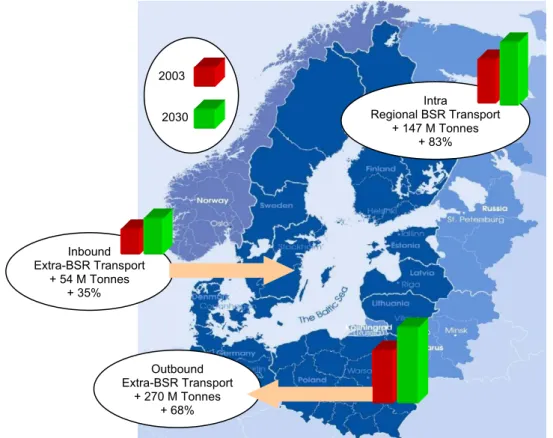
Many results of researches and forecasts done in the Baltic Sea Region show that there will be a huge increase in transportation and logistics related the Baltic Region. Maritime transport development assessment for period 2003 - 2030 is presented on the Figure 1. The Conference of Peripheral Maritime Regions (CPMR) Baltic Sea Commission and Baltic Development Forum confirm that this situation results from and will affect simultaneously business development and living conditions in general and thus call for important political decisions.
Main focus of many activities is developing practical actions in a partnership between the public and private sector based on a common strategic platform. Baltic Region applied projects complies with TEN, Motorways of the Sea, The Northern Dimension and national/supra-national politics and objectives.
The main addressed challenge is to prepare for the future growth in transportation and logistics and to bring this issue from analysis mode into actions. Within the region is seen increased exploitation of natural resources (seafood, petroleum, minerals, forest products etc.) resulting in increased transport demand as well as increased general trade due to strong economical growth. Important external factors that in particular will result in increased cargo flows through the region are the future economical growth in Russia and China and increased trade between these countries and Western Europe / USA. As result is seen future capacity problems and restrictions regarding transport through the region that
makes major issue to develop alternative transport corridors. Some important factors to be considered are:
- lack of trans-national interoperability of intermodal transports and common strategies for infrastructure development,
- limited capacity in many ports and terminals,
- congestion on European roads making alternative transport corridors feasible,
- large number of countries with different technical transport standards, lack of cross-border operability and tradition for cooperation.
Source: Northern Maritime Corridor Project - Results of researches of NMC2 project. Fig. 1. Maritime transport development assessment for period 2003 – 2030.
Rys. 1. Rozwój transportu morskiego w okresie 2003-2030.
These challenges can only be met through development of transnational cooperation. The main objectives followed from above factors analysis include:
- to interlink regions and actors of Region into collaborative networks,
- to support logistics infrastructure investment decisions at country/region/hub level (based on accumulated cargo flows data analysis),
- to improve and to optimize planning of transport corridors and intermodal supply chains.
The comprehension of business processes interactions along supply chain is an important factor to succeed in the fast changing and competitive business arena.
The solution presented in this paper is unique in its approach to manage supply chain and logistics services as a collection of configurable processes. Multiple operators' activities are not managed as individual files but as services in a coherent process. This enables proper planning and enhanced visibility. Outbound Extra-BSR Transport + 270 M Tonnes + 68% 2003 2030 Inbound Extra-BSR Transport + 54 M Tonnes + 35% Intra Regional BSR Transport + 147 M Tonnes + 83%
GENERAL ASSUMPTIONS OF PLANNING PROCESS FOR INTERMODAL
SUPPLY CHAINS
1. The planning process is focused on building and dynamic search of international, intermodal transport chains.
2. The planning process system gathers data on transport network nodes (sea and inland ports, logistic centers, etc.) and allows its users to build transport chains on the basis of the data. 3. The gathered data include all information necessary from the point of view of logistics and IT in
order to correctly build transport chains. This includes locations of the nodes, descriptions of logistic services available in a given node, as well as commercial data of the node and the services required to calculate the costs and to subsequently settle the services.
4. The data are introduced to the system by the operators and also with the help of messages generated by other, external IT systems.
5. The users are able to plan supply chain using a leg by leg method, taking independent decisions concerning the details of their course or system should to build a chain on the basis of user-specified start and end nodes, and intermediary nodes - if user-specified. The system presents solutions that have been optimized on the basis of required parameters or their combination. 6. The supply process planning system supports the realization of the transport service on the basis
of the planned transport chains.
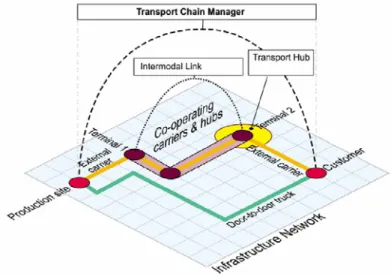
A general outline of data flow and participants of supply chain with their roles within the planning system are presented on the Figure 2.
Interoperability of supply chain process stakeholders means that one combined planning process must cover:
- many transport routes - many service providers - different timetables - different schedules - different costs
- different quality measures
The supply chain planning process provides in complete information about service suppliers, logistics infrastructure (at line and node), logistics services, conditions of using those services, corridors parameters (road, rail, sea) etc. The infrastructure or services information mast be related to logistics node (centre) or route (transport line). The planning system provides consolidation mechanism of information:
provider or service → node (all providers and services) → chain or corridor (all nodes and routes) Information include data essential for logistics planning e.g.: warehouse or transport capacity, pipeline capacity, lift of terminals capacity, infrastructure capability, actual level of load, lead time or time of service fulfil, load standards, etc. Designing of all possible cargo flows, routes and solutions in supply chains are enabled in the planning process.
Source: Terms of References : The System for planning intermodal supply chains; WP3 of Interbaltic Project; Institute of Logistics and Warehousing - Poland.
Fig. 2General outline of data flow of supply chain planning process.
Rys. 2. Schemat przepływu danych w procesie planowania łańcucha zaopatrzenia.
PLANNING SYSTEM OF INTERMODAL SUPPLY CHAINS
The intermodal planning is focused on choices support, while intermodal planning emphasized the most efficient way of moving from point-to-point within the system. In intermodal planning, key interactions between modes, including transfers but also policy and service interactions, are paramount. Three-part intermodalism based on the concepts of connections, choice, and coordination/cooperation:
Choice among transportation options provided by competing modes, independently or in combination. (Choice also means that decision makers need to consider alternative systems to address transportation needs before investing in infrastructure.)
Connections that provide convenient, rapid, efficient, and safe transfer of people and goods from U14 S2 S1 U1 U12 U11 U10 U9 U5 U6 U7 U8 U4 U1 U3 U2 MAG2 MAG1 P2 P1 CL2 CL3 CL1 D D D Services
(description, costs, transport units, dates, constraints, other conditions) U1: local service in CL1
U2: transport CL1 - P2 U3: transport MAG1 - CL1 U4: transport CL3 - MAG1 U14: transport P1 - MAG1
Services
(description, costs, transport units, dates, constraints, other conditions)
U5: local service in CL3 U6: local service in CL3 U7: transport CL1 - MAG2 U8: transport P1 - CL3
Services
(description, costs, transport units, dates, constraints, other conditions) U9: transport P2 - P1
U10: transport P1 - P2 U11: transport CL2 - PL2 U12: transport MAG2 - CL2 U13: transport MAG2 - P2
K K
Transport realization
(products, description, quantities, path, other conditions)
S1: transport of product T1 from MAG2 to MAG1; path: U7, U5, U4
Transport realization
(products, description, quantities, path, other conditions)
S2: transport of product T2 from CL2 to MAG1; path: U11, U9, U14
DU1, DU2, DU3: services suppliers,
CL1, CL2, CL3: logistic centers, MAG1, MAG2: warehouses P1, P2: ports
highest quality and most comprehensive transportation service for cost, time, safety, punctuality and other.
Coordination and cooperation among transportation organizations to improve transportation service, quality, safety, and efficiency across all modes or combinations of modes.
Fig. 3. Planning system of intermodal supply chains
Rys. 3. System planowania intermodalnego łańcucha dostaw
Intermodal freight operations involve the combination of different types of logistics services, some of them available according to specific timetables. Especially when multiple scheduled services are combined, this poses specific difficulties for planning.
Fig. 4a. Supported Business Process
Rys.4a. Wspomagany proces zarządzania
Transport Planning Transport Execution and Monitoring Inovoice and Payment Customer Booking Transport Planned Transport Executed Invoices Provider Bookings Transport-documentation Service Provider Customer Service Customer Booking Register Customer Booking Build Transport Networks Register Provider Services Register Customer Services 1. Transport Configuration 2. Network Planning 3. Establish Customer Relationships
5. Transport Execution 4. Shipment Planning
6. Invoice and Payments Deviation
Management
Deviations Deviation Managed
Automatic routing decision support with a network of available intermodal services needs to be supported. Optimization decisions in such networks take place under the restriction that several (types of) services are available according to scheduled timetables, which is fundamentally different from standard linear optimization problems. Within planning process is created network of possible transport connections and choose the best route for the Customer and create a complete transport chain with estimated schedule and costs.
During the optimization process is allowed the automatic creation of intermodal chains on the basis of information on start and end nodes, intermediary nodes (optional), and available services, according to following criteria (or any combination of them): cost, time, punctuality, safety and other.
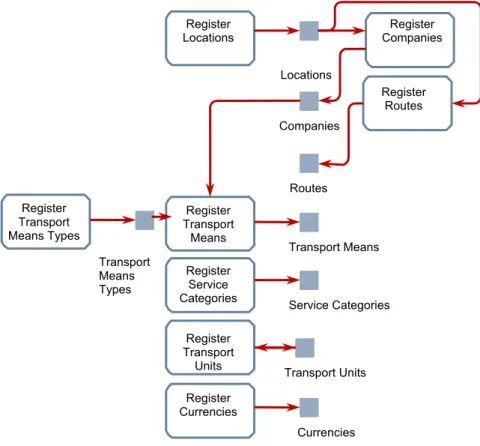
The planning process with described functionality and reference data for it is presented on Figure 4a and 4b.
Fig. 4b. Reference data for supply chain planning system
Rys.4b. Dane referencyjne w systemie planowania łańcucha dostaw
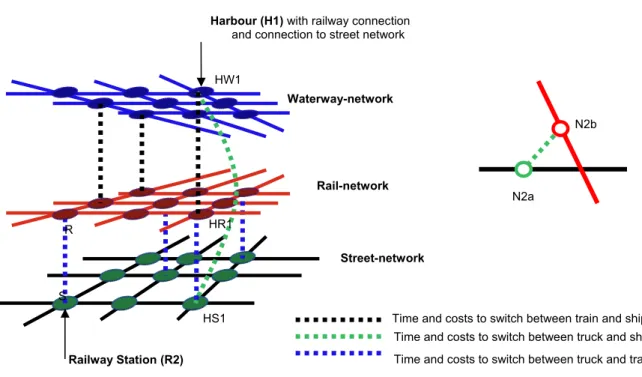
Planning process includes analysis of multilayered network with intermodal switches (Transshipment Points). The generated proposals of supply chains are based on data about infrastructure and geographical positions and characteristics stored in database. The example of transshipment point (hub) description during planning process is presented on Figure 5.
The planning process of supply chains (including routes and schedules for an intemodal transportation) belongs to the most complex and complicated optimization problems that require a lot of computational effort. The coordination of separate schedules for different transportation modes is required. This coordination results in a system - oriented global optimization of routes and schedules, as opposed to local optimization leading to suboptimal solutions. In many real life situations the decision models involve non-linear description of certain phenomena, which additionally complicates solution procedures. Transport Units Locations Routes Companies Service Categories Transport Means Register Locations Currencies Register Companies Register Routes Register Service Categories Register Transport Units Register Transport Means Register Currencies Transport Means Types Register Transport Means Types
Fig. 5. Transshipment point (hub) of multilayered network description Rys. 5. Punkt centralny (hub) sieci wielopoziomowej
CONCLUSIONS
Concluding these considerations about supporting of supply chain planning process it is essential to point out interlinking regions and actors of Region into collaborative networks and supporting logistics infrastructure investment decisions at country/region/hub level. The intermodal planning is focused on choices support, while intermodal planning emphasized the most efficient way of moving from point-to-point within the system. The international applying of described system is response to needs of trans-national interoperability of intermodal transport and makes a possible common strategy for infrastructure development. The planning process meets and alerts limitation capacity in many ports and terminals. Using of such system in large number of countries with different technical transport standards is one of most efficient way of cross-border operability and cooperation.
REFERENCES
The System for planning intermodal supply chains; Terms of References; WP3 of Interbaltic Project; Institute of Logistics and Warehousing, Poland, 2006.
WSPARCIE PROCESU PLANOWANIA INTERMODALNYCH
Ł
A
Ń
CUCHÓW DOSTAW
STRESZCZENIE. Jednym z głównych wyzwań postawionych przed uczestnikami procesów biznesowych w łańcuchach dostaw Morza Bałtyckiego jest przygotowanie do znaczącego wzrostu obrotu towarowego i przewozów pasażerskich oraz przełożenie wyników analiz na płaszczyznę konkretnych działań. W rejonie Morza Bałtyckiego jest obserwowany oraz prognozowany wzrost transportu paliw, owoców morza, surowców mineralnych czy produktów drzewnych, wynikający ze stałego wzrostu obrotów handlowych i wzrostu gospodarczego wielu państw w tym rejonie.
Street-network Rail-network
Railway Station (R2)
Waterway-network Harbour (H1) with railway connection
and connection to street network
Time and costs to switch between truck and train Time and costs to switch between truck and ship Time and costs to switch between train and ship HW1 HR1 HS1 R S N2a N2b
Jednym z głównych celów rozwoju intermodalnych łańcuchów dostaw jest międzynarodowa (transgraniczna) współpraca oraz powiązania komunikacyjne i informacyjne poszczególnych regionów, portów i uczestników łańcuchów dostaw. Planowanie intermodalnych dostaw jest zorientowane na wspomaganie decyzji wyboru najbardziej efektywnej drogi przewozu (ludzi lub towarów), z punktu startowego do docelowego punktu trasy.
W prezentowanym rozwiązaniu systemu planowania, zastosowano podejście procesowe. Zarządzanie łańcuchem dostaw i operacjami logistycznymi oparte jest na dynamicznym konfigurowaniu wielu operacji zdefiniowanych w procesach dostaw. W konsekwencji, działania operatorów są planowane w tworzonym połączeniu jako zestaw spójnych i powiązanych wzajemnie usług. Takie podejście pozwala na właściwe i sprawne planowanie oraz odpowiednią wizualizację procesu dostaw.
Słowa kluczowe: łańcuch dostaw, system planowania, korytarz transportowy, interoperacyjność, operacje intermodalne, sieć współpracy.
UNTERSTÜTZUNG DES PLANUNSGPROZESSES VON
LIEFER-KETTEN
ZUSAMMENFASSUNG. Eine der Hauptherausforderungen vor den Unternhemen steht, die in Lieferketten in der Ostsee eingebunden sind, ist die Vorbereitung auf die erhebliche Erhöhung des Waren- und Passagierverkehrs sowie die Übertragung der Ergebnisse der Analysen auf konkrete Handlungen. In der Ostseeregion ist steigende Dynamik der Transporte von Kraftstoffen, Seefrüchten, Rohstoffen oder Holzprdukte sichtbar. Dieser ergibt sich aus dem konstanten Anstieg des Warenverkehrs und Wirtschaftswachstums in meheren Staaten dieser Region. Eines der Hauptziele der Entwicklung intermodaler Lieferketten ist die internationale (grenzüberschreitende) Kooperation sowie die Verkehrs- und Kommunikationsverbindungen der einzelnen Regione, Häfen und Unternehmen, die in den Lieferketten eingebunden sind. Die Planung intermodaler Lieferketten orientiert sich auf die Unterstützung des Entscheidungsprozesses der effektivsten Transportweges vom Start bis zum Ziel. In der dargestellten Lösung des Planungssystems wurde der Prozessansatz angewendet. Das Mangement von Lieferketten und Logistikoperationen basiert auf der dynamischen Konfigurierung meherer Operationen in dem Lieferungsprozess. Im Ergebnis werden die Aktivitäten von Logistikdienstleistern als Pakete kohärenter und aufeinader abgestimmter Dienstleistungen geplant. Durch einen solchen Ansatz ist richtige und effiziente Planung und entsprechedne Visualisierung des Lieferungsprozesses möglich.
Codewörter: Lieferkette, Planunsgsystem, Transportkorridor, Interoperabilität, intermodale Operationen, Kooperationsnetz.