Head Office: Università degli Studi di Padova Human Inspired Technology Research Centre
Ph.D. COURSE IN: Brain, Mind & Computer Science (BMCS)
CURRICULUM: Computer Science and Innovation for Societal Challenges XXX SERIES
Security and Privacy Threats on Mobile Devices through Side-Channels Analysis
Coordinator: Prof. Giuseppe Sartori
Supervisor: Prof. Mauro Conti
Co-Supervisor: Prof. Luciano Gamberini and Prof. Giuseppe Sartori
University of Padua
Human Inspired Technology Research Centre
Doctorate Degree in Brain, Mind and Computer ScienceCurriculum in Computer Science and Innovation for Societal Challenges
Security and Privacy Threats
on Mobile Devices
through Side-Channels Analysis
Candidate Supervisor
Riccardo Spolaor Prof. Mauro Conti
Co-Supervisors
Prof. Luciano Gamberini Prof. Giuseppe Sartori
University of Padova, Italy
Acknowledgements
I want to express my sincere gratitude to my advisor Prof. Mauro Conti for his valuable support, motivation, for letting me discover the amazing world of research, and for guiding me with his inexhaustible enthusiasm since the very beginning of my research career. It is an honor working with him and I really hope to keep learning from him in my future scientific career.
Thanks also to my Ph.D. co-advisors Luciano Gamberini and Giuseppe Sartori. Despite they are from another research field, they taught me that psychology and computer science have strong boundings.
A sincere thank to my parents Renzo and Sonia, my sister Martina, and my grandma Lina. They supported me throughout my life and they always encouraged me to follow my aspirations. Without their support, I would have never achieved this goal.
A special thanks to my girfriend and colleague QianQian Li, for her patient and continuous encouragement to improve myself as a researcher and as a man.
I would like to sincerely thank Prof. Ivan Martinovic from University of Oxford for being a precious mentor for me, especially during my visiting period in his university.
Also, I would like to thank Prof. Radha Poovendran, Prof. Christina Popper, Prof. Marco Ferrante, Prof. Lejla Batina, Prof. Cristiano Giuffrida, Prof. Luigi Vincenzo Mancini, and Dr. Michele Nati for accompanying me during important periods of my Ph.D. studies. Additionally, I would like to give a special thank to the members of the Ph.D. Thesis Committee for the valuable comments and suggestions they have provided.
I would like to thank my friends, collegues and officemates at the Univer-sity of Padua (Moreno Ambrosin, Riccardo Lazzeretti, Daniele Lain, Luca Pasa, Ankit Gangwal, Alberto Compagno, and Franchino P.) for the help, stimulating discussions and beautiful (life) moments that we have had in the last three years. Moreover, a big thank to the other members of the SPRITZ
san Khan, Pallavi Kaliyar, Sarada Prasad Gochhayat, Chhagan Lal, and Vinod P.) and other collegues of BM&CS Ph.D. school (Merylin Monaro, Mirko Polato, Dinh Van Tran, Reza Khosh Kangini, and Kiyana Bahadori).
A special thanks to the PostDocs and Ph.D. students that collaborated with me and helped me during these years, in particular, Veelasha Moon-samy, Nino Vincenzo Verde, Vincent F. Taylor, Michal Piskozub, Katharina Kohl, and Valeriu Daniel Stanciu.
I would like to thank the numerous MSc and BCs thesists and friends that I had the pleasure to supervise (Elia Dal Santo, Lorenzo Bordoni, Clau-dio Guarisco, Alberto Maragno, Stefano Sandon`a, Riccardo Bonafede, En-rico Rotundo, Maddalena Favaretto, Marco Baesso, Giulia Calzavara, Laila Abudahi, Pasquale Capuozzo, and Zahra Alimadadi). I honestly feel that I learned from them more than they learned from me.
I would also want to thank my collegues of SSL Research group at Uni-versity of Oxford (Martin Strohmeier, Bushra AlAhmadi, Richard Baker, Simon Birnbach, Simon Eberz Giulio Lovisotto, Michal Piskozub, Marc Roeschlin, Ivo Sluganovic, Matt Smith, Vincent F. Taylor, and Christian Vaas) for their friendly support during my visiting period in Oxford.
Last but not least, I want to thank my long-time friends Davide, Mari-achiara, Ludovico, Luigi, Jenny, and Carlo.
Riccardo Spolaor Padua, October 31st, 2017
Abstract
In recent years, mobile devices (such as smartphones and tablets) have be-come essential tools in everyday life for billions of people all around the world. Users continuously carry such devices with them and use them for daily communication activities and social network interactions. Hence, such devices contain a huge amount of private and sensitive information. For this reason, mobile devices become popular targets of attacks. In most attack settings, the adversary aims to take local or remote control of a device to access user sensitive information. However, such violations are not easy to carry out since they need to leverage a vulnerability of the system or a care-less user (i.e., install a malware app from an unreliable source). A different approach that does not have these shortcomings is the side-channels analysis. In fact, side-channels are physical phenomenon that can be measured from both inside or outside a device. They are mostly due to the user interaction with a mobile device, but also to the context in which the device is used, hence they can reveal sensitive user information such as identity and habits, environment, and operating system itself. Hence, this approach consists of inferring private information that is leaked by a mobile device through a side-channel. Besides, side-channel information is also extremely valuable to enforce security mechanisms such as user authentication, intrusion and information leaks detection.
This dissertation investigates novel security and privacy challenges on the analysis of side-channels of mobile devices. This thesis is composed of three parts, each focused on a different side-channel: (i) the usage of network traffic analysis to infer user private information; (ii) the energy consumption of mobile devices during battery recharge as a way to identify a user and as a covert channel to exfiltrate data; and (iii) the possible security application of data collected from built-in sensors in mobile devices to authenticate the user and to evade sandbox detection by malware.
In the first part of this dissertation, we consider an adversary who is able to eavesdrop the network traffic of the device on the network side (e.g.,
is possible to leverage machine learning techniques to identify user activity and apps installed on mobile devices analyzing the encrypted network traffic they produce. Such insights are becoming a very attractive data gathering technique for adversaries, network administrators, investigators and market-ing agencies.
In the second part of this thesis, we investigate the analysis of electric energy consumption. In this case, an adversary is able to measure with a power monitor the amount of energy supplied to a mobile device. In fact, we observed that the usage of mobile device resources (e.g., CPU, network capabilities) directly impacts the amount of energy retrieved from the sup-plier, i.e., USB port for smartphones, wall-socket for laptops. Leveraging energy traces, we are able to recognize a specific laptop user among a group and detect intruders (i.e., user not belonging to the group). Moreover, we show the feasibility of a covert channel to exfiltrate user data which relies on temporized energy consumption bursts.
In the last part of this dissertation, we present a side-channel that can be measured within the mobile device itself. Such channel consists of data col-lected from the sensors a mobile device is equipped with (e.g., accelerometer, gyroscope). First, we present DELTA, a novel tool that collects data from such sensors, and logs user and operating system events. Then, we develop MIRAGE, a framework that relies on sensors data to enhance sandboxes against malware analysis evasion.
Contents
1 Introduction 5
1.1 Research Motivation and Contribution . . . 6
1.1.1 Network Traffic Analysis . . . 8
1.1.2 Energy Consumption Analysis . . . 10
1.1.3 Built-in Sensors Analysis . . . 12
1.2 Publications . . . 14
1.2.1 Journal Publications . . . 14
1.2.2 Conference and Workshop Publications . . . 14
1.2.3 Patents and Knowledge Transfer . . . 16
I Network Traffic Analysis 17 2 User Actions Recognition 19 2.1 Related Work . . . 21
2.1.1 Machine Learning and Data Mining Background . . . 25
2.1.2 Supervised and Unsupervised Learning . . . 26
2.2 Our Proposed Methodology . . . 27
2.2.1 Network Traffic Pre-Processing Steps . . . 27
2.2.2 Classification of Network Traffic . . . 31
2.3 Experimental Evaluation . . . 32
2.3.1 Hardware and Network Configuration . . . 32
2.3.2 Dataset Collection and Analysis . . . 33
2.3.3 Classification Performance . . . 35
2.3.4 Comparison with other methods . . . 40
2.4 Possible Countermeasures and Limitations . . . 42
2.5 Summary . . . 44
3 Mobile Apps Fingerprinting 45 3.1 Related Work . . . 47
3.2 System Overview . . . 48
3.2.1 Equipment Setup . . . 50
3.2.2 Construction of an App Fingerprint . . . 51
3.2.3 App Identification . . . 54
3.2.4 Ambiguity Detection . . . 54
3.3 Dataset Collection . . . 55
3.4 Evaluation . . . 57
3.4.1 Effect of Time . . . 58
3.4.2 Effect of a Different Device . . . 58
3.4.3 Effect of Different App Versions . . . 59
3.4.4 Effect of a Different Device and Different App Versions 60 3.5 Improving Accuracy . . . 60
3.5.1 Ambiguity Detection . . . 61
3.5.2 Classification Validation . . . 63
3.5.3 Considerations for Parameter Tuning . . . 67
3.6 Discussion . . . 67
3.6.1 Comparison with Related Work . . . 69
3.6.2 Limitations . . . 69
3.6.3 Countermeasures . . . 71
3.7 Summary . . . 71
II Energy Consumption Analysis 73 4 Laptop Users Identification 75 4.1 Related work . . . 79
4.2 Background knowledge . . . 80
4.3 Our framework: MTPlug . . . 83
4.3.1 Dataset creation . . . 83 4.3.2 Data Collector . . . 84 4.3.3 Pre-processing . . . 84 4.3.4 Segmentation . . . 84 4.3.5 Features extraction . . . 85 4.3.6 Laptop-users classification . . . 85 4.4 Experimental results . . . 86
4.4.1 Test-bed configuration and data collection . . . 86
4.4.2 Classification Performance . . . 88 4.5 Possible Countermeasures . . . 92 4.6 Summary . . . 92 5 Data Exfiltration 93 5.1 Related Work . . . 94 5.2 Background Knowledge . . . 96
Security and Privacy Threats on Mobile
Devices through Side-Channels Analysis R. Spolaor
5.2.2 Signal Transmission and Processing . . . 97
5.3 Covert Channel using Mobile Device Energy Consumption . . 99
5.3.1 Overview of Attack . . . 99
5.3.2 Terminology and Transmission Parameters . . . 100
5.3.3 PowerSnitch app: Implementing the Attack on Android101 5.3.4 Analysis of Energy Traces . . . 103
5.4 Experimental Evaluation . . . 107
5.4.1 Experiment Settings . . . 107
5.4.2 Results . . . 108
5.5 Discussion and Optimizations . . . 108
5.6 Summary . . . 111
III Built-in Sensors Analysis 113 6 Logging and Data Extraction Tool 115 6.1 Mobile Data Collection Tools . . . 117
6.1.1 Existing tools . . . 117
6.1.2 Additional Related Work . . . 121
6.1.3 Limitations . . . 122
6.1.4 Comparison of DELTA with Other Solutions . . . 123
6.1.5 The “plugin problem” in Android . . . 124
6.2 Our proposal: DELTA . . . 125
6.2.1 System model . . . 126
6.2.2 Logging Framework . . . 127
6.2.3 Experiment Maker . . . 129
6.2.4 Core App . . . 129
6.2.5 Web Service . . . 133
6.2.6 Data format and the Log Viewer . . . 133
6.2.7 Plugins and extensibility model . . . 134
6.3 Summary . . . 135
7 Robust Sandbox Against Malware Analysis Evasion 137 7.1 Related Work . . . 139
7.2 Sandbox Requirements . . . 141
7.3 Mirage: Our System Architecture . . . 143
7.3.1 Methods Hooking Layer . . . 143
7.3.2 Events Player . . . 144
7.3.3 Coordinator and Logger . . . 145
7.3.4 Data Collection App . . . 146
7.4 A Representative Case Study: Tackling Evasion Attacks Based on Sensors with Mirage . . . 146
7.4.1 Threat Model . . . 148
7.4.3 Module Implementation . . . 153 7.5 Evaluation . . . 154 7.6 Discussion . . . 156 7.7 Summary . . . 158 8 Conclusions 161 8.1 Summary of Contributions . . . 161 8.1.1 Network Analysis . . . 161
8.1.2 Energy Consumption Analysis . . . 163
8.1.3 Built-in Sensors Analysis . . . 163
8.2 Future Work . . . 164
8.2.1 Network Traffic Analysis . . . 165
8.2.2 Energy Consumption Analysis . . . 165
8.2.3 Built-in Sensors Analysis . . . 166
Chapter 1
Introduction
Nowadays, mobile devices like smartphones and tablet have spread rapidly becoming more and more pervasive; this is due to their feature-richness, mobility, and affordable price. In fact, market studies reported that in 2011 mobile device sales surpassed those of desktop PCs [97]. At the time of writing, smartphone and tables remain the most used handheld devices. Such outbreaking success is mostly due to the fact that these devices embed advanced operating systems and allow users to perform a variety of tasks, which in the past would have been only possible on desktop PCs. In order to carry out such tasks, mobile platforms make available to users a plethora of multi-purpose applications, commonly known as apps. Since mobile devices are also equipped with networking capabilities, many apps rely on Inter-net access to provide extra functionalities and fresh contents. In addition to this, other mobile devices such as laptops are becoming year after year more popular than desktop workstations [188], since they offer portability in addition to equivalent computational capabilities.
Users continuously rely on mobile devices in their everyday life to per-form even the most sensitive tasks from the point of view of privacy. For example, users can perform tasks such as private messaging, manage ap-pointments, purchase of goods or services, finance or bank operations. Mo-bile devices became a receptacle for personal information. Moreover, with the recent diffusion of cloud services, users private data are kept updated and available anytime and anywhere from all the devices that belong to a user.
Unfortunately, this worldwide technological success of mobile devices and their access to users private information have not gone unnoticed by malicious users. Despite some of them could be also motivated by politi-cal interests, attackers are mostly motivated to obtain financial advantages from their malicious behavior. Such malicious behavior may either directly hinder users’ financial assets or sell users’ private information to interested
third-parties. To perpetrate their malicious behaviors, attackers can adopt different approaches, which can be either active or passive
On one hand, in an active attack, the adversary’s main target is to gain control of the mobile device in order to exfiltrate information she aims at. In most scenarios, the attacker relies on vulnerabilities exposed by flaws on the operating system or application software. Alternatively, adversaries leverage also distracted users, or users without sufficient knowledge of secu-rity. Indeed, another attack method consists of inducing the victim to install malware via untrusted or repackaged apps. Active attacks are the most suit-able choice for the adversaries that want since immediately access to stolen information. Luckily, attackers may not always succeed in their malicious intent without being detected and neutralized, since such violations have to meet requirements that are beyond their control. In fact, active attacks are only possible when the victim does not adopt good security practices or does not deploy any prevention mechanisms (e.g., anti-viruses software). Nevertheless, even the most motivated attackers have to invest a lot of effort and money in order to discover novel zero-day vulnerabilities.
On the other hand, passive attacks do not face the shortcomings de-scribed above. In this kind of attacks, the adversary passively collects data leaked by mobile devices through side-channels. We can define a side-channel as a physical phenomenon that can be measured, and it is due to user actions or to processes running in a mobile device. In particular, withuser actions
we mean the operations actively performed by a user, such as sending a message, reading the news, or watching a video. It is worth noticing that, despite some common issues, our definition of side-channel differs from the traditional one given in cryptanalysis. In particular, we use such channels to infer knowledge about the user and the mobile device itself, rather than focus on inferring a cryptographic key. Side-channels analysis is the ideal approach for adversaries that aim to not raise suspiciousness in the victim and remain undetected, because she does not intervene directly on the mo-bile device. Besides, the adversary can analyze side-channels information to inferring valuable insights about the user and the mobile device itself.
1.1
Research Motivation and Contribution
The multi-purpose capabilities offered by mobile devices are inducing users to develop a symbiotic bound with them, which is becoming stronger year by year. Users rely on such devices to carry out sensitive tasks and to store even the most private information. At the same time, the usage of mobile devices generates side-channels from which an attacker can infer such information. In this dissertation, we investigate on side-channels analysis techniques and applications in the field of security and privacy. Besides, we not only present user privacy attacks that can be perpetrated relying
Security and Privacy Threats on Mobile
Devices through Side-Channels Analysis R. Spolaor
on side-channel information, but also propose some possible applications that aim to enhance mobile devices’ security. We highlight that most of the applications of side-channels analyses that we report in this dissertation are novel contributions to the state of the art.
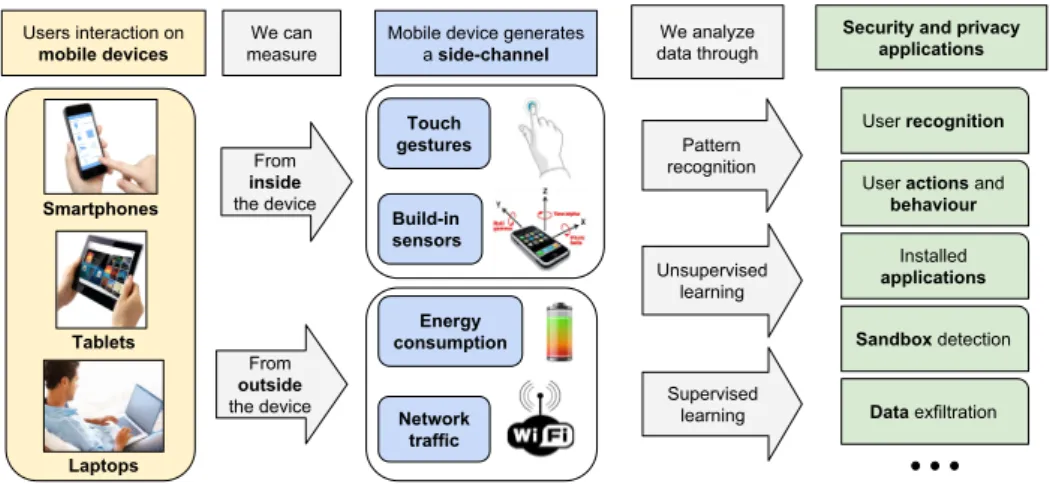
Figure 1.1 depicts the type of mobile devices considered in this thesis, the side-channels analyzed and their possible applications of such analyses. On the left side of Figure 1.1, we report the mobile devices we consider in our work, namely smartphones, tablets, and laptops. Side-channels can be categorized according to the point in which they can be measured: in-side or outin-side the mobile device. The former category includes the data about touch gestures (i.e., user inputs on the touchscreen) and built-in sen-sors that measure environmental properties, such as motion and orientation of the mobile device. The latter category considers physical phenomenon measurable externally to the device, such as the electric energy provided to recharge the battery, and the wireless network traffic. Given the data collected from the aforementioned side-channels, it is possible to apply ma-chine learning techniques to extract some valuable knowledge. On the right side of Figure 1.1, we list some possible outcomes and applications of such analyses. Smartphones Laptops Users interaction on mobile devices We can measure From inside the device Touch gestures From outside the device Build-in sensors Energy consumption Network traffic
Mobile device generates
a side-channel Tablets Supervised learning We analyze data through Unsupervised learning Pattern recognition
Security and privacy applications
User recognition
User actions and behaviour
Installed applications
Sandbox detection
Data exfiltration
Figure 1.1: Schema for mobile devices side-channels analysis and possible applications.
The research work presented in this thesis is composed of three main parts, each related to a different side-channel:
• Network traffic analysisinvestigates on possible information that could be inferred in wireless encrypted communications between mobile de-vice and remote serde-vice.
• Energy consumption analysisconsiders the applications of electric cur-rent retrieved by a mobile device as a side-channel.
• Built-in sensors analysis presents work that consider data collected from mobile devices’ sensors as a side-channel to be used to enforce security.
In what follows, we briefly introduce the aforementioned parts, high-lighting our contributions.
In this dissertation, some figures have been re-used and some passages have been quoted verbatim from the following works [34, 51–53, 183, 185, 195, 196] (all co-authored by the author of this dissertation).
1.1.1 Network Traffic Analysis
In order to access to web services, mobile devices are equipped with WiFi or cellular network adapters, that provide Internet connectivity. An attacker could intercept the communications between mobile devices and services in several ways, such as by eavesdropping wireless transmission with an an-tenna, by wiretapping the transmission cable, or by being the deployer of Internet access point. Such kind of attack is called Man-In-The-Middle (MITM) attack since the attacker places herself in the middle of the com-municating parties, being able to observe their messages. In Figure 1.2, we depicts a possible MITM attack that involves an Android device and a web server. This kind of attack can be either active or passive.
On one hand, an active attacker can intercept a web service’s real certifi-cate and provide the victim a fake certificertifi-cate, pretending to be the real web service. Nonetheless, active MITM attack can be easily revealed whether the victim adopts effective security countermeasures [49]. On the other hand, at the time of the writing, passive MITM attack are hard, if not impossible, to detect since it only listens to the channel without performing any alteration. In the first part of this thesis, we consider a passive MITM attacker that listen to TCP/IP network traffic generated by the victim’s mobile device. It is worth noticing that such network traffic is encrypted with SSL/TLS encryption protocol, thus the attacker is not able to rely on Packet Inspection techniques. Even the network traffic is encrypted, a passive MITM attacker can still infer a significant amount of information from the analysis of the properly encrypted network traffic. For example, work leveraging analysis of encrypted traffic already highlighted the possibility of understanding the set of apps installed on a mobile device [190], or identify the presence of a specific user within a network [198].
In our work, we focus on inferring two private information about the victim: (i) the actions performed by the victim with an app; and (ii) the list of installed apps on the victim’s mobile device.
Security and Privacy Threats on Mobile
Devices through Side-Channels Analysis R. Spolaor
Figure 1.2: Man-In-The-Middle attack.
User Actions Recognition
The actions a user performs on an app could reveal many insights about her. She installs and uses several apps to communicate with friends or ac-quaintances. Through her smartphone, she gets information about sensitive topics such as diseases, sexual or religious preferences. As a consequence, several concerns have been raised about the capabilities of these portable devices to invade the privacy of users actually becoming “tracking devices”. This work focuses on understanding whether the user profiling made through analyzing encrypted traffic [198] can be enhanced to understand exactly what actions the user is doing on her phone: as concrete examples, we aim at identifying actions such as the user sending an email, receiving an email, browsing someone’s profile on a social network, publishing a post or a tweet, or “tagging” someone in a picture. The underlying issue we leverage in our work is that SSL and TLS protect the content of a packet, while they do not prevent the detection of networks packets patterns that instead may reveal some sensitive information about the user behavior.
Contributions: We investigate to which extent such an external attacker can identify the specific actions that a user is performing on her mobile apps. Our work analyzes the network communications and leverages information available in TCP/IP packets (like IP addresses and ports), together with other information like the size, the direction (incoming/outgoing), and the timing. By using an approach based on machine learning, each app that is of interest is analyzed independently. To set up our system, for each app we first pre-process a dataset of network packets labeled with the user ac-tions that originated them, we cluster them in flow typologies that represent recurrent network flows, and finally we analyze them in order to create a training set that will be used to feed a classifier. The trained classifier will then be able to classify new traffic traces that have never been seen before. We run a thorough set of experiments to evaluate our solution considering seven popular apps: Facebook, Gmail, Twitter, Tumblr, Dropbox, Google+ and Evernote. The results show that it can achieve accuracy and precision
higher than 95%, for most of the considered actions. We also run a thorough comparison of our solution with three algorithms, showing that our solution outperforms them in all of the cases. We present this work in Chapter 2 Mobile Apps Fingerprinting
Automatic fingerprinting and identification of mobile apps are becoming a very attractive data gathering technique for adversaries, network admin-istrators, investigators, and marketing agencies. In fact, the list of apps installed on a device can be used to identify vulnerable apps for an attacker to exploit, uncover a victim’s use of sensitive apps, assist network planning, and aid marketing. However, app fingerprinting is challenging because of the vast number of apps available for download, the wide range of devices they may be installed on, and the use of payload encryption protocols such as HTTPS/TLS.
Contributions: In Chapter 3, we propose a novel methodology and a framework implementing it, called AppScanner, for the automatic finger-printing and real-time identification of Android apps from their encrypted network traffic. To build app fingerprints, we run apps automatically on a physical device to collect their network traces. We apply various processing strategies to these network traces before extracting the features that are used to train our supervised learning algorithms. Our fingerprint genera-tion methodology is highly scalable and does not rely on inspecting packet payloads; thus our framework works even when HTTPS/TLS is employed. We built and deployed this lightweight framework and ran a thorough set of experiments to assess its performance. We automatically profiled 110 of the most popular apps in the Google Play Store and were later able to re-identify them with more than 99% accuracy.
1.1.2 Energy Consumption Analysis
The Internet of Things (IoT) paradigm, in conjunction with the one of smart cities, is pursuing toward the concept of smart buildings, i.e., “intelligent” buildings able to receive data from a network of sensors and thus to adapt the environment. IoT sensors can monitor a wide range of environmental features such as the energy consumption inside a building at fine-grained level (e.g., for a specific wall-socket). Some smart buildings already de-ploy monitoring electric energy consumption of appliances. Besides, charger stations deployed in public places provide electric current to recharge the batteries of mobile devices. Such stations could monitor the energy provided as well. While electric consumption measurements could be carried out in order to optimize the energy use for good purposes (e.g., to save money, to reduce pollution), they also raise a significant amount of privacy concerns.
Security and Privacy Threats on Mobile
Devices through Side-Channels Analysis R. Spolaor
Energy consumption can be considered as another side-channel of mobile devices because it is directly related to the way a user interacts with a device. In the second part of this dissertation, we contribute to the state of the art of energy consumption analysis with two works having the following targets: (i) identifying the user laptop plugged on a smart meter; and (ii) exfiltrating data via USB charging cable using energy consumption as a covert channel.
User Laptops Identification
Laptops became a useful mobile device thanks to their portability and com-putational capabilities. Despite these positive features make them a valu-able tool for work and entertainment, laptops share the same shortcoming of smartphones and tablet: they are limited by the life of their battery if not connected to a power source. For this reason, when laptops are used in a stationary location, users connect them to a power source rather than rely on the battery. In our threat model, we assume a smart building where a user plugs her laptop to a wall-socket smart meters, thus we are able to measure the energy consumption of such laptop.
Contributions: We investigate the feasibility of recognizing the pair laptop-user (i.e., a user using her own laptop) from the energy traces pro-duced by her laptop in Chapter 4. We design MTPlug, a framework that achieves this goal relying on supervised machine learning techniques as pat-tern recognition in multivariate time series. We present a comprehensive implementation of this system and run a thorough set of experiments. In particular, we collected data by monitoring the energy consumption of two groups of laptop users, some office employees and some intruders, for a total of 27 people. We show that our system is able to build an energy profile for a laptop user with an accuracy above 80%, in less than 3.5 hours of laptop us-age. To the best of our knowledge, this is the first research that assesses the feasibility of laptop users profiling relying uniquely on fine-grained energy traces collected using wall-socket smart meters.
Data Exfiltration
Thanks to the technological innovation and to the high user demand, mo-bile devices are integrating extensive battery-draining functionalities, which results in a surge of energy consumption of these devices. This scenario leads many people to look for opportunities to charge their devices at public charging stations: the presence of such stations is already prominent around public areas such as hotels, shopping malls, airports, gyms and museums, and is expected to significantly grow in the future. While most of the times the electric power comes for free, there is no guarantee that the charging
station is not maliciously controlled by an adversary, with the intention to exfiltrate data from the devices that are connected to it.
Contributions: We show for the first time how an adversary could leverage a maliciously controlled charging station to exfiltrate data from a smart-phone via a USB charging cable (i.e., without using the data transfer func-tionality), controlling our simple app (named PowerSnitch) running on the device. It is worth noticing that PowerSnitch app does not any permission to be granted by the user to send data out of the device. We show the feasibility of our attack through a prototype implementation in Android, which is able to send out potentially sensitive information, such as IMEI
and contacts’ phone number. We present and evaluate our covert-channel in Chapter 5
1.1.3 Built-in Sensors Analysis
Along with other aforementioned features, mobile devices are equipped with a wide range of sensors to measure the surrounding environment (e.g., ori-entation, location, lightness) and provide an advanced user experience. The data measured by those sensors are made available to all apps without any permission and it can be considered as a side-channel. To some extent, we can also consider mobile device’s touchscreen as a sensor, more than simply an input device. Differently from the side-channels presented in the two previous parts, built-in sensors side-channel can be directly measured from inside a mobile device. Since the analysis of such data may require time and computational power for a battery-powered device, it is possible to first collect sensors data and then send it out to be analyzed in a more suitable facility.
In our work, we investigate different aspects related to built-in sensors side-channel and we give two contributions to the state of the art: (i) we present a usable and multi-purpose logging tool for Android; and (ii) we use sensors data collected from real devices to build a malware analysis sandboxes robust against emulator detection heuristics.
Logging and Data Extraction Tool
The use of smartphones has increased exponentially, and so have their sens-ing and functional capabilities. Indeed, together with an increase in process-ing power, smartphones and tablets are equipped with a variety of sensors and provide an extensive set of API. Such capabilities allow mobile devices to collect data related to environment, user habits, and operating system itself. This data is extremely valuable in many research fields such as infor-mation leaks detection and user authentication [54, 85, 184, 187]. For these
Security and Privacy Threats on Mobile
Devices through Side-Channels Analysis R. Spolaor
reasons, researchers need a solid and reliable logging tool to collect data from mobile devices.
Contributions: First, we survey the existing logging tools available on the Android platform, comparing their features and their impact on the system. Second, we present DELTA, a framework for Data Extraction and Logging Tool for Android. DELTA improves the existing Android logging solutions in terms of flexibility, fine-grained tuning capabilities, extensibility, and available set of logging features. We fully implement DELTA and we run a thorough performance evaluation. The results show that our tool has a low impact on the performance of the system, on battery consumption, and on user experience. DELTA is open source and its code is available to the research community. We presented this work in Chapter 6.
Robust Sandbox Against Malware Analysis Evasion
Malware developers attention is gradually moving from PCs to mobile de-vices. This because the latter ones can access and store personal information (e.g., location, photos, and messages). The most promising approach to an-alyze malware is by monitoring its execution in a sandbox (i.e., via dynamic analysis). In particular, most malware sandboxing solutions for Android rely on an emulator, rather than a real device. This motivates malware authors to include runtime checks in order to detect whether the malware is running in a virtualized environment. In that case, the malware does not trigger the malicious payload. The presence of differences between real devices and Android emulators (also called artifacts) started an arms race between security researchers and malware authors, where the former want to hide these differences and the latter try to seek them out.
Contributions: We present Mirage, a malware sandbox architecture for Android focused on dynamic analysis evasion attacks in Chapter 7. We designed the components of Mirage to be extensible via software modules, in order to build specific countermeasures against such attacks. Mirage is the first modular sandbox architecture that is robust against sandbox detection techniques. As a representative case study, we present a proof of concept implementation of Mirage with a module that tackles evasion attacks based on sensors API return values. In particular, such values can be constant or stream of sensor data previously collected from real mobile devices via a data collection app (e.g., DELTA). Mirage replays such data injecting them into the emulator that, such a way, pretends to be a real device does.
Finally, Chapter 8 we draw some conclusions and possible future direc-tions.
1.2
Publications
The research presented in this dissertation and carried out during my Ph.D. program produced peer-reviewed conference, journal and workshop publica-tions. In what follows, we report the complete list of published and currently submitted works: In Section 1.2.1, journal papers; in Section 1.2.2, confer-ence and workshop papers; and international patents and knowledge transfer in Section 1.2.3.
1.2.1 Journal Publications
[J01] M. Conti, L. V. Mancini, R. Spolaor and N. V. Verde, “Analyzing An-droid Encrypted Network Traffic to Identify User Actions”, inIEEE Trans-actions on Information Forensics & Security, 2016(JCR IF 2013: 2.065; IT-ANVUR Class 1).
[J02] R. Spolaor, Q-Q. Li, M. Monaro, M. Conti, L. Gamberini and G. Sartori, “Biometric Authentication Methods on Smartphones: A Survey”, inPsychNology Journal, 2017.
[J03] R. Spolaor, E. Dal Santo and M. Conti, “DELTA: Data Extraction and Logging Tool for Android”, in IEEE Transactions on Mobile Computing,
2017. (JCR IF 2016: 3.822; IT-ANVUR Class 1) (In press).
[J04] V. F. Taylor, R. Spolaor, M. Conti and I. Martinovic, “Robust Smart-phone App Identification Via Encrypted Network Traffic Analysis”, inIEEE Transactions on Information Forensics & Security, 2017. (JCR IF 2016: 4.332; IT-ANVUR Class 1)(In press).
[J05] M. Conti, Q-Q. Li, A. Maragno, R. Spolaor, “The Dark Side(-Channel) of Mobile Devices: A Survey on Network Traffic Analysis”, CoRR abs/1708.03766, 2017. Under submission at: IEEE Communications Sur-veys and Tutorials.
[J06] M. Monaro, C. Galante , R. Spolaor, Q-Q. Li , L. Gamberini, M. Conti, and G. Sartori, “Covert lie detection using keyboard dynamics”, Under MINOR revision at: Scientific Reports.
1.2.2 Conference and Workshop Publications
[C01] M. Conti, L. V. Mancini, R. Spolaor and N. V. Verde, “Can’t you hear me knocking: Identification of user actions on Android apps via traffic
Security and Privacy Threats on Mobile
Devices through Side-Channels Analysis R. Spolaor
analysis”, in Proceedings of the ACM Conference on Data and Application Security and Privacy (CODASPY), 2015. (acceptance rate 21%). [C02] V. F. Taylor, R. Spolaor, M. Conti and I. Martinovic, “AppScanner: Automatic Fingerprinting of Smartphone Apps From Encrypted Network Traffic”, inProceedings the IEEE European Symposium on Security and Pri-vacy (EuroS&P), 2016. (acceptance rate 17%).
[C03] V. D. Stanciu, R. Spolaor, M. Conti and C. Giuffrida, “On the Ef-fectiveness of Sensor-enhanced Keystroke Dynamics Against Statistical At-tacks”, in Proceedings of the ACM Conference on Data and Application Security and Privacy (CODASPY), 2016. (acceptance rate 19%). [C04] M. Conti, M. Nati, E. Rotundo and R. Spolaor, “Mind The Plug! Laptop User Recognition Through Power Consumption”, in Proceedings of the International Workshop on IoT Privacy, Trust, and Security (IoTPTS) @ AsiaCCS, 2016.
[C05] M. Conti, C. Guarisco and R. Spolaor, “CAPTCHaStar! A novel CAPTCHA based on interactive shape discovery”, in Proceedings of the International Conference on Applied Cryptography and Network Security (ACNS), 2016(acceptance rate 19%).
[C06] R. Spolaor, L. Abudahi, V. Moonsamy, M. Conti, R. Poovendran, “No Free Charge Theorem: A Covert Channel via USB Charging Cable on Mobile Devices”, in Proceedings of the International Conference on Applied Cryptography and Network Security (ACNS), 2017.
[C07] L. Bordoni, M. Conti and R. Spolaor, “Mirage: Toward a Stealthier and Modular Malware Analysis Sandbox for Android”, inProceedings of the European Symposium on Research in Computer Security (ESORICS) 2017. (acceptance rate 15.88%).
[C08] Merylin Monaro, R. Spolaor and Q-Q. Li, M. Conti, L. Gamberini and G. Sartori, “Type Me the Truth!: Detecting Deceitful Users via Keystroke Dynamics”, in Proceedings of the International Conference on Availability, Reliability and Security (IWCC) @ ARES, 2017.
[C09] M. Favaretto, R. Spolaor, M. Conti, and M. Ferrante, “You Surf so Strange Today: Anomaly Detection in Web Services via HMM and CTMC”, in Proceedings of the International Conference on Green, Pervasive and Cloud Computing (GPC), 2017.
[C10] R. Spolaor, M. Monaro, P. Capuozzo, M. Baesso, M. Conti, L. Gam-berini, and G. Sartori, “You Are How You Play: Authenticating Mobile Users via Game Playing”, inProceedings of the International Workshop on Communication Security (WCS) @ EuroCrypt, 2017.
[C11] M. Piskozub, R. Spolaor, M. Conti and I. Martinovic, “NetVerifier: Analysis of Host Behavior Profiles using CompactFlow Data” (submitted). [C12] S. Wang, Z. Chen, Q. Yan, L. Wang, R. Spolaor, B. Yang and M. Conti, “Lexical Clustering of Malicious URLs for Mining Mobile Malware” (submitted).
1.2.3 Patents and Knowledge Transfer
[P01] M. Conti, C. Guarisco and R. Spolaor, “Metodo per riconoscere se un utente di un terminale elettronico e’ un umano o un robot” (International Patent Submitted), First prize at Notte dei Brevettatori 2015, Padua.
[P02] M. Conti, R. Spolaor an G. Tolomei “CAPTCHAd: interactive
Part I
Chapter 2
User Actions Recognition
With people becoming more familiar with mobile devices and their related privacy threats, users have started adopting good practices that better adapt to their understanding privacy. Unfortunately, even adopting such good practices would not close the door to malicious adversaries. Indeed, several attacks may violate user privacy even when the adversary does not physically or remotely control the user device. In this chapter, we consider a passive attacker that is able to sniff the network traffic generated by mobile apps. Obviously, if the network traffic is not encrypted, the attacker can simply read the payload of each packet. However, many apps use the Secure Sockets Layer (SSL) – and its successor Transport Layer Security (TLS) – as a building block for encrypted communications. Even when such encryption are in place, the adversary can still infer a significant amount of information from encrypted network traffic analysis. As an example, work leveraging such analysis highlighted the possibility of identify the presence of a specific user within a network [198].
In this chapter, we present a work that focuses on identifying whether user profiling can be enhanced to understand what actions a user is per-forming on a specific app. In particular, we aim at identifying actions such as the user sending an email, browsing friend’s profile on a social network, publishing a tweet or a post. Our framework can carry out such task by leveraging an analysis on encrypted network traffic. Indeed, SSL and TLS do not prevent us to detect patterns of networks packets that may reveal some sensitive information about the user behavior.
An adversary may use our framework in several practical ways to threaten the privacy of the user. In the following, we present some pos-sible scenarios:
• A censorship government trying to identify a dissident who spreads anti-government propaganda using an anonymous social network ac-count. Comparing the time of the public posts with the time of the
actions (inferred with our method), the government can guess the iden-tity of that anonymous dissident.
• By tracing the actions performed by two users, and taking into account the communication latency, an adversary can guess (even with some probability of error) whether there is a communication between them. However, multiple observations could reduce the probability of errors. • An adversary can build a behavioral profile of a target victim based on the habits of the latter one (e.g., wake up time, work time). For example, this could be used to improve user fingerprinting methods, to infer the presence of a particular user in a network [198], even when she accesses the network with different types of devices.
Contributions: Our framework analyzes the network communications and leverages information available in TCP/IP packets, such as IP addresses and ports, packet size, direction (i.e., incoming or outgoing), and timing. We analyze traffic of several apps of interests using an approach based on machine learning techniques. For each app, we build a dataset in three steps: (i) we pre-process a dataset of network packets labeled with the user actions that generated them; (ii) we cluster them in flow typologies that represent recurrent network flows; and (iii) we analyze them in order to create a training set that will be used to feed a classifier. The trained classifier will then be able to classify new traffic traces that were never seen before. We run a thorough set of experiments to evaluate our framework considering seven popular apps: Facebook, Gmail, Twitter, Tumblr, Dropbox, Google+, and Evernote. For most of the considered actions, our proposal achieves an accuracy and a precision more than 95%.
In addition to that, we discuss about the key idea underneath our traffic analysis approach. In particular, we examine thoroughly examine the con-cept of network flow and the metric to evaluate the similarity between them. We also report details of the machine learning techniques we leverage in our method. Furthermore, we run a thorough comparison of our solution with three state of the art algorithms, showing that our solution outperforms them in all of the scenarios.
Organization: The rest of this chapter is organized as follows. We revise the state of the art around our research topic in Section 2.1. In Section 2.1.1, we introduce some background knowledge on machine learning and data mining tools used in our work. We present our framework describing all its different components in Section 2.2, and we present the evaluation of our solution for identifying user actions in Section 2.3. In Section 2.4, we discuss about possible countermeasures against the proposed attack. Finally, we summarize the work described in this chapter in Section 2.5.
Security and Privacy Threats on Mobile
Devices through Side-Channels Analysis R. Spolaor
2.1
Related Work
Our main claim in this chapter is that network traffic analysis and machine learning can be used to infer private information about the user, i.e., the actions that she executes with her mobile phone, even though the traffic is encrypted. To position our contribution with respect to the state of the art, we survey the works that belong to two main research areas that focus on similar issues: privacy attacks via traffic analysis (not necessarily focusing on mobile devices) and traffic analysis of mobile devices (not necessarily focusing on privacy).
Security and privacy on smartphones Privacy is an important matter also sensed by smartphones’ users, even more than using a laptop [46]. Mal-ware are a serious threat to security on smartphone [72], because they can cause device malfunctioning and user personal information disclosure, like her position, contacts, health condition, etc. Some works propose apps pro-filing frameworks to detect malicious behavior or potential privacy-related informations exposure [64, 172, 210]. In particular Wei et al. [204] present system to profile the behavior of Android apps. App profile is done from four different points of view (layer): static, user interaction, OS and net-work. On Android OS, malicious apps could obtain the access to device resources by given permissions. But in most cases, users don’t understand what these permissions really mean [73]. Possible countermeasures to this problem consist to replace sensitive data with shadowed copy [95] or use taint analysis [66], to track and understand how these informations are used by apps. Another possible approach to this problem is MockDroid [27], a modified version of Android OS, that gives to apps a fake access to resources, trading more privacy with a reduction of functionality.
Application classification with traffic analysis In recent years it was produced lots of works about traffic analysis, aiming to identify which ap-plication produces a flow. With apap-plications, in these works, authors mean the last layer in ISO/OSI model, those cannot be classified using only the ports or protocols used. Particular interest is focused on P2P traffic recog-nition (emule, bittorrent), but also in application level protocols like HTTP, POP3, SSH and so on. Traffic analysis can be done in several ways exploiting machine learning algorithms on different network traffic features [104, 118]. Works on traffic analysis could be distinguished from each other by the machine learning methods: Naive Bayes [138, 149], Hidden Markov Models (HMM) [29, 181, 198, 206], unsupervised clustering and supervised classifica-tion [41, 88, 129], Support Vector Machines (SVM) [88, 177, 212], or custom classification algorithms [56,102,213]. Many of these works’ analysis could be done also on encrypted TCP/IP traffic, because they consider only statistics of network flows (with no access to payloads). In our work we use a method
known as early traffic analysis, that consist in consider only a limited the number of packets of a traffic flow. [29,88,177]. An example of custom traffic classifier is proposed by Crotti et al. in [56]. They build a fingerprint for a protocol using statistics about packets size, inter-arrival time and order. So they propose a classification algorithm made ad-hoc for classify these finger-prints. Another example of custom TCP traffic classification is BLINC [102]. In theirmulti-level analysis Karagiannis et al. consider network traffic from three different points of view: hosts popularity (social), hosts role in the network (client/server), and traffic flow features (application level). Finally, they propose a multi-level classifier that combines features from each level. In our framework we use a classification in two steps, first we regroup flows by typology, and then we use those typologies to classify user actions. A similar approach, but with different purpose, is used in [129] on HTTP traffic and in [41] on TCP traffic. In [88, 177] Sena et al. describes two on-line methods to classify encrypted traffic. Starting from a payload traffic analysis ground truth, they compare Centroid clustering and SVM applied on statistical flow analysis. Like us, they doesn’t consider a whole flow, but only the first N packets (early) in both directions. Although in their flow representation, informations about packets sequence isn’t take in concern. Early flows analysis is also used in [29] for application recognition. First studying early TCP connection features, then evaluating performance of HMM and clustering methods like GMM on this domain. Some others, like [149], do the same classification but timely and continuously, oriented to QoS management. Their traffic classifier uses C4.5 Decision Tree and Naive Bayes Machine learning algorithms on statistics of sub-flows (a limited number of packets taken at any point on a flow). They are able to classify interactive traffic (on-line gaming and VOIP) among other TCP/IP traffic. Privacy attacks via traffic analysis
In the literature, several works proposed to track user activities on the web by analyzing unencrypted HTTP requests and responses [20, 26, 176]. With this analysis it was possible to understand user actions inferring inter-ests and habits. More recently, Neasbitt et al. proposed ClickMiner [146], a tool that reconstructs user-browser interactions. However, in recent years, websites and social networks started to use SSL/TLS encryption protocol, both for web and mobile services. This means that communications between endpoints are encrypted and this type of analysis cannot be performed any-more.
Different works surveyed possible attacks that can be performed using traffic analysis assuming a very strong adversary (e.g., a national security agency) which is able to observe all communication links [30, 168]. In [116], Liberatore et al. evaluated the effectiveness of two traffic analysis techniques based on naive Bayes and on Jaccards coefficient for identifying encrypted HTTP streams. Such an attack was outperformed by [94], where the
au-Security and Privacy Threats on Mobile
Devices through Side-Channels Analysis R. Spolaor
thors presented a method that applies common text mining techniques to the normalized frequency distribution of observable IP packet sizes, obtaining a classifier that correctly identifies up to 97% of requests. Similarly, in [156] the authors presented a support vector machine classifier that was able to correctly identify web pages, even when the victim used both encryption and anonymization networks such as Tor. Finally, Cai et al. [38] and Dyer et al. [62] presented a web pages fingerprinting attack and proved its effec-tiveness despite traffic analysis countermeasures, such as HTTPOS [124].
More recently still, Panchenko et al. [155] present a website fingerprint-ing attack on Tor that outperforms related work (includfingerprint-ing their own earlier proposal) while requiring less computational resources. Using SVMs as the classifiers, they proposed a feature extraction technique that samples fea-tures starting from a cumulative representation of a web page’s network flow. Muehlstein et al. [139] show that HTTPS traffic can be used to identify op-erating system, browser, and application. Similar to our work, the authors generate features using the concept of an encrypted network traffic flow. Miller et al. [133] use traffic analysis to identify individual web pages within websites with approximately 90% accuracy. However, the authors make two assumptions: (i) they rely on feature extraction using whole network bursts (multiple flows), assuming all the flows in the same burst belong to the same web page; and (ii) they can also rely on multiple bursts to build a website graph through an Hidden Markov Model (HMM). These assumptions, while reasonable for web page fingerprinting, fail for mobile app fingerprinting. On smartphones, multiple apps can concurrently send network traffic and so a single burst could contain flows generated by different apps.
Unfortunately, none of the aforementioned works was designed for (or could easily be extended) to mobile devices. In fact, all of them focus on web pages identification in desktop environment (in particular, in desktop browsers), where the generated HTTP traffic strictly depends on how web pages are designed. Conversely, mobile users mostly access the contents through the apps installed on their devices [86]. These apps communicate with a service provider (e.g., Facebook) through a set of APIs. An example of such differences between desktop web browsers and mobile apps is the validation of SSL certificates [49, 84].
Traffic analysis has been applied not only to HTTP but also to other protocols. For example, Song et al. [181] prove that several versions of SSH are not secure. In particular, they show that even very simple statistical techniques suffice to reveal sensitive information such as login passwords. More importantly, the authors show that by using more advanced statistical techniques on timing information collected from the network, the eaves-dropper can also learn significant information about what users type in SSH sessions. SSH is not the only protocol that has been target of such attacks. Another example is Voice Over IP (VoIP). In [206], the authors show how the length of encrypted VoIP packets can be used to identify spoken phrases
of a variable bit rate encoded call. Their work indicates that a profile Hid-den Markov Model trained using speaker- and phrase-indepenHid-dent data can detect the presence of some phrases within encrypted VoIP calls with recall and precision exceeding 90%.
In [45], the authors show that despite encryption, web applications also suffer from side-channel leakages. The system model considered is differ-ent from ours. In particular, their focus is on web applications. On the contrary, we focus on mobile applications. More importantly, the authors leverage three fundamental features of web applications: stateful communi-cation; low entropy input; significant traffic distinction. We believe that in most mobile applications two of these features (stateful communication, low entropy input) are not very useful to characterize user actions. In contrast to the work in [45], we adopt a solution that only needs information about packet sizes and their order.
Traffic analysis of mobile devices Focusing on mobile devices, traffic analysis has been successfully used to detect information leaks [66], to pro-file users by their set of installed apps [190], and to generate network propro-files to identify Android apps in the HTTP traffic [57]. Traffic analysis has also been used to understand network traffic characteristics, with particular at-tention to energy saving [67]. Stober et al. [190] show that it is possible to identify the set of apps installed on an Android device, by eavesdropping the 3G/UMTS traffic that those apps generate. Similarly, Tongaonkar et al. [57] introduce an automatic app profiler that creates the network fingerprint of an Android app relying on packet payload inspection. Unfortunately, their solution is viable only for apps that do not use encrypted traffic. In [214], Zhou et al. discovered three unexpected channels of information leaks on Android: per-app data-usage statistics, ARP information, and speaker sta-tus. In particular, the authors used a suite of inference techniques to reveal a phone user’s identity from the network-data consumption of Twitter app, by also leveraging online resources such as tweets published by Twitter. Unfortunately, the authors focused only on a specific user action (i.e., send a tweet) without distinguish that action from the other ones a user could perform. More recently, Coull et al. in [55] presented a work similar to ours. The authors inferred information analyzing payload lengths of net-work packets produced by Apple iMessage and other messaging apps on iOS and OSX. In particular, the purpose of their work is to infer the OS version, user actions and language used in instant messaging. The author focused on five actions strictly related to instant messaging apps: start writing, stop writing, message sending, attachment sending and read notification. In this chapter, we consider social network and email service apps on An-droid. Those apps permit us to investigate a wider set of actions than the one offered by instant messaging apps. We believe that the interest from researchers to aim at different targets (i.e., OS version, actions, language)
Security and Privacy Threats on Mobile
Devices through Side-Channels Analysis R. Spolaor
and the results obtained so far, underlines the feasibility of those attacks, the relevance of this issue and the importance to foster further research in this domain.
2.1.1 Machine Learning and Data Mining Background
In this section, we briefly recall several machine learning and data mining concepts that we use in our works, while we point the reader to appropriate references for a complete introduction on those topics.
Dynamic Time Warping
Dynamic Time Warping (DTW) [140] is a useful method to find alignments between two time-dependent sequences (also referred as time series) which may vary in time or speed. This method is also used to measure the distance or similarity between time series.
Let us consider two sequences that represent two discrete signals: X =
(x1, . . . , xN) of lengthN ∈N; andY = (y1, . . . , ym) of lengthM ∈N. DTW
uses a local distance measure c : R×R→ R≥0 to calculate a cost matrix C ∈ RN×M, s.t., each cell C
i,j reports the distance between xi and yj. The goal is to find an alignment between X and Y having minimal overall distance. Intuitively, such an optimal alignment runs along a “valley” of low cost cells within the cost matrix C. More formally, a warping path is defined as a sequencep= (p1, . . . , pL) withpl= (nl, ml)∈[1 :N]×[1 :M],
l∈[1 :L] satisfying the following three conditions: 1. Boundary condition:
p1 = (1,1) and pL= (N, M); 2. Monotonicity condition:
n1≤n2 ≤. . .≤nM andm1≤m2 ≤. . .≤mL;
3. Step size condition:
pl+1−pl={(0,1),(1,0),(1,1)} forl∈[1 :L−1].
The total cost of a warping path is calculated as the sum of all the local distances of its elements. An optimal warping path is a warping path p∗
having minimal total cost among all possible working paths. The total cost of an optimal warping path is also used as a distance measure between two sequencesX and Y. In this chapter, we will indicate the cost of anoptimal warping path with DT W(X, Y).
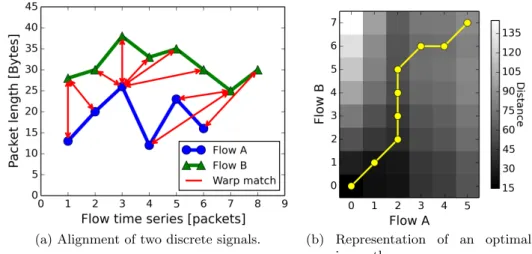
Figure 2.1a shows an example of alignment between two signals (indi-cated in the figure withFlow AandFlow B). The arrows show the matched points which are given by the DTW algorithm. The same two flows have been used to calculate the heat matrix shown in Figure 2.1b. In this repre-sentation, the color of a cell (i, j) represents the minimum distances to reach
(a) Alignment of two discrete signals. (b) Representation of an optimal warping path.
Figure 2.1: Example of DTW algorithm applied to two discrete signals:
Flow Aand Flow B.
cell (i, j) when starting from cell (0,0). An optimal warping path is then highlighted with a line that runs from cell (0,0) to cell (12,13). It can be noticed that this warping path satisfies boundary, monotonicity, and step size conditions reported above.
2.1.2 Supervised and Unsupervised Learning
Generally, machine learning approaches can be classified in two classes: un-supervised and un-supervised algorithms. Unun-supervised learning algorithms try to find hidden structure in unlabeled data. Since the examples given to the learner are unlabeled, there is no error or reward signal to evaluate a potential solution. On the contrary, supervised machine learning algorithms learns from labeled instances or examples, which are collected in the past and represent past experiences in some real-world applications. They pro-duce an inferred model, which can be then used for mapping or classifying new instances. An optimal scenario will allow for the algorithm to correctly determine the class labels for unseen instances.
In this chapter, we will use both supervised and unsupervised learning algorithms. We use supervised learning by applying an ensemble classifier that is called Random Forest [35]. The main principle behind ensemble methods is that a group of “weak learners” can be combined together to form a “strong learner”. Random forest leverages a standard machine learning technique called “decision tree”, which, in ensemble terms, corresponds to the weak learner. In practice, it combines together the results of several decision trees trained with different portions of the training dataset and
Security and Privacy Threats on Mobile
Devices through Side-Channels Analysis R. Spolaor
different subsets of features. More details about the Random Forest classifier can be found in [35].
We use unsupervised learning by applying a clustering algorithm called hierarchical clustering. Hierarchical clustering is a cluster analysis method which seeks to build a hierarchy of clusters. This clustering method has the distinct advantage that any valid measure of distance can be used. In fact, the observations themselves are not required: all that is used is a matrix of distances.
In the following we will use a type of hierarchical clustering that is called agglomerative: each observation starts in its own cluster, and pairs of clus-ters are merged as one moves up the hierarchy. In order to decide which clusters should be combined, a metric (a measure of distance between pairs of observations) and a linkage criterion are required. Since we will clusterize time-dependent sequences, we will use the total cost of anoptimal warping path as distance metric. As for the linkage criterion, that determines the distance between sets of observations as a function of the pairwise distances between observations, we will use the average distance, that is defined as:
d(u, v) = X
1≤i≤n
1≤j≤m
d(u[i], v[j])
|u| ∗ |v| ,
where d() is a distance function, and u and v are two clusters of n and m
elements, respectively. More details about Hierarchical clustering can be found in [93].
2.2
Our Proposed Methodology
Our framework is logically composed by two components: the
“pre-processor” and the “traffic classifier”. The former has the task of executing all the pre-processing steps that allow us to model the network traffic into data that the traffic classifier can easily handle. The latter executes the ac-tual classification task. Before using the traffic classifier, it has to be trained with labeled traffic data that we are able to generate by artificially stimu-lating the analyzed apps. We detail the steps executed by the pre-processor in Section 2.2.1, while in Section 2.2.2, we describe the methodology used to generate our training dataset, as well as the procedure used to classify user actions.
2.2.1 Network Traffic Pre-Processing Steps
Mobile apps generally rely on SSL/TLS to securely communicate with peers. These protocols are built on the top of the TCP/IP suite. The TCP layer receives encrypted data from the above layer, it divides data into chunks
ID Type Time series Flow 1 Incoming [1514, 1514, 315, 113, 477] Outgoing [282, 188, 514, 96, 1514, 179, 603, 98, 801, 98] Complete [282, -1514, -1514, -315, 188, -113, 514, 96, 1514, 179, 603, 98, 801, 98, -477] Flow 2 Incoming [1514, 1514, 1266, 582, 113, 661] Outgoing [282, 188, 692, 423] Complete [282, -1514, -1514, -1266, -582, 188, -113, 692, 423, -661] Flow 3 Incoming [1245, 1514, 107, 465, 172, 111] Outgoing [926, 655, 136, 913, 1514, 1514, 863] Complete [926, 655, 136, -1245, 913, 1514, 1514, 863, -1514, -107, -465, -172, -111] Table 2.1: Example of time series generated from three network flows. Val-ues within square brackets represent the amount of bytes exchanged per packet: negative values in complete time series indicate incoming bytes, while positive values indicate outgoing bytes.
if the packets exceeds a give size. Then, for each chunk it adds a TCP header creating a TCP segment. Each TCP segment is encapsulated into an Internet Protocol (IP) datagram, and exchanged with peers. Since TCP packets do not include a session identifier, both endpoints identify a TCP session using the client’s IP address and the port number.
A fundamental entity considered in this work is the trafficflow: with this term we indicate a time ordered sequence of TCP packets exchanged between two peers during a single TCP session. The pre-processor takes in input the network traffic, it builds the network flows that represent that network traffic, and it generates a set of time series: (i) a time series is obtained by considering the bytes transported by incoming packets only; (ii) another one is obtained by considering bytes transported by outgoing packets only; (iii) a third one is obtained by combining (ordered by time) bytes transported by both incoming and outgoing packets. Hence, we use this set of time series as an abstract representation of a connection between two peers. Note that additional time series may be added to this set for example by considering other parameters such as the time-gap between different packets. For the sake of simplicity, in the following we will only consider the first three types of time series mentioned above.
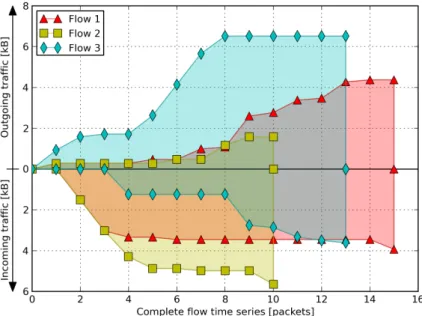
Table 2.1 reports an example of time series generated from three net-work flows, while Figure 2.2 graphically represents these flows through a cumulative chart. The lower side of the chart represents incoming traffic, while the upper side represents outgoing traffic. This is only one of the possible representations, and it shows that the “shapes” of these three net-work flows are quite different. Intuitively, our classification approach tries to learn the “shape” of network flows related to particular user actions, and successively it aims to identify user actions by classifying the “shape” of previously unseen network flows.
Before generating for each flow the corresponding set of time series, a few pre-processing steps have to be performed. In particular: 1) we apply
Security and Privacy Threats on Mobile
Devices through Side-Channels Analysis R. Spolaor
Figure 2.2: Representation of flows time series.
a domain filtering to select only flows belonging to the analyzed app; 2) we filter the remaining flows, in order to delete packets that may degrade the precision of our approach (i.e., we filter out ACK and retransmitted packets); 3) we limit the length of the generated time series. For each flow, the result of these three pre-processing steps will be a set of time series that will be passed to the next component of the framework, which is the traffic classifier. In the following, we will detail the three pre-processing steps. Domain filtering
The network traffic generated by an application is generally directed toward a back-end infrastructure. The back-end infrastructures might be composed of a single server, or a set of servers. The set of servers might even be behind a load balancer. Since we analyze each app independently, we need to make sure that traffic generated from apps other than the considered one (or traffic generated by the OS) does not interfere with the analysis. Different methods can be used in order to identify the app that generated each network flows. The destination IP address is a trivial discriminating parameter. However, in case of a load balanced back-end, we should know all the individual IP addresses that can be involved in the communication. The same happens when the back-end is composed of several components such as different web services, databases, etc. To overcome this problem we use another strategy: we take into consideration for further analysis only the flows which destination IP addresses owners have been clearly identified as related to the considered app. In the implementation of our framework, we
leverage the WHOIS protocol for this purpose, but we want to highlight that this is only one of the possible ways. Business and other context information may be used in order to perform the domain filtering. We also take into consideration the traffic related to third party services (such as Akamai or Amazon) that are indeed used by several applications [204].
Packets filtering
Due to network congestion, traffic load balancing, or other unpredictable network behavior, IP packets can be lost, duplicated, or delivered out of or-der. TCP detects these problems, hence requesting retransmission of lost data, and reordering out-of-order data. As a results, several TCP packets that do not carry data, may hinder the analysis process. In the data ex-change phase, for example, the receiver sends a packet with the ACK flag set to notify the correct reception of a chunk of data. These ACK packets are transmitted in asynchronous mode so they are affected by many factors related to round trip time of the connection link. The order of the received packets may hinder the evaluation of the similarity between two network flows. For this reason, we filter out all packets retransmissions, as well as packets marked with the ACK flag. Note that the metric that we will use in order to measure similarity between flows (see Section 2.2.2) will mitigate the consequences of missing packets. We also filter out other packets that do not bring any additional information helpful in characterizing flows. In particular, we filter out the three way handshake executed to open a TCP connection, and the packets exchanged to close it.
Timeout and packets interval
Two different techniques are used to limit the length of the generated time series: a timeout mechanism and the specification of a packets inter-val. The timeout mechanism is used to terminate the flows that did not receive any new packet since 4.5 seconds. Indeed, it has been proved ex-perimentally that 95% of all packets arrive at most 4.43 seconds after their predecessors [190]. Thepackets interval specifies the first and the last packet to be considered.
For example, considering a flowfcomposed bylpackets, and the interval [x, y] with x≤y and y≤l, the corresponding time series will be composed byy−x+ 1 values that report the bytes of the xth to theyth packet. This simple mechanism allows us to focus on particular portions of the flow. The first part, for example, is often the more significant. In the experimental part, we report the results for different configurations of packets intervals, showing that the best configuration is app dependent.