University of Pennsylvania
ScholarlyCommons
Departmental Papers (ESE)
Department of Electrical & Systems Engineering
July 2008
Grassmann Discriminant Analysis: a Unifying
View on Subspace-Based Learning
Jihun Hamm
University of Pennsylvania
Daniel D. Lee
University of Pennsylvania, [email protected]
Follow this and additional works at:
http://repository.upenn.edu/ese_papers
Reprinted from the Proceedings of the 25th International Conference on Machine Learning (ICML 2008), July 2008. URL: http://icml2008.cs.helsinki.fi/index.shtml
This paper is posted at ScholarlyCommons.http://repository.upenn.edu/ese_papers/465 For more information, please [email protected].
Recommended Citation
Grassmann Discriminant Analysis: a Unifying View on Subspace-Based
Learning
Abstract
In this paper we propose a discriminant learning framework for problems in which data consist of linear
subspaces instead of vectors. By treating subspaces as basic elements, we can make learning algorithms adapt
naturally to the problems with linear invariant structures. We propose a unifying view on the subspace-based
learning method by formulating the problems on the Grassmann manifold, which is the set of
fixed-dimensional linear subspaces of a Euclidean space. Previous methods on the problem typically adopt an
inconsistent strategy: feature extraction is performed in the
Euclidean
space while
non-Euclidean
distances are
used. In our approach, we treat each subspace as a point in the Grassmann space, and perform feature
extraction and classification in the same space. We show feasibility of the approach by using the Grassmann
kernel functions such as the Projection kernel and the Binet-Cauchy kernel. Experiments with real image
databases show that the proposed method performs well compared with state-of- the-art algorithms.
CommentsReprinted from the Proceedings of the 25th International Conference on Machine Learning (ICML 2008),
July 2008.
URL: http://icml2008.cs.helsinki.fi/index.shtml
Grassmann Discriminant Analysis:
a Unifying View on Subspace-Based Learning
Jihun Hamm [email protected]
Daniel D. Lee [email protected]
GRASP Laboratory, University of Pennsylvania, Philadelphia, PA 19104 USA
Abstract
In this paper we propose a discriminant learning framework for problems in which data consist of linear subspaces instead of vectors. By treating subspaces as basic el-ements, we can make learning algorithms adapt naturally to the problems with lin-ear invariant structures. We propose a uni-fying view on the subspace-based learning method by formulating the problems on the Grassmann manifold, which is the set of fixed-dimensional linear subspaces of a Eu-clidean space. Previous methods on the prob-lem typically adopt an inconsistent strategy:
feature extraction is performed in the
Eu-clidean space while non-Euclidean distances are used. In our approach, we treat each sub-space as a point in the Grassmann sub-space, and perform feature extraction and classification
in the same space. We show feasibility of
the approach by using the Grassmann kernel functions such as the Projection kernel and the Binet-Cauchy kernel. Experiments with real image databases show that the proposed method performs well compared with state-of-the-art algorithms.
1. Introduction
We often encounter learning problems in which the
ba-sic elements of the data aresets of vectors instead of
vectors. Suppose we want to recognize a person from multiple pictures of the individual, taken from differ-ent angles, under differdiffer-ent illumination or at differdiffer-ent places. When comparing such sets of image vectors, we are free to define the similarity between sets based on Appearing inProceedings of the 25thInternational Confer-ence on Machine Learning, Helsinki, Finland, 2008. Copy-right 2008 by the author(s)/owner(s).
the similarity between image vectors (Shakhnarovich et al., 2002; Kondor & Jebara, 2003; Zhou & Chel-lappa, 2006).
In this paper, we specifically focus on those data that can be modeled as a collection of linear subspaces. In the example above, let’s assume that the set of images of a single person is well approximated by a low di-mensional subspace (Turk & Pentland, 1991), and the whole data is the collection of such subspaces. The benefits of using subspaces are two-fold: 1) compar-ing two subspaces is cheaper than comparcompar-ing two sets directly when those sets are very large, and 2) it is more robust to missing data since the subspace can ‘fill-in’ the missing pictures. However the advantages come with the challenge of representing and handling the subspaces appropriately.
We approach the subspace-based learning problems by formulating the problems on the Grassmann manifold, the set of fixed-dimensional linear subspaces of a Eu-clidean space. With this unifying framework we can make analytic comparisons of the various distances of subspaces. In particular, we single out those distances
that are induced from the Grassmann kernels, which
are positive definite kernel functions on the Grassmann
space. The Grassmann kernels allow us to use the
usual kernel-based algorithms on this unconventional space and to avoid ad hoc approaches to the problem. We demonstrate the proposed framework by using the Projection metric and the Binet-Cauchy metric and by applying kernel Linear Discriminant Analysis to clas-sification problems with real image databases.
1.1. Contributions of the Paper
Although the Projection metric and the Binet-Cauchy metric were previously used (Chang et al., 2006; Wolf & Shashua, 2003), their potential for subspace-based learning has not been fully explored. In this work, we provide an analytic exposition of the two metrics as examples of the Grassmann kernels, and contrast the
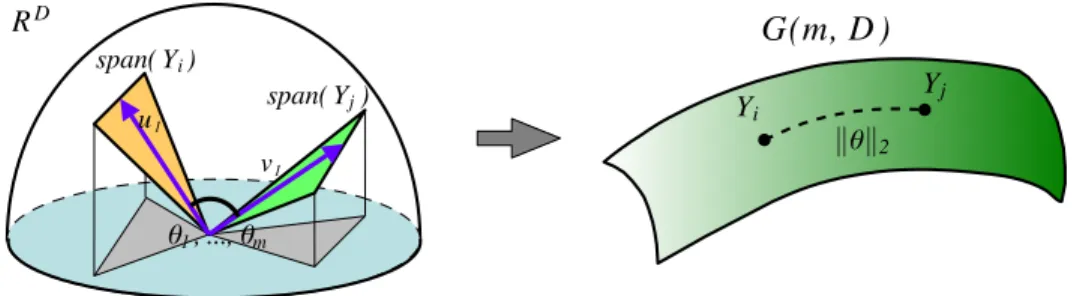
Yi Yj θ 2
G(m, D)
u1 v1 θ1, ..., θm span( Yi) span( Yj) RDFigure 1.Principal angles and Grassmann distances. Let span(Yi) and span(Yj) be two subspaces in the Euclidean space
RD on the left. The distance between two subspaces span(Yi) and span(Yj) can be measured by the principal angles θ= [θ1, ... , θm]0 using the usual innerproduct of vectors. In the Grassmann manifold viewpoint, the subspaces span(Yi)
and span(Yj) are considered as two points on the manifoldG(m, D), whose Riemannian distance is related to the principal
angles byd(Yi, Yj) =kθk2. Various distances can be defined based on the principal angles.
two metrics with other metrics used in the literature. Several subspace-based classification methods have been previously proposed (Yamaguchi et al., 1998; Sakano, 2000; Fukui & Yamaguchi, 2003; Kim et al., 2007). However, these methods adopt an inconsistent
strategy: feature extraction is performed in the
Eu-clideanspace when non-Euclideandistances are used. This inconsistency can result in complications and
weak guarantees. In our approach, the feature
ex-traction and the distance measurement are integrated around the Grassmann kernel, resulting in a simpler and better-understood formulation.
The rest of the paper is organized as follows. In Sec. 2 and 3 we introduce the Grassmann manifolds and
de-rive various distances on the space. In Sec. 4 we
present a kernel view of the problem and emphasize the advantages of using positive definite metrics. In Sec. 5 we propose the Grassmann Discriminant Analysis and compare it with other subspace-based discrimination methods. In Sec. 6 we test the proposed algorithm for face recognition and object categorization tasks. We conclude in Sec. 7 with a discussion.
2. Grassmann Manifold and Principal
Angles
In this section we briefly review the Grassmann man-ifold and the principal angles.
Definition 1 The Grassmann manifold G(m, D) is the set of m-dimensional linear subspaces of theRD.
TheG(m, D) is am(D−m)-dimensional compact
Rie-mannian manifold.1 An element of G(m, D) can be
1G(m, D) can be derived as a quotient space of
orthog-onal groups G(m, D) =O(D)/O(m)× O(D−m), where
represented by an orthonormal matrixY of size Dby
msuch thatY0Y =Im, whereImis thembym
iden-tity matrix. For example,Y can be thembasis vectors
of a set of pictures in RD. However, the matrix
rep-resentation of a point in G(m, D) is not unique: two
matricesY1andY2are considered the same if and only
if span(Y1) = span(Y2), where span(Y) denotes the
subspace spanned by the column vectors ofY.
Equiva-lently, span(Y1) = span(Y2) if and only ifY1R1=Y2R2
for someR1, R2∈ O(m). With this understanding, we
will often use the notation Y when we actually mean
its equivalence class span(Y), and use Y1 =Y2 when
we mean span(Y1) = span(Y2), for simplicity.
Formally, the Riemannian distance between two sub-spaces is the length of the shortest geodesic connecting the two points on the Grassmann manifold. However, there is a more intuitive and computationally efficient
way of defining the distances using theprincipal angles
(Golub & Loan, 1996).
Definition 2 Let Y1 and Y2 be two orthonormal
matrices of size D by m. The principal an-gles 0≤θ1≤ · · · ≤θm≤π/2 between two subspaces
span(Y1)and span(Y2), are defined recursively by
cosθk= max uk∈span(Y1) max vk∈span(Y2) uk0vk, subject to uk0uk = 1, vk0vk= 1, uk0ui= 0, vk0vi= 0, (i= 1, ..., k−1).
In other words, the first principal angleθ1is the small-est angle between all pairs of unit vectors in the first and the second subspaces. The rest of the principal
O(m) is the group ofmbym orthonormal matrices. We refer the readers to (Wong, 1967; Absil et al., 2004) for details on the Riemannian geometry of the space.
Grassmann Discriminant Analysis
angles are similarly defined. It is known (Wong, 1967; Edelman et al., 1999) that the principal angles are
re-lated to the geodesic distance by d2
G(Y1, Y2) = Piθ2i
(refer to Fig. 1.)
The principal angles can be computed from the Singu-lar Value Decomposition (SVD) ofY10Y2,
Y10Y2=U(cos Θ)V0, (1)
where U = [u1 ... um], V = [v1 ... vm], and cos Θ
is the diagonal matrix cos Θ = diag(cosθ1 ... cosθm).
The cosines of the principal angles cosθ1, ... ,cosθm
are also known ascanonical correlations.
Although the definition can be extended to the cases
where Y1 and Y2 have different number of columns,
we will assumeY1 andY2 have the same sizeD bym
throughout this paper. Also, we will occasionally use G instead ofG(m, D) for simplicity.
3. Distances for Subspaces
In this paper we use the term distance as any
assign-ment of nonnegative values for each pair of points in
a spaceX. A validmetricis, however, a distance that
satisfies the additional axioms:
Definition 3 A real-valued function d:X × X →R
is called a metric if 1. d(x1, x2)≥0, 2. d(x1, x2) = 0if and only if x1=x2, 3. d(x1, x2) =d(x2, x1), 4. d(x1, x2) +d(x2, x3)≤d(x1, x3), for allx1, x2, x3∈ X.
A distance (or a metric) between subspacesd(Y1, Y2) has to be invariant under different representations
d(Y1, Y2) =d(Y1R1, Y2R2), ∀R1, R2∈ O(m).
In this section we introduce various distances for sub-spaces derivable from the principal angles.
3.1. Projection Metric and Binet-Cauchy Metric
We first underline two main distances of this paper. 1. Projection metric dP(Y1, Y2) = m X i=1 sin2θi !1/2 = m− m X i=1 cos2θi !1/2 . (2)
The Projection metric is the 2-norm of the sine of principal angles (Edelman et al., 1999; Wang et al., 2006). 2. Binet-Cauchy metric dBC(Y1, Y2) = 1− Y i cos2θi !1/2 . (3)
The Binet-Cauchy metric is defined with the
product of canonical correlations (Wolf &
Shashua, 2003; Vishwanathan & Smola, 2004). As the names hint, these two distances are in fact valid metrics satisfying Def. 3. The proofs are deferred until Sec. 4.
3.2. Other Distances in the Literature
We describe a few other distances used in the liter-ature. The principal angles are the keys that relate these distances.
1. Max Correlation
dMax(Y1, Y2) = 1−cos2θ1
1/2
= sinθ1. (4) The max correlation is a distance based on only
the largest canonical correlation cosθ1 (or the
smallest principal angle θ1). This max
correla-tion was used in previous works (Yamaguchi et al., 1998; Sakano, 2000; Fukui & Yamaguchi, 2003). 2. Min Correlation
dMin(Y1, Y2) = 1−cos2θm
1/2
= sinθm. (5)
The min correlation is defined similarly to the
max correlation. However, the min correlation
is more closely related to the Projection metric:
we can rewrite the Projection metric as dP =
2−1/2 kY
1Y10 −Y2Y20kF and the min correlation
asdMin=kY1Y10−Y2Y20k2. 3. Procrustes metric dCF(Y1, Y2) = 2 m X i=1 sin2(θi/2) !1/2 . (6)
The Procrustes metric is the minimum distance between different representations of two subspaces span(Y1) and span(Y2): (Chikuse, 2003)
dCF = min
R1,R2∈O(m)
kY1R1−Y2R2kF =kY1U−Y2VkF,
where U and V are from (1). By definition,
bases of span(Y1) and span(Y2). The Procrustes metric is also called chordal distance (Edelman et al., 1999). We can similarly define the mini-mum distance using other matrix norms such as
dC2(Y1, Y2) =kY1U−Y2Vk2= 2 sin(θm/2).
3.3. Which Distance to Use?
The choice of the best distance for a classification task depends on a few factors. The first factor is the dis-tribution of data. Since the distances are defined with particular combinations of the principal angles, the best distance depends highly on the probability dis-tribution of the principal angles of the given data. For example,dMaxuses the smallest principal angleθ1 only, and may be robust when the data are noisy. On the other hand, when all subspaces are sharply concen-trated on one point,dMaxwill be close to zero for most
of the data. In this case, dMin may be more
discrimi-native. The Projection metric dP, which uses all the
principal angles, will show intermediate characteristics between the two distances. Similar arguments can be
made for the Procrustes metrics dCF and dC2, which
use all angles and the largest angle only, respectively. The second criterion for choosing the distance, is the degree of structure in the distance. Without any struc-ture a distance can be used only with a simple K-Nearest Neighbor (K-NN) algorithm for classification. When a distance have an extra structure such as tri-angle inequality, for example, we can speed up the nearest neighbor searches by estimating lower and
up-per limits of unknown distances (Farag´o et al., 1993).
From this point of view, the max correlation is not a metric and may not be used with more sophisticated algorithms. On the other hand, the Min Correlation
and the Procrustes metrics are valid metrics2.
The most structured metrics are those which are in-duced from a positive definite kernel. Among the met-rics mentioned so far, only the Projection metric and
the Binet-Cauchy metric belong to this class. The
proof and the consequences of positive definiteness are the main topics of the next section.
4. Kernel Functions for Subspaces
We have defined a valid metric on Grassmann mani-folds. The next question is whether we can define a kernel function compatible with the metric. For this
purpose let’s recall a few definitions. Let X be any
2The metric properties follow from the properties of
matrix 2-norm and F-norm. To check the conditions in Def. 3 for Procrustes we use the equality minR1,R2 kY1R1−
Y2R2k2,F = minR3kY1−Y2R3k2,F forR1, R2, R3∈ O(m).
set, and k : X × X → R be a symmetric real-valued
functionk(xi, xj) =k(xj, xi) for allxi, xj∈ X.
Definition 4 A real symmetric function is a (resp. conditionally) positive definite kernel function, if P
i,jcicjk(xi, xj) ≥ 0, for all x1, ..., xn(xi ∈ X) and
c1, ..., cn(ci ∈ R) for any n ∈ N. (resp. for all c1, ..., cn(ci∈R)such that Pni=1ci= 0.)
In this paper we are interested in the kernel functions on the Grassmann space.
Definition 5 A Grassmann kernel function is a pos-itive definite kernel function onG.
In the following we show that the Projection metric and the Binet-Cauchy are induced from the Grass-mann kernels.
4.1. Projection Metric
The Projection metric can be understood by
associ-ating a point span(Y)∈ G with its projection matrix
Y Y0 by an embedding:
ΨP :G(m, D)→RD×D, span(Y)7→Y Y0. (7)
The image ΨP(G(m, D)) is the set of rank-m
or-thogonal projection matrices. This map is in fact
an isometric embedding (Chikuse, 2003) and the projection metric is simply a Euclidean distance in
RD×D. The corresponding innerproduct of the space
is tr [(Y1Y10)(Y2Y20)] =kY10Y2k2F, and therefore
Proposition 1 The Projection kernel
kP(Y1, Y2) =kY10Y2k 2
F (8)
is a Grassmann kernel.
Proof The kernel is well-defined becausekP(Y1, Y2) =
kP(Y1R1, Y2R2) for any R1, R2∈ O(m). The positive definiteness follows from the properties of the Frobe-nius norm. For allY1, ..., Yn(Yi∈ G) andc1, ..., cn(ci∈
R) for anyn∈N, we have
X ij cicjkYi0Yjk2F = X ij cicjtr(YiYi0YjYj0) = tr(X i ciYiYi0) 2 = kX i ciYiYi0k 2 F ≥0.
We can generate a family of kernels from the Projec-tion kernel. For example, the square-root kYi0YjkF is
Grassmann Discriminant Analysis
4.2. Binet-Cauchy Metric
The Binet-Cauchy metric can also be understood from
an embedding. Let s be a subset of {1, ..., D} with
m elements s ={r1, ..., rm}, and Y(s) be the m×m
matrix whose rows are ther1, ... , rm-th rows ofY. If
s1, s2, ..., snare all such choices of the subsetsordered
lexicographically, then the Binet-Cauchy embedding is defined as
ΨBC :G(m, D)→Rn, Y 7→
detY(s1), ...,detY(sn),
(9)
wheren=DCmis the number of choosingmrows out
of D rows. The natural innerproduct in this case is
Pn r=1detY (si) 1 detY (si) 2 .
Proposition 2 The Binet-Cauchy kernel
kBC(Y1, Y2) = (detY10Y2) 2
= detY10Y2Y20Y1 (10)
is a Grassmann kernel.
Proof First, the kernel is well-defined because
kBC(Y1, Y2) = kBC(Y1R1, Y2R2) for any R1, R2 ∈ O(m). To show thatkBC is positive definite it suffices
to show that k(Y1, Y2) = detY10Y2 is positive definite. From the Binet-Cauchy identity, we have
detY10Y2=
X
s
detY1(s)detY2(s).
Therefore, for allY1, ..., Yn(Yi ∈ G) andc1, ..., cn(ci ∈
R) for anyn∈N, we have
X ij cicjdetYi0Yj = X ij cicj X s detYi(s)detYj(s) = X s X i cidetY (s) i !2 ≥0.
We can also generate another family of kernels
from the Binet-Cauchy kernel. Note that although
detY10Y2 is a Grassmann kernel we prefer using
kBC(Y1, Y2) = det(Y10Y2)2, since it is directly related to principal angles det(Y0
1Y2)2 = Qcos2θi, whereas
detY10Y2 6= Qcosθi in general.3 Another variant
arcsinkBC(Y1, Y2) is also a positive definite kernel4 and its induced metric d = (arccos(detY10Y2))1/2 is a conditionally positive definite metric.
4.3. Indefinite Kernels from Other Metrics
Since the Projection metric and the Binet-Cauchy metric are derived from positive definite kernels, all
3detY0
1Y2can be negative whereasQcosθi, the product
of singular values, is nonnegative by definition.
4Theorem 4.18 and 4.19 (Sch¨olkopf & Smola, 2001).
the kernel-based algorithms for Hilbert spaces are at our disposal. In contrast, other metrics in the previ-ous sections are not associated with any Grassmann kernel. To show this we can use the following result (Schoenberg, 1938; Hein et al., 2005):
Proposition 3 A metricdis induced from a positive definite kernel if and only if
ˆ
k(x1, x2) =−d2(x1, x2)/2, x1, x2∈ X (11)
is conditionally positive definite.
The proposition allows us to show a metric’s non-positive definiteness by constructing an indefinite ker-nel matrix from (11) as a counterexample.
There have been efforts to use indefinite kernels for learning (Ong et al., 2004; Haasdonk, 2005), and sev-eral heuristics have been proposed to make an in-definite kernel matrix to a positive in-definite matrix (Pekalska et al., 2002). However, we do not advocate the use of the heuristics since they change the geome-try of the original data.
5. Grassmann Discriminant Analysis
In this section we give an example of the Discriminant Analysis on Grassmann space by using kernel LDA with the Grassmann kernels.
5.1. Linear Discriminant Analysis
The Linear Discriminant Analysis (LDA) (Fukunaga, 1990), followed by a K-NN classifier, has been success-fully used for classification.
Let {x1, ...,xN} be the data vectors and {y1, ..., yN}
be the class labels yi ∈ {1, ..., C}. Without loss of
generality we assume the data are ordered according to the class labels: 1 =y1≤y2≤...≤yN =C. Each
classc hasNc number of samples.
Letµc= 1/NcP{i|yi=c}xibe the mean of classc, and
µ = 1/NP
ixi be the overall mean. LDA searches
for the discriminant directionw which maximizes the
Rayleigh quotient L(w) = w0Sbw/w0Sww where Sb
andSware the between-class and within-class
covari-ance matrices respectively:
Sb = 1 N C X c=1 Nc(µc−µ)(µc−µ)0 Sw = 1 N C X c=1 X {i|yi=c} (xi−µc)(xi−µc)0
The optimal w is obtained from the largest
eigenvec-tor ofS−1
C−1-number of local optima W = {w1, ...,wC−1}.
By projecting data onto the space spanned by W, we
achieve dimensionality reduction and feature extrac-tion of data onto the most discriminant subspace.
5.2. Kernel LDA with Grassmann Kernels
Kernel LDA can be formulated by using the kernel
trick as follows. Let φ: G → H be the feature map,
and Φ = [φ1...φN] be the feature matrix of the
train-ing points. Assumtrain-ingwis a linear combination of the
those feature vectors, w = Φα, we can rewrite the
Rayleigh quotient in terms ofαas
L(α) = α 0Φ0S BΦα α0Φ0S WΦα = α 0K(V −1 N10N/N)Kα α0(K(I N −V)K+σ2IN)α , (12)
where K is the kernel matrix, 1N is a uniform vector
[1 ... 1]0 of length N, V is a block-diagonal matrix
whose c-th block is the uniform matrix 1Nc1
0
Nc/Nc,
andσ2I
N is a regularizer for making the computation
stable. Similarly to LDA, the set of optimal α’s are
computed from the eigenvectors.
The procedures for using kernel LDA with the Grass-mann kernels are summarized below:
Assume the D by m orthonormal bases {Yi} are
already computed from the SVD of sets in the data. Training:
1. Compute the matrix [Ktrain]ij =kP(Yi, Yj) or
kBC(Yi, Yj)for allYi, Yj in the training set.
2. Solve maxα L(α)by eigen-decomposition. 3. Compute the (C−1)-dimensional coefficients
Ftrain=α0Ktrain.
Testing:
1. Compute the matrix [Ktest]ij = kP(Yi, Yj) or
kBC(Yi, Yj)for allYi in training set andYj in
the test set.
2. Compute the (C−1)-dim coefficients Ftest = α0Ktest.
3. Perform 1-NN classification from the Eu-clidean distance between Ftrain andFtest. Another way of applying LDA to subspaces is to use
the Projection embedding ΨP (7) or the Binet-Cauchy
embedding ΨBC (9) directly. A subspace is
repre-sented by a D by D matrix in the former, or by a
vector of lengthn=DCmin the latter. However,
us-ing these embeddus-ings to computeSb orSw is a waste
of computation and storage resources whenDis large.
5.3. Other Subspace-Based Algorithms
5.3.1. Mutual Subspace Method (MSM)
The original MSM (Yamaguchi et al., 1998) performs
simple 1-NN classification with dMax with no feature
extraction. The method can be extended to any dis-tance described in the paper. There are attempts to use kernels for MSM (Sakano, 2000). However, the kernel is used only to represent data in the original space, and the algorithm is still a 1-NN classification.
5.3.2. Constrained MSM
Constrained MSM (Fukui & Yamaguchi, 2003) is a technique that applies dimensionality reduction to
bases of the subspaces in the original space. Let
G = P
iYiYi0 be the sum of the projection matrices
and{v1, ...,vD} be the eigenvectors corresponding to
the eigenvalues {λ1 ≤ ... ≤ λD} of G. The authors
claim that the first few eigenvectorsv1, ...,vd ofGare
more discriminative than the later eigenvectors, and they suggest projecting the basis vectors of each sub-spaceY1onto the span(v1, ...,vl), followed by
normal-ization and orthonormalnormal-ization. However these proce-dure lack justifications, as well as a clear criterion for
choosing the dimensiond, on which the result crucially
depends from our experience.
5.3.3. Discriminant Analysis of Canonical Correlations (DCC)
DCC (Kim et al., 2007) can be understood as a non-parametric version of linear discrimination analysis us-ing the Procrustes metric (6). The algorithm finds the
discriminating direction w which maximize the ratio
L(w) = w0SBw/w0Sww, where Sb and Sw are the
nonparametric between-class and within-class ‘covari-ance’ matrices: Sb = X i X j∈Bi (YiU −YjV)(YiU−YjV)0 Sw = X i X j∈Wi (YiU−YjV)(YiU−YjV)0,
where U and V are from (1). Recall that tr(YiU −
YjV)(YiU −YjV)0 = kYiU −YjVk2F is the squared
Procrustes metric. However, unlike our method, Sb
and Sw do not admit a geometric interpretation as
true covariance matrices, and cannot be kernelized ei-ther. A main disadvantage of the DCC is that the algorithm iterates the two stages of 1) maximizing the
ratio L(w) and of 2) computing Sb and Sw, which
parame-Grassmann Discriminant Analysis
ters to be determined. This reflects the complication of treating the problem in a Euclidean space with a non-Euclidean distance.
6. Experiments
In this section we test the Grassmann Discriminant Analysis for 1) a face recognition task and 2) an object categorization task with real image databases.
6.1. Algorithms
We use the following six methods for feature extraction together with an 1-NN classifier.
1) GDA1 (with Projection kernel), 2) GDA2 (with Binet-Cauchy kernel), 3) Min dist , 4) MSM, 5) cMSM, and 6) DCC.
For GDA1 and GDA2, the optimal values of σ
are found by scanning through a range of
val-ues. The results do not seem to vary much as
long as σ is small enough. The Min dist is
a simple pairwise distance which is not
subspace-based. If Yi and Yj are two sets of basis vectors:
Yi = {yi1, ...,yimi} and Yj = {yj1, ...,yjmj}, then
dMindist(Yi, Yj) = mink,lkyik−yjlk2. For cMSM and
DCC, the optimal dimension l is found by
exhaus-tive searching. For DCC, we have used two
nearest-neighbors for Bi and Wi in Sec. 5.3.3. Since the Sw
andSb are likely to be rank deficient, we first reduced
the dimension of the data to N −C using PCA as
recommended. Each optimization is iterated 5 times.
6.2. Testing Illumination-Invariance with Yale Face Database
The Yale face database and the Extended Yale face database (Georghiades et al., 2001) together consist of pictures of 38 subjects with 9 different poses and 45 dif-ferent lighting conditions. Face regions were cropped
from the original pictures, resized to 24×21 pixels
(D= 504), and normalized to have the same variance.
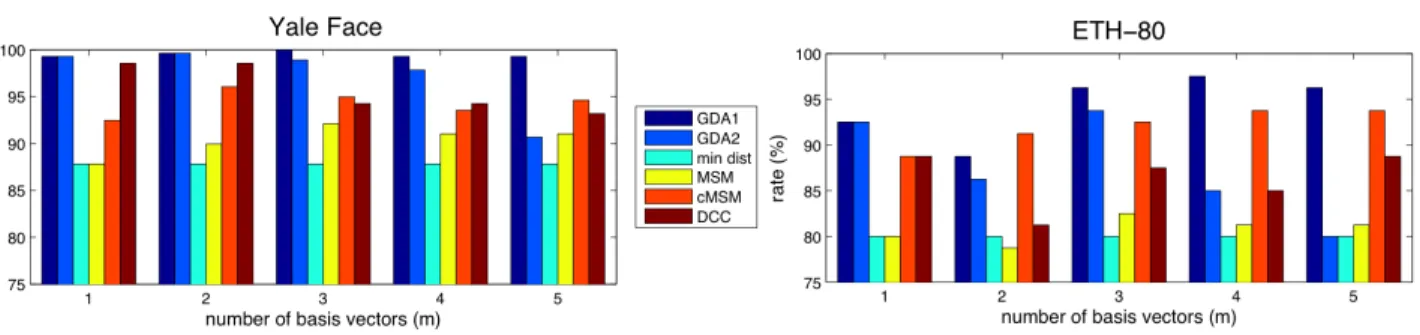
For each subject and each pose, we model the illumi-nation variations by a subspace of the sizem= 1, ...,5, spanned by the 1 to 5 largest eigenvectors from SVD. We evaluate the recognition rate of subjects with nine-fold cross validation, holding out one pose of all sub-jects from the training set and using it for test. The recognition rates are shown in Fig. 2. The GDA1
outperforms the other methods consistently. The
GDA2 also performs well for small m, but performs
worse as m becomes large. The rates of the others
also seem to decrease as m increases. An
interpreta-tion of the observainterpreta-tion is that the first few
eigenvec-tors from the data already have enough information and the smaller eigenvectors are spurious for discrim-inating the subjects.
6.3. Testing Pose-Invariance with ETH-80 Database
The ETH-80 (Leibe & Schiele, 2003) database con-sists of pictures of 8 object categories (‘apple’, ‘pear’, ‘tomato’, ‘cow’, ‘dog’, ‘horse’, ‘cup’, ‘car’). Each cat-egory has 10 objects that belong to the catcat-egory, and each object is recorded under 41 different poses.
Im-ages were resized to 32×32 pixels (D = 1024) and
normalized to have the same variance. For each cate-gory and each object, we model the pose variations by
a subspace of the size m = 1, ...,5, spanned by the 1
to 5 largest eigenvectors from SVD. We evaluate the classification rate of the categories with ten-fold cross validation, holding out one object instance of each cat-egory from the training set and using it for test. The recognition rates are also summarized in Fig. 2. The GDA1 also outperforms the other methods most of the time, but the cMSM performs better than GDA2
as m increases. The rates seem to peak around m =
4 and then decrease as m increases. This results is
consistent with the observation that the eigenvalues from this database decrease more gradually than the eigenvalues from the Yale face database.
7. Conclusion
In this paper we have proposed a Grassmann frame-work for problem in which data consist of subspaces. By using the Projection metric and the Binet-Cauchy metric, which are derived from the Grassmann ker-nels, we were able to apply kernel methods such as kernel LDA to subspace data. In addition to having theoretically sound grounds, the proposed method also outperformed state-of-the-art methods in two experi-ments with real data. As a future work, we are pur-suing a better understanding of probabilistic distribu-tions on the Grassmann manifold.
References
Absil, P., Mahony, R., & Sepulchre, R. (2004). Riemannian geometry of Grassmann manifolds with a view on algo-rithmic computation. Acta Appl. Math.,80, 199–220. Chang, J.-M., Beveridge, J. R., Draper, B. A., Kirby, M.,
Kley, H., & Peterson, C. (2006). Illumination face spaces are idiosyncratic. IPCV(pp. 390–396).
Chikuse, Y. (2003). Statistics on special manifolds, lecture notes in statistics, vol. 174. New York: Springer. Edelman, A., Arias, T. A., & Smith, S. T. (1999). The
Figure 2.Recognition rates of subjects from Yale face database (Left), and classification rates of categories in ETH-80 database (Right). The bars represent the rates of six algorithms (GDA1, GDA2, Min Dist, MSM, cMSM, DCC) evaluated form= 1, ....,5 wheremis the number of basis vectors for subspaces. The GDA1 achieves the best rates consistently, and the GDA2 also performs competitively for smallm.
geometry of algorithms with orthogonality constraints.
SIAM J. Matrix Anal. Appl.,20, 303–353.
Farag´o, A., Linder, T., & Lugosi, G. (1993). Fast nearest-neighbor search in dissimilarity spaces. IEEE Trans. Pattern Anal. Mach. Intell.,15, 957–962.
Fukui, K., & Yamaguchi, O. (2003). Face recognition using multi-viewpoint patterns for robot vision. Int. Symp. of Robotics Res.(pp. 192–201).
Fukunaga, K. (1990). Introduction to statistical pattern recognition (2nd ed.). San Diego, CA, USA: Academic Press Professional, Inc.
Georghiades, A. S., Belhumeur, P. N., & Kriegman, D. J. (2001). From few to many: Illumination cone models for face recognition under variable lighting and pose. IEEE Trans. Pattern Anal. Mach. Intell.,23, 643–660. Golub, G. H., & Loan, C. F. V. (1996). Matrix
compu-tations (3rd ed.). Baltimore, MD, USA: Johns Hopkins University Press.
Haasdonk, B. (2005). Feature space interpretation of svms with indefinite kernels. IEEE Trans. Pattern Anal. Mach. Intell.,27, 482–492.
Hein, M., Bousquet, O., & Sch¨olkopf, B. (2005). Maximal margin classification for metric spaces.J. Comput. Syst. Sci.,71, 333–359.
Kim, T.-K., Kittler, J., & Cipolla, R. (2007). Discrimi-native learning and recognition of image set classes us-ing canonical correlations. IEEE Trans. Pattern Anal. Mach. Intell.,29, 1005–1018.
Kondor, R. I., & Jebara, T. (2003). A kernel between sets of vectors.Proc. of the 20th Int. Conf. on Mach. Learn.
(pp. 361–368).
Leibe, B., & Schiele, B. (2003). Analyzing appearance and contour based methods for object categorization.CVPR,
02, 409.
Ong, C. S., Mary, X., Canu, S., & Smola, A. J. (2004). Learning with non-positive kernels. Proc. of 21st Int. Conf. on Mach. Learn.(p. 81). New York, NY, USA: ACM.
Pekalska, E., Paclik, P., & Duin, R. P. W. (2002). A gener-alized kernel approach to dissimilarity-based classifica-tion. J. Mach. Learn. Res.,2, 175–211.
Sakano, H.; Mukawa, N. (2000). Kernel mutual subspace method for robust facial image recognition.Proc. of Int. Conf. on Knowledge-Based Intell. Eng. Sys. and App. Tech.(pp. 245–248).
Schoenberg, I. J. (1938). Metric spaces and positive definite functions. Trans. Amer. Math. Soc.,44, 522–536. Sch¨olkopf, B., & Smola, A. J. (2001). Learning with
ker-nels: Support vector machines, regularization, optimiza-tion, and beyond. Cambridge, MA, USA: MIT Press. Shakhnarovich, G., John W. Fisher, I., & Darrell, T.
(2002). Face recognition from long-term observations.
Proc. of the 7th Euro. Conf. on Computer Vision (pp. 851–868). London, UK.
Turk, M., & Pentland, A. P. (1991). Eigenfaces for recog-nition. J. Cog. Neurosc.,3, 71–86.
Vishwanathan, S., & Smola, A. J. (2004). Binet-cauchy kernels. Proc. of Neural Info. Proc. Sys..
Wang, L., Wang, X., & Feng, J. (2006). Subspace distance analysis with application to adaptive bayesian algorithm for face recognition. Pattern Recogn.,39, 456–464.
Wolf, L., & Shashua, A. (2003). Learning over sets using kernel principal angles. J. Mach. Learn. Res., 4, 913– 931.
Wong, Y.-C. (1967). Differential geometry of Grassmann manifolds.Proc. of the Nat. Acad. of Sci., Vol. 57, 589– 594.
Yamaguchi, O., Fukui, K., & Maeda, K. (1998). Face recognition using temporal image sequence.Proc. of the 3rd. Int. Conf. on Face & Gesture Recognition(p. 318). Washington, DC, USA: IEEE Computer Society. Zhou, S. K., & Chellappa, R. (2006). From sample
similar-ity to ensemble similarsimilar-ity: Probabilistic distance mea-sures in reproducing kernel hilbert space. IEEE Trans. Pattern Anal. Mach. Intell.,28, 917–929.