MASTER IN INNOVATION AND RESEARCH IN INFORMATICS High Performance Computing
Final Master Thesis
Code generation for the dataflow-basedxsmll runtime
Author: Daniel Peyrolon Lago
Supervisor: Xavier Martorell Boll
Director's department: Computer Architecture
FACULTAT D'INFORMÀTICA DE BARCELONA (FIB)
UNIVERSITAT POLITÈCNICA DE CATALUNYA (UPC)
Contents
1 Introduction 1 2 Programming Models 3 2.1 OmpSs Description . . . 3 2.1.1 Introductory description . . . 3 2.1.2 Implementation . . . 4 2.1.3 OmpSs example . . . 6 2.1.4 OmpSs dependences . . . 9 2.2 xsmll description . . . 10 2.2.1 SDSM systems . . . 10 2.2.2 xsmll design . . . 11 2.2.3 xsmll dependences . . . 12 2.2.4 xsmll shared memory . . . 14 2.2.5 xsmll example . . . 15 2.2.6 xsmll usage . . . 18 3 Methodology 20 4 Limitations 21 4.1 xsmll API limitations . . . 21 4.2 Mercurium limitations . . . 23 4.3 Summary . . . 24 5 Code generation 26 5.1 Dependences between xthreads . . . 265.2 xthread and frame generation . . . 27
5.2.1 xthread struct . . . 27
5.2.2 xthread function . . . 28
5.2.3 Function and struct example . . . 29
5.3 xthread schedule and start . . . 29
5.3.1 xschedule code generation . . . 29
5.3.2 xdecrease code generation . . . 31
5.4 Passing variables to an xthread . . . 31
5.4.2 Shared variables . . . 32
5.5 Working example of code generation . . . 34
6 Mercurium runtime architecture 39 6.1 The Mercurium compiler driver . . . 39
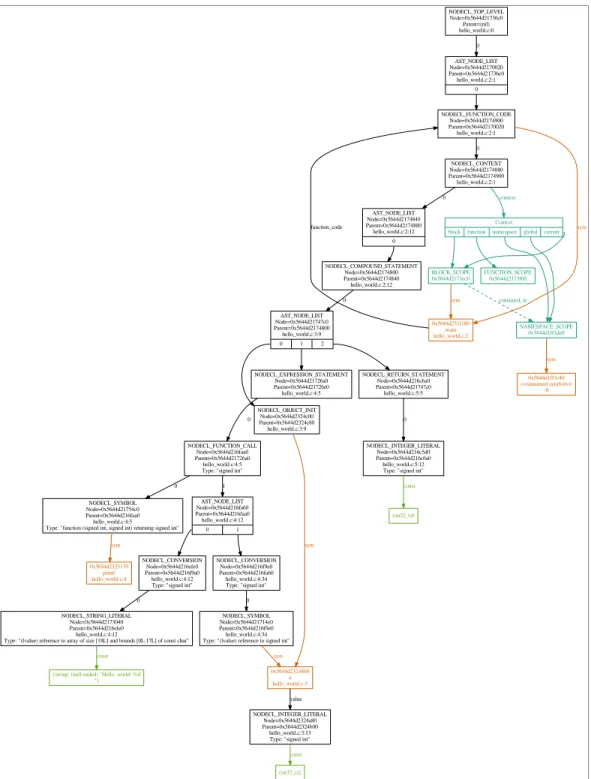
6.2 Phase structure . . . 40 6.3 Nodecl tree . . . 41 6.4 Nodecl visitors . . . 41 7 xsmll lowering phase 44 7.1 LoweringPhaseclass . . . 44 7.1.1 Class infrastructure . . . 44 7.1.2 run()function . . . 44 7.2 Lower class . . . 45 7.2.1 TaskCallvisitor . . . 46 7.2.2 Taskwaitvisitor . . . 46 7.2.3 FunctionCodevisitor . . . 46
7.2.4 OpenMPTask visitor . . . 47
7.3 XsmllCodegen andXthreadCodeclasses . . . 47
7.3.1 XsmllCodegenclass . . . 47
7.3.2 XthreadCodeclass . . . 49
7.4 SharedMemAllocator andSharedMemVarclasses . . . 52
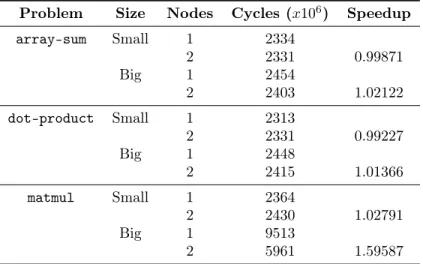
8 Results 54 8.1 Testing of the Mercurium phase . . . 54
8.2 Benchmarks . . . 55
Abstract
This document presents the report of the Master’s Thesis Code generation for the dataflow-based xsmll runtime developed in the context of the Master in Innovation and Research in Informatics.
In this report we analyze the possibilities that there exist for the OmpSs programming model to be mapped onto the xsmll runtime system. The OmpSs programming model developed at BSC is based on a set of directive-based constructs providing task-based parallelism. Thexsmll runtime system is being developed at the University of Siena. Both institutions are partners in the AXIOM EU project.
We define and describe the implementation of the code generation phase for the Mercurium compiler, show the limitations we have found both in the input codes that we can transform, and in the capacity that the Mercurium compiler analysis passes currently have. In order to check the correctness of our generated code, we also execute and evaluate some programs compiled with the new phase, making use of the xsmll runtime.
Chapter 1
Introduction
This project has been performed as part of the bigger AXIOM project. The AXIOM (acronym for Agile, Extensible I/O Module) project tries to design and manufacture with European funds a single board computer. This board has to be energy efficient, use Open Source software, use a FPGA (Field-Programmable Gate Array) to perform complex calculations, it should integrate support for Arduino “shields” (which are boards using a hardware specification to connect peripheral devices to the Arduino board). Additionally, the boards have to be easily used as a cluster.
With that objectives in mind, some ideas have been explored, and that includes the design and development of a system called xsmll, which is a SDSM (Software Defined Shared Memory) system which strives to have good performance for clustered environments. Since in order to usexsmll there is a need to write code for a specific API, automatic code generation for the API was considered, and the in-house compiler atBSC (Mercurium) was proposed as the preferred tool. This is the reasoning behind the development of this thesis. The AXIOM project has a set of so-calledWork Packages, and each one of them tries to push the project completion forward in a specific direction. The work packages for this project are:
WP1 Management of the project WP2 Dissemination and exploitation
WP3 Scenario definition and application porting WP4 Programming model
WP5 Runtime and Operating System WP6 Architecture implementation
In the context of the AXIOM project, this work pertains toWP4 (Program-ming model). As stated in [8] and [7] this work package deals with:
1. Providing compiler and runtime support in order to program theAXIOM cluster with the OmpSs programming model, and extend it if necessary. (The OmpSs programming model is described in section 2.1 (OmpSs De-scription)).
2. The instrumentation design and implementation for theFPGAdevices in the board.
3. Compiler design exploration to support the distributed cluster environ-ment using xsmll. (Which is also described in section 2.2 (xsmll descrip-tion).
This work has been done in the context of the last element in the list.So the general objective is to map the task-based OmpSs Programming Model onto the execution environment defined by thexsmll runtime interface. This objective is split into the following sub-objectives:
• Determine if it is possible to convert task-based OmpSs programs to code using correctly thexsmll API.
• Determine what shortcomings this transformation has, with respect to the OmpSs application and the compiler analysis available in the Mercurium compiler.
• Implement a set of transformations that will perform the actual code trans-formations.
• Test and validate the code transformations. • Evaluate the resulting code with benchmarks.
Chapter 2
Programming Models
This section will describe and provide simple examples of the two programming models that had to be used in the making of this thesis. These are theOmpSs programming model, and the programming model implicitly described in the xsmll specification.
2.1 OmpSs Description
We will start with the already-known programming model OmpSs, as it is much better known thatxsmll. We will start describing a little bit the paradigm it uses as well as the ideas used for its development, then proceed to describe how it is usually run, and finally, explain how it is used with a simple example.
2.1.1 Introductory description
OmpSs is a programming model being currently developed at Barcelona Supercomputing Center which at the beginning aimed to push the develop-ments made with the StarSs (Star SuperScalar), bringing concepts from the superscalar processors into software management of tasks. Currently, OmpSs is being used as a forerunner to develop new extensions to OpenMP, which has already taken benefit for several OmpSs features, like task dependences, priorities, reductions,tasksloop, etc.
The OmpSs programming model tries to empower the programmer to transform easily sequential to parallel code through the use of annotations, just like OpenMP. The annotations will describe tasks, and synchronization mech-anisms. Each task is the basic unit of work, and they may have dependences, which allows the programmer to describe the data flow of the program, so that –at runtime– the program knows the order in which to execute each task. Although not recommended, barriers (taskwait) may be used to assert that the tasks have finished execution before continuing with sequential execution.
Even so, there should be only one barrier (taskwait) at the end of the parallel computation.
The biggest difference between OmpSs and OpenMP is how parallelism is controlled. The traditional OpenMP model uses fork-join parallelism, while OmpSs uses athread-pool. This means that in the former case, a set of threads will be used to execute the code in parallel (fork), and when the parallel execution finishes, only one thread will remain (join). In the latter case though, there will be a set of threads available to the runtime so that they can perform computation in parallel at any moment.
With the traditional OpenMP model the user has to define all the regions of code where he/she wants parallel regions, and define explicitly how this parallelism is handled in the code. The OmpSs programming model instead simplifies this creating an implicit set of threads at the beginning of the program execution, thus liberating the programmer from defining what the parallel regions will be (thread-pool). These threads will then execute all the different tasks asynchronously while respecting all the dependences between tasks. This increases the ease of parallelizing applications, which is considered a hard endeavor.
Given the nature of the programs that are described through the use of tasks and dependences, it makes sense to the developers to push forward the programming model to support heterogeneity in order to get better performance when executing applications. This implies supporting different devices and accelerators, handling development all the way from the programming model (i.e. describing if a task has to be executed on a GPU, or any different device) to the runtime (i.e. actually supporting the data management to comply with the annotations written by the programmer), at the moment, this is currently one of the directions in which OmpSs is being developed.
2.1.2 Implementation
The OmpSs programming model is currently supported thanks to a compiler –Mercurium–, and a runtime system:
Mercurium compiler The Mercurium compiler performs all the needed trans-formations in order to support the OmpSs programming model, and given a set of tasks, it will generate the code to make that tasks work with the defined runtime.
Runtime systems OmpSs is currently supported by two different runtime sys-tems:
Nanos++ Is the runtime library that creates and manages the thread-pool for the parallel application, and provides all the primitives
needed to support the programming model, like task creation, data movement, data execution. . . etc.
Nanos6 Is a new runtime being developed at BSC currently, that strives to improve the performance of Nanos++ with a different architecture, and reducing the overhead of the runtime services by redesigning the interface with a focus in simplicity.
2.1.3 OmpSs example
We provide an example of OmpSs implementing adot-product algorithm. This example is taken from the OmpSs exercises at PATC OmpSs courses ([2], [4]). 1 double
2 dot_product(long n, long chunksize, 3 double A[n], double B[n]) 4 {
5 long actual_size; 6 int j = 0;
7 double result = 0.0; 8
9 const long n_chunks = n/chunksize +
10 (n % chunksize != 0);
11 double *C = malloc (n_chunks*sizeof(double)); 12
13 for (long i=0; i<n; i+=chunksize) {
14 actual_size = (n-i >= chunksize)?chunksize:n-i; 15
16 #pragma omp task firstprivate(j, i, actual_size) \
17 in(A[i;actual_size], \
18 B[i;actual_size]) \
19 inout(C[j;1])
20 {
21 C[j]=0;
22 for (long ii=0; ii<actual_size; ii++) 23 C[j]+= A[i+ii] * B[i+ii];
24 }
25
26 // OmpSs: Accumulate C[j] into result.
27 #pragma omp task firstprivate(j) in(C[j;1]) \
28 commutative(result)
29 result += C[j];
30 j++;
31 }
32
33 // OmpSs: Assert task ending before return.
34 #pragma omp taskwait 35
36 return(result); 37 }
The first directive (at line 16 of the example) that we can find at listing 2 (First task of OmpSs example) is:
#pragma omp task firstprivate(j, i, actual_size) \ in(A[i;actual_size],B[i; actual_size]) \ inout(C[j;1])
Listing 2: First task of OmpSs example
This directive defines a task. The associated code is outlined and created as a task. Since the next lines open an explicit scope, the code in this scope is what will be executed with the task.
The next clause is firstprivate, this is called adatasharing clause. This kind of clause is used to describe how the variables with the corresponding values are going to be used. There are three different datasharing clauses, which are: private Each thread will have a unique variable whose value is not copied by
default (it will not be initialized, and its value will be unspecified). firstprivate Similar to private, but the value of the variable will be copied into
the private thread.
shared All the threads will share its value, and access directly to the variable –usually through a pointer–.
In this case, the variables j, i, and actual_size, are set as firstprivate variables, which means that its value will be copied into the task.
The next clause in the directive is in(A[i;actual_size]), this is the first dependence of the task. The dependences are used to explicitly define the order in which tasks have to be executed, by defining how the variables are going to be used. There are three dependence clauses:
in The values of the variables that are in dependences will be used, but not overwritten.
out The values of these variables will only be used to write, and not read. inout The variables will be used both to read and write.
This means that the task is going to useA[i;actual_size]just to read its value. We are also seeing for the first time the syntax to define as a dependence a set of positions of a given array. This form is called an extended lvalue at [3]. There are two ways to define them:
array[initial:final ] This form describes as a dependency all the elements of an array from the initial to the final one, and both are included in the range.
array[position;size ] This one describes as a dependency all the elements of the array from position to (position+(size-1)), and both are included. Finally, the last clause defines an inout dependency for the task, and uses the extended lvalue form to add a dependency that takes justC[j;1], which is nothing more thatC[j].
The next directive in the code (at line 28) is: #pragma omp task firstprivate(j) in(C[j;1]) \
commutative(result)
Listing 3: Second task of OmpSs example
The only new element in this task is the clause commutative(result). [3] specifies that the tasks that handle theresultvariable will be able to execute in any order –but not in parallel– granted that all sibling tasks that deal with resulthave finished its execution.
Finally, the last directive in the example (at line 35) is: #pragma omp taskwait
Listing 4: Third task of OmpSs example
Which is just a barrier to ensure that all tasks have finished before returning from the function.
Given that this document does not try to describe OmpSs in a thorough manner, we refrain from explaining any further feature of OmpSs, specially given that all of its features needed for the thesis have been already described. There are many more OmpSs features that can be used. If the reader wants to learn more about this programming model, we encourage the reader to take a look at [2].
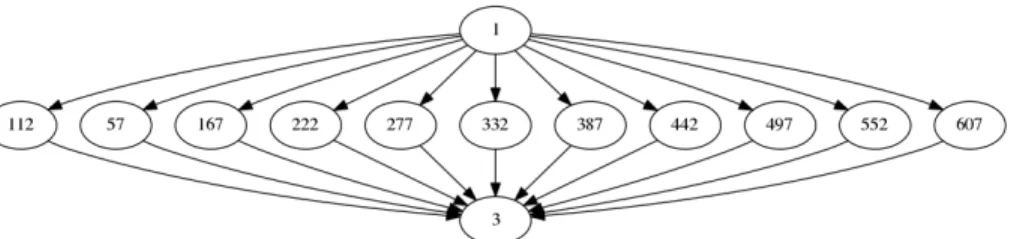
Figure 2.1: Dependency graph for the example
2.1.4 OmpSs dependences
There’s one cardinal thing to describe even further. This is how dependences are created and used with OmpSs. Given the next example at listing 5 (Simple tasking example with dependences), there are three tasks. This example performs a parallel summation of two vectors, storing the result of the sun on another different vector.
First task The first task deals with the initialization of the two vectors that will be summed (A, and B), its out dependences are the two initialized vectors.
Second task The second tasks uses as anindependency theAandBvectors, andC[i] as an output dependency. Given that the task is inside a loop, there are10different task instances. All of them depend on the first task. Third task The third task is just an empty dependency that hasC as an in dependency. It therefore depends on all the instances of the second task. Given all these three tasks, we can build a graph that represents all this tasks (in this case, we’re using the Mercurium compiler to build it). It can be seen at figure 2.1 (Dependency graph for the example). This is important and will be taken into account throughout the whole text.
1 int main() {
2 int A[10], B[10], C[10]; 3
4 #pragma omp task out(A, B, C)
5 { 6 for (int i= 0; i < 10; i++) { 7 A[i] = B[i] = i; 8 } 9 } 10 11 for (int i = 0; i <= 10; i++) {
12 #pragma omp task in(i, A[i], B[i]) out(C[i]) 13 C[i] = A[i] + B[i];
14 }
15
16 #pragma omp task in(C)
17 {
18 // Save results or print
19 ;
20 }
21 22
23 #pragma omp taskwait 24 }
Listing 5: Simple tasking example with dependences
2.2 xsmll description
Thexsmll layer (which stands foreXtended Shared MEmory (XSM) Low Level specification) is a runtime system designed with the idea of managing threads, data consistency and synchronization between nodes in a cluster environment. Given that it has been designed for cluster environments, its design is that of a Software Distributed Shared Memory (SDSM) system. In order to properly understand the reasoning behind its design we need to take a brief look at how SDSM systems work and their performance constraints.
2.2.1 SDSM systems
For starters, we have to define what a SDSM system does. As the name indicates (Software Distributed Shared Memory), its a system that has a shared logical memory space distributed among systems in a cluster environment. This logical memory space can be addressed in any node in the cluster, and the system has to be able to detect that and perform all the necessary data
management in order to fetch the data, or write it in its place in its actual memory location, while keeping a coherency policy for data management (which depends on configuration or system design). This allow its users to design and create applications that work seamlessly in a distributed system without any explicit data management code, which eases development.
As stated in [6], the classic memory management in SDSM systems is performed at a page granularity, using custom page-fault handlers, that will perform the actual data management through the network. While a simple design, it performs poorly, since memory access time is too big. A number of techniques to try to solve this (data prefetch, and a relaxed consistency policy) have been developed through time, but none of them amortizes the memory access time completely.
A well-known problem of SDSM systems is false-sharing, which is a performance-degrading usage pattern that occurs when a system manages and shares data which is partially modified. Since the mechanism to share and manage the data will work at a certain data block size, thewhole block will be treated like as it were also modified, making the system to copy its whole data block from one system to another –which ideally would happen when the whole data block is modified–. This is also a classical problem in cache design.
This set of unsolved problems have made the research community to stop trying new ideas to overcome this problems, and instead, have focused on systems with explicit synchronization mechanisms (i.e. MPI, OpenMP...), or they have tried to solve (up to now, unsuccessfully) these issues with object-based SDSM systems, where the user has to manage the coherence policy at a per-data-structure level, which makes the users be aware of the coherence policies and underlying architecture (at the expense of making development much harder).
At [6], the authors performed an experiment to verify that page-granularity SDSM systems on modern hardware does not perform ideally. To that end, they ported theJUMP system –a SDSM system– to a modern ARM architecture, and tested its scalability (with two boards). Its scalability was negative for two problems out of three, and the authors used that results as a justification to explore different designs for clustered environments (i.e. asxsmll).
2.2.2 xsmll design
As described at the beginning of this section, xsmll, is a runtime that strives to provide thread scheduling and synchronization for distributed systems. Its basic idea is to only start threads when their data is ready to be handled, instead of expecting the programmer to handle the data management part of a distributed system –using synchronization code such as mutexes–, and data
management code. This model is an extension of the Dataflow Threads, which was developed for the Teraflux project ([5]), and is also further explained at [6]. Thexsmll runtime represents any given thread with thexthread construct. This is the basic computation block, and represents a thread being executed in any node of a givenxsmll cluster. All xthreads are represented through the xtid_ttype –this is called an xthread descriptor from now on–. An xthread is a function that has no parameters, and returns no value:
typedef void (*xthread_t)(void)
Listing 6: Type of xthread
Given that an xthread is a function that does not accept or return values it must fetch data in a different way. That is handled by the input and output frames. Both are a buffer in local memory that contains the data for the xthread, or succeeding xthreads. The xthread needs to have all the data in its frame before starting.
Every xthread has an associatedsynchronization count, which is an integer that should be initialized to the number of inputs of the xthread, and whenever an input is written, is should be decreased through the use of a function. When finally decreased to zero, the runtime executes the xthread corresponding to the synchronization counter.
We can see at table 2.1 (xsmll Specification functions (as seen in [6])) a definition of the whole API of the xsmll runtime. As we can see, this simple API does not allow us the same ease when dealing with parallelism as OmpSs. The idea of this project is to support automatic transformation from OmpSs code to code leveraging thexsmll API.
Since the API description is not enough to understand how the runtime works, we are going to explain an example similarly to OmpSs –by taking an example and proceed to describe how it uses the API–. But we first need to explain a relatively complex part of the runtime that is not properly explained by the API definition, its shared memory.
2.2.3 xsmll dependences
Provided that we will need to implement dependent tasks, we will take advantage of the xthread dependence counter to implement the task graphs. Also the finaltaskwait can be implemented with the same support.
Function Syntax and explanation
xschedule xtid_t xschedulez(xthread_t ip, uint32_t sc, uint32_t sz)
Schedules the xthread whose name isip, sets its synchronization count tosc, and allocate a frame ofszbytes.
xdestroy void xdestroy()
Called at the end of the xthread to deallocate its resources. xsubscribe void* xsubscribe(xtid_t tloc, uint32_t regionstart,
uint32_t regionsize, uint8_t type)
Subscribes a memory region that is going to be shared by xthreads with some r/w protection specified by type. The region of memory that is going to be subscribed is defined by an offset (regionstart), and its size (regionsize), both expressed in bytes, and aligned to 8 bytes. It returns the pointer to the region, and is stored intloc, which is an element of the frame of a given xthread). When a region of memory is “subscribed”, it means that an element of its frame will be changed to a pointer to the shared memory region that we want to use.
xpublish void* xpublish(void* regptr)
Forces the update of the memory region pointed by regptr, which has to be previously subscribed.
xpreload void* xpreload()
Returns a pointer to the input frame of the xthread. It’s used at the beginning of the xthread.
xpoststor void* xpoststor(xtid_t tid)
Returns a pointer to the frame of the xthreadtid. Used from out of the xthread in order to pass values to it.
xdecrease void xdecrease(xtid_t tid, int n)
Used to decrease the synchronization counter of the xthread tid.
xtmbegin uint64_t xtmbegin(uint64_t s1, uint64_t s2)
Begins a transaction on the transactional memory region pointed bys1and having a lengths2. Returns 1 if the transaction can start, and 0 otherwise. (Unused in the making of this project). xtmend uint64_t xtmend(uint64_t s1, uint64_t s2)
Ends a transaction on the transactional memory region pointed by s1 with a length of s2. (Unused in the making of this project).
This is implemented by creating xthreads with a non-zero synchronization counter, passing the xthread descriptor to another xthread through its frame, and when an xthread finishes, using the xdecrease API to decrement the counter of the dependent xthreads.
Implementing this technique automatically in our compiler requires a way to detect the dependences between tasks. In order to do so, we have leveraged a pre-existing phase of the Mercurium compiler, the so called analysis phase, as will be seen in chapter 7 (xsmll lowering phase).
2.2.4 xsmll shared memory
The API provides the programmer with the tools to use shared memory between threads. This is done through the use of thexsubscribe andxpublish functions. Since we are developing a compiler phase we do not really care about the actual implementation of these functions, but we do care about using them correctly. With that in mind, let us delve further in what these functions do.
xpublish()
Thexpublish() function prototype is:
void* xpublish(void* regptr);
This first function (xpublish), as stated by the table 2.1 forces the update of the memory region pointed byregptr. Basically, the runtime will take care of updating the value of that memory region in the shared memory and copy its new value from the xthread as necessary (to the other nodes in the system, if it must). This is used in order to ensure that xsubscribed values will be updated (otherwise, the shared memory will be unchanged and work performed by the xthread will be in vain).
xsubscribe()
The other function isxsubscribe(), its function prototype is:
void* xsubscribe(xtid_t tloc, uint32_t regionstart, uint32_t regionsize, uint8_t type);
,→
This function has 4 parameters:
tloc This first parameter is the xthread whose memory we want to subscribe. While its type is xtid_t, it will not point at an xthread. It will be a pointer to the position of the frame of the xthread (the xtid_t value returned fromxschedulezpoints to the beginning of the xthread frame).
As we will see in the example, this first parameter is the result of calling a macro that will add the xthread ID to the offset of an element in its frame. Therefore, its real value is a direct pointer to the element of the frame whose memory we want to subscribe.
regionstart This is the offset of the shared memory where we want to start to subscribe the data. Its starting position.
regionsize The size of the region that we want to subscribe.
type This represents the xthread permissions of the thread when dealing with the memory. It has 3 possible values: read permissions, write permissions and read and write permissions.
When using the function we are telling the runtime that we want to share this memory region with other xthreads by using a pointer, reserving regionsize bytes in the shared memory, and changing the pointer value in the frame to point to this region of memory. We can then work with that region of memory, and at the end of the xthread, we should callxpublishto publish that changes in the memory. That will basically update the memory region across all xthreads.
2.2.5 xsmll example
We provide a simple of example of an xthreads application in order to properly describe how the application using xsmll will work at listing 7 (xsmll matrix multiply example).
1 #define N 200 2 #define BLOCKSZ 25 3 #define DATA uint64_t
4 #define SIZE(M,N) (N*M*sizeof(DATA)) 5
6 #define RB_SZ SIZE(N,N) 7 #define RA_SZ SIZE(N,BLOCKSZ) 8 #define RC_SZ SIZE(N,BLOCKSZ) 9
10 #define RC_OFF(j) ( SIZE(N,j)) 11 #define RB_OFF(j) ( SIZE(N,N)+SIZE(N,j)) 12 #define RA_OFF(j) (2*SIZE(N,N)+SIZE(N,j)) 13
14 typedef struct {xtid_t xr;} owm_matrix_mul_s; 15 void owm_matrix_mul() /* Compute C=A*B. */
16 {
17 const owm_matrix_mul_s *fp = xpreload(); 18 xtid_t xr = fp->xr;
20 for (int j=0; j<N; j+=BLOCKSZ) {
21 // Schedule the actual multiplying function.
22 xtid_t bm = xschedulez(bmmul, 4, sizeof(bmmul_s)); 23 xsubscribe(XDST(bm, bmmul, A), RA_OFF(j), RA_SZ,
_OWM_MODE_R);
,→
24 xsubscribe(XDST(bm, bmmul, B), RB_OFF(0), RB_SZ, _OWM_MODE_R);
,→
25 xsubscribe(XDST(bm, bmmul, C), RC_OFF(j), RC_SZ, _OWM_MODE_W); ,→ 26 27 bmmul_s* bm_fp = xpoststor(bm); 28 bm_fp->xreport = xr; 29 xdecrease(bm,4); 30 } 31 xdestroy(); 32 } 33 34 typedef struct {
35 DATA *A; DATA *B; DATA *C; 36 xtid_t xreport;} bmmul_s; 37 void bmmul()
38 {
39 const bmmul_s *cfp = xpreload(); 40 const DATA *A = cfp->A; 41 const DATA *B = cfp->B; 42 DATA *C = cfp->C; 43 int i, j, k; 44 45 for (j = 0; j < BLOCKSZ; j++) { 46 for (i = 0; i < N; i++) { 47 DATA t = 0; 48 for (k = 0; k < N; k++) { 49 t += A[j * N + k] * B[k * N + i]; 50 } 51 C[i + (j * N)] = t; 52 } 53 } 54 xpublish(C); 55 xdecrease(cfp->xreport,1); 56 xdestroy(); 57 }
Listing 7: xsmll matrix multiply example
thexsmll Git repository. We have taken just two functions since it is enough to provide a good explanation of how to work withxsmll.
Let us start describing whatowm_matrix_muldoes. It firsts gets a pointer to its own frame through the use ofxpreload(), and the type of the pointer is that of anowm_matrix_mul_s, that is a struct defined just before the function. This struct contains axtid_t object, which is the xthread descriptor of the report function (this function deals with checking if the program has been correctly executed, and print a message accordingly, –its code has been omitted–). The idea of having this field in the struct is to pass it to the bmmul function so that it calls xdecrease() when it has finished. When it has been decrease N/BLOCKSZ, the synchronization count will be zero, and its execution will be triggered.
Following in the code, we have the loop that will be executedN/BLOCKSZtimes. This loop has a call toxschedule() to schedule a call to bmmul. It has as a first parameter the function to be scheduled, as a second parameter the initial value of the synchronization counter (4), and lastly, the size of its frame (which issizeof(bmmul_s), wherebmmul_sis the struct defined just before thebmmul function). After the call to xschedulez, there is a call toxsubscribe(), its first parameter is a call to the macroXDST(). This is defined at thexsmll header as: #define XDST(_xtid,_fun,_off) \
((_xtid)+(uint64_t)(offsetof(_fun ## _s, _off))) Which resolves in the firstxsubscribe()call to:
bm + (uint64_t) offsetof(bmmul_s, A)
This macro uses three parameters, but only one the first references a runtime object. The other two are just the struct definition, and the name of its field. This macro is important, since we need to generate code with this behavior, but the Mercurium compiler is not able to generate macros, as it will be seen in section 4.2 (Macro generation constraint).
The macro calculated the actual position of the A pointer in the frame of bmmul. This pointer will be set with the value of the location of the A array in the shared memory ofxsmll, which is written previously in a different function. In order to point to these arrays we use a combination of the RA_OFF() and RA_SZ() macros, which are defined at the beginning of the function. With RA_OFFwe point to the offset of the location in shared memory, and withRA_SZ we declare the size of the array, as a last parameter toxsubscribe(), we have _OWM_MODE_R, which defines the permissions of the xthread to use the data (read, write, or both)
After the calls to xsubscribe, we call xpoststor() to get the frame of the bm xthread, and set the xreport field with the value of the xr value (the field that was taken throughxpreload()), and call xdecrease() to start the xthread. Please note that the value 4 is totally arbitrary (the authors could have used 1 as well). This mechanism is the one described at section 2.2.3 (xsmll dependences). Finally xdestroy() is called to deallocate the resources used by this specific xthread.
For the xthreadbmmulthere is not much to note, besides that it uses the value passed at the end of the owm_matrix_mul xthread, and calls xdecrease() on that specific xthread (which has been previously scheduled). Another interesting point is the fact that it calls xpublish(C) to publish the result of the function. That is because the xthread whose counter is decreased has been subscribed to that array and we need to callxpublish() in order to update the value of the array.
2.2.6 xsmll usage
In order to use thexsmll runtime, the AXIOM project partners are provided provides the developers with a VirtualBox image ready to be used. This Virtu-alBox image contains a Ubuntu 14.04.5 LTS distribution that contains all that is needed in order to run it. For now this is what it includes (besides the Ubuntu system):
SimNow simulator This is a simulator written by AMD in order to create a PC platform emulation environment. It is used to run
COTSon This is a tool build on top of the SimNow simulator, written in Ruby from HP-Labs. Its main contribution is to be able to simulate a specific microarchitecture on demand and perform reliable simulation. More about it can be read at [1].
Xsmll runtime and library This is the actual runtime implementation, it is a library and the headers needed to use the xsmll API in code. Its examples come with specificMakefileused to compile them and execute them with cotson.
dsetools This is a in-house-developed set of shell scripts used to manage ex-periments running with xsmll. The user can specify the inputs of the programs and will take care of changing the Makefile when needed in order to properly run the examples. In the end we opted for not using it and rely on modifying the Makefiles by hand.
When you execute a correctxsmllprogram this is what happens under the hood: • Once you have a proper program to execute, its code should be in the testfolder, with the rest of the examples provided of the xsmll runtime.
• The Makefile should be modified to set theTESTSvariable with the correct filename, the wanted number of nodes that should be used, and size of the shared memory (using theOWMSZmakefile variable), and the inputs should be specified by setting theSZvariable.
• Once all that is set, when runningmake run, make will save a script at/ tmp, compile the program including thexsmllheaders, and compile it with its library, with the--wrap,mainflag among others –this makes themain ()function in the program to be wrapped with another function specified at the library, which will actually start the runtime–, and execute cotson using the generated script. This script will take care of copying the binary into the virtual machine and running it.
• When it has been executed, cotson will take care of printing runtime information, andmakefilewill print a digest of it.
Chapter 3
Methodology
This section explains the methodology for the development of this project. It was developed using the waterfall model.
Before designing the phase for the Mercurium compiler, we first tried to understand how thexsmll runtime actually worked by reviewing the examples given with the runtime. There were two valid examples, one which implemented a dot-product algorithm, and another one that implemented amatrix multiply algorithm.
Once the model was understood, –we not only read and execute the examples, but also wrote some additional applications, and tried to determine how to im-plement the final synchronization at the end of the parallel region (taskwait)–, we also had to properly start defining the transformations needed in order to generatexsmll code from OmpSs code. The design of these transformations is described in section 5 (Code generation).
When we had a clear idea of how these transformation had to be performed, we then proceeded with a phase design and implementation in order to perform the transformations. This design was constantly improved and tinkered with, since for every test that we wrote, we potentially had to change some details of the implementation. This is also described at section 7 (xsmlllowering phase) During this developmental process, we wrote tests that we used to verify the results of the development, and we refined further our design when the design failed until we fixed most of its shortcomings and bugs –just as the waterfall model implies–.
Chapter 4
Limitations
In the development of this project we realized that not every OmpSs application could be ported directly toxsmllwithout changes. There are a variety of reasons for such limitations, that come from the limitations in thexsmll API, and in-herent limitations in the Mercurium compiler that we need to take into account. We explain all the changes that should be done to an original OmpSs application so that it can be correctly compiled into OmpSs code in this chapter.
4.1 xsmll API limitations
There are some limitations in the expressiveness of the xsmll API that will hinder the options available to generate code.
Lack of barrier primitives
One limitation we found out very soon in the design phase is that since we want to support the most dataflow-like parts of OmpSs in order to generate xsmll code, we could not support barrier constructs, nor OmpSs features that could break a dataflow-like paradigm –like thefinalclause, that uses a condition in order to decide whether to compute a task using a thread of the runtime pool, or compute it sequentially–.
Another limitation that stems from this is that since we can’t use barriers, we need to somehow use the dataflow paradigm to start a xthread after a loop. The way this is done in the examples given to us with the runtime is to know in advance how many iterations of the loop will be executed, and use that as the initial value of the synchronization count of the xthread after the loop. Whenever an iteration ends, it will have to use the xdecrease() function call to decrement the synchronization counter of the successor xthread. That way, when the last innermost xthread has finished its execution, the successor xthread will be triggered. This behavior is seen at listing 7 (xsmll matrix multiply example) with thereport()function
The other problem associated with this is that we cannot retrieve values generated by an xthread from sequential code. In order to do so, we would need to support a barrier construct, or a way to fetch data from the main thread, and xsmll does not provide us with that functionality. Some tricks were tried in order to get over this constraint, but their result was unsatisfactory. In order to overcome the lack of a direct barrier primitive from xsmll, we tried using a “barrier thread”. This was a dummy xthread that would act as a barrier. We would set its initial synchronization counter to 1 –recall that the xthread would start its execution when the synchronization counter gets to 0–. Its synchronization counter is increased by one every time a previous xthread is triggered, and it is decreased when this xthread finishes. In order to increase the synchronization counter, we added axincrease()function, which increases the synchronization counter for an xthread by a specified amount. Finally, at the original barrier location, the synchronization counter would be decreased by1so that its execution would be triggered after the completion of each and every previous xthread.
Since our barrier primitive did not work –due to problems with the runtime–, we had to impose as a constraint that all the values generated by xthreads must be used inside a task.
Inter-iteration dependences
Given the nature ofxsmll thread descriptors xtid_t, we cannot (trivially) use xthreads depending on different iterations of a given loop. A simple example of how this is done with OmpSs is shown in the next snippet of code.
for (i = 0; i < n; i++) {
#pragma omp task in(A[i-1], i) inout(A[i]) shared(A) A[i] = A[i-(i == n)?0:1] + calc_offset(A); }
Listing 8: Code with dependences between different iterations
For that reason, when dealing with dependences we flatten the task instance space, making it all have the same dependences, and the same dependant tasks. One way that this could be supported is by having array of xthread descriptors (one for each iteration), and passing each element of the array to its correspond-ing xthread instance.
Usage of xsmll shared memory
According to the xsmll API, we can only use shared memory from inside an xthread. Therefore, we can only translate code whose shared variables are modified only from a task.
4.2 Mercurium limitations
These are the limitations of the Mercurium compiler that made the project harder.
Lack of interprocedural analysis
The Nanos++ runtime system (which is the runtime that supports OmpSs) receives the data dependences hints as expressed by the programmer, and it computes the dependences between tasks internally. This way, it does not matter if the next task created is on a different application scope.
On the other hand, with xsmll, the programmers must express directly the dependences between the tasks. When generating the code for a task, the compiler must know which will be the dependent task to be executed after-wards. Observe that this is not possible without interprocedural analysis, as the compiler will not know which is the next task.
The Mercurium compiler currently lacks the features to perform interprocedural analysis (that was a never an objective of the compiler, since it does not need to perform it in order to support the OmpSs runtime). That forces us to set as a constraint that the transformations must be done for only the tasks in one
function.
Macro generation constraint
The next limitation is due to the Mercurium compiler lacking support for code generation with macros. This is because gcc is used to preprocess the code before the Mercurium compiler parses the code, this performs macro substitution and eliminates all the macros, thus lifting some load on the Mercurium compiler. This complicates code generation, as it will be seen.
Loop analysis constraint
As seen in the API limitation, we have to perform loop analysis from the compiler point of view, there are some instances of code in which this won’t be possible (i.e. loop limits depend on user input).
Since the phase will be used in controlled environments, we can perform such analysis by ourselves (or by leveraging third-party libraries for the Mercurium compiler), and set as a limitation that the number of iterations of loops con-taining tasks must be constant.
Task dependency analysis
Since we have to provide the successor tasks at code generation time, the com-piler has to perform the dependence analysis between the tasks expressed by the programmer. We are using the analysis passes already present in the Mercurium compiler, partially developed in the PSocrates EU project [9].
4.3 Summary
So, as a summary, these are the limitations we found out when developing this project:
1. The results of the computations must be used in another task.
2. We cannot translate properly any code that uses barriers (taskwait), unless the order of the task is well-defined through dependences.
3. Differenttaskediterations of a loop must always depend on the same tasks, and they cannot depend on different iterations.
4. All initialization of shared variables must be in a task. 5. All tasks must be in a single function.
7. If we want to generate correct code that leverages parallelism, we need to perform loop analysis, and use applications that use loops that depend on constants.
8. We must perform some kind of task dependency analysis before generating code.
Chapter 5
Code generation
In this chapter we’ll outline the transformations needed to proceed with the translation from OmpSs to the xsmll API. First, let’s pinpoint some obvious design objectives for the code generation phase:
• For each task, we’ll have to generate thestructthat represents the frame, and its corresponding xthread function.
• We need to generate thexscheduleandxdecreasecalls for every xthread. • We also need to get all the variables that the xthread needs before it starts
its execution.
• If there are dependences between xthreads, wemust be able to generate code that will respect them –otherwise we’re just generating code that won’t be executed in the specified order–.
We’ll demonstrate the points of this chapter with actual code generated by the Mercurium compiler.
5.1 Dependences between xthreads
First of all we need to explain the synchronization mechanisms at our disposal in order to maintain an ordered execution of the tasks in the system –If dependences are not respected, we will never get correct results from scientific applications–. We need to expose this first since it permeates the code generation at every layer.
Given a set of dependences between tasks, we say that asuccessor task depends on a predecessor task if the latter needs to execute and finish before the former. With thexsmll model, we need to pass the descriptor of the successor xthread to the predecessor xthread –so that it can trigger the execution of
the successor xthread–. This is achieved by adding a field to the frame of the predecessor with that purpose, and calling thexdecrease()function it xthread. We can clearly see that a task will depend on another one if one of itsin or out dependences is an out dependency of another previous task. Since our code cannot have barriers (taskwait), as seen in section 4.1 (Lack of barrier primitives), all the dependences will have to be expressed in this way. In order to use them, we use a class that performs the task analysis for us in the Mercurium compiler (as explained in section 4.2 –Task dependency analysis–). This makes compulsory the scheduling of the successor xthread before the predecessor xthread gets executed, which means that we have to generate first thexschedule() calls for each task that is going to be executed in that scope. That way, if we need to use the xthread descriptors, we’ll have them available. There is also another issue to take into account. It is the fact that if there is a loop which contains a task, we have to know the number of iterations of the loop because we will have to pass the xthread descriptor of the next task to every instance of the task in the loop. Then, we will call xdecrease() from every iteration of the loop, decreasing the synchronization counter of the next task. This implies that we set the number of iterations as the value for the initial synchronization counter of thenext xthread.
5.2 xthread and frame generation
Since we’re dealing with xthreads, for every task, we’ll have to define a function which won’t accept any parameter and won’t return any value, and have the task code embedded in that function. Likewise, we’ll have to define a data structure (the one used as a frame for the task). Both the struct and the xthread function must be defined at the global scope of the current compilation unit.
5.2.1 xthread struct
Generating the structure is a relatively simple task. We just need to add all the variables used by the task to a struct. This information is obtained from the programmer, and it uses the dependency and datasharing information. Depending on the datasharing and dependency, we might add elements differently to thestruct.
in, out, inout All of these variables are automatically added asfirsprivate variables, unless a datasharing is specified –this is the standard behavior– The behavior for each datasharing is also described in this list.
private All these variables doesn’t have to be added to the data structure. In order to maintain the semantics of OmpSs, we just add a variable to the frame stack. This is done simply by adding a declaration of a variable with the same name and type of the variable inside the xthread function. firsprivate We have to add a field to the data structure sharing the name and type of the firstprivate variable of the task. This field will be set after the xschedule() function call using the xpoststor() function and an assignment to the field of the xthread –xpoststor() returns a pointer to the frame of the xthread–.
shared Similarly tofirsprivate variables, we have to add a field, which will use the same name as the variable, but instead of sharing its type, it will just be a pointer to that type. This variable will then be used as a memory region inside the shared memory ofxsmll.
Dependent xthreads We need to pass the xthread descriptors of the tasks that depend on the one for which we are generating the struct. This will be further explained through the section, but for now, suffice to say that we will add a variable of the typextid_tfor each of these dependent xthreads, and that they are treated asfirstprivatevariables.
5.2.2 xthread function
Besides the creation of the struct for the xthread, we also need to generate the function for that xthread. This function, as explained many times, doesn’t accept any parameters, and it doesn’t return any value. The generation of the function code is divided in three parts, its preface, body, and its epilogue. Function preface
Initially, we get the xthread’s frame (represented by the struct whose generation has been already explained), this is done through the use of the xpreload()function.
The result of that call is a pointer to the xthread’s frame, and the next step for the preface of the function consists in generating definitions of the local variables used in the function, whose values will be taken from the frame. These variables will share the type andname of the variables, so that they can be used without any problem in thefunction body.
Lastly, we declare all the private variables of the task that is represented with this xthread. By doing so, the compiler will use the activation record to allocate the memory needed for the variables, whose values will be undefined, as it is defined in the OmpSs specification.
Function body
The next part of the function is its body. This part will have the task’s code without just one change: since all the variables that are shared are now a pointer to the type of the variable, we have to rewrite the code that uses this variables and make it use a pointer instead, dereferencing the variable each time its used.
Function epilogue
After the preface, and the execution of the task code, we still need to generate code for a few reasons.
• First of all, we need to ensure that the shared variables are correctly prop-agated through the runtime to the shared memory so that the xthreads that are going to use this variable can use its new value –this is achieved by a call to thexpublish()function–.
• The next step is to callxdecrease()for all the xthreads that depend on the execution of the current one, the xthread descriptor will be taken from its frame.
• As the last step, we will add a call toxdestroy() in order to deallocate the current resources allocated for the xthread.
5.2.3 Function and struct example
Follows a simple example of an xthread function and structure, that contains all of the elements exposed so far. The code uses comments in order to name and show them.
5.3 xthread schedule and start
If we want to schedule and start the xthread we are going to need to generate calls to thexschedulez() and xdecrease() function calls, –at least one pair for each xthread that we want to execute–. In this section we explain how code is generated for both functions.
5.3.1 xschedule code generation
At listing 10 (xschedule prototype), the reader can see the prototype of xschedulez(). Its first argument is an xthread, which (as seen in 2.2.2), is just a function pointer of a function that accepts no parameters, and returns nothing. Its second argument is the original value of the synchronization counter. When set to 0, the execution of the scheduled xthread will be trig-gered. The final argument is the size of the frame. Usually, we just make a call
struct xsmll_struct_1_s //
{ // Struct required for the xthread
xtid_t f2; //
int *a; //
}; //
struct xsmll_struct_1_s; // Struct declaration
static void xsmll_task_1(void) // Function definition
{
// Epilogue
int b; // Private variables
struct xsmll_struct_1_s //
*f1_data = xpreload(); // Getting the frame
xtid_t f2 = (*f1_data).f2; // Initialization of local variables
int *a = (*f1_data).a; //
*a = 10; // Body of the xthread
// a is dereferenced, since it is now a // shared variable
// Epilogue
xpublish(a); // Write new value to shared memory
xdecrease(f2, 1); // Decrement the counter of dependant xthread
xdestroy(); // Deallocate resources
}
Listing 9: Example of code generation for struct and function
to thesizeof()operator with the name of thestructthat represent the frame. In the design phase of thexsmll API, the synchronization counter was intended to represent the number of inputs of the xthread frame. When the fields of the frame were set to the desired value, the user would callxdecrease()to lower the value. We instead use the synchronization counter to represent the number of xthreads that need to be executed before its xthread starts its execution. In order to do so, we opted to use the number of xthread on which the current xthread depends, if there are any, or 1 otherwise (how the dependences infor-mation is obtained is described at section 5.1 –Dependences between xthreads–). In order to avoid problems, we opted to prepend all the requiredxschedulez() calls at the beginning of the scope of the task. Doing this, we will ensure to have all xthread descriptors available to pass to any other xthread that may need them, in order to call xdecrease() on them. How this is achieved is explained at section 5.4 (Passing variables to an xthread).
xtid_t xschedulez(xthread_t ip, uint32_t sc, uint32_t sz);
Listing 10: xschedule prototype
5.3.2 xdecrease code generation
At listing 11 (xdecrease prototype), the prototype of xdecrease() can be read. Its first argument is a xthread descriptor, and the second argument is an intthat indicates by how much the xthread synchronization counter must be decreased.
void xdecrease(xtid_t xtid, int n);
Listing 11: xdecrease prototype
The position where the xdecrease() function calls have to be inserted is not as trivial as it seems, since given a successor and predecessor task, we need to schedule the successor before calling xdecrease() for the father, because we need to pass the xthread descriptor to the father so that its synchronization counter is decremented. We also need to take into account that all the variables have been passed to the frame of the xthread. In the end, we just opted to append it at the location of the last task of the scope of the task. Another thing to consider is by how much we decrement the synchronization counter each time we generate a call toxdecrease(). Since the synchronization counter represents the number of dependences, we have to generate a call with a value of 1 if it’s called from a xthread, and the same applies to the root threads (those which do not depend on any other threads), since they use a synchronization counter with a value of 1 by default, which makes the code generation for xdecrease calls very straightforward.
5.4 Passing variables to an xthread
Given that we want the xthreads to compute something useful, we need to fill the frame of the xthreads. In this section we explain how this is accomplished for firsprivate and shared variables. We omit private variables since we do not pass any value with that datasharing, as their value must be undefined –they are allocated in the activation record of the function, as seen in section 5.2.2 (xthread function)–.
All of the code described in this section must be located at the position where the task was, since it may need some variables that are only available at its location. Furthermore, as explained previously, all the calls toxschedulez() and xdecrease() need to be done at the start and end of the current scope, respectively, which lets us use pass the value of all the xthread descriptors that we may need to use – they are passed asfirsprivatevariables–.
5.4.1 Firstprivate variables
To pass firsprivate variables, we first need to generate a call to the xpoststor() function (it uses thextid_t obtained with xschedulez()), and returns a pointer to the frame that said xthread is going to use. We can see the prototype of this function at listing 12. We only require to pass an xthread descriptor to it, and it will return a void *, which will point to the frame of the xthread. We will assign its return value to e pointer to thestructused as its frame.
Once that we have generated a call to such function, we can also generate an assignment to the fields of the struct that correspond with firstprivate variables.
We can see at listing 13 one example of code generated to pass afirsprivate variable.
void* xpoststor(xtid_t xtid)
Listing 12: xpoststor()prototype
// Call to xpoststor() in order to get a pointer to the frame
struct xsmll_struct_1_s *f1_frame = xpoststor(f1);
// Actual assignment of a field of said frame
(*f1_frame).f2 = f2;
Listing 13: Code generated to passfirsprivatevariables
5.4.2 Shared variables
In order to use effectively shared variables, we need to set them up in thexsmll shared memory. This is done with a call to xsubscribe(), and the variables have to be update with a call toxpublish() to ensure its propagation at the end of the xthread. The call to this function is added at the function of the
xthread (as seen in 5.2.2).
We’ll take one snippet from listing 7 as an example. Please remember that this code comes from an example given to us, and has been written manually, this helps to explain the nuances of the generation ofxsubscribe()call.
xsubscribe(XDST(bm, bmmul, A), RA_OFF(j), RA_SZ, _OWM_MODE_R);
Listing 14: Call to xsubscribe() in hand-written code
As we can see at listing 14 –Call to xsubscribe() in hand-written code–, every argument of the function is computed with a macro, but as we saw in section 4.2 (Macro generation constraint), we cannot generate code using macros. Instead, we opted to add the functionality of these macros with inline functions at the xsmll header files. We describe how we substituted the macros with functions that implement the same functionality, and show the code of such functions at listing 16 (Functions added toxsmll header to substitute macros). The first parameter corresponds to a call to the XDST() macro. Since we can’t generate calls to it, we added a xdst() function that calculates the address of a specific field in the frame of an xthread. Contrary to the XDST() macro (as seen in section 2.2.5 –xsmll example –), we need to calculate the address at runtime –not at compile time– so we need an instance of the frame that is used by the xthread. Regrettably, this makes compulsory the generation of a previous call to the xpoststor() function in order to get a frame instance –even if there are nofirstprivate variables–. This way we can calculate its address without the use of theoffsetof()macro. As for the second and third arguments of thexsubscribe function, the second argument is the offset of the region of shared memory that is going to be used, and the third one, the size of such region. This is calculated at compile time using the size of the field that uses ashared datasharing –how it is done will be explained at section 7.4 (SharedMemAllocator and SharedMemVar classes )–. The results of the calculations are later aligned to 8 bytes through the use of a function calledaligned_size()–we explained that memory alignment is compulsory for thexsmll at section 2.2.2 (xsmll design)–.
The last parameter is the macro substitution for _OWM_MODE_R (there are two more, _OWM_MODE_W, and _OWM_MODE_RW). Luckily, all of them only return a value that represents the permissions of the xthread for this shared memory region –which is encoded just by an int variable–. We wrote one owm_mode function for each macro that returns its value. This allows us to just generate a simple function call.
Lastly, we show one example of how one field of a frame may be set up to use xsmll shared memory with code generated by out phase at listing 15 –Code generated to usesharedvariables–.
// Call to xpoststor() in order to get a pointer to the frame
struct xsmll_struct_1_s *f1_frame = xpoststor(f1);
// The actual call to xsubscribe. It requires to use // the result of xpoststor to calculate the address // of the field that must point to shared memory
xsubscribe(xdst(f1, f1_frame, &(*f1_frame).a), aligned_size(0), aligned_size(4L), owm_mode_w());
,→
Listing 15: Code generated to usesharedvariables
5.5 Working example of code generation
In this section, we will see a complete example of the code generation process to create valid xsmll code, using the code generation primitives described previously. At listing 17 –OmpSs example of dependent tasks– we have a simple OmpSs code that uses dependences –required if we want to demonstrate all the code generation features–.
The code only has two tasks, and the second task is a successor of the first one. This means that we will have pass the xthread descriptor of the second task to the first one –using a firstprivate datasharing–, so that it can call xdecrease()from the predecessor function.
We need to generate both a struct and a function for each task. The first task will have a frame with a xthread descriptor, and an int* that will point to shared memory. The frame of the second task will have anint* that will use shared memory to get the value ofa, and another field to capture the value of b(of type int). Thestructs that have been generated for both tasks can be seen at listing 18.
As for the functions of these two tasks, let us explain how they should be. Its code can be found at listing 19.
First task The code generated for the first task must be as follows:
prologue The prologue of the first task only needs to call xpreload() in order to get its frame, and take the values for those variables into local variables. These will be f2 (the name of the second thread descriptor), anda–int*, because it is a shared variable–.
_INL static xtid_t xdst(xtid_t tid, void* structure, void*
element)
,→
{
/* XDST(_xtid,_fun,_off) ((_xtid)+(uint64_t)(offsetof( _fun ## _s, _off))) */
,→
return (xtid_t)(void*)((char*)tid + ((char*)element
-(char*)structure));
,→
}
_INL static int owm_mode_w() {
return _OWM_MODE_W; }
_INL static int owm_mode_r() {
return _OWM_MODE_R; }
_INL static int owm_mode_rw() {
return _OWM_MODE_RW; }
_INL static size_t aligned_size(size_t s) {
return (s+7) & ~0x07; }
Listing 16: Functions added to xsmll header to substitute macros
body The body of the first task must be the same code for the taska = 10;, except that amust now just be a pointer toint, because it is shared, so the assignment must be*a = 10;instead.
epilogue Finally, since the first task has a shared variable, it must call xpublish(a); to propagate its value to the shared memory. After that, since the execution of the first task has ended, it must call xdecrease(f2, 1);to trigger the execution of the second task. Fi-nally, it must deallocate its own resources, callingxdestroy(). Second task The code for the second xthread will be very similar, except that
now it getsbas afirsprivateparameter, and it has a typeint. ais still a shared variable and its used as anint*, and it doesn’t receive any other xthread descriptors. Since there are no changes to store for this task (a has anindependency, so we don’t have a need to generate axpublish() call for this variable.
1 int main() 2 {
3 int a;
4 int b = 10;
5 #pragma omp task inout(a) shared(a) 6 a = 10;
7 #pragma omp task in(a) inout(b) shared(a) firsprivate(b) 8 a = b * 2;
9
10 #pragma omp taskwait 11 return 0;
12 }
Listing 17: OmpSs example of dependent tasks
struct xsmll_struct_1_s { xtid_t f2; int *a; }; struct xsmll_struct_2_s { int b; int *a; };
Listing 18: Frames generated for the example
set the values we pass it, and trigger its execution. This can bee seen at listing 20 –20–.
• First of all, thexschedulez()andxdecrease() calls (the latter only for the first task) are added at the beginning and the location of the last task in main function, respectively.
• The normal code before task execution is the declaration of the variable a and the definition of b. The first one is not required in the last code generation step of the Mercurium compiler and is not generated. The second one is.
• For the first task, we have a shared variable (a), and a firsprivate (the xthread descriptor) variables, the first one is set, and the second one is captured and propagated to the frame (by usingxpoststor(), and xsubscribe()).
static void xsmll_task_1(void) {
struct xsmll_struct_1_s *f1_data = xpreload(); xtid_t f2 = (*f1_data).f2; int *a = (*f1_data).a; { *a = 10; } xpublish(a); xdecrease(f2, 1); xdestroy(); }
static void xsmll_task_2(void) {
struct xsmll_struct_2_s *f2_data = xpreload(); int b = (*f2_data).b; int *a = (*f2_data).a; { *a = b * 2; } xdestroy(); }
Listing 19: Xthreads generated for the example
• For the second task, we have a as a shared variable, and b as a firsprivate variable. The first one is again set through a call to xsubscribe()and the second one with an assignment of the frame’s field. Since this is the last task of the scope, the requiredxdecrease()calls for the root tasks are added.
• Finally, the rest of the code is left untouched. The taskwait before the end is deleted, as it doesn’t translate to any xsmll constructs, and it is only required for specific implementation details –which will be explained at chapter 7,xsmll lowering phase–.
This is a thorough demonstration of the code generation process for a simple case. In the next section we will explain how this Mercurium compiler phase works internally.
1 int main() 2 {
3 // Task instantiation.
4 xtid_t f2 = xschedulez(xsmll_task_2, 1, sizeof(struct
xsmll_struct_2_s));
,→
5 xtid_t f1 = xschedulez(xsmll_task_1, 1, sizeof(struct
xsmll_struct_1_s)); ,→ 6 7 // Setting up b 8 int b = 10; 9
10 // First xthread frame setting process
11 struct xsmll_struct_1_s *f1_frame = xpoststor(f1);
12 xsubscribe(xdst(f1, f1_frame, &(*f1_frame).a), aligned_size(0), aligned_size(4L), owm_mode_w());
,→
13 (*f1_frame).f2 = f2; 14
15 // Second xthread frame setting process
16 struct xsmll_struct_2_s *f2_frame = xpoststor(f2);
17 xsubscribe(xdst(f2, f2_frame, &(*f2_frame).a), aligned_size(0), aligned_size(4L), owm_mode_r()); ,→ 18 (*f2_frame).b = b; 19 20 // Trigger execution of f1 21 xdecrease(f1, 1); 22 23 // Return 24 return 0; 25 }
Chapter 6
Mercurium runtime
architecture
This chapter explains how the runtime of the Mercurium compiler works, and how phases and visitors –the bread and butter for code generation and transformations in the compiler– can be written and implemented.
Obviously, in order to develop a Mercurium phase, the author of a phase also has to modify the build system. While interesting, this is omitted as it isn’t relevant for the project deliverable. Also out of the scope of the deliverable has been considered a great part of the internal API of the Mercurium compiler, given that we can provide a good description of how it works without the nitty-gritty details.
6.1 The Mercurium compiler driver
First of all, we need to explain how the Mercurium compiler works internally at a high level. After themain() function starts execution, the steps that the Mercurium compiler does are,a grosso modo:
• Initializes internal configuration following the arguments and configura-tion of the program. Also configures and sets some UNIX environmental resources (signals, settingatexit()function...).
• Parses all the flags passed to the source-to-source compiler and sets inter-nal models accordingly.
• Calls compile_every_translation_unit() function, where for every translation unit:
– Loads all the phases required by the compiler’s configuration (these phases are loaded as external shared objects).
– Calls the native compiler set in the configuration to preprocess every file.
– Parses the translation unit (it represents a source code file).
– Initialize theDTO –it stands for Data Transfer Object–, this object implements the homonymous pattern, which is nothing more than a common object that contains information which is shared and used through all the different phases.
– Runs thepre-executionfunction for all the loaded phases. This func-tion can be set up by the phase programmer so that it does some special initialization for the phase.
– Checks that the AST that we have so far is correct. This is done before the most important step for this process.
– Run all the run, and phase_cleanup functions of every phase. For instance, when compiling code with OpenMP or OmpSs annotations it will produce code that uses the specified runtime (depending on the switches passed to the Mercurium compiler), to execute the code in parallel.
– Once all the phases have performed its required work. It calls the native compiler in order to generate actual binaries.
• Once all of this has been done, the next step is to embed all the required object files. This is done in order to put all the object files together after compilation, before linking.
• The next step is to link the required objects. This is done with the help of an external linker.
• Finally,main()finishes and the execution of the Mercurium compiler ends.
6.2 Phase structure
Each phase in the Mercurium compiler is represented by a parent class called CompilerPhase, this class contains the following the following public functions: Constructor The constructor of the class is called when the phase is loaded,
after having read the configuration files.
Destructor The destructor is called just before finishing the compiler. pre_run This function is executed before the parsing and typechecking of a
translation unit.
run Entry point of the phase with parsed and typechecked translation unit. phase_cleanup This function is executed to perform all the cleanup after the
![Table 2.1: xsmll Specification functions (as seen in [6])](https://thumb-us.123doks.com/thumbv2/123dok_us/10114118.2911976/17.918.198.729.193.955/table-xsmll-specification-functions-seen.webp)