Special Report
Implementing the EU
budget through financial
instruments — lessons to
be learnt from the 2007-
2013 programme period
EN
2016
NO19
EUROPEAN
COURT
OF AUDITORS
EUROPEAN COURT OF AUDITORS 12, rue Alcide De Gasperi
1615 Luxembourg LUXEMBOURG Tel. +352 4398-1 Enquiries: eca.europa.eu/en/Pages/ContactForm.aspx Website: eca.europa.eu Twitter: @EUAuditorsECA
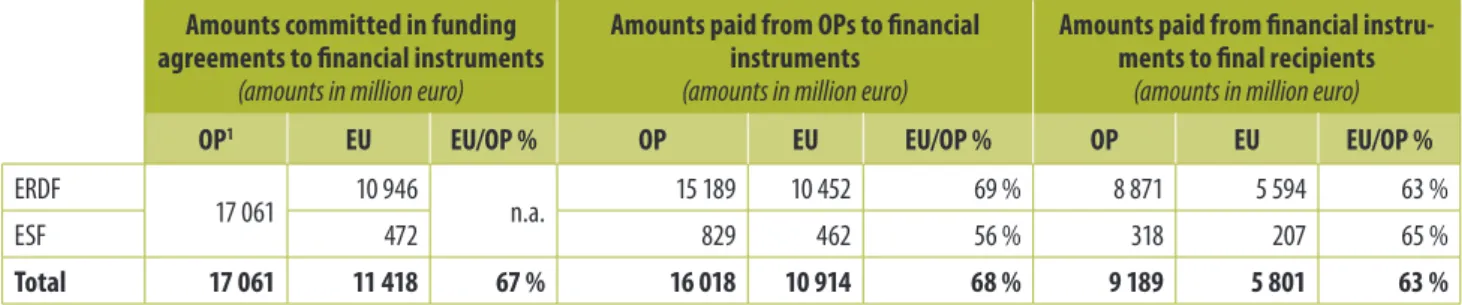
More information on the European Union is available on the internet (http://europa.eu). Luxembourg: Publications Office of the European Union, 2016
Print ISBN 978-92-872-5417-7 ISSN 1831-0834 doi:10.2865/66662 QJ-AB-16-019-EN-C
PDF ISBN 978-92-872-5399-6 ISSN 1977-5679 doi:10.2865/98596 QJ-AB-16-019-EN-N
EPUB ISBN 978-92-872-5414-6 ISSN 1977-5679 doi:10.2865/617611 QJ-AB-16-019-EN-E
© European Union, 2016
Implementing the EU
budget through financial
instruments — lessons to
be learnt from the
2007-2013 programme period
(pursuant to Article 287(4), second subparagraph, TFEU)Special Report
EN
2016
NO02
Audit team
The ECA’s special reports set out the results of its performance and compliance audits of specific budgetary areas or management topics. The ECA selects and designs these audit tasks to be of maximum impact by considering the risks to performance or compliance, the level of income or spending involved, forthcoming developments and political and public interest.
This performance audit was produced by Audit Chamber II — headed by ECA Member Henri Grethen — which spe-cialised in structural policies, transport and energy spending areas. The audit was led by the Reporting Member Iliana Ivanova, supported by Tony Murphy, Head of Private Office and Mihail Stefanov, Attaché; Niels-Erik Brokopp, Principal Manager; Rares Rusanescu, Head of Task; and Agathoclis Argyrou, Marcel Bode, Viorel Cirje and Maria Ploumaki, Auditors.
03
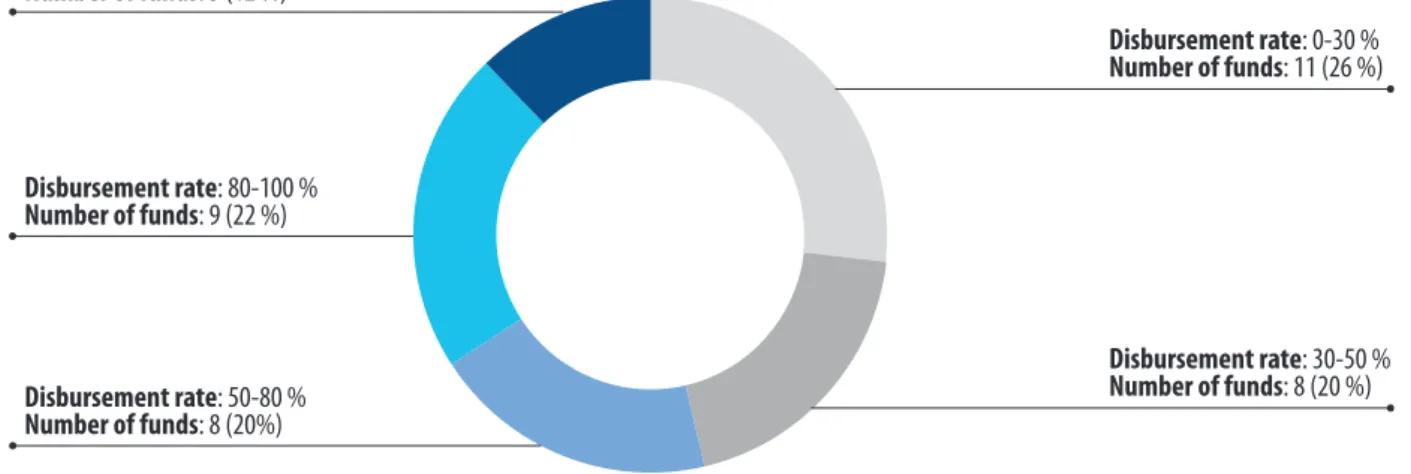
Contents
Paragraph
Abbreviations
Glossary
I-VIII
Executive summary
1-22Introduction
1-4 What are financial instruments?
5-22 Use of financial instruments in implementing the EU budget since 2007
23-26
Audit scope and approach
27-146Observations
27-61 Were financial instruments appropriately sized in view of market needs?
29-45 Excessive capital endowment led to low disbursement rates, avoidance of de-commitment and potential reimbursement at closure
46-54 Market needs were not always properly assessed by managing authorities before funds were allocated to ERDF and ESF financial instruments
55-61 Regional focus contributed to Member States setting up a large number of small-sized financial instruments in the 2007-2013 programme period
62-91 Did financial instruments succeed in attracting private capital?
64-72 Commission’s measure of leverage for financial instruments does not properly take into account the extent to which public financing mobilises additional funds
73-91 Difficulties of attracting private-sector investors to financial instruments in both shared and central management
04
Contents
92-105 Were financial instruments providing revolving financial support?
93-95 Delays in the implementation significantly shortened the actual investment period of several ERDF and ESF financial instruments
96-105 Limited revolving effect of ERDF and ESF financial instruments during implementation and uncertain after closure of the 2007-2013 programmes
106-146 Did financial instruments prove to be a cost-efficient method to implement the EU budget? 108-110 High level of management costs and fees compared to actual level of disbursement to final recipients
111-120 No reimbursement from the EU budget of management costs and fees above the regulatory ceilings at closure
121-131 Commission’s assessment of management costs and fees does not take due account of differences in types of instruments and actual level of support provided to final recipients
132-141 Limitations in reporting of management costs and fees by Member States
142-146 Management costs and fees are incurred in addition to the administrative cost of implementing ERDF and ESF OPs
147-163
Conclusions and recommendations
Annex I — Financial instruments in shared management — how do they work (2014-2020
programme period)
Annex II — Definition of the term ‘financial instruments’ in the legal basis (2014-2020 and 2007 -2013 programme period)
Annex III — Overview of the ERDF financial instruments in the 28 EU Member States: number of funds and endowment (2007-2013 programme period)
Annex IV — Overview of the ESF financial instruments in the 28 EU Member States: number of funds and endowment (2007-2013 programme period)
Annex V — Summary of ex ante assessment requirements (2014-2020 programme period)
Reply of the Commission
Reply of the Marguerite Fund
05
Abbreviations
CEF: Connecting Europe Facility
CF: Cohesion Fund
COCOF: Coordination Committee of the Funds
CPR: common provisions regulation
EAFRD: European Agricultural Fund for Rural Development
EaSI: European Union programme for employment and social innovation
EEEF: European Energy Efficiency Fund
EEPR: programme to aid economic recovery by granting Community financial assistance to projects in the field of energy
EFF: European Fisheries Fund
EFSI: European Fund for Strategic Investments
Egesif: Expert Group on European Structural and Investment Funds
EIB: European Investment Bank
EIF: European Investment Fund
EPMF: European Progress Microfinance Facility for employment and social inclusion
ERDF: European Regional Development Fund
ESF: European Social Fund
ESIF: European Structural and Investment Funds
GBER: general block exemption regulation
Jeremie: Joint European Resources for Micro to Medium Enterprises
LGTT: Loan Guarantee Instrument for Trans-European Transport Network Projects
Marguerite Fund: The 2020 European fund for Energy, Climate Change and Infrastructure
06
Abbreviations
OP: operational programme
PBI: project bond initiative
PFLP: portfolio first loss piece
SICAV: Société d’investissement à capital variable
SICAR: Société d’investissement en capital à risque
SMEs: small and medium-sized enterprises
SoA: statement of assurance
TEN-E/T: trans-European networks — energy/transport
07
Glossary
Capital endowment refers to the amount of funding paid to a financial instrument (from the EU budget, the
national budget or private investors) to support its operations. It should reflect its capacity for investment and be commensurate to the market that the instrument targets.
CEF regulation: Regulation (EU) No 1316/2013 of the European Parliament and of the Council of 11 December 2013
establishing the Connecting Europe Facility, amending Regulation (EU) No 913/2010 and repealing Regulations (EC) No 680/2007 and (EC) No 67/20101.
Cohesion policy in the 2007-2013 programme period covered the European Regional Development Fund and the
European Social Fund (i.e. the two Structural Funds) and the Cohesion Fund. In the 2014-2020 programme period, the coordination between cohesion policy and the other EU policies contributing to regional development, namely rural development and fisheries and maritime policy, was improved by the establishment of common provisions for the European Structural and Investment Funds.
The Coordination Committee of the Funds (COCOF) is a standing monitoring committee of the Commission. Its
function is to discuss issues relating to the implementation of the regulations governing the European Regional Development Fund, European Social Fund and Cohesion Fund.
Common provisions regulation (CPR) for the 2014-2020 period: Regulation (EU) No 1303/2013 of the European
Parliament and of the Council of 17 December 2013 laying down common provisions on the European Regional Development Fund, the European Social Fund, the Cohesion Fund, the European Agricultural Fund for Rural Development and the European Maritime and Fisheries Fund and laying down general provisions on the European Regional Development Fund, the European Social Fund, the Cohesion Fund and the European Maritime and Fisheries Fund and repealing Council Regulation (EC) No 1083/20062.
A contingent credit line is a credit line which could be drawn provided that a previously defined event occurred.
Delegated regulation: Commission Delegated Regulation (EU) No 480/2014 of 3 March 2014 supplementing
Regulation (EU) No 1303/2013 of the European Parliament and of the Council laying down common provisions on the European Regional Development Fund, the European Social Fund, the Cohesion Fund, the European Agricultural Fund for Rural Development and the European Maritime and Fisheries Fund and laying down general provisions on the European Regional Development Fund, the European Social Fund, the Cohesion Fund and the European Maritime and Fisheries Fund3.
The European Fund for Strategic Investments (EFSI) aims to mobilise at least 315 billion euro in private and
public long-term investment across the EU over the 2015-2017 period, and to guarantee the funding of projects in subsequent years. The EFSI is established within the European Investment Bank (EIB) as a trust fund with unlimited duration to finance riskier parts of projects. A guarantee of up to 16 billion euro, backed by the EU budget, will compensate for the additional risk taken by the EIB. Member States can contribute additional funds to the EFSI.
1 OJ L 348, 20.12.2013, p. 129. 2 OJ L 347, 20.12.2013, p. 320. 3 OJ L 138, 13.5.2014, p. 5.
08
Glossary
The Expert Group on European Structural and Investment Funds (Egesif) was created in the Commission
with the aim of providing advice to the Commission on issues in relation with the implementation of programmes adopted and implemented in accordance with the European Structural and Investment Funds regulations. It is one of the two groups replacing the Coordination Committee of the Funds (the second one being Coesif — Coordination Committee for European Structural and Investment Funds).
The aim of the European Regional Development Fund (ERDF) is to reinforce economic and social cohesion within the European Union by redressing the main regional imbalances through financial support for the creation of infrastructure and productive job-creating investments, mainly for businesses.
The aim of the European Social Fund (ESF) is to strengthen economic and social cohesion within the European Union by improving employment and job opportunities, mainly through training measures, encouraging a higher level of employment and the creation of more and better jobs.
The European Structural and Investment Funds (ESIF) cover five separate funds that aim to reduce regional
imbalances across the Union during the 2014-2020 programme period. The funds include: the European Regional Development Fund; the European Social Fund; the Cohesion Fund; the European Agricultural Fund for Rural Development; and the European Maritime and Fisheries Fund.
Equity investment means the provision of capital to a firm, invested directly or indirectly in return for total or
partial ownership of that firm and where the equity investor may assume some management control of the firm and may share the firm’s profits.
A financial intermediary is an entity acting as an intermediary between the managing authority or the holding
fund and the final recipients of funds channelled through financial instruments in shared management.
A final recipient is any legal or natural person, other than a holding fund or financial intermediary, receiving
funding from a financial instrument.
Financial regulation: Regulation (EU, Euratom) No 966/2012 of the European Parliament and of the Council
of 25 October 2012 on the financial rules applicable to the general budget of the Union and repealing Council Regulation (EC, Euratom) No 1605/20024.
General regulation for the 2007-2013 programme period: Council Regulation (EC) No 1083/2006 of 11 July 2006
laying down general provisions on the European Regional Development Fund, the European Social Fund and the Cohesion Fund and repealing Regulation (EC) No 1260/19995.
4 OJ L 298, 26.10.2012, p. 1. 5 OJ L 210, 31.7.2006, p. 25.
09
Glossary
A guarantee is a commitment by a third party, called the guarantor, to pay the debt of a borrower when the latter
cannot pay it themselves. The guarantor is liable to cover any shortfall or default on the borrower’s debt under the terms and conditions as stipulated in the agreement between the guarantor, the lender and/or the borrower.
A guarantee cap rate is a percentage of a total loan portfolio value actually covered by the guarantee.
A holding fund is a fund set up to invest in several venture capital funds, guarantee funds, loan funds, urban
development funds, funds or other incentive schemes providing loans, guarantees for repayable investments, or equivalent instruments, for energy efficiency and use of renewable energy in buildings, including in existing housing.
The hurdle rate is the minimum rate of return on a project or investment required by a manager or investor.
Implementing regulation: Commission Regulation (EC) No 1828/2006 of 8 December 2006 setting out rules for
the implementation of Council Regulation (EC) No 1083/2006 and of Regulation (EC) No 1080/2006 of the European Parliament and of the Council on the European Regional Development Fund6.
Joint European Resources for Micro to Medium Enterprises (Jeremie) is an initiative of the Commission
developed together with the European Investment Fund. It promotes the use of financial engineering instruments to improve access to finance for SMEs through the Structural Funds.
Legacy funding is the part of the capital endowment which reached the final recipients, was subsequently
returned to the financial instrument and it is thus available for a new round of investments.
A loan means an agreement which obliges the lender to make available to the borrower a sum of money for the agreed amount and time. The borrower is obliged to repay the loan after a certain period. Usually the borrower is obliged to pay interest on the loan amount.
A managing authority is a national, regional or local public authority, or any other public or private body, which
has been designated by a Member State to manage an operational programme. Its tasks include selecting projects to be funded, monitoring how projects are implemented and reporting to the Commission on financial aspects and results achieved.
An operational programme (OP) sets out a Member State’s priorities and specific objectives and how funding
will be used during a given period, generally 7 years, to finance projects. These projects must contribute to
achieving one or more of a certain number of objectives specified at the level of the OP’s priority axis. Programmes have to be in place for each of the funds in the area of cohesion policy, i.e. the European Regional Development Fund, European Social Fund or Cohesion Fund. OPs are prepared by Member States and must be approved by the Commission before any payments from the EU budget can be made. They can only be modified during the period covered if both parties agree.
Portfolio first loss piece (PFLP): when a portfolio of loans is divided in several risk tranches, the PFLP is the tranche
which absorbs the first losses of the portfolio (which could be for example the result of loan defaults).
10
Glossary
Priority axis: one of the priorities of the strategy in an operational programme comprising a group of operations
which are related and have specific measurable goals.
A Société d’investissement en capital à risque (SICAR) is a structure designed for private equity and venture
capital investments with no investment diversification rules, nor lending or leverage restrictions.
A Société d’investissement à capital variable (SICAV) is a type of open-ended investment fund for which the
value of its capital changes based the number of investors and on the value of its underlying investments. Shares in the fund are bought and sold based on the fund’s latest net asset value.
Specific funds are funds which are not holding funds.
State aid is any form of direct or indirect financial support provided by public authorities to private-sector
undertakings. The Treaty on the Functioning of the European Union (TFEU) generally prohibits state aid within the common market unless it is duly justified. The EU State aid rules set out when this support does not distort (or does not threaten to distort) competition. The European Commission has the exclusive competence to assess the compatibility of state aid granted by Member States with these rules. Procedural decisions and actions taken by the European Commission are subject to review by the Court of Justice of the European Union and the General Court.
11
Executive
summary
I
The European Union is currently facing serious challenges such as the economic and financial recovery and the management of the refugee crisis. Therefore, the EU’s decision-makers are seeking ways to maximise the effect-iveness and efficiency of the available EU budget, which accounts for less than 1 % of the EU’s gross domestic product (GDP).
II
Financial instruments are a delivery tool to provide financial support from the EU budget. Financial support provided to final recipients through financial instruments may take the form of loans, guarantees and equity investments.
III
If properly implemented, financial instruments provide two specific benefits compared to grants:
— the possibility of leveraging the public funds (i.e. mobilising additional private and public funds to complement the initial public funding); and
— the revolving nature of their capital endowment (i.e. the use of the same funds in several cycles).
The fact that loans have to be paid back and guarantees have to be released or, in the case of equity investments, returned should in principle also have an impact on the behaviour of final recipients, leading to the better use of public funds and reducing the likelihood that the final recipients will become dependent on public support.
IV
During the 2007-2013 programme period financial instruments set up under the European Regional Development Fund (ERDF) and the European Social Fund (ESF) were used by 25 out of 28 EU Member States: in total, 972 ERDF and 53 ESF financial instruments were set up across the EU. By the end of 2014, around 16 billion euro had been paid as contributions from the ERDF and ESF operational programmes (OPs) to these instruments. This represents a signifi-cant increase compared to around 1.3 billion in the 2000-2006 programme period and 0.6 billion euro in the 1994-1999 programme period allocated to such instruments. During the same period, 2007-2013, the overall contribution from the EU budget to the 21 financial instruments managed directly or indirectly by the Commission was about 5.5 billion euro. These centrally managed financial instruments operate across all EU Member States.
12
Executive summary
V
Through this audit, we examined whether financial instruments were an efficient mechanism to implement the EU budget during the 2007-2013 programme period. Our audit was carried out between October 2014 and March 2016 and focused on the areas of regional, social, transport and energy policy. Our analysis covers all 1 025 ERDF and ESF financial instruments set up during the 2007-2013 programme period under shared management, as well as six centrally managed financial instruments in these areas. The data presented in this report are based on the latest available information provided by the Commission in September 2015 reflecting the situation at the end of 2014.
VI
Our audit identified a number of significant issues that limited the efficiency of financial instruments as a mechan-ism to implement the EU budget during the 2007-2013 programme period.
— A significant number of ERDF and ESF financial instruments were oversized and, by the end of 2014, continued to face significant problems in disbursing their capital endowments (on average, around 57 % of all capital en-dowment paid from the OPs to the financial instruments had been used). A contributing factor to the excessive initial capital endowments was the Member States’ intention to avoid de-commitments throughout the 2007-2013 programme period.
— Overall, financial instruments in both shared and central management were not successful in attracting private capital.
— So far, only a limited number of ERDF and ESF financial instruments have been successful in providing revolving financial support.
— For ERDF and ESF financial instruments, high levels of management costs and fees compared to the actual fi-nancial support to final recipients which also appear to be significantly higher than those of centrally managed instruments or private-sector investment funds.
VII
At the same time, we also note that improvements were made in the legal framework for the 2014-2020 programme period as regards financial instruments based on the expertise gained during the 2007-2013 programme period, but certain issues remain.
13
Executive summary
VIII
In our report, we recommend that
— The Commission’s ex ante assessment for centrally managed instruments should systematically include an analysis of the ‘lessons learnt’ to date.
— The Commission, in addition to the ‘lessons learnt’, should also assess the effect of major socioeconomic changes on the rationale of the instrument and the corresponding contribution required from the EU budget in the context of their respective mid-term reviews for all centrally managed financial instruments.
— The Commission and the Member States should aim at optimising the size of specific ERDF and ESF funds to take, wherever possible, advantage of the significant economies in the cost of operating funds. Additional guid-ance should be provided to Member States on how to set up such financial instruments within Member States or at Union level (which are managed directly or indirectly by the Commission).
— The Commission should provide in the financial regulation (and subsequently in sectorial regulations) a defin-ition for the leverage of financial instruments applicable across all areas of the EU budget, which clearly distin-guishes between the leverage of private and national public contributions under the OP and/or of additional private or public capital contributions, and takes into account the type of instrument involved.
— For ERDF and ESF financial instruments under the 2007-2013 programme period, the Commission should ensure at closure that Member States provide complete and reliable data on private contributions on capital endow-ments, both through the OPs and in addition to them.
— For ERDF and ESF financial instruments, the Commission should provide additional guidance to Member States on how best to apply the provisions on preferential treatment to attract more private capital without allocating excessive risks to public contributors to the financial instruments’ endowments.
— For centrally managed financial instruments, the general risk-sharing principles which may have an impact on the EU budget should be defined in the legislation governing the instrument concerned.
— For all financial instruments funded from the EU budget during the 2014-2020 programme period, the Commis-sion should ensure that only structures which are in line with its own recommendations and actions with regard to tax arrangements are implemented by Member States, the Commission itself and the EIB group.
— The Commission should take appropriate measures to ensure that Member States maintain the revolving nature of the funds during the required 8-year period after the end of the eligibility period for the 2014-2020 pro-gramme period.
14
Executive summary
— The Commission should provide guidance in respect of the provisions allowing financial instruments to con-tinue to be used into the following programme period, in particular for cases where fund managers are selected on the basis of public procurement.
— The Commission should ensure that Member States report comprehensive information on management costs and fees incurred and paid by March 2017 in view of the upcoming closure of the 2007-2013 programme period. — The Commission should clarify that the ceilings for management costs and fees need to be applied to the actual
capital endowment used by the financial instrument, i.e. the contribution from the OP that has been used to provide financial support to final recipients.
— As regards the performance-based remuneration of fund managers in the 2014-2020 programme period the Commission should make a legislative proposal aiming at a revision of the existing provisions in the common provisions regulation (CPR) to strengthen the incentive effect of these arrangements.
— Member States’ managing authorities should make extensive use of the existing performance-based elements of the remuneration for fund managers when negotiating funding agreements.
— The Commission should carry out a comparative analysis of the implementation costs of grants and repayable financial support, mainly through financial instruments, for the 2014-2020 programme period with a view to establishing their actual levels. Such information would be particularly relevant for preparing legislative propos-als for the post-2020 period and determining an adequate level of technical assistance.
15
Introduction
What are financial instruments?
01
The European Union is currently facing serious challenges such as the economic and financial recovery and the management of the refugee crisis. Therefore, the EU’s decision-makers are seeking ways to maximise the effectiveness and ef-ficiency of the available EU budget, which accounts for less than 1 % of the EU’s gross domestic product (GDP).
Financial instruments7 are a delivery tool to provide financial support from the EU
budget through loans, guarantees and equity (or quasi-equity) investments for the implementation of projects (see Table 1)8.
Annex I provides an illustration of how the different types of financial instruments operate.
7 During the 2007-2013 programme period, the legislation governing the ERDF and the ESF made reference to ‘financial engineering instruments’. In this report, the terms ‘financial engineering instrument’ and ‘financial instrument’ are used synonymously.
8 According to International Accounting Standard 32, a financial instrument is ’[…] any contract that gives rise to a financial asset of one entity and a financial liability or equity instrument of another entity.
Ta
bl
e 1
Main types of financial instruments supported by the EU budget
Source: European Commission and EIB, FI Compass — Financial instrument products: Loans, guarantees, equity and quasi‑equity, p. 3.
Loan
‘Agreement which obliges the lender to make available to the borrower an agreed sum of money for an agreed period of time and under which the borrower is obliged to repay that amount within the agreed time’. Under a financial instrument, a loan can help where banks are unwilling to lend on terms acceptable to the borrower. They can offer lower interest rates, longer repayment periods or have lower collateral requirements.
Equity
‘Provision of capital to a firm, invested directly or indirectly in return for total or partial ownership of that firm and where the equity investor may assume some management control of the firm and may share the firm’s profits’.
The financial return depends on the growth and profitability of the business. It is earned through dividends and on the sale of the shares to another investor (‘exit’), or through an initial public offering (IPO).
Guarantee
‘Written commitment to assume responsibility for all or part of a third party’s debt or obligation or for the successful performance by that third party of its obligations if an event occurs which triggers such guarantee, such as a loan default*’.
Guarantees normally cover financial operations such as loans.
* European Commission (2015). Guidance for Member States on Financial Instruments – Glossary.
Quasi-equity
‘A type of financing that ranks between equity and debt, having a higher risk than senior debt and a lower risk than common equity.
Quasi equity investments can be structured as debt, typically unsecured and subordinated and in some cases convertible into equity, or as preferred equity’.
The risk return profile typically falls between debt and equity in company’s capital structure.
16
Introduction
02
Compared to grants (which are the traditional way of providing funding from the EU budget), financial instruments, if properly implemented, can provide two specific benefits:
ο the possibility of leveraging the public funds (i.e. mobilising additional pri-vate and public funds to complement the initial public funding); and
ο the revolving nature of their capital endowment (i.e. the use of the same funds in several cycles) allows each euro of funding through financial instru-ments in principle to be used more than once.
03
The fact that loans have to be paid back and guarantees have to be released or, in the case of equity investments, returned should in principle also have an impact on the behaviour of final recipients, leading to the better use of public funds and reducing the likelihood that the final recipients will become dependent on public support.
04
A common definition for financial instruments was first provided in the revision of the financial regulation in 2012; this definition has since been applied in the sectorial regulations for the 2014-2020 programme period (see Annex II).
Use of financial instruments in implementing the EU
budget since 2007
Use of financial instruments funded from the EU budget
05
The EU budget can be implemented through shared management (i.e. in cooper-ation with Member States such as in cohesion policy), through direct manage-ment (i.e. by its departmanage-ments or through executive agencies) or through indirect management (i.e. by entrusting budget implementation tasks to third countries or to different entities)9. The latter two are collectively referred to as centralised
management.
9 Article 58 of the financial regulation.
17
Introduction
06
Financial instruments are used in different parts of the EU budget:
ο Shared management financial instruments in the area of cohesion are set up mainly under the European Regional Development Fund (ERDF), and to a lesser extent under the European Social Fund (ESF). Since the 2014-2020 programme period, financial instruments can also be used for the Cohesion Fund (CF). Each instrument has to be implemented within the framework of an operational programme (OP), which is decided by the managing authori-ties responsible for that programme, together with its size and design10.
Financial instruments are also used under the European Agricultural Fund for Rural Development (EAFRD) and the European Fisheries Fund (EFF).
ο Centrally managed financial instruments are financed from various budget-ary areas such as research, enterprise and industry, education and culture, etc. For these instruments the Commission, together with its partners, is directly involved in their design and in developing their investment strategy and endowment. The decision to set up these instruments is taken by the budgetary authorities (i.e. the European Parliament and the Council) on the basis of a Commission proposal.
Rules for selecting the fund manager of financial instruments
07
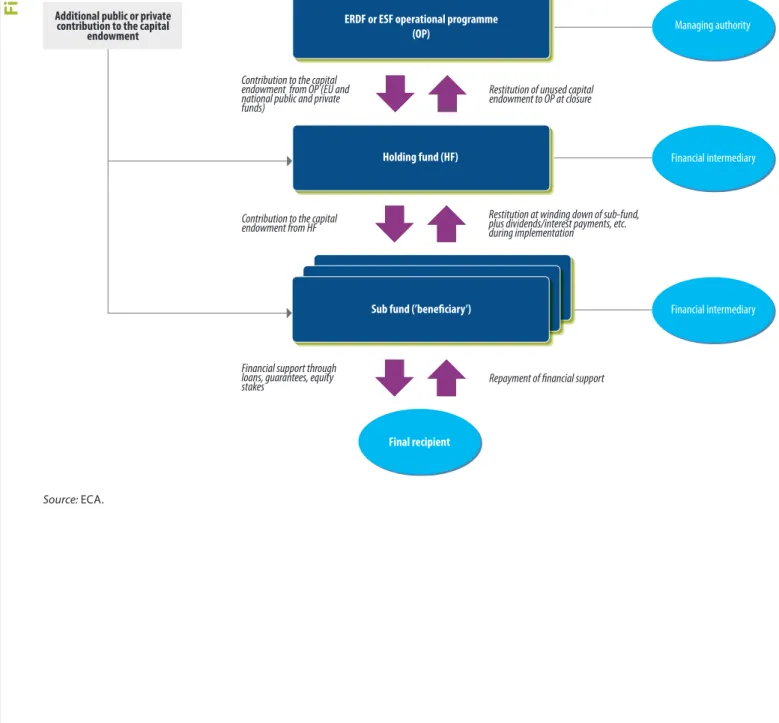
In shared management, financial instruments can be set up as standalone funds or as sub-funds of a holding fund, later referred to as specific funds (see Figure 1). A holding fund, sometimes also referred to as a ‘fund of funds’, is a fund set up with the objective of managing different types of instruments. It also allows making contributions from one or more OPs to one or several finan-cial instruments.
08
Financial instruments are generally managed by private- or public-sector banks or other financial intermediaries rather than public administrations. For ERDF and ESF instruments, the selection of a fund manager has to comply with EU and na-tional public procurement rules if the management of the fund is tendered out. In situations where public procurement rules do not apply (i.e. in case the fund management contract is not a public service contract), the managing authority can designate the fund manager subject to complying with the relevant State aid rules (see paragraphs 10 to 12).
09
The EIB group (which comprises the European Investment Fund (EIF) and the Eu-ropean Investment Bank (EIB)) benefits from a special status since they can be ap-pointed as fund managers without a public procurement proced ure11. They also
manage most of the centrally managed instruments for which the fund manager is designated in the legislative proposal.
10 European Parliament, Directorate-General for Internal Policies, Financial engineering instruments in cohesion policy — Study, 2013, p. 46.
11 Article 44(c) of the general regulation.
18
Introduction
Source: ECA.Fi
gu
re
1
Simplified overview of a holding fund structure for ERDF or ESF financial
instruments
Additional public or private contribution to the capital
endowment
Contribution to the capital endowment from OP (EU and national public and private funds)
Contribution to the capital endowment from HF
Financial support through loans, guarantees, equity
stakes Repayment of financial support
Restitution at winding down of sub-fund, plus dividends/interest payments, etc. during implementation
Restitution of unused capital endowment to OP at closure
Final recipient
Financial intermediary Financial intermediary Managing authority
Sub fund (’beneficiary’) Holding fund (HF) ERDF or ESF operational programme
19
Introduction
Financial instruments and the EU State aid rules
10
EU funds under shared management are considered part of the national or re-gional budgets and as such are potentially subject to State aid control. When im-plementing the financial instrument, managing authorities must therefore ensure compliance with State aid rules12. The relevant State aid rules are contained in
the new general block exemption regulation (GBER)13 and the Commission’s new
guidelines for risk finance14, which both came into effect in July 2014.
11
For each ERDF and ESF financial instrument, the managing authority has to pro-vide epro-vidence that it is either15:
ο conforming with normal market practice (which in practice means that the management of the fund has been selected following an open, transparent and non-discriminatory process); or
ο covered by the de minimis regulation16; or
ο an exempted aid, because it falls under the GBER or falls under a notified aid scheme in accordance with the Commission’s guidelines for risk finance.
12
Centrally managed financial instruments (which do not use national or regional resources, and thus are not part of Member State budgets) fall outside of the scope of the EU’s State aid rules, because the main condition of Article 107 TFEU ‘[…] granted by a Member State or through state resources’ is not fulfilled.
Background information on the number of financial instruments
and their capital endowment since 2007
2007-2013 programme period
13
During the 2007-2013 programme period financial instruments were used by 25 out of 28 EU Member States. Only Croatia, Ireland and Luxembourg did not use this funding mechanism17. Annex III and IV give an overview of the ERDF and ESF
instruments per Member State.
12 Article 37(1) of the common provision regulation (CPR): ‘When applying this Title (Title IV, Financial Instruments), the managing authorities, the bodies implementing funds of funds, and the bodies implementing financial instruments shall comply with applicable law, in particular on State aid and public
procurement.’
13 Commission Regulation (EU) No 651/2014 of 17 June 2014 declaring certain categories of aid compatible with the internal market in application of Articles 107 and 108 of the Treaty (OJ L 187, 26.6.2014, p. 1).
14 European Commission, ‘Guidelines on State aid to promote risk finance investments’ (OJ C19, 22.1.2014, p. 4). 15 Article 37 of the CPR. 16 Council Regulation (EU)
2015/1588 of 13 July 2015 on the application of Articles 107 and 108 of the Treaty on the Functioning of the European Union (TFEU) to certain categories of horizontal State aid (codification) (OJ L 248, 24.9.2015, p. 1).
17 Nevertheless, centrally managed financial
instruments have been set-up in Luxembourg. Moreover they have provided EU financing to projects in Ireland and Croatia.
20
Introduction
Ta
bl
e 2
Implementation of ERDF and ESF financial instruments (2007-2013)
as of 31 December 2014
Amounts committed in fundingagreements to financial instruments (amounts in million euro)
Amounts paid from OPs to financial instruments
(amounts in million euro)
Amounts paid from financial instru‑ ments to final recipients
(amounts in million euro)
OP1 EU EU/OP % OP EU EU/OP % OP EU EU/OP %
ERDF
17 061 10 946 n.a. 15 189 10 452 69 % 8 871 5 594 63 %
ESF 472 829 462 56 % 318 207 65 %
Total 17 061 11 418 67 % 16 018 10 914 68 % 9 189 5 801 63 %
Source: ECA, based on the most recent Commission data as of September 20152.
1 For the OP amounts committed no separation between ERDF and ESF financial instruments is presented in the Commission’s implementation report.
2 EGESIF_15-0027-00, ‘Summary of data on the progress made in financing and implementing financial engineering instruments reported by the managing authorities in accordance with Article 67(2)(j) of Council Regulation (EC) No 1083/2006 — Programme period 2007-2013 — Situation as at 31 December 2014’, pp. 21 and 54.
14
As shown in Table 2, by the end of 2014 around 15.2 billion euro had been paid as ERDF OP contributions and 0.8 billion euro through ESF OP contributions. This represents a significant increase compared to around 1.3 billion in the 2000-2006 programme period and 0.6 billion euro in the 1994-1999 programme period18.
15
During the 2007-2013 programme period, the EU contribution paid to financial instruments corresponded to 5 % of the total EU funding for the ERDF and 1 % of the total EU funding for the ESF for the entire period. The EU budget accounted for 69 % and 56 % of the total contribution to the capital endowments of the ERDF and ESF 2007-2013 financial instruments, respectively (see Table 2). In terms of financial support for the final recipient, the EU contribution accounted for 63 % (ERDF) and 65 % (ESF).
18 European Commission and EIB, FI Compass — Financial instruments: A sustainable way of achieving EU economic and social objectives, p. 3.
21
Introduction
Ta
bl
e 3
16
According to the latest data reported by the Commission, 972 ERDF financial instruments and 53 ESF instruments had been set up across the EU. Out of these, 903 are specific ERDF funds and 49 are specific ESF funds (see Table 3). 31 of the ERDF instruments are managed by the EIB group (see paragraph 9).
17
In addition, there were 14 instruments funded through the EAFRD and 6 instru-ments funded by the EFF. For the 2007-2013 programme period, these two funds did not require Member States to report on financial instruments, so there are no official data in this respect19. However, based on data compiled by the Court, at
the end of 2013 the capital endowment of funds co-financed by the EAFRD can be estimated at around 700 million euro, and around 72 million euro for the EFF (in both cases including the national contributions to the programmes).
19 See Special Report No 5/2015,
Are financial instruments a successful and promising tool in the rural development area?, paragraph 82
(http://eca.europa.eu).
ERDF and ESF financial instruments per type of specific fund (2007-2013)
as of 31 December 2014
ERDF ESF
Number of
funds (in million euro)Endowment Number of funds (in million euro)Endowment Specific funds, out of which:
— loan instruments 371 5 637 31 417
— guarantee instruments 171 2 215 7 196
— equity instruments 162 2 006 1 70
— mixed instruments (combination of loans,
guarantees, equity or other instruments) 110 2 496 5 59
— other instruments 6 65 0 0
— type not reported 83 770 5 74
Total 903 13 189 49 816
22
Introduction
18
For the centrally managed instruments, the EU’s overall contribution allocated to 2007-2013 instruments in all budgetary areas was about 5.5 billion euro20, spread
over 21 financial instruments21. These instruments operate across all EU Member
States.
2014-2020 programme period
19
Within the EU budget, the European Structural and Investment Funds (ESIFs) are the main source of funding for capital investment and infrastructure, with a total budget of around 450 billion euro for the 2014-2020 programme period.
20
Since 2011 the European Parliament and European Council has encouraged an in-creased use of financial instruments22. This political commitment is also reflected
in the common provisions regulation (CPR) which provides for an extended use of financial instruments to deliver all five ESIFs (i.e. also the Cohesion Fund) and all thematic objectives for the programmes23.
21
At the end of 2015 the Commission estimated that, for the 2014-2020 programme period as a whole, approximately 21 billion euro will be allocated to financial in-struments from the five ESIFs24. Since the average EU contribution to the total
en-dowments of such instruments for the 2007-2013 programme period was around 68 % by the end of 201425, we estimate that the 21 billion euro amount coming
from the EU budget will probably correspond to approximately 31 billion euro in total allocations (not taking account of additional national and private financing that may be provided to the funds outside the ESIF programmes).
22
In comparison, the European Fund for Strategic Investments (EFSI) aims to mobil-ise at least 315 billion euro in private and public long-term investment across the EU over the period from 2015 to 2017 and the funding of projects in subsequent years.
20 COM(2015) 565 final of 13 November 2015, ‘Report from the Commission to the European Parliament and the Council on financial instruments supported by the general budget according to Article 140.8 of the financial regulation as at 31 December 2014’, p. 4. 21 SWD(2015) 206 final of 13 November 2015, ‘Activities relating to financial instruments’, pp. 6-12. 22 European Parliament,
‘5th cohesion report and strategy for the post-2013 cohesion policy’; EUCO 169/13, Conclusions of the European Council, 25 October 2013, p. 10.
23 Regulation (EU) No 1303/2013. 24 European Parliament and
Commission, ‘The 2014 budgetary discharge to the Commission — Answers to the European Parliament’s written questions to Commissioner Crețu’, hearing on 7 December 2015, p. 34. 25 EGESIF_15-0027-00, ‘Summary
of data on the progress made in financing and
implementing financial engineering instruments reported by the managing authorities in accordance with Article 67(2)(j) of Council Regulation (EC) No 1083/2006 — Programme period 2007-2013 — Situation as at 31 December 2014’, pp. 21 and 54.
23
Audit scope
and approach
23
Through this audit, the Court examined whether financial instruments were an efficient mechanism to implement the EU budget during the 2007-2013 pro-gramme period. In that context our report addresses the following main audit questions:
ο were financial instruments appropriately sized in view of market needs?
ο did financial instruments succeed in attracting private capital?
ο were financial instruments providing revolving financial support?
ο did financial instruments prove to be a cost-efficient method to implement the EU budget?
For each of these questions, we examined which lessons could be learnt from the main shortcomings identified. We also assessed to what extent they had been ad-dressed in the regulations applicable to the 2014-2020 programme period.
24
Our audit covers the period from 2009 to 2015. We focused on the areas of regional, social, transport and energy policy. In particular, our review covers all ERDF and ESF financial instruments, as well as six centrally managed financial instruments in the areas of social, transport and energy policy. Several issues identified in this report may, however, also affect other areas of the EU budget where such instruments are used.
25
The audit work consisted of the following elements:
ο a review of various Commission, EIB, EIF and third-party analyses and publications.
ο the analysis of the most recent annual monitoring report published by the Commission in September 2015, covering all 1 025 ERDF and ESF financial instruments. This analysis, based on data reported by the Commission in November 2015, was also made for six26 of the 21 instruments under central
management (accounting for an EU contribution of 789 million euro, or 14 % of the total amount of all 21 instruments)27.
ο an examination of 10 case studies of financial instruments implemented in the area of the EU budget covered by this report28, including a field visit to
one Member State (Slovakia).
26 One of these six financial instruments, the 2020 European Fund for Energy, Climate Change and Infrastructure (Marguerite Fund), is managed under the direct management mode (see paragraph 6). 27 European Commission,
SWD(2015) 206 final, ‘Summary of data on the progress made in financing and implementing financial engineering instruments reported by the managing authorities in accordance with Article 67(2)(j) of Council Regulation (EC) No 1083/2006 — Programme period 2007-2013 — Situation as at 31 December 2014’, Brussels, September 2015.
28 Loan Guarantee Instrument for Trans-European Transport Network Projects (LGTT), Project Bond Initiative (PBI), Marguerite Fund, European Energy Efficiency Fund (EEEF), European Progress
Microfinance Facility (EPMF), Jessica Greece, Jeremie Slovakia, Entrepreneurship Fund Greece, Venture Finance Hungary (Jeremie Hungary), Jeremie Sicily.
24
Audit scope and approach
ο a follow-up review of 45 financial instruments audited in compliance audits carried out by the Court since 2009 (whose results were previously reported in our annual reports) and 54 financial instruments examined by our perform-ance audits since 2012.
ο a survey of 85 managing authorities and fund managers involved in the implementation of financial instruments. Out of the 85 entities surveyed, 82 relate to ERDF and ESF instruments under shared management and three to centralised management. There were 66 replies for shared management instruments and two for centrally managed ones.
ο interviews with more than 40 officials from the Commission, the EIB and the EIF and more than 10 experts from organisations with expertise in the field29.
26
The Court has already carried out numerous examinations of the use of finan-cial instruments, and has reported since 2011 on the findings in several annual reports30 and special reports31. Moreover, the Commission itself, but also the EIB,
the EIF, the European Parliament, national audit bodies and private-sector fund managers, have identified a number of issues in recent years which collectively limited the effectiveness of financial instruments during the 2007-2013 pro-gramme period. This report builds also on these assessments.
29 Caisse des Dépôts, Kreditanstalt für
Wiederaufbau (KfW) and the OECD.
30 Paragraphs 4.30 to 4.36 of the 2010 annual report (OJ C 326, 10.11.2011); paragraph 5.34 of the 2011 annual report (OJ C 344, 12.11.2012); paragraph 10.31 of the 2012 annual report (OJ C 331, 14.11.2013); paragraphs 5.33 to 5.36 of the 2013 annual report (OJ C 398, 12.11.2014); paragraphs 6.46 to 6.52 of the 2014 annual report (OJ C 373, 10.11.2015). 31 Special Report No 4/2011,
Audit of the SME Guarantee Facility; Special Report No 2/2012, Financial instruments for SMEs co‑financed by the European Regional Development Fund; Special Report No 5/2015,
Are financial instruments a successful and promising tool in the rural development area?; Special Report No 8/2015, Is EU financial support adequately addressing the needs of micro‑entrepreneurs? (http://eca.europa.eu).
25
Observations
32 See annual reports concerning the financial years 2013 (paragraph 5.35) and 2014 (paragraph 6.49); Special Report No 8/2015 (paragraph 67). 33 European Commission,
‘Summary of data on the progress made in financing and implementing financial engineering instruments reported by the managing authorities in accordance with Article 67(2)(j) of Council Regulation (EC) No 1083/2006 — Programme period 2007-2013 — Situation as at 31 December 2014’, p. 22.
Were financial instruments appropriately sized in view
of market needs?
27
Financial instruments are not projects themselves but a delivery tool for fund-ing from the EU budget. In cohesion policy, the decision of a managfund-ing authority to deliver OP support through a financial instrument is not so much a decision of whether to invest OP resources or not (this is already predefined in the OP) but rather how to invest: through a one-off grant or support through a financial instrument providing a repayable financial support.
28
We have therefore examined to what extent the 1 025 ERDF and ESF instruments used their capital endowment to provide different forms of financial support to final recipients and analysed several factors contributing to the instruments’ low disbursement rates to final recipients during the 2007-2013 programme period: the level of the initial capital endowments of the instruments, whether market needs were properly addressed by the managing authorities and specific difficul-ties faced by regional financial instruments. We also analysed how similar aspects were dealt with in the case of centrally managed instruments.
Excessive capital endowment led to low disbursement rates,
avoidance of de-commitment and potential reimbursement
at closure
29
The financial instruments disbursement rates have already been examined in several of the Court’s annual and special reports32. In this report we analyse the
latest available information reported by the Member States to the Commission as at 31 December 2014, published in September 2015. Our analysis of these most recent data shows that a significant number of them continue to face difficulties in using their capital endowments as planned.
30
Table 4 shows the disbursement rates for each of the 25 Member States which implemented financial instruments during the 2007-2013 programme period33.
The percentages presented are averages for all ERDF and ESF instruments in the Member State concerned. A significant number of financial instruments were established only in 2012 or afterwards.
26
Observations
Implementation of ERDF and ESF financial instruments per Member State — as of
31 December 2014
Member State OP contri‑ butions committed (in million euro) Out of which EU contribution % OP contributions paid to financial instruments(in million euro)
OP contributions paid to final recipients
(in million euro)
Amount % of commitment Amount payment% of % of commitment
Estonia 200 125 63 % 200 100 % 191 95 % 95 % Poland 1 196 1 008 84 % 1 190 100 % 1 104 93 % 92 % Slovenia 124 105 85 % 124 100 % 112 90 % 90 % Hungary 916 778 85 % 897 98 % 751 84 % 82 % Germany 1 629 1 025 63 % 1 554 95 % 1 265 81 % 78 % Malta 12 10 83 % 12 100 % 10 81 % 81 % Portugal 854 531 62 % 477 56 % 386 81 % 45 % Czech Republic 278 171 62 % 278 100 % 223 80 % 80 % Denmark 74 35 47 % 51 68 % 40 80 % 55 % Romania 150 129 86 % 150 100 % 118 78 % 78 % Sweden 161 74 46 % 157 97 % 121 77 % 75 % Lithuania 507 409 81 % 444 87 % 331 75 % 65 % France 460 240 52 % 419 91 % 310 74 % 67 % Belgium 396 159 40 % 396 100 % 288 73 % 73 % Finland 75 35 47 % 75 100 % 51 68 % 68 % Latvia 216 160 74 % 216 100 % 145 67 % 67 % United Kingdom 1 632 710 44 % 1 483 91 % 983 66 % 60 % Cyprus 20 17 85 % 20 100 % 13 63 % 63 % Bulgaria 388 330 85 % 388 100 % 228 59 % 59 % Austria 27 10 37 % 27 100 % 13 49 % 49 % Netherlands 75 20 27 % 67 90 % 32 47 % 42 % Greece 1 789 1 477 83 % 1 589 89 % 695 44 % 39 % Italy 4 538 2 809 62 % 4 460 98 % 1 427 32 % 31 % Spain 1 233 954 77 % 1 234 100 % 330 27 % 27 % Slovakia 112 95 85 % 112 100 % 23 21 % 21 % Total 17 061 11 418 67 % 16 018 94 % 9 188 57 % 54 %
Note: Croatia, Ireland and Luxembourg are not listed, as they had no ERDF and ESF financial instruments during the 2007-2013 programme period.
Source: ECA; based on 2015 Commission data.
Ta
bl
27
Observations
31
By the end of 2014, with only 1 year before the end of the initial eligibility pe-riod (31 December 2015), only 57 % of ERDF and ESF instruments’ endowments had been disbursed to final recipients. Disbursements were low in particular for financial instruments in Slovakia (21 %), Spain (27 %) and Italy (32 %). Moreover, a further three Member States (Greece, Netherlands, Austria) had disbursed less than half of their initial endowments.
32
Overall, 177 of the 972 ERDF financial instruments (18 %) and 16 of the 53 ESF financial instruments (30 %) had disbursed less than a third of their endowment by the end of 2014. For these 177 instruments, their total unused endowment amounted to 4.2 billion euro as at 31 December 2014. For these instruments, we consider it to be unlikely that the available funding will be used once, even though the Commission has extended the eligibility period until March 2017 (see paragraph 43). The final disbursement rate of the financial instruments can, how-ever, only be assessed at the end of their life cycle, especially as regards those set up towards the end of the programme period.
Low disbursement rates due to excessive initial endowment of
financial instruments
33
During our interviews, it was often argued that the financial and economic crisis had had a major effect, and had negatively affected disbursement rates to final recipients. However, given the size of the problem, we consider that this is neither the only nor the main factor behind low disbursement rates. In fact, low disbursement rates are primarily due to an excessive endowment of the financial instruments in the first place.
34
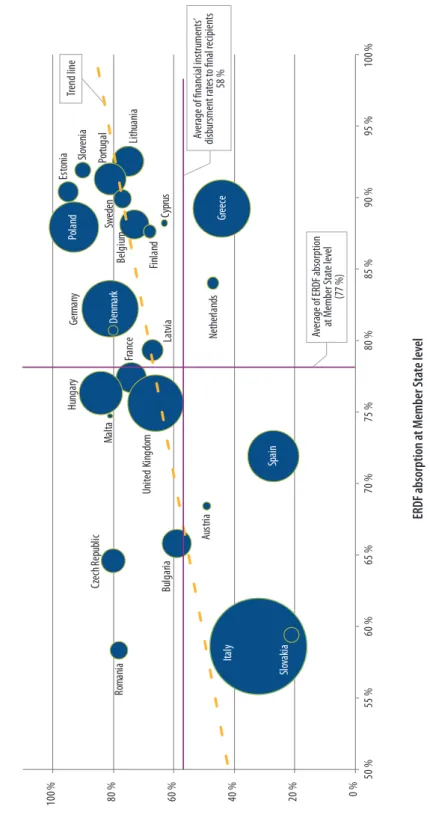
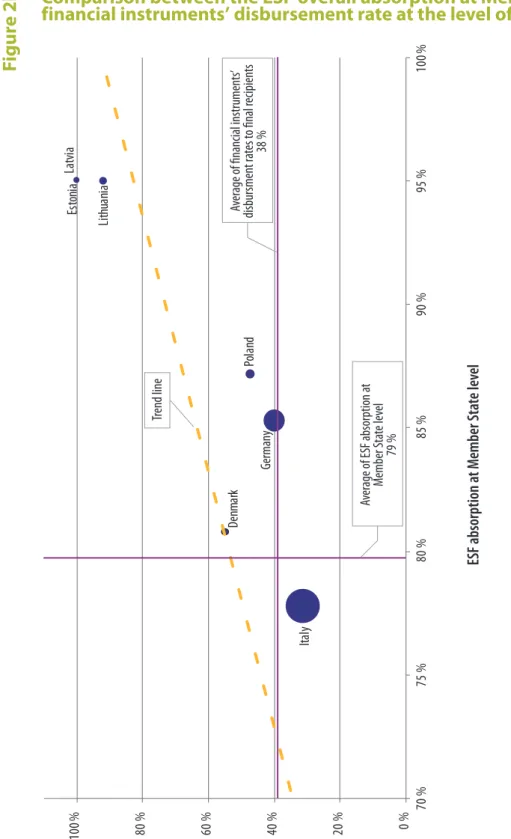
Our analysis of the data published by the Commission in 2015 showed that there is a positive correlation between ERDF and ESF absorption rates at Mem-ber State level and financial instruments’ disbursement rates to final recipients (see Figure 2a and Figure 2b). This analysis illustrates that those Member States which already face difficulties in absorbing the ERDF and ESF budget often have even more significant problems in disbursing the capital endowment allocated to financial instruments.
28
Observations
Fi
gu
re
2
a
Comparison between the ERDF overall absorption at Member State level and the
financial instruments’ disbursement rate at the level of final recipients
Financial instrumen ts’ disbursemen
t rates ecipients — OP amoun to final r
ts ERDF absorption a t Member Sta te le vel Av
erage of ERDF absorption at Member S
ta te lev el (77 %) Trend line Av er
age of financial instr
umen ts’ disbursmen t r at es t o final r ecipien ts 58 % 10 0 % 95 % 90 % 85 % 80 % 75 % 70 % 65 % 60 % 55 % 50 % 10 0 % 80 % 60 % 40 % 20 % 0 % Un ite d Kin gd om Sw ed en Fin la nd Slo va kia Slo ve nia Ro ma nia Po rtu ga l Po la nd Au str ia Ne th erl an ds Ma lta Hu ng ar y Lit hu an ia La tvi a Cy pru s Ita ly Fra nc e Sp ain Gr ee ce Es ton ia Ge rm an y De nm ar k Cz ec h R ep ub lic Bu lg ar ia Be lg ium N ot e: T he s iz e o f t he c irc le s c or re sp on ds to t he to ta l c on tr ib ut io n f ro m t he O Ps to fi na nc ia l i ns tr um en ts ( se e Ta bl e 4 ). C or re la tio n c oe ffi ci en t: 0 .5 . So ur ce : EC A , b as ed o n 2 01 5 C om m is si on d at a.
29
Observations
Fi
gu
re
2
b
Comparison between the ESF overall absorption at Member State level and the
financial instruments’ disbursement rate at the level of final recipients
Financial instrumen ts’ disbursemen
t rates ecipients — OP amoun to final r
ts ESF absorption a t Member Sta te le vel Av er
age of ESF absorption a
t Member S ta te lev el 79 % Av er
age of financial instr
umen ts’ disbursmen t r at es t o final r ecipien ts 38 % Trend line 10 0 % 95 % 90 % 85 % 80 % 75 % 70 % 10 0 % 80 % 60 % 40 % 20 % 0 % Po la nd Lit hu an ia La tvi a Germany Ita ly Es ton ia De nm ar k N ot e: T he s iz e o f t he c irc le s c or re sp on ds to t he to ta l c on tr ib ut io n f ro m t he O Ps to fi na nc ia l i ns tr um en ts ( se e Ta bl e 4 ). C or re la tio n c oe ffi ci en t: 0 .9 . So ur ce : E CA , b as ed o n 2 01 5 C om m is si on d at a.
30
Observations
Increase in capital endowments of financial instruments in 21 out
of 25 Member States
35
In 21 out of 25 Member States, we also found that the initial endowment had been increased since 2011. Overall, around 7.1 billion euro of additional funding from the 2007-2013 ERDF and ESF OPs had been allocated to financial instru-ments since then.
36
Most of these increases in the instruments’ capital endowment were made in Italy (2.5 billion euro), Spain (0.9 billion euro), Greece (0.9 billion euro), the United Kingdom (0.7 billion euro) and Hungary (0.5 billion euro). These five Member States alone account for 77 % of the total increase of capital endowment dur-ing the entire period. Four of these five Member States (Italy, Spain, the United Kingdom and Hungary) had a below-average ERDF absorption rate at the end of 2014 (see Figure 2a).
Provisions in the legal base for the 2007-2013 programme period
created incentives for Member States to use financial instruments
to circumvent the risk of de-commitment of EU funds
37
The legal base for the 2007-2013 programme period made it possible for Member States to absorb the EU contribution to the ERDF and ESF OPs upfront through the use of financial instruments. These upfront contributions could be used by Member States as a mechanism to avoid the risk of de-commitment (‘n + 2’ rule)34
(see Box 1).
34 The automatic de-commitment rule (n + 2 rule) helps to clear outstanding commitments. This rule requires automatic de-commitment of all funds not spent or not covered by a payment request by the end of the second year following the year of allocation.
Reimbursement the ERDF and ESF contribution to setting up the financial
instruments as eligible cost during the 2007-2013 programme period
According to the general regulation, the only condition for certifying amounts in the 2007-2013 programme period related to financial instruments as eligible expenditure under the OP was that the amounts concerned must have been used to establish or contribute to funds or holding funds. On that basis, ERDF and ESF con-tributions are reimbursed from the EU budget to Member States and considered as temporarily absorbed. In other words, there was no requirement to link the contribution from the OP to the capital endowment of an instrument to final recipients. Interest generated by the capital also contributes to the instruments’ endow-ment. It is only at the closure of the OP that the Commission will determine the total eligible expenditure on the basis of the actual amounts of loans, guarantees and equity investments provided to final recipients.
Bo
31
Observations
38
This arrangement has created an incentive for Member States to ‘park’ at least part of the EU’s contribution to the OPs in the accounts of the banks and financial intermediaries managing the funds, without it being actually used for its intend-ed purposes (see Box 2).
Case study — Excessive endowment of a financial instrument in Italy (Fondo
regionale di cogaranzia e controgaranzia per le PMI operanti in Sardegna)
In December 2009, the regional government decided to set up a guarantee fund with a capital endowment of 233 million euro. This corresponded to 14 % of the total budget of the OP for the entire programme period. The total endowment was intended to guarantee loans of around 2.3 billion euro.
Our audit in 2010 of this Italian guarantee fund found that there had been no market needs analysis which justified such an allocation. Moreover, several other mandatory elements (such as the investment strategy and planning, the description of an exit policy and the winding-up provisions) were not in place when the funding agreement was signed by the regional government and the regional agency implementing the fund.
Only in June 2010 was a business plan finally prepared and approved; however, it was based on unrealistic assumptions.
Our audit also showed that a significant part of the OP’s funding committed by the managing authorities in 2007 had not been spent by this point. Allocating a high endowment to the financial instrument made it pos-sible to circumvent the n + 2 rule in place at the time, according to which unused funds must be de-commit-ted after 2 years.
By the end of 2014, the managing authority reported that 45 million euro out of a total endowment of 233 mil-lion euro had been provided as guarantees to final recipients. This gives a disbursement rate of 19 %.
The guarantees made correspond to loans of 460 million euro.
Bo
32
Observations
39
On the other hand, we found one case where the endowment of financial instru-ments had been reduced to take into account market conditions and projected disbursement rates, which is considered good practice. (see Box 3).
Case study — Downward adjustment of the Jeremie fund’s endowment in line with
changing market needs in Lithuania
A Jeremie (Joint European Resources for Micro to Medium Enterprises) instrument was set up in Lithuania in 2008, and its endowment increased progressively to 210 million euro by the end of 2009. The endowment had been based on an assessment of market needs carried out in September 2007.
However, at a later stage, after analysing the effects of the economic crisis on the Lithuanian economy, the managing authority decided to reduce the fund’s endowment. By 2012 the fund’s endowment was reduced to 170 million euro and the money returned to the OP.
Out of the reduced fund capital of 170 million euro, 121 million euro had been disbursed by the end of 2014, resulting in a disbursement rate for the Jeremie fund of 71 %, instead of 58 % which would have been the disbursement rate in the absence of the capital reduction. Without this change, the overall disbursement rate for all Lithuanian financial instruments would have been 68 % rather than 75 % (see Table 4).
Bo
x 3
40
Excessive endowments of financial instruments have a negative impact on man-agement costs and fees, where these are determined on the basis of the capital paid into the fund rather than the fund manager’s performance. Oversizing the endowment provides a means of generating income for the fund managers with-out them actually providing the services expected (see paragraphs 116 to 125).
Particularly low disbursement rates for financial instruments
managed by the EIB group
41
Our analysis also showed that the average disbursement rate for the 31 ERDF and ESF instruments manged by the EIB and the EIF was particularly low: 43 % as compared to 60 % for the instruments managed by other fund managers.