Making and Breaking Monetary Policy
Rules: the Experience of African Countries
Dominique Guillaume
*and David Stasavage
**WPS/99-2
January 1999
Abstract: This paper analyses the experience with rule-based monetary policy in African countries which have participated in monetary unions (CFA Franc Zone, Eastern African Currency Board and Rand Monetary Area). We show that African countries have generally lacked the domestic political institutions which would allow individual governments to tie their hands by establishing such rules. Monetary unions have proved to be an alternative possibility for credible commitment to sound macroeconomic policies, but only in cases where exit from a union is made costly by the provision of side-payments (or sanctions) in other areas of regional co-operation, and only when governance structures have been designed so as to maximise chances for the enforcement of monetary rules. We conclude by making suggestions about the design of African monetary unions.
*Centre for the Study of African Economies; Oxford University; ** St. Antony's College, Oxford University. We are grateful to Chris Adam, A. Basu, M. Katz, L. Kuijs and Richard Mash for useful comments. D. Guillaume acknowledges the financial support of a EU TMR fellowship and D. Stasavage of a DFID grant. Part of this research was completed while D. Guillaume was a visiting scholar at the Research Department of the IMF. Email: [email protected] and [email protected].
1. Introduction
In recent years, a consensus has emerged among economists that the main objective of a sound monetary policy should be to ensure price stability. For developed economies, the key element in a credible commitment to price stability is delegation of monetary policy to an independent central bank with a clearly specified inflation target, associated with sanctions when the target is not met (Persson and Tabellini, 1993). For developing countries, in contrast, the debate continues on what commitment mechanisms are both appropriate and feasible. While many IMF stabilisation programmes in Sub-Saharan Africa have recommended setting up an independent central bank, combined with a floating exchange rate regime (Schadler, 1995), others have argued, based on a number of failures with this institutional mix, that for many developing countries the only institutional framework which would ensure a credible commitment to pursue sound monetary and macro-economic policies may be to establish policy rules within the framework of a monetary union, possibly with the participation of advanced industrial countries (Collier, 1991; Cobham and Robson, 1994).
A credible commitment to pursue sound macro-economic policies is not only central to the success of structural adjustment reforms. It is also a main component of the risk associated with investment in Africa (King and Levine, 1993), which in turn affects the potential for growth (Sachs and Warner, 1997). A further argument in favour of regional monetary agreements is that the perceived risk associated with investing in Africa not only depends on the credibility of the policies pursued in the country where the investment is planned, but also on the stability of neighbouring countries and the credibility of their policies (Easterly and Levine, 1998).
Establishing rule-based monetary policy within the framework of a monetary union is not a new idea in Africa. At independence, many African countries choose to preserve monetary institutions of this sort which were inherited from the colonial era. The subsequent evolution of these institutions has shown considerable variation in terms of both the sustainability of monetary integration and the economic performance of member states. This provides us with a natural experiment for asking when and why rules are more effective. Drawing upon evidence from three African monetary unions, this paper evaluates several hypotheses concerning the conditions under which monetary rules lead to improved policy outcomes. The monetary rules we consider include the maintenance of exchange rate pegs with full convertibility between the unions’ members, combined with strict limits on central bank lending to governments, and statutory minimum levels of foreign reserves.
Asking what conditions determine whether policy rules are effective first requires a method for assessing whether the presence of a rule led to a policy outcome which would have not have occurred in the absence of the rule. One way to deal with this issue is to gauge whether investors perceive a rule as being credible. For an exchange rate peg this would be the case to the extent that they demand similar risk premia on their local currency bonds as compared to their bonds denominated in foreign currency, adjusting for a potential parallel exchange rate premium. Unfortunately, the absence of well developed markets for government debt in the countries considered here precludes using this method. Moreover, while comparing yields on different assets can help indicate whether investors think a government will stick to an announced policy, it cannot shed light on the question whether a government would have stuck to the policy even
2
in the absence of a rule. To address this question, we need to examine whether policy rules survive in periods where we would otherwise expect policy to be reversed.
The basic argument presented in this paper is that in order for rules to be effective in tying governments hands, there must be obstacles to their reversal. Following Keefer and Stasavage (1998), we suggest that the ability of an individual government to credibly commit to a rule depends on the existence of checks and balances within a country’s political institutions, so that no one individual or party has unrestricted power. Such checks and balances raise the cost of reversing a rule. In their absence, participation in a monetary union can be an alternative option for credible commitment, but only in cases where there are side-payments (or sanctions) in other areas of co-operation that raise the cost of exit. Governance structures of a monetary union must also be devised so as to maximise the likelihood of monetary rules being respected.
The remainder of the paper is as follows. Section 2 reviews several credibility problems inherent to monetary policy-making and the extent to which rules can serve as a means for governments to make a credible commitment to sound policies. Section 3 gives a brief overview of the different monetary regimes prevalent in Africa during the post-colonial period and their relative performance. Sections 4 to 6 evaluate our hypotheses based on evidence from the three monetary unions, the East-African Currency Board, the Franc Zone in Western and Central Africa, and the Common Monetary Area in Southern Africa.. Finally, section 7 draws a number of lessons for current initiatives based on past experience.
2. Rules and credibility
2.1 Factors that undermine credibility
To assess when rule-based policies are instrumental in raising a government’s credibility, it is useful to first review the circumstances under which a government may be tempted to deviate from sound policies.
The first credibility problem is time-inconsistency, highlighted in the seminal articles by Kydland and Prescott (1977) and Barro and Gordon (1983) which showed that governments which announce a monetary policy objective in one period may have an incentive to deviate from that policy in subsequent periods once private sector actors have formed their expectations and entered into wage and other contracts. For monetary policy, this problem exists even when one assumes a government that maximises social welfare. When one considers that governments in practice may be interested in retaining power even at the expense of sub-optimal economic policies, the possibility for time-consistency problems expands accordingly. For example, there may be incentives for governments to engage in surprise monetary expansions before elections. A second credibility problem is that even if a current government is pursuing prudent macroeconomic policies, investors may fear that future governments will not have the same preferences. Collier and Gunning (1996) refer to this as the “rotten descendant problem”. Persson and Svensson (1989) and Tabellini and Alesina (1990) show how a sitting government may accumulate less of a surplus if it believes that its successor is likely to have different preferences over the optimal level of public spending or over the type of public goods provided. Changes in
This is above and beyond the increased technical difficulties in a shock-prone environment such as judging
1
between temporary and permanent shocks. Although the effects of negative shocks are usually stressed, it is also important to recall that a positive shock may have an adverse effect on macro-economic policies if, in the case of a windfall, its temporary nature is not recognised (Collier and Gunning, 1997).
government can bring to the fore interest groups whose demands for subsidies lead to macroeconomic indiscipline. A common example of a powerful lobby in contemporary Africa are demobilised soldiers whose requests for transfers may conflict with a government’s budgetary objective but whose interests often cannot be easily ignored. A lobby group may also have a positive effect on macro-economic policies as in cases where developing country agricultural exporters have political influence (Bates, 1981).
Either of the above two credibility problems may be exacerbated in countries which are prone to exogenous shocks. In an environment where such shocks are prevalent, it is likely to be more difficult for actors in the private sector to judge whether a government is adopting appropriate policies. Exogenous shocks of both domestic origin (drought) and international origin (such as1
changes in world prices) have been shown to be particularly important in Africa (Eldabawi and Ndulu, 1996).
Mechanisms that enhance credibility
Apart from acquiring a reputation, which is a lengthy process, the common suggestion for governments facing credibility problems is to tie their hands, either by creating a policy rule or by delegating to an independent agent. Existing literature generally assumes that once in place, rules or delegation are immutable. It fails to ask when and why the obstacles to reneging on rules or delegation are likely to prove more formidable. While the focus of this paper is on monetary policy rules, we consider both rules and delegation in this section in order to also ask when delegation to an independent national central bank could be an alternative to monetary union as a source of credible commitment for African countries.
Domestic obstacles to reneging
One way for governments to enhance the credibility of monetary policy is to delegate to an independent central bank which places a greater weight than society at large on the goal of price stability, as opposed to stabilisation of output (Rogoff, 1985). In Rogoff's model however, the implicit assumption is that governments cannot easily reverse decisions to delegate. Walsh (1995) proposes a different solution of giving an independent central bank a contract whereby it pays a linear penalty for inflation above a certain target. The result would be to address the time-consistency problem without the increased variability in output which the Rogoff solution entails. This model suffers from the same weakness, however, in that it assumes that once written, a contract is respected by all parties concerned. Similarly, exchange rate pegs have often been proposed as a rule based credibility enhancing device with the unquestioned assumption that they cannot be easily reversed. Formal independence for central banks, inflation contracts for central bankers, or exchange rate rules are likely to remain a dead letter if they can be reneged on with little cost. Reinforcing this point, Cukierman’s (1992) study shows that even though African countries score better than average on an index of legal central bank independence, it seems to have little bearing on their inflation performance.
While not directly addressing the issue of delegation, Persson, Roland, and Tabellini (1997) is another contribution
2
which emphasises the importance of checks and balances for economic policy outcomes.
More specifically, Keefer and Stasavage (1998) suggest that under these conditions rules or delegation can help
3
solve the rotten descendant problem but not the classic time-inconsistency problem in monetary policy. 4
More recent work has emphasised that delegating or adopting a rule will not pose a constraint on a government's actions unless the decision to do so is more difficult to reverse than would be a reversal of the underlying macroeconomic policies which respect of the rule implies. Jensen (1998) revisits Rogoff's (1985) model for delegation to an independent central bank and includes a parameter for costs involved in firing a central bank governor. He does not ask what real-world conditions are more likely to be associated with this parameter, however. Moser (1996) and Lohmann (1998) go further by developing models where the degree of central bank independence depends not only on the formal granting of independence but also on the extent to which a countries political institutions make independence costly to revoke. Keefer and Stasavage2
(1998) expand upon Moser and Lohmann’s work to develop a more general theory of how the credibility of rules and of delegation depends upon the existence of checks and balances in a country's political institutions. Checks and balances are defined as situations where multiple decision makers are able to veto any decision to renege on a policy rule or on a decision to delegate. They distinguish between two general cases.
The first case is when a greater number of decision makers must be in agreement to change a rule than would be required to change underlying policies. For instance, an under-emphasised aspect of currency boards is that they generally require approval of a legislature rather than just the executive, as would most exchange rate policy choices. In some cases currency boards may require not just legislative approval, but a parliamentary super-majority. In Argentina, for example, the rate of parity between the peso and the US dollar is written into the country's constitution.
A second case is where the decision to renege on a policy rule does not require a greater number of decision makers to approve than is necessary for underlying policy decisions. Under these conditions, if a current government establishes a rule or delegates, then this decision cannot be reversed under future governments as long there are multiple decision makers and at least one decision maker from the previous government remains in a position to veto such a move. This3
scenario is possible in political systems where there are regular changes in government, but changes in government do not always result in a complete replacement of decision makers. In political systems where regime changes are frequent, and they result in complete replacement of decision makers (as is more likely to be the case in autocracies), credible commitment will not be possible. Finally, in political systems where there is a very low frequency of regime change, governments will have much less incentive to delegate or to create a rule in the first place. A situation where multiple decision makers can veto a policy proposal may apply in countries where there is a constitutional separation of powers between the executive and different houses of the legislature. It may also apply in countries with coalition governments of several different parties. It can even apply under conditions where the rule of law and constitutional prerogatives are not respected, as long as no one individual, faction, or party has all the levers of power under its control. A good example here is Thailand where independence of the Budget Bureau has been
A further step is to base an international agreement on delegation to an international agency whose decision makers
4
will themselves be independent from control by any government, as will be the case in the European Central Bank. This is not applicable to the monetary unions considered in this paper, however, because ministerial representatives have dominated the governing boards of the monetary authorities.
preserved since the 1950s in a context where basic constitutional rules have often been flouted. This may be attributable to the fact that Thai governments have tended to be coalition governments, but some parties have been represented in several successive governments. These hypotheses represent a modification of received notions in political economy where divided or coalition government is predicted to led to poor macro-economic policy performance (Alesina and Drazen (1991); Grilli, Masciandro, and Tabellini (1991)).
International obstacles to reneging
For countries in which the domestic political institutions required for credible commitment are absent, joining an international agreement can act as a substitute by creating a situation similar to that described above, where an increased number of decision makers must agree to any decision to renege on a rule. In order for international agreements to be effective, however,4
member states must also be willing to oppose any attempt by their neighbours to break the rules of the arrangement.
Moreover, for an international agreement to be effective, exit must be costly. That is, for a state wishing to pursue a different monetary and exchange rate policy than its partners, there must be significant and immediate cost involved in setting up a separate currency. These costs can include economic costs such as the administrative costs involved in setting-up a separate currency, the difficulty of running an independent monetary policy with a low level of foreign reserves, or increased debt servicing obligations.
A more important deterrent to exit may be the fear of sanctions from other member states. Countries which enter into international monetary agreements may have agreements with other member states in the domains of trade, finance, aid, or security. Continuation of these other forms of co-operation may be implicitly or explicitly linked to continued participation in the monetary agreement. For example, the French government's decision to abandon Keynesian inflationary policies in 1983 in order to remain in the EMS was undoubtedly influenced by the idea that an EMS departure would undermine other areas of EU co-operation.
The presence of co-operation in several different issue areas is also likely to increase the possibility for provision of side payments (or the threat of sanctions) so as to alter incentives for a state considering breaking a rule. Conversely, governments in a position to sanction their neighbour's actions in one area of co-operation may choose not to do so if it would cause great damage to other areas of co-operation. It has been observed that for the advanced industrial countries involved in international agreements like NAFTA and the Europe agreements (between the EU and Eastern European states), non-economic objectives, such as limiting immigration and preserving political stability, have been as important as the economic goal of promoting respect for certain economic policy rules in neighbouring states in order to generate trade and investment opportunities. For the developed country partners in such arrangements, if a developing country partner is hit with a severe economic shock, attempting to meet the two objectives in the
short-6
term may be seen as undesirable if it is feared that a strict enforcement of the economic rules of an arrangement risks political collapse in the developing country followed by significant emigration for example.
To sum up, there is reason to believe that international constraints on reversal of commitments will be more effective when countries operate on multiple issues. At the same time, co-operation on multiple issues is no guarantee that it will be costly to exit or to break the rules of an arrangement. Because it would seem difficult at this stage to make firm predictions in this area, for the international arrangements considered in this paper a more limited effort will be made to identify ex post whether there was a country willing to provide the side-payments (or sanctions) necessary to make either exit or rule-breaking costly. We will also attempt to identify
ex ante whether a union’s governance structures should promote respect of monetary rules.
3. Monetary institutions in Africa
3.1 African monetary regimes
Africa has one of the richest histories of monetary regimes. Since the 1960s, the full spectrum of regimes can be found, ranging from currency boards or monetary unions, to a single currency peg, to a peg to a basket of currencies, to a float within a pre-determined range with heavy intervention, to a pure float (Ghosh et al., 1997). In addition to this classification based on fixed vs. floating, other typologies of monetary regimes have distinguished between regimes with or without foreign exchange rationing or credit ceilings (Honohan and O’Connell, 1997). In this study we concentrate on those countries with a rule-based system characterised by a fixed exchange rate peg with full convertibility, strict limits on central bank lending to governments, and minimum legal levels of foreign reserves. More specifically, our focus is on the three groups of countries who have been part of an international monetary agreement: the East African Currency Board, the Franc Zone and the Rand Monetary Area.
The East African Currency Board (EACB), comprised Kenya, Uganda, and Tanzania. At independence, the three states decided to maintain the monetary arrangement set-up by the British colonial power with the possibility of enacting gradual reforms whereby the EACB would take on the functions of a central bank. After several years of effective functioning, however, in 1966 the EACB fell apart as each member country created its own central bank and currency. Each country subsequently attempted to preserve a rule-based monetary policy at the national level, characterised by a fixed peg to Sterling, current account convertibility, and limits on central bank finance of government deficits.
The composition of the Franc Zone has changed over time but at independence it comprised the five members of the Central African Monetary Area (CAMA) (Cameroon, the Central African Republic, Chad, the Republic of Congo, and Gabon) and the eight member countries of the West African Monetary Union (UMOA) (Benin, Burkina-Faso, Côte d’Ivoire, Mali, Mauritania, Niger, Senegal and Togo). Madagascar was also a member of the Franc Zone, although it had its own central bank. Three of these former French colonies left the CFA Zone in the 1960s and early 1970s (Mali, Madagascar and Mauritania, with the subsequent re-entry of Mali in 1968) and two non French-speaking countries entered the union more recently (Equatorial Guinea in 1985 and
Guinea-Bissau in 1997). In 1972-73, a major re-negotiation of the CFA arrangements took place and in 1994, following a decade of poor economic performance and real exchange rate over-valuation, the CFA franc was devalued by 50 percent. This was the first change in the CFA franc - French franc rate of parity since 1948.
The South-African rand already circulated freely in Lesotho, Swaziland and Botswana in the 1960s, but it became legal tender in the region when the Rand Monetary Agreement was signed in 1974. According to the agreement, the countries of the zone retained the right to create their own central bank and to issue their own currency, at par with the rand. Both Lesotho and Swaziland chose this option, followed by Namibia when it became independent in 1990. Botswana decided to leave the zone in 1976 to establish a more discretionary monetary policy.
3.2 Evolution of African monetary unions
Economic performance
Most analyses of the economic performance of monetary regimes in Africa have focused on a comparison of CFA Zone countries with other African countries that have maintained floating exchange rate regimes. Table 1 confirms previous findings of lower inflation in CFA Zone. Long run evidence on growth is more mixed with higher GDP growth in the CFA countries until the beginning of the 1970s, strong performance among the oil-producing countries of BEAC between 1973 and 1985, and poorer performance in the CFA Zone when compared to other Sub-Saharan African countries between 1986 and 1993. While total investment increased in Sub-Saharan Countries outside the CFA Zone over the three periods, it decreased in the CFA Zone as a result of the crowding out of private investment and significant cuts in public investment after 1985. Lower growth in the later period has usually been attributed to less flexible exchange rate management in the face of rapidly deteriorating terms of trade and to a worsening of the fiscal stance which is also apparent in Table 1 (Devarajan and de Melo, 1992). As shown in Table 1, after 1973, net claims of the banking sector on government rose rapidly, even though the terms of trade evolved positively in the late seventies.
Table 2 shows that the performance of Tanzania and Uganda considerably deteriorated after the Eastern African Currency Board fell apart in 1966. Inflation and net credit to central government rose rapidly even though Uganda experienced an improvement in its terms of trade resulting temporarily in faster growth. Temporary rapid growth in investment in Tanzania can be attributed to the shift to socialist planning. Kenya’s stance after 1966 lies in sharp contrast to Tanzania and Uganda with a relatively good inflation record and continued restraint in terms of government borrowing from the banking sector.
Data for the Rand Monetary Areas countries presented in Table 3 shows relatively good inflation and fiscal performance. They also experienced relatively higher investment and growth rates, although these were somewhat reduced after 1977. Botswana is an exception to this pattern as performance improved considerably after it had left the RMA. One should note, however, that the relatively good terms of trade experienced by Botswana in the first period considered does not take into account the impact of massive droughts in the beginning of the seventies.
Table 1. Economic performance in the CFA countries (annual averages) Inflation B u d g e t C h a n g e % Deficit in Net % GDP C l a i m s o n Govern. % GDP 60-73 73-85 86-93 60-73 73-85 86-93 60-73 73-85 86-93 UMOA average 3.7 10.9 3.9 0.0 -8.0 -6.3 1.5 3.9 3.6
Côte d’Ivoire 3.2 11.6 6.0 n.a. -7.1 -12.0 -2.6 -0.4 8.8
BEAC average 4.1 12.2 8.4 -2.6 -2.1 -8.4 -1.2 4.5 8.4
Cameroon 5.4 11.7 5.7 n.a. 0.7 -6.8 -2.7 1.7 2.9
Other SSA countries 4.2 18.6 31.9 -2.0 -5.9 -4.6 -1.6 13.8 14.1
average*
excluding EACB, RMA.
Sources: International Financial Statistics, World Development Indicators, IMF (1968; 1970).
Table 1 (cont.) Economic performance in the CFA countries
(annual averages)
G r o s s GDP C o m m o d .
Invest. Growth % Index
% % Change GDP 60-73 73-85 86-93 6 0 - 73-85 86-93 60-73 73-85 86-93 73 UMOA average 13.8 21.2 16.3 3.8 3.2 2.0 -0.7 1.3 -1.2 Côte d’Ivoire 16.9 21.6 9.2 7.3 4.0 -4.4 0.8 5.1 -12.5 BEAC average 15.6 23.2 18.3 3.9 7.3 0.0 1.5 8.2 -3.7 Cameroon 14.4 21.2 26.2 3.6 7.1 -2.3 0.8 5.2 -11.0
Other SSA countries average* 14.4 16.3 18.3 4.0 2.2 2.4 2.6 1.8 -0.1
excluding EACB, RMA.
Table 2. Economic performance in the EACB countries (annual averages) Inflation B u d g e t Change in % D e f i c i t Net Claims % GDP on Govern. % GDP 61-66 67-73 61-66 67-73 61-66 67-73 EACB average 3.3 7.5 -4.4 -5.2 0.1 2.8 Kenya 2.3 3.5 -5.4 -4.4 -0.9 0.7 Tanzania 4.0 9.7 -2.4 -4.7 -1.8 1.5 Uganda 3.4 9.3 -5.4 -6.4 2.9 6.1
Other SSA countries 3.6 4.7 -0.6 -2.9 0.9 3.5
average**
** excluding CFA, RMA.
Sources: International Financial Statistics, World Development Indicators, IMF (1969).
Table 2 (cont.) Economic performance in the EACB countries
(annual averages)
G r o s s GDP C o m m o d .
Invest. Growth Index
% GDP % % Change 61-66 67-73 61-66 67-73 61-66 67-73 EACB average 12.2 17.6 5.4 5.8 -0.5 1.3 Kenya 12.6 20.0 4.0 7.4 -1.1 -0.1 Tanzania 12.2 18.9 10.1 -1.5 -0.9 1.6 Uganda 12.1 13.8 3.9 11.5 0.4 2.4
Other SSA countries 14.9 13.7 4.2 3.8 0.7 4.6
average**
** excluding CFA, RMA.
Sources: International Financial Statistics, World Development Indicators, IMF (1969), Deaton and Miller (1997).
Table 3. Economic performance in the RMA countries
(annual averages) Inflation B u d g e t Change in % D e f i c i t Net Claims % GDP On Govern. % GDP 68-76 77-93 68-76 77-93 68-76 77-93 RMA countriesE 9.3 13.4 -6.3 -3.2 6.2 2.6 South-Africa 8.5 13.6 -4.0 -4.3 10.2 5.4 Botswana 10.7 11.4 -12.4 9.1 -13.4 -34.8
Other SSA countries 9.8 25.6 -3.4 -5.7 5.2 69.8
average***
*** excluding CFA, EACB. E Botswana was part of RMA countries until 1976. Data for Namibia was included from 1980 onwards.
10
Table 3 (cont.) Economic performance in the RMA countries
(annual averages) G r o s s GDP C o m m o d . Invest. G r o wth Index % GDP % % Change 68-76 77-93 68-76 77-93 68-76 77-93 RMA countriesE 21.8 29.8 8.8 2.5 4.2 3.2 South-Africa 25.8 22.7 3.8 1.6 6.1 1.9 Botswana 31.4 27.9 16.7 10.2 1.9 6.5
Other SSA countries 15.4 17.0 4.5 1.7 6.1 -0.5
average***
*** excluding CFA, EACB. E Botswana was part of RMA countries until 1976. Data for Namibia was included from 1980 onwards.
Sources: International Financial Statistics, World Development Indicators, IMF (1973), Deaton and Miller (1997).
The political environment
Before considering more detailed evidence on the political environment in each of the three unions, it is possible to draw generalisations based on quantitative political data which has been increasingly used to make cross-country comparisons. We consider two issues here: the degree of political instability and the degree to which checks and balances pose a constraint on a country’s executive.
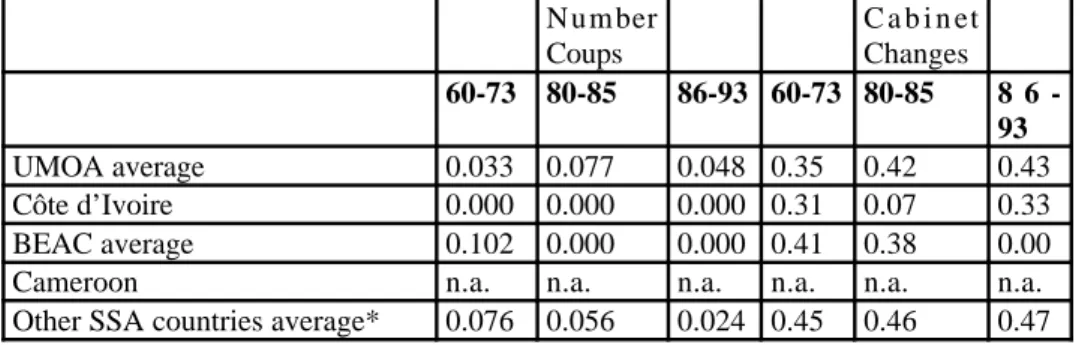
Political instability in tables 4, 5, and 6 is proxied by the average frequency of coups d’état and of major cabinet changes over the period of reference. Whereas the RMA countries were remarkably stable according to our measure, both EACB and BEAC group of countries showed significant instability, according to these measures, during the initial period of rule-based policies (1960-66 for the EACB and 1960-73 for BEAC) which was nonetheless characterised by a credible commitment to monetary rules resulting in strong inflation and fiscal performance. While the number of cases here is obviously limited, this evidence runs contrary to the predictions of political economy models where political instability is necessarily associated with poorer performance.
As stressed in section 2, the existence of checks and balances in a country’s political institutions will have a direct effect on the costliness of reneging on policy rules which are adopted by a single government. In cases where checks and balances are absent, joining an international arrangement may be the only way to credibly commit. In tables 7, 8, and 9, we use two variables to proxy for the degree of check and balances: the degree of political party fractionalisation and an index of constraints on the executive. Fractionalisation in the lower house of a country’s parliament is measured on a 0 to 1.0 scale with an index which is calculated using the same formula frequently adopted for measuring concentration in industrial sectors. In countries where fractionalisation is high (tending towards 1.0) there will be a tendency for coalition governments to form. It is likely to be more costly to renege on policy rules within coalition governments, as suggested in section 2, because multiple decision makers must agree to such a change. The index of “executive constraints” developed by Gurr (1990) is a subjective indicator of the extent to which the executive in a country is constrained by features such as a constitution and a separate
It should also be noted that the case of Botswana shows why the fractionalisation measure is an imperfect proxy
5
for the presence of coalition government. Botswana had a higher degree of political party fractionalisation than the very low average level for other African countries, but this did not reflect a situation where there were frequent coalition governments. In fact, Botswana was ruled by one political party for the entire period under consideration here while it was the opposition which was fragmented into several different parties.
legislature which can veto legislation. The index is scaled from 1 to 7, with 7 representing the highest degree of executive constraints.
It appears from the tables below that African countries for the period studied here have had an increasing tendency towards low party fractionalisation and low levels of constraints on the executive. This is most marked among the CFA states where levels of fractionalisation approaching zero reflect the emergency of single-party states and where executive constraints have averaged less than 3.0 on Gurr’s scale. There is one major exception to this pattern. Uganda had a fairly high level of party fractionalisation during the 1961-66 period, combined with strong executive constraints. We will show in a more detailed fashion in the next section that this contributed to the credibility of Uganda’s commitment to the East African Currency Board’s rules. 5
In sum, evidence on political instability and on political checks and balances suggests that African countries have generally not had the domestic political institutions necessary to make credible commitments on a unilateral basis. The fact that a number of countries have shown strong policy performance at one time or another despite high levels of political instability suggests that countries may have been able to credibly commit through their participation in international arrangements. It remains to be shown that exit from international arrangements for such states has been costly, and that governance structures have been designed so as to promote enforcement of monetary rules. Sections 4, 5, and 6 consider these questions for each of the three unions.
Table 4. Political instability in the CFA countries
(annual averages) N u m ber C a b i n et Coups Changes 60-73 80-85 86-93 60-73 80-85 8 6 -93 UMOA average 0.033 0.077 0.048 0.35 0.42 0.43 Côte d’Ivoire 0.000 0.000 0.000 0.31 0.07 0.33 BEAC average 0.102 0.000 0.000 0.41 0.38 0.00
Cameroon n.a. n.a. n.a. n.a. n.a. n.a.
Other SSA countries average* 0.076 0.056 0.024 0.45 0.46 0.47
excluding EACB, RMA. Sources: Banks (1994).
12
Table 5. Political instability in the EACB countries (annual averages)
Number Cabinet Coups Changes 61-66 67-73 61-66 67-73 EACB average 0.000 0.055 0.53 0.11 Kenya 0.000 0.000 0.75 0.00 Tanzania 0.000 0.000 0.50 0.17 Uganda 0.000 0.167 0.60 0.17
Other SSA countries 0.086 0.065 0.59 0.29
average**
** excluding CFA, RMA Sources: Banks (1994).
Table 6. Political instability in the RMA countries (annual averages)
Number Cabinet Coups Changes 68-76 77-93 68-76 77-93 RMA countriesE 0.000 0.063 0.14 0.29 South-Africa 0.000 0.000 0.00 0.33 Botswana 0.000 0.000 0.00 0.00
Other SSA countries 0.075 0.036 0.39 0.45
average***
*** excluding CFA, EACB. E Botswana was part of RMA countries until 1976. Data for Namibia was included from 1980 onwards.
Sources: Banks (1994).
Table 7. Party fractionalisation and executive constraints in CFA countries
(annual averages)
P a r t y E x e c u t i v e
Fraction. Constraints
60-73 80-85 86-93 60-73 80-85 86-93
UMOA average 0.016 0.039 0.026 2.6 2.1 2.6
Côte d’Ivoire 0.000 0.000 0.000 n.a. n.a. n.a.
BEAC average 0.058 0.052 0.066 2.7 1.8 2.4
Cameroon 0.000 0.000 0.000 2.9 2.1 2.3
Other SSA countries average* 0.147 0.136 0.077 2.7 2.6 2.2
* excluding EACB, RMA.
Sources: Banks (1994), Gurr (1990).
Table 8. Party fractionalisation and executive constraints in EACB countries
(annual averages) P a r t y E x e c u t i v e Fraction. Constraints 61-66 67-73 61-66 67-73 EACB average 0.193 0.039 5.1 2.8 Kenya 0.222 0.033 4.5 3.3 Tanzania 0.000 0.000 3.0 3.0 Uganda 0.452 0.084 7.0 2.3
Other SSA countries 0.134 0.161 3.0 2.2
average**
** excluding CFA, RMA.
British Somaliland and Aden were also members but the former withdrew before independence and the latter
6
remained a British colony until the 1970s.
Table 9. Party fractionalisation and executive constraints in RMA countries
(annual averages)
P a r t y E x e c u t i v e
Fraction. Constraints
68-76 77-93 68-76 77-93
RMA countriesE 0.289 0.182 n.a. n.a.
South-Africa 0.405 0.376 n.a. n.a.
Botswana 0.352 0.396 n.a. n.a.
Other SSA countries 0.142 0.133 2.3 2.51
average***
*** excluding CFA, EACB. E Botswana was part of RMA countries until 1976. Data for Namibia was included from 1980 onwards. Sources: Banks (1994), Gurr (1990).
4. The East-African Community (1960-1973)
4.1 Rules and governance structure: 1960-1966
In 1919 a new monetary authority was formed to issue a common currency, the East African shilling, within the British colonies of Kenya, Uganda, and Tanganyika (later Tanzania). The6
East African Currency Board (EACB), for which the offices were based in London, exchanged East African shillings for British Sterling without restriction at a fixed rate. The Board initially refrained from any lending to either commercial banks or to territorial governments. Interestingly, even if the clear objective of the British officials which ran the Board was to accumulate a stock of foreign assets at least equal to the value of all local currency in circulation, the statutes of the Board did not specify a legal minimum for reserves. This figure was determined at the discretion of the British Secretary of State for the Colonies, who had the ultimate authority for Board decisions. When foreign reserves rose above the amount deemed necessary, dividends could be issued to the territorial governments.
During the years immediately preceding and following independence, the EACB evolved considerably towards fulfilling many of the duties of a central bank. Beginning in 1955 the Board was authorised to back a small portion of its foreign reserves (£10 million) with local government securities denominated in East African shillings that were issued by territorial governments. This limit was gradually raised, to £20 million in 1957, to £25 million in 1963, and to £35 million in 1964. Beginning in 1960, the Board was authorised to engage in a limited amount of crop refinancing to commercial banks (up to £5 million Sterling). This limit was subsequently raised to £10 million in 1962. These were short-term loans for which repayment was required within the year. The crop finance facility also allowed the Board to act as a lender of last resort to commercial banks in difficulty. If it had been fully used, the £45 million fiduciary issue (from 1964 onwards) would have equalled more than 50% of the currency in circulation (Kratz, 1966). Finally, the EACB also began assisting in operating Treasury bill markets in each of the newly independent countries.
de Loynes papers December 10, 1962 (OV7/82 614/3).
7
The best direct evidence on the attitude taken by the Kenyan government is from 1964 and 1965. (de Loynes
8
papers (OV7/63 609/5, OV7/64 610/1).
de Loynes papers 14 May 1963 (OV7/61 609/3).
9
14
In 1960 the governance structure of the EACB changed radically, as the British government essentially withdrew from direct involvement with Board decisions. The EACB offices were moved from London to Nairobi, and the representation on the Board was changed so that all but one of the 7 seats were given to representatives from the three African member territories, the permanent secretaries from the Ministries of Finance of Kenya, Uganda and Tanganyika, the Financial Secretaries of Zanzibar and Aden, and the Secretary General of the East African Services Organisation, an institution created to administer regional co-operation in areas such as transport, who was also made chairman of the EACB. In keeping with much of the spirit of the arrangement, there is no record of written voting rules on the EACB board, but in practice, the Kenyan, Ugandan, and Tanzanian representatives each held a veto (see below). From this point on, the only member of the UK administration on the EACB was a technical advisor from the Bank of England. Legally the UK Secretary of State for the Colonies remained the ultimate authority for EACB decisions, but there is no indication of direct interventions by the Secretary of State in EACB affairs at this time. In fact, private correspondence from the UK Colonial Office makes clear that the UK government had every intention of revising the EACB statutes as soon as possible so that this responsibility could be removed from the Secretary of State. 7
4.2 Operations of the EACB: 1960-1966
There is evidence that the relatively good fiscal and inflation performance of Tanzania and Uganda between 1960 and 1966 would not have taken place if it were not for the existence of EACB's limits on lending to governments, and if this rule had not been backed up by a Kenyan veto of any increases in fiduciary limits which it saw as unwarranted.
Tanzania's government made numerous demands for increasing fiduciary limits in order to obtain finance for its first Five Year Development Plan for which foreign sources of funding had fallen short of original estimates. In cases where the EACB was not forthcoming with finance to make up the gap, Tanzania was forced to scale back certain investments (IMF, 1969). As seen below, from the end of 1962 on, the Tanzanian government found itself frequently at or near its limit for borrowing from the EACB. On occasions, periodic increases in the limit provided further breathing room. These increases had been planned as part of a gradual reform program whereby the EACB would begin to operate more like a central bank. The Kenyan government vetoed attempts to make excessive hikes in the limit above those which were seen as prudent. 8
The Ugandan government also found itself in periodic borrowing difficulties with the EACB. As early as 1963, documents show that Ugandan representatives were complaining about the “uncompromising” attitude of the EACB. In Uganda fiscal pressures seem to have come as9
much from demands for increased current spending as for development spending. The Ugandan government apparently had more success in finding private investors to fund portions of its initial development plan (IMF, 1969). Table 1 shows that Uganda also found itself at its borrowing limit from 1964 on, whereas the Kenyan government itself rarely borrowed more than 50% of its fiduciary limit.
Tanzanian and Kenyan positions on lending limits were also reflected in discussions about future reforms of the EACB. In 1962 the Tanzanian government commissioned a staff member of the German Bundesbank to conduct a study on central banking arrangements in East Africa. The official proposed establishing a federal central bank system similar to that which existed in Germany and the USA, but he remained vague about the degree of control which regional banks would be allowed to have over monetary policy. Records of private meetings subsequent to the presentation of the report show that the Kenyan Minister of Finance preferred strong central control, while the Tanzanian Minister of Finance argued for substantial autonomy for the national central banks. The rationale behind creating national banks was clearly to provide more possibility to use central bank lending to government in order to fund development projects. In the end, Kenya's opposition to excess increases in EACB lending limits help suggest why the rules were binding, but this doesn't explain why Uganda and Tanzania did not choose to exit the EACB earlier. To do so we need to consider the broader context of regional integration in East Africa as well as domestic political institutions in each of these states.
Table 10. Use of fiduciary allocations by East African Currency Board governments Stock of loans outstanding in million £ sterling
D e c J u n e D e c J u n e D e c J u n e D e c J u n e N o v A p r 61 62 62 63 63 64 64 65 65 66 Kenya used 4.8 3.8 3.8 3.8 3.6 3.5 3.5 3.5 4.5 3.5 total 5.6 5.6 5.6 5.6 7.0 7.0 9.9 9.9 9.9 9.9 Tanzania used 4.5 4.7 5.6 5.1 6.4 4.7 8.1 6.2 8.6 2.6 total 5.6 5.6 5.6 5.6 7.0 7.0 9.9 9.9 9.9 9.9 Uganda used 5.5 5.1 4.9 3.6 5.9 3.7 8.9 9.5 10.0 9.8 total 5.6 5.6 5.6 5.6 7.0 7.0 9.9 9.9 9.9 9.9
Sources: Kratz (1966), EACB reports.
4.3 Obstacles to exiting the EACB: 1960-66
There were two main obstacles to Tanzania and Uganda exiting the EACB. For Tanzania, while there were no checks and balances in its political system of the sort that could have raised the cost of exit, there was an incentive not to exit the EACB as long as its government believed that integration in areas other than money would result in significant benefits for Tanzania. For the Ugandan government, there was both the incentive of potential gains in other areas of integration, as well as the fact that until 1964 its prime minister was constrained by significant checks and balances.
The common market which had existed between the three East African territories during the colonial period was preserved at independence. Tanzania in particular hoped to extract concessions from Kenya in exchange for maintaining free trade, it was thought that these
Tanzania's President believed that Kenya was enjoying a disproportionate benefit from the common market since
10
it was running a significant trade surplus with Tanzania.
Bailey (1964), who was himself a participant at the meetings in question, records that in February 1964 the
11
Tanzanian Finance Minister stated that unless the common market could be kept on Tanzanian terms, that is with separate currencies and selected trade barriers, the Tanzanian government would dissolve all forms of association. The trade restrictions agreed to included (1) a transfer of activity by certain firms present in all three markets in order to favour Tanzania, (2) suspended exports on certain products from Kenya, (3) allocations of future industries to individual countries. As a result of this third clause Tanzania obtained the dubious reward of having the sole right to produce Land Rovers in the East African Common Market.
This dominance was the result of free and open elections in 1962. Another party sponsored by the colonial
12
administration fared miserably in the elections as did a more ephemeral all Muslim party. For a brief account of this period see Jackson and Rosberg (1986).
13
16
concessions might come in the form of subsidies, perhaps via a regional development bank, through direct transfers, or at a minimum through the allocation of rights to produce certain industrial products to each state. There may also have been a hope of deriving benefits from10
the political federation, which the three East African governments in 1963 announced their intention of creating. Members of the Ugandan government, and its Prime Minister in particular, also hoped that political federation with Kenya might provide access to increased development finance.
The problem for the sustainability of the EACB was that Kenya was ultimately not willing to agree to the sort of regional subsidies which the Tanzanian government in particular was demanding. The Kenyan and Ugandan delegations agreed to extend limited trade privileges to Tanzania, but only on the proviso that in exchange Tanzania would formally agree to preserve a common currency. The Tanzanian government did not agree to this demand, and from the late Spring of 1964 there were rumours of a Tanzanian unilateral initiative to set up a separate currency. In February 1965 the Ugandan government also changed its position, as it made a11
unilateral decision that it would create its own state bank which effectively spelled the end of the common currency.
The absence of checks and balances also explains why the Tanzanian and Ugandan governments choose to exit. In Tanzania, its President, Julius Nyerere, was bent on using monetary finance to dramatically increase government spending. Tanzanian political institutions placed no checks or balances on Nyerere's ability to achieve this goal. There was a one party government where the TANU party held all the levers of power. Aside from the Presidency, TANU dominance included control of the totality of seats in the single house of parliament. Within the TANU party,12
Nyerere's authority was uncontested. Outside the party, the one challenge to his rule came from a brief army mutiny in 1963, but this quickly failed, and there does not appear to have existed a powerful military faction in politics which placed a constraint on the President. Tanzania13
remained in the EACB as long as Nyerere believed further political integration within the EACB might provide additional sources of finance for government spending.
In strong contrast with Tanzania, during the first years of independence Uganda's Prime Minister, Milton Obote, was constrained by several political checks and balances. It was only after these checks on his power disappeared in the second half of 1964 that it was possible for the Ugandan government to take a different line on monetary issues. At independence, the UPC under Obote
At independence, there were three main political movements in Uganda: the UPC controlled by Obote, the
14
Democratic Party, and the Kabaka Yekka, a royalist party which supported autonomy for the former kingdom of Buganda, led by its king, the Kabaka. Underlying these three parties were a series of major fault lines in Ugandan society: (1) between Nilotic speakers in the North and Bantu in the South and West; (2) between Catholic and Protestant; (3) between the Baganda ethnic group which had been favoured for posts in the colonial administration, and the rest of population.
On Ugandan party politics during this period see the excellent history in Mutibwa (1992) as well as Sathyamurthy
15
(1975).
First hand accounts from the period suggest that the Ugandan Finance Minister during this period deliberately
16
followed a stalling strategy in order to keep the EACB status quo from breaking up (de Loynes papers, May 24, 1963 (OV7/83 615/1) and August 28, 1963 (OV7/84 615/2).
East African Standard, 30 June 1965.
17
was only able to form a government thanks to an alliance of convenience with the KY party.14
Although this alliance seemed an inherently unstable one to many observers, given the UPC's status as a party of northerners and the KY's base in the South of the country, it provided the power sharing necessary for credibility of Uganda’s commitment to the rules of the EACB. As part of this alliance, the Kabaka was made President of Uganda (although with limited powers) and several ministries including the Ministry of Finance were allotted to the KY party. The KY15
party seems to have favoured gradualism when it came to reforming or replacing the EACB.16
There is also direct evidence that a moderate faction of the UPC favoured continued monetary integration precisely because of the greater restraint which this could provide. This situation17
changed towards the end of 1964, as thanks to defections from other parties, Obote was able to form a single party majority. It is noteworthy that this split was followed within a few short months by the Ugandan government's statement that it intended to set up a state bank.
4.4 Rules and governance structures at the national level 1966-1973
Following the break-up of their currency union, all three East African countries initially retained their fixed peg to sterling as well as full current account convertibility, but they son abandoned the fixed peg following sterling's devaluation against the dollar in 1967. They also subsequently restricted convertibility of their new currencies (Gulhati, 1983).
The new national central banks were not particularly independent in that ministerial representatives had substantial influence on their governing boards, but each government did establish rules to either limit central bank lending to governments or to specify a minimum level of reserves. The Kenyan central bank statute adopted a limit on central bank credit to government which was only slightly higher than its limit under the EACB (£12 million as opposed to £9.9 million).
The Bank of Uganda Act limited direct advances to 15% of estimated current revenues for the financial year in which the advances were made, and furthermore all advances were to be repaid within 3 months. Although the statutes placed no limit on holdings by the Bank of government securities of more than 12 months in maturity, the statutes did effectively limit credit to government and commercial banks by requiring a minimum level for foreign reserves of 40% of demand liabilities. Since the Ugandan government was already close to this limit in 1966, in theory it should have had little possibility for borrowing from the central bank in the short term.
Bank of Uganda annual reports.
18
Bank of Uganda annual reports
19
18
In Tanzania, the Bank of Tanzania Act stipulated that the Bank could directly purchase government securities equivalent to not more than 25% of the government's average annual current revenues over the preceding 3 fiscal years. It was also possible for the Bank to make advances to government equivalent to not more than 20% of revenues, but any advances had to be repaid in full within 300 days. The 45% of revenue which could be loaned through these two facilities was greater than Tanzania's fiduciary limit under the EACB (which represented 32% of revenue based on an average of fiscal 1963/64 and 1964/65), but the EACB fiduciary allocations were of unlimited duration while this was not the case for direct advances under the new system. The Bank of Tanzania statutes also established a minimum level of foreign reserves equivalent in value to four months of imports.
4.5 Operation of rules at the national level 1966-1973
Rules limiting central bank finance of government deficits at the national level proved much less effective at constraining governments than had been the case under the EACB. In Uganda, the statutes of the central bank were easily modified to suit the government’s increased demands for both current and capital expenditures. These increased demands were a direct product of Prime Minister Obote's mounting difficulties in retaining power (Mutibwa, 1992). In 1968 the statutes of the central bank were reformed to allow government representatives to have more direct influence on the bank. In 1970 a law was passed to enlarge the scope of foreign reserves (for purposes of calculating the reserve floor) to include “any external fund, facility, or drawing rights which the Minister considers acceptable”. This was followed in June 1971 by a decree removing the official floor on foreign reserves altogether. This same decree raised the limit on temporary advances to government. These rule changes facilitated expansions in central bank credit to18
government, the net flow of which reached 3.7% of GDP during fiscal 1970-71 alone during the final stages of the Obote government. 19
In Tanzania, from 1967 the socialist economic program advocated by Nyerere was centred upon an increasing role of state owned enterprises in the economy and involved substantial increases of capital expenditures (Kimei, 1987). Although a significant share of these deficits was financed by external grants and borrowing, the domestic financing component had also to increase substantially. Unlike in Uganda, this was made possible not by altering the rules limiting central bank finance of government, but instead through making the limits irrelevant by nationalising the banking sector and by the grouping of existing commercial banks within a new entity, the National Bank of Commerce. This allowed for indirect channelling of credit from the central bank to the government and public sector entities more generally. Credit to the public sector from the state owned National Bank of Commerce expanded at an annual average rate of 245% in real terms between 1966 and 1973 (Kimei, 1987), whereas until 1978, direct credit from the Bank of Tanzania to the government remained within the prescribed limits. It was only at this point that rules were changed to accommodate increased fiscal pressures.
See Bates (1981).
20
In Kenya, the government borrowed relatively little from the central bank and pursued a prudent monetary policy, as evidenced by its inflation performance. Fiscal policy also showed substantial stability.
4.6 Obstacles to the reversal of rules at the national level: 1966-73
Evidence on the structure of political institutions after 1966 in the three East African states supports the hypothesis that an absence of checks and balances makes it relatively easy for governments to change policy rules. Tanzania after 1966 continued to be dominated by a one party government which controlled the Presidency as well as all seats in the legislature. Its President remained unchallenged within his own party during the period under consideration here. Uganda after 1966 took several successive steps towards one-party rule, followed by extra-constitutional rule once Prime Minister Obote unilaterally revised the constitution. Obote was replaced by a coup d'état in 1971 led by Idi Amin.
Like its two neighbours, Kenya's political institutions after 1966 were also characterised by a relative absence of checks and balances, but the situation was different to the extent that it's ruling party was supported by a group which had a strong interest in the maintenance of macro-economic discipline. The Kenyan political scene was dominated by the KANU party which had close ties to the Kikuyu agricultural elite, a group of export producers which benefited from conditions of low inflation and an absence of real exchange rate overvaluation. One might think20
that the Kikuyu exporters would have benefited from the creation of policy rules that ensure that future Kenyan governments were obliged to follow disciplined macroeconomic policies. However, as predicted in section 2, because political instability in Kenya at this time was very low, there was probably little perceived need to adopt such a constraint out of fear that KANU might be replaced by a different government. By 1966 the KANU government had no major challengers. As a result, the government was able to make moves to increase discretionary control over monetary policy (through a more flexible exchange rate), without fear of sub-optimal outcomes.
5. The Franc Zone
5.1 Rules and governance structure 1960-1973
Like their Anglophone neighbours, the French colonies of Western and Central Africa also had monetary institutions where a single currency was shared between several territories. There was a fixed peg to the currency of the colonial power and strict limits on monetary financing of government deficits. One key difference between the Franc Zone and the East African Currency Board is that instead of assuring convertibility for the CFA franc through a 100% reserve cover, convertibility for the CFA francs has been assured through a guarantee by the French Treasury. When foreign reserves are positive they are deposited in an “operations account” at the French
Since 1973 the CFA member states have had the right when reserves are positive to keep 35% of their holdings
21
in accounts outside the French Treasury.
This 10% could come in the form of either direct advances or rediscount of treasury bills held by commercial
22
banks with less than six months to mature. The 10% limit was reduced by an amount equivalent to commercial bank holdings of treasury bills. In addition, commercial banks holdings of Treasury bills were limited to 10% of their average deposit liabilities during the preceding 12 months (IMF, 1963).
Guinea left the union at independence in 1958, but because this is a study of the effectiveness of monetary
23
commitments in countries where governments made an initial choice to adopt a monetary rules, Guinea is not included.
20
Treasury. If reserves fall to zero, the French Treasury guarantees convertibility by allowing an21
overdraft on the accounts.
The counterpart to the guarantee of the French government has been that it is allowed to participate in the formulation of monetary policy within each of the Franc Zone’s two monetary unions in order to see that the guarantee does not become a source of moral hazard. The monetary arrangements agreed to by Franc Zone governments upon independence in 1960 involved substantial delegation of control over monetary policy to the French government. The French government held a third of the seats on the governing board in each of the two central banks, the BCEAO (for UMOA) and the BEAC (for CAMA). Instead of being transferred to Africa as in the EACB case, both central bank offices also remained in Paris, and the director general position of each bank was held by a French civil servant.
Contrary to common belief, the initial rules limiting BCEAO and BEAC lending to member governments were actually more strict than those which existed under the East African Currency Board. Under agreements signed in 1962, a government could borrow from the BCEAO up to a maximum of 10% of the previous year's revenues, but the loan was limited to 240 days duration. In 1968 this limit was raised to 15%. Provisions for central bank lending to22
government evolved more slowly for the BEAC, but by 1967 its statutes in this area were harmonised with those of the BCEAO. Apart from these alterations, the statutes of the two Franc Zone central banks and the statutes governing the monetary relationship with France remained unchanged until the early 1970s. In addition to rules limiting central bank financing of governments, both unions at independence also established a statutory minimum level of foreign reserve holdings. When foreign exchange reserves of either bank fell below 20% of demand liabilities, the governing board was to be convened to take adjustment measures. If foreign exchange reserves fell below 10% of demand liabilities, discount rates were to be raised automatically and significant reductions in refinancing to individual countries were to be implemented (IMF, 1963).
5.2 Operations of the Franc Zone: 1960-1973.
During the initial independence period all but three Franc Zone states chose to remain in their respective monetary union. Mali exited in 1962 (only to return in 1968), Mauritania exited in23
Figure 1: stock of direct government borrowing from BCEAO
0% 20% 40% 60% 80% 100% 1963 1964 1965 1966 1967 1968 1969 1970 1971 1972 1973 % of borrowing limit
In some cases the French government provided small budgetary subsidies and remained directly responsible for
24
certain categories of expenditure in the newly independent countries. The last full separation between the French Treasury and the Treasury of a CFA state (the Central African Republic) did not occur until 1970 (de la Fournière, 1970).
Source: Bhatia (1985).
The particularly good inflationary and fiscal performance of the countries that remained in the Franc Zone during this period was the result of strict compliance with the rules of their central banks and conservative monetary policies where lending to governments remained far below statutory limits. As shown in Figure 1, BCEAO lending to governments only once reached more than 40% of the statutory limit. This aggregate figure does not reflect the fact that several of the smaller CFA states, like Benin, borrowed up the maximum amount allowed by the rules, but there were no clear cases of violations. BCEAO's foreign reserve coverage ratio during this period remained significantly higher than the 20% minimum stipulated by statute. The BEAC pursued similar policies, and the operations accounts for the two banks at the French Treasury remained in constant surplus.
The initial post-independence period was one of very stable demand for the principal exports of the CFA states with no major terms of trade shocks. Even so, there is evidence that as in East Africa, governments were constrained by central bank borrowing rules. Major shortfalls in the foreign financed component of development plans for many CFA states necessitated the cancellation or deferral of numerous public investment projects. In Senegal the public finance24
component of the development plan for 1965/66 - 1966/67 amounted to only 37% of original projections. The shortfall was equivalent to 5.6% of GDP per year. In Niger during the Second Development Plan (1965-68), foreign financing was only 38% of expectations. These gaps between anticipated and actual foreign finance were in part attributable to delays in implementation rather than a simple lack of funds, but there seems to have been a significant degree of simple overestimation of available foreign resources. In the absence of a rule limiting government borrowing from the monetary authorities, these shortfalls might well have been financed by monetary means, as is suggested by the increasing number of complaints lodged by governments about the lending limits of the two central banks (IMF, 1970).
Provided Prime Minister and President were from the same party, as was almost always the case.
25
22 5.3 Obstacles to exit from the Franc Zone: 1960-73
Evidence on the obstacles to exit from the Franc Zone during the first thirteen years of independence is consistent with the hypotheses laid out in section 2. While the CFA states generally lacked checks and balances in their political institutions, they received a number of side-payments from co-operation with France in areas other than money, such as military affairs, aid, and intelligence support. As the hypotheses would predict, the only states to leave the Franc Zone were those which were eager to break off all forms of co-operation with France.
At the national level, there is little evidence that CFA governments at independence had the sort of checks and balances in their political systems which could have made it costly to arrive at a decision to exit the Franc Zone. Francophone governments had generally adopted constitutions modelled on that of the French Fifth Republic which gave the executive considerable authority to take decisions without parliamentary consent. In many cases this executive dominance was25
increased by subsequent constitutional amendments that expanded possibilities for rule by decree. Irrespective of formal constitutional considerations, the trend in countries such as Cameroon, Côte d’Ivoire and Senegal during the early 1960s was for leaders to move quickly to establish unrestricted executive power through purges of opposing factions or parties.
In the absence of domestic checks and balances, side-payments from other areas of co-operation kept Franc Zone states which were disenchanted with monetary policy from establishing separate currencies. Unlike in East Africa during 1960-66, however, these side-payments came from the former colonial power. Regional co-operation on trade issues was far less developed among the CFA states, as they quickly implemented tariff barriers against neighbouring states. One key reason for this general development was that the two largest economies in each of the two Franc Zone unions (Côte d'Ivoire and Cameroon) expressed little interest in joining a regional trade arrangement or a regional political federation, out of fear that such an arrangement would entail significant financial transfers to smaller states. Agreements with the French government, however, covered non-monetary issues such as bilateral aid, military support, and intelligence support. In Senegal, for instance, French military and intelligence support helped weigh in favour of President Senghor in his conflict with a political rival in 1963. In Côte d’Ivoire and Gabon, France played a similarly prominent role involving permanent stationing of French troops. If side payments from France had not been so prominent, it seems doubtful whether the Franc Zone would have been so effective, as more governments might have chosen to leave.
While French diplomatic and military support was the side-payment which kept many governments in the Franc Zone, each of the three cases of departure from the Zone came as part of an effort by governments to end not only monetary co-operation but also military and intelligence co-operation with France. In fact, in two of the three cases, France had historically given military and diplomatic support to the political opponents of the parties which decided to exit when they gained control of government. In Madagascar, the French government had remained a staunch supporter of President Philibert Tsiranana up to his resignation in 1972. The military government which succeeded him made tactical moves to develop a different support base among the island's growing nationalist movement. Madagascar's exit from the Franc Zone in 1973 occurred at the same time that the Malagasy government negotiated a French withdrawal
Le Monde, 30 November, 1972.
26
This was a somewhat dubious claim seeing as the reserves were remunerated at market rates, and they never
27
amounted to a sum large enough to aid in defending the French franc against speculative attacks.
from military bases on the island. There are strong indications that this overall break with France was engineered as a way for the new government to gain support from groups in the island's interior who had been marginalised under the previous government.
In 1962 the Malian government decided to create its own currency after a series of disputes with the BCEAO over requests for extensions of credit to government and public enterprises (Julienne, 1987). Underlying this dispute over lending, however, was the fact that the French colonial administration had given strong support to the PSP party, but an opposing party gained power at independence. Modibo Keita's government made a number of moves to establish close diplomatic relations with Soviet bloc governments, and its decision to leave the Franc Zone was accompanied by a distancing of overall relations with France. Likewise, Mali's return to the Franc Zone was made possible by a coup that toppled the Keita government.
Mauritania's exit from the Franc Zone in 1973 also occurred as part of a broader political break with France, although it was less brutal than that which occurred in both Madagascar or Mali. At independence Mauritania was not recognised by North African states like Morocco and Algeria which laid claim to portions of its territory. In order to balance against these threats, Mauritania's President studiously cultivated links with Paris. In the early 1970s, however, a growing nationalist movement in this predominantly Arab speaking country prompted a change of strategy, as the Mauritanian government was able to negotiate accords with Morocco and Algeria while deliberately distancing itself from Paris. Exit from the Franc Zone occurred during this transition. 26
5.4 Changes to CFA rules and governance structures in 1973
By the early 1970s, representatives from a number of the smaller CFA states, especially Niger and Benin, began to call for a revision of their monetary agreements with France. Chief among their demands was increased central bank finance for development projects (both public and private) (Julienne, 1987). This was no doubt triggered by the fact that for many countries, foreign aid flows for investment projects had been less than desired. There was also a sentiment that the monetary arrangements were biased in favour of France. France was able to benefit from having the totality of foreign reserves for the two central banks deposited with the French Treasury, while it had never been obliged to use resources to guarantee convertibility since the two operations accounts had never been in deficit. Finally, there was a very understandable lack of27
satisfaction at the fact that the French government dominated decision making within the two central banks.
One outcome of the reforms agreed to in 1973 was that limits on central bank credit to governments were raised, but to only 20% of the previous year's revenues. This was less than had been hoped for. However, a number of new facilities were created for the two central banks to extend refinancing credits at subsidised rates in order to fund development projects. While previous statutes had been quite explicit in counting indirect credit from the central banks to