Kitsune: Efficient, General-purpose Dynamic Software Updating for C
Christopher M. Hayden, University of Maryland, College Park
Karla Saur, University of Maryland, College Park
Edward K. Smith, University of Maryland, College Park
Michael Hicks, University of Maryland, College Park
Jeffrey S. Foster, University of Maryland, College Park
Dynamic software updating (DSU) systems facilitate software updates to running programs, thereby per-mitting developers to add features and fix bugs without downtime. This paper introduces Kitsune, a DSU system for C. Kitsune’s design has three notable features. First, Kitsune updates the whole program, rather than individual functions, using a mechanism that places no restrictions on data representations or allowed compiler optimizations. Second, Kitsune makes the important aspects of updating explicit in the program text, making the program’s semantics easy to understand while minimizing programmer effort. Finally, the programmer can write simple specifications to direct Kitsune to generate code that traverses and trans-forms old-version state for use by new code; such state transformation is often necessary and is significantly more difficult in prior DSU systems. We have used Kitsune to update six popular, open-source, single- and multi-threaded programs, and find that few program changes are required to use Kitsune, that it incurs essentially no performance overhead, and that update times are fast.
Categories and Subject Descriptors: C.4 [Performance of Systems]: Reliability, availability, and service-ability
General Terms: Design, Languages
Additional Key Words and Phrases: dynamic software updating
ACM Reference Format:
Christopher M. Hayden, Karla Saur, Edward K. Smith, Michael Hicks, and Jeffrey S. Foster. 2014. Kitsune: Efficient, General-purpose Dynamic Software Updating for CACM T Progr Lang SysV, N, Article A (January YYYY), 38 pages.
DOI:http://dx.doi.org/10.1145/0000000.0000000 1. INTRODUCTION
Running software systems without incurring downtime is very important in today’s 24/7 world.Dynamic software updating(DSU) services can update programs with new code—to fix bugs or add features—without shutting them down. The research commu-nity has shown that general-purpose DSU is feasible: systems that support dynamic upgrades to running C, C++, and Java programs have been applied to dozens of realis-tic applications, tracking changes according to those applications’ release histories [Al-tekar et al. 2005; Chen et al. 2011; Hayden et al. 2011; Hicks and Nettles 2005; Makris and Bazzi 2009; Makris and Ryu 2007; Neamtiu and Hicks 2009; Neamtiu et al. 2006;
This research was supported in part by NSF grant CCF-0910530 and the partnership between UMIACS and the Laboratory for Telecommunication Sciences.
Author’s addresses: Dept. of Computer Science University of Maryland A.V. Williams Building College Park, MD 20742
Permission to make digital or hard copies of part or all of this work for personal or classroom use is granted without fee provided that copies are not made or distributed for profit or commercial advantage and that copies show this notice on the first page or initial screen of a display along with the full citation. Copyrights for components of this work owned by others than ACM must be honored. Abstracting with credit is per-mitted. To copy otherwise, to republish, to post on servers, to redistribute to lists, or to use any component of this work in other works requires prior specific permission and/or a fee. Permissions may be requested from Publications Dept., ACM, Inc., 2 Penn Plaza, Suite 701, New York, NY 10121-0701 USA, fax+1 (212) 869-0481, or [email protected].
c
YYYY ACM 1539-9087/YYYY/01-ARTA $15.00
Subramanian et al. 2009; Pina and Hicks 2013; Giuffrida et al. 2013; Payer and Gross 2013; Payer et al. 2013]. Concurrently, industry has begun to package DSU support into commercial products [Arnold and Kaashoek 2009; LiveRebel 2013].
The strength of DSU is its ability to preserve program state during an update. For example, servers for databases, media, FTP, SSH, and routing can maintain client con-nections for unbounded time periods. DSU can allow those active concon-nections to im-mediately benefit from important program updates (e.g., security fixes), whereas tra-ditional updating strategies like rolling upgrades cannot. Servers may also maintain significant in-memory state; examples include memcached (a caching server) and re-dis (a key-value server). DSU techniques can maintain this in-memory state across the update, whereas traditional upgrade techniques will lose it (memcached) or must rely on an expensive disk reload that degrades performance (redis). This problem is acute enough that Facebook uses a custom version of memcached that keeps in-memory state in a ramdisk to which it can reconnect on restart [Nishtala et al. 2013]. However, Face-book’s approach permits no changes to the memory representation and may be poten-tially unsafe if there are significant program changes.
We are interested in supporting general-purpose DSU for single- and multi-threaded C applications. While progress made by existing DSU systems is promising, a truly practical system must be in harmony with the main reasons developers use C: control over low-level data representations; explicit resource management; legacy code; and, perhaps above all, performance. In this paper we present Kitsune, a DSU system for C that is the first to satisfy these motivations while supporting general-purpose dynamic updates in a programmer-friendly manner.
Approach. Kitsune operates in harmony with C thanks to three key design and im-plementation choices. First, Kitsune uses entirely standard compilation. After a trans-lation pass to add some boilerplate calls to the Kitsune runtime, a Kitsune program is compiled and linked to form a shared object file (via a simple Makefile change). When a Kitsune program is launched, the runtime starts a driver routine that loads the first version’s shared object file and transfers control to it. When a dynamic update becomes available (only at specific program points, as discussed shortly), the programlongjmps back to the driver routine, which loads the new application version and calls the new version’s main function. Thus, application code is updated all at once, and as a con-sequence, Kitsune places no restrictions on coding idioms or data representations; it allows the application’s internal structure to be changed arbitrarily from one version to another; and it does not inhibit any compiler optimizations.
Second, Kitsune gives the programmer explicit control over the updating process, which is reflected as three kinds of additions to the original program: (1) a handful of calls to kitsune update(...), placed at the start of one or more of the program’s long-running loops, to specifyupdate pointsat which dynamic updates may take effect; (2) code to initiatedata migration, where old-version data is assigned to new-version vari-ables (possibly after transformationto accommodate program changes); and (3) code to perform control migration, which redirects execution to the corresponding update point in the new version. In our experience, these code additions are small (see be-low) and fairly easy to write because of Kitsune’s simple semantics. (Sections 2 and 3 explain Kitsune’s use in detail.)
Finally, Kitsune includes a novel tool calledxfgen that assists the programmer in writing code to migrate and transform old program state to be compatible with a new program version. The input to xfgen is a series of programmer-provided transforma-tion specificatransforma-tions(“transformers” for short), one per changed type or variable, that de-scribe in intuitive notation how to translate data from the old to new format. The out-put of xfgen is C code that performs state migration, executing transformation
wher-ever needed. The generated code operates analogously to a tracing garbage collector, traversing the heap starting at global variables and locals marked by the programmer. When the traversal reaches data requiring transformation, it allocates new memory cells and initializes them using the transformers, taking care to maintain the shape of the heap. The old version’s copies of any transformed data structures are freed once the update is complete. To support generating safe traversal code, the programmer may need to add lightweight, Deputy-style annotations [Condit et al. 2007] to some types, e.g., to indicate the length of an array. Kitsune’s approach is easy to use, rel-ative to other DSU systems; it adds no overhead during the non-updating portion of execution; and it does not change data layout. (Section 4 describes xfgen.)
Results.We have implemented Kitsune and used it to update three single-threaded programs—vsftpd, redis, and Tor—and three multi-threaded programs—memcached, icecast, and Snort. For each application, we considered from three months’ to three years’ worth of updates. We found that the number of code changes we needed to make for Kitsune was generally small, between 57 and 529 LoC total, across all versions of a program. The change count is generally related to the amount/complexity of heap-resident state and its initialization, rather than to overall code size. For example, 134 LoC were changed for 16 KLoC icecast vs. 529 LoC for 215 KLoC Snort. xfgen was also very effective, allowing us to write transformers with similarly small specifications totaling between 27 and 297 lines; the size here depends on the number of data struc-ture changes across the sequence of updates. We thoroughly tested that all programs behave correctly under our updates.
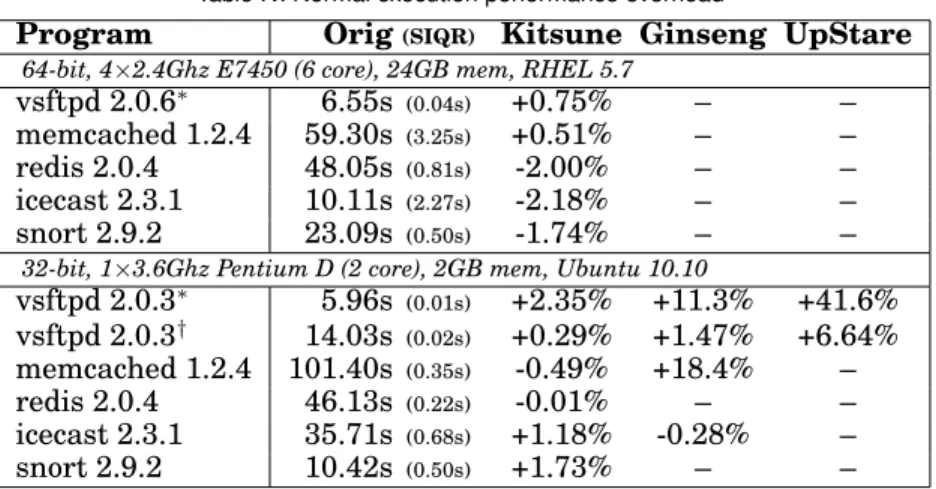
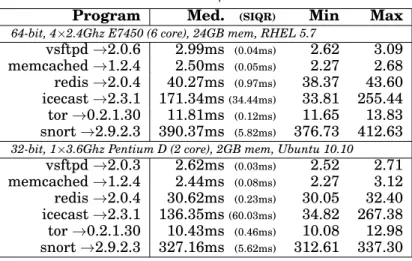
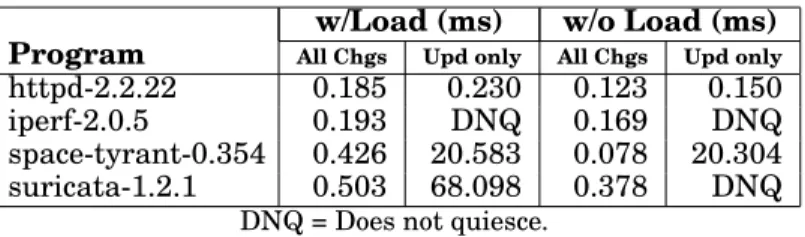
We measured Kitsune’s performance overhead on normal execution and found it ranged from -2.2% to +2.35%, which is in the noise on modern systems [Mytkowicz et al. 2009]. This is substantially better than the overhead that Ginseng [Neamtiu et al. 2006; Neamtiu and Hicks 2009] and UpStare [Makris and Bazzi 2009], two other general-purpose DSU systems for C, impose on some of the same programs: we mea-sured this overhead to be as high as 18.4% for the former and 41.6% for the latter. We also measured the time an application must pause while Kitsune performs an up-date and found it was typically less than 40ms, and less than 400ms in the worst case. This time is substantially faster than the time to save and restore state from disk; for redis we found this could take as long as 40seconds for a 15 GB heap. For some multi-threaded programs we require threads to synchronize before an update can take place; we found that making some minor program changes could dramatically reduce this synchronization time from an indefinite pause (in the worst case) to tens of mil-liseconds.
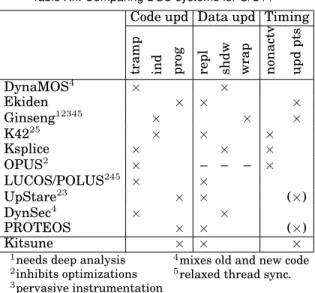
Related work.Kitsune’s design adopts the best ideas from existing systems while it eschews their shortcomings; a thorough analysis of the design space is given in Sec-tion 7. Notably, Kitsune’s design drew significant inspiraSec-tion from UpStare and Gin-seng. From the former, Kitsune adopts the notion of whole-program updates, rather than per-function updates, and from the latter it adopts the idea of updating only at explicitly specified update points, rather than at arbitrary positions. Whole-program updating eliminates the need to refactor programs to support certain updates (e.g., “loop extraction” [Neamtiu et al. 2006] to enable updating long-running loops), while update points simplify the task of testing and otherwise reasoning about an update, since far fewer program states need to be considered.
On the other hand, Kitsune specifically rejects other elements of these systems’ de-signs to better balance competing concerns. For example, both UpStare and Ginseng require nontrivial compilers to enable updating—UpStare compiles the entire program specially to enablestack reconstruction, a mechanism that reduces the control migra-tion problem to specifying a stack mappingat update-time, while Ginseng’s compiler
inserts extra levels of indirection, adds “slop” space tostructdefinitions, inserts read-/write barriers to support on-the-fly control and data migration, and performs a static analysis to ensure that these compilation changes will not break the program (e.g., due to tricky uses of typecasts).
Kitsune’s design requires the programmer to write slightly more code in the worst case compared to Ginseng and UpStare, but in general, it confers several advantages, including: (1) significantly better performance, since control migration code is localized to program paths that rarely overlap with normal program execution, while Ginseng’s and UpStare’s compilation changes are pervasive; (2) simplified update understanding, since the programmer can just read the code without having to mentally apply a stack mapping and/or indirection model to it; (3) a simpler implementation, since no special compiler/analyzer is needed; and (4) greater flexibility and scalability, since Kitsune does not require (conservative, slow) whole-program analysis that prohibits certain programming idioms.
In essence, Kitsune makes DSU a first-classprogram feature that is implemented and maintained by the programmer, a task that is made simpler and more manageable thanks to the careful design of the Kitsune run-time library and tool suite. Considered as a whole, we find Kitsune to be the most flexible, efficient, and easy to use (and deploy) DSU system for C developed to date.1
Documentation and the source code of both Kitsune and the programs we retrofitted to use it are freely available at http://kitsune-dsu.com/.
2. KITSUNE
A Kitsune application’s execution goes through three phases:
Normal execution. When started for the first time, and while no dynamic update is
available, the application executes normally.
Update preparation. Once a dynamic update becomes available, the application
thread(s) must reach a state in which the update can be safely applied. The program-mer will insert calls to the functionkitsune updateat program points at which an up-date is permitted to take effect; such calls are dubbedupdate points[Hicks and Nettles 2005]. When an update is available, thekitsune updatefunction starts the update pro-cess. If the program is single-threaded, the new program is loaded and the next phase, update execution, begins. If the program is multi-threaded, each thread blocks until all reach an update point, and then update execution begins.
Update execution. The threads running the old code have their stacks unwound,
the entire new program is loaded, and itsmainfunction is called by the main thread. Sincemain also executes during normal startup, the programmer adds a few Kitsune API calls to direct it to behave differently during an update. This added code will do two things: (1) migrate and transform the old version’s data, and (2) direct control to a point in the new version that is equivalent to the point at which the update took place in the old version, identified by calls tokitsune update. We call these two activi-tiesdata migrationandcontrol migration, respectively. Once all threads have reached
1This paper is an expanded version of Hayden et al. [2012c], with changes including: (a) consideration
of dynamic updates to Snort, a large and complicated application; (b) better handling of multi-threaded programs, incorporating ideas proposed in a workshop paper [Hayden et al. 2012b] to improve update times; (c) additional performance experiments considering large heaps; (d) comparisons to related work published since the original paper; (e) many improvements to the exposition.
.c .c .c kitc gcc -c-fPIC -fvis...= gcc -shared xfgen .c .c .ts .xf .c .c .c .c .c .o app.so st.c rt.a .c .c .ts (old)
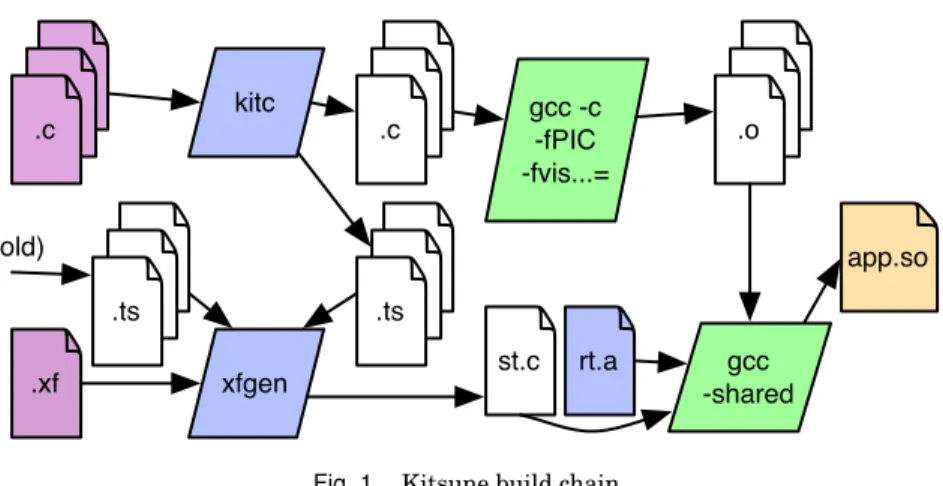
Fig. 1. Kitsune build chain
their update points, the update is complete, resources are freed, and normal execution resumes.
In what follows, we explain how we build programs to implement this semantics (Section 2.1), and how data and control migration are orchestrated by the programmer using the Kitsune API (Section 2.2). For simplicity, we start by assuming we are work-ing with a swork-ingle-threaded program, and later describe how we handle multi-threaded programs and other language features (Section 3).
2.1. Implementing dynamic updating
The process of building a Kitsune application is illustrated in Figure 1. There are two inputs provided by the programmer: the main application’s .csource files (upper left) and an xfgen. xfspecification file for transforming the running state during an update (not needed for the initial version). The source files are processed by the Kitsune com-piler kitc to add some boilerplate calls derived from programmer annotations. kitc is built using CIL [Necula et al. 2002]. Rather than compile and link the resulting.cfiles to a standalone executable, these files are compiled to be position independent (using gcc’s-fPICflag) and linked, along with the Kitsune runtime systemrt.a, intoapp.so, a shared object library. (For the best performance we also usegcc’s-fvisibility=hidden op-tion to prevent applicaop-tion symbols from being exported, since exported symbols incur heavy overhead when called.) When building an updating version of the program, the . xffile is compiled by xfgen to C code and linked in as well. During this process, xfgen uses .tstype summary filesproduced by kitc for the old and current versions (described in detail in Section 4.2). We consider xfgen in Section 4.
The first version of a program is started by executing “kitsune app.soargs...” where args... are the program’s usual command-line arguments. The kitsune executable is Kitsune’s application-independentdriver routine, which dynamically loads the shared library and then performs some initialization. Among other things, the driver installs a signal handler forSIGUSR2,2which is later used to signal that an update is avail-able. The driver also calls setjmp and then transfers control to the (globally visible) kitsune init function defined in rt.a. This function performs some setup and calls the application’s (non-exported)mainfunction; at this point,normal executionbegins. The
2The exact method for signaling that an update is available is left to the discretion of the programmer.
However, Kitsune provides a sensible default of SIGUSR2, which works well in most cases. In programs we worked with, only Tor, which had a previously existing control framework, required a different mechanism.
kitsune driver is 120 lines of C code and is the sole part of a program that cannot be dynamically updated.
When SIGUSR2 is received, the handler sets a global flag; this starts the up-date preparation phase. Thekitsune update function will notice the flag has been set and call longjmp to return to the driver, which then dynamically loads the new pro-gram version’s shared object library. Since the longjmp call will reset the stack, the kitsune updatefunction copies any local variables marked for migration to the heap be-fore jumping back to the driver. Thus, just after an update, the old version’s full state (e.g., its heap, open files and connections, process/parent ID, etc.) is still available. At this point, kitsune init is invoked to start the new version and initialize Kitsune’s in-ternal data structures (such as a hashmap used to manage migration), and then the update executionphase begins when the driver calls into the program’s main function. The programmer will have inserted calls to various Kitsune API functions to perform data and control migration during this phase, which we illustrate in detail next.
2.2. Example
To use Kitsune, the programmer must slightly modify her application to insert update points and add code to perform control and data migration. This subsection uses an example to illustrate what these modifications look like using the Kitsune API.
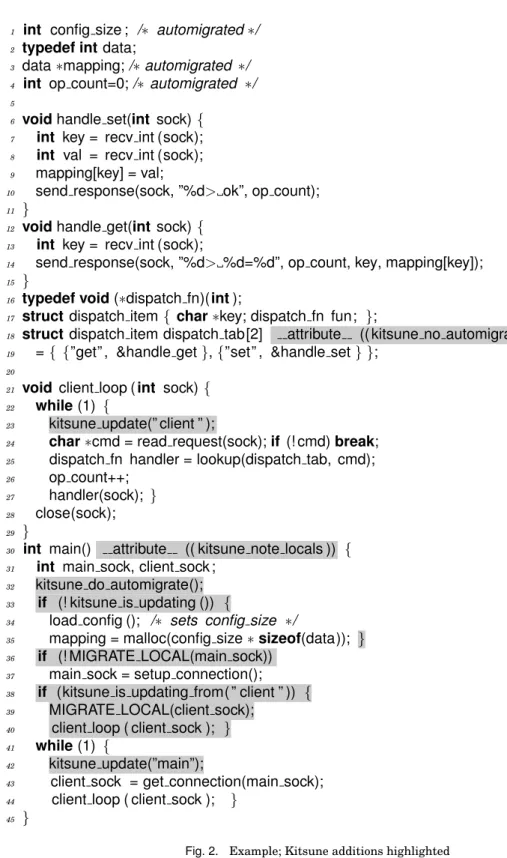
Consider the C program in Figure 2, which implements a simple key-value server. Clients connect to the server and send either get i to get the integer value associ-ated with index i, orseti n to associate index iwith value n. In the figure we have highlighted the extra code we need to perform data and control migration.
Let us ignore the highlighted code for the moment and discuss the program’s core operation. Execution begins withmain()on line 30. After defining some local variables, the function calls load config () (code not shown), which initializes config size defined on line 1 and then allocates an emptymapping. Next,main() calls setup connection() (code also not shown) to begin listening on main sock. Finally, main() enters the main loop on lines 41–45. This loop repeatedly waits for a connection and then calls client loop () to handle that connection. The client loop () function repeatedly reads a command from the socket; finds the handler (a function pointer) for that command in dispatch tab(created on lines 18–19); increments a global counterop countthat tracks the number of requests; and then dispatches to handle setorhandle get. If the client disconnects, the function exits the loop on line 24 and returns. While this code is very simple, many server programs share this same general structure—a main loop that listens for connections; a client loop that dispatches different commands; and handler functions that implement those commands.
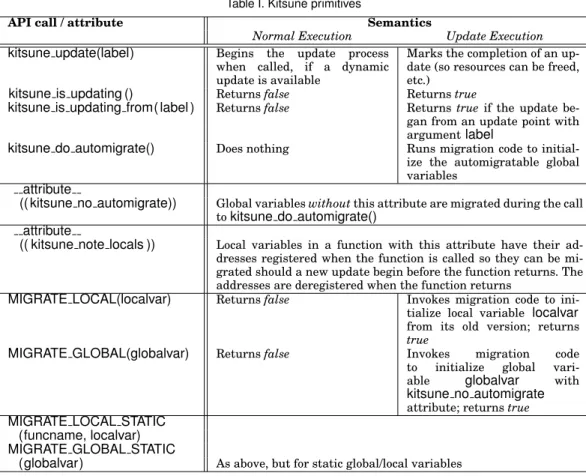
Now consider the highlighted code, which the developer has added to the program to implement Kitsune control and data migration. This code makes use of several prim-itive operations that Kitsune provides which we have summarized in Table I and dis-cuss here. We should emphasize that because this example is tiny, the amount of high-lighted code is disproportionately large (see Section 5).
Migrating control.A dynamic update is initiated when the program calls kitsune update(name), wherenamedistinguishes thisupdate pointfrom other update points in the program; we will see why such naming is important shortly. In Figure 2 we have added update points on lines 23 and 42, i.e., we have one update point at the start of each long-running loop. These are good choices for update points because the
1 int config size ; /∗ automigrated∗/ 2 typedef intdata;
3 data∗mapping;/∗automigrated ∗/ 4 int op count=0;/∗ automigrated ∗/ 5
6 voidhandle set(int sock){ 7 int key = recv int (sock); 8 int val = recv int (sock); 9 mapping[key] = val;
10 send response(sock, ”%d> ok”, op count); 11 }
12 voidhandle get(int sock){ 13 int key = recv int (sock);
14 send response(sock, ”%d> %d=%d”, op count, key, mapping[key]); 15 }
16 typedef void(∗dispatch fn)(int);
17 structdispatch item{ char∗key; dispatch fn fun; };
18 structdispatch item dispatch tab[2] attribute (( kitsune no automigrate)) 19 ={ {”get” , &handle get},{”set” , &handle set} };
20
21 void client loop (int sock) { 22 while(1) {
23 kitsune update(” client ” );
24 char∗cmd = read request(sock);if (! cmd)break; 25 dispatch fn handler = lookup(dispatch tab, cmd); 26 op count++;
27 handler(sock); } 28 close(sock); 29 }
30 int main() attribute (( kitsune note locals )) { 31 int main sock, client sock ;
32 kitsune do automigrate(); 33 if (! kitsune is updating ()) {
34 load config (); /∗ sets config size ∗/
35 mapping = malloc(config size∗sizeof(data)); } 36 if (! MIGRATE LOCAL(main sock))
37 main sock = setup connection(); 38 if (kitsune is updating from( ” client ” )) { 39 MIGRATE LOCAL(client sock);
40 client loop ( client sock ); } 41 while(1) {
42 kitsune update(”main”);
43 client sock = get connection(main sock); 44 client loop ( client sock ); }
45 }
program isquiescent, i.e., in between events, when update-relevant state is not in the middle of being modified [Neamtiu et al. 2006; Hayden et al. 2012d].3
Thekitsunedriver will load the new version and call itsmainfunction. During update execution, the program will direct control toward the equivalent update point in the new version, which is to say, one having the same name as the update point that ini-tiated the update in the old version. To do this, it will branch on kitsune is updating (), which returns true if the program is being run as a dynamic update, and lets the program distinguish update execution from normal startup. The Kitsune API also in-cludes the variant kitsune is updating from(name), which checks whether the update was triggered at the named update point.
In Figure 2, the conditional on line 33 prevents the configuration from being reloaded and mapping from being reallocated when run as an update, since in this case the program will migrate that state from the old version instead (discussed below). If the update was initiated from the client loop, then on line 38 the program migrates client sock from the previous version and then goes straight to that loop. Notice that when control returns from this call, the program will enter the beginning of the main loop, just as if it had returned from the call on line 44. Also notice we do not specifically test for an update from the ”main”update point, as in that case the control flow of the program naturally falls through to that update point.
Migrating data. When a program using Kitsune starts update execution, critical data from the previous version of the program remains available in memory. The pro-grammer is responsible for identifying what portion of that data should be migrated to the new version and specifying how that migration is to take place.
The first step is to identify the global and local variables that should be migrated. All global variables are migrated by default (that is, “automigrated”), and the programmer can identify any exceptions. For our example, migration occurs for config size(line 1), mapping (line 3), and op count (line 4). We use the kitsune no automigrate attribute on line 18 to prevent dispatch tab from being automigrated, so that it is initialized normally—with pointers to new version functions—rather than overwritten with old version data. Only local variables in functions annotated with the kitsune note locals attribute are eligible for migration (c.f.main()).
To facilitate data migration, kitc generates a per-file do registration () function that registers the names and addresses of all global variables, includingstatics, and records for each one whether it is automigratable. The do registration () function is marked as a constructor so it is called automatically bydlopen. Similarly, kitc introduces code in each of the functions annotated with kitsune note localsto register (on function entry) and deregister (on function exit) the names and addresses of local variables (in thread-local storage).
The second step is to indicate whendata should be migrated after the new version starts. Callingkitsune do automigrate() (line 32) starts migration of global state, call-ing a migration function for each registered variable that is automigratable. These functions traverse data structures, transforming them wherever necessary, and are produced by xfgen automatically, when migratable data is unchanged between ver-sions, or else according to programmer specifications. Each function follows a partic-ular naming convention, and the runtime finds it in the new program version using dlsym().
Within a function annotated with kitsune note locals, the user calls MIGRATE LOCAL(var) to migrate (via the appropriate migration function) the
3Note that our definition ofquiescentdiffers from (and is not comparable to) that of some prior work, which
Table I. Kitsune primitives
API call / attribute Semantics
Normal Execution Update Execution kitsune update(label) Begins the update process
when called, if a dynamic update is available
Marks the completion of an up-date (so resources can be freed, etc.)
kitsune is updating () Returnsfalse Returnstrue
kitsune is updating from( label ) Returnsfalse Returnstrueif the update be-gan from an update point with argumentlabel
kitsune do automigrate() Does nothing Runs migration code to initial-ize the automigratable global variables
attribute
(( kitsune no automigrate)) Global variableswithoutthis attribute are migrated during the call tokitsune do automigrate()
attribute
(( kitsune note locals )) Local variables in a function with this attribute have their ad-dresses registered when the function is called so they can be mi-grated should a new update begin before the function returns. The addresses are deregistered when the function returns
MIGRATE LOCAL(localvar) Returnsfalse Invokes migration code to ini-tialize local variable localvar
from its old version; returns true
MIGRATE GLOBAL(globalvar) Returnsfalse Invokes migration code to initialize global vari-able globalvar with
kitsune no automigrate
attribute; returnstrue MIGRATE LOCAL STATIC
(funcname, localvar) MIGRATE GLOBAL STATIC
(globalvar) As above, but for static global/local variables
old version of var to the new version, e.g., as used on line 39 to migrate client sock. MIGRATE LOCAL()returns true if the program was started as a dynamic update; on line 36 we test this result to decide whether to initializemain sock.
Our overall design for data migration reflects our experience that we typically need to migrate all, or nearly all, global variables, whereas we need only migrate a few local variables—only locals up to the relevant update point are needed, and of these, most contain transient state. We also assume that data that should be migrated is reachable from the application’s local and global variables. In our experiments, this assumption was true except for memcached, in which pointers to some application data were stored only in a library. We solved this problem by caching such pointers in the main application; see Section 5.2.
Cleaning up after an update.After updating, Kitsune reclaims space taken up by the old program version. Since control and data migration are under programmer control in Kitsune, we need to specify the point at which the update is “complete.” That point is when the new program version reaches the same update point at which the update occurred (cf. the branch on line 40 of Figure 2, which then reaches the update point on line 23). Kitsune then unloads the code and stack data from the previous program version; to be safe, the programmer must ensure there are no stale pointers to these locations. For example, programmers must ensure any strings in the data segment that need to migrate are copied to the heap (which can be done in state transformers, or with strdupin the program text). Kitsune also frees any heap memory that
xfgen-generated migrations have marked as freeable. Finally, control returns to the new version to begin normal execution.
Checking correctness. To test that code supporting dynamic updates is correct, a pro-grammer can test that the program properly updates to itself (e.g., use the program’s normal system test suite, slightly modified, to update the program during a test run). Doing so ensures that all of the control and data migration code works as it should, preserving the state following the update. In our experience, suchself updatesare the most challenging part of retrofitting a program to use Kitsune, and normal program updates take comparatively far less time.
3. ADVANCED FEATURES
This section describes how Kitsune supports programs that make use of multiple threads and dynamically loaded libraries, and discusses Kitsune’s current limitations.
3.1. Multi-threading
Updating a multi-threaded program is more challenging since the programmer must migrate control and data for every thread. Using the methodology in the previous section, the programmer could add control migration to the main thread to kill and restart, or reuse, existing threads. However, most of the time the number and role of threads before and after the update is the same (or close to it), and thus Kitsune provides support to ease thread management during an update.
To make a pthreads program Kitsune-enabled, the programmer modifies all thread creation sites to use a wrapper for pthread create called kitsune pthread create.4 A thread created with kitsune pthread create( tid , f , arg) has its thread id tid, thread functionf, andf’s argumentargatomically added to a global listkitsune threadsof live threads. When a thread exits normally, it removes its entry fromkitsune threads.
When an update to a multi-threaded program is requested, Kitsune sets a flag to indicate the update has been received, as usual. When a thread reaches an update point, if that flag is set then the thread records the name of the update point in its kitsune threadsentry and then blocks. Once all threads have blocked at update points, the system has reachedfull quiescenceand is ready to be begin the actual update.
At this point, the main thread starts updating as described in Section 2.2 and contin-ues until it finally reaches its own update point in the new version. Then the run-time system iterates through kitsune threadsand relaunches each thread, calling the new version of the recorded thread function with its recorded argument. If needed, the de-veloper can provide a special transformation function to modify the set of threads or transform a thread’s entry function and argument. Each of those threads then exe-cutes, performing whatever control and data migration is needed. Each thread pauses when it reaches the update point where it was stopped. Once all threads have paused, the Kitsune runtime cleans up the old program version, freeing its code and data as usual, and resumes the main thread and all paused threads.
3.1.1. Requirements for multi-threaded updates. In order to work with the design just described, Kitsune multi-threaded programs must meet—or be modified to meet— several requirements. First, the program should be insensitive to the order in which the threads are restarted in the new version. We find this often holds because the main thread naturally migrates any shared state, which would otherwise be the main source of contention between threads. Second recreating threads changes their thread IDs, so 4We could have automated this step, but wanted to give the programmer the option of orchestrating
the program should not store those IDs in memory. We could extend Kitsune to relax this requirement, but so far have not found it necessary.
Third, to achieve full quiescence quickly, threads should avoid non-interruptible blocking calls on paths to update points. For example, a call to kitsune update may be preceded by a call that reads from a socket. If this call blocks and cannot be in-terrupted, the thread will not reach its update point until data is available. Worse still, one thread could hold a mutex when it reaches its update point, but then another thread could block on the same mutex prior to reaching its own update point, delaying full quiescence indefinitely.
3.1.2. Avoiding blocking calls. To ensure full quiescence the programmer must confirm that all blocking calls that appear on any path to an update point are interrupt-ible. This requirement immediately rules out the second situation above: the pro-gram is not permitted to hold any locks when it reaches an update point, because pthread mutex lock is not interruptible (nor would it be sensible to make it so). For-tunately, we found that no quiescent points in the programs we considered are ever reached by threads holding locks.
For programs we have considered, blocking calls that could inhibit quiescence fell into two categories: blocking I/O calls and calls topthread mutex wait. We found that in both cases, we could interrupt the call and the program would either behave correctly with no changes, or we could make it behave correctly with a few small modifications. Blocking on I/O.Mature server programs, such as the kind we studied, are often written to deal with interrupted blocking calls, so adding update points to such pro-grams requires little or no change. Consider the following example.
1 void∗thread entry(void∗arg){ 2 /∗ thread init code∗/ 3 while(1) {
4 kitsune update();
5 res = accept(sockfd, addr, addrlen); 6 if (res ==−1 && errno == EINTR) 7 continue;
8 /∗ ... handle connection∗/ 9 } }
Under normal circumstances anacceptcall will block until a connection is accepted. However, if a signal is received the call will be interrupted, returning−1and setting the errno to EINTR.5 In the above code snippet, the programmer has accounted for this possibility by returning control to the start of the loop so as to retry the accept. Because in Kitsune program updates are initiated by sending the process aSIGUSR2 signal, adding the update point to line 4 in the example ensures the blockedacceptcall will be released and will reach the update point quickly when the update is signaled.
Note that signals are normally handled by a program’s main thread, so only that thread’s blocking calls are interrupted. To interrupt blocking I/O calls in all threads, Kitsune’s main signal handler sends a signal to any other thread that has not already reached its update point and is not waiting on a condition variable; how we handle the latter situation is described next.
5POSIX supports auto-restarting interrupted, “slow” system calls [Stevens and Rago 2005] (i.e., without
returningEINTR), which would defeat our scheme. We disable that feature by excludingSA RESTART
Blocking on Condition Variables. We observe that the threads often coordinate using condition variables, blocking on calls to pthread cond wait. As a matter of good style, programmers guard against spurious wake-ups of such calls by placing them in loops, as the following non-highlighted code on lines 6–7 shows:
1 void∗thread entry(void∗arg){ 2 /∗ thread init code∗/ 3 while(1) {
4 kitsune update();
5 pthread mutex lock(&mutex);
6 while (! input is ready () && !kitsune update requested()){ 7 kitsune pthread cond wait(&cond, &mutex);
8 }
9 pthread mutex unlock(&mutex); 10 if (kitsune update requested())
11 continue;/∗ reaches kitsune update∗/ 12 /∗ ... handle connection∗/
13 } }
To allow an update to interrupt this idiomatic use of condition variables, we first mod-ify the condition to check whether an update has been requested, as shown in the highlighted code on line 6. We also modify the code following the condition variable loop to jump back to the start of the loop if an update is requested (lines 10-11). This ensures that an update is reached if pthread cond wait wakes. One straightforward way to force the pthread cond wait call on line 7 to wake up would be to replace it withpthread cond timedwaitwith a short timeout. But this approach incurs some un-necessary delay and potentially expensive polling overhead. Therefore, we replace the pthread cond wait call with a call to kitsune pthread cond wait, which (before calling pthread cond wait) notes the condition variable argument in the global list of threads so that it can later be signaled by another thread once an update has been requested.
Uninterruptible sleep calls are similar to blocking condition variables. To solve this problem, we implemented an interruptible sleep call, kitsune ms sleep, that can be easily swapped out for blocking sleep functions. When the program receives the update request signal, the sleep will be interrupted. Similar to the other interruptible calls, programmers should write code to redirect control flow back to an update point.
These solutions for waking a thread blocking on I/O or condition variables require that another thread be available to signal the process or condition variable (e.g., since pthread cond signal cannot safely be called from a signal handler). This presents a problem if the thread that receives the initial updating signal is blocked on a condi-tion variable and so may not wake up to signal other threads. For this reason, Kitsune launches one additional thread that sleeps during most of execution, but periodically wakes and checks the update-requested flag. If an update was requested, it will at-tempt to signal any threads that have not yet reached an update point.
While the above circumstances cover the vast majority of blocking calls, one of our subject programs, suricata, required custom code to be called from a signal handler to unblock one of its threads (as we describe in Section 6.3). However, POSIX requires that the same signal handler function be used for all threads in a process. Thus, Kit-sune provides a library function, kitsune thread update callback, that allows the de-veloper to provide a callback function to be executed for the current thread when an update signal is received. A separate callback function may be set for each thread as needed, or left unset for no callback (in the majority of cases).
3.2. Dynamically loaded shared objects
Recall that to use Kitsune, we must compile the application to a shared library that can be loaded and unloaded. If that application itself loads other shared libraries that change with an update, then we have to update those other shared libraries as well. If the library was statically linked with the host program, it will be reloaded naturally along with the new version of the program; if it was linked dynamically, then the control migration code can be written to call dlclose and dlopento unload and load shared objects, respectively. If the shared object has state, then it must be compiled with kitc so that state can be registered and updated.
One issue we have encountered with shared objects is that Kitsune uses the names of globals and (registered) locals internal to each shared object. Thus, from Kitsune’s perspective, symbol names can conflict across different shared objects (and the main program), even if they are hidden in terms of standard dynamic linking. This situa-tion arose for us when updating Snort, which uses a plug-in architecture for protocol analyzers.
To solve this problem we introduced namespace support in the style of C++ using a directive to the kitc compiler. The programmer can specify a namespace for a file with the file-level command E_NAMESPACE name, where name is a unique string for that namespace. The same namespace is used for all files that build the same shared object. When kitc compiles a file, it prepends thenameto the front of each symbol in that file as it stores it in the. tsfile. This change propagates to how kitc generates and uses symbol registrations, avoiding conflicts.
3.3. Limitations
Kitsune’s main limitations at present are a lack of support for custom allocators and pointers to the interior of objects.
Custom allocators.One notable limitation is that Kitsune does not support the use of custom memory allocators. Recall that Kitsune updates the heap by traversing the pointer graph for the program, redirecting pointers to statically-allocated memory, or using the standardmallocandfreefunctions to allocate new objects and free old ones on a per-object basis. However, if an object was allocated by a custom allocator, freeing it with the standardfreefunction will not work, and likewise allocating memory with standardmallocduring transformation will fail if the updated program uses a custom freeon that memory later.
Supporting custom allocation is certainly possible, e.g., by storing additional meta-data to disambiguate pointers. But so far custom allocation has not been an issue for Kitsune, for two reasons. First, in many cases we can simply replace the use of a cus-tom allocator with the standard one, which often improves performance [Berger et al. 2002]. Second, many custom allocators aretype-specific, i.e., they only allocate objects of some typeT. As such, if an update does not changeT’s type, then none of the mem-ory managed byT’s allocator will need to be allocated or freed, and so the update can be performed safely. Snort uses more than a dozen type-specific allocators, but none of the updates we considered changed their types. If such an update occurred, Kitsune could not support it and normal stop/restart would have to be employed.
Interior pointers.Another memory management issue is that Kitsune assumes there are no pointers into the middle of objects. This comes up in two ways. First, our gen-erated code assumes that when it comes across astructfoo∗that this pointer is to the front of an allocated object, and thus can be freed and reallocated ifstructfoochanged size. Second, pointers into the middle of objects that could be reallocated may dangle, e.g., a int ∗x may point to the field of a particular struct, but if that object is freed
INITnew var: {action} INITnew type: {action}
old var→ new var: {action}
old type→new type: {action}
old var→ new var old type→new type
$in , $out– old/new type or var $old/newsym(x)–xin old/new prog. $old/newtype(t)– tin old/new prog. $base– containingstruct
$xform(old, new)– transformer function fromoldtonewtype/var
(a) transformers (b) special variables Fig. 3. xfgen specification language
and reallocated thenxwill now point to stale memory. We currently address this issue by writing code to manually transform interior pointers. (In all of our test programs across all versions, we only encountered one instance of an interior pointer.)
Once again, we could address these issues by storing more metadata, but metadata management (e.g., in conjunction with calls to malloc/free) may add overhead to normal execution. We do support a debugging mode that maintains an interval tree to keep track of the address ranges of allocated blocks. This allows us Kitsune-generated code to identify pointers into the middle of allocated blocks and issue a warning if this pointer could be affected by a memory management action taken at update time.
4. XFGEN
As mentioned briefly in Section 2.2, Kitsune’s runtime invokes migration functions for each automigrating variable, following a naming convention to locate the appropriate migration function. Kitsune includes a tool, xfgen, that produces migration functions automatically for variables and types that have not changed, and generates migra-tion funcmigra-tions for those that have changed according to specificamigra-tions the programmer expresses in a simple, domain-specific language. We refer to such explicitly specified migration functions astransformers, since they are used to transform the data from an old representation to a new one. The design of xfgen is based on our prior experience applying DSU to C [Hayden et al. 2012d; Hayden et al. 2011; Hicks and Nettles 2005; Neamtiu and Hicks 2009; Neamtiu et al. 2006], and aims to make common kinds of state transformers easy to write while maintaining the flexibility to implement arbi-trary transformations.
This section presents the xfgen specification language, giving a series of examples, and then describes how xfgen generates migration functions.
4.1. Transformer specifications
Figures 3(a) and (b) summarize xfgen’s specification language. Each transformer has one of the forms shown in part (a). The INIT transformers describe how to initialize new variables or values of new types, and the→transformers describe how to trans-form variables or types that have changed and/or been renamed. Here {new,old} var is either a noted local (via kitsune note locals from Table I) or global variable name and{new,old} typeis either a regular C type name or astructfield (we will see exam-ples below). The transformeractionconsists of C code that may reference the special xfgen variables shown in Figure 3(b). These variables refer to entities from the old or new program version. A→transformation without an action identifies a variable/type renaming.
Example 1.Suppose we wrote a new version of the program in Figure 2 in which we removed the variable op countand replaced it with two new variablesget countand set countthat record per-operation counts. These variables will need to be initialized during the update. We do not know exactly how many get and set operations have
occurred, but we do have their sum in op count, so we might over-approximate each with the sum, as follows:
INIT get count: { $out = $oldsym(op count);} INIT set count: { $out = $oldsym(op count);}
Here we are initializing new variables, so we use anINITtransformer, and the action uses$oldsym(op count)to refer to the old version’s value ofop countand$outto refer to the output of the transformer, i.e.,get countandset countin the new version. Alter-natively, we might wish to preserve the total count, and in lieu of precise information we might assume most calls aregets, and some aresets:
INIT get count: { $out = (int) floor ($oldsym(op count)∗0.9);} INIT set count: { $out = (int) ceil ($oldsym(op count)∗0.1);}
In general, how a programmer writes a transformer depends on an application’s invari-ants and the desired properties of the updated application’s behavior [Hayden et al. 2012a].
Example 2.While transformers are often simple, xfgen is powerful enough to express more complicated changes. For example, suppose we change line 3 in Figure 2 so that, rather than an array,mappingis a linked list:
struct list {
int key; data val ; struct list ∗next; } ∗mapping;
Then we can specify the following transformer:
1 mapping→mapping:{ 2 int key;
3 $out = NULL;
4 for(key = 0; key<$oldsym(config size); key++){ 5 if ($in [key] != 0) {
6 $newtype(structlist ) ∗cur =
7 malloc(sizeof($newtype(structlist ))); 8 cur→key = key;
9 cur→val = $in [key]; 10 cur→next = $out; 11 $out = cur; 12 } } }
Heremapping→mappingindicates this is a transformer for the new version ofmapping (the occurrence to the right of the arrow, referred to as $out within the action) from the old version of mapping (referred to as $in). The body of the transformer loops over the old mapping array (whose length is stored in old version’s config size), al-locating and initializing linked list cells appropriately. In the call to malloc, we use $newtype(structlist ) to refer to the list type in the new program version.
Example 3.Finally, suppose the programmer wants to change type data from int to long, and at the same time extendmapping with field int cid to note which client established a particular mapping:
typedef longdata; struct list {
int key; data val ; int cid ; struct list ∗next; } ∗mapping;
The programmer can specify that val should simply be copied over andcidshould be initialized to−1:
typedefdata→typedefdata:{ $out = (long) $in; } INIT struct list . cid { $out =−1;}
Because the type of mappingchanged, xfgen will use these specifications to generate a function that traverses themapping data structure, initializing the new version of mappingalong the way. As we will see shortly, this is possible because we have merely added a (non-pointer) field to thestruct, so the traversal of the existing data structure accurately recovers the structure of the updated data structure. (We could not use this approach for the previous array-to-list change because the data elements were not related in a simple structural manner.)
Other special variables. In the examples so far, we have seen uses of all but the last two special variables in Figure 3(b). The variable$baserefers to the struct whose field is being updated. For example, in
INIT structs.x: { $out = $base.y}
new fieldxofstructsis initialized to fieldyin the samestruct.
Variable$xform(old,new)names the migration function between typesoldandnew. This variable is useful when defining a transformer for a container data structure, so that an action can recursively call the migration for each contained object. For ex-ample, suppose we merged Examples 2 and 3 into a single update that transformed mappingto a list and changeddata’s type tolong. Then we could use the transformer from Example 2, changing line 9 to
XF INVOKE($xform(data, data), &$in[key], &cur→val);
$xform looks up (or forces the creation of) the migration between its argument vari-ables/types. This migration is returned as a closure (a function pointer and an atten-dant environment) that takes pointers to the old and new object versions. A closure is called using theXF INVOKEmacro.
4.2. Migration generation
xfgen generates code to perform migration. At a high level, the generated code will traverse the heap, starting from the migratable global and local variables in the old version’s stack and data segment, and assign the (possibly transformed) data to the corresponding variables in the new version. With xfgen, the programmer is able to focus on defining whattransformation should be used for data representations that have changed, and is relieved of the tedium ofhowto find all of the old values, preserve the structure of the heap, and manage memory.
xfgen generates migration code based on the contents of the developer-provided . xf specification file and the Kitsune-maintained . ts type summary files for the old and new versions (see Figure 1). A type summary file contains all of the type definitions (e.g.,struct,typedef) and global and local variable declarations from its corresponding .c source file, noting which are eligible for migration (according to the rules given in Section 2.2). The type summary files of the old and new versions are compared, to identify those data definitions that have changed from the old to the new version. To assist the programmer, xfgen can check that . xf files are complete: an . xf file is
rejected if it fails to define a transformer that applies to migratable data that was added or whose type changed between versions.
xfgen uses type information to generate migration functions for migratable types and variables (or portions thereof) that have not changed—these functions will iter-ate over the variable/type in question, recursively invoking migration functions on the variable/type’s subcomponents. Migratable data includes migrated local and global variables, their types, and types they transitively reference; e.g.,structbaris migrat-able ifstructfoois migratable and contains a pointer to astructbar. xfgen sometimes needs additional programmer-provided type information to work correctly; e.g., it may need to know the lengths of arrays. We discuss annotations in detail below.
In the remainder of this section, we describe how migration code is generated for variables and types, and how annotations are used to ensure the generated code is complete.
Migrating variables.For each migrated variable listed in the new version’s. tsfile, if that variable is named explicitly in anold var→ new varspecification, then xfgen gen-erates C code from the specified action, substituting references appropriately. For ex-ample,$inand$outare replaced by values returned fromkitsune lookup oldand new, respectively, which return a pointer to a symbol in the old or new program version, respectively, orNULLif no such symbol exists. Thus xfgen will produce the following C code from the overapproximating specifications in Example 1, above:
void kitsune migrate get count() {
int ∗o op count = (int∗)kitsune lookup old(”op count”); int ∗n get count = (int∗)kitsune lookup new(”get count”); ∗n get count =∗o op count;
}
void kitsune migrate set count() { /∗ similar to the above∗/}
For each remaining migrated variablex, xfgen will consult they→x renaming rule if one exists to determine the source symbol y; otherwise it assumes x’s name is un-changed. In that case, as we noted previously, the lack of a symbolxin the old version code, or the lack of an explicit transformer ifx’s type has changed, will cause xfgen to reject the . xffile. Assuming the old version symbol has typeold typeand the new ver-sion has typenew type, xfgen’s generated function forxwill simply call the migration function for old type → new type; ifold type and new typehave the same definition (and no explicit transformer has been specified) then xfgen will generate C code for this function. We describe this process next.
Migrating types.xfgen generates transformer code fromold type→ new type specifi-cations in approximately the same manner as for variables. For specifispecifi-cations involving only a singlestructfield (as for thecidfield in Example 3), xfgen will generate code for the rest of the fields in the manner described below, and then insert the hand-written code for the new or changed field.
A generated function for an unchanged type simply recursively invokes the migra-tion funcmigra-tions for the immediate children of the type. For example, suppose we gen-erated a migration forstruct list in Example 3. Then, xfgen would produce code that retains the oldkeyvalue by copying it (generated migrations for primitive types are simple assignments); recursively invokes the user-provided transformer for data for the val field; inserts the user-provided code to assign to the cidfield; and recursively invokes itself on the target of thenextfield, assuming it is notNULL.
Pointers must be handled carefully by the generated code. For non-NULLpointers, the generated code checks a global migration mapto see if the pointer has been
mi-E PTRARRAY(S)– size of ptd-to array E ARRAY(S)– size of array
E OPAQUE– non-traversed pointer E FORALL(@t)– polymorphism intro. E VAR(@t)– refer to type var
E INST(typ)– instantiate poly. type Fig. 4. xfgen type annotations
grated before; if so it returns the old target. Doing so maintains the shape of the heap and avoids infinite loops when traversing cyclic data structures. Otherwise it calls the appropriate migration for the pointer’s target. If the pointer is to a global or local vari-able, then the address of this variable is different in the new version. As such, the code will look up the corresponding address and redirect to it. If the pointer target’s type has truly changed (and so must have an explicit transformer), the generated code mallocs space to store the result and then frees the old-version pointer. This is what happens fornextin Example 3—since thestructincreased in size, new memory is al-located for it and all fields must be copied. As an optimization, since the generated code for an unchanged struct reuses the old memory, migrations ignore non-pointer fields, retaining the old values. Once the source and target addresses (which may be the same) have been determined, they are added to the migration map.
xfgen-generated code may uselessly traverse portions of the heap that do not contain changed data. If the programmer knows that a particular data structure contains only pointers into the heap (and not to global or local variables), and that no pointed-to ob-jects require transformation, she can create transformers that truncate the traversal. For example, if field f ofstructfoo(transitively) points only to unchanged heap data, the developer could write
structfoo. f →structfoo. f : { $out = $in ; } to shallow-copy the field.
Recall from Section 3.3 that we assume there are no pointers into the middle of migratable objects. To help check this assumption, we provide an execution mode in which the xfgen-created migrations use an interval tree to record the start and end of each object they encounter. A migration reports an error if it is ever asked to migrate an object that overlaps with, but does not exactly match the bounds of, a previously migrated object. Supporting pointers to the interior of objects is future work.
Type annotations.xfgen sometimes needs type information beyond what is normally available in C. For example, without further guidance, xfgen would generate an incor-rect migration for mappingin Example 1. It would assume that mapping points to a singledataelement, rather than an array of elements. In Kitsune, extra type informa-tion is provided by the programmer as annotainforma-tions, shown in Figure 4. kitc recognizes these annotations and adds the information supplied by them to the . tsfiles.
The annotations, inspired by Deputy [Condit et al. 2007], are straightforward. E PTRARRAY(S)provides a sizeSfor a pointed-to array. For example, we would change line 3 of Figure 2 to
data∗ E PTRARRAY(config size) mapping;
By default, xfgen assumes that t∗ values for all types t are annotated with E PTRARRAY(1); explicit annotations override this default. Annotation E ARRAY(S) provides a sizeSfor array fields at the end of astruct(such fields can be left unsized in C). For both of these annotations,Scan be an integer constant, a global variable, or a co-locatedstructfield.E OPAQUEannotates pointers that should be copied as
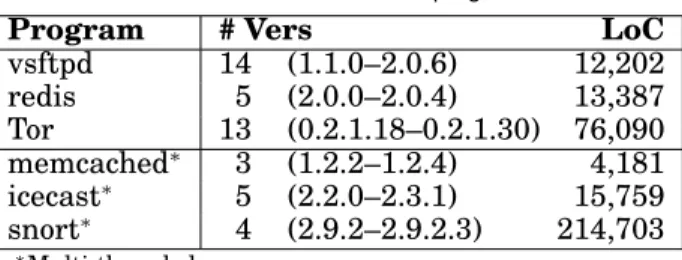
val-Table II. Kitsune benchmark programs
Program # Vers LoC
vsftpd 14 (1.1.0–2.0.6) 12,202 redis 5 (2.0.0–2.0.4) 13,387 Tor 13 (0.2.1.18–0.2.1.30) 76,090 memcached∗ 3 (1.2.2–1.2.4) 4,181 icecast∗ 5 (2.2.0–2.3.1) 15,759 snort∗ 4 (2.9.2–2.9.2.3) 214,703 ∗Multi-threaded
Table III. Kitsune modifications to support updating
Program Upd Ctrl Data E∗ Oth Σ v→v t→t Σ xf LoC
vsftpd 6 26 17+8 6+14 28+8 83+30 9 21 30 101 redis 1 2 3 43 50 99 0 5 5 37 Tor 1 39 37+6 19 57 153+6 16 15 31 189 memchd∗ 4 9 13 20 66 112 12 10 22 27 icecast∗ 11+1 22+3 14+9 32+3 41 120+16 25 50 75 200 snort∗ 2 136+16 118 183+2 54+18 493+36 111 64 175 297 ∗Multi-threaded
ues, rather than recursed inside during traversals (so we could use this annotation on thefoo. f field to truncate traversal in the above example, rather than define a manual transformation).
Finally, xfgen includes annotations to handle some idiomatic uses ofvoid∗to encode parametric polymorphism (a.k.a. generics). For example, the following definition intro-duces astruct list type that is parameterized by type variable@t, which is the type of its contents:
struct list {
voidE VAR(@t)∗val;
struct list E INST(@t)∗next; } E FORALL(@t);
E FORALL(@t) introduces polymorphism,E VAR(@t) refers to type variable @t, and E INST(@t)instantiates a polymorphic type with type@t. For comparison, this exam-ple is equivalent to the following Java generic linked list:
class List<T>{// like E FORALL(@T) T val ; // like E VAR(@T) List<T>next;// like E INST(@T) }
With generics, we can writestruct list E INST(int)∗xto declare thatxis a list ofints. Generated migration code will invoke the migration function that is appropriate for the list elements’ instantiated type.
5. EXPERIENCE AND APPLICATIONS
To evaluate Kitsune, we used it to develop dynamic updates for six widely deployed open-source server programs.6 This section quantifies the programming effort of ap-plying Kitsune to these applications; Section 6 quantifies Kitsune’s performance. 6The source code for these programs is freely available at http://kitsune-dsu.com/.
To measure programmer effort, we tallied the number and kinds of changes we made to the programs, and the number and variety of xfgen specifications we wrote for state transformation. Overall, we made few code changes—between 99 and 529 LoC—to support updating, with most changes only to the initial version. Likewise, xfgen speci-fications were generally small, averaging 3–4 lines per changed variable or type. These numbers are comparable to prior work.
5.1. Applications
We applied Kitsune to programs that maintain in-process state that would be benefi-cial to preserve during an update. Vsftpdis a popular open-source FTP server.Redis is a key-value database used by several high-traffic services, including guardian.co.uk and craigslist.org.Toris a popular onion-router that provides anonymous Internet ac-cess. Memcachedis a widely used, high-performance data caching system employed by sites such as Twitter and Facebook. Icecast is a popular music streaming server. Snortis an open-source network intrusion detection and prevention system with mil-lions of downloads and nearly 400,000 registered users. All of these programs main-tain persistent network connections that an offline update would interrupt. Redis and memcached also maintain potentially large volumes of in-memory data that would ei-ther be lost (memcached) or expensive to restore (redis) following an update. Vsftpd also serves as a useful benchmark because several other DSU systems have used it for evaluation [Neamtiu et al. 2006; Makris and Bazzi 2009; Chen et al. 2011; Hayden et al. 2011].
Table II lists for each program the length of the version streak we looked at (forn versions there are n−1 updates), which versions we considered, and the number of source lines of the last version as computed bysloccount. We consider at least three months of releases per program; for Tor we cover two years and for vsftpd we cover three. We tested that all programs behaved correctly before, during, and after updates were applied; we say more about the tests we used at the start of Section 6.2.
5.2. Programmer effort
Here we describe the manual effort that was required to prepare these programs for updating with Kitsune, and to craft updates corresponding to actual releases.
Table III summarizes the Kitsune-related source code modifications we made, tab-ulating the number of update points added (Upd); the number of lines of code needed for control migration and data migration (Ctrl and Data, respectively);7the number of type annotations for xfgen (E *); the number of lines changed for other reasons (Oth); and their sum. Changes from the Oth column are explained in the subsections below for the respective applications. Each column shows the number of changes in the first version, followed by+n, wherenis the sum of changes in all subsequent versions; if this is omitted, no further changes were needed.
One striking trend in the table is that most required changes occurred in the first version. Control migration and update points were particularly stable, essentially be-cause the top-level control structure of the programs rarely changed. Data migration code and annotations were occasionally added along with new data structures. Another interesting trend is that the magnitude of the changes required is not directly propor-tional to either the code size or number of versions considered, e.g., 134 LoC for 16 KLoC icecast vs. 529 LoC for 215 KLoC Snort. On reflection, this trend makes sense. Changes to support control migration depend on the number and location of update 7Specifically, control migration changes comprise calls tokitsune is updatingandkitsune is updating from.
Data migration changes include calls tokitsune do automigrate,MIGRATE GLOBAL, andMIGRATE LOCAL, and uses of thekitsune no automigrateattribute.
points, and data annotations depend on the type and number of data structures; none of these characteristics scales directly with code size. Together, these numbers show that with Kitsune, DSU can be viewed as a stable program feature that is added to the program and maintained (with minimal effort) as the program evolves.
The rightmost columns of Table III list the xfgen specifications we wrote for each program’s updates. We list the number of variable transformers (v→v) and type trans-formers (t→t), across all versions, and their sum. We also list the total number of lines of transformer code we wrote, across all versions. We can see that, on average, 3–4 lines of xfgen code were needed for each transformer. The median lines of xfgen code was 1, with some larger transformations such as one that switches on a signal value to determine the type of certain data, which affects its transformation.
Overall, we found both the control and data migration code relatively easy to write. Following the structure of the example given in Section 2.2, we added conditionals to avoid re-initializing data we wished to preserve across the update, and to direct con-trol back to the correct update points. State transformation code was also relatively easy to write. Most state required either no or very simple transformation along the lines of Example 1 in Section 4.1. Perhaps the trickiest part was adding type annota-tions to data structures. While in many cases these annotaannota-tions were obvious (specify-ing generic types or bounded arrays) or prompted by xfgen, a miss(specify-ing annotation was sometimes hard to debug. For example, failing to annotate a pointer as an array would result in the generated code not migrating all of the state, ultimately leading to a later crash. Fortunately, since Kitsune uses normal compilation and linking, we could use gdb to debug these problems directly.
Now we consider the particulars of each program, and when possible, compare the magnitude of these changes against those required by prior systems. In general, using Kitsune seems to require more program changes than prior systems, but the total sum of changes is still small.
5.2.1. Vsftpd.Many of the changes we made to vsftpd were typical across our bench-marks: we added type annotations for generics and inserted control flow changes to avoid overwriting OS state when updated. We added one update point for each of the five long-running loops in the program, which comprise the connection acceptance loop, two loops to implement privilege-isolated logins, the main FTP command processing loop, and a loop left running in a privileged parent process that implements commands such aschown.
The most interesting change we made to vsftpd was to handle I/O. Instead of calling therecvlibrary routine directly, vsftpd calls a wrapper that callsrecv, restarting it if it is interrupted, e.g., by the receipt of a signal. We inserted one update point in the wrapper, just after the recv, so that interruption can initiate an update. To simplify the control-flow changes needed, rather than give the update point its own name, we reused the name of the update point in the loop that initiated the wrapped call; this is safe is because this loop will reinitiate the call when the update completes.
Other DSU systems. Neamtiu et al. [2006] applied Ginseng, another DSU system, to vsftpd. They updated a subset of the version streak we did (finishing at version 2.0.3). Even though their changes support just one update point (versus our six, which permit updating in many more situations), the effort was comparable: They report 50 LoC changed and 162 lines for state transformation, compared to 113 LoC changed and 101 lines of state transformation for Kitsune.
Makris and Bazzi [2009] also updated vsftpd using UpStare for a shorter streak. Up-Stare version 0.12.9 (which we compare against experimentally in Section 6) includes 14 state-mapping files for vsftpd, containing 4,644 lines of C code between them.