INSTALLATION INSTRUCTIONS
FOR UPFLOW, DOWNFLOW/HORIZONTAL HIGH
EFFICIENCY CONDENSING TWO-STAGE GAS
FURNACES
RGRM, RGTM SERIES
U.L. recognized fuel gas and CO (carbon monoxide) detectors are recommended in all applications, and their installation should be in accordance with the manufacturer’s recommendations and/or local laws, rules, regulations, or customs.
INSTALLATION CHECK LIST
REFER TO INSTALLATION INSTRUCTIONSGAS SUPPLY
______ Adequate pipe size
______ Correct supply pressure (during furnace operation)
______ Manifold pressure
______ No gas leaks
______ L.P. Kit Number (if applicable)
ELECTRICAL
______ 115 V.A.C. supply (Single Circuit)
______ Polarity observed
______ Furnace properly grounded
______ Adequate wire size
FURNACE INSTALLATION
______ Adequate clearance to combustibles
______ Adequate clearance for service (at front)
DUCT STATIC PRESSURE
______ in. w.c. on heating speed
______ in. w.c. on cooling speed
______ Air temperature rise
CONDENSATE LINE ______ Trap filled with water
______ Vented
______ Sloped toward drain
______ Condensate drain line hoses connected and clamped
______ Freeze protection (if necessary)
VENTING – DIRECT VENT ______ in. diameter – intake pipe
______ in. diameter – exhaust pipe
______ ft. of pipe – intake air
______ no. of elbows – intake air
______ ft. of pipe – exhaust pipe
______ no. of elbows – exhaust pipe ______ Exhaust Vent Temperature
TERMINATIONS – DIRECT VENT VERTICAL
______ Intake – 12" min. above roof/snow level
______ Correct relationship – exhaust to intake
HORIZONTAL/VERTICAL – CONCENTRIC (RXGY-E03A)
______ Intake – 12" min. above roof/snow level
______ Intake “Y” rotated above center
______ Exhaust sloped toward furnace
HORIZONTAL – STANDARD (RXGY-D02, -D03) – US (RXGY-D02A, RXGY-D03A) – CANADA
______ Correct relationship – exhaust to intake
______ 12" min. above grade/snow level
HORIZONTAL – ALTERNATE
(RXGY-D02, -D03 OR -D04) – US (RXGY-D02A, -D03A, -D04A) – CANADA
______ Correct relationship – exhaust to intake
______ Above anticipated snow level
VENTING – NON-DIRECT VENT ______ in. diameter – exhaust pipe
______ ft. of pipe – exhaust
______ no. of elbows
TERMINATION – NON-DIRECT VENT VERTICAL
______ 12" min. above roof/snow level
HORIZONTAL – STANDARD
______ 12" min. above grade/snow level
HORIZONTAL – ALTERNATE
______ Above anticipated snow level
_____________________________ Model Number
_____________________________ Serial Number
CONTENTS
Safety Precautions ...1
Installation Check List ...2
General Information...4
Safety Information ...7
Location Requirements and Considerations ...9
Ducting ...14
Venting and Combustion Air Piping ...16
Combustion and Ventilation Air ...18
Vent Pipe Installation...21
Condensate Drain/Neutralizer ...34
Gas Supply and Piping...38
Electrical Wiring...41
Accessories ...42
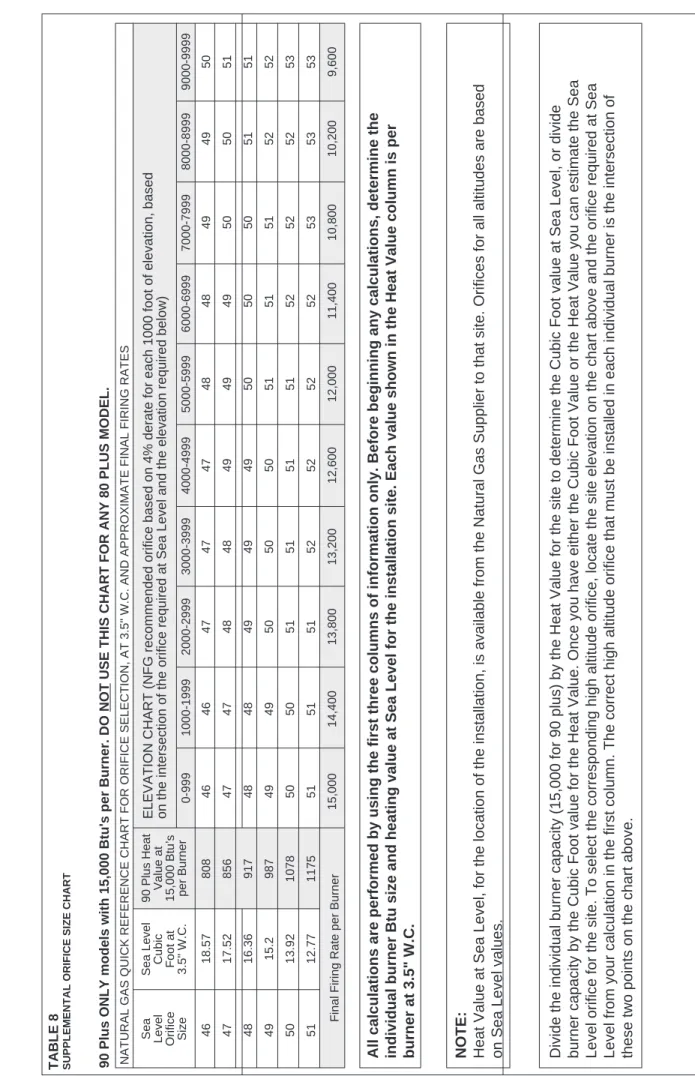
High Altitude Installations ...43
Start-Up Procedures...46
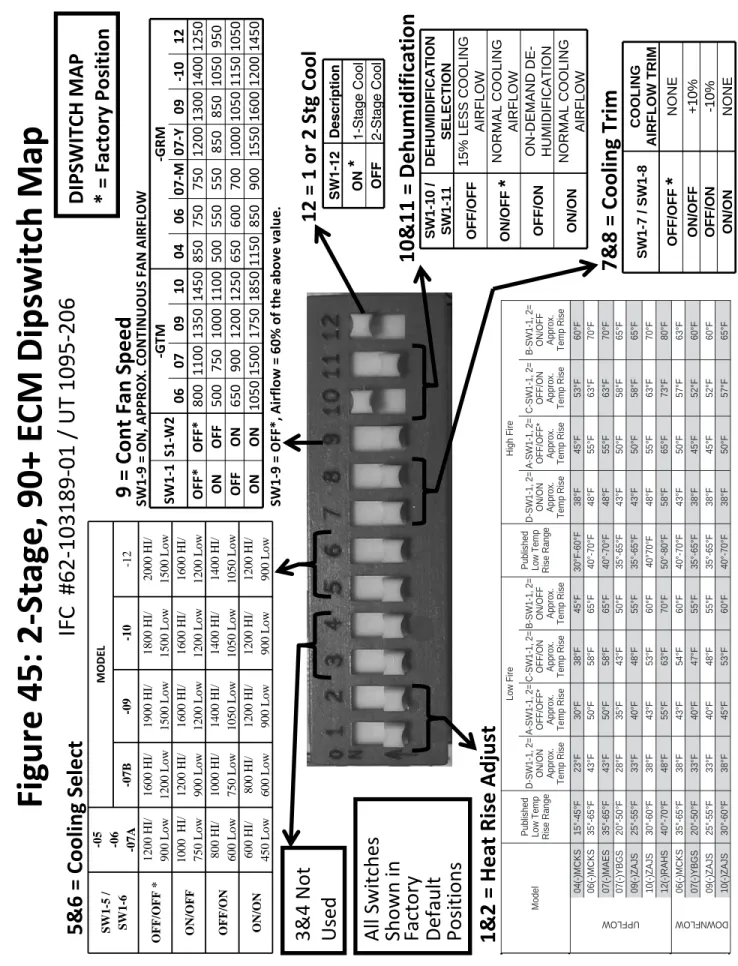
Integrated Furnace Control and ECM Motor Settings...47
Two Stage 90’s w/Elm (GRM’s & GTM’s) ...49
Air Flow...51
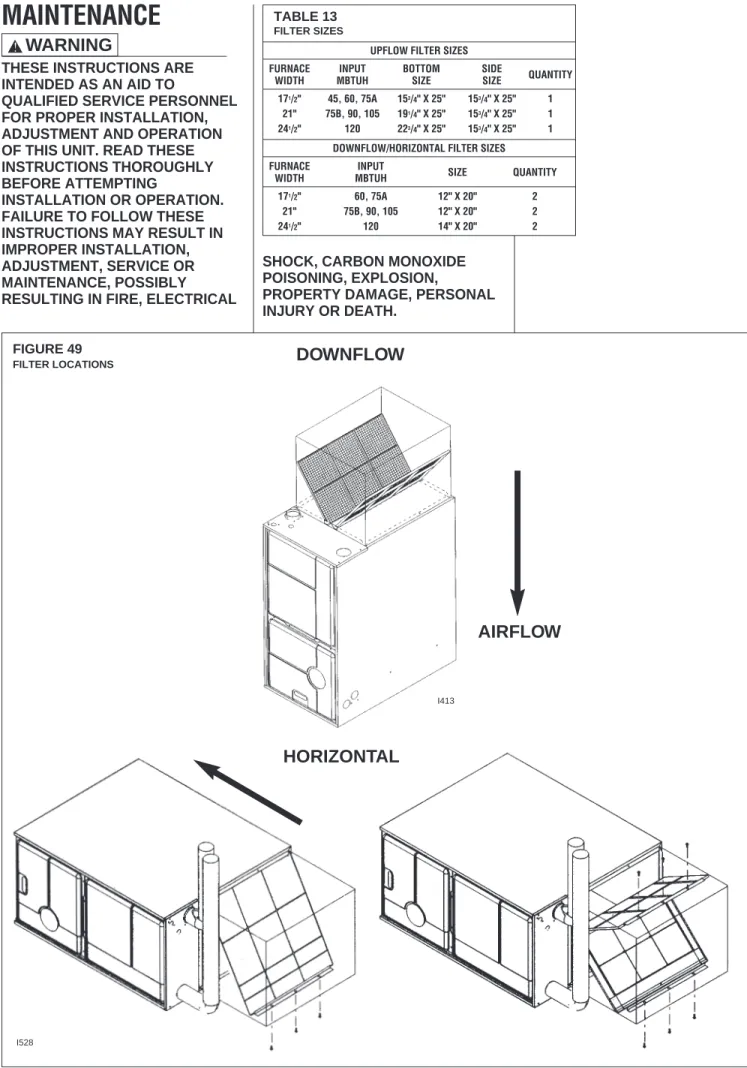
Maintenance ...52
Troubleshooting ...56-57 Wiring Diagram...58 IMPORTANT: All manufacturer
products meet current Federal OSHA Guidelines for safety. California Proposition 65 warnings are required for certain products, which are not covered by the OSHA standards. California's Proposition 65 requires warnings for products sold in California that contain, or produce, any of over 600 listed chemicals known to the State of California to cause cancer or birth defects such as fiberglass insulation, lead in brass, and combustion products from natural gas.
All “new equipment” shipped for sale in California will have labels stating that the product contains and/or produces Proposition 65 chemicals. Although we have not changed our processes, having the same label on all our products facilitates manufacturing and shipping. We cannot always know “when, or if” products will be sold in the California market.
You may receive inquiries from customers about chemicals found in, or produced by, some of our heating and air-conditioning equipment, or found in natural gas used with some of our products. Listed below are those chemicals and substances commonly associated with similar equipment in our industry and other manufacturers. • Glass Wool (Fiberglass) Insulation • Carbon Monoxide (CO)
• Formaldehyde • Benzene
More details are available at the Websites for OSHA (Occupational Safety and Health Administration), at www.osha.gov and the State of California's OEHHA (Office of Environmental Health Hazard Assessment), at www.oehha.org. Consumer education is important since the chemicals and substances on the list are found in our daily lives. Most consumers are aware that products present safety and health risks, when improperly used, handled and maintained.
NOTE: A load calculation must be performed to properly determine the required furnace BTU size for the structure. Also, the duct must be properly designed and installed for proper airflow. Existing ductwork must be inspected for proper size and sealed system. Proper airflow is necessary for both user comfort and equipment performance.
Before opening the furnace carton and installation of the furnace, verify the data tags on the carton and inside the furnace, match and is what was ordered from the local distributor. Also, check for any damage to the furnace before installation.
IMPORTANT: Proper application, installation and maintenance of this furnace and system is a must if
consumers are to receive the full benefits for which they have paid.
The RGRM and RGTM series furnaces are design-certified by CSA for use with natural and propane gases as follows:
1. As non-direct vent central forced air furnaces taking combustion air from the installation area or using air ducted from the outside.
2. As direct vent central forced air furnaces with all combustion air supplied directly to the furnace burners through a special air intake system outlined in these
instructions.Install this furnace in accordance with the American National Standard Z223.1 – latest edition entitled “National Fuel Gas Code” (NFPA54) and requirements or codes of the local utilities or other authorities having jurisdiction. This is available from the following:
National Fire Protection Association, Inc. Batterymarch Park
Quincy, MA 02269 CSA-INTERNATIONAL
8501 East Pleasant Valley Road Cleveland, Ohio 44131-5575 Install units in Canada in accordance with CSA-B149, local installation codes and authorities having jurisdiction. CSA-B149 is available from:
GENERAL INFORMATION
CSA-INTERNATIONAL 178 Rexdale Blvd. Toronto, Ontario Canada M9W, 1R3
NOTE: It is our recommendation that any HVAC equipment which were subject to flooding be replaced to avoid any risk of property damage, personal injury or death. Also, our position that the immersion by flood waters compromises any HVAC products thus voiding this warranty. NOTE: Models having option code 320 added at the end of the model number designation are shipped factory ready for a horizontal only installation. The drain trap for downflow installation is not included in the parts bag for these appliances.
IMPORTANT: Remove bracket from models where applicable. See Figure 1.
FIGURE 2
UPFLOW FURNACE COMPONENTS
25
26
ITEM
NO. PART NAME 1 CONDENSATE TRAP 2 DOOR SWITCH 3 JUNCTION BOX 4 TRANSFORMER 5 PRESSURE SWITCHES 6 EXHAUST TRANSITION 7 CONNECTOR 8 OUTLET AIR PIPE
9 SHIPPING PLUG (TO BE REMOVED) 10 FLAME SENSOR*
11 OVERTEMPERATURE SWITCH*
12 TOP PLATE 13 BURNER 14 IGNITER*
15 COMBUSTION AIR INLET
16 OPTIONAL AIR INLET (UPFLOW UNITS ONLY) 17 OPTIONAL GAS INLET
18 GAS VALVE
19 INDUCED DRAFT BLOWER 20 CAPACITOR*
21 BLOWER
22 LOW VOLTAGE TERMINAL 23 CONTROL MOUNTING PLATE 24 FILTER / SOLID METAL BASEPLATE
(UPFLOW UNITS ONLY)
25 POWER FACTOR CORRECTION CHOICE*
26 AIR CIRCULATING BLOWER*
*These components may be only partially visible in this photo.
NOTE: A PARTS BAG IS INCLUDED WITH THE FURNACE. IF A NEW PARTS BAG NEEDS TO BE ORDERED, USE THE FOLLOWING PART
NUMBERS: AS-100717-01 FOR -GRM-45, -GRM-60, -GRM-75, GRM-90 AND GRM-105 AS-100717-02 FOR -GRM-120.
AIRFLOW
DOWNFLOW/HORIZONTAL FURNACE COMPONENTS
9 8 4 17 11 25 10 18 5 19 20 21 2 3 15 12 23 22 7 1 14 6 13
AIRFLOW
IMPROPER INSTALLATION, OR INSTALLATION NOT MADE IN ACCORDANCE WITH THE CSA INTERNATIONAL (CSA) CERTIFICATION OR THESE INSTRUCTIONS, CAN RESULT IN UNSATISFACTORY OPERATION AND/OR DANGEROUS CONDI-TIONS AND ARE NOT COVERED BY THE UNIT WARRANTY.
IN COMPLIANCE WITH RECOGNIZED CODES, IT IS RECOMMENDED THAT AN AUXILIARY DRAIN PAN BE INSTALLED UNDER ALL
EVAPORATOR COILS OR UNITS CONTAINING EVAPORATOR COILS THAT ARE LOCATED IN ANY AREA OF A STRUCTURE WHERE DAMAGE TO THE BUILDING OR BUILDING CONTENTS MAY OCCUR AS A RESULT OF AN OVERFLOW OF THE COIL DRAIN PAN OR A STOPPAGE IN THE PRIMARY CONDENSATE DRAIN PIPING. SEE ACCESSORIES SECTION OF THESE INSTRUCTIONS FOR AUXILIARY HORIZONTAL OVERFLOW PAN INFORMATION (MODEL RXBM).
RECEIVING
Immediately upon receipt, all cartons and contents should be inspected for transit damage. Units with damaged cartons should be opened immediately. If damage is found, it should be noted on the delivery papers, and a damage claim filed with the last carrier. • After unit has been delivered to job
site, remove carton taking care not to damage unit.
• Check the unit rating plate for unit size, electric heat, coil, voltage, phase, etc. to be sure equipment
NOTICE
IMPORTANT INFORMATION
ABOUT EFFICIENCY AND
INDOOR AIR QUALITY
Central cooling and heating equipment is only as efficient as the duct system that carries the cooled or heated air. To maintain efficiency, comfort and good indoor air quality, it is important to have the proper balance between the air supplied to each room and the air returning to the cooling and heating equipment.Proper balance and sealing of the duct system improves the efficiency of the heating and air conditioning system and improves the indoor air quality of the home by reducing the amount of airborne pollutants that enter homes from spaces where the ductwork and / or equipment is located. The
manufacturer and the U.S.
Environmental Protection Agency’s Energy Star Program recommend that central duct systems be checked by a qualified contractor for proper balance and sealing.
DUCT LEAKS CAN CREATE AN UNBALANCED SYSTEM AND DRAW POLLUTANTS SUCH AS DIRT, DUST, FUMES AND ODORS INTO THE HOME CAUSING PROPERTY DAMAGE. FUMES AND ODORS FROM TOXIC, VOLATILE OR FLAMMABLE CHEMICALS, AS WELL AS AUTOMOBILE EXHAUST AND CARBON MONOXIDE (CO), CAN BE DRAWN INTO THE LIVING SPACE THROUGH LEAKING DUCTS AND UNBALANCED DUCT
SYSTEMS CAUSING PERSONAL INJURY OR DEATH (SEE FIGURE 3). • IF AIR-MOVING EQUIPMENT OR
DUCTWORK IS LOCATED IN GARAGES OR OFF-GARAGE STORAGE AREAS - ALL JOINTS, SEAMS, AND OPENINGS IN THE EQUIPMENT AND DUCT MUST BE SEALED TO LIMIT THE
MIGRATION OF TOXIC FUMES AND ODORS INCLUDING CARBON MONOXIDE FROM MIGRATING INTO THE LIVING SPACE. • IF AIR-MOVING EQUIPMENT OR
DUCTWORK IS LOCATED IN SPACES CONTAINING FUEL BURNING APPLIANCES SUCH AS WATER HEATERS OR BOILERS -ALL JOINTS, SEAMS, AND OPENINGS IN THE EQUIPMENT AND DUCT MUST ALSO BE SEALED TO PREVENT DEPRESSURIZATION OF THE SPACE AND POSSIBLE MIGRATION OF COMBUSTION BYPRODUCTS INCLUDING CARBON MONOXIDE INTO THE LIVING SPACE.
NOTICE
WARNING
!
matches what is required for the job specification.
• Read the entire instructions before starting the installation.
• Some building codes require extra cabinet insulation and gasketing when unit is installed in attic applications.
• If installed in an unconditioned space, apply caulking around the power wires, control wires, refrigerant tubing and condensate line where they enter the cabinet. Seal the power wires on the inside where they exit conduit opening. Caulking is required to prevent air leakage into and condensate from forming inside the unit, control box, and on electrical controls.
• Install the unit in such a way as to allow necessary access to the coil/filter rack and blower/control compartment.
• Install the unit in a level position to ensure proper condensate drainage. Make sure unit is level in both directions within 1/8”. • Install the unit in accordance with
any local code which may apply and the national codes. Latest editions are available from: “National Fire Protection Association, Inc., Batterymarch Park, Quincy, MA 02269.” These publications are:
• ANSI/NFPA No. 70-(Latest Edition) National Electrical Code.
• NFPA90A Installation of Air Conditioning and Ventilating Systems.
• NFPA90B Installation of warm air heating and air conditioning systems.
• The equipment has been evaluated in accordance with the Code of Federal Regulations, Chapter XX, Part 3280. FIGURE 3
!
WARNING
!
WARNING
!
WARNING
!
WARNING
SAFETY INFORMATION
COMBUSTION PRODUCTS MUST BE DISCHARGED OUTDOORS. CONNECT THIS FURNACE TO AN APPROVED VENT SYSTEM ONLY, AS SPECIFIED IN VENT PIPE INSTALLATION SECTION OF THESE INSTRUCTIONS. PROVIDE ADEQUATE
COMBUSTION AND VENTILATION AIR TO THE FURNACE SPACE AS SPECIFIED IN THE COMBUSTION AND VENTILATION AIR SECTION OF THESE INSTRUCTIONS. INSTALL THIS FURNACE ONLY IN A LOCATION AND POSITION AS SPECIFIED IN THE LOCATION REQUIREMENTS AND
CONSIDERATIONS SECTION OF THESE INSTRUCTIONS. PROVIDE ADEQUATE COMBUSTION AND VENTILATION AIR TO THE FURNACE SPACE AS SPECIFIED IN THE VENTING SECTION OF THESE INSTRUCTIONS. USE ONLY WITH TYPE OF GAS APPROVED FOR THIS FURNACE. REFER TO THE FURNACE RATING PLATE.
IMPORTANT!
THE COMMONWEALTH OF MASSACHUSETTS REQUIRES COMPLIANCE WITH REGULATION 248 CMR 4.00 AND 5.00 FOR INSTALLATION OF THROUGH-THE-WALL VENTED GAS APPLIANCES AS FOLLOWS: (a) For all side wall horizontally vented gas fueled equipment installed in every dwelling, building or structure used in whole or in part for residential purposes, including those owned or operated by the Commonwealth and where the side wall exhaust vent termination is less than seven (7) feet above finished grade in the area of the venting, including but not limited to decks and porches, the following requirements shall be satisfied: 1. INSTALLATION OF CARBON MONOXIDE DETECTORS. At the time of installation of the side wall horizontal vented gas fueled equipment, the installing plumber or gasfitter shall observe that a hard wired carbon monoxide detector with an alarm and battery back-up is installed on the floor level where the gas equipment is to be installed. In addition, the installing plumber or gasfitter shall observe that a battery operated or hard wired carbon monoxide detector with an alarm is installed on each additional level of the dwelling, building or structure served by the side wall horizontal vented gas fueled equipment. It shall be the responsibility of the property owner to secure the services of qualified licensed professionals for the installation of hard wired carbon monoxide detectors.
a. In the event that the side wall horizontally vented gas fueled equipment is installed in a crawl space or an attic, the hard wired carbon monoxide detector with alarm and battery back-up may be installed on the next adjacent floor level. b. In the event that the requirements of this subdivision can not be met at the time of completion of installation, the owner shall have a period of thirty (30) days to comply with the above requirements; provided, however, that during said thirty (30) day period, a battery operated carbon monoxide detector with an alarm shall be installed.
2. APPROVED CARBON MONOXIDE DETECTORS. Each
720 and be ANSI/UL 2034 listed and IAS certified.
3. SIGNAGE. A metal or plastic identification plate shall be
permanently mounted to the exterior of the building at a minimum height of eight (8) feet above grade directly in line with the exhaust vent terminal for the horizontally vented gas fueled heating appliance or equipment. The sign shall read, in print size no less than one-half (1/2) inch in size, “GAS VENT DIRECTLY BELOW. KEEP CLEAR OF ALL OBSTRUCTIONS”. 4. INSPECTION. The state or local gas inspector of the side wall horizontally vented gas fueled equipment shall not approve the installation unless, upon inspection, the inspector observes carbon monoxide detectors and signage installed in accordance with the provisions of 248 CMR 5.08(2)(a) 1 through 4.
(b) EXEMPTIONS: The following equipment is exempt from 248 CMR 5.08(2)(a)1 through 4:
1. The equipment listed in Chapter 10 entitled “Equipment Not Required To Be Vented” in the most current edition of NFPA 54 as adopted by the Board; and
2. Product Approved side wall horizontally vented gas fueled equipment installed in a room or structure separate from the dwelling, building or structure used in whole or in part for residential purposes. (c) MANUFACTURER
REQUIREMENTS – GAS EQUIPMENT VENTING SYSTEM PROVIDED. When the manufacturer of Product Approved side wall horizontally vented gas equipment provides a venting system design or venting system components with the equipment, the instructions provided by the manufacturer for installation of the equipment and the venting system shall include:
1. Detailed instructions for the installation of the venting system design or the venting system components; and
2. A complete parts list for the venting system design or venting system. (d) MANUFACTURER
REQUIREMENTS – GAS EQUIPMENT VENTING SYSTEM NOT PROVIDED. When the manufacturer of a Product Approved
but identifies “special venting systems”, the following requirements shall be satisfied by the manufacturer: 1. The referenced “special venting system” instructions shall be included with the appliance or equipment installation instructions; and
2. The “special venting systems” shall be Product Approved by the Board, and the instructions for that system shall include a parts list and detailed installation instructions.
(e) A copy of all installation
instructions for all Product Approved side wall horizontally vented gas fueled equipment, all venting instructions, all parts lists for venting instructions, and/or all venting design instructions shall remain with the appliance or equipment at the completion of the installation.
!
WARNING
!
WARNING
DO NOT OPERATE THE SYSTEM WITHOUT FILTERS. A PORTION OF THE DUST ENTRAINED IN THE AIR MAY TEMPORARILY LODGE IN THE AIR DUCT RUNS AND AT THE SUPPLY REGISTERS. ANY CIRCULATED DUST PARTICLES WILL BE HEATED AND CHARRED BY CONTACT WITH THE
FURNACE HEAT EXCHANGER. THIS SOOTY RESIDUE WILL SOIL CEILINGS, WALLS, DRAPES, CARPETS AND OTHER
HOUSEHOLD ARTICLES. SOOT DAMAGE MAY ALSO RESULT WITH, OR WITHOUT, FILTERS IN PLACE, WHEN CERTAIN TYPES OF CANDLES ARE BURNED, OR CANDLEWICKS ARE LEFT UNTRIMMED.
DO NOT INSTALL THIS FURNACE IN A MOBILE HOME!! THIS
FURNACE IS NOT APPROVED FOR INSTALLATION IN A MOBILE HOME. DOING SO COULD CAUSE FIRE, PROPERTY DAMAGE, PERSONAL INJURY OR DEATH.
NOTICE
NOTICE
!
WARNING
NEVER TEST FOR GAS LEAKS WITH AN OPEN FLAME. USE A COMMERCIALLY AVAILABLE SOAP SOLUTION MADE SPECIFICALLY FOR THE
DETECTION OF LEAKS TO CHECK ALL CONNECTIONS, AS
SPECIFIED IN GAS SUPPLY AND PIPING SECTION OF THESE INSTRUCTIONS.
!
WARNING
ALWAYS INSTALL FURNACE TO OPERATE WITHIN THE
FURNACE'S INTENDED TEMPERATURE-RISE RANGE WITH A DUCT SYSTEM WHICH HAS AN EXTERNAL STATIC PRESSURE WITHIN THE ALLOWABLE RANGE, AS
SPECIFIED IN DUCTING SECTION OF THESE INSTRUCTIONS. SEE ALSO FURNACE RATING PLATE.
!
WARNING
WHEN A FURNACE IS INSTALLED SO THAT SUPPLY DUCTS CARRY AIR CIRCULATED BY THE
FURNACE TO AREAS OUTSIDE THE SPACE CONTAINING THE FURNACE, THE RETURN AIR SHALL ALSO BE HANDLED BY DUCT(S) SEALED TO THE FURNACE CASING AND TERMINATING OUTSIDE THE SPACE CONTAINING THE FURNACE.
!
WARNING
WHEN THIS FURNACE IS INSTALLED IN A RESIDENTIAL GARAGE, IT MUST BE INSTALLED SO THE BURNERS AND IGNITION SOURCE ARE LOCATED NO LESS THAN 18 INCHES ABOVE THE FLOOR. THIS IS TO REDUCE THE RISK OF IGNITING FLAMMABLE VAPORS WHICH MAY
BE PRESENT IN A GARAGE. ALSO, THE FURNACE MUST BE LOCATED OR PROTECTED TO AVOID PHYSICAL DAMAGE BY VEHICLES. FAILURE TO FOLLOW THESE WARNINGS CAN CAUSE A FIRE OR EXPLOSION, RESULTING IN PROPERTY DAMAGE,
PERSONAL INJURY OR DEATH.
!
WARNING
THE FURNACE MAY BE USED FOR HEATING OF BUILDINGS OR STRUCTURES UNDER
CONSTRUCTION.
INSTALLATION MUST COMPLY WITH ALL INSTALLATION INSTRUCTIONS INCLUDING: • PROPER VENT INSTALLATION; • FURNACE OPERATING UNDER
THERMOSTATIC CONTROL; • RETURN AIR DUCT SEALED TO
THE FURNACE;
• AIR FILTERS IN PLACE; • SET FURNACE INPUT RATE
AND TEMPERATURE RISE PER RATING PLATE MARKING; • MEANS FOR PROVIDING
OUTDOOR AIR REQUIRED FOR COMBUSTION;
• RETURN AIR TEMPERATURE MAINTAINED BETWEEN 55°F (13°C) AND 80°F (27°C); AND • CLEAN FURNACE, DUCT
WORK AND COMPONENTS UPON SUBSTANTIAL COMPLETION OF THE CONSTRUCTION PROCESS, AND VERIFY FURNACE OPERATING CONDITIONS INCLUDING IGNITION, INPUT RATE, TEMPERATURE RISE AND VENTING, ACCORDING TO THE INSTRUCTIONS AND CODES.
!
WARNING
DUCT LEAKS CAN CREATE AN UNBALANCED SYSTEM AND DRAW POLLUTANTS SUCH AS DIRT, DUST, FUMES AND ODORS INTO THE HOME CAUSING PROPERTY DAMAGE. FUMES AND ODORS FROM TOXIC, VOLATILE OR FLAMMABLE CHEMICALS, AS WELL AS AUTOMOBILE EXHAUST AND CARBON MONOXIDE (CO), CAN BE DRAWN INTO THE LIVING SPACE THROUGH LEAKING DUCTS AND UNBALANCED DUCT SYSTEMS CAUSING PERSONAL INJURY OR DEATH (SEE FIGURE 3).
• IF AIR-MOVING EQUIPMENT OR DUCTWORK IS LOCATED IN GARAGES OR OFF-GARAGE STORAGE AREAS - ALL JOINTS, SEAMS, AND OPENINGS IN THE EQUIPMENT AND DUCT MUST BE SEALED TO LIMIT THE MIGRATION OF TOXIC FUMES AND ODORS INCLUDING CARBON MONOXIDE FROM MIGRATING INTO THE LIVING SPACE.
• IF AIR-MOVING EQUIPMENT OR DUCTWORK IS LOCATED IN SPACES CONTAINING FUEL BURNING APPLIANCES SUCH AS WATER HEATERS OR BOILERS - ALL JOINTS, SEAMS, AND OPENINGS IN THE
EQUIPMENT AND DUCT MUST ALSO BE SEALED TO PREVENT DEPRESSURIZATION OF THE SPACE AND POSSIBLE MIGRATION OF COMBUSTION BYPRODUCTS INCLUDING CARBON MONOXIDE INTO THE LIVING SPACE.
IMPROPER INSTALLATION, OR INSTALLATION NOT MADE IN ACCORDANCE WITH THE CSA INTERNATIONAL (CSA) CERTIFICATION OR THESE INSTRUCTIONS, CAN RESULT IN UNSATISFACTORY OPERATION AND/OR DANGEROUS CONDI-TIONS AND ARE NOT COVERED BY THE UNIT WARRANTY.
IN COMPLIANCE WITH RECOGNIZED CODES, IT IS RECOMMENDED THAT AN AUXILIARY DRAIN PAN BE INSTALLED UNDER ALL
EVAPORATOR COILS OR UNITS CONTAINING EVAPORATOR COILS THAT ARE LOCATED IN ANY AREA OF A STRUCTURE WHERE DAMAGE TO THE BUILDING OR BUILDING CONTENTS MAY OCCUR AS A RESULT OF AN OVERFLOW OF THE COIL DRAIN PAN OR A STOPPAGE IN THE PRIMARY CONDENSATE DRAIN PIPING. SEE ACCESSORIES SECTION OF THESE INSTRUCTIONS FOR AUXILIARY HORIZONTAL OVERFLOW PAN INFORMATION (MODEL RXBM).
GENERAL INFORMATION
DO NOT INSTALL THIS FURNACE IN A MOBILE HOME!! This furnace is not approved for installation in a mobile home. Doing so could cause FIRE, PROPERTY DAMAGE, PERSONAL INJURY OR DEATH.
WHEN THIS FURNACE IS INSTALLED IN A RESIDENTIAL GARAGE, IT MUST BE INSTALLED SO THE BURNERS AND IGNITION SOURCE ARE LOCATED NO LESS THAN 18 INCHES ABOVE THE FLOOR. THIS IS TO PREVENT THE RISK OF IGNITING FLAMMABLE VAPORS WHICH MAY BE PRESENT IN A GARAGE. ALSO, THE FURNACE MUST BE LOCATED OR PROTECTED TO AVOID PHYSICAL DAMAGE BY VEHICLES. FAILURE TO FOLLOW THESE WARNINGS CAN CAUSE A FIRE OR EXPLOSION, RESULTING IN PROPERTY DAMAGE,
PERSONAL INJURY OR DEATH. 1. IMPORTANT: If installing the unit
over a finished ceiling or living area, be certain to install an auxiliary condensate drain pan under the entire unit. This auxiliary drain pan should extend under any evaporator coil installed with the furnace and the open portion of the condensate drain assembly. See
“Condensate Drain/Neutralizer” section for more details. 2. IMPORTANT: If using a cooling
evaporator coil with this furnace,: a. be sure the air passes over
the heat exchanger before passing over the cooling coil. The cooled air passing over the warm ambient air inside the heat exchanger tubes can cause
condensation inside the tubes resulting in corrosion and eventual failure.
or
b. install a parallel duct system to divert all the air from the furnace allowing it to pass over the cooling coil only. Use dampers or other means to prevent chilled air from passing over the heat exchanger.
If these are manual dampers, they must be equipped to prevent heating or cooling operation unless the damper is in the full heat or cool position.
3. IMPORTANT: Install the furnace level. If it is not level, condensate cannot drain properly, possibly causing furnace shut down. NOTE: These furnaces are approved for installation in attics, as well as alcoves, utility rooms, closets and crawlspaces. Provisions must be made to prevent freezing of condensate.
4. IMPORTANT: If this furnace is installed in a garage, attic and/or any unconditioned space, install a self-regulating heat tape around the condensate trap and along the entire length of the condensate drain in the unconditioned space. When the condensing horizontal gas furnace is installed in an unconditioned space where the temperature would be capable of reaching close to or below 32°F
!
WARNING
!
WARNING
(0°C), a self-regulating heat tape is required on the condensate drain, along with an insulation wrap. The heat tape should meet the following requirements: a. The heat tape must be UL
listed.
b. The heat tape must be installed per the
manufacturer’s instructions for the entire length of drain pipe in the unconditioned space. c. The heat tape should be rated
at 5 or 6 watts per foot at 120V. See Figure 4. IMPORTANT: Support this unit when installed. Since this furnace is suitable for attic or crawl space installation, it may be installed on combustible wood flooring or by using support brackets. 5. IMPORTANT: If installing in a
utility room, be sure the door is wide enough to:
a. allow the largest part of the furnace to pass; or b. allow any other appliance
(such as a water heater) to pass.
c. allow service clearance
LOCATION REQUIREMENTS AND CONSIDERATIONS
FIGURE 4
HORIZONTAL FURNACE W/HEAT TAPE ON CONDENSATE TRAP
DRAIN PIPE HEAT TAPE TRAP AIRFLOW
Upflow furnaces are shipped with a bottom closure panel installed. When bottom return air is used, remove the panel by removing the two screws attaching the panel to the front base angle. See filter section for details.
COMBUSTIBLE MATERIAL MUST NOT BE PLACED ON OR AGAINST THE FURNACE JACKET. THE AREA AROUND THE FURNACE MUST BE KEPT CLEAR AND FREE OF ALL COMBUSTIBLE
MATERIALS INCLUDING GASOLINE AND OTHER FLAMMABLE VAPORS AND LIQUIDS. PLACEMENT OF COMBUSTIBLE MATERIALS ON, AGAINST OR AROUND THE FURNACE JACKET CAN CAUSE AN EXPLOSION OR FIRE RESULTING IN PROPERTY DAMAGE, PERSONAL INJURY OR DEATH. THE HOMEOWNER SHOULD BE CAUTIONED THAT THE FURNACE AREA MUST NOT BE USED AS A BROOM CLOSET OR FOR ANY OTHER STORAGE PURPOSES.
CLEARANCE
-ACCESSIBILITY
The design of forced air furnaces with input ratings as listed in the tables under Figures 6, 7, 8 are certified by CSA-International for the clearances to combustible materials shown in inches.
See name/rating plate and clearance label for specific model number and clearance information.
Service clearance of at least 24 inches is recommended in front of all furnaces.
NOTE: Use recommended 24” clearance if accessibility clearances are greater than fire protection clearances.
UPFLOW FURNACES ARE DESIGN-CERTIFIED FOR INSTALLATION ON COMBUSTIBLE FLOORS. NOTE, HOWEVER, THAT FURNACES MUST NOT BE INSTALLED DIRECTLY ON CARPETING, TILE OR OTHER COMBUSTIBLE MATERIAL OTHER THAN WOOD FLOORING.
INSTALLATION ON A
COMBUSTIBLE MATERIAL CAN RESULT IN FIRE, CAUSING PROPERTY DAMAGE, PERSONAL INJURY OR DEATH.
!
WARNING
THIS FURNACE IS NOT
APPROVED OR RECOMMENDED FOR INSTALLATION ON ITS BACK, WITH ACCESS DOORS FACING UPWARDS OR IN ANY
HORIZONTAL CONFIGURATION.
SITE SELECTION
1. Select a site in the building near the center of the proposed, or existing, duct system. 2. Give consideration to the vent
system piping when selecting the furnace location. Be sure the venting system can get from the furnace to the termination with minimal length and elbows. 3. Locate the furnace near the
existing gas piping. Or, if running a new gas line, locate the furnace to minimize the length and elbows in the gas piping. See Figure 5.
4. Locate the furnace to maintain proper clearance to combustibles as shown in following Figures 6, 7, 8.
DO NOT LIFT THE UNIT BY THE HEAT EXCHANGER TUBES. DOING SO CAN DAMAGE THE HEAT EXCHANGER ASSEMBLY.
!
WARNING
CAUTION
!
!
WARNING
FIGURE 5
HORIZONTAL FURNACE INSTALLED W/SUPPORT BRACKETS
GAS PIPE TRAP EXHAUST FAN ELECTRICAL CONDUIT INTAKE VENT I522 AIRFLOW
FIGURE 6
CLEARANCE TO COMBUSTIBLES, UPFLOW UNITS
UPFLOW MODELS
MINIMUM CLEARANCE (IN.)
LEFT RIGHT SHIP MODEL A B C D E F SIDE SIDE BACK TOP FRONT VENT WGTS 04 17 1/ 2 16 11 / 32 15 5/ 8 2 15 13 25 / 32 0 0 0 1 2 * 0 111 06 17 1/ 2 16 11 / 32 15 5/ 8 2 15 13 25 / 32 0 0 0 1 2 * 0 117 07B 21 19 27 / 32 19 1/ 8 2 18 1/ 2 17 9/ 32 0 0 0 1 2 * 0 145 09 21 19 27 / 32 19 1/ 8 2 18 1/ 2 17 9/ 32 0 0 0 1 2 * 0 148 *
A service clearance of at least 24 inches is recommended in front of all furnaces.
SUPPLY
AIR
RETURN
AIR
AIRFLOW
*BOTH SIDES FOR 1800 CFM AND ABOVE
OPTIONAL RETURN AIR CUTOUT (EITHER SIDE)*
I392.DGN
2 DIA. KNOCKOUT ALT. GAS CONNECTION
26
7⁄16
27
5⁄8
FIGURE 7
CLEARANCE TO COMBUSTIBLES, DOWNFLOW UNITS
I393
DOWNFLOW MODELS
MINIMUM CLEARANCE (IN.)
LEFT RIGHT SHIP MODEL A B C D E F SIDE SIDE BACK TOP FRONT VENT WGTS 06 17 1⁄ 2 16 11 ⁄ 32 15 5⁄ 8 2 16 5⁄ 8 13 7⁄ 8 0 0 0 1 2 * 0 117 07A 17 1⁄ 2 16 11 ⁄ 32 15 5⁄ 8 2 16 5⁄ 8 13 7⁄ 8 0 0 0 1 2 * 0 123 07B 21 19 27 / 32 19 3/ 16 2 18 1/ 2 17 9/ 32 0 0 0 1 2 * 0 123 09 21 19 27 ⁄ 32 19 3⁄ 16 2 20 1⁄ 8 17 3⁄ 8 0 0 0 1 2 * 0 148 10 21 19 27 ⁄ 32 19 3⁄ 16 2 20 1⁄ 8 17 3⁄ 8 0 0 0 1 2 * 0 152 *
A service clearance of at least 24 inches is recommended in front of all furnaces.
NOTE:
IN DOWNFLOW CONFIGURATION, RETURN AIR CUTOUT IS NOT PERMITTED.
AIRFLOW SUPPLY AIR RETURN AIR A103501.DGN
2 DIA. ALT. GAS CONNECTION
25 13 ⁄ 16 4 3⁄8
FIGURE 8
CLEARANCE TO COMBUSTIBLES, HORIZONTAL UNITS
HORIZONTAL MODELS
MINIMUM CLEARANCE (IN.)
LEFT RIGHT SHIP MODEL A B C D E F SIDE SIDE BACK TOP FRONT VENT WGTS 06 17 1⁄2 16 11 ⁄ 32 15 5⁄8 2 16 5⁄8 13 7⁄8 0 0 0 1 2 * 0 117 07A 17 1⁄2 16 11 ⁄ 32 15 5⁄8 2 16 5⁄8 13 7⁄8 0 0 0 1 2 * 0 123 07B 21 19 27 ⁄ 32 19 3⁄ 16 2 20 1⁄8 17 3⁄8 0 0 0 1 2 * 0 123 09 21 19 27 ⁄ 32 19 3⁄ 16 2 20 1⁄8 17 3⁄8 0 0 0 1 2 * 0 148 10 21 19 27 ⁄ 32 19 3⁄ 16 2 20 1⁄8 17 3⁄8 0 0 0 1 2 * 0 152 *
A service clearance of at least 24 inches is recommended in front of all furnaces.
NOTE:
In horizontal configuration, return air cutout is not permitted.
Horizontal left-hand airflow only. IMPORTANT:
This furnace is not approved or recommended for
installation on its back, with access doors facing upwards.
AIRFLOW
DRAIN TRAP LOCATION
SUPPLY
AIR
RETURN AIR
A103601.DGN
2 DIA. GAS CONNECTION
2 DIA. ALT. GAS CONNECTION
4
3⁄8
25
13⁄
14 14
DUCTING
Proper air flow is required for the correct operation of this furnace. Too little air flow can cause erratic operation and can damage the heat exchanger. The duct system must carry the correct amount of air for heating and cooling if summer air conditioning is used.
SOME HEATING AIRFLOW VALUES MAY BE HIGHER THAN THOSE REQUIRED FOR COOLING. BE SURE TO SIZE DUCT FOR THE MAXIMUM POSSIBLE AIRFLOW VALUE.
Size the ducts according to acceptable industry standards and methods. The total static pressure drop of the air distribution system should not exceed 0.5" w.c.
NEVER ALLOW THE PRODUCTS OF COMBUSTION FROM THE FLUE TO ENTER THE RETURN AIR DUCTWORK OR THE CIRCULATED AIR SUPPLY. ALL RETURN
DUCTWORK MUST BE ADEQUATELY SEALED AND SECURED TO THE FURNACE WITH SHEET METAL SCREWS; AND JOINTS, TAPED. ALL OTHER DUCT JOINTS MUST BE SECURED WITH APPROVED CONNECTIONS AND SEALED AIRTIGHT. WHEN AN UPFLOW FURNACE IS
MOUNTED ON A PLATFORM WITH RETURN THROUGH THE BOTTOM, IT MUST BE SEALED AIRTIGHT BETWEEN THE FURNACE AND THE RETURN AIR PLENUM. THE FLOOR OR PLATFORM MUST PROVIDE SOUND PHYSICAL SUPPORT OF THE FURNACE WITHOUT SAGGING, CRACKS, OR GAPS, AROUND THE BASE, PROVIDING A SEAL BETWEEN THE SUPPORT AND THE BASE. FAILURE TO PREVENT
PRODUCTS OF COMBUSTION FROM BEING CIRCULATED INTO THE LIVING SPACE CAN CREATE POTENTIALLY HAZARDOUS CONDITIONS, INCLUDING CARBON MONOXIDE POISONING THAT COULD RESULT IN
PERSONAL INJURY OR DEATH. DO NOT, UNDER ANY
CIRCUMSTANCES, CONNECT RETURN OR SUPPLY DUCTWORK TO OR FROM ANY OTHER HEAT PRODUCING DEVICE SUCH AS A FIREPLACE INSERT, STOVE, ETC. DOING SO MAY RESULT IN FIRE, CARBON MONOXIDE POISONING, EXPLOSION, PERSONAL INJURY OR PROPERTY DAMAGE. IMPORTANT: Some high efficiency filters have a greater than normal resistance to air flow. This can adversely affect furnace operation. BE SURE TO CHECK AIR FLOW AND STATIC PRESSURE.
IMPORTANT: When using outside air, design and adjust the system to maintain a return air temperature ABOVE 55° F during the heating season.
NOTE: Return air grilles and warm air registers must not be obstructed or closed.
UPFLOW UNITS
1. Position the unit to minimize long runs of duct or runs of duct with many turns and elbows.
2. Open the return air compartment.
UPFLOW FURNACE: A SOLID METAL BASE PLATE MUST REMAIN IN THE FURNACE BOTTOM WHEN USING SIDE AIR RETURN. FAILURE TO INSTALL A BASE PLATE COULD CAUSE THE PRODUCTS OF
COMBUSTION TO CIRCULATE INTO THE LIVING SPACE AND CREATE POTENTIAL LY HAZARDOUS CONDITIONS, INCLUDING CARBON MONOXIDE POISONING OR DEATH. FOR BOTTOM RETURN, REMOVE SOLID METAL BASE PLATE.
a. Cut an opening in the side. The opening should be cut the full width and height of the knockouts on the unit. See Figure 9.
NOTE: Where the maximum air flow is 1800 CFM or more, both sides or the bottom must be used for return air.
3. Connect the return duct or return air cabinet to the unit. Make the connection air tight to prevent entraining combustion gases from an adjacent fuel-burning appliance.
4. Be sure to have adequate space for the unit filter. NOTE: DO NOT take return air from bathrooms, kitchens, furnace rooms, garages, utility or laundry rooms, or cold areas. NOTE: DO NOT use a rear air return.
5. If summer air conditioning is desired, position the indoor coil on the supply-air side of the unit. Insure that no air can bypass this coil.
6. Connect the supply air plenum to the furnace plenum opening. IMPORTANT: If a flexible duct connector must be used, it MUST be rated for a minimum temperature of 250°F. continuous.
!
WARNING
!
WARNING
FIGURE 9
UPFLOW CUTOUT AND DRILL INFORMATION
JACKET DRILL (2) 3/16" DIA. HOLES 8.000 4.875 1.531
!
WARNING
DOWNFLOW UNITS
1. Position the unit to minimize long runs of duct or runs of duct with many turns and elbows. 2. If summer air conditioning is
desired, position the indoor coil on the supply-air side of the unit. Insure that no air can bypass this coil.
3. If installing on a combustible floor and not using an air
conditioning plenum, install the special non-combustible floor base. See Table 1 and Figure 10.
THE DOWNFLOW FURNACE DESIGN IS CERTIFIED FOR INSTALLATION ON A NON-COMBUSTIBLE FLOOR. USE THE SPECIAL BASE SPECIFIED ON THE FURNACE CLEARANCE LABEL. FAILURE TO INSTALL THE SPECIAL BASE MAY RESULT IN FIRE, PROPERTY DAMAGE, PERSONAL INJURY OR DEATH. THIS SPECIAL BASE IS SHIPPED FROM THE FACTORY AS AN ACCESSORY.
4. Connect the furnace to the supply air plenum.
5. Connect the return air ducting to the return air opening at the top of the unit. Make the connection air tight to prevent entraining combustion gases from an adjacent fuel-burning appliance. NOTE: In downflow
configuration, return air cut out is not permitted.
6. Be sure to have adequate space for the unit filter.
NOTE: DO NOT take return air from bathrooms, kitchens, furnace rooms, garages, utility or laundry rooms, or cold areas.
HORIZONTAL UNIT
IMPORTANT: THIS FURNACE MAY ONLY BE INSTALLED SO AS WHEN FACING THE FRONT OF THE FURNACE, SUPPLY AIR IS
DISCHARGED ON THE LEFT HAND SIDE.
1. Position the unit to minimize long runs of duct or runs of duct with many turns and elbows. 2. If summer air conditioning is
desired, position the indoor coil on the supply air side of the unit. Insure that no air can bypass this coil.
3. Connect the furnace to the supply air plenum.
4. Connect the return air ducting to the return air opening at the right end of the unit. Make the connection air tight to prevent pulling combustion gases from an adjacent fuel-burning appliance. NOTE: In horizontal configuration, return air cut out is not permitted. 5. Be sure to have adequate space
for the unit filter.
NOTE: DO NOT take return air from bathrooms, kitchens, furnace rooms, garages, utility or laundry rooms, or cold areas.
!
WARNING
FIGURE 10
NON-COMBUSTIBLE FLOOR BASE
TABLE 1
NON-COMBUSTIBLE FLOOR BASES
Floor Base Size
No. Cabinet
(-)XGC-B17 17
(-)XGC-B21 21
GENERAL INFORMATION
READ AND FOLLOW ALL
INSTRUCTIONS IN THIS SECTION. FAILURE TO PROPERLY VENT THIS FURNACE CAN CAUSE CARBON MONOXIDE POISONING OR AN EXPLOSION OR FIRE, RESULTING IN PROPERTY DAMAGE, PERSONAL INJURY OR DEATH.
This furnace removes both sensible and latent heat from the combustion flue gases. Removal of latent heat results in condensation of flue gas water vapor. This condensed water vapor drains from the secondary heat exchanger and out of the unit into a drain trap.
When installed as a non-direct vent furnace, only exhaust piping is required and inside combustion air may be used. Refer to section on “COMBUSTION & VENTILATION AIR FOR FURNACE INSTALLATIONS.” Direct vent installations require a dedicated combustion air and venting system. All air for combustion is taken from the outside atmosphere and all combustion products are discharged to the outdoors.
The combustion air and vent pipe fittings must conform to American National Standards Institute (ANSI) and American Society for Testing Materials (ASTM) standards D1785 (Schedule 40 PVC), D2665 (PVC-DWV), D2241 (SDR-21 and SDR26-26 PVC), D2661 (ABS-DWV) or F628 (Schedule 40 ABS-DWV).
IN CANADA, PRODUCTS CERTIFIED FOR INSTALLATION AND INTENDED TO BE VENTED WITH PLASTIC VENT SYSTEMS (PVC, CPVC) MUST USE VENT SYSTEMS THAT ARE CERTIFIED TO THE STANDARD FOR TYPE BH GAS VENTING SYSTEMS, ULC S636.
THE COMPONENTS OF THE CERTIFIED MATERIAL MUST NOT BE INTERCHANGED WITH OTHER VENT SYSTEMS OR UNLISTED PIPE/FITTINGS.
PLASTIC COMPONENTS AND SPECIFIED PRIMERS AND GLUES OF THE CERTIFIED SYSTEM MUST BE FROM A SINGLE SYSTEM MANUFACTURER AND NOT INTERMIXED WITH OTHER SYSTEM MANUFACTURER’S PARTS.
NOTE: INLET AIR PIPING IS NOT CONSIDERED TO BE A PART OF THE “VENTING SYSTEM”. THE
REQUIREMENT THAT VENT MATERIAL BE CERTIFIED TO ULC S636 DOES NOT APPLY TO INLET AIR PIPING.
IMPORTANT: The plastic combustion air and venting components are of Schedule 40 PVC. If using ABS piping, ensure that the solvent cement is compatible for joining PVC to ABS components or use a mechanical connection that can withstand the vent temperatures and is corrosion resistant.
NOTE: Schedule 40 ABS-DWV pipe and fittings may be used as an alternate to PVC pipe for the combustion air inlet and vent pipes. NOTE: Cellular core PVC is also approved for use. It must be schedule 40PVC-DWV cellular pipe for non-pressure applications and manufactured under ASTM F-891. NOTE: With the furnace correctly vented, the inducer will move approximately 25 cfm per 100,000 Btu’s.
IMPORTANT: No part of the combustion air and vent pipes may run under ground.
OVERTEMPERATURE
SAFETY SWITCHES
Furnaces are equipped with safety switches in the control compartment to protect against overtemperature conditions caused by inadequate combustion air supply. The switches are located in the burnercompartment. If a switch is tripped it must be manually reset.
DO NOT JUMPER THESE DEVICES! IF ONE OF THESE SWITCHES SHOULD TRIP, A QUALIFIED INSTALLER, SERVICE AGENCY OR THE GAS SUPPLIER MUST BE CALLED TO CHECK AND/OR CORRECT FOR ADEQUATE COMBUSTION AIR SUPPLY. DO NOT RESET THE SWITCHES WITHOUT TAKING CORRECTIVE ACTION TO ASSURE THAT AN ADEQUATE SUPPLY OF COMBUSTION AIR IS MAINTAINED UNDER ALL CONDITIONS OF OPERATION. FAILURE TO DO SO CAN RESULT IN CARBON MONOXIDE POISONING OR DEATH. IF THIS UNIT IS MOUNTED IN A CLOSET, THE DOOR MUST BE CLOSED WHEN MAKING THIS CHECK.
REPLACE THESE SWITCHES ONLY WITH THE IDENTICAL REPLACEMENT PART.
EXISTING VENT SYSTEMS
When the installation of this furnace replaces an existing furnace that is removed from a vent system serving other appliances, the vent system is likely to be too large to properly vent the remaining attached appliances. The following steps should be followed with each appliance remaining connected to the original common vent system. Place the appliance to be tested in operation, while the other appliances remaining connected to the common vent system are not in operation. Test the operation of each applianceindividually by the following method. 1. Permanently seal any unused
openings in the common venting system.
2. Visually inspect the venting system for proper size and horizontal pitch and determine that there is no blockage, restriction, leakage, corrosion or other deficiencies which could cause an unsafe condition. 3. If practical, close all building
doors, windows and all doors between the space where the appliances remaining connected to the common venting system are located.
Turn on clothes dryers and any appliance not connected to the common venting system. Turn on any exhaust fans, such as range hoods and bathroom exhausts, so they will operate at maximum speed. Do not operate a summer exhaust fan. Close fireplace dampers.
4. Follow the lighting instructions. Place the appliance being inspected into operation. Adjust the thermostat so the appliance will operate continuously. 5. Test for spillage at the draft hood
relief opening after 5 minutes of main burner operation. Use the flame of a match or candle, or smoke from a cigarette, cigar or pipe.
VENTING AND COMBUSTION AIR PIPING
!
WARNING
1. Cut pipe end square. Chamfer edge of pipe. Clean fitting socket and pipe joint area of all dirt, grease and moisture.
2. After checking pipe and socket for proper fit, wipe socket and pipe with cleaner-primer. Apply a liberal coat of primer to inside surface of socket and outside of pipe. Read instructions included with the primer for proper application.
3. Apply a thin coat of cement evenly in the socket. Quickly apply a heavy coat of cement to the pipe end and insert pipe into fitting with a slight twisting movement until it bottoms out. NOTE: Cement must be fluid; if not, recoat.
4. Hold the pipe in the fitting for 30 seconds to prevent the tapered socket from pushing the pipe out of the fitting.
5. Wipe all excess cement from the joint with a rag. Allow 15 minutes before handling. Cure time varies according to fit, temperature and humidity.
NOTE: Stir the solvent cement frequently while using. Use a natural bristle brush or the dauber supplied with the can. The proper brush size is one inch.
IMPORTANT: For Proper Installation DO NOT use solvent cement that has become curdled, lumpy or thickened.
DO NOT thin. Observe shelf precautions printed on containers. For application below 32°F, use only low-temperature-type solvent cement.
6. After it has been determined that each appliance that remains connected to the common venting system properly vents (when tested as outlined above), return doors, windows, exhaust fans, fireplace dampers and any other gas-burning appliance to their previous conditions of use. 7. If improper venting is observed
during any of the above tests, the common venting system must be resized.
When the furnace is installed in the same space with other gas
appliances such as a water heater, be sure there is an adequate supply of combustion and ventilation air for the other appliances. Do not delete or reduce the combustion air supply required by the other gas appliances in this space. See Z223.1, National Fuel Gas Code (NFPA54) for determining the combustion air requirements for gas appliances. An unconfined space must have at least 50 cubic feet (volume) for each 1,000 BTUH of the total input of all appliances in the space. If the open space containing the appliances is in a building with tight construction (contemporary construction), outside air may still be required for the appliances to burn and vent properly. Outside air openings should be sized the same as for a confined space. IMPORTANT: Only the current vent instructions apply. All 90 Plus Gas Furnaces cannot be common vented.
JOINING PIPE AND
FITTINGS
PVC SOLVENT CEMENTS AND PRIMERS ARE HIGHLY FLAMMABLE. PROVIDE
ADEQUATE VENTILATION AND DO NOT ASSEMBLE NEAR HEAT SOURCE OR AN OPEN FLAME. DO NOT SMOKE. AVOID SKIN OR EYE CONTACT. OBSERVE ALL
CAUTIONS AND WARNINGS PRINTED ON MATERIAL CONTAINERS. FAILURE TO FOLLOW THESE GUIDELINES MAY RESULT IN FIRE, EXPLOSION OR ASPHYXIATION CAUSING PERSONAL INJURY OR DEATH. All pipe, fittings, solvent cement, primers and procedures must conform to American National Standard Institute and American Society for Testing and Materials (ANSI/ASTM) standards as shown below:
CEMENTING JOINTS
Properly seal all joints in the PVC vent using the following materials and procedures.PVC CLEANER-PRIMER AND PVC MEDIUM-BODY SOLVENT CEMENT
IMPORTANT: After cutting pipe, remove all ragged edges and burrs. This is important to prevent reduction in pressure drop throughout the system.
!
WARNING
PIPE & FITTING MATERIAL ASTM
SPECIFICATION
Schedule 40 PVC (Pipe) D1785
Schedule 40 PVC (Cellular Core Pipe) F891
Schedule 40 PVC (Fittings) D2466
SDR-21PVC (Pipe) D2241
SDR-26 PVC (Pipe) D2241
Schedule 40 ABS Cellular Core DWV (Pipe) F628
Schedule 40 ABS (Pipe) D1527
Schedule 40 ABS (Fittings) D2468
ABS-DWV (Drain Waste & Vent)
(Pipe & Fittings) D2661
PVC-DWV (Drain Waste & Vent)
NON-DIRECT
FURNACE INSTALLATIONS
THE FURNACE AND ANY OTHER FUEL-BURNING APPLIANCE MUST BE PROVIDED WITH ENOUGH FRESH AIR FOR PROPER
COMBUSTION AND VENTILATION OF THE FLUE GASES. MOST HOMES WILL REQUIRE THAT OUTSIDE AIR BE SUPPLIED INTO THE FURNACE AREA. FAILURE TO DO SO CAN CAUSE
PERSONAL INJURY OR DEATH FROM CARBON MONOXIDE POISONING.
Adequate facilities for providing air for combustion and ventilation must be provided in accordance with section 5.3, “Air for Combustion and Ventilation” of the National Fuel Gas Code, ANSI Z223.1 (latest edition) or applicable provisions for the local building codes, and not obstructed so as to prevent the flow of air to the furnace.
IMPORTANT: Air for combustion and ventilation must not come from a corrosive atmosphere. Any failure due to corrosive elements in the atmosphere is excluded from warranty coverage.
The following types of installation (but not limited to the following) will require OUTDOOR AIR for combustion, due to chemical exposures:
• Commercial buildings • Buildings with indoor pools
• Furnaces installed in laundry rooms • Furnaces in hobby or craft rooms • Furnaces installed near chemical
storage areas.
Exposure to the following substances in the combustion air supply (but not limited to the following) will also require OUTDOOR AIR for combustion:
• Permanent wave solutions • Chlorinated waxes and cleaners • Chlorine-based swimming pool
chemicals
• Water softening chemicals • De-icing salts or chemicals • Carbon tetrachloride • Halogen type refrigerants
• Cleaning solvents (such as perchloroethylene)
• Printing inks, paint removers, varnishes, etc.
• Hydrochloric acid • Cements and glues
• Antistatic fabric softeners for clothes dryers
• Masonry curing and acid washing materials
Combustion air must be free of acid-forming chemicals such as sulphur, fluorine and chlorine. These elements are found in aerosol sprays,
detergents, bleaches, cleaning solvents, air fresheners, paint and varnish removers, refrigerants and many other commercial and
household products. When burned in a gas flame, vapors from these products form acid compounds. The acid compounds increase the dew point temperature of the flue products and are highly corrosive after they condense.
ALL FURNACE INSTALLATIONS MUST COMPLY WITH THE NATIONAL FUEL GAS CODE AND LOCAL CODES TO PROVIDE ADEQUATE COMBUSTION AND VENTILATION AIR FOR THE FURNACE. FAILURE TO DO SO CAN RESULT IN EXPLOSION, FIRE, PROPERTY DAMAGE, CARBON MONOXIDE POISONING, PERSONAL INJURY OR DEATH. Combustion air requirements are determined by whether the furnace is in an open (unconfined) area or in a confined space such as a closet or small room.
EXAMPLE 1:
FURNACE LOCATED IN AN UNCONFINED SPACE
Using indoor air for combustion. An unconfined space must have at least 50 cubic feet for each 1,000 BTUH of the total input for all appliances in the space. Here are a few examples of the room sizes required for different inputs. The sizes are based on 8-foot ceilings.
BTUH Minimum Sq. Feet Typical Room Size
Input With 8' Ceiling With 8' Ceiling
45,000 281 14' x 20' OR 16' x 18' 60,000 375 15' x 25' OR 19' x 20' 75,000 469 15' x 31' OR 20' x 24' 90,000 563 20’ x 28’ OR 24’ x 24’ 105,000 657 20' x 33' OR 26' x 25' 120,000 750 25' x 30' OR 24' x 32'
If the open space containing the furnace is in a building with tight construction, outside air may still be required for the furnace to operate and vent properly. Outside air openings should be sized the same as for a confined space.
EXAMPLE 2:
FURNACE LOCATED IN A CONFINED SPACE
A confined space (any space smaller than shown above as “unconfined”) must have openings into the space which are located in accordance with the requirements set forth in the following subsections A and B. Size the openings by how they are connected to the heated area or to the outside,
and by the input of all appliances in the space.
If confined space is within a building with tight construction, combustion air must be taken from outdoors or area freely communicating with the outdoors.
A. USING INDOOR AIR FOR COMBUSTION
IMPORTANT: Air should not be taken from a heated space with a fireplace, exhaust fan or other device that may produce a negative pressure.
If combustion air is taken from the heated area, the openings must each have at least 100 square inches of free area. Each opening must have at least one square inch of free area for each 1,000 BTUH of total input in the space. Here are some examples of typical openings required.
COMBUSTION AND VENTILATION AIR
!
WARNING
BTUH Free Area
Input Each Opening
45,000 100 square inches 60,000 100 square inches 75,000 100 square inches 90,000 100 square inches 105,000 105 square inches 120,000 120 square inches
B. USING OUTDOOR AIR FOR COMBUSTION
IMPORTANT: Do not take air from an attic space that is equipped with power ventilation. The confined space must communicate with the outdoors in accordance with Methods 1 or 2. The minimum dimension of air openings shall not be less than 3 inches. Where ducts are used, they shall be of the same cross-sectional area as the free area of the openings to which they connect.
Method 1
Two permanent openings, one located within 12 inches of the top and one located within 12 inches of the bottom of the enclosure, shall be provided. The openings shall communicate directly, or by ducts, with the outdoors or spaces (crawl or attic) that freely
communicate with the outdoors. a. Where directly communicating with the outdoors or where
communicating to the outdoors through vertical ducts as shown in Figure 12, each opening shall have a minimum free area of 1 square inch for each 4,000 BTUH of total appliance input rating in the enclosure.
BTUH Free Area Round Pipe
Input Each Opening Size
45,000 11.25 square inches 4" 60,000 15.00 square inches 5" 75,000 18.75 square inches 5" 90,000 22.50 square inches 6" 105,000 26.25 square inches 6" 120,000 30.00 square inches 6"
b. Where communicating with outdoors through horizontal ducts, each opening shall have a minimum free area of 1 square inch for each 2,000 BTUH of total input rating of all equipment in the enclosure (see Figure 13). Here are some typical sizes:
BTUH Free Area Round Pipe
Input Each Opening Size
45,000 22.50 square inches 6" 60,000 30.00 square inches 6" 75,000 37.50 square inches 7" 90,000 45.00 square inches 8" 105,000 52.50 square inches 8" 120,000 60.00 square inches 9" FIGURE 12
AIR FROM ATTIC/CRAWL SPACE
FIGURE 13
OUTSIDE AIR USING A HORIZONTAL DUCT
FIGURE 11
AIR FROM HEATED SPACE
NOTE:
EACH OPENING SHALL HAVE A FREE AREA OF NOT LESS THAN ONE SQUARE INCH PER 1,000 BTU PER H0UR OF THE TOTAL INPUT RATING OF ALL EQUIPMENT IN THE ENCLOSURE, BUT NOT LESS THAN 100 SQUARE INCHES. GAS WATER HEATER FURNACE GAS WATER HEATER GAS WATER HEATER FURNACE FURNACE 12" MAX. 12" MAX.
OUTLET AIR 1 SQ. INCH PER 2000 BTUH
INLET AIR 1 SQ. INCH PER 2000 BTUH 1 SQ. INCH PER 4000 BTUH OUTLET AIR O P T IO N A L 1 S Q . IN C H P E R 4 0 0 0 B T U H I N L E T A IR VENTILATED ATTIC GABLE OR SOFFIT VENTS GABLE VENT OUTLET AIR IN ATTIC MUST BE ABOVE INSULATION
FIGURE 14
COMBUSTION AIR FITTING
Method 2 (not shown)
One permanent opening, located within 12 inches of the top of the enclosure, shall be permitted where the equipment has clearances of at least 1 inch from the sides and back and 6 inches from the front of the appliance. The opening shall directly communicate with the outdoors or communicate through a vertical or horizontal duct to the outdoors or spaces (crawl or attic) that freely communicate with the outdoors, and shall have a minimum free area of:
a. 1 square inch for each 3,000 BTUH of the total input rating of all equipment located in the enclosure and
BTUH Free Area Round Pipe
Input Each Opening Size
45,000 15.00 square inches 4" 60,000 16.67 square inches 5" 75,000 25.00 square inches 6" 90,000 30.00 square inches 6" 105,000 35.00 square inches 7" 120,000 40.00 square inches 7"
b. Not less than the sum of the areas of all vent connectors in the confined space.
If unit is installed where there is an exhaust fan, sufficient ventilation must be provided to prevent the exhaust fan from creating a negative pressure.
Combustion air openings must not be restricted in any manner.
CONSULT LOCAL CODES FOR SPECIAL REQUIREMENTS.
CONNECTION TO
FURNACE
IMPORTANT: When indoor combustion air is used, the inlet air opening at the furnace must be protected from accidental blockage. (See Figure 14). UPFLOW DOWNFLOW/HORIZONTAL 2" PVC DOUBLE ELBOW TOP OPTION EXHAUST 2" PVC ELBOW SIDE OPTION 2" PVC DOUBLE ELBOW* COMBUSTION AIR EXHAUST ATTACH DOUBLE ELBOW TO INTAKE AIR COLLAR AND SECURE WITH TWO SHEET METAL SCREWS TO PREVENT ACCIDENTAL BLOCKAGE OF INTAKE AIR OPENING.
*NOTE: WHEN FURNACE IS INSTALLED IN A HORIZONTAL POSITION ONLY ONE 90° ELBOW IS REQUIRED. INSTALL THE ELBOW SO THE OPEN END IS POINTED DOWNWARD.
ATTACH DOUBLE ELBOW TO TOP INLET AIR OPENING OR 90° ELBOW TO SIDE INLET AIR OPENING TO PREVENT ACCIDENTAL BLOCKAGE OF INTAKE OPENING. PLUG OPENING NOT USED.
I337
I336
NON-DIRECT VENT
INSTALLATION
GUIDELINES
IMPORTANT: Failure to correctly follow all venting guidelines may result in erratic furnace operation, freeze-up of combustion air or exhaust air piping or sooting of the furnace.
All exhaust piping must be installed in compliance with Part 7, “Venting of Equipment,” of the latest edition of the National Fuel Gas Code NPFA54/ ANSI Z223.1-, local codes or ordinances and these instructions.
1. Vertical piping is preferred. 2. All horizontal piping must slope
upward a minimum of 1/4inch per
foot of run so that condensate drains toward the furnace.
3. All horizontal runs must be supported at least every 4 feet. No sags or dips are permitted.
4. IMPORTANT: Do not common vent with any other appliance. Do not install in the same chase or chimney with a metal or high temperature plastic pipe from another gas or fuel-burning appliance unless the required minimum clearances to combustibles are maintained between the pvc pipe and other pipes.
5. All vent runs through unconditioned spaces where below-freezing temperatures are expected should be insulated with 1-in. thick, medium-density, foil-faced fiberglass. An equivalent “arm-a-flex” or “rub-a-tex” insulation may also be used as long as there is no heat tape applied to the vent pipe. For horizontal runs where water may collect, wrap the vent pipe with self-regulating 3 or 5 watt heat tape. The heat tape must be U.L. listed and installed per the manufacturer’s instructions.
6. The minimum vent pipe length is 5 feet with 15” between elbows. 7. Extend the exhaust pipe a minimum
of 18” from the cabinet before turning vent.
8. Vent cannot be run underground.
FIGURE 15
TEE TERMINAL – FOR STANDARD HORIZONTAL NON-DIRECT INSTALLATION VENT 12" 12" MIN. ABOVE NUMBERS OF ELBOWS 45° OR 90° Medium / Long Radius ONLY
1-2 3-4 5-6 2” Standard 60 55 50 45,000 Alternate 55 50 45 2” Standard 30 25 20 Alternate 25 20 15 60,000 3” Standard 120 120 115 Alternate 120 120 110 3” Standard 45 40 NR 75,000 Alternate NR NR NR 3” Standard 90 85 75 90,000 Alternate 60 50 45 105,000 3” Standard 45 40 NR 120,000 3” Standard 70 65 55 Alternate 40 30 25 NOTES: 1. *N.R. - NOT RECOMMENDED.
2. MAXIMUM OF 4 ELBOWS MAY BE USED. DO NOT COUNT ELBOWS REQUIRED FOR ALTERNATE TERMINATION. USE ONLY MEDIUM OR LONG SWEEP ELBOWS. 3. A 45 OR 22.5 DEGREE ELBOW IS CONSIDERED ONE ELBOW.
4. NO SCREENS MAY BE USED TO COVER EXHAUST. *A = 17-1/2” CABINET WIDTH B = 21) CABINET WIDTH
FURNACE INPUT
VENT PIPE INSTALLATION
PIPE
SIZE TERMINATION
TABLE 1
UPFLOW UNITS
FOR NON-DIRECT VENT APPLICATIONS - AIR FOR COMBUSTION PROVIDED FROM INDOORS
MAXIMUM ALLOWABLE LENGTH IN FEET OF EACH EXHAUST PIPE AND INTAKE PIPE
ELEVATED SINGLE PIPE
ALTERNATE TEE
TERMINATION
See Figure 16. The tee termination may be elevated up to 24 inches above the wall penetration if required for anticipated snow levels. Use 2 long-sweep, 2-in.
NUMBERS OF ELBOWS 45° OR 90° Medium / Long Radius ONLY
1-2 3-4 2” Standard 50 40 Alternate 40 30 60,000 3” Standard 50 40 Alternate 50 40 3” Standard 50 40 75,000 Alternate 50 40 90,000 3” Standard 50 40 Alternate 50 40 105,000 3” Standard 50 40 Alternate 50 40 NOTES:
1. *N.A. - NOT APPLICABLE.
2. MAXIMUM OF 4 - 90 DEGREE ELBOWS MAY BE USED. DO NOT COUNT ELBOWS REQUIRED FOR ALTERNATE TERMINATION. USE ONLY MEDIUM OR LONG SWEEP ELBOWS.
3. A 45 OR 22.5 DEGREE ELBOW IS CONSIDERED ONE ELBOW. 4. NO SCREENS MAY BE USED TO COVER EXHAUST.
*A = 17-1/2” CABINET WIDTH B = 21” CABINET WIDTH FURNACE INPUT PIPE SIZE TERMINATION TABLE 2 DOWNFLOW/HORIZONTAL UNITS
FOR NON-DIRECT VENT APPLICATIONS - AIR FOR COMBUSTION PROVIDED FROM INDOORS