P
ROGRAM-ing Finger Trees in
C
OQ
Matthieu Sozeau
Univ. Paris Sud, CNRS, Laboratoire LRI, UMR 8623, Orsay, F-91405 INRIA Futurs, ProVal, Parc Orsay Universit´e, F-91893
Abstract
Finger Trees (Hinze and Paterson 2006) are a general purpose persistent data structure with good performance. Their genericity permits developing a wealth of structures like ordered sequences or interval trees on top of a single implementation. However, the type systems used by current functional languages do not guarantee the coherent parameterization and specialization of Finger Trees, let alone the correctness of their implementation.We present a certified implementation of Finger Trees solving these problems using the PROGRAMextension of COQ. We not only implement the structure but also prove its invariants along the way, which permit building certified structures on top of Finger Trees in an elegant way. Categories and Subject Descriptors D.2.4 [Software/Program Verification]: Correctness proofs, Formal methods; F.3.1 [ Speci-fying and VeriSpeci-fying and Reasoning about Programs]: Mechanical verification, Specification techniques
General Terms Algorithms, Languages, Verification Keywords Coq, Dependent Types, Finger Trees, Certification
1.
Introduction
Finger Trees are based on an optimization of 2-3 trees which gives constant or in the worst case logarithmic amortized time to the usual sequence operations, from adding an element at either end to splitting at an arbitrary location. Suffice to say that it has been in-tegrated as theData.Sequenceimplementation in HASKELL6.6 to witness the fact that it is a practical, useful data structure. Our first contribution will be to show that the implementation given by Hinze & Paterson is correct, which means that all functions are ter-minating and that the invariants of Finger Trees are respected. In fact, as the invariants are part of our data structure we will also carry the properties to the client side, which lead us to our sec-ond contribution, a certified implementation of random-access se-quences built on top of Finger Trees. This development1was made
possible using the PROGRAMextension of COQ. It is based on a high-level programming language (RUSSELL) which permits writ-ing functional programs with rich specifications and a translation to COQgenerating proof obligations. This paper also serves as a gentle introduction to PROGRAM-ing in COQ.
1www.lri.fr/~sozeau/research/russell/fingertrees.en.html
Permission to make digital or hard copies of all or part of this work for personal or classroom use is granted without fee provided that copies are not made or distributed for profit or commercial advantage and that copies bear this notice and the full citation on the first page. To copy otherwise, to republish, to post on servers or to redistribute to lists, requires prior specific permission and/or a fee.
ICFP’07, October 1–3, 2007, Freiburg, Germany. Copyright c2007 ACM 978-1-59593-815-2/07/0010. . . $5.00
The remaining of this paper is organized as follows: in sections 2 and 3 we give a short introduction to COQand RUSSELL respec-tively, walking through simple examples. Then we move on to the implementation of Finger Trees, in section 4, their specialization in section 5 and their extraction in section 6. We finally discuss our method and results in section 7. No prior knowledge of the COQ
tool is assumed, but practice of a typed functional language is rec-ommended. Familiarity with Finger Trees is not required either. Notations The bulk of this paper consists of a set of literate COQ
files processed by thecoqdoctool. COQcode is typeset with the usual mathematical style; variable and definition names are typeset initalic, inductive types and constructor names are typeset in sans-serifand language keywords are typeset intypewriterfont.
2.
Preliminaries
In this section we present COQ’s underlying calculus and some features of the tool we use in the rest of the paper. It can be safely skipped by COQusers.
2.1 CICpower
COQis a proof assistant based on the Calculus of Inductive Con-structions (CIC), a very powerful type system and logical language. It relies on the Curry-Howard isomorphism between proofs and programs, types and logical statements to provide an environment in which programming and proving are seemingly intermingled. CICis an extension of the Calculus of Constructions (CC), the rich-est type system of Barendregt’sλ-cube, which integrates polymor-phic, dependent types with highly expressive (co-)inductive types. The environment built around this kernel allows users to do inter-active theorem proving of mathematical developments and certified programming using the underlyingλ-calculus. It provides facilities to define datatypes and functions like a regular functional program-ming language but it also gives the ability to write rich specifica-tions and construct proofs in the same language viewed as a higher-order logic.
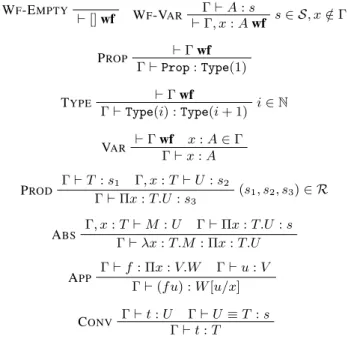
We present the typing rules of CCin figure 1 as a reminder. We will extend them when defining RUSSELL’s type system in section 3. The basic calculus is church-styleλ-calculus plus a set of sorts
S = {Prop} ∪ {Type(i) | i ∈ N}and the dependent product Πx:A, Bwhich types abstractions (rules PROD, ABS, APP). We do not detail the relationRwhich allows an impredicativeProp
sort and a predicativeTypehierarchy. The sortType(0)represents computational types (e.g. lists, naturals) andProplogical proposi-tions. Both sorts are typed byType(1)which is itself typed using the rule TYPE. An essential rule is CONVwhich internalizes the fact thatβ-convertible types can be considered equal during type-checking (≡is theβ-equivalence relation). Here lies the true power of the system: computation can be interleaved with reasoning any-where. We do not treat the full kernel of COQ, which also contain sort subtyping and inductive datatypes as they are not essential to
WF-EMPTY `[]wf WF-VAR Γ`A:s s∈ S, x /∈Γ `Γ, x:Awf `Γwf PROP Γ`Prop:Type(1) `Γwf TYPE i∈N Γ`Type(i) :Type(i+ 1) `Γwf x:A∈Γ VAR Γ`x:A Γ`T :s1 Γ, x:T `U :s2 PROD (s1, s2, s3)∈ R Γ`Πx:T.U :s3 Γ, x:T `M :U Γ`Πx:T.U:s ABS Γ`λx:T.M : Πx:T.U Γ`f: Πx:V.W Γ`u:V APP Γ`(f u) :W[u/x] Γ`t:U Γ`U ≡T :s CONV Γ`t:T
Figure 1. Calculus of Constructions
describe the core features RUSSELLwill add; inductives will be described next by example.
Important properties of this system are Subject Reduction and Strong Normalization, i.e.: all well-typed terms reduce to a value in a finite number of reductions, which ensures that typing is de-cidable in the CONVrule. With such expressive power and strong metatheoretical properties comes verbosity and inflexibility. We will present in the following sections what mechanisms help over-come these difficulties in the COQtool. But first we will present the salient features of inductives in COQ.
Inductive types Inductive types are a generalization of the usual algebraic datatypes of ML. For example we may define the stan-dard polymorphic lists using the declaration:
Inductivelist(A:Type) :Type:=
|nil:listA
|cons:A→listA→listA.
HereAis aninductive parameterrepresenting the type of ele-ments of the list and each constructor is declared with a product type from its arguments types to the inductive type. This presen-tation as a product comes from the fact that constructor arguments may depend on each other and that each constructor may target a different instance of the family. For example we may declare vec-tors (lists of fixed length) as:
Inductivevector(A:Type) :nat→Type:=
|vnil:vectorA0
|vcons:A→ ∀n,vectorA n→vectorA(Sn).
The inductives of COQ(Paulin-Mohring 1993) are in fact pa-rameterized, possibly nested, mutually recursive inductive families. An inductive family is a family of types indexed by a type or a value. Here for example,vectoris a family parameterized by a type
Aof elements and indexed by the naturalsnat. Thevnilconstructor is the empty vector of length0and thevconsconstructor builds a
vectorof lengthSnfrom an object of typeAand avectorof length
n.
Finally, we can define nested inductive types using non-uniform parameters; this feature is needed to be able to define Finger Trees.
Fixpointpow map(A B:Type) (f :A→B) (l:pow listA){structl}:pow listB:=
matchlwith
|pow nil⇒pow nilB
|pow conshd tl⇒pow consB(f hd) (pow map(A×A) (B×B)
(funx:A×A⇒(f(fst x),f(snd x)))tl)
end.
Figure 2. pow mapdefinition
A classical example of a nested datatype is the power list ofAwhere the tail of a list is a list of pairs ofA. The important point is that we can reinstantiate the parameterAin the constructors.
Inductivepow list(A:Type) :Type:=
|pow nil:pow listA
|pow cons:A→pow list(A×A)→pow listA.
We can of course recurse on elements of these inductive types and in the last case we will even use polymorphic recursion, a fea-ture the type system of ML lacks. For example themapcombinator on power lists can be defined as in figure 2.
To ensure the aforementioned properties are preserved when adding inductive families, the kernel implements a relatively inflex-ible syntactic criterion to discard non-structurally recursive defini-tions. In thepow mapexample, it checks thattlis indeed a subterm oflwhich the user marked as the structurally decreasing argument using the{structid}annotation. In this definition we also face the foremost difficulty in using CIC as a programming language: verbosity. Clearly, writing all these types is not viable from a soft-ware development point of view, so we must find a way to over-come this problem while still retaining decidability of inference and type-checking. COQ’s solution to this problem is to use a higher-level language GALLINAwhich elaborates/compiles into CIC. This approach does not change the kernel’s languageat all, so we keep all the nice properties once our definitions have compiled into it.
2.2 COQsurface:GALLINA
We will now present a few of COQ’s surface language features which deal with the verbosity and abstraction power of CIC: im-plicit arguments to omit some type information, notations to abbre-viate and beautify the otherwise obfuscated definitions and sections to easily parameterize whole developments.
2.2.1 Recovering inference
Implicit arguments systems permit writing terms omitting as much inferable information as possible. Its effect is best described by an example application. Suppose we want to apply thepow map
function to a functionf:A→Band a power listl:pow listA. Without implicit arguments, we must give the type off as the first arguments of the function, like this:pow map A B f l. In implicit arguments mode, the first two arguments become implicit as the system knows that they will be inferable at application time from thetype of the functional argumentf, hence we can write
pow map f l to achieve the same effect. This permits users to write definitions with a syntax very similar to languages based on Hindley-Milner type inference, e.g. thepow mapdefinition comes down to the code in figure 3. We do not consider partial applications here for which this mechanism is incomplete.
2.2.2 Notations: pretty parsing/printing
Notations are kind of hygienic macros which serve to abbreviate or beautify specifications and generally give a more mathematical feel to writing COQ. For example we can define the type representing
Fixpointpow map(A B:Type) (f:A→B) (l:pow listA){structl}:pow listB:=
matchlwith
|pow nil⇒pow nil
|pow conshd tl⇒pow cons(f hd) (pow map(funx⇒(f(fst x),f(snd x)))tl)
end.
Figure 3. pow mapdefinition with implicit arguments
the subset of elements of a typeAhaving a particular propertyP
as in figure 4.
Inductivesig(A:Type) (P:A→Prop) :Type:=
|exist:∀a:A,P a→sigA P.
Notation”{x:A|P}” := (sigA(funx:A⇒P))
Figure 4. Subset type in Coq
An element of the typesigA Pis a tupleexistA P x pwhere
xis a witness of typeAandpis of typeP a, i.e.pis a proof that the predicateP holds fora. However it is much clearer to write this type as{x:A|P}rather thansigA P and this is what the notation system permits.
An alternative encoding of thevectorinductive structure may be the lists of fixed lengths which we can define using this notation (the types ofAandncan be infered automatically in this case):
DefinitionvectorA n:={x:listA|length x=n}. One can define arbitrary notations, possibly for binding con-structs, and assign them priorities (levels) and associativities. For example we may define composition using the symbol◦as a nota-tion:
Notation”g’◦’f” := (funx⇒g(f x)) (at level20,left associativity).
Armed with these tools we can start our first development.
2.2.3 Sections: implementing the monoid typeclass
As a gentle introduction to COQ, we will build a monoid datatype corresponding to theMonoidtypeclass of HASKELL. We recall its signature:
classMonoidmwhere ∅ :: m
() :: m→m→m
Instances should make sure the following properties hold:
left identity ∅ x=x
right identity x ∅=x
associativity x(yz) = (xy)z
We first introduce the monoid laws we just described. We will use the section mechanism of COQextensively in the following. Sec-tions permit to write a bunch of definiSec-tions which are parameterized by some variables, e.g. for types and operations. When closing a section, every definition inside it is quantified over the variables it used.
SectionMonoid Laws.
The carriermtype may be any type.
Variablem:Type.
The identity elementmemptyand the operationmappend.
Variables(mempty:m) (mappend:m→m→m). We define fancy notations for the element and operation.
Notationε:=mempty.
Infix”·” :=mappend(right associativity,at level20). We now state the properties.
Definitionmonoid id l t:Prop:=∀x,ε·x=x.
Definitionmonoid id r t:=∀x,x·ε=x.
Definitionmonoid assoc t:=∀x y z, (x·y)·z=x·y·z.
EndMonoid Laws.
Every variable inMonoid Lawshas been discharged by now, so we must apply each definition to particularmemptyandmappend ob-jects. We can finally define the dependent record which represents monoids onm:
Recordmonoid(m:Type) :Type:=mkMonoid {mempty:m;mappend:m→m→m
;monoid id l:monoid id l t mempty mappend
;monoid id r:monoid id r t mempty mappend
;monoid assoc:monoid assoc t mappend}.
We will come back to monoids when implementing Finger Trees. We will now present the RUSSELLlanguage which was the essential tool we needed to develop them.
3.
R
USSELLin
C
OQThe lack of distinction between proofs and programs in Type The-ory helps having a clear, unified semantics for the complete system but hinders users and implementers alike, because sometimes you do not want to have proofs polluting computations (e.g. when eval-uating a term, the way proofs are constructed should not matter, only the algorithm) and you certainly do not want to write com-plex programs using a procedural language with automation like the language used in proof scripts of COQ but directly inputing terms and have them interpreted in COQ’s kernel language. A so-lution to the first problem is given by theProp/Typedistinction in COQ. IfPropis used as the type of propositions (e.g. conjunc-tion, negation) andTypeas the type of computational types (e.g. naturals, lists) then we can immediately see whether something is a proof or a program just by looking at its sort. This is used by the extraction mechanism (Letouzey 2002) to extractonlythe algo-rithmical code from a COQterm. However, the extraction is not used directly inside the proof-checker, so computations in COQ
may freeze because of irreducible proofs in the term, even when they are irrelevant; we will discuss this later issue in section 7. For now we will concentrate on the problem of writing richly specified programs in COQby taking advantage of this distinction between
PropandType.
Usually, as soon as you have propositions appearing in the type of a function, you will write its body in COQusing tactics instead of using the functional language because otherwise you would have to directly manipulate proof terms. This is a showstopper because it becomes intractable as soon as you have a complex proof to do, especially since there is is not so much support for incremental refinement in COQ, unlike in AGDA(Coquand 2006) or EPIGRAM
(McBride and McKinna 2004), although therefinetacticcan give the same flavor of program development (Chlipala 2006).
RUSSELLis a programming language built on top of COQwhich permits writing only the algorithmical code of strongly specified functions and forgetting about the required proofs which COQ
needs to establish correctness (i.e. typecheck the term). Its main purpose is to act as a convenient, permissive source language which elaborates into CIC, which can be type-checked by the safe kernel of COQ. Here, permissive means the user is not restricted to using structural recursion, complete pattern-matching and total functions only, as we have seen up to now. Obviously, you have to give evidence that your source term can be seen as a legitimate COQ
term, which generally means that what you left out can be proved. This is done by solving obligations which are generatedafterthe type-checking procedure of RUSSELL terms by an interpretation into CIC. For a detailed presentation of this procedure, the reader is directed to (Sozeau 2007). The generation of obligations is done in a similar way as in PVS (Owre and Shankar 1997), using subsets to carry propositions. We will describe this essential feature of the RUSSELLtype system and its extension to the richer CICcalculus next, then move on gradually to our motivating example: Finger Trees.
3.1 Subset equivalence
Subset equivalence is a simple idea: two subsets over the same carrier may be considered equal, given a proof that they contain the same elements. We can leave the properties out and just consider the carrier of subsets. That is, if we have an object tof typeT
where we expect an object of type{x:T |P}, we may say “ok, you will have to give me a proof thatP[t/x]holds but we are good for now”. Conversely, considering an object of type{x:T |P}as an object to typeT is alright. This is the essential idea behind the type system of RUSSELL: it checks type equivalence on the carriers only, ignoring if the properties really hold. We need only enrich the type conversion relation of CICwith the rule given figure 5 to formalize this idea.
Γ`T ≡U:Type Γ, x:U`P:Prop Γ`T ≡ {x:U |P}:Type
Figure 5. Subset equivalence rule As an example, we can derive:
Γ`0 :N
Γ`N≡N:Type Γ, x:N`x= 0 :Prop Γ`N ≡ {x:N|x= 0}:Type Γ`0 :{x:N|x= 0}
After a term has been typed in this system, we can automatically generate the obligations and produce a full-fledged, well-typed COQterm once these are solved. Following the example, a single obligation demanding that0 = 0be proved will be generated which will easily be solved by reflexivity of equality. But we could have derivedΓ ` 0 : {x : N | x 6= 0} in RUSSELLas well, in which case the generated obligation could certainly not be solved except ifΓis inconsistent. This phase distinction is essential: as soon as we want to do any proof we jump into an undecidable world because we have the full higher-order logic of COQat hand, so we must not have any proving to do if we want our type-checking to be decidable. This is to contrast with the approaches of other dependently-typed programming languages, from DML (Xi and Pfenning 1999) to EPIGRAM. In these languages either the expressive power is limited so that an automatic prover can solve obligations during type-checking (e.g. Pressburger arithmetic in DML) or there is no limit but proofs and code are intermingled in the same language (for EPIGRAM, COQand AGDA) or a mix of the two styles in ATS (Xi 2004) orΩMEGA(Sheard 2004) for example.
3.2 RUSSELL’s incarnation:PROGRAM
Using RUSSELLwe can write arbitrarily complex code with ar-bitrarily complex specifications, it will typecheck only if it is “structurally” well-typed. We do not care about proofs at the type-checking step but later, when recombining obligations with the algorithmical skeleton we wrote. Let us define the strongly speci-fied euclidean division ofabybwherebmust be non-zero. This
function is defined by well-founded recursion using the less-than order on the argumenta:
Program Fixpointdiv(a:nat) (b:nat|b6=0){wf lt}:
{(q,r) :nat×nat|a=b×q+r∧r<b}:=
ifless than a bthen(0,a)
else destdiv(a-b)bas(q’,r)in(Sq’,r).
TheProgramvernacular indicates that we use the RUSSELL type-checker followed by the interpretation into COQinstead of COQ’s original type-checker. The constructdesttas pinbis equiv-alent to a destructiveletconstruct where pis an arbitrary pat-tern (allowing one to pull values from nested tuples for example) but it also reflects the equality betweent and p in the context for later use in the obligations. We also use sugar for the binder
(x :nat |P) , (x :{x : nat| P}). Finally, theifconstruct works on any inductive type with two constructors.
This code type-checks and PROGRAM generates obligations which are discharged automatically by COQ’s tactics except the one for the inductive case. We can discharge it interactively using COQ’s proof language. When all obligations are solved the PRO
-GRAMsystem adds the completed definition ofdivin the environ-ment. We can then usedivlike any other COQobject, reasoning and computing with it as desired.
We were able to discharge the obligations because hypotheses
a < bor a ≥ bwere present in their contexts. However, these hypotheses are not automatically generated by COQ. They come directly from the term which uses a dependent functionless than
of type: ∀x y,{x < y} +{x ≥ y}. Had we simply used a boolean function instead, we would have no information about the comparison in the obligations. Hence we must always take care of
reflectingthe logic in our code if we want to reason on it later. In case of boolean conditionals, we can always use the combinator
dec:∀b,{b=true}+{b=false}to achieve this reflection.
3.3 Extension to inductive types
It is natural to extend the support for subset types in RUSSELL
to inductive families. For example, we have seen we can have two encodings of vectors, one using subsets and another using an inductive family. The facility we added for handling subset types should then transpose easily to inductive types. Indeed we can obtain the RUSSELLderivation:
Γ`x:vectorA m Γ`vectorA m≡vectorA n:Type Γ`x:vectorA n
The type conversion results from an instantiation of the rule given figure 6 which states that an inhabitant of an inductive family
Iwith indexes−→xi also inhabits the typeI −→yi (coercion does not happen on parameters).
Iinductive family Γ`I−→xi, I−→yi :Type Γ`I−→xi≡I−→yi :Type
Figure 6. Dependent inductive equivalence rule
When interpreting into COQ, proof obligations will be gener-ated to show that indices are equal. For the example above, a proof ofΓ`m=n:Propwill be required. This extension was crucial in the development of Dependent Finger Trees where a good part of the obligations are generated due to applications of this rule.
Dually to this construction used for building an inductive object with arbitrary index, we have enriched the pattern-matching con-struct to get information about decon-structed values and their indexes (i.e. automatically reflecting pattern-matching at the logical level). Informally, in our setting each branch of a pattern-matching con-struct will be typed in a context extended with equalities between
the patterns and the matched values up to their indices. For exam-ple, in a context wherevis of typevectorA(Sn), when typing the termmatchvwithvnil ⇒ · · · |vconsx n0v0 ⇒ · · · end
the first branch will be typed in a context containing hypotheses
Sn = 0andv 'vnil, hence an absurd case. The equality sym-bol'will be presented in§4.4.1. We will also be able to deduce thatn=n0in the second branch because we will have an equality
Sn=Sn0in the context (and constructors are injective). As a fur-ther refinement of pattern-matching, we add inequality hypotheses in the context of branches for which the pattern was intersecting with a previous one. Consider the following code:
Program Fixpointdiv2(n:nat) :
{n’:nat|n= 2×n’∨n= 2×n’+ 1}:=
matchnwith
|S(Sp)⇒S(div2 p)
|x⇒0
end.
The second branch is typed in a context extended with the hypothesesx=nand∀p, x6=S(Sp), which is crucial to solve the obligationn=2∗0∨n=2∗0+1.
A conclusion on RUSSELL We think having an unrestricted power of expression in the logic is essential to having useful soft-ware development and certification tools and our method achieves it without losing the facilities we are accustomed to in a practical programming language. So we get decidability of type-checking and our programs look exactly like their simply-typed counterparts with no proof handling code appearing in the term but we also have a highly expressive logic and a complete system to prove and check statements in this logic.
4.
Dependent Finger Trees
We will now illustrate RUSSELL’s expressiveness by presenting a certified implementation of Finger Trees in COQ. Finger Trees (Hinze and Paterson 2006) are a functional, general purpose, ef-ficient data structure based on an optimization of 2-3 trees. It is implemented in HASKELLas anesteddatatype which is parame-terized by a type ofmeasures, which can be instantiated by various types to give specializations of the Finger Trees. The data structure builds upon simpler structures like digits and 2-3 nodes which we will present first.
4.1 Digits
A digit is simply a buffer of one to four values.
SectionDigit.
VariableA:Type.
Inductivedigit:Type:=
|One:A→digit |Two:A→A→digit |Three:A→A→A→digit |Four:A→A→A→A→digit.
We build simple functional predicates on digits for use in specifi-cations.
Definitionfull(x:digit) :Prop:=
matchxwithFour ⇒True| ⇒Falseend. We now define addition of an element to the left of a digit.
Program Definitionadd digit left(a:A) (d:digit| ¬full d) :digit:=
matchdwith |Onex⇒Twoa x |Twox y⇒Threea x y a : A d : digit Hd : ¬full d x,y,z,w : A Heq d : d=Fourx y z w False
Figure 7. Obligation ofadd digit left
|Threex y z⇒Foura x y z |Four ⇒!
end.
It has become interesting here, as we define apartialfunction. We can add to a digit if and only if it is not already full. So, we require the argument digit to be accompanied by a proof that it is not full. We will use it to prove that the last branch is inaccessible. Note that we can pattern-match ondas if it was just a digit: properties have no influence on code, only on proofs.
As in COQ, there has to be a branch for each and every con-structor in RUSSELLpattern-matchings, but we can use!to assert that a branch is inaccessible due to contextual information on the matched object. We must treat every constructor because exhaus-tiveness of pattern matching with dependent types is undecidable in general. The generated obligation (figure 7) is easily solved, as we have a contradiction in the context: both¬full dandd=Four
are present. We can define in a similar fashion addition on the right and the various accessors on digits (head,tail,lastandliat). From now on we will omit the obligations and the proof scripts used to solve them; they can be found in the COQcontribution.
As an other example of the usefulness of PROGRAM, consider defining the monoid([],++)on lists. To construct a monoid imple-mentation (c.f.§2.2.3), we have to apply themkMonoid construc-tor to[ ],++and proofs of identity and associativity. Fortunately, those can be filled automatically by COQusing lemmas proved in the standard library. When PROGRAMprocesses the following def-inition it turns the holes ( ) in the term into obligations which are thus automatically discharged. We explicitly give the element and operation using the syntax (x:=t) ; they are considered implicit ar-guments by the system as they are derivable from the types of the proofs.
Program DefinitionlistMonoid(A:Type) :monoid(listA) :=
mkMonoid(mempty:=nil) (mappend:=app) .
We shall now define the Finger Trees over some monoid and mea-sure. We will see in section 5 how particular instantiations of these will give different structures.
SectionDependentFingerTree.
Variables(v:Type) (mono:monoidv).
The variablev is the monoid carrier type, mono is the monoid implementation. As before, we useεand·for the monoid empty element and operation respectively.
4.2 Nodes
Finger Trees are implemented using 2-3 nodes as in 2-3 trees, with the addition of a cached value that stores the combined measure of the subobjects.
SectionNodes.
Variables(A:Type) (measure:A→v).
Intuitively, the measure represents an abstraction of the sequence of objects in the node (later, in the tree) considered from left to right. Taking the list monoid previously defined and the singleton measure[ ]gives the most concrete abstraction of this sequence of elements: the sequence itself. Themeasurefunction is denoted by
k kin the following, when possible (notations local to a function are not supported). We now define 2-3 nodes with cached measures:
Inductivenode:Type:=
|Node2:∀x y,{s:v|s=kxk · kyk } →node |Node3:∀x y z,{s:v|s=kxk · kyk · kzk } →node. We use a subset type here to specify the invariant on the cached value. This invariant could not be checked using simple types, because it is dependent on the values carried by the node. Moreover, it uses the measurefunctionas adatatype parameterso it would require an additional abstraction mechanism like type classes or functors to achieve it in a regular ML-based functional language. A regular dependent product is used here instead.
We have smart constructorsnode2andnode3which compute the measure, e.g:
Program Definitionnode2(x y:A) :node:= Node2x y(kxk · kyk).
The generated obligations are trivially true as they are of the form
x=x. Correspondingly,node measurepulls the cached measure.
Program Definitionnode measure(n:node) :v:= matchnwithNode2 s⇒s|Node3 s⇒send.
EndNodes.
Although it may seem that thenode measurefunction is indepen-dent of themeasurefunction, it is not. Witness its type after we closed the section:
∀(A:Type)(measure :A→v),nodemeasure →v
Thenodedatatype itself is parameterized by the measure function, hence all operations on nodes take it as an implicit parameter. Had we not added the invariant, we would not need this parameter, but we could not prove much about node measures either, because they might be any element of typev. We could define an inductive invariant on nodes asserting that their measures were built using the measure function coherently, but we would need to show that this invariant is preserved in each of the functions, while in our case we get it for free by typing.
4.3 Thefingertreedatatype
Before presenting the definition offingertreein COQ, we introduce the original HASKELLdatatype and justify why the direct transla-tion would be unsatisfactory. In HASKELL, theFingerTree alge-braic datatype is defined as:
dataFingerTreev a=Empty|Singlea
|Deepv(Digita) (FingerTreev(Nodev a)) (Digita) TheEmptyconstructor represents the empty tree, theSingle con-structor builds a singleton tree from an element ofaand theDeep
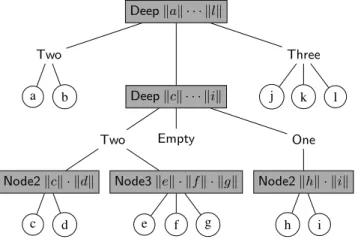
constructor is the branching node. It builds aFingerTreev afrom a cached measure of typev, two digits ofaand a middleFingerTree v(Nodev a) of2-3 nodesofawith measures of typev. This is where the nesting occurs; it is best described by a picture (figure 8).
We could directly define the Finger Tree data structure in COQ
by translating the HASKELLdefinition. However doing so would
Deepkak · · · klk Two a b Deepkck · · · kik Two Node2kck · kdk c d Node3kek · kfk · kgk e f g Empty One Node2khk · kik h i Three j k l
Figure 8. A sample FingerTree.At the first level we have aDeepnode with a 2-digit ofaat the left and a 3-digit at the right. The middle tree is a
FingerTreev(Nodev a) consisting of aDeepnode with anEmptymiddle tree. It has a 2-digit ofNodev aat its left and a 1-digit at its right. The circled nodes represent elements of typeaand the shaded ones indicate loci where cached measures are stored
cause a rather subtle problem: the cached measures in two Finger Trees could be computed by twodifferentmeasure functions but these trees would still have the same type because theFingerTree
datatype is parameterized only by the type of the computed mea-sures and not by the measure function. Again, we could live with it and have a predicate formalizing the fact that the measures appear-ing in aFingerTreewere built coherently with some measure func-tion, but preservation of this invariant would have to be proved for each new definition on Finger Trees. We prefer to view the measure function as an additional parameter of the Finger Tree datatype. In this case coherence is ensured by the type system because two Fin-ger Trees will have different types if they are built from different measure functions. Hence the following definition:
Afingertreeinductive is parameterized by a typeAand a mea-sure functionmeasure:A→von this type. Eachfingertreeobject is also indexed by its corresponding measure:
• Emptybuilds the empty tree of measureε;
• Singlexbuilds the tree with sole elementxof measurekxk; • Deep pr ms m sf builds the tree of prefix pr, subtreem of
measuremsand suffixsf. Its measure is given by combining the measures of its subtrees. The argumentmswill be implicit when constructingDeepnodes, as it can be infered from the type of
m. We place this argumentmsjust before the middle Finger Tree contrary to the original datatype in which the cached measure is the first field and stores the measure of thewholetree whereas for us the latter is given by the index.
We present the definition using inference rules for enhanced readability, omittingAandmeasurein the premises:
Empty:fingertreeA measureε
x:A
Singlex:fingertreeA measure(measure x)
pr,sf:digit A,ms:v
m:fingertree(node measure A) (node measure measure)ms Deeppr ms m sf:fingertreeA measure
This inductive family is indexed by values of typev. Why we need a dependent type follows from a simple observation. If we want the cached measure on theDeepnode and the invariant that the measure is really the one of the middle tree, we must have a way to refer to the measure of the middle tree, but we are actually defining trees, so we cannot recurse on them at this time. Note also that we needpolymorphicrecursion to go into the middle subtrees ofDeep
nodes.
Adding elements We can add an elementato the left of a treet
of measuresto get a tree with measurekak ·s. Due to polymorphic recursion, our functions will now always have A and measure
arguments as they are realarguments which will change during recursive calls. Iftis empty, a singleton or a tree with a left prefix which is not full, then we simply putaat the leftmost position of the tree. Otherwise, we need to reorganize the tree to make space at the left fora, and this requires recursing polymorphically to add anodeato the left of the middle subtree in theDeepnode.
Program Fixpointadd left(A:Type) (measure:A→v) (a:A) (s:v) (t:fingertreemeasure s){structt}:
fingertreemeasure(measure a·s):= matchtinfingertree s
return@fingertreeA measure(measure a·s)with |Empty⇒Singlea
|Singleb⇒Deep(Onea)Empty(Oneb)
|Deeppr st’ t’ sf⇒ matchprwith
|Fourb c d e⇒
letsub:=add left(node3 measure c d e)t’in Deep(Twoa b)sub sf
|x⇒Deep(add digit left a pr)t’ sf end
end.
The first match expression uses dependent elimination. Its meaning is that from a particularfingertreeof measureseach branch will build a fingertree of measure measure a · s where s has been substituted by the measure of the matched pattern. For example in the first branch we must build an object of type fingertree measure(measure a·ε). However, the right hand sideSingle a
has typefingertreemeasure(measure a), hence we must use the inductive equivalence rule (figure 6), which generates an obligation
`measurea·ε=measurea, easily solved using the right identity of the monoid. Theinandreturnclauses are mandatory in COQ
due to undecidability of higher-order unification, but they can be dropped in RUSSELL, in which case substitution is replaced by equational reasoning. Had we dropped the clauses, we would have the equation s =ε in the context of the first branch hence the generated obligations = ε ` measurea·s = measurea. This one would be solved by first substitutingsby εin the goal then applying the right identity ; we just postponed the substitution.
The nested match expression uses an alias x for capturing prefixes which are not Four and applies the partial function
add digit leftdefined earlier. There is an application of the subset equivalence rule here, which generates an obligation to show that
pris not full. It can be solved because we have∀b c d e, pr 6= Four b c d ein the context.
It is an essential property of this function that the measure is preserved. To see that, let us instantiate the Finger Tree by the list monoid([],++)and measure[ ]defined earlier. You can check here that adding to the left is prepending the measure of the element to the measure of the Finger Tree, hence consing to the sequence of elements of the tree with the list monoid interpretation. For each of the following operations, this correspondence with the list instanciation of the measure will hold.
4.4 The view from the left... of afingertree
We will now construct views on the Finger Trees which decom-pose a tree into its leftmost element and a remaining Finger Tree (View L) (or dually, the rightmost one and the ”preceding” Fin-ger Tree). It serves to abstract from the implementation and give a list-like view offingertree, which is used to write functions which recurse on fingertrees without having to deal with the intricacies of the structure (c.f. figure 5.1). TheView Linductive is a little less polymorphic, as it does not need carry the measure function which views ignore. HoweverView Lstill stores the measuresof the rest of the tree in thecons Lconstructor (swill be implicit), hence we need to abstract by the sequence’s typeseqwhich is indexed byv. It will be instanciated byfingertreemeasure.
InductiveView L(A:Type) (seq:v→Type) :Type:= |nil L:View LA seq
|cons L:A→ ∀s,seq s→View LA seq.
Such a view will be constructed by theview Lfunction, by struc-tural (polymorphic) recursion on thefingertree. We can seamlessly use thedigit tailfunction which is partial (it accepts only digits which are notOne) and need not add any type annotations when callingview Lrecursively ont’. Note that we use a partial type ap-plication (fingertreemeasure) in the return type, which is perfectly legal.
Program Fixpointview L A(measure:A→v) (s:v) (t:fingertreemeasure s){structt}:
View LA(fingertreemeasure):= matchtwith
|Empty⇒nil L
|Singlex⇒cons LxEmpty |Deeppr st’ t’ sf⇒
matchprwith |Onex⇒
matchview L t’with
|nil L⇒cons Lx(digit to tree sf)
|cons La st’ t’⇒
cons Lx(Deep(node to digit a)t’ sf)
end
|y⇒cons L(digit head y) (Deep(digit tail y)t’ sf)
end end.
We can show thatview Lpreserves the measure of the input tree; had we indexedView Lby the measure of the input tree, these generation lemmas would have appeared as obligations.
Lemmaview L nil:∀A(measure:A→v)s
(t:fingertreemeasure s),view L t=nil L→s=ε.
Lemmaview L cons:∀A(measure:A→v)s
(t:fingertreemeasure s)x st’ t’,
view L t=cons Lx(s:=st’)t’→s=measure x·st’.
4.4.1 Dependence hell
Our views are useful to give an high-level interfaces to Finger Trees, but in their current state they are very limited as we can write only non-recursive definitions on views. That is, we will not be able to convince COQthat functions defined by recursion on the view of a tree are just as valid as those defined by recursion on the tree itself. To do that, we must have a measure on our Finger Trees, e.g. their number of elements (namedtree size), from which we can trivially build a measure on the viewsView L size. Then it is only a matter of showing that for allt,view L treturns a view of sizetree size tto prove that a recursive call on the tail of a view is correct (c.f.§5.1).
However, doing such a thing is not as easy as it looks be-causeview Lmanipulates objects of dependent types and reason-ing about them is somewhat tricky. An essential difficulty is that the usual Leibniz equality is not large enough to compare objects in de-pendent types as they may be comparable but in different types. A simple example is that the propositionvnil=vconsx n vis not well-typed becausevnilis of typevector0 andvconsx n vof type
vector(Sn) which are not convertible.
In our case, we want to say that an arbitrary treet of mea-sure s with viewnil L must be the Empty tree, but those two trees do not have the same type. We apply the usual trick of het-erogeneous equality (McBride 1999) : prove they must be in the same type. The inductiveJMeqdefines an heterogeneous equality (previously denoted by') in COQ. It is used to compare objects which are not of the same type. Its sole constructor isJMeq refl
of type∀A a,JMeqA a A a. The point of this admittedly strange notion of equality is to postpone the moment at which we need to prove that the types of the compared objects are equal. When we arrive at this point, we can apply theJMeq eqaxiom of type
∀A x y,JMeqA x A y →x=yto get back a regular equality between the objects.
In the first lemma, we comparetof measureswithEmptyof measureε; clearly, replacingJMeqby regular equality would yield a type error here.
Lemmaview L nil JMeq Empty:∀A(measure:A→v)s
(t:fingertreemeasure s),view L t=nil L→ JMeqt(Empty(measure:=measure)).
Now that we have shown the equality for a generalsindex, we can instantiate it with a particular one, i.e.ε. Given thattis now of measureε, we can use the regular equality withEmpty.
Lemmaview L nil Empty:∀A(measure:A→v)
(t:fingertreemeasureε),view L t=nil L→t=Empty. These technical lemmas aboutnil LandEmptywill help us build our measure. Indeed, they are needed to prove the following:
Lemmaview L size:∀A(measure:A→v) (s:v)
(t:fingertreemeasure s),View L size(view L t) =tree size t. This gives us a decreasing measure onview Lresults. We will use it when building the instances.
Lemmaview L size measure:∀A(measure:A→v) (s:v) (t:fingertreemeasure s)x st’(t’:fingertreemeasure st’),
view L t=cons Lx t’→tree size t’<tree size t.
We can also definedeep L, the smart constructor which rearranges a tree given a potentially empty digit for the prefix. It is a dependent version of the internal function for theDeepcase ofview L, which is used when splitting Finger Trees. The code has not changed at all from the non-dependent version hence we do not show it. How-ever, the specification would greatly benefit from an overloading mechanism to factor the differentmeasurespecializations.
Program Definitiondeep L(A:Type) (measure:A→v) (d:option(digitA)) (s:v)
(mid:fingertree(node measure measure)s)
(sf :digitA) :fingertreemeasure(option digit measure measure d·s·digit measure measure sf):=· · ·
4.4.2 Back to normal
We are now ready to implement regular deque viewing operations on our Finger Trees. We do not need recursion on the trees here, so we can define the operations for a fixed element type, measure function and measure index.
SectionView.
Variables(A:Type) (measure:A→v) (s:v).
We define anisEmptypredicate for some operations will be par-tial, i.e. defined only for non-emptyfingertreeobjects. We do not match directly on the object to maintain the abstraction from the implementation.
DefinitionisEmpty(t:fingertreemeasure s):= matchview L twithnil L⇒True| ⇒Falseend. Emptiness is decidable.
DefinitionisEmpty dec(t:fingertreemeasure s) :
{isEmpty t}+{ ¬isEmpty t}.
The obvious operations are definable, we show theliatoperation dual totail. Here we return the index along with the fingertree in a dependent pair of type{s:v& fingertreemeasure s}, which corresponds more closely to the view that the cached measure is really data, not only an index used to refine a datatype. The pairing of a tree t with its measure m is denotedm :| t and reads ”m
measurest”.
Program Definitionliat(t:fingertreemeasure s| ¬isEmpty t) :{s’:v&fingertreemeasure s’}:= matchview R twith
|nil R⇒!|cons Rst’ t’ last⇒st’:|t’ end.
EndView.
4.5 Catenation & splitting, dependently
We can also define catenation using a dependent type which clearly states the function’s specification. The implementation is the same as the one of Hinze & Paterson, except we proved the 100 obliga-tions generated by PROGRAMconcerning measures. The five mu-tually recursive functions hidden here which defineapphave the particularity of being quite big because they implement a special-ization of concatenation for each combination of the digits at the right of the left tree and the left of the right tree. Hinze & Paterson even recommend to produce the 200 lines long definition automat-ically to prevent mistakes. Here the definition is checked directly: the type itself expresses that we did not mess up the obvious prop-erty ofappon measures.
Definitionapp(A:Type) (measure:A→v) (xs:v) (x:fingertreemeasure xs)
(ys:v) (y:fingertreemeasure ys) :
fingertreemeasure(xs·ys).
Notation”x+:+y”:=(app x y) (at level20).
The last and most interesting operation from the specifier’s point of view, is splitting a tree by a predicate on its measure. We begin by splitting a node.
SectionNodes.
Variables(A:Type) (measure:A→v).
Variables(p:v→bool) (i:v).
We split a nodenby finding where some predicatepon measures turns totrue, starting with an initial measureiand accumulating the measures of subtrees from left to right. We simply copy the invariant given by Hinze and Paterson (2006) here, there is nothing to change, we only add the corresponding property on the measure which clearly generalizes theto list equation. The code is also a direct translation from HASKELL to RUSSELL except we use a regular tuple instead of a customsplit datatype. We have also defined asplit digitfunction with the same specification.
Program Definitionsplit node(n:nodemeasure) :
{(l,x,r) :option(digitA)×A×option(digitA)| letodm:=option digit measure measurein node measure measure n=odm l· kxk ·odm r∧ node to list n=option digit to list l++[x]++
option digit to list r∧
(l=None∨p(i·ls) =false)∧
(r=None∨p(i·ls· kxk) =true)}:=· · · EndNodes.
The interesting case is for trees, as usual. Instead of returning a tuple, we use a dependent tree split inductive which directly captures the invariant that a split is a decomposition of afingertree
preserving measures. We also put the invariants on the left and right trees, which can be used by clients to prove properties about their code. This is one of the most distinctive parts of this work: we derive not only reusable code but also reusable proofs using rich types. Indeed,split treecan be seen as a proof combinator, turning a property on a measure and monoid to a property on words on this monoid.
SectionTrees.
Variablep:v→bool.
Inductivetree split(A:Type) (measure:A→v) (i:v) :v→Type:=
mkTreeSplit:∀(xsm:v) (xs:fingertreemeasure xsm| isEmpty xs∨p(i·xsm) =false)
(x:A) (ysm:v) (ys:fingertreemeasure ysm| isEmpty ys∨p(i·xsm·measure x) =true),
tree splitmeasure i(xsm·measure x·ysm).
This inductive combines both subsets and dependent inductive types, but we can still write our code as usual. Approximately 100 lines of proof are necessary to discharge the generated obligations.
Program Fixpointsplit tree(A:Type) (measure:A→v) (i s:v) (t:fingertreemeasure s| ¬isEmpty t)
:tree splitmeasure i s:=· · · EndTrees.
This concludes our implementation of (dependent) Finger Trees with PROGRAM. To sum up, we have proven that:
•All functions are total, once properly annotated with their pre-conditions.
•All functions respect the measure semantics and use them co-herently.
•All functions respect the invariants given in the paper by Hinze & Paterson.
The complete file we walked through comprises 600 lines of specifications (declarations, types, programs, proof statements) and 450 lines of proof. In comparison the source file provided by Hinze & Paterson is 650 lines including comments. We argue that this is proof of the scalability of RUSSELLas a programming language.
5.
Instances
We will now instantiate thefingertreeimplementation by particular monoids and measures to get higher-level structures. Obviously, we can instantiate the Finger Trees just like in the original paper of Hinze & Paterson using weak, simply typed specifications and extract the code, but that would not be too exciting. Nevertheless, we will first present a way to recover the simply-typed interface and instantiate it to ordered sequences. We will then focus on proving a particular specialization using the dependent interface directly.
5.1 FingerTree: a non-dependent interface
As shown before, we can wrap the measure and the tree in a dependent pair to offer a simpler interface to Finger Trees.
SectionFingerTree.
Variables(v A:Type) (mono:monoidv) (measure:A→v).
DefinitionFingerTree:=
{m:v&fingertreemono measure m}.
This gives us a typeFingerTreev mono A measure, which can be compared with the originalFingerTreev adatatype in HASKELL. It adds themonoidimplementation andmeasurefunction as explicit parameters whereas in HASKELLthey are passed implicitely using the typeclass mechanism. Morally, the parameterization we did using the section mechanism correspond to the systematic prefixing of functions onFingerTreeobjects by aMeasuredv aconstraint in HASKELL(Measuredv ais a class with a single functionmeasure
of typea→vwherevmust have aMonoidinstance). We think this equivalence indicates an interesting field of investigations on how to integrate overloading in a language like RUSSELL, or a section system in HASKELL.
We do not describe the wrapping in detail, it is just destructuring aFingerTreeobject, calling the appropriate function onfingertrees and packing back the measure and the tree. However, an important point is that we can wrap views too and obviously recover the associated measure:
Inductiveleft view:Type:=
|nil left:left view|cons left:A→FingerTree→left view.
Lemmaview left size:∀t x t’,view left t=cons leftx t’→ tree size t’<tree size t.
We can finally wrap splitting onFingerTrees along a predicate. We offer the same simply-typed interface as HASKELLby definining the functionsplit with p x. It splits any treexby first checking ifx
is empty and if not calls thesplitfunction on it using the predicate
pwith an empty accumulator.
Program Definitionsplit with(p:v→bool) (x:FingerTree) :FingerTree×FingerTree:= ifis empty dec xthen(empty,empty)
else let(l,x,r):=splitpεxin(l,cons x r).
EndFingerTree.
As an example use of the simply-typed interface we develop the specialization of Finger Trees to Ordered Sequences. The main idea is to use as a measure on elements ofAthe element itself and have the monoid implement an operation which returns the rightmost element in the tree. Then if the operations maintain the invariant that the sequence of elements in the tree are ordered we have an ordered sequence where the maximal element can be retrieved in constant time.
ModuleOrdSequence(AO:OrderedType).
We use modules instead of the section mechanism as it gives compile-time instanciation which is exactly what we need here. The module system of COQis a superset of OCAML’s. We suppose given an implementation of an ordered typeAO.
DefinitionA:Type:=AO.t.
Definitionmeasure(x:A) :=Somex. We measure one element by itself.
TheKeyMonoidmodule implements the monoid (None,keyop) on the typeoptionA, wherekeyopis defined by:
keyop xNone = x
keyop (Some asy) = y
Clearly this will give the rightmost element of the structure as its measure if there is one. It also defines the functionkey gtwhich lift the operation of the ordered type to the monoid’s type. We can then declare the ordered sequence type asFingerTreeapplied to the monoid and measure.
DefinitionOrdSeq:=FingerTreem measure.
We can get the maximal element in constant time by taking the measure of the whole Finger Tree.
Definitionmax(x:OrdSeq) :=tree measure x.
We skip the other operations defined in the original paper which permit to partition an ordered sequence or insert or delete in it, they are no more difficult to code. We focus on the merge oper-ation which is the only terminoper-ation challenge in the whole devel-opment. Merging of ordered sequences simply does a merge sort of the list of elements of both sequences. It does so using the left view defined earlier and hence needs to recurse on results of the
view leftfunction. Note however that the termination argument is complicated by the swapping of arguments for the recursive call. We can usepair sizemeasure defined below to define the function by well-founded recursion on the pair of sequences. The generated obligations can be solved using theview left sizelemma defined earlier.
Definitionpair size(x:OrdSeq×OrdSeq) :=
let(l,r) :=xintree size l+tree size r.
Program Fixpointmerge(x:OrdSeq×OrdSeq)
{measurepair size}:OrdSeq:=
destxas(xs,ys)in matchview left xswith
|nil left⇒ys |cons leftx xs’⇒
destsplit with(funy⇒key gt y(measure x))ys as(l,r)incat l(cons x(merge(r,xs’)))
end.
5.2 Dependent Sequences.
We will now define random-access sequences as a specialization offingertree. This structure provides insertion and deletion at both ends in constant amortized time, concatenation and splitting in log-arithmic time and access (get) and mutation (set) operations in log-arithmic time too. We will build a certified implementation of this structure by showing that the operations respect a functional spec-ification. This method slightly differs from the usual separation of operation definition and invariant proving. Here, invariant preserva-tion will be proved simultaneously with the definipreserva-tion of operapreserva-tions. We define sequences over a type of elementsA.
SectionDependentSequence.
VariableA:Type.
First, a useful definition: the typebelow irepresents the naturals below somei, sobelow0 is not inhabited.
Definitionbelow i:={x:nat|x<i}.
Lemmanot below 0:below0→False.
We use naturals to measure sequences by their length. Our measure is a bit special as it also carries a function giving the map realized
by the Finger Tree. It is used solely for specification and could be removed in extracted code using a dead code analysis or even rejected at extraction using a finer type system.
Definitionv:={i:nat& (below i→A)}.
We define a notation for our measure objects: an object i m
is a dependent pair composed by an indexi and a mapmfrom naturals belowito elements ofA. The epsilon will represent empty sequences. As it contains no elements, no value is returned by the function. We have an obligation to show that in a context with an hypothesis of typebelow0, we can proveFalse: we just use
not below 0.
Program Definitionε:v:= 0(fun ⇒!).
Appending two maps requires some reindexing: the new map is formed by projecting the new index to either the first or the second map.
Program Definitionappend(xs ys:v) :v:=
let(n,fx) :=xsin let(m,fy) :=ysin
(n+m)(funi⇒ifless than i nthenfx ielsefy(i-n)).
We can build a monoidseqMonoidfrom these operations, we skip the proofs which are relatively easy.
The measure of a singleton sequence built from x gives the constant map tox.
Program Definitionsingle(x:A) :v:= 1(fun ⇒x). We define an abbreviationseqfor our sequence type. Sequences are a specialization offingertreewith theseqMonoidmonoid and
singlemeasure defined above. Hence an object of typeseq(im)
is a Finger Tree representing a sequence of objects of lengthigiven by the mapm.
Definitionseq(x:v) :=fingertreeseqMonoid single x. We can get the length of the sequence in constant time as it is part of the cached measure.
Program Definitionlength(s:v) (x:seq s) :nat:=
destsassize insize.
The constructormake n xcreates a sequence of lengthnwith value
xin each cell. Note that obligations are generated to prove that e.g., whenmake n xis of typeseq(nfun ⇒x) thenadd left x(make n x) is of typeseq(Snfun ⇒x). We prove the preservation of semantics of our sequence’smakeoperation directly here.
Program Fixpointmake(i:nat) (x:A){structi}:
seq(i(fun ⇒x)) := matchiwith
|0⇒empty
|Sn⇒add left x(make n x)
end.
We now define the strongly specifiedgetfunction which gets thejth element of a sequencexof lengthi. We ensure that no out-of-bound access is made becausejis of typebelow iand we assert thatget in-deed returns the right value of the mapm. Note thatmis never used in the code, only in the types. Again, some obligations are gener-ated to prove that this specification is indeed a correct abstraction of the semantics of the code. It is crucial that thesplit treefunction be dependent and return atree splitobject carrying proofs to solve these obligations. As before, the code stays simple and compact. However, we skip around 50 lines of proof needed to discharge the obligations. The boolean predicatelt idx i xtests whether an index
Program Definitionget i m(x:seq(im)) (j:below i) :{value:A|value=m j}:=
destsplit tree(lt idx j)εx asmkTreeSplitls l x rs rinx.
The natural companion ofgetissetwhich given a sequencexof lengthisets itsjth cell tovalue. We have as precondition thatjis belowiand as postcondition that the new sequence hasvalueat itsjth index and the same elements asx otherwise The function denoted by =ndecides equality on naturals.
Program Definitionset i(m:below i→A) (x:seq(im)) (j:below i) (value:A) :
seq(i(funidx⇒ifidx=n jthenvalueelsem idx)) := destsplit tree(lt idx j)εxasmkTreeSplitls l rs r inadd right l value+:+r.
Now that we have defined our operations with built-in invariants, it is a simple matter of using the type information to relate operations. Here we formalize howgetandsetbehave together. The proofs use solely the types ofget andset, not their code. We show that our sequences respect the two axioms of functional arrays: if getting at an indexjjust set tovaluewe getvalue(get set), otherwise we get the value from the original map (get set diff).
Program Lemmaget set:∀i m(x:seq(im))
(j:below i) (value:A),value=get(set x j value)j.
We were able to state this lemma only because we are using the RUSSELLtype-checker, indeed there is an automatically inserted coercion at the right hand side of the equality to go from a subset ofAto an object ofA(the implicit type of an equality is fixed by its first argument). This seamless integration of PROGRAM with COQas a theorem prover is also an improvement over a previous attempt to provide a programming environment in COQ, namely the Program tactic by Parent (1995). However, we are not yet able to get the most natural statements in RUSSELL. In the next definition for example, we coerce objectsjand k of typebelow i to their underlying nat components and the results of get to
A. This is because the comparison of objects from subset types only makes sense on their first component, the witness, whereas comparing proofs is useless. Our pragmatic solution is to let the user insert a cast to get the expected behavior, but in a proof-irrelevant Type Theory the problem disappears because comparison of proofs become trivial. We discuss this solution in§7.1.
Program Lemmaget set diff:∀i m(x:seq(im)) (j:below i) (value:A) (k:below i),
(j:nat)6=k→(get x k:A) =get(set x j value)k.
Finally, we define splitting of sequences. It requires creating two projections of the original map, hence the following:
Program Definitionsplit l(i:nat) (j:below i) (idx:below j) :below i:=idx.
Program Definitionsplit r(i:nat) (j:below i) (idx:below(i-j)) :below i:=j+idx.
We can finally split a sequencexat a particular indexj, returning two sequences whose maps are just projections of the splittedx. Approximately a hundred lines of proof are necessary to discharge the three obligations generated by PROGRAM.
Program Definitionspliti m(x:seq(im)) (j:below i) :
seq(j(m◦split l j))×seq((i-j)(m◦split r j)) :=
destsplit tree(lt idx j)εxasmkTreeSplitls l x rs rin
(l,add left x r).
EndDependentSequence.
This gives us a certified implementation of sequences in less than 500 lines whose dependent interface can be used directly to imple-ment programs and prove properties at the same time.
6.
Extraction
We can extract the code we just certified to both HASKELLand OCAML(bypassing the type checker for polymorphic recursion) to get certified implementations of Finger Trees and sequences. We are guaranteed to get the same algorithmic code than what we wrote using PROGRAM. This is an important aspect of developing with RUSSELL, because usually when developing programs with rich specifications in COQone tends to use the proof language as much as the programming language and this can have devastating results on the extracted code. Our method enforces a distinction between code and proofs that is healthy in this respect.
Unsurprisingly, our extracted Finger Trees have indeed the same performance as the original implementation: they have the same code. TheData.Sequenceimplementation in HASKELLis in fact a specialization of theFingerTreeimplementation to a particular monoid and measure, avoiding dynamic lookups and unnecessary boxing. Had we used the module system of COQto parameterize our development instead of the section mechanism, we would have had this instantiation at no cost. However the lack of a powerful module system in HASKELLprevented us from doing that, as we would not be able to extract to it then.
Unfortunately, extraction of our dependent sequences will not give excellent results because the measure contains a function giv-ing the map which will be extracted even though it has no algo-rithmical role. We are in a case where only part of an index need be stored (unlike the setting of Brady et al. (2003)), so a finer dis-tinction thanProp/Type has to be found to distinguish between algorithmical and non-algorithmical content. Current work by B. Barras and B. Bernardo on an adaptation of the Calculus of Implicit Constructions (Miquel 2001) as the core calculus of a dependently-typed language ought to give the expressivity we seek.
We conclude that RUSSELLis not overly verbose and that doing the proofs is actually not a insurmountable task, knowing that most of them were solved automatically using a normalization tactic for monoid expressions.
7.
Discussion
7.1 Proof-Carrying Code
As displayed before, COQultimately melts proof and code in its terms, so as to be able to check the correctness of any part of a term at any time. On the surface, we can manage to separate the two ac-tivities of coding and proving using PROGRAM, but there are parts of the system where it still bites. The same notable problem appear during proofs and computations. When proving, we are faced with terms containing proofs we do not want to name or manipulate and when computing (in the call-by-value case only) the system itself is stuck with irreducible opaque proofs. However, in the two cases the proofs appear only in parts of the term that should not be reduced because they have no algorithmical content and need not be ma-nipulated as their structure has no importance. This is formalized by proof-irrelevance (PI), the statement that two proofs of the same proposition are equal. The meta theory of the Calculus of Construc-tions extended with PI has been studied extensively by Werner and Miquel. Recently, Werner (2006) also gave a method to implement it effectively in COQ, which is currently pursued by the author. It has also been studied in the context of Observational Type Theory, the (would be) core calculus of EPIGRAM2. Having PI in the sys-tem would make these two problems disappear and would probably improve performance of computations inside COQtoo.
7.2 A note on the implementation
PROGRAMis composed of two distinct parts: the type-checker and the proof-obligation handling machinery. In fact only a small part of the COQ type-checker needed to be changed, so RUSSELL’s
type-checker is just a different instantiation of the typing functor of COQwhich is parameterized by the conversion algorithm. This is to contrast with the work by Catherine Parent on the previous PROGRAM tactic which was a completely different solution for program-synthesis in COQ. The system was not integrated with COQand so went unmaintained.
7.3 Related Work
RUSSELL can be seen as one point in the design space of pro-gramming languages with dependent types. Its most distinctive fea-ture is the separation of code from proof, `a la PVS, and its treat-ment of subsets and indexed data types. It is also original in the sense that itelaboratesinto a well-studied, safe and mature lan-guage while most other solutions coming from the programming languages community have no such safety net or only for part of the system. RUSSELL could in fact be implemented in EPI
-GRAM or AGDA rather easily as they are based on roughly the same foundations as COQ. The main difference is that COQalready has a comprehensive standard library and a tactic system. Com-pared to programming languages like ATS, CONCOQTION (Fog-arty et al. 2007) or HASKELL, RUSSELLhas no effects and only well-founded recursion. We found that in practice the programs we write usually have relatively simple termination arguments and real non-termination could be accommodated by using a coinductive encoding. We think having a layered approach to treating compu-tational effects using functional encodings like monads is a more disciplined approach to development and certification than trying to design a system with some computational effects built-in, if this is at all possible while keeping strong properties.
Other certifications of tree-based data structures include a certi-fication of the AVL trees used in OCAMLand also red-black trees in COQ(Filliˆatre and Letouzey 2004). The development was done by first building a dependent interface and providing a simpler one on top of it. The second author reported great success adapting the dependently-typed implementation which was originaly done using tactics to PROGRAM.
8.
Conclusion
What we would like to assess is that writing programs in RUSSELL
is not more difficult than in HASKELL, with the added benefit of a complete environment for proving properties about your programs in a highly expressive specification language. Clearly, there is room for improvement on the side of programming language technol-ogy, for example some kind of overloading mechanism would allow more conciseness, but RUSSELLis already very powerful in terms of specification possibilities and actual support for proving proper-ties, as it (re-)lies on an already mature proof assistant. One thing we learned is that once we begin to use dependent types, embrac-ing them completely become a sensible and desirable goal, carryembrac-ing the strong properties bottom-up. PROGRAMallows to do this in a tractable and hopefully maintainable way.
Acknowledgments Thanks to Christine Paulin-Mohring, Jean-Christophe Filliˆatre and the anonymous referees for their insightful comments on drafts of this paper, along with Adam Chlipala and my colleagues of the D ´EMONSteam for their lasting enthusisasm and criticism. Finally, I thank Yann R´egis-Gianas for introducing me to Finger Trees.
References
Edwin Brady, Conor McBride, and James McKinna. Inductive families need not store their indices. In Stefano Berardi, Mario Coppo, and Ferruccio Damiani, editors,TYPES, volume 3085 of
LNCS, pages 115–129. Springer, 2003.
Adam Chlipala. Position paper: Thoughts on programming with proof assistants. InPLPV’06: Proceedings of the Programming Languages meets Program Verification Workshop, August 2006. Coq. The Coq proof assistant.coq.inria.fr.
Thierry Coquand. Alfa/agda. In Freek Wiedijk, editor,The Seven-teen Provers of the World, volume 3600 ofLNCS, pages 50–54. Springer, 2006.
Jean-Christophe Filliˆatre and Pierre Letouzey. Functors for proofs and programs. In David A. Schmidt, editor,ESOP, volume 2986 ofLNCS, pages 370–384. Springer, 2004.
Seth Fogarty, Emir Pasalic, Jeremy Siek, and Walid Taha. Conco-qtion: indexed types now! In G. Ramalingam and Eelco Visser, editors,PEPM, pages 112–121. ACM, 2007.
Haskell. The Haskell programming language.haskell.org. Ralf Hinze and Ross Paterson. Finger Trees: A Simple
General-purpose Data Structure. J. Funct. Program., 16(2):197–217, 2006.
Pierre Letouzey. A new extraction for coq. In Herman Geuvers and Freek Wiedijk, editors,TYPES’02, volume 2646 ofLNCS, pages 200–219. Springer, 2002.
Conor McBride. Dependently Typed Functional Programs and Their Proofs. PhD thesis, University of Edinburgh, 1999. Conor McBride and James McKinna. The view from the left. J.
Funct. Program., 14(1):69–111, 2004.
Alexandre Miquel. The implicit calculus of constructions. In
TLCA, volume 2044 ofLNCS, pages 344–359. Springer, 2001. OCaml. The Ocaml programming language.caml.inria.fr. Sam Owre and Natarajan Shankar. The formal semantics of PVS.
Technical Report SRI-CSL-97-2, Computer Science Laboratory, SRI International, Menlo Park, CA, August 1997.
Catherine Parent. Synthesizing proofs from programs in the Cal-culus of Inductive Constructions. In Bernhard M¨oller, editor,
MPC, volume 947 ofLNCS, pages 351–379. Springer, 1995. Christine Paulin-Mohring. Inductive definitions in the system
COQ. InTyped Lambda Calculi and Applications, volume 664 ofLNCS, pages 328–345. Springer, 1993.
Tim Sheard. Languages of the future. SIGPLAN Notices, 39(12): 119–132, 2004.
Matthieu Sozeau. Subset coercions in Coq. InTYPES’06, volume 4502 ofLNCS, pages 237–252. Springer, 2007.
Benjamin Werner. On the strength of proof-irrelevant type theories.
3rd International Joint Conference on Automated Reasoning, 2006.
Hongwei Xi. Applied Type System (extended abstract). In
post-workshop Proceedings of TYPES 2003, pages 394–408. Springer-Verlag LNCS 3085, 2004.
Hongwei Xi and Frank Pfenning. Dependent types in practical pro-gramming. InACM SIGPLAN–SIGACT Symposium on Princi-ples of Programming Languages (POPL), San Antonio, Texas, pages 214–227, January 1999.