COMMITMENT AND (IN)EFFICIENCY:
A BARGAINING EXPERIMENT
Marina Agranov
Division of the Humanities and Social Sciences, California Institute of Technology
Matt Elliott
Cambridge University, Faculty of Economics
Abstract
In many matching markets, bargaining determines who matches with whom and on what terms. We experimentally investigate allocative efficiency and how subjects’ payoffs depend on their matching opportunities in such markets. We consider three simple markets. There are no information asymmetries, subjects are patient, and a perfectly equitable outcome is both feasible and efficient. Efficient perfect equilibria of the corresponding bargaining game exist, but are increasingly complicated to sustain across the three markets. Consistent with the predictions of simple (Markov perfect) equilibria, we find considerable mismatch in two of the markets. Mismatch is reduced but remains substantial when we change the nature of bargaining by moving from a structured experimental protocol to permitting free-form negotiations, and when we allow players to renege on their agreements. Our results suggest that mismatch is driven by players correctly anticipating that they might lose their strong bargaining positions, and by players in weak bargaining positions demanding equitable payoffs. (JEL: C78, C92, D40)
Teaching Slides
A set of Teaching Slides to accompany this article are available online as Supplementary Data.
The editor in charge of this paper was Juuso V¨alim¨aki.
Acknowledgments: We thank Federico Echenique, Edoardo Gallo, Ben Gillen, Ben Golub, J¨org Kalbfuss, Francesco Nava, Emanuel Vespa, Leeat Yariv, and participants in seminars at Berkeley HAAS, Berlin, Bonn, Cologne, Columbia, EUI, Georgetown, NYU, Pittsburgh, Queen Mary, Tel Aviv, UCL, and UCSD for helpful comments and suggestions. Financial support from the European Research Council under the grant EMBED #757229 (Elliott) is gratefully acknowledged.
E-mail:[email protected](Agranov);[email protected](Elliott)
Journal of the European Economic Association 2020 00(0):1–49 DOI: 10.1093/jeea/jvaa012 c
The Author(s) 2020. Published by Oxford University Press on behalf of European Economic Association. This is an Open Access article distributed under the terms of the Creative Commons Attribution License (http://creativecommons.org/licenses/by/4.0/), which permits unrestricted reuse, distribution, and reproduction in any medium, provided the original work is properly cited.
1. Introduction
A fundamental question in economics is whether the “right” people end up in the “right” jobs. Labor markets are important and their allocative efficiency is crucial for the productivity of the economy. The typical way that frictions have been modeled is through costly search and imperfect information.1However, in many high-skill labor markets, these frictions are limited. Workers typically know which firms are looking to hire, and similarly firms know which workers would be appropriate for a given vacancy. Does this mean that the right workers will end up in the right firms? More specifically, absent these frictions, can decentralized bargaining be expected to result in an efficient allocation of workers to firms?
On the one hand, if the aforementioned frictions are absent, then in line with a Coasian logic it might be hoped that two parties leave no gains from trade on the table when bargaining. If so, and this holds across all possible worker–firm pairs that could match, then by results from Shapley and Shubik (1972), the matching market will clear efficiently.
On the other hand, agreements in decentralized matching markets are typically reached sequentially, causing the composition of the market to change over time. As this market context evolves so can the bargaining positions of those remaining in it. Suppose it is efficient for a worker, Ann, to match to a firm, B, but that Ann is currently in a strong negotiating position; there is another firm, C, with a vacancy Ann could instead fill. Although Ann would be less productive with firm C, Ann would still like to use this alternative possible match to bid up her wage with firm B. However, this alternative vacancy at C might be filled by someone else, in which case Ann would lose her strong bargaining position. Indeed, if there is no chance Ann will match inefficiently with firm C, then firm B might as well wait for C’s vacancy to be filled and for Ann’s bargaining position to deteriorate. Can agents who find themselves in temporarily strong bargaining positions benefit from these positions without sometimes matching inefficiently?
No empirical work we are aware of investigates whether bargaining frictions, that is, the strategic actions of market participants to improve their terms of trade, can lead to allocative inefficiency. Fundamental identification problems inhibit such an investigation. Even under very strong assumptions it is hard to identify whether matches are positively or negatively assortative from wage data (Eeckhout and Kircher 2011).2More generally, to observe the extent of mismatch, an econometrician must estimate the counterfactual productivities of matching different people to different jobs. But unobservable worker characteristics that are valued differently by different firms can generate any counterfactual productivities and rationalize any given match as efficient. Even if it is possible to detect inefficient matches, it would be hard to separate
1. See Rogerson, Shimer, and Wright (2005) and Rogerson and Shimer (2011) for surveys of the search literature. Informational frictions are studied in Calv´o-Armengol and Jackson (2004), among others. 2. Specifically, assuming that workers are vertically differentiated, firms are vertically differentiated, and surpluses are either supermodular or submodular. Under these assumptions, the welfare loss from inefficient matchingcanbe identified.
the role of bargaining frictions and other frictions. To overcome these problems, and provide some first empirical evidence on bargaining frictions, as opposed to search or informational frictions, we take an experimental approach.
We use laboratory experiments to study how payoffs are affected by the structure of the market and whether allocative efficiency, matching the “right” worker to the “right” job, is achieved by decentralized bargaining. Matching is one-to-one, and we consider the simplest markets in which a player can lose a matching possibility as others reach an agreement and exit. Our experiments feature two characteristics, which are common in many labor markets: heterogeneous match surpluses and endogenous agreements regarding how the surplus generated by a match is split.3In the laboratory, we control the entire set of possible match surpluses, removing unobserved heterogeneity in match quality and observing counterfactual match productivities. We also track individuals’ bargaining patterns in full.
In our main experiment, Experiment I, we use a standard bargaining protocol from the theoretical literature to study three simple markets. In all three markets, there are two players on each side of the market, and on each side of the market, one player is in a strong bargaining position, whereas the other is in a weak bargaining position— the weak worker is only a good fit for the strong firm and the weak firm can only productively employ the strong worker, whereas the strong worker and strong firm can also productively match with each other, causing the weak buyer and weak seller to be left unmatched. It is always efficient for the strong worker to match to the weak firm and the weak worker to match to the strong firm. The three markets vary only by the value of the surplus the strong worker and strong firm can obtain by matching with each other.
These markets are designed so that increasingly complex strategies in the corresponding noncooperative game are required to reach an efficient outcome. As more complicated strategies are required, we find increasing rates of mismatch. The rates of inefficient matching are substantial, increasing from 0% to 49% to 70% across the three treatments. Players in strong bargaining positions, with alternative possible matches, are able to exploit these bargaining positions and receive higher payoffs as the value of their alternative (inefficient) match increases. We also find that the market composition at the time agreements are reached matters. Once strong participants’ alternative possible matches have been lost, they receive a lower payoff.
The Markov perfect equilibria (MPE) organize our data very well across a number of dimensions, including comparisons across the three markets of efficiency and the payoffs of players in strong and weak bargaining positions. The essential logic of the MPE predictions is that players in strong bargaining positions match inefficiently because they correctly anticipate the possibility that they might lose their strong
3. Many labor markets are characterized by heterogeneous surpluses so that it matters which worker is employed by which firm. We expect, however, that getting the “right” worker to be employed by the “right” firm is likely to matter more in high-skill labor markets. These markets are also characterized by wages being negotiated (Hall and Krueger2012) and are economically important: The top 10% of earners accounted for 45% of overall income and for 68% of federal income tax receipts in the United States in 2011 (http://www.heritage.org).
bargaining position. The main discrepancy between the data and MPE predictions is that there ismoremismatch than predicted. An explanation for this, which is consistent with our analysis of players’ strategies, is that players sometimes demand at least equitable payoffs. For players in strong positions, this constraint is nonbinding, but for weak players it means that, in comparison to the MPE, they ask for too much when making offers and reject offers they should accept. Whereas in the ultimatum game players playing in this way induce others to make more equitable offers, in our market setting, our results suggest that it leads players in strong positions to inefficiently match with each other, thereby excluding weak players and leading to both less equitable outcome and more mismatch than predicted by the MPE.
An important question concerning our findings, especially when considering their external validity, is: What features of our environment drive the inefficiency we find? Two features, in particular, merit a closer examination. The first is our bargaining protocol, which constrains the interactions among our participants. This creates artificial frictions that could be responsible for the inefficiencies we document—in practice, interactions in markets are much less constrained than in our experimental protocol, or in fact any protocol corresponding to a dynamic bargaining model from the theoretical literature. Second, our experiment endows players with commitment power—after an agreement is reached, players are unable to renege on it. As whenever an inefficient outcome is obtained, there exist at least two players both of which could do better by instead matching with each other; this commitment power seems likely to be important. However, unlike the constraints on interactions imposed by the bargaining protocol, this is a feature that seems to be present in many matching markets. Firms, and to a large degree also workers, rarely renege on agreements they have reached.
In Experiments II and III, we investigate these two explanations. In Experiment II, we let participants interact in an unstructured way, allowing them to make and remove offers to anyone at any time. The market composition at the time agreements are reached continues to affect the terms of trade, and although the rate of mismatch is reduced, substantial inefficiencies remain. In Experiment III, we instead adjust the bargaining protocol to let participants renege on agreements they have reached at a small cost. This reduces inefficiencies a bit more than removing the protocol, but again inefficiencies remain.
We contend that in many real labor markets the bargaining positions of players change as others reach agreements and exit the market. Our experimental investigation replicates and studies this feature. Alternative matches affect the average terms of trade agreed upon. The composition of the market, which workers and which firms are still searching for a match, thus matters, and players’ bargaining positions are nonstationary. Evidence across our three experiments collectively suggests that this nonstationarity is intimately tied to high rates of inefficient matching. Our experiments provide some first evidence for the role of bargaining frictions, as opposed to search or informational frictions, in decentralized matching markets.
Finally, before we dive into our investigation, we want to step back and address concerns regarding the general ability of laboratory experiments to obtain results that can be generalized to real markets. This is an important question as the ultimate goal of
our investigation is to obtain qualitative insights that inform us about the world outside the laboratory.4Our paper joins the branch of experimental literature termed theory-based experiments.5 The philosophy behind theory-based experiments is to capture key aspects of real economic environments in simplified settings, and to observe real subjects making decisions with monetary consequences. This can enable clean tests of important workhorse theories, and speak to important economic outcomes, which can be very hard to test using field data. In general, the impediments to such field data examinations include the scarcity of data, unobservability of counterfactuals, endogeneity problems, and other confounding factors that prevent identifying causal effects. The very complexity and existence of these confounds in naturally occurring data is precisely why controlled laboratory tests provide a valuable additional source of data. If the theoretical predictions fail in the simplest and most transparent applications of the model, then that casts serious doubt on the usefulness of the theory when applied to more complex settings. Furthermore, the data created from carefully controlled settings can be used toward the development of better theoretical models.
Related Literature. We focus in this section on the related experimental literature. We discuss the theoretical literature in the context of our different experimental protocols. There is a large experimental literature on bargaining.6The most relevant to our paper is the study by Binmore, Shaked, and Sutton (1989), which investigates the effect of exogenous outside options on the bargaining position of players in a two-person bargaining setup that has features of both the alternating-offer and ultimatum-game protocols. The authors find that responders receive a payoff equal to their binding outside option, providing support for the “outside option principle”.
Our paper is also related to the experimental literature on decentralized two-sided matching markets, which is relatively thin and for the most part focuses on matching markets with nontransferable utility (NTU). The prominent studies in this space include Echenique and Yariv (2013) and Pais and Veszteg (2011). Echenique and Yariv (2013) consider fully decentralized two-sided matching markets with complete information and find that most markets reach stable outcomes. When more than one stable outcome exists, the outcomes gravitate towards the median stable match. Pais and Veszteg (2011) study both complete and incomplete information matching markets and vary search costs and the degree of commitment to formed matches; this last variation is similar to us allowing players to renege on their agreements, which we do in our Experiment III.
4. See Kessler and Vesterlund (2015) for a recent discussion regarding the external validity of laboratory experiments.
5. The tradition of theory-based experiments goes back to the market experiments of Vernon Smith and Charles Plott, which had a profound effect on our understanding of the functioning of markets and the performance of economic institutions.
6. See Roth (1987) for an overview of experimental work on coalition bargaining, which was mostly concerned with testing cooperative game theory concepts, Roth (1995) for a survey of early experiments exploring noncooperative theories of bargaining, and Palfrey (2016) for a recent survey of multilateral bargaining games.
The authors find that in complete information markets, which are the closest to our setup, the degree of commitment affects both the frequency of efficient final matchings and the level of market activity as captured by the number of match offers made by subjects. Contrary to our main finding, the authors document that the treatments with commitment correspond to the highest proportion of efficient final outcomes.7
The main difference between our paper and those discussed previously is that we allow bargaining over the terms of trade, studying decentralized matching markets with
transferable utility(TU). This brings to light an additional dimension of the bargaining process that is missing, by construction, from games with NTU: Bargainers need to agree not only on who is matched with whom but also on how to split the available surplus between the pair of potential match partners. The only other experimental study of decentralized matching markets with TU that we are aware of is the study by Nalbantian and Schotter (1995). In this paper, the authors analyze several procedures for matching with players who are privately informed about their payoffs.8The authors find that although efficiency levels were relatively high in all treatments, different mechanisms suffered from different types of problems: Some produced a considerable number of no-matches, whereas others produce a substantial number of suboptimal matches.
There is a small experimental literature studying bargaining on networks, which is surveyed in Choi, Gallo, and Kariv (2016). The study most closely related to ours is Charness, Corominas-Bosch, and Fr´echette (2007), which examines experimentally the effects of network structure on market outcomes following the model of Corominas-Bosch (2004). The bargaining is structured as a sequential alternating public-offer bargaining game over the shrinking value of homogeneous and indivisible goods. Offers made by players on one side of the market alternate with offers made by players on the other side of the market, and all players on a given side of the market make offers simultaneously. An offer is a price that is announced to all players on the other side of the market, who then choose which offers to accept. Experimental results qualitatively support the theoretical predictions and display a high degree of efficiency: Total payoffs of players constitute over 95% of the maximum attainable surplus, and three-quarters of all agreements are reached in the first bargaining round.9
Finally, there is an experimental literature in sociology that studies how network structures confer power. Two foundational papers are Cook and Emerson (1978) and
7. For an experimental study of one-sided matching markets with NTU, see Molis (2010). For studies with a more rigid bargaining structure, such as the one in which one side of the market makes offers to the other side but not vice versa, see Haruvy and ¨Unver (2007) and Niederle and Roth (2009). Finally, see Kagel (2000) and Featherstone and Mayefsky (2015), who study unravelling and the transition between a decentralized market and a centralized clearinghouse.
8. These matching procedures range from the free-agency system similar to the problem of matching baseball players to teams to the simultaneous bid mechanism, in which participants on each side of the market simultaneously submit the maximum amount they are willing to pay to be matched to each participant on the other side of the market.
9. See also Gale and Kariv (2009) and Choi, Galeotti, and Goyal (2014) for a study of trading in networks with intermediaries, implemented through a simultaneous bid-ask protocol and posted prices, respectively.
C
B
D
A
20
15
20
(a) Game 15C
B
D
A
20
25
20
(b) Game 25C
B
D
A
20
30
20
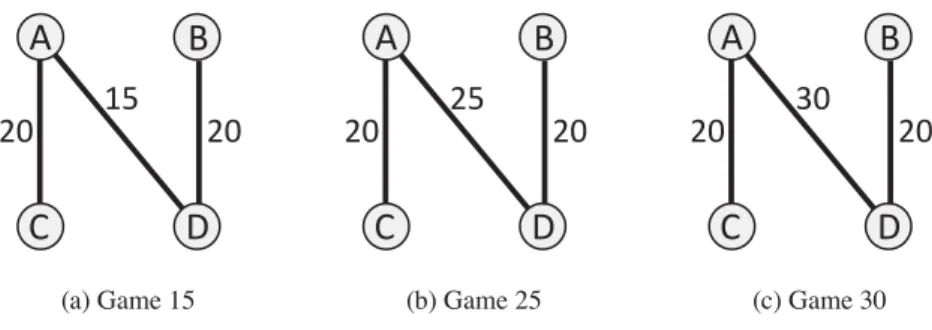
(c) Game 30FIGURE1. The three markets considered in this study. We refer to players A and D as the strong players and players B and C as the weak players.
Cook et al. (1983), and there is a nice albeit brief discussion in Jackson (2010). A typical experimental design in this literature has several features different from us, and more importantly, the focus is on identifying strong and weak network positions rather than evaluating the efficiency of markets. As far as we are aware, this literature does not investigate the interaction between changing market composition and efficiency, and the typical protocol considered does not lend itself to such an investigation by preventing players from exiting before negotiations among all possible matches have taken place.10
2. Environment
2.1. Basic Setup
We set out to test whether the endogenous evolution of thin, heterogeneous matching markets can result in an inefficient allocation of workers to firms in the case of labor markets, buyers to sellers in product markets, or men to women in the marriage market. As we suspect that inefficiencies will be more likely in more complicated settings, we consider the simplest possible markets capable of exhibiting the effects we are interested in. For bargaining positions to change as others exit, we need the market to be able to support at least two matches, requiring at least four players, and at least three different matches among these four players to be possible.
Figure1presents three different market structures (Game 15, Game 25, and Game 30), which will serve as the basis of our investigation. These are four-person markets, with each player identified by the letter A, B, C, or D. A link between two players indicates the joint surplus that this pair of players generate by matching with each other, with the surplus indicated by a number next to the link. These are one-to-one matching markets, that is, each player can be matched with at most one other player in the market. The payoffs of unmatched players are normalized to 0. In all three
10. Perhaps the closest papers to ours are Bienenstock and Bonacich (1993) and Skvoretz and Willer (1993). Both consider a variety of theories, including some from cooperative game theory.
markets, the vertical links (the link between A and C and the link between B and D) generate a surplus of 20 units. The markets differ in one feature only: the value of the diagonal link between A and D. In Game 15, this link is worth 15 units, in Game 25, it is worth 25 units, and in Game 30, it is worth 30 units. This diagonal link determines the bargaining position of A and D vis-´a-vis C and B. We will refer to A and D as the strong players, and to B and C as the weak players. In all three markets, it is efficient for A and C to match and for B and D to match. Across these three markets, we study how the average payoffs of players differ and the frequency with which the efficient match is reached.
2.2. Key Issues and Experimental Approach
There are several fundamental questions we hope to address through our experiments.
Efficiency. First and foremost, when can decentralized bargaining in matching markets be expected to efficiently match the two sides of the market? What are the mechanisms that facilitate efficient matches being reached? What causes inefficient outcomes?
Network Bargaining Power. How do players’ network positions affect their payoffs? Can players with alternative matching opportunities play these alternatives off against each other to extract most of the rents? Does the possibility that these alternative matching opportunities will be lost limit the extent to which agents can exploit strong network positions?
To explore these questions, we focus mainly on an experimental protocol that mirrors a standard noncooperative bargaining game (Experiment I). There are competing theories that offer different predictions about both efficiency and network bargaining power. A general finding from the noncooperative bargaining literature is that there is a tension between using simple strategies and using strategies that can sustain efficient outcomes. An advantage of using this protocol is that the corresponding noncooperative game is tractable, and we can cleanly test how this trade-off between complexity and efficiency is resolved. Better understanding this can inform us about what insights regarding efficiency and network bargaining power from the theoretical literature are most applicable in different situations.
However, it is also important to understand the limitations of this approach. In particular, there are two key features of the bargaining environment in Experiment I we would like to understand better. First, how important is the rigid bargaining protocol? Does it prevent players from achieving efficient outcomes by limiting the interactions between them, or aid efficiency by limiting the extent to which players can try to manipulate each other? Second, in the bargaining protocol of Experiment I, agents leave the market after reaching an agreement. Thus, players are endowed with commitment power by the protocol—they commit not to renege on an agreement whenever they reach one. Does removing this commitment power and allowing players to renege on agreements increase or reduce efficiency? On the one hand, commitment is often
useful in a variety of settings for achieving efficient outcomes. On the other hand, it makes the environment less stationary and more complicated. We conduct two additional experiments. In Experiment II, we remove the experimental protocol and allow players to make offers to whom they want and when they want. Hence, we investigate the role the protocol plays in our Experiment I results. In Experiment III, we follow a structured protocol similar to Experiment I, but with the exception that players remain in the market after they have reached an agreement and can renege on that agreement at a small cost. Hence, we investigate the role of commitment in our Experiment I results.
3. Experiment I: Theory
To guide our experimental investigation, it is helpful to consider some alternative theories. These theories yield different predictions of players’ expected payoffs and matches—and, thus, the level of efficiency in the market. For each theory, we briefly describe the main idea and implications for the three games depicted in Figure1. We refer the reader to Appendices A, B, and C for additional details.
The experimental protocol we consider is standard and extends Rubinstein bargaining to accommodate many players. The corresponding game has an infinite horizon with a common discount factor ı 2 (0, 1). In round t, there is a set of unmatched players who are active. One player is chosen uniformly at random to be a proposer. If the proposer is already matched, we move to roundt C1; otherwise, the proposer can choose to propose a match or to do nothing. To propose a match, the proposer must select an unmatched player and suggest a division of the surplus their match would generate. If a proposal is made, then the player who receives the proposal must either accept or reject it. If the proposal is accepted, then a match is formed, and those two players, having reached an agreement, leave the market. If the proposal is rejected, then both players remain unmatched and we move to roundtC1. The game ends when there is no positive surplus between any two unmatched players.
Although there will often be multiple equilibria of this dynamic game, following the literature, we focus on two criteria on which equilibrium selection can be based— simplicity and efficiency. Simplicity has led a large literature to study the MPE of related bargaining problems, including Rubinstein and Wolinsky (1985), Rubinstein and Wolinsky (1990), Gale (1987), Chatterjee and Sabourian (2000), Sabourian (2004), Gale and Sabourian (2006), Polanski and Winter (2010), Abreu and Manea (2012b), and Elliott and Nava (2019). In our context, the MPE are perfect equilibria in which players choose strategies that depend only on which other players remain active in the market, rather than on the entire history of play.11Although this prevents players from having to keep track of complicated histories of play, it limits the ability of players to
11. The MPE are motivated in Maskin and Tirole (2001), and have been theoretically justified on complexity grounds as those selected when there is a second-order lexicographic preference for simple strategies (Sabourian2004).
punish and reward each other. When there are no efficient MPE, a natural question that then arises is whether more complicated strategies could obtain efficient outcomes. A second type of equilibria we will consider are efficient perfect equilibria (EPE). By design, the markets we study require increasingly complex strategies for an efficient perfect equilibrium. In Game 15, there is an efficient MPE. In Game 25, there is no efficient MPE, but there is an EPE that punishes deviations by reverting to the MPE. In Game 30, there is no efficient MPE or EPE that relies on Markov reversion, but there is an EPE that relies on more complicated strategies. Thus, as we move from Game 15 to Game 25 to Game 30, ever more complicated equilibrium strategies are required to obtain the efficient outcome.
3.1. Quantitative Theoretical Predictions
We begin by describing the limit MPE payoffs and provide some intuition for Games 15, 25, and 30. In all these games, there is a unique MPE. In Game 15, all players always proposing efficiently is an MPE. When all players do so, it is as if they bargain bilaterally with their efficient partner and all players receive limit payoffs of 10. Given that offers of less than 10 will be rejected, it is unprofitable for A or D to deviate and instead offer to each other. Thus, in Game 15, the efficient match is reached with probability 1.
In Game 25, it is no longer an equilibrium for only efficient offers to be made. If A and D never use their link, they will get limit payoffs of 10 as before, but now they will have a profitable deviation to instead offer to each other when selected as the proposer. In equilibrium, A and D mix between offering to each other and making efficient offers. Whenever A and D match with each other, players C and B get a payoff of 0. This reduces the amount players C and B are willing to accept when they do receive offers. In Game 25, the efficient match is obtained when C or B propose, but not always when A or D propose. Given the equilibrium probability with which A and D offer to each other, the probability the efficient match is reached is 0.72.
As the value of the diagonal link increases to 30, we reach a corner solution in which A and D can no longer push down the expected payoffs of C and B enough for them to be indifferent about whom to offer to. Hence, A and D always offer to each other. Nevertheless, when selected as the proposer players, C and B continue to make acceptable offers to A and D, respectively, and we get the efficient match with probability 0.5.12
There are also equilibria in which non-Markovian strategies are played. In all our games, an efficient perfect equilibrium exists, reflecting results in Abreu and Manea (2012a).13
12. For example, we can calculate the expected payoff of C as follows: With probability 0.5, A or D proposes and C gets 0; with probability 0.25, B proposes and reaches an agreement with D, leaving C to get 10 from bargaining bilaterally with A; and with probability 0.25, C proposes and gets 20 less the minimum offer A will accept.
13. They show that by cleverly constructing punishments, an EPE always exists in markets where the gains from trade are either 1 or 0.
There are two constraints that make constructing an EPE hard. First, a player who makes an off-path offer cannot be punished if that offer is accepted (as the player exits). Second, in any EPE a subgame will be reached in which either just A and C are active or just B and D are active. In these subgames, there is a unique subgame perfect equilibrium, and in this equilibrium, both players’ limit payoffs are 10. So once these subgames are entered, there is no scope for rewards or punishments, and all players receive relatively high payoffs. In the case of Game 25, this holds, but in Game 30, it does not, and there is no EPE supported by MPE reversion.
In Game 25, there is an EPE supported by the threat of reverting to the MPE. We label these outcomes EPE with Markov reversion (and sometimes use Markov reversionfor short). Interestingly, the threat of reverting to the MPE can only support on-path play, which yields a unique vector of expected payoffs in an EPE (see Appendix B). Constructing an EPE in Game 30 is more complicated. The threat of reverting to the MPE does not provide sufficient incentives to induce the strong players to offer to their efficient partners, but more complicated strategies can be used. In Appendix B, we derive such strategies and show the range of payoffs they can support. We call these outcomes EPE with rewards and punishments (and sometimes usecarrot and stickfor short). These strategies entail both rewards for not accepting offers that deviate from the prescribed play and punishments for deviating. Finally, we note that in Games 25 and 30 there does not exist an EPE in which the expected limit payoffs of players B and C sum to less than 10, which means that the average expected payoff of weak players must be at least 5.14
In addition to the noncooperative theories we outlined previously, a variety of cooperative solution concepts have been proposed for matching markets, like the ones we study. Although these theories abstract from the timing of offers and agreements, they are founded on appealing principles and provide a useful benchmark.15
A basic principle it might be hoped matching markets satisfy is for no buyer–seller pair to leave any gains from trade on the table when agreements are reached. This motivates considering the outcomes that are robust to pairwise deviations, such that there is no buyer and seller who could both do better by reaching some agreement between themselves. In seminal work that sparked a literature on market games, Shapley and Shubik (1972) show that ruling out pairwise deviations in matching environments such as ours is necessary and sufficient for ruling out coalitional deviations.16
For the markets we consider, pairwise stable outcomes, or equivalently core outcomes, require that A is matched to C and B is matched to D for sure, whereas
14. The reason is that in any EPE either B or C will be left to bargain bilaterally with their efficient partner, thus receiving a limit payoff of 10.
15. Experiments II and III are not amenable to a noncooperative analysis. For example, in Experiment II, the corresponding noncooperative game would be in continuous time with an endogenous ordering and timing of moves. In such settings, these cooperative solution concepts may be particularly relevant. 16. If the market outcome was not efficient, then the grand coalition would be able to form and implement the match that maximized total surplus, and then redistribute this surplus in a way that made everyone better off. Thus, only efficient market outcomes are robust to coalitional deviations, and, hence, by Shapley and Shubik’s result, only efficient market outcomes are robust to pairwise deviations.
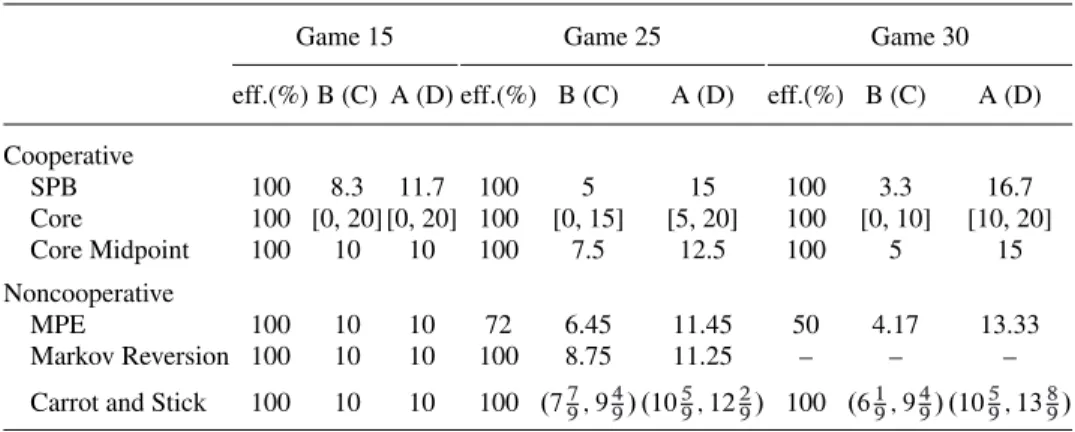
TABLE1. Theoretical predictions about final matches.
Game 15 Game 25 Game 30
eff.(%) B (C) A (D) eff.(%) B (C) A (D) eff.(%) B (C) A (D)
Cooperative SPB 100 8.3 11.7 100 5 15 100 3.3 16.7 Core 100 [0, 20] [0, 20] 100 [0, 15] [5, 20] 100 [0, 10] [10, 20] Core Midpoint 100 10 10 100 7.5 12.5 100 5 15 Noncooperative MPE 100 10 10 72 6.45 11.45 50 4.17 13.33 Markov Reversion 100 10 10 100 8.75 11.25 – – –
Carrot and Stick 100 10 10 100 .779; 949/.1059; 1292/ 100 .619; 949/.1059; 1389/
Notes: For the noncooperative theories, we list the limiting expected payoffs of players ası!1. For EPE, we consider two specifications: In (i) there is MPE reversion following a deviation, whereas in (ii) there are two off-path punishment states: one to punish A and B whereas rewarding C and D and another to punish C and D whereas rewarding A and B.
the combined payoffs of the strong players (A and D) must sum to weakly more than
xD15, 25, and 30 for Game 15, Game 25, and Game 30, respectively. Thus, although the match is pinned down, payoffs are not, and many different payoff profiles can be supported. In Appendix C, we derive the range of each player’s payoffs that can be supported in a pairwise stable outcome.
Various theories have refined the set-valued predictions provided by pairwise stability into point predictions. One alternative is to look at the midpoint of the supported payoffs (e.g. Elliott 2015).17 A second alternative proposed by Rochford (1984), and independently by Kleinberg and Tardos (2008), extends Nash bargaining to matching markets. These symmetrically pairwise balanced (SPB) outcomes coincide with several other cooperative solution concepts—specifically the nucleolus, kernel, and prekernel. We develop these theoretical predictions for the markets we consider in Appendix C and record them in Table2.18
Table2summarizes the quantitative predictions of the theories discussed previously in terms of final outcomes: the frequency with which an efficient match is reached and players’ payoffs by their network position. When a range of payoffs can be supported, we report this range.
We also examine the specific amounts that players offer and accept. Whereas the cooperative theories do not make predictions in this regard that are any more nuanced
17. This is the transferable utility (TU) equivalent to median stable matches in an non-transferable utility (NTU) environment (Schwarz and Yenmez2011), which has received some experimental support in NTU matching experiments (Echenique and Yariv2013).
18. The Shapley value makes unappealing predictions in matching markets, and so we do not consider it. For example, with one worker and two firms, the Shapley value will typically require the firm that ends up unmatched to receive a transfer of surplus from the matched pair.
TABLE2. Theoretical predictions about offer and acceptance strategies.
Game 15 Game 25 Game 30
Ask Accept Ask Accept Ask Accept
MPE strong 10 10 13.55 11.45 16.67 13.33
MPE weak 10 10 8.55 6.45 6.67 4.17
Markov Reversion strong 10 10 11.25 11.25 — —
Markov Reversion weak 10 10 8.75 8.75 — —
Carrot and Stick strong 10 10 .1119; 1449/ .1119; 1494/ .1119; 1779/ .1119; 1779/
Carrot and Stick weak 10 10 .559; 889/ .559; 898/ .229; 889/ .229; 889/
Notes: The amounts players are predicted to ask to keep themselves when making offers and the minimum amounts they would be willing to accept are reported. When strong players make offers to both other strong players and weak players in the equilibrium, they ask to keep the same amount for themselves. The amounts reported are for when all players are still present in the market. When only two players (who can match to each other) are left in the market, there is a unique perfect equilibrium in which both players ask to keep 10 when proposing and are willing to accept offers that give them 10 or more. The amounts reported are for the limit as
ı!1.
than their payoff predictions, the noncooperative theories do. Table2summarizes these predictions.19
3.2. Qualitative Predictions
In evaluating the usefulness of the theories, we also consider their qualitative predictions. Even when the quantitative predictions a theory makes are not supported by the data, it can provide a useful guide to understanding patterns in the data and the key forces underlying a given situation.
First, we consider how efficiency is predicted to vary across treatments. The cooperative theories predict efficient outcomes across all games. For the noncooperative theories we consider, efficiency is tied to the complexity of equilibria played. Our theoretical predictions show that more complex strategies are required for efficiency as we move from Game 15 to 25 to 30. Studying the relative rates of efficient matching across these treatments may speak to the complexity of equilibria subjects are able to coordinate on in order to reach efficient outcomes.
The MPE predicts that the efficient match should be reached with a higher probability in Games 25 and 30 if a weak player is selected to propose first. If there is inefficiency, but this pattern is not observed, it would be suggestive of forces other than those present in the MPE driving inefficiencies. These qualitative predictions are summarized in Table3.20
19. We decided to look at these predictions ex post, after considering the performance of the theories quantitatively and qualitatively in other dimensions.
20. We took the decision to look at these more nuanced predictions of the MPE ex post, after we found substantial rates of mismatch.
TABLE3. Qualitative predictions.
Cooperative theories Noncooperative theories
Core Markov Carrot
Core SPB midpoint MPE reversion and Stick
Efficiency
(1) Matching is efficient in Game 15 Yes Yes Yes Yes Yes Yes
(2) The rate of efficient matching declines from Game 15 to Game 25 to Game 30
No No No Yes No No
(3) Games 25 and 30: Efficient outcomes are more likely to be reached if a weak player proposes first
No No No Yes No No
Players’ payoffs
(1) Strong players’ payoffs increase from Game 15 to Game 25 to Game 30
– Yes Yes Yes Yes –
(2) Weak players’ payoffs decrease from Game 15 to Game 25 to Game 30
– Yes Yes Yes Yes –
(3) Difference in payoffs of strong players in efficient matches from exiting first rather than second is positive and higher in Game 30 than in Game 25
– No No Yes Yes –
Players’ strategies
(1) Players do not delay – – – Yes Yes Yes
(2) Frequency of efficient proposals by strong players declines from Game 15 to Game 25 to Game 30
– – – Yes No No
Notes: We consider a theory to predict an outcome if it would be violated by the opposite finding, in which case we mark the cell “Yes”, and to not predict an outcome if the theory would be violated by the finding, in which case we mark the cell with a “No”. If the theory would be consistent with such a finding, but would also be consistent with the opposite finding, we mark the cell with a “–”.
A consistent prediction across the theories is that the players in weak positions in Game 25 and Game 30 get lower payoffs than the players in strong positions, and that the payoffs of strong players increase from Game 15 to Game 25 to Game 30, whereas the payoffs of weak players decline from Game 15 to Game 25 to Game 30. If we see that this prediction is not borne out in our experiment, it would suggest that our theories are missing the mark and other forces, for example, equity concerns, other-regarding preferences, or other behavioral phenomena, are swamping the basic incentives captured by the theories.
A further interesting prediction all the noncooperative theories make for Game 25 and Game 30 is that, when an efficient match is reached, the first strong player to reach an agreement does better than the second strong player to reach an agreement, whereas the second weak player to reach an agreement does better than the first weak player to reach an agreement. Moreover, this difference is predicted to be greater in Game 30 than Game 25. This prediction is important because it tests whether the environment is nonstationary. If this is borne out in the data, then, as we discuss in
the Introduction, there is scope for players in temporarily strong bargaining positions to match inefficiently from the fear that they will lose this strong position. These qualitative predictions are summarized in Table3.
Finally, Table3also summarizes qualitative predictions regarding strategies. As the cooperative theories are silent on how outcomes are reached, these predictions are confined to the noncooperative theories.21
4. Experiment I: Design and Procedures
Experiment I consists of three treatments (Game 15, Game 25, and Game 30) corresponding to the three markets described in Figure1. All our experimental sessions were conducted at two locations: the Experimental Social Science Laboratory (ESSL) at the University of California, Irvine and the Experimental and Behavioral Economics Laboratory (EBEL) at the University of California, Santa Barbara. At both locations, subjects were recruited from a database of undergraduate students enrolled in these universities.22,23A total of 10 sessions were conducted, with a total of 176 subjects.24 No subject participated in more than one session. The experiments lasted about one hour and a half. Average earnings, including a $15 showup fee, were $23.5 with a standard deviation of $5.3.
In each experimental session, subjects played ten repetitions of the same game with one or more rounds in each repetition and random rematching between games (i.e. between repetitions). In other words, before the beginning of each game, subjects were randomly divided into groups of four and assigned one of the four letters (A, B, C, or D), which determined their network position. This procedure is standard practice in the experimental literature and is often used in relatively complicated games in which it is natural to expect learning.
Within each game, we implement the following bargaining protocol. At the beginning of a game, all players are unmatched. At the beginning of each round,
allunmatched players then choose (a) whom, if anyone, to make an offer to; and (b) how to split the available surplus. One player is then selected at random to be the proposer, and her offer is implemented. This timing differs in a strategically irrelevant way from the game described and allows us to collect more data on proposals. If the offer of the selected player is rejected, then both players remain unmatched and the group proceeds to the next round of the game. If the offer is accepted, then the matched
21. We decided to look at predictions regarding strategies ex post, after analyzing the performance of the theories in the other dimensions.
22. The software for the experiment was developed from the open source Multistage package, available for download athttp://software.ssel.caltech.edu/.
23. In Online Appendix Section G, we report the location at which each session was conducted and compare the behavior of subjects across the two laboratories. Our data suggest that subjects’ behavior is similar across these two subject pools.
24. A total of 40 subjects participated in Game 15 treatment, 68 subjects participated in Game 25 treatment, and 68 subjects participated in Game 30 treatment.
players exit the market permanently. All players in the group observe the move of the selected player and the move of the responder. There are two ways in which the game can come to an end. The first one is the situation in which the surplus generated by any pair of unmatched players who have made proposals in the last round is 0.25 The second one is discounting implemented as a random termination of the game: There is a 1% chance that each round is the last one in a game and a 99% chance that the game is not over. When the game ends, unmatched players receive a payoff of 0, whereas matched players earn payoffs according to their agreements. At the end of the experiment, the computer randomly selects one of the ten games played, with all ten games being equally likely to be selected. Subjects’ earnings in the experiment consist of a showup fee plus their earnings in the randomly selected game.
In Online Appendix Section I, we present the instructions that were distributed to the subjects and read out loud by the experimenter before the beginning of the experiment. Before starting the experiment, subjects were asked to complete a quiz, which tested their understanding of the game rules. Subjects could not move on to the experiment until they correctly answered all the questions on the quiz.26Two features of our interface are worth mentioning. First, at all times the subjects saw the network structure and the available surpluses on the left-hand side of the screen. Second, on the right-hand side of the screen, subjects could observe how the matches evolved over the course of the previous rounds for the current game, by clicking arrow buttons following the diagram that depicted the network structure. These features were implemented to ensure that the subjects had complete information about what had transpired in the previous rounds of a game, in order to eliminate reliance on the subjects’ memory of the history of play.
5. Experiment I: Results
In this section, we present the results from Experiment I. We are interested in two fundamental economic questions—do we get efficient matches and how do players’ network positions affect their payoffs? At the same time, we run a horse race between the theories presented in Section 3.1 in terms of how their predictions fit the data.
Our main interest is in subjects’ behavior after they have had the opportunity to experience the game. Allowing for the presence of an initial learning phase, our statistical tests use data from the last five repetitions of a game played in each experimental session. We think play in these games will better reflect the market
25. In other words, this rule means the game ends if there are no possible matches between any two players who are both still actively bargaining (by making proposals). This includes the situation in which the two strong players (players with two links) match with each other and exit the market leaving the two weak players unmatched as well as the situation in which all four players are matched (each weak player is matched with a strong player).
26. The list of questions and the screenshots of the game are also presented in Online Appendix Section I.
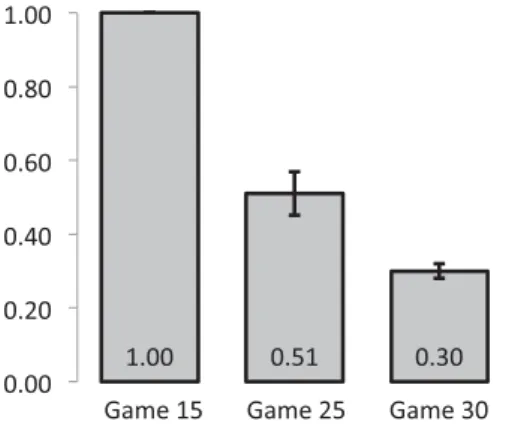
FIGURE2. Efficiency levels in Experiment I, experienced games. The average efficiency levels and the corresponding 95% confidence intervals are reported for each game. Robust standard errors are obtained by clustering observations by session.
situations we seek to capture—in these markets the stakes are higher and many participants will have some experience. We refer to these games asexperienced games. We refer the reader to Online Appendix Section H for the detailed analysis of initial repetitions of the game and learning.
When we compare final outcomes between games, we focus on the groups that finished the game naturally rather than those that were interrupted by the random termination.27When we investigate the strategies used by our experimental subjects, we use all the collected data, including all the submitted proposals rather than just proposals randomly selected for implementation. Finally, to account for interdependencies of observations that come from the same session due to subjects being rematched between repetitions of the game, we cluster standard errors at the session level.
5.1. Efficiency
Figure2presents the rate of efficient matching across our treatments. The evolution of final match efficiency across rounds of play is presented in Online Appendix D.1.
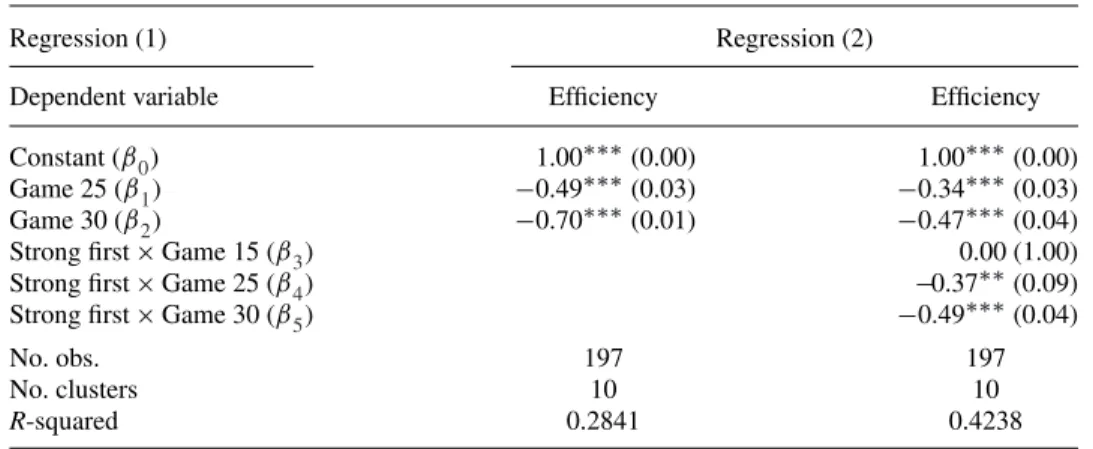
The statistical analysis of efficiency is documented in Tables4and5. Table4reports the outcomes of a regression analysis in which we regress an indicator for whether the efficient match is reached (1Eff) on indicators for two out of three treatments (1Game25 and1Game30), and these interacted with whether the first player in the game selected to be the proposer is a strong player or not (1Strong First):
1EffDˇ0Cˇ11Game25Cˇ21Game30Cˇ31Game151Strong First
Cˇ41Game251Strong FirstCˇ51Game301Strong FirstC" :
27. Random termination was very rare: About 6% of games in all treatments of Experiment I ended because of random termination.
TABLE4. Efficiency in Experiment I, experienced games.
Regression (1) Regression (2)
Dependent variable Efficiency Efficiency
Constant (ˇ0) 1.00(0.00) 1.00(0.00)
Game 25 (ˇ1) 0.49(0.03) 0.34(0.03)
Game 30 (ˇ2) 0.70(0.01) 0.47(0.04)
Strong firstGame 15 (ˇ3) 0.00 (1.00)
Strong firstGame 25 (ˇ4) 0.37(0.09)
Strong firstGame 30 (ˇ5) 0.49(0.04)
No. obs. 197 197
No. clusters 10 10
R-squared 0.2841 0.4238
Notes: Linear regressions with standard errors clustered at the session level are reported.Significant at the 5% level;significant at the 1% level.
TABLE5. Hypothesis tests for efficiency in Experiment I, experienced games.
Regression Null hypothesis Alternative hypothesis p-value
Test 1 Regression (1) ˇ0Cˇ1Dˇ0Cˇ2 ˇ0Cˇ1> ˇ0Cˇ2 p<0.0001
Test 2 Regression (2) ˇ4Dˇ5 ˇ4> ˇ5 pD0.1042
Test 3 Regression (1) ˇ0Cˇ1D0.72 ˇ0Cˇ1<0.72 p<0.0001
Test 4 Regression (1) ˇ0Cˇ2D0.50 ˇ0Cˇ2<0.50 p<0.0001
Table5runs comparative tests of the coefficients from the regressions.
Although all the final matches in Game 15, in the experienced games, are efficient, the probability that the efficient match is reached drops to 51% in Game 25 and even further to 30% in Game 30. Regression (1) and Test 1 confirm these changes. The positive and significant values ofˇ1andˇ2in Regression (1) show that the decline in efficiency in Game 25 and Game 30 in comparison to Game 15 is significant (p < 0.0001 in both cases). Test 1 shows that there is also a significant decline in efficiency from Game 25 to Game 30 (p <0.0001). With respect to the theoretical predictions outlined in Section 3.1, this monotonic decrease in efficiency is predicted by the MPE, but not by any other theory that we consider.
Furthermore, according to the MPE theory, whether or not the market clears efficiently in Games 25 and 30 depends on the network position of the first mover: If the first mover is a player with two links (strong player), then the market should end in an inefficient outcome with positive probability, whereas if it is a player with one link (weak player), then an efficient outcome will be reached with certainty.28The negative and significant values ofˇ4andˇ5in Regression (2) support this prediction: Markets are less likely to reach efficient outcomes in Games 25 and 30, respectively, when the
28. In contrast, in Game 15 the MPE predicts that the network position of the first mover plays no role as all outcomes are expected to be efficient.
first player randomly selected to make a move is a strong player. The same is true if we condition the efficiency of the final match on the network position of the player who makes the first acceptedoffer. Details of this analysis are presented in Online Appendix D.1. Finally, Test 2 evaluates whether the decline in efficiency is larger in Game 30 compared with Game 25 when the first mover is the strong player, as also predicted by the MPE (pD0.1084).
Despite the MPE making qualitative predictions about efficiency that are in agreement with our data, the quantitative predictions of MPE do not match the data so well. In Game 15, all the theories we considered predict that the efficient match will be reached for sure, and this is borne out in the data. Indeed, in every observation of Game 15 we have, the efficient match is reached. However, in Games 25 and 30, the MPE predicts that the rate of efficient matching will be 72% and 50%, respectively. Our observed rates of efficient matching are considerably lower. In Game 25, only 51% of markets reach an efficient outcome, which is significantly lower than the predicted 72% (p<0.0001, Test 3). In Game 30, only 30% of markets reach an efficient outcome, which is also significantly lower than the predicted 50% (p<0.0001, Test 4).
To summarize, we find strong evidence that matching is inefficient in Games 25 and 30, but not Game 15. This is only consistent with the MPE predictions of the theories we considered. Moreover, the various qualitative predictions made by the MPE about inefficient matching are borne out in the data. However, although the MPE does well qualitatively, there are significant deviations from its quantitative predictions. Interestingly, these deviations take the data further away from the predictions made by the other theories rather than towards them—there is even more inefficient matching than is predicted by the MPE.
5.2. Players’ Payoffs
Figure 3 presents the average payoffs of strong players (players A and D) and the average payoffs of weak players (players B and C) across our three treatments.
FIGURE 3. Players’ payoffs depending on their network position in Experiment I, experienced games. The average payoffs and the corresponding 95% confidence intervals are reported for each game. Robust standard errors are obtained by clustering observations by session.
TABLE6. Players’ payoffs in Experiment I, experienced games.
Regression (3) Regression (4)
Dependent variable Players’ payoffs Players’ payoffs
(all players) (strong players in efficient matches)
Constant (ˇ0) 10.04(0.03) 9.97(0.02) Game 25 (ˇ1) 5.53(0.23) 0.13(0.05) Game 30 (ˇ2) 7.68(0.10) 0.02 (0.04) StrongGame 15 (ˇ3) 0.07 (0.05) StrongGame 25 (ˇ4) 7.26(0.25) StrongGame 30 (ˇ5) 11.81(0.14)
Exit firstGame 15 (ˇ6) 0.01 (0.02)
Exit firstGame 25 (ˇ7) 2.21(0.14)
Exit firstGame 30 (ˇ8) 4.62(0.23)
No. obs. 788 218
No. clusters 10 10
R-squared 0.6977 0.8067
Notes: Linear regressions with robust standard errors clustered at the session level. Regression (3) considers payoffs of all players, whereas Regression (4) focuses on the payoffs of strong players (those with two links, players A and D) in the markets that reached an efficient outcome.Significant at the 5% level;significant at the 1% level.
TABLE7. Hypothesis tests for players’ payoffs in Experiment I, experienced games.
Regression Null hypothesis Alternative hypothesis p-value
Test 5 Regression (3) ˇ0Cˇ1Dˇ0Cˇ2 ˇ0Cˇ1> ˇ0Cˇ2 p<0.0001
Test 6 Regression (3) ˇ0Cˇ1Cˇ4Dˇ0Cˇ2Cˇ5 ˇ0Cˇ1Cˇ4< ˇ0Cˇ2Cˇ5 p<0.0001
Test 7 Regression (4) ˇ7Dˇ8 ˇ7< ˇ8 p<0.0001
The statistical analysis of players’ payoffs is documented in Tables6and7. Table6 reports regression analyses in which we regress players’ payoffs on indicators for different games (treatments); these indicators interacted with whether the player was strong (1Strong), and also interacted with whether the player exited the market first (1Exit First):
PayoffDˇ0Cˇ11Game25Cˇ21Game30Cˇ31Game151Strong
Cˇ41Game251StrongCˇ51Game301StrongCˇ61Game151Exit First
Cˇ71Game251Exit FirstCˇ81Game301Exit FirstC":
As the value ofˇ3in Regression (3) is insignificant, there is no evidence that in Game 15 strong players receive higher payoffs. However, the significant values ofˇ4 andˇ5in Regression (3) show that strong players do receive higher payoffs in Game 25 and Game 30 than weak players. Furthermore, weak players receive statistically higher payoffs in Game 25 than in Game 30 (Test 5), whereas strong players obtain significantly lower payoffs in Games 25 than in Game 30 (Test 6).
(a) Payoffs of strong players in Game 25 (b) Payoffs of strong players in Game 30
FIGURE4. Distribution of strong player payoffs in efficient matches by the market composition at the time of exit, experienced games. In both figures, we consider only groups that reached an efficient match and focus on payoffs of strong players (players A and D).
Linking these observations regarding players’ payoffs back to the theories described in Section 3.1, we note that the observed trends are consistent with the predictions of all the theories. This is reassuring as it suggests that the theories we consider are able to capture key forces operating in our environment.
To further examine players’ payoffs across treatments, we consider whether the order in which players reach deals affects their payoffs, conditional on the final match being efficient.29 In any perfect equilibrium of the dynamic game that reaches an efficient match, the pair of players exiting second receive the same payoff on average. This makes sense. These players end up in a bilateral bargaining game with a unique perfect equilibrium, and this equilibrium is symmetric. Thus, for all our noncooperative theories, the payoffs of strong players are predicted to be higher in Games 25 and 30 when they reach an agreement first, whereas the payoffs of weak players are predicted to be lower in Games 25 and 30 when they reach an agreement first.
These predictions are supported in the data. Figure 4presents histograms of the final payoffs of the strong players by their order of exit and conditional on an efficient outcome being reached, where gray bars depict payoffs of players that exited the market first and black bars represent payoffs of players that exited the market second.30 In Game 25, the average payoff of strong players is 12.3 if they exited first, whereas it is only 10.1 if they exited second. For weak players, it is 7.7 if they exited first and 9.9 if they exited second. Similarly, in Game 30, the average payoff of strong players is 14.5 if they exited first, whereas it is 10 if they exited second; the weak players’ average payoff is 5.5 when exiting first compared to 10 when exiting second. As reported in
29. Note that when aninefficientmatch is reached, weak players must receive a payoff of 0 and the average payoff of a strong player must be 12.5 in Game 25 and 15 in Game 30.
30. Only the payoffs of strong players are shown, but the expected payoffs of weak players conditional on reaching the efficient match are 20 less the payoff of the strong players conditional on reaching the efficient match.
TABLE8. Predicted versus observed outcomes in Experiment I, experienced games.
Game 15 Game 25 Game 30
eff.(%) B (C) A (D) eff.(%) B (C) A (D) eff.(%) B (C) A (D)
Theories
MPE all 100 10 10 72 6.45 11.45 50 4.17 13.33
MPEjeff. 10 10 8.95 11.05 8.34 11.67
Markov Reversion 100 10 10 100 8.75 11.25 – – –
Carrot and Stick 100 10 10 100 .77
9; 949/ .1059; 1229/ 100 .619; 949/ .1059; 1389/ SPB 100 8.3 11.7 100 5 15 100 3.3 16.7 Core Midpoint 100 10 10 100 7.5 12.5 100 5 15 Core 100 [0, 20] [0, 20] 100 [0, 15] [5, 20] 100 [0, 10] [10, 20] Data All 100 10 10 51 4.5 11.8 30 2.4 14.2 (0.00) (0.03) (0.03) (0.03) (0.25) (0.10) (0.01) (0.11) (0.05) jefficient 10 10 8.8 11.2 7.7 12.3 (0.03) (0.03) (0.10) (0.10) (0.09) (0.09) Notes: The last four rows report efficiency rates and average payoffs of players by their network position, with the corresponding robust standard errors in the parentheses where observations are clustered at the session level. The first two rows under the category of Data report players’ payoffs and robust standard errors in all the final outcomes, whereas the last two rows under the category of Data focus on the groups that reached an efficient outcome.
Table 6, the positive and significant coefficients onˇ7andˇ8, but not onˇ6, show that in Games 25 and 30, strong players do better when they move first, but there is no evidence that they do better moving first in Game 15. Furthermore, Test 7, reported in Table7, shows that for the strong players, the relative benefit of moving first is larger in Game 30 than in Game 25 (p<0.0001).
We now turn to compare the quantitative outcomes observed in our experiments with the payoff predictions of the theories. These predictions and outcomes are summarized in Table8(along with, for ease of reference, predictions and outcomes for the rate of efficient matching).
In neither Game 25 nor Game 30 does any theory predict payoffs for both weak and strong players within a 95% confidence interval of those observed. Moreover, despite the EPE being able to support a range of payoffs (possibly even a larger range than the one we constructed if more complicated strategies were used), there does not exist an EPE that closely matches the observed payoffs in Game 30. As discussed in Section 3.1, in any EPE, the weak players must receive expected payoffs of at least 5, well outside the 95% confidence interval for the observed average payoffs of 2.4.
The average combined payoffs of players mechanically depend on the frequency with which an efficient match is reached. Given the high rate of inefficient matching observed in Game 25 and Game 30 treatments, considerably above the predicted rate of inefficient matching for any of the theories, it is impossible for any of the theories to do very well in their quantitative predictions of matching payoff. To strip away the efficiency dimension, and focus on the division of the surplus between strong and weak players, we also present the payoffs of playersconditional on reaching an efficient outcome (last row of Table8). For comparison, we also present the MPE-predicted payoffs of players who reach efficient outcomes (third row of Table8). The
MPE then predicts players’ payoffs within a 95% confidence interval in Game 25, and comes close to doing so in Game 30. There also then exist EPE strategies and core outcomes that generate consistent payoffs in both games.
5.3. Players’ Strategies
So far, market outcomes and market dynamics observed in our experiments fit well with the predictions of the MPE, and considerably better than with any of the other theories we have considered. In this section, we zoom in on the players’ strategies to determine whether MPE also provides helpful guidance for organizing the strategies used by our subjects. Although none of our subjects use strictly Markovian strategies,31 the analysis that follows shows that strategies used by our subjects are consistent with several qualitative features predicted by MPE.
The strategy of a player specifies a probability distribution over whom to make an offer to or choose the “Do Nothing” button, details of such offers (amounts kept), and the minimum amount a player is willing to accept from others after every possible history of play. The restriction to Markovian strategies only allows players’ strategies to depend on the state variable, which is the set of unmatched players. This greatly simplifies the strategy space and, given the structures of the markets we consider, there are just two different states for us to analyze. First is the state in which all the players are unmatched and active and the other is the one in which one of the efficient pairs has exited the market and the market consists of the one remaining strong player and one remaining weak player.
When only two players remain active in the market, both the weak and the strong players receive average payoffs of 10 in all three games, as the MPE predicts. Statistical analysis confirming this result is presented in Online Appendix D.2. Thus, in the remainder of this section, we focus on characteristics of strategies our experimental subjects use when all four players are unmatched and active.
We start by looking at the frequency with which players choose the “Do Nothing” button. As we have documented in the previous section, weak players earn more when they exit second rather than first. However, this should not incentivize weak players to delay in equilibrium because doing so increases the probability that they will be left unmatched. Nevertheless, do experimental subjects that are assigned weak positions in a network try to reach an agreement second? To answer this question, we look at the frequency with which players choose the “Do Nothing” button in each game. Pressing this button can be seen as the manifestation of delay, that is, the choice not to make a proposal. Our data show that players almost never choose to delay, irrespective of their network position: There are no delays in Game 15, one instance of a delay in Game 25 (0.64%) by a strong player, and three instances of delays in Game 30 (1.56%), two of which are by a weak player and one by a strong player. Statistical analysis confirms
31. Indeed, any subject who proposed two different amounts to the player in the same network position conditional on the same market composition cannot be playing a Markovian strategy.
(a) Game 15 (b) Game 25 (c) Game 30
FIGURE5. Frequency of efficient proposals by strong players, experienced games. For each subject,
we compute the frequency of proposing to her efficient partner in the first round of the last five repetitions conditional on this player being assigned a strong position. Black bars are the observed frequencies. Light gray bars take the distribution over the number of offers different players make from the data, and then simulate the frequencies with which these players make efficient offers assuming that they all play exactly the strategy prescribed by MPE. We run 10,000 simulations and report the average frequencies as well as the range of frequencies between the 5th and 95th percentiles.
that there is no significant difference between the frequency of delays between the strong and weak players in both Game 25 and Game 30 (see Online Appendix D.2). The absence of delay also provides some support for subjects using simple strategies. Next, we examine the frequency with which strong players make offers to their efficient partners rather than to each other when all players are present in the market. The MPE predicts that this frequency is 100% in Game 15, 42% in Game 25, and 0% in Game 30. In Figure5, we present the empirical histogram of strong players’ individual frequencies of proposing efficiently in each game. Because the MPE predicts that an agreement will always be reached in the first round, we restrict our attention to first-round proposals. The observed proposal frequencies, across the three treatments, fit the MPE theory well. As Figure5shows, we observe a significant shift in the strategies used by the strong players as the value of the diagonal link increases. In particular, in Game 15 over 80% of subjects always propose only to their efficient partner in every game in which they are assigned to a strong bargaining position. In contrast, in Game 30, over 80% of subjects never propose to their efficient partner when in strong bargaining positions. To confirm this, we regress an indicator for a strong player making a proposal to their efficient partner (1Strong Proposes Efficient Match) on indicators for the treatments (games):
1Strong Proposes Efficient MatchDˇ0Cˇ11Game25Cˇ21Game30C":
The regression analysis, reported in Table 9, confirms that subjects in strong network positions are more likely to make efficient proposals in Game 15 than in Game 25 and Game 30.32
Next, we consider the amount that players propose to keep for themselves when making an offer and compare this to the amounts predicted by the MPE. Table 10
32. We also run a hypothesis test with a null hypothesis ofˇ1Dˇ2and an alternative hypothesis of ˇ1> ˇ2and find evidence to reject the null (pD0.0002). This provides evidence that subjects in strong
positions are more likely to make efficient proposals in Game 25 than in Game 30.