Social Network Integration and Language Change in Progress in Iraqi
Arabic: A Sociophonetic Study of Dialect Levelling in the Hīti Dialect
Fuad Jassim Mohammed
Submitted in accordance with the requirements for the degree of Doctor of Philosophy
The University of Leeds
The School of Languages, Cultures and Societies Department of Linguistics and Phonetics
The candidate confirms that the work submitted is his own and that appropriate credit was given where reference was made to the work of others.
This copy was supplied on the understanding that it is copyright material and that no quotation from the thesis may be published without proper acknowledgement
© 2018 The University of Leeds and Fuad Jassim Mohammed
The right of Fuad Jassim Mohammed to be identified as Author of this work has been asserted by him in accordance with the Copyright, Designs and Patents Act 1988
Dedication
To my late mother, may Allah have mercy on her, whose words of farewell guided me to this day, and to my beloved father, for his prayers.
Acknowledgements
First and foremost, all praise is due to Allah Almighty, without his help and blessings I would have accomplished nothing.
My uttermost feelings of gratitude go to my supervisors, Prof Janet C.E. Watson and Dr James Wilson, without their guidance and support this thesis would not have been completed. From the beginning, they have been giving me, not only academic, but emotional support. During the hardest times, especially my worries toward my family in Iraq, whom I could not meet since I left to the UK in 2014, they gave me support and insights to overcome my difficulties and reduce my anxiety. To whom I say: I am deeply proud of your supervision and I am indebted to you along my life. Both of you were not only supervisors, but also friends that I can count on throughout my life.
I am extremely grateful to the Higher Committee for Education Development in Iraq (HCED) for funding my PhD study for four years, and to the University of Al-Anbar for granting me the study leave.
My sincere gratitude goes to the University of Leeds for accepting me as a PGR student. From School of Languages, Cultures and Societies, I want to express my sincere respect and gratitude to Prof Matthew Treherne, the head of the school, Prof Ingrid Sharp, the Graduate Studies Director, Mrs Karen Priestley, Education Service Officer for Postgraduate Research, for their support and kindness in the difficult times.
From the department of Linguistics and Phonetics, I would like to thank Dr Amanda Cardoso and Dr Leendert Plug for their kindness giving me pieces of advice in data analysis. I am indebted to my friend Dr AbdurraoufShitaw for his kindness and support. I would also like to thank all my Iraqi participants for giving up their time in volunteering to take part in the data collection, without their kind help this study would not have been done.
My heartfelt gratitude goes to all people, who gave me spiritual support and encouragement; my life candle Dad, the soul of my Mum, who was waiting to see me holding my PhD certificate, my brothers, sisters, nephews and nieces, my wife and two daughters Nabaa and Noor, without their patience my dream would not have come true.
Abstract
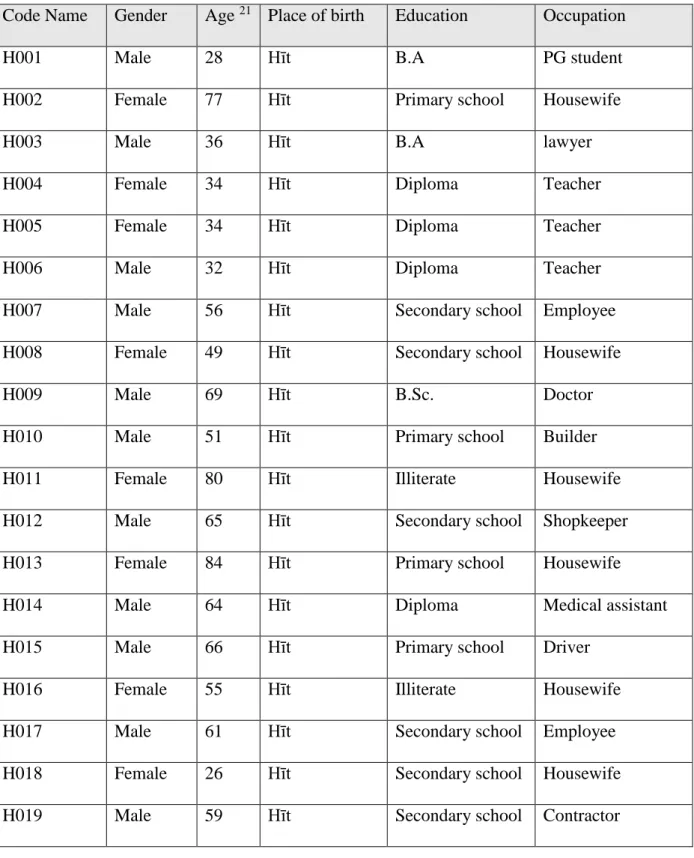
This study investigates the linguistic outcomes of war-induced dialect contact between speakers of two dialects of Iraqi Arabic (IA): the qiltu dialect spoken in Hīt (HIA) and the gilit dialect spoken by migrants from the gilit areas to Hīt. It differs from previous contact-based studies on Arabic dialects in that it investigates dialect change in the speech of the local residents rather than in the speech of the migrants. The HIA dialect has been noted for the loss of certain local linguistic features at the expense of gilit features with a wider areal distribution (Al-Ani, 1978; Khan, 1997). The thesis provides a quantitative sociophonetic description of the speech of 36 male and female HIA speakers and of their accommodation to the gilit dialect by examining the impact of four independent variables (age, gender, Social Network Integration (SNI), and speakers’ attitudes) on the use of four phonological variables (two consonantal and two vocalic). At the consonantal level, variation in the use of the uvular stop (q) and the velar stop (k) are examined. At the vocalic level, the variation in the insertion of the epenthetic vowel [i] within onset consonant clusters in word initial positions and the lowering of the short high vowel /i/ into [a] in the context of pharyngeal consonants is examined. This is the first quantitative sociophonetic study of its kind to be conducted on HIA to examine whether dialect levelling is taking place and to compare the findings to those of other sociolinguistic studies on IA qiltu dialects (e.g. Mosuli Iraqi Arabic) spoken in communities that have undergone similar sociodemographic changes as Hīt.
Over the course of the last three decades, Hīt has seen high levels of internal migration of people from gilit-speaking cities, namely the capital Baghdad. Previous research has suggested that as a consequence of spatial mobility and dialect contact, language features with a wider socio-spatial currency become more widely used at the expense of more locally specific features (Britain, 2009). This mobility disrupts large-scale close-knit
localised networks, which have over time retained highly systematic and intricate sets of socially built linguistic standards (Milroy, 2002).
This study shows that speakers’ age, gender and SNI have an important impact on the acquisition of gilit features, with SNI being the most important independent variable. HIA speakers with more open friendship networks i.e. high scorers on the SNI scale were the leaders in adopting gilit features. There is sound change in progress and gilit features spread faster among the younger generation. In all age groups, male speakers produced more gilit features than female speakers did. The results suggest that the spread of the gilit features at the expense of the HIA local features is determined by social, linguistic and social-psychological factors. It was shown that speakers’ attitudes play an important role in their linguistic behaviour. Socially salient phonological variables such as (k) are levelled only minimally and the vocalic features are levelled more and adopted more frequently than the consonantal features. Epenthesis of the vowel [i] is restricted to monosyllabic words. Vowel lowering is not limited to the context of velar and pharyngeal consonants. The outcome of dialect contact is levelling, which involves the replacement of local linguistic forms with other linguistic features with a wider geographical spread (Cheshire et al., 1999:1) and motivated by individuals having open networks to people outside their community.
Table of Contents
Dedication ... III Acknowledgement ...IV Abstract ...VI Table of Contents ... VIII List of Tables ... XIII List of Figures ... XVI List of Abbreviations ... XIX Phonetic Symbols ... XXI Consonants ... XXI Vowels ...XXII
Chapter One: Introduction ... 1
1.1 Arabic Language ... 1
1.2 The Linguistic Situation in Iraq ... 4
1.3 Previous Studies on Iraqi Arabic ... 6
1.4 The research site ... 14
1.5 The historical background and socioeconomic development in Hīt ... 15
1.6 Causes of dialect levelling (DL) in HIA ... 18
1.7 Importance of the study ... 21
1.8 Aims and scope of the study ... 22
1.9 Research questions ... 24
1.10 The phonology of HIA ... 24
1.10.1 Consonants ... 26
1.10.2 Vowels ... 29
1.10.2.1 Long vowels ... 29
1.10.2.2 Short vowels ... 31
1.10.2.3 Diphthongs ... 31
1.10.3 General phonological processes ... 31
1.10.3.1 Vowel rising ... 32
1.10.3.2 Elision ... 33
1.11 Outline of the Thesis ... 33
Chapter Two: Dialect Levelling ... 37
2.1 Introduction ... 37
2.2 Supralocalisation and spatial mobility... 38
2.3 Convergence and divergence ... 42
2.4 Arabic variationist studies ... 45
2.5 Approaches to studying language variation and change ... 53
2.5.1 Social Class studies ... 54
2.5.2 Social Network studies ... 56
2.5.3 The Community of Practice studies ... 61
2.6 Summary of Chapter Two ... 62
Chapter Three: Communication Accommodation Theory and Dialect Contact .... 64
3.1 Introduction ... 64
3.2 Research in the dialect contact framework ... 67
3.3 Research in the Accommodation framework ... 75
3.4 Summary of Chapter Three ... 78
Chapter Four: Research Methodology and Data Collection ... 79
4.1 Introduction ... 79
4.2 Ethical issues ... 79
4.3 The Sample ... 80
4.3.1 Sampling Methods ... 80
4.3.2 The sample design and size ... 83
4.4 The researcher ... 86
4.5 Observer’s paradox ... 90
4.6 Data collection Procedure... 93
4.6.1 Interview One (I) ... 96
4.6.2 Interview Two (II) ... 97
4.6.2.1 Life-style questions ... 98
4.6.2.2 ‘Attitude’ questions ... 100
4.7 The social variables ... 101
4.7.1 Age ... 101
4.7.2 Gender ... 108
4.7.3.1 Measuring speakers’ SNI scores ... 116
4.7.4 Speakers’ Attitudes ... 121
4.7.4.1 Measuring the attitudes scores ... 124
4.8 The linguistic variables ... 125
4.8.1 (q) velarisation ... 127
4.8.2 (k) affrication ... 129
4.8.3 Vowel epenthesis ... 132
4.8.4 Vowel lowering ... 136
4.9 Statistical Analysis ... 139
4.10 Summary of Chapter Four ... 140
Chapter Five: Results and Discussion ... 142
5.1 Introduction ... 142
5.2 The relationship between the dependent and independent variables ... 142
5.2.1 Distribution across age groups ... 143
5.2.1.1 (q) velarization ... 145
5.2.1.2 (k) affrication ... 153
5.2.1.3 Vowel epenthesis ... 157
5.2.1.4 Vowel lowering ... 159
5.2.2 Distribution according to gender ... 163
5.2.2.1 (q) velarization ... 164
5.2.2.2 (k) affrication ... 168
5.2.2.3 Vowel lowering ... 170
5.2.2.4 Vowel epenthesis ... 171
5.2.3 Distribution according to SNI ... 173
5.2.3.1 Individual language behaviour ... 173
5.2.3.2 Group language behaviour ... 180
5.2.3.3 The SNI sub-variables ... 183
5.2.3.3.1 Friendship network ... 186
5.2.3.3.2 Workmates network ... 190
5.2.3.3.3 Leisure time activities ... 192
5.2.4 Distribution according to speakers’ attitudes ... 194
5.3 Summary of Chapter Five ... 201
Chapter Six: Interactions between Independent Variables ... 202
6.2 SNI ... 204
6.2.1 SNI and gender ... 204
6.2.2 SNI and age ... 206
6.2.3 Speakers’ SNI and attitudes ... 209
6.3 Friendship network ... 210
6.3.1 Friendship network and age ... 210
6.3.2 Friendship network and gender ... 212
6.4 Interaction of age and gender ... 213
6.5 Family-related differences ... 218
6.6 Summary of Chapter Six ... 225
Chapter Seven: Conclusion and Suggestions for Future Research ... 227
7.1 Overview of the main contribution... 227
7.2 Findings ... 229
7.2.1 Socioeconomic situation in Hīt ... 229
7.2.2 Gender-related differences ... 231
7.2.3 The role of Social Network Integration (SNI) ... 233
7.2.4 Psycholinguistic factors ... 235
7.2.5 Linguistic factors ... 237
7.2.7 Family-related variations ... 238
7.3 Suggestions for future research ... 238
7.3.1 Investigating the speech of the gilit migrants in Hīt. ... 239
7.3.2 Investigating other qiltu dialects. ... 239
7.3.3 Longitudinal studies. ... 239
7.3.4 Investigatiing other phonological processes. ... 240
7.3.5 Examining the impact of other social factors. ... 240
References ... 241
Appendix A: Ethical documents ... 256
A1: Research ethical review letter ... 256
A2: Research ethical approval letter ... 258
Appendix B: Speaker metadata ... 259
Appendix C: Informants’ individual scores for consonants ... 261
Appendix E: Indicators of SNI ... 265
Appendix F: Indicators of Attitudes... 268
Appendix G: Research information sheet and participant’s consent form ... 270
G1: Consent form in Arabic ... 270
G2: Consent form in English ... 272
Appendix H: Examples of target and expected reflexes of words tested in picture description (target sounds in bold) ... 274
Appendix I: Collection of pictures used in the interview to ilicit linguistic variables ... 275
Appendix J: Sample of Transcribed Speech... 279
Appendix K: A screenshot of the SPSS variable view ... 286
List of Tables
CHAPTER 1:
Table 1.1 The sample of Blanc (1964) ... 7
Table 1.2 The linguistic variables investigated in this study... 24
Table 1.3 The inventory of the HIA consonants ... 27
CHAPTER 4: Table 4.1The distribution of informants by gender and age ... 84
Table 4.2 Research participants ... 85
Table 4.3 Information about the three consultants ... 90
Table 4.4 Language scores of two female informants interviewed by the female consultant compared to two interviewed by the researcher ... 94
Table 4.5 Informants scores on the SNII ... 99
Table 4.6 The distribution of informants by age group ... 102
Table 4.7 Informants’ scores on the SNII. ... 120
Table 4.8 Informants’ attitudes scores. ... 124
Table 4.9 The linguistic variables investigated in the study ... 126
Table 4.10 Reflexes of (q) in the qiltu and gilit dialects ... 127
Table 4.11 Reflexes of (k) in the qiltu and gilit dialects ... 131
Table 4.12 Sample of the words with vowel epenthesis extracted from the data ... 136
Table 4.13 Sample of the words extracted from the data showing vowel lowering .... 138
CHAPTER 5: Table 5.1 Mean age and year of birth of informants in the three age groups ... 146
Table 5.2 Reflexes of (q) according to age group. ... 148
Table 5.3 T-test among age groups in the use of/ɡ/ ... 149
Table 5.4 Variants of (k) according to age ... 154
Table 5.5 T-test among age groups in the use of /ʈʃ/ ... 155
Table 5.6 Use of /ʈʃ/ according to adjacent vowel ... 157
Table 5.7 Epenthetic [i] according to age... 157
Table 5.8 T-test among age groups in the use of epenthetic [i] ... 158
Table 5.9 Vowel lowering according to age... 160
Table 5.10 Reflexes of (q) according to gender ... 165
Table 5.11 Use of /ɡ/ by grammatical categories ... 167
Table 5.12 Use of /ʈʃ/ by male and female informants ... 169
Table 5.13 Percentages of vowel lowering according to gender ... 170
Table 5.14 Epenthetic [i] according to gender ... 171
Table 5.15 Correlations between language scores and SNI ... 183
Table 5.16 Use of gilit features according to friendship networks ... 187
Table 5.17 Informants’ language scores calculated separately for ‘negative’ and ‘positive’ categories ... 198
CHAPTER 6: Table 6.1 Correlations of independent variables with the dependent variables ... 203
Table 6.2 Cross-tabulation of SNI and gender ... 205
Table 6.3 Cross-tabulation of SNI and age ... 207
Table 6.5 Cross-tabulation of close friendship and age group ... 211 Table 6.6 Cross-tabulation of close friendship and gender ... 212 Table 6.7 Informants in the three families... 220
List of Figures
CHAPTER 1:
Figure1.1 Countries with Arabic as a majority language. ... 2
Figure 1.2 The linguistic composition of Iraq. The green ovals indicate Tigris qiltu dialects of Mosul and Tikrit and the the red arrows indicate the Euphrates qiltu dialects of Anah and Hīt... 15
Figure 1.3 Population growth in Hīt 1903-2016 (Based on Census 2016, Republic of Iraq, Ministry of Planning, Central Bureau of Statistics, Population of Al-Anbar Province) ... 18
Figure 1.4 A map of Iraq showing the internal migration from the gilit area to Hīt and registered numbers of inflows for 2007 (Data were adopted from Al-Hiti, 2010). 20 CHAPTER 5: Figure 5.1 Overall distribution of variants by age, with correlation coefficients ... 144
Figure 5.2 Distribution of /ɡ/ among male and female informants by age ... 147
Figure 5.3 Overall distribution of /ɡ/ by age. ... 148
Figure 5.4 Distribution of /ɡ/ by grammatical category and age ... 151
Figure 5.5 Distribution of /ɡ/ by syllable position ... 152
Figure 5.6 Distribution of /ʈʃ/ by gender and age ... 155
Figure 5.7 Age-related distribution of epenthetic [i] according to syllable type ... 158
Figure 5.8 Distribution of vowel lowering by older vs younger generation ... 161
Figure 5.9 Distribution of vowel lowering by adjacent consonant consonants: pharyngeal (bottom), other consonants (top) ... 162
Figure 5.11 Gender-related use of epenthetic [i] by syllable type: Males (left) and females
(right)... 172
Figure 5.12 Informants’ individual use of /ɡ/ according to SNI ... 173
Figure 5.13 Informants’ individual use of epenthetic [i] according to SNI ... 175
Figure 5.14 Informants’ individual use of vowel lowering according to SNI ... 176
Figure 5.15 Informants’ individual use of /ʈʃ/ according to SNI ... 177
Figure 5.16gilit variants percentage scores by SNI... 181
Figure 5.17 Percentages of /ɡ/ by open and closed friendship networks ... 188
Figure 5.18 Percentages of /ʈʃ/ by open and closed friendship networks ... 189
Figure 5.19 Use of /ɡ/ by open and closed work relationships with gilit speakers ... 191
Figure 5.20 Individual use of vowel lowering according to leisure time ... 192
Figure 5.21 Individual scores of vowel epenthesis according to leisure time ... 193
Figure 5.22 Percentages of the gilit variants according to speakers’ attitudes ... 195
Figure 5.23 Individual language scores of positive attitude group by age ... 199
CHAPTER 6: Figure6.1 Gender-related use of variants according to SNI. ... 204
Figure 6.2 Distribution of /ɡ/ by gender and age groups ... 214
Figure 6.3 Distribution of /ʈʃ/ by gender and age groups ... 215
Figure 6.4 Distribution of vowel lowering by gender and age groups ... 216
Figure 6.5 Distribution of epenthetic [i] by gender and age groups ... 217
Figure 6.6 Use of /ɡ/ in three families ... 221
Figure 6.8 Use of epenthetic [i] in three families... 223 Figure 6.9 Variation in vowel lowering in three families ... 224
List of Abbreviations
ANOVA Analysis of Variance
BA The gilit dialect of the Muslims of Basra C Consonant
CA Classical Arabic
CAT Communication Accommodation Theory CB The qiltu dialect of the Christians of Baghdad CoP Community of Practice Approach
DL Dialect Levelling f. Feminine
HIA The qiltu dialect spoken in Hīt IA Iraqi Arabic
Interview (I) Interview One Interview (II Interview Two
IPA International Phonetic Alphabet
JB The qiltu dialect of the Jews of Baghdad KBA Kordofan Baggara Arabic
KH The qiltu dialect of the Karaite Jews of Hīt m. Masculine
MA The qiltu dialect of Muslims in Mosul MB The gilit dialect of the Muslims of Baghdad NSS Network Strength Scale
OA Old Arabic
QA The dialect spoken in Al Qassim area in Saudi Arabia RA The qiltu dialect of Muslims in Rabia
RP Received Pronunciation SA Standard Arabic
SCA Social Class Approach Sig. Significance
SNI Social Network Integration SNII Social Network Integration Index
SPSS Statistical Package for the Social Sciences SNT Social Network Theory
Trans. Transliteration
UIS Urbanization Integration Scale UK United Kingdom
USA United States of America V Short vowel
VCI Vernacular Culture Index VV Long vowel
Phonetic symbols
The IPA symbols are used in the thesis for Arabic transcription. The transliterations are used when the examples cited from Arabic references. Below is the list of symbols used in this thesis for transcription; Arabic letters, transliteration symbols, and IPA symbols are used in the table to make comparisons easier for the reader.
Consonants
Arabic Letter Trans. IPA Sound Description Example and English
gloss
أ hamza ʾ ʔ Voiced glottal plosive /ʔinʃa:ʔ/ ‘composition’
ب bāʾ b b Voiced bilabial plosive /be:t/ ‘house’
ت tāʾ t t Voiceless denti-alveolar plosive /tamur/ ‘dates’
ث ṯāʾ ṯ θ Voiceless interdental fricative /θo:r/ ‘ox’
ج ǧīm ǧ dʒ Voiced post-alveolar fricative /dʒi:r/ ‘tar’
ح ḥāʾ ḥ ћ Voiceless pharyngeal fricative /ћarr/ ‘heat’
خ xāʾ x x Voiceless velar fricative /xe:r/ ‘goodness’
د dāl d d Voiced denti-alveolar plosive /du:ʃ/ ‘shower’
ذ ḏāl ḏ ð Voiced interdental fricative /ði:b/ ‘wolf’
ر rāʾ r r Voiced alveolar trill /ra:s/ ‘head’
ز zāy z z Voiced denti-alveolar fricative /za:r/ ‘dice’
س sīn s s Voiceless dental fricative /sinn/ ‘tooth’
ش šīn š ʃ Voiceless palate-alveolar fricative /ʃa:riʕ/ ‘street’ ص ṣād ṣ sˤ Voiceless velarised/emphatic alveolar fricative /sˤe:f/ ‘Summer’ ض ḍād ḍ dˤ Voiced velarised/emphatic denti-alveolar plosive /dˤaɣitˤ/ ‘pressure’ ط ṭāʾ ṭ tˤ Voiceless velarised denti-alveolar plosive /tˤajja:ra/ ‘airplane’ ظ ḏ̣āʾ ḏ ̣ ðˤ Voiced velarised interdental fricative /ћaðˤðˤ/ ‘luck’
ع ʿayn ʿ ʕ Voiced pharyngeal fricative /ʕu:d/ ‘stick’
غ ġayn ġ ɣ Voiced uvular fricative /ɣani/ ‘rich’
ف fāʾ f f Voiceless labio-dental fricative /flu:s/ ‘money’
ق qāf q q Voiceless uvular plosive /qara:ba/ ‘relatives’
ك kāf k k Voiceless velar plosive /kinit/ ‘I was’
ل lām l l Voiced alveolar lateral /le:l/ ‘night’
م mīm m m Voiced bilabial nasal /manu/ ‘Who?’
ن nūn n n Voiced alveolar nasal /niswa:n/ ‘women’
ه hāʾ h h Voiceless glottal fricative /hawa/ ‘air’
و wāw w w Voiced bilabial approximant /watan/ ‘homeland’
ي yāʾ y j Voiced palatal approximant /jo:m/ ‘day’
Vowels
Trans. IPA Sound Description
ɪ i Short, close, front unrounded ī i: Long, close, front unrounded a a Short, open, front unrounded ā a: Long, open, front unrounded u ʊ Short close, back rounded ū u: Long, close, back rounded ē ɛ: Long, mid, front unrounded ō ɔ: Long, mid, back rounded
Important Note 1: The transliteration symbols used in the Encyclopaedia of Arabic Language and Linguistics were followed for the quoted examples and words, i.e., each quoted word is italicised followed by the IPA between square brackets and the English gloss, when required between single inverted commas. This does not apply to Proper Names.
Important Note 2: The symbols and descriptions for vowels are adopted from Alsiraih (2013: 23-24).
Chapter One: Introduction
1.1 Arabic Language
In this introductory chapter, I provide an account of Arabic language and some information about the linguistic situation in Iraq. I also present a sketch of the historical background of Hīt and a description of the phonological system of HIA. My aim in this chapter is to guide the reader to the research site, the importance of the present study, and the research questions addressed in the present study.
Arabic, spoken today by approximately 250 million people, is the official language in the eighteen countries that make up the Arab world, extending from Iraq in the east to Mauritania in the west (Watson, 2011: 1). It is also spoken in Arabic-speaking enclave communities in other areas of the world, such as Turkey, Iran, Cyprus, some areas of sub-Saharan Africa, and in some parts of Khuzestan, Uzbekistan, and Khorasan. Arabic-speaking migrant communities in, for example, the USA, Europe and Australia, also use it.
Figure1.1 Countries with Arabic as a majority language.1
Arabic is a member of the Semitic languages family, which is a member of a broader group of languages, called Hamito-Semitic (Ryding, 2005: 1). It shares with many other Semitic languages a rich consonantal, but poorer vocalic system. Two standard varieties of Arabic are recognised, Classical Arabic (CA) and Standard Arabic (SA). In the pre-Islamic era, CA was used mostly in literature, especially in poetry. From the rise of Islam, CA began to be connected with the Qur’an. Conversely, SA arose as a result of the spread of education in the Arab world and is nowadays the official variety of the Arab world, being the language of education, media and newspapers (Al-Wer, 1997: 254).
SA is not used in informal speech in Arab countries or in other Arabic-speaking territories, where dialects are used in everyday life. While SA is used in formal situations such as teaching, religious talks, news broadcasts and sports commentaries, there are various spoken
dialects used by speakers at home and in informal situations in the Arabic-speaking areas mentioned above. This sociolinguistic situation, which is known as ‘diglossia’ (Ferguson, 1959), is characteristic of the Arabic language. Eisele (2002: 3) relates Arabic diglossia to prestige. He argues that Arabic diglossia has been viewed in the vertical dimension: that is, one of a distinction between prestige and stigmatised dialects.2 According to Nevat et al (2014), LA differs from SA in that it is homogeneous across the Arabic-speaking region, while there are considerable differences between SA dialects. Owing to contact with other languages, such as Greek, Turkish, French, and English, mainly during invasions, these dialects underwent change
Arabic dialects are traditionally classified in three ways. The first is the geographical distribution, according to which they fall into mašriqi i.e. Eastern region of the Arab world and maġribi i.e. Western part of the Arab world dialect groups. The former includes the Arabic dialects spoken in Saudi Arabia, Oman, Yemen, Kuwait, Qatar, Bahrain, United Arab Emirates, Iraq, Syria, Jordan, Palestine, Lebanon, Sudan and Egypt. The latter includes the Arabic varieties spoken in Libya, Tunisia, Algeria, Morocco, and Mauritania. This classification is based on overall linguistic features that recognise one group from another (Palva, 2006: 605-6).
The second classification is the Bedouin versus Sedentary dialects, which is based on a sociological stratification. Bedouin communities are found to be more conservative, while sedentary communities are more innovative due to their openness to contact which leads to change (Watson, 2011: 50). The third classification is based on religious and communal affiliation according to which Arabic dialects are divided depending on the religious background of their users. Examples of this division are the Arabic dialects of Muslim, Jewish
2 Eisele (2002:3) viewed language variation in terms of certain dimensions: a ‘horizontal’ one, which is concerned with the
geographical spread and contact, a ‘vertical’ one, which follows a prestige vs. prestige concept, and a ‘temporal’ one, whch is concerned with the historical change and ‘rise and fall’ of prestige forms.
and Christian communities in Iraq (Blanc, 1964), and the dialects of the Sunni and Shi’a groups in Bahrain (Holes, 1983).
1.2 The linguistic situation in Iraq
Iraq is an Arab country, situated in Southwest Asia, south of Turkey, north of Kuwait and Saudi Arabia, west of Iran and east of Syria and Jordan. The ancient name of Iraq is Mesopotamia, which means ‘the land between the rivers’ (Al-Ani and Al-Birazy, 1979). Politically, the area where Iraq is located has also been referred to in the English literature as the Middle East. Iraq is considered as a hybrid of three types of environments: mountains, desert, and a fertile river valley. Two main rivers run through most of the country, the Euphrates and Tigris, the rest of which run through neighbouring countries: Turkey and Syria. The desert area is located in the west bank of the Euphrates and covers wide areas in Al-Anbar, Karbala and Najaf provinces, the fertile valley is between the two rivers, and the mountains are in the northeast part of the country (Al-Ani and Al-Birazy, 1979).
Iraq has a diversified population, owing to which there is considerable linguistic variation. Its geographical domain is the location for a range of spoken and written languages and dialects. A number of languages are spoken in Iraq, with Arabic as the majority language; the main minority languages are Kurdish, Neo-Aramaic, and Turkman. Iraqi Arabic (SA) falls into two spoken dialect groups: the gilit3 group and the qiltu4 group based on the different pronunciations of the verb qultu ‘I said’ (Blanc, 1964). The gilit group is of Bedouin origin and shares many features with Gulf Arabic and with Syrian dialects spoken on the Iraq-Syria border (Abu-Haidar, 2006: 222). This dialect is spoken by the Bedouin, and by the sedentary populations of the Muslim majority in Baghdad and the southern region of Iraq (Abu-Haidar,
3 Also referred to as gələt or gelet in some references.
1991). Religious minorities, such as the Christians and Jews of Baghdad, Muslims and Jewish communities in Mosul, Tikrit, Anah and Hīt, mainly speak the qiltu group. It has been claimed that the qiltu dialects in Iraq, especially the dialect in Hīt, are being influenced by the gilit dialects (Al-Ani, 1978; Mansour, 1991; Khan, 1997). It has been assumed that the qiltu dialects are ‘direct descendants of the dialects spoken by the urban population of the Abbasid Iraq (Blanc, 1964: 166-167). There are no valid census figures for numbers of speakers of each dialect group.
Until the 20th century, no studies had been conducted on the dialects of IA. The earliest studies were conducted in the 1960s and 1970s, and were carried out by Blanc (1964), Malaika (1963), and Jastrow (1978). These studies investigated IA in terms of regional distribution and religious affiliation. Several works were conducted on IA in the 1980s, 1990s, and 2000s. Among these works are those of Jastrow (1978), Al-Ani (1978), Bakir (1986), Abu-Haidar (1989, 1991, and 2004), Mansour (1991), Ingham (1997), Khan (1997), Al-Abdely (2002), Tawfiq (2010), and Ahmed (2012).
The approach that Blanc (1964) adopted to study vernacular dialects has become the standard for many subsequent studies that investigated the Arabic dialects of Iraq, and his study tends to be a source of inspiration for generations of studies conducted on these dialects. Although he investigated the dialects spoken in Baghdad only, the qiltu-gilit dichotomy he used is still the concept upon which all following studies, which followed a traditional dialectological frame, relied (Abu Haidar, 1991; Mansour, 1991; Khan, 1997, Abu-Haidar, 2004). The major focus of these studies is directed to establishing typological descriptions of the dialects, rather than looking for change in progress, or providing profound sociolinguistic interpretations, which underline potential variations. Furthermore, a criticism that may be directed to these studies is that they aimed to investigate the general linguistic status of the communities, rather than attempt to establish a specific description of potential phonological changes. The unstable political situation that Iraq has witnessed during the last three decades
has affected the progress of dialectal and sociolinguistic research, especially with regard to difficulties for researchers in conducting fieldwork.
1.3 Previous Studies on IA
Despite the large number of sociolinguistic studies that have examined Arabic dialects, most of the studies that were conducted on IA mainly relied on investigating language variation and change between colloquial and standard language use at the level of lexicon (e.g. Bakir, 1986; Khan, 1997). Some other studies focused on the concept of gender (e.g. Abu Haidar, 1989, 1991), while others concentrated on specific independent variables, such as level of education and spatial mobility (e.g., Al-Ani, 1978). Some studies examined particular dialects (e.g. Jastrow, 1978; Ingham, 1997). Many of these attempts did not go beyond the limits of religiously related dialects, such as the studies on the dialects of Muslim, Christian and Jewish communities in Baghdad (e.g., Abu Haidar, 1991; Mansour, 1991).
Blanc (1964), who classified the Mesopotamian i.e. Iraqi dialects into two main groups, conducted the earliest sociolinguistic study on IA. The first group includes the qiltu ‘I said’ dialects. They are spoken primarily in the towns of Mosul and Tikrit on the Tigris River and the towns of Anah and Hīt on the Euphrates River. The four towns are ancient urban sites and are located north of Baghdad. The second group is referred to as the gilit ‘I said’ group, which is used by the semi-nomadic rural areas in all areas other than the four qiltu towns, including the capital Baghdad (Al-Ani, 1978: 104). In addition to this geographical distribution, this division is also based on communal and social criteria. Sedentary Muslims mainly speak the gilit dialects, while the qiltu dialects are mostly related to the Jewish and Christian minorities (Abu-Haidar, 1991).
Blanc’s 1964 study was an attempt to describe the IA dialects spoken in Baghdad by following a religious pattern. The speech of Baghdadi Muslims (MB), Christians of Baghdad
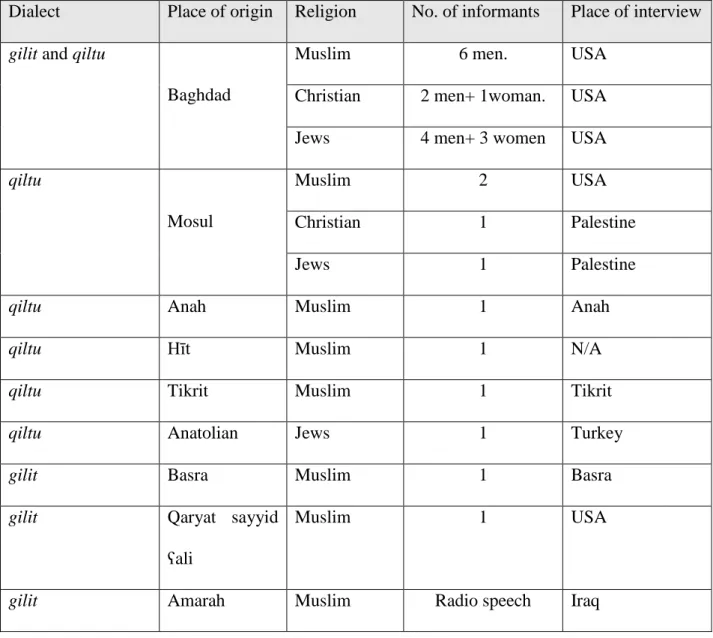
(CB), and Jews of Baghdad (JB) were investigated. For comparison purposes, informants from the towns of lower and northern Iraq were recorded as well. Blanc found that the three Arabic-speaking communities in Baghdad exhibited remarkable linguistic differences. For example, while the Muslim community realised (q) as /ɡ/, the Christian and Jewish groups retained the /q/ variant. Nonetheless, the social distribution of such differences in the community and what that distribution informs us of the social relations between these communal groups is also involved. Religion has been found to be one of the social variables along which the IA dialects of Baghdad vary. The dialects and sample of Blanc’s study are explained in Table 1.1.
Table 1.1. The sample of Blanc (1964)
Dialect Place of origin Religion No. of informants Place of interview gilit and qiltu
Baghdad
Muslim 6 men. USA
Christian 2 men+ 1woman. USA
Jews 4 men+ 3 women USA
qiltu
Mosul
Muslim 2 USA
Christian 1 Palestine
Jews 1 Palestine
qiltu Anah Muslim 1 Anah
qiltu Hīt Muslim 1 N/A
qiltu Tikrit Muslim 1 Tikrit
qiltu Anatolian Jews 1 Turkey
gilit Basra Muslim 1 Basra
gilit Qaryat sayyid
ʕali
Muslim 1 USA
Another of Blanc’s findings is that MB, CB and JB differ in their consonant and vowel inventories. Noticeably, CB lacks interdentals. Blanc shows the similarity of the qiltu dialects to the CB and JB dialects in having a /q/ variant of the SA (q), supporting his argument with some instances from Anah and Hīt, such as /θqiːl/ ‘heavy’ and /qahwa/ ‘coffee’ (1964: 27). Bakir (1986) investigated gender-related differences in the speech of Basra Iraqi dialect speakers. He found that men used standard or literary Arabic forms more frequently than women did. Women spoke a more prestigious variety when they adopted a variety of Arabic approximating the socially prestigious Baghdadi dialect. In sociolinguistics, linguistic prestige is the degree of status and social value attached by members of a speech community to certain language varieties or language features (Trudgill, 1986). Speakers tend to use a particular language variety or feature because that variety or feature is socially accepted and highly regarded. In most cases linguistic prestige is directly associated with socially and politically dominant groups. Labov (1966) makes a distinction between overt and covert prestige. In overt prestige, non-standard language varieties are usually considered low-prestige, but in some situations these varieties are stigmatised by the education system and therefore enjoy a covert prestige among working-class men for the same reason that they are considered incorrect. For example, the Christians of Baghdad accommodate to Muslims’ speech by abandoning /q/ in favour of /ɡ/, which they consider being a feature of power characteristic of the Muslim majority (Abu-Haidar, 1991). An example for covert prestige in English is the case where Americans say who did you ask? Instead of whom did you ask?. On the other hand, in overt prestige speakers attach significance to a variety or feature that is, say, non-standard to achieve specific goals. For example, speakers of Standard English who deliberately switches to use of social markers such as ain’t and he don’t in downward style-shifting are said to seek covert prestige. An example of linguistic prestige in Arabic is when speakers of lower status or minority dialects adopt language features spoken in big cities, namely capitals even if such features are close to standard Arabic. In most cases, such features
are evaluated positively by these speakers. In Bahrain, /y/ which is used by the Sunni community (e.g. [rayyal]) was replaced with /j/ (e.g. [rajjal]), a feature associated with the Shi’a community because Sunnis consider the Shi’a community and dialect as more prestigious (Holes, 1983).
Jastrow (1978) followed Blanc’s division, but with more detail. He divided the qiltu dialects into three groups. The first group is the Tigris group spoken in Mosul, Tikrit, and Baghdad. The second group is the Euphrates group spoken in Anah and Hīt. The third group is the Kurdistan group that covers Sendor, Aqrah, and Erbil (1978: 415). Blanc (1964) reported that the qiltu dialects are characterised by the retention of the SA (q) and (k), interdentals and the reflexes of (r) as /ʁ/.
In the same year, Al-Ani (1978) studied the reflexes of the SA (q) by Baghdadi inhabitants. His study is based on two assumptions. The first assumption is the noticeable increase in the reflexes of this variable among Baghdadi inhabitants. The second assumption is that the qiltu dialects are spreading towards Baghdad. This change is attributed to two main factors. The first factor is the large influx of people from the other qiltu city areas, mainly Mosul, into Baghdad. The second factor is the increase in education. Consequently, there was a noticeable increase in the number of words pronounced with/ɡ/ instead of (q) (Al-Ani, 1978:106). The main reason was thought to be the spread of compulsory education in Iraq. In order not to rely on guesswork, a study was conducted. His data came from 1323 dictionary words containing (q) in initial, medial and final positions. By means of applying an x-ray sound film, the results revealed that out of the total number, 672 words had the /q/ variant while 630 words had the variant /ɡ/. A first impression of this finding, reflected a levelling of /ɡ/ in favour of the qiltu variant, but the researcher ascribed this to the influence of the literary dialect, that is SA, and not to the spread of the qiltu dialects (Al-Ani, 1978:108).
Ten years later, Abdul-Hassan (1988) conducted a sociolinguistic study to examine the impact of speakers’ attitudes, gender, and region of living in Iraq on their use of five linguistic variables i.e. (q), (k), [ana:], /u/, /i/, and [ma:]. He found that attitudes play an important role in the linguistic behaviour of speakers. Abu-Haidar (1989) investigated whether women in Baghdad are more prestigious than men in the use of SA. Her prediction was that men in Baghdad are using more SA variables than vernacular ones because they are more prestigious than women in their life styles, including their language usage. She believes that the reason is that women have less access to sources of SA. Two years later, Abu-Haidar (1991) conducted a synchronic study surveying CB on phonological, morphological and syntactic levels. The main findings were:
1. Interdentals are lacking in CB and cognates of the SA interdentals are dental stops. 2. In CB (r) variable was realised as /ʁ/.
3. The (q) variable was realised as /q/ in other qiltu dialects.
4. CB speakers were considered as bidialectal, that is CB speakers use CB with their fellow Christians only, but they use MB with those from other communities, such as Muslims. Finding 4 might support the prediction that HIA speakers behave similarly in that they use HIA when they communicate with HIA speakers, but may use the gilit dialect when they communicate with gilit speakers.
Mansour (1991) conducted a synchronic study of the speech of Palestinians, originally born in Iraq i.e. Baghdadi Jews who migrated to Palestine in the early fifties. He collected part of his data from recorded, transcribed, but not taped speech of his mother in 1950. The rest of the data were collected twenty years later and showed the noticeable influence that Hebrew had on JB. Mansour had given a profound phonological analysis of JB; while Blanc showed the occurrence of unstressed long syllables in MB and CB, Mansour found that this feature does not exist in JB. In addition to the four vowels that Blanc identified in JB i.e. /i/, /u/, /ə/ and /a/, Mansour identified two other vowels i.e. /e/ and /o/. Also, in contrast to MB and CB,
JB does not exhibit the possession particle [ma:l]. This study may suggest a change, which this dialect is thought to undergo. In her review of Mansour’s (1991) study, Abu-Haidar claims that it can be inferred from the features, especially the voiceless ones that JB is in a state of change, given that Mansour’s data were collected before Blanc’s data.
Ingham (1997) investigated the distribution of a number of IA dialects in relation to geographical and demographical groups of southern Iraq. The investigation concentrated on phonological variables (1997: 30). He surveyed the speech community of the area stretching around the waterway area, hat is the Tigris River, the Euphrates River, Shatt-al-Arab River, and Karun. This wide area is represented by four dialects: 1- the Shatt-al-Arab and lower Karun, 2- Amarah and surrounding marshes, 3- the Zubayr and 4- parts of Faw. All these, with the exception of the fourth dialect, fell into the gilit dialect of Mesopotamia (Ingham, 1997:39). The findings fell into two main categories; the differences in syllabification were ascribed to the occupational group contrasts, while the differences in inventory and incidence were ascribed to regional contrasts. An occupational contrast is made between nomads and the town dwellers, referred to as Arab and Ḥaḍar, respectively (Ingham, 1997:29), which is termed by the researcher as degrees of sedentarisation, as a wider classification in addition to the basic rural-to-urban classification.
Khan (1997) conducted the first dialectological description in Hīt by investigating the qiltu dialect spoken by Jews (KH). He collected his data in 1991 from a number of families living in the Beersheba area of Palestine. Those families are originally descended from the Jewish community who had been, until the early 1950s, living in Hīt, before they migrated to Palestine. One of Khan’s research questions was whether the dialect of the Jews in Hīt differs from that of the Muslims in the town (Khan, 1997: 54). This study included a comprehensive description of the phonology, morphology, and syntax used by the Jewish community of Hīt. One of Khan’s assumptions was the potentially high degree of bedouinisation in which the gilit group was influencing the dialect spoken in Hīt. His results showed that this dialect
combines a hybrid of features from the qiltu and the gilit dialects. Although the dialect is one of the qiltu dialect groups, no evidence of ʾimāla was found.
In the 2000s, many studies were conducted on the qiltu dialects of Hīt, Rabia, and Mosul. Al-Abdely (2002) investigated the syllable structure and syllabification in HIA with reference to Received Pronunciation in English (RP). His study is pedagogically oriented in that he aimed to analyse potential differences in the syllable structure in HIA and RP English, which are thought to influence the ability to learn them as foreign language varieties. Data for HIA came from words that were elicited from recorded individual interviews, obtained from HIA native speakers. The researcher gave no details of the number of informants, or of their ages and genders. The English data were extracted from some studies in English. The study has shown that the two varieties differ from each other in syllable structure, type, phonotactics, and stress placement (Al-Abdely, 2002: 124-126). This study did not extend to give a wider description of the phonological system of HA. Furthermore, it did not relate the dialect to other qiltu dialects. This study falls under the heading of comparative and pedagogically oriented studies.
Following Jastrow’s descriptions of some qiltu dialects and his attempts to collect data in situ, Abu-Haidar (2004) had as an objective to survey some points of the phonology and morphology of the qiltu dialect spoken in Rabia (RA). The data were collected between October 2000 and August 2001, and consisted of five recorded hours of speech from seven one-time inhabitants of Rabia. These recordings included individual interviews. The choice of informants (2 women and 5 men) was limited to those living out of Iraq; a couple living in Turkey, a married couple living in Switzerland, and five informants living in Germany, of which two women are homemakers. All were under the age of forty. Comparing the variety to Mosul Arabic (MA), her findings revealed some differences on the phonological and morphological levels. Phonologically, while MA reflexes (r) as /ʁ/, RA preserves the variant /r/. Morphologically, RA has the bound morpheme ending in /n/ instead of /m/ in pronominal
morphemes. For example, compare the RA /bəntən/ the MA /bəntəm/ ‘their daughter’ (see Abu-Haidar, 2004:11). The study implied religion as a social factor among inhabitants of the town, but not enough details about a dialect change were provided.
Tawfiq (2010) conducted a phono-pragmatic study of (r) in MA. He analysed the speech of fifty native speakers of this dialect, aged between 15 and 70. He obtained his data by following two methods: in the first method, informants were given passages, which they were asked to read in their dialect; while the second method was to use individual interviews through which the researcher elicited his informants’ pronunciation of /r/. No exception from other studies, Tawfiq found that speakers of MA realise (r) as /ʁ/. Interestingly, they do not have this variant when they utter religious names, especially the ‘Ḥusna names of Allah’ (Tawfiq, 2010: 35). For example: [rabb] ‘Lord’, [satta:r] ‘The Veiler’. It also applies when dealing with the names of the lunar months. However, it was not open for all of them. Thus, compare to [ʁamaðˤa:n]’ the month of fasting’ to [muħarram] ‘the first lunar month’, and [raʤab] ‘the seventh lunar month’.
Ahmed (2012) conducted an ethnographic study of HIA. He attempted to investigate the processes of intrusion, elision, and ʾimāla in HIA, with reference to Standard Arabic. His most significant aim was to know how close HIA forms are to other SA ones. No information was given about the number of informants. However, they are recognised as male and female HIA native speakers who were born in Hīt and aged between 10 and65 years old. In contrast to Khan (1997), Ahmed (2012: 23) claimed that HIA exhibits ʾimāla. Interestingly, he has noted that uneducated older male and female speakers tended to use the original variety of pronunciation, that is, HA, more than their peers (Ahmed, 2012: 3).
1.4 The research site
As Milroy (2002: 4) remarks, ‘The classic procedure in describing a speech community is for the analyst to specify a particular geographical location and then to identify a series of relevant social categories such as class, ethnicity, gender, or generation’. There is no doubt that this procedure is the starting point for most, if not all, sociolinguistic studies, and the present study is no exception. In this section, I provide a geographical description of the potential research site.
The original target research site of the present study was Hīt, which at the time of planning my fieldwork trip was considered safe. However, owing to a sudden worsening of the security situation in Hīt the University of Leeds did not grant me permission to carry out fieldwork there, this led to change my plans and identify a new fieldwork site. As will be described in more detail later in the thesis (§ 4.4), the study was carried out in Baghdad by analysing the linguistic behaviour of a group of migrants from Hīt.
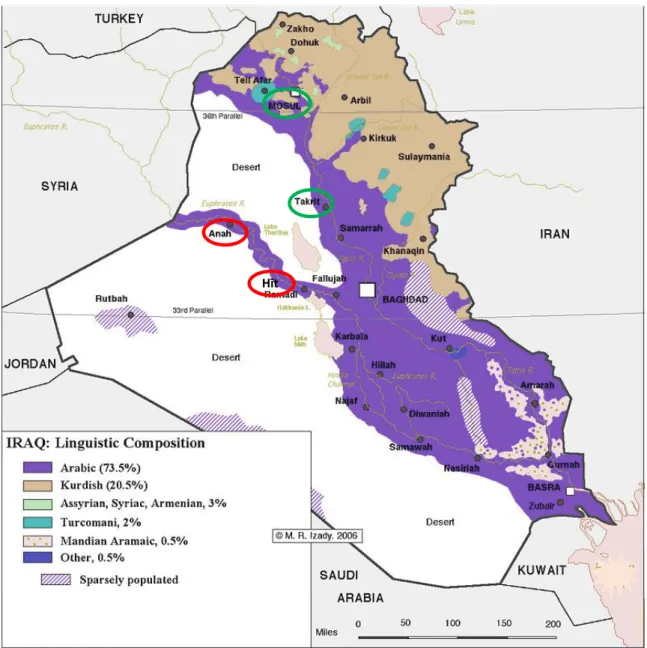
Hīt, a town on the Euphrates River (33°N, 42°E),5 is one of the oldest cities in Iraq. It is located in the west of Iraq approximately 190 km to the west of Baghdad, the capital of the Republic of Iraq, and 450km to the east of Al-Qaim town on the Iraq-Syria border. It belongs to Al-Anbar province and covers an area of roughly 466 km² (Al-Hiti, 2010: 24) (see Figure 1.2).
Figure 1.2 The linguistic composition of Iraq. The green ovals indicate Tigris qiltu dialects of Mosul and Tikrit and the the red arrows indicate the Euphrates qiltu dialects of Anah and
Hīt6
1.5 The historical background and socioeconomic development in Hīt
Hīt is a town of considerable historical importance and has played a significant role in the rise of Iraqi civilization and culture. It was one of the other towns on the Euphrates, which
6Map cited, with modification, from:
https://borderlessblogger.wordpress.com/2014/05/03/arabic-dialectics-muslim-baghdadi-arabic-2/.
functioned as frontier fortresses for Assyria (U.S. Department of Defence. U.S, 2018). The original inhabitants of Hīt can be classified as sedentary Sunni Muslims, whose livelihood has depended for generations on agriculture, fishing, and sheep rearing. This population is an early urban settlement that can be traced back to the Sumerian era (5500 and 4000 BC). It was a village that the Sumerian King Sargon of Akkad (2334-2279 BC) settled with his army, when he marched from Babylonia to the land of Kanaan (Syria). He called it Total, which means the place of buckets (Abdel-Salam, 2005: 151). During the Babylonian and Assyrian eras, Hīt was named ‘īto’ or ‘Hīto’, which means ‘bitumen’, a product for which Hīt is famous. Reports state that King Nebuchadnezzar (604-516 BC) probably brought bitumen from Hīt, which was used in rebuilding Babylon and for paving its roads. Therefore, the city has played an important role in the construction of the civilization of Mesopotamia because it was the main source of bitumen, which was transported to the central and southern cities of Iraq, and used by the Babylonians as a construction material with mortar, burnt bricks and clay and for cementing the walls of Babylon. Hīt remained part of the Sumerian Empire until its decline in around 539 BC. Ever since Islam spread to Mesopotamia (Iraq) in about 636 AD, Hīt was used as one of the most important axes, due to its location, which links Mesopotamia to the Levant (Syria). Commercial convoys and military campaigns would pass through Hīt on their way both eastwards and westwards.
It has been agreed upon by many historians that the castle of Hīt is one of the oldest castles in Iraq (Abdel-Salam, 2005): other historical castles were built in Erbil, Mosul and Kirkuk. The ancient mosque, named Al-Farooq mosque after Caliph Umar bin al-Khattab, who was known as Al-Farooq, has the second highest minaret in Iraq after Al-Hadba minaret in Mosul. This mosque was rebuilt several times. Its minaret was used as an observation tower before the spread of Islam to Hīt. Until the late 1940s, Hīt was home to sedentary Sunni Muslim and Jewish populations. All the Jewish citizens, however, migrated to Palestine after the Israeli
occupation in 1948. Nowadays, the population in Hīt is entirely Sunni Muslim. Research on the social and linguistic history of Hīt is still in progress.
Hīt is famous for extensive farms on both banks of the Euphrates River. It was a suburb belonging to Dulaim (Al-Anbar) province. It is famous for fruit production, such as dates and oranges, which are highly prised and in demand by people in other parts of Iraq. This town is also famous for local industries, such as boat building, water wheels, natural salt collection, knitting, gathering asphalt and the limestone industry. It is also famous among other Iraqi cities for some of its food industries, such as date molasses and Taḥenia industries, a product which is made of sesame seed paste. Until the early 1920s, the majority of Hīt citizens were either farmers or sailors. The first primary schools for boys and girls in Hīt were built in 1921 and 1932, respectively. Hīt had a population of 2000 in 1903. Due to converting Hīt to a town in 1958 and the expansion of the railways, the population increased to 4,830 in 1912. According to the national census of 1947, Hīt had a population of 5000 people, which had grown to 6,808 in 1957. It then raised to reach 9.131 in 1965, and to 14.884 in 1977. In the 1987 calculation, the population in the city increased to 26.402 and to 37.394 in 1997. The population grew to 50.677 in 2008 and jumped to 84.569 in 2016 (Ghudheb, 2005: 234).
Figure 1.3 Population growth in Hīt 1903-2016 (Based on Census 2016, Republic of Iraq, Ministry of Planning, Central Bureau of Statistics, Population of Al-Anbar Province)
1.6 Causes of dialect levelling (DL) in HIA
Over the course of the last three decades, Iraq has witnessed massive socio-economic and demographic changes. The socio-economic changes are represented by industrial development and expansion and increase in the levels of education and economy. Forms of the demographic changes, such as internal migration, which is identified as one of the leading forces behind DL (Trudgill, 1986; Kerswill and Williams, 2000b; Evans, 2004), tends to affect the linguistic situation in Hīt.
Hīt has a homogeneous social composition, which is however subject to disruption by high degrees of mobility into the town from the gilit-speaking areas. As Milroy (2002: 7) argues, mobility is an effective cause of the disruption of large-scale, close-knit localised networks, which have over time retained highly systematic and intricate sets of socially built linguistic standards. It is claimed that recently the migration trend is no longer playing a crucial role in the evolution of the urban vernacular and does not participate in formulating new mechanisms
2,000 4,830 5,000 6,808 9,131 14,884 26,402 37,394 50,677 84,569 0 10000 20000 30000 40000 50000 60000 70000 80000 90000 1903 1912 1947 1957 1965 1977 1987 1997 2008 2016 population i n thous ands Year
of DL or koineization and that the development of the urban vernaculars is more motivated by the influence of fuṣḥā or by linguistic factors (Miller, 2003: 13). However, it was reported that one type of migration-induced dialect change is represented by the spread of the dialects of the capital cities, such as Baghdad into neighbouring cities (Abu-Haidar, 1991).
Hīt was the target for internal migration of people from most cities of Iraq, mainly the gilit -speaking cities, such as Baghdad, Hillah, and Basra. Since the early 1980s, families migrated there in large numbers. The level of migration has noticeably increased from 500 families in the early 1990s to more than 1200 families in 2013 (Al- Hiti, 2010: 171). As a result, the HIA dialect is noted to be in a state of levelling, where some of its salient features are being lost in favour of gilit features. The three sequential wars, globally termed ‘the Gulf Wars’, based on the Arabian Gulf, in 1980, 1991, and 2003 reformulated the composition of culture-specific expressions, lifestyles, dialect, and behavioural orientation. That reformulation began to threaten the overall phonological structure of the socially tightly coherent community of this town.
During the First Gulf War between Iraq and Iran in the years 1980-1988, one of the largest military camps was located in Hīt. Hundreds of officers and soldiers served in this camp, and they later brought their families and settled in Hīt (Al- Hiti, 2010: 182). They are originally from the gilit-speaking cities, such as Baghdad, Hillah, and Basra and speak the gilit dialect. When the Second Gulf War took place in 1991, hundreds of families sought refuge in Hīt in fear of the military operations, and most of them stayed there.
After the Third Gulf War in 2003, Hīt welcomed a massive influx of displaced employees, academics and army officers with their families from different parts of Iraq (Al- Hiti, 2010: 185). These displaced people came from the cities of Baghdad, Kirkuk, Basra, Hillah and Ramadi, where the gilit dialect is spoken. They were all educated Muslims who had, until their migration, been living in the city centres. That has put HIA speakers in direct everyday contact with the gilit speakers. Consequently, some phonological variables began to be
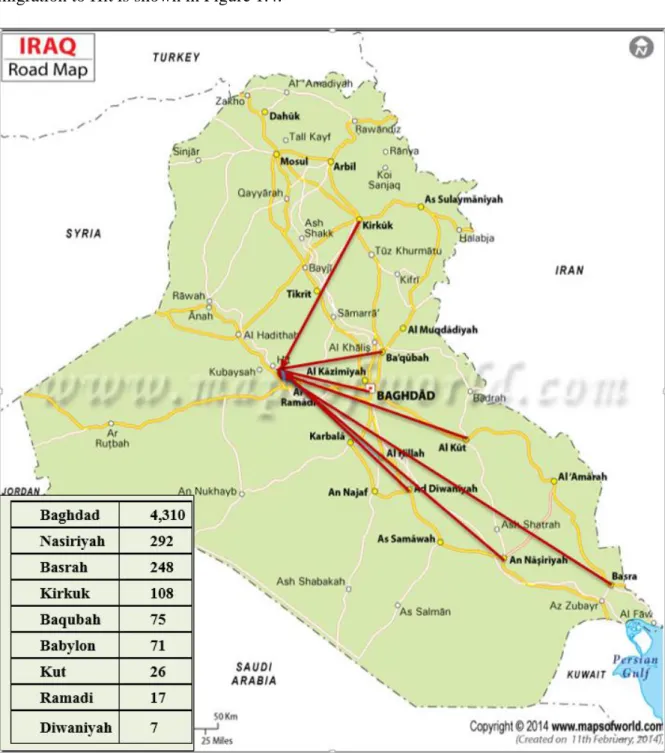
replaced by gilit variants. The contact between Hīt and the gilit areas caused by internal migration to Hīt is shown in Figure 1.4.
Figure 1.4 A map of Iraq showing the internal migration from the gilit area to Hīt and registered numbers of inflows for 2007 (Data were adopted from Al-Hiti, 2010).
1.7 Importance of the study
Most of the previous variationist studies on Arabic dialects focused on the speech of mobile populations in Trudgill’s terms i.e. migrants (e.g. Jassem, 1987; Miller, 2005; and Hachimi, 2007). This study will be different in that it targets potential change in the speech of the non-mobile populations (local residents).
There is no strong variationist tradition on IA dialects and most empirical works on them are written in the framework of traditional dialectology. Moreover, the linguistic behaviour of speakers of the qiltu dialects, represented by HIA speakers and the gilit speakers has not attracted any attention from Iraqi linguists and therefore no hypothesis for the outcomes of dialect contact between these two groups is proposed. IA has not yet been studied in SNI research despite its large population and the demographic changes represented by waves of internal migration in Iraq.
Guy et al. (1996, reported in Bassiouney, 2009: 90) claim that irregularities provide evidence of linguistic change in progress. Taking this claim as a key point, therefore, there is reason to believe that HIA is witnessing a change in progress. Two pieces of evidence in the literature come from Al-Ani (1978) and Khan (1997) to support this prediction. Al-Ani (1978: 105) mentioned that ‘the dialect in Anah and Hīt seems to have a change in progress, where a large number of words are pronounced with/ɡ/instead of (q)’. Likewise, Khan (1997: 54) reported that ‘one of the distinctive features of the qiltu dialects of the Euphrates is a high degree of Bedouinisation... extensive influence from the gilit dialects...which seems far advanced…’. However, Khan investigated the qiltu dialect of the Karaite Jews of Hīt (KH) and concluded that KH was still exhibiting some of its urban features, namely (q) and (k), which were realised in the gilit dialects as /ɡ/ and /ʈʃ/, respectively Khan, 1997: 94). While Khan investigated the dialect of the Jewish community of Hīt, there is still a descriptive and methodological gap between his study and one of a Muslims dialect in terms of description and also potential change in progress due to the noticeable recent migration from the gilit
-speaking cities to Hīt. Irregularities in the realisation of some phonological variables in HIA provide evidence of linguistic change in progress, and from the references made by some researchers (Al-Ani, 1978; Khan, 1997), who claim that HIA is in a state of change toward the gilit group, there is reason to believe that DL is occurring in this dialect. These studies were conducted before or during the gilit migration waves to Hīt. In the late 1970s, Al-Ani reported that in Hīt, (q) was realised as /ɡ/. In the mid-1990s, Khan reported a Bedouinization state, whereby the dialect in Hīt was in a state of change in progress. As an HIA native speaker myself, I noticed that HIA native speakers, especially younger speakers are using the gilit dialect features more than the HIA ones by replacing some of their own dialect features, such as (q) and (k) with features from the gilit dialect. Furthermore, a number of my informants have reported that they observe that the (q) is realised as /ɡ/ namely by younger speakers.
1.8 Aims and scope of the study
The principal theoretical aim of the present study is to determine whether Social Network Theory (SNT) (Milroy, 1980) is an effective model for explaining DL in a local urban community in Iraq. It is hoped that it contributes to contemporary Arabic dialects as well as general (socio)linguistic theory. The method adopted here follows Torgersen and Kerswill’s (2004) pattern and combines geographical diffusion, which involves language features spreading out from an economically and culturally pre-dominant centre to the surrounding regions, levelling, a process limited to smaller towns, and extra-linguistic factors, such as identity and attitudes.7 To achieve this goal, the speech of members of the local speech community in Hīt were explored to examine whether they acquired specific features of the
gilit-speaking groups, and the degree to which their SNI with the gilit community has affected their linguistic behaviour.
Academic literature on the qiltu dialects of Iraq covers studies conducted on the dialects of the Jewish and Christian minorities in Baghdad and of migrants who originally lived in Baghdad (Blanc, 1964; Abu-Haidar, 1991; Mansour, 1991), on the qiltu dialect of Muslims in Mosul (MA) (Tawfiq, 2003), on the dialect of Muslims in Rabia (Abu-Haidar, 2004), and on the dialect of the Jews in Hīt (Khan, 1997). These studies referred to HIA only marginally. Moreover, no study has attempted to investigate the existence of potential change, trace the path of change, or interpret the causes behind it. Therefore, part of the present study attempts to describe the phonology of this qiltu dialect, while a considerable part of it seeks to interpret DL in terms of SNI.
The present study aims to investigate variation and change in HIA in relation to geographical mobility, more specifically migration and commuting (Neil, 2011). It examines the role of Social Network Integration (SNI) and tests how informants’ use of the linguistic variables is affected by their level of integration into the gilit community. In addition, it determines the role of age and gender in formulating change and seeks secondarily to identify the importance of informants’ attitudes towards the gilit dialect and community in DL. This study highlights the direction of change; that is, whether language change moves towards or away from the local dialect. All informants are HIA native speakers, who were born and lived most of their life in Hīt. They are stratified into three age groups (20-39, 40-59, and over 60).
The present study is based on the analysis of four phonological variables8 and features; two consonants i.e. (q) velarisation and (k) affrication, and two vocalic features i.e. vowel
lowering and vowel epenthesis. It attempts to identify possible correlations of this variation with social factors, such as informants’ age, gender, SNI, and attitudes.
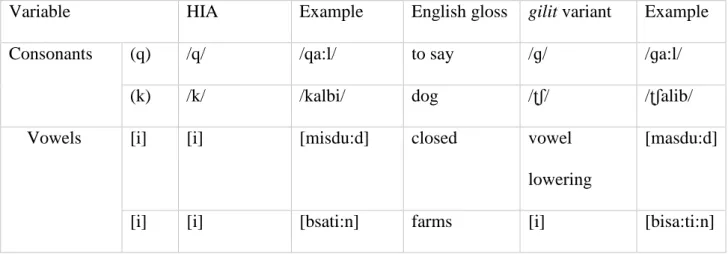
Table 1.2 The linguistic variables investigated in this study
Variable HIA Example English gloss gilit variant Example
Consonants (q) /q/ /qa:l/ to say /ɡ/ /ɡa:l/
(k) /k/ /kalbi/ dog /ʈʃ/ /ʈʃalib/
Vowels [i] [i] [misdu:d] closed vowel
lowering
[masdu:d]
[i] [i] [bsati:n] farms [i] [bisa:ti:n]
1.9 Research questions
To date, as far as I am aware, no other empirical studies of dialect contact were conducted on IA. This is due to the fluctuating situation in Iraq during the last three decades, which has restricted opportunities to carry out fieldwork in situ. The findings of the present study are to be compared to those of other varieties in the literature on languages within larger communities. I hereby address the following research questions:
1. What gilit forms do HIA speakers acquire and to what extent?
2. Is the assimilation of the gilit forms innovated by male or female speakers?
3. How does informants’ levels of SNI within the gilit community influence their linguistic behaviour?
4. How do informants’ attitudes towards the gilit dialect and community affect their linguistic behaviour?
1.10 The phonology of HIA
There is very little information about the historical formation and the evolution of this dialect or its linguistic situation in terms of present-day use. HIA has not been studied previously within the variationist framework. However, some of its phonological features were investigated (e.g. Al-Abdely, 2002; Ahmed, 2012.). The only reports available concerning this dialect are sporadic references by Blanc (1964) and Jastrow (1978), who assigned it to the Euphrates qiltu dialects and Khan (1997), who described the dialect of the Karaite Jewish populations living in Hīt i.e. KH. I conducted a description of the phonology of HIA, which covered the consonantal and vocalic systems. In this study, I interviewed six native gilit speakers (three male and three female) to allow for a comparison of the four phonological variables under investigation.9 In her study of dialect contact between Palestinian and Jordanian dialects, Al-Wer (2002) interviewed a similar number of informants for comparison purposes. I examine whether the two dialects are in a convergent or divergent state.
In this section, I present a short description of the phonology of HIA to examine how it relates to other Arabic dialects in Iraq. I limit my description to the reflexes of consonants and vowels and do not go beyond the scope of the present study. To my knowledge, Khan (1997), whose description showed to a certain extent a convergence state between KH and the gilit group, conducted the first description on this dialect. For knowing in what aspects HIA differs from other qiltu dialects, I cite instances from Khan (1997), Abu-Haidar (1991), and Abu-Haidar (2004). These researchers investigated the KH qiltu dialect, the qiltu dialects used by the Jews (JB) and Christians (CB) in Baghdad, and the qiltu dialect of Muslims in Rabia (RA). These four dialects are classified as qiltu dialects (Blanc, 1964; Abu-Haidar, 2004).