FLORESTA, Curitiba, PR, v. 48, n. 3, p. 331-342, jul/set. 2018. Tomaz. J.S. et.al.
ISSN eletrônico 1982-4688 DOI: 10.5380/rf.v48 i3.52799
331
GENETIC EVALUATION OF SEED GERMINATION AND
DEVELOPMENT OF SEEDLINGS IN Ormosia excelsa Benth
Jennifer Souza Tomaz1, Maria Teresa Gomes Lopes2, Mágno Sávio Ferreira Valente2, Manuel de Jesus Vieira Lima Júnior1, Graciela Inês Bolzón de Muniz3, Sulianne Idalior Paião Rosado1
1 Federal University of Amazonas, College of Agrarian Science, Department of Forest Science, Manaus, Amazonas, Brazil – [email protected]; [email protected]; [email protected]
2 Federal University of Amazonas, College of Agrarian Science , Department of Animal and Planta Production, Manaus, Amazonas, Brazil – [email protected]; [email protected]
3 Federal University of Paraná, Department de Forestry and Forest Technology, Curitiba, Paraná, Brazil – [email protected] Received for publication: 26/05/2017 - Accepted for publication: 20/03/2018
Abstract
The aim of this study was to estimate the genetic parameters of Ormosia excelsa seeds based on germination traits, at different temperatures, in order to facilitate the selection of superior varieties of seeds for producing seedlings. Twenty six progenies collected in the municipality of Autazes (state of Amazonas, Brazil) were evaluated. The experiment was completely randomized, with four replications and 25 seeds per plot, totaling 100 seeds per progeny. The germination rate, mean germination time and the synchronization and speed germination indexes were determined at the temperatures of 30 and 35 °C. Seedling development was also evaluated under nursery conditions. The progenies of O. excelsa showed significant genetic variability for all traits. Both temperatures proved to be effective in producing germination close to 87%. Germination began between 1 and 4 days after sowing. However, for greater efficiency in the selection of superior progenies, each environment should be considered individually. The high heritability values obtained (> 65%) and the high genetic correlation favorable for selection, among all traits, resulted in significant gains according to the selection process used. Our results indicated that determining superior progenies for height and number of leaves was possible based on a single evaluation. The fact that 100% of seedlings planted in the field survived promotes a promising outlook to set up commercial nurseries for the species.
Keywords: Progeny test, native forest species, genetic parameters, selection gain.
Resumo
Avaliação genética da germinação e desenvolvimento de plântulas em Ormosia excelsa Benth. Este trabalho teve como objetivo estimar parâmetros genéticos de sementes de Ormosia excelsa com base em caracteres de germinação, sob diferentes temperaturas, a fim de viabilizar a seleção de matrizes superiores para a coleta de sementes e produção de mudas. Foram avaliadas 26 progênies da espécie, coletadas no município de Autazes (AM). Foi utilizado o delineamento inteiramente casualizado, com 4 repetições e 25 sementes por parcela, totalizando 100 sementes por progênie. Foram determinados: porcentagem de germinação, tempo médio de germinação, e índices de sincronização e velocidade de germinação sob temperaturas de 30 e 35 °C. Além disso, foi avaliado o desenvolvimento das plântulas em condições de viveiro. As progênies de O. excelsa
apresentaram variabilidade genética significativa para todos os caracteres. Ambas as temperaturas avaliadas se mostraram apropriadas com uma porcentagem de germinação próxima a 87%. A germinação se iniciou entre 1 e 4 dias após a semeadura. No entanto, a seleção de progênies superiores deve apresentar maior eficiência se realizada para cada ambiente. A obtenção de altos valores de herdabilidade (> 65%) assim como a presença de alta correlação genética no sentido favorável à seleção, entre todos os caracteres, possibilitam ganhos expressivos de acordo com o processo seletivo adotado. Nossos resultados indicaram que a determinação de progênies superiores para altura e número de folhas em mudas de O. excelsa pode ser feita a partir de apenas uma avaliação, uma vez que o resultado de 100% de sobrevivência das mudas levadas a viveiro revela boas perspectivas para formação de viveiros comerciais da espécie.
Palavras-chave: Teste de progênie, espécie florestal nativa, parâmetros genéticos, ganho de seleção.
INTRODUCTION
Ormosia excelsa Benth, popularly known as the tento amarelo or tento do igapó (blackwater-flooded forests) in Amazonas, and as sucupirana da várzea (swamp forest) in Rondônia, belongs to the Fabaceae family
332
FLORESTA, Curitiba, PR, v. 48, n 3, p 331-342, jul/set.2018 Tomaz. J.S. et.al. .ISSN eletrônico 1982-4688 DOI: 10.5380/rf.v48 i3.52799 and is considered a Brazilian native and endemic forest species, typical in the of blackwater-flooded forests (CAMPOS FILHO, 2012). It occurs in the Brazilian states of Amazonas, Pará, Rondônia, Goiás, and Mato Grosso (CARDOSO; MEIRELLES, 2015). It is a broad canopy tree, ranging from 3 to 20 meters tall, with a trunk diameter of 10 to 45 cm (REFLORA, 2017). It flowers in November and December and fruits from May to October (CAMPOS FILHO, 2012). Its fruits are late dehiscents and purple-brown in color, and the seeds are yellow, pale orange or reddish orange, with no pleurogram and a well-developed hilum (REFLORA, 2017).
Considered an Amazonian medicinal plant, O. excelsa is used in the treatment and prevention of diseases. Its seeds are often used in popular arts and crafts and the seed extract is currently being tested as a possible preventive for dental caries (CAMPOS FILHO, 2012). In addition to its medicinal and economic potential, the species is also of interest because of its rapid growth and, as a native of the blackwater-flooded forests, it can be used in recovering ciliary forest. Its wood is used by local communities to make furniture, benches and canoes (CARDOSO; MEIRELLES, 2015; CAMPOS FILHO, 2012).
The need to restore or recover native vegetation in impacted areas means that studies are needed to find ways of propagating native forest species. Reforestation work has been successful in conserving several forest species under threat. However, this activity is limited because seedling production can pose problems, especially due to a lack of basic information on simple aspects, such as seed germination (CARVALHO et al., 2016).
Rapid, uniform seed germination is desirable in order to produce seedlings for future plantations of widely differing species (OLIVEIRA et al., 2013). Temperature is one of the factors that directly affect germination, especially in terms of water absorption by the seeds and the role it plays in the biochemical and physiological processes involved (CARAKAL, NAKAGAWA, 2012; OLIVEIRA, PEREIRA, 2014). In view of climate change forecasts for the coming decades, we need to know how high temperatures will affect the germination of O. excelsa
seeds, and it is also important to identify superior strains for such environmental conditions.
In order to identify genetic material with superior seed characters, it is essential to elucidate the genetic variability of the population, a task that involves estimating genetic parameters in progeny tests (NASCIMENTO JÚNIOR et al., 2016). Estimates of genetic parameters help in choosing suitable methods and characters for the initial and advanced stages of breeding programs. Moreover, it allows us to draw inferences regarding genetic variability in terms of characteristics of interest and determine expected selection gains (CRUZ et al., 2014). Studies on the genetic parameters of germination characters have been conducted on several Amazonian species (CONCEIÇÃO et al., 1999; OLIVEIRA et al., 2013; NASCIMENTO JÚNIOR et al., 2016).
Natural populations of O. excelsa have been impacted by deforestation activities in the Amazon region for many years. The poor management of genetic resources in situ has aggravated the threat to the survival of native species and loss of genetic resources, which means that knowledge of their ecological and genetic patterns is essential (REIS et al., 2009). In view of the extractive activities impacting O. excelsa seeds, as well as their potential uses and the need for more information in the literature, guidelines for the species are required in respect of germination conditions and the production of seedlings. In addition, studies of the genetic parameters of germination characters are necessary for species domestication, since tools for assessing seed physiological quality will be essential for future research and will help ensure that germplasm is conserved.
Thus, the aim of this study was to estimate the genetic parameters of O. excelsa seeds, based on germination characters, at different temperatures so that superior strains can be selected for seed collection and seedling production.
MATERIAL AND METHODS
From a native population of O. excelsa located in the municipality of Autazes, in the state of Amazonas (3 º 34' 49" S, 59 º 7' 53" W), 26 adult open pollinated trees were inventoried in a seed collection area (approximately 80 hectares) of the Amazonas Native Seed Center (CSNAM), which is under the auspices of the Federal University of Amazonas (UFAM). To obtain the progenies, a minimum of 400 fruits of each strain at least 100 m apart were selected. Fruits and seeds were processed at CSNAM. After removing the seeds from the fruits, they were dried and stored in sealed plastic bags and the original strain properly identified. They were then kept in a cold room at 18 ºC until the beginning of the trials.
The various progenies were subjected to germination character assessment trials under laboratory conditions and the seedlings grown under nursery conditions. The germination test was conducted in a BOD germination chamber. The design was fully randomized, with four replicates of 25 seeds, totaling 100 seeds for each strain evaluated. All individuals were evaluated daily for 50 days. In order to evaluate the influence of temperature on seed germination, the trials were conducted in environments at 30 and 35 ºC.
Soon after the progenies were received in the laboratory, water content was determined in an oven set to 105 º C ± 3 ºC for 24 hours (BRASIL, 2009). The seeds were subjected to a pre-germinative treatment for lateral
FLORESTA, Curitiba, PR, v. 48, n. 3, p. 331-342, jul/set. 2018. Tomaz. J.S. et.al.
ISSN eletrônico 1982-4688 DOI: 10.5380/rf.v48 i3.52799
333 sprouting, which involved making small incision in the side of the seed opposite the hilum. The seeds were also immersed in distilled water for 12 hours to interrupt integumentary dormancy and induce fast, uniform germination.
The seeds were sown in a Gerbox plastic container, containing a medium vermiculite substrate. The container was covered with clear plastic to keep the substrate moist. Radical protrusion was monitored daily until the seedlings were formed, noting the time taken by each progeny. The substrate was moistened daily with 200 ml of distilled water for each replicate.
The following characters were examined: 1) Germination Rate (GR) - seeds that had sprouted a primary radical 2 mm long were considered to have germinated, and were counted at 50 days after sowing to obtain the percentage. The results were expressed as a mean percentage based on the number of normal seedlings (BRASIL, 2009); 2) Germination Speed Index (GSI) - which is the number of seeds germinated each day, divided by the number of days elapsed between sowing and germination, given by the formulaGSI = Σ niti (in which: ni is the number of seeds germinated on each count and ti is the number of days from sowing at the i-th count); 3) Germination Synchronization Index (SI) - determined by the following formula SI = −Σ 𝑓𝑖log 𝑓𝑖 (in which: 𝑓𝑖is the relative frequency of germination); 4) Mean germination time (MGT) - based on means of daily counts of germinated seeds carried out until the end of the trial and calculated using the formulaMGT = Σ niti⁄Σ ni(results expressed in days). The data obtained on germination characters were tested for normality (Lilliefors test) to check whether transformation was required. Subsequently, the Cochram test was run to verify homogeneity of variances and the need to adjust the degrees of freedom, so that the data could be jointly analyzed for the two evaluationtemperatures.
Individual analysis of variance was performed based on a statistical model:
𝑌𝑖𝑗 = 𝑚 + 𝐺𝑖+ 𝑒𝑖𝑗
In which: Yij: phenotypic value of character Y measured in genetic material i and replicate j; m: general parametric mean of the data under study; Gi: effect of the ith genotype (random effect); and eij: mean error associated with observation Yij.
Joint analysis of variance was based on a statistical model: 𝑌𝑖𝑗𝑘= 𝑚 + 𝐺𝑖+ 𝐴𝑗+ 𝐺𝐴𝑖𝑗+ 𝑒𝑖𝑗𝑘
In which: Yijk: phenotypic value of the character Y measured in genetic material i, in environment j and replicate k; m: general parametric mean of the data under study; Gi: effect of the ith genotype (random effect); Aj: effect of the jth environment (random effect); GAij: effect of the interaction of the ith genotype in the jth environment; and eijk: mean error associated with observation Yijk.
Based on the expected mean squares associated with the statistical models and analysis of variance, the following genetic parameters were estimated: genotypic, phenotypic and environmental variance component; genotypic and environmental interaction variance component; coefficient of genetic variation; coefficient of broad sense heritability; and ratio of the coefficient of genetic variation and the coefficient of environmental variation, as described by Cruz et al. (2014). In addition, phenotypic and genotypic correlations were estimated, together with the expected responses for direct and indirect selection of all characters under evaluation. The selection gain (SG) of the superior progenies was obtained using the expression:
𝑆𝐺 = 𝐷𝑠. ℎ2
In which: h²: broad sense heritability; and Ds: selection differential. The selection differential was obtained by:
𝐷𝑠 = 𝑌𝑠− 𝑌0
In which: Ys: mean of progenies selected; and Y0: the original population mean for germination characters. In order to obtain more information on the vigor of the progenies, seedling development under nursery conditions was also evaluated. To assess the effect of higher temperature on the germination and establishment of seedlings, and the impact of the climatic changes, the progenies subjected to a temperature of 35 ºC were taken to the open nursery seedling production area at the Amazonas Project and Environmental Studies Center (CEPEAM) in order to monitor seedling growth under local intrinsic climatic conditions. The seedlings were uprooted when they had developed 2 to 4 pairs of leaves, which usually took 18 days after germination. Twenty-two progenies were transplanted (four progenies did develop enough seedlings).
334
FLORESTA, Curitiba, PR, v. 48, n 3, p 331-342, jul/set.2018 Tomaz. J.S. et.al. .ISSN eletrônico 1982-4688 DOI: 10.5380/rf.v48 i3.52799 To produce the seedlings, they were transplanted in plastic bags (20 x 26 x 0.20 cm) with a substrate of mixed black earth, clay, sand, and decomposed material. Fifty seedlings of each progeny were transplanted, giving a total of 1,100 seedlings. Irrigation was carried out daily and weeds removed manually when necessary. The experimental design was fully randomized with 22 progenies and five replicates of ten plants.
The following characters were evaluated: Shoot Height (SH) in cm measured from the base of the seedling to the apical bud using a rule; Stem Diameter (SD) measured by means of a pachymeter to within 0.1 mm; and Number of leaves (NL). The seedlings were monitored up to 70 days after transplanting, and all the characters were measured at intervals of approximately three weeks, totaling three evaluations. Data were subjected to analysis of variance and means compared by the Scott Knott test at 5% probability. All statistical analysis was performed on Genes, version 2014.6.1 (CRUZ, 2013).
RESULTS
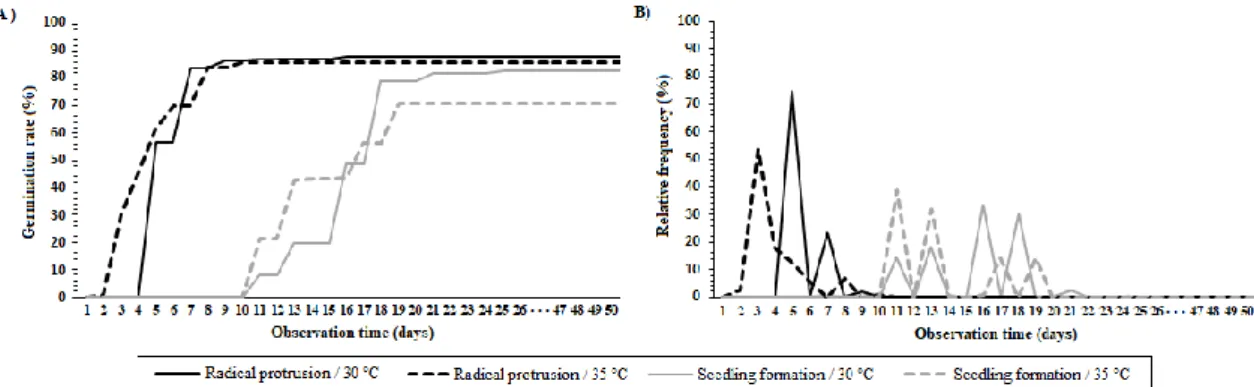
The Lilliefors test showed that the germination rate data were not normal. They were therefore transformed into arco seno√x/100, in which x is the percentage of germinated seeds. In general, species germination was fast and epigeal, commencing between 1 and 4 days after sowing. The mean germination period at 30 °C was between 4 and 9 days after the start of the trial (Figure 1A). At 35 ºC, germination was earlier, at between 2 and 9 days. Germination frequency was higher on the third day at 30 °C and the fifth day at 35 °C (Figure 1B). In general, the seeds had an average water content of 17.93%.
Figure 1. Mean germination rate (A) and relative frequency of germination (B) of 26 progenies of O. excelsa
subjected to temperatures of 30 and 35 ºC.
Figura 1. Porcentagem média de germinação (A) e frequência relativa de germinação (B) de 26 progênies de
O. excelsa submetidas às temperaturas de 30 e 35 ºC.
However, the results showed that, despite the higher initial seedling formation at 35 °C, a higher percentage of seedlings were formed at 30 °C (82.52% compared to 71.04%).
In the individual analysis of variance, a significant genotypic effect (P < 0.05) was observed at both temperatures, showing that the progenies exhibit genetic variability for all germination traits (Table 1). Germination at 30 ºC was 88.00% and at 35 ºC, 86.46%.
Table 1. Mean squares and genetic parameters for germination rate (GR), mean germination time (MGT), germination synchronization index (SI) and germination speed index (GSI) in O. excelsa seeds, evaluated at 30 and 35 °C.
Tabela 1. Quadrados médios e parâmetros genéticos para a porcentagem de germinação (GR), tempo médio de germinação (MGT), índice de sincronização de germinação (SI) e índice de velocidade de germinação (GSI) em sementes de O. excelsa, avaliados em ambientes de 30 e 35 °C.
Source of Variation DF
Mean Squares
Ambient temperature of 30 °C Ambient temperature of 35 °C GR MGT SI GSI GR MGT SI GSI Genotype 25 0.129** 0.756** 0.120** 1.415** 0.143** 9.673** 0.488** 34.313** Residual 78 0.017 0.186 0.042 0.173 0.015 0.137 0.048 0.538 Genetic parameters Mean1 1.276 (88.00) 4.895 1.001 4.776 1.249 (86.46) 3.972 1.454 7.103 CVe (%)2 10.320 8.800 20.410 8.700 9.760 9.330 14.990 10.330
FLORESTA, Curitiba, PR, v. 48, n. 3, p. 331-342, jul/set. 2018. Tomaz. J.S. et.al. ISSN eletrônico 1982-4688 DOI: 10.5380/rf.v48 i3.52799 335 Phenotypic var. 0.032 0.189 0.030 0.354 0.036 2.418 0.122 8.578 Environmental var. 0.004 0.046 0.010 0.043 0.004 0.030 0.012 0.135 Genotypic var. 0.028 0.143 0.020 0.311 0.032 2.384 0.110 8.444 Heritability (%) 86.550 75.420 65.070 87.790 89.570 98.580 90.260 98.430 CVg (%)3 13.093 7.711 13.932 11.668 14.305 38.869 22.822 40.910 CVg/CVe4 1.268 0.876 0.683 1.341 1.465 4.170 1.522 3.960
**; * p < 0.01, p < 0.05, respective means of transformed GR data (root arcsine x/100) and original data by the F test1 as a percentage; 2 Experimental coefficient of variation; 3 Genetic coefficient of variation; 4 Ratio between genetic coefficient of variation and experimental coefficient of variation.
The germination speed index was lower at 30 ºC, with a mean value of 4.776 and mean germination time of 4.895 (days). At 35 ° C, the GSI was higher (7.103) and the MGT lower (3.972) (Table 1). The lowest synchronization index values, representing higher germination synchrony (RICKLI et al., 2014), were observed at 30 ºC (1,011). This was also the character with the highest experimental coefficient of variation.
High heritability (> 65%) was obtained for all characters, with broad sense values ranging from 65.07 to 87.79% at 30 °C and from 89.57 to 98.58% at 35 °C. In addition to the highest heritability values, the trial at 35 °C also had the highest experimental accuracy (lower CVs) and was the only trial in which the CVg/CV ratio was higher than unity (ranging from 1.47 to 4.17) for all characters.
Since the ratio between the highest and the lowest residual mean square in the individual analysis of variance was always less than seven, joint analysis of variance was performed for both evaluation temperatures simultaneously (Table 2). In the joint analysis, no significant environmental effect was observed on the germination rate. However, for the other characters, the temperature difference was sufficient to induce a differential response from the progenies. Furthermore, germination rate was the only character with significant genetic variability among the genotypes, and estimated heritability in the joint analysis was consistently lower than in the individual analysis.
Table 2. Estimated mean squares and genetic parameters for germination rate (GR), mean germination time (MGT), germination synchronization index (SI) and germination speed index (GSI) in O. excelsa seeds, based on a joint analysis of environments at 30 and 35 °C.
Tabela 2. Quadrados médios e parâmetros genéticos para a porcentagem de germinação (GR), tempo médio de germinação (MGT), índice de sincronização de germinação (SI) e índice de velocidade de germinação (GSI) em sementes de O. excelsa, estimados a partir da análise conjunta dos ambientes a 30 e 35 °C.
Source of Variation DF Mean Squares
GR MGT SI GSI Genotype (G) 25 0.238** 4.672ns 0.1945ns 21.282ns Environment (A) 1 0.039ns 44.246* 10.675** 281.565** GxE 1 25 0.034** 5.757** 0.413** 14.446** Residual 156 0.016 0.162 0.045 0.356 Genetic parameters Mean 2 1.262 (87.23) 4.434 1.228 5.939 CVe (%)3 10.050 9.070 17.210 10.040 Genotypic var. 0.026 0.000 0.000 0.855
Component of variance GxE 0.004 1.399 0.092 3.523
Residual var. 0.016 0.162 0.045 0.356
Heritability (%) 85.940 0.000 0.000 32.120
CVg (%) 4 12.667 0.000 0.000 15.562
CVg/CVe5 1.260 0.000 0.000 1.550
ns; **; * not significant, p < 0.01, p < 0.05, respectively, by the F test. 1 Genotype x environment interaction; 2 Mean of transformed GR data (root arcsine x/100) and original as a percentage; 3 Experimental coefficient of variation; 4 Genetic coefficient of variation; 5 Ratio of the genetic coefficient of variation to the experimental coefficient of variation.
Join analysis of variance confirmed that the mean germination rate of the progenies was 87.23%, and there was no statistical difference by the F test between the two environments evaluated. In addition, the genotype/environment interaction was significant for all characters.
336
FLORESTA, Curitiba, PR, v. 48, n 3, p 331-342, jul/set.2018 Tomaz. J.S. et.al. .ISSN eletrônico 1982-4688 DOI: 10.5380/rf.v48 i3.52799 In both trials (30 and 35 °C), high-magnitude positive genotypic correlations were estimated between GR and GSI (Table 3). However, negative genotypic correlations were obtained for MGT and SI compared to GR and GSI, inducing a desirable reduction in mean germination time and greater germination synchronism by directly selecting for this character.
Table 3. Phenotypic (rF) and genotypic (rG) correlations between germination rate (GR), mean germination time (MGT), germination synchronization index (SI) and germination speed index (GSI) in seeds of 26 progenies of O. excels, evaluated at ambient temperatures of 30 and 35 °C.
Tabela 3. Correlações fenotípicas (rF) e genotípicas (rG) entre a porcentagem de germinação (GR), tempo médio de germinação (MGT), índice de sincronização de germinação (SI) e índice de velocidade de germinação (GSI) em sementes de 26 progênies de O. excelsa, avaliadas em ambientes a 30 e 35 °C.
Characters r Ambient temperature of 30 ° C Ambient temperature of 35 ° C MGT SI GSI MGT SI GSI GR F -0.196 -0.001 0.917 -0.477 -0.300 0.645 G -0.302 -0.021 0.950 -0.502 -0.348 0.658 MGT F 0.789 -0.490 0.339 -0.936 G 0.818 -0.529 0.369 -0.940 SI F -0.234 -0.406 G -0.201 -0.438
The highest values of genetic correlation were estimated for GR and GSI (r = 0.9495) and MGT and SI (r = 0.8178) at ambient temperature of 30 ºC. At 35 ºC, the highest values for the MGT and GSI (r = -0.94) and GR and GSI (r = 0.6577) were observed. The behavior of phenotypic correlation coefficients was similar to that of genetic correlation coefficients at both temperatures.
The estimated selection gains by direct selection for the characters of interest were higher at 30 °C (Table 4). Satisfactory gains for all characters were obtainable, but the best gains were for GR (17.28%) and SI (-13.72%). Table 4. Genetic gain estimates and identification of progenies selected directly and indirectly for germination rate (GR), mean germination time (MGT), germination synchronization index (SI) and germination speed index (GSI) in seeds of O. excelsa, evaluated at 30 and 35 °C.
Tabela 4. Estimativas de ganho genético e identificação das progênies selecionadas por seleção direta e indireta para a porcentagem de germinação (GR), tempo médio de germinação (MGT), índice de sincronização de germinação (SI) e índice de velocidade de germinação (GSI) em sementes de O. excelsa, avaliadas em ambientes a 30 e 35 °C.
Characters Environments GS (%) Indirect selection gain (%) Selected progenies Direct Selection GR TMG SI GSI
GR 30 °C 17.28 --- -1.72 0.08 11.85 9; 1; 7; 8; 18 35 °C 15.21 --- -0.74 -2.7 0.72 15; 10; 12; 7; 1 MGT 30 °C -5.73 -3.30 --- -13.61 1.32 22; 20; 10; 24; 17 35 °C -2.46 7.58 --- -3.98 1.98 5; 12; 6; 13; 9 SI 30 °C -13.72 -0.49 -4.13 --- 3.39 22; 20; 17; 26; 10 35 °C -5.95 3.72 0.01 --- 0.26 25; 12; 13; 6; 15 GSI 30 °C 13.19 14.94 -3.44 -3.71 --- 10; 9; 20; 1; 7 35 °C 2.05 10.76 -2.43 -3.24 --- 5; 12; 10; 6; 9
At 30 ºC, progenies 1, 7, 9, 10, 18 and 20 were superior with a higher germination rate and shorter germination time, based on the selection index of Mulamba and Mock (1978). Seed batches of these strains are expected to germinate rapidly and uniformly, resulting in shorter nursery time and uniform seedlings, cutting costs and facilitating the O. excelsa planting schedule. For locations with higher temperatures, progenies 5, 6, 7, 9, 10 and 12 are recommended.
Twenty-two progenies subjected to a temperature of 35 ºC and with better performance in seedling formation were taken to the seedling production area. Survival of seedlings taken to the nursery was 100%. The time required for germination and seedling formation in the laboratory was, on average, 12 days. At 65 days after sowing, the mean height of the seedlings was 18.62 cm (Table 5). The ideal height for the seedlings to be transplanted in the field is 15 to 30 cm. The seedlings were therefore ready for planting.
FLORESTA, Curitiba, PR, v. 48, n. 3, p. 331-342, jul/set. 2018. Tomaz. J.S. et.al.
ISSN eletrônico 1982-4688 DOI: 10.5380/rf.v48 i3.52799
337 Table 5. Mean squares and genetic parameters for shoot height (cm), stem diameter (mm) and number of leaves
of 22 progenies of O. excelsa in the field emergence tests.
Tabela 5. Quadrados médios e parâmetros genéticos para os caracteres altura da parte aérea (cm), diâmetro do coleto (mm) e número de folhas de 22 progênies de O. excelsa em teste de emergência em campo.
Source of Variation DF Mean Squares
Shoot height Stem Diameter Number of leaves
Genotype (G) 21 1601.072** 3.153** 17.623** Environment (A) 2 267.533** 28.446** 61.629** GxE1 42 3.649ns 0.554** 0.806ns Residual 3234 15.795 0.192 1.149 Genetic parameters Mean 18.625 2.848 2.262 CVe (%)2 21.340 15.390 47.400 Genotypic var. 10.650 0.017 0.112
Component of variance GxE -0.243 0.007 -0.007
Residual var. 15.795 0.192 1.149
Heritability (%) 99.770 82.420 95.430
CVg (%)3 17.522 4.622 14.804
CVg/CVe4 0.821 0.300 0.312
ns; **; * not significant, p < 0.01, p < 0.05, respectively, by the F test. 1 Genotype x environment interaction; 2 Experimental coefficient of variation; 3 Genetic coefficient of variation; 4 Ratio of the genetic coefficient of variation to experimental coefficient of variation.
The analysis of variance for monitoring seedling growth showed a significant genotype effect (P < 0.01), indicating the presence of genetic variability in the progenies for the characters under study (Table 5). The seedlings that exhibited the best growth means and the highest number of leaves remained the same in all three evaluations. This can be ascribed to the absence of any significant genotype and environment interaction for these characters.
In general, the seedlings performed satisfactorily. All the characters showed high heritability (> 85%). However, the CVg/CV ratio was below unity for all the characters.
By correlating field data (nursery) and laboratory data, it can be seen that the only characters with high correlations are shoot height and GSI (0.7243), and shoot height and MGT (-0.8167), which were statistically significant at 1% probability by the t-test in the 35 °C environment.
The mean stem diameter was 2.85 mm. This character is often associated with seedling percentage survival in the field, i.e. the higher the stem diameter, the higher the survival rate. In this sense, progenies 6 and 7 were found to be statistically superior and recommended for selection (Figure 2).
Figure 2. Estimated means for shoot height, stem diameter and number of leaves for 22 progenies of O. excelsa
in field emergence tests. Means followed by the same letter in each column belong to the same cluster according to the Scott and Knott clustering criterion at 5% probability.
Figura 2. Médias estimadas para os caracteres altura da parte aérea, diâmetro do coleto e número de folhas de 22 progênies de O. excelsa em teste de emergência em campo. Médias seguidas da mesma letra em cada coluna pertencem ao mesmo grupo de acordo com o critério de agrupamento de Scott e Knott a 5% de probabilidade.
338
FLORESTA, Curitiba, PR, v. 48, n 3, p 331-342, jul/set.2018 Tomaz. J.S. et.al. .ISSN eletrônico 1982-4688 DOI: 10.5380/rf.v48 i3.52799 Progenies 7 and 9 produced the tallest seedlings, showing that these progenies develop faster than the others. Progeny 7 was also statistically superior to the other candidates in terms of number of leaves, corroborating the selection recommendations resulting from the germination tests at 30 and 35 °C. The same applies to progeny 9, which performed well in both nursery and laboratory tests.
DISCUSSION
Different species can respond is very different ways to factors such as water, light, temperature, oxygen and the occurrence of pathogens. For this reason, we need to know the appropriate conditions for germinating seeds (CARVALHO; NAKAGAWA, 2012). Knowing the conditions required for germinating O. excelsa seeds provides significant selection gains for breeding, so that germination potential can be optimized in a short period of time.
Our results show that O. excelsa is a species that germinates rapidly (from 1 to 4 days after sowing). In
Ormosia arborea
,
germination occurs five days after imbibition and, in Ormosia fastigiata, seven days (GURSKI et al., 2012). In Parkia gigantocarpa (Fabaceae), germination occurs between the second and fifth day after sowing, and the fully formed seedling stage is reached fifteen days after sowing (RIBEIRO et al., 2015).The water content and storage characteristics observed in O. excelsa seeds mean that they can be classified as orthodox, i.e. they can remain viable when water content drops to 5% and they are stored at temperatures below 0 °C.
In O. excelsa, although a temperature of 30 °C leads to slightly higher germination than at 35 °C, germination speed is lower and germination takes longer. In the jatobá (Hymenaea courbaril L., Fabaceae), a higher germination rate was observed at 30 ºC (95%), with a higher germination speed index (3.83) and longer mean germination time (7.74) compared to germination at 20 ºC (DUARTE et al., 2016). Similar findings were reported by Matos et al. (2015) in their study of seed germination in Dalbergia nigra. The authors observed an increase in germination speed at 35 ºC.
Ataide et al. (2016) found that in Melanoxylon brauna, temperatures of 25 and 30 °C propitiated respective germination rates of 93 and 95%, and GSI was significantly higher at the higher temperature. In general, low temperatures result in slower germination in tropical species because the germination process involves enzymes whose activity is maximized only at higher temperatures (CARVALHO; NAKAGAWA, 2012).
Although the germination synchronization index (SI) was better at 30 °C, some caution is required, since the germination of a single seed in one day can affect the germination synchrony of a whole sample (SANTANA, RANAL, 2000). However, Rickli et al. (2014), studying the germination of
Vochysia bifalcata seeds on different substrates and at different temperatures, also observed higher germination synchronization at 30 ºC.
In common with the species under study, other forest species can germinate satisfactorily within different temperature ranges (MACIEL et al., 2013). Oliveira and Pereira (2014) showed that the germination rate was higher for Guibourtia hymenaefolia seeds at temperatures of 30 °C (90%), 35 °C (97%) and 25-35 °C (90%). All these temperatures were statistically identical in promoting germination. However, studies such as Oliveira et al. (2012) report more specific conditions for the germination of certain seeds. What we can observe is that seeds that germinate within a certain temperature range often tend to reflect the thermal characteristic of their habitats.
Genetic variability, an essential factor for setting up any breeding program, was observed for all germination traits. However, the efficient selection of superior genotypes depends on the genetic and environmental parameters related to the characters of interest. In general, estimates of genetic parameters show that a large part of the existing variance is of genetic origin, and it is possible to obtain significant gains in species’ seedling production.
The two germination temperatures trialed should produce satisfactory genetic gains. However, the best results were obtained at 35 °C. At this ambient temperature, the highest heritability estimates and the lowest estimated experimental coefficients of variation were obtained. In terms of the CVg/CV ratio, values greater than 1 are very favorable to selection (CRUZ et al., 2014). Thus, if a researcher or producer has to opt for only one germination environment, priority should be given to a temperature of 35 °C when selecting genotypes with higher seed germination rates.
Joint analysis of variance revealed that the genotype/environment interaction was significant for all characters. The temperatures used therefore had a distinct influence on the expression of these characters. In view of this, the inferences and selection for these characters tend to be more efficient when applied to each individual environment.
Heritability values also indicated that selection would be more efficient if applied to an individual environment, rather than multiple environments. This is attributable to the fact that heritability is higher when
FLORESTA, Curitiba, PR, v. 48, n. 3, p. 331-342, jul/set. 2018. Tomaz. J.S. et.al.
ISSN eletrônico 1982-4688 DOI: 10.5380/rf.v48 i3.52799
339 estimated from individual analysis. Note that heritability for MGT and SI was zero in the joint analysis. This can be ascribed to the satisfactory nature of the environments trialed, since all the genotypes exhibited high phenotypic means over a narrow range, as well as limited environmental variance, zeroing genotypic variance values. In this case, because the seeds exhibited no variability for MGT and SI, selection based on the joint analysis would fail to achieve the desired result.
The complexity of the quantitative characters (i.e. quantity of genes and their action) means that there is room for interaction. Studies on these associations, dependent on several factors including the environment, are needed to assess the strength of one character when selection targets the correlated character (MARTINS et al., 2014). If there are strong and favorable correlations between characters, it is important to bear in mind that directly selecting for any one of the characters evaluated would produce satisfactory indirect gains in all the other characteristics, and that this is an efficient procedure because, for the purposes of this study, it provides adequate distribution of the expected gains, such as higher germination rate and lower mean germination time. In a study on estimating of genetic parameters in Jacaranda copaia (Aubl.) seeds, Nascimento Júnior et al. (2016) also observed strong positive correlations between GSI and GR (r => 0.9) and negative correlations between MGT and the other characters evaluated. According to the authors, this makes the selection process simpler, obviating the need to impose constraints on selection to obtain the gains targeted.
A breeding program is designed to achieve high selective gains, together with satisfactory genetic variability for characters of interest. Generally, the seed collection process does not favor genetic diversity in populations, since few individuals are represented in the batches of seeds collected. This means that forestry nurseries produce large numbers of seedlings with a high degree of kinship (REIS et al., 2003). In this study, recommendations are made for five progenies by means of direct selection, taking into account different temperature conditions and characters. Furthermore, progeny performance in terms of the combined results for GR and MGT was used as the selection criterion. Therefore, recommending a greater number of superior progenies promotes the accumulation of favorable alleles related to germination traits, and guarantees high genetic variability in O. excelsa populations. In addition, distinct progenies can be recommended for specific environments and objectives within a seedling production and/or genetic improvement program.
When subjected to a temperature of 35 ºC, the progenies that produced at least 50% fully formed seedlings were taken to the seedling production area in an open nursery. The fact that 100% of the seedlings taken to the field survived is evidence of the satisfactory nature of the trial and promises to provide a sound basis for setting up commercial nurseries for the species.
Evaluation of seedling height and number of leaves proved more advantageous when carried out in the early stages of development, since there was no interaction between the genotypes and the evaluations made. Thus, the superior seedlings for the characters concerned can be identified by only one evaluation three weeks after transplanting in the field. Identifying superior plant materials early on is always beneficial, improving efficiency and making better use of available resources. Seedling height was also significantly correlated with germination speed and mean germination time at 35 °C, affording the possibility of indirect gains for this character by applying direct selection for GSI and MGT. Some progenies (i.e. progenies 7 and 9) performed outstandingly in both controlled and nursery environments.
Once again, high heritability values revealed weaker environmental influence, in contrast to the genetic control imposed on the characters measured in nursery. In general, the results obtained herein bode well for the development of superior plant materials for seedling production and the domestication and breeding of this native Brazilian forest species.
CONCLUSIONS
• The results confirm the high genetic variability of the germination traits, affording the possibility of selecting superior plants for producing seedlings.
• Germination temperatures of 30 and 35 °C led to satisfactory results. However, they did not influence the expression of the genotypic characters analyzed in the same way.
• High heritability values were estimated for all the characters in both trialed environments, allowing significant gains depending on the selection process used.
• High favorable genetic correlation among all the characters simplifies selection.
• Superior progenies for height and number of leaves in O. excelsa seedlings can be identified from only one field evaluation.
340
FLORESTA, Curitiba, PR, v. 48, n 3, p 331-342, jul/set.2018 Tomaz. J.S. et.al. .ISSN eletrônico 1982-4688 DOI: 10.5380/rf.v48 i3.52799
ACKNOWLEDGEMENTS
Our thanks go to the Agency for the Coordination of Improvement in Higher Education Personnel (CAPES) for funding this study.
REFERENCES
ATAÍDE, G. M.; BORGES, E. L.; FILHO, A. T. L. Alterações fisiológicas e biométricas em sementes de
Melanoxylon brauna Schott durante a germinação em diferentes temperaturas. Revista Árvore, Viçosa, v. 40, n. 1, p. 71 - 70, 2016.
BRASIL. Ministério da Agricultura, Pecuária e Abastecimento. Regras para análise de sementes. Brasília: Secretaria de Defesa Agropecuária, MAPA/ACS, 2009, 399 p.
CAMPOS FILHO, E. M. C. Plante as árvores do Xingu e Araguaia - Ed. revisada e ampliada. São Paulo: Instituto Socioambiental, 2012, 253 p.
CARDOSO, D. B. O. S.; MEIRELLES, J. E. Ormosia in Lista de Espécies da Flora do Brasil. Jardim Botânico do Rio de Janeiro, 2015. Disponível em <http://floradobrasil.jbrj.gov.br/jabot/floradobrasil/FB79116>Acesso em: 05/04/2016.
CARVALHO, N. M.; NAKAGAWA, J. Sementes: ciência, tecnologia e produção. Jaboticabal: FUNEP, 5° ed. 2012, 590 p.
CARVALHO, C. A.; SILVA, J. B; ALVES, C. Z. Envelhecimento acelerado em sementes de mogno. Revista
Ciência agronômica,Fortaleza, v. 47, n. 4, p. 691 – 699, 2016.
CONCEIÇÃO, C. C. C.; MOTA, M. G. C.; KATO, A. K. Estimativa de parâmetors genéticos para a germinação de sementes de guaraná (Paullinia cupana var. sorbilis (Mart.) Ducke). Revista de Ciências Agrarias, Belém, n. 32, p. 47 - 54, 1999.
CRUZ, C. D. Genes - a software package for analysis in experimental statistics and quantitative genetics. Acta
Scientiarum, Maringá, v. 35, n. 3, p. 271 - 276, 2013.
CRUZ, C. D; CARNEIRO, P. C. S; REGAZZI, A. J. Modelos biométricos aplicados ao melhoramento genético
- Volume 2. Viçosa: Ed. UFV, 3ª ed. 2014, 668 p.
DUARTE, M. M; PAULA, S. R. P. de; FERREIRA, F. R. de L; NOGUEIRA, A. C. Morphological characterization of fruit, seed and seedling and germination of Hymenaea courbarilL. (Fabaceae) ('Jatobá').
Journal of Seed Science, Viçosa, v. 38 n. 3, p. 204-211, 2016.
GURSKI, C; DIAS, E. S; MATTOS, E. A. Caracteres das sementes, plântulas e plantas jovens de Ormosia arborea (Vell.) Harms e Ormosia fastigiata Tul. (Leg-papilionoideae). Revista Árvore, Viçosa, v. 36, n. 1, p. 37 - 48, 2012.
MACIEL, C. G.; BOVOLINI, M. P.; FINGER, G.; POLLET, C. S.; MUNIZ, M. F. B. Avaliação de temperaturas e substratos na germinação de sementes de Jacaranda mimosifolia D. Don. Revista Floresta e Ambiente, Seropédica, v. 20, n. 1, p. 55 – 61, 2013.
MARTINS, C. C.; SILVA, N.; MACHADO, C. G. Testes para a seleção de populações de cenoura visando ao vigor e à longevidade das sementes. Revista Ciência Rural, Santa Maria, v. 44, n. 5, p. 768 - 774, 2014.
MATOS, C. B.; BORGES, E. E. L.; SILVA, L. J. Fisiologia da germinação de sementes de Dalbergia nigra (Vell.)
Allemão ex Benth. sob diferentes temperaturas e tempos de exposição. Revista Árvore, Viçosa, v. 39, n. 1, p. 115
- 125, 2015.
MULAMBA, N. N.; MOCK, J. J. Improvement of yield potential of the Eto Blanco maize (Zea mays L.) population by breeding for plant traits. Egyptian Journal of Genetics and Cytology, Cairo, v. 7, p. 40-57, 1978
NASCIMENTO JÚNIOR, L. G. L.; LOPES, M. T. G.; VALENTE, M. S. F.; MARTINS, C. C.; COLARES, C. R. B.; LIMA JÚNIOR, M. J. V. Estimativa de parâmetros genéticos em sementes de caroba. Revista de Ciências
FLORESTA, Curitiba, PR, v. 48, n. 3, p. 331-342, jul/set. 2018. Tomaz. J.S. et.al.
ISSN eletrônico 1982-4688 DOI: 10.5380/rf.v48 i3.52799
341 OLIVEIRA, L. M.; BRUNO, R. L. A.; SILVA, K. R. G.; SILVA, V. D. M.; FERRARI, C. S.; SILVA, G. Z. Germinação e vigor de sementes de Sapindus saponaria L. submetidas a tratamentos pré-germinativos, temperaturas e substratos. Ciência Rural, Santa Maria, v. 42, n. 4, p. 638-644, 2012.
OLIVEIRA, S. A. G.; LOPES, M. T. G, CHAVES, F. C. M, MARTINS, C. C., ALVES, E. U. Estimation of genetic parameters of Plukenetia volubilis L. seed germination. Revista de Ciências Agrárias, Belém, v. 56, p. 49 - 54, 2013.
OLIVEIRA, A. K. M.; PEREIRA, K. C. L. Efeito de diferentes temperaturas na germinação e crescimento
radicular de sementes de jatobá-mirim (Guibourtia hymenaefolia (Moric.) J. Léonard). Ciência Florestal, Santa
Maria, v. 24, n. 1, p. 111-116, 2014.
REIS, A.; BECHARA, F. C.; ESPÍNDOLA, M. B.; VIEIRA, N. K.; SOUZA, L. L. Restauração de áreas degradadas a nucleação como base para incrementar os processos sucessionais. Natureza e Conservação, Bela Vista, v. 1, n. 1, p. 28 - 36, 2003.
REIS, C. A. F.; SOUZA, A. M.; MENDONÇA, E. G.; GONÇALVES, F. R.; MELO, R. M. G.; CARVALHO, D. Diversidade e estrutura genética espacial de Calophyllum brasiliense Camb. (Clusiaceae) em uma floresta paludosa. Revista Árvore, Viçosa, v. 33, n. 2, p. 265 - 75, 2009.
REFLORA. Herbário Virtual. Disponível em <http://reflora.jbrj.gov.br/reflora/herbarioVirtual/ConsultaPublico HVUC/BemVindoConsultaPublicaHVConsultar.do?modoConsulta=LISTAGEM&nomeCientifico=Ormosia+ex celsa> Acesso em: 10/02/2017.
RIBEIRO, J. W. F.; OLIVEIRA, A. K. M.; RODRIGUES, A. P. A. C.; RONDON, E. V. Germination and Morphology of Seeds and Seedlings of Parkia Gigantocarpa Fabaceae: Mimosoidae. Revista Floresta, Curitiba, v. 45, n. 2, p. 303 - 314, 2015.
RICKLI, H. C.; NOGUEIRA, A. C; KOEHLER H. S.; RIBAS, K. C. Z. Germinação de sementes de Vochysia bifalcata em diferentes substratos e temperaturas. Revista Floresta, Curitiba, v. 44, n. 4, p. 669 - 676, 2014. SANTANA, D. G.; RANAL, M. A. Análise estatística na germinação. Revista Brasileira de Fisiologia Vegetal, Campinas, v. 12, p. 205 - 237, 2000.
342
FLORESTA, Curitiba, PR, v. 48, n 3, p 331-342, jul/set.2018 Tomaz. J.S. et.al. .ISSN eletrônico 1982-4688 DOI: 10.5380/rf.v48 i3.52799