Procedia Computer Science 85 ( 2016 ) 325 – 330
1877-0509 © 2016 The Authors. Published by Elsevier B.V. This is an open access article under the CC BY-NC-ND license (http://creativecommons.org/licenses/by-nc-nd/4.0/).
Peer-review under responsibility of the Organizing Committee of CMS 2016 doi: 10.1016/j.procs.2016.05.240
ScienceDirect
International Conference on Computational Modeling and Security (CMS 2016)
Comparative Analysis of Black Hole Attack in Ad Hoc
Network Using AODV and OLSR Protocols
aPraveen K S, bGururaj H L
*
, cRamesh Ba,bResearch Scholar, Department of Computer Science and Engineering, Malnad College of Engineering, Hassan-573202, India, cProfessor, Department of Computer Science and Engineering, Malnad College of Engineering, Hassan-573202, India
Abstract
Security is an essential factor in wireless ad-hoc network to have safety in transmitting data packets between two wireless sensor nodes. The nodes posses a unique characteristics and it leads to consequential challenges to security design. Comparing to other wireless networks WSN has more security problem; this may be due to its nature of broadcasting messages, resources and their environment. One of the traditional and main attacks of WSNs is Black Hole Attack.
Keywords:Mobile ad hoc network (MANET); BlackHole Attack; AODV; OLSR.
1. Introduction
Ad-hoc network consists of dynamic nodes with router functions. The important sector of ad-hoc network is routing protocols, because network topologies keep on changing according to the movement of active nodes [5].
Black Hole is an active and routing attack method where attacker node promotes itself as a best node path to reach the destination and all other nodes. In this attack, the attacker node waits until neighboring nodes initiate the RREQ packet. When the attacker node gets the request it sends a fake reply packet RREP with a new sequence number.
* Gururaj H L: Tel.:+91 9686418942 E-mail address:[email protected]
The source thinks it is the active and best node to reach the destination. So, it ignores the other nodes and sends all its data packets through attacker node. The malicious node accepts all the incoming data packets and drops it. It does not forward it to other nodes. As all the data packets are concentrated at a single node hence is called as
‘Black hole’ and theregion is called as ‘Black region’ [1] [2] [4]
2. Related Work
We have two types of routing protocols in ad-hoc network, Table-driven type (proactive) Routing protocols and On-demand (reactive) Routing protocols. The two main routing protocols we are focusing here are AODV (Ad-hoc On demand Distance Vector) which comes under the on demand type of routing, and the other one is OLSR (Optimized Link State Routing) which comes under Table-driven type of routing.
2.1 AODV:
AODV is one of the on demand and typical routing protocol. To avoid the link breaks in the routing, this protocol will be used. It has symmetrical path between the nodes. AODV has routing table and sequence number for the nodes. The sequence numbers are assigned by the destination node to obtain the freshness of routing information [1] [2] AODV uses Client-server method that is Request-reply method for finding a valid path between sources to destination. The source node broadcast RREQ (route request), the neighboring node receives a route request and routing table gets updated. Finally the RREQ reaches destination node, after receiving the RREQ destination node creates a RREP (route reply) and unicast a route reply in the optimal path choose by the destination. The communication starts between the nodes when the RREP reaches the source. If the links get fail the respective nodes create a message called RERR (Route Error) [7] [8].
2.2 OLSR:
OLSR is a table driven, proactive link state protocol. As it is a proactive Routes are predefined hence by reduces the delay. Control messages are periodically exchanged. Few messages are sent to neighbor for enabling route discovery and some control messages are flooded, this message contains topology information [9]. Every node in the network discovers its links with neighbor nodes and each node keep on flooding the link state messages. Each node calculates the best next hop for other nodes and MPR (Multi Point Relays) which are subsets if neighboring nodes. The main idea of MPR is reduce the flooding of broadcast messages in the network by minimizing duplicate retransmission messages. So the numbers of transmission messages are reduced [10]. There are four different kinds of messages
1. HELLO (Hello) 2. TC (Topology control)
3. MID (Multiple interface Declaration) 4. HNA (Host or Network Announcement)
OLSR is an optimized routing protocol for Mobile Ad hoc Network because messages are compacted and reduces the number of retransmission to flood these messages [3]. The black hole attack is an active and routing attack method which affects the network security and depletes the performance of the network [1]. The performance of AODV, OLSR, and ZRP Protocols are compared and AODV outperforms compared to OLSR and ZRP for different performance metrics [5].
3. Performance Metrics
NS2 is an event simulator mainly intended to network research. NS is an interpreter of TCL scripts of the users; they work along with C++ codes. It uses Object Oriented Tool Command Language to evaluate user simulated Scripts. TCL and C++ are totally compatible with each other.
3.1 Packet-to-Delivery Ratio (PDR): The ratio of the packets delivered to destination when compared to that of the packets sent from the source. The below equation gives the formula to evaluate PDR:
PDR= Number of packets received/ Number of packets sent (1)
3.2 Average Throughput: Throughput is the total number of packets sent successfully from sender to receiver in a specified time.
4. Simulation and Performance Analysis
We had analyzed the performance of both AODV and OLSR protocols individually with black hole attack and without black hole attack.
4.1 Black Hole attack under AODV Protocol
The Throughput and the packet to delivery ratio of the AODV protocol using black hole attack can be analyzed by introducing an attacker on a particular node. Whenever an attacker claims for a specific node, there is a possibility that several parameters like throughput, packet to delivery ratio etc can vary accordingly. The change in throughput can be shown in the below Fig 1.
Fig. 1 Analysis of Throughput under AODV
As we can see in the above graph, the average throughput in the absence of the attacker is very high, such that the majority of the packets sent from the source will reach the intended destination without any packet loss. Hence high is the throughput when there is no attacker in a networking area during the transmission of data. Similarly, the green line which indicates the throughput in the presence of attacker shows that when a node is attacked the throughput gradually decreases. Hence we can see the difference in the throughput because of attacker. In the sense the packet sent by the sender will not be successful in reaching the destination. Hence there is decrease in the throughput.
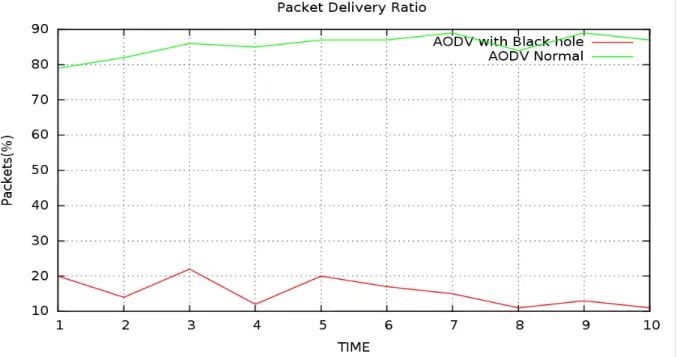
The Packet to Delivery ratio can also be analyzed using the similar method by introducing an attacker to any of the nodes. Here in case of normal transmission of packets in the absence of attacker, the packet to delivery ratio is very high and remains constant throughout the transmission. Such that the ratio of number of packets sent to number of packets received will be very high .All the packets are assumed to be received at the destination. While in the presence of an attacker, we can clearly notice that the packet to delivery ratio has come down to very low values .The attacker captures the sent packets from the source leading to low delivery of packets to the destination. Hence the Packet to Delivery ratio is very low if the attacker is present in the network as depicted in Fig. 2.
Fig. 2 Analysis of PDR under AODV protocol
4.2 Black Hole Attack under OLSR Protocol
To evaluate Throughput we have taken some nodes, it is evaluated by plotting the graphs, and numbers of malicious nodes are taken in the xaxis and throughput in the y-axis. We evaluate the Throughput as, higher the throughput higher the performance.
So when we consider OLSR without attack we can have maximum throughput. After a malicious node is added there will be a decrease in throughput, from the Fig. 3 we can see that we are getting a reliable throughput when there is no malicious node is there in the network.
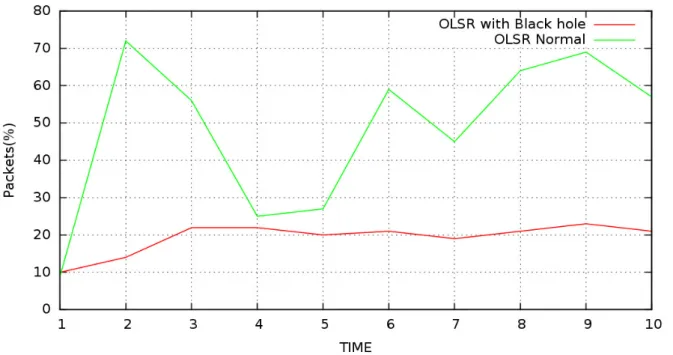
To evaluate the Packet delivery ratio we have taken Number of malicious nodes in the x-axis and PDR in the y -axis
.
Fig. 4 Analysis of PDR under OLSR protocol
Higher the PDR value, the performance is best. In this case PDR performance will be better under the OLSR, we can observe from the Fig. 4 when a malicious node is added to the network we will have decreased performance, this will continue until the attacker node is present and hence affecting the performance
4.3 Comparative analysis of PDR in AODV and OLSR
In AODV protocol, almost all the packets will reach the destination when there is no attack. When we consider the attack it almost none of the packets will reach destination. When a link fails, a routing error is passed back to a transmitting node, and the process repeats. Where as in OLSR protocol, destination path is known by all neighboring nodes before transmitting the data with the help of MPR (Multi Point Relays).We will have better PDR until the no attacker node joins the network, once the malicious nodes joins the network we can have decreasing values of PDR. This will continue until the attacker nodes are present in the network.
4.4 Comparative analysis of Throughput in AODV and OLSR
We consider higher the throughput higher the performance by using AODV protocol it will have better throughput means packets will be sent fast and overhead will be avoided. When we consider attack the average throughput will decrease thus the performance also decreases. The No. of packets travelling from one node to another decreases this will affect the entire performance. When we consider AODV throughput is better than OLSR protocol because all the nodes have to update the destination in the table whenever the path is made. When a attacker node joins the network throughput performance decreases.
5. Conclusion
From the above result analysis we can say that the AODV protocol outperforms when we consider the attack. When we consider without attack again the AODV protocol Performance is better. However, if there is no attack and the number of source nodes are less we prefer OLSR protocol due higher throughput, but for other parameter like PDR we go for AODV. Overall AODV will have a better approach than OLSR protocol for security reasons. In our further research we will consider different parameters and different attacks of application layer to check the performance the AODV and OLSR routing protocols
References
1.Amol A. Bhosle, Tushar P. Thosar and Snehal Mehatre. Black-Hole and Wormhole Attack in Routing Protocol AODV in MANET (IJCSEA) Vol.2, No.1, February 2012
2. Ei Ei Khin1 and Thandar Phyu2 Impact Of Black Hole Attack On Aodv Routing Protocol (IJITMC) Vol. 2, No.2, May 2014
3. P.Jacket , P Muhlethaler, T.Classue,A. Laouiti,A Qayyum,L. Vienment. Optimized Link State Routing Protocol for Mobile Adhoc Network Hipercorn Project, BP 105
4. Deepali Virmani, Ankita Soni, Nikhil Batra, Reliability Analysis to Overcome Black Hole Attack wireless Sensor Network ICCIN-2K14 | January 03-04, 2014
5. Harjeet Kaur , Manju Bala , Varsha Sahni Performance Evoluation of AODV ,OLSR ,ZRP Protocols under Blackhole attack in Manet IJAREEIE,vol 2 , issue 6, july 2013
6. Irshad Ullah and Shahzad Anwar Effects of Black Hole Attack on MANET Using Reactive and Proactive Protocols IJCSI, Vol. 10, Issue 3, No 1, May 2013
7. T.Manikandan, S.Shitharth, C.Senthilkumar, C.Sebastinalbina, N.Kamaraj, Removal of Selective Black Hole Attack in MANET by AODV Protocol IJIRSET Volume 3, Special Issue 3, March 2014
8. Vipan Chand Sharma Atul Gupta Vivek Dimri, Detection of Black Hole Attack in MANET under AODV Routing Protocol IJARCSSE Volume 3,Issue 6, June 2013
9. Ms. Twincle G. Vyas Mr. Dhaval J. Rana, Survey on Black Hole Detection and Prevention in MANET IJARCSSE Volume 4, Issue 9, September 2014
10. Amin Mohebi, Ehsan Kamal, Prof.Dr.Simon.Scott. Simulation and Analysis of AODV and DSR Routing Protocol under Black Hole Attack IJMECS November 2013