Predictive validity of preschool screening tools
for language and behavioural difficulties: A
PRISMA systematic review
Fiona SimID1, Lucy Thompson1, Louise MarryatID2,3*, Nitish Ramparsad4, Philip WilsonID1
1 Centre for Rural Health, Centre for Health Sciences, University of Aberdeen, Inverness, United Kingdom, 2 Farr Institute/Scottish Collaboration for Public Health Research and Policy, University of Edinburgh, Edinburgh, United Kingdom, 3 Salvesen Mindroom Centre Research Centre for Learning Difficulties, University of Edinburgh, Edinburgh, United Kingdom, 4 Robertson Centre for Biostatistics, Institute of Health and Wellbeing, University of Glasgow, Glasgow, United Kingdom
Abstract
Background
Preschool screening for developmental difficulties is increasingly becoming part of routine health service provision and yet the scope and validity of tools used within these screening assessments is variable. The aim of this review is to report on the predictive validity of pre-school screening tools for language and behaviour difficulties used in a community setting.
Methods
Studies reporting the predictive validity of language or behaviour screening tools in the pre-school years were identified through literature searches of Ovid Medline, Embase, EBSCO CINAHL, PsycInfo and ERIC. We selected peer-reviewed journal articles reporting the use of a screening tool for language or behaviour in a population-based sample of children aged 2–6 years of age, including a validated comparison diagnostic assessment and follow-up assessment for calculation of predictive validity.
Results
A total of eleven eligible studies was identified. Six studies reported language screening tools, two reported behaviour screening tools and three reported combined language & behaviour screening tools. The Language Development Survey (LDS) administered at age 2 years achieved the best predictive validity performance of the language screening tools (sens 67%, spec 94%, NPV 88% and PPV 80%). The Strengths and Difficulties Question-naire (SDQ) administered at age 4 years achieved the best predictive validity compared to other behaviour screening tools (Sens 31%, spec 93%, NPV 84% and PPV 52%). The SDQ and Sure Start Language Measure (SSLM) administered at 2.5 years achieved the best pre-dictive validity of the combined language & behaviour assessments (sens 87%, spec 64%, NPV 97% and PPV 31). Predictive validity data and diagnostic odds ratios identified a1111111111 a1111111111 a1111111111 a1111111111 a1111111111 OPEN ACCESS
Citation: Sim F, Thompson L, Marryat L, Ramparsad N, Wilson P (2019) Predictive validity of preschool screening tools for language and behavioural difficulties: A PRISMA systematic review. PLoS ONE 14(2): e0211409.https://doi. org/10.1371/journal.pone.0211409
Editor: Ronald B. Gillam, Utah State University, UNITED STATES
Received: May 8, 2018 Accepted: January 14, 2019 Published: February 4, 2019
Copyright:©2019 Sim et al. This is an open access article distributed under the terms of the Creative Commons Attribution License, which permits unrestricted use, distribution, and reproduction in any medium, provided the original author and source are credited.
Data Availability Statement: All relevant data are within the paper and its Supporting Information files.
Funding: FS received funding to complete this review from a University of Aberdeen PhD stipend. At the time of this work being carried out, LM was supported by the Farr Institute @ Scotland, which is supported by a 10-funder consortium: Arthritis Research UK, the British Heart Foundation, Cancer Research UK, the Economic and Social Research Council, the Engineering and Physical Sciences
language screening tools as more effective and achieving higher sensitivity and positive pre-dictive value than either behaviour or combined screening tools. Screening tools with com-bined behaviour and language assessments were more specific and achieved higher negative predictive value than individual language or behaviour screening tools. Parent-report screening tools for language achieved higher sensitivity, specificity and negative pre-dictive value than direct child assessment.
Conclusions
Universal screening tools for language and behaviour concerns in preschool aged children used in a community setting can demonstrate excellent predictive validity, particularly when they utilise a parent-report assessment. Incorporating these tools into routine child health surveillance could improve the rate of early identification of language and behavioural diffi-culties, enabling more informed referrals to specialist services and facilitating access to early intervention.
Introduction
Developmental screening in the preschool years is increasingly attracting the attention of pol-icy makers and clinicians, yet this remains a contentious area. Proponents cite the importance of moderate delays, which are harder to identify in community or primary care settings and yet carry pervasive effects into later childhood [1,2], while opponents have raised concerns about costs and lack of robust screening instruments [3]. The aim of this comprehensive review is to report on the predictive validity of screening tools for language and behaviour dif-ficulties utilised in a community preschool setting. Language and behaviour difdif-ficulties have been identified as key overlapping neurodevelopmental problems [4] which present in the pre-school years and can predict poor psychiatric, educational and social outcomes into adoles-cence and adulthood [5,6].
Screening for language delay
Delayed language development can have a profound impact on the way in which a child views and interacts with the world. Language concerns identified in the preschool years often persist and can impact upon multiple domains of a child’s life in the early school years [7], into ado-lescence [5] and adulthood[6]. Particular problems associated with early language delay include learning difficulties [8], poorer health and behavioural outcomes [7] and unemploy-ment in adulthood [9].
In the United States, prevalence of language delay, based on children aged 3 to 5 years receiving services for speech and language disabilities, was around 2.6% of the population [10] and data from a universal community surveillance of 2.5 year old children in Scotland esti-mated prevalence of between 3–8% of the population[4]. Depending on the definition and metric employed in quantifying language delay, this figure could be as high as 23% of pre-school children experiencing delayed language development [11].
A Cochrane review conducted by Law and colleagues [12] found that there was insufficient evidence to merit the introduction of universal screening for speech and language delay but stressed that speech and language development remain a focus of routine child surveillance. Since then the Health for all Children Revised Fourth Edition (Hall 4) report, shaped
Research Council, the Medical Research Council, the National Institute of Health Research, the National Institute for Social Care and Health Research (Welsh Assembly Government), the Chief Scientist Office (Scottish Government Health Directorates), (MRC Grant No: MR/K007017/1). At the time, LM sat within SCPHRP, the core grant to SCPHRP was from the MRC, with half that support from the Scottish Chief Scientist Office (MR/ K023209/1). LM currently holds a funded research fellowship from the Slavesen Mindroom Centre Research Centre for Learning Difficulties. Competing interests: The authors have declared that no competing interests exist
government recommendations to incorporate surveillance or screening for speech and lan-guage disorders into routine primary care practice [13,14], but implementation of this remains inconsistent [15,16]. Widely used screening tools for language development include the Ages and Stages Questionnaire [17], the Language Development Survey [18] and the McArthur-Bates Communicative Development Inventory [19] but the majority are poorly validated.
Screening for behaviour difficulties
The distinction between psychopathology and normal maturation is often indistinct in early childhood; behavioural patterns of aggression, non-compliance, hyperactivity and destructive behaviour may all be part of normal development until they are displayed at high levels indi-cating increased risk of continued behaviour problems [20]. This concept of a continuum of mental health has been particularly expressed in research demonstrating the common occur-rence of features of autistic spectrum disorders in non-clinical populations of children [21]. Preschool behaviour problems have been associated with poorer outcomes in language and general development, health, behaviour and school life in the early school years [7] and adverse physical, mental health and forensic outcomes into adulthood [22–24]. Prevalence of preschool behavioural problems have been estimated at 4.8% in a Danish community sample [25], 8.6% in a German sample [25] and 8.8% in a Scottish sample [4].
As with screening for language delay, the implementation of standardized screening for behavioural concerns in the preschool years is variable. In the US, state laws often mandate that children are screened prior to school entry in order to gauge support needs but there is lit-tle consensus in how this is delivered [26]. In Scotland, Denmark, Finland, Norway and Swe-den; child health policy explicitly aims to screen for problems in child development and each country has a focussed programme of child surveillance in place to meet this aim [27].
Issues with preschool screening
Within the field of medicine, screening for preclinical disease is commonplace and highly suc-cessful in areas such as oncology and audiology [28,29]. This success has not translated into the field of paediatric developmental screening, but with 60% of young people with develop-mental or develop-mental health difficulties not being detected prior to school entry [30,31] it is clear that our current detection methods are somewhat lacking. Due to the individual differences in developmental trajectory in the preschool years and the complexity in mental health screening more broadly, the implementation of routine screening is not a straightforward task. Criteria for population screening, outlined by Wilson and Jungner [32] are still pertinent in relation to availability of interventions and evidence of superior efficacy of early intervention [19]. Con-cerns relating to stigma [33]; lack of consensus on age at which to screen for developmental concerns as well as disagreement over diagnostic thresholds eliciting intervention [34]; com-bined with stretched primary care resources [3] have all contributed to a lack of clarity as to the best way to progress with universal screening programmes.
Measuring validity of screening tools
Screening tools are designed to allocate the individuals being screened into one of two groups; those at risk of developing the condition and those who are not. Screening accuracy measures the association between risk group allocation and later diagnostic status (i.e. whether the indi-vidual has developed the condition or not). Statistically this is assessed by calculating the sensi-tivity(the proportion of true positives [TPs]);specificity(the proportion of true negatives [TNs]);positive predictive value(the proportion of those classified as at-risk who did develop
the outcome [PPV]); andnegative predictive value(the proportion classified as not at-risk in whom the outcome is absent [NPV]). For screening measures that are compatible with variable cut-off points, the trade-off between sensitivity and specificity can be analysed using a receiver operating curve (ROC), allowing for the identification of optimal cut-points [35].
Perhaps one of the foremost concerns relating to preschool developmental screening is a lack of well validated screening tools. While there are numerous studies demonstrating the construct and concurrent [36–38] validity of preschool screening tools, there is a dearth of evi-dence relating to the predictive validity of these tools when used within a community setting. Predictive validity is a key criterion in determining the efficacy of a screening tool as it ensures that the tool provides not just a snapshot of how a child is developing at a specific time point but also allows some insight into the progression of their development in subsequent years.
Having ascertained the prevalence and pervasiveness of language and behavioural difficul-ties formed during the preschool years, and outlined the case for (and concerns regarding) universal screening for these difficulties; the screening tools currently utilised in this popula-tion will now be reviewed and compared in terms of their validity in predicting child outcomes.
Objectives
The aims of the current review were to:
• Report on the predictive validity of screening tools for language difficulties utilised in a com-munity preschool setting
• Report on the predictive validity of screening tools for behaviour difficulties utilised in a community preschool setting
Methods
Protocol and registration
The protocol for this systematic review was registered with PROSPERO on the 28thJuly 2017, registration number CRD42017072027.
Eligibility criteria
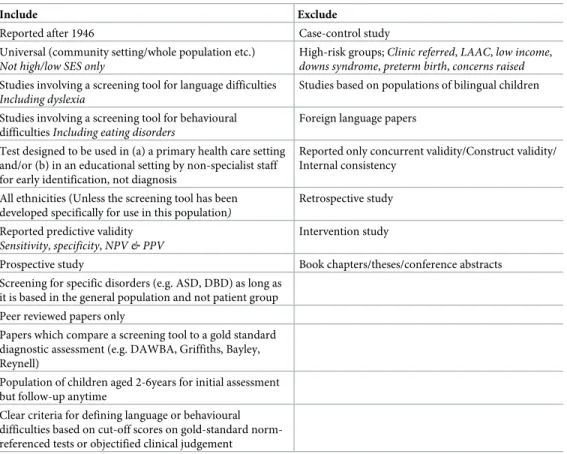
Peer reviewed journal articles reporting the use of a screening tool for language or behaviour difficulties in a population-based sample of children aged 2–6 years of age, including a vali-dated comparison diagnostic assessment and follow-up assessment for calculation of predic-tive validity (of which all data must be reported) were included. Complete inclusion and exclusion criteria are presented inTable 1.
Journal articles published in English before 28thJuly 2017 were eligible for inclusion.
Information sources
We searched Ovid Medline 1946 –March week 2 2017, Embase 1947 –present (updated daily), EBSCO CINAHL 1983–2017, PsycInfo 1914–2017 and ERIC 1959–2017.
Once the final sample of articles had been selected, the first author used the reference list of each of these articles as a secondary data source.
Search
1. child/ or child, preschool/
2. (child�or preschool�or kindergar?en�).tw 3. 1 or 2
4. Psychometrics/
5. (screening tools or assessment�).tw 6. 4 or 5
7. Child Development/
8. Neurodevelopmental disorders/ or developmental disabilities/
9. (language or communicat�or neurodevelopment�or development�).tw 10. 7 or 8 or 9
11. child behavior/ or problem behavior/ 12. exp Social Behavior
13. “Disruptive, Impulse Control, and Conduct Disorders”/ 14. Conduct Disorder/
15. (conduct or behavio?r).tw 16. 11 or 12 or 13 or 14 or 15
Table 1. Complete inclusion and exclusion criteria.
Include Exclude
Reported after 1946 Case-control study
Universal (community setting/whole population etc.) Not high/low SES only
High-risk groups;Clinic referred,LAAC,low income,
downs syndrome,preterm birth,concerns raised
Studies involving a screening tool for language difficulties Including dyslexia
Studies based on populations of bilingual children Studies involving a screening tool for behavioural
difficultiesIncluding eating disorders
Foreign language papers Test designed to be used in (a) a primary health care setting
and/or (b) in an educational setting by non-specialist staff for early identification, not diagnosis
Reported only concurrent validity/Construct validity/ Internal consistency
All ethnicities (Unless the screening tool has been
developed specifically for use in this population)
Retrospective study Reported predictive validity
Sensitivity,specificity,NPV & PPV
Intervention study
Prospective study Book chapters/theses/conference abstracts
Screening for specific disorders (e.g. ASD, DBD) as long as it is based in the general population and not patient group Peer reviewed papers only
Papers which compare a screening tool to a gold standard diagnostic assessment (e.g. DAWBA, Griffiths, Bayley, Reynell)
Population of children aged 2-6years for initial assessment but follow-up anytime
Clear criteria for defining language or behavioural difficulties based on cut-off scores on gold-standard norm-referenced tests or objectified clinical judgement https://doi.org/10.1371/journal.pone.0211409.t001
17. 3 and 6 and 10 and 16
Study selection
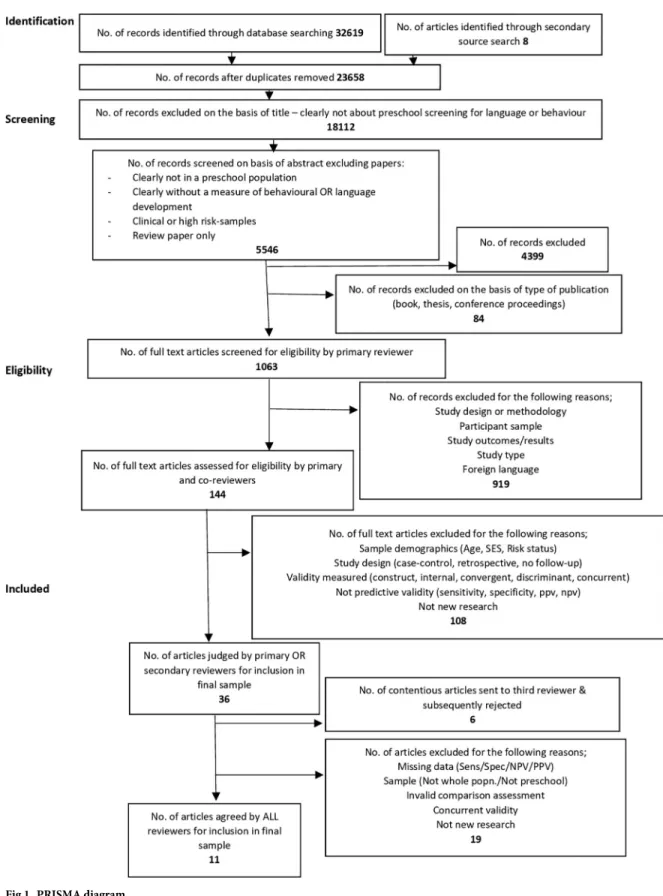
The study selection process is illustrated inFig 1. Screening:
In the first stage, papers were excluded based on their title, if they did not clearly report pre-school screening for language or behaviour difficulties.
In the second stage of screening, papers were excluded on the basis of title and abstract, if they were not clearly:
• Reporting on preschool children aged 2–6 years • Measuring language or behavioural development • Utilising a population based sample
In addition; review papers, book chapters and conference proceedings were also excluded at this stage.
Full-text files were obtained for the remaining records. Papers were rejected at this stage if they:
• Were not available in English • Did not report original data
• Used a clinic referred or high risk sample • Did not report on a distinct preschool population • Did not include a validated assessment for comparison
• Did not include a follow-up assessment for calculation of predictive validity
All final sample papers were assessed by a second reviewer to reduce the risk of inclusion bias. Those papers whose inclusion was disputed by the first and second reviewers, were sent to a third reviewer and subsequently included or rejected.
Data extracted from eligible papers was tabulated and used in the qualitative synthesis.
Data collection process
Data were collected onto a form developed by the first author, based on a form utilised by Law and colleagues in a large systematic review on screening for speech and language delay commissioned by the NHS R&D Health Technology Assessment programme[12]. For each paper, the first author completed the data collection form. As our analysis concerned only pub-lished data, we did not seek to obtain further data from authors.
Data items
The variables extracted from each study are included in Supporting information (S1 Table).
Risk of bias in individual studies
A Critical Appraisal Skills Programme (CASP) Diagnostic Checklist was completed for each study to document risk of bias. These data are reported qualitatively.
Fig 1. PRISMA diagram.
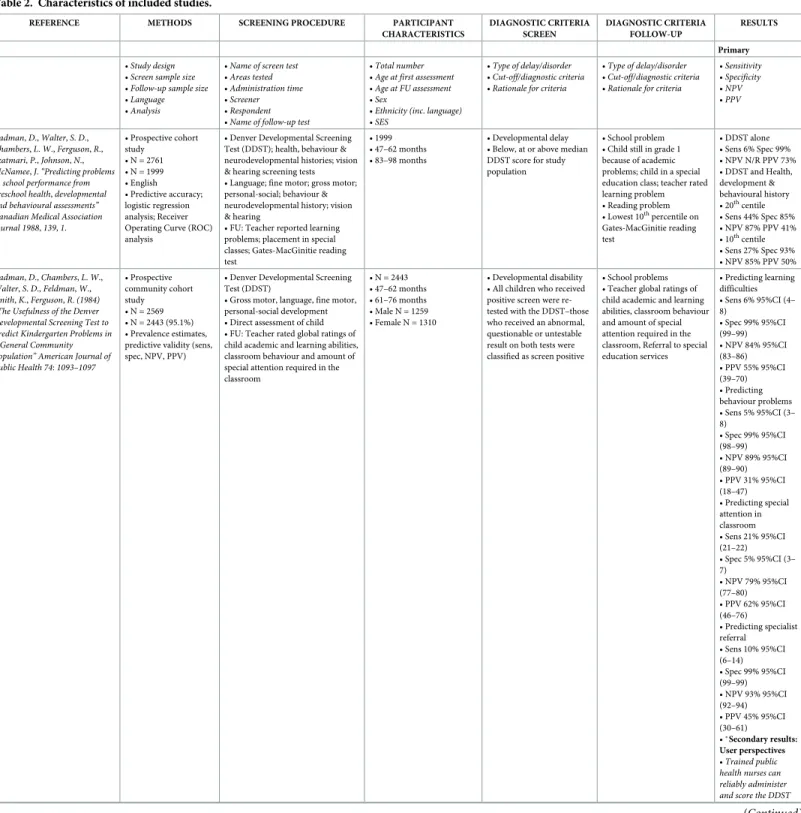
Table 2. Characteristics of included studies.
REFERENCE METHODS SCREENING PROCEDURE PARTICIPANT
CHARACTERISTICS DIAGNOSTIC CRITERIA SCREEN DIAGNOSTIC CRITERIA FOLLOW-UP RESULTS Primary •Study design •Screen sample size •Follow-up sample size •Language •Analysis
•Name of screen test •Areas tested •Administration time •Screener •Respondent •Name of follow-up test
•Total number •Age at first assessment •Age at FU assessment •Sex
•Ethnicity (inc.language) •SES
•Type of delay/disorder •Cut-off/diagnostic criteria •Rationale for criteria
•Type of delay/disorder •Cut-off/diagnostic criteria •Rationale for criteria
•Sensitivity •Specificity •NPV •PPV Cadman,D.,Walter,S.D., Chambers,L.W.,Ferguson,R., Szatmari,P.,Johnson,N., McNamee,J.“Predicting problems in school performance from preschool health,developmental and behavioural assessments” Canadian Medical Association Journal 1988,139,1. • Prospective cohort study • N = 2761 • N = 1999 • English • Predictive accuracy; logistic regression analysis; Receiver Operating Curve (ROC) analysis
• Denver Developmental Screening Test (DDST); health, behaviour & neurodevelopmental histories; vision & hearing screening tests • Language; fine motor; gross motor; personal-social; behaviour & neurodevelopmental history; vision & hearing
• FU: Teacher reported learning problems; placement in special classes; Gates-MacGinitie reading test
• 1999 • 47–62 months • 83–98 months
• Developmental delay • Below, at or above median DDST score for study population
• School problem • Child still in grade 1 because of academic problems; child in a special education class; teacher rated learning problem • Reading problem • Lowest 10th percentile on Gates-MacGinitie reading test • DDST alone • Sens 6% Spec 99% • NPV N/R PPV 73% • DDST and Health, development & behavioural history • 20th centile • Sens 44% Spec 85% • NPV 87% PPV 41% • 10th centile • Sens 27% Spec 93% • NPV 85% PPV 50% Cadman,D.,Chambers,L.W., Walter,S.D.,Feldman,W., Smith,K.,Ferguson,R.(1984) “The Usefulness of the Denver Developmental Screening Test to Predict Kindergarten Problems in a General Community Population” American Journal of Public Health 74:1093–1097 • Prospective community cohort study • N = 2569 • N = 2443 (95.1%) • Prevalence estimates, predictive validity (sens, spec, NPV, PPV)
• Denver Developmental Screening Test (DDST)
• Gross motor, language, fine motor, personal-social development • Direct assessment of child • FU: Teacher rated global ratings of child academic and learning abilities, classroom behaviour and amount of special attention required in the classroom • N = 2443 • 47–62 months • 61–76 months • Male N = 1259 • Female N = 1310 • Developmental disability • All children who received positive screen were re-tested with the DDST–those who received an abnormal, questionable or untestable result on both tests were classified as screen positive
• School problems • Teacher global ratings of child academic and learning abilities, classroom behaviour and amount of special attention required in the classroom, Referral to special education services • Predicting learning difficulties • Sens 6% 95%CI (4– 8) • Spec 99% 95%CI (99–99) • NPV 84% 95%CI (83–86) • PPV 55% 95%CI (39–70) • Predicting behaviour problems • Sens 5% 95%CI (3– 8) • Spec 99% 95%CI (98–99) • NPV 89% 95%CI (89–90) • PPV 31% 95%CI (18–47) • Predicting special attention in classroom • Sens 21% 95%CI (21–22) • Spec 5% 95%CI (3– 7) • NPV 79% 95%CI (77–80) • PPV 62% 95%CI (46–76) • Predicting specialist referral • Sens 10% 95%CI (6–14) • Spec 99% 95%CI (99–99) • NPV 93% 95%CI (92–94) • PPV 45% 95%CI (30–61) •�Secondary results: User perspectives •Trained public health nurses can reliably administer and score the DDST
Table 2. (Continued)
REFERENCE METHODS SCREENING PROCEDURE PARTICIPANT
CHARACTERISTICS DIAGNOSTIC CRITERIA SCREEN DIAGNOSTIC CRITERIA FOLLOW-UP RESULTS Primary
Dale, P.S., Price, T.S., Bishop, DVM & Plomin, R. “Outcomes of early language delay: I. Predicting persistent and transient language difficulties at 3 and 4 years” American Speech-Language-Hearing Association 2003, 46.3 • Longitudinal birth cohort study • N = 8,386 • N at 3yrs = 7,808 (93.1%) • N at 4yrs = 6,660 (79.4%) • English • Relative risk ratios, logistic regression, predictive validity (sens, spec, NPV, PPV)
• MacArthur Communicative Development Inventory: UK Short Form (MCDI:UKSF) • 100 word list, 12 item grammar scale, 5 items from original MCDI combined to give a 10-point “Displaced reference scale” • Parent Report of Children’s Abilities (PARCA)
• Vocabulary, grammar, contextual language, nonverbal ability • Parent report
• 3yr FU: 45 words from MCDI 100 word list & 55 new words; Displaced Reference Scale; Abstract Language Scale; Parental language concerns; Communicative Abnormality Scale • 4yr FU: MCDI inc. 48 new words; Grammar Rating Scale; Abstract Language Scale; Parental language concerns; Communicative Abnormality Scale
• N = 8,386 • 2 years • 3 or 4 years
• Early language delay • Vocabulary score of 15 or less (10th
centile) • To obtain an adequate sample size the authors employed a less stringent cut-off than previous research • Persistent language difficulties • Scores on 2 of 3 language measures at or below 15th centile
• At 3 years: raw scores<33 for vocabulary, 2 for grammar and 5 for abstract language
• At 4 years:<29 for vocabulary, 6 for grammar, 8 for abstract language
• 10th
centile cut-off • Sens: 3yr 38.5% 4yr 44.6%
• Spec: 3yr 76.2% 4yr 80.5% • NPV: 3yr 61.1% 4yr 67.7% • PPV: 3yr 56.1% 4yr 61.4% • 5th centile cut-off • Sens: 3yr 50.0% 4yr 63.9%
• Spec: 3yr 67.3% 4yr 70.0%
• NPV: 3yr 60.5% 4yr 68.3%
• PPV: 3yr 58.1% 4yr 65.6%
Study 1:Girio-Herrera,E., Dvorsky,M.R.,Sarno Owens,J. (2015) “Mental health screening in kindergarten youth:A multistudy examination of the concurrent and diagnostic validity of the impairment rating scale” Psychological Assessment 2015, 27:1. • Multi-study, prospective cohort • N = 568 • N = 568 (100%) • Concurrent and diagnostic validity by examining within- and between-rater bivariate correlations and AUC statistics
• The Impairment Rating Scale (IRS) • BASC-2 parent report • Relations with peers, relations with teachers/parents (respondent dependant), relations with siblings, academic progress, self-esteem, classroom/family functioning (respondent dependant), and overall impairment
•<5mins • Parent & teacher • BASC-2 teacher report
• N = 568 • Mean age 5.48 years • FU 8–12 weeks later • 46.8% male 53.2% female • 95.1% Caucasian (2.8% classified as other and less than 1% as African • American, Hispanic, Asian, and American Indian/ Alaskan Native) • Middle and lower SES
• Risk for social, emotional and behavioural problems • Overall impairment IRS efficiency statistics for scores of 2,3 and 4 were examined • Cut-off of 3 or higher identified in previous research. 2,3 & 4 were examined for efficiency
• BASC-2 BESS teacher report
• T-score of 60 or greater on either the Externalising Problems or Internalising Problems Composites or a T-score of 40 or lower on the Adaptive Skills Composite
• Parent IRS identifying teacher BASC-2 BESS • Sens: • cut-off 2: 15% • cut-off 3: 9% • cut-off 4: 5% • Spec: • cut-off 2: 90% • cut-off 3: 95% • cut-off 4: 98% • NPV: • cut-off 2: 80% • cut-off 3: 80% • cut-off 4: 80% • PPV: • Cut-off 2: 28% • Cut-off 3: 32% • Cut-off 4: 37% • AUC .53, SE .03 • 95%CI (.47-.59)
Study 2:Girio-Herrera,E., Dvorsky,M.R.,Sarno Owens,J. (2015) “Mental health screening in kindergarten youth:A multistudy examination of the concurrent and diagnostic validity of the impairment rating scale” Psychological Assessment 2015, 27:1. • Multi-study, prospective cohort • N = 242 • N = 242 (100%) • Concurrent and diagnostic validity by examining within- and between-rater bivariate correlations and AUC statistics
• The Impairment Rating Scale (IRS) • BASC-2 parent report • Relations with peers, relations with teachers/parents (respondent dependant), relations with siblings, academic progress, self-esteem, classroom/family functioning (respondent dependant), and overall impairment
•<5mins • Parent & teacher • BASC-2 BESS teacher report
• N = 242 • Mean age 5.61years • FU 2-6months later • 50.8% male 49.2% female • 95.5% Caucasian (2.1.% classified as Hispanic; less than 1%
• African American, Asian, and American Indian/ Alaskan Native)
• Risk for social, emotional and behavioural problems • Overall impairment IRS efficiency statistics for scores of 2,3 and 4 were examined • Cut-off of 3 or higher identified in previous research. 2,3 & 4 were examined for efficiency
• BASC-2 BESS behavioural and emotional problems screen • T-score of 61 or greater • Parent IRS identifying teacher BESS • Sens: • Cut-off 2: 29% • Cut-off 3: 17% • Cut-off 4: 8% • Spec: • Cut-off 2: 91% • Cut-off 3: 95% • Cut-off 4: 97% • NPV: • Cut-off 2: 92% • Cut-off 3: 90% • Cut-off 4: 90% • PPV: • Cut-off 2: 29% • Cut-off 3: 28% • Cut-off 4: 22% • AUC .66, SE .07 • 95%CI (.53-.78) Missall,K.,Reschly,A.,Betts,J.,
McConnell,S.,Heistad,D., Pickart,M.,Sheran,C.and Marston,D.(2007) “Examination of the Predictive Validity of Preschool Early Literacy Skills” School Psychology Review; 36; 3.
• Longitudinal cohort study
• N = 110 • FU N = 88 (80%) • General latent variable modelling, multiple regression models, logistic regression model
• Early Literacy Individual Growth and Development Indicators EL-IGDI’s
• Early literacy skills; picture naming, rhyming and alliteration • 10mins • Reading–Curriculum-based measurement (R-CBM) • N = 116 • 4 years • FU 6 years • Females 54.5% Males 45.5% • 40% African American, 34% European American, 10% Asian American, 10% American Indian, and about 6% Hispanic American • 58% of the students were eligible for free or reduced-price lunch
• Early literacy difficulties • Picture naming subscale fail • R-CBM cut-off 60 words per minute • EL-IGDIs predicting R-CBM 60 word cut-off • Sens: 64% • Spec: 81% • NPV: 72% • PPV: 74% (Continued)
Table 2. (Continued)
REFERENCE METHODS SCREENING PROCEDURE PARTICIPANT
CHARACTERISTICS DIAGNOSTIC CRITERIA SCREEN DIAGNOSTIC CRITERIA FOLLOW-UP RESULTS Primary
Owens,J.S.,Storer,J.,Holdaway, A.S.,Serrano,V.J.,Watabe,Y., Himawan,L.K.,Krelko,R.E., Vause,K.J.,Girio-Herrera,E.& Andrews,N.(2015) “Screening for Social,Emotional,and Behavioral Problems at Kindergarten Entry: Utility and Incremental Validity of Parent Report” School Psychology Review 44; 1 • Prospective population cohort • N = 252 • FU N = 252 (100%) • Receiver operating curve (ROC) analysis, predictive validity
• Disruptive Behaviour Disorders (DBD) rating scale
• Strengths and Difficulties Questionnaire (SDQ) • Disruptive behaviour disorders, socio-emotional functioning • Parent
• BASC-2 BESS-Teacher Rating • 252 • 4.87 years • FU 6 months later • 50.4% male 49.6% female • 94.8% white
• Social, emotional and behavioural disorders • DBD rating scale average score�1 denotes at-risk status • SDQ recommended cut scores (www.sdqinfo.org) • BASC-2 BESS-teacher version • Internalizing, externalizing and adaptive behaviour problems
• Cut score for age-basedt score of 61 or higher • SDQ behaviour problems • Sens: • Cut-off 2: 58% • Cut-off 3: 46% • Cut-off 4: 31% • Spec: • Cut-off 2: 68% • Cut-off 3: 83% • Cut-off 4: 93% • NPV: • Cut-off 2: 87% • Cut-off 3: 86% • Cut-off 4: 84% • PPV: • Cut-off 2: 31% • Cut-off 3: 40% • Cut-off 4: 52% • AUC: • .68 95%CI [.55, .80] • SDQ emotional problems • Sens: • Cut-off 1: 58% • Cut-off 2: 35% • Cut-off 3: 23% • Spec: • Cut-off 1: 39% • Cut-off 2: 65% • Cut-off 3: 82% • NPV: • Cut-off 1: 79% • Cut-off 2: 80% • Cut-off 3: 81% • PPV: • Cut-off 1: 19% • Cut-off 2: 20% • Cut-off 3: 25% • AUC: • .50 95%CI [.37, .62] • DBD hyperactivity-impulsivity • Sens: • Cut-off 0.5: 73% • Cut-off 1: 54% • Spec: • Cut-off 0.5: 49% • Cut-off 1: 79% • NPV: • Cut-off 0.5: 88% • Cut-off 1: 87% • PPV: • Cut-off 0.5: 26% • Cut-off 1: 39% • AUC: • .68 95%CI [.55, .80] • DBD oppositional defiant • Sens: • Cut-off 0.5: 50% • Cut-off 1: 31% • Spec: • Cut-off 0.5: 67% • Cut-off 1: 91% • NPV: • Cut-off 0.5: 84% • Cut-off 1: 84% • PPV: • Cut-off 0.5: 27% • Cut-off 1: 47% • AUC: • .63 95%CI [.51, .75] •�Secondary results: user perspectives •Informal interviews with school staff suggest that screening reports were minimally and inconsistently used across teachers
Table 2. (Continued)
REFERENCE METHODS SCREENING PROCEDURE PARTICIPANT
CHARACTERISTICS DIAGNOSTIC CRITERIA SCREEN DIAGNOSTIC CRITERIA FOLLOW-UP RESULTS Primary
Rescorla,L.& Alley,A.(2001) “Validation of the Language Development Survey (LDS):A Parent Report Tool for Identifying Language Delay in Toddlers” Journal of Speech,Language,and Hearing Research.44.2. • Epidemiological, prospective cohort • N = 422 • FU N = 66 (15.6%) • Correlational analysis and odds ratios
• Language Development Survey (LDS)
• 10mins • Parent
• Reynell receptive and expressive language scales
• 422
• Mean 24.7months • FU mean 25.2 months • 50% male and female • Majority white • 81% middle- to upper-middle class (Hollingshead social class I and II)
• Expressive language delay • Delay 1 cutoff:<30 words AND no word combinations • Delay 2 cutoff:<30 words OR no word combinations • Delay 3 cutoff:<50 words OR no word combinations
• Expressive language delay • Reynell Z-score less than or equal to -1.25 (10th percentile) • Sens: • Delay1: 67% 2: 89% 3: 94% • Spec: • Delay 1: 94% 2: 77% 3: 67% • NPV: • Delay 1: 88% 2: 95% 3: 97% • PPV: • Delay 1: 80% 2: 59% 3: 52%
Sachse,S.,Von Suchodoletz,W. 2008 “Early identification of language delay by direct assessment or parent report?” Journal of Developmental Pediatrics 29:34–41. • Prospective cohort study • N = 1056 • FU N = 102 (9.66%) • German • Descriptive statistics, concurrent validity, predictive validity • MacArthur Communicative Development Inventory (MCDI) Toddler form (ELFRA-2) • Sprachentwicklungstest fur zweijahrige kinder (2.0–2.11) SETK-2, noverbal subscale of the Munchener Funktionelle Entwicklungsdiagnostik, hearing screen ECHO-SCREEN Plus-T • Productive vocabulary, syntax and morphology
• Parent report • Sprachentwicklungstest fur zweijahrige kinder 3/5 (SETK-3/5)
• N = 102 • 24 months • FU mean age 37 months • Monolingual german
• Late talking (LT) toddlers • Productive vocabulary<50 words or 50–80 words • Syntax score<7, Morphology score<2 • Followed test instructions
• Language delay • 1SD below the mean on one of three subscales of SETK-3/ 5 • Sens: 61% • Spec: 94% • NPV: 95% • PPV: 56% •�secondary results: user perspectives • Accuracy of parent report dependent on mothers education level: • Vocabulary and word production scores tended to be lower in toddlers with less educated mothers–but differences were not significant Sim,F.,Haig,C.,O’Dowd,J.,
Thompson,L.,Law,J., McConnachie,A.,Gillberg,C., Wilson,P.(2015) “Development of a triage tool for
neurodevelopmental risk in children aged 30 months” Research in Developmental Disabilities 45–46; 69–82. • Prospective cohort study • N = 486 • FU N = 103 (21.19%) • English • Receiver operating curve (ROC) analysis for optimised cut points • Predictive validity • Non parametric bootstrapping to produce confidence intervals
• Sure Start Language Measure (SSLM)
• Strengths and Difficulties Questionnaire (SDQ) • Vocabulary, socio-emotional development
• 15mins • Parent
• Development and Wellbeing Assessment (DAWBA) • Griffiths Mental Development Scale-Extended Revised (GMDS-ER) • New Reynell Developmental Language Scale (NRDLS)
• N = 103 • 30months • FU mean 47.5months • 55% male 45% female • 41% living in most deprived quintile (Scottish Index of Multiple Deprivation)
• Language delay • Socio-emotional difficulties •<32 words on SSLM •>8 Total Difficulties Score SDQ
• ROC curve analysis of optimal screen performance
• ICD-10 Psychiatric diagnosis from DAWBA • Language disorder: Comprehension or production scores 2SD below mean NRDLS
• Global developmental delay: General performance 2SD below mean GMDS • Sens: 87% 95%CI (76–96) • Spec: 64% 95%CI (59–71) • NPV: 97% 95%CI (94–99) • PPV: 31% 95%CI (23–39) • SSLM—NRDLS (AUC .905) SSLM— GMDS (AUC .983) • SDQ–DAWBA (AUC .821) Stott,C.M.,Merricks,M.J., Bolton,P.F.,Goodyer,I.M. (2002) “Screening for speech and language disorders:the reliability, validity and accuracy of the General Language Screen” International Journal of Language & Communication Disorders, 37:2,133–151. • Longitudinal epidemiological study • N = 1936 • FU N = 254 (13.12%) 45mths • FU N = 218 (11.26%) 8yrs • Content validity, criterion validity, construct validity, predictive validity, Receiver Operating Curve (ROC) analysis, factor analysis
• General Language Screen (GLS) • Developmental Profile II (DPII) • Receptive and expressive language • Parent
• 45 months: Edinburgh Articulation Test (EAT), Reynell Developmental Language Scales (RDLS), British Picture Vocabulary Scales (BPVS). • 8 years: Clinical Evaluation of Language Fundamentals–Revised (CELF-R)
• N = 254 at 45 months • N = 218 at 8 years • 36 months
• FU 45 months and 8 years
• Speech/language difficulties
• Parent endorsement of any one of the 11 speech/ language-related GLS items OR any two of the 11 items
• Language function • 2SD below the mean on any one of the Edinburgh Articulation Test (EAT), Reynell Developmental Language Scales (RDLS), British Picture Vocabulary Scales (BPVS), Clinical Evaluation of Language Fundamentals–Revised (CELF-R) • 2/11 GLS items endorsed • Sens: • 45mths:67.4% • 8yrs: 60.0% • Spec: • 45mths: 68.2% • 8yrs: 67.4% • NPV: • 45mths: 90.6% • 8yrs: 91.3% • PPV: • 45mths: 31.5% • 8yrs: 22.8% • AUC • 45mths: .77 • 8yrs: .68 • 1/11 GLS items endorsed • Sens: • 45mths: 97.7% • 8yrs: 90% • Spec: • 45mths: 35.9% • 8yrs: 31% • NPV: • 45mths: 98.6% • 8yrs: 95.1% • PPV: • 45mths: 24.9% • 8yrs: 17.3% (Continued)
Risk of bias across studies
Due to time and financial constraints, translators were not employed to assist in this review process. Papers published in any language other than English were therefore excluded. It is inevitable that this would introduce a degree of bias in the final sample of studies reported here.
Diagnostic accuracy measures
The principal measure of diagnostic accuracy is the predictive validity of the screening tool compared with a validated diagnostic follow-up assessment. Primary outcome data are the sen-sitivity, specificity, negative predictive value (NPV) and positive predictive value (PPV). The Table 2. (Continued)
REFERENCE METHODS SCREENING PROCEDURE PARTICIPANT
CHARACTERISTICS DIAGNOSTIC CRITERIA SCREEN DIAGNOSTIC CRITERIA FOLLOW-UP RESULTS Primary Wilson,B.,Lonigan,C.J.(2010) “Identifying preschool children at risk of later reading difficulties: Evaluation of two emergent literacy screening tools” Journal of Learning Disabilities 43(1) 62–76
• Prospective cohort study
• N = 199 • FU N = 176 (88.44%) • Descriptive statistics & correlations between time 1 & time 2 measures • Receiver Operating Curve (ROC) analysis
• Get Ready to Read! Screening Tool (GRTR)
• Individual Growth and Development Indicators (IGDIs) • GRTR–print knowledge and phonological awareness • IGDIs–expressive communication, adaptive ability, motor control, social ability and cognition
• Direct child assessment • Test of Preschool Early Literacy (TOPEL) • N = 199 • 48.55 months • FU 3 months later • Male 61% Female 39% • 52% African American; 9% other • Reading difficulties • TOPEL standard score cutoff of 90 (26th
percentile) for all three subtests • In choosing the 25th
percentile the goal was to identify a group of children performing at the lower end of the distribution of emergent literacy skills and therefore those who were more likely candidates for additional assessment/ intervention than those scoring in higher percentiles
• TOPEL–print knowledge, definitional vocabulary, phonological awareness • Standard score cutoff of 90 (26th percentile) • GRTR predicting TOPEL ELI • Sens: 90% Spec: 69% • NPV: 38% PPV: 97% • AUC .86 • IGDI’s predicting TOPEL ELI • Sens: 93% Spec: 38% • NPV: 24% PPV: 97% • AUC: .73 • GRTR predicting TOPEL PK • Sens: 92% Spec: 56% • NPV: 35% PPV: 96% • AUC: .84 • IGDI’s predicting TOPEL PK • SENS: 94% Spec: 40% • NPV: 29% PPV: 97% • AUC: .76 • GRTR predicting TOPEL DV • Sens: 95% Spec: 15% • NPV: 13% PPV: 96% • AUC: .75 • IGDI’s predicting TOPEL DV • Sens: 95% Spec: 6% • NPV: 11% PPV: 90% • AUC: .71 • GRTR predicting TOPEL PA • Sens: 93% Spec: 23% • NPV: 36% PPV: 87% • AUC: .68 • IGDI’s predicting TOPEL PA • Sens: 93% Spec: 13% • NPV: 33% PPV: 79% • AUC: .64 https://doi.org/10.1371/journal.pone.0211409.t002
area under the curve (AUC) resulting from receiver operating characteristic (ROC) analysis provides an estimate of the discriminative power of a diagnostic test and is reported if included in the study results.
Quantitative synthesis of results
Based on the observed heterogeneity of results across the final sample of studies; random effects models of sensitivity and specificity data were generated from the best performing screening assessments for each individual study, and grouped based on whether they reported screening tools for language/behaviour/or a combined language and behaviour screening tool. Heterogeneity was assessed with the I-squared statistic (i.e. the percentage of variation across studies that is due to heterogeneity rather than chance). In order to provide an overall measure of the effectiveness of the screening tests, a diagnostic odds ratio was calculated based on the best performing screening test reported in each of the final studies. The diagnostic odds ratio (DOR) is a global measure for diagnostic test accuracy that is independent of prevalence, and represents the ratio of the odds of positivity in subjects with disease relative to the odds in sub-jects without disease [39].
Qualitative synthesis of results
Due to the heterogeneity of the studies, data were synthesized qualitatively by comparing pre-dictive validity statistics across studies and exploring age and respondent effects on prepre-dictive performance. Eligible papers are assigned to one of three categories; studies reporting language screening tools; studies reporting behavioural screening tools; and studies reporting combined language & behavioural screening tools. Within each category, studies are reported in descend-ing order of overall predictive validity performance.
Results
Study selection
The study selection process is illustrated inFig 1. The PRISMA checklist is included in Sup-porting information (S1 Fig).
Each of the articles selected for the final sample was reviewed by two independent reviewers and when those reviewers disagreed, a third independent reviewer was consulted.
Study characteristics
Study characteristics are presented inTable 2.
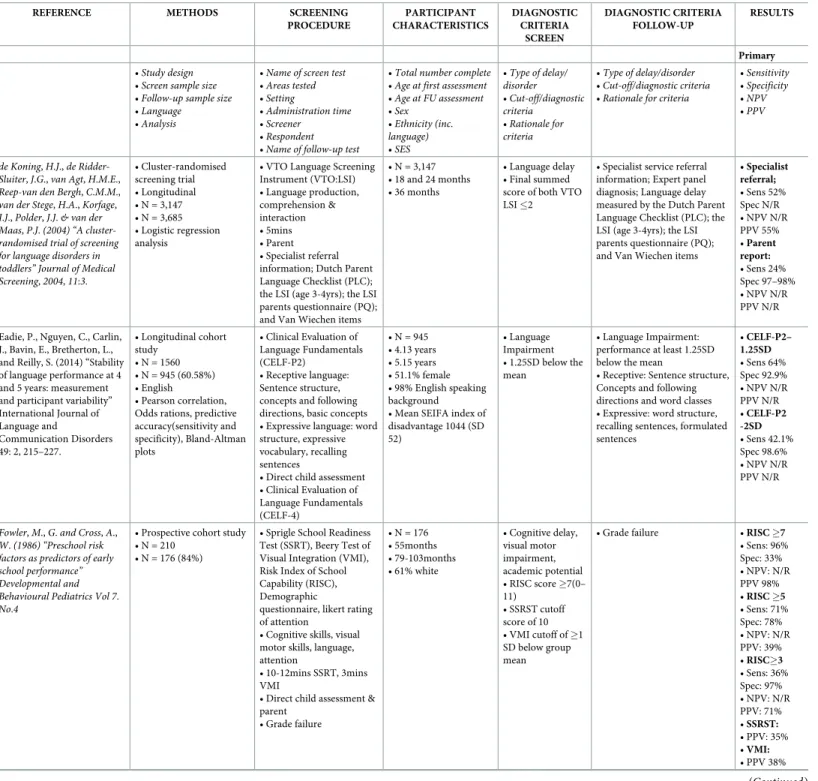
Five studies failed to meet inclusion criteria for the final sample on the basis of missing ele-ments of predictive validity data but did meet all other inclusion criteria. These studies are mentioned in a separate section of the results and study characteristics are presented in
Table 3.
Risk of bias
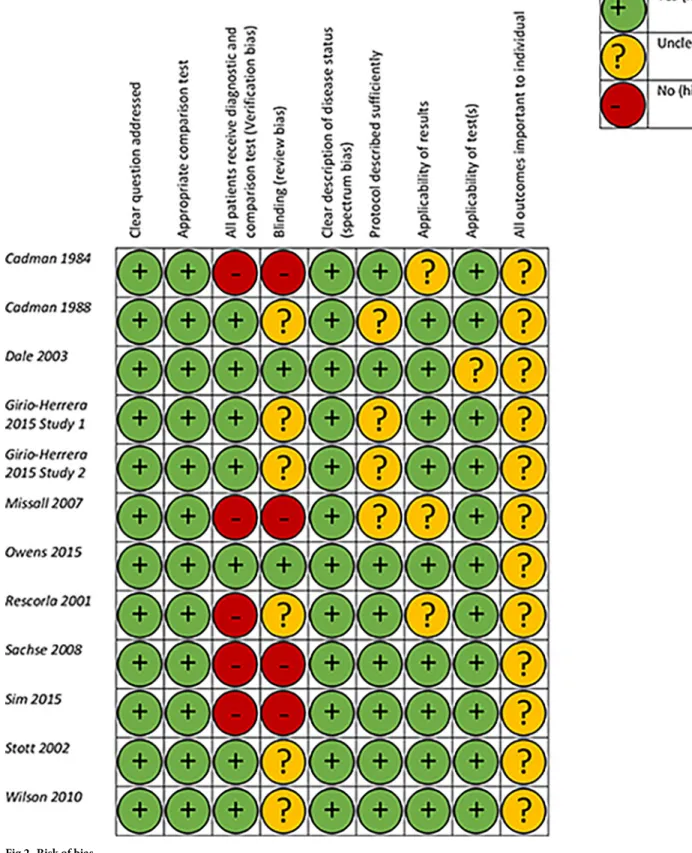
Assessment of bias data extracted using the Critical Appraisal Skills Programme (CASP) Diag-nostic Checklist are presented inFig 2.
The majority of papers had generally low risk of bias as assessed by the CASP checklist. All final papers addressed clear study questions, used appropriate comparison tests, provided clear descriptions of disease status (spectrum bias) and all but one [40] reported tests applica-ble to a general population setting. Risk of bias was high in the areas of verification and review bias; with five [18,41–44] of the eleven papers reporting that all participants did not receive
Table 3. Studies reporting screening tools failing to meet full inclusion criteria.
REFERENCE METHODS SCREENING
PROCEDURE PARTICIPANT CHARACTERISTICS DIAGNOSTIC CRITERIA SCREEN DIAGNOSTIC CRITERIA FOLLOW-UP RESULTS Primary •Study design
•Screen sample size •Follow-up sample size •Language
•Analysis
•Name of screen test •Areas tested •Setting
•Administration time •Screener •Respondent •Name of follow-up test
•Total number complete •Age at first assessment •Age at FU assessment •Sex •Ethnicity (inc. language) •SES •Type of delay/ disorder •Cut-off/diagnostic criteria •Rationale for criteria •Type of delay/disorder •Cut-off/diagnostic criteria •Rationale for criteria
•Sensitivity •Specificity •NPV •PPV
de Koning,H.J.,de Ridder-Sluiter,J.G.,van Agt,H.M.E., Reep-van den Bergh,C.M.M., van der Stege,H.A.,Korfage, I.J.,Polder,J.J.& van der Maas,P.J.(2004) “A cluster-randomised trial of screening for language disorders in toddlers” Journal of Medical Screening,2004,11:3. • Cluster-randomised screening trial • Longitudinal • N = 3,147 • N = 3,685 • Logistic regression analysis
• VTO Language Screening Instrument (VTO:LSI) • Language production, comprehension & interaction • 5mins • Parent • Specialist referral information; Dutch Parent Language Checklist (PLC); the LSI (age 3-4yrs); the LSI parents questionnaire (PQ); and Van Wiechen items
• N = 3,147 • 18 and 24 months • 36 months
• Language delay • Final summed score of both VTO LSI�2
• Specialist service referral information; Expert panel diagnosis; Language delay measured by the Dutch Parent Language Checklist (PLC); the LSI (age 3-4yrs); the LSI parents questionnaire (PQ); and Van Wiechen items
• Specialist referral; • Sens 52% Spec N/R • NPV N/R PPV 55% • Parent report: • Sens 24% Spec 97–98% • NPV N/R PPV N/R Eadie, P., Nguyen, C., Carlin,
J., Bavin, E., Bretherton, L., and Reilly, S. (2014) “Stability of language performance at 4 and 5 years: measurement and participant variability” International Journal of Language and Communication Disorders 49: 2, 215–227. • Longitudinal cohort study • N = 1560 • N = 945 (60.58%) • English • Pearson correlation, Odds rations, predictive accuracy(sensitivity and specificity), Bland-Altman plots • Clinical Evaluation of Language Fundamentals (CELF-P2) • Receptive language: Sentence structure, concepts and following directions, basic concepts • Expressive language: word structure, expressive vocabulary, recalling sentences
• Direct child assessment • Clinical Evaluation of Language Fundamentals (CELF-4) • N = 945 • 4.13 years • 5.15 years • 51.1% female • 98% English speaking background • Mean SEIFA index of disadvantage 1044 (SD 52) • Language Impairment • 1.25SD below the mean • Language Impairment: performance at least 1.25SD below the mean
• Receptive: Sentence structure, Concepts and following directions and word classes • Expressive: word structure, recalling sentences, formulated sentences • CELF-P2– 1.25SD • Sens 64% Spec 92.9% • NPV N/R PPV N/R • CELF-P2 -2SD • Sens 42.1% Spec 98.6% • NPV N/R PPV N/R
Fowler,M.,G.and Cross,A., W.(1986) “Preschool risk factors as predictors of early school performance” Developmental and Behavioural Pediatrics Vol 7. No.4
• Prospective cohort study • N = 210
• N = 176 (84%)
• Sprigle School Readiness Test (SSRT), Beery Test of Visual Integration (VMI), Risk Index of School Capability (RISC), Demographic
questionnaire, likert rating of attention
• Cognitive skills, visual motor skills, language, attention
• 10-12mins SSRT, 3mins VMI
• Direct child assessment & parent • Grade failure • N = 176 • 55months • 79-103months • 61% white • Cognitive delay, visual motor impairment, academic potential • RISC score�7(0– 11) • SSRST cutoff score of 10 • VMI cutoff of�1 SD below group mean
• Grade failure • RISC�7
• Sens: 96% Spec: 33% • NPV: N/R PPV 98% • RISC�5 • Sens: 71% Spec: 78% • NPV: N/R PPV: 39% • RISC�3 • Sens: 36% Spec: 97% • NPV: N/R PPV: 71% • SSRST: • PPV: 35% • VMI: • PPV 38% (Continued)
Table 3. (Continued)
REFERENCE METHODS SCREENING
PROCEDURE PARTICIPANT CHARACTERISTICS DIAGNOSTIC CRITERIA SCREEN DIAGNOSTIC CRITERIA FOLLOW-UP RESULTS Primary Westerlund,M.1995 “Predictive power of a phonological screening test at four years of age in relation to later linguistic ability” Scandinavian Journal of Logopedics and Phoniatrics, 20:60–76
• Prospective cohort study • N = 1658
• N = 1451 (87.5%) school start
• N = 1328 (80.1%) grade 3 • Prevalence analysis, predictive validity; sens; spec; NPV; PPV
• Uppsala screening test inc. parent report language questionnaire
• Receptive and expressive language
• Direct child assessment and parent report • Phonological assessment by speech therapist • Reading comprehension test • N = 1328 at grade 3 • 4 years • School start • Age 4: 869 boys 776 girls
• Social class 1(high): 428 Social class 2: 643 • Social class 3(low): 353
• Language impairment • No impairment; Slight; Moderate; Severe -Phonological assessment by speech therapist at school start •No impairment (including lisping),slight(/s/and/or /r/ mistakes),moderate (other phonological problems hardly influencing understandability) and severe impairment (significant problems considerably influencing •understandability). - Reading comprehension test in grade 3
•Pupils with scores 1–4 are defined as poor performers and those with scores8and9as good performers.
• -School placement and grade in school the year after the children had reached the age of compulsory school start
• 4yr screen & speech therapist assessment at school start • Severe • Sens 12% Spec 99% • NPV N/R PPV 43% • Moderate to severe • Sens 48% Spec 88% • NPV N/R PPV 19% • Slight to severe • Sens 71% Spec 69% • NPV N/R PPV 12% • 4yr screen & grade 3 assessment • Moderate to severe • Sens 21% Spec 88% • NPV N/R PPV 29% Westerlund, M. and Sundelin,
C. (2000) “Can severe language disability be identified in three-year-olds? Evaluation of a routine screening procedure” Acta Paediatrica 89: 94–100
• Prospective cohort study • N = 2359
• N = 2237 (94.83%) • Swedish
• Significance tests were performed using the chi-squared statistic and Fisher’s exact test, when expected counts were less than 5. The predictability of the 3-y screening was expressed in terms of sensitivity, specificity, positive predictive value and risk ratio.
• Uppsala CHC nurse 3yr screen
• Parent language questionnaire
• Language comprehension & production, observation of child’s level of cooperation
• Direct child assessment & parent report • Uppsala screening • Clinical examination • N = 2237 • 3 years • 4 years • 95% Swedish speakers • 5% Swedish language learners • Severe developmental language disability • Child understands<3 of 5 questions • Child doesn’t utter 3 word sentences • Nurse assessment of phonology and parent language questionnaire (intelligibility, grammar and non-fluency) •Minor disability: Phonological problems (Ph.pr.) scarcely influencing intelligibility. • (2)Moderate disability: Ph.pr. influencing intelligibility, Ph. pr. influencing intelligibility and grammatical problems, Ph. pr. influencing intelligibility and stuttering, grammatical problems with or without stuttering (priority was given to grammar).
• (3)Severe disability: Ph.pr. heavily influencing intelligibility, Ph.pr. heavily influencing intelligibility and grammatical problems, Ph.pr. heavily influencing intelligibility and stuttering. Judgements of intelligibility were based on professional knowledge and consensus among the SLTs about the • specific effect of phonological deviations in the listener’s understanding. The extent of this influence varies as a function of the amount of deviation, kind of phonological substitute and the frequency of the phoneme in the language.
• Referred • Sens 86.4% Spec 98.2% • NPV N/R PPV 31.7% • Diagnosed as disabled • Sens 77.3% Spec 99.0% • NPV N/R PPV 42.5% https://doi.org/10.1371/journal.pone.0211409.t003
Fig 2. Risk of bias.
both the screen and diagnostic follow-up assessment and nine papers [18,37,41–47] reporting no or ambiguous assessor blinding to screen results.
Risk of bias across studies
The exclusion of studies not reported in English will have introduced a degree of bias to the review as a whole, but this was judged an acceptable risk by the authors.
Quantitative synthesis of results
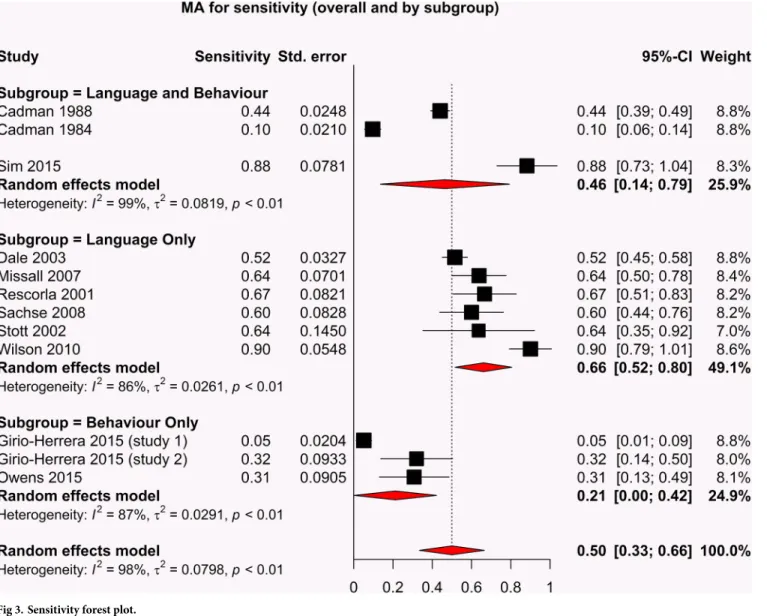
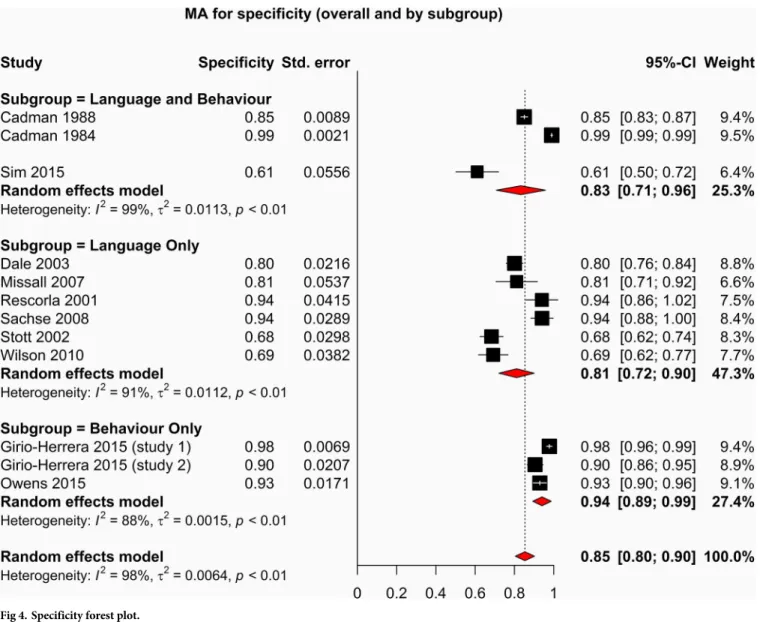
The forest plots depicting the sensitivity and specificity of included studies are shown in Figs3
and4.
Due to the variability of the outcome measure and the various tools used to assess language only, behaviour only and language and behaviour performances, we expected a high level of heterogeneity across all studies. In response to the assumption of heterogeneity, a random effects model was used to perform the meta-analysis of sensitivity, specificity and diagnostic odds ratio. The forest plots for both sensitivity and specificity indicate an overall heterogeneity Fig 3. Sensitivity forest plot.
(I2) of 98%, indicating that there are significant differences between the studies that cannot be explained by random variation.
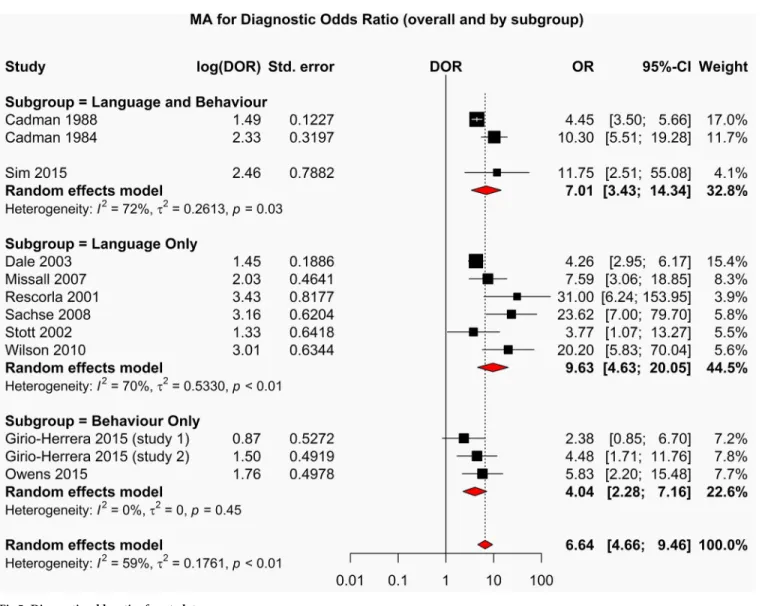
The forest plot depicting the diagnostic odds ratios for all studies is shown inFig 5. The studies reporting screening tests with the highest diagnostic odds ratios are those which measure language; Rescorla et al 2001(OR: 31.00[95%CI: 6.24–153.95]); Sachse et al 2008(OR 23.62 [95%CI: 7.00 79.70]); Wilson et al 2010(OR 20.20 [95%CI: 5.83–70.04]). Stud-ies reporting combined language and behaviour screening tools demonstrated poorer perfor-mance than language only studies but better overall perforperfor-mance than studies reporting behaviour only screening tools.
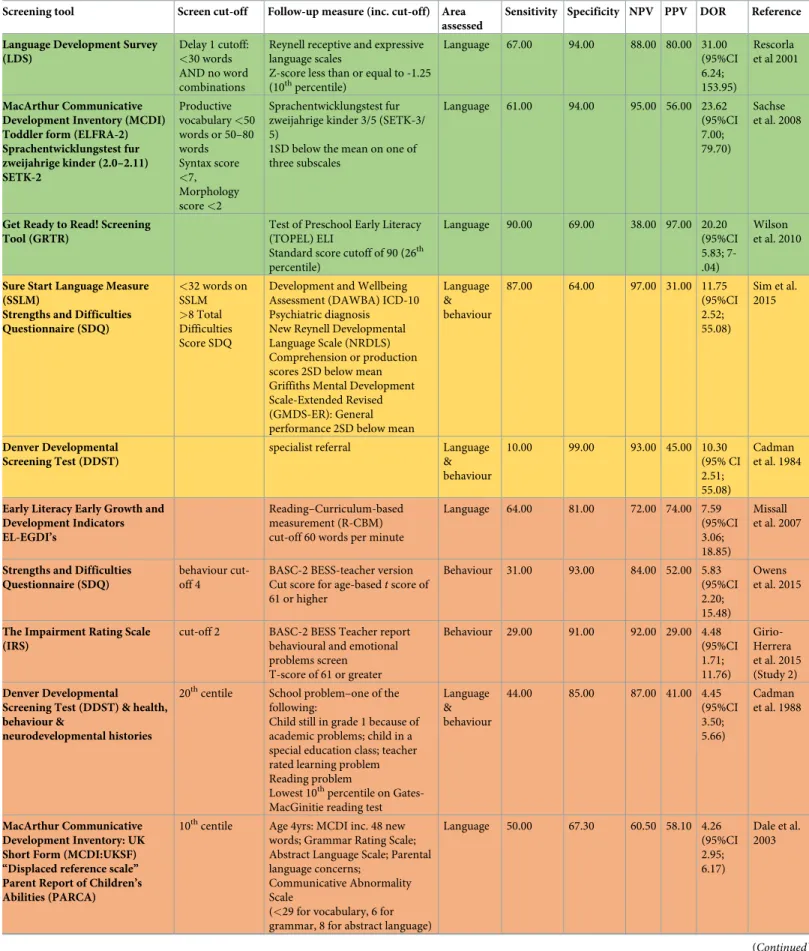
The performance of screening tools in descending order of diagnostic odds ratios are pre-sented inTable 4.
Qualitative synthesis of results
Predictive validity of preschool language screening tools. Six of the final eleven papers reported language-only screening tools [18,40,42,43,46,47]. The majority (N = 4) employed Fig 4. Specificity forest plot.
a screening battery composed of multiple tools, with two of the six reporting on the use of one screening tool. The average reported administration time for these assessments was 12 min-utes. The mean age of the child at initial screening assessment was 36.9 months (SD 11.2) and 43.9 months at follow-up (SD 11.4).
While most of the studies utilised the screening tool as a stand-alone measure, three studies recommended the screens would be most suited as a first step in a two-step screening process [40,46,47]. Four of the six final studies used parent-report measures [18,40,43,46] and two used direct child-assessment [42,47]; respondent effects on predictive validity will be dis-cussed subsequently.
The study reporting the strongest overall predictive validity and diagnostic odds ratio was presented by Rescorla et al. 2001 [18] using the Language Development Survey (LDS) at mean age 24.7 months and the Reynell Receptive and Expressive Language Scales at mean age 25.2 months. The Language Development Study is a parent report of vocabulary and word combi-nations, specifically designed as a screening tool for identifying toddlers with early language delay. The authors conducted validity analyses using three different delay criteria; Delay 1<30 Fig 5. Diagnostic odds ratios forest plot.
Table 4. Performance of screening tools by Diagnostic Odds Ratio (DOR)1.
Screening tool Screen cut-off Follow-up measure (inc. cut-off) Area assessed
Sensitivity Specificity NPV PPV DOR Reference Language Development Survey
(LDS)
Delay 1 cutoff:
<30 words
AND no word combinations
Reynell receptive and expressive language scales
Z-score less than or equal to -1.25
(10thpercentile) Language 67.00 94.00 88.00 80.00 31.00 (95%CI 6.24; 153.95) Rescorla et al 2001 MacArthur Communicative Development Inventory (MCDI) Toddler form (ELFRA-2) Sprachentwicklungstest fur zweijahrige kinder (2.0–2.11) SETK-2 Productive vocabulary<50 words or 50–80 words Syntax score <7, Morphology score<2 Sprachentwicklungstest fur zweijahrige kinder 3/5 (SETK-3/ 5)
1SD below the mean on one of three subscales Language 61.00 94.00 95.00 56.00 23.62 (95%CI 7.00; 79.70) Sachse et al. 2008
Get Ready to Read! Screening Tool (GRTR)
Test of Preschool Early Literacy (TOPEL) ELI
Standard score cutoff of 90 (26th
percentile) Language 90.00 69.00 38.00 97.00 20.20 (95%CI 5.83; 7-.04) Wilson et al. 2010
Sure Start Language Measure (SSLM)
Strengths and Difficulties Questionnaire (SDQ) <32 words on SSLM >8 Total Difficulties Score SDQ
Development and Wellbeing Assessment (DAWBA) ICD-10 Psychiatric diagnosis New Reynell Developmental Language Scale (NRDLS) Comprehension or production scores 2SD below mean Griffiths Mental Development Scale-Extended Revised (GMDS-ER): General performance 2SD below mean
Language & behaviour 87.00 64.00 97.00 31.00 11.75 (95%CI 2.52; 55.08) Sim et al. 2015 Denver Developmental Screening Test (DDST)
specialist referral Language
& behaviour 10.00 99.00 93.00 45.00 10.30 (95% CI 2.51; 55.08) Cadman et al. 1984
Early Literacy Early Growth and Development Indicators EL-EGDI’s
Reading–Curriculum-based measurement (R-CBM) cut-off 60 words per minute
Language 64.00 81.00 72.00 74.00 7.59 (95%CI 3.06; 18.85) Missall et al. 2007
Strengths and Difficulties Questionnaire (SDQ)
behaviour cut-off 4
BASC-2 BESS-teacher version
Cut score for age-basedtscore of
61 or higher Behaviour 31.00 93.00 84.00 52.00 5.83 (95%CI 2.20; 15.48) Owens et al. 2015
The Impairment Rating Scale (IRS)
cut-off 2 BASC-2 BESS Teacher report
behavioural and emotional problems screen T-score of 61 or greater Behaviour 29.00 91.00 92.00 29.00 4.48 (95%CI 1.71; 11.76) Girio-Herrera et al. 2015 (Study 2) Denver Developmental Screening Test (DDST) & health, behaviour &
neurodevelopmental histories
20thcentile School problem–one of the
following:
Child still in grade 1 because of academic problems; child in a special education class; teacher rated learning problem Reading problem
Lowest 10thpercentile on
Gates-MacGinitie reading test
Language & behaviour 44.00 85.00 87.00 41.00 4.45 (95%CI 3.50; 5.66) Cadman et al. 1988 MacArthur Communicative Development Inventory: UK Short Form (MCDI:UKSF) “Displaced reference scale” Parent Report of Children’s Abilities (PARCA)
10thcentile Age 4yrs: MCDI inc. 48 new
words; Grammar Rating Scale; Abstract Language Scale; Parental language concerns;
Communicative Abnormality Scale
(<29 for vocabulary, 6 for
grammar, 8 for abstract language)
Language 50.00 67.30 60.50 58.10 4.26 (95%CI 2.95; 6.17) Dale et al. 2003 (Continued)
words AND no word combinations; Delay 2<30 words OR no word combinations; Delay 3
<50 words OR no word combinations. Criteria for diagnosis of expressive language delay at follow-up was a Z-score less than or equal to -1.25 on the Reynell assessment, equivalent to the lowest decile. Use of the most stringent criteria (Delay 1<30 words AND no word combina-tions) provided the strongest predictive validity data; sensitivity 67%, specificity 94%, NPV 88% and PPV 80%. Overall predictive validity decreased as cut-off criteria became more inclu-sive (though predictably, sensitivity and NPV increased).
The second strongest overall predictive validity data was achieved by Sachse and colleagues 2008 (43) using the MacArthur Communicative Development Inventory (MCDI) Toddler form (ELFRA-2) administered at age 24 months and followed-up with the Sprachentwick-lungstest fu¨r zweija¨hrige Kinder (SETK-3/5) administered at age 37 months. The MCDI ELFRA-2 measures productive vocabulary, syntax and morphology. The ELFRA-2 parent-report predicted language delay defined by 1SD below the mean on the SETK-3/5 with 61% sensitivity, 94% specificity 95%, NPV and 56% PPV.
Missall et al. 2007 [42] reported the performance of the Early Literacy Individual Growth and Development Indicators (EL-IGDIs) which assess children’s early literacy skills, picture naming, rhyming and alliteration. The EL-IGDIs at age four years predicted reading fluency measured by a Reading-Curriculum-based measurement (R-CBM) at age six years with 64% sensitivity, 81% specificity, 72% NPV and 74% PPV.
Another study added a variant of the MacArthur Communicative Development Inventory, the UK Short Form (MCDI:UKSF) to a battery of screening tools including a 10-item Dis-placed Reference scale and a Parent Report of Children’s Abilities (PARCA). Administered at age two years, this screening battery predicted persistent language difficulties at age four years with 63.9% sensitivity, 70% specificity, 68.3% NPV and 65.6% PPV. Persistent language diffi-culties at age four was defined by a 5thcentile cut-off on the MCDI, grammar rating scale and abstract language rating scale.
Another screening battery approach presented by Stott and colleagues 2002 [46] used the General Language Screen (GLS) and the Developmental Profile II (DPII) administered at 36 months to predict speech and language disorders at 45 months with 67.4% sensitivity, 68.2% specificity, 90.6% NPV and 31.5% PPV. Speech and language disorders were characterised by performance 2SD below the mean on any one of the Edinburgh Articulation Test (EAT) Table 4. (Continued)
Screening tool Screen cut-off Follow-up measure (inc. cut-off) Area assessed
Sensitivity Specificity NPV PPV DOR Reference General Language Screen (GLS) 2/11 GLS 45mths: Language function
2SD below the mean on any one of the Edinburgh Articulation Test (EAT), Reynell
Developmental Language Scales (RDLS), British Picture Vocabulary Scales (BPVS). Language 67.40 68.20 90.60 31.50 3.77 (95%CI 1.07; 13.27) Stott et al. 2002
The Impairment Rating Scale (IRS)
cut-off 4 BASC-2 BESS teacher report
T-score of 60 or greater on either the Externalising Problems or Internalising Problems Composites or a T-score of 40 or lower on the Adaptive Skills Composite Behaviour 5.00 98.00 80.00 37.00 2.38 (95%CI 0.85; 6.70) Girio-Herrera et al. 2015 (Study 1)
1 Diagnostic Odds Ratio’s (DOR) colour guide: Red = 0–9; Yellow = 10–19; Green = 20–31 https://doi.org/10.1371/journal.pone.0211409.t004
Reynell Developmental Language Scale (RDLS), British Picture Vocabulary Scales (BPVS) and Clinical Evaluation of Language Fundamentals–Revised (CELF-R).
The study reporting the poorest predictive performance of a screening tool utilised the Indi-vidual Growth and Development Indicators (IGDIs) at initial assessment and the Test of Pre-school Early Literacy (TOPEL) at follow up [47]. The IGDIs assess expressive communication, adaptive ability, motor control, social ability and cognition. Children were screened at a mean age 48.55 months and received the comparison assessment 3 months later. Predictive validity of IGDIs total score and TOPEL Definitional Vocabulary was 95% sensitivity, 6% specificity, 11% NPV, 90% PPV, AUC .71. This study reported predictive values of eight different variants of screening and follow-up assessments using both the IGDIs and the Get Ready to Read (GRTR) screen and four subscales of the TOPEL at follow-up, the most predictive combina-tion was the GRTR and TOPEL ELI at follow up (sens 90%, spec 69%, npv 38%, ppv 97%).
The overall predictive performance of screening tools for language difficulties in pre-schoolers reported in this sample of studies is poor, with just one [18] of the six meeting the benchmark 70% sensitivity & specificity and 50% PPV recommended for developmental screening tools [48].
Age effects on language screening performance. Age at which children were first assessed does not appear to have a significant effect on the overall predictive performance of the language screening tools used, however the time lapse between first assessment and follow up does appear to impact on the predictive outcome.
Crosstabulation with chi-squared analysis demonstrated a significant relationship with the time interval between screen and follow up assessment and the sensitivity of the screening tools (x2(df) = 75; p = .05). Studies reporting a time lapse of 9 months or less [40,42,46,47] between screen and follow-up broadly reported higher sensitivity data (Mean 87.34% SD 11.97) than those reporting a time lapse of 12 months or more (Mean 53.67% SD 10.87). There was no significant relationship between time interval and specificity (p = .60), PPV (.07), or NPV (p = .60). Only two of the six studies reported using receiver operating curve analysis to optimise screen performance.
Respondent effects on language screening performance. The final sample of studies reported here utilised either direct child assessment or parent report screening tools for lan-guage. While there is no statistically significant effect of respondent on predictive validity, it is worth noting that in all predictive outcome areas but positive predictive value, parent-report screening tools achieve higher predictive validity scores than direct child assessment.
Studies reporting predictive validity of language screening tools failing to meet full inclusion criteria. Four studies reporting predictive validity of preschool language screening tools but not meeting full inclusion criteria for the final sample (Table 3) are reported here in order of strength of predictive validity (those reporting strongest validity data are discussed first).
Westerlund & Sundelin [49] reported the validity of the Uppsala CHC nurse screen admin-istered at age three years predicting severe developmental language disability diagnosed by clinical nurse examination at age four years with 77.3% sensitivity, 99% specificity and 42.5% PPV. They also reported screening validity in predicting children who would be referred for clinical examination at 86.4% sensitivity, 98.2% specificity and 31.7% PPV. This screening tool comprised direct child assessment and parent-report of language comprehension, production and observation of child’s level of cooperation. This study was rejected from the final sample as it does not report the NPV of the screening tool.
Eadie et al. [50] reported the performance of the Clinical Evaluation of Language Funda-mentals (CELF-P2) administered at 4.13 years predicting language impairment 1.25SD below the mean on the CELF-4 with 64% sensitivity and 92.9% specificity. Using a more stringent
cut-off of 2SD below the mean reduced sensitivity to 42.1% but improved specificity to 98.6%. This screening tool is a direct child assessment of both receptive and expressive language development. This study was rejected from the final sample as it does not report NPV or PPV and the authors had concerns over the comparative value of using two editions of the same assessment as screening and follow-up assessments.
Westerlund [51] reported further data utilising the Uppsala screening test and a parent report language questionnaire administered age four years in predicting language
impairment diagnosed by a speech therapist at school start (c. age 7 years). The screen pre-dicted severe language impairment with 12% sensitivity, 99% specificity and 43% PPV; moderate to severe impairment with 48% sensitivity, 88% specificity and 19% PPV; slight to severe impairment with 71% sensitivity, 69% specificity and 12% PPV. This study was rejected from the final sample as it does not report the negative predictive value of the screening tool.
De Koning et al [52] reported screening performance of the VTO Language Screening Instrument (VTO:LSI) administered at ages 18 and 24 months in predicting specialist service referral and language delay measured by the Dutch Parent Language Checklist (PLC); the LSI (age 3-4yrs); the LSI parents questionnaire (PQ); and Van Wiechen items at age 36 months. The VTO:LSI predicted specialist service referral with 52% sensitivity and 55% PPV; and par-ent-reported language delay with 24% sensitivity and 97–98% specificity. The VTO:LSI is a parent-report measure of language production, comprehension and interaction. This study was rejected from the final sample as it did not present complete predictive validity data (sensi-tivity, specificity, NPV & PPV) for either outcome.
The study reported by Sim et al [44] met criteria for inclusion in the final sample based on data obtained from their combined language and behavioural screening tool, but this study also reported sensitivity and specificity data for the individual language and behavioural tools utilised in the screening assessment. Using a cut-off of 31.5 out of 50 words on the Sure Start Language Measure (SSLM), screening at 30 months predicted comprehension or production difficulties identified by the New Reynell Developmental Language Scale (NRDLS) 1–2 years later with 87% sensitivity and 83% specificity.
Predictive validity of preschool behavioural screening tools
Two of the final eleven papers reported behaviour-only screening tools [37,53]. Both of these studies employed two concurrent screening tools and compared with a diagnostic assessment at follow-up. Both employ the Behavior Assessment System for Children–Second Edition as the gold standard comparison assessment. Results from the publication by Girio-Herrera et al. 2015 [37] are presented as two distinct studies and so for ease of understanding, results are reported separately here.
The highest combined predictive validity and diagnostic odds ratio for a behavioural screening tool comes from the Strengths and Difficulties Questionnaire (SDQ) parent-report behavioural difficulties subscale using a cut-off of 4 in predicting results from the BASC-BESS teacher report at follow-up [53].The mean age of the child at screening was 4.87 years and fol-low-up assessment was six months later. Results were sensitivity 31%, specificity 93%, NPV 84% and PPV 52%. The authors of this study reported validity data using both the SDQ and the Disruptive Behaviour Disorders (DBD) rating scale across a range of subscales and cut-offs.
The poorest predictive outcome from studies reporting behavioural screening tools was achieved by the SDQ parent-report emotional problems (cut-off 1) predicting the BASC-BESS teacher report six months later (sensitivity 58%, specificity 39%, NPV 79%, PPV 19%, AUC .50