DigitalCommons@University of Nebraska - Lincoln
DigitalCommons@University of Nebraska - Lincoln
Theses, Dissertations, and Student Researchfrom Electrical & Computer Engineering Electrical & Computer Engineering, Department of
12-2019
Pixel-Level Deep Multi-Dimensional Embeddings for
Pixel-Level Deep Multi-Dimensional Embeddings for
Homogeneous Multiple Object Tracking
Homogeneous Multiple Object Tracking
Mateusz MittekUniversity of Nebraska-Lincoln, [email protected]
Follow this and additional works at: https://digitalcommons.unl.edu/elecengtheses
Part of the Computer Engineering Commons, and the Other Electrical and Computer Engineering Commons
Mittek, Mateusz, "Pixel-Level Deep Multi-Dimensional Embeddings for Homogeneous Multiple Object Tracking" (2019). Theses, Dissertations, and Student Research from Electrical & Computer Engineering. 113.
https://digitalcommons.unl.edu/elecengtheses/113
This Article is brought to you for free and open access by the Electrical & Computer Engineering, Department of at DigitalCommons@University of Nebraska - Lincoln. It has been accepted for inclusion in Theses, Dissertations, and Student Research from Electrical & Computer Engineering by an authorized administrator of
HOMOGENEOUS MULTIPLE OBJECT TRACKING
by
Mateusz M. Mittek
A DISSERTATION
Presented to the Faculty of
The Graduate College at the University of Nebraska
In Partial Fulfilment of Requirements
For the Degree of Doctor of Philosophy
Major: Electrical and Computer Engineering
Under the Supervision of Professor Lance C. Pérez
Lincoln, Nebraska
HOMOGENEOUS MULTIPLE OBJECT TRACKING
Mateusz M. Mittek, Ph.D.
University of Nebraska, 2019
Adviser: Lance C. Pérez
The goal of Multiple Object Tracking (MOT) is to locate multiple objects and keep
track of their individual identities and trajectories given a sequence of (video) frames. A
popular approach to MOT is tracking by detection consisting of two processing
components: detection (identification of objects of interest in individual frames) and
data association (connecting data from multiple frames). This work addresses the
detection component by introducing a method based on semantic instance
segmentation, i.e., assigning labels to all visible pixels such that they are unique among
different instances. Modern tracking methods often built around Convolutional Neural
Networks (CNNs) and additional, explicitly-defined post-processing steps.
This work introduces two detection methods that incorporate multi-dimensional
embeddings. We train deep CNNs to produce easily-clusterable embeddings for semantic
instance segmentation and to enable object detection through pose estimation. The use of
embeddings allows the method to identify per-pixel instance membership for both tasks.
Our method specifically targets applications that require long-term tracking of
homogeneous targets using a stationary camera. Furthermore, this method was
developed and evaluated on a livestock tracking application which presents exceptional
challenges that generalized tracking methods are not equipped to solve. This is largely
because contemporary datasets for multiple object tracking lack properties that are
specific to livestock environments. These include a high degree of visual similarity
between targets, complex physical interactions, long-term inter-object occlusions, and a
application in mind and, specifically, group-housed pigs are evaluated in this work. Our
method reliably detects pigs in a group housed environment based on the publicly
available dataset with99%precision and95%using pose estimation and achieves80% accuracy when using semantic instance segmentation at50%IoU threshold.
Results demonstrate our method’s ability to achieve consistent identification and
tracking of group-housed livestock, even in cases where the targets are occluded and
despite the fact that they lack uniquely identifying features. The pixel-level embeddings
used by the proposed method are thoroughly evaluated in order to demonstrate their
DEDICATION
I dedicate this work to my mother who due to the political and economical scenery of
Poland in the early 1980s could not pursue her own doctoral degree in animal husbandry
ACKNOWLEDGMENTS
First and foremost, I would like to sincerely thank my adviser Lance C. Pérez for his
support during my doctoral program. Lance, without you consistently motivating me
this would would never come to completion. You gave me the biggest opportunity of my
life and for that I would like to thank you with all my heart.
It was a great honor to become a member of the Perceptual Systems Research Group
and work alongside such individuals like Jędrzej Kowalczuk, who became one of my
dearest fiends and an older-brother-like figure. Thank you for all the support and belief
you gave me.
This work could not be completed without the advisory role of Eric T. Psota who I
would like to thank for the tremendous day-to-day patience and understanding. Eric, you
were my teacher, adviser, and a friend. Thank you.
I would also like to thank Bertrand Clarke for all the suggestions and corrections he
provided to make this work live up to the expected standards. I hope I did not fail you dr
Clarke and I apologize for all the changes I was not able to include. Thank you once again.
Without you I would not be able to ever accomplish this work.
I would also like to thank the members of my doctoral committee: Khalid Sayood,
who always stood for the academic integrity, meritocracy, and transparency, and Ashok
Samal who represented the department of Compuer Scicence and contributed
significantly to the ability of accomplishing this work.
I would like to thank my lab mates: Jay Carlson, who was always challenging my
biases and helped me become a batter person, and Yanfeng Liu, who inspired me with his
positivedemeanor in the pursuit of knowledge.
I would also like to thank my friends: Johanna Shattuck and Sartaj Chowdhury who
helped me survive the stress of pursuing a doctoral degree.
Looking back I reserve the final words of gratefulness to my math teachers: Elżbieta
Contents
1: Introduction 1
1.1 Multiple Object Tracking . . . 1
1.2 Motivation: Precision Livestock Farming . . . 3
2: Background 7 2.1 A need for novel, automated approach to Precision Livestock Farming us-ing Machine Vision . . . 7
2.2 State of the Art: attempts to track livestock using cameras . . . 13
2.3 Multiple Object Tracking . . . 15
2.3.1 Object Detection . . . 16
2.3.2 MOT as Data Association Problem . . . 18
2.3.3 Motion, appearance, interaction, and affinity measures . . . 25
2.4 Semantic Image Segmentation . . . 27
2.5 Pose Estimation using Keypoints and Part Affinity Fields . . . 31
2.6 Embeddings . . . 35
2.7 Convolutional processing of images . . . 42
2.8 Problem Statement . . . 53
3: Method 55 3.1 (Big) Data collection . . . 58
3.2 Convention of image representation . . . 63
3.3 Representation of Body Part Locations (Keypoints) . . . 65
3.3.1 Sparse representation of keypoint locations . . . 66
3.3.2 Dense representation of keypoint location using heatmap images 70 3.4 Pixel-level instance identification representation . . . 73
3.4.1 Small manually-annotated semantic instance segmentation evalu-ation set . . . 76
3.5 Class-level representation of foreground instances . . . 77
3.5.1 Small manually-annotated foreground mask evaluation set . . . 80
3.5.2 Multi-view alignment and foreground mask extraction from depth images . . . 82
3.6 Representation of Body Part Associations (Part Affinity Fields) . . . 86
3.7 Image Augmentations . . . 89
3.7.1 Augmentations in color space . . . 90
3.7.2 Augmentations in pixel coordinate space . . . 91
3.8 Models . . . 94
3.8.1 OP Model: A Very Deep Multiple-Objective Convolutional Neural Network . . . 96
3.8.1.1 Receptive Field . . . 97
3.8.2 UNET: A Deep, Symmetric Architecture with Skip-Connections . 100 3.9 Instance-Level Weakly-Supervised Multi-Dimensional Embeddings . . . 101
3.9.1 Silhouette Coefficient: Cohesion and Separation of Multi-Dimensional Embeddings . . . 102
3.9.2 Discriminative loss function for direct silhouette score maximization 106 3.9.3 Discriminative loss function with parametric cluster margins . . 108
3.9.4 Speed of Convergence Analysis using Silhouette Score . . . 112
3.9.6 Speed of convergence with respect to the number of embedding
channels . . . 116
3.10 Training using Backpropagation . . . 116
3.11 Pose Estimation using Body Part Detections and Part Affinity Fields . . . 122
3.11.1 Keypoint Detection using Non-Maximum Suppression . . . 123
3.11.2 Bipartite Matching . . . 125
3.11.3 Part Affinity Fields . . . 126
3.11.4 Augmentations of the Cost Metric . . . 129
3.12 Semantic Instance Segmentation using Embeddings . . . 131
4: Results 134 4.1 Receiver Operating Characteristics . . . 136
4.2 Foreground Segmentation Evaluation . . . 138
4.3 Evaluation of the Body Part Detector . . . 145
4.3.1 Keypoint Detection Threshold . . . 147
4.3.2 Spatial Accuracy of Keypoint Detection and Distance Threshold . 148 4.3.3 Keypoint peak detector smoothing kernel size . . . 149
4.3.4 Scale (target width) selection based on the keypoint detection per-formance . . . 149
4.4 Part Affinity Estimation Evaluation . . . 152
4.5 Embeddings Analysis . . . 154
4.5.1 Within-instance and between-instances embedding analysis . . 155
4.5.2 Correlation with image position, orientation, size, and color prop-erties . . . 160
4.5.3 Number of Instances Estimation through Cluster Analysis of the Embedding Vectors . . . 164
4.6 Pose Estimation Evaluation . . . 170
4.6.2 Evaluation using predictions from Deep CNNs . . . 172
4.7 Semantic Instance Segmentation Evaluation . . . 175
5: Conclusion 179 5.1 Challenges . . . 179
5.2 Approaches and contributions . . . 180
5.3 Recommendations . . . 181
5.4 Future work . . . 182
References 184 Appendices 205 A.1 Image blending using selective reconstruction of Laplacian Pyramids . . 206
CHAPTER 1
Introduction
1.1
Multiple Object Tracking
Multiple Object Tracking (MOT), or Multiple Target Tracking (MTT) is a Computer Vision
problem of locating multiple objects, and keeping track of their identities along with
their individual trajectories given a sequence of (video) frames.1Starting in 2012, the
field of Computer Vision experienced a disruptive shift in the processing methodology
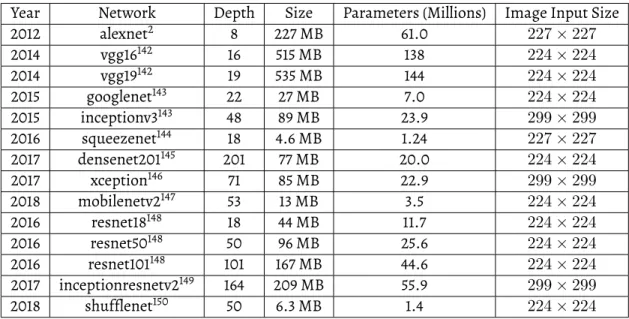
due to the rise of Deep Learning.2This shift can be characterized by a few factors: 1) the
use of large (millions of trainable parameters) parametric models due to improvements
and increased accessibility of the computational resources - namely Graphics Processing
Units (GPUs), 2) introduction of Convolutional Neural Network (CNN) architecture,33)
release of software frameworks specifically designed for Machine Learning for Computer
vision such as Caffe4or TensorFlow,5and 4) availability of large-scale, annotated image
datasets such as ImageNet6and PASCAL VOC,7and more recently MS COCO,8
CIFAR-10,9CityScapes.10Subjectively the most impactful factor was the introduction of
the convolutional processing of images which lead to formulation of various recognizable
standard-like model architectures and training methodology. Naturally, more and more sophisticated tasks were undertaken by researchers and eventually industry. An example
from simple image-classification tasks to what we would know today as image
segmentation and steps towardstotal scene understanding. Interest in Computer Vision for robotics and surveillance needs motivated rapid progress in tracking human locomotion
in natural images which became the first applications of MOT. Alongside the modern
single-image processing pipelines, came methods for tracking in video frames to address
the difficulties inherent to the MOT problem. Methods like YOLO,11, 12SSD,13variants of
the R-CNN14, 15- all based on the Convolutional Neural Networks became the standard
building blocks of the custom tracking systems. Some visual applications such as
pedestrian tracking or face detection already became incorporated and widely used in
modern computer vision frameworks and Computer Vision libraries since.
There are two major approaches to MOT:
• 2D Tracking: focuses on tracking objects on an image plane. Recently, the most
popular approach istracking by detectionwhich involves identification ofpixelsof interest by various methods of segmentation and background subtraction on a
per-frame basis or optical flow using temporal windows, detectingobjectsof interest by classification, and maintaining identity of the same objects between
frames by solving theData Associationproblem - often through graphical models and bipartite matching between consecutive frames.
• 3D Tracking: where the real-world, 3-dimensional coordinates and object geometry
are the primary focus.16In this category methods take advantage of multi-view
geometry (e.g. stereo matching) or sensing using depth sensor like Microsoft
Kinect or Intel Realsense.
Being a class of Computer Vision problems, MOT faces multiple levels of challenges
which can be categorized in two major domains: 1) lowlevel; imagecapture challenges
-such as variation in light intensity, reflections, noisy images, cropping and more. Those
tracking challenges - related to the properties of tracked objects and their interactions
with each other and the environment such as: occlusions, natural object deformations,
appearance changes, texture, abrupt motion, camera motion (or environment motion
with respect to the camera). Problem of tracking multiple objects that are difficult to
distinguish visually is here referred to asHomogeneousMultiple Object Tracking.
Some of these challenges can be easily addressed by using different capture spectra,
such as through the use of infrared depth-sensing camera. Simultaneous capture of color
and depth images provides an additional dimension (distance from the camera) to the
image data and reduces ambiguities in terms of scale / distance. Consumer-grade
platforms like Microsoft Kinect or Intel Real Sense have proven to be a suitable choice for
a proof-of-concept applications but have inherent limitations in terms of range, the size
of the sensor, and its robustness to harsh environment or high temperature. More
sophisticated sensors, such as 3D lidars, address those problems but their high costs
make them unrealistic for wider adoption. With the modern trends in automotive
industry and rise of autonomous vehicles, it is, however, possible that robust, high quality
depth sensing cameras will become readily available for custom data capture platforms.
1.2
Motivation: Precision Livestock Farming
Currently, livestock farming is a manual labor-intensive industry and relies heavily on
herdsmen performing both the monitoring and the intervention when walking through
the facilities once or multiple times a day. The herdsmen use their senses (hearing,
seeing, smelling, and feeling) to uncover and resolve potential problems in the pen or at
the animal level. In large scale operations with thousands of animals and vast areas, such
methodology is sensitive to the availability and capability of the herdsman, cannot ensure
consistency, and precision and is prone to human bias.17Due to the overwhelmingly large
single events and maintain proper record keeping in a changing environment even when
trying to provide as little as the recommended 2 seconds per day per animal.18
Additionally, recent shifts in the standards of Animal Welfare put increasingly more
emphasis on the quality of human-animal interaction which requires better knowledge,
skills, attitudes, and behavior when handling livestock.19New requirements, tough
working conditions, expected availability, and shrinking rural population strongly
indicate the need for automation and the use of technology in livestock farming.20
When considering the dynamics of the environment in the facilities, there are many
components to the farmingsystemthat can quickly (within minutes) and drastically affect the performance of the animal. In case of hog farming, the environment controls include
exhaust fans, feed and water distribution, heat mats and lamps, curtains, pit slats, lights.
Being able to remotely monitor and possibly control those factors on a regular interval
would reduce a chance of those controls having a catastrophic effect on the animals.
This work addresses the problem of unobtrusive, visual tracking of multiple
group-housed animals in an attempt to widen the context of Precision Livestock Farming
by the use of Machine Learning and Computer Vision. Data sets and annotation
representations are specific to swine monitoring in the group-housed setting, using a
static, over-head camera, but the findings and methodology are directly applicable to
other livestock animals such as beef cattle, sheep, and potentially poultry.
It has been shown that a long-term monitoring of animal behavior has the potential
of predicting health outcomes.21One of the biggest challenges to ensuring the wellbeing
and efficiency of pigs is rapidly and accurately identifying compromised (sick or injured)
pigs. To date, the only method available for identification of compromised pigs is via
manual observation for visible indicators of sickness or illness (clinical symptoms). It is
However, given the quantity of pigs in modern group-housed settings, it is a daunting
task to ensure that each pig is visually inspected even as frequently as once a day. This
Homogeneous Object Tracking System for Precision Livestock Farming using Cameras.
Being based on a long-term research project, this work also attempts to capture the
dynamics of the development over the span of multiple years backed by multiple
publications with the emphasis on the modern Machine Learning techniques and
principles. Thus, the work is focused on the development, training, and evaluation of a
deep, fully convolutional neural networks trained using back-propagation. Model
transfer is accomplished by the use of a pre-trained network front-end as a deep feature
extractor. Supervised learning is applied to the tasks where the annotated data was
available, and the weakly supervised methodology was used elsewhere. Various ideas
from the author’s experience with Generative Adversarial Networks were employed to
address missing data problems.
The key contributions of this work are: 1) adaptation of the pose estimation method
designed for human tracking to simultaneous tracking of multiple pigs, 2) modification
of said method through the use of weakly-supervised embeddings produced by a neural
network, 3) a novel loss function allowing for fully convolutional neural network training
to produce instance-level embedding, 4) the analysis of said embeddings in the task of
semantic instance segmentation of group-housed animals, 5) method of processing
color-and-depth image pairs applied to a large scale unannotated image set to improve
the performance of the foreground estimation subtask, 6) detailed description of the data
collection and processing system animal tracking from a fixed camera without the need
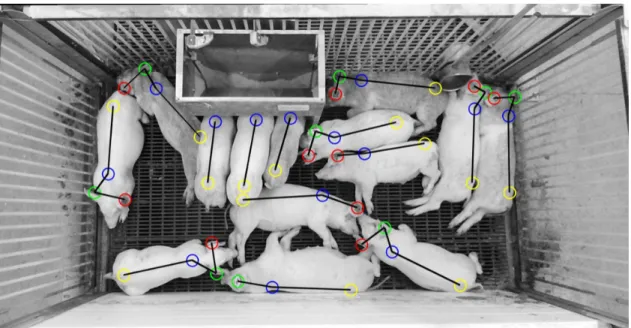
Figure 1.1: A compelling example of a pig keypoint and orientation detector fromhttp:
CHAPTER 2
Background
2.1
A need for novel, automated approach to Precision
Live-stock Farming using Machine Vision
Rapid increases in pig and cattle meat production lead to increased consumer and
producer interest in animal wellbeing. Broadly speaking, health and living conditions of
farm animals is referred to asanimal welfare, which is nowadays pushing forward the standards of barn environments, food and water adequacy, and production efficiency. It
has been seen, that modern technology, namely machine vision, can provide systems for
real-time, automated, non-invasive animal behavior monitoring solutions. Parameters
such as real-time activity (feeding, drinking, lying, locomotion, aggression, and
reproductive behaviors) can be extracted from 3D and 2D image analysis. It has been
established that such automated analysis can provide farmers with support much needed
in the food production industry.22
Thus, the industry needs a scalable and cost-effective way of monitoring animals at
an individual level and in a more continuous fashion. Supplementing the staff with
precise metrics of animal and environmental performance would drastically reduce the
costs and labor required to properly maintain operations. Lowering the amount of
lowers the risk of biological contamination carried between facilities.
Precision Livestock Farming (PLF) is an engineering approach to livestock
management using automated, long-term monitoring of individual livestock.23–25
Systems falling under the PLF category aim to aid the producers with high-precision,
low-latency (or real time) tools capable of determining the state of the facility and the
animals on the individual level. PLF data collection platforms consist of cameras and
sensors for measuring temperature, air speed, humidity, and gas contents (e.g. amonia).
On a facility level, vibration and current sensors help monitoring the state of equipment
and microphone arrays can be deployed to keep track of the noise levels and potentially
detect pen-level events.
Researchers proposed a variety of technological approaches to individual animal
tracking in PLF over the last decade26, 27including: wearable Ultra-Wide Band (UWB)
tags,28, 29GPS-enabled motes,30, 31accelerometers / Inertial Measurement Units
(IMUs),32–35RFID ear tags,36–38and depth-sensing cameras.39, 40
Whereas the wearables offer a solution to individual animal tracking, they have a set
of disadvantages when compared to surveillance-type systems with cameras.40, 41
Battery-powered devices also carry an additional burden on the staff due to outages and
additional charge-level monitoring requirements. Animal farming facilities require the
monitoring equipment to withstand harsh, humid, hot, dusty environments, need to
stay attached to the observed animal, and their initial deployment is costly and scales
with the size of the operation as each individual animal needs to be equipped with a
uniquely identifiable sensor mote or tag.42UWB and GPS systems provide reasonable
positioning accuracy in their respective environments (indoors and outdoors) but alone
lack the ability to determine the animal’s orientation. The use of IMUs alone allows for
very accurate estimation of the orientation but due to long-term drift do not provide
good positional accuracy due to magnification of the measurement errors through
of positional and inertial sensing is a very common solution to this problem and has been
used successfully in many applications. In land navigation, additional, potentially more
sparse but precise measurements of absolute position allow for closed-loop corrections.43
Literature shows successful implementations of tracking animals using IMUs but they do
not inherently carry over any richer context such as social behaviors.
Cameras however, do carry over rich contextual information (both spatial via image
resolution and temporal in video) and allow for unobtrusive deployments allowing for
minimum human-to-animal interaction during monitoring. The video collection system
has a multitude of advantages including the fact that individual frames are human
readable and allow for the easy evaluation / annotation of any frame. Large-scale data
sets can be easily obtained once the system such system is deployed, which leaves the
most interesting aspect of this work as a still-open question of how to process such a vast
amount of data with minimum human effort? As processing of the video frames of on a
contextual / semantic level requires more sophisticated treatment than just mere image
processing techniques, researchers started to lean more openly to the field of machine
learning and artificial intelligence incorporating recent advancements in those rapidly
growing fields in their work.44, 45
An image-processing pipeline of a tracking system often explicitly includes a
method of determining the pixels of interest. Such a process is referred to assegmentation and can occur on multiply levels of abstraction. In its most basic form, it allows for
distinguishing the foreground pixels from the background using a background
subtraction.46When the pixel blobs obtained through this process are spatially separated,
a connected-component algorithm can be used to obtain identification of individual
instances. Another approach is to use a separation in the pixel intensity values via
clustering if the within-cluster intensity value deviations are lower than between clusters
according to a selected similarity measure. In the current application however, it is not a
each other (due to piling when animals try to stay warm) which prohibits the spatial
separation, and additionally indistinguishably similar in color to one another prohibiting
the clustering. Thus, a more sophisticated, rich-feature-based and context-aware
method needs to be used when attempting to process images of group-housed animals.
This work is a step towards addressing the broader problem of lack of automated
methods of animal behavior monitoring. Section 1.2 establishes the need for the
technology to step into the agriculture, and anticipation for the potential use of visual
tracking to predict animal health outcomes. A successful, widely adopted, easy to deploy,
and unobtrusive long-term tracking method could yield means to better understanding
of animal conditions and improve overall quality of animal handling.
Thanks to a collaboration with the Department of Animal Science of University of
Nebraska-Lincoln it was possible to gain access to locations resembling swine production
facilities. The main goal was to capture large amounts of visual data, while at the same
time, working on the ways of processing it. At that time it was anticipated that
simultaneous collection of color and depth images could be useful in the future. Use of
cameras addresses the needs for an unobtrusive, asynchronous, and unattended,
long-term data collection with minimal interference with animal-handling personnel.
Currently available methods produced by the research community are presented in
Section 2.2. To this day however, there are no methods presented that could satisfy the
needs of the industry. With such a niche field, the amount of data available for
development of such method is also fairly sparse. Thus, in order to step in an attempt to
tackle this problem, one had to resort to collecting their own data. Section 3.1 describes
the process and methodology used to collect he data for this work.
Chapter 3 is dedicated to the description of the proposed method of tracking by
detection using outputs of a deep, fully convolutional neural network. Additional
sub-tasks and significant earlier attempts are briefly described as well to provide reader
Figure 2.1: Lifetime of thePig Trackingproject. Lengths of the blocks represent relative timespan of various components - often done in parallel. Total work spans over the course of years 2016-2019.
As shown in Figure 2.1, the annotation ended up being one of the most
time-consuming phases of this project. Section 3.3.1 describes the proposed process of
annotating images in a fashion that is specific to pigs. Similar methodology however can
be used for different kinds of targets.
Our initial work on this problem involved the development of a novel iterative
EM-based clustering technique of elliptical objects in 3D space.39, 40In spite of being very
compelling at the time, and resulting in the US patent application,47this method does not
seem applicable for a widespread adoption as it imposes requirement of capturing depth
information as well as color images. Witnessing a huge shift in the field of computer
vision towards the use of CNNs inspired the author to participate and potentially
contribute to both fields: Precision Livestock Farming (PLF) and Machine Learning, in an
interdisciplinary fashion. Furthermore, we decided to reinterpret the problem from
iterative clustering in 3D to instance-level semantic image segmentation and pose
Switching the source domain from sparse 3D point clouds to dense color images
required a new model, one capable enough to accommodate necessary operations
transforming the inputsxinto desired outputsy, and a deep CNN became a natural choice. When using a parametric modely=f(x, θ)one needs to define appropriate representations of the inputx, outputyand parametersθ. CNNs are indifferent in that regard. Since their original versions date from the early 1990s, the community developed
standard formats and conventions for representing the visual domain inputs (images),
outputs, training objectives, and structure of the parameters via commonly adopted
network architectures. Section 3.2 introduces the reader to the convention of data
processing using CNNs in a broad sense, while Sections 3.3 through 3.4 describe the
problem-specific choices of representations.
Despite being extremely successful in tackling computer vision tasks, CNNs, due to
the very large number of parameters always carry a risk of over-fitting, casting a shadow
on their ability to generalize and produce useful results for unseen data. We acknowledge
those limitations in section 2.7, and present attempts to mitigate them.
When switching from 3D to 2D processing, we always kept in mind the anticipated
potential hidden in thedepthof depth information. First, it was identified that the process of training large, deep CNNs requires large amounts of data. Being however
equipped with unannotated pairs of color and depth images, author attempted to make a
good use of the sheer volume of available images by providing a reliable, high quality
ground-truth information for the subtask of foreground estimation. A relatively large
amount of paired data was processed to extract foreground (class level segmentation)
masks. Section 3.5.2 is dedicated to description of this process including the use of the
elements of multi-view geometry.
Chapter 4 presents the analysis of the method in the context of available datasets
2.2
State of the Art: attempts to track livestock using
cam-eras
Nasirahmadi et al.48studied the relationship between group lying behavior and ambient
temperature using model-based ellipse-fitting from.49They used adaptive background
subtraction50to separate separate parts of the image belonging to the animals from the
static elements of the scene. The number of pigs detected in the picture and their
orientation were accurate approximately95%of the time. The method is mathematically sound and well defined, however it does not address the ambiguity between the head / tail
position as it only aims to determine the dominant axis. The method seems to be able to
handle a partial occlusion but no explicit claims about occlusion handling are made in the
paper. Also, the animals used in the trials had little to no variety in terms of appearance.
Ahrendt et al.42use a model-based approach to pig tracking with a multivariate
Gaussian distribution to represent thex, ycoordinates and appearance (RGB intensity). The authors adapt the model between frames in an EM-like fashion using Mahalanobis
distance as instance affinity measure. The method is compact and robust but fails to
separate instances when the animals are touching or in the presence of high number of
instances due to limited frame rate and optics. In order to challenge the frame rate,
authors had to allow for high enough variance between the frames to accommodate
model adaptation, which lead to separation problems. The fish-eye optics were used to
allow for larger field of view in the presence of multiple animals but the amount of
introduced distortion was overwhelming for their processing algorithm. Figure 2.2
illustrates the this effect.
The introduction of a depth sensing component helps to resolve the ambiguity
between scale and location (distance from the camera) and allows for fitting geometric
models to the 3D point clouds in the real world coordinate space. An approach utilizing
(a) (b)
Figure 2.2: Illustration of the top-down view of the pig pen captured with the fish-eye lens in the work of Ahrendt et al.;42 before the distortion compensation algorithm is used (a) and after (b).
the points of interest.40The method focuses on incremental inter-frame adaptation
using EM and the authors have shown an average of 20 minutes of consistent tracking
but manual initialization is required.
Matthews et al. uses depth sensing for activity monitoring of the animals.51Their
method operates without the need for manual initialization and is capable of tracking
individual animal instances via performing regional grouping of surface normals with
the average reliable tracking duration of 22 seconds.
(a) Color image (b) Correspondingheightmap
Figure 2.3: Example of color (a) and corresponding, processed depth image in form of a height map (b).
2.3
Multiple Object Tracking
A popular approach to MOT istracking by detectionwhich consists of two major
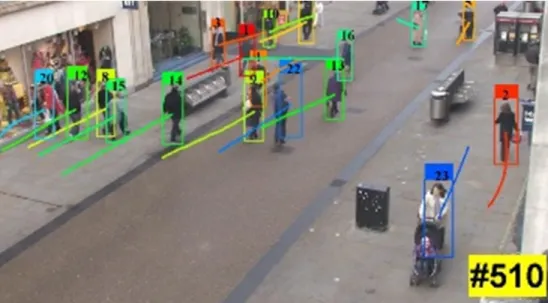
components:52, 53object detectionanddata association. When referring to MOT, one usually has in mind a scenario like the one shown in Figure 2.4. The image depicts a state of an
MOT method for pedestrian tracking.54There is a number of pedestrians (objects) being
tracked by the method. Each pedestrian is indicated in the frame using a bounding box.
Each bounding box is also color-coded to display the unique identity of each tracked
object. It is safe to assume that that objects are in motion between the frames. The
tracker combines the detection hypothesis from each frame and combines them into
likely progression of each object in the sequence of frames using a data association
method. Such method often depends on appearance and motion models. The location of
each object across frames is tracked by the method and displayed as individual
trajectories using colored lines. It is safe to assume that the camera is stationary as the
image most likely comes from a street monitoring system.
Figure 2.4: A visual depiction of an output of a Multiple Object Tracking Method applied to pedestrian tracking.54
2.3.1
Object Detection
Growth of availability of vast data sets containing millions of annotated images and
publication of open, performance-oriented challenges can be identified as driving force
in the field of Computer Vision. The most commonly known challenge (and data set) is
ImageNet Large Scale Visual Recognition Challenge (ILSVRC)6focused on three
fundamental tasks in the field. At this point it is important to define the terms
classification, localization, and detection according to ILSVRC’s definition:
• Image classification is the task of determining a single class for the entire image.
In ILSVRC it is one out of a 1000 classes and the top 5 scoring classes are reported.
If the ground-truth class is present among the five, it is counted as full success,
failure otherwise.
• Single-object localization focuses on finding one object out of the list of
ground-truth objects present in the image along with proper (≥50%Intersection over Union (IoU)) bounding box position and size.
• Object detectionis the most demanding task and involves proper classification and positioning of bounding boxes around all the objects indicated in the ground-truth
with criteria as in previous tasks.
Classic approaches implemented sliding-window methods operating on multiple
scales of the images and correlating pre-trained visual object representations with the
content of the window, which can be unsuitable for online tracking scenario due to
computational complexity increasing with the number of learned representations.55To
overcome the complexity problem, some methods used two-step processing with
lower-accuracy detector yielding regions of interest for more robust one.56, 57
Another way of avoiding sliding-window approach is to explore the
Figure 2.5: Object representations: top-down representation of objects as bounding boxes or segmentation masks64often used in tracking by detection methods (left) and a bottom-up representation of a person as an organized collection of keypoints and their associa-tions65(right).
circular matrices and operations in Fourier domain for high performance (≈100 frames per second) single-object tracking.
Modern hardware however allows for using more computationally expensive
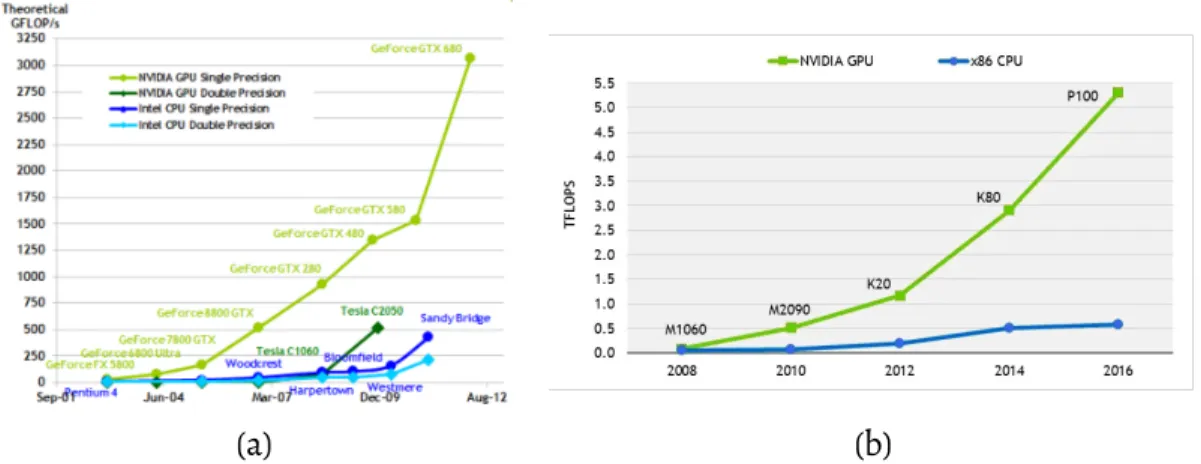
methods such as Neural Networks in (nearly) real time due to GPU processing and make
2D convolution operation feasible. This was exploited heavily by Sermanet et al. by using
multi-scale sliding-window approach with simultaneously learned bounding box
regressor and classifier.61
After obtaining hypothesis of object class membership of each pixel, additional step
can be introduced to model the interaction between detected objects within the same
frame. Method presented in62focuses on learning complex objects as constrained
alignments of its parts and was widely used in various Computer Vision applications
including MOT.63
Object detection can be related to other tasks based on representation. In Figure 2.5
we are contrasting two opposite object representation methods: top down (left) starting
with region of interest proposals (bounding boxes) and bottom-up based on detecting
parts (right).
Figure 2.6: Mask R-CNN extended to estimate human pose from in images selected from COCO data set and operating at 5 frames per second.66, 67
multi-step Neural Network structure capable of complete Semantic Segmentation of
single images. Work presented in64, 67shows human pose estimation based on keypoint
detection using Mask R-CNN on single color images with real time performance when
running on modern hardware. It is worth to mention that this recent development
combines multiple steps of the pipeline within one trainable structure yielding very
promising results in terms of both accuracy and performance.
Following reasoning by Choi et al.,53having high quality object detector is essential
in achieving prime tracking performance. Most recently Bergman et al.52argue that a
high quality object detector is all that is necessary to achieve state-of-the-art
performance in MOT.
2.3.2
MOT as Data Association Problem
Resolving object correspondences between frames is the essential component of MOT
pipeline. Depending on the implementation and allowed output latency, it can allow for
filling the gapscaused by occlusions and estimation of actual motion of the tracked objects while maintaining consistent distinct identities of the targets. In the scenario of 2D
tracking-by-detection, resolving inter-frame correspondences is formulated as the Data
Association Problem (DAP). Even though partial occlusions can be internally handled by
is essential for tracking.
Before diving into graphical models considering larger time windows (both past and
future) it is worth to mention, that some tracking systems use Markovian assumption
and maintain continuously updatedstatebuilt upon the evidence from processing past frames and adopting the model to most recent frame. Widely used single-object tracking
method known as Continuously Adaptive Mean Shift (CAM-SHIFT)70operated by
continuously adopting scale and position of tracked target based on evidence of the
detections. Again, it is worth to emphasize the importance of high quality detector at this
point.
MOT is often formulated as Data Association Problem (DAP). This approach is
commonly used in tracking-by-detection methods and heavily rely on quality of object
detector and affinity measures between the detections. The goal of DAP is to find
optimum (minimum cost) assignment in a graphG= (V, E)where vertices represented by setV are object detections and edges represented by setEare potential edges between verticesv1, v2 ∈V with cost representing dissimilarity between detections
corresponding to verticesv1, v2. This formulation is prone to major difficulties caused by false positive and negative detections.71
Depending on the application and computational constraints the correspondences
between the single detections and vertices in the graph can be modeled differently as well
as the global cost metric or costs associated to edges. At this point the author would like
to recommend a few literature positions which, according to his belief, represents the
evolution of Data Association Problem formulation in MOT.
Solving MOT as DAP is often approached using temporally local matching between
each pair of consecutive frames. This class of methods simplifies the problem tobipartite matchingwhich can be solved using Hungarian Algorithm.72
Temporally global methods constrain the problem around batch of frames which can
Figure 2.7: Bipartite matching between pairs of frames compared to k-partite complete graph spanned over longer time window.73It is worth to mention that k-partite complete graph is not the only formulation used in solving the DAP but is used here as a valuable example clarifying the difference.
Figure 2.8: Minimum clique problem formulation used in GMCP74compared to k-partite complete graph problem.73
between temporally local and temporally global processing is presented in Figure 2.7.
Global optimization is significantly more computationally demanding than local, thus
some methods formulate the tracking problem in global fashion but solve it using greedy
processing (solving trajectories one-by-one, often according to heuristic quality
prediction based on detection scores) which is vastly criticized for its suboptimal
tracking quality and yielding non-optimal tracks53caused mostly by occlusions and
within-sequence variations.73The difference between greedy processing and global
optimization is presented in Figure 2.7 which illustrates the major difference between
The rest of this section is dedicated to showing the evolution of DAP formulation for
tracking. It presentsancientMHT recently revisited due to the use of CNN-based features. GMCP and GMMCP as examples of elegant, clever, and mathematically sound
problem formulation, JMC as a the most recent reinterpretation of the problem which
does not require 2-step processing allowing for more robust tracking, and MDPNN using
Long Short-Term recurrent neural networks and learns motion, appearance and object
interaction jointly. These methods were selected based on their high tracking scores
presented in recent comparative study77(JMC, MDPNN, MHT-DAM), elegance and
relevance (GMCP, GMMCP).
More recent revision of Multiple Hypothesis Tracking (MHT) using features
obtained from deep convolutional neural network (MHT-DAM) presented in78is based on
the initial proposal from 1979.79The major strength of this method lays in keeping
multiple identity hypothesis through the tracking process and resolving the past as new
information is processed. It heavily relies on optimized heuristic solver.80The most likely
set of tracks is a result of solving the Maximum Weighted Indepenent Set (MWIS)81and
incorporating appearance modeling through deep features68compressed to 256-element
vectors using PCA for higher performance. Analysis of comparison between MHT and
MHT-DAM using deep features shows that appearance features are significantly more
important than movement features. And havingproperappearance feature vectors makes it less sensitive to the size of temporal window. Authors also point out that simplistic
motion models such as linear motion often do not represent the behavior of real tracked
objects yielding suboptimal results. This method scores highly in recent comparison
study77but is potentially prone to mismatches due in homogeneous target appearance
applications due to its emphasis on appearance.
Zamir et al.74present a global multiple object tracking method (GMCP1) formulating
DAP as minimum clique problem (where complete subgraphs span over the same identity
1
detections over multiple frames). Theglobality is achieved by incorporating 2-step approach of slicing the sequence into temporally local sub-sequences and extracting
trajectories usingtrackletsand estimating linear velocity vectors and appearance representation through averaging visible appearances. Then, the problem is solved
iteratively using Tabu search82using greedy method estimatingglobaltrajectories in sequence. Occlusions are handled by adding hypothetical nodes filled up using RANSAC.
The greedy processing is the most important disadvantage of this method.
Deghan et al.73criticize GMCP for using greedy processing and introduce DAP in
MOT formulated as k-partite complete graph problem which can be solved
simultaneously yielding optimum track assignment. Comparison of GMCP and GMMCP
is presented in Figure 2.8. On the mathematical level authors establish three major
constraints incorporating all hypothetical assignments within the considered time
window and use Binary Integer Programming (BIP) solver. Authors formulate tracklets to
lower the computational complexity but also allow for a motion model incorporated into
the cost metric.
Authors provide 3 constraints to formulate GMMCP as BIP which essentially builds a
f-partite complete graph (fbeing the number of frames) which considers all possible associations of detections between all frames / tracklets. They introduce dummy nodes to
handle occlusions and represent them as integer variables instead of binary and use a
heuristic measure to determine their number, which reduces the number of constraint
equations. They use83(color histogram intersection) as their affinity measure. Authors
show superiority of their methods compared to GMCP.
It is worth to mention that both, GMCP and GMMCP are not well suited for large
time frame formulation as the problem scales by the number of frames in the time
window with respect to number of detections per frame and exponentially with respect to
number of frames. The main computational complexity comes from actual memory
constraints. Thus, for fixed number of targets and fixed size of the time window it can be
done once and just solved for the cost values coming from detection scores and object
affinity. This however imposes constraints of the number of detections allowed per
frame, which requires either very accurate detector, raising the detection confidence
threshold (which can result in increased number of FNs) or using aggregation techniques
such as Non-Maximum Suppression (NMS). These observation come from the experience
of the author of this proposal as he implemented the GMMCP in MATLAB and applied it
to livestock tracking but did not achieve high quality results due to poorly defined visual
affinity and not incorporating motion constraints.
In63author propose JMC, a novel graphical method of solving MOT using DAP. As a
natural extension of their previous work in84authors eliminate the need for intermediate
local trajectory representation of tracklets as authors lower the emphasis on motion
model and focus on appearance. This is aiming towards high robustness against camera
motion. In their previous work84authors handled false positives using additional binary
variables at nodes for masking depending on detection confidence threshold. Here,
authors add post-processing step to remove small clusters of detections. The main
advantage of this change is ability to use KLj-algorithm from85without any
modifications. They reframe the MOT as minimum cost subgraph multicut problem.84, 86
As a result all the detections corresponding to the same target can originate both inside
single frame as well as across time due to the fact that solution of a problem is based on
subgraphs and not paths (edges between single detections). Authors use deep matching? for affinity measures of each detection yielded by DPM62object detector. The use very
efficient solver presented in.85
Finally, a very sophisticated method presented in87(MDPNN) uses Long Short-Term
Memory (LSTM) Neural Networks. Authors jointly learn target representations taking
into account appearance, motion and interaction after being inspired by recent work on
Figure 2.9: Effects on different components on the continuous energy function presented in.89 Please keep in mind that this method is an energyminimizationframework, so the correctassociations are going to carry lower energy than the erroneous ones.
Authors point out the importance of modeling the target’s motion in case of
handling occlusions as it allows for predicting the location of the target in the next frame
but also emphasize the importance of appearance as performance of graph-based MOT
methods is bounded by design choices of similarity function.
DAP can also be solved using maximum-a-posteriori (MAP) network flow approach
which is capable of handling longer time windows. Work presented in71uses min-cost
flow algorithm to for pedestrian tracking scenarios. Each trajectory is modeled as
Markov chain. Each detection has associated random variable with Bernoulli distribution
trained on the data and modeling probability of being a true or false detection. These
methods introduce additional graph vertices and edges modeling uncertainty between
the hidden state (true positions of targets) and the hypothesis.
Another attempt to solve the Data Association Problem is by minimizing global
energy function defined such that it captures all possible tracked targets in all frames.
In89authors present Continuous Energy Minimization (CEM) framework for Multiple
Object Tracking. Authors state that due to its general non-convexity the tracking problem
can not be solved globally and argue that local optima of carefully formulated objective
yield satisfying results in practice. Their objective function explicitly encapsulates:
detection evidence, appearance, motion dynamics, persistence, and collision avoidance
linear SVM and they use HOG90and HOF91as feature descriptors filtered by NMS.
NOMT method presented in53achieves very good performance according to,77
mostly due to high emphasis on robust affinity measure between any two detections and
novel affinity descriptor (AFDL) which mostly focuses on movement.
2.3.3
Motion, appearance, interaction, and affinity measures
Interaction between tracked objects can be modeled either explicitly or implicitly. The
most common methods of explicit modeling are used in the pedestrian tracking: crowd
motion patterns92and social force model (group model)93where object trajectories are
augmented by two types of forces: attraction or repulsion. In89authors use repulsion
based on target’s volume.94These standard models were criticized for low generality (due
to inflexible constraints imposed on motion such as linearity) and over-simplicity making
it unable to capture more complex interactions between objects and more data-driven,
LSTM-based model was proposed.87The main strength of this approach is in its ability to
model long term interactions based on multiple clues. Implicit object interaction (mostly
repulsion) is often handled by exclusive area occupancy such that no two distinct objects (or parts of those objects) can be present in the same frame at the same location (nor
having bounding boxes with areas overlapping above certain threshold) which is often
inherently ensured in tracking-by-detection by the detector’s output (with proper
segmentation).71, 73, 74
In53authors present Near-Online Multi-Target (NOMT) tracking framework heavily
relying on their motion affinity measure with less emphasis on the appearance. Such
choice is often motivated by the need for tracking similarly looking (or even
homogeneous) objects. They introduce Aggregated Local Flow Descriptor (ALFD) which
encodes relative motion pattern between two detection boxes in different time frames.
Authors propose to solve the problem using temporal windowτ(Vt
1,Dtt−τ,At
−1)→
At. Given the previous set of points, they identify new points and reduce their number by
Figure 2.10: Appearance model presented in.87Bounding boxes at each time step are pro-cessed through a CNN, effectively used as a feature extractor. Those features are then passed into the LSTM-based appearance model for all time stepsi= 1,2, . . . , tand com-pared with the features from the most recent frame using fully connected layer.
applying a movement threshold of at least 4 pixels. Then they calculate forward and
backward optical flow. Any point with high disagreement in forward-backward flow
(consistency measure) is terminated.
Methods described in previous section used tracklets to describe temporally local,
consistent sub-trajectories of targets. In73authors build tracklets by slicing the sequence
into a fixed length sub-sequences and estimating motion models for consistent
detections. They also use forward-backward consistency when merging tracklets into
smooth(global) trajectories. It has been shown in the literature that the use of tracklets is a95–97
Choi et al.53leverage the importance of pairwise affinity measure between any two
detections based on motion clues for considering similarly looking targets. The most
recent, previously mentioned work presented in MDPNN tracker87learns the motion
model and affinity measure between tracks using LSTM neural network in very similar
fashion to the way it does with respect to the appearance (Figure 2.10).
and the upper bound of the appearance similarity, namely the appearance similarity
decreases with decreasing overlap. Authors explore multiple common appearance
descriptors such as bag of visual words using SURF features,99GIST,100and HOG.90
Authors propose an efficient algorithm for affinity measure capable of real time
operation.
In101authors propose a Siamese CNN architecture to estimate object likelihood of
two pedestrian detections to belong to the same tracked identity. They combine visual
affinity (pixel values) with motion (optical flow) in their measure.
Appearance-focused methods used in classic tracking systems can be often
described asweakvisual affinity measures such as: spatial affinity (bounding box overlap or euclidean distance),75, 76, 102color histogram intersection.74, 83
Dis(similarity) measure between two image regions is a fundamental problem of
stereo matching. The output of the evaluation function usually produces overallcostvalue or returns disparity directly. The groundbreaking work in103uses neural network-based
approach to estimate the similarity score. The network is built from two convolutional
feature extractors, concatenation layer, and a stack of fully connected layers. Presented
method outperformed previous attempts.
Concluding this section author would like to once again emphasize the importance
of the visual object representation and affinity measure due to its broader impact in the
field of Computer Vision.
2.4
Semantic Image Segmentation
Semantic segmentation allows systems to interpret image content in both the spatial and
categorical domain. As arbitrary as it seems, it is a task beyond mere texture and
color-based analysis and requires domain-specific prior knowledge stored as model
frombackground subtractionbeing a single-class foreground/background identification task, through multi-class case and eventually instance-level or sub-instance level. When
an image contains multiple disjoint segments of the same category, the segments can
easily be separated into unique instances. Such categories can be defined as people,
animals, inanimate objects, and more.8Unfortunately, in cluttered scenes this condition
is seldom satisfied; here, one can only interpret the results as a collection of ambiguous,
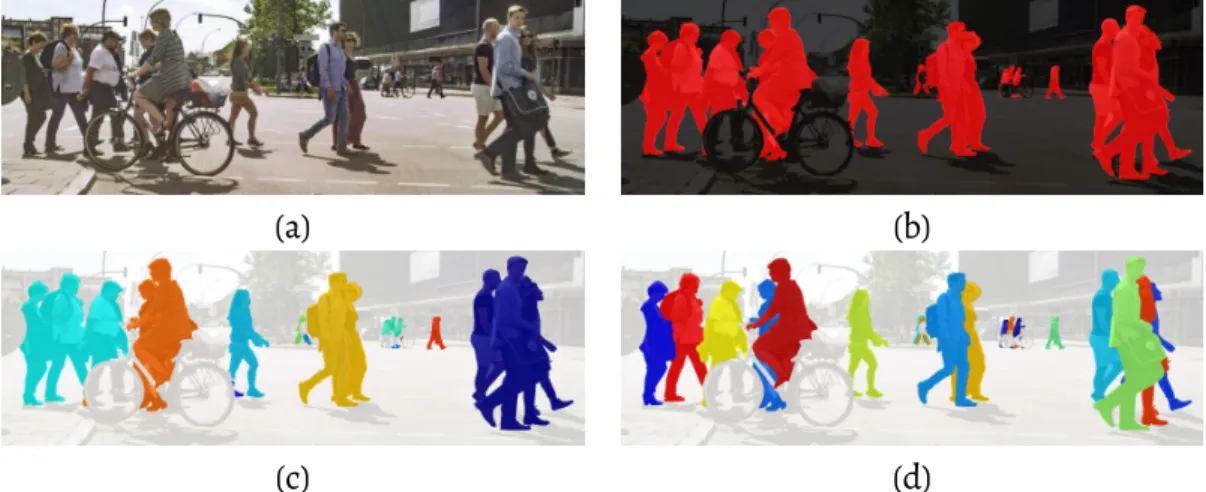
inseparable blobs. Figure 2.11(a,b,c) illustrates various levels of segmentation and the
limitations of (class-level) semantic segmentation in cluttered scenes.
(a) (b)
(c) (d)
Figure 2.11: Semantic segmentation and instance-level segmentation of people (Cityscapes dataset,10Hamburg image #036527): (a) original image; (b) semantic person segmentation; (c) grouping via connected components; (d) person instance segmentation.
Instance segmentation adds to the capabilities of semantic segmentation by
distinguishing between objects of the same category. This task is significantly more
challenging than mere semantic segmentation as it needs to produce unique
identification of each instance such that there exists a clear boundary between them.
Implementation carries additional challenges because the specific identifiers provided by
ground truth instance labeling are permutation invariant, i.e., any permutation of
ground truth instance labels (unique colors in Figure 2.11(d)) is considered a perfect
solution.
segmentation despite the inherent ambiguity of labeling. In general, they can be divided
into two classes: 1) top-down and 2) bottom-up. A top-down approach begins by isolating
the region of interest from the rest of the image prior to performing pixel-level
segmentation66,104while the bottom-up methods attempt to assign unique “codes” to
each pixel so that clustering methods like mean-shift can separate different instances
easily105 106.107
Modern methods achieve impressive results on challenging datasets like COCO,8
Cityscapes,10and KITTI,108however, because they are specifically trained to assign a
single instance label to visible pixels, each object’s full spatial occupancy and depth
ordering — two properties that humans instinctively estimate — are not represented in
the image annotations. As a consequence, the common approach of training deep
fully-convolutional networks (FCNs) to detect and segment objects in the image109faces
the dilemma of an ambiguous target because there is no definitive ground truth to
provide the network during training. In the context of tracking, the main limitation
inherent to those vast instance-level segmentation datasets is the lack of temporal
context as they contain random natural images and not consecutive image frames.
As mentioned above, there are two categories of approaches to achieve instance
segmentation. The first begins by finding the regions (often bounding boxes) that contain
each instance, and then performing pixel-wise segmentation of the dominant instance
within that region.
One of the most successful and nowadays widely adopted family of top-down
methods are based on the work proposed in 2014 by Girshick et al.110known as R-CNN.
Its latest incarnation, Mask R-CNN, introduced by He et al.66is capable of performing
instance level segmentation and keypoint detection. It extends upon Faster R-CNN15by
adding a branch for segmentation mask prediction in parallel with the other branches
(bounding boxes and classification). However, because it relies on a priori region
1 1 1 11
(a) (b) (c) (d) (e)
Figure 2.12: Instance segmentation output scenarios for two overlapping rectangles.
overlap—a common occurrence among group-housed animals
Li et al.111proposed a solution that uses a location-sensitive fully convolutional
network that partitions bounding boxes into a 3×3 grid, and then evaluates the likelihood that each partition contains the correct part relative to the other partitions. Alternative
approaches using recurrent neural networks with attention have also been introduced to
iterate through the instances while keeping track of which regions have already been
processed104.112
Methods relying on bounding box selection are inherently limited byan prioriregion selection. When instances of similar size overlap with one another, the region selection
phase often experiences one of two types of error: either 1) due to non-maximum
suppression, the algorithm ignores the bounding box of the occluded instance (Figure
2.12(b)), or 2) the instance will be represented as a collection of separate partial instances
(Figure 2.12(c)).
As an alternative to region selection, bottom-up approaches that use pixel
embedding move the high-level detection stage to the end of the process106 107.105A
bottom-up keypoint detection was even successfully adopted to cow tracking.44The
authors identified a set of class-specific landmarks visible from a top-down view to
represent each cow ’s location and orientation, and trained a fully-convolutional neural
network to detect them in images. A post-processing network was then used to convert
the annotations to per-pixel orientation classification outputs, resulting in95%accuracy in correctly labeling all cows in a given image. In a follow-up experiment, they applied the
previously trained network to a new environment and observed that it only succeeded on
only55%of images, indicating that the network was over-fitting to a particular environment.
2.5
Pose Estimation using Keypoints and Part Affinity
Fields
Wei et al. introduce the concept of convolutional pose machines.113Their work establishes
an architecture, landmark definition and general approach to bottom-up processing
suitable for human tracking. Cao et al.65extend this work and propose a real-time
method of multi-person pose estimation using a combination of keypoint detection, a
novel concept ofPart Affinity Fields, and well-defined post-processing step to resolve associations between objects of interest.
Figure 2.13: Real-time multi-person 2D pose estimation.65
This approach is still targeted to single-domain processing; namely: human pose
estimation where the objects of interest arepeoplevisible in single images and trained on two popular datasets: MS-COCO and MPII. Their findings and methodology are however
more than adequate for other object classes. Presented qualitative results of processing
random video inputs (https://www.youtube.com/watch?v=pW6nZXeWlGM) seem very convincing, even though the presented method does not support video processing
explicitly in its architecture as it operates in a state-less fashion and no consistency is
object tracking (when desired) needs to be resolved using external processing. Authors
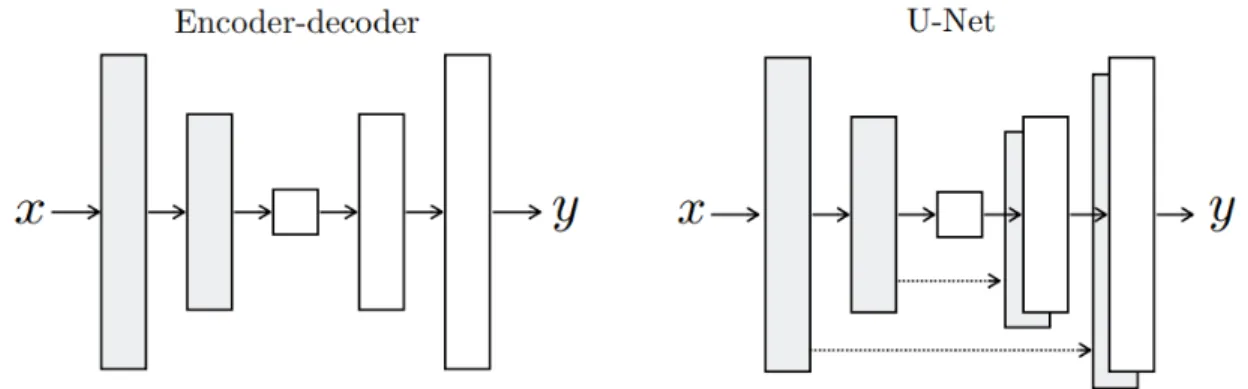
use deep convolutional neural network working as a 8-step downsampling-encoder (with
natural input size of368×368×3) with multiple deep dense (using skip connections) refinement steps operating on the downsampled, deep features (46×46×128). The final output is then produced by up-sampling back to368×368×3and post-processed (Figure 2.13 (d, e) ).
For human pose, position of the keypoints such as wrists, knees, ankles, elbows etc.
are encoded using real-valued images representing heatmap of confidence that a
keypoint of certain type exists at a particular location of the image. For each type, a
number of two dimensional Gaussian kernels centered at the locations of the keypoints
and with a pre-assumed variance (spread factor) is drawn on the image corresponding
the the keypoint’s type. Those images are then stacked together using concatenation
along the last index forming a multi-channel composite image (Figure 2.13 (b) ).
The model is trained in an end-to-end fashion to produce detection heatmaps. The
joints such as arms, legs and connections between keypoints located on the head are
encoded using 2-dimensional (2 image channels per link) direction vectors defined on an
image plane normalized to unit length and drawn as a thick line (Figure 2.13 (c) ). The
method does not explicitly encode instance-level embeddings but lays the ground work
for simultaneous multiple-instance processing due to clever encoding. If however,
instances are subjected to complete occlusion of joints, it may be difficult to recover their
accurate placement. Although the method estimates the class-level foreground mask for
background subtraction, individual instance-level masks are not explicitly produced but
rather approximated in post-processing using features representing part associations.
A promising extension to this method has been applied to smaller body parts
-namely hand tracking. Simon et al.114extends the capabilities ofOpenPoseby creating a separate model capable of recovering position of finger joints and links between them.
difference being the target class - a pair of human hands.
Due to the need of appropriate input handling and gesture recognition for
augmented and virtual reality applications, hand tracking became a topic of interest
-especially when approached in three dimensions. Taylor et al.115present a
computationally efficient and accurate / robust method of tracking deformable model
with 28 degrees of freedom in the application of hand tracking for virtual and mixed
reality interaction using depth sensing. They use smooth model inferred through loop
subdivision116of the triangulated reference mesh to formulate a non-linear global
energy-based optimization problem which can be tackled using Levenberg method.115
Authors indicate limitations present in previously used, single RGB camera-based
methods mostly focused on inverse kinematics labeling them as inaccurate, thus
reinforcing the use of depth information.
So far the bottom-up approaches consisted of a two-stage process. First, the images
are fed to a (fully) convolutional neural network producing the keypoint heatmaps and
potentially images with features allowing for keypoint association cost estimation - such
as part affinity fields. Then, those dense, image-like representations are transformed
into sparse, real-valued representation and an association problem is formulated and
solved. Parameters like detection thresholds or size of detection window need to be put
in place to constrain the problem and ensure reasonable outputs which renders those
methods as very flexible, yet requiring careful parameter tuning.
In work commonly known asPersonLab117the authors reinterpret the idea ofPart Affinity Fieldsand differentiate between the short-range, mid-range, and long-range offset vectors to produce more robust input to the post-processing stages. They
additionally generate instance-level-consistent embedding vectors and segmentation
(foreground / background) mask. Their publication along withOpenPoseare the main inspiration of this work.
It is important to emphasize the fact that both, the mid-range and long-range offsets
heavily depend on the model’s ability to aggregate information over larger area of the
image and will depend on the size of thereceptive field. The short-range vectors however allow for flexibility of model selection due to their locality and make the method
potentially suitable for operation with front-end networks with limited receptive fields.
Short-range vectors are drawn as discs located around each corresponding keypoint
(x0, y0) and encoded on appropriate ground-truth image channels as pixel-coordinate distance vectorsSk(x, y, x0, y0) = [x0, y0]−[x, y]is represented as a 2-dimensional vector for each pixel within the disc (each point(x, y)that lies within the defined radius). Each of this pixels is then encoded as a two-channel image, where the first channel
contains the values of thexcomponent and the second contains the values ofy. This information allows for locating the keypoint based even if the very center of it is
(partially) occluded and allows for more robust postion estimation. In contrast to
OpenPose, where the keypoint position would have to be estimated using information from potentially spatially distant elements of the image, here the more local information
is explicitly trained (authors only train in32-pixel radius around the keypoint).
Long-range offsets indicate the position of each keypoint from (virtually) every pixel
belonging to particular instance (indicated by the red lines in the middle of figure 2.14).
This information is rarely present in the data sets used in this work and thus the most
problematic. When working with actively developed and constantly expanded datasets
such as COCO,8one has the comfort of using vast instance-level segmentation data.
Thus, methods like OpenPose or PersonLab achieve very convincing results when visually