Revenue 2,442.0 2,371.2 3.0 % Total revenue 2,549.2 2,452.8 3.9 % EBITDA 850.7 802.3 6.0 % EBIT 498.0 496.6 0.3 % EBT 366.1 347.3 5.4 % Group result 251.6 250.8 0.3 %
Profit attributable to shareholders of Fraport AG 238.3 240.4 – 0.9 %
Year-end closing price of the Fraport share (€) 43.94 38.00 15.6 %
Earnings per share (basic) (€) 2.59 2.62 – 1.1 %
Dividend per share (€) 1.25 1) 1.25 0.0 %
Dividend yield on December 31 (%) 2.8 1) 3.3 – 0.5 PP 4)
Operating cash flow 553.0 618.8 – 10.6 %
Free cash flow – 162.4 – 350.1 –
Capital expenditure 1,059.7 1,440.2 – 26.4 %
Total assets 9,640.6 9,224.4 4.5 %
Shareholders’ equity 2,945.5 2,850.8 3.3 %
Shareholders’ equity without non-controlling interests and
profit earmarked for distribution 2,794.3 2,706.0 3.3 %
Group liquidity 2) 1,663.1 1,606.9 3.5 %
Net financial debt 2) 2,934.5 2,647.0 10.9 %
Capital employed 2) 5,728.8 5,353.0 7.0 %
Fraport assets 5,152.3 4,447.3 15.9 %
Return on revenue (%) 15.0 14.6 0.4 PP 4)
Return on shareholders’ equity (%) 8.5 8.9 – 0.4 PP 4)
EBITDA margin (%) 34.8 33.8 1.0 PP 4) EBIT margin (%) 20.4 20.9 – 0.5 PP 4) ROCE 2) (%) 8.7 9.3 – 0.6 PP 4) ROFRA (%) 9.7 11.2 – 1.5 PP 4) Gearing ratio 2) (%) 105.0 97.8 7.2 PP 4) Traffic Figures 2012 2011 Change
Passengers: Fraport Group 3) (million) 188.2 180.8 4.1 %
thereof in Frankfurt (million) 57.5 56.4 1.9 %
Cargo volume: Fraport Group 3) (thousand metric tons) 3,392.4 3,573.1 – 5.0 %
thereof in Frankfurt (thousand metric tons) 2,066.4 2,215.2 – 6.7 %
Aircraft movements: Fraport Group 3) (thousand) 1,676.5 1,636.9 2.4 %
thereof in Frankfurt (thousand) 482.2 487.2 – 1.0 %
Employees
2012 2011 Change
Average number of employees 20,963 20,595 1.8 %
thereof in Germany 18,939 18,391 3.0 %
Personnel expenses (€ million) 947.8 906.3 4.6 %
1) Proposed dividend (2012).
2) Liquidity adjusted for accrued interest income, previous year figures adjusted.
3) Without traffic figures for the airports in Riyadh and Jeddah (management contracts) as well as Dakar
(management/consulting contract until end of July 2012. Fraport in addition holds a 60 % share in the new Dakar airport, which is currently under construction). Those figures were not available until the editorial deadline.
4) Percentage points.
Table 1
Table 2
Revenue 823.4 774.9 6.3 % Personnel expenses 278.9 263.9 5.7 % EBITDA 199.9 187.8 6.4 % EBITDA margin 24.3 % 24.2 % 0.1 PP 1) EBIT 77.6 96.1 –19.3 %
Average number of employees 6,298 6,088 3.4 %
Retail & Real Estate
€ million 2012 2011 Change Revenue 452.9 444.7 1.8 % Personnel expenses 46.6 42.6 9.4 % EBITDA 333.9 305.3 9.4 % EBITDA margin 73.7 % 68.7 % 5.0 PP 1) EBIT 251.5 232.1 8.4 %
Average number of employees 629 596 5.5 %
Ground Handling € million 2012 2011 Change Revenue 649.3 655.5 – 0.9 % Personnel expenses 403.3 390.8 3.2 % EBITDA 43.6 54.5 – 20.0 % EBITDA margin 6.7 % 8.3 % – 1.6 PP 1) EBIT 4.7 20.3 – 76.8 %
Average number of employees 8,924 8,899 0.3 %
External Activities & Services
€ million 2012 2011 Change
Fraport at a Glance and Fraport Segments
1 2 1 Airport charges 673.6 2 Security services 98.3 3 Others 51.5 € million Revenue split 2012 1 2 3 4 AVIATION 1 Retail 179.8 2 Real Estate 175.2 3 Parking 73.5 4 Others 24.4 € million Revenue split 2012 1 2 AVIATION
1 Ground handling services 393.3 2 Infrastructure charges 256.0 3 Others 0.0 € million Revenue split 2012 AVIATION Table 4 Table 5 Table 6 Graphic 1 Graphic 2 Graphic 3
Letter of the CEO 4
The Fraport Executive Board 8
To our Shareholders
1
Consolidated Financial Statements
Consolidated Income Statement 78
Consolidated Statement of Comprehensive Income 79
Consolidated Statement of Financial Position 80
Consolidated Statement of Cash Flows 81
Consolidated Statement of Changes in Equity 82
Consolidated Statement of Changes
in Non-current Assets 84 Segment Reporting 86 Group Notes 88 Responsibility Statement 174 Auditor’s Report 175 7-year Overview 176
List of Graphics and Tables 178
Glossary 180 Imprint U5 Financial Calendar 2013 U5 Traffic Calendar 2013 U5 Further Information
3
4
5
Overview of the Situation of the Fraport Group 26
The Fraport Group 28
Business Development 2012 37
The Fraport Share and Investor Relations 50
Non-financial Performance Indicators 53
Significant Events after the Balance Sheet Date 56
Outlook Report 57
Group Management Report
2
Report of the Supervisory Board 12
Statement on Corporate Governance and
Corporate Governance Report 18
On October 10, 2012, after a construction period of approximately 4 years, Fraport took
Pier A-Plus at Frankfurt Airport into operation. The almost 800-meter long pier increases
the annual terminal capacity of the airport by around 6 million passengers and offers
additional terminal positions for 7 wide-body aircraft which can also be flexibly utilized
for up to 11 smaller aircraft. With its newly created retail spaces, the pier will significantly
contribute to increase the net retail revenue per passenger at Frankfurt Airport from currently
€ 3.32 in the direction of € 4 in fiscal year 2013. The construction costs of the pier came to
approximately € 700 million.
“A plus for our passengers”
“A step into the future” or simply:
“An increase in terminal capacity in Frankfurt”
“An increase in shopping opportunities”
“Added value for our customers”
“The new Pier A-Plus.”
Group Management Report
Consolidated Financial Statements
Corporate Governance
Aviation
With the inauguration of Pier A-Plus, the terminal capacity in Frankfurt increased
from around 58 million passengers annually to approximately 64 million. Fraport is thus taking into
account the expected growth in the aviation market. In order to ensure smooth processes, along
with Pier A-Plus Fraport created space for more than 40 new security control lanes. In addition,
fast lanes and an innovative route guidance guarantee fast boarding and transfer processes. As a
part of the “Great to have you here!” passenger service initiative, children‘s play areas, a modern
lighting concept and high-quality sanitary installations provide the highest level of travel comfort.
from left to right:
Oya Telli (FraSec GmbH, Airport Security Assistant Section 5 Aviation Security Act)
Claudia Uhe (Fraport AG, Head of Airport Security Management)
The Fraport Executive Board 8
Group Management Report
Consolidated Financial Statements
Corporate Governance
Letter of the CEO
Dr. Stefan Schulte
On the occasion of the presentation of this year’s Annual Report, I would like to warmly welcome
you to our new Pier A-Plus at Frankfurt Airport! This pier, which we opened in October, last
year, sets new standards in product quality and functionality. This is already reflected by the
highly positive reception of the Pier A-Plus by the airlines and our passengers, whether they
are departing from, passing through or arriving in Frankfurt. With a capacity of approximately
six million passengers, the pier can accommodate as many passengers annually as, for instance,
our entire affiliate airport in Hanover. It also has approximately 12,000 square meters of retail
space, a space that is available exclusively for shopping and food and beverages, which is
larger than a football field. This, on the one side, is doubling our previously available
shop-ping space in Frankfurt on the airside and, on the other side, offers our passengers a world of
shopping never available before, offering new brands and concepts. The pier is also a
trend-setter from an ecological point of view, among others, due to its modern façade technology.
This reduces the CO
2emissions of the building by some 40 percent compared to traditional
construction methods and makes an important contribution to protecting the environment –
whilst at the same time saving costs for us and your company.
Although the pier only started operations gradually in the last quarter of the past fiscal year,
our Retail & Real Estate segment in particular achieved first positive effects from its
inaugura-tion. We increased the key figure “Net retail revenue per passenger” by almost five percent
to 3.32 Euros compared to the previous year. Just looking at the fourth quarter, we recorded
growth of more than ten percent compared to the quarter of the previous year.
However, dear shareholders, your company made good progress in more than just this
aspect in the past 2012 fiscal year. In a difficult environment, Frankfurt Airport achieved a
clear increase in passenger numbers compared to many other German and European airports
of just under two percent. Throughout the Group, the number of passengers increased by
around three percent to almost 100 million at those airports in which we have a share of at
least 50 percent. The reason for this slightly higher growth was in particular our investment
in Lima Airport, which continued to record strong growth in air traffic due to the economic
prosperity of Peru.
Group Management Report
Consolidated Financial Statements
Corporate Governance
Despite the growth in passenger numbers and the before-mentioned positive development
on the retail side, Group revenue increased slightly lower than our forecast of over 2.5 billion
Euros, by three percent to 2.44 billion Euros. The sole reason for this difference is, however,
an accounting effect that had no effect on profits. The operating result before interest, taxes,
depreciation and amortization, in other words, EBITDA, in contrast increased substantially
by six percent to a good 850 million Euros. We thus fully met our guidance of improving the
operating result by at least five percent. The Group result of some 252 million Euros was also
consistent with our forecast of a stable development. This result also gives us, dear
share-holders, the reason to again propose to you a dividend of 1.25 Euros per share at this year’s
Annual General Meeting.
At this point, also on behalf of my colleagues on the Executive Board, I would like to thank all
our employees who made this result possible with their commitment in the past year.
Looking forward, the situation of the European air traffic industry in fiscal year 2013 is still
characterized by economic and structural challenges. The macroeconomic environment will
also remain challenging in 2013. The industry-specific burdens from the further on planned
emissions trading scheme for airlines within the European Union and the German air traffic
tax have dampening effects on air traffic demand. Consequently, airlines are taking capacities
out of the market and a number of airports occasionally are expecting significant declines in
passenger numbers. For Frankfurt Airport, in contrast, we are nevertheless expecting a largely
stable passenger number this fiscal year.
In view of this environment, we will keep on managing business from a very cost-conscious
point of view this year, and at the same time ensure that the high quality of operational
processes and level of passenger satisfaction achieved are retained. In order to ensure that we
achieve this, we have put important wheels into motion with our “Great to have you here!”
service initiative. The continuously increasing customer satisfaction figures attest to this.
Air traffic has time and again gone through challenging phases in previous decades. The
subsequent years were then usually characterized by significant increases in passenger numbers.
This is also being confirmed by current air traffic forecasts – despite the current challenges. In
the medium- to long-term, the average increase in European passenger numbers is expected
to be between 2.5 and over four percent per year, depending on the study. It is, however,
also true that stronger growth is expected outside of Europe.
We are correctly positioned here with our international airport investments, which we have
bundled into the “External Activities & Services” segment. This segment is already today
responsible for approximately one third of our operating result. We plan to continue to
develop our international activities by creating value, even though we were not awarded
the contracts in Brazil and Portugal in the past fiscal year. New projects are already currently
being reviewed.
I wish to extend my sincere gratitude to you for the trust that you have placed in us in the
past year. I look forward to your continued loyalty, as does our share.
Sincerely yours,
Stefan Schulte
Group Management ReportConsolidated Financial Statements
Corporate Governance
Executive Director Operations
Born in 1950
Appointed until August 31, 2014
Peter Schmitz
Executive Director Ground Handling
Born in 1963
Appointed until December 31, 2017
Anke Giesen Executive Director Controlling and Finance
Born in 1961
Appointed until March 31, 2017
Dr. Matthias Zieschang
The Fraport Executive Board
The strategic and operational responsibility of the Fraport Group is borne by the Executive Board,
comprised of Dr. Stefan Schulte (Chairman), Anke Giesen (since January 1, 2013), Michael Müller
(since October 1, 2012), Peter Schmitz and Dr. Matthias Zieschang. The Supervisory Board of
the company is responsible for appointing the Executive Board and the Annual General Meeting
formally approves its actions.
Chairman of the Executive Board
Born in 1960
Appointed until August 31, 2014
Dr. Stefan Schulte
Executive Director Labor Relations
Born in 1957
Appointed until September 30, 2017
Michael Müller
Group Management Report
Consolidated Financial Statements
Corporate Governance
Retail & Real Estate
On approximately 12,000 square meters of retail space,
the new Pier A-Plus offers not only more than 60 food and shopping areas, but also space for
rest, orientation and relaxing breaks. The multi functional construction concept includes shopping
and lounge areas on several levels for arriving, departing and transferring passengers. The new
market places offer shopping and excitement 365 days a year.
Statement on Corporate Governance
and Corporate Governance Report 18
from left to right:
Nadine Brauckmann (Gebr. Heinemann Frankfurt, Head of Sales Team)
Group Management Report
Consolidated Financial Statements
Report of the Supervisory Board
Karlheinz Weimar
The Supervisory Board performed all the tasks incumbent on it under law, the company statutes and rules of inter-nal procedure and continuously monitored the management of the company in fiscal year 2012. The Supervisory Board obtained regular, timely and comprehensive information from the Executive Board, in writing and orally, on the proposed business policies, fundamental questions concerning future management and corporate planning, the situation and development of the company and the Group as well as significant business transactions, and consulted with the Executive Board on these matters. Deviations in the development of business from the planning were explained in detail to the Supervisory Board. Based on the reports of the Executive Board, the Supervisory Board has extensively discussed the business transactions of significance to the company. The Supervisory Board harmonized the strategic alignment of the company with the Executive Board. In addition, the Chairman of the Executive Board maintained regular contact with the Chairman of the Supervisory Board and informed him about the current developments concerning the business situation as well as significant business transactions. The Super-visory Board was directly involved in all the decisions that were of fundamental importance to the company. Where required by law, the company statutes or rules of internal procedure, the Supervisory Board voted on the relevant proposals made by the Executive Board after having thoroughly examined and consulted on those matters. During the reporting period, the Supervisory Board convened four ordinary meetings, one strategy session and one special meeting. On average of all of the meetings 92.5 % of the members took part in the meetings. No member of the Supervisory Board took part in less than half of the meetings of the Board.
Focal points of the discussion of the Supervisory Board
The business development of the Fraport Group and its investments, with a particular emphasis on the traffic and earnings development at Frankfurt Airport, were the subject of regular discussions by the Supervisory Board. The European economic crisis and its effects on air traffic played an increasingly important role during the course of the year.
Besides this regular reporting, the following topics were extensively discussed in particular:
> After the inauguration of the new runway at Frankfurt Airport at the end of 2011, the topic of “Noise disturbances in the surrounding areas” became more of a focal point of discussion than before. The Supervisory Board obtained extensive information on various measures and initiatives to improve the active and passive noise abatement. A key area was the “Together for the Region – Alliance for Noise Abatement 2012” agreement, which was concluded on February 29, 2012 with the participation of the state of Hesse, Deutsche Lufthansa, the Forum Flughafen und Region, Deutsche Flugsicherung, the Board of Airline Representatives in Germany (BARIG) and Fraport AG and which provides among others for the allocation of funds in particular by the state of Hesse and Fraport AG. The total amount of the “Passive noise abatement” program of the Alliance for Noise Abatement amounts to 335 million Euros. > In addition, information was received on a regular basis about the modification and expansion of the existing
terminals as well as the plans for Terminal 3 on the south side of Frankfurt Airport.
> An additional issue concerning the Frankfurt location was the wage disputes in the areas of apron control (Vorfeldkontrolle), traffic control (Verkehrszentrale), and apron supervision (Vorfeldaufsicht) as well as the appropriate handling of the strike initiated by the air traffic controllers’ trade union (Gewerkschaft der Flugsicherung [GdF]) at the beginning of 2012.
> As a continuation of the internationalization strategy of the Group, the Supervisory Board agreed to the participation in the tender process for the airport concession company, ANA S.A., Lisbon, at its special meeting held on December 10, 2012.
Group Management Report
Consolidated Financial Statements
> Furthermore, the Supervisory Board dealt with the financial statements and management reports of the company and the Group as at December 31, 2011, the agenda and the resolution proposals for the Annual General Meet-ing (AGM) on May 11, 2012, as well as the 2011 Annual Report. Furthermore, the Supervisory Board has decided to propose to the AGM that KPMG AG Wirtschaftsprüfungsgesellschaft, Berlin, be appointed as the auditor for fiscal year 2012. In order to implement the cyclical foreseen change in auditors, the Supervisory Board intends to propose to the AGM a change to PricewaterhouseCoopers AG, Frankfurt am Main, for fiscal year 2013.
> In addition, the Supervisory Board agreed to increase the issue limit for bid and performance guarantees at the subsidiary Air-Transport IT Services Inc. and approved
- a further capital increase for use by Fraport Malta Ltd. for granting loans to Fraport’s majority and minority holdings through Fraport Malta Business Services Ltd.,
- an additional reserve for flexible loan assumption in 2013 - and the 2013 Business Plan.
> The Supervisory Board also agreed to some individual measures, including the signing of a Memorandum of Understanding (MoU Cargo) with Deutsche Lufthansa AG and Lufthansa Cargo AG for the further development of Frankfurt as a cargo location.
> In its strategy session, the Supervisory Board also dealt in more detail with the opportunities and perspectives arising from the changing aviation market across all locations.
Work of the committees
The Supervisory Board continued its successful work with the committees it had formed to increase the efficiency of its work and to prepare for the Supervisory Board meetings. In individual cases and in accordance with law, decision-making powers of the Supervisory Board were granted to the committees. The chairmen of the committees provided regular reports at the next Supervisory Board meeting to the plenum of the Supervisory Board on the work of the committees. The composition of the individual committees can be found in the section “Statement on Corporate Governance and Corporate Governance Report” as well as on the Group’s website www.fraport.com under the section The Fraport Group.
The finance and audit committee met seven times during the reporting period and discussed significant business transactions, the annual and consolidated financial statements, the management reports and the profit utilization proposal to the AGM, respectively, the amount of dividends. The meetings of the finance and audit committee took regularly place in the presence of representatives from the auditors. The finance and audit committees prepared the determination of the focal points of the 2012 audit for the Supervisory Board. The half-year financial report and the other quarterly reports were discussed in detail prior to their publication. Comments were also made on the 2013 Business Plan of Fraport AG (prepared in accordance with the German Commercial Code, HGB) and the 2013 Group Plan (prepared in accordance with IFRS). Furthermore, the finance and audit committee dealt with the issuance of awarding the audit mandate to the auditor and made a proposal to the plenum for the election of the auditor for fiscal year 2012. In this context, the auditor’s confirmation of independence pursuant to Section 7.2.1 of the German Corporate Governance Code (GCGC) was obtained, the qualification of the auditor monitored and the remuneration of same discussed. Furthermore, the issue of orders for non-audit-related services to the auditor was discussed. In addition, the decision for a proposal to the AGM for a change of auditor in 2013 was prepared. Further discussion points related to the topic of risk and asset management. In addition, the committee discussed in detail the examination of the risk management system, the internal control system, the internal audit system as well as the compliance management system and ensured that the Supervisory Board was appropriately informed.
In its four meetings, the focal points of the discussions of the investment and capital expenditure committee
in fiscal year 2012 were again the further business development of the investment business and the area of capital expenditure. With respect to the investments, the committee made, among others, resolution recommendations to the Supervisory Board on the issues of “Increase in the limit for bid and performance guarantees at the subsidi-ary Air Transport IT Services” and “MoU Cargo”. In addition, the already existing investments were regularly the center of attention, whereas the planned expansions to Lima Airport were discussed by several Supervisory Board members in the context of a personal site visit in spring 2012, meeting among others the Peruvian Prime Minister Mr. Oscar Valdes, the Minister for Foreign Trade and Tourism, Mr. Jose Luis Silva as well as the Deputy Minister for Transport, Mr. Alejandro Chang. New investment opportunities were also evaluated and discussed. Furthermore, the committee assisted with the capital expenditure at the Frankfurt am Main site and commented on the invest-ment plan in the context of the 2013 Business Plan.
The human resources committee met four times in fiscal year 2012 and again was regularly involved with the staffing situation within the Group. Further issues discussed were health management, management remuneration within the Group, the results of an age structure analysis and child support facilities at Fraport and in the region. Other discussion focal points were the counteractions supported by the entire Supervisory Board to the planned Euro-pean Union (EU) directive on the further liberalization of ground handling services and the transfer of undertakings in the areas of apron control, traffic control, and apron supervision as a result of the strike organized by the trade union, GdF.
The executive committee met four times during the reporting period. It dealt with Executive Board matters arising in fiscal year 2012 and, in particular, the determination of the performance-related remuneration components. In addition, the executive committee prepared the resolutions of the Supervisory Board on the appointment of the new Executive Board members, Ms. Anke Giesen and Mr. Michael Müller.
The nomination committee formed for preparing for the new election of shareholder representatives met twice in fiscal year 2012, to prepare for the changes in the Supervisory Board after the resignation of Dr. Manfred Bischoff, Ms. Jutta Ebeling and Prof. Klaus-Dieter Scheurle. The nomination committee initially recommended to the plenum of the Supervisory Board that Prof. Dr.-Ing. Katja Windt should be proposed to the AGM 2012 as the successor to Dr. Manfred Bischoff. In addition, the committee recommended to the plenum of the Supervisory Board after the AGM 2012, that the Lord Mayor of the city of Frankfurt am Main, Mr. Peter Feldmann, and the State Secretary Mr. Michael Odenwald be court appointed by the Frankfurt am Main local court to replace the members who had resigned.
It was not necessary to convene the mediation committee in accordance with the German Co-Determination Act in fiscal year 2012.
Corporate governance and statements of compliance
The Executive Board and the Supervisory Board have addressed in detail the further developments of the GCGC, that was presented by the Government Commission on May 15, 2012. Based on the new recommendation of the nomination of concrete targets for the composition of the Supervisory Board in Section 5.4.1 of the GCGC, the Supervisory Board decided in its meeting on December 14, 2012 that the committee must comprise at least three independent shareholder representatives within the meaning of Section 5.4.2 of the GCGC. The current composition of the Supervisory Board complies with this request with the result that, pursuant to Section 5.4.2 of the GCGC the Supervisory Board now, in its estimation, has an appropriate number of independent members. As the new version of Section 5.4.6 (2) of the GCGC in addition no longer provides for a recommendation of the introduction of performance-related remuneration for Supervisory Board members, it was established that Fraport AG
Group Management Report
Consolidated Financial Statements
The Supervisory Board has reviewed the efficiency of its activities in fiscal year 2012 with external assistance. As a result, the Supervisory Board made a number of decisions, among others, to regularly review the rules of internal procedures, to organize the monitoring of the effectiveness of the compliance management system, to evaluate the auditors and to guide the annual strategy session in terms of thematic focus.
Further details on corporate governance as well as the text of the current statement of compliance pursuant to Section 161 of the German Stock Corporation Act (AktG) made by the Executive Board and Supervisory Board on December 14, 2012 can be found in the section “Statement on Corporate Governance and Corporate Governance Report” starting on page 18. The Fraport code and the current and past statements of compliance can also be found on the Group’s website www.fraport.com under the section The Fraport Group.
Conflicts of interest and their treatment
In order to avoid any potential conflicts of interest, Mr. Stefan H. Lauer did not participate in the discussions and voting of the “Signing of a Memorandum of Understanding (MoU) with Deutsche Lufthansa AG and Lufthansa Cargo AG for the further development of Frankfurt as a cargo location” (December 14, 2012) against the back-ground of his Executive Board activity for Deutsche Lufthansa AG.
Annual and consolidated financial statements
KPMG AG Wirtschaftsprüfungsgesellschaft audited the annual financial statements of Fraport AG and the consoli-dated financial statements as at December 31, 2012 as well as the management report and Group management report and issued unqualified audit reports. The Supervisory Board issued the audit mandate on November 21, 2012 in accordance with the resolution passed by the AGM on May 11, 2012.
The annual financial statements and the management report were prepared and audited by the auditor in accord-ance with the regulations of the HGB applicable to large capital companies, the consolidated financial statements and the Group management report in accordance with IFRS as they apply in the EU. The consolidated financial statements and the Group management report meet the conditions for exemption from the preparation of con-solidated financial statements in accordance with German law. The auditor established that an early risk warning system that meets the legal requirements and which makes it possible to identify at an early stage developments that may put the continued existence of the Company at risk was in place.
The documents mentioned as well as the proposal by the Executive Board for the utilization of profits have been sent to the Supervisory Board by the Executive Board without delay. The finance and audit committee of the Super-visory Board examined these documents extensively and the SuperSuper-visory Board reviewed them also personally. The audit reports of KPMG AG Wirtschaftsprüfungsgesellschaft and the financial statement documentation were avail-able to all the members of the Supervisory Board, and were comprehensively dealt with in the accounting meeting of the Supervisory Board in the presence of the auditors who reported on significant results of their audit, and were available to respond to additional questions and provide further information. The chairman of the audit committee provided a comprehensive report on the treatment of the annual financial statements and the consolidated financial statements in the finance and audit committee. The Supervisory Board approved the results of the annual audit. After the completion of the audit by the finance and audit committees and its own review, the Supervisory Board did not raise any objections. The Supervisory Board approved the annual financial statements prepared by the Executive Board; the annual financial statements were thus adopted.
The Supervisory Board approved the proposal by the Executive Board to use the profit earmarked for distribution to pay a dividend of 1.25 Euro per no-par value share with dividend entitlement.
The report prepared by the Executive Board on the relationships of Fraport AG with affiliated companies pursuant to Section 312 of the AktG was submitted to the Supervisory Board. The report concludes with the following state-ment by the Executive Board, which is also included in the managestate-ment report:
“The Executive Board declares that Fraport AG received an appropriate consideration for every legal transaction in accordance with the circumstances known to us at the time that the legal transactions were undertaken. During the reporting year, measures were neither taken nor omitted at the request of or in the interests of the state of Hesse and the city of Frankfurt am Main and their affiliated companies.”
The auditor reviewed the report on the relationships with affiliated companies and issued the following opinion: “Based on our audit and the conclusions reached, we confirm that
1. the disclosures made in the report are correct,
2. the consideration paid by the company for the legal transactions referred to in the report was not unreasonably high.”
The auditor participated in the discussions with the Supervisory Board on March 22, 2013 on the report regarding the relationships with affiliated companies and was available to the Supervisory Board to provide any additional information. After conducting its own review, the Supervisory Board agreed with the assessment by the auditor and raised no objections to the statement by the Executive Board regarding the relationships with affiliated companies provided at the end of the report and included in the management report.
Personal particulars
The AGM elected Prof. Dr.-Ing. Katja Windt as a new member of the Supervisory Board on May 11, 2012. The professor for global production logistics in Bremen replaced Dr. Manfred Bischoff, who resigned his mandate on the Supervisory Board with the conclusion of the 2012 AGM.
In addition, the competent trade registry court of the city of Frankfurt am Main appointed the Lord Mayor of the city of Frankfurt, Mr. Peter Feldmann, to the Supervisory Board on September 3, 2012. Mr. Feldmann assumes the mandate of Ms. Jutta Ebeling, who left the Supervisory Board on August 31, 2012. Likewise, State Secretary Mr. Michael Odenwald was appointed by the court to replace Prof. Klaus-Dieter Scheurle, who resigned his mandate on November 30, 2012.
As regards employees, Ms. Petra Rossbrey, as representative for Senior Managers, resigned her mandate on the Supervisory Board on July 31, 2012. Dr. Roland Krieg took her place on August 1, 2012. Furthermore, Mr. Mario A. Bach on October 5, 2012 succeeded Mr. Peter Wichtel, who left the Supervisory Board on October 4, 2012, and on February 1, 2013, Mr. Detlev Draths replaced Ms. Gabriele Rieken, who left on January 31, 2013.
On June 19, 2012, the Supervisory Board also decided to appoint Ms. Anke Giesen and Mr. Michael Müller as members of the Executive Board.
In view of the successful 2012 fiscal year – despite an increasingly difficult environment – the Supervisory Board thanks the Executive Board and the company’s employees for their dedicated commitment in the interests of the company.
Frankfurt am Main, March 22, 2013
Karlheinz Weimar
Group Management Report
Consolidated Financial Statements
Statement on Corporate Governance
and Corporate Governance Report
In the following statement on corporate governance, pursuant to Section 289a of the German Commercial Code (HGB) and corporate governance report pursuant to Section 3.10 of the German Corporate Governance Code (GCGC), the Executive Board – and simultaneously for the Supervisory Board in summary (see also Section 3.10 of the GCGC) – reports on the company’s management and the corporate governance of Fraport.
The term “corporate governance” at Fraport means responsible corporate management and control, the objective of which is sustainable value creation. Good corporate governance has highest priority at Fraport. In this context, efficient collaboration between the Executive Board and the Supervisory Board is as important as protecting shareholders’ interests and maintaining open and transparent corporate communications. Fraport follows the national and interna-tional developments in this area and regularly modifies its own corporate code to the new regulations of the GCGC. In accordance with Section 317 (2) of the HGB, the following disclosures under Section 289a of the HGB were not included in the audit by the auditor.
Statement of compliance pursuant to Section 161 of the AktG
On December 14, 2012, the Executive Board and the Supervisory Board of Fraport AG issued the following statement of compliance for the year 2012 in accordance with Section 161 of the AktG:
“The last statement of compliance was made on December 12, 2011. Since then, Fraport AG has complied with the recommendations made by the Government Commission German Corporate Governance Code (GCGC) as amended on May 26, 2010 with the following exception:
‘The remuneration of members of the Supervisory Board does not provide for a performance-related variable com-ponent (Code Section 5.4.6 [2] as amended on May 26, 2010).’
In accordance with Section 12 of the Company Statutes, the members of the Supervisory Board receive a fixed remuneration and an attendance fee for meetings. In view of the intensive supervision activity of the Supervisory Board, the company considers this to be appropriate. This opinion was confirmed by the revision of Section 5.4.6 (2) (elimination of the recommendation of performance-related remuneration for members of the Supervisory Board) in the new version of the Code presented by the Government Commission German Corporate Governance Code on May 15, 2012 and published in the Federal Gazette (Bundesanzeiger) on June 15, 2012.
Fraport AG also complied with the recommendations of the new version of the Code dated May 15, 2012, with the exception of the revised Section 5.4.1.
On the basis of the revised recommendation for the statement of specific goals for the composition of the Supervisory Board in Section 5.4.1, the Supervisory Board adopted a resolution at its meeting on December 14, 2012 stating that a minimum of 3 independent representatives of the shareholders within the meaning of Section 5.4.2 GCGC should be members of the Supervisory Board.
Since the new version of Section 5.4.6 (2) GCGC no longer contains a recommendation with respect to the introduc-tion of a performance-related component of remuneraintroduc-tion for members of supervisory boards, Fraport AG is now in compliance with the current recommendations of the GCGC without exception and will continue to be in compli-ance in the future.”
The statement of compliance was promptly made permanently available to the shareholders on the company’s home-page at www.fraport.com under the section The Fraport Group.
GCGC recommendations
Fraport AG also voluntarily complies with the recommendations of the GCGC, solely with the following exceptions: Transmission of the Annual General Meeting via modern communication media (Section 2.3.4 GCGC).
Primarily for security reasons, Fraport published only the welcoming speeches of the Chairman of the Supervisory Board and the Chairman of the Executive Board at the 2012 Annual General Meeting on the Internet.
Availability of a proxy exercising shareholder’s voting rights during the Annual General Meeting (Section 2.3.3 sen-tence 2 GCGC).
Shareholders who did not take part directly in the Annual General Meeting were able to appoint a proxy up until the evening before the 2012 Annual General Meeting. Since the transmission of the meeting on the Internet ended fol-lowing the speeches of the Chairmen of the Supervisory and Executive Boards, it was not necessary for the proxies to be available for these shareholders during the Annual General Meeting. For shareholders who took part in the Annual General Meeting, the proxy was also available during the meeting.
First-time appointment of members of the Executive Board (Section 5.1.2 [2] GCGC).
All Executive Board members were initially appointed for a term of 5 years, indicating the company’s willingness to enter into a long-term arrangement. Furthermore, an initial term of 5 years represents the common practice among experienced professionals and is therefore in line with the expectations of many potential Executive Board members.
Objectives for the composition of the Supervisory Board
Pursuant to Section 5.4.1, the Supervisory Board has set the following unchanged objective for its composition in fiscal year 2010:
“Fraport AG is committed to forward-looking, equal opportunity cooperation across genders. It will continue to promote the employment of women according to qualification and skill at all levels and areas of responsibility in a targeted manner. This also applies to the Supervisory Board that aims to achieve a gender ratio in the coming years that reflects the gender ratio within the overall workforce.”
The ratio of female employees to the total number of employees at Fraport AG (single entity) is approximately 19 %. The Supervisory Board of Fraport AG comprises 20 members, with the number of female members currently at 3. The reduction from recently 5 to currently 3 female members resulted from the fact that, since the last Annual General Meeting 2 female members, Ms. Jutta Ebeling and Ms. Petra Rossbrey, resigned from the Supervisory Board and were replaced by Messrs. Lord Mayor Peter Feldmann and Dr. Roland Krieg. With a view to the pending elections to the Supervisory Board in 2013, the aim, however, is to increase the ratio of women on the board to again reach at least the target level.
In addition, there is an adequate number of members on the Supervisory Board who have international experience. When proposing candidates, the nomination committee and the Supervisory Board will continue to take the interna-tional experience of Supervisory Board candidates appropriately into account.
Group Management Report
Consolidated Financial Statements
Furthermore, based on the new provision in Section 5.4.1 of the GCGC, the Supervisory Board decided in its meeting on December 14, 2012 that at least 3 independent shareholder representatives within the meaning of Section 5.4.2 of the GCGC should be members of the board.
With Ms. Dr. Margarete Haase, Mr. Christian Strenger and Ms. Prof. Dr.-Ing. Katja Windt, there are already at least 3 independent shareholder representatives on the Supervisory Board.
Notes on corporate governance practices
Beyond the statutory provisions, Fraport AG utilizes the following corporate governance practices:
Own corporate governance code
The Supervisory Board of Fraport AG has adopted its own corporate governance principles for the company. The Fraport Corporate Governance Code describes the fundamental principles for the management and control of the company as well as the responsible corporate governance that the company has undertaken to uphold. Furthermore, it clarifies the material rights of shareholders.
The Fraport Corporate Governance Code is closely modeled after the GCGC and is regularly monitored and adapted where necessary in light of new legal regulations as well as revised national and international standards (last amended on December 14, 2012). It can be downloaded from the company website www.fraport.com in the section The Fraport Group.
Values-based compliance management system
In order to secure and promote integrity in business conduct, Fraport AG introduced a values management system in 2003. The system focuses on strict compliance with the law on the part of employees, integrity in dealing with gifts and benefits and loyalty to corporate interests. The guiding light is the code of conduct, which is binding on all employees and has been an integral component of employment contracts since 2005. In addition, Fraport AG expects initiatives promoting the highest standards of business practice from its business partners. Fraport AG makes the sign-ing of integrity declarations a prerequisite for suppliers as a component of contractual relationships. The effectiveness of values management is monitored and improved through regular online surveys.
In January 2009, an electronic whistleblower system was introduced by Fraport AG as an additional channel of infor-mation about compliance violations. Employees and business partners can report bad behavior via this online-based system. The system protects the anonymity of the whistleblower and permits the filing of reports that cannot be linked to a particular time and place. Besides the Frankfurt site, the whistleblower system is in place at all foreign companies of the Fraport Group with a shareholding of more than 50 %. In conjunction with the further development of the values-based compliance process, Fraport AG supplemented the function of the existing internal contact point for confidential information with the addition of an external ombudsperson. Annette Parsch, an attorney specializing in criminal law, has served in this function for Fraport AG since December 2011. The central task of the ombudsperson is to confidentially receive and legally examine tips on serious legal violations such as corruption, misappropriation or fraud within Fraport AG. She is available as a confidential contact person to all employees of the Fraport Group as well as persons outside the Group.
Since October 2012, Fraport AG has bundled the values management system and compliance areas into the central unit “Compliance, Risk and Values Management” and, since the beginning of fiscal year 2013, has trained 3,500 employees on value-based compliance via e-learning. For the remaining employees, the e-learning training is avail-able for information purposes.
In February 2013, Fraport AG additionally adopted 2 new codes of conduct in the area of compliance. The new code of conduct for employees covers the areas of compliance, working conditions and human rights. It also includes the values and responsibility of Fraport AG. The new code of conduct for suppliers addresses the topics of compliance, working conditions, human rights and environment along the supply chain. Both codes are being gradually imple-mented within the Fraport Group.
Application of internationally accepted standards
In the spirit of responsible corporate governance at all Group locations, Fraport has obligated itself to comply with the most important, internationally recognized standards of conduct – the principles of the UN Global Compact, the OECD Guidelines and the ILO core labor standards. Based on these guidelines, Fraport developed the afore-mentioned codes of conduct for employees and suppliers in 2012, which are gradually implemented in the Fraport Group in 2013. Further information on corporate governance practices can be accessed on the company website at www.fraport.com in the section Sustainability.
Structure and functioning of the management and control bodies
For Fraport AG, a responsible, transparent corporate governance and control structure is the central foundation for creating value and trust. In accordance with the provisions of law, Fraport AG is subject to a “dual governance system”, which is achieved through strict separation of the personnel in the management and control bodies (two-tier board). While the Executive Board manages the company, the Supervisory Board supervises the Executive Board. The members of the Executive Board and the Supervisory Board work closely together in the interests of the company.
The structure of the management and control bodies at Fraport AG is a follows:
Executive Board
The Executive Board of Fraport AG has comprised 5 members since January 1, 2013: the Chairman Dr. Stefan Schulte, Ms. Anke Giesen as well as Messrs. Michael Müller, Peter Schmitz and Dr. Matthias Zieschang. As a management body, it conducts the business of the company. Within the framework of the stock corporation law, the Executive Board is bound by the company’s interests and corporate socio-political principles. Beyond this, the rules of procedure, which the Executive Board established for itself and presented to the Supervisory Board for approval, form the basis of its work. The schedule of responsibilities for the Executive Board, which governs the allocation of responsibilities, is also attached to the rules of procedure as an annex.
On this basis, the Executive Board reports to the Supervisory Board in a regular, timely and comprehensive manner concerning all relevant matters of business development, corporate strategy and possible risks. In addition, the Execu-tive Board must have the prior approval of the Supervisory Board for several matters, particularly for the assumption of obligations above a value of € 5 million to the extent such is not provided for in a business plan approved by the Supervisory Board. The length of the appointment of Executive Board members is oriented toward the long-term and – as already mentioned – is as a rule 5 years. Remuneration of the Executive Board comprises fixed and performance-related components. A detailed schedule of the remuneration is provided in the remuneration report in the Group notes (see note 52).
The Executive Board usually meets weekly and constitutes a quorum if at least half of its members participate in the meeting. Resolutions are adopted by a simple majority of all the participating members of the Executive Board. In the case of a tie vote, the vote of the chairman is deciding.
Supervisory Board
The Supervisory Board of Fraport AG supervises the activities of the Executive Board. It is composed of an equal number of representatives of shareholders and employees and comprises 20 members. The 10 shareholder representatives are elected by the Annual General Meeting and the 10 representatives of the employees are elected for 5 years by the employees in accordance with the provisions of the German Co-Determination Act (MitbestG). The Supervisory Board has created rules of procedure, under which it has a quorum if – on the basis of a proper notice of meeting – at least half of its members participate in the voting in person or through submission of written votes. Resolutions
Group Management Report
Consolidated Financial Statements
A detailed schedule of its remuneration is included in the remuneration report in the Group notes (see note 52). At the time of the adoption of the annual financial statements, the Supervisory Board was comprised as follows:
Composition of the Supervisory Board
Representatives of the shareholders Representatives of the employees
Former State Minister Karlheinz Weimar (Chairman) Gerold Schaub (Vice Chairman) Lord Mayor Peter Feldmann Ismail Aydin
Dr. Margarete Haase Mario A. Bach
State Minister Jörg-Uwe Hahn Detlev Draths Former State Minister Lothar Klemm Erdal Kina
Stefan H. Lauer Dr. Roland Krieg
State Secretary Michael Odenwald Arno Prangenberg
Dr. h. c. Petra Roth Hans-Jürgen Schmidt
Christian Strenger Werner Schmidt
Prof. Dr.-Ing. Katja Windt Edgar Stejskal
Committees of the Supervisory Board
On the basis of statutory provisions and the provisions of its rules of procedure, the Supervisory Board has formed the following committees:
Committees of the Supervisory Board
Committee Functions Number
of regular meetings Meetings 2012 of regular Number members Members Finance and audit committee
> Preparation of Supervisory Board resolutions in the area of finance and audit-related resolutions
> Monitoring of the accounting process, the effectiveness of the internal control system, the risk management system, the internal audit system, the audit of the accounts – particularly the independence of the external auditor and the auxiliary services rendered by the external auditor
> Statement of opinion on the business and development plan, the annual and consolidated financial statements, the proposal of the Executive Board for the appropriation of profits and the audit report of the external auditor and other auditors
4 7 8 Christian Strenger (Chairman) Dr. Margarete Haase Lothar Klemm Dr. Roland Krieg Arno Prangenberg Hans-Jürgen Schmidt Edgar Stejskal Prof. Dr.-Ing. Katja Windt
Investment and capital expenditure committee
> Preparation of resolutions relating to capital expenditure, resolutions or decisions concerning the founding, acqui-sition and sale of associated companies and ongoing monitoring of the economic development of existing associated companies
> Final decision to the extent the obligation or entitlement of Fraport AG arises from an investment-related action that is between € 5,000,000.01 and € 10,000,000 > Statement of opinion on the capital expenditure plan
and on capital expenditure reporting
4 4 8 Jörg-Uwe Hahn (Chairman) Detlev Draths Lothar Klemm Dr. h. c. Petra Roth Gerold Schaub Werner Schmidt Edgar Stejskal Christian Strenger Human resources committee
> Preparation of resolutions in the area of human resources > Statement of opinion, in particular, on the development of the number of workforce, fundamental issues relating to collective bargaining law, payment systems, emplo-yee investment plan, matters concerning company retirement plan 4 4 8 Jörg-Uwe Hahn (Vice Chairman) Ismail Aydin Mario A. Bach Detlev Draths Erdal Kina Lothar Klemm Michael Odenwald Dr. h. c. Petra Roth The chair of the committee is currently vacant; the vice chairman therefore is currently responsible for heading it.
Table 8
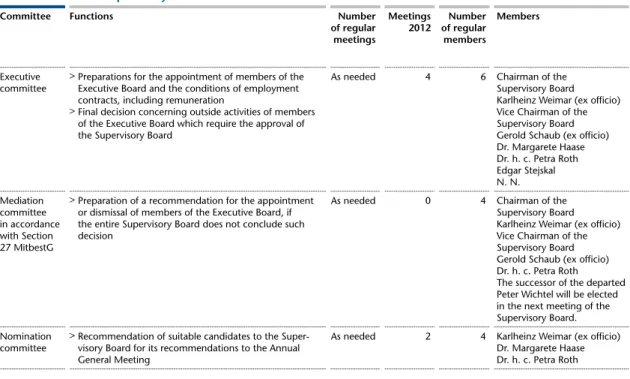
Committee Functions Number of regular meetings Meetings 2012 of regular Number members Members Executive
committee > Preparations for the appointment of members of the Executive Board and the conditions of employment contracts, including remuneration
> Final decision concerning outside activities of members of the Executive Board which require the approval of the Supervisory Board
As needed 4 6 Chairman of the Supervisory Board Karlheinz Weimar (ex officio) Vice Chairman of the Supervisory Board Gerold Schaub (ex officio) Dr. Margarete Haase Dr. h. c. Petra Roth Edgar Stejskal N. N. Mediation committee in accordance with Section 27 MitbestG
> Preparation of a recommendation for the appointment or dismissal of members of the Executive Board, if the entire Supervisory Board does not conclude such decision
As needed 0 4 Chairman of the Supervisory Board Karlheinz Weimar (ex officio) Vice Chairman of the Supervisory Board Gerold Schaub (ex officio) Dr. h. c. Petra Roth The successor of the departed Peter Wichtel will be elected in the next meeting of the Supervisory Board. Nomination
committee
> Recommendation of suitable candidates to the Super-visory Board for its recommendations to the Annual General Meeting
As needed 2 4 Karlheinz Weimar (ex officio) Dr. Margarete Haase Dr. h. c. Petra Roth
Shareholders and the Annual General Meeting
The shareholders of Fraport AG exercise their rights in the company at the Annual General Meeting and exercise their right to speak and to vote there. With sufficient time prior to the meeting, the shareholders are informed of business developments in the past year and the company’s forecasts for the following 2 years through the management report. During the year, the shareholders are provided with comprehensive and timely information about current business developments through interim reports and other company publications on its website. The Annual General Meet-ing of Fraport AG is held each year in the first 6 months of the fiscal year and makes decisions concernMeet-ing the tasks assigned to it by law, such as the appropriation of profits, elections and approving of the actions of the members of the Supervisory and the Executive Boards, the selection of the independent auditor, amendments to the Company Statutes, and other tasks. The shareholders can exercise their right to vote in person or can authorize third parties to exercise their right to vote.
Remuneration of the Executive Board and Supervisory Board
The disclosures on the essential features of the remuneration system as well as the disclosures on the remuneration of the Executive Board and the Supervisory Board can be found in a separate remuneration report. In compliance with Section 4.2.5 and Section 5.4.6 (3) GCGC, this is part of the Group notes (see note 52) and simultaneously the Group management report.
Acquisition or disposal of shares of the company
Pursuant to Section 15a of the WpHG, management and persons closely related thereto are obliged by law to disclose the acquisition or disposal of shares of Fraport AG or any financial instruments related thereto, if the value of the transactions undertaken exceeds the sum of € 5,000 within one calendar year. The notifications in this respect are disclosed by Table 9 Committees of the Supervisory Board
Group Management Report
Consolidated Financial Statements
Ground Handling
6 million additional passengers a year present new
organiza-tional, technical and logistics challenges: The new baggage conveyor system can sort an additional
5,000 pieces of baggage per hour, which are transported to their destination at a speed of up to
5 meters per second. At more than 7 kilometers in length this state-of-the-art expansion of the
existing system improves transport volume, organization and reliability.
of the Fraport Group 26
The Fraport Group 28
Business Development 2012 37
The Fraport Share and Investor Relations 50 Non-financial Performance Indicators 53 Significant Events
after the Balance Sheet Date 56
Outlook Report 57
Group Management Report
Group Management Report for the Fiscal Year 2012
The following graphics and notes provide an overview of the situation of the Group in the fiscal
year 2012 as well as a comparison with the previous years. For more detailed information, please
see the further chapters of the management report and the Group notes.
Overview of the Situation of the Fraport Group
> Growth in Frankfurt especially in intercontinental and transfer traffic
> Passenger figure in Antalya at the level of the previous year despite high comparison basis
> Continuing economic growth in Peru causes passenger figures to increase significantly again
> Solid passenger development in Burgas and Varna
> Increase in Group revenue resulting from positive business development in Germany and abroad
> Group EBITDA at all-time high mainly due to good development of operational revenue
> Group result at level of the previous year also as a result of higher tax ratio
Lima Frankfurt Antalya Burgas 0 Varna 57.5 56.4 53.0 50.9 10 20 30 40 50 60 in millions 2012 2011 2010
Passenger development at Group airports in which an interest of at least 50 % is held
25.0 25.0 22.1 11.0 13.3 11.8 10.3 8.8 2.4 2.3 1.9 1.7 1.2 1.2 1.2 1.2 2009 Graphic 5 Group result Group revenue Group EBITDA 0 € million
Development of Group revenue, Group EBITDA and Group result
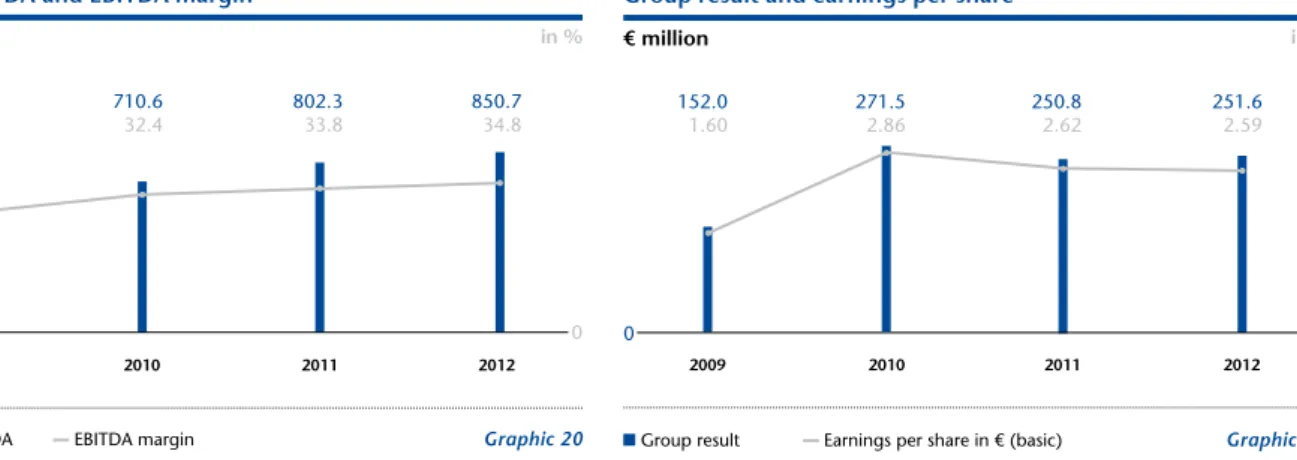
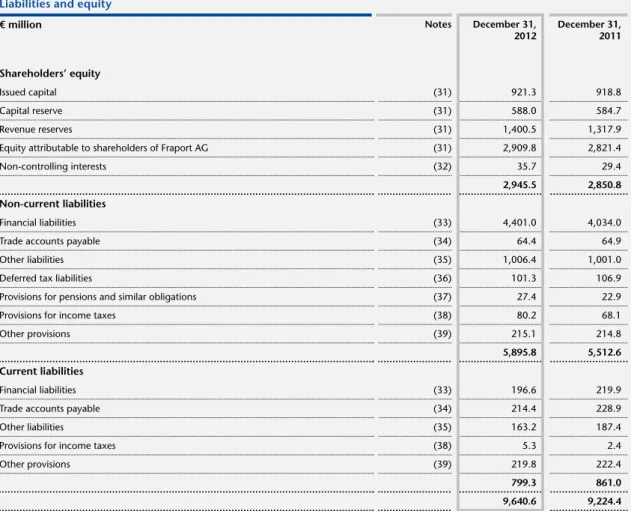
500 1,000 1,500 2,000 2,500 2012 2011 2010 2,442.0 2,371.2 2,194.6 2,010.3 850.7 802.3 710.6 569.7 251.6 250.8 271.5 152.0 2009 Graphic 6
> Outlook for 2012 essentially met
> Revenue below forecast due to lower revenue in the context of IFRIC 12, but without effect on earnings > Unchanged dividend recommendation to the Annual General Meeting (AGM)
> Operating cash flow at € 553.0 million
> Free cash flow again negative due to further capital expenditure in Frankfurt
> Slight increase in Group liquidity as a result of additional bor-rowing
> Higher net financial debt as a result of continuing high cash outflows > Gearing ratio at 105.0 %. Operating cash flow 0 500 € million 2012 2011 2010 Free cash flow Group liquidity 1) Net financial debt 1) Gearing ratio in % 1) 1,000 1,500 2,000 2,500 3,000 – 500 0 % 50 % 100 % 553.0 618.8 567.5 426.5 – 162.4 – 350.1 – 291.1 – 711.4 1,663.1 1,606.9 2,384.0 2,601.3 2,934.5 2,647.0 2,024.4 1,644.5 105.0 % 97.8 % 77.8 % 67.3 %
1) Group liquidity adjusted for accrued interest income;
for reasons of comparison, Group liquidity, net financial debt and gearing ratio of fiscal year 2011 were adjusted.
Graphic 7
Fraport Group Outlook 2012 Target attainment
Passengers in Frankfurt Growth lower than 4 % 1.9 % passenger growth
Revenue Increase above € 2.5 billion Group revenue at € 2.44 billion
Group EBITDA Increase of at least 5 % € 850.7 million (+6.0 %)
Group result About level of the previous year € 251.6 million (+0.3 %)
Dividend per share Unchanged dividend recommendation
of € 1.25 per share Stable dividend
Target/actual comparison of major forecasts for 2012
Graphic 8
Fraport Group Actual 2012 Forecast 2013
Passengers in Frankfurt 57.5 million passengers At about level of the previous year
Revenue € 2.44 billion Increase up to 5 %
Group EBITDA € 850.7 million Between € 870 million and € 890 million
Group result € 251.6 million Decrease
Dividend per share € 1.25 1) Stable dividend recommendation
Major forecasts for 2013
2009
Group Management Report
The Fraport Group
Operating Activities and Organization
A leading international Airport Group
With its international portfolio of airport investments, the Fraport Group (hereinafter also referred to as: Fraport) is among the lead-ing global airport operators. The spectrum of services of the Group comprises all aspects of flight and terminal operation, as well as the further development of airports as integrated mobility, event and real estate locations.
The Frankfurt Airport, one of the largest passenger and cargo airports in the world, is Fraport’s main location and key driver of revenue and earnings. In contrast to concession models that will expire, the Group parent company, Fraport AG Frankfurt Airport Services Worldwide (short: Fraport AG), owns and operates the Frankfurt Airport independently and with no time limits. It directly or indirectly holds the interests in the Group companies (companies pursuant to Section 313 of the German Commercial Code [HGB]) and is its largest operating company. Fraport AG is headquartered in Frankfurt am Main. In addition to the Frankfurt Air-port, the Group is involved in 12 other airports on four continents through majority or minority holdings and management contracts.
Strategic and operative responsibility at the Executive Board
The strategic and operative responsibility of the Group lies with the Executive Board of Fraport AG. In 2012, the Executive Board was composed of the members Dr. Stefan Schulte (Chairman), Herbert Mai (until September 30, 2012), Michael Müller (since October 1, 2012), Peter Schmitz and Dr. Matthias Zieschang. Since January 1,
2013, the Executive Board has been expanded by the addition of Anke Giesen. It thus is made up of the 5 members Dr. Stefan Schulte (Chairman), Anke Giesen (Executive Director Ground Handling), Michael Müller (Executive Director Labor Relations), Peter Schmitz (Executive Director Operations) and Dr. Matthias Zieschang (Executive Director Controlling and Finance).
Division of the Group into 4 segments
For the purpose of reporting and managing the Group’s results, the strategic business, service and central units have been divided into 4 segments: Aviation, Retail & Real Estate, Ground Handling and External Activities & Services.
The Aviation segment incorporates the strategic business units “Airside and Terminal Management, Corporate Safety and Security” and “Airport Security Management” at the Frankfurt site. The stra-tegic business unit “Retail and Properties,” which mainly handles retailing activities, parking facility management, as well as leasing and marketing of real estate at the Frankfurt site, is assigned to the
Retail & Real Estate segment. The Ground Handling segment comprises the strategic business unit “Ground Services” and the Group companies involved in these activities at the Frankfurt site. The “Global Investments and Management” central unit, which is mainly responsible for airport services and airport management for Group companies that are not integrated into the business pro-cesses at the Frankfurt site, is assigned to the External Activities & Services segment, as are also the service units “Facility Manage-ment”, “Information and Telecommunications” and “Corporate Infrastructure Management”, including the Group companies of all of the above.
Segments of the Fraport Group
Segment Aviation Retail & Real Estate Ground Handling External Activties & Services
Business units Airside and Terminal Management, Corporate Safety and Security Airport Security Management
Retail and Properties Ground Services Global Investments and Management Information and Telecommunications Facility Management Corporate Infrastructure Management Graphic 10 Fraport Group
In addition, 12 central units render among others Group-wide services that span departments, such as “Corporate Compliance, Risk and Values Management”, “Central Purchasing, Construction Contracts”, “Human Resources”, “Corporate Development and Sustainibility Management”, or “Finance and Investor Relations”.
Changes on the Supervisory Board
The following changes with respect to the Supervisory Board took place:
> Prof. Dr.-Ing. Katja Windt was elected by the 2012 AGM as a new member of the Supervisory Board. The professor of global production logistics from Bremen replaced Dr. Manfred Bischoff who resigned his mandate on the Supervisory Board with the conclusion of the 2012 AGM.
> On September 3, 2012, the competent trade registry court of the city of Frankfurt am Main appointed the Lord Mayor of the city of Frankfurt, Peter Feldmann, to the Supervisory Board. Peter Feldmann is assuming the mandate of Jutta Ebeling, who left the Supervisory Board as of August 31, 2012. The appointment of Peter Feldmann will initially apply until the end of the 2013 AGM. > Petra Rossbrey resigned her position on the Supervisory Board
as representative of the Senior Manager as of July 31, 2012. Dr. Roland Krieg, head of the “Information and Telecommunications” service unit, succeeded her as of August 1, 2012.
> In addition, Mario A. Bach, team leader of Group Idea Manage-ment, succeeded Peter Wichtel, who left the Board on October 4, 2012, as substitute member on October 5, 2012.
> Succeeding Prof. Klaus-Dieter Scheurle, who resigned his man-date on November 30, 2012, is State Secretary Michael Oden-wald who was appointed by court effective December 11, 2012. > Gabriel Rieken, who separated from the Supervisory Board
on January 31, 2013, was replaced on February 1, 2013 by Mr. Detlev Draths.
Group Strategy
Despite short-term unfavorable conditions, the strategy has been directed toward long-term positive market development
The strategy of the Fraport Group is based on the forecasted long-term development of global air traffic and market trends. Follow-ing significant growth in passenger traffic in fiscal years 2010 and 2011, globally weakening economic growth and in particular the results of the European debt crisis, led to a perceptible weakening of growth in the course of the year 2012. In the area of air freight volume, a softness of demand has set in primarily due to economic factors since the middle of 2011. The aviation tax and the planned emissions trading scheme in the European Union (EU) also had a dampening effect on demand.
Despite these deteriorating short-term general conditions, leading aviation associations such as Airports Council International (ACI) and the major aircraft manufacturers Airbus and Boeing, continue to expect long-term stable growth rates in global air traffic. The Fraport Group at the Frankfurt site will profit from the future growth of the market in particular due to the additional capacity resulting from the Northwest Runway, Pier A-Plus and the planned Terminal 3. In harmony with the forecast growth in air traffic, Fraport also expects long-term positive traffic development for the airport investments outside of Frankfurt.
Strategic challenges summarized in Agenda 2015
Taking these anticipated developments in global air traffic into account, the Fraport Group has described the challenges it faces in Agenda 2015, which consists of 5 areas of activity:
> Manage capital expenditure > Strengthen profitability > Increase customer satisfaction > Secure sustainability
> Utilize growth potentials
Manage capital expenditure
Strengthen
profitability Increase customer satisfaction sustainabilitySecure Utilize growth potentials
Agenda 2015
Group Management Report