UVM Honors College Senior Theses Undergraduate Theses
2016
The Impact of Full Practice Authority of Nurse
Practitioners and Resulting Patient Satisfaction
Kayleigh Ehler-VockThe University of Vermont
Follow this and additional works at:http://scholarworks.uvm.edu/hcoltheses
This Honors College Thesis is brought to you for free and open access by the Undergraduate Theses at ScholarWorks @ UVM. It has been accepted for inclusion in UVM Honors College Senior Theses by an authorized administrator of ScholarWorks @ UVM. For more information, please contact [email protected].
Recommended Citation
Ehler-Vock, Kayleigh, "The Impact of Full Practice Authority of Nurse Practitioners and Resulting Patient Satisfaction" (2016).UVM Honors College Senior Theses.Paper 130.
The Impact of Full Practice Authority of Nurse Practitioners and Resulting Patient Satisfaction
Kayleigh Ehler-Vock University of Vermont
Abstract
The purpose of this study is to assess the current understanding about the roles and abilities of
nurse practitioners (NP) with full practice authority (FPA), and to evaluate the level of patient
awareness and satisfaction related to having NP as their primary care provider (PCP). The study was a quantitative, non-experimental design including 76 participants ages 18 and older
receiving care from Appletree Bay Primary Care in Burlington, VT. Participants completed anonymous surveys and identified themselves into one of four age groups (18-49, 50-64, 65-75, 76+). Over 97 percent of participants were aware that they were seeing an NP-PCP versus a
medical doctor (MD). The questions addressing patient understanding revealed a statistically significant difference between age groups (p=0.05) when asked if they understood that the NP could perform a list of tasks without MD supervision. Participants reported high levels of satisfaction with averages ranging from 3.8-3.91 out of 4. This study showed a high level of support and satisfaction with FPA NP-PCPs at Appletree Bay, suggesting a need for continuing research on NPs with FPA to allow for findings to be generalized, supporting FPA NPs. With projected demands for PCPs to grow faster than MD workforce growth, continued research may help support endorsing NP-PCPs to be incorporated into workforce to help alleviate projected PCP shortages.
Chapter 1: Statement of the Problem
In August of 2014, seven nurse practitioners (NP) that are faculty at the University of Vermont’s College of Nursing and Health Sciences reopened Appletree Bay Primary Care as a
NP independently run clinic (Johnson, 2014). Previously run by two physicians/medical doctors (MD), the seven NP primary care providers (PCP) allowed the clinic to stay open and accept new patients when two-thirds of surrounding MD-PCPs are not accepting new patients (AHEC, 2013). This NP run clinic is unique as there are limited numbers of NP run clinics nationwide due to legislative limits on NP practice.
Vermont is one of 22 states that currently practice Full Practice authority (FPA) (AANP, 2016b), passing the law in 2011 (Professions & Occupations, 2011, §§ 28-1613). The law has added responsibilities to the scope of practice among NPs by allowing more autonomy and independence. FPA allows NPs to provide care without the direct collaboration and supervision of a MD. FPA laws allow NPs to “evaluate patients, diagnose, order and interpret diagnostic tests, initiate and manage treatments—including prescribe medications” (AANP, 2016b, para.1). In Vermont, after the advanced license is attained, the NP undergoes a transition into practice before being legally granted the independence of FPA. During the transition, the graduate NP must spend two years in the traditional collaborative arrangement with a physician, fulfilling 2,400 hours of clinical time, and maintaining all signed and dated collaborative paperwork. While each of the 22 states has variable statutes for the requirement to achieve independent practice, the end role of the NP is largely the same (AANP, 2016b).
The American Association of Nurse Practitioners (AANP) argues in favor of FPA. As access to health care is currently limited with a growing demand of care and a growing shortage of PCPs, the surge of FPA NPs may provide an answer to the problem of inadequate MD-PCPs. In a study done by the US Health Resources and Services Administration (HRSA), the
projected MD-PCP shortage is estimated to be 20,400 in 2020 (HRSA, 2013). With the
transformation of a new healthcare model including FPA NPs, the projected shortage could be significantly improved.
One challenge currently facing FPA legislature is the public perception of NPs. States and organizations, such as the Michigan Medical Society, label the bill as dangerous, arguing that NPs do not have the same education and perhaps clinical experience of a physician and should remain under physician supervision (Gorski, 2014). In such states, there is an incongruity in the ability of a NP to provide high level care and laws that limit the level of care that they are allowed to deliver. “Closing this gap between clinical preparation and regulated practice
authority will help end some of the disparities that patients encounter when they seek healthcare, and improve the quality and efficiency of care” (AANP, 2013, p.1).
While literature continues to focus on the growing need of health care, data available to report patient satisfaction regarding NP-PCP care is inconsistent. In addition, little is known about patientawareness of their PCP’s credentials as MD to a NP as well as patient
understanding of the NP’s full scope of practice. This honors college thesis will investigate the level of understanding, knowledge, and satisfaction of patients who receive their healthcare from an independent NP clinic (Appletree Bay Primary Care) in Burlington, Vermont.
Significance
In 2008, an initiative launched by The Robert Wood Johnson Foundation (RWJF) and the Institute of Medicine (IOM) sought to “respond to the need to assess and transform the nursing profession…with the purpose of producing a report that would make recommendations for an action-oriented blueprint for the future of nursing” (IOM, 2010, para.2). Shortly after this initiative, the Affordable Care Act was passed in 2010 making health care more affordable, accessible, and of higher quality to many including previously uninsured or underinsured
Americans (U.S. Department of Health & Human Services, 2015). This call to attention of current health care standards laid the framework for an overhaul of the health care system.
This honors college thesis will seek to gauge how a select number of Vermonters evaluate their care and understanding as legislation is changing to allow a greater number of eligible independent PCPs to provide full care. With the nursing profession representing the largest portion of the health care workforce at more than 3 million members (IOM, 2010), local NPs will be able to reflect on the impact of their practice and bring awareness to the potential need of greater patient education surrounding health care. Local patients will also benefit from the results, as their feedback could greatly shape Appletree Bay Primary Care’s attention to their patients’ needs. This thesis will seek to fill gaps in the literature regarding changing legislature and patient satisfaction by focusing on a small sample population of patients in Burlington, Vermont who are seeking care from a health clinic that could pave the way for future, like NP run clinics.
Purpose Statement
The purpose of this study is to assess the current understanding patients at Appletree Bay Primary Care have about the roles and abilities of NPs, and to evaluate the level of patient awareness and satisfaction related to having NP as their PCP.
Research Questions
1. What is the current level of awareness among adult patients who receive care at Appletree Bay Primary Care that their PCP has a title of NP (versus MD/physician)? 2. Do adult patients at Appletree Bay Primary Care understand a NP’s scope of practice
with FPA?
3. How satisfied are adult patients at Appletree Bay Primary Care with the care they receive from their NP PCP?
Definitions of Key Terms and Concepts
• Full Practice Authority (FPA): state laws that allow nurse practitioners to have
independence within their scope of practice (see ‘nurse practitioner’) by eliminating required physician oversight after an initial transition to practice in which a time and experience requirement is met. In Vermont, the law states:
“Graduates with fewer than 24 months and 2,400 hours of licensed active advanced nursing practice in an initial role and population focus or fewer than 12 months and 1,600 hours for any additional role and population focus shall have a formal agreement with a collaborating provider as required by board rule. APRNs shall have and maintain signed and dated copies of all required collaborative provider agreements as part of the practice guidelines. An APRN required to practice with a collaborative provider agreement may not engage in solo practice, except with regard to a role and population focus in which the APRN has met the requirements of this subsection.” (Professions &
Occupations, 2011, §§ 28-1613)
• Health literacy: an individual’s ability to obtain, process, and understand information
regarding their healthcare to make appropriate decisions to prevent or treat illness.
• Nurse practitioner (NP): an advanced practice registered nurse (APRN) who is licensed
and “prepared to assume responsibility and accountability for health promotion and/or maintenance as well as the assessment, diagnosis, and management of patient problems, including prescription of pharmacologic and non-pharmacologic interventions” (ANA, 2009, p.2).
• Patient awareness: an individual’s depth of knowledge, perception, and/or attention to a
• Patient satisfaction: an individual’s sense of having their expectations and needs fulfilled.
• Patient understanding: an individual’s level of knowledge and ability to comprehend
applicable information.
• Physician/medical doctor (MD): a provider who is educated and legally licensed to
provide all aspects of medical care (prevention, diagnosis, treatment) with complete independence or self-responsibility. Physicians can be specialists in a specific disease, generalists such as a primary care provider, or surgeons. For the purposes of this study, when referring to a physician, a generalist physician is implied and therefore a generalist’s scope of practice is implied (scope of practice does not permit surgical procedures as a surgeons scope of practice would).
• Primary care provider (PCP): health care provider that patients seek for routine, or
Chapter 2: Review of the Literature
This chapter introduces literature relevant to the purpose of this study—patient understanding, awareness, and satisfaction. It addresses FPA NPs, the growing demand for PCPs, and sections of healthcare policy.
FPA Nurse Practitioners
Currently 22 states allow NPs the authority of FPA (AANP, 2016b). NP-PCPs are
growing in popularity, such as in the 22 states, as a hopeful way to address an anticipated growth in need from patients and continued shortages of available PCPs, especially in rural areas.
Satisfaction of care. There is minimal evidence regarding FPA NPs, including patient satisfaction. However, every two of three individuals support legislation for great NP roles (AANP, 2016). Opinion papers argue that FPA NPs may cause compromised patient outcomes due to less training and education, and are not as cost effective as people believe (Jauhar, 2014). The two providers, MD and NP, have unique strengths. The AANP argues that NPs go beyond treating the illness and suggest that NPs emphasize more treating the whole person in
comparison to the traditional medical model (AANP, 2016). One patient is quoted “we haven’t found one we didn’t like yet. They’ve always been really good, really knowledgeable. They’re caring, they take more time with you, they’re more personable” (Johnson, 2014, para.18).
Demand for PCPs
The growing prevalence of NP-PCPs with full practice authority provides an opportunity to restructure the current health care delivery system. It has the potential to provide increased supply to serve populations facing an increasing shortage of MD-PCPs. According to AANP (2016), there are more than 205,000 NPs licensed in the United States, 87.2 percent of which have selected primary care as their specialty. On the other hand, in 2010 there was upwards of
850,000 licensed physicians (Young, 2011) with 205,000, or roughly 24 percent, selecting primary care positions (HRSA, 2013).
The projected concerns with primary care access are multi-faceted. While PCPs are still primarily MDs, the projection study by HRSA (2013) predicts that by 2020, the demand for primary care providers will increase by 14 percent. However, the number of MD-PCPs is projected to increase only 8 percent leaving a deficit of 20,400 MD-PCPs by 2020 (HRSA, 2013). With MD-PCP workforce slowing and at a rate lower than projected demand growth, evaluating potential alternatives becomes crucial. In the same time period that MD workforce is projected to grow 8 percent, NP-PCP workforce is projected to increase by 30 percent (HRSA, 2013). By successfully integrating NP-PCPs and even physician assistant (PA) PCPs, the projected shortage could be reduced to 6,400 providers (HRSA, 2013). The growing
discrepancies in supply and demand are directly affecting patient outcomes and related issues needs to be addressed.
Geographical discrepancies. According to the AHEC (2013), Vermont has 215 PCP sites including specialties such as family medicine, pediatrics, and obstetrics-gynecology. Servicing these clinics were 559 physicians, 150 NPs, and 83 PAs. Combining care providers to include MDs, NPs, and PAs showed an overall increase in available PCPs specifically in regions of greatest need, such as in rural Vermont counties with workforce shortage ranging from 10 to 86 percent (AHEC, 2013). On average, nearly half of available family practices, and two thirds of internal medicine providers in Vermont were closed to new patients, or extremely limited in accepting new patients. Access to care was further limited by the geographical distance to primary care clinics with many towns being surrounded by virtually no offices for miles, a primary care desert (AHEC, 2013). Southern Vermont counties such as Bennington, Rutland, Windham, and Windsor are facing the greatest need. According to the AHEC (2013), the
197,762 people in these counties are served by 70 primary care practices including 161 MDs and 85 NP and PA-PCPs. Of these practices, 46 percent of MD-PCPs were limited or closed in accepting new patients and 36 percent of NP and PA-PCPs were limited or closed to new
patients. The saturation of already inadequate numbers of practices greatly impacts access to care and resulting patient outcomes.
Affordable Care Act
In 2010, the Affordable Care Act was passed mandating widespread, comprehensive health care reforms over a four-year period. The law granted new consumer protections, improved quality of care, lowered cost of care, and increased access to care.
Quality andcost. Starting in 2010, funding was invested to increase prevention programs and public health programs at reduced cost, specifically targeted at seniors. Technology supporting integrated health systems and electronic health records were
implemented to reduce paperwork, administrative cost, and reduce medical errors. Eligibility for Medicaid and Medicare programs were redesigned to include Americans earning less than 133 percent of the poverty level ($14,000 for an individual) (US Dept. of Health & Human Services, 2015). Most recently, effective on January 1, 2015 physicians are to be paid based on patient outcomes rather than volume (U.S. Dept. of Health & Human Services, 2015). When comparing reimbursement for NPs versus MDs, insurance pays NPs 15 percent less for the same procedure performed by a MD (Jauhar, 2014).
Access. Beyond mandating that those with prior health conditions not be denied care, incentive programs were developed to expand the number of PCPs (including NPs). Those who work in underserved areas would receive funding as well as be granted loan forgiveness (U.S. Dept. of Health & Human Services, 2015). Legislature was also designed to create insurance coverage for those requiring long-term care (U.S. Dept. of Health & Human Services, 2015).
With laws both facilitating PCP growth as well as revised insurance laws, supplied funding is hopeful to stimulate increased access.
Health literacy. Health literacy is the ability to discuss and make informed decisions regarding one’s health. Only 12 percent of U.S. adults have proficient health literacy, and over 33 percent of “U.S. adults have difficulty with common health tasks, such as following direction on a prescription drug label or adhering to a childhood immunization schedule using a standard chart” (U.S. Dept. of Health & Human Services, 2008, para.3). With national health literacy at such a low level, improved access to care becomes even more crucial. African Americans had the lowest level of adults with proficient health literacy (2%), followed by Hispanics (4%). Elderly (75+) had the lowest rate of proficiency (1%), followed by ages 65-75 (5%), and ages 50-64 (12%).
Summary
While there is well-established literature on projected PCP shortages and need for healthcare reform and many opinion papers on FPA NPs, virtually no studies have been
performed to assess NP-PCPs and NPs with FPA in regards to patient satisfaction and outcomes. The purpose of this study is to begin research on levels of patient satisfaction and understanding in relation to NP-PCPs with FPA.
Chapter 3: Methods Research Design
This study was a quantitative, non-experimental design. Data were collected using an author created written survey.
Variables. The dependent variables of this study included: (1) patient satisfaction with care received from a NP-PCP, (2) patient understanding of the role of a NP, and (3) patient awareness of their PCP having the title of NP.
Data collection instrument. This study utilized a two-part survey. Part one included nine yes/no questions and part two included eight Likert scale questions. Two doctoral prepared board-certified family NPs with active programs of research established content validity. See Appendix A for survey.
Operational definitions. Patient awareness was measured by part one, question 1.
Patient understanding was measured by part one, questions 2a-2h. Lastly, patient satisfaction was measured by part two, questions 1-8.
Recruitment and Participants
The population included patients’ ages 18 and older received care from Appletree Bay Primary Care Clinic. Every patient who sought care from the clinic from June 22, 2015 until September 18, 2015 was invited to participate. Those who chose to complete the survey made up the sample population. The invitation to participate included a brief description of the study as well as what they could expect if they choose to participate. Completion of the survey indicated intent to participate and waiver of written consent. See Appendix B for the Invitation to
Ethical Considerations
Data protection. The data collected were anonymous. Completed surveys were placed into a secure box at the clinic. The researcher collected the completed surveys every 7-10
business days. Completed surveys were stored in a locked room at the researcher’s residence that was accessible only by the researcher. Survey information was entered into a spreadsheet and saved on a password-protected computer that remained the researchers possession or in the researcher’s locked room.
Participant protection. Along with data protection, participants were further protected by the minimal presence of personal identifiers included on the survey. Age was included but de-identified by using four age ranges. In the Invitation to Participate letter, participants were provided the researcher’s contact information for questions or concerns regarding their
participation. The invitation letter also addressed that their participation was voluntary and their participation, or lack thereof, would have no impact on their healthcare. Due to the minimal harm posed by the study, including lack of personal health information, consent was obtained via implied consent.
Right to withdrawal. As explained in the Invitation to Participate letter, participants had the right to withdraw from the study, without penalty, up until they submitted survey.
Procedure
1. Patient entered clinic.
2. The receptionist checked the patient in and offered the adult patient (18 years and older) a packet (including the Invitation to Participate and survey) and said “a University of Vermont Nursing Student is conducting a survey regarding patient experience with Appletree Bay Primary Care Clinic. Your participation is voluntary. It should take approximately 5-10 minutes to complete and there is a letter attached that provides more details of the study. Would you be interested in participating?”
3. The patient was able to then immediately refuse the invitation to participate or take the packet.
4. The subject read the invitation letter and either (a) decided to fill out the survey or (b) decided to return it to the receptionist or submit the empty survey.
5. At the completion of the NP-PCP visit, the subject submitted the survey into the secure box located next to the check out desk.
Chapter 4: Results
The purpose of this study was to assess the current understanding adult patients at Appletree Bay Primary Care have about the roles and abilities of NPs, and to evaluate the level of patient awareness and satisfaction related to having NP as their PCP. The purpose of this section is to summarize and analyze data.
Final Sample
Over a three-month period, all adult patients with appointments with a NP from
Appletree Bay Primary Care were invited to participate in the study. Seventy-six adult patients completed surveys. One survey was omitted due to incompletion. The only demographic characteristic obtained from the sample was participant age. Table 1 shows the sample, comprised of those ages 18-49, 50-64, 65-75, and 76 and older.
Research Questions
Three research questions guided this research: (a) What is the current level of
understanding among adult patients who receive care at Appletree Bay Primary Care that their PCP has a title of NP (versus MD/physician)? (b) Do adult patients at Appletree Bay Primary Care understand a NP’s scope of practice with FPA? And (c) How satisfied are adult patients at Appletree Bay Primary Care with the care they receive from their NP PCP?
Results
SPSS 23 was used to analyze and summarize the data. The significance level was set at
p < 0.05. Results were summarized into absolute frequency and relative frequency. Absolute frequency representing the number of times each answer occurred, and relative frequency representing the ratio of the absolute frequency to the sample size, summarized as a percentage. Table 1 (Appendix C) shows the distribution of participants’ age.
Participant awareness. The first research question concerned the level of awareness that participants’ had that they were seeing a NP as a PCP. Table 2 (Appendix D) shows the results summarized both as an entity of 75 responses as well as broken into the stratified age groups for absolute frequency and relative frequency. When observing for a possible relationship between the age of the respondent and their awareness that the provider was a NP, results suggested that the difference between age groups were not statistically significant (p = 0.18), therefore
suggesting participant age does not influence this piece of knowledge.
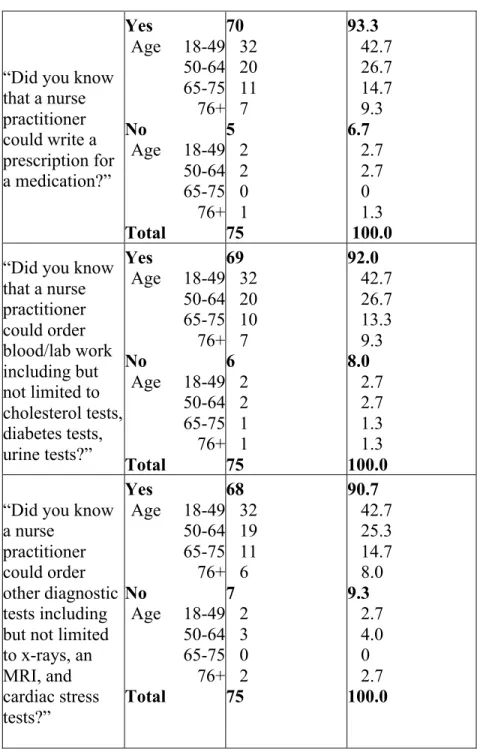
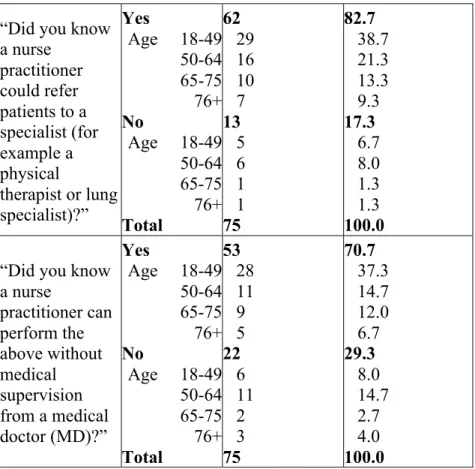
Participant understanding. The second research question evaluated participants’ understanding of the NP’s scope of practice with FPA in Vermont. Table 3 (Appendix E) shows absolute frequencies and relative frequencies for the responses in stratified age groups as well as an entity of 75 respondents. When evaluating for a possible association between the knowledge of a NP’s scope of practice and patient age, only one question suggested an association. When the participant was asked if they knew that a NP could perform various tasks without supervision from a MD, results showed a statistically significant difference between age groups (p-value = 0.5).
Participant satisfaction. The third research question evaluated patient satisfaction with the care provided at Appletree Bay Primary Care. Table 4 (Appendix F) shows frequencies and relative frequencies for the corresponding questions. Average satisfaction ranged from 3.8-3.91 out of 4.
Chapter 5: Discussion
Our healthcare system faces a significant deficit of primary care providers and with little projected increase in PCP-MDs, NPs with FPA could be integrated into solution. Three research questions guided this research: (a) What is the current level of awareness among adult patients who receive care at Appletree Bay Primary Care that their PCP has a title of NP (versus
MD/physician)? (b) Do adult patients at Appletree Bay Primary Care understand a NP’s scope of practice with FPA? And (c) How satisfied are adult patients at Appletree Bay Primary Care with the care they receive from their NP-PCP?
Findings
While satisfaction with NPs was not compared against satisfaction with MDs, a high level of satisfaction with NP-PCPs was found, echoing what Johnson (2014) found. The lowest area of satisfaction was in response to, “I feel my care provider explains my conditions clearly,” rating at 86.7 percent. One possibility for this the low health literacy rates across the US, with only 12 percent of adults having proficient health literacy (U.S. Dept. of Health & Human Services, 2008). The greatest area of satisfaction was in response to “I feel my care provider is competent,” rating at 96 percent. This result is very interesting because the root argument against NP-PCPs is compromised patient outcomes from lower levels of education and clinical
experience when compared to MDs (Gorski, 2014).
Over 97 percent of participants stated that they were aware of their PCP’s NP credentials. This may have been influenced by the attention and support that the clinic received when it became an NP run clinic, therefore increasing patient awareness. The 2.7 percent of participants that stated they were not aware of their PCP being an NP were both in the age range of 50-64. It is interesting to speculate reasons that this may be. The U.S. Department of Health & Human Services (2008) found that among the age groups of 50-64, 65-75, and 76+, the age range 50-64
had the greatest level of literacy. This is not to imply that health literacy necessarily influences awareness of a provider’s credentials, however it is a consideration.
Evaluating participants’ reported understanding of an NP’s scope of practice, stratified by age provided some unique findings. While there were a vast number of affirmative responses to questions about NP abilities, when asked, “did you know a nurse practitioner can perform the above without medical supervision from a medical doctor (MD)?” not only were there the lowest number of affirmative responses (70.7%), but the differences across age groups was statistically significant (p=0.05). This question directly evaluated the participants’ understanding of FPA and the age group 50-64 had the highest relative frequency of negative answers, suggesting that ages 50-64 have the lowest level of understanding, or knowledge, of the NP’s scope of practice with FPA. Due to the incongruent sample sizes of age groups, and overall small sample size, these results may have affected the relative frequencies of the age groups.
Strengths
Content validity of the survey was established by two doctoral prepared board-certified family nurse practioners with active programs of research. Furthermore, using an anonymous survey allowed for candid responses.
Limitations
Both a small sample size and data collection at one location only limits the ability to generalize findings beyond this clinic. Additionally, due to the minimal identifying factors to ensure participant confidentiality, it was difficult to explore similarities and differences amongst demographics other than age. With an anonymous survey certainty of who completed the survey cannot be established.
Future Research
Future research should include more clinics with NP-PCPs. Trending geographical location and access to providers in relation to population may also be helpful in evaluating efficacy of integrating FPA NP-PCPs to help mitigate projected provider shortage. Also, evaluating patient satisfaction with NPs in specialties other than primary care may provide additional insight. Lastly, methodology could grow include adolescents participants.
Conclusion
Over 97 percent of participants stated that they were aware they were seeing an NP-PCP versus a MD-PCP. While the majority of participants reported they understood NP’s scope of practice, only 70.7 percent of participants, the lowest reported level of understanding, reported they understood that the NP could perform the list of tasks without MD supervision. The difference of understanding for this question was statistically significant between age groups (p=0.05). Lastly, participants reported high levels of satisfaction with averages ranging from 3.8-3.91 out of 4.
With an outpour of satisfaction with NP-PCPs from Appletree Bay Clinic, continued research on NPs with FPA is needed to allow for findings to be generalized, endorsing FPA NPs. With demands for PCPs projected to grow faster than MD-PCP workforce, continued research may also help evaluate the efficacy of incorporating FPA NP-PCPs to help alleviate the shortage.
References
American Association of Nurse Practitioners (AANP). (2013). Issues at-a-glance: full practice authority. The Voice of the Nurse Practitioner. Retrieved from
https://www.aanp.org/aanpqa2/images/documents/policy-toolbox/fullpracticeauthority.pdf
American Association of Nurse Practitioners (AANP). (2016). What is an NP. All about NPs. Retrieved from https://www.aanp.org/all-about-nps/what-is-an-np
American Association of Nurse Practitioners (AANP). (2016b). State practice environment. Retrieved from https://www.aanp.org/legislation-regulation/state-legislation/state- practice-environment/66-legislation-regulation/state-practice-environment/1380-state-practice-by-type
American Nurses Association (ANA). (2009). Consensus model for APRN regulation: licensure, accreditation, certification, and education. Retrieved from:
http://www.nursingworld.org/cmissuebrief
Area Health Education Centers Program (AHEC). (2013). The Vermont primary care workforce, 2013 snapshot. Retrieved from
http://www.uvm.edu/medicine/ahec/documents/AHEC2013PCReport2014_01_28_001.p df
Gorski, D. (2014, January 6). Expanding the scope of practice of advanced practice nurses will not endanger patients. Retrieved from http://www.sciencebasedmedicine.org/expanding-the-scope-of-practice-of-advanced-practice-nurses-does-not-endanger-patients/
Health Resources and Services Administration (HRSA). (2013). Projecting the supply and demand for primary care practitioners through 2020. Rockville, Maryland: U.S. Department of Health and Human Services. Retrieved from
http://bhpr.hrsa.gov/healthworkforce/supplydemand/usworkforce/primarycare/
Institute of Medicine (IOM). (2010). The future of nursing: leading change, advancing health.
Washington, DC: The National Academies Press. Retrieved from
http://www.iom.edu/Reports/2010/The-Future-of-Nursing-Leading-Change-Advancing-Health.aspx
Jauhar, S. (2014, April 30). Nurses are not doctors. New York Times. Retrieved from http://www.nytimes.com/2014/04/30/opinion/nurses-are-not-doctors.html
Johnson, T. (2014, August 30). New healthcare model tested in Burlington. Burlington Free Press. Retrieved from
http://www.burlingtonfreepress.com/story/news/local/2014/08/30/new-health-care-model-tested-burlington/14809133/
Professions & Occupations, 4 V.S.A. §§ 28-1572-1613 (2011).
U.S. Department of Health & Human Services. (2008). America’s health literacy: why we need accessible health information.Retrieved from
http://www.health.gov/communication/literacy/issuebrief/
U.S. Department of Health & Human Services. (2015). Key features of the Affordable Care Act.
Appendix A Survey PART 1: Please circle YES or NO
Are you aware that the care provider you saw today is a Nurse Practitioner? YES / NO 1. Did you know that a nurse practitioner could:
a. Be your primary care provider? YES / NO
b. Take care of your healthcare needs when you are sick? YES / NO
c. Manage ongoing, or chronic conditions? (ex. depression, asthma, diabetes) YES / NO d. Write a prescription for a medication? YES / NO
e. Order blood/lab work including but not limited to cholesterol tests, diabetes tests, urine tests? YES / NO
f. Order other diagnostic tests including but not limited to x-rays, an MRI, and cardiac stress tests? YES / NO
g. Refer patients to a specialist (for example a physical therapist or lung specialists)? YES / NO
h. Perform the above without medical supervision from a Medical Doctor (MD)? YES / NO
PART 2: Please rate the degree to which you agree with the following statements as 1 (completely disagree), 2 (somewhat disagree), 3 (somewhat agree), or 4 (completely agree) IN REFERENCE TO THE CARE PROVIDER YOU SAW TODAY AT APPLETREE BAY CLINIC.
1. I feel that my care provider listens to me
1 2 3 4
2. I feel my care provider is knowledgeable about my health
1 2 3 4
3. I feel my care provider answers my questions
1 2 3 4
4. I feel my care provider explains my condition clearly
1 2 3 4
5. I feel my care provider explains ways that I can self-manage my health 1 2 3 4
6. I feel my provider spends an appropriate amount of time with me
1 2 3 4
7. I feel my care provider is competent 1 2 3 4
8. Overall, I am satisfied with the care I receive
1 2 3 4
Appendix B Invitation To Participate Dear Appletree Bay Clinic Patient:
My name is Kayleigh Ehler-Vock and I am a student nurse at the University of Vermont. I am currently enrolled in the Honors College and I am conducting a research study entitled “The Impact of Full Practice Authority on Public Perception of Nurse Practitioners and the Resulting Patient Satisfaction”. The purpose of this study is to investigate how patients at Appletree Bay Primary Care Clinic perceive their care.
You are receiving this letter because you are a patient at Appletree Bay Primary Care Clinic. This letter serves as an invitation to participate in a research study. Your participation is
voluntary. If you choose to not participate, there will be no negative effects on the healthcare you receive.
Participation in this study involves completing a one-time survey, which should take about 10 minutes to complete. This research study will occur through September 18, 2015. The risks of your participation are minimal. You will not be asked for any identifying information beyond indicating the age range that most closely defines you. Your participation will help to identify the rate of satisfaction among patients at Appletree Bay Primary Care Clinic. Results of the study may be presented, published, or used for educational purposes.
You will be asked to answer nine yes/no questions and eight questions where you will circle the number that most closely relates to your degree of agreement. The only demographic information will be identifying with one of four age groups. You have a right to withdraw from participating in this study up until your survey is placed into the secure survey response box, as then there is no way to identify who completed what survey. Again, the completion of the survey is
completely voluntary.
If you have any questions concerning your participation in the study, please contact me by phone at (802) 324-1617 or by email at [email protected]. You may also contact my thesis advisor, Dr. Marcia Bosek at (802) 879-1697 or by email at [email protected]. By completing this survey, you are giving your consent to participate. Please keep this information sheet for your records. Thank you for your time and consideration of participation.
Sincerely,
Kayleigh Ehler-Vock
University of Vermont Nursing student [email protected]
Appendix C Table 1 Distribution of Respondents’ Age Within Sample
Age in Years Absolute Frequency Relative Frequency (%) 18-49 50-64 65-75 76+ Total 34 22 11 8 75 45.3 29.3 14.7 10.7 100.0
Appendix D Table 2 Respondents’ Awareness of NP as PCP
Question Response Absolute
Frequency Relative Frequency (%) “Are you aware that the care provider you saw today is a nurse practitioner?” Yes Age 18-49 50-64 65-75 76+ No Age 18-49 50-64 65-75 76+ Total 73 34 20 11 8 2 0 2 0 0 75 97.3 45.3 26.7 14.7 10.7 2.7 0 2.7 0 0 100
Appendix E
Table 3 Frequencies and Relative Frequencies for Respondents’ Understanding of NP Scope of Practice
Question Response Absolute
Frequency
Relative Frequency (%)
“Did you know that a nurse practitioner could be your primary care provider?” Yes Age 18-49 50-64 65-75 76+ No Age 18-49 50-64 65-75 76+ Total 69 32 18 11 8 6 2 4 0 0 75 92.0 42.7 24.0 14.7 10.7 8.0 2.7 5.3 0 0 100.0
“Did you know that a nurse practitioner could take care of your
healthcare needs when you are sick?” Yes Age 18-49 50-64 65-75 76+ No Age 18-49 50-64 65-75 76+ Total 74 34 21 11 8 1 0 1 0 0 75 98.7 45.3 28.0 14.7 10.7 1.3 0 1.3 0 0 100.0
“Did you know that a nurse practitioner could manage ongoing, or chronic conditions? (ex. Depression, asthma, diabetes)” Yes Age 18-49 50-64 65-75 76+ No Age 18-49 50-64 65-75 76+ Total 68 30 21 9 8 7 4 1 2 0 75 90.7 40.0 28.0 12.0 10.7 9.3 5.3 1.3 2.7 0 100.0
Table 3 continued
“Did you know that a nurse practitioner could write a prescription for a medication?” Yes Age 18-49 50-64 65-75 76+ No Age 18-49 50-64 65-75 76+ Total 70 32 20 11 7 5 2 2 0 1 75 93.3 42.7 26.7 14.7 9.3 6.7 2.7 2.7 0 1.3 100.0
“Did you know that a nurse practitioner could order blood/lab work including but not limited to cholesterol tests, diabetes tests, urine tests?” Yes Age 18-49 50-64 65-75 76+ No Age 18-49 50-64 65-75 76+ Total 69 32 20 10 7 6 2 2 1 1 75 92.0 42.7 26.7 13.3 9.3 8.0 2.7 2.7 1.3 1.3 100.0
“Did you know a nurse
practitioner could order other diagnostic tests including but not limited to x-rays, an MRI, and cardiac stress tests?” Yes Age 18-49 50-64 65-75 76+ No Age 18-49 50-64 65-75 76+ Total 68 32 19 11 6 7 2 3 0 2 75 90.7 42.7 25.3 14.7 8.0 9.3 2.7 4.0 0 2.7 100.0
Table 3 continued
“Did you know a nurse practitioner could refer patients to a specialist (for example a physical therapist or lung specialist)?” Yes Age 18-49 50-64 65-75 76+ No Age 18-49 50-64 65-75 76+ Total 62 29 16 10 7 13 5 6 1 1 75 82.7 38.7 21.3 13.3 9.3 17.3 6.7 8.0 1.3 1.3 100.0
“Did you know a nurse practitioner can perform the above without medical supervision from a medical doctor (MD)?” Yes Age 18-49 50-64 65-75 76+ No Age 18-49 50-64 65-75 76+ Total 53 28 11 9 5 22 6 11 2 3 75 70.7 37.3 14.7 12.0 6.7 29.3 8.0 14.7 2.7 4.0 100.0
Appendix F
Table 4 Frequencies and Relative Frequencies of Respondents’ Satisfaction
Question Response Absolute
Frequency
Relative Frequency (%) “I feel that my
care provider listens to me” Completely disagree Somewhat disagree Somewhat agree Completely agree Total 2 0 2 71 75 2.7 0 2.7 94.7 100.0 “I feel my care
provider is knowledgeable about my health” Completely disagree Somewhat disagree Somewhat agree Completely agree Total 2 0 3 70 75 2.7 0 4.0 93.3 100.0 “I feel my care
provider answers my questions” Completely disagree Somewhat disagree Somewhat agree Completely agree Total 2 0 4 69 75 2.7 0 5.3 92.0 100.0 “I feel my care
provider explains my conditions clearly” Completely disagree Somewhat disagree Somewhat agree Completely agree Total 2 1 7 65 75 2.7 1.3 9.3 86.7 100.0 “I feel my care
provider explains ways that I can self-manage my health” Completely disagree Somewhat disagree Somewhat agree Completely agree Total 3 1 2 69 75 4.0 1.3 2.7 92.0 100.0 “I feel my provider spends an appropriate amount of time with me” Completely disagree Somewhat disagree Somewhat agree Completely agree Total 2 0 2 71 75 2.7 0 2.7 94.7 100.0 “I feel my care
provider is competent” Completely disagree Somewhat disagree Somewhat agree Completely agree Total 2 0 1 72 75 2.7 0 1.3 96.0 100.0 “Overall, I am
satisfied with the care I receive” Completely disagree Somewhat disagree Somewhat agree Completely agree Total 2 0 2 71 75 2.7 0 2.7 94.7 100.0