Volume 12 Issue 1 Article 5
5-28-2020
In-Service Biology Teachers’ Perceptions and Pedagogical Rating
In-Service Biology Teachers’ Perceptions and Pedagogical Rating
of Two Mobile Learning Applications Recommended for Learning
of Two Mobile Learning Applications Recommended for Learning
Biology in Nigerian Secondary Schools
Biology in Nigerian Secondary Schools
Uchenna Udeani ProfUniversity of Lagos, Akoka., [email protected] Jeremiah Nosakhare Akhigbe Mr
University of Lagos, Akoka., [email protected]
Follow this and additional works at: https://digitalcommons.kennesaw.edu/ajis
Part of the Curriculum and Instruction Commons, Management Information Systems Commons, Science and Mathematics Education Commons, and the Secondary Education and Teaching Commons Recommended Citation
Recommended Citation
Udeani, Uchenna Prof and Akhigbe, Jeremiah Nosakhare Mr (2020) "In-Service Biology Teachers’ Perceptions and Pedagogical Rating of Two Mobile Learning Applications Recommended for Learning Biology in Nigerian Secondary Schools," The African Journal of Information Systems: Vol. 12 : Iss. 1 , Article 5.
Available at: https://digitalcommons.kennesaw.edu/ajis/vol12/iss1/5 This Article is brought to you for free and open access by
DigitalCommons@Kennesaw State University. It has been accepted for inclusion in The African Journal of
Information Systems by an authorized editor of
DigitalCommons@Kennesaw State University. For more information, please contact
In-Service Biology Teachers’
Perceptions and Pedagogical
Rating of Two Mobile
Learning Applications
Recommended for Learning
Biology in Nigerian
Secondary Schools
Research Paper
Volume 12, Issue 1, May 2020, ISSN 1936-0282 Uchenna Udeani
University of Lagos, Akoka
Jeremiah Nosakhare Akhigbe
University of Lagos, Akoka
(Received April 2019, accepted December 2019)
ABSTRACT
The study investigated in-service biology teachers’ perceptions of the instructional use of smartphones equipped with Biology Mobile Learning Applications (BMLAs) in the learning of biology concepts in Nigerian senior secondary schools and the pedagogical rating of two commercially available mobile learning applications recommended for learning biology. The study utilized a descriptive survey design. Data collected were analyzed using descriptive and inferential statistics. Findings gathered revealed that the in-service biology teachers had good perceptions of the instructional use of BMLAs and that these perceptions influence their pedagogical rating and selection of mobile applications. The study also revealed that demographic variables such as gender and years of professional teaching experience do not have any significant effect on biology teachers’ perceptions of the instructional use of mobile
applications and in the pedagogical rating of the BMLAs respectively. The implications of these findings for a mobile-enabled biology curriculum development were discussed extensively.
Keywords
INTRODUCTION
The use of mobile learning devices has been increasing exponentially (Ally, 2013). The evolution of smart phones has prompted an increase in the use of mobile learning (m-learning) platforms for
educational purposes. With the prevalence of mobile devices among the younger population, especially students, mobile and digital learning is gradually becoming a trend in education (Cheon, Lee, Crooks, & Songs, 2012; Kalinic, Arsovski, Stefanovic, Arsovski, & Rankovic, 2011; Park, Nam, & Cha, 2012; Zydney & Warner, 2015). Mobile learning refers to any form of learning facilitated by handheld mobile devices (Kearney, Schuck, Burden, & Aubusson, 2012; Wu, Wu, Chen, Kao, Lin, & Huang, 2012). Mobile learning creates an environment that allows access to teaching and learning materials and
resources regardless of time and location (Cobcroft, Towers, Smith, & Bruns, 2006; Sandler, Romine, & Menon, 2015). Mobile learning has become a major requirement in formal and informal education and it is a paradigm shift towards lifelong learning, students' centered pedagogy, and constructivist learning (Motiwalla, 2007; Sha, Looi, Chen, & Zhang, 2012). A variant of m-learning incorporates the use of mobile applications (apps), a software that runs on small program files which can be downloaded from application stores such as Google, Apple and Educational application stores to personal mobile devices such as smart phones and tablets. Mobile applications provide easy access to resources and interactive features such as games, quizzes, encyclopedias, and other resources that facilitate the learning and sharing of educational contents (Vogel, Kennedy, Kuan, Kwok, & Lai, 2007). Although students could have access to a large number of mobile applications from the respective scientific disciplines, however, the widespread, effective, and applicable use of mobile learning technologies in education has not yet been fully actualized (Milrad, Wong, Sharples, Hwang, Looi, & Oguta, 2013; Teri, Acai, Griffith, Mahmoud, David, & Newton, 2013). A recurring argument in learning literature emphasizes that m-learning should not attempt to replace traditional education but should rather complement it. This can be achieved by deploying it as a pedagogical tool in the teaching and learning of concepts (Macdonald & Chiu, 2011; Wu et al., 2012). Students and teachers can, however, be limited in their ability to carry out these functions because most mobile applications used in science teaching and learning were developed by researchers, and as a result, are not easily accessible to students and the public (Zydney & Warner, 2015). Furthermore, teachers and students need to be cognizant of new approaches to the management of instruction and the pedagogical strategy needed to infuse educational content unto mobile devices (Khaddage, Christensen, & Knezek, 2015).
The increasing number of mobile applications in education and its availability calls for the need to evaluate the efficacy of these applications as learning tools in formal education in order to validate the feasibility of their development and their use in an educational context (Teri et al., 2013). A major challenge confronting the use of commercially available educational applications is that not all the mobile learning applications are developed in line with the traditional school curriculum or specific course modules (Khaddage, Christensen, Lai, Knezek, Norris, & Soloway, 2015; Khaddage & Lattemann, 2013). Hence, there is an attempt to standardize the mobile applications evaluation procedure and to develop a common language structure for their evaluation. The effort to achieve standardization calls for the utilization of mobile application evaluation rubrics (Green, Hechter, Tysinger, & Chassereau, 2014). There is also a need to conduct more research on the use of
commercially available mobile applications developed outside the research community, since teachers are more inclined to use them in the classroom (Zydney & Warner, 2015).
Teachers can leverage the potential of mobile technologies to design classroom instructions, facilitate active classroom interactions and social environment, and expand their teaching repertoires to achieve educational goals (Sutherland, Armstrong, Barnes, Brawn, Breeze, & Gall, 2014). However, for mobile
technologies to be fully deployed as pedagogical tools, teachers’ perceptions and acceptance of educational innovations play a critical role in the successful adoption and implementation of mobile learning strategy (Ismail, Azizan, & Azman, 2013). Teachers’ beliefs about technology are an important predictor of their acceptance of technology and their willingness to adopt and use the technology as an instructional tool (Celik & Yusilyurt, 2013; Chen, 2010; Kim, Kim, Lee, Spector, & De Meester, 2013). A survey of the Nigerian mobile learning environment revealed that Nigeria has an adequate
infrastructure that can support mobile learning and that learners are willing to use mobile devices for learning purposes (Adedoja, Adelore, Egbokhare, & Oluleye, 2013; Adedoja, Botha, & Ogunleye, 2012; Oyelere, Suhanen, & Sutinen, 2016). A number of programs also have been initiated to make
m-learning accessible to students. For instance, the “Tablet of Knowledge" initiative, the New Educational Partnership for Africans' Development (NEPAD) e-school, the One Laptop Per Child (OLPC) initiative, and the Interactive Child Learning Aid Project (i-CLAP) for Nigerians have been enacted to support mobile learning (Azi, Nkom, & Scheweppe, 2012). Notwithstanding, the potential of mobile learning is yet to be realized fully in a typical Nigerian classroom (Oyelere et al., 2016). Studies on the use of commercially available mobile applications, such as Biology Mobile Learning Applications (BMLAs) in formal teaching and learning of biology at the secondary school context in Africa and in diaspora, are scanty.
This study therefore explores the potential and efficacy of BMLAs as pedagogical tools, with specific reference to teachers’ perceptions of the instructional use of mobile applications and the pedagogical rating of these mobile learning applications. In this study, in-service biology teachers rated two commercially available Biology Mobile Learning Applications (BMLAs) recommended for learning biology using the Mobile App Selection for Science (MASS) evaluation rubric developed by Green, Hechter, Tysinger, and Chassereau (2014). Teachers rated the selected BMLAs based on how the content of the mobile learning applications aligned with the traditional school curriculum and certain features of the BMLAs that makes it appropriate for the teaching and learning of biology in Nigerian secondary schools.
THEORETICAL FRAMEWORK
M-learning can be assessed through various theoretical perspectives and frameworks, such as authentic learning, action learning, experiential learning, and activity-based learning (Sharples, Taylor, &
Vavoula, 2007). The m-learning pedagogical framework developed by Kearney et al. (2012) underpins the use of mobile applications, such as BMLAs in the teaching and learning of biology. The m-learning pedagogical framework specifies the major characteristics of m-learning to be authenticity,
personalization, and collaboration. This framework draws on the basic principles of socio-cultural theory put forward by Vygotsky (1978). The socio-cultural theory posits that learning is a social process with meaning negotiated from multiple perspectives. Mobile learning applications can be used to create an interactive learning environment grounded in real world context (Kearney et al., 2012). It also affords students opportunities for self-paced and self-regulated learning suited to their personal needs
(Mcloughlin & Lee, 2008; Cochrane, 2014). Evidence gathered from previous studies also supports the view that mobile learning applications can be used to achieve the desired educational goals and learning outcomes (Jeno, Grytnes, & Vandvik, 2016; Teri et al., 2013). The m-learning pedagogical framework informed the development of the instrument titled “Mobile Application Selection for Science” (MASS) evaluation rubric by Green et al. (2014). The MASS evaluation rubric is a valid instrument specifically designed for the pedagogical rating of mobile learning applications. The MASS instrument consists of the following subscales: accuracy, relevance of content, sharing of findings, provision of feedback, promotion of scientific inquiry and practices, and easiness of navigation. These subscales serve as the
criteria under which mobile applications are evaluated for their pedagogical appropriateness. In this study, the MASS evaluation rubric was utilized as an instrument that aids teachers’ pedagogical rating and evaluation of the BMLAs recommended for learning biology.
Description of the Biology Mobile Learning Applications (BMLAs)
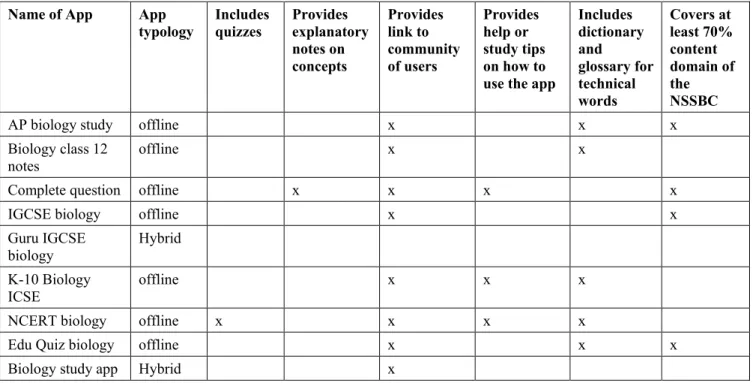
The study utilized two commercially available mobile learning applications that can be downloaded from Google play, educational application stores, and other android operating system (OS) services. The mobile applications were selected from a large repository of mobile applications available on the iOS application store and Google play. An initial extensive search conducted on these databases yielded 156 applications in a single search. Nine mobile learning applications were thereafter selected from the search results based on the following inclusion criteria: (a) free mobile application; (b) covers at least 70% of the content domains in the Nigerian Senior Secondary Biology Curriculum (NSSBC); (c) have a four-star application rating and above; (d) either a hybrid (i.e., can be used with or without Internet connectivity) or a native (i.e., used offline) application; and (e) language used in the mobile application is English. Table 1 below specifies the other application features that were used to narrow down the applications to the two mobile learning applications used in the study.
Table 1. Biology Mobile Learning Application Features
The applications originally named Guru IGCSE Biology Mobile Application and Biology Study
Application were tagged BMLA 1 and BMLA 2 respectively for convenience. BMLA 1 is developed by Guru Applications limited, a company based in Malaysia. BMLA 1 is classified as a hybrid application because it combines both characteristics of native and web applications (Boulos, Wheeler, Tavares, & Jones, 2011; Khaddage & Cosio, 2014; Korf & Oksman, 2012). Native applications are offline or off the web applications that can be downloaded and installed directly onto mobile phones. Mobile web
applications, on the other hand, are accessible only through web browsers. The BMLA 1 has interactive features, such as practice questions, link to YouTube video tutorials, slides share, Ecards, and a
download center to help students with their study. A distinctive feature of BMLA 1 is its practice
Name of App App
typology Includes quizzes Provides explanatory notes on concepts Provides link to community of users Provides help or study tips on how to use the app
Includes dictionary and glossary for technical words Covers at least 70% content domain of the NSSBC
AP biology study offline x x x
Biology class 12
notes offline x x
Complete question offline x x x x
IGCSE biology offline x x
Guru IGCSE
biology Hybrid K-10 Biology
ICSE offline x x x
NCERT biology offline x x x x
Edu Quiz biology offline x x x
questions. BMLA 1 has over 800 multiple choice questions which are organized under 21 headings that cover the major concepts in biology. The application also provides students with the opportunity to review quizzes under the major concepts in biology. BMLA 1 has a timer that indicates to learners the time spent on a biology quiz challenge. It has audio features that make two distinct sounds when the correct or wrong answer options are selected when taking the biology quiz. BMLA 1 provides a review and congratulatory message on the quiz results and students’ overall performance. It also embeds features that allow students to share quiz results on social media platforms or view the leaderboard. BMLA 2 is also a hybrid application and a learning management system. It was developed originally for biology science majors in open distant education in the United States. Similar to BMLA 1, the
application can be downloaded from the Google play store and other android OS services. BMLA 2 incorporates critical thinking and clicker questions to help students understand and apply key concepts in biology. The application interface consists of a dashboard, a study column, and a practice column. The application covers eight major themes in biology organized under 256 lessons, 47 quizzes, and 440 flashcards. The quiz section of the application has over 676 practice multiple-choice questions covering the eight major themes in Biology. BMLA 2 also includes a glossary of about 2,350 words.
RESEARCH QUESTIONS
Based on the purpose of the study, the following research questions were formulated:
RQ1: What are the perceptions of in-service biology teachers on the pedagogical use of biology mobile learning applications?
RQ2: How do in-service biology teachers rate two commercially available biology mobile learning applications recommended for learning biology?
RQ3: What is the influence of gender on in-service biology teachers’:
a. perceptions on the pedagogical use of biology mobile learning applications.
b. pedagogical rating of the biology mobile learning applications recommended for learning biology.
RQ4: What is the influence of years of professional teaching experience on in-service biology teachers’: a. perceptions on the pedagogical use of biology mobile learning applications.
b. pedagogical rating of the biology mobile learning applications recommended for learning biology.
RQ5: What is the relationship between in-service biology teachers’ perceptions on the pedagogical use of mobile applications recommended for learning biology and the pedagogical rating of these
applications?
METHODOLOGY
Participants and design
The study incorporated the use of quantitative research method within the blueprint of descriptive survey research design. The participants in the study consisted of 32 in-service biology teachers drawn from public senior secondary schools domiciled in Lagos Island local government area of Lagos state, Nigeria. This sample size constitutes a small proportion of biology teachers drawn from a population of 648 biology teachers in Lagos state. This is because only a small proportion of secondary schools in Lagos state operate at the application stage of ICT integration in the classroom based on the United
Nations Educational, Scientific, and Cultural Organization stages of ICT adoption and use (UNESCO, 2010). Hence, very few secondary schools in Lagos state have ICT availabilty, such as computers, projectors, and Internet connectivity installed in classrooms where teachers are actively using them in instructional delivery. Biology teachers were recruited from ICT-compliant schools and used as the study sample. A convenient sampling technique was used to recruit teachers who were accessible and willing to participate in the study (Onwuegbuzie & Collins, 2007). Seventeen (53.1%) of the study’s respondents were male and fifteen (46.9%) were female. The biology teachers had professional teaching experience ranging from below 5 years (12.5%), 5-10 years (50.0%), and above 10 years (37.5%). In Nigeria, the teaching profession is regulated by the Teachers Registration Council of Nigeria (TRCN). Based on TRCN mandate, a professional teacher must have had formal training, or acquired a degree in the field of education, or must have undergone a mandatory one-year teacher certification course to be registered as a teacher. Hence, the study also ensured that only teachers who met these standards were included in the sample.
A pre-survey instrument that was administered and returned revealed that all the participants had handheld mobile devices, such as tablets and smart phones, and were proficient in the use of these devices and with their application software. The teachers were also proficient in the integration and instructional use of ICT in the classroom.
Instruments
The Technology Acceptance Model (TAM) Questionnaire and Mobile App Selection for Science (MASS) rubric were utilized as instruments for data collection. The Technology Acceptance Model (TAM) questionnaire revised by Chen and Huang (2010) was adopted in this study. The TAM
questionnaire was used to gather data on biology teachers’ perceptions regarding the pedagogical use of the BMLAs. The TAM questionnaire validated by Chen and Huang (2010) was derived from the original version by David (1985) and the subsequent version by Vankatesh and David (2000). This questionnaire consists of 11 items under a 7-point Likert scale, and with the variables of perceived usefulness (PU), perceived ease of use (PEOU) and behavioral intentions (BI). TAM is a valid
instrument with a Kaiser-Mayer-Olkin (KMO) value of 0.868, which indicates an excellent correlation among the variables. The approximate chi-square value for the Bartletts’ test of sphericity is 868.336, which is also significant (p< .001). The Principal Component Analysis (PCA) of all the items in the TAM instrument have reliability coefficients that range from 0.7- 0.88, while the sub categories of PU, PEOU, and BI have coefficients of 0.854, 0.855, and 0.916, respectively (Chen & Huang, 2010). In this study, the overall Cronbach’s alpha reliability coefficient of the TAM instrument was 0.78.
The MASS evaluation rubric developed by Greene et al. (2014) was used to collect data on biology teachers’ rating of the BMLAs for their pedagogical appropriateness. The MASS evaluation rubric consisted of 14 items grouped under six different categories which include measures of: accuracy, relevance of content, sharing of findings, the provision of feedback, promotion of scientific inquiry and practices, and easiness of navigation. All these factors were measured on a 4-point Likert scale, that is, Non-applicable (N)=1, Unacceptable (U)=2, Acceptable (A)=3, and Target (T)=4, respectively. The target option refers to mobile application features that match each evaluation criterion specified in the MASS rubric. The MASS evaluation rubric used for this study is a standard evaluation rubric with divergent and concurrent validity (Green et al, 2014). The Cronbach’s alpha reliability coefficient of the MASS evaluation rubric was 0.85.
Procedure
The teachers were briefed on the purpose of the study, after which the researchers solicited their participation in the study. The BMLAs were installed onto the Biology teachers’ personal mobile devices three weeks before they completed the TAM questionnaire and the MASS evaluation rubric questionnaire. A three-week period was considered appropriate for debriefing and training because the teachers were immersed with the responsibility of ensuring adequate coverage of the curriculum and preparation of their students for examination. Thus, it was not practical to commit teachers to a much longer training period for a non-certificate or professional development course (Jong, 2016). Hence, the official schools’ holiday period was utilized for training teachers for a period of three weeks. During this period, the teachers received intensive training on how to incorporate the BMLAs into classroom
instruction. This involved the use of BMLAs in concept inventory, personal learning management systems, scientific inquiry, and formative and summative assessment. The teachers were encouraged to explore features of the BMLAs and to design sample lessons that incorporated the use of the BMLAs. In filling out the MASS evaluation rubric, the biology teachers were instructed first to read the items under each evaluation criteria and then indicate whether the BMLAs met the criteria. They were then requested to rate the extent to which the BMLAs’ features met the accuracy, relevance of content, sharing of findings, provision of feedback, promotion of scientific inquiry and practices, and easiness of navigation criteria specified in the MASS evaluation rubric. After filling out the MASS rubric, the biology teachers were given opportunities to share their opinions about the BMLA they were exposed to using the TAM questionnaire. The completed questionnaires were returned and data was captured in SPSS Version 21 for data analysis.
RESULTS
RQ1: What are the perceptions of in-service biology teachers on the pedagogical use of biology mobile learning applications?
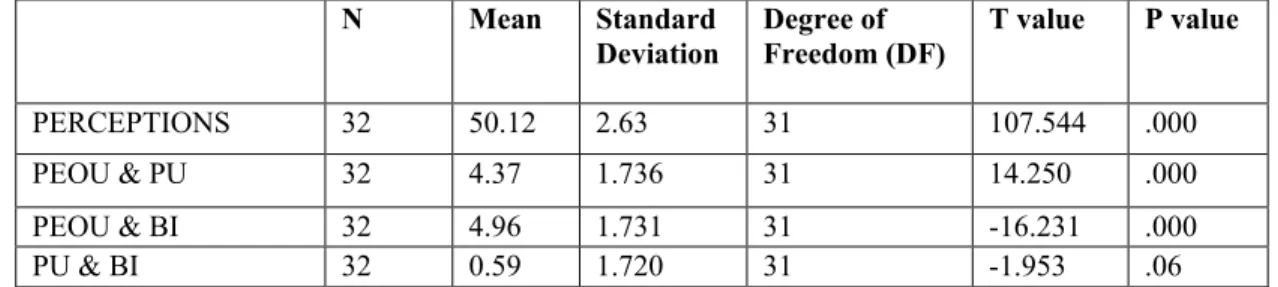
As depicted in Table 2, the computed Mean (M) and Standard Deviation (SD) scores for the teachers’ perceptions of the pedagogical use of the BMLAs were 50.12 and 2.63, respectively, while each TAM subscale yielded the following values: perceived usefulness (PU) (M=17.96, SD=1.61); perceived ease of use (PEOU) (M=13.59, SD=0.97), and behavioral intention (BI) (M=18.56, SD=1.31). Table 2 indicates that biology teachers have high perceptions on the pedagogical use of the BMLAs. A t-test analysis revealed that these perceptions were significant (t31= 107.544, p=.000<.05). A paired sample
t-test analysis revealed that PEOU is a significant predictor of biology teachers’ PU of the BMLAs (t31=
14.250, p=.000<.05) and the BI to use the BMLAs (t31= -16.231, p=.000<.05), respectively.
Notwithstanding, PU is not a good predictor of biology teachers’ BI to use the BMLAs in biology instructions (t31= -1.953, p=.06>.05).
N Mean Standard
Deviation Degree of Freedom (DF) T value P value
PERCEPTIONS 32 50.12 2.63 31 107.544 .000
PEOU & PU 32 4.37 1.736 31 14.250 .000
PEOU & BI 32 4.96 1.731 31 -16.231 .000
PU & BI 32 0.59 1.720 31 -1.953 .06
RQ2: How do in-service biology teachers rate two commercially available biology mobile learning applications recommended for learning biology?
Most of the respondents rated the content of BMLA 1 to be scientifically accurate (frequency=8(44.4%) for target, frequency=10(55.6%) for acceptable), and that the graphics promote the understanding of the science contents (f=11(61.1%) for target, f=7(38.9%) for acceptable). All but one of the respondents rated BMLA 1 to be an accurate representation of experimental procedures and measurements
(f=8(44.4%) for target, f=9(50%) for acceptable and f=1(5.6%) for unacceptable). For relevance of the content of BMLA 1, the respondents rated the contents to be closely aligned and connected with science learning objectives (f=13(72.2%) for target, f=5(27.8%) for acceptable), and that the content support and enhance scientific literacy (f=11(61.1%) for target, f=7(38.9%) for acceptable). The respondents also rated BMLA 1 to be current in scientific ideas, practices, and discoveries (f=2(11.1%) for target, f= 16(88.9%) for acceptable).In terms of sharing of findings, all the respondents evaluated that the findings or results from BMLA 1 can be shared or exported through multiple applications such as documents, other applications, social media platforms and, emails (f=9(50%) for target, f=9(50%) for acceptable). All the respondents also agreed that BMLA 1 provided feedback that was meaningful, specific, detailed and relevant (f=9(50%) for target, f=9(50%) for acceptable). They also evaluated that BMLA 1 provided feedback at the point of need (f=13(72.2%) for target, f=5(27.8%) for acceptable). The respondents agreed that BMLA 1 provided multiple opportunities for scientific inquiry (f=12(66.7%) for target, f=6(33.3%) for acceptable) and that BMLA 1 allowed information to be gathered through observation, experience, reflection, reasoning, and communication (f= 11(61.1%) for target, f= 7(38.9%) for
acceptable).With specific reference to the navigation of BMLA 1, most respondents agreed that BMLA 1 was easy to navigate (f=12(66.7%) for target, f=6(33.3%) for acceptable), and that it was consistent in its design and layout (f=10(55.6%) for target, f=8(44.4%) for acceptable). They also agreed that the graphics were appropriate for the age of the intended user of the application (f=14(77.8%) for target, f= 4(22.2%) for acceptable). The summary Table 3 below indicates that Navigation was highly rated (M=8.00, SD=1.084), followed by Relevance (M=7.44, SD=0.783), Accuracy (M=7.38, SD=1.036), Scientific inquiry (M=5.27, SD=0.894), Feedback (M=5.22, SD=0.808) and finally Sharing (M=2.50, SD=0.514).
Evaluation criteria Mean Standard Deviation
Accuracy 7.38 1.036 Relevance 7.44 0.783 Sharing findings 2.50 0.514 Feedback 5.22 0.808 Scientific Inquiry 5.27 0.894 Navigation 8.00 1.084
Table 3. Summary Table for BMLA 1
Similar to BMLA 1, the biology teachers rated the BMLA 2 to be scientifically accurate (f=2(14.3%) for target, f=12(85.7%) for acceptable), and that the graphics promote the understanding of the science contents (f=4(28.6%) for target, f=10(71.4%) for acceptable). However, not all the respondents rated BMLA 2 to be an accurate representation of experimental procedures and measurements (f=4(28.6%) for target, f=5(35.7%) for acceptable, f=2(14.3%) for unacceptable and f=3(21.4%) for not applicable). For relevance of the content of BMLA 2, the respondents rated the contents to be closely aligned and connected with science learning objectives (f=4(28.6%) for target, f=10(71.4%) for acceptable). In addition, they perceived that BMLA 2 supports and enhances science literacy (f=3(21.4%) for target,
f=11(78.6%) for acceptable). Furthermore, most of the respondents accepted that BMLA 2 is current in scientific ideas, practices, and discoveries (f=5(35.7%) for target, f=5(35.7%) for acceptable and
f=4(28.6%) for unacceptable). In terms of sharing of findings, most of the respondents evaluated that the findings or results from BMLA 2 could not be shared or exported through multiple applications such as documents, other applications, social media platforms, and emails (f=0(0%) for target, f=3(21.4%) for acceptable, f=7(50%) for unaccepted and f=4(28.6%) for not applicable). Most of the respondents agreed that BMLA 2 provided feedback that was meaningful, specific, detailed, and relevant (f=5(35.7%) for target, f=8(57.1%) for acceptable, and f=1(7.1%) for unacceptable). They also
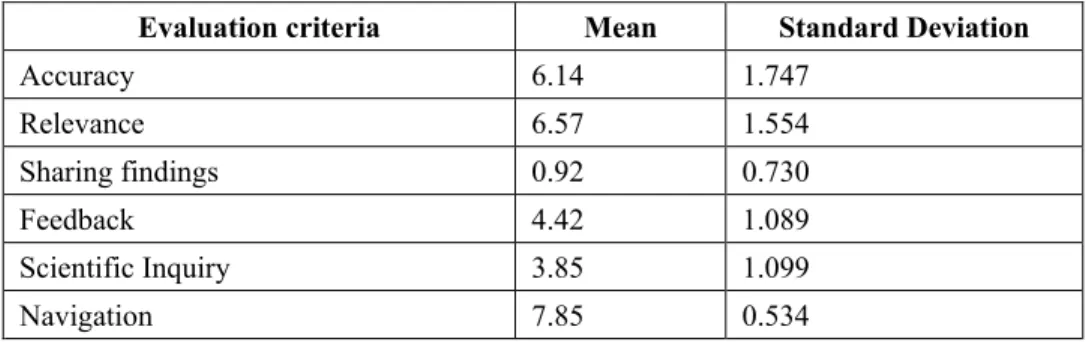
evaluated that BMLA 2 provided feedback at the point of need (f=3(21.4%) for target, f=10(71.4%) for acceptable and f=1(7.1%) for unacceptable). Some of the respondents agreed that BMLA 2 provided multiple opportunities for scientific inquiry (f=10(71.4%) for acceptable, f=4(28.6%) for unacceptable), and that BMLA 2 allowed information to be gathered through observation, experience, reflection, reasoning, and communication (f= 5(35.7%) for target, f= 6(42.9%) for acceptable and f=3(21.4%) for unacceptable). With specific reference to the navigation of BMLA 2, most of the respondents agreed that BMLA 2 was easy to navigate (f=8(57.1%) for target, f=6(42.9%) for acceptable), and that it was consistent in its design and layout (f=11(78.6%) for target, f=3(21.4%) for acceptable). They also agreed that the graphics were appropriate for the age of the intended users of the application (f=7(50%) for target, f= 7(50%) for acceptable). The summary table 4 below indicates that Navigation had the highest rating (M=7.85, SD=0.534), followed by Relevance (M=6.57, SD=1.554), Accuracy (M=6.14,
SD=1.747), Feedback (M=4.42, SD=1.089) while Scientific Inquiry (M=3.85, SD=1.099) and Sharing (M=0.92, SD=0.730) were rated the lowest.
Evaluation criteria Mean Standard Deviation
Accuracy 6.14 1.747 Relevance 6.57 1.554 Sharing findings 0.92 0.730 Feedback 4.42 1.089 Scientific Inquiry 3.85 1.099 Navigation 7.85 0.534
Table 4. Summary Table for BMLA 2
RQ3 (a): What is the influence of gender on in-service biology teachers’ perceptions on the pedagogical use of biology mobile learning applications?
The female teachers had slightly higher perceptions on the pedagogical use of the BMLAs (M=50.60, SD=2.29) than their male counterparts (M=49.70. SD=2.91). However, the results of an independent sample t-test analysis depicted in Table 5 revealed that the difference in perceptions was not statistically significant (t30= -.95, p= 0.27>.05). There was also no significant gender difference in the perceptions
concerning the PU (t30= -.97, p= 0.89>.05), PEOU (t30= 1.43, p= 0.68>.05) and BI (t30= -1.82,
p=0.19>.05), respectively.
Perceptions Gender N Mean Standard
Deviation Degree of Freedom (DF) T value P value
PU Male Female 17 15 17.70 18.26 1.72 1.48 30 -.97 0.89 PEOU Male 17 13.82 0.88
Female 15 13.33 1.04 30 1.43 0.68 BI Male Female 17 15 18.17 18.00 1.38 1.13 30 -1.82 0.19 OVERALL Male Female 17 15 49.70 50.60 2.91 2.29 30 -.95 0.27
Table 5. Independent Sample t-test Analysis on the Influence of Gender on Teachers’ Perceptions on the Pedagogical Use of the BMLAs
RQ3 (b): What is the influence of gender on in-service biology teachers’ pedagogical rating of the biology mobile learning applications recommended for learning biology?
The male teachers had a slightly higher mean score (M=33.88, SD=4.22) on the rating of the BMLAs for its pedagogical appropriateness than their female counterparts (M=32.40. SD=6.05).
Notwithstanding, the result from an independent sample t-test analysis depicted in Table 6 revealed that gender differences in biology teachers’ pedagogical rating of the BMLAs was not statistically significant (t30= .81, p= 0.06>.05). There was also no significant gender difference in the pedagogical ratings of the
BMLAs in each of the following evaluation criteria: accuracy (t30= 2.44, p= 0.33> .05), relevance (t30=
2.63, p= 0.67>.05), sharing of findings (t30= .77, p= 0.95>.05), feedback (t30= .74, p= 0.21>.05), scientific
inquiry (t30= -.62, p= 0.52>.05) and navigation (t30= -.37, p=0.28>.05), respectively. BMLAs
Ratings Gender N Mean Deviation Standard Freedom (DF) Degree of T value P value Accuracy Male Female 17 15 7.41 6.20 1.22 1.56 30 2.44 0.33 Relevance Male Female 17 15 7.11 7.60 1.16 1.04 30 2.63 0.67 Sharing Findings Male Female 17 15 1.94 1.66 1.02 0.97 30 0.77 0.95 Feedback Male Female 17 15 5.00 4.73 0.86 1.16 30 0.74 0.21 Scientific Inquiry Male Female 17 15 4.52 4.80 1.12 1.32 30 -.62 0.52 Navigation Male Female 17 15 7.88 8.00 0.99 0.75 30 -.37 0.28
Table 6. Independent Sample t-test Analysis on the Influence of Gender on Teachers’ Pedagogical Rating of the BMLAs
RQ4 (a): What is the influence of years of professional teaching experience on in-service biology teachers’ perceptions on the pedagogical use of biology mobile learning applications?
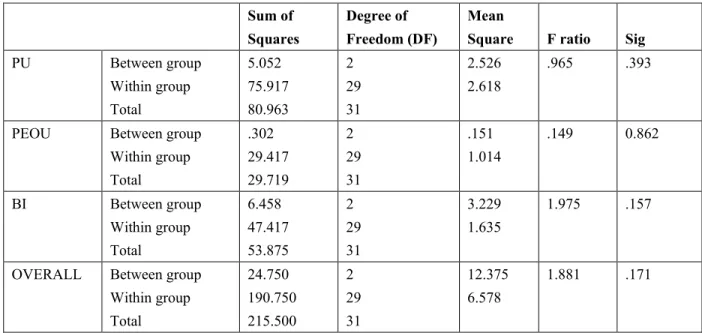
The ANOVA output portrayed in Table 7 indicates that the biology teachers’ professional teaching experience did not have any significant effect on their perceptions regarding the pedagogical use of the BMLAs for learning purposes (F (2,29) = 1.881, p=.171>.05). Likewise, there was no significant
difference between years of professional teaching experience and teachers’ perceptions with specific reference to PU (F (2,29) = .965, p= .393>.05), PEOU (F (2,29) = .149, p= .862>.05) and BI (F (2,29) = 1.975,
Sum of Squares
Degree of Freedom (DF)
Mean
Square F ratio Sig PU Between group Within group Total 5.052 75.917 80.963 2 29 31 2.526 2.618 .965 .393
PEOU Between group Within group Total .302 29.417 29.719 2 29 31 .151 1.014 .149 0.862 BI Between group Within group Total 6.458 47.417 53.875 2 29 31 3.229 1.635 1.975 .157
OVERALL Between group Within group Total 24.750 190.750 215.500 2 29 31 12.375 6.578 1.881 .171
Table 7. ANOVA Output on the Influence of Professional Teaching Experience on Teachers’ Perceptions on the Pedagogical Use of the BMLAs
RQ4 (b): What is the influence of years of professional teaching experience on in-service biology teachers’ pedagogical rating of the biology mobile learning applications recommended for learning biology?
The ANOVA output in Table 8 reveals that years of professional teaching experiences had no significant effect on in-service biology teachers’ rating of the BMLAs (F (2,29) = 2.004, p= .153> .05).
Sum of Squares
Degree of Freedom (DF)
Mean
Square F ratio Sig
Table 8. ANOVA Output on the Influence of Professional Teaching Experience on Teachers’ Perceptions on the Pedagogical Use of the BMLAs
RQ5: What is the relationship between in-service biology teachers’ perceptions on the pedagogical use of mobile applications recommended for learning biology and the pedagogical rating of these
applications?
There was a significant positive correlation between in-service biology teachers’ perceptions and the pedagogical rating of the BMLAs (Pearson r = .539, p<.01). The ANOVA output portrayed in Table 9 on the relationship between in-service biology teachers’ perceptions on the pedagogical use of mobile applications recommended for learning biology and the pedagogical rating of the BMLAs reveals that teachers’ perceptions play a significant role in the evaluation of the BMLAs (F (9, 22) = 3.650, p=.006 <
.05). Sum of Squares Degree of Freedom (DF) Mean
Square F ratio Sig BMLAs Ratings Between group Within group 489.208 327.667 9 22 54.356 14.894 3.650 .006
Total 816.875 31
Table 9. ANOVA Output Showing the Relationship between Teachers’ Perceptions and their Pedagogical Rating of the BMLAs
DISCUSSION
The study investigated in-service biology teachers’ perceptions on the instructional use of Biology Mobile Learning Applications (BMLAs) and the pedagogical rating of these mobile learning applications. Findings from the study revealed that in-service biology teachers generally had high perceptions on the pedagogical use of BMLAs and that these perceptions were significant. This finding supports the view of Ozdami and Uzunboylu (2015) who reported that teachers and students generally have good perceptions on the instructional use of mobile technologies. Mobile learning applications, such as BMLAs, can be used to create a learner-centered pedagogy that promotes students’ active construction of knowledge and scientific inquiry (Ally & Palalas, 2011). The biology teachers perceived that the BMLAs were instructional tools that can help students better understand biological concepts. They were also confident that the BMLAs have the potential to help students achieve the desired
educational objectives due to its interactive features such as quizzes, immediate feedbacks, collaborative learning, ubiquitous learning, and links to other useful learning resources and services. This assertion is consistent with the findings of Chen and Huang (2010) who reported that the instructional use of mobile applications as learning management systems stimulates a constructivist and collaborative learning environment that bolsters students’ performance and application of knowledge.
The study revealed that demographic variables, such as gender and years of professional teaching experience, did not influence teachers’ perceptions and pedagogical ratings of the BMLAs. These findings concur with the view of Sad and Goktas (2014), who asserted that gender and grade levels do not play a significant role in teachers’ perceptions of the use of mobile technologies as a learning tool. The findings of this study also support the view from previous studies in which males and females were reported to have the same capacity to make use of mobile devices for educational purposes (Fouh, Breakiron, Hamouda, Farghally, & Shaffer, 2014; Mac Callum & Jeffrey, 2014). Notwithstanding, findings from this study conflict with the findings of Liu and Guo (2016), who concluded that gender does play a significant role in the acceptance of mobile learning devices and that gender influences the perceived usefulness of mobile technologies for learning purposes. In the present study, gender did not influence the biology teachers’ perceptions about the use, perceived ease of use, and behavioral intention to use the BMLAs in biology instruction. This is contrary to Chen and Hu (2012), who found that
females have higher intentionality to adopt mobile devices in instruction.
There was a significant relationship between teachers’ perceptions and their evaluation of the BMLAs (F
(9, 22) = 3.650, p=.006 < .05.). This implies that teachers’ perceptions of the pedagogical use of mobile
devices play a significant role in the rating and selection of mobile applications for biology instruction. This is consistent with the view that teachers’ perceptions influence the selection and evaluation of educational technologies recommended for students learning (Hanghoj & Engel Brund, 2011). The in-service teachers rated the BMLAs to be pedagogically appropriate because they perceived that the BMLAs have the potential to bolster students’ performance in biology. This finding compares favorably with the findings of Huizenga, ten Dam, Voogt, and Admiraal (2017) and Kim et al. (2013) who posited that teachers’ perceptions on the usefulness of an educational technology is very much consistent with the cognitive outcomes associated with the educational technology. Educational applications whose contents align with the traditional school curriculum are rated to be pedagogically accurate by teachers. This rating criterion is the most important among other criteria used to select mobile applications
(Greene et al., 2014; Tantu, 2017). The affordance of commercially available mobile learning applications, such as the BMLAs utilized in the study, can be harnessed for the learning of abstract concepts in biology. The potential of these mobile technologies can also be utilized in the delivery of rich contents and to foster students’ communication (Traxler, 2007). The BMLAs included video tutorials and lessons that augmented the biology course. The BMLAs also have features that provide opportunities for students to acquire and apply knowledge regardless of time and location. Tantu (2017) opined that mobile applications that have these features are ranked well by teachers in the selection of mobile applications. This assertion is corroborated by Hu and Garimella (2014) and Chiong and Shculer (2010), who posited that interactive mobile application features which promote content sharing and communication, and which provide links to useful materials, improves in-service teachers’ evaluation of the mobile applications. This is why the biology teachers rated the BMLAs to be pedagogically
appropriate; because they perceived that BMLAs can foster positive cognitive learning outcomes and collaboration among the students.
The relevance of content did not rank at the top of teachers’ rating of the BMLAs. This may be due to the fact that the applications did not provide teachers with an opportunity to redesign the content of the learning applications. Findings from Tantu (2017) suggest that educational applications are perceived to be more relevant if it affords teachers the opportunity to modify the content of the applications. The study also revealed that scientific inquiry features of the BMLAs was low among other evaluation criteria. This might be due to the fact that the learning applications did not provide students with authentic learning experiences. Educational applications that embed more problem-solving practices promote scientific inquiry and boost in-service teachers’ perceptions of applications relevance (Tantu, 2017).
The MASS evaluation rubric utilized in the study provides useful insight into how in-service biology teachers rate mobile applications recommended for biology learning. Findings derived from the study revealed that in-service biology teachers rated the BMLAs high in all the evaluation criteria. However, the ease of navigating through the applications was rated higher than other evaluation criteria. This is consistent with the finding of Tantu (2017), who reported that technical usability ranks among the top criteria of in-service teachers’ perceptions and rating of mobile learning applications. This has a major implication for the design of educational applications because the simplicity of the learning applications influences teachers’ perceptions and subsequently their use for instruction. Teachers who are less skilled in technology use should still find it convenient to integrate educational applications into classroom instruction. Hence, educational applications recommended for science learning should incorporate a user-friendly interface in its design features.
The study revealed that gender and years of professional teaching experiences did not have any
significant influence on teachers’ pedagogical rating and selection of mobile learning applications. This implies that gender and professional teaching experience do not influence in-service teachers’ rating and selection of mobile applications.
LIMITATIONS OF THE STUDY
There are several limitations in this study that are worth mentioning. First, this study was conducted on a small sample. Hence, its findings cannot be generalized. Future research should incorporate a larger sample size and a more diverse teachers’ population that includes pre-service biology teachers. Second, this study was limited by its’ research design, i.e., descriptive survey. Future research should adopt a mixed methodology research design to enrich the study’s findings. Finally, this study included gender
and years of professional teaching experience only as predictive variables that influence teachers’ perceptions of the instructional use of the mobile applications. However, the authors hereby
acknowledge that there are more factors that could contribute to teachers’ perceptions of the BMLAs. Therefore, future research should incorporate more factors and variables that shape teachers’ perceptions of the adoption of educational mobile technologies and study them in more detail.
CONCLUSION AND RECOMMENDATIONS
The biology teachers had favorable perceptions on the pedagogical use of mobile learning applications. These perceptions are consistent with the teachers’ belief that the instructional use of mobile learning applications can be used to achieve the desired educational objectives. Findings also gathered from the study revealed that gender and professional teaching experience do not play any significant role in teachers’ perceptions and rating of mobile applications recommended for science teaching and learning. Teachers’ perceptions of the instructional use of mobile applications influence the rating and selection of mobile applications in science instruction.This has implications for educational planning because output from teachers’ evaluation of mobile learning applications can be utilized by the developers of mobile applications and by curriculum planners to design effective educational applications that align with the traditional school curriculum in order to improve the applications’ rating and usability.
Teachers play a critical role in the successful adoption and implementation of mobile learning instructional pedagogy. Hence, activities relating to the evaluation of mobile applications should be incorporated in teacher education programs and professional development programs. This will enhance teachers’ skills and knowledge in the integration of mobile learning applications into classroom
practices. Above all, the study recommends the instructional use of mobile applications in the teaching and learning of biology, provided that they are rated to be pedagogically appropriate for teacher use. Furthermore, this study should be replicated within other subjects and in other contexts, such as special education, using a much larger sample size so that the results thereof can be generalized.
ACKNOWLEDGEMENT
The authors appreciate the collaborative efforts of the teachers, research assistants, and data analysts for the good work done.
REFERENCES
Adedoja, G., Adelore, O., Egbokhare, F., & Oluleye, A. (2013). Learners’ acceptance of the use of mobile phones to deliver tutorials in a distance learning context: A case study at the University of Ibadan. The African Journal of Information Systems, 5(3), 80-93.
Adedoja, G., Botha, A., & Ogunleye, O. S. (2012). The future of mobile learning in the Nigerian education system. In P. Cunningham & M. Cunningham (Eds.), IST-Africa. IIMC International Information Management Corporation. Ally, M. (2013). Mobile Learning: From research to practice to impact education. Learning and Teaching in Higher
Education: Gulf Perspectives, 10(2), 1-10.
Ally, M., & Palalas, A. (2011). State of mobile learning in Canada and future directions. Athabasca University. Retrieved from http://www.rogersbizresources.com/files/308/Mobile_Learning_in_Canada_Final_Repo.
Azi, J. I., Nkom, A. A., & Schweppe, M. (2012). ICT integration in Nigeria and the quest for indigenous contents: Prospects of the i-CLAP model design initiative. International Journal of Advancements in Research & Technology, 1(5), 1-9. Biology Study App. Open Education Course, USA. (n.d.). Retrieved from
Boulos, M. N., Wheeler, S., Tavares, C., & Jones, R. (2011). How Smart phones are changing the face of mobile and participatory healthcare: An overview, with example from CAALYX. Biomedical Engineering Online, 10, 24. https://doi-org.proxy.kennesaw.edu/10.1186/1475-925X-10-24
Celik, V., & Yesilyurt, E. (2013). Attitudes to technology, perceived computer self-efficacy and computer anxiety as predictors of computer supported education. Computers & Education, 60(1),148–158.
Chen, H. R., & Huang, H. L. (2010). User acceptance of mobile knowledge management learning system: Design and analysis. Educational Technology & Society, 13(3), 70–77.
Chen, R. J. (2010). Investigating models for preservice teachers’ use of technology to support student-centered learning. Computers & Education, 55(1), 32–42.
Cheon, J., Lee, S., Crooks, S. M., & Song, J. (2012). An investigation of mobile learning readiness in higher education based on the theory of planned behavior. Computers & Education, 59(3), 1054-1064.
Chiong, C., & Shuler, C. (2010). Learning: Is there an app for that? Investigations of young children’s usage and learning with mobile devices and apps. The Joan Ganz Cooney Center at Sesame Workshop.
Cobcroft, R., Towers, S., Smith, J., & Bruns, A., (2006). Mobile learning in review: Opportunities and challenges for learners, teachers, and institutions. In Proceedings from the Online Learning and Teaching Conference (pp. 21–30.) Cochrane, T. D. (2014). Critical success factor for transforming pedagogy with mobile web 2.0. British Journal of
Educational Technology, 45(1),65- 82. http://dx.doi.org/10.1111/j.4678535.2012.01384.x.
David, F. D. (1989). Perceived usefulness, perceived ease of use, and user acceptance of information technology. MIS Quarterly,13(3), 319-340.
Fouh, E., Breakiron, D.A., Hamouda, S., Farghally, M.F., & Shaffer, C.A. (2014). Exploring students learning behaviour with an interactive e-text book in computer science courses. Computer and Human Behaviour, 41, 478–485.
Green, L S., Hechter, R. P., Tysinger, P. D., & Chassereau, K. D. (2014). Mobile app selection for 5th through 12th grade science: The development of the MASS rubric. Computers and Education, 75, 65-75. http://dx.doi.org/10.1016/j.compedu.2014.02.007.
Hanghøj, T., & Engel Brund, C. (2011). Teachers and serious games: Teachers roles and positioning in relation to educational games. In S. Egenfeldt-Nielsen, B. H. Sørensen, , & B. Meyer, (Eds.), Serious games in education: A global perspective (pp. 125-136). Aarhus University Press.
Hu, H., & Garimella, U. (2014). iPads for STEM Teachers: A case study on perceived usefulness, perceived proficiency, intention to adopt, and integration in k-12 instruction. Journal of Education and Technology, Development and Exchange, 7(1), 49–66.
Huizenga J. C., ten Dam, G. T. M., Voogt J. M., & Admiraal, W. F. (2017). Teacher perceptions of the value of game-based learning in secondary education, Computers & Education,110, 105-116. DOI:10.1016/j.compedu.2017.03.008. IGCSE biology app. Guru Apps Limited. (n.d.). Retrieved from
https://www.educationalappstore.com/app/igcse-biology-guru-app-gcse
Ismail, I., Azizan, S. N., & Azman, N. (2013). Mobile phone as pedagogical tools: Are teachers ready? International Education Studies, 6(3), 36-47.
Jeno L. M., Grytnes J. A., & Vandvik, V. (2016). The effect of a mobile-application tool on biology students' motivation and achievement in species identification: A self-determination theory perspective. Computers & Education, 107, 1-12. DOI: 10.1016/j.compedu.2016.12.011.
Jong Morris, S. Y. (2016). Teachers’ concerns about adopting constructivist online game-based learning in formal curriculum teaching: The VISOLE experience. British Journal of Educational Technology, 47(4), 601–617. DOI:10.1111/bjet.12247.
Kalinic, Z., Arsovski, S., Stefanovic, M., Arsovski, Z., & Rankovic, V. (2011). The development of a mobile learning application as support for a blended e-learning environment. Technics Technologies EducationManagement, 6(4), 1345–1355.
Kearney, M., Schuck, S., Burden, K., & Aubusson, P. (2012). Viewing mobile learning from a pedagogical perspective. Research in Learning Technology, 20(1), 1–17.
Khaddage, F., & Cosío, J. H. (2014). Trends and barriers on the fusion of mobile apps in higher education. Where to next and how? In M. Searson & M. Ochoa (Eds.), Proceedings of Society for Information Technology & Teacher Education International Conference (pp.903–909). Association for the Advancement of Computing in Education.
Khaddage, F., Christensen W. L., Knezek, G., Norris, C., & Soloway, E. (2015). A model driven framework to address challenges in a mobile learning environment. Education and Information Technologies,20(4), 625-640. DOI10.1007/s10639-015-9400-x.
Khaddage, F., & Lattemann, C. (2013). The future of mobile apps for teaching and learning. In Z. Berge & L. Muilen-Burg (Eds.), Handbook of mobile learning: Definitions (pp. 119–128). Routledge.
Kim, C., Kim, M. K., Lee, C., Spector, J. M., & De Meester, K. (2013). Teacher beliefs and technology integration. Teaching and Teacher Education, 29, 76–85.
Korf, M., & Oksman, E. (2012). Native, HTML5, or hybrid: Understanding your mobile application development options. Developer Force Technical Library. Retrieved from http://wiki.developerforce.com
Liu, D., & Guo, X. (2016). Exploring gender differences in acceptance of mobile computing devices among college students. Information Systems and E-Business Management, 15(1), 197–223. DOI 10.1007/s10257-016-0315-x.
MacCallum, C. K., & Jeffrey, L. (2014). Comparing the role of ICT literacy and anxiety in the adoption of mobile learning. Computers in Human Behavior,39, 8–19. DOI: 10.1016/j.chb.2014.05.024.
Macdonald, I., & Chiu, J. (2011). Evaluating the viability of mobile learning to enhance management training. Canadian Journal of Learning and Technology, 37(1), 1-12.McLoughin, C., & Lee, M. (2008). The 3 P’s of pedagogy for the networked society: Personalization, participation and productivity. International Journal of Teaching and Learning in Higher Education, 20(1), 10-27.
Milrad, M., Wong, L. H., Sharples, M., Hwang, G., Looi, C., & Oguta, H. (2013). Seamless learning: An international perspective on next generation technology enhanced learning. In Z. I Berge & I. Y. Muilenburg (Eds.), Handbook of Mobile Learning (pp. 95-108). Routledge.
Motiwalla, L. F. (2007). Mobile learning: A framework and evaluation. Computers & Education, 49, 581–596.
Onwuegbuzie, A. J., & Collins, K. M. (2007). A typology of mixed method sampling design in social science research. Qualitative Report, 12(2), 281-316.
Oyelere, S., Suhanen, J., & Sutinen, E. (2016). M-learning: A new paradigm for learning ICT in Nigeria. International Journal of Interactive Mobile Technologies, 10(1), 35-44. http://dx.doi.org/10.3991/ijim.v10i1.4872
Ozdamli, F., & Uzunboylu, H. (2015). M-learning adequacy and perceptions of students and teachers in secondary schools. British Journal of Educational Technology, 46(1), 159–172. DOI:10.1111/bjet.12136.
Park, S.Y., Nam, M. W., & Cha, S. B. (2012). University students’ behavioral intention to use mobile learning: Evaluating the technology acceptance model. British Journal of Educational Technology, 43(4), 592–605. DOI:10.1111/j.1467-8535.2011.01229.x
Sadler, T., Romine, W. L., & Menon, D. (2015). Learning biology through innovative curricula: A comparison of game and nongame approaches. Science Education, 99(4), 696-720. DOI: 10.1002/SCE.21171.
Şad, S. N., & Göktas, O. (2014). Preservice teachers’ perceptions about using mobile phones and laptops in education as mobile learning tools. British Journal of Educational Technology, 45(4), 606–618. DOI:10.1111/bjet.12064. Sha, L., Looi, C. K., Chen, W., & Zhang, B. H. (2012). Understanding mobile learning from the perspective of self-regulated
learning. Journal of Computer Assisted Learning, 28, 366–378.
Sharpes, M., Taylor, J., & Vavoula, F. (2007). A theory of learning for the mobile age. In R. Andrews & C. Haythornthwaite (Eds.), The SAGE handbook of e-learning research (pp. 221–247). Sage.
Sutherland, R., Armstrong, V., Barnes, S., Brawn, R., Breeze, N., Gall, M., et al. (2004). Transforming teaching and learning: embedding ICT into everyday classroom practices. Journal of Computer Assisted Learning, 20(6), 413–425.
Tantu, O. (2017). Evaluating mobile apps for STEM education with in-service teachers [Unpublished master’s thesis]. Middle East Technical University.
Teri, S., Acai, A., Griffith, D., Mahmoud, Q., David W. L., & Newton, M. (2013). Student use and pedagogical impact of a mobile learning application. Wiley Online Library.
Traxler, J. (2007). Defining, discussing and evaluating mobile learning. The International Review of Research in Open and Distributed Learning,8(2), 1-8.
UNESCO. (2010). ICT Transforming Education: A Regional Guide. Retrieved from https://unesdoc.unesco.org/ark:/48223/pf0000189216.pdf
Venkatesh, V., & David, F. D. (2000). A theoretical extension of the technology acceptance model: Four longitudinal field studies. Management Science,46(2), 186-204.
Vogel, D., Kennedy, D. M., Kuan, K., Kwok, R., & Lai, J. (2007). Proceedings of the 2007 40th Annual Hawaii International Conference on System Sciences .
Vygotsky, L. S. (1978). Mind in Society. Harvard University.
Wu, W. H., Wu, Y. C. J., Chen, C. Y., Kao, H. Y., Lin, C.-H., & Huang, S. H. (2012). Review of trends from mobile learning studies: A meta-analysis. Computers & Education, 59(2), 817-827.
Zydney, J. M., & Warner, Z. (2015). Mobile apps for science learning: Review of research. Computers and Education, 94, 1-17. https://doi.org/10.1016/j.compedu.2015.11.001