2017
Reverse transfer credit: A case study of the
perceived influence on degree recipients
Shawna SaadIowa State University
Follow this and additional works at:https://lib.dr.iastate.edu/etd Part of theEducation Commons
This Dissertation is brought to you for free and open access by the Iowa State University Capstones, Theses and Dissertations at Iowa State University Digital Repository. It has been accepted for inclusion in Graduate Theses and Dissertations by an authorized administrator of Iowa State University Digital Repository. For more information, please [email protected].
Recommended Citation
Saad, Shawna, "Reverse transfer credit: A case study of the perceived influence on degree recipients" (2017).Graduate Theses and Dissertations. 16207.
Reverse transfer credit: A case study of the perceived influence on degree recipients
by
Shawna L. Saad
A dissertation submitted to the graduate faculty in partial fulfillment of the requirements for the degree of
DOCTOR OF PHILOSOPHY
Major: Education (Educational Leadership)
Program of Study Committee: Janice N. Friedel, Major Professor
Brian A. Burt Larry H. Ebbers Aurelia W. Kollasch Michael S. Retallick
The student author, whose presentation of the scholarship herein was approved by the program of study committee, is solely responsible for the content of this dissertation. The
Graduate College will ensure this dissertation is globally accessible and will not permit alterations after a degree is conferred.
Iowa State University Ames, Iowa
2017
DEDICATION
To my amazing daughter, Bella, whom I love dearly: You inspire me each day with your loving spirit,
your quick wit, and your never-ending drive to stand up for others. May those qualities inspire you to never give up on what you believe in,
always fight for what is right, and never be afraid to take a risk in order to achieve
your dreams.
First, think. Second, believe.
Third, dream. And finally, dare.
TABLE OF CONTENTS Page LIST OF TABLES ... v ACKNOWLEDGMENTS ... vi ABSTRACT ... viii CHAPTER 1. INTRODUCTION: ... 1
Background of the Study ... 1
Statement of Problem ... 6
Purpose of the Study ... 6
Research Questions ... 7
Significance of the Study ... 8
Theoretical Framework ... 9
Research Design... 10
Definition of Terms... 12
CHAPTER 2. LITERATURE REVIEW ... 15
Benefits of Student Success in Higher Education ... 15
Reverse Transfer ... 16
History the reverse transfer credit agreement ... 16
Reverse transfer credit agreement terminology ... 19
Degree completion agenda: Completion drivers ... 20
Human Capital Theory ... 22
Sense of belong within a community ... 24
Economic status ... 27
Social well-being ... 28
Persistence... 29
Summary ... 34
CHAPTER 3. RESEARCH DESIGN ... 36
Research Questions ... 36
Methodological Approach ... 37
Epistemology: Social Constructivism ... 37
Theoretical Perspective: Human Capital Theory ... 38
Methodology: Case Study ... 39
Methods... 42
Participants ... 43
Data Collection ... 48
Trustworthiness ... 51 Credibility ... 51 Transferability: ... 52 Dependability ... 52 Ethical Issues ... 53 Positionality ... 53 Limitations ... 56 Summary ... 57
CHAPTER 4. RESULTS AND FINDINGS ... 58
Demographics ... 58
Jake ... 59
Susan ... 60
Calvin ... 61
Thematic Findings ... 63
Finding 1: Every transfer student should participate ... 63
Finding 2: Key characteristics of persistence and self-sufficiency ... 67
Finding 3: Influence on Sense of Belonging within a Community ... 71
Finding 4: Influence on Social Well-being ... 76
Finding 5: Influence on Job Attainment and Speed of Promotion …………... 79
Summary ... 83
CHAPTER 5. DISCUSSION, IMPLICATIONS, AND CONCLUSIONS ... 84
Summary of the Study ... 84
Theoretical Framework Discussion ... 85
Implications ... 88
Implications for Practice ... 91
Implications for Policy ... 92
Implications for Future Research ... 94
Conclusion ... 94
Personal Reflection ... 94
REFERENCES ... 96
APPENDIX A. MEMO ON PERSISTENCE ... 109
APPENDIX B. STATE OF IOWA REVERSE TRANSFER AGREEMENT ... 110
APPENDIX C. INSTITUTIONAL REVIEW BOARD APPROVAL ... 113
APPENDIX D. INFORMED CONSENT... 114
APPENDIX E. INTERVIEW PROTOCOL ... 117
LIST OF TABLES
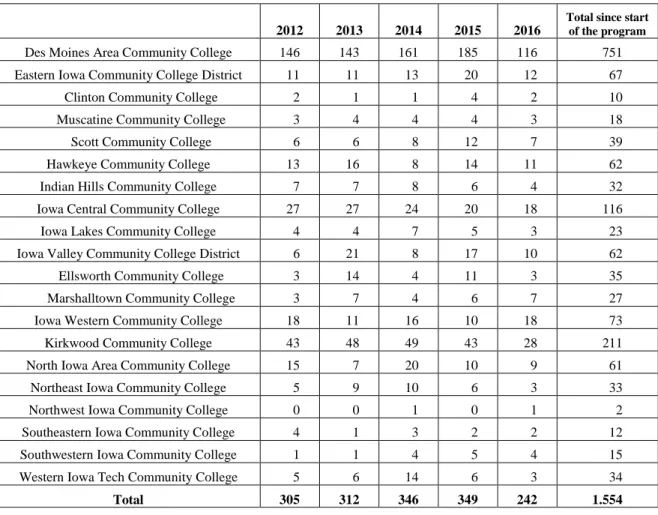
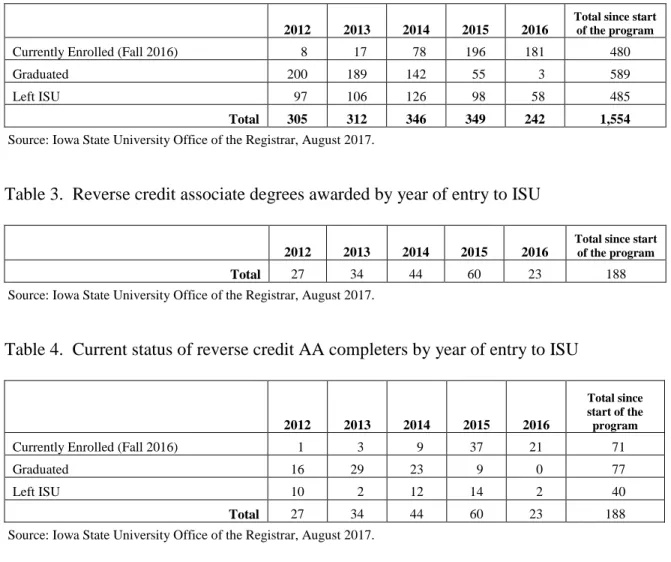
Page Table 1. Reverse credit program participation by year of entry to ISU ... 44 Table 2. Reverse credit program participants by current status by year of entry to
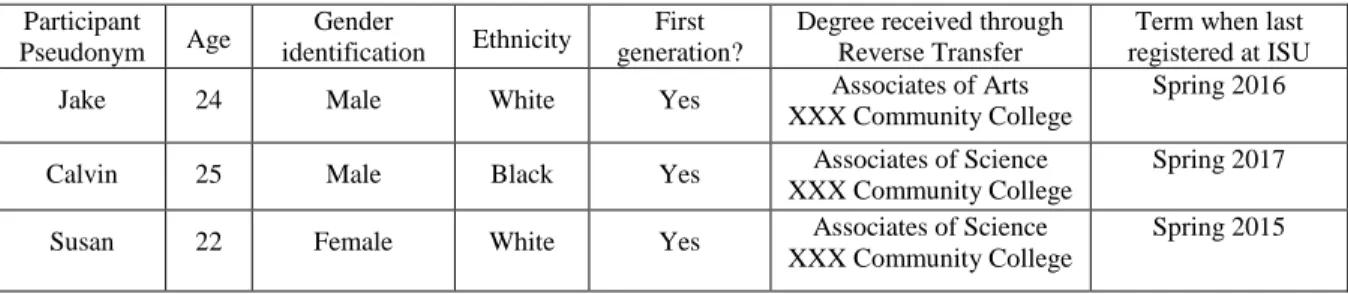
ISU ... 45 Table 3. Reverse credit associate degrees awarded by year of entry to ISU ... 45 Table 4. Current status of reverse credit AA completers by year of entry to ISU .... 45 Table 5. Participant matrix ... 59
ACKNOWLEDGMENTS
First, I would like to thank my committee chair, Dr. Jan Friedel, for guiding me through this process, providing insight and suggestions along the way, being honest with me, allowing me to be honest in return and, most of all, advocating for me when I needed it the most. Your support and belief in me was crucial to my success in this program and I will be forever grateful. In addition, I would like to thank my committee members: Drs. Brian Burt, Larry Ebbers, Aurelia Kollasch, and Michael Retallick, for their guidance and support throughout the course of this research. Each provided insights and suggestions that added value to my experience as a researcher and I am truly thankful as each piece helped make the whole a reality. I would also like to thank Dr. Lyn Brodersen Cochran whom I admire greatly and will be forever thankful that I had an opportunity to be in several of her classes. I learned so much from her not only regarding qualitative research but also about being a professional woman in the field of higher education.
I would also like to thank my friends and colleagues for continuously providing unwavering support throughout this process. To Diane Rupp – thank you for always believing me, always mentoring me, and telling me to be bold! There were times when I needed to vent and you were always there to listen and support me. To Mindy Heggen – thank you for always telling me to never give up. There were so many times that hearing those three words helped to push me through. To Linda Svenson – I truly have found a lifelong friend in you. We went through this process together and our writing dates, therapy sessions, and the ups and downs we experienced along this journey enabled us to create a bond that will never be forgotten. I value you so much, and am so thankful for this program that has brought us together for this incredible experience. To Katie Davidson – thank you
for being my writing partner for a big part of this journey. It was a lot of fun and you helped me to continue to push through and move forward when I didn’t always want to! To the many other friends and colleagues across campus – you know who you are – thank you for always encouraging me to finish and reminding me that it’s worth it. I am forever grateful to my ISU family!
Finally, and most importantly, I want to thank my family for always supporting me. Mom and Dad – you mean the world to me and I hope this accomplishment will make you proud! I have come to realize my drive and work ethic comes from following your example as I matured. I admire these qualities in both of you and am thankful for the influence you have had on my life. Mom – thank you for always being there and listening. I know you didn’t always understand all the details of this process along the way but you still listened, encouraged, and told me not to give up. Renee – I want to thank you for telling me I can do this and reminding me I’m the smart one who always succeeds [ha ha]. I needed to hear this times when I didn’t think this was possible. Last, but certainly not least, Bella – I am grateful for all you have done to support my dreams. I know you have made many sacrifices and there were times I had to give up time with you to do school work. You have been supportive the entire time and often stepped up to help me at home so that my dream could become a reality. Your love, patience, and humor throughout this process has be invaluable to me. Your turn is next to follow your stars and pursue your dreams!
ABSTRACT
Researchers have consistently attested that those who earn a college degree
experience numerous personal and professional benefits that can greatly influence their lives. Degree completion has been linked to multiple individual benefits including financial
benefits, overall health benefits, increased civic engagement, social mobility, and overall job satisfaction (Baum, Ma, & Payea, 2013). In addition to the benefits indicated in the research, degree completion has also become more important than ever as institutions of higher
education work to respond to President Barack Obama’s administration completion agenda which set a goal to increase the nation’s degree attainment rate to 60% by 2020 (Kanter, Ochoa, Nassif, & Chong, 2011), and adding at least “…10 million more graduates from community colleges and four year colleges and universities” (Kanter et al., 2011).
The reverse transfer credit agreement has been increasingly looked at as one opportunity to increase degree completion numbers. The new reverse transfer is defined as students who transfer from a two-year college to a four-year institution and retroactively receive an associate’s degree with their newly earned four-year college credits (Friedel & Wilson, 2015). As the implementation of the new reverse transfer program has been revamped in higher education institutions across the U.S., many students have participated and received their associate’s degree through this program. Although students have
completed their associate’s degree through the new reverse transfer credit agreement, little research has been completed to explore the influence the receipt of a degree through reverse transfer has had from the perspective of the student.
The purpose of this case study was to explore the perceived influence the receipt of an associate’s degree through the new reverse transfer credit agreement had on a student’s
economic status as it relates to position, sense of belonging within a community, and social well-being. After the data obtained were transcribed, coded and analyzed, five thematic findings emerged: (1) all participants of this study indicated every transfer student should opt-in to the new reverse transfer credit agreement as it was perceived as a benefit; (2) all of the participants exhibited key characteristics of persistence and self-sufficiency that informed the participant’s perception within this study; (3) all participants believed earning an
associate’s degree through the new reverse transfer program had a beneficial influence on their sense of belonging within a community; (4) all participants stated connections built during their educational experience while pursuing their associate’s degree through the new reverse transfer program had influence on their sense of belonging within the community as well as their social well-being; and (5) the majority of participants indicated that the receipt of an associate’s degree through the new reverse transfer credit agreement had a positive influence on job attainment and speed of promotion.
CHAPTER 1. INTRODUCTION
Background of the Study
Researchers have consistently attested that those who earn a college degree
experience numerous personal and professional benefits that can greatly influence their lives. Degree completion has been linked to multiple individual benefits including financial
benefits, overall health benefits, increased civic engagement, social mobility, and overall job satisfaction (Baum, Ma, & Payea, 2013). These benefits could become a crucial step in motivating students towards degree completion. College is widely understood to be the gateway to the middle class. Nearly 75% of future jobs will require a postsecondary degree or certificate, and many of these job openings will be in middle-skill professions that require more than a high school degree but less than a four-year college degree (Wakelyn, 2009). From a financial perspective, the benefits of postsecondary education are clearly detailed in the research. In 2014, median weekly earnings for people with a bachelor’s degree or higher were $1,193, compared with $488 for those with less than a high school diploma. High school graduates without any college earned $668 per week in 2014, and those with some college or an associate degree earned $761 per week (Bureau of Labor Statistics, 2015).
In addition to the benefits shown in the research, degree completion has also become more important than ever as institutions of higher education work to respond to the Obama administration’s completion agenda, which set a goal to increase the nation’s degree
attainment rate to 60% by 2020 (Kanter, Ochoa, Nassif, & Chong, 2011), and the addition of at least “…10 million more graduates from community colleges and four year colleges and universities” (Kanter et al., 2011, p. 12). The “completion agenda” has been brought forth by educators, reformers, policy makers, and foundations in response to low completion rate,
with the goal to increase the number of individuals with college degrees and certificates (Bailey, 2017). The completion agenda provides an opportunity to evaluate higher education and the current needs of the United States, with the intent of much needed reform.
Reform that has occurred historically through efforts proposed by President Lincoln with the Morrill Act, and by President Roosevelt with the G.I. Bill. The completion agenda is a clear program from the Obama administration that was promulgated by the reality that completion rates in the U.S. have flattened. Twenty years ago, the United States was first in the world in postsecondary attainment for adults ages 25 to 34 (Wakelyn, 2009). According to the Organization for Economic Co-Operation and Development (OECD, 2017), the nation was ranked as 10th as of 2016, with regards to population with tertiary education. In order to change this ranking and meet industry and economic needs, many programs are now in place in order to increase degree completion.
The National Governors Association (NGA) has led the call for more transparency and more of a focus on outcomes in postsecondary education for years (Reindl, 2013), which is in part a reflection of the need to increase degree completion. According to the NGA, Governors are the only policymakers to oversee the entire pipeline of policies and resources for their state’s education systems, making them well-positioned to lead discussion in improving education (NGA, 2015). In part, many discussions around increasing degree completion have looked at transparency for students, families, and taxpayers. With that comes the need to understand the demand for a more educated workforce, significant and lasting fiscal constraints, and changes in who goes to college (Reindl, 2013). By
understanding the data from these standpoints, states are better positioned to make informed policy decisions that can improve degree completion.
For their part, the NGA has partnered with Complete College America in order to determine better metrics for measuring student outcomes. The common Completion Metrics were created in 2010. From a student progress standpoint, metrics included remedial
education, gatekeeper courses, credit accumulation, course completion, and retention (Reindl, 2013). From a student-outcomes standpoint, metrics included degrees awarded, graduation rate, transfer rate, and time and credits to degree (Reindl). Furthermore, as of 2013, 32 states were collecting and publicly reporting these metrics through Complete College America’s Alliance for States (Reindl).
Community Colleges have also been at the forefront of evaluating ways to increase degree completion. They were asked to increase the number of associate degrees and certificates they award by 5 million, making these institutions responsible for over 60% of the graduates’ need to reach the completion agenda 2020 goal (Templin Jr., 2011). The American Council on Education prepared a blueprint of strategies that could be applied to help community colleges achieve success with this goal. Among the list of guidelines, five have stood out as having potential to influence this need: (a) confronting the issues around low students success and making data driven decisions; (b) bringing more-college ready students into the system through local school partnerships; (c) increasing the number of students receiving financial aid; (d) redesigning remedial education; and (5) partnering with community-based nonprofits in job training and college completion programs (Templin Jr., 2011).
It is clear community colleges play an invaluable part in moving the completion agenda forward, and coordination with higher education institutions is essential. One clear way this coordination effort has been established is through the reverse transfer credit
agreement. In the Annual Condition of Iowa’s Community College (2014) report, among the 8,959 students from the 2012 cohort, 2,268 transferred to four-year colleges or universities, yielding a transfer rate of 25.3%. Of these, 1,271 students (56.0%) transferred to four-year colleges or universities before graduating with two-year awards. This increase has inspired community colleges to look further at reverse transfer credit as a solution to increasing degree attainment numbers.
The new reverse transfer credit agreement has been viewed increasingly as one opportunity to increase degree completion numbers. New reverse transfers are defined as students who transfer from a two-year college to a four-year institution and retroactively receive an associate’s degree with their newly earned four-year college credits (Friedel & Wilson, 2015). As the implementation of the new reverse transfer program has been revamped in higher education institutions across the U.S., many students have participated and received their associate’s degree through this program. Although an increasing number of students have completed their associate’s degree through the new reverse transfer credit agreement, little research has been conducted to explore the influence the receipt of a degree through reverse transfer has had from the perspective of the student.
In order to research this question, policies and practices surrounding reverse transfer credit in the state of Iowa must also be understood. One practice noted throughout the research process for this study as well as in my capstone project is the concept of opt-in and opt-out as operationalized in Iowa. Opt-in refers to a student who applies to an Iowa Regents Institution, i.e. Iowa State University (ISU) and authorizes the release of academic records from ISU to a previously attended community college for the purposes of credit evaluation to determine eligibility to receive an associate’s degree by the community college. Opt-out
refers to a student who applies to Iowa State University (ISU) and does not authorize the release of academic records from ISU to a previously attended community college for the purposes of credit evaluation to determine eligibility to receive an associate’s degree by the community college.
The current policy followed at ISU is an opt-in approach. During the admissions process for students, there is an opportunity for a student to opt-in to the new reverse transfer credit agreement. Information provided by the Iowa State University Office of the Registrar (2017) revealed that from 2012 to 2016, 1,554 students had participated (i.e., opted-in) in the reverse transfer credit agreement, with 188 associate degrees awarded. In comparison, in fall 2016 alone, there were 1,871 transfer students admitted of which 1,382 had not completed their two-year degree (Iowa State University Office of the Registrar, 2017).
There seems to be a clear disconnect for students in relation to opting in to the new reverse transfer credit agreement. This study suggests that the reverse transfer credit agreement is an option to provide academic success to students and improve degree
completion rates. Understanding students’ perspective regarding the opt-in process for new reverse transfer can inform policy makers on decisions surrounding the admission process. In addition, it is important to understand why institutions have chosen opt-in versus opt-out language. This is a direct reflection of the language listed in the Family Educational Rights and Privacy Act (FERPA), a federal privacy law that protects student records. FERPA guidelines currently followed at ISU require the institution to obtain permission from a student prior to sending electronic transcripts to a community college of their choice. Although the policy is aimed to protect student privacy, it does have unintended
discusses the benefits of degree attainment yet current FERPA policy could be a barrier for this situation.
In order to better understand new reverse transfer implications, it is essential to have a clear understanding of the influence it may have from the students’ perspective. Therefore, this case study was conducted to better understand the influence this program has had on Iowa State University student degree completers from their perspective. Data were gathered by the current researcher regarding students’ perceptions of the new reverse transfer credit agreement. It was anticipated that results of the study will highlight the perceived influence from the perspective of the students, and inform higher education institutions of the influence of receiving a degree through the new reverse transfer program may have to students.
Statement of the Problem
Research findings have indicated that students who obtain an associate’s degree are positively influenced both personally (financial, health, self-worth) and professionally (higher job level attained, further education attainment, social mobility, and job satisfaction) (Baum, Ma, & Payea, 2013). Although current research studies have been conducted on the benefits of a degree, no current research has examined the student’s perceived influence the receipt of a degree through the new reverse transfer program may have. This research may contribute to the literature by providing higher education institutions, state administrators, and policy makers insight regarding the students’ perspective of the new reverse transfer degree completion program.
Purpose of the Study
The purpose of this case study was to explore the perceived influence of the new reverse transfer credit agreement by students who have received their associate’s degree in
this manner. This research could contribute to the literature by providing additional insight into the influence students perceive they have received by obtaining a degree through the new reverse transfer program. New reverse transfer students are defined as those who transfer from a two-year college to a four-year institution and retroactively receive an associate’s degree with their newly earned four-year college credits (Friedel & Wilson, 2015). This qualitative study focused on new reverse transfer completers who attended Iowa State University (ISU) within the last five years (2012–2016) who then left ISU without completing their bachelor’s year degree.
Research Questions
The research questions were derived after a detailed literature review that provided insight and support for the numerous benefits students receive related to degree completion. Although not an exhaustive list, some of the most commonly identified benefits include: increased earnings, decreased unemployment, overall health benefits, increased civic engagement, social mobility, job satisfaction, open mindedness, more rational decision making, and an increased awareness of cultural norms (Baum, Ma, & Payea, 2013; Day & Newburger, 2002; Rowley & Hurtado, 2002). In order to focus this study, I chose to
conceptualize the larger body of knowledge related to the benefits of degree completion for a student and narrow the focus into three major categories: (a) economic status as it relates to position; (b) sense of belonging within a community; and (c) social well-being. The
following questions framed the study and guided the process of collection and analysis of data:
1. How has the completion of an associate’s degree through the new reverse transfer credit agreement influenced students’ perceptions of their economic status as it relates to position?
2. How has the completion of an associate’s degree through the new reverse transfer credit agreement influenced students’ perceptions of their social well-being? 3. How has the completion of an associate’s degree through the new reverse transfer
credit agreement influenced students’ perceptions of their sense of belonging within their community?
Significance of the Study
This study was conducted due to the limited qualitative research that has focused on the student’s perceived influence as it relates to the receipt of a degree through the new reverse transfer credit agreement may have on them. At the time of this study, no research had been found that discussed the new reverse transfer credit agreement from the student perspective. Although economic and social benefits are well established, reverse credit transfer policies raise new questions on the benefits and value of an associate’s degree from multiple perspectives (Taylor, 2016). The results of this study could be valuable to higher education institutions, state administrators, and policy makers as they continue to look for ways to increase degree completion rates. An understanding of the student perspective could guide the way in which higher education institutions promote their programs and develop retention plans. In addition, an understanding of the student experience could enable a deeper appreciation of the student perspective which, in turn, could direct the way student success programs are created. Finally, focusing on students who completed their associate’s degree through reverse transfer who then left prior to completing their bachelor’s degree could
inform higher education administrators regarding the factors that influence a student’s decision to leave an institution.
Theoretical Framework
This research study was explored through the lens of the Human Capital Theory (HCT) which is derived from the work of Gary Becker who made people the central focus of human capital theory as opposed to economics (Becker, 1964). At its principle, HCT refers to people’s abilities and qualities that make them productive. Of these qualities, knowledge is the most important; however, other factors also matter. Investment in human capital mainly refers to education. Becker observed that people do acquire general human capital, but they often do so at their own expense, rather than that of their employer. An example of this would be at a university, when students take on debt to pay for education prior to entering the workforce. The main contribution of HCT is that it could be applied as returns to individuals from education. As with any theory, some objected, stating that Becker had expounded the importance of learning. Education matters not because it imparts knowledge, but because of what it signals about the people who complete a credential, namely that they are disciplined and more likely to be productive workers (Spence, 1973).
The early cultivators of HCT were economist Sir William Petty and Adam Smith. Petty’s contribution examined the role of the state in the economy while Smith was credited with establishing the basis of the economics of human capital. Joseph Spengler (1955) had several references to human capital in some of his articles on the qualitative analysis of population.
Human capital theory resurged in the 1960's primarily through the work of American economists Theodore Schultz and Gary Becker. During this time, economists began making
tangible connections between education and its impact on the ability of humans to earn higher wages. Based upon the work of Schultz (1971), human capital theory rests on the assumption that formal education is highly instrumental in improving the production capacity of a population. To that extent, HCT emphasizes how education increases the productivity and efficiency of workers by increasing the level of cognitive stock of economically productive human capability. Human capability is a product of innate abilities and investments in human beings. Therefore, a provision of formal education is seen as a productive investment in human capital.
Originally HCT focused primarily on the relationship between levels of education, economic returns, and social returns. More recently, developments in the literature suggest that the quality of education (e.g., how educational time is spent) and when educational investments are made (e.g., early childhood vs. secondary education) are critical in the
process of human capital formation. In alignment with the more recent applications of HCT, I used this theory as defined by Netcoh (2016) who states HCT is a framework that examines the relationships between education, economic growth, and social well-being. Netcoh further explains HCT as an extension of the capital concept and posits that expenditures on
education, job training, and health are capital investments that will yield economic and social returns at the individual and societal levels (Netcoh, 2016).
As with any theory, HCT was utilized for this study as the guiding lens. HCT was an appropriate lens to use for this study as it followed a bounded system which was used to also support the use of case study as a methodology. Although that was the original intention, challenges with HTC developed during the process of this study. Theory is a constantly
evolving process, therefore, the process framed by HCT in this study evolved into an evaluation and challenge of HCT’s assumptions.
Piketty (2014) posited that Becker’s (1964) mathematisation of human capital theory was permeated by the belief that all forms of capital other than human capital (i.e., financial, social and cultural capital) have lost their determining importance. This study aligns with the idea that more than just economic status can be considered as a form of human capital in relation to educational attainment. Another point of challenge was the level of understanding each participant had related to their sense of value as it relates to human capital.
HCT informed the study as to the perceived influences a student received due to the completion of a degree through the new reverse transfer program. The relationship between behaviors and perceptions has been well-documented in the social psychology literature (Gifford, 1987; Walsh, 1973), but has rarely been explicitly specified in the empirical testing of theoretical models. An understanding of these challenges can inform the theory and provide insight to alternative approaches when using human capital theory.
Research Design
The research design used for this study followed a qualitative approach. Case study was the methodology applied in this study. Case study research involves the study of an event or a situation within a real-life, contemporary context or setting (Yin, 2009). In this case study, the real life context was the experience of receiving a degree through the new reverse transfer credit agreement and then leaving ISU prior to completing a bachelor’s degree. Participants in this study were identified using criterion based sampling, a strategy under the concept of purposeful sampling. Participants had an entry year at Iowa State University of 2012, 2013, 2014, 2015, or 2016, had received an associate’s degree through
the new reverse transfer credit agreement, and had left ISU prior to completing a bachelor’s degree. Data were collected using semi-structured interviews, document reviews, memos, and journals. Data were then analyzed by coding the data to look for significant statements to generate meaning units (or codes), that were then used to create thematic findings. The thematic findings were then described in detail, with the study concluding with a theoretical discussion, and implications for policy, practice, and future research.
In order to provide for a deeper understanding of the topic at hand, select definitions are detailed in the next section. Following the definition section is a discussion of the literature surrounding the major concepts of this study, benefits of degree completion on student success, new reverse transfer credit history, new reverse transfer credit terminology, the degree completion agenda and drivers, sense of belonging within a community, economic status, social well-being, and persistence.
Definition of Terms
The following terms were defined for the purpose of this study:
Case Study: An approach to inquiry in which the research involves the study of an event or situation within a real-life, contemporary context or setting (Yin, 2009).
Economic Status: An individual’s financial position based on income, education, and occupational prestige (Johnson, 2016).
First Generation Student Status: A student whose parents did not earn a four-year college degree (TRIO, 2017).
Human Capital Theory (HCT): A framework that examines the relationships between
education, economic growth, and social well-being (Necoh, 2016). According to Becker (2008), education is an investment in human capital that pays off in terms of
higher productivity. Therefore, economists regard expenditures on education, training, medical care, and so on as investments in human capital. They are called human capital because people cannot be separated from their knowledge, skills, health, or values in the way they can be separated from their financial and physical assets (Becker).
New Reverse Transfer: A term used in higher education which refers to students who begin at a two-year college and transfer to a four-year college before completing a degree. Credit is then transferred back to the two-year college retroactively in order to award a degree. Other terms, such as “new revers transfer”, “transfer back”, “reverse university transfer”, and “reverse articulation” are also used interchangeably in the field (Bragg, Cullen, Bennett, & Rudd, 2011; Friedel & Wilson, 2015; Marling, 2012).
New Reverse Transfer Agreement: Enacted by a group of individuals from Iowa’s
community colleges, Regent universities, the Board of Regents, and the Iowa Department of Education who focus on analyzing data and making enhancements to the Reverse Transfer Credit program (Merten, 2017).
Opt-in: Refers to a student who applies to Iowa State University (ISU) and authorizes the release of academic records from ISU to a previously attended community college for the purposes of credit evaluation to determine eligibility to receive an associate’s degree by the community college.
Opt-out: Refers to a student who applies to Iowa State University (ISU) and does not authorize the release of academic records from ISU to a previously attended community college for the purposes of credit evaluation to determine eligibility to receive an associate’s degree by the community college.
Persistence: The desire and action of students to remain in higher education and complete their degree. (Berger et al., 2012).
Retention: Refers to the ability of an institution to retain students from admission to graduation. (Berger et al., 2012).
Sense of Belonging within a Community: A feeling that members have of belonging, that members matter to one another and to the group, and a shared faith that members’ needs will be met through their commitment to be together (McMillan, 1976, McMillan & Chavis, 1986).
Social Well-being: The appraisal of one’s circumstance and functioning in society (Keyes, 1998).
CHAPTER 2. LITERATURE REVIEW
The purpose of this case study was to ascertain the perceived influence the new reverse transfer credit agreement had on students who have received their associate’s degree through the new reverse transfer credit agreement. The study was conducted due to the limited qualitative research that has focused on the student’s perceived influence as it relates to receiving a degree through the new reverse transfer credit agreement. The literature review addresses the benefits of student success in higher education, reverse transfer history,
terminology, the degree completion agenda and drivers, sense of belonging within a community, economic status, social well-being, and persistence.
Benefits of Student Success in Higher Education
Research findings on the benefits of higher education continue to reinforce the positive effect a higher education degree can have on a student. Individuals with higher levels of education earn more and are more likely than others to be employed (Baum, Ma, & Payea, 2013). According to the College Board Education Pays 2013 report, in 2011, median earnings of bachelor’s degree recipients with no advanced degree working full time were $21,000 higher than those of high school graduates (Baum et al., 2013). According to the Census Bureau, over an adult’s working life, high school graduates earn an average of $1.2 million; associate’s degree holders earn about $1.6 million; and bachelor’s degree holders earn about $2.1 million (Day & Newburger, 2002). In addition to the financial benefits, many other benefits have been associated with attaining a degree in higher education.
The unemployment rate for individuals with at least a bachelor’s degree has
consistently been about half the unemployment rate for high school graduates (Baum et al., 2013). Baum et al. also noted that other benefits consistently appear such as better overall
health, increased civic engagement, social mobility, and overall job satisfaction. According to a report published by the Carnegie Foundation, non-monetary individual benefits of higher education include the tendency for postsecondary students to become more open-minded, more cultured, more rational, more consistent and less authoritarian; these benefits are also passed along to succeeding generations (Rowley and Hurtado, 2002).
Reverse Transfer History of the reverse transfer credit agreement
At one time, students who transferred to earn a higher education degree may have been considered “nontraditional students.” Now, these multifaceted trajectory patterns indicate an “American undergraduate” (Goldrick-Rab, 2006). Traditionally, a student
participates in a vertical transfer progression transferring from a two-year community college to a four-year college or university hoping to acquire a baccalaureate degree. Reverse transfer is coined reverse because its direction and goals are considered the opposite of vertical transfer movement (LeBard, 1999; Renn & Reason, 2013; Townsend & Dever, 1999).
Reverse transfer students are often divided into categories within literature,
nationwide surveys, institutional data, and focus groups (Anderson, 2015; Catanzaro, 1999; Kajstura & Keim, 1992; LeBard, 1999; Shapiro, et al., 2015; Townsend & Dever, 1999; Townsend, 2001; Winter & Harris, 1999). The reverse transfer categories are based on their reasons for reverse transferring from a four-year college or university to a two-year
community college. Reverse transfer students can be categorized into one of four subgroups: (1) undergraduate reverse transfers, (2) temporary reverse transfers, (3) post-baccalaureate reverse transfers, and (4) reverse transfer credits (Anderson, 2015; Catanzaro, 1999; Kajstura
& Keim, 1992; LeBard, 1999; Shapiro, et al., 2015; Townsend & Dever, 1999; Townsend, 2001; Winter & Harris, 1999).
Undergraduate reverse transfers include students who begin their postsecondary education at a four-year institution and then transfer to a two-year community college (Townsend & Dever, 1999). These students often are referred to as noncompleters due to their lack of completing a bachelor’s degree before enrolling at a community college (Catanzaro, 1999; Kajstura & Keim, 1992; Winter & Harris, 1999). However, this student group can be categorized beyond mere incompletion; undergraduate reverse transfer students can have a variety of educational goals and reasons for the reverse transfer movement: to fulfill a special need, to attain a two-year associate’s degree, to earn a technical degree or certificate (Catanzaro, 1999; Winter & Harris, 1999). Associate degrees or certificates in nursing, engineering technology, graphic arts, dental hygiene, automotive technology, cosmetology, fashion merchandising, construction management, hotel and lodging
management, and more may be earned in two or fewer years and afford students well-paying jobs sooner than if they were to stay enrolled at a four-year college or university.
Higher wages and job security can be reasons for an undergraduate reverse transfer. Temporary reverse transfers attend the two-year college for a short amount of time, typically during the summer semester (Catanzaro, 1999; Townsend & Dever, 1999; Townsend, 2001). These students, who represent the largest group of reverse transfers, typically intend to return earned credits to their four-year university. Transient student is another term found in
literature to describe this student cohort. Comparative cost, proximity, accessibility, easier coursework, and convenience can be reasons for this temporary reverse transfer movement (Catanzaro, 1999; Townsend, 2001). Additionally, typical temporary reverse transfer
students are often traditional-aged students. Exploring Reverse Transfer 31
Post-baccalaureate reverse transfers are students who already have at least a bachelor’s degree before enrolling at a two-year college (Catanzaro, 1999; Kajstura & Keim, 1992; LeBard, 1999; Townsend & Dever, 1999; Townsend, 2001; Winter & Harris, 1999). These students are often seeking personal enrichment or have a specific personal objective (Townsend & Dever, 1999). This enrollment pattern typically happens a year or more after having earned the bachelor’s degree.
Community colleges implement new course development, specific marketing, nontraditional course sites, convenient times, condensed required credits, and internet and video delivery to appeal to the post-baccalaureate reverse transfer students (Catanzaro, 1999). Today, a fourth category of reverse transfer students is emerging. This category, only recently cited in research, originated in news stories and by the current actions of higher education administrators. According to Dr. Andy Tompkins, President and Chief Executive Officer of the Kansas Board of Regents, KBOR is beginning to incorporate a new definition of reverse transfer: students who begin at a two-year community college and transfer
vertically to a four-year college or university, but then acquire a two-year degree or
certificate based on combined credit hours from both the two- and the four-year institutions (A. Tompkins, personal communication, February 14, 2014). This emerging reverse transfer category, reverse transfer credits, can now be found in the literature (Anderson, 2015; Shapiro, et al., 2015). The definition of reverse transfer now also includes “the process by which students combine credits from both two-year and four-year institutions toward an associate’s degree from the two-year institution” (Shapiro, et al., 2015).
Reverse transfer credit agreement terminology
There are multiple terms to describe transfer patterns: transfer swirl, vertical transfer, horizontal transfer, parallel transfer, reverse transfer, dropping down, stopping out, double-reverse transfer, lateral transfer, double-dipping, upward transfer, summer swirl, transfer out, and downward transfer (Adelman, 2006; Bahr, 2012; Catanzaro, 1999; Cohen & Brawer, 2003; Duggan & Pickering, 2008; Eggleston & Laanan, 2001; Flaga, 2006; Hagedorn, 2006; Hossler, Shapiro, Dundar, Chen et al., 2012; Hossler, Shapiro, Dundar, Ziskin et al., 2012; Ishitani, 2010; Jacobs, 2003; Kajstura & Keim, 1992; Kalogrides & Grodsky, 2011; Kim et al., 2012; Laanan, 2004; Laanan, Starobin & Eggleston, 2011; Lang, 2009; LeBard, 1999; Nutting, 2011; Sylvia et al., 2010; Townsend & Dever, 1999; Townsend, 2001; Wang, 2009; Winter & Harris, 1999). It is clear the term reverse transfer credit has evolved over time.
In the traditional definition, reverse transfer has been used to describe multiple patterns of transfer, often focused on a student who started at a four-year college and then transferred to a two-year college (Hossler, Shapiro, Dundar, 2012a). Townsend and Dever (1999) defined reverse transfer as “…students who move from a four-year college to a two-year college” because they “…transfer in a pattern that is the reverse of the traditional pipeline pattern” (p. 5). Townsend and Dever referred to students as:
…undergraduate reverse transfer students (URTS); they are those that either (a) begin their education at a four-year school and then transfer to a two-year school and stay there for a while; or (b) temporarily reverse transfer, students who attend a two-year college, often during the summer, simply to earn a few credits that can be transferred back to their four-year college. (p. 6)
The second subset is referred to as “summer sessions” in research by Hagedorn and Castro (1999, p. 23). The third type of reverse transfer subgroup is called post baccalaureate reverse transfer students (PRST) (Townsend & Dever, 1999; Yang, 2006). This group has
already earned at least their bachelor’s degree before enrolling at a two-year college and “may attend a two-year school for personal development, exploration of new career fields, or advancement with their current field” (Townsend & Dever, 1999, p. 6).
Additionally, the scope and pattern of student departure can be considered when describing transfer trends (Tinto, 1993). Tinto highlighted these trends: institutional
departure, system departure, immediate transfer, delayed transfer, stop outs, and institutional stop outs. These terms show the “scope and variability among different segments” of the higher education student population (Tinto).
More recently, the term new reverse transfer has developed. New Reverse Transfer: An emerging term in higher education which refers to students who begin at a two-year college and transfer to a four-year college before completing a degree. Credit is then
transferred back to the two-year college retroactively in order to award a degree. Other terms, such as “new reverse transfer”, “transfer back”, “reverse university transfer”, and “reverse articulation” are also used interchangeably in the field (Bragg, Cullen, Bennett & Rudd, 2011; Friedel & Wilson, 2015; Marling, 2012). For the purposes of this study, reverse transfer is associated with the definition of the new reverse transfer.
Degree completion agenda: Completion drivers
In addition to the college completion agenda discussed previously, completion is also becoming more important as state funding continues to decrease and students continue to bear the burden of rising tuition. Since the beginning of the 21st century, higher education enrollment has grown faster than in any decade since the 1960s. Simultaneously, state and local funding for higher education stagnated twice due to recessions (Pernsteiner & King, 2015). In order to handle these major economic downturns students and their families have
had to bear the costs of tuition at a higher and higher level. According to the State Higher Education Finance report for fiscal 2014 by the State Higher Education Executive Officers association, tuition dollars in 2014 made up 47.1% of public higher education revenues, down slightly from last year’s level of 47.7%, an all-time high. (Woodhouse, 2015).
Additional drivers for universities to build community college transfer partnerships include competition for lower-division students; few accountability demands; few status rewards and mission overload (meeting demands of ever increasing institutional mission requirements) (Hillman et al., 2014). Institutions of higher education have become more aware of what is currently being done to improve college completion rates and are targeting areas where improvement can be made. Many institutions have programs in place to improve retention and completion, such as academic success centers and student engagement
programs. Several institutions are creating partnerships in order to improve completion rates. One program that is supporting the completion agenda at a national level is the Complete College America (CCA). CCA partners with the National Governors Association (NGA) to increase the number of college graduates through Complete to Compete program (Parke, Wilson, & Dufour, 2012). The Complete to Compete program uses a series of metrics to measure performance, including progress, outcomes, and context (Parke, Wilson, & Dufour, 2012).
Another program that is supporting the completion agenda is the Credit When It’s Due program. The Lumina Foundation, Kresge Foundation, Helios Education Foundation, USA Funds and Bill & Melinda Gates Foundation are collaborating to support partnerships of community colleges/universities that significantly scale-up approaches to awarding associate degrees to the many students who transfer from community colleges to universities
before receiving the associate’s degree when students demonstrate the learning required for the degree (Lumina Foundation, 2015). National goals for increasing the level of college attainment among adults are central to current U.S. education policy discussions both because of their importance to educational opportunity and social equity, and for their importance to economic competitiveness (Shapiro, Dundar, Yuan, Harrel, &Wild, 2014).
Human Capital Theory
Human Capital Theory (HCT) is a framework that examines the relationships between education, economic growth, and social well-being (Necoh, 2016). Human capital theory formally evolved in this century, but its bona fide conceptualization was articulated centuries ago (Kiker, 1968). Prominent users have included: Adam Smith, John Stuart Mill, Alfred Marshall, and Irving Fisher (Sweetland, 1996). Thoedore Schultz, pushed the concept of education as an investment in man with its consequences as a form a capital, thus creating the idea of human capital (Schultz, 1961). Schultz’s metaphor of human capital was quickly embraced by economists, and those outside the profession also perceived it as a new way of thinking about education being advocated by a social science that had previously given little systematic attention to the phenomenon (Biddle & Holden, 2016). Becker (1964) viewed HCT as an economic approach to human behavior. That is, he considered it to be a method of analysis rather than an assumption about human motivations. This became an attempt to explain various facets of human behavior through a set of simplified assumptions regarding human behavior. This was a result of individual choices characterized by utility
maximization, a forward-looking stance, consistent rationality, and stable and persistent preferences (Becker, 1976).
HCT primarily focuses on post-secondary educational options and the returns provided (Baum & Ma, 2007; Becker, 1975; Benson, 1978; Mincer, 1958; Schultz, 1971). Although originally focused on the economics of a student’s status, more recently HCT has been used to support the concepts surrounding education, social well-being, increased civic participation, and other non-monetary values (Necoh, 2016; Mulongo, 2012). Education is considered a capital good, and as a capital good, it can be used to develop the human resources necessary for economic and social transformation (Olaniyan & Okemakinde, 2008). All of these concepts support the research questions and provide a guiding framework for review of students perceived influence the receipt of an associate’s degree had on
economic status as it relates to position, social well-being, and sense of belonging within a community.
Human Capital Theory provides a useful lens for understanding how policy can be developed to incentivize individual’s investment in their own education (Necoh, 2016) and can provide answers surrounding how to determine the optimal levels of individual/social investments in education (Necoh). Two major critiques addressed in the literature include the assumption that education increases productivity and that a higher level of degree attainment impacts quality or productivity (Necoh, 2016; Mulongo, 2012). A related limitation is that upper-level applications of HCT (e.g., at the national or state levels) treat education as a relatively homogenous input. These applications assume that higher levels of educational attainment and quality will yield greater productivity and wages across the board. Such treatment of education is problematic because the process of human capital formation varies for individuals and groups. People learn differently, and a “quality” education in one context may prove ineffective in another. The investments required to achieve a desired outcome in
urban schools are necessarily different from those in suburban districts because of the unique characteristics of their student populations. It is thus incumbent upon policymakers to
consider the context dependency of human capital investments to ensure efficient allocation of resources and effective policy interventions at the national and state levels (Necoh, 2016). Sense of belonging within a community
There are many terms to describe sense of belonging. Osterman (2000) described sense of belong as “…a feeling that members matter to one another and to the group, and a shared faith that members’ needs will be met through their commitment to be together” (p. 324), Anant (1966) posited sense of belonging characterizes a person’s perceived belief of indispensability within a system. Tovar and Simon (2010) noted that sense of belonging is defined as “…an individual’s sense of identification or positioning in relation to a group or to the college community, which may yield an effective response” (p. 200).
In addition, there are definitions related to community. One definition used is a feeling that members have of belonging, a feeling that members matter to one another and to the group, and a shared faith that members’ needs will be met through their commitment to be together (McMillan, 1976, Chavis, 1986). Community, by definition, cannot exist until members experience feeling of belonging, trust in others (and self), as well as safety
(Furman, 1998). According to Strayhorn (2014), a fair amount of research has revealed that sense of belonging is also associated with numerous positive, prosocial, and productive outcomes in specific domains such as education. Quite often, students’ academic and social involvement influences their sense of belonging on campus and vice versa (Strayhorn, 2008). By interacting frequently (and in positive ways) with others on campus, students establish meaningful relationships (e.g., friendships), which, in turn, can be seen as supportive
resources that can be brought to bear on the college experience (Strayhorn). Conversely, an absence of sense of belonging often leads to decreased or diminished interest and
engagement in ordinary life activities (Weiss, 1973).
There is a deep history with regards to research surrounding the concepts of social bonds and connection and the concept has had many different terms to reflect this concept. Some references include the need for affection between people (Murray, 1938), the need for positive regard from others (Rogers, 1951), and belongingness (Baumeister & Leary, 1995, Goodenow, 1993, Maslo, 1954). Although numerous ideas surround these concepts, the first psychologist to address the study of sense of community was Seymour Sarason. Sarason summed up sense of community as the sense that one was part of a readily available,
mutually supportive network of relationships upon which one could depend and as a result of which one did not experience sustained feelings of loneliness (Sarason, 1974). In 1975, Gusfield further defined sense of community by distinguishing between two major uses of the term community; territorial/geographical (based on location as a community) and relational (based on quality of character of a human relationship regardless of location).
Out of the concept of sense of belonging within a community, four elements are present; membership, influence, integration and fulfillment of needs, and shared emotional connection (McMillan & Chavis, 1986). Membership is a feeling that one has invested part of oneself to become a member and therefore has a right to belong (Aronson & Mills, 1959). Membership also includes boundaries, which define who is in and who is out (McMillan & Chavis, 1986). A major component within the element of membership is sense of belonging and identification which involves the feeling, belief, and expectation that one fits in the group and has a place there, a feeling of acceptance by the group, and a willingness to sacrifice for
the group (McMillan & Chavis, 1986). In addition, personal investment is an important contributor to a person’s feeling of group membership and to his or her sense of community (McMillan & Chavis, 1986). McMillan (1976) contended (a) that working for membership will provide a feeling that one has earned a place in the group and (b) that, as a consequence of this personal investment, membership will be more meaningful and valuable (McMillan & Chavis, 1986).
The second element of the sense of community concept is influence. Influence indicates that for a member to be attracted to a group, he or she must have some influence over what the group does (Peterson & Martens, 1972; Solomon, 1960; Zander & Cohen, 1955).
The third element of the sense of belonging concept is integration and fulfillment of needs (reinforcement). Reinforcement as a motivator of behavior is a cornerstone in
behavioral research, and it is obvious that for any group to maintain a positive sense of togetherness, the individual – group association must be rewarding for its members (McMillan & Chavis, 1986).
The final element of sense of community is the shared emotional connection. In order to share an emotional connection seven features are important to the principle and include; contact hypothesis, the quality of interaction, closure of events, investment, effect of honor and humiliation, and a spiritual bond (McMillan & Chavis, 1986). Although all of the elements are important in understand sense of belonging within a community, membership and a shared emotional connection are by far the most commonly identified factors (Fremlin, 2016).
Maslow (1968) indicated that beneath most emotional breakdowns lies a need for belongingness, being loved, and respected. Clearly sense of belonging within a community is a crucial concept for this study.
Economic status
While socioeconomic status is a combination of an individual’s work status as well as the individual’s economic position based on income, education, and occupational prestige (APA, 2017), economic status is focused specifically on economic position based on income, education, and occupational prestige. The relationship between economic status and
education is strongly articulated in the research. It is important to note that economic status is a sub-status that is housed under socioeconomic status (SES). Higher education attrition has been linked to satisfaction, race/ethnicity, socialization, as well as SES (Agliata & Renk, 2008; Gerdes & Mallinckrodt, 1994). Research shows that low SES undergraduate students are less likely to complete 4 years of college or university education (Titus, 2006).
Economic status correlates to one’s ability to sell one’s labor in the marketplace for a premium that correlates with educational attainment (Bills, 2003). Not only is economic status and it’s relation to higher education attainment strongly connected, but the research also suggests economic status has strong impact on health; including mortality rates (Adler & Newman, 2002). Some researchers suggest that income is perhaps the strongest and most robust predictor of health (McDonough, Duncan, Williams, & House, 1997, Lantz, House, Lepkowski, Williams, Mero, & Chen, 1998) because to some degree the impacts of other SES variables are mediated through it (House & Williams, 2000). According to McMahon (2002), lower incomes generally correlate with many social problems and lower living standards. Economic status continues to be an important aspect researched for the purpose of
connection in higher education and the perceived influence from a student’s perspective was important in the approach and goals of this study.
Social well-being
Social well-being is the appraisal of one’s circumstance and functioning in society (Keyes, 1998). Social well-being includes multiple dimensions which should be considered when discussion the concept of social well-being. The dimensions include social integration, acceptance, contribution, actualization, and coherence (Keyes, 1998).
People do not begin or maintain the quest for social well-being with the same assets. Social structure should constrain or facilitate individuals’ ability and opportunity to respond successfully to the social challenges of life. In particular, educational attainment and
processes of aging generally affect instrumental resources and self-conceptions. Educational attainment launches young adults into specific occupations, affecting what they earn and the conditions and people they encounter daily. Indirectly, through monetary sequelae, education determines the quality of one’s housing and neighborhood (Karable & Halsey, 1977; Kohn, 1969; Kohn & Schooler, 1982; Sewell & Hauser, 1975). Lower socioeconomic status (SES) has been linked consistently to diminished physical and mental health (N. Adler et al. 1994), partially because life at lower socioeconomic levels appears to impair health-promoting self-conceptions (Mirowsky & Ross, 1989). Whereas higher levels of education should promote social well-being, the relationship of age to social well-being is equivocal. (Keyes, 1998)
Research has indicated that the foundations of social well-being, sense of belonging within a community, and economic status as it relates to position have been tied to
has focused on the student’s perceived influence felt upon receiving a degree through the new reverse transfer credit agreement.
Persistence
Based on the participants’ responses, findings were generated which related to persistence. In order to better understand persistence, one must first address retention which is often inaccurately used interchangeably. For the purposes of this study, retention was defined as the ability of an institution to retain students from admission to graduation (Berger et al., 2012). Persistence is defined as the desire and action of students to remain in higher education and complete their degree (Berger et al., 2012).
The American National Center for Education Statistics (NCES), has differentiated the terms by using retention as an institutional measure and persistence as a student measure. As factors such as the college completion agenda have become a national priority, student retention and persistence have come into sharp focus for higher education institutions, policymakers, students, and their families. From a historical context, higher education has been responsive to national priorities; between 1941 and 1945 American colleges and
universities participated directly and effectively in a complex national war effort. Post WWII, higher education enrollments surged due to the return of service members.
Many readjustments had to be made after the war, including the shift from a war time economy to a peace time economy and the transition of military personal to civilian status who needed the knowledge and skills for a new peacetime economy. In 1947, the President’s Commission on Higher Education in a Democracy concluded that federal funding of research should continue even in peacetime. In response to the “problem” of returning military
Servicemen's Readjustment Act (1944), popularly known as the “G.I. Bill.” For at least a temporary period, this generous and flexible financial aid program enabled an unprecedented number of veterans to attend colleges, universities, and an array of “postsecondary”
institutions.
Enrollment also surged during the cold war era. Just prior to World War II the state universities with the largest enrollments—namely, the Ohio State University and the
University of California at Berkeley—surged far ahead of other institutions with enrollments of around 19,000. Many major state universities prior to World War II had enrollments between 3,000 and 6,000. By 1970, however, the Ohio State University's main campus at Columbus enrolled more than 50,000–comparable to the University of Minnesota. The University of California had expanded its Berkeley campus enrollment to 26,000 (Thelin, Edwards, & Moyen, 2002).During the post war and cold war periods the focus of national policy was on increasing access to higher education, that is increasing enrollment.
As we entered the twenty first century, national priorities shifted to being able to compete globally as our economy shifted from manufacturing to information technology. Other countries began to outpace the United States in their proportion of adults having obtained college degrees (OECD). Due to the increased national focus on completion rates, the extensive research regarding benefits of degree completion, and the ever increasing cost of tuition that is now directly on the shoulders of students and their families, persistence and retention are being looked at more than ever in the 21st century. Retention not only has an impact on the individual and her/his family but also produces a ripple effect on the
postsecondary institutions, the work force and the economy (Hagedorn, 2004). Winston and Sandor (1994) noted that “…with college enrollment declining and college populations
changing, recruitment and retention have become key issues that affect the success of institutions” (p.5). According to Bean (1996), this institutional concern with retention is motivated by economical, ethical, and institutional reasons.
Numerous theories surround the concepts of persistence and retention. The most often cited theories are Tinto’s Student Integration Model and Astin’s
Input-Environment-Outcomes Model. Other models of student persistence include: Bean and Metzner (1985), Pascarella and Terenzini (1991), State and Hossler (2000), and Tierney (1992). Tinto’s (1987) Integration Model suggests that retention is related to the student’s ability and actions to become an involved actor in her/his institution. Tinto posited that many who leave college do not see themselves as failures; but, rather, they see their time in postsecondary instruction as a positive process of self-discovery that has resulted in individual social and intellectual maturation.
The Integration Model suggests some factors are out of an institution’s control. Tinto’s (1987, 1993) model emphasizes the importance of academic and social integration of students in the prediction of student retention. A match between the institution and student is based on both environmental and commitment factors respectively. If a match can be
achieved, the likelihood of persistence increases. Tinto (as cited by Bean, 1983) further proposed that increased levels of academic and social integration will lead to greater commitment to the institution and to the goal of graduation. As the author of the Student Attrition Model, based on the Price/Mueller model of employee turnover behavior (Bean, 1980), Bean deviated from Tinto’s model and stressed that students’ beliefs which
beliefs are affected by the interaction between the students and different components of the institution similar to interaction between employees and corporations.
Astin (1993) was one of the first theorists to explain student persistence by
developing the Input-Environment-Outcome model. According to Astin, the purpose of this model was “…to assess the impact of various environmental experiences by determining whether students grow or change differently under varying environmental conditions” (p. 7). Astin’s model discusses the concepts of inputs, environmental variables, and outcomes that effect student persistence.
Astin (1991) identified 146 possible input (precollege) variables, including high school grades and admission test scores, race, ethnicity, age, gender, marital status, religious preference, income, parental level of education, and reasons for attending college. Astin also identified 192 environmental variables that might influence student success, organized into eight classifications: institutional characteristics (such as type and size), students’ peer group characteristics (such as socioeconomic status, academic preparation, values, and attitudes), faculty characteristics (such as methods of teaching and values), curriculum, financial aid (Pell grants, Stafford loans), major field of choice, place of residence (residence hall, living at home, apartment living Greek housing), and student involvement (hours spent studying, number of classes, participation in extracurricular activities, and others). Finally, outcomes are the effects of college and refer to the student’s characteristics after exposure to the environment.
Consistent with Astin’s idea of inputs, Tinto (1993) theorized that students enter a college or university with particular characteristics and skills that affect their initial commitment to their educational goals and their institution. Astin’s and Tinto’s concepts