A Scalable Architecture for Autonomous
Heterogeneous Database Interactions
Steve Milliner, Athman Bouguettaya and Mike Papazoglou
fsteve,athman,[email protected]
School of Information Systems Queensland Univ. of Technology
Brisbane, QLD 4001, Australia Abstract
With the exponential proliferation of databases and advances in wide area network-ing, interest in worldwide database interoperability has gained momentum. Scalability and language support for this new environment remain open questions. We propose a scheme where database nodes are dynamically clustered around current areas of inter-est. Data sharing is then pursued, with any relationship information discovered being fed back for re{clustering. In order to achieve scalability, the proposed architecture sub{divides both the relationshipand information spaces.
Keywords:
Interoperable Heterogeneous Autonomous Databases, Database Clustering,Distributed Database Language, Scalable Architecture for Interoperability.
1 Introduction and Motivation
Sharing information among autonomous heterogeneous databases has been researched
exten-sively. In essence the problem has been to make component databasesinteroperable despite
their dierent platforms (software and hardware). In many large organizations there has been a proliferation of database systems to handle ever increasing volumes of information. These systems tend to be developed in isolation, and this results in structural and semantic heterogeneity, and related problems. The promise of a commercial competitive edge via the logical integration of existing database systems, has attracted intense interest. A major assumption has been that component databases have a-priori knowledge of remote schemas. However, this is only reasonable provided the number of participating databases (and global information) is small. Recent advances in communications technology have led to expecta-tions of large scale, world wide database interoperability. There are various fundamental diculties associated with large scale database interoperability. These include scale, auton-omy and heterogeneity [4]. The case of the failed 3 1/2 year $ 125 million CONFIRM project
clearly demonstrates the limits of current technology. This project entailed the linking of organizations spanning only three general areas: hotel, airlines and car rentals. The nal reason given for failure was \technical diculty" associated with constructing interfaces between the systems [21].
In large collections of autonomous distributed resources the question of nding appro-priate information becomes paramount. This is further complicated in the database case by
the complexity of implicit inter-relationships of information items between database nodes,
and the complexity of queries which may be formed based upon these inter-relationships.
There are thus two distinct types of space that must be explored one concerns the search
for appropriate information - the information space, the other concerns the search for
re-lationships between nodes - the relationship space. To promote scalability, a two level
architecture is introduced which segments both of these spaces. If the information space is not sub{divided exhaustive searching must be performed. If exhaustive interactions between database nodes are permitted, then communications and processing bottlenecks will occur. Hence, in the case of large numbers of autonomous databases, an organization and segmen-tation of database nodes needs to be introduced to lter interactions, accelerate information searches, and allow for the sharing of data in a tractable manner.
System size and complexityprecludes the static a priori sub{division of the relationship and information spaces. Thus, in both levels of the architecture, an incremental building and sharing of inter-relationship meta-information [5, 18] is pursued. A main objective is to let databases know dynamically (as opposed to statically) how they relate to remote sites, and what these databases contain. Relationship information discovery, and data sharing, must be driven by the states of the individual database nodes as the system executes. In particular, the aim here is to consider how a large collection of database nodes may be organized so that information resources may be easily identied and shared. This work is concerned with integration at the schema and model levels, as well as interoperation at the language and database application levels. Heterogeneity resolution of lower levels such as the le and operating systems, the DBMS and transaction management levels, are outside the scope of this paper.
The organization of this paper is as follows. In section 2 an overview of related work is presented. Section 3 provides an overview of the proposed architecture, while sections 4 and 5 describe the initialization and execution of the system. The conclusion is presented in the nal section 6.
2 Related Work
Related work has been carried out in areas including multidatabases, federated databases, information retrieval, and distributed system naming. In multidatabase systems and feder-ated databases, the focus has mainly been on sharing information. These systems assume users know the specic information of interest and databases are willing to release a certain amount of their autonomy. In most multidatabase systems, sharing is provided through partial or total integration [14, 16]. In federated databases, loose partial integration is the
means used for sharing information [11, 24]. On the other hand, information retrieval sys-tems have traditionally been more interested in access methods [22]. In this area, research has mainly focused on accessing text documents in a centralized environment. Research in distributed naming systems has mainly been geared towards nding simple information types that carry little or no structure (or behavior) in a network of computer systems [28]. [23] describes an interesting system for discovering resources in a network of computer sys-tems.
Multidatabases
Most multidatabase systems provide resource sharing through a global schema [27, 19, 15] which is usually obtained by integrating multiple schemas. Global queries are then exe-cuted against this global schema. The major problem associated with this technique is the translation of local languages and schemas into a global format. No automatic translation, schema update and integration has been performed so far. The main diculty concerns how one might map an understanding of entities from one schema to another [2]. In existing systems, translations and integration are done in an ad hoc fashion. In addition autonomy is sacriced and decentralized decision making is not achieved. Nodes are required to reveal details of their schemas so that a central schema, designed by a single schema administrator, can be formed. Because of the scale of systems being considered here. Global schemas are not considered, as they lead to serious design bottlenecks.
Global Naming
Another area of related research is global naming [28]. In this scheme, the system views resources as simple entities. The name service is in charge of mapping the name of an entity into a set of properties, each of which is a string. The search is usually instance based rather than type based. The data involved belongs to a small set of basic types. Hence, little or no semantics are attached to the data. Most services use one single hierarchy to cope with extensibility [3]. These hierarchies are meant to provide means for better organizational management. [23] presents an interesting model for nding resources in a network of computer systems. In this project, resources are typically unstructured text. As the research was conducted from a system point of view, databases issues were simplied.
The most interesting idea in this latter paper is the stress on the separation of concerns
between resource providers and resource consumers.
Information Retrieval
In most information retrieval systems, the emphasis is usually on how to build an indexing scheme to eciently access information given some hints about the resource [22]. Most of the distributed information retrieval systems are designed to work in a homogeneous environment. There has been some work to extend schemes to a network of heterogeneous
information retrieval systems [26]. In [1, 25], an approach is described that relies on external
indexing for nding information in a network of information systems. Each node of the
index contains a network address along with a set of condensed descriptions calledskeleton.
Resource providers are added to the index using knows-about relationships. This approach tends to centralize the search as a single index is used for the actual resource discovery. Potentially (if users make queries about all existing information space), all nodes would
have the same index. It is not clear from the above references how the system behaves if several nodes can answer a given query. There is also no reference of how the actual node selection is performed.
Federated Databases
A work that shares some philosophical commonalities with ours and is of particular interest to our research, is the federated approach. In federated databases [11, 24], a certain amount of autonomy for individual database systems is maintained. In this approach,
information sharing occurs through importandexportschemas. All databases are registered
in a federal dictionary. In the current state of federated databases, locating information is achieved in two steps. First, the requesting database consults the federal dictionary for existing databases and available schemas, and second, imports all known schemas (whenever possible) and browses through them for a certain information type. Once this is done, a negotiation is initiated with the exporting database to query a specic information type. The federated approach as described in [11] does not address the issue of how the federal dictionary is to be designed in presence of a large number of databases. The federated approach implicitly assumes that only a few databases participate in sharing information. In this framework, no incremental sharing is implied. Instead, databases share actual data and in one single step. We believe that any viable approach to sharing information in a large network of databases has to rely on dening a exible architecture, a variable-grained information sharing, and a more user oriented centered sharing (versus database administrator-centered sharing). It should be borne in mind that the federated databases approach was not specically designed to address the issue of networks of databases. The purpose has been to provide a better alternative to the global integration approach and to a large extent, has succeeded in doing so.
Academic and Commercial Information Retrieval Databases
There are several products that oer access to a wide variety of databases. Some of these products are commercial while others are academic. The basic assumption underlying most of these products is that the participating databases have little or no structure at all (i.e. text-based) [20, 23]. Academic products like Archie [8], WAIS [12], World Wide Web (or WWW) [9], and Gopher [17] use indices and browsing or a combination thereof to access freestyle documents. The architecture centers around servers providing information to clients. In the case of Gopher and WWW, servers are connected in a graph-like fashion. In the case of WWW, hypertext links constitute the graph.
An interesting commercial product that is somewhat more sophisticated is the French
Minitel service [7]. This service is provided by the state run PTT. Hundreds of databases
are hooked together to provide a wide range of information services. However, this service requires a uniform interface and access can only be through specialized terminals. All databases hooked to this service are text-based.
In summary - a constant across all the systems described above, is that the problem of database autonomy is not a concern. In most cases, databases are actually plain text les. In these cases, no interaction with a database management systems is assumed, thus no problem of database heterogeneity arises. However, these issues are fundamental to
addressing the problem of data sharing in database systems. Data sharing in databases
requires that, before data can be accessed, we rst need to understand schemasand
inter-relationships between databases.
3 Overview of the Relationship and Information Space
Architectures
In order to sub{divide the relationship space, a high level \context abstraction" is used.
This is to be implemented through the use of dynamic meta objects termedglobal concepts
(GCs). GCs are based upon \descriptions" (meta data) of each local database's domain, and correspond to the current areas of interest within the universe of discourse (UoD). Database nodes then form links to each GC, and associate an updatable weight with each of these.
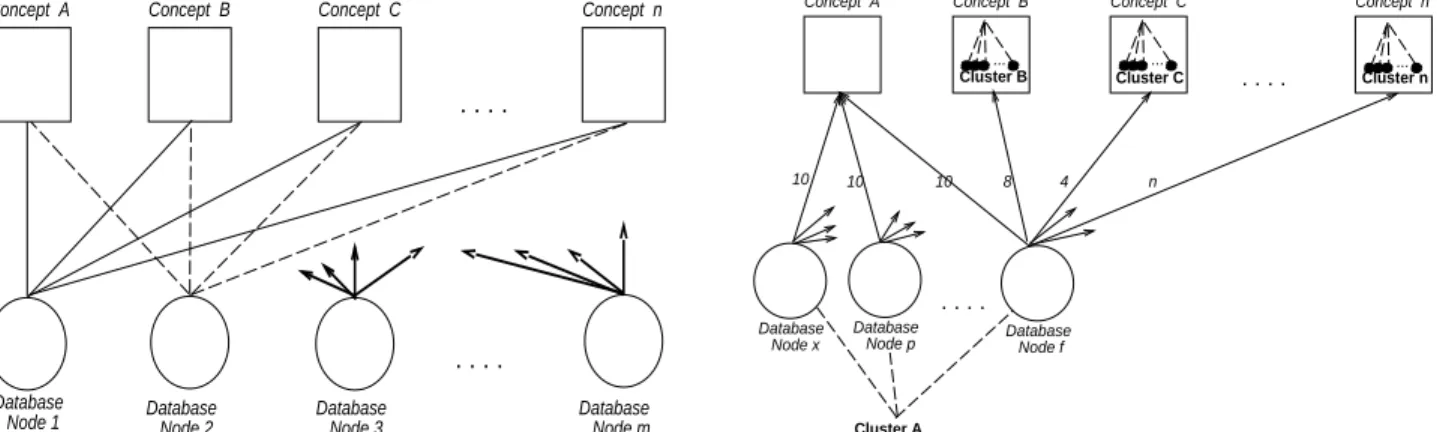
This results in a clustering of database nodes [6] around the various GCs (as shown in
Figure 1).
. . . .
. . . .
Database
Node 1 Database Node 2 Database Node 3 Database Node m Global Concept A Global Concept B Global Concept C Global Concept n . . . . Global
Concept A GlobalConcept B GlobalConcept C GlobalConcept n
Database Node p Database
Node x Database Node f
. . . .
10 10 10 8 4 n
Cluster B Cluster C Cluster n
... ... ...
Cluster A
Figure 1: Database Nodes Linked to Global Concepts and Clusters
By clustering database nodes, the relationship space is sub{divided, and searching is implemented via reference to the link weights. While this structure may appear \at", the link weights actually impose a dynamic ordering and structure upon the GCs and the database nodes clustered around them. When several database nodes all link strongly to
the same GC (eg. weight 10/10), a dynamic cluster A is formed. However, each of these
same database nodes will also link less strongly (eg. weigh 8/10) to other GCs which will
have their own associated clusters B, C, D and so on. Database nodes in cluster A will
therefore overlap with all other clusters to various degrees.
Link weights updates are performed locally at each database node. The organization is based upon individual database node \states", and thus control remains logically dis-tributed. Consequently, the organization is inherently exible, and avoids the short comings of strict hierarchical and object oriented organizations noted in [13, 23]. Search granularity is determined by the number of GCs and the number of nodes clustered around them.
In order to establish, and maintain a dynamic subdivision of the information space,
the Tassili language was developed [5]. The constructs of this language are also used to
query and extract information from the system, as well as for educating users about the information space. Linking of database nodes to one another results in the formation of database clusters. It should be noted that these \information space" clusters are dierent to those formed in the relationship space. Clusters formed in the information space allow for the exchange of structural information between database nodes, as a prelude to data sharing. In addition, relationships may be formed between two clusters, or between a single database node and a cluster. In the relationship space, clustering provides high level logical associations, and does not result in the sharing of physical information. By grouping
database nodes in the information space, meta level relationship types are specied. Their
formation is driven by the system, and they represent how database nodes physically relate to each other. Formation and alteration of information space relationships represent an alteration in current areas of interest. Hence, information regarding relationships is fed back into the relationship space for link weight and GC adjustment. A meta-information type is a unit which describes the structure and behavior, of semantically related portions of database schemas. Two basic forms of meta{information types are used; one which arises from a cluster, and a second which is instantiated by relationships between two databases, a database and a cluster, or two clusters.
Dealer Database Node 10 GC representing Sales GC representing Spare Parts GC representing Car Registration GC representing Insurance Relationship Space Cluster of Database Nodes 10 10 ... ... ... ... ... 4 −> 7 3 −> 8 2 −> 6 Insurance Government Insurance Agents Manufactures Consumer Organisations Dealers Manufacturers Insurance Government Insurance Manufacturers Government Police Insurance Electrical Housing Machinery . . . Rentals CheapRent Database Vehicle Spare Parts Vehicle Sales Vehicle Specifications Vehicle Registration Vehicle Safty Vehicle Dealers Vehicle Manufacturers Vehicle Wreckers Consumer Organizations . . House Insurance Boat Insurance Vehicle Insurance Car
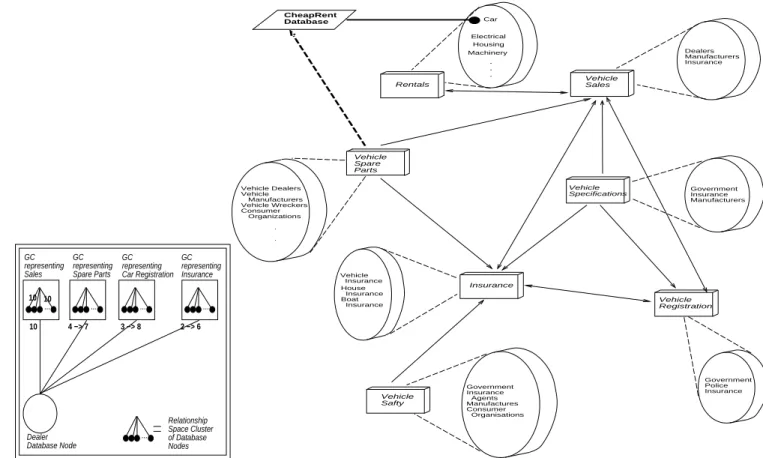
Figure 2: A Partial View of a Network of Relationships and Clusters
Consider for instance, a second{hand car dealer's database node. Initially it will be strongly linked (eg. weight 10/10) to a GC representing the area of interest \sales", and more weakly linked (eg. weight of 3/10) to other GCs dealing with the area of interests relating to cars. Assume the dealer database node requires continual information from
several remote sites regarding car registration, car insurance and car spare parts which are initially strongly linked to GCs representing these three areas. The dealer database node will examine GCs it is less strongly linked to, and will locate these remote sites. If the information at these remote sites is found to be appropriate, then the dealer database links to the remote GCs is increased (as shown in the Figure 2 insert). Links pictured as lines in the Figure 2 insert, do not represent relationships, but overlaps between clusters representing the current areas of interest. Database nodes which now sharing physical data, form an information space clustering. Figure 2 depicts the information space sub{division, and will be referred back to throughout the remainder of the paper. The information space clustering is implemented by having the dealer database node join with \Vehicle Sales" cluster. Information space relationships are then formed between the \Vehicle Sales" cluster and the \Vehicle Spare Parts", \Insurance" and \Vehicle Registration" clusters (shown as solid lines in the gure). In this way, the relationship space sub{division creates a platform for the resulting information space sub{division. As time progresses seven information space clusters and their associated relationships are formed.
Consider theCheapRent car rental company in the Figure. It will initially be strongly
linkedto the GC representing rentals { and less strongly connected to GCs representing other areas of interest (such as cars). After exploration of the relationship space, its database
contacts remote sites and eventually joins the rentals information space cluster - this is
depicted in Figure 2 by the solid bold line leading from the CheapRent database symbol
to the collection of databases comprising the rentals cluster. CheapRent also enters into
a relationship with the vehicle spare parts cluster. This is depicted in Figure 2 by the
broken bold line between the CheapRent database symbol and the collection of databases
comprising the vehicle spare parts cluster. Once these information space associations have
been established, this relationship information is fed back into the relationship space level architecture, causing the link weight updating shown.
CO−DB CO−DB DB DB User Administrator Interface Process Interface Process Network DB Node DB Node
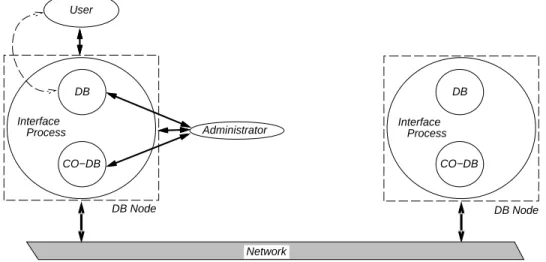
Figure 3: Database Nodes Connected Over a Network
Figure 3 depicts how database nodes may be connected over a network, and how general users and administrators interact with the system. General users are permitted to interact with the local database (as indicated by the broken arrow). To access remote systems however, these users must interact with the interface process. Co{databases (CO-DB) are
object oriented databases where information and knowledge of the relationship space and information space sub{divisions are stored. General users may also suggest updates to local co{databases, however, persistent updates are performed only by the administrators (as indicated by the arrows in the gure).
There are two basic phases in the lifetime of a distributed system organized around
the proposed architecture. These are the initialization phase and execution phase. During
initialization GCs are created and link weights to them are established. This is essentially a pre{clustering process, where groupings of database nodes are established on a tentative
basis only. During execution the system operates on four levels: an architectural level, an
interoperability level, an interaction/negotiation level, and an exploration level. These are
discussed in section 5.
4 System Bootstrapping
The initialization phase consists of three basic activities: presentation of database node descriptions, global concept instantiation and link weight initialization.
4.1 Database Node Descriptions
Initial clustering is based upon a description which each database node forwards to a cen-tral location. Clustering based upon these descriptions is then performed. This step is performed only once, and should be viewed as pre{clustering of the system. As information space clusters are formed, inaccuracies in the pre{clustering phase are eliminated and link weight adjustment results in re{clustering of the system. In addition to the database node description, other descriptive categories may be included to further lter database nodes involved in the information space clustering process. For example, geographical location and corporate structure may be included, and so on. Although it is assumed that descriptive categories are dened statically at initialization, there is no intrinsic reason why further categories cannot be added or existing categories deleted.
4.2 Pre{Clustering and Global Concept Instantiation
The \topic" based clustering of database nodes, is depicted in Figure 4. After being clus-tered, each database node forms a weighted link with the other clusters. In Figure 4, each node in cluster#1 forms a weighted link with cluster#2, cluster#3 and so on. Database nodes will be most strongly connected (eg. have a weight of 10/10) to the cluster they were initially assigned to. Weights for the other links are automatically initialized by having each node calculate the ratio of similarityof all database nodes in its cluster to all database nodes in the remote cluster it is forming a link to. This process will occur for each cluster set, to produce a series of distinct fully logically connected groupings. Verication and renement by a human operator is required before the system becomes useful. The eventual outcome
. . . . . . . . . . . . . . . . . Cluster #1 Cluster #2 DB1 DB 2 DB x DB 3 DB 8 DB y DB p DB q DB z . . . . . . . . . . . . . . . . . Cluster #1 Cluster #2 DB1 DB 2 DB x DB 3 DB 8 DB y DB p DB q DB z Cluster #n Cluster #n "Rentals" "Insurance" "Vehicle Spare Parts" "Rentals" "Insurance" "Vehicle Spare Parts"
Figure 4: Creation of Links After Initial Clustering
is a collection of abstract global concepts around which nodes can cluster. The set of GCs which forms a basis for relationship space by :
1. Sub-dividing the nodes to produce a reasonably uniform distribution, 2. Providing an appropriate degree of search space granularity.
Initial clustering may not result in uniform size groupings. Hence, an additional sub-division
of groups may be required [10]. A tuning phase may also be introduced if node descriptions
do not provide an adequate basis for the clustering process (eg. when a small proportion of clusters contain a large percentage of the clustered items). This situation corresponds to an over generalization of key features and can be resolved by employing a subdivision algorithm which renes and decomposes over generalized GCs.
5 The Execution Phase
During execution, activities are characterized by four levels: an architectural level, an
in-teroperability level, an interaction/negotiation level, and an exploration level. In the
ar-chitectural level a logical interconnection of nodes is pursued, and clusters are formed in the relationship space. In the interaction/negotiation level, the GC organization is used as a platform for information space clustering. Information concerning physical relationships formed in the information space, is then fed back into the rst layer for adjustment of the relationship space structure (via link weight and GC updates). Together these two layers allow organization of interactions between the system's database nodes. Remote informa-tion must be understood, this is achieved in the interoperability level through the use of
demonstrations. Lastly, the appropriate information must be located. This is achieved in the exploration level using relationship space GC clusters, in conjunction with the Tassili language and existing information space clusters.
5.1 The Architectural Level
This level supplies an architecture for data sharing between database nodes, using the clus-ters formed in both the relationship and information spaces. By forming clusclus-ters, a means is provided for the synchronizing of both relationship formation and data sharing activities. By adjusting link weights locally, each database node itself decides which relationship space clusters it will participate in. Thus, control remains decentralized. By joining a cluster
database nodes implicitlyagreeto work together (and thus sacrice their autonomy to some
degree). However, nodes retain control locally and join or leave clusters based upon lo-cal considerations (by following the appropriate protocol - described later). Consequently, maximum local autonomy is maintained and both, inter{relationship space and informa-tion space control, remains distributed. In addiinforma-tion, inter-node relainforma-tionships continue to be dynamically updated, formed, and dissolved in an incremental fashion.
Because database nodes are fully logically interconnected, via GCs and link weights,
any information type dened by a particular clustering of nodes is potentially accessible.
The system thus allows the sharing among databases of all information types available.
Once inter{node relationships have been initiated, a platform is provided for the interoper-ability process and data sharing { this is required to restrict the potential number of nodes involved. If this subdivision is not performed the information space remains huge and the interoperability problem becomes intractable.
5.2 The Interaction/Negotiation Level
There are several database node interaction phases. The rst form of node interaction involves searching of the inter-node relationship space by means of search heuristics. Pre-viously, a pre{clustering of nodes has been performed. Once the appropriate nodes are identied, access to the remote information may be negotiated to determine which tasks get delegated to which remote servers. This latter process is performed through the Tas-sili language, and may result in updates to both the information space clusters, as well as relationship space clusters (i.e. GC link weights, and GCs themselves).
The second form of node interaction results in the discovery of interoperability facts which are stored in the node co{database. In order to extract/explore (or export)
infor-mation a node may contact and interact with the relevant nodes in a information space
database cluster. Once again, this interaction is performed using Tassili language
primi-tives { understanding of remote data is facilitated through the use of Demonstrations as
described in section 5.3.
5.2.1 Information Space Cluster Construction and Update
The ability to form, and control joining and leaving of clusters, is restricted to selected users. The primitives for these interactions and semi{automated negotiation sessions are provided by the Tassili language, and result in the creation and maintenance of an object oriented information space schema.
In some instances, users may ask about information that is not in the local database domain interest. If these requests are small and not persistent, a mapping to a remote information type will suce. If the number of requests remains high, re{clustering may ensue. The database will then either share the meta{information type represented by the remote \popular" databases, or a new information type will be formed.
In the CheapRent car rental company case, information retrieval begins by determining which remote databases should be contacted. After examining the relationship space, and/or the available information space cluster information, the CheapRent administrator joins the
rentals cluster. That is, after identifying the appropriate \area of interest", joining of the
information space cluster and sharing of data ensues. In Tassili this negotiation process is performed using the the following primitive:
Inquire atGM-Spare-Parts With Message\Wish to establish a relationship. What are
the main attributes of your resource?"
A message is sent along with the query to explain what is expected. If the query fails, a diagnostic is returned. Its co-database is then loaded with information regarding relationships between the rentals cluster and other cluster/databases, as well as informa-tion regarding databases in the cluster itself. The CheapRent administrator will now, for
instance, have knowledge of the vehicle salescluster, and indirect knowledge of thevehicles
spare parts cluster for example { because of the relationship between the sales and spare
parts clusters. A general user can thus investigate this latter cluster in the hope of resolving an av-cost-of-parts query for instance. If this investigation proves fruitful a short term in-teraction with this cluster site will ensue. In order to obtain remote structural information, the following Tassili primitive is used:
Send to CheapRentObject GM-Spare-Parts.template.
This query is used by the target (representative) database to send information about the information requested to the servicing database or cluster. If the specications meets the servicing needs, no further action is taken. However, if the specications do not meet the
servicing entity specications, an Inquire query is sent back to the target entity for further
renement. This process of negotiation ends whenever the involved entities decide so. If the
Send query is successful, nothing is returned. If the query fails, a diagnostic of the failure is
returned. Other primitivesexist to create data structures at local co-databases to implement the relationship abstraction, and to end the relationship. This results in formation and/or modication of the object oriented schema.
When the car rental company joins the rental cluster a information space schema
update occurs. A new class (representing the rental company node) is instantiated via an existing cluster member. This update is then propagated to the other cluster members.
These changes are achieved using the primitive:
Instantiate Class RentalsWith Object Car With Name = CheapRent.
The rental database manager may then choose to allow remote access to certain local information. For example, the CheapRent node may wish to allow access to \rental-rate", \model" and \year" attributes which are contained within its database. This is achieved by adding methods to its class via the Tassili primitive:
Add Method Rental-price With Body
if date.month >= Oct and date.month <= Jan then
return(1.2 * base-price) else
return(base-price)
To Class Rentals.
Other Tassili primitives exist to remove methods and objects (ie. when a node relin-quishes access to local information or leaves a cluster), and to alter methods or objects. There are also more basic primitives which are used to establish a cluster, and propagate and validate changes. Each operation has to be validated by the participating database administrators.
For any database to enter or leave a certain cluster, it has to fulll the requirements set by that cluster. If a database would like to be a member of a certain cluster, it has to provide some information about the data it would like to share as well as information about itself. The administrator of that cluster will then decide how the information space schema is to be augmented if the database is accepted as a new member. During this informal exchange, many parameters need to be set. For instance, a threshold for the minimum and maximum number of cluster members is negotiated and set. Likewise, a threshold on the minimum and maximum number of relationships with databases and cluster is also set. In the example shown in Figure 2, the CheapRent administrator has decided that long term
connection is required with the vehicle spare parts cluster. Thus, a relationship is entered
into with the vehicle spare partscluster's nodes (ie. information ow from the vehicle spare
parts cluster to the CheapRent database).
Initially, a database administrator creates the root class of the cluster schema. Once this is done, the root of the schema is sent to every participating database for validation. If the operation is not validated, the rejecting node sends an edited version of the object to the creator of the object. Based on this feedback, the creator will decide whether to change the object or not. This process will continue until there is a consensus. Changes are only made at a single site until consensus is achieved - at which time the change is made persistent and propagated to the appropriate database nodes.
If existing classes/methods are to be updated responsibility lies with the database that \owns" it. Prior to any changes, the database owner tells every participating database to lock the object to be changed. After an acknowledgment from those databases, the
local database administrator proceeds with implementing the changes, and propagates the update.
A database cluster is dismantled by deleting the whole corresponding subschema in every participating database schema, along with all objects belonging to the classes of that cluster. All clusters with which there is a relationship are notied that the cluster no longer exists. Local schemas are updated by their administrators. The decision to dismantle a cluster is reached by a consensus of participating databases, or when only one node remains in the cluster. The update of co-databases resulting from relationships changes is practically the same as dened for clusters. The only dierence being that changes in the cluster case obey a stricter set of rules.
After CheapRent creates a relationship connection with thevehicle spare partscluster,
both it and the cluster members must update their co-database. Similarly, when
Cheap-Rent joins the rentals cluster co-databases must be updated to reect the new inter-node
relationship structure. In this way CheapRent builds up its local knowledge of remote sites and forms appropriate relationships with those containing applicable information. Thereby ltering the amount of information which must be assimilated at the car rental node. Fur-ther relationships and clusters are contacted by CheapRent users as they attempt to ac-cess required information. The rental database administrator may then choose to enter into/create further relationships and clusters based upon users needs. When no information space meta{types exist, or when there are a huge number, it becomes necessary for users to explore the information space using the underlying information space GC sub{division. That is, when there are no information space clusters, or when there are too many, the underlying relationship space sub{division may be utilized to restrict the search space [18].
5.3 The Interoperability Level
In a large scale system, interpretation of remote information is a major problem, even if the data model is the same across databases. Before information can be accessed
inter-relationships between databases must be organized and schemas must be understood.
Un-derstanding of remote information is handled through the introduction of documentations.
These are sample behaviors or structures of certain classes of information, which are at-tached to each information type that is shared with the outside world. Their aim is to explain/dene that information type. Even if two databases contain the same information, local usages will vary and dierent behaviors may be exhibited.
In the example (Figure 2) documentation is required by CheapRent to make sense of
remote node methodsadvertisedin the various clusters it must interact with. Confusion may
arise when interacting with databases in thevehicle spare partscluster because of dierences
in price listings (eg. one database may include sales tax, others may not), dierences in domains (eg. a database may only stock parts for one type of car), dierences in the types of businesses (eg. a car wrecker may only display part availability, not price) and so on. Demonstrations may also provide details of information needed by the remote node to access the required data. For example, a vehicle's year and make will be required to obtain a spare part's price.
Similarly, in the case of interpreting insurance cluster members, demonstrations may be included to dierentiate policies oered by various insurance agents. This may include a simple policy statement, or include graphical/video/audio data comparing one companies policy with another. For example, one company may provide cover for both the vehicle and driver, others may not. Dierent companies may also pay out dierent market value prices
if a car is damaged beyond repair, and so on. In the vehicle sales cluster databases may
list prices of models. Video and audio demonstrations may be included to highlight vehicle features. A similar demonstration format may be included by a government database in the
vehicle safety cluster to explain attributes in a safety standards database.
Documentation is oered by the providing databases and is not an integral part of the system, and may include several of the following features:
Structured Text: This is similar to the man pages dened in UNIX and oers a
non-graphical description of database information.
Graphical Interface: The documenting database is charged with the sending binary objects to users' screens. This assumes users have access to high resolution workstations.
Audio Capability: If users have audio capability, and adequate amount of storage at their disposal, databases may document information with sound capability.
System Dependencies: If the documentation relies on a programming tool, databases are encouraged to provide many platforms of implementation so that the maximumnumber of users can use the documentation. Databases are also encouraged to provide documen-tation that may run under dierent operating systems. The user is prompted for a choice of operating systems to choose from. Last and not least, the documentation runs on a multitude of hardware.
Demonstrations thus provide a way of converting data (eg. price of parts versus price with sales tax), evaluating data (eg. the \best" insurance policy - cost benet analysis), translating data (eg. demonstrations may be oered in several dierent languages), and interpreting data (eg. what is the denition of a \safe" car). Note also that demonstrations on the same topic will vary from database to database. For instance, safety features in a manufacturer's database (meant for public consumption) may not equate with safety features in a government vehicle safety database (meant for expert consumption). Thus, the local \meaning" of attributes/objects is dened, through the Tassili query language.
5.4 The Exploration Level
Once a number of information space clusters have been established, exploration of the UoD may be pursued via the relationship or information space organization representations. Although an explosion in the number of information space clusters may limit information space based searches. The syntax specications of Tassili queries provide constructs to educate users about the available information space organization, as well as connecting databases and performing remote queries. The information type name, structure, behavior, and graphical representation are used as a handle for identifying the appropriate information
resources. Node co-databases maintainschemas and it is to co-databases that all information space queries (local and remote) are directed.
Co-database Root Class
Database-Database Class Relationships Root Class
Cluster Relationships Root Class Database Relationships Root Class
Cluster-Database Class
Cluster-Cluster Class
Database-Cluster Class
Cluster Root Class
Cluster 1 Root Class Cluster n Root Class
. . . . .
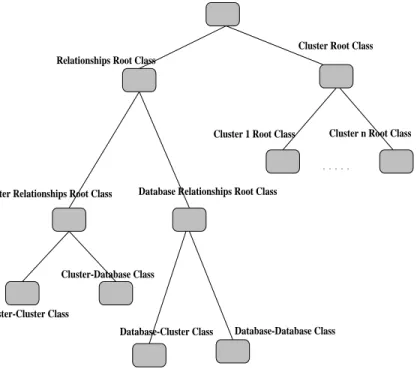
Figure 5: A Skeleton of a Typical Co{Database Schema
A co-database information schema consists of two subschemas as depicted in Figure 5. Each subschema represents either a cluster or a relationship and contains a lattice of classes. Each class represents a set of databases that can answer queries about a specic type of
information (e.g. queries about car parts). A graphical interface has been implemented so
users may navigate through the information space. The relationship subschema (left side of Figure 5) consists of two subschemas, the rst depicts relationships that clusters (it is mem-ber of) have with other databases and clusters. The second is a subschema of relationships the database in question has with other databases and clusters. Each of these subschemas, in turn, consists of two subclasses that describe relationships with databases and clusters. The cluster subschema (right side of Figure 5) consists of one or more subschemas, each of which represents a cluster the database in question is a member of.
Cluster relationship descriptions include information about points of entries and con-tact with those clusters that are involved in a relationship with. Other descriptions provide information to local databases so the best point of contact can be chosen. It should be noted that the subschema representing the set of relationships providing clusters will be the same for all databases that are members of the providing cluster.
A set of databases, containing a certain information type is represented by a class in the schema. Every class contains a description of the participating databases and the information type(s) they contain. Some attributes describe the information type while the remaining attributes describe the databases that contain this information type. Database descriptions include information about the data model, operating system, query language, etc. A description of the information type includes its general structure and behavior
(if applicable). Since databases may have dierent views on the same information type, only the common parts of the view are represented in the class. These descriptions dier from demonstrations in that they only oer general structural information. Following is
an example of a class description showing some details of the class Root-Cluster. Using
this structural information and various Tassili query primitives, a user at the CheapRent company (Figure 2) can begin to resolve complex queries. The CheapRent co-database is
a member of the rentals cluster and has a relationship with thevehicle spare parts cluster.
Because of these relationships CheapRent has knowledge of the vehicle sales cluster stored
in its co-database. This information is accessed by a user through the Tassili primitives:
Display Clusters of CheapRent.
This provides a list of clusters CheapRent is a member of.
Display Cluster Relationships Rentals.
This provides a list of clusters the CheapRent database andrentalscluster has a relationship
with (eg. vehicle sales and vehicle spare parts). A similar query may be used to examine
the relationship links of the vehicle spare parts and vehicle sales clusters. In this way
CheapRent users can discover the clusters: vehicle specications, insurance and vehicle
registration. Lastly, by examining the relationship links to theinsurance cluster, thevehicle
safety cluster can be found.
Primitives also exist which display the classes of relationships and clusters, and allow connections to remote clusters/database relationships. Users may utilize other primitives and stipulate an \information name" - for example \part prices" - which returns a list of possibly remote clusters/relationships that have a corresponding class name. This process requires that nodes maintain an appropriate list of thesaurus terms. If no match is made a null list is returned. In this case a user may either submit another information name term, attempt to navigate through the system and discover the information \manually", or make use of the underlying relationship space search structure. In the last case three basic search heuristics have been proposed in [18], based on link weight relaxation.
In the car rental case the relationship between the CheapRent database and thevehicle
spare partsmayhave been returned by stipulating the information namespare partsor simply
by listing relationships. Once an appropriate cluster/relationship has been found, Tassili provides primitives for investigating its classes. For example:
Display SubClasses vehicle-spare-parts
will display all the subclasses of the vehicle spare parts cluster.
The query:
Find Informationpart-prices
will display information associated with the subclass part prices within the cluster vehicle
spare parts.
Lastly, the query:
Find Information With Attributes parts : \exhaust";model : \JaguarXJS";year : \1990".
will display actual information. Clearly these queries require increasingly greater knowledge of the cluster schema. Thus both expert and novice users are catered for.
Further Tassili primitives are available for exploring objects more fully (as required in the rst two of the three class queries above). For example, the \Display SubClass" query will return the list : cars, trucks, motorbikes and so on. The user then issues the query:
Display Instances By Attribute Of Information Car.
By leaving the \instance" term blank all instances associated with the sub-class \Car" are displayed. Similarly, Tassili allows attributes of instances to be displayed.
Finally, Tassili allows for further understanding of an information type using the primitive:
Display Documentation of Instance Ford-spare-parts Of Informationpart-price.
The answer can be in textual or graphical form (as noted previously). The query itself may require a certain type of hardware and/or software to be run. The user is prompted to provide some information about the environmentcurrently used. The list of information that may be requested is presented in a preceding section. If there is no behavioral capability or no suitable environment is present, the query fails. Otherwise, documentation is displayed.
6 Conclusion
This paper addresses issues relating to large-scale interoperation. In particular, we propose an architectural framework for organizing interactions among a large number of autonomous disparate database nodes. The proposed form of interaction results in the creation of dy-namic clusters of databases centered around subject areas of interest or expertise called global concepts. Global concepts are high-level abstract meta-schema objects which essen-tially represent centroids of a database cluster pertaining to an area of interest. Database nodes then form weighted links to global concepts in a way which reects their own interests. Thus they organize the inter-database information and relationship search space.
Linguistic tools are also provided in order to allow application programmers to estab-lish and maintain the subdivision of the inter-database information space. Moreover, the system provides facilities for querying and extracting information regarding the inter-cluster relationships and the information space in general. The proposed approach allows for a high degree of exibility as it allows relationship information discovery and data sharing to be driven by the states of the individual database nodes as the system executes.
The proposed approach fullls three fundamental tasks: it provides a common frame-work (the global concepts) to which participant databases contribute; it species a relatively small set of databases/nodes for interaction (viz. database clusters) thereby accelerating information searches; and implicitly provides local nodes with an abstract model of other clusters and database nodes. Other virtues of this approach are its simplicity, dynamic
nature, and extensibility in addition to the the fact that it retains local autonomy because nodes provide and control their own classication.
References
[1] Rafael Alonso, Daniel Barbara, and Luis L. Cova. Data sharing in large heterogeneous infor-mation networks. In Workshop on Heterogeneous Databases, Chicago, Dec. 1989. IEEE-CS Technical Committee on Distributed Processing.
[2] C. Batini, M. Lenzerini, and S. B. Navathe. A comparative analysis of methodologies for database schema integration. ACM Computing Surveys, 18(4):324{364, Dec. 1986.
[3] A. D. Birell, R. Levin, R. N. Needham, and M. D. Schroeder. Grapevine: An exercise in distributed computing. Communications of the ACM, 25(4):260{274, April 1982.
[4] A. Bouguettaya and R. King. Large multidatabases: Issues and directions. In IFIP DS-5 Interoperable Database Systems (Editors: D. K. Hsiao, E. J. Neuhold, and R. Sacks-Davis). Elsevier Publishers, Lorne, Victoria, Australia, 1993.
[5] Athman Bouguettaya. Large multidatabases: Beyond federation and global schema integra-tion. In R.Sacks-Davis, editor, Proceeedings of the Fifth Australasian Database Conference, Christchurch, New Zealand, January 1994. Global Publications Services.
[6] Athman Bouguettaya. On-line clustering. To appear in the IEEE Transaction on Data and Knowledge Engineering Journal, 1994.
[7] Wallys W. Conhaim. Maturing french videotext becomes key international tool. Information Today, 9(1):28, January 1992.
[8] A. Emtage and P. Deutsch. Archie: An electronic directory service for the internet. Proc. Winter 1992 Usenix Conf., pages 93{110, 1992.
[9] T. Berners-Lee et al. World-wide-web: The information universe. Electronic Networking: Research, Applications, and Policy, 1(2):52{58, Spring 1992.
[10] B. Everitt. Cluster Analysis. Halsted Press, 1980.
[11] D. Heimbigner and D. McLeod. A federated architecture for information systems. ACM Transactions on Oce Information Systems, 3(3):253{278, July 1985.
[12] B. Kahle and A. Medlar. An information system for corporate users: Wide area information servers. Connexions - The Interoperability Report, 5(11):2{9, November 1991.
[13] V. Kashyap and A. Sheth. Semantics-based information brokering: A step towards realizing the infocosm. Technical Report DCS-TR-307, Rutgers University, March 1994.
[14] W. Litwin and A. Abdellatif. Multidatabase interoperability. IEEE Computer Magazine, 19(12):10{18, Dec. 1986.
[15] W. Litwin, J. Boudenant, C. Esculier, A. Ferrier, A. M. Glorieux, J. La Chimia, K. Kabbaj, C. Moulinoux, P. Rolin, and C. Stangret. SIRIUS system for distributed data management. In Distributed Databases, pages 311{343, Amsterdam, 1982. North-Holland Publishing Company.
[16] Witold Litwin, Leo Mark, and Nick Roussopoulos. Interoperability of multiple autonomous databases. In ACM Computing Surveys, volume 22(3), pages 267{293. ACM Press, September 1990.
[17] M. McCahill. The internet gopher protocol: A distributed server information system. Con-nexions - The Interoperability Report, 6(7):10{14, July 1992.
[18] S. Milliner and M. Papazoglou. Reassessing the roles of negotiation and contracting for inter-operable databases. In International Workshop on Advances in Databases and Information Systems, pages 169{202, March 1994.
[19] E. J. Neuhold and B. Walter. An overview of the architecture of the distributed database system POREL. In Distributed Databases, pages 247{290, Amsterdam, 1982. North-Holland Publishing Company.
[20] Katia Obraczka, Peter B. Danzig, and Shi-Hao Li. Internet resource discovery services. IEEE Computer Magazine, 26(9):25{35, September 1993.
[21] Ey Oz. When professional standards are lax. Communications of the ACM, 37(10), 1994. [22] Gerard Salton and Michael J. McGill. Introduction to modern information retrieval. In
McGraw Hill Computer Science Series, New York, 1983. McGraw Hill Book Company. [23] Michael F. Schwartz. Internet resource discovery at the University of Colorado. IEEE
Com-puter Magazine, 26(9):25{35, September 1993.
[24] Amit P. Sheth and James A. Larson. Federated database systems and managing distributed, heterogeneous, and autonomous databases. In ACM Computing Surveys, volume 22(3), pages 183{226. ACM, September 1990.
[25] P. Simpson and R. Alonso. A model for information exchange among autonomous databases. Technical Report, Dept. of Computer Science, Princeton University, May 1989.
[26] Patricia Simpson. Query processing in a heterogeneous retrieval network. In 11th International Conference on Research & Development in Information Retrieval, pages 359{370, Grenoble, France, June 13-15,1988. ACM SIGIR.
[27] M. Templeton, D. Brill, A. Chen, S. Dao, and E. Lund. Mermaid - experiences with network operation. Proc. 2nd Data Engineering Conference, 292-300:292{300, Feb. 1986.
[28] R. Watson. Identiers (naming) in distributed systems. In B. W. Lampson, M. Paul, and H. J. Siegert, editors, Lecture Notes in Computer Science: Distributed Systems - Architecture and Implementation, pages 191{210. Springer Verlag, New York, 1981.