Zurich Open Repository and Archive University of Zurich Main Library Strickhofstrasse 39 CH-8057 Zurich www.zora.uzh.ch Year: 2014
An algorithm for random trajectory generation between two endpoints, honoring time and speed constraints
Technitis, Georgios ; Weibel, Robert
Posted at the Zurich Open Repository and Archive, University of Zurich ZORA URL: https://doi.org/10.5167/uzh-104468
Conference or Workshop Item Published Version
Originally published at:
Technitis, Georgios; Weibel, Robert (2014). An algorithm for random trajectory generation between two endpoints, honoring time and speed constraints. In: GIScience 2014: Eighth International Conference on Geographic Information Science, Vienna (A), 23 September 2014 - 26 September 2014, 88-92.
An Algorithm for Random Trajectory Generation Between
Two Endpoints, Honoring Time and Speed Constraints
G. Technitis, R. Weibel
Department of Geography, University of Zurich (UZH), Winterthurerstrasse 190, CH-8057, Zurich Email: {georgios.technitis | robert.weibel}@geo.uzh.ch
1. Introduction
In order to test hypotheses regarding possible effects of stimuli on the movement of an animal, researchers frequently use various forms of random walk (RW) as a reference movement model (Turchin 1998). Using the starting point (origin) and the diffusion coefficient of the walk as an input, multiple instances of RWs may then be used to create a space utilization surface, a valuable tool for the behavioral ecologists.
However, in cases where movement has to be simulated between two given points (i.e. an origin and a destination) in a given limited timeframe — for example simulating potential paths between two stop-overs in continental scale bird migration — simple RWs fail to deliver the desired result. Extensions, such as RW with correlation, bias (or drift), self-avoidance abilities, etc. have thus been introduced. Bartumeus et al. (2005) used multiple distributions of correlation for increasing the ‘search efficiency’ of the walk, and Codling et al. (2008, 2010) attempted to quantitatively parameterize it. In a more qualitative approach, Fronhofer et al. (2013) try to cluster and express the behavior of the animal with a biased correlated random walk and ‘area restricted search strategies’. In order to meet the constraint of reaching the destination point, a common solution is to introduce a global bias to ‘force’ the RW to the endpoint, thus resulting in a highly unrealistic mode of movement which, at the same time, neglects the temporal dimension (i.e. the available time of total travel). Thus, RW models can only be made sufficiently efficient at the expense of introducing excessive bias, thus sacrificing randomness.
Space-time prisms and the Brownian bridges movement model, which will be discussed below, account for the time of total travel, though both methods focus on calculating areas and surfaces rather than individual trajectories. Thus, the use for hypothesis testing of individual movement patterns is limited.
We propose an algorithm that combines concepts from random walks, space-time prisms and alibi queries, and is capable of efficiently generating trajectories between a given origin and a destination, with the least bias possible. Since it is implemented both on the plane and the sphere it is suitable for simulating intercontinental movements such as those of migrating birds. The algorithm is catering to applications in animal ecology. It is not intended to simulate human navigation and wayfinding (e.g. on networks), though it accounts for physical limitations, such as maximum speed and movement time, and provides the user with either single or multiple trajectories as a result. The single trajectory can be used as an (unbiased) null model to test hypotheses about movement stimuli (bias), while the multiple trajectories may be used to create a probability density surface for comparison against established methods, most importantly Brownian bridges.
2. Background
Space-time prisms (STP) allow to define an envelope of accessibility given a specific time budget and maximum speed (Hägerstrand 1970), resulting in a potential path space (in a 3D
Technitis, G. & Weibel, R. (2014): An Algorithm for Random Trajectory Generation Between Two Endpoints, Honoring Time and Speed Constraints. Proceedings GIScience 2014, 24-26 September 2014, Vienna
cube) or its 2D projection, the potential path area (PPA) as shown in Figure 1. One of the methods related to our study was based on the STP and developed by Kuijpers et al. (2011) in an attempt to identify whether two spatio-temporal moving objects, given a maximum possible speed, could have physically met (solving the alibi query). The reasoning of the solution is simple and concrete, though the result is a surface, not an individual trajectory.
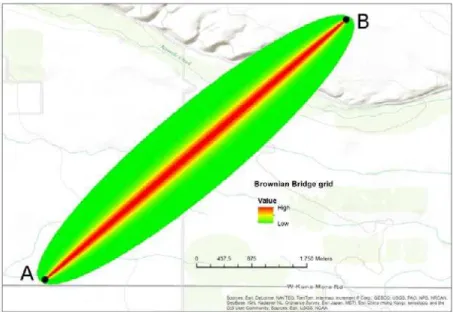
Figure 1. The space-time prism (STP) principle (adapted from Miller 1991 and Kuipers 2011) The Brownian bridge (BB) movement model attempts to account for both origin and destination, considering the time of total travel. Since the BB was introduced in the ecology community, it has been used extensively for defining the home range of species (Bullard 1991, Benhamou 2011), by calculating the space utilization distribution. In the example of Figure 2, which was created using the ArcMET BBMM tool by Jake Wall, we can see that this method generates a probability surface.
Figure 2. An example of a 0.99 probability surface generated between two points using Brownian bridges.
Recently, Song and Miller (2014) have presented a possible combination of the two approaches, with the definite advantage that the BB probability can be truncated using the STP, excluding areas that cannot be reached in the given timeframe. However, this method focuses on generating a truncated BB surface rather than a single trajectory, and even if a
trajectory is sampled from the resulting visit probability surface, no analytical solution exists to compute the STP on the globe. This deficiency becomes apparent in applications requiring distance calculations over large geographic distances.
3. Algorithm
We now describe an algorithm that generates trajectories between two given points A (origin) and B (destination) as randomly placed walks with as little bias as possible. We accomplish this by integrating concepts of the STP model in random walk generation.
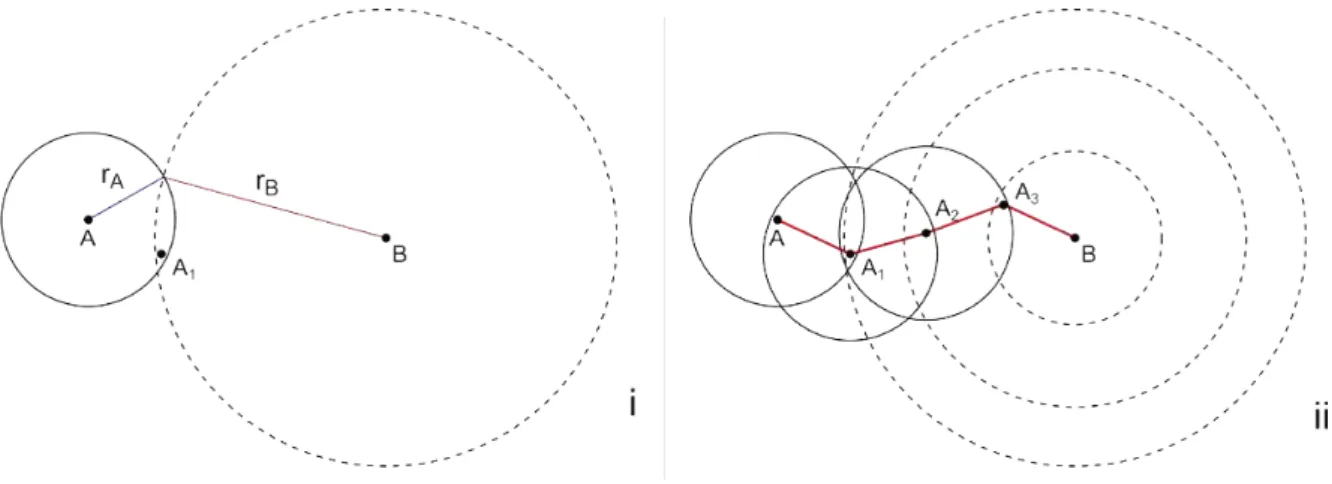
Based on the reasoning of the STP model a mobile object can move, at every time-step, as far as its maximum speed (Vmax) permits. At the same time, n time-steps before the end of the trajectory, the object should be within the reach of the destination B. The candidate area where an intermediate point of the simulated trajectory can be placed is called the potential point area (PpA), not to be confused with the potential path area (PPA). The PpA is the intersection of two circles, in our case, the circles CA(A,rA) and CB(B,rB). Circle CA has a center at the origin, and radius rA = Vmax, whereas circle CB has its center at the destination and a radius rB = n * Vmax (Fig. 3i). Within the intersection of these two circles (i.e. within the PpA), the new point (A1) is picked generating possible coordinates for the two dimensions,
using a uniform random distribution.
Once the point A1 has been created, the same procedure is followed, with the difference
that circle CA now moves its center to A1, for the calculation of point A2, then at A2 for
calculating point A3, and so on (Fig. 3ii). In the end, when all the points have been created,
the destination will be reached, while respecting both time and speed limitations.
Figure 3. Point generation procedure.
While this algorithm potentially covers many application domains, in ecology the researchers deal with migration patterns that often cover intercontinental movement. For such long-haul distances, the curvature of the earth must be taken into consideration when generating the trajectory. To account for this distortion, the proposed algorithm has been extended by calculating the circle-circle intersection on a spherical surface. The solution is based on spherical trigonometry identities, and uses transposition equations and transformation matrices for performing the necessary calculations.
4. Results
The scenario used for the following experiment was a migrating bird carrying a GPS tag and moving between two distant geographical points. If the GPS data is partially corrupted, or has a significant temporal lag between two consecutive fixes, gaps will need to be filled to ensure the dataset is homogenous—thus comparable—between individuals or species.
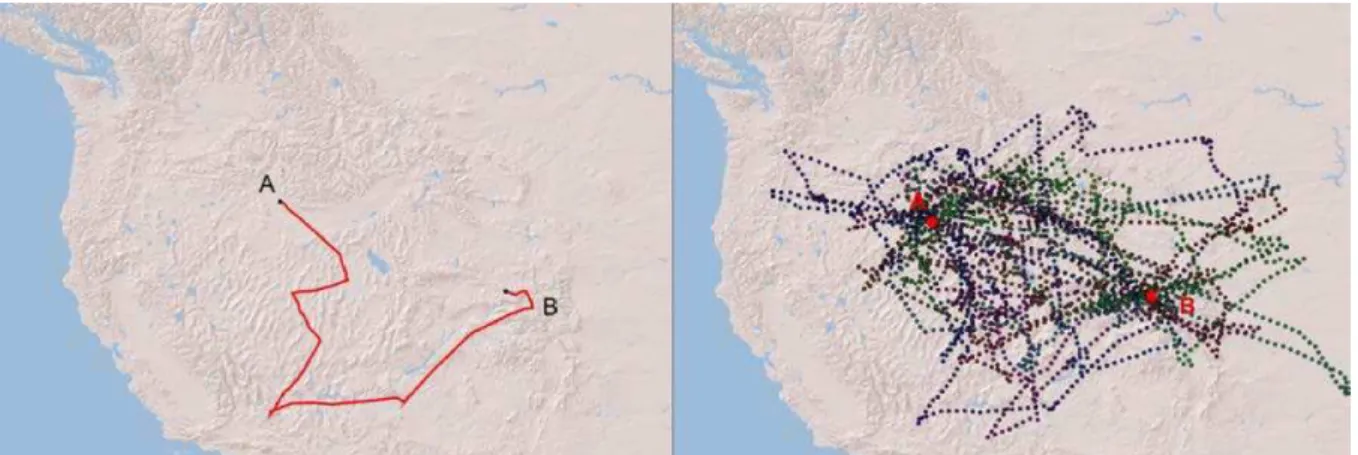
Figure 4 depicts the result of generating a single trajectory (left) and 50 random trajectories (right), respectively, from origin A to destination B, given a speed of 4.9 km/h and an available time of 26 days, 1 h and 10. Each trajectory consists of 94 points (3-4 points per day). Points A and B are spaced 800km apart.
Figure 4. Trajectories generated by the proposed algorithm between origin A and destination point B, spaced 800 km apart. Left: Single trajectory. Right: 50 simulated trajectories. We generated 1200 random trajectories between the same points A and B, which were then rasterized using a line density function with a bandwidth of 0.5 degrees (Fig. 5). It becomes apparent that even with the relatively small number of 1200 trajectories, the density surface starts approaching the space-use surface of the BB movement model. The origin and destination points possess the maximum probability, as expected, since all the simulated trajectories start and end in the same points. Also, the pixels falling near the straight line connecting the endpoints have higher probability of being selected, exactly as in the case of the BB. Similarly, the further a pixel is from this line, the more its probability fades out. Finally, our approach results in a growing region with the two endpoints as centers, and the tendency to approximate an ellipsis, exactly as in the case of BB.
Future research will on the one hand focus on the extended quantitative and qualitative evaluation of the algorithm, and on the other hand, we plan to exploit its modular design and expand it further to account for change of internal state, behavior and context boundaries.
Acknowledgements
This research represents part of the PhD project of the first author. Funding by the Swiss State Secretariat for Education, Research and Innovation (SERI) through project CASIMO (C09.0167) is gratefully acknowledged. We would like to thank Walied Othman and Kamran Safi for their valuable inputs to this work.
References
Benhamou S, 2011, Dynamic Approach to Space and Habitat Use Based on Biased Random Bridges. PLoS ONE, 6(1): e14592.
Bullard F, 1991, Estimating the Home Range of an Animal: A Brownian Bridge Approach. PhD Thesis. University of North Carolina at Chapel Hill.Bartumeus F, da Luz MGE, Viswanathan, GM, and Catalan J, 2005, Animal search strategies: a quantitative random-walk analysis. Ecology, 86(11), 3078–3087.
Codling EA, Plank, MJ, & Benhamou S, 2008, Random walk models in biology. Interface, 5(25), 813–34. Codling EA, Bearon RN, and Thorn GJ, 2010, Diffusion about the mean drift location in a biased random walk.
Ecology, 91(10), 3106–13.
Fronhofer, EA, Hovestadt, T, & Poethke, H.-J., 2013, From random walks to informed movement. Oikos, 11(6), 857–866.
Hägerstrand T, 1970, What about people in regional science? Regional Science Association. Papers and Proceedings, 24: 7-21.
Horne JS, Garton EO, Krone SM and Lewis JS, 2007, Analyzing animal movements using Brownian bridges.
Ecology, 88: 2354-2363.
Hornsby K and Egenhofer M, 2002, Modeling moving objects over multiple granularities. Annals of Mathematics and Artificial Intelligence, 36(1–2): 177–194.
Kuijpers B, Grimson R, Othman W, 2011, An analytic solution to the alibi query in the space-time prisms model for moving object data. International Journal of Geographical Information Science, 25(2): 293-322. Miller, HJ, 1991, Modelling accessibility using space-time prism concepts within geographical information
systems. International Journal of Geographical Information Systems, 5(3), 287–301.
Song Y and Miller HJ, 2014, Simulating visit probability distributions within planar space-time prisms.
International Journal of Geographical Information Science, 28(1): 104–125.