Innovation Studies Utrecht (ISU)
Working Paper Series
A Framework for Interactive Learning in
Emerging Technologies
Rens L.J. Vandeberg and Ellen H.M. Moors
A Framework for Interactive Learning
in Emerging Technologies
Rens L.J. Vandeberg & Ellen H.M. Moors
Department of Innovation Studies, Copernicus Institute, Utrecht University PO BOX 80115, NL-3508TC UTRECHT
Tel.: +31 30 253 7632 | E-mail address: [email protected] Abstract
Innovation is an interactive learning process which is of special interest for emerging technologies in which complex complementary knowledge from heterogeneous stakeholders is combined. In the emerging phase of technology development a lot of knowledge is tacit and can only be transferred face-to-face. At the same time a shared vision between stakeholders is being formed that acts as a driver for innovation. Although the importance of interactive learning is widely acknowledged, an adequate framework for studying interactive learning processes in emerging technologies is still missing. Therefore we formulated the leading research question: How to understand and conceptualize interactive learning in the context of emerging technologies?
We did not only take the outcome of interactive learning into account, but also focused on opening the black box of the interactive learning process. We developed a framework based on characteristic elements of the interactive learning process in emerging technologies (i.e. prime mover, intermediaries, network formation and knowledge flows), influencing conditions (geographical, cognitive, regulatory, cultural and organisational proximity), and the outcome of the interactive learning process (single-loop and double-loop, tacit and codified knowledge). Clarifying examples are taken from the empirical field of the development of novel food products (functional foods).
Keywords: interactive learning, emerging technology, innovation, proximity,
functional foods 1 Introduction
Innovation increasingly is perceived as a collective effort of a variety of public and private stakeholders within the context of an innovation system. The innovation system is perceived as a framework in which innovation is conceived as interactions of distinct actors (e.g. companies, market, government and supporting organizations), acquiring, understanding and combining knowledge and producing, diffusing, or using technologies, which result in the (re-)design of technical systems. In Innovation Systems various types of learning processes play a pivotal role, and interdependency (mutual relations), path dependency and non-linearity are emphasized. Learning within the Innovation System occurs through interaction between different stakeholders (users, producers, suppliers, researchers, etc.) in a network in order to create new products, processes and services (Schumpeters’ Neue Combinationen).
In this context Lundvall [1] states that in particular interactive learning is an important type of learning. Interactive learning is defined as: “a process in which
economically useful knowledge” [2, p226]. In order to find a solution to a specific
problem (scientific) knowledge is needed. Whereas knowledge is necessary to bring forth new product, process or service innovations, it is the creation of a shared vision that acts as a driver for innovation because it brings heterogeneous stakeholders together, working in collaboration towards a common goal [3-5]. Knowledge has a tacit and codified dimension. Tacit knowledge is knowledge that
resides in individuals and codification is the reduction of tacit knowledge into symbolic representations (e.g. scientific articles) [6, p254]. In science based developments knowledge is normally diffused through articles. However, in an emerging scientific discipline there is a latency time between discovery in a laboratory and codification in an article [7]. Therefore relevant knowledge might not yet be codified as for example Senker [8] found in her case studies on the role of tacit knowledge in innovation: “many of the researchers [report] that most of the underlying knowledge has not yet been published or documented anywhere”. But even if scientific knowledge has been codified in articles tacit
knowledge is an important factor because codified knowledge is often so complex that it needs a face-to-face explanation [8, 9]. Tacit knowledge itself entails both i) knowledge that might not yet have been written down (i.e. codified) and ii) knowledge that is important and cannot be codified. Polanyi’s [10, p4] statement
“we know more than we can tell” refers to some knowledge of which we might
not be aware that it is important or valuable to others and which cannot be codified. Especially tacit knowledge consisting of habits, culture, values and norms which is crucial for deriving a shared vision that stimulates innovation is not recognized by ourselves. It is this tacit knowledge that can only be transferred through face-to-face contact [11, 12]. “While explicit [i.e. codified] knowledge can be shared by language and written documents, the transfer of tacit user knowledge requires face-to-face interactions” [13].
Thus, interactive learning stimulates the process of obtaining knowledge and the creation of a shared vision through interaction between multiple stakeholders in the innovation system. The stakeholders are influencing the outcome of the interactive learning process by market demand, government legislation, or cooperation between companies in product research and development. This paper focuses on interactive learning, more specifically on the process itself and the conditions of interactive learning, leading to a certain learning outcome. The knowledge from other forms of ‘local’ learning (within one organisation), including by-searching (R&D), by-doing (during production) and learning-by-using (during use) can only be transformed into innovations if there is user-producer interaction [1, p352]. For example Arrow [14] saw a productivity growth in the production of aeroplanes due to increasing production skills (learning-by-doing) and Rosenberg [15] referred to a 30% cost reduction over a decade in the maintenance of jet engines because the users became more familiar with the complex systems (learning-by-using). But a producer can only benefit from this ‘localised user learning’ if there is interactive learning between the various heterogeneous stakeholders in the innovation system. Only if interaction between users and producers results in a change in (scientific) knowledge and a shared vision of the stakeholders (and therefore in the end more successful innovations) we talk about interactive learning.
Interactive learning is of special interest in so called emerging technologies. Technologies go through several life stages from invention (the original idea) to innovation (the successful social and/or economical application of the invention in a product, process or service). Based on the depiction of the cumulative diffusion of innovations [16] or technological performance over time [17] resulting in an S-curve four life stages can be distinguished [18]: exploration, take off, embedding and stabilisation phase. In the development phases, the technology is often referred to as an emerging technology. There are no or hardly any products already commercially available [19] and there is no dominant design [20]. In the
emerging phase future options are unclear and therefore this phase is surrounded with uncertainty [21]. But there is an increase in linkages between heterogeneous stakeholders (i.e. the formation of a network) in order to create a shared vision or a “search of defining the newly emerging field or technology” [19]. In the
emerging phase the technology is still ‘fluid’ and it is difficult for stakeholders to specify desired characteristics. When the technology becomes more ‘solidified’ due to increasing vested interests, stakeholders know far better what they want but the options to intervene are decreased. This trade off or so called Collingridge dilemma [22] makes interactive learning in emerging technologies very important because interactive learning brings stakeholders together in a network [19], it facilitates the tacit knowledge exchange [11, 12] and creates a shared vision – or as Vergragt [5] puts it “dominant problem definition” – that can act as a driver
for innovation [3-5]. Tacit and codified knowledge are complementary dimensions, especially in emerging technologies: First, tacit knowledge is important because it entails habits, culture, values and norms that are crucial for the construction of a shared vision that acts as a driver for innovation. Second, not all scientific knowledge that can be codified might already have been codified in articles and is still tacit. Third, codified knowledge is often so complex that it needs a tacit explanation.
Accordingly, interactive learning is an important factor in the process of obtaining 1) tacit and complex knowledge about the solution to a specific problem and 2) a shared vision through interaction between stakeholders, resulting in change of their knowledge pool, a shared vision and eventually innovation success on the system level.
The importance of including users in innovation processes is widely acknowledged (e.g. [23-26]) and the influence of interactive learning on innovation performance has been acknowledged through empirical studies (e.g. [20, 27-31]).
We have shown that interactive learning is especially important in emerging technologies since it leads to the exchange of knowledge and creation of a shared vision, which are crucial elements in the innovation process of emerging technologies.
Learning could be regarded both as a process and an outcome. However, most fields focus on the outcome of learning, rather than what learning is and how the outcomes are achieved [32]. Consequently there is no adequate framework describing the process of interactive learning. At the same time there is not enough insight in conditions that might influence interactive learning. We focus on the interactive learning process and the conditions influencing the interactive learning process and therefore we formulate the following leading question:
How to understand and conceptualize interactive learning in the context of emerging technologies?
The answer to this leading question provides insights into the interactive learning process itself and the conditions for interactive learning especially in emerging technologies. A framework for analysing the interactive learning processes might create tools for policymakers to manage emerging innovation processes in such a way that they facilitate better, more or earlier innovations. In §2 we develop a framework for interactive learning in emerging technologies and we discuss the methodological consequences for initial application of the framework. We end our paper with a discussion and concluding remarks in §3. Throughout the paper our theoretical work is exemplified in boxes on a real life example in functional foods (Box 1Box 1).
Box 1 Functional foods - an introduction
In recent years more attention has been paid to food with a particular health effect. In consumer food, products that lower cholesterol levels have become available. There are various ways of
producing these novel food products, so called functional foodsi, providing health benefits, e.g. by
fortifying existing products with additional nutrients, so called fortified foods (e.g. fruit juice fortified
with additional vitamin C), by adding nutrients that normally are not present in the product, so called
enriched foods (e.g. margarine with plant sterol esters that have shown to lower blood cholesterol),
by replacing some potentially harmful or undesirable constituents by more beneficial components,so
called altered products (e.g. the use of high fibre fat replacers from grain products to reduce fat in
products), and the enhanced commodities, these include developed products with enhanced content
of certain components beneficial for health (e.g. tomatoes with increased production of the nutrient lycopene) [34].
Functional food products are the result of strong R&D efforts, and of the development of new technologies as well as new markets. These products provide the basis for patents, know-how, licences and sales of high value added products, sold with health-related marketing arguments [35]. Despite the large range of possibilities for the development and ways of producing functional foods, many firms have difficulties with the translation of scientific knowledge in successful new products. There is a lack of insight in the needs of the consumer. For the development of new successful products it is essential that producers study consumer’s needs and translate these into a new product. This raises the question how to improve the interaction between the user and producer so that innovation processes can benefit from the creative potential of the users. Furthermore, research in functional foods requires combining complex heterogeneous knowledge about both food- and health related issues. Not all firms have both these competences in house. Producing functional foods is a very complex process. It must prove functionality and provide benefits for human health. The largest technical problem is that of biomarkers, which are needed not only to assess the value of functional foods and their biological components as modifiers of disease, but also to evaluate their ability to promote health, growth and well-being [36]. As the effect of functional foods remains difficult to measure, complex heterogeneous knowledge on e.g. diet-gene interactions and health effects. is necessary.
2 Towards a Framework for Interactive Learning in Emerging Technologies
In this paragraph we construct the framework using three building blocks which are based on the above mentioned theoretical notions (Figure 1). For the development of a framework for interactive learning in emerging technologies we first identify characteristic elements describing the learning process (§2.1) where after we identify conditions influencing this learning process (§2.2). As we have seen in the previous paragraph learning is a process with an outcome. Therefore we turn to the learning outcome (§2.3) to complete the building blocks of our framework. The methodological consequences for the initial application of the framework are discussed in §2.4.
Figure 1 Building blocks for a theoretical framework for interactive learning in emerging technologies
2.1 Characteristics of the Interactive Learning Process
Lundvall stressed the importance of the concept of interactive learning for innovation [1]. Although Lundvall introduced the concept of interactive learning, he did not present a framework describing interactive learning in general, let alone in the specific situation of emerging technologies. Therefore, for the time being the process of interactive learning is considered to be a black box. This might be a reason why most research is focused on the outcome of interactive learning, rather than the process [32]. In this paragraph we start opening the black box of interactive learning and identify characteristic elements describing
the interactive learning process in emerging technologies. We start with a short review of earlier work which provides starting points.
In relation to innovation, we came across one study that linked the macro level of the Innovation System with the micro level of learning [37]. However, in this approach by Leeuwis et al some choices have been made that make their model less suitable for describing interactive learning in emerging technologies. First, their model is placed in the social learning perspective. As with interactive learning, social learning focuses on the creation of a shared vision. But, since this focus is primarily and dominantly on the shared vision, learning about scientific knowledge is under analysed. Second, since learning is approached from sociological and social-psychological theories the emphasis is on perceptions of stakeholders regarding their own capabilities rather than observable elements in the learning process itself. One last, but very important point – that is addressed by the authors – is that variables within their model for social learning are sometimes at the same time conditions for social learning. This leads to the methodological difficulty of unravelling cause-effect relations.
Although Leeuwis et al’s model [37] was insufficient for our framework and Lundvall [1] did not present a ‘ready made framework’ for interactive learning, their work provides starting points for the development of our framework. Starting from the definition of interactive learning –“a process in which agents communicate and even cooperate in the creation and utilisation of new economically useful knowledge” [2, p226] – we see that there has to be
interaction between agents. This interaction between multiple stakeholders takes place in a network. In emerging technologies this network is not yet automatically in place, therefore, Leeuwis et al [37] refer to the process of network formation. “Network activity can be regarded as a precondition to ‘learning by interacting’”
[38]. A network builder [39] or prime mover [37, 40] plays an important role in
the ‘becoming’ of such a network. Once the network is being formed it might be that stakeholders are not able to ‘understand’ each other completely. Since complex complementary knowledge from multiple heterogeneous stakeholders is combined in an emerging technology it might not be possible for all stakeholders to understand the knowledge that is brought in by other stakeholders. An
intermediary organisation “connect[s], translate[s] and facilitate[s] flows of knowledge” [41]. An intermediary could then be regarded as a broker between
stakeholders in order to create mutual understanding.
Summarising, we have seen the process of network formation and the specific
role of the prime mover and the intermediary within the network of stakeholders.
In the end however, within the network of stakeholders knowledge is interchanged and assimilated in order to learn and innovate. Therefore knowledge flows have to be studied as well. Based on these elements, we can expand the
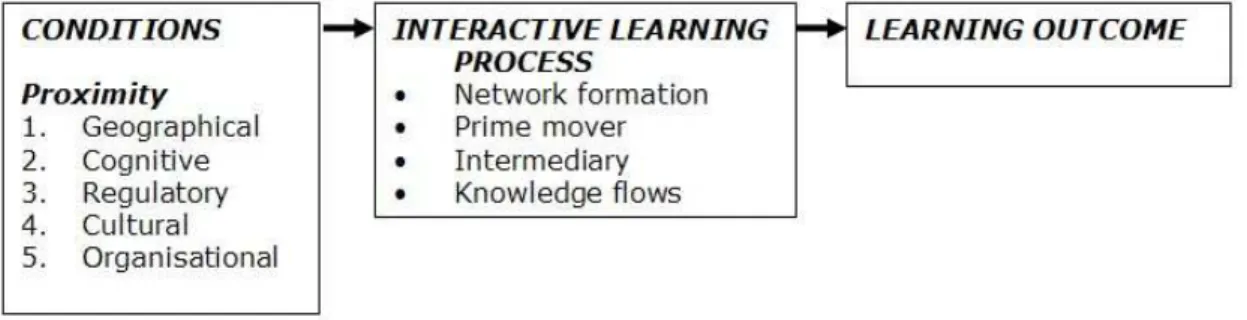
framework for interactive learning further (Figure 2). We exemplify the interactive learning process in the case of the functional food Benecol (Box 2).
Figure 2 The ‘opened’ black box of the interactive learning process (block 2) in the framework for interactive learning in emerging technologies
Box 2 The interactive learning process in the case of Benecol
In the late 1980s, scientists of The Raisio Group, being a Finnish foodstuffs, animal feeds, paper and chemicals conglomerate, started searching for a cholesterol decomposing food product, because of the known cholesterol lowering potential of sterols, and because of the scientists background in wood- and plant-based sterols. Building on this knowledge, they became the first to successfully isolate and manufacture a stanol ester: a by product of wood and vegetable poplins [42]. Plant sterols and stanols reduce low density lipoproteing (LDL) cholesterol absorption by competing with cholesterol for uptake into mixed micelles.
In 1995, clinical studies showed the cholesterol lowering effect of Benecol, the margarine with the plant stanol esters. In November 1995, the Raiso Group successfully launched Benecol in Finland. According to the scientists, Benecol blocks the absorption of LDL cholesterol and carries it away, thereby reducing it by an average of 14%. This result could be achieved simply by eating three servings a day. Even though the functional food Benecol costed seven times more than ordinary
margarine, it sold out quickly [43, 44]. This development process makes The Raisio Group the prime
mover in the learning process about novel food products with the cholesterol-lowering plant stanols. Next, a separate brands based business unit was formed with employers in UK and the USA. The Raisio Group established initial contracts with several companies for the improvement of the extraction of plant sterols and to obtain rights to patent and trademark the product within various markets, as The Raisio Group alone did not have the right resources to enter international markets [45]: The Raisio Group did not have a lot of experience with these types of food products and searched for a global partner for marketing the margarine while The Raisio Group itself would maintain control of stanol ester production. In 1997, a contract was established with the US McNeill Consumer Health Care, a subsidiary of Johnson & Johnson. As a global partner for market penetration, McNeill obtained the rights to patent and trademark within the North-American markets in 1997 and a similar global marketing agreement in 1998, while The Raisio Group in turn had the
exclusive rights to supply stanol ester to McNeill. So, network formation around the Benecol
developments took place, and The Raisio Group more and more became an intermediary facilitating
and translating knowledge flows on stanol ester production [43, 46]. Due to Raisio’s little experience
with a healthy food business line like that of Benecol, and to cope with the demand of the stanol esters, and to gain ground on the global market before the competitors did, Raisio started different collaborations (i.e. networks) and formed a panel with many key players in the food industry to form a strategy and to understand the potential and position of Benecol. In addition it set up four new stanol production facilities [42]. Unless the advantage for The Raisio Group to be the first mover with a cholesterol lowering margarine, Unilever catched up soon with its Becel Pro-Activ and took over the leading position of Benecol [43].
Summarizing, Raiso could be regarded both as a prime mover for network formation and an
intermediary on stanol based enriched food production, translating knowledge in-house on plant
stanol production in novel food products, and using external knowledge on marketing (branding), distribution channels, and already existing healthy food products markets to more successfully develop Benecol.
2.2 Conditions for Interactive Learning
In this paragraph we identity the conditions that enable or constrain the interactive learning process. Starting from the innovation characteristics in emerging technologies (i.e. interchange of tacit and codified complex complementary knowledge) proximity is a key concept. The general idea behind
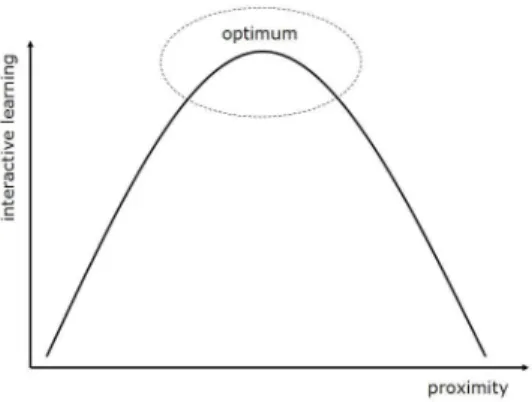
proximity is that an optimum exists, stimulating interactive learning and innovation performance: an optimum area between two extremes that have negative influence on interactive learning. This can be visualised in an inverted U-shaped learning curve (Figure 3). Traditionally geographical proximity is seen as
the dominant enabling factor for innovation. It is assumed that firms located in areas with other firms have better innovation performance than more isolated or distant firms: Organisations benefit from being located close to other organisations [47]. Recently scholars [9, 48-52] have suggested that other conditions besides geographical proximity influence interactive learning and innovation: cognitive proximity, institutional proximity and organisational proximity
Figure 3 Inverted U-shaped learning curve depending on proximity
Geographical proximity is the absolute or relative spatial or physical distance
between stakeholders [48]. Geographical proximity is an important condition for interactive learning since it facilitates face-to-face contacts [50, 53]. As we have seen in emerging technologies the exchange of complex complementary scientific knowledge that is often still tacit and the creation of a shared vision among the heterogeneous stakeholders are fundamental to innovation. The more complex the interchanged knowledge (both scientific knowledge as well as the shared vision) is, the richer the ‘medium’ to exchange the knowledge should be. Media richness is a gliding scale for ‘media’ which depicts the extent to which the medium meets the complexity of the interchanged knowledge. The media richness is based on four properties: 1) the speed of feedback, 2) the number of cues (e.g. verbal and non-verbal cues), 3) the richness of the language that can be used, and 4) the public or private character of the information (i.e. the accessibility of information) [54]. Based on these properties and the complexity of the interchanged knowledge a scale can be constructed (Figure 4). Face-to-face communication is the richest medium and is therefore crucial for interactive learning in emerging technologies in which complex complementary knowledge is interchanged and most knowledge is still tacit [11, 12]. Face-to-face interactions and the exchange of tacit and codified complex complementary knowledge are facilitated by geographical proximity. Since the rapid diffusion of ICT it has been claimed that not only codified knowledge can be transferred over geographical distance and through time by all means of communication devices [55] but also tacit knowledge. However, several studies have falsified this so called ‘death of distance’ hypothesis (e.g. [56]).
Box 3 Geographical proximity in the Benecol case
In the Benecol case, the Finnish Raisio Group made contracts with McNeill, a subsidiary of the Johnson & Johnson company in the USA, in order to get access to the North American markets. Thus geographical proximity to the American market via partner McNeill was a precondition to market penetration in USA.
Cognitive proximity denotes a common knowledge base and/or expertise which
enables people or organisations to learn from each other [48]. Cognitive proximity is the distance/closeness between actors and/or individual people within the network with respect to an individual’s education, interest and working experience and the technological focus of the organisation: “a firm’s development along a specific path determines its organizational focus” [58]. For example,
cognitive proximity between scientist is relatively high “due to the use of a common codebook” [59]. In order to innovate, new knowledge has to be created
and/or complementary existing knowledge has to be combined [60, 61]. In general, firms will look for new knowledge in “close proximity” [48] because then
there is a better chance that there is enough absorptive capacity to bridge the knowledge gap. Absorptive capacity is the ability of a firm to recognize the value
of new, external information, assimilate it, and apply it to commercial ends is critical to its innovative capabilities [62]. Searching in close vicinity often results in cumulative localized outcomes with high degrees of tacit knowledge [63]. If all organisations act like this, knowledge will be dispersed over different organisations [64]. Innovation however is dependent on combining complementary knowledge of heterogeneous organisations [65]. It is not easy to incorporate external knowledge into one’s own knowledge system, therefore the cognitive distance should not be too big [66] and – in other words – a certain amount of absorptive capacity is needed. At the same time some cognitive distance is required since too close cognitive proximity can lead to a “cognitive lock in [..] obscur[ing] the view on new technologies or new market possibilities”
[48], which is also known as the “competency trap” [67, p519]. Hence contacts
with heterogeneous information sources and openness are important [68]. Another argument for some cognitive distance is that organisations with close cognitive proximities (often competitors) are very reluctant to share knowledge with each other because it might lead to unwanted spill-overs [69].
Box 4 Cognitive proximity in the Benecol case
For the development of Benecol, being at that time a radical new enriched food product, in-house knowledge alone was not enough. Specific knowledge was required on the effect of food components on the human body and the production of foods with added health values. Due to this complexity of functional foods, external knowledge was very important as knowledge of both the food and the medical field (and the associated food and pharma industry) was necessary. Additionally, the development of functional foods is more expensive for firms than developing just a normal food product, as more R&D is necessary to prove the effect and the safety of the product. Many companies cannot afford these studies or do not have the knowledge and expertise. Often, these studies can only be performed by specialized firms, which are very expensive to hire. Only when a company is able to absorb this external knowledge, it is able to combine this knowledge with in-house knowledge, and ideas can become real projects.
Institutional proximity may encourage or hamper interactive learning between
stakeholders [23, 48, 53]. Regulations and a culture of shared trust influence the way in which stakeholders coordinate their actions by which they reduce the uncertainty surrounding these interactions: “As such institutions are enabling or constraining conditions that affect the level of knowledge transfer, interactive learning, and (thus) learning” [48]. Since the terms institution, culture and
regulation are used differently and or (partly) overlapping in different scientific (sub)fields, we make a distinction between regulatory proximity (i.e. formal rules
culture of shared trust and working habits and norms) and use institutional proximity as the overarching concept. Regulations (partly) reduce the uncertainty about return on investment, an issue of particular relevance for emerging technologies. At the same time regulations might also be a constraining factor for innovation: Rules are almost always favourable towards the status quo whereas innovation is about challenging this status. This results in institutional inertia that hinder restructuring existing rules or creating completely new ones [70, 71]. Regulatory proximity is the distance/closeness between the regulations each stakeholder has to comply with. If stakeholders have to comply with e.g. the same laws, they are very close; if they fall within different juridical areas the distance becomes bigger whereas joint agreements represent closeness. Formal, written institutions are laws, regulations, IPR arrangements, contracts, non-disclosure agreement (NDA) and mutual agreements. The complexities of collaborations and the inherent uncertainty surrounding emerging technologies
“render it generally impossible to encode all contingencies in a contract, and, as a consequence, these networks have to rely at least partially on less formal institutions that reduce the risk of opportunism” [59].
Box 5 Regulatory proximity in the Benecol case
The globalisation of trade and technological developments in the foods industry has resulted in a significant increase in the number of new foods and food ingredients commercially available. In 1997 the Novel Food Regulation (Regulation 258/97) came into force. This regulation set out rules for authorization and labelling of novel foods including food products containing, consisting or produced from GMOs. A safety assessment should be made whenever any new food or ingredient is introduced on the European market. Besides this Novel Food guideline, there are regulations on patenting biotech derived materials. For GMO plants for example, there are some restrictions, such as the exclusion of plant varieties from patentability. In addition, quality and safety regulations exist (GLP, GMP, ISO etc). The possibility of patenting products is important for functional foods, because product imitation is a common process in the foods industry and a lot of investments are necessary before a functional foods can be launched.
Regarding the Benecol case, there were substantial regulatory hurdles Benecol had to pass in Europe and the USA. In Europe, functional food products such as Benecol are regulated by the Novel Food Regulation, with fast-track and full-assessment track approvals [72]. As Benecol was registered in Finland in 1995, the product did not have to pass the Novel Foods Commission for approval in other member States after the introduction of the Novel Food Regulation in 1997.
In the USA, the regulatory process for functional food products consists of three basic pathways: a) Food-additive path (generally regarded as safe (GRAS) by FDA), b) Pharmaceutical path by FDA c) Dietary supplement path by FDA. The FDA didn’t approve Benecol as a dietary supplement as margarine was seen as a regular food product, restricting The Raisio Group to follow and learn about the characteristics food-additive regulatory path. In 1999 FDA gave The Raisio Group permission to publicise Benecol’s cholesterol-reducing effects when marketing it in the USA, thus issued as a food health claim by the FDA [46]. The development of Benecol is thus an example of a novel food product innovation being ahead of food regulation in Europe ( regulatory absorptive capacity). Furthermore, regulatory proximity has been shown in the health claims made for Benecol when getting approval of the FDA , i.e. dietary supplement vs food additive. After all, the dilemma of functional foods is that they are balancing between medicines and food and therefore difficult to regulate. On the one hand, functional foods are complex and the expectations on the health capacities are high, regulations used for normal foods is strictly limited. On the other hand, the pharmaceutical regulation system is very complex, expensive and long termed for food companies and food companies do not have the competences for the complex clinical trials [44].
Cultural proximity is the distance/closeness between informal ‘rules’ of the
stakeholders in the network. These informal rules encompass e.g. sets of common habits, routines, and established practices [73, p46], norms and habits [48] or ways of working [74]. Scientific exploration and industrial exploitation (including R&D) take place in different socio-economic structures [75]. In science-industry collaborations cultural differences occur due to the fundamental difference between science and industry: “the logic of scientific discovery does not adhere to the same logic that governs the development of new technologies”
[76]. Science stakeholders are focused on maximising knowledge diffusion through scientific articles whereas industry stakeholders want to minimise the
world of technology can be seen as two different communities with their own set of [informal] rules and behaviour” [59]. The result is a difference in underlying
incentive structures for science and industry [75, 77]. Of specific interest regarding cultural proximity, emerging technologies and tacit knowledge is the concept of trust within relations. Tacit knowledge is transmitted more easily
within a culture of trust which therefore is often regarded as a capability that supports learning and innovation [12]. The ubiquitous character (i.e. available anywhere, anytime against marginal cost for every extra unit) of tacit knowledge in emerging technologies results in a very peculiar knowledge marketplace; the user of the tacit knowledge wants to know what specific knowledge he is acquiring whereas the producer does not want to give away to much knowledge in advance of the definite transaction. Stakeholders in networks in emerging technologies are mutually dependent on each others knowledge. When combing their tacit and codified complex complementary knowledge they have to trust that no one will misuse this knowledge for their sole benefit (e.g. one of the stakeholders applying for a patent based on complementary knowledge from stakeholders within the network).
Box 6 Cultural proximity in the Benecol case
The Raisio Group and McNeill are companies that both have the same outcome focus: the successful introduction of the functional food on the (American) market. Thus there is no difference in the underlying incentive structure for The Raisio Group and McNeill. This could have been different when a university or public research institute would have been involved in the development (and marketing) of Benecol.
Although The Raisio Group and McNeill have the same incentive structure, trust was a very important factor in their collaboration. The Raisio Group discovered the benefits of stanols. Since The Raiso Group had no experience with the market introduction of functional foods they – decided that they – needed a partner. The Raisio Group found this partner in McNeill. The relation between these partners is based on mutual trust. The Raisio Group had to trust McNeill that they could implement a successful market introduction and would not misuse The Raisio Group’s knowledge on stanols for their sole benefit. At the same time McNeill had to trust on The Raisio Group’s expertise in the emerging technology of stanols.
Organisational proximity is “the extent to which relations are shared in an organisational arrangement” [48], with an ‘organisational arrangement’ ranging
from a single (intra)organisational unit to a collaboration of stakeholders. Organisational proximity is about the way stakeholders coordinate their actions. Within science based collaborations stakeholders interchange complex complementary knowledge and “knowledge creation [..] depends on a capacity to coordinate the exchange of complementary pieces of knowledge owned by a variety of actors” [48]. Besides the coordination of knowledge exchange,
innovation is also dependent on the autonomy or flexibility of the individual stakeholders within the organisational arrangement. Individual stakeholders working on their part should be able to pursuit their quest for knowledge unhindered by too restricting settings because unexpected insights and serendipity might lead to the need to exploit new possibilities instead of following fixed (and even outdated) working packages. Innovation is dependent on both the free flow of (complex) knowledge and the coordination of the complementary knowledge search processes. Therefore organisational proximity “involves the rate of autonomy and the degree of control” [48] and there should be an
optimum between these two prerequisites. According to Hansen [78] in general strong ties (i.e. close and frequent relationships) between the stakeholders stimulate the transfer of complex knowledge. However, too strong ties become contra-productive due to i) lock-in in relations, ii) incomplete or less feedback loops in a-symmetrical relations and iii) because it hampers flexibility [77, 79].
“In [more] loosely coupled networks where the identity and separateness of elements is preserved, the network can potentially retain a great number of
mutations and novel solutions than would be the case with a tightly coupled system” [80].
In this context there are three different types of organisational settings: hierarchies, markets and networks. Each organisational setting has its specific influence on coordination and flexibility and some of these organisational settings facilitate the free flow of knowledge better [81] or the coordination of actions. Hierarchies correspond with strong ties that are good for coordination but have a hampering effect on flexibility. On the other extreme (ideal) markets correspond with weak ties that facilitate stakeholders individual flexibility but there is hardly any control or coordination over the individual actions. Strong, but not to strong ties – granting both flexibility and coordination – are represented by networks in which stakeholders have the flexibility to perform their activities while at the same time all individual activities are coordinated. Therefore networks denote optimal organisational proximity.
Box 7 Organisational proximity in the Benecol case
In the Benecol case, The Raisio Group realized that for entering the international market they did not have enough resources, and collaboration with the McNeill Group and Johnson & Johnson in the USA was established. Regarding functional organization structure, bigger companies have more in-house knowledge, are better aware of regulatory context and possibilities in the market and have larger financial resources, making them more successful in functional foods innovations. Development of effective functional foods requires appropriate knowledge management throughout the production chain and must include all disciplines involving food technology, nutrition, health and consumer sciences [82]. When there is not enough of this knowledge in-house, collaborations and strategic alliances with market leaders have to be organized. Within the collaboration between The Raisio Group and McNeill, The Raisio Group developed Benecol autonomously and McNeill was responsible for the marketing and distribution. Therefore tasks within the collaboration where clearly devidided and coordinated within the collaboration whereas each organisation had the flexibility to perform their individual tasks (e.g. The Raisio Group had the flexibility to perform the research they needed to develop Benecol).
Summarising, we identified five conditions influencing interactive learning in emerging technologies based on the general principle of proximity: geographical, cognitive, regulatory, cultural and organisational proximity. Based on the identification and description of the conditions we can complement the framework for interactive learning in emerging technologies (Figure 5).
Figure 5 The framework for interactive learning in emerging technologies complemented with conditions (block 1)
2.3 Learning Outcome of The Interactive Learning Process
We have described the interactive learning process with characteristic elements and identified five conditions that influence this interactive learning process. In order to see if the learning process actually leads to learning, the learning outcome has to be taken into account as well. Therefore we take a closer look at the learning outcome in this paragraph.
Learning in emerging technologies requires scientific knowledge in order to find solutions to specific scientific ‘problems’ or unknowns. At the same time a shared vision acts as a driver for innovation [3, 5]. Thus interactive learning in emerging technologies requires two forms of knowledge: content specific scientific knowledge and contextual ‘visionary’ knowledge. The process of acquiring scientific knowledge is characterised by hypothesis testing and falsification or trial and error and actions are modified depending on the difference between the expected and obtained outcome: if a scientific experiment confirms the hypothesis, the chosen approach shows the be valuable, otherwise a new approach has te be chosen. Learning in relation to errors is called single-loop
learning by [83] which “relate[s] to the cognitive level of analysis” [84]. At the
same time the process of creating a shared vision is called double-loop learning.
Double-loop learning “involve[s] the modification of an organization’s underlying [..] objectives” [83, p3].ii The knowledge resulting from these learning processes
is single-loop knowledge (i.e. scientific knowledge) and double loop knowledge (i.e. adapted shared vision).
An available product is a concrete output. However, in science based emerging technologies these products are very rare. In their research on collaborations between French academic organisations and firms Goddard and Isabelle [85] showed that the most frequent outcome of these collaborations are (co-)publications. Hereby co-authorship on an article refers to collaboration and
interaction and the same holds for co-patents. Standardisation of how to perform experiments is also a codification process which makes knowledge exchange easier and an outcome on the first order.
Second order learning outcome is visible in the construction or adaptation of a shared vision, the goal that is defined and the way through which this is being achieved. This information is mainly tacit but sometimes it might also be traced back in visionary documents or as mission statements.
Box 8 Learning outcome in the Benecol case
The challenges for successful functional food innovations are the understanding, exploiting and combining of complex scientific and technological knowledge with clear health effects. The success of Becel Pro-Activ of Unilever, for example, is its marketing strategy based on the scientifically proven health effect (its proven functionality), besides the use of a trusted brand (Becel) [44].
Problematic is the scientific controversy about the general definition of a functional food. Due to these scientific uncertainties, there is a lack of shared vision about what a functional food actually is
and 2nd order learning could not take place with regard to functional foods. This made that the
regulation of functional food products remained unclear for a long time [46].
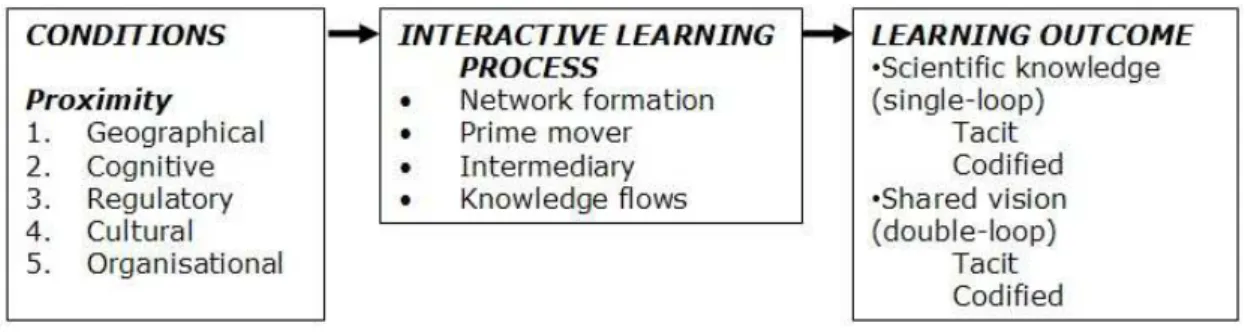
Summarising, interactive learning is a process with an outcome. Based on the distinction in scientific knowledge and a shared vision the outcome of interactive learning can be subdivided in single and double-loop [83]. At this point we can present the complete framework for interactive learning in emerging technologies (Figure 6). We do not suggest that this framework for describing the interactive learning process in emerging technologies is the ultimate framework, but it does highlight characteristic elements of interactive learning in emerging technologies. We think of it as an attempt of opening the black box of interactive learning in emerging technologies. In the next paragraph we discuss how this framework can be applied (and refined) in future research and which methodological consequence lay ahead.
Figure 6 The complete framework for interactive learning in emerging technologies complemented
2.4 Outlook on Methodological Consequences
The whole purpose of opening the black box of interactive learning is the understanding of mechanisms that underlay interactive learning in emerging technologies and identify possibilities for policy makers and innovation managers to facilitate interactive learning and innovation. In this paragraph we take an outlook on the methodological consequences for the initial studying of interactive learning in emerging technologies.
Interactive learning in emerging technologies is a phenomenon in real life. In real life boundaries between the phenomenon itself and the surrounding context might not be clearly evident and alternative and/or additional mechanisms might also be of importance. Therefore, for the study of interactive learning in emerging technologies the case study becomes the preferred research method. We defined interactive learning in emerging technologies as the process of obtaining 1) tacit and complex knowledge about the solution to a specific problem and 2) a shared vision through interaction between stakeholders, resulting in change of their knowledge pool, a shared vision and eventually innovation success on the system level. Thus, when studying interactive learning in emerging technologies we have to focus on instances in which stakeholders interact and interactive learning has taken place.
As an emerging technology to apply our framework to we will focus on nutrigenomics which is seen as a “grand challenge” [86] that might result in a
solution to the metabolic syndrome. “The metabolic syndrome is a common metabolic disorder that results from the increasing prevalence of obesity” [87].
According to the WHO “Obesity is one of the greatest public health challenges of the 21st century. [..] Obesity is already responsible for 2-8% of health costs and 10-13% of deaths in different parts of [Europe]”iii The emerging technology of
nutrigenomics can be seen as contributing to the fight against obesity and the metabolic syndrome [88]. The expectations of scientific developments in nutrigenomics have stimulated the formation of various consortia [89] of
heterogeneous stakeholders. A patent and publication analysis will be employed to pinpoint activity hot spots in the emerging technology of nutrigenomics that are used to identify suitable cases [90].
3 Discussion and Concluding Remarks
In this paper we developed a framework for interactive learning in emerging technologies. By doing so we started to open the black box of interactive learning. We do not claim to have constructed the ultimate framework for interactive learning (Figure 6). Other frameworks might be constructed based on other starting points. We started from the importance of interactive learning in emerging technologies for the interchange of tacit and complex knowledge and
starting point we developed a framework based on characteristic elements of the interactive learning process (i.e. prime mover, intermediary, network formation and knowledge flows), influencing conditions (geographical, cognitive, regulatory, cultural and organisational proximity) and the outcome of the interactive learning process (single-loop and double-loop, tacit and codified knowledge). Contrary to earlier work on learning, we did not only look at the outcome of the interactive learning process but also started to open the black box of interactive learning. We used Benecol – one of the world’s first cholesterol lowering functional foods – as an exemplifying case.
We made the argument that tacit knowledge is important, especially in emerging technologies, because the construction of a shared vision is often based on purely tacit knowledge and complex codified knowledge needs a tacit explanation. However, there is some discussion on the value or usability of tacit knowledge. In their article Cowan, Foray and David [91] argued that tacit knowledge represents no economical value since it cannot be traded (like e.g. patents) and therefore it cannot be used in standard micro-economic models of human behaviour. According to the authors this would not be a problem because only a small part of all knowledge is tacit knowledge and therefore it can be left out of standard micro-economic models. However, according to Maskell and Malmberg [92] “the really valuable knowledge is [..] still at least partially tacit”. In a direct reaction
on Cowan, Foray and David [91] Johnson, Lorenz and Lundvall [6] stress the importance of tacit knowledge because not all knowledge might be possible to codify and some of this tacit knowledge might be crucial for the innovation process. For example a scientific article does not reflect the authors’ know how which might be crucial for the findings. It is even more difficult to codify believe systems, values or norms which are crucial in the construction of a shared vision. We looked at the concept of trust in relation to the exchange of tacit knowledge. Besides this trust between stakeholders in a network societal trust becomes of
importance when introducing new technologies into the market. Societal trust in the companies and the scientists conducting research in the area of gene technologies and other new technologies has a strong effect on the risks and benefits perceived to be associated with those technologies [93]. Social trust refers to peoples’ willingness to rely on experts and institutions in the management of risks and technologiesiv [94]. Source credibility refers to peoples’
perceptions of the motivations of institutions or individuals providing information to the public.
This paper presented preliminary results of an ongoing study on interactive learning in the emerging technology of nutrigenomics. Future work will elaborate further on unravelling the interactive learning process and the influencing conditions in emerging technologies. The interactive learning process within consortia in emerging technologies will be analysed in more detail and theoretically supported using the concepts outlined in this paper. These concepts will be used to get more insight into the interactive learning process itself and the relationships between this process and the influencing proximity conditions, and how it impacts single-loop and double-loop learning outcome in emerging technologies. By doing so the framework contributes to the understanding of interactive learning mechanisms and provides possibilities for policymakers that want to stimulate innovation.
Acknowledgements
The authors thank Ron Boschma, Stefan Kuhlmann, Ruud Smits and the reviewers of the DRUID winter school 2007 for their comments and suggestions on earlier versions. This study was funded by NWO (www.nwo.nl) under grant number MCG-C03-03.
About the authors
Rens L.J. Vandeberg MSc is a PhD-researcher at the Department of Innovation Studies, Copernicus Institute, Utrecht University. His dissertation is on interactive learning in emerging technologies (www.rensvandeberg.com). Dr Ellen H.M. Moors is assistant professor at the Department of Innovation Studies, Copernicus Institute, Utrecht University, program Leader of the N.W.O. Program ‘User-Producer Interactions in Functional Genomics Innovations’ and coordinator of the educational track Medical Biotechnology.
Literature
1. Lundvall, B.-A., Innovation as an interactive process: from user-producer interaction to the nation system of innovation, in Technical Change and Economic Theory, G. Dosi, et al., Editors. 1988, Pinter: London. p.
349-369.
2. Lundvall, B.A., et al., National systems of production, innovation and competence building. Research Policy, 2002. 31(2): p. 213-231.
3. Checkland, P.B., Soft systems methodology: An overview. Journal of
Applied Systems Analysis, 1988. 15: p. 27-30.
4. Smits, R., How users matter. The co-construction of users and technology - Comments from an innovation studies perspective. 2005.
5. Vergragt, P., The Social Shaping of Industrial Innovations. Soial Studies of
Science, 1988. 18: p. 483-513.
6. Johnson, B., E. Lorenz, and B.A. Lundvall, Why all this fuss about codified and tacit knowledge? Industrial and Corporate Change, 2002. 11(2): p. 245-262.
7. Arundel, A. and A. Geuna, Proximity and the Use of Public Science by Innovative European Firms. Econ. Innov. New Techn., 2004. 13(6): p. 559-580.
8. Senker, J., Tacit Knowledge and Models of Innovation. Ind Corp Change,
1995. 4(2): p. 425-447.
9. Howells, J.R.L., Tacit Knowledge, Innovation and Economic Geography.
Urban Studies, 2002. 39(5): p. 871 - 884.
10. Polanyi, M., The Tacit Dimension. 1983[1966], Gloucester, Mass.: Peter
Smith.
11. Doloreux, D., Regional networks of small and medium sized enterprises: evidence from the Metropolitan Area of Ottawa in Canada. European
Planning Studies, 2004. 12(2): p. 173-189.
12. Malmberg, A. and P. Maskell, Guest Editorial: Localized Learning and Regional Economic Development. European Urban and Regional Studies,
1999. 6(1): p. 5-8.
13. Lettl, C., User involvement competence for radical innovation. Journal of
Engineering and Technology Management, 2007. 24(1-2): p. 53-75.
14. Arrow, K.J., The economic implications of learning by doing. Review of
economic studies, 1962. XXIX(80).
15. Rosenberg, N., Inside the black box: Technology and economic. 1982,
Cambridge: Cambridge University Press.
16. Rogers, E.M., Diffusion of innovations. 1962, New York: Free Press.
17. Foster, R.N., Innovation: the Attacker's Adcantage. 1986, New York:
Summit.
18. Tidd, J., J. Bessant, and K. Pavitt, Managing Innovation: Integrating Technological, Market and Organizational Change (2nd Edn). 2001,
Chichester: John Wiley & Sons.
19. van Merkerk, R.O. and H. van Lente, Tracing emerging irreversibilities in emerging technologies: The case of nanotubes. Technological Forecasting
20. Utterback, J.M., Mastering the Dynamics of Innovation. 1994, Boston:
Harvard Business School Press.
21. Nelson, R.R. and S.G. Winter, In search of useful theory of innovation.
Research Policy, 1977. 6(1): p. 36-76.
22. Collingridge, D., The Social Control of Technology. 1980, London: Pinter.
23. Lundvall, B.-Å., National Innovation Systems: Towards a Theory of Innovation and Interactive Learning. 1992, London: Pinter Publishers.
24. Moors, E., et al., User-producer interactions in functional genomics innovations. 2003: p. 22.
25. Smits, R. and P.d. Hertog, TA and the management of innovation in economy and society. IJFIP 2007.
26. Von Hippel, E., The Sources of Innovation. 1988, Oxford Oxford University
Press.
27. Lüthje, C., Characteristics of innovating users in a consumer goods field - An empirical study of sport-related product consumers. Technovation,
2004. 24: p. 683–695.
28. Lüthje, C., C. Herstatt, and E.v. Hippel, User-innovators and “local” information: The case of mountain biking. Research Policy, 2005. 34: p. 951–965.
29. Pavitt, K., Sectoral patterns of technical change: Towards a taxonomy and a theory. Research Policy, 1984. 13: p. 343-373.
30. Rothwell, R., et al., Sappho Updated - Project Sappho Phase II. Research
Policy, 1974. 3(3): p. 258-291.
31. Von Hippel, E., A customer-active paradigm for industrial product idea generation. Research Policy, 1978. 7: p. 240-266.
32. Meeus, M. and L. Oerlemans, Innovation Strategies, Interactive Learning and Innovation Networks. Innovation and Institutions, ed. S. Casper and
F.v. Waarden. 2005, Chektenham (UK): Edgard Elgar Publishing.
33. Frewer, L.J., J. Scholderer, and N. Lambert, Consumer acceptance of functional foods: Issues for the future. British Food Journal, 2003.
105(10): p. 714-731.
34. Spence, J.T., Challenges related to the composition of functional foods.
Journal of Food Composition and Analyses, 2006. 19: p. S4-S6.
35. Mark-Herbert, C., Functional Foods for Added Value - Developing and marketing a new product category. 2002, Swedish University of
Agricultural Sciences: Uppsala.
36. Milner, J.A., Functional Foods: the US perspective. Am. J. Clin. Nutr, 2000.
71 (suppl): p. 1654S-1659S.
37. Leeuwis, C., et al., Innovation systems and social learning: linking the meso and the micro level. Transforum Working Papers 4, 2005: p. 3-58.
38. Hekkert, M.P., et al., Functions of innovation systems: A new approach for analysing technological change. Technological Forecasting and Social
Change, 2007. 74(4): p. 413-432.
39. Kamp, L., Learning in wind turbine development - A comparison between the Netherlands and Denmark. 2002, Utrecht: Utrecht University.
40. Smits, R. and S. Kuhlmann, The rise of systemic instruments in innovation policy. Int. J. Foresight and Innovation Policy, 2004. 1(1/2): p. 4.
41. Van Lente, H., et al., Roles of Systemic Intermediaries in Transition Processes. International Journal of Innovation Management, 2003. 7(3): p. 247-279.
42. Moffet, M.H. and S.W. Howard, Benecol: Raisio’s Global Nutriceutical.
Thunderbird. The American Graduate School of International Management, 1999.
43. Heasman, M. and J. Mellentin, The functional foods revolution. Healthy people, healthy profits? 2001, London: Earthscan Publications Ltd.
44. Huigen, M., Regulation and Innovative Behaviour in the Dutch Functional Foods Sector, in Science & Innovation Management, Utrecht University.
2003: Master thesis.
45. Markula, J., Health-Functional Foods in Foodwebs Publications, University of Helsinki, Faculty of Agriculture and Forestry, Dept. of Economics and Management. 2001: Helsinki.
46. Hofstede, H., Functional Food. More than just a problem of consumer acceptance, in Science & Innovation Management, Department of Innovation Studies. 2004, Utrecht University: Utrecht.
47. Weterings, A.B.R., Do firms benefit from spatial proximity? 2006, Utrecht
University: Utrecht.
48. Boschma, R., Proximity and Innovation: A Critical Assessment. Regional
Studies - Abingdon, 2005. 00039(00001): p. 61-75.
49. Breschi, S. and F. Lissoni, Knowledge spillovers and local innovation systems: A critical survey. Industrial and Corporate Change, 2001. 10: p. 975-1005.
50. Gertler, M.S., Tacit knowledge and the economic geogaphy of context, or the undefinable tacitness of being (there). Journal of Economic Geography,
2003. 3: p. 75-99.
51. Malmberg, A. and P. Maskell, The Elusive Concept of Localization Economies: Towards a Knowledge-Based Theory of Spatial Clustering.
Environment and Planning A, 2002. 34: p. 429-449.
52. Torre, A. and A. Rallet, Proximity and localization. Regional Studies, 2005.
39(1): p. 47-59.
53. Feldman, M.P., The Geography of Innovation. 1994, Dordrecht: Kluwer.
54. Fulk, J. and C. Steinfield, eds. Organisations and Communication Technology. 1990: London.
55. Koschatzky, K., M. Kulicke, and A. Zenker, Innovation Networks: Concepts and Challenges in the European Perspective. 2001: Fraunhofer:
Physica-Verlag.
56. Blasio, G.d., Does the Internet Kill the Distance? Evidence from Navigation, E-commerce, and E-banking. 2006.
57. Bongers, F., Participatory Policy Analysis and Group Support Systems.
2000, Tilburg: Frank Bongers.
58. Nooteboom, B., et al., Optimal cognitive distance and absorptive capacity.
Research Policy, 2007. 36(7): p. 1016-1034.
59. Ponds, R., F.v. Oort, and K. Frenken, The Geographical and Institutional Proximity of Scientific Collaboration Networks. Papers in Regional Science,
2007. 86(3): p. 423–443.
60. Cohendet, P. and P. Llerena, Learning, technical change, and public policy: how to create and exploit diversity, in Systems of Innovation. Technologies, Institutions and Organizations, C. Edquist, Editor. 1997,
Pinter: London. p. pp. 223-241.
61. Nooteboom, B., Inter-firm Alliances. Analysis and Design. 1999, London:
Routledge.
62. Cohen, W.M. and D.A. Levinthal, Absorptive Capacity: A New Perspective on Learning and Innovation. Administrative Science Quarterly, 1990.
35(1): p. 128-152.
63. Boschma, R.A., Competitiveness of regions from an evolutionary perspective. Regional Studies, 2004. 38(9): p. 1001-1014.
64. Antonelli, C., The Economics of Localized Technological Change and Industrial Dynamics. 1995, Dordrecht: Kluwer.
65. Nooteboom, B., Learning and Innovation in Organizations and Economies.
2000, Oxford: Oxford University Press.
66. Boschma, R.A. and J.G. Lambooy, Evolutionary economics and economic geography. Journal of Evolutionary Economics, 1999. 9(4): p. 411-429.
67. Levitt, B. and J. March, Organizational learning, in Organizational Learning, M.D. Cohen and L.S. Sproul, Editors. 1996, Sage: Thousand
Oaks, CA. p. pp. 516-541.
68. Saviotti, P.P., Technological Evolution, Variety and the Economy. 1996,
Cheltenham: Edward Elgar.
69. Cantwell, J. and G.D. Santangelo, The new geography of corporate research in Information and Communication Technology (ICT). Journal of
Evolutionary Economics, 2002. 12: p. 163-197.
70. Freeman, C. and C. Perez, Structural crisis of adjustment, business cycles and investment behaviour, in Technical Change and Economic Theory, G.
Dosi, et al., Editors. 1988, Pinter: London. p. pp. 38-66.
71. Schumpeter, J., The theory of economic development. 1934, London:
Oxford University Press.
72. Howard, S. and M. Moffett, Benecol: Raisio’s Global Nutriceutical. The
American School of International Management, 1999.
73. Edquist, C. and B. Johnson, Institutions and organizations in systems of innovation, in Systems of Innovation: Technologies, Institutions, Organizations, C. Edquist, Editor. 1997, Pinter: London. p. 41-63.
74. Tracey, P. and G.L. Clark, Alliances, Networks and Competitive Strategy: Rethinking Clusters of Innovation. Growth & Change, 2003. 34(1): p. 1-16.
75. Dasgupta, P. and P.A. David, Toward a new economics of science.
Research Policy, 1994. 23: p. 487-521.
76. Gittelman, M. and B. Kogut, Does Good Science Lead to Valuable Knowledge? Biotechnology Firms and the Evolutionary Logic of Citation Patterns. Management Science, 2003. 49(4): p. 366 -382.
77. Frenken, K. and F.G. Van Oort, The geography of research collaboration: theoretical considerations and stylised facts in biotechnology in Europe and the United States, in Regional Economies as Knowledge Laboratories,
P.C.a.A. Piccaluga, Editor. 2004, Edward Elgar: Cheltenham UK and Northampton MA. p. 38-57.
78. Hansen, M.T., The search-transfer problem: the role of weak ties in sharing knowledge across organization studies. Administrative Science
Quarterly, 1999. 44: p. 82-111.
79. Blanc, H. and C. Sierra, The internationalisation of R&D by multinationals: a trade-off between external and internal proximity. Camb. J. Econ., 1999.
23(2): p. 187-206.
80. Grabher, G. and D. Stark, Organizing diversity: evolutionary theory, network analysis and postsocialism. Regional Studies, 1997. 31: p. 533-544.
81. Cook, P. and K. Morgan, The Associational Economy. Firms, Regions, and Innovation. 1998, Oxford: Oxford University Press.
82. Plaami, S.P.e.a., Functional Foods Position and Future Perspective. 2001,
NRLO report no. 2000/15: The Hague.
83. Argyris, C. and D. Schön, Organisational Learning. A Theory of Action Perspective. 1978, Massachusetts, USA: Addison-Wesley Publishing.
84. Kerkhof, M.v.d. and A. Wieczorek, Learning and stakeholder participation in transition processes towards sustainability: Methodological considerations. Technological Forecasting & Social Change, 2005.
72(2005).
85. Goddard, J.G. and M. Isabelle, How do public laboratories collaborate with industry? New survey evidence from France. Paper presented at the
DRUID summer conference 2006 Copenhagen June 18 - 20, 2006.
86. Omenn, G.S., PRESIDENTIAL ADDRESS: Grand Challenges and Great Opportunities in Science, Technology, and Public Policy. Science, 2006.
87. Eckel, R.H., S.M. Grundy, and P.Z. Zimmet, The metabolic syndrome. The
Lancet, 2005. 365(9468): p. 1415-1428.
88. Kussmann, M., F. Raymond, and M. Affolter, OMICS-driven biomarker discovery in nutrition and health. Journal of Biotechnology, 2006. 124(4): p. 758-787.
89. Kaput, J., et al., Horizons in Nutritional Science - The case for strategic international alliances to harness nutritional genomics for public and personal health. British Journal of Nutrition, 2005. 94: p. 623-632.
90. Vandeberg, R.L.J. and W. Boon, Anticipating emerging technologies. GSP
Journal, accepted.
91. Cowan, R., P.A. David, and D. Foray, The explicit economics of knowledge codification and tacitness. Ind Corp Change, 2000. 9(2): p. 211-253. 92. Maskell, P. and A. Malmberg, The competitiveness of firms and regions.
‘Ubiquitification’ and the importance of localized learning. European Urban
and Regional Studies, 1999. 6(9-25).
93. Siegrist, M., The influence of trust and perceptions of risks and benefits on the acceptance of gene technology. Risk Analysis, 2000. 20: p. 195-204. 94. Metlay, D., Institutional Trust and Confidence: A Journey into a Conceptual
Quagmire, in Social trust and the Management of Risk, G.e.a. Cvetkovich,
Editor. 1999, Earthscan Publications: London. p. 100-116.
i Functional foods constitute a range of novel foods delivering benefits beyond nutritional value to the
person consuming them 33. Frewer, L.J., J. Scholderer, and N. Lambert, Consumer acceptance of
functional foods: Issues for the future. British Food Journal, 2003. 105(10): p. 714-731..
ii Others terms for single-loop learning are instrumental learning, first-order learning, or lower order
learning; other terms for double-loop learning are political learning, second-order learning, or higher
order learning (see 84. Kerkhof, M.v.d. and A. Wieczorek, Learning and stakeholder participation in
transition processes towards sustainability: Methodological considerations. Technological Forecasting &
Social Change, 2005. 72(2005). for an overview).
iii http://www.euro.who.int/obesity
iv Risk communication at government level is of high importance to provide objective information
about e.g. safety aspects of food, potential benefits and risks of new products, because many
consumers perceive functional food products as unnatural and risky 46. Hofstede, H., Functional
Food. More than just a problem of consumer acceptance, in Science & Innovation Management, Department of Innovation Studies. 2004, Utrecht University: Utrecht..