Mathematical Sciences Faculty Publications Mathematical Sciences, Department of
2012
Estimation of Parameters in Weighted Generalized
Beta Distribution of the Second Kind
Yuan Ye
University of Houston
Broderick O. Oluyede
Georgia Southern University, [email protected]
Marvis Pararai
Indiana University of Pennsylvania
Follow this and additional works at:https://digitalcommons.georgiasouthern.edu/math-sci-facpubs
Part of theMathematics Commons
This article is brought to you for free and open access by the Mathematical Sciences, Department of at Digital Commons@Georgia Southern. It has been accepted for inclusion in Mathematical Sciences Faculty Publications by an authorized administrator of Digital Commons@Georgia Southern. For more information, please [email protected].
Recommended Citation
Ye, Yuan, Broderick O. Oluyede, Marvis Pararai. 2012. "Estimation of Parameters in Weighted Generalized Beta Distribution of the Second Kind."Journal of Statistical and Econometric Methods, 1 (1): 1-12. source: http://www.scienpress.com/
journal_focus.asp?main_id=68&Sub_id=IV&Issue=198
International Scientific Press, 2012
Estimation of Parameters in Weighted Generalized
Beta Distributions of the Second Kind
Yuan Ye1, Broderick O. Oluyede2 and Mavis Pararai3
Abstract
This paper applies the class of weighted generalized beta distribu-tion of the second kind (WGB2) as descriptive models for size distri-bution of income. The properties of WGB2 including mean, variance, coefficient of variation(CV), coefficient of skewness(CS), coefficient of kurtosis(CK) are presented. Other properties including top-sensitive index, bottom-sensitive index, mean logarithmic deviation(MLD) index and Theil index obtained from generalized entropy(GE) are applied in this paper. WGB2 proved to be in the generalized beta-F family of distributions, and maximum likelihood estimation(MLE) is used to ob-tain the parameter estimates. WGB2 is fitted to U.S. family income (2001-2009) data with different values of the parameters. The empirical results show the length-biased distribution provides the best relative fit.
Mathematics Subject Classification : 62F10
Keywords: WGB2, Income distribution, Entropy, Beta-F family, MLE
1
Introduction
Generalized beta distribution of the second kind (GB2) has been widely used in income distribution. It provides a good description of income
distri-1 Department of Mathematical Sciences, Georgia Southern University, Statesboro,
GA 30460, e-mail: [email protected]
2 Department of Mathematical Sciences, Georgia Southern University, Statesboro,
GA 30460, e-mail: [email protected]
3 Department of Mathematics, Indiana University of Pennsylvania, Indiana,
PA 15705, e-mail: [email protected]
Article Info: Received : November 29, 2011. Revised : December 26, 2011 Published online: February 28, 2012
bution and captures the characteristics of size distribution of income such as: skewness, has a peak in low-middle range, and long right hand tail [7]. Mc-Donald [7] adopted different distributions as models for size distribution of income, and found that GB2 provides the best relative fit.
Weighted distribution provides an approach to dealing with model specifi-cation and data interpretation problems. Fisher [3] and Rao [12] introduced and unified the concept of weighted distribution. Cox [1] and Zelen [17] used it to present length biased sampling. The usefulness and applications of weighted distribution to biased samples in various areas including medicine, ecology, re-liability, and branching processes can also be seen in Nanda and Jain [9], Gupta and Keating [2], Oluyede [10] and in references therein.
Suppose Y is a non-negative random variable with its natural pdf f(y;θ),
θis a parameter, then the pdf of the weighted random variableYw is given by:
fw(y;θ, β) = w(y, β)f(y;θ)
ω , (1)
where the weight functionw(y, β) is a non-negative function, that may depend on the parameterβ, and 0< ω=E(w(Y, β))<∞ is a normalizing constant.
This paper applies the class of WGB2 as descriptive models for the size distribution of income. The properties of WGB2 such as moments and gener-alized entropy (GE) are presented in Section 2. Section 3 applies WGB2 in the size distribution of income. WGB2 is fitted to U.S. family income data (2001-2009) with different values of the parameter k in Section 4. The parameter estimates of WGB2 are obtained and empirical results are presented. Section 5 contains an application of the results to US family nominal income for the years 2001 to 2009.
2
The Distribution and Special Cases
Weighted generalized beta distribution of the second kind (WGB2) with polynomial weight function w(y) = yk is a very flexible five-parameter distri-bution. The probability density function (pdf) of WGB2 is given by:
gW GB2(y;a, b, p, q, k) = ay ap+k−1 bap+kB(p+ k a, q− k a)[1 + ( y b) a]p+q, (2) wherey >0, a, b, p, q >0 and−ap < k < aq.
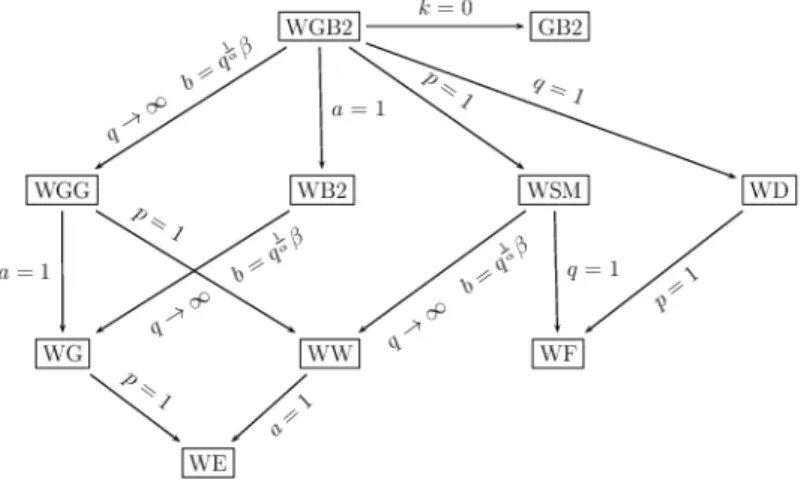
WGB2 includes GB2 as a special case, it also includes several other weighted distributions as special or limiting cases: WGG (weighted generalized gamma), WB2 (weighted beta of the second kind), WSM (weighted Singh Maddala),
Figure 1: Graph Tree
WD (weighted Dagum), WG (weighted gamma), WW (weighted Weibull) and WE (weighted exponential). The distribution tree is given below:
Jones and Faddy [5] introduced the concept of generalized beta-F distribu-tion:
gF(y;α, β) = B(α, β)−1f(y)[F(y)]α−1[1−F(y)]β−1,
where f(y) is the derivative of F(y), B(α, β) = Γ(Γ(αα)Γ(+ββ)) is the beta function. Sepanski and Kong [14] applied the generalized beta-F family in size distribu-tion of income and obtained the parameter estimates. They concluded that log-F followed by GB2 provides the best relative fit.
3
Related Results
From our previous work, we obtain the moments of WGB2 with weight functionw(y) = yk, that is EGW GB2(Y j ) = b jB(p+ k a+ j a, q− k a − j a) B(p+ ka, q−k a) . (3)
The corresponding mean and variance are given by
µGW GB2 =EGW GB2(Y) = bB(p+ ka +1a, q−k a− 1 a) B(p+k a, q− k a) , (4)
and V arGW GB2(Y) = b2 B(p+ k+2 a , q− k+2 a ) B(p+ka, q− k a) −(p+ k+1 a , q− k+1 a p+ka, q− k a )2 . (5)
respectively. The coefficient of variation (CV) is given by
CVW GB2 = s B(p+k+2a , q− k+2 a )B(p+ k a, q− k a) B2(p+k+1 a , q− k+1 a ) −1. (6)
Similarly, the coefficient of skewness and coefficient of kurtosis are
CS= E[Y 3]−3µE[Y2] + 2µ3 σ3 , (7) and CK = E[Y 3]−4µE[Y3] + 6µ2E[Y2]−3µ4 σ4 , (8) where µ=µGW GB2, σ = q V arGW GB2(Y), E[Y2] = b2B(p+ k a+ 2 a, q− k a− 2 a) B(p+ ka, q−k a) , E[Y3] = b 3B(p+ k a + 3 a, q− k a− 3 a) B(p+ ka, q−k a) , and E[Y4] = b 4B(p+k a + 4 a, q− k a − 4 a) B(p+ka, q− k a) .
The generalized entropy (GE) is widely used to measure inequality trends and differences. It is primarily used in income distribution. Generalized en-tropyI(α) for WGB2 is given by:
I(α) = B(p+ k a + α a, q− k a− α a)B −α(p+ k a+ 1 a, q− k a− 1 a)−B 1−α(p+ k a, q− k a) α(α−1)B1−α(p+k a, q− k a) , (9) where α 6= 0 and α 6= 1. The bottom-sensitive index is I(−1), and the top-sensitive index isI(2). Moreover, the mean logarithmic deviation (MLD) index and Theil index are:
I(0) =logB(p+ k+1 a , q− k+1 a ) B(p+ka, q− k a) −ψ(p+ k a) a − ψ(q−k a) a , (10) and I(1) = ψ(p+ k+1 a ) a − ψ(q− k+1 a ) a −log B(p+ k+1a , q−k+1 a ) B(p+ ka, q−k a) . (11) respectively.
4
Estimation of Parameters
For WGB2 with weight function w(y) = yk, the pdf can be written as:
gw(y;a, b, p, q) =B−1 p+ k a, q− k a a b y b ap+ka 1 + y b a−(p+q) . If we set F(y) = 1−(1 + (yb)a)−1, then f(y) = a b( y b) a−1[1 + (y b) a]−2 and gw(y;a, b, p, q) = B−1 p+k a, q− k a f(y)[F(y)]p+ka−1[1−F(y)]q− k a−1. (12)
Clearly, this distribution belongs to thebeta−F class of distributions with
F(y) = 1− 1 + y b a−1 = y a ba+ya. (13)
Let θ = (a, b, p, q)T be a column vector of parameters associated with the
income distribution. The income distribution is given by:
Pi(θ) = B−1 p+k a, q− k a Z F(yi) F(yi−1) tp+ka−1(1−t)q− k a−1dt, (14)
where Pi(θ) denotes the estimated proportion of the population in the ith
interval of the r income groups defined by the interval Ii = [yi−1, yi]. The
multinomial likelihood function for the data is given by:
N! r Y i=1 [Pi(θ)]ni ni! ,
where ni, i = 1,2, ..., r denotes the observed frequency in the ith group and
N =Pr i=1ni. We maximize: L(θ) = r X i=1 nilnPi(θ), wherePi(θ) = RF(yi) F(yi−1)h(t)dt, and h(t) = B −1(p+ k a, q− k a)t p+ka−1(1−t)q−k a−1. Sepanski and Kong [14] pointed out that obtainingPi by computing the cdf of
a beta random atF(yi−1) andF(yi) can reduce the complexity of programming
required to calculate the integrations.
The first derivative with respect to θ = (a, b, p, q)T are:
dL(θ) dθ = r X i=1 ni Pi(θ) · dPi(θ) dθ . (15)
The partial derivative equations of Pi(θ) with respect toa, b, p, q are given by: ∂Pi(θ) ∂a =h(F(yi)) bayai(lnyi−lnb) (ba+ya i)2 −h(F(yi−1)) baya i−1(lnyi−1−lnb) (ba+ya i−1)2 + Z F(yi) F(yi−1) kh(t) a2 Ψ p+ k a −Ψ q− k a +ln1−t t dt, (16) ∂Pi(θ) ∂b =−ab a−1 h(F(yi))yia (ba+ya i)2 − h(F(yi−1))y a i−1 (ba+ya i−1)2 , (17) ∂Pi(θ) ∂p = Z F(yi) F(yi−1) h(t) −Ψ p+ k a + Ψ(p+q) +lnt dt, (18) and ∂Pi(θ) ∂q = Z F(yi) F(yi−1) h(t) −Ψ q−k a + Ψ(p+q) +ln(1−t) dt, (19)
where Ψ(x) = dxd[Γ(x)]. Using the equations (15)-(18) in equation (14), we can obtain the gradient functions of L(θ) with respect to parameters a, b, p, q.
The partial derivative equation (15) exists whenk >0. Ifk = 0, the partial derivative equation of Pi with respect to a is given by:
∂Pi(θ) ∂a =b a h(F(yi))(yi)a(ln(yi)−ln(b)) (ba+ya i)2 −h(F(yi−1))(yi−1) a(ln(y i−1)−ln(b)) (ba+ya i−1)2 .(20)
5
Applications
In this section, we obtain parameter estimates based on our previous dis-cussions and results. WGB2 was fitted to U.S. family nominal income for 2001-20094. The groups consist of families whose income are in the corre-sponding income interval Ii = [yi−1, yi), the ni/N are the observed relative
frequencies (N =P
ni).
The common way to obtain parameter estimates is to maximize the multi-nomial likelihood function. Since the likelihood function is nonlinear and com-plicated, we use MATLAB to search for the maximum value of multinomial
likelihood function.5 The results of this estimation for 2001, 2005, and 2009
are reported in Tables 2-4.
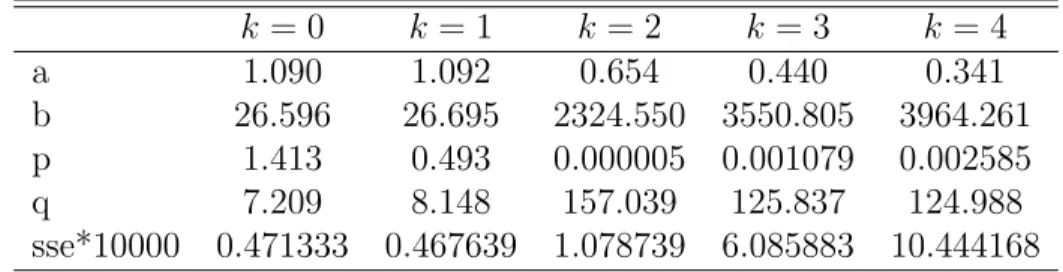
Based on the sum of squares error (sse) value we can conclude that: the length-biased WGB2 (k= 1) provides a better fit than GB2 (k = 0) and other WGB2 (k = 2,3,4). If we plug the estimated parameters in the partial deriva-tive equations in Section 4, we obtain the values of these partial derivaderiva-tive equations in Table 5-7. From the tables, we find that these values are close to zero or very small, this means that the estimated parameters that we obtained are precise and effective.
Since we have already obtained estimates of parameters for WGB2 in Sec-tion 4, and found that the length-biased WGB2 provides the best fit to in-come distribution, we can apply these estimated parameters from length-biased WGB2 model to obtain the estimates of the mean, variance, coefficient of vari-ation, skewness and kurtosis, bottom sensitive index, top-sensitive index, MLD index and Theil index. The results are presented in Table 8.
6
Concluding Remarks
In this paper, the weighted generalized beta distribution of the second kind (WGB2) was fitted to U.S. family income data (2001-2009). The maximum likelihood estimation (MLE) is used for estimating the parameters of the in-come distribution model. The results showed that the length-biased WGB2 provides the best relative fit to income data. Based on previously obtained descriptive measures for WGB2, we estimate the mean, variance, coefficient of variation, coefficient of skewness, coefficient of kurtosis, bottom-sensitive index, top-sensitive index, MLD index and Theil index of the income data.
ACKNOWLEDGEMENTS. The authors wish to express their
grati-tude to the referees and editor for their valuable comments.
4The data were taken from the Census Population Report
5By setting different initial values and using ’fminsearchbnd’ to search for the maximum
References
[1] D. R. Cox, Renewal Theory, Barnes & Noble, New York, 1962.
[2] R.C. Gupta and J.P. Keating, Relations for Reliability Measures Un-der Length Biased Sampling,Scandinavian Journal of Statistics,13(1), (1985), 49 - 56.
[3] R.A. Fisher, The Effects of Methods of Ascertainment upon the Esti-mation of Frequencies, Annals of Human Genetics, 6(1), (1934), 439 -444.
[4] S.P. Jenkins, Inequality and GB2 Income Distribution,ECINQE, Soci-ety for study of Economic Inequality, Working Paper Series, (2007). [5] M.C. Jones and M.J. Faddy, A Skew Extension of the t distribution,
with Applications, Journal of the Royal Statistical Society. Series B,
65(1), (2003), 159 - 174.
[6] C. Kleiber and S. Kotz, Statistical Size Distributions in Economics and Actuarial Sciences, Wiley, New York, 2003.
[7] J.B. McDonald, Some Generalized Functions for the Size Distribution of Income, Econometrica, 52(3), (1984), 647-663.
[8] J.B. McDonald and Y.J. Xu, A Generalization of the Beta Distribution with Application, Journal of Econometrics, 69(2), (1995), 133 - 152. [9] K.A. Nanda and K. Jain, Some Weighted Distribution Results on
Uni-variate and BiUni-variate Cases, Journal of Statistical Planning and Infer-ence, 77(2), (1999), 169 - 180.
[10] B.O. Oluyede, On Inequalities and Selection of Experiments for Length-Biased Distributions, Probability in the Engineering and Informational Sciences, 13(2), (1999), 129 - 145.
[11] G.P. Patil and R. Rao, Weighted Distributions and Size-Biased Sam-pling with Applications to Wildlife and Human Families, Biometrics,
34(6), (1978), 179 - 189.
[12] C.R. Rao, On Discrete Distributions Arising out of Methods of Ascer-tainment, The Indian Journal of Statistics, 27(2), (1965), 320 - 332. [13] A. Renyi, On Measures of Entropy and Information, In Proceedings of
the Fourth Berkeley Symposium on Mathematics, Statistics and Prob-ability, 1(1960), University of California Press, Berkeley, (1961), 547 -561.
[14] J.H. Sepanski and L. Kong, A Family of Generalized Beta Distribution For Income, International Business , 1(10), (2007), 129 - 145.
[15] C.E. Shannon, A Mathematical Theory of Communication, The Bell System Technical Journal, 27(7), (1948), 379 - 423.
[16] C.E. Shannon, A Mathematical Theory of Communication, The Bell System Technical Journal, 27(10), (1948), 623 - 656.
[17] M. Zelen, Problems in Cell Kinetics and Early Detection of Disease,
Table 1: U.S. family nominal income for 2001-2009 [yi−1, yi) observed relative frequencies ni/N
(thousand) 2001 2002 2003 2004 2005 2006 2007 2008 2009 [0,15) 13 13.4 12.9 12.6 13 13.3 13.2 12.9 12.4 [15,25) 11.9 12 11.3 11.2 11.5 11.6 11.6 11.4 11.4 [25,35) 11.1 11 10.5 11.1 10.8 11 10.9 10.6 10.5 [35,50) 14.1 14.1 14 14.1 14.2 14.1 14 14.5 14.8 [50,75) 18.1 17.6 18 18.2 18.1 18.1 17.7 18 17.9 [75,100) 11.5 11.9 12 11.6 12.1 12 12.2 12.5 12.6 [100,150) 11.9 11.9 12.7 12.5 12 11.9 12.3 12.3 12.2 [150,200) 4.4 4.3 4.7 4.7 4.3 4.4 4.4 4.2 4.3 [200,∞) 3.8 3.7 4 4 4 3.6 3.7 3.7 3.9
Table 2: Estimated parameters of WGB2 for income distribution (2001) k = 0 k = 1 k = 2 k = 3 k = 4 a 1.403 1.405 0.669 0.4487 0.3376 b 16.66 16.488 11408.457 5463.111 15213.5 p 0.999 0.288 0.000001 0.001681 0.037333 q 3.963 4.629 470.178 154.668 187.036 sse*10000 1.208234 1.208159 2.509558 8.463283 13.220825
Table 3: Estimated parameters of WGB2 for income distribution (2005)
k = 0 k = 1 k = 2 k = 3 k = 4 a 1.423 1.383 0.646 0.432 0.339 b 15.502 16.621 12800.159 6595.86 4379.966 p 0.961 0.271989 0.000003 0.004804 0.00976 q 3.582 4.648 446.0185 156.662 127.893 sse*10000 0.520372 0.518495 2.109663 8.049098 13.146924
Table 4: Estimated parameters of WGB2 for income distribution (2009)
k = 0 k= 1 k = 2 k = 3 k= 4 a 1.090 1.092 0.654 0.440 0.341 b 26.596 26.695 2324.550 3550.805 3964.261 p 1.413 0.493 0.000005 0.001079 0.002585 q 7.209 8.148 157.039 125.837 124.988 sse*10000 0.471333 0.467639 1.078739 6.085883 10.444168
Table 5: Values of partial derivative equations of WGB2 (2009)
k = 0 k = 1 k = 2 k= 3 k = 4 ∂L(θ) ∂a 0.0255 -0.0029 0.0397 -0.1732 -0.1347 ∂L(θ) ∂b -0.0017 -0.0001 0 0 0 ∂L(θ) ∂p -0.0105 -0.0048 -0.0791 -0.1077 -0.0625 ∂L(θ) ∂q 0.007 -0.0005 0 0.0004 0
Table 6: Values of partial derivative equations of WGB2 for (2005) k = 0 k = 1 k = 2 k= 3 k = 4 ∂L(θ) ∂a -0.0069 -0.0341 0.0028 -0.0922 0.0033 ∂L(θ) ∂b -0.0021 -0.0017 0 0 0 ∂L(θ) ∂p 0.0118 0.0422 -0.1075 -0.097 -0.0638 ∂L(θ) ∂q -0.0007 -0.0058 0.0002 0.001 -0.0001
Table 7: Values of partial derivative equations of WGB2 (2001)
k = 0 k = 1 k = 2 k= 3 k = 4 ∂L(θ) ∂a -0.0283 -0.0502 -0.2614 -0.6607 3.2358 ∂L(θ) ∂b -0.0031 -0.0123 0 0 0 ∂L(θ) ∂p 0.0173 -0.1533 -0.1243 -0.1381 -0.0055 ∂L(θ) ∂q -0.0009 0.0327 0.0003 0.0011 -0.0028
Table 8: Estimated statistics for income distribution (k = 1 in WGB2)
Year Est.mean Est.Var Est.CV Est.CS Est.CK 2001 6.759468 38.091976 0.913070 -4.242920 24.013806 2005 6.719345 39.169450 0.931423 -4.114463 25.864490 2009 6.629841 37.111483 0.918864 -4.195311 16.203708 Year Est.I(-1) Est.I(2) Est.MLE Est.Theil
2001 1.150014 0.416849 0.396929 1.758663 2005 1.252677 0.433774 0.410256 1.789568 2009 1.033116 0.422155 0.402408 3.567591