Pag. 1 de 15
EXPERIENCE IN THE SELECTION OF KEY
PERFORMANCE INDICATORS IN STATIC
EQUIPMENT MAINTENANCE
Integrity Assessment Services Maracaibo State Zulia Venezuela
April 2013
Medina N. Robinson J. MSc. CM RP. Mechanical Engineer, with specialization in Materials Evaluation and Inspection Equipment at the Central University of Venezuela, Diploma in Industrial Systems Reliability at the University Rafael Belloso Chacin of Venezuela and Master of Reliability and Risk Engineering at the University of Las Palmas de Gran Canaria and professional certified in The Society for Maintenance & Reliability Professionals (SMRP). With 21 years of experience in Maintenance and Inspection area of Static Equipment associated with the oil industry, national and international level.
1. INTRODUCTION
In the main companies producing of manufactured goods and worldwide oil production, their directors and managers are convinced that it is a business investment in asset maintenance and not see maintenance as an expense. This transformation is happening in the world of maintenance has made evident the need for a substantial and sustained operational and financial performance improvement of the companies, which has led to the progressive pursuit and implementation of new and more efficient techniques and management practices of planning and performance measurement business.
An efficient maintenance organization should focus on four principal elements or role as regards the value maintenance chain these are: these roles are critical to the efficient accomplishment of its objectives in generating value for the company, these basic objectives are, optimization costs and ensuring business continuity of equipment in order to maximize the production system output.
The diagnosis and capture, as well as planning, scheduling and execution of maintenance can not be only in plans, they have to be executed and its results need to be evaluated and measured. That is why any serious maintenance organization must first consider the development of key performance indicators that are aligned with the different activities of the value chain maintenance and this way facilitate measurement and not only that but compare their performance or companies with world-class competition, to finally archive a continuous improvement process supported by a comparison with the performance levels of the best in each area.
Taking in mind that is not documented the selection process of which and how many indicators should be kept, in this paper describes a practical experience of selecting indicators for monitoring maintenance management to static equipment.
2. DEFINITIONS
Maintenance: Any activity carried out in a equipment, system or installation in order to continue development the role for which it was designed. The maintenance is a discipline that guarantees the availability, functionality and conservation of the equipment, long as it applies correctly, at a competitive cost.
Maintenance Management: Is the effective and efficient use of material, financial, and human resources and time to achieve the objectives of maintenance.
Performance Indicator: A performance indicator is the quantitative expression of the behavior and performance of a process, whose magnitude, when is compared to a reference level, may be pointing a deviation upon which corrective or preventive actions are taken as appropriate.
Indicators are a key form of feedback a process, to monitor the progress or the execution of a project and strategic plans, among others.
Efficiency: Ability to dispose of someone or something to achieve an particular purpose. Effectiveness: Ability to achieve the effect that you want or expect. This term will be used to mediate the result of the efficiency of the performance of maintenance on the equipment maintained.
Static equipment: Static equipment is defined as one whose principal function is to contain the fluid handled, we can cite as examples pipes, tanks, vessels, heat exchangers.
3. TYPES OF INDICATORS
Exists in a general way a subdivision of the type of existing indicators, then we say that we must differentiate indicators that reflect the results of past performance in terms of equipment performance (Lag Measures), other indicators
describe what is done to maintain the equipment and are known as "inducers" (Lead Measures).
To understand the difference between performance indicators or equipment performance and inducers, it is important to know the purpose of each:
Performance Indicators or Results (Lag Measures)
• They reflect results of past decisions
• Generally they are not clear to the operational staff
• No one feels responsible for the result
Are equivalent to the autopsy because they provide information about what has already happened, without being able to change the result.
Performance Indicators or inducers (Lead Measures)
• They say how we do it
• They show steps to follow every day
• They are more accessible to the entire organization
• The staff feels responsible for variations • Generally measured processes
In contrast to the autopsies, equivalent to do a biopsy, to detect what is happening and take appropriate actions to improve the result.
4. CRITERIA OF INDICATORS TO USE The following criteria can help in the definition of indicators:
• must not be ambiguous and must be defined uniformly across the company.
• The indicators used between different organizations must be clearly connected.
• The selection and measurement should be an easy and uncomplicated process.
• It must find a balance between outcome
indicators and performance indicators (inductors).
•It must be clearly defined the responsibility
for calculation and evaluation period.
•It is not desirable from an indicator to define a target.
•The right thing is to clarify which is the first objective. The logical sequence and internationally accepted to define an indicator is: objective, indicator, and target. • The process of defining indicators, requires
clearly define what to measure, how to measure, when to measure, source and responsible for the measurement.
5. EFFECTIVENESS, EFFICIENCY AND
EFFECTIVENESS AS INDICATORS ASSOCIATED WITH PRODUCTIVITY AND QUALITY
There are three criteria commonly used to evaluate the performance of a system, hich are closely related to the quality and productivity, these are: efficiency, effectiveness and efficacy. However sometimes they are misinterpreted, used inappropriately or considered synonymous, so we considered appropriate to discuss their definitions and their relationship to quality and productivity.
Effectiveness: Is the relationship between the results achieved and the proposed results, allows us to measure the degree of compliance with the planned objectives.
Efficacy: efficacy refers to the "Results" in relation to "Goals and compliance with organizational objectives." To be effective they must prioritize tasks and perform those that allow orderly achieve better and faster.
Efficiency: In more words applied to our profession, consists of the good use of resources. In achieving the best possible with what we have. If a human group has a number of inputs that are used to produce goods or services, "efficient" will be the group that achieved the greatest number of goods or services using the least number of inputs as possible. "Efficient" is the one who achieves high productivity relative to the resources available.
6. STRATEGIES FOR SELECTING
PERFORMANCE INDICATORS
There is currently an innumerable range of indicators that can be selected and probably all of them interesting for the organization. However, the resources of any organization are limited and therefore only those indicators must be developed that are "profitable" for the organization, that is, those for which the importance of the information that symbolize justify the effort required to obtain them.
For an adequate selection of performance indicators in maintenance management at the organizational level static equipment, should note that levels of the organization analyze these indicators in this regard three organizational levels are defined.
Strategic Indicators: Generate a Corporate Vision these indicators provide insight into the direction and organizational effectiveness comparing with other organizations in the same field (Benchmarking).
Tactical Indicators: Generate Vision of the active performance, these indicators help to monitor in the effectiveness in meeting goals and take action.
Operating Indicators: Generate View over the performance of management; this project will help to measure efficiency and efficacy of maintenance management process.
6.1. Strategy 1: Investigation of the
existence of indicators to Static Equipment Maintenance
As a preliminary strategy should take a look at the history within the organization, there sure we will get an information infrastructure that will allow us to know what count, we've done, how we've evolved and where we are today. For the development of this stage to place the magnifying glass on previous experiences, both in the implementation of indicators in organizations involved as well as the technical documentation developed by the organization, this will build the foundation that will support the technical proposal of indicators that really are required to measure and monitor the maintenance management of static equipment.
6.2. Strategy 2: Determine if the current
management indicators reflect the reality of what is required to measure
The management indicators should allow different levels of the organization to evaluate the performance of management, in general form one can say that the organization that
performs the maintenance is composed of three basic levels of responsibility in achieving the objectives set by the business, these levels are:
• Tactical or Strategic level (General
Management of the active)
• Technical Level (Maintenance Management
of the active)
• Operational Level (Executor Maintenance)
These three levels are aligned with the hierarchical structure of a maintenance model organization and it can be represented in a pyramid shape, it is important to note that indicators that allow evaluate to the entire organization maintenance management should be developed. In Figure 1 shows the three decision levels of a maintenance organization.
Figure 1: Levels of Organizational Hierarchy
In this regard, it must be ensured define key performance indicators to facilitate the analysis of maintenance management to the General Manager of the active, who have the lead role of tactical and strategic asset performance while supplying alignment information of the results of the maintenance management with business goals.
The technical level associated with maintenance management, needs nourishment indicators to assess their management as management measure while executing the operational management of maintenance. For that reason, this group of indicators search to measure equipment performance as well as productivity
of the value chain maintenance formed by maintenance engineering, planning, scheduling and execution of maintenance.
The operational indicators allow the executor of maintenance within the active evaluate its management and therefore feed back in order to ensure efficient management and therefore meet the needs of your customer.
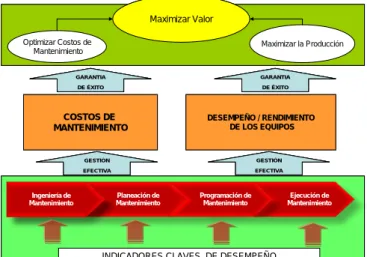
One of the key objectives of this strategy is to define if it is actually being measured must continue being measured , so we must be very clear about the role to be played by a maintenance organization in modern business vision, this means, the maintenance and is not seen as an investment and subject to the plan of operations or production , the role of the maintenance organization at present is to bring value to the business and its importance is so great as is the production or operations and that is why we can say that both organizations should aim at becoming business objectives both partners. In this sense a maintenance organization should in the first instance and as north, have set a goal to " MAXIMIZING VALUE" in any production asset in this respect this premise should be the guide for comparative setting indicators currently lead to indicators that must be. In Figure 2 shows the relationship that should exist between the different indicators in maintenance management oriented value creation.
To understand this scheme we must start from the premise that the maintenance organization is closely related to the efficiency of the financial management of the company, this means, an efficient company financially is necessarily supported in a maintenance organization connected, involved and responsible for achieving the objectives of financial management of the company.
Planeación de Mantenimiento Ingeniería de Mantenimiento Ejecución de Mantenimiento Programación de Mantenimiento COSTOS DE MANTENIMIENTO DESEMPEÑO / RENDIMIENTO DE LOS EQUIPOS Maximizar Valor Optimizar Costos de Mantenimiento Maximizar la Producción
INDICADORES CLAVES DE DESEMPEÑO GESTIÓN EFECTIVA GESTIÓN EFECTIVA GARANTIA DE ÉXITO GARANTIA DE ÉXITO G EST IO N M AN T EN IM IEN T O G E S T IO N F INA NCI E RA Planeación de Mantenimiento Ingeniería de Mantenimiento Ingeniería de Mantenimiento Ejecución de Mantenimiento Programación de Mantenimiento COSTOS DE MANTENIMIENTO DESEMPEÑO / RENDIMIENTO DE LOS EQUIPOS Maximizar Valor Optimizar Costos de Mantenimiento Maximizar la Producción
INDICADORES CLAVES DE DESEMPEÑO GESTIÓN EFECTIVA GESTIÓN EFECTIVA GESTIÓN EFECTIVA GESTIÓN EFECTIVA GARANTIA DE ÉXITO GARANTIA DE ÉXITO GARANTIA DE ÉXITO GARANTIA DE ÉXITO G EST IO N M AN T EN IM IEN T O G E S T IO N F INA NCI E RA
Figure 2: Relations between the indicators that comprise a maintenance management
When we refer to the involvement of the maintenance organization for the financial management of a company referring to two aspects:
The first aspect refers to the optimization of maintenance costs, this will only be possible if from the maintenance organization is able to develop an efficient management of the diagnostic process and capture as well as an efficient planning to short and medium term, it is in these two areas of the value chain where maintenance for cost reduction opportunities in management, from there are centered the need for monthly indicators that can to monitor the performance of these two processes, so that the strategic alignment will ensure optimization cost ensuring the maintenance budget to spend on those teams that really need it.
The second aspect relates to maximize value which is aligned to maximize production, here plays an important role the efficient management of the areas of programming and implementation of maintenance, who through an efficient management will get the hand of equipment maintenance who need it most, allowing it to ensure their availability for the production process will not be affected and be
as continuous as possible depending on production requirements established.
Based on Figure 2, where the interrelationship between financial management and maintenance management in a company is established you must define which indicators are required by the organization and on the question, if the current indicators give effect to follow up on the effectiveness of maintenance of static equipment? The answer to this question will obtain identifying three core measures which areas are: Costs, static equipment performance and efficiency in maintenance management, from this analysis should focus on developing indicators for static equipment, which can efficiently to monitor all processes Engineering, Planning, Programming, Implementation maintenance costs and static equipment performance time.
6.3. Strategy 3: Selected Indicators
6.3.1. Selecting Indicators for the
Strategic or tactical level of the organization:
This group of indicators should be defined as general indicators formed by a group of specific indicators in each selected area, such general indicators enable a corporate vision of asset management by measuring various elements of a process, so it will provide information to determine the directionality and effectiveness of the organization in the areas than want to be measured.
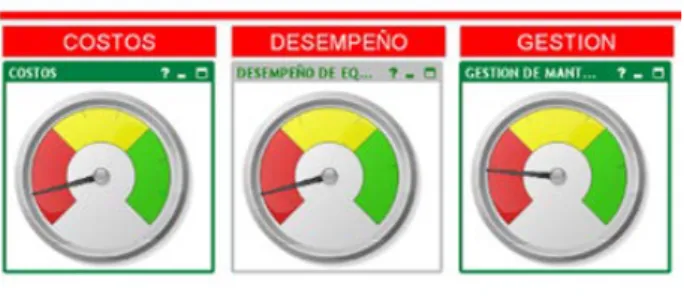
It is important to highlight that each general indicator tactical level will be fed it by a group of specific indicators that will be responsible to reflect the reality of the analyzed area. In this sense the general indicators are recommended for this level Cost, Performance of static
equipment and maintenance management, in Figure 3 can be seen a graphical representation of the proposed indicators for tactical level:
Figure 3: General indicators proposed for the tactical level of the organization
6.3.2. Selecting indicators for the
technical level of the organization:
It possible to generate a view of the level of
performance of asset management, its main
function is to monitor the effectiveness of maintenance on the active.
Specific indicators established for the technical level are: Costs and Performance teams.
Selection of indicators for the
management of costs.
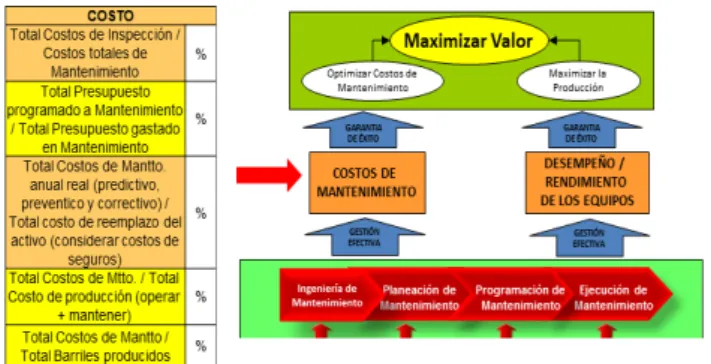
Cost control is an essential element of any management, indeed, in the management of asset maintenance, especially in the reality of the oil industry where the actual reservoir behavior is declining and thus negatively impact the production potential and therefore in economy income. It is also important to point out the need to develop indicators to assess the percentage of costs that represents the process of inspection of static equipment in terms of total expenses. In this regard, management should define indicators that can be used for comparison with other companies in the same industry worldwide.
The indicators proposed costs are shown in Figure 4.
Figure 4: Selected Indicators of Costs
This type of indicator is usually sharing between tactical and technical levels, and operating the organization.
Selection of Indicators for monitoring the performance of static equipment.
The suggested performance indicators for monitoring static equipment should be measurement parameters that allow monitoring and evaluating compliance with the primary objective of static equipment (containing fluid, support the installation). The indicators selected in this study search to assess the performance of maintenance management as a direct correlation between level of deterioration or integrity that such equipment may have. In this sense, the selected performance indicators for the family of static equipment are shown in Figure 5.
Figure 5: Selected Performance Indicators
6.3.3. Selecting indicators for the
operational level of the organization:
These indicators fed tactical indicator Maintenance Management and can generate a view of the efficiency of maintenance management in the areas of Engineering, Planning, Scheduling and Execution of maintenance, allowing them to measure and verify the performance and quality of these processes, this way the executing maintenance management can provide feedback to take corrective actions necessary to maintain the indicator within the parameters established measurement.
Selecting Indicators for Managing Maintenance Engineering
The essence of Maintenance Engineering is to determine the needs of facilities maintenance. We can define the role of Maintenance Engineer as the set of philosophies intended to define the maintenance tasks by which the reliability and desired Maintainability is achieved technically supporting the Maintenance function, by monitoring the condition of equipment and installations and applying methodologies to improve the operational
reliability of the same, according to Model Management System Maintenance.
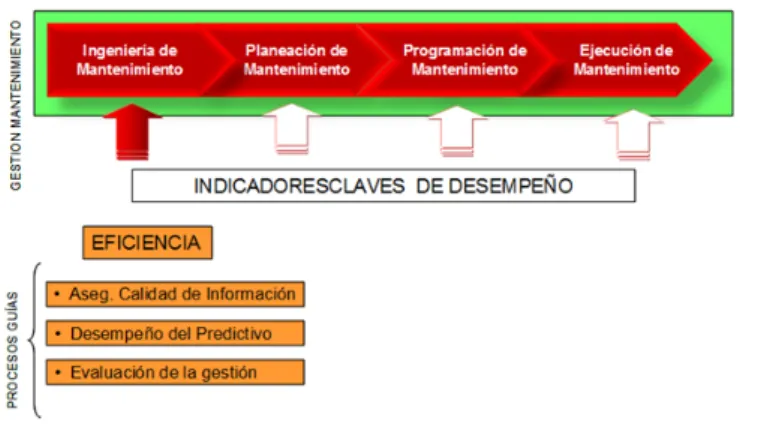
Within the maintenance management process Maintenance Engineering has under its basic functions and capture diagnostic equipment conditions. In Figure 6, can be seen the three elements guide the management of maintenance
engineering.
Figure 6: Elements guides the management of Maintenance Engineering
In Figure 7, Show the indicators proposed for measuring the efficiency of maintenance engineering role in the organization.
Figure 7: Proposed indicators for the management of Maintenance Engineering
Selecting indicators for the management of Maintenance Planning.
The essence of planning is to determine the What, How and dates of implementation of
maintenance activities. We can define the role of planner as systematic or methodological process by which the activities and resources required in the short, medium and long term for the performance of determined maintenance work. The main objective should be guarantee the generation of maintenance plans to ensure operational continuity of equipment or techniques to meet production goals according to available resources.
For planning management processes of this management are highlighted two guides: Management Maintenance Plans coming from engineering maintenance and operational planning, aligning the interests of the business needs to keep available the key to meeting the target equipment business. In Figure 8 show the two elements guides of maintenance management planning. Planeación de Mantenimiento Ingeniería de Mantenimiento Ejecución de Mantenimiento Programación de Mantenimiento INDICADORESCLAVES DE DESEMPEÑO GE S T ION M A N T E N IM IE N T O EFICIENCIA • Gestión de Planes • Planeación Operativa PR O C ESO S G U ÍAS Planeación de Mantenimiento Ingeniería de Mantenimiento Ejecución de Mantenimiento Programación de Mantenimiento INDICADORESCLAVES DE DESEMPEÑO GE S T ION M A N T E N IM IE N T O EFICIENCIA • Gestión de Planes • Planeación Operativa PR O C ESO S G U ÍAS
Figure 8: Elements guide of management planning maintenance
In Figure 9, Show the selected indicators to measure the efficiency of maintenance planning role in the organization.
Figure 9: Indicators for the Management of maintenance planning
Selecting indicators for the Management of Maintenance Schedule:
The essence of the role is to determine the programming WHEN, WHERE and HOW of maintenance activities. We can define the role of programmer and the process by which the start and end of a job, according to the availability of resources.
The objective of the developer role is to schedule and prioritize of human and material resources needed to execute maintenance activities.
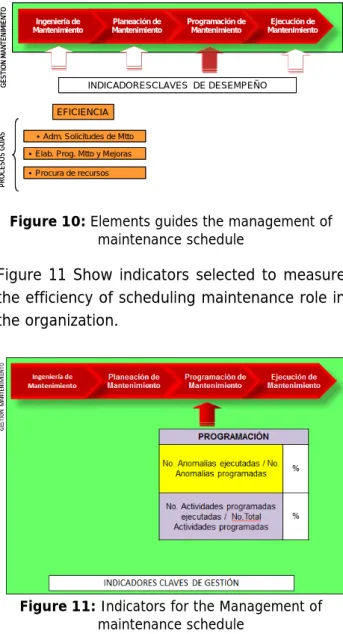
Within the maintenance management, the process of programming on its basic functions is the materialization of the basic maintenance activities, which will help to ensure the availability of equipment to produce and with it thus to maximize the performance and efficiency of equipment and supporting them to maximize corporate value by maximizing production ensuring the availability of equipment.
To schedule management processes three guides of this management are highlighted as shown in Figure 10. Planeación de Mantenimiento Ingeniería de Mantenimiento Ejecución de Mantenimiento Programación de Mantenimiento INDICADORESCLAVES DE DESEMPEÑO GE S T ION M A N T E N IM IE N T O EFICIENCIA
• Adm. Solicitudes de Mtto • Elab. Prog. Mtto y Mejoras • Procura de recursos PR O C ESO S G U ÍAS Planeación de Mantenimiento Ingeniería de Mantenimiento Ejecución de Mantenimiento Programación de Mantenimiento INDICADORESCLAVES DE DESEMPEÑO GE S T ION M A N T E N IM IE N T O EFICIENCIA
• Adm. Solicitudes de Mtto • Elab. Prog. Mtto y Mejoras • Procura de recursos PR O C ESO S G U ÍAS
Figure 10: Elements guides the management of maintenance schedule
Figure 11 Show indicators selected to measure the efficiency of scheduling maintenance role in the organization.
Figure 11: Indicators for the Management of maintenance schedule
Selecting indicators for the Management of Maintenance Implementation:
We can define the role of executor as the process by which maintenance activities effectively and efficiently materialize, allowing increase the productivity in maintenance management and successfully established maintenance programs for equipment and facilities.
The fundamental executing maintenance role is materialize the maintenance action, either planned or unplanned, with quality, safety and aligned to the model of Maintenance
Management. Inside the maintenance
management process Maintenance Implementation is who really plays the equipment needs to be maintained to ensure the continuity of the same, it is this element and with his quality will ensure correct performance and equipment performance and they support the corporate objective of creating value by maximizing production ensuring the availability of equipment.
For guides Execution management processes are highlighted the three: Conditions Assurance start working, Implementation and Supervision of activities and equipment delivery times. In Figure 12, these elements can be seen.
Figure 12: Elements guide management Maintenance Implementation
Figure 13 shows selected indicators to measure the efficiency of Maintenance Execution role in organizing.
Figure 13: Indicators for managing Maintenance Implementation
As a summary, is presented in Annex 1 of this document, the total proposed indicators that will serve as tools for monitoring the efficiency and effectiveness of maintenance management of any organization responsible for static equipment maintenance.
To facilitate future implementation of these indicators, it should develop a format denominate "Overview of the indicator", which must be left captured for each recommended indicator, all the necessary information that identifies you as a unique, this means, coding, definition, formula, responsible, reference values thereof.
6.4. Benefits derived from a process of
defining and implementing management indicators.
What gets measured, can be controlled in this sense, the implementation of a system of indicators proposed provides the tools to establish strategic control of management.
It is formed as an early warning system, so enabling act under the policy diagnosis and no conclusion or biopsy.
They allows to align the effort with the business Maintenance (optimization of costs and maximize production).
Allow to build knowledge, leaving traces of the past management to incorporate the improvements required to ensure the correct direction of the management with business performance.
If an organization intends to improve its processes, beyond their borders they must understand the environment to learn and implement what they learned. The proposed indicators allow through benchmarking evaluate processes and activities to and compare with other companies in the oil marker bunch.
It allows people to know their contribution to organizational goals and what results that supports the assertion that it is performing well.
6.5. Recommendations for the
implementation of a process definition and implementation of performance indicators
The success of a process of defining indicators actually measure or depend on the process of implementing them, this means, to the extent that these indicators are not implemented whatever its cause, to that extent it can be concluded that the process of definition was not really efficient.
The implementation of system indicators requires not only the correct specification, but also involves those affected in their implementation, it will ensure the proper use and the need to clear out the information required to calculate them.
It is very important training and sensitization of staff of the organization involved in the area or activity evaluated on the objectives of the indicator system, and upon the operating system.
The formation or training to responsible for the indicators should cover all aspects of design, implementation and operation of information. It is also very important to explain how the result of the indicators is the product of the activities of the personnel involved in the area or activity evaluated, as this increases the motivation to achieve the results of the staff.
Organizationally a process of communication and motivation on the proposed indicators should be encouraged; the communication aims to sensitize the staff of the organization on indicators and invite your enthusiastic participation. This action facilitates collaboration and interest in the indicator system; predisposing staff in acceptance of participate in actions derived to achieve the relevant objectives.
The communication also allows keeping the motivation of participants in the system because everyone can understand the value of engagement and appreciate the impact of their efforts, resulting in their effective implementation.
Explain to the personnel involved the commissioning of indicators comes to obtain values coherent in the progress of monitoring and maintenance management is not intended to punish.
Inform staff about the results and the evolution of the indicators (trends).
Ensure that indicators are understandable to all personnel involved.
Before reporting the results of the indicators, it is very important to know the degree of confidentiality of the information to be disseminated, in order to establish a communication coherent plan for with the level of disclosure is being sought.
The calculation process should initially be implemented manually and to the extent that the indicator is validated, understood and very important accepted into the organization as a fundamental element in the performance measurement, the same should be migrating to automatic calculation aligned to systems information that nourish it.
There is a way of information important areas as the production process that are of special interest in the monitoring of any management and we are talking about managing process safety and risk associated with the occurrence of catastrophic events in the loss of function containment of static equipment, which are not discussed in this technical paper. In this sense we should establish performance indicators complementary to those noted above that help monitor the management of the two designated areas and with it complement the universe of indicators that should be monitored to ensure cost optimization and business continuity assurance asset of production.
7. REFERENCES
(1)Medina N. Robinson José; “Informe técnico,
“Elaboración de los Indicadores del Mantenimiento al Equipo Estático” Iniciativa SPRMNE 4.2. Pemex Año 2012
(2)Medina N. Robinson José; “Informe técnico,
Definición de indicadores de desempeño. Proyecto: Tablero de Administración, Indicadores Clave de Desempeño y Base de Datos de información/datos requeridos. UNACAR, México. Año 2010.
(3)Pérez J. Carlos M; ”Los Indicadores de
Gestión. Artículo, Una Guía para su definición”. Año 2010.
(4)Klaus M. Blache, PhD; “Benchmarking a
Better Understanding. Benchmarks Shed Light on Maintenance & Reliability Perceptions”.
http://reliabilityweb.com/index.php/print/b enchmarking_a_better_underst. Año 2010.
(5)Independent Statistics & Analysis U.S
Energy Information Administration. Cos for producing Crud oil and Natural gas. Año 2007-2009.
(6)Al Weber and Ron Thomas. Performance
indicators. Measuring and managing the maintenance.Reliability Consultant, Ivara. Año 2005.
(7)Klaus Kerstin Müller. Parameters for
Effective Service Checking costs and performance in wastewater treatment. European Water Management Online Official Publication of the European Water Association (EWA).Año 2003.
# Cod Nombre Fórmula Rango de desempeño Tipo de Indicador
1 IM01 % Equipos Fuera de Normas
Ejecutados No. Equipos FN ejecutados / No. Total Equipos FN Lead measures
2 IM02 Eficacia del proceso de Ing.
Mantto
No. Equipos con fugas y derrames con Recomendación FN / No. Total
Equiposcon fugas y derrames Lead measures
3 IM03 Cumplimiento del programa de
Inspección Inspecciones programadas del planNo. Inspecciones ejecutadas. / No. Lead measures
4 IM04
No. Plataformas con equipos censados / No. Total
Plataformas
No. Plataformas con equipos censados / No. Total Plataformas
100% : SATISFACTORIO
<100%: DEFICIENTE Lead measures
5 PM01 Eficacia del Proceso de
Planeación de Mantto
No. Actividades ejecutadas planificadas / No. Actividades
planificadas Lead measures
6 PM02 Eficiencia del Proceso de
Planeación de Mantto
No. órdenes Actividades planificadas ejecutadas en 100% /
No. Total de actividades ejecutadas Lead measures
7 PRG01 Eficacia del Proceso de
Programación de Mantto
No. Anomalías ejecutadas / No.
Anomalias Programadas Lead measures
8 PRG02 Eficiencia del Proceso de
Planeación de Mantto
No. Actividades programadas ejecutadas / No. Total de Actividades programadas
Lead measures
# Cod Nombre Fórmula Rango de desempeño Tipo de Indicador
9 EM01 Eficiencia Administrativa No. Ordenes cerradas / No. Total de ordenes generadas Lead measures
10 EM02 Eficacia de la Ejecución de
Mantenimiento No. Ordenes retrabajo / No. Total de ordenes
Menor 3 %: SATISFACTORIO Entre 3 y 10% : ACEPTABLE
Mayor al 10 % : DEFICIENTE Lead measures
11 EM03 Eficiencia del proceso de
ejecución
No. Actividades programadas ejecutadas / No. Total actividades
programadas
Lead measures
12 EM04 Cumplimiento de Programa ejecutadas / No. Total actividades No. Actividades programadas ejecutadas
Lead measures
13 EM05 % Trabajos ejecutados de
Emergencia
No. Jornadas ejecutadas (EMERGENCIA) / No. Total jornadas
ejecutadas
Lead measures
14 EM06 Mantto Preventivo/ Predictivo
ejecutado
No. Jornadas Preventiva-predictiva ejecutadas / No. Total jornadas
ejecutadas
Lead measures
15 EM07 Backlog de Mantenimiento
(Cant) No. Actividades programadas no ejecutadas Lead measures
INGENIERÍA PLANEACIÓN PROGRAMACIÓN EJECUCIÓN 92-96 97-100 >100 < 92 92-96 97-100 >100 < 92 92-96 97-100 >100 < 92 92-96 97-100 >100 < 92 92-96 97-100 >100 < 92 92-96 97-100 >100 < 92 92-96 97-100 >100 < 92 92-96 97-100 >100 < 92
# Cod Nombre Fórmula Rango de desempeño Tipo de Indicador
16 DES01 No. Totales de fallas (Fugas y
derrames)
No. Total de Fallas (Fugas o derrames)
0 SATISFACTORIO
>0 DEFICIENTE Lag measures
17 DES02 Condición Global de
Estructuras No. Estructuras con calificación MA / No. Total estructuras Lag measures
18 DES03 % estructuras protegidas
catódicamente
No. Estructuras protegidas (Valor de protección catód. entre 850 y
-1200 mV vs Ag/AgCl) / No. Total estructuras
Lag measures
19 DES04 % Total de estructuras dentro
de norma
(No. Estructuras con RSR dentro de norma / No. Total estructuras con RSR calculado) x (No. Estructuras con RSR calculado / No. Total de
estructuras)
Lag measures
20 DES05 Condición UDC No. Equipos FN/ No. Total de equipos en operación Lag measures
21 DES06 % Equipos por encima del
riesgo aceptable
No. Equipo con nivel de riesgo > Riesgo objetivo / No. Total de
Equipos Lag measures
22 DES07 Afectación de producción
asociada al equipo estático Producción diferida (Eq. Estático)/ Producción diferida Total 0 SATISFACTORIO>0 DEFICIENTE Lag measures
# Cod Nombre Fórmula Rango de desempeño Tipo de Indicador
23 COS01 Relación de gastos de
inspección Total Costos de Inspección/ Costos Totales de mantto Entre 25 - 30% ACEPTABLE Lag measures
24 COS02 Cumplimiento del plan de
desembolso
Total Presup. programado a Mantto/ Total Presup. gastado en
Mantenimiento Lag measures
25 COS03 Indice de costos de Mantto Vs
valor de reemplazo de activos
Total Costos de Mantto. anual real (predict/ prevent/ correct) / Total
costo de reemplazo del activo (considerar costos de seguros)
Lag measures
26 COS04 Indice de costos de Mantto Vs
costo de producción
Total Costos de Mtto. / Total Costo de producción (operar + mantener)
Menor al 15%: SATISFACTORIO Entre 15 y 25%: ACEPTABLE
Mayor al 25% : DEFICIENTE Lag measures
27 COS05 Costo de mantto/barril Total Costos de Mantto / Total
Barriles producidos Menor al 1.5%: SATISFACTORIO Entre 1.5 y 2.5%: ACEPTABLE Mayor al 2.5% : DEFICIENTE Lag measures COSTOS DESEMPEeO 92-96 97-100 >100 < 92