http://siba-ese.unisalento.it/index.php/ejasa/index e-ISSN: 2070-5948
DOI: 10.1285/i20705948v12n2p392
On the maximum likelihood estimation for progressively censored lifetimes
from constant-stress and step-stress accelerated tests
By Han, Bai
Published: 14 October 2019
This work is copyrighted by Universit`a del Salento, and is licensed un-der aCreative Commons Attribuzione - Non commerciale - Non opere derivate 3.0 Italia License.
For more information see:
DOI: 10.1285/i20705948v12n2p392
On the maximum likelihood estimation
for progressively censored lifetimes
from constant-stress and step-stress
accelerated tests
David Han
∗and Tianyu Bai
Department of Management Science and Statistics, The University of Texas at San Antonio
Published: 14 October 2019
In order to gather the information about the lifetime distribution of a product, a standard life testing method at normal operating conditions is not practical when the product has an extremely long lifespan. Accelerated life testing solves this difficult issue by subjecting the test units at higher stress levels than normal for quicker and more failure data. The lifetime at the design stress is then estimated through extrapolation using an appropriate regression model. Estimation of the regression parameters based on exponen-tially distributed lifetimes from accelerated life tests has been considered by a number of authors using numerical methods but without systematic or an-alytical validation. In this article, we propose an alternative approach based on a simple and easy-to-apply graphical method, which also establishes the existence and uniqueness of the maximum likelihood estimates for constant-stress and step-constant-stress accelerated life tests under progressive censorings. keywords: Accelerated life tests, Constant-stress loading, Exponential dis-tribution, Maximum likelihood estimation, Progressive censoring, Step-stress loading
∗
Corresponding author: [email protected]
c
Universit`a del Salento ISSN: 2070-5948
1 Introduction
With ever increasing reliability and substantially long life-spans of products, it is often very difficult for standard life testing methods under normal operating conditions to obtain sufficient information about the failure time distribution of the products. This practical difficulty is overcome by accelerated life test (ALT). By subjecting test units to higher stress levels than normal, the ALT collects more failure data in a shorter period of time. By applying more severe stresses, ALT collects information on the parameters of lifetime distributions more quickly. The lifetime at the normal operating stress can be estimated through extrapolation using an appropriate stress-response regression model. Some key references in the area of ALT include Nelson (1980), Meeker and Escobar (1998), and Bagdonavicius and Nikulin (2001).
The parameter estimation and design optimization for the ALT models have been discussed by numerous authors over the decades; see, for instance, Miller and Nelson (1983), Bai et al. (1989), Leemis et al. (1990), Bagdonaviˇcius and Nikulin (1997), Han et al. (2006), Balakrishnan and Han (2008, 2009), Balakrishnan et al. (2011), Laronde, R. et al. (2010), Han and Balakrishnan (2010), Wu and Huang (2010), Han and Ng (2013), Sha and Pan (2014), Han and Kundu (2015), Ismail (2016), and Han (2015, 2017). In the literature as noted by Balakrishnan and Kateri (2008), the estimation problem has been approached by different techniques including probability plotting, method of moments, and maximum likelihood estimation (MLE). In particular, the MLE requires solving a series of likelihood equations computationally. Since the solution is numerical in nature, one needs to address the issues of existence and uniqueness of the estimates, which get quite involved in the case of progressive censoring. Studying the existence and uniqueness of the estimates are not only theoretically but also practically important in order to guarantee the estimability under general settings as well as to develop and implement an efficient computational estimation algorithm. In this article, a simple graphical method is proposed for determination of the MLE of the regression slope parameter for the general k-level constant-stress and step-stress ALT under progressive Type-I and Type-II censorings. This approach ensures the existence and uniqueness of the MLE as well.
It is assumed that the physical relationship between the mean lifetime parameter and stress level is log-linear along with the accelerated failure time (AFT) model for the effect of changing stress in step-stress ALT. For deriving the analytical tractable results, it is further assumed that the lifetimes are exponentially distributed at each stress level. Al-though simple, the exponential distribution is a very good approximate model for many practical applications, including the decay time of a radioactive particle, the waiting time for service calls, the default time in credit risk modeling, and the distance between mutations on a DNA strand. In electrical and mechanical engineering, it has been suc-cessfully used to model the lifetime of an electric circuit and a semiconductor. Reliability theory and reliability engineering also make extensive use of the exponential distribution since its memoryless property renders it well-suited for modeling the constant hazard rate portion of the bathtub curve. More importantly, its statistical property serves as a theoretical proof of concept for other popular lifetime distributions such as gamma and
Weibull, which is also the case based on the research outcomes of this study.
Here we also consider a generalized form of censoring known as it progressive censoring, which has attracted considerable attention in the reliability literature for its efficient ex-ploitation of the available resources in comparison to traditional designs. There are two fundamental censoring schemes: Type-I and Type-II. Progressive Type-I censoring occurs when a prefixed number of surviving units are continuously removed during the experiment at the end of each pre-specified time interval. On the other hand, progres-sive Type-II censoring corresponds to the situation where a prefixed number of surviving units are continuously withdrawn from the experiment at each observed failure time un-til the pre-specified number of units have failed; see Balakrishnan et al. (2011) for more details. Both censoring schemes provide greater flexibility to the experimenter in the design stage by allowing removal of test units at non-terminal time points. Those with-drawn unfailed test units could be used in other experiments in the same or at a different facility. As special cases, when no intermediate censoring takes place but the censoring is allowed only at the terminal time point of an experiment, it reduces to the conventional Type-I and Type-II censorings, respectively.
The rest of the paper is organized as follows. Section 2 presents the model descriptions and formulations fork-level constant-stress ALT and step-stress ALT under progressive Type-I and Type-II censorings. The MLEs of the model parameters are then derived, and the proposed estimation procedure is described in Section 3 under the unified structure of the likelihoods. Section 4 illustrates the proposed method using a real dataset. Finally, Section 5 is devoted to some concluding remarks.
2 Model descriptions and MLE
Let s(t) be the given stress loading (a deterministic function of time) for ALT. Also, let sH be an upper bound of stress level and sU be the normal use-stress level. The
standardized stress loading is then defined as
x(t) = s(t)−sU sH −sU
, t≥0
so that the range ofx(t) is [0,1]. Now, let us define 0≡x0≤x1 < x2 <· · ·< xk≤1 to
be the ordered kstandardized stress levels to be used in the test. It is further assumed that under any stress level xi, the lifetime of a test unit follows an exponential
distri-bution whose probability density function (PDF) and cumulative distridistri-bution function (CDF) are fi(t) = 1 θi exp − t θi ! , 0< t <∞, (1) Fi(t) = 1−Si(t) = 1−exp − t θi ! , 0< t <∞, (2)
respectively. Also, it is assumed that under any stress levelxi, the mean time to failure
(MTTF) of a test unit, θi, is a log-linear function of stress given by
logθi =α+βxi, (3)
where the regression parameters α and β need to be estimated. The log-linear rela-tionship is a commonly used and well-studied model for the accelerated exponential distribution model. Along with its simplicity, the log-linear link represents several sig-nificant life-stress relationships built from physical principles such as Arrhenius, inverse power law, Eyring, temperature-humidity, and temperature-non-thermal; see Miller and Nelson (1983).
Here we consider two popular classes of ALT: constant-stress and step-stress. In constant-stress testing, a unit is tested at a fixed stress level until failure occurs or the life test is terminated, whichever comes first. On the other hand, (step-up) step-stress testing allows the experimenter to gradually increase the stress levels at some prefixed time points during the test. The following subsections present the likelihoods and the MLEs of α and β for general k-level constant-stress ALT and step-stress ALT under (progressive) Type-I and Type-II censorings. For simplicity, no notational distinction is made in this article between the random variables and their corresponding realizations. Also, we adopt the usual conventions that Pm−1
j=maj ≡0 andQmj=m−1aj ≡1.
2.1 k-level step-stress test under progressive Type-I censoring
For i= 1,2, . . . , k, let ni denote the (random) number of units failed at stress level xi
in time interval [τi−1, τi)). Letyi,l denote the l-th ordered failure time of ni units at xi, l = 1,2, . . . , ni while ci denotes the number of units censored at timeτi. Furthermore,
letNi denote the number of units operating and remaining on test at the start of stress
levelxi. That is,Ni =n−Pj=1i−1 nj−Pij=1−1 cj. Then, a step-stress ALT under progressive
Type-I censoring proceeds as follows. A total of N1 ≡ n test units is initially placed
at stress level x1 and tested until time τ1 at which point c1 live items are arbitrarily
withdrawn from the test and the stress is changed to x2. The test is continued on N2 = n−n1 −c1 units until time τ2, when c2 items are withdrawn from the test and
the stress is changed to x3, and so on. Finally, at time τk, all the surviving items are
withdrawn, thereby terminating the life test. Note that since n ≡ Pk
i=1(ni+ci), the
number of surviving items at timeτkisck =n−Pki=1ni−Pki=1−1ci =Nk−nk. Obviously,
when there is no intermediate censoring (viz.,c1 =c2 =· · ·=ck−1 = 0), this situation
corresponds to the k-level step-stress ALT under conventional Type-I right censoring as a special case. When there is no right censoring (viz., τk = ∞ and nk =Nk), this
situation corresponds to the k-level step-stress testing under complete sampling as a special case.
It is noted that unlike progressive Type-II censoring, prefixing the progressive Type-I censoring scheme (c1, c2, . . . , ck−1) has an inherent mathematical lapse due to
a non-zero probability that all the units could fail before reaching the last stress level xk, resulting in an early termination of the test as well as failing to fully implement the
and Han (2009) proposed a simple adjustment, which is to determine a sequence of a fixed proportion of surviving items to be censored at the end of each stress level xi,
denoted by (π∗1, π2∗, . . . , πk∗−1) with 0 ≤ πi∗ < 1. Then, the actual number of items withdrawn at the end of xi is determined by ci = Υ((Ni −ni)π∗i), where Υ(·) is a
discretizing function of choice to transform its argument to a whole number. It could be round(·), trunc(·), f loor(·), or ceiling(·), for example. This adjustment essentially allows the ALT to terminate prior to reaching the final level xk. As the number of
surviving items at the end of each level before censoring occurs is random, the actual censoring scheme (c1, c2, . . . , ck−1) is also random through this modification. Another
practical modification suggested is first to determine a sequence of a fixed number of units to be censored at the end of each stress levelxi, say (c∗1, c∗2, . . . , c∗k−1) withc∗i ≥0
andPk−1
i=1 c
∗
i < n. Then, the actual number of units withdrawn at the end of stress level xi is determined byci = min
c∗i, Ni−ni . In case the number of remaining units at any
time point of censoring is at most the prefixed number of items to be withdrawn at that time point, every surviving and operating item is withdrawn and the ALT is terminated. Hence, this modification also allows an earlier termination of the ALT whenever the number of the items remaining on the ALT is insufficient. Again, as the number of the functioning items at the end of each stress level prior to censoring is random, the actual censoring scheme (c1, c2, . . . , ck−1) is essentially random as well.
Since the step-stress loading is non-constant stress loading, an additional assump-tion is required to represent the effect of changing stress. The AFT model, also referred to as the additive accumulative damage model, is often appropriate as it generalizes several well-known models in reliability engineering for the exponential distribution, including the basic (linear) cumulative exposure model and the PH model; see Gerville-Reache and Nikulin (2007). Now, under the AFT model along with the assumption of exponentiality, the PDF and CDF of a test unit are
f(t) = "i−1 Y j=1 Sj(∆j) # fi(t−τi−1) if ( τi−1 ≤t≤τi fori= 1,2, . . . , k−1 τk−1 ≤t <∞ fori=k , (4) F(t) = 1− "i−1 Y j=1 Sj(∆j) # Si(t−τi−1) if ( τi−1≤t≤τi fori= 1,2, . . . , k−1 τk−1 ≤t <∞ fori=k , (5)
where ∆j = τj−τj−1 is the step duration at stress level xj, and fi(t) andFi(t) are as
given in (1) and (2), respectively. Then, using (4) and (5), the joint distribution function ofn= (n1, n2, . . . , nk) andy= (y1,y2, . . . ,yk) withyi= (yi,1, yi,2, . . . , yi,ni) is obtained as fJ(y,n) =C " k Y i=1 θ−ni i # exp − k X i=1 Ui θi ! , (6)
where C = k Y i=1 Ni! (Ni−ni)! , Ui = ni X l=1 (yi,l−τi−1) + (Ni−ni)∆i (7)
for i = 1,2, . . . , k. The detailed derivation of (6) is similar to Balakrishnan and Han (2009). Note thatUi in (7) is the it Total Time on Test statistic at stress levelxi. Now,
using (6) and the log-linear link given in (3), the log-likelihood function of (α, β) can be written as l(α, β) =−α k X i=1 ni−β k X i=1 nixi− k X i=1 Uiexp −(α+βxi) . (8)
Upon differentiating (8) with respect to α and β, the MLEs ˆα and ˆβ are obtained as simultaneous solutions to the following two equations:
" k X i=1 ni #" k X i=1 Uixiexp (−βxˆ i) # = " k X i=1 nixi #" k X i=1 Uiexp (−βxˆ i) # , (9) ˆ α= log Pk i=1Uiexp (−βxˆ i) Pk i=1ni ! . (10)
2.2 k-level constant-stress test under Type-I censoring
For illustrative simplicity, let us consider the procedure of a constant-stress ALT under Type-I censoring. A constant-stress ALT under progressive Type-I censoring can be described in a similar manner like in the previous subsection by introducing a set of time points for intermediate censoring. Fori= 1,2, . . . , k,Ni units are allocated on test
at stress levelxi such thatPki=1Ni=n. The allocated units are then tested until time τi at which point all the surviving items are withdrawn, thereby terminating the life
test. Letni denote the (random) number of units failed at stress levelxiin time interval
[0, τi) andyi,l denote thel-th ordered failure time ofni units at xi,l= 1,2, . . . , ni while Ni−ni denotes the number of units censored at time τi. Obviously, when there is no
right censoring (viz., τi = ∞ and ni = Ni), this situation corresponds to the k-level
constant-stress ALT under complete sampling as a special case.
Then, using (1) and (2), the joint distribution function ofn= (n1, n2, . . . , nk) and
y= (y1,y2, . . . ,yk) withyi = (yi,1, yi,2, . . . , yi,ni) is obtained as in (6) where Ui=
ni
X
l=1
Again, note that Ui in (11) is the Total Time on Test statistic at stress level xi. Using
(6) and the log-linear link in (3), the log-likelihood function of (α, β) can be written as in (8) and as a result, we obtain the MLEs ˆαand ˆβ as simultaneous solutions to (9) and (10) with Ui given in (11).
2.3 k-level constant-stress test under progressive Type-II censoring
Let us now describe the procedure of a constant-stress ALT under progressive Type-II censoring. For i= 1,2, . . . , k, Ni units are allocated on test at stress level xi such that
Pk
i=1Ni =n. Let ni denote the prefixed number of failure times to be observed at xi
along with the progressive censoring scheme given byRi = (Ri,1, Ri,2, . . . , Ri,ni). Also, let yi,l denote the l-th ordered failure time of ni units at xi, l = 1,2, . . . , ni. Then, a
constant-stress ALT under progressive Type-II censoring proceeds as follows. At stress level xi, Ni units are tested until the first failure time yi,1 at which Ri,1 live items are
arbitrarily withdrawn from the test. The test continues until the second failure timeyi,2
at whichRi,2 items are withdrawn from the test, and so on. Finally, at theni-th failure
timeyi,ni, all the surviving items are withdrawn, thereby terminating the life test. Note that sinceNi ≡ni+Pl=1ni Ri,l, the number of items censored at theni-th failure time is Ri,ni =Ni−ni−
Pni−1
l=1 Ri,l. Obviously, when there is no intermediate censoring (viz., Ri,1 =Ri,2 =· · ·=Ri,ni−1= 0), this situation corresponds to thek-level constant-stress ALT under conventional Type-II right censoring as a special case. When there is no right censoring (viz., ni =Ni), this situation corresponds to the k-level constant-stress
testing under complete sampling as a special case.
Then, using (1) and (2), the joint distribution function of y = (y1,y2, . . . ,yk)
withyi = (yi,1, yi,2, . . . , yi,ni) is obtained as
fJ(y) =C " k Y i=1 θ−ni i # exp − k X i=1 Ui θi ! , (12) where C = k Y i=1 ni−1 Y j=0 Ni−j− j X l=1 Ri,l , Ui = ni X l=1 yi,l(1 +Ri,l) (13)
fori= 1,2, . . . , k. Note that the structure of (12) is identical to (6). Also,Ui in (13) is
the it Total Time on Test statistic at stress level xi. Using (12) and the log-linear link
in (3), the log-likelihood function of (α, β) can be written as in (8) and as a result, we obtain the MLEs ˆα and ˆβ as simultaneous solutions to (9) and (10) with Ui given in
2.4 k-level step-stress test under progressive Type-II censoring
For i= 1,2, . . . , k, let ni denote the (random) number of units failed at stress level xi
in time interval [τi−1, τi)) such that the total number of failure observations is fixed at nT ≤n (viz., nT =
Pk
i=1ni) along with the progressive censoring scheme specified by
R= (R1, R2, . . . , RnT). Also, let yi,l denote thel-th ordered failure time ofni units at xi, l = 1,2, . . . , ni while Ni denotes the number of units operating and remaining on
test at the start of stress level xi. That is, Ni =n−Pij=1−1nj −Pij=1−1Pnl=1i Rj,l where
R∗ = (R1,R2, . . . ,Rk) with Ri = (Ri,1, Ri,2, . . . , Ri,ni) such that R matches with the first nT elements of R∗. Then, a step-stress ALT under progressive Type-II censoring proceeds as follows. A total of N1 ≡ n test units is initially placed at stress level x1
and tested until the first failure time y1,1 at which R1,1 ≡R1 live items are arbitrarily
withdrawn from the test. The test continues until the second failure time y1,2 at which R1,2 ≡ R2 items are withdrawn, and so on. During this process, if the testing time
reaches τ1, the stress is changed to x2. The test continues until time τ2 at which the
stress is changed to x3, and so on. Finally, at the nT-th failure time, all the surviving items are withdrawn, thereby terminating the life test. Note that sincen≡nT+
PnT i=1Ri,
the number of items censored at the nT-th failure time is RnT = n−nT −
PnT−1 i=1 Ri.
When there is no intermediate censoring (viz., R1 = R2 = · · · = RnT−1 = 0), this
situation corresponds to the k-level step-stress ALT under conventional Type-II right censoring as a special case. When there is no right censoring (viz., nT = n), this situation corresponds to the k-level step-stress testing under complete sampling as a special case.
Using (4) and (5), the joint distribution function of y = (y1,y2, . . . ,yk) with
yi= (yi,1, yi,2, . . . , yi,ni) is obtained as in (12) where
C = nT−1 Y j=0 n−j− j X i=1 Ri , Ui = ni X l=1
(yi,l−τi−1)(1 +Ri,l) +Ni+1∆i (14)
fori= 1,2, . . . , k with ∆i =τi−τi−1 being the step duration at stress levelxi. Again, Ui in (14) is the Total Time on Test statistic at stress level xi. Using (12) and the
log-linear link in (3), the log-likelihood function of (α, β) can be written as in (8) and as a result, we obtain the MLEs ˆα and ˆβ as simultaneous solutions to (9) and (10) with Ui given in (14).
3 Determination of the MLE
We can see from (9) and (10) that for the existence of ˆβ and also of ˆα, at least one failure has to be observed from at least two different stress levels. Otherwise, the parameters are not estimable. Under such a condition, to prove the existence and uniqueness of the
MLEs of α and β, let us express (9) alternatively as Pk i=1nixi Pk i=1ni = Pk i=1Uixiexp (−βxi) Pk i=1Uiexp (−βxi) , (15)
whose RHS is denoted byH(β;x,U). We will show that for given xand U,H(β;x,U) is a monotone decreasing function ofβwith a limit smaller than LHS of (15) asβ →+∞ and with a limit greater than LHS of (15) asβ → −∞. Since LHS of (15) is a constant, it then follows that the plots ofPk
i=1nixi/Pki=1ni andH(β;x,U) would intersect exactly
once, at the MLE of β. This intersection guarantees the unique existence of ˆβ and also of ˆα from (10).
For this purpose, we have to ensure that ∂ ∂βH(β;x,U) = h(β;x,U) h Pk i=1Uiexp (−βxi) i2 ≤0,
or equivalently thath(β;x,U)≤0 where h(β;x,U) =− " k X i=1 Uix2i exp(−βxi) #" k X i=1 Uiexp(−βxi) # + " k X i=1 Uixiexp(−βxi) #2 . (16) Setting ai =xi p Uiexp(−βxi) and bi = p
Uiexp(−βxi) for i= 1,2, . . . , k, (16) can be
expressed as h(β;x,U) =− k X i=1 a2i k X i=1 b2i + k X i=1 aibi 2 ≤0
by the Cauchy-Schwarz inequality, which establishes the required property thatH(β;x,U) is indeed a monotone decreasing function of β. It is also observed that the limits for H(β;x,U) are lim β→+∞H(β;x,U) = x1 ≤ Pk i=1nixi Pk i=1ni , lim β→−∞H(β;x,U) = xk ∗ ≥ Pk i=1nixi Pk i=1ni ,
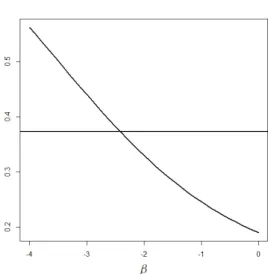
wherexk∗ is the observed last stress level when the life test is terminated. Thus, a plot of
the LHS and RHS of (15) gives a simple graphical method of determining the MLE of the parameterβ; see Figure 1. The proposed method is advantageous compared to the tra-ditional methods for obtaining the MLE of the model parameters. The Newton-Raphson algorithm has been one of the standard procedures for the parameter estimation. In or-der to implement the Newton-Raphson procedure, however, it is necessary to acquire the second-order derivatives of the log-likelihood function, and this might be complicated under progressive censorings. This is a clear benefit of the proposed method since its simplicity does not require such derivations.
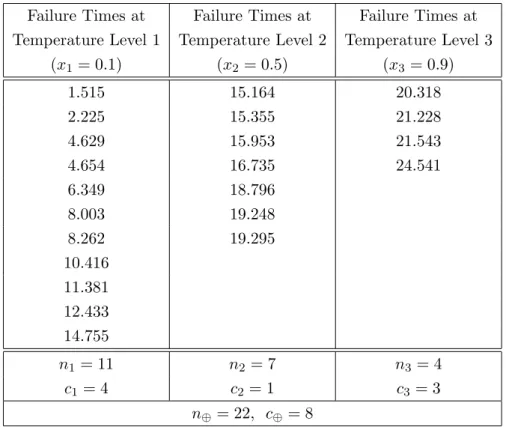
Table 1: Progressively Type-I censored dataset fromn= 30 prototypes of a solar lighting device on a three-level step-stress ALT withτ1 = 15,τ2= 20, and τ3= 25
Failure Times at Failure Times at Failure Times at Temperature Level 1 Temperature Level 2 Temperature Level 3
(x1= 0.1) (x2 = 0.5) (x3= 0.9) 1.515 15.164 20.318 2.225 15.355 21.228 4.629 15.953 21.543 4.654 16.735 24.541 6.349 18.796 8.003 19.248 8.262 19.295 10.416 11.381 12.433 14.755 n1 = 11 n2= 7 n3 = 4 c1 = 4 c2 = 1 c3 = 3 n⊕ = 22, c⊕= 8
4 Illustrative example
The graphical estimation method proposed here is illustrated with a real engineering case study. A three-level step-stress ALT was conducted under progressive Type-I censoring in order to assess the reliability characteristics of a solar lighting device, whose dominant failure mode is controller failure. Here, temperature is the stress factor whose level was changed during the test in the range of 293K to 353K with the normal operating temperature at 293K. The standardized stress loading was x1 = 0.1, x2 = 0.5, and x3 = 0.9. The stress change time points were τ1 = 15 (in hundred hours) and τ2 = 20
(in hundred hours) with the censoring time point at τ3 = 25 (in hundred hours). The
number of devices censored atτ1 = 15 andτ2 = 20 werec1 = 4 andc2 = 1, respectively,
in order to utilize them for further engineering analyses and in other tests. The dataset obtained is presented in Table 1 and it consists of total n⊕ = 22 failure times from the
initial sample size ofn= 30 prototypes (i.e., 26.7% right censoring).
Initially, Weibull models with a constant shape parameter across different stress levels were fitted under the power law relationship but the inference for the shape pa-rameter supported an exponential lifetime of the device at any constant temperature.
Figure 1: Plot of H(β;x,U) and LHS functions of (15) for the progressively Type-I censored data in Table 1
Consistent with our model assumption, fitting exponential distribution to the data with the log-linear parameter-stress relationship in (3), the estimation procedure described in Section 3 leads to a simple graphical solution of ˆβ =−2.41309 with no need to use the Newton-Raphson method; see Figure 1. This in turn produces ˆα= 3.659685 from (10).
5 Conclusion
In this work, a simpler estimation method was proposed for determination of the MLE of the regression slope parameter for the generalk-level constant-stress and step-stress ALT under progressive Type-I and Type-II censorings. The unified structure of the likelihoods was provided upon using the popular physics-based log-linear link function between the mean lifetime parameter and the (transformed) stress level along with the AFT model for explaining the effect of changing stress levels in step-stress ALT. It was demonstrated that this proposed approach ensures the existence and uniqueness of the MLE. For analytical tractability, the derivations and numerical results presented in this work are based on the exponentially distributed lifetimes at each stress level. It is of practical interest to extend the results of this research to other types of censoring schemes and the failure data from other popular lifetime distributions containing non-scale parameters such as Weibull, extreme value, gamma, and lognormal. With added distributional parameters, it is challenging to assess the nature of the likelihood equations analytically but luckily, the existence and uniqueness of the MLE can be inferred based on the results reported in this work. For instance, if the failure times follow Weibull distributions with a common shape parameter across stress levels, a simple power transformation converts the lifetime distribution to an exponential, which has been discussed in this paper; see Balakrishnan and Kateri (2008) for example. Research in these direction is under
progress and it is hoped to report these findings in future communications.
Acknowledgment
The authors are grateful to the managing editor and anonymous reviewers for their critical comments and valuable suggestions on the previous version of the manuscript.
References
Bagdonavicius, V. and Nikulin, M. (2001). Accelerated Life Models: Modeling and Sta-tistical Analysis. Chapman & Hall/CRC Monographs on Statistics & Applied Proba-bility. CRC Press.
Bagdonaviˇcius, V. and Nikulin, M. (1997). Accelerated life testing when a process of production is unstable. Statistics & Probability Letters, 35(3):269 – 275.
Bai, D. S., Kim, M. S., and Lee, S. H. (1989). Optimum simple step-stress accelerated life tests with censoring. IEEE Transactions on Reliability, 38(5):528–532.
Balakrishnan, N. and Han, D. (2008). Exact inference for a simple step-stress model with competing risks for failure from exponential distribution under type-ii censoring.
Journal of Statistical Planning and Inference, 138(12):4172 – 4186.
Balakrishnan, N. and Han, D. (2009). Optimal step-stress testing for progressively type-i censored data from exponenttype-ial dtype-istrtype-ibuttype-ion. Journal of Statistical Planning and Inference, 139(5):1782 – 1798. Special Issue on Degradation, Damage, Fatigue and Accelerated Life Models in Reliability Testing.
Balakrishnan, N., Han, D., and Iliopoulos, G. (2011). Exact inference for progressively type-i censored exponential failure data. Metrika, 73(3):335–358.
Balakrishnan, N. and Kateri, M. (2008). On the maximum likelihood estimation of parameters of weibull distribution based on complete and censored data. Statistics & Probability Letters, 78(17):2971 – 2975.
Gerville-Reache, L. and Nikulin, M. (2007). Some recent results on accelerated failure time models with time-varying stresses. Quality Technology & Quantitative Manage-ment, 4(1):143–155.
Han, D. (2015). Time and cost constrained optimal designs of constant-stress and step-stress accelerated life tests. Reliability Engineering & System Safety, 140:1 – 14. Han, D. (2017). Optimal accelerated life tests under a cost constraint with non-uniform
stress durations. Quality Engineering, 29(3):409–430.
Han, D. and Balakrishnan, N. (2010). Inference for a simple step-stress model with competing risks for failure from the exponential distribution under time constraint.
Computational Statistics & Data Analysis, 54(9):2066 – 2081.
Han, D., Balakrishnan, N., Sen, A., and Gouno, E. (2006). Corrections on ”optimal step-stress test under progressive type-i censoring. IEEE Transactions on Reliability, 55(4):613–614.
Han, D. and Kundu, D. (2015). Inference for a step-stress model with competing risks for failure from the generalized exponential distribution under type-i censoring. IEEE Transactions on Reliability, 64(1):31–43.
Han, D. and Ng, H. (2013). Comparison between constant-stress and step-stress acceler-ated life tests under time constraint. Naval Research Logistics (NRL), 60(7):541–556. Ismail, A. A. (2016). Statistical inference for a step-stress partially-accelerated life test model with an adaptive type-i progressively hybrid censored data from weibull distri-bution. Statistical Papers, 57(2):271–301.
Laronde, R., Charki, A., and Bigaud, D. (2010). Reliability of photovoltaic modules based on climatic measurement data. Int. J. Metrol. Qual. Eng., 1(1):45–49.
Leemis, L. M., Shih, L.-H., and Reynertson, K. (1990). Variate generation for accelerated life and proportional hazards models with time dependent covariates. Statistics & Probability Letters, 10(4):335 – 339.
Meeker, W. and Escobar, L. (1998). Statistical Methods for Reliability Data. Wiley Series in Probability and Statistics. Wiley.
Miller, R. and Nelson, W. (1983). Optimum simple step-stress plans for accelerated life testing. IEEE Transactions on Reliability, R-32(1):59–65.
Nelson, W. (1980). Accelerated life testing - step-stress models and data analyses.IEEE Transactions on Reliability, R-29(2):103–108.
Sha, N. and Pan, R. (2014). Bayesian analysis for step-stress accelerated life testing using weibull proportional hazard model. Statistical Papers, 55(3):715–726.
Wu, S.-J. and Huang, S.-R. (2010). Optimal progressive group-censoring plans for expo-nential distribution in presence of cost constraint. Statistical Papers, 51(2):431–443.