(IJARET)
Volume 7, Issue 1, Jan-Feb 2016, pp. 60-67, Article ID: IJARET_07_01_008 Available online at
http://www.iaeme.com/IJARET/issues.asp?JType=IJARET&VType=7&IType=1 Journal Impact Factor (2016): 8.8297 (Calculated by GISI) www.jifactor.com ISSN Print: 0976-6480 and ISSN Online: 0976-6499
© IAEME Publication
___________________________________________________________________________
PERFORMANCE STUDY OF A PHASE
CHANGE MATERIAL ASSISTED SOLAR
STILL
Maheep Kumar
Mechanical Engineering Department, Noida International University, Noida, (U.P.) India
Ajeet Kumar Rai
Mechanical Engineering Department, SSET, SHIATS, Allahabad, (U.P.) India ABSTRACT
A Solar still is a simple device, which is used to produce drinking water using energy of sun. Its low productivity is of great concern. Lauric acid is used as energy storage medium in the solar still to produce drinking water in the off sunshine hours. To examine the effects of use of PCM in the solar still for same total daily solar intensity on energy and exergy efficiency, experiments were carried out on two similar double slope solar still at Allahabad (250 28ꞌN, 810 54ꞌE) U.P. India. PCM is used in one of the still for the purpose of comparison with conventional still. It is observed that the exergy efficiency increases by 40% when lauric acid is used as energy storage medium in the solar still.
Key words: Solar Still, Phase Change Medium, Energy Efficiency, Exergy Efficiency.
Cite this Article: Maheep Kumar and Ajeet Kumar Rai, Performance Study of A Phase Change Material Assisted Solar Still. International Journal of Advanced Research in Engineering and Technology, 7(1), 2016, pp. 60-67. http://www.iaeme.com/IJARET/issues.asp?JType=IJARET&VType=7&IType=1
1. INTRODUCTION
Performance Study of A Phase Change Material Assisted Solar Still
Non-conventional, used to convert brakish water into drinking water. Among the available solar desalination systems, solar still is a very simple and easy to construct device. It has many features but the daily productivity from the solar still is not sufficient to meet the end users needs. Different solar still designs have been developed by the researchers and numerous theoretical and experimental investigations have been carried out to improve the performance. Many researchers have used energy storage mediums in the solar still to improve the daily productivity. Nafey et al, used black rubber and black gravel to enhance the productivity of the solar still. El-Sebaii et al used baffle suspended absorber plate in the solar still to increase the productivity. Almost 20% gain in daily productivity was found by these researchers. Latent heat of phase change material is many orders higher than the specific heat of materials. Therefore PCM can share 2-3 times more heat or cold per volume or per mass as can be stored as sensible heat in water in a temperature interval of 20 0C (Maheep et al 2014). Lorsh et al, Lane et al and Humphries and Griggs have studied PCMs that can be selected as a storage media. Dincer and Rosen, Abhat have given a detailed classification of PCMs along with their properties. Rai et al have reviewed work on PCMs and their wide range of applications. Naim et al, Shukla et al, and Rai et al used PCM as a energy storage medium to constructed a novel continuous single stage solar still. They reported that the productivity of a solar still can be greatly enhanced by the use of a PCM integrated to the still. In the present study, performance of a double slope solar still with Lauric acid as PCM is compaired with the conventional still in outdoor conditions in the month of February. Melting temperature of Lauric acid is 490C and latent heat of fusion is 178 kJ/kg Maheep et al 2014. Exergy analysis is a powerful indicative tool for the performance evaluation of thermal systems. Objective of the present work is to evaluate the performance of the solar still using energy and exergy analysis.
2. EXPERIMENTAL SET-UP
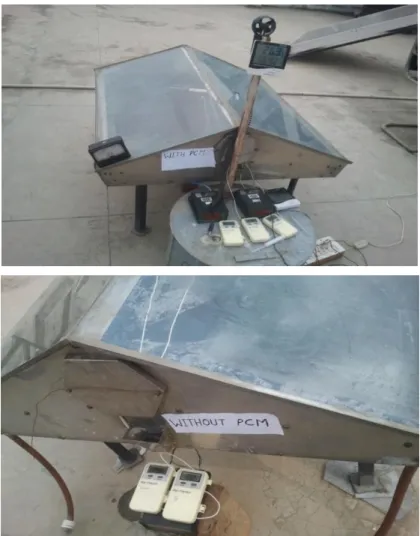
Figure 1 shows the photograph of two double slope solar still (DSS) of same size and shape. They are kept on the same plateform for experimentation. One still is conventional while other is assisted with PCM at its base. The DSS consist of a passive solar distillation unit with a glazing glass cover of thickness 3mm. Inclination of the glass covers are at 260. Area of the basin is 0.048m x 0.096m. The basin of the still is made up of Galvanized iron. The effective area of the basin is 0.72 m2. Mass of 2 kg of Lauric acis as PCM is spread in the basin. A separate basin made of Aluminum is used to store water for distillation. Air tight contact is made between water basin (Aluminium tray) and the PCM. Thermocouples were attached in different locations of the still to record the temperature. A distillate channel was provided at each end of the basin for the collection of distilled water. The distillate was collected in a jar and then measured by graduated beaker. Solarimeter is used to measure the solar intensity. Anemomter is used to measure the wind velocity.
Figure 1 Experimental Set up of Double Slope Solar Still With and without PCM
3. PROCEDURE
The experiments were conducted in the premises of SHIATS Allahabad U.P.India in the winter season. Datas presented here are of the month february. Experiments started at 8:30 AM at local time. Copper-Constantan thermocouples with 10 least count were used to measure the temperature of water basin, PCM, east and west side glass covers and atmosphere. Thermocouples were caliberated using ZEAL thermometer. The distillate output was recorded with the help of a measuring cylinder of least count 1 ml. The solar intensity was measured with the help of caliberated solarimeter of least count 2 mW/m2.
Energy Analysis of passive solar still ᶯηΣ
Energy analysis of a solar still is based on the principle of conservation of energy. In this regard, the input energy to the still and the energy output of the still has to be determined. After determining the input and output energy expressions the solar still daily efficiency can be calculated by the following expressions.
ηenergy = (Mw × L) / (As ×Σ I
Performance Study of A Phase Change Material Assisted Solar Still L = 2.4935×106 × [1-9.4779 × 10⁻⁴Tw + 1.3132 × 10 -7 ×Tw 2 -4.794 × 10⁻⁹ × Tw 3 ] (2)
Tw is basin water temperature in 0C. ΣIt(s) is the daily solar intensity. As is the
basin area of the still in m2.
4. EXERGY ANALYSIS OF PASSIVE SOLAR STILL
Exergy analysis is derived from the second law of thermodynamics. Exergy of a thermodynamic system is the part of energy which is the maximum useful work that can be obtained from the system at a given state in a specified environment. Similar to the energy analysis, the input exergy to the still and the exergy output of the still has to be determined to be able to carry out an exergy analysis. The expression presented by Petela for the available amount of terrestrial solar radiation, which has the widest acceptability, can be used to calculate the exergy of solat radiation as the exergy input (Exin) to the solar still.
ΣExin = ΣExsun= (As × ΣIt(s)) × [1-{(4/3)(Tamb/Tsun)}+{(1/3)(Tamb/Tsun)4}] (3)
Where Tamb is the ambient temperature and Tsun is the surface temperature of the
sun. Several researchers used different values for Tsun. In this paper Tsun is taken to be
5777K.
ΣExout = ΣExevap= [(Mw × L) × {1-(Tamb/Tw)}] / 3600 (4)
The exergy efficiency can be calculated as the ratio between the net exergy output and the input exergy.
ηEx = ΣExevap / ΣExsun (5)
5. RESULTS AND DISCUSSION
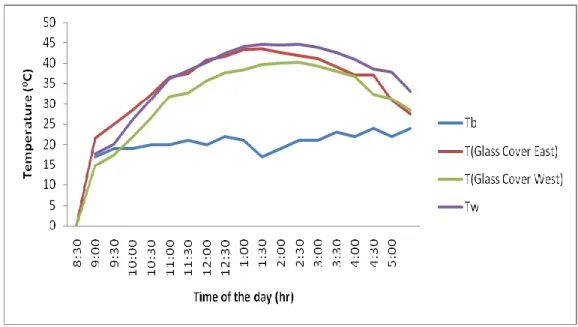
Figure 2 Variation of Temperature of different components of the solar still (Conventional still)
Figure 3 Variation of temperatures of different components of the solar still (with PCM)
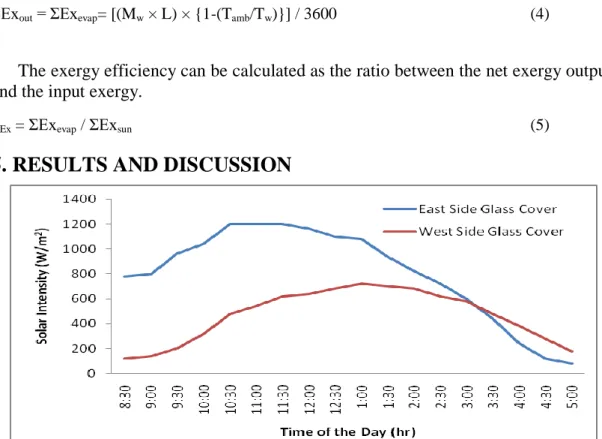
Figure 1 shows the variation of solar intensity with respect to the time of the day for a particular day in the month of February of Indian climatic conditions. As expected, solar intensity on the East facing glass cover is more till 2:30 PM. North facing glass cover receives more intensity after 3:00 PM. Fig. 2 and Fig. 3 shows the variation of temperature of the different components of the solar still without and with PCM. After initial heating of 2 to 3 hours temperature of water is maximum than any other component of the still. Temperature of the base is minimum but sufficient to loss heat to the environment. So base should be insulated to conserve heat.
Performance Study of A Phase Change Material Assisted Solar Still
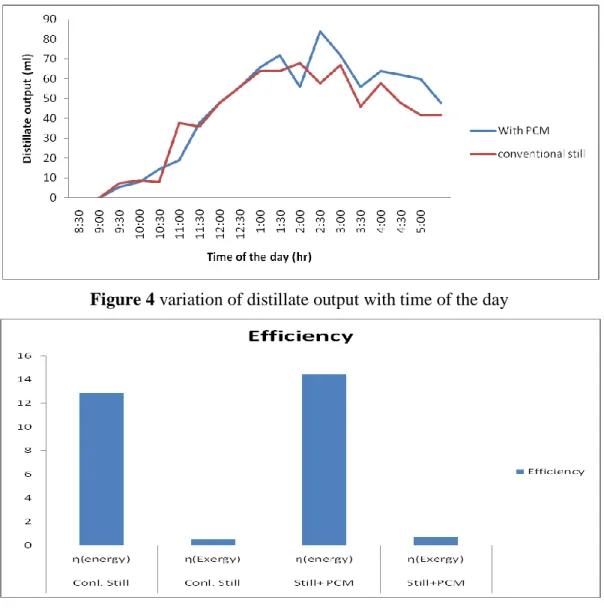
of the still. Discharging of PCM, heats the water in the basin and the base temperature also rises. Due to thermal inertial effect temperature of the base is higher till late morning hours. Fig. 4 shows that distillate output in afternoon is more in the PCM assisted still than the conventional still. Use of PCM in the basin of the still increases the daily productivity by 12.7%, day time distillate output increases by 9.4% and night time distillate output increases by 21.7% than the conventional still. Energy and exergy efficiencies of both conventional and PCM assisted stills are shown in fig. 5. It is clear that PCM assisted still is more efficient than the conventional still. Daily exergy efficiency value is very low in comparison with daily energy efficiency. This is due to the degradation of energy quality. Energy efficiency of the solar still increases by 12.42 when still is assisted with PCM. Exergy efficiency of the still with PCM is 40% higher than the exergy efficiency of the conventional still.
Figure 4 variation of distillate output with time of the day
Figure 5 Energy and Exergy efficiency of the conventional and PCM assisted solar still
6. CONCLUSIONS
In this study, two similar, single basin double slope passive solar stills are used for the purpose of analysis. PCM is used in one of the still to find its suitability in terms of the performance of the still. Energy and exergy analysis is carried out for the same total daily solar intensity. It is observed that the use of PCM in the basin of the still
increases the daily productivity by 12.7%. Day time distillate output increases by 9.4% and night time distillate output increases by 21.7% for the same total daily solar intensity. Daily exergy efficiency value is very low in comparison with daily energy efficiency. Energy efficiency of the solar still increases by 12.42% and exergy efficiency increases by 40% when Lauric acid is used as energy storage medium in the still.
REFERENCES
[1] A. Abhat, 1983 Low temperature latent heat thermal energy storage: heat storage materials, Solar Energy 30 313-332.
[2] Al-Hamadani A.A.F. and Shukla S.K. 2011, Modeling of solar distillation system with phase change material (PCM) storage medium, thermal science, [3] Dincer I., Rosen M.A. 2002 Thermal energy storage, Systems and
Applications John Willey and Sons Chichester (England).
[4] Duffie, J.A. and Beckman, W.A., 2006. Solar Engineering of Thermal Processes. 3rd ed. New York:Wiley Interscience, pp.5-41, 85-103.
[5] Dunkle, R.V., 1961. Solar water distillation: the roof type still and a multiple effect diffusion still. International Development in Heat Transfer: International Heat Transfer Conference. University of Colorado, 895-902 (part 5).
[6] El-Sebaii A. A., Al-Ghamdi A.A., Al-Hazmi F.S. and Faidah A.S. 2009, Thermal performance of a single basin solar still with PCM as a storage medium, Applied Energy, 86, 1187-1195.
[7] El-Sebaii A. A., Aboul-Enein, S., El-Bialy, E., 2000, Single basin solar still with baffle suspended absorber, Energy Conversion and Management, 41, 7, 661-675.
[8] Hasan Falih M., Dr. Ajeet Kumar Rai, Vivek Sachan, Omar Mohammed (2014). Experimental Study of Double Slope Solar Still with Energy Storage Medium, International Journal of Advanced Research in Engineering and Technology : 5(3) 147-154
[9] Humphries WR, Griggs EI. 1977 A designing handbook for phase change thermal control and energy storage devices. (NASA Technical Paper, p. 1074).
[10] Kalogirou Soteries A, 2005 Sea water desalination using renewable energy sources, Prog.Energy combustion Sci. 31,242-81.
[11] Lane G.A. 1983 Solar heat storage-Latent Heat Materials, vol. I. Boca Raton, FL: CRC Press, Inc.
[12] Lane GA, Glew DN, Clark EC, Rossow HE, Quigley SW, Drake SS, 1975 “Heat of fusion system for solar energy storage subsystems for the heating and cooling of building”. Chalottesville, Virginia, USA.
[13] Malik, M.A.S., Tiwari, G.N., Kumar, A. and Sodha, M.S. (1982) “Solar Distillation: A Practical Study of A Wide Range of Stills and Their Optimum Design, Construction and Performance. Pergamon Press, Oxford, England, [14] Murugavel KK, Chockalingam Kn K S K Srithar K, 2008 Progresses in
improving the effectiveness of the single basin passive solar still Desalination 220; 677–686
Performance Study of A Phase Change Material Assisted Solar Still
[16] Nafey A.S. (2001) Solar still productivity enhancement, Energy Conversion and Management,42; 11, 1401-1408
[17] Nafey A.S. (2002) Enhancement of Solar still productivity using floating perforated black plate, Energy Conversion and Management,43; 7, 937-946 [18] Petela R. Engineering Thermodynamics of thermal radiation for solar power
utilization. New York, The McGraw Hill Companies Inc 2010.
[19] Rai Ajeet Kumar and Kumar Ashish 2012, A review on phase change materials and their applications. International journal of Advanced Research in Engineering and Technology (IJARET) 3(2), pp 214-225.
[20] Rai Ajeet Kumar, Sachan Vivek and Kumar Maheep (2013), Experimental Investigation of a double slope solar still with a latent heat storage medium, International Journal of Mechanical Engineering and Technology: 4 (1) 22-29.
[21] Rai Ajeet Kumar, Singh Nirish and Sachan Vivek (2013), Experimental study of a single basin solar still with water cooling of the glass cover. International Journal of Mechanical Engineering and Technology: 4 (6) 1-7.
[22] Simon Furbro, Sven Svendsen (1977), Heat storage in a solar heating system using salt hydrates. Thermal insulation laboratory of technical university of Denmark.
[23] Singh Parmendra, Rai Ajeet Kumar and Sachan Vivek (2014) Study of Effect of Condensing Cover Materials on the Performance of a Solar, Still International Journal of Mechanical Engineering and Technology :5(5) 98-107
[24] Singh Ankur Kumar, Rai Ajeet Kumar and Sachan Vivek (2014) Energy and Exergy Analysis of a Double Slope Solar Still International Journal of Mechanical Engineering and Technology :5(6) 47-54
[25] Shukla S.K. and Ali A. Farhan, (2011) Thermal Modelling of Solar Stills Using PCM as Storage Medium, accepted for oral presentation at ASME-ES Fuel Cell 2011 conference to be held at Washington D.C. USA during August 7-10.
[26] Shukla S.K. and Rai A.K., (2008) Analytical Thermal Modelling of Double Slope Solar Still by Using Inner Glass Cover temperature, Thermal Science, Vol.12(3),139-152.
[27] Shukla S.K. and Rai A.K., (2010) Estimation of Solar Still output Under Indoor Environment, International Journal of Applied Engineering Research:, Vol. 5( 2), 343-350.