Computer Science and Artificial Intelligence Laboratory
Technical Report
m a s s a c h u s e t t s i n s t i t u t e o f t e c h n o l o g y, c a m b r i d g e , m a 0 213 9 u s a — w w w. c s a i l . m i t . e d u
MIT-CSAIL-TR-2011-027
May 2, 2011
Library Cache Coherence
Keun Sup Shim, Myong Hyon Cho, Mieszko Lis,
Omer Khan, and Srinivas Devadas
Keun Sup Shim1, Myong Hyon Cho1, Mieszko Lis, Omer Khan and Srinivas Devadas Massachusetts Institute of Technology, Cambridge, MA, USA
Abstract—Directory-based cache coherence is a popular
mechanism for chip multiprocessors and multicores. The directory protocol, however, requires multicast for inval-idation messages and the collection of acknowledgement messages, which can be expensive in terms of latency and network traffic. Furthermore, the size of the directory increases with the number of cores. We present Library
Cache Coherence (LCC), which requires neither
broad-cast/multicast for invalidations nor waiting for invalidation acknowledgements. A library is a set of timestamps that are used to auto-invalidate shared cache lines, and delay writes on the lines until all shared copies expire. The size of library is independent of the number of cores. By removing the complex invalidation process of directory-based cache coherence protocols, LCC generates fewer network messages. At the same time, LCC also allows reads on a cache block to take place while a write to the block is being delayed, without breaking sequential consistency. As a result, LCC has 1.85X less average memory latency than a MESI directory-based protocol on our set of benchmarks, even with a simple timestamp choosing algorithm; moreover, our experimental results on LCC with an ideal timestamp scheme (though not implementable) show the potential of further improvement for LCC with more sophisticated timestamp schemes.
I. INTRODUCTION
With the demise of Dennard scaling, the increase in processor clock frequencies from 1980-2003 has slowed down significantly [1]. To improve performance, archi-tects are exploring many parallel architectures includ-ing manycore architectures in academia (e.g., Raw [2], TRIPS [3]) and industry (e.g., Tilera [4], Intel Ter-aFLOPS [5]). In a manycore or multi-core architecture, cores with relatively low complexity are connected to memory and each other via high-bandwidth on-chip interconnect.
How will these multicores be programmed? Amongst many different types of parallel programming models, message passing and shared memory are the most dom-inant ones. Some multicores, for example, the Tilera Tile-Gx 100 provide a shared memory abstraction to the programmer, while other architectures like Intel
1equal contributors
TeraFLOPS rely on message passing. Message passing is a very efficient programming model for certain types of applications, such as scientific computation. However, many programs and operating systems are based on the shared memory abstraction, so it is indispensable for general-purpose multicores to support the shared memory abstraction.
On-chip cache memory cannot be directly imple-mented as a single large cache primarily because the energy consumption of caches grows quadratically with cache size, and because the number of read and write ports do not scale with the number of cores. To maintain performance, we need distributed caches that behave like a logically shared cache.
A. Directory-Based Cache Coherence (DirCC) Architec-ture
When we consider a two-level on-chip cache hierar-chy for a tiled multicore architecture, there are many choices in implementing a logically shared cache. One of the most common approaches in modern multicore processors is to implement a private L1 cache and a
shared L2 cache slice for each core (e.g., Tilera’s 64-core processor [4], Cavium Octeon 32-64-core processor). A shared L2 cache architecture unifies the per-core L2 cache slices into one large logically shared cache, and a memory address has a unique location where it can be cached on-chip, which is termed the homecache for the address. Therefore, data can be replicated in L1 but not in L2. On an L1 miss, the home L2 cache, where the data block may be located, needs to be looked up; the home can be a local L2 cache if the address is mapped to the requesting core’s cache (core hit), or a remote L2 cache if the core is not the home for the address (core miss). While these remote accesses may lead to a higher average L2 hit latency, the on-chip cache is better utilized by not replicating any data in L2, reducing the number of expensive off-chip accesses when compared to a private L2 design.
The common shared memory abstraction model re-quires data coherence between cores. In this example of the shared L2 cache architecture, private L1 caches need
2
to be kept coherent. When the number of cores is large (>32), snoopy caches are no longer viable [6], and we are left with directory-based cache coherence [7]. There are difficulties in scaling directories to hundreds of cores, since the directory sizes grow with the number of cores. A fullmap directory is a directory that keeps track of all the sharers of each cache block [8]. If, say, we have 256 cores on the chip, we will require a 256-bit vector for each shareable cache block, unless compression tech-niques, e.g., [9], [10], are applied, which may degrade performance.
Moreover, directory protocols that maintain sequen-tially consistent operation may require up to four net-work messages, that include broadcast (multicast) to all (a subset of) cores, and return acknowledgements. Broadcast/multicast can be expensive in terms of latency and network traffic and therefore many techniques have been developed to alleviate this expense (e.g., [11], [12]).
B. Our contribution: Library Cache Coherence Protocol (LCC)
We proposeLibrary Cache Coherence(LCC), a novel cache coherence protocol which 1) does not require broadcast/multicast of invalidations (and therefore, no collection of invalidation acknowledgements), 2) is scal-able to any number of cores, and 3) guarantees sequential consistency.
There are several points worth of note before we describe the LCC protocol:
• We assume a global timer that is available to all
cores and caches. (This timer does not have to increment with the processor clock, and can be significantly slower.)
• Each memory address has a unique home L2
loca-tion.
• Each line in the L1/L2 cache has an additional
timestamp. This timestamp is interpreted in two different ways. If the data block is not in its home L2 location, the timestamp indicates the time until when the line is valid (i.e., can be read), and if it is at its home L2, the timestamp holds the maximum
value of timestamps among all the copies of the data block.
• A line can only be written at its home location, i.e.,
writes requested by a processor have to be sent to the home L2 cache.
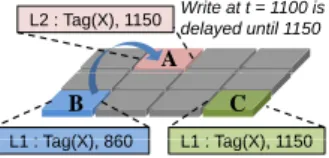
We will describe the protocol informally here and more formally in Section III. A high-level example of LCC with a shared L2 cache is also illustrated in Figure 1. While a data block can only be written in its home L2 location, when a processor makes a request
for a word in the data block, read-only copies of data blocks with timestamps can be stored in L1 caches. The timestamp assigned to the data block is assigned by the home L2 cache when it sends the block to the requesting core (cf. Figure 1a,1b). The requested word
from the block is loaded into a register, and a copy of the block is stored in the local L1 cache provided that its timestamp has not expired. The home L2 cache keeps the information about the timestamps assigned to each data block that is stored in it, for those blocks that have been shared. Crucially, for any given data block, the home cache needs to just keep information about the
maximum value of the timestamp assigned to any copy
of the data block. Any write request to the data block in the home cache will not occur until the timestamp has expired. In other words, we delay writes to a block until all the read copies of the data block have expired in their respective locations to maintain sequential semantics (cf. Figure 1c,1d).
C. Comparing the Library and the Directory Protocol
The library protocol does not require broad-cast/multicast of invalidation messages, and therefore it need not wait for invalidation acknowledgements to arrive, when writing to a shared cache line. However, as writes are only done at the L2 cache of the home core, they do not exploit spatio-temporal locality and may be delayed if the cache line being written has an unexpired copy elsewhere. This implies that the choice of the timestamps is crucial to performance and we show how it affects the performance of LCC in Section IV-A. For the directory-based protocol, directories are stored at L2 caches combined with cache blocks, and lines in L1 caches have state information on whether the line is shared or exclusive. On the other hand, the library protocol requires per-cache-line timestamps for both the L1 and L2 caches. In terms of scalability, the area overhead of directory-based protocols becomes greater as the number of cores grows, as the sharer information grows linearly with the number of cores in a full-map directory scheme, whereas the library protocol incurs only a constant overhead independent of the number of cores by storing timestamps of fixed size in the L1 and L2 caches.
II. RELATEDWORK
Reducing coherence overhead in distributed shared memory (DSM) has been widely explored over decades. Dynamic Self-Invalidation (DSI) [13] eliminates inval-idation messages by having a processor self-invalidate its local copy of a cache block before a conflicting
3 L2 : Tag(X), 860 A Remote read at t = 1000 L2 : Tag(X), 1150 A New timestamp = t + 150 = 1150 A B C A B C
L1 : Tag(X), 860 L1 : Tag(X), 860 L1 : Tag(X), 1150
Write at t = 1100 is Write performed
L2 : Tag(X), 1150
A
Write at t = 1100 is
delayed until 1150 L2 : Tag(X), 1150 A Write performed at t = 1150 L1 : Tag(X) 860 L1 : Tag(X) 1150 B C L1 : Tag(X) 860 L1 : Tag(X) 1150 B C
L1 : Tag(X), 860 L1 : Tag(X), 1150 L1 : Tag(X), 860 L1 : Tag(X), 1150 (a) Suppose core B has a copy
of address X in its L1 and its timestamp is 860. Core C wants to read X, but misses in its L1 cache, resulting in a remote read to the L2 cache at core A. The remote read arrives at supposedly, t = 1000. L2 : Tag(X), 860 A Remote read at t = 1000 L2 : Tag(X), 1150 A New timestamp = t + 150 = 1150 A B C A B C
L1 : Tag(X), 860 L1 : Tag(X), 860 L1 : Tag(X), 1150
Write at t = 1100 is Write performed
L2 : Tag(X), 1150
A
Write at t = 1100 is
delayed until 1150 L2 : Tag(X), 1150 A Write performed at t = 1150 L1 : Tag(X) 860 L1 : Tag(X) 1150 B C L1 : Tag(X) 860 L1 : Tag(X) 1150 B C
L1 : Tag(X), 860 L1 : Tag(X), 1150 L1 : Tag(X), 860 L1 : Tag(X), 1150 (b)Tdelta, 150, is added to the current clock, 1000, and data is sent back to core C (L1 cache) with this new timestamp of 1150. The timestamp at core A’s L2 cache is also updated.
B C B C
L1 : Tag(X), 860 L1 : Tag(X), 860 L1 : Tag(X), 1150
Write at t = 1100 is Write performed
L2 : Tag(X), 1150
A
Write at t = 1100 is
delayed until 1150 L2 : Tag(X), 1150 A Write performed at t = 1150 L1 : Tag(X) 860 L1 : Tag(X) 1150 B C L1 : Tag(X) 860 L1 : Tag(X) 1150 B C
L1 : Tag(X), 860 L1 : Tag(X), 1150 L1 : Tag(X), 860 L1 : Tag(X), 1150 (c) When core B wants to write
on X, it needs to perform a remote write to the home core A, and suppose it arrives at t = 1100. Since the current time has not past the timestamp (1150) yet, it should wait until t be-comes greater than 1150.
B C B C
L1 : Tag(X), 860 L1 : Tag(X), 860 L1 : Tag(X), 1150
Write at t = 1100 is Write performed
L2 : Tag(X), 1150
A
Write at t = 1100 is
delayed until 1150 L2 : Tag(X), 1150 A Write performed at t = 1150 L1 : Tag(X) 860 L1 : Tag(X) 1150 B C L1 : Tag(X) 860 L1 : Tag(X) 1150 B C
L1 : Tag(X), 860 L1 : Tag(X), 1150 L1 : Tag(X), 860 L1 : Tag(X), 1150 (d) Once the timestamp has ex-pired (i.e., t≥1150), the write can be performed and the ac-knowledgement is sent back.
Fig. 1. An example of LCC for the private L1 and shared L2 configuration : assume core A to be the home core for memory address X, and we add a constantTdelta of 150 to the system time to decide a new timestamp. Each box in the figure consists of TagandTimestamp
of the cache line for address X. Note that the entry in the home L2 cache always keeps the maximum value of timestamps given out by the home core, and other cores can hold the block only in their L1 caches.
memory request by another processor, and the directory needs to identify the blocks to be self-invalidated. DSI, however, still requires invalidation acknowledgements to maintain sequential consistency. Last-Touch Predictor (LTP) [14] predicts the ”last touch” to a memory block by one processor before the block is accessed and subsequently invalidated by another using trace-based correlation. This, however, comes at a high cost; to learn a last-touch, all the invalidation messages for a processor must be exposed to the corresponding LTP, and the DSM controller needs to be integrated in the processor. Moreover, both DSI [13] and LTP [14] are built on top of a directory-based protocol since blocks that are not self-invalidated still need to be explicitly self-invalidated in the conventional manner. This necessitates directories and sharer information; LCC eliminates the need for sharer information and therefore, is more scalable.
Timestamp-based approaches for self-invalidation were also proposed, but in the context of software cache coherence. Min and Baer [15] proposed a timestamp-based software-assisted cache coherence scheme which detects and invalidates the possibly incoherent cache entry, essentially reassigning the entire burden of maintaining cache coherence to the compiler/software. Timestamp-based Selective Invalidation Scheme (TB-SIS) [16] explicitly invalidates stale cache copies using a special invalidation instruction if the corresponding variable is modified in the current epoch. Again, the compiler must insert this instruction at the proper place at compilation time. Unlike these schemes, library cache coherence is a full hardware coherence scheme and does not require additional compiler or software support.
Nandy and Narayan [17] proposed a hardware-based, auto-invalidate cache coherence protocol. They assume a fixed life-timetcfor each cache line that begins with the
load of the data in the requesting cache (cf. Figure 3b
in [17]). The scheme in [17] is not sequentially consis-tent, and only supports a weaker notion of consistency, namely release consistency. In order to be sequentially consistent, we need to maintain a library of timestamps at the home cache, which also assigns timestamps for data requested. Our timestamps have two different meanings, and unlike in the scheme of [17], it is quite possible for a cache block to have expired by the time it arrives at the requesting core because of interconnect delays; we can, however, still use the word that was requested by the processor.
III. LIBRARYCACHECOHERENCE
A. Baseline Architecture dircc_arch Network Node Core Switch Private L1 Private L1 Shared L2 Dir. (a) Directory-based lcc_arch Network Node Core Switch Private L1 T/S Private L1 T/S Shared L2 T/S (b) Library
Fig. 2. Baseline architectures for DirCC and LCC (T/S = timestamp)
Figure 2 shows the baseline architecture for directory-based CC (DirCC) and LCC. Although LCC can be implemented on either the private L2 or the shared L2 organization, we choose the shared L2 architecture (with private L1) as a baseline, and use the same architecture for both DirCC and LCC for a fair comparison.
As shown in Figure 2a, directories and L2 caches are integrated for DirCC, so the sharer information is contained together with each cache line. LCC does not require directories, but instead requires per-cache-line timestamps for both the L1 and L2 caches (Figure 2b).
Under the shared L2 architecture, each memory ad-dress has a unique home location. In this paper, we
4
use a static data placement scheme, striping, at page granularity, which allows the computation of the home core from the memory address using simple logic.
Since data cannot be replicated in shared L2 caches, each L2 slice can maintain only the homedata, and the data fetched from remote L2 caches can only be cached in L1. For the library protocol, it is important to note that the timestamp of L1 and that of L2 have different meanings. A timestamp in the L1 cache line indicates the time until when the block can be read. A timestamp in the L2 cache, on the other hand, keeps the maximum
value of timestamps that have been assigned by the home L2 cache, until when the L2 cache must prevent writing on the block. As all read copies at L1 caches will be discarded when their timestamps expire, the home L2 cache can write to the block when the system time becomes larger than the maximum timestamp value stored at the L2 cache.
B. Baseline Protocol
Below is the full description of library cache coher-ence protocol:
• Read operations
1) At the requesting core : The requesting core first looks up its local L1 cache, and proceeds to the L2 cache of the home location if it misses in its L1. The request to the L2 cache will be a local access if the request gets acore hit, and a remote access if it gets acore miss. Note that an L1 cache block will be invalid when its timestamp expires, so it won’t get a cache hit on an expired cache line.
2) At the home L2 cache : If the data does not exist in the L2 cache, it will first be brought to the cache from the DRAM. Once the cache block is ready, it is returned to the requester core along with a timestamp. Timestamp choosing logic is used to decide whether to use the old timestamp which was previously given to other L1 caches, or to use a new timestamp. The maximum timestamp among all timestamps issued to L1 caches is kept in the L2 cache.
• Write operations
1) At the requesting core : A write request is directly forwarded to its home L2. L1 caches do not have to be looked up for writes, since writes can be only done in home L2 locations and L1 caches only maintain read-only copies. 2) At the home L2 cache : If the data does not exist in the L2 cache, it will be first brought
to the cache from the DRAM. Once the cache block is ready, the L2 cache checks if its times-tamp has expired. If it has not expired yet, the write is delayed until the current system time reaches the timestamp value and the line has expired; this is a write delay. When a cache block is brought in from DRAM, it has a null timestamp (cf. Section III-E.)
C. Request Scheduling at the L2 Cache (Home)
Multiple requests on the same cache line may arrive at an L2 cache at the same time. Scheduling of these requests is very important in order to provide functional correctness and to prevent starvation. The library proto-col processes one request at a time, serializing both read and write requests on the cache block. Read requests and write requests are treated the same, and we assume a fair scheduling between requests from the local L1 cache and remote L1 caches. When a write request is being delayed due to an unexpired timestamp, however, the protocol holds the blocked write request until the timestamp expires and processes other read requests if available. This may cause a read request that arrived later to be processed before a blocked write request. However, this still maintains sequential consistency since the reordered execution sequence is yet another se-quential interleaving of programs. We have assumed in-order cores that have a single outstanding write request to simplify the requirements for sequential consistency. However, this assumption is not strictly required for LCC as conventional techniques to support sequential consistency for multi-issue or out-of-order cores can be applied to LCC as well without significant modifications.
D. Choosing Timestamps
As shown in the protocol, timestamps affect whether memory reads in L1 caches result in hits or misses, and also affect the amount of write delays at L2 caches. If a timestamp is too small, a core gets more L1 read misses as its read copy is invalidated too soon. If it is too large, on the other hand, the write delays will compromise system performance. Thus, timestamp choosing logic plays a critical role in determining the performance of library cache coherence.
Here, we present the simplest timestamp strategy, namely a FIXED-DELTA scheme. FIXED-DELTA uses a
constant value Tdelta to decide timestamps. When a read request for block X is being processed at its home L2 cache:
1) if there is a write request on the same block X waiting to be served, the current timestamp of the
L2 entry is returned without any change to prevent increasing write delay.
2) otherwise, a new timestamp for the read request is calculated as (current clock + Tdelta) at the home L2 cache, and is returned to the requesting core’s L1 cache with the data block.
We also implement and evaluate anIDEALscheme; in IDEAL, home L2 caches are assumed to know when the
next write request on each cache linewill arrive, and/or when each cache line willbe evicted by a capacity miss. Timestamps are set to the time when the earlier event will happen, so read requests get the maximum timestamp values that do not delay any writes or evictions. Although IDEAL is not implementable in real hardware, the
per-formance of IDEAL tells us the performance potential
for LCC, provided we have a smart timestamp choosing scheme that can predict close to optimal timestamp values. While relegating the development of such a scheme to future work, we sweep the value of Tdelta
for scheme FIXED-DELTA, and show how close the best FIXED-DELTA scheme can perform when compared to
the IDEALscheme (cf. Section IV).
E. Cache Replacement Policy
The library protocol can be implemented with any conventional cache replacement scheme with one modi-fication to ensure the correctness of the protocol. While L1 cache evictions can be done anytime, an L2 cache entry with unexpired copies should not be evicted until all the copies expire. If the cache entry gets evicted, we lose track of the timestamp for the corresponding entry, and thus, we cannot fetch the correct timestamp value when the entry is restored from memory — this will break sequential consistency. This restriction may result in cache eviction delays if all the entries in multiple ways of the L2 cache happen to have unexpired copies.
IV. EVALUATION
Using Pin [18] and Graphite [19], we first gener-ate memory instruction traces for a set of SPLASH-2 benchmarks [SPLASH-20]: FFT, LU CONTIGUOUS, OCEAN, RADIX and WATER. Then, we feed these traces to
HORNET [21], a cycle-level multicore simulator, which models the interconnect behavior (e.g., congestion) in a cycle-accurate manner. The important system parameters used in the experiments are listed in Table I.
A. FIXED-DELTA with varying Tdelta
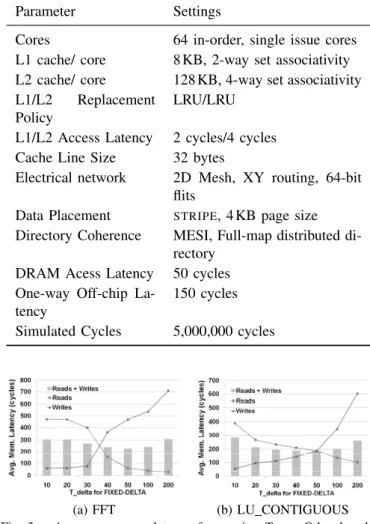
We first swept the value of Tdelta for the FIXED
-DELTA scheme, and Figure 3 shows a tradeoff between
TABLE I
SYSTEMCONFIGURATIONS
Parameter Settings
Cores 64 in-order, single issue cores L1 cache/ core 8KB, 2-way set associativity L2 cache/ core 128KB, 4-way set associativity L1/L2 Replacement
Policy LRU/LRU
L1/L2 Access Latency 2 cycles/4 cycles Cache Line Size 32 bytes
Electrical network 2D Mesh, XY routing, 64-bit flits
Data Placement STRIPE, 4KB page size Directory Coherence MESI, Full-map distributed
di-rectory DRAM Acess Latency 50 cycles One-way Off-chip
La-tency 150 cycles Simulated Cycles 5,000,000 cycles
(a) FFT (b) LU CONTIGUOUS
Fig. 3. Average memory latency for varying Tdelta. Other
bench-marks are not shown for lack of space, but have the same trends.
the read latency and write latency. As we increase
Tdelta, the L1 cache hit rate for reads increases because the entry becomes valid for a longer period of time, resulting in lower average memory latency for reads. For writes, however, the average latency increases with a largerTdelta due to the write delays. The combination of these two factors determine the optimal range of Tdelta
which minimizes the overall memory latency; for our experiments,Tdeltabetween 50 and 100 showed the best performance depending on the benchmark, but without a big difference in performance within the range.
B. Performance Comparison with DirCC and
LCC-IDEAL
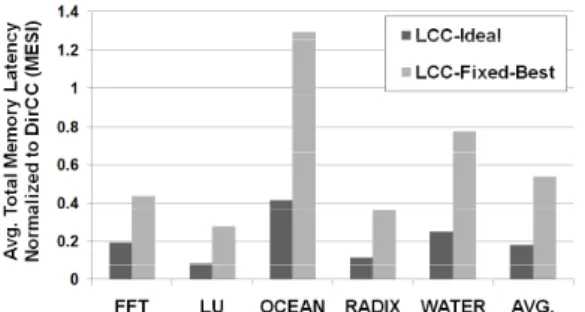
Figure 4 shows the performance of the best FIXED -DELTALCC and theIDEALLCC, both normalized to the
MESI directory protocol. For all the benchmarks we run except for OCEAN, LCC shows better performance than
DirCC, and on average (geometric mean), the best LCC-Fixed outperforms DirCC by 1.85x. This performance gain mainly comes from the fact that 1) LCC does
6
Fig. 4. Average overall memory latency for the LCC-Ideal and the best LCC-Fixed normalized to the MESI directory protocol.
not send out invalidation requests and wait for their acknowledgements, and 2) LCC can serve subsequent read requests while delaying a write on the same line maintaining sequential consistency. Moreover, the per-formance of the ideal LCC is much better (outperforms DirCC by 5.5x), showing the potential for further im-provement of LCC. For example, since each cache line has a different access pattern, a timestamp choosing scheme that captures such patterns and assigns different
Tdelta’s for each line at runtime may provide better performance.
V. CONCLUSIONS
We presented a library cache coherence protocol that can replace conventional directory-based cache coher-ence protocols in manycore architectures. LCC outper-forms a directory-based MESI protocol as it avoids expensive invalidations before a write on a shared cache line. Also, it serves read requests first when a write is pending because it is not allowed to write on a cache line, which further increases the memory access perfor-mance while maintaining sequential consistency. LCC is also more scalable than directory-based coherence since library size does not grow with the number of cores. We believe that the performance of LCC can be improved further with more sophisticated schemes of choosing timestamps, which provides an interesting research problem to the community. Finally, while we have focused on sequential consistency in this paper, LCC can also improve performance for weaker memory consistency models.
REFERENCES
[1] S. Borkar, “Thousand core chips: a technology perspective,” in
DAC, 2007, pp. 746–749.
[2] E. Waingold, M. Taylor, D. Srikrishnaet al., “Baring it all to Software: Raw Machines,” inIEEE Computer, September 1997, pp. 86–93.
[3] K. Sankaralingam, R. Nagarajan, H. Liuet al., “Exploiting ILP, TLP, and DLP using polymorphism in the TRIPS architecture,” inInternational Symposium on Computer Architecture (ISCA), June 2003, pp. 422–433.
[4] David Wentzlaff et al, “On-Chip Interconnection Architecture of the Tile Processor,”IEEE Micro, vol. 27, no. 5, pp. 15–31, Sept/Oct 2007.
[5] S. R. Vangal, J. Howard, G. Ruhlet al., “An 80-Tile Sub-100-W TeraFLOPS processor in 65-nm CMOS,”IEEE J. Solid-State Circuits, vol. 43, no. 1, pp. 29–41, 2008.
[6] A. Agarwal, R. Simoni, J. Hennessy et al., “An evaluation of directory schemes for cache coherence,” inIn Proceedings of the 15th Annual International Symposium on Computer Architecture, 1988, pp. 280–289.
[7] A. Gupta, W. Weber, and T. Mowry, “Reducing memory and traffic requirements for scalable directory-based cache coher-ence schemes,” in International Conference on Parallel Pro-cessing, 1990.
[8] D. Chaiken, C. Fields, K. Kurihara et al., “Directory-based cache coherence in large-scale multiprocessors,” in COM-PUTER, 1990.
[9] J. Zebchuk, V. Srinivasan, M. K. Qureshi et al., “A tag-less coherence directory,” in Proceedings of the 42nd Annual IEEE/ACM International Symposium on Microarchitecture, ser. MICRO 42, 2009, pp. 423–434.
[10] H. Zhao, A. Shriraman, and S. Dwarkadas, “Space: sharing pattern-based directory coherence for multicore scalability,” in
Proceedings of the 19th international conference on Parallel architectures and compilation techniques, 2010, pp. 135–146. [11] N. Eisley, L.-S. Peh, and L. Shang, “In-network cache
coher-ence,” inProceedings of the 39th Annual IEEE/ACM Interna-tional Symposium on Microarchitecture, 2006, pp. 321–332. [12] J. A. Brown, R. Kumar, and D. Tullsen, “Proximity-aware
directory-based coherence for multi-core processor architec-tures,” inProceedings of the nineteenth annual ACM symposium on Parallel algorithms and architectures, 2007, pp. 126–134. [13] A. R. Lebeck and D. A. Wood, “Dynamic self-invalidation:
Re-ducing coherence overhead in shared-memory multiprocessors,” inIn Proceedings of the 22nd Annual International Symposium on Computer Architecture, 1995.
[14] A.-C. Lai and B. Falsafi, “Selective, accurate, and timely self-invalidation using last-touch prediction,” inProceedings of the 27th Annual International Symposium on Computer Architec-ture, ser. ISCA ’00, 2000.
[15] S. L. Min and J. L. Baer, “Design and analysis of a scalable cache coherence scheme based on clocks and timestamps,”
IEEE Trans. Parallel Distrib. Syst., vol. 3, pp. 25–44, January 1992.
[16] X. Yuan, R. Melhelm, and R. Gupta, “A timestamp-based selec-tive invalidation scheme for multiprocessor cache coherence,”
International Conference on Parallel Processing, vol. 3, p. 0114, 1996.
[17] S. K. Nandy and R. Narayan, “An Incessantly Coherent Cache Scheme for Shared Memory Multithreaded Systems,” in ceedings of the First International Workshop on Parallel Pro-cessing, 1994.
[18] M. M. Bach, M. Charney, R. Cohnet al., “Analyzing parallel programs with pin,”Computer, vol. 43, pp. 34–41, 2010. [19] J. E. Miller, H. Kasture, G. Kurian et al., “Graphite: A
dis-tributed parallel simulator for multicores,” inHPCA, 2010, pp. 1–12.
[20] S. Woo, M. Ohara, E. Torrieet al., “The SPLASH-2 programs: characterization and methodological considerations,” inISCA, 1995, pp. 24–36.
[21] M. Lis, P. Ren, M. H. Choet al., “Scalable, accurate multicore simulation in the 1000-core era,” inInternational Symposium on Performance Analysis of Systems and Software (ISPASS 2011), April 2011.