SLO • Netherlands institute for curriculum development
Ed u ca tio nal D esi gn R es ea rc h - Pa rt A : A n I nt ro du ct io n Editors:Tjeerd Plomp & Nienke Nieveen
Educational
Design Research
Editors:
Tjeerd Plomp & Nienke Nieveen
Educational
Design Research
EDUCATIONAL DESIGN RESEARCH - PART A: AN INTRODUCTION
2
Authors: Jan van den Akker
Brenda Bannan Anthony E. Kelly Nienke Nieveen Tjeerd Plomp
Editors: Tjeerd Plomp
Nienke Nieveen
Design: SLO, Enschede
ISBN: 978 90 329 2334 1
SLO P.O. Box 2041
7500 Enschede the Netherlands
http://international.slo.nl/publications/edr/ Enschede, November 2013
Colophon
© 2013 Netherlands Institute for Curriculum Development (SLO), Enschede, the Netherlands. All rights reserved. It is permitted, without prior permission from the publisher, to copy this publication in full or in part, or reproduce it in any other way – on condition that the source is revealed.
Contents
Preface 5 - 9
1. Educational Design Research: An Introduction 10 - 51
Tjeerd Plomp
2. Curricular Development Research as a Specimen 52 - 71
of Educational Design Research
Jan van den Akker
3. Design Research from the Learning Design Perspective 72 - 113
Koeno Gravemeijer & Paul Cobb
4 The Integrative Learning Design Framework: 114 - 133
An Illustrated Example from the Domain of Instructional Technology
Brenda Bannan
5 When is Design Research Appropriate? 134 - 151
Anthony E. Kelly
6 Formative Evaluation in Educational Design Research 152 - 169
Nienke Nieveen & Elvira Folmer
7 References and Sources on Educational Design Research 170 - 199
Tjeerd Plomp & Nienke Nieveen
Preface
This book is the result of a seminar on ‘educational design research’ organized from November 23-26, 2007, by Prof Zhu Zhiting (Department of Educational Technology) of the College of Educational Sciences at the East China Normal University in Shanghai (PR China).
The primary goal of the seminar was to introduce a group postgraduate students and lectu-ring staff in China to educational design research as a research approach. The second goal of the seminar was to prepare, based on the contributions of a number international experts, proceedings of the seminar written in such a way that they can be used in postgraduate seminars on educational design research across China.
About 75 people with backgrounds mainly in instructional technology, curriculum and instructional design participated in the seminar. Most of them were working in teacher education, in schools as instructional technologist and/or in distance education. Although participants had (through their studies) already knowledge and some experience in in-structional or course design and in research methods, they were eager to be introduced to design research as a relatively new research approach for addressing complex problems in educational practice.
The seminar staff consisted of Profs Brenda Bannan and Eamonn Kelly (both George Mason University, Fairfax, VA, USA) and Prof Jan van den Akker (University of Twente and Natio-nal Institute for Curriculum Development [SLO], Enschede, The Netherlands), and the two editors of this book Dr Nienke Nieveen (National Institute for Curriculum Development [SLO], Enschede) and Prof Tjeerd Plomp (University of Twente, Enschede, The Netherlands). As can be seen from the table of content of this book, they are reflecting the background of the participants, as they represented experience in conducting design research in the domains of curriculum development, instructional technology and mathematics and science education. Experts were consciously invited from both Europe (The Netherlands) as well as the USA, so as to ascertain that variation in background and perspective on design research was represented in conducting the seminar.
The chapters in this book are based on the presentations and the small group discussions during this seminar. Although the book does not provide a ‘how to do guide’ for designing and conducting design research, the chapters have been written in such a way that they reflect both the conceptual underpinning and practical aspects of the ‘what’ and ‘how’ of doing design research (chapters by Plomp, Kelly and Nieveen), as well as provide the reader an insight in the specifics of doing design research in the domain of curriculum (chapter
EDUCATIONAL DESIGN RESEARCH - PART A: AN INTRODUCTION
6
To assist the readers in finding their way in the abundance of literature on design research, we have added a chapter with references and sources on educational design research. This bibliography is far from complete and reflects very much the background and the biases of the editors of this book. Yet we trust that this chapter will assist the interested reader in getting introduced to this exciting and promising research approach.
We want to thank Prof Zhu Zhiting from the East China Normal University for taking the initiative for this seminar. Similarly we want to thank our colleagues for contributing to this book.
But above all, we like to express our hope that this book will stimulate and support many (future) researchers to engage themselves in educational design research.
Jan van den Akker Director General SLO
Tjeerd Plomp and Nienke Nieveen Editors
Additional note about the revised edition
As stated in the Preface to the 2009 edition, this book is the result of a seminar on ‘educational design research’ organized in 2007 by Prof Zhu Zhiting of the East China Normal University in Shanghai (PR China). When we met Prof Zhu in 2011, he asked for a number of illustrative cases (15-20 cases) of successful educational design research (EDR)
to be used in combination with the 2009-book with the purpose that graduate students and
novice researchers could also learn from examples by others about how to design and conduct a research project utilizing EDR.
We, editors, decided to take up the challenge after SLO had indicated to support such an initiative and be willing to publish the new book. This resulted in a major project (starting in December 2011) comprising not only of editing a book with ‘illustrative cases of
educational design research’, but also an update of our 2009 book. So in the end the project resulted in a two-volume book.
This book, Part A: Educational Design Research: An Introduction is a revision of our 2009
book. We invited the authors whether they wanted to revise their chapter. This resulted in major revisions of the Chapters 1, 2 and 6 and some updates and minor revisions of the remaining authored chapters. In addition, we felt that that one of the possible foci of design research was underexposed, namely design research with the aim to develop new theories, such as new instructional, pedagogical or learning theories. To compensate for this, we invited Koeno Gravemeijer and Paul Cobb to contribute to our book and we are glad with their chapter ‘Design research from the learning design perspective’. Finally, we revised the chapter on ‘References and Sources’ somewhat by adding references to a few articles and books that have been published since the first edition of our book, and in addition we added the URL of a number of PhD theses. Moreover, we refer the reader interested in more references to the ‘key sources’ for the research reported in each of the illustrative cases in the second volume.
Part B: Educational Design Research: Illustrative Cases is a varied collection of 51 examples of successful educational design research. The case chapters are written with the aim to enable graduate students and novice researchers to learn how to design and conduct a project utilizing educational design research.
EDUCATIONAL DESIGN RESEARCH - PART A: AN INTRODUCTION
8
The collection reflects a number of dimensions, such as
• various domains in the field of education, such as curriculum, learning and instruction,
subject related pedagogy (for example math education, language education, science education), instructional technology, ICT in education
• various purposes of design research, such as developing an innovative intervention or
developing or a new instructional or learning theory
• representing all educational levels: (pre-)primary education, junior and senior
secondary education, teacher education, other higher education, and also workplace learning
• having been conducted in more than 20 countries.
The resulting two-volume book has been published electronically by SLO, the Netherlands Institute for Curriculum Development. Part B, the collection of case studies is a ‘supra-book’ with each case chapter separately electronically published, which allows readers or users to make their own selection of chapters given their specific purpose of use.
Pdf files of both volumes can be freely downloaded from http://international.slo.nl/edr This website comprises also a ‘case selection tool’ to assist users in selecting cases for their intended use.
Professor ZHU Zhiting (East China Normal University in Shanghai, PRChina) and
associate professor Wang Qiyun (National Institute of Education, Singapore) will prepare a Chinese edition of this book for which they will be co-editors.
We are very grateful for the support of SLO in preparing and publishing this revised edition of our book.
We hope that this book will become a source of inspiration and good ideas for many (also future) researchers who want to address important problems in educational practice!
Tjeerd Plomp and Nienke Nieveen
1. Educational Design Research:
An Introduction
Tjeerd Plomp
Introduction
The purpose of this chapter is to provide an introduction to educational design research as a research design appropriate to develop research-based solutions to complex problems in educational practice or to develop or validate theories about learning processes, learning environments and the like.
This twofold purpose will be reflected in the definition of design research discussed later in this chapter. However, regardless of the purpose, design research encompasses the
systematic study of designing, developing and evaluating educational interventions1
- such as programs, learning processes, learning environments, teaching-learning materials, products and systems.
The need for a research design that addresses problems in educational practice has been argued by researchers in various ‘corners’ of the domain of education because of an apparent lack of relevance of much educational research for educational practice. For example, the Design-Based Research Collective (2003, p.5) states that “educational research is often divorced from the problems and issues of everyday practice – a split that resulted in a credibility gap and creates a need for new research approaches that speak directly to problems of practice and that lead to the development of ‘usable knowledge’.” From his background in research in the domain of curriculum development and implementation, van den Akker (1999, p.2) writes “that ‘traditional’ research approaches such as experiments, surveys, correlational analyses, with their emphasis on description hardly provide prescriptions that are useful for design and development problems in
education”. He claims that an important reason for design research2 stems from the
complex nature of educational reforms worldwide. Ambitious reforms cannot be developed at the drawing tables in government offices, but call for systematic research, supporting the development and implementation processes in a variety of contexts.
1 ) intervention is used as a ‘container’ term referring to all entities that can be designed and developed. 2 ) which he calls ‘development research’ in his 1999 publication.
EDUCATIONAL DESIGN RESEARCH - PART A: AN INTRODUCTION
12
In his review of the state of educational research, and more specifically educational technology research, Reeves (2006, p.57) concludes that there is “a legacy of ill-conceived and poorly conducted research that results in no significant differences or, at best, in modest effect sizes”. He also argues for the domain of educational technology that it would be better that educational technologists instead of doing more studies comparing whether in a certain context method A is better than method B, undertake design research aimed at developing an optimal solution for the problem in that context.
In the field of learning sciences, the belief that context matters lead to the conclusion that research paradigms simply examining learning processes as isolated variables within laboratory settings, will necessarily lead to an incomplete understanding of their
relevance in more naturalistic settings (Barab & Squire, 2004, p.3; with reference to Brown, 1992). In this field, design-based research “was introduced with the expectation that researchers would systematically adjust various aspects of the designed context so that each adjustment served as a type of experimentation that allowed the researchers to test and generate theory in naturalistic contexts”.
These authors illustrate the need for design research as an alternative research approach. Before elaborating on design research, the next section will first discuss more generally possible functions of research and how research functions are related to research designs. After this, design research is defined and a number of characteristics of this research design are presented. This is followed by a discussion on how design research may vary in focus resulting in differentiation between development studies aimed at design principles, and validation studies aimed at theory development and validation. The next section takes a closer look at design research by discussing the main research question in design research and the quality criteria for interventions. This section also presents a simplified research model for design research. After reflecting on the issue of generalizability of design research the following section presents some aspects of conducting design research, such as formative evaluation as the prominent research activity in design research, and how the design stages can become micro-cycles of research. The next section illustrates that conducting design research puts researchers in a situation in which they have to face a number of challenges and how to manage these. These will be discussed before ending the chapter with a section presenting a few concluding remarks and an outline of this book.
A final note on terminology, following van den Akker, Gravemeijer, McKenney, and Nieveen (2006) design research is used as a common label for a ‘family’ of related research designs which may vary somewhat in goals and characteristics – examples are design
experiments (e.g. Brown, 1992; Cobb, Confrey, diSessa, Lehrere, & Schauble, 2003), design studies (Shavelson, Phillips, Towne, & Feuer, 2003; Walker, 2006), design-based research (Design-Based Research Collective, 2003), developmental research (Lijnse, 1995; van den Akker, 1999) and engineering research (Burkhardt, 2006). In addition to these, other members of this ‘family’ are participatory action research (Eilks & Ralle, 2002; Marks & Eilks, 2010) and design-based implementation research (Penuel, Fishman, Cheng, & Sabelli, 2011).
Research functions and research designs
Before elaborating on the meaning of design research, this section positions design research as a research design in conjunction with other research designs.
The primary function of scientific research is the search for ‘understanding’ or for ‘knowing’ with the aim of contributing to the body of knowledge or a theory in the domain of the research. Other broad aims could be to provide insights and contributions for improving practice, and to inform decision making and policy development in the domain of education.
There is a great variation in the possible functions of research, and – dependent on their particular aims - each of these can be realized through one or more research designs.
Research functions
In general, various research functions can be identified and distinguished from each other, with each reflecting certain types of research questions. Examples of research functions (with exemplary research questions illustrating the function) are:
1. to describe: e.g., what is the achievement of Chinese grade 8 pupils in mathematics?; what barriers to students’ experience in the learning of mathematical modelling? 2. to compare: e.g., what are the differences and similarities between the Chinese and the
Netherlands curriculum for primary education?; what is the achievement in
mathematics of Chinese grade 8 pupils as compared to that in certain other countries? 3. to evaluate: e.g., how well does a program function in terms of competences of
graduates?; what are the strengths and weaknesses of a certain approach?; etc.
4. to explain or to predict: e.g., what are the causes of poor performance in mathematics (i.e. in search of a ‘theory’ predicting a phenomenon when certain conditions or
characteristics are met)?
5. to design and develop: e.g., what are the characteristics of an effective teaching and learning strategy aimed at acquiring certain learning outcomes?.
EDUCATIONAL DESIGN RESEARCH - PART A: AN INTRODUCTION
14
In many research projects, the research questions posed are often such that in fact various research functions do apply, which results in the need to identify a primary function. For example, if the research question pertains to comparing the mathematics achievement of Chinese grade 8 pupils to that in certain other countries, then as part of comparing, the researchers will evaluate the achievement of grade 8 pupils in each of the countries involved. Or, as another example, if one wants to design and develop a teaching-learning strategy for developing the competency of mathematical modelling (in grade 11 and 12), then researchers may first want to understand and carefully describe what barriers students experience with mathematical modelling, and at a later stage also evaluate whether the teaching-learning strategy that has been developed is effective. Both examples illustrate that usually a research project has a primary research function, but that other research functions need to be applied to ‘serve’ the primary research function. At the level of a research project, beginning with a research problem or question, there is a logical sequence of development, namely:
Research question (primary) research function choice of research design.
In this chapter, the focus is on research which has design and develop as the primary research function.
Research designs
The traditional and most widely and commonly used text books on research methodology (in social science and education in particular) present and discuss a number of research approaches or designs (see e.g. Arthur, Waring, Coe, & Hedges, 2012; Cohen, Manion, & Morrison, 2007; Creswell, 2011; Denscombe, 2007; Edmonds & Kennedy, 2013). Usually each research design can be used for realizing more than one research function. Without going into detail here, examples of research designs and their possible research functions are:
Survey to describe, to compare, to evaluate
Case studies to describe, to compare, to explain
Experiments to explain, to compare
Action research to design/develop a solution to a practical problem
Ethnography to describe, to explain
Correlational research to describe, to compare
Textbooks on research methodology usually do not present and discuss design research, probably due to its recently emerging status and the fact that relatively small groups across several disciplines have been responsible for its development.
Design research to design and develop an intervention (such as programs, teaching-learning strategies and materials, products and systems) as a solution to a complex educational problem as well as to advance our knowledge about the characteristics of these interventions and the processes to design and develop them, or alternatively to design and develop educational interventions (about for example, learning processes, learning environments and the like) with the purpose to develop or validate theories. It should be noticed that in a research project often more than one research design needs to be applied. For example, if there is a need to compare how well Chinese grade 8 pupils perform in mathematics as compared to a number of other countries, the primary research function is to compare, leading in this case to a survey as the best research design.
However, as part of the development of a valid and reliable mathematics test, the researchers may do correlational research to determine whether the test being developed is valid, i.e. whether it correlates significantly with other measures of mathematics achievement.
As a final remark, it is important that design researchers, like all researchers, should keep in mind that the guiding principles for scientific research (Shavelson & Towne, 2002) also apply for their research, namely:
·
pose significant questions that can be investigated·
link research to relevant theory·
use methods that permit direct investigation of the question·
provide a coherent and explicit chain of reasoning·
replicate and generalize across studiesEDUCATIONAL DESIGN RESEARCH - PART A: AN INTRODUCTION
16
What is design research?
In this section, a formal definition of educational design research is firstly given, at which a distinction is made between development studies and validation studies. Then some characteristics of educational design research are presented, followed by a brief discussion of the twofold yield of all design research and of the differentiation between possible foci and functions of design research.
Definition of educational design research
As stated at the beginning of the chapter and in the previous section, two possible purposes of design research can be identified, and dependent on the purpose of the research we may distinguish between development studies and validation studies
respectively.3
In the case of development studies, the purpose of educational design research is to develop research-based solutions for complex problems in educational practice. This type
of design research is defined as the systematic analysis, design and evaluation of educational
interventions with the dual aim of generating research-based solutions for complex problems in educational practice, and advancing our knowledge about the characteristics of these interventions and the processes of designing and developing them.
On the other hand, in validation studies the purpose of design research is the development
or validation of a theory, and this type design research is defined as the study of
educational interventions (such as learning processes, learning environments and the like) with the purpose to develop or validate theories about such processes and how these can be
designed.
It is important to note that design research encompasses systematic educational design processes, but that the reverse is not true: not all systematic educational design can be called research. The second aim of contributing to the body of scientific knowledge (for development studies) or to generate or validate theories (for validation studies) distinguishes design research from just systematic educational design processes.
3) McKenney and Reeves (2012) characterize this difference between the two purposes as research on interventions and research through interventions. Van den Akker (personal communication) characterizes this difference by labeling design research focusing on the development of solutions to complex problems as ‘research-based design’, and the studies aiming at developing and validating (local) theories ‘design-based research’.
The twofold yield of design research, namely, research-based interventions as well as knowledge about them, or theories based on them, can also be found in definitions of design research by other authors. For example, Barab and Squire’s broad definition (2004, p. 2) also encompasses these variations of educational design(-based) research when they state that
“Design-based research is not so much an approach as it is a series of approaches, with the intent of producing new theories, artefacts, and practices that account for and potentially impact learning and teaching in naturalistic setting”.
Cycles, phases and other characteristics
By its nature, design research is relevant for educational practice (and therefore also for educational policy) as it aims to develop research-based solutions for complex problems in educational practice or to develop or validate theories about processes of learning and teaching.
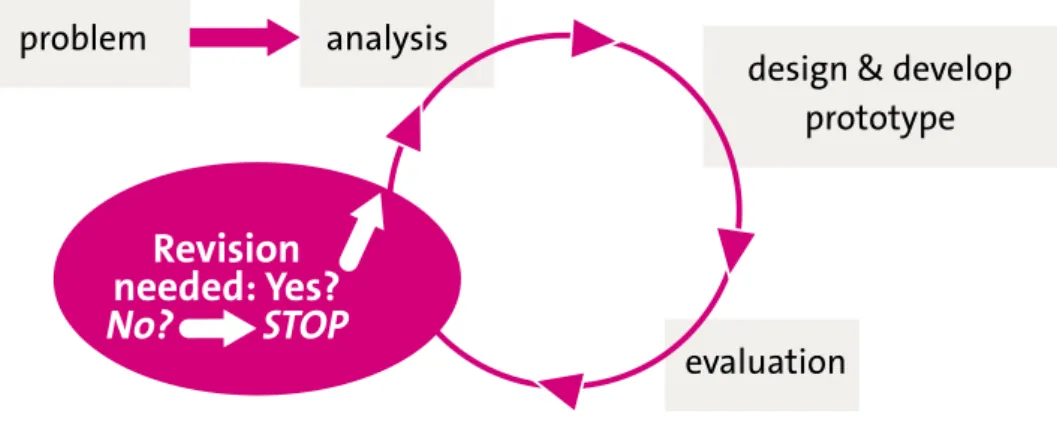
Whatever the purpose of design research, the research process always incorporates systematic educational design processes, as illustrated in Figure 1.
design & develop
prototype
evaluation
analysis
problem
Revision
needed: Yes?
No? STOP
Figure 1: Iterations of systematic design cycles
It is therefore – like all systematic educational and instructional design processes - cyclical in character: analysis, design, evaluation and revision activities are iterated until an
appropriate balance between ideals (‘the intended’) and realization has been achieved4.
This process can be illustrated in various ways with a few examples presented here showing how different authors have visualized the design research process.
4) See for example Gustafson and Branch (2002) for a taxonomy of instructional development models based on selected characteristics; they distinguish between models with a classroom orientation, product orientation and system orientation.
EDUCATIONAL DESIGN RESEARCH - PART A: AN INTRODUCTION
18
Reeves (2006) depicts the design research approach as follows:
Analysis of practical problems by researchers & practitioners in collaboration Development of prototype solutions informed by existing design principals and Iterative cycles of of solutions in practice
‘design principles’ & enhance solution implementation
Figure 2: Refinement of problems, solutions, methods, and design principles (Reeves, 2000, 2006)
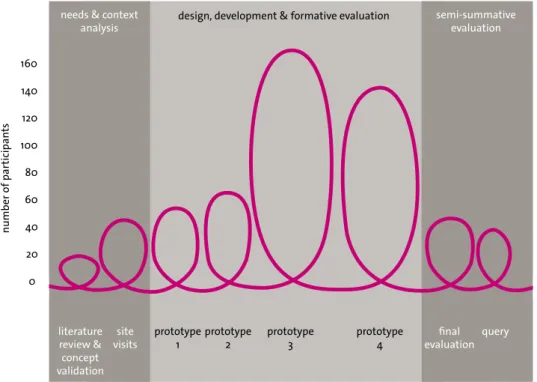
McKenney (2001) illustrates this cyclical process as follows:
160 140 120 100 80 60 40 20 0 number o f par ticipan ts
needs & context
analysis design, development & formative evaluation semi-summativeevaluation
literature review & concept validation
site
visits prototype1 prototype2
cycle width is proportional to time
schale: = circa 6 months
prototype
3 prototype4 evaluationfinal query
Figure 3: Display of the cascade-sea study (McKenney, 2001)
NOTE: the ‘query’ as the last phase in McKenney’s display can be interpreted as the reflection box in the model of Reeves (Figure 2).
Another example is the Integrative Learning Design Framework that Bannan presents in chapter 4 of this book (see also Bannan-Ritland, 2003).
Authors may vary in the details of how they picture design research, but they all agree that design research consists of a number of phases. In the case of design research as development studies, the following phases are distinguished:
• preliminary research: needs and context analysis, review of literature, development of a conceptual or theoretical framework for the study
• development or prototyping phase: iterative design phase5 consisting of iterations, each
being a micro-cycle of research6 with formative evaluation as the most important
research activity aimed at improving and refining the intervention
• assessment phase: (semi-) summative evaluation to conclude whether the solution or intervention meets the pre-determined specifications. As also this phase often results in recommendations for improvement of the intervention, we call this phase semi-summative.
Throughout all these activities, the researcher or research group will do systematic reflection and documentation to produce the theories or design principles (a concept taken from van den Akker, 1999 – see also later on, the sub-section on development studies) as the scientific yield from the research. One may state that this systematic reflection and documentation ensures that research-based design and development of an intervention emerges as design research.
Similar research phases are found in validation studies. For example, Cobb et al. (2003) distinguish between the phases of preparing for a design experiment, conducting a design experiment and conducting a retrospective analysis.
Refer to the sub-section on validation studies and also Gravemeijer and Cobb in chapter 3 of this book.
5) it is possible that the design/development component in a such a research project will not begin from scratch but with the evaluation of an existing intervention with the aim of identifying the need for improvement, which then is followed by re-design and a number of design cycles.
EDUCATIONAL DESIGN RESEARCH - PART A: AN INTRODUCTION
20
Design research authors also agree on a number of characteristics represented in this type of research. Van den Akker et al. (2006, p.5) mention the following:
Interventionist the research aims at designing an intervention in a real world setting
Iterative the research incorporates cycles of analysis, design and development, evaluation, and revision
Process oriented the focus is on understanding and improving interventions (a black box model of input – output measurement is avoided)
Utility oriented the merit of a design is measured, in part by its practicality for users in real contexts
Theory oriented the design is (at least partly) based on a conceptual framework and upon theoretical propositions, whilst the systematic evaluation of consecutive prototypes of the intervention contributes to theory building.
With reference to several authors, such as van den Akker (1999), Kelly (2006) and Nieveen (1999), another characteristic can be added, namely
Involvement of practitioners
the research involves active participation or collaboration with practitioners in the various stages and activities of the research - this will increase the chance that the intervention will indeed become relevant and practical for the educational context which increases the probability for a successful implementation.
Shavelson et al. (2003, p.26) have suggested another characteristic of design studies, namely that they “are often multileveled in that they link classroom practices to events or structures in the school, district, and community”.
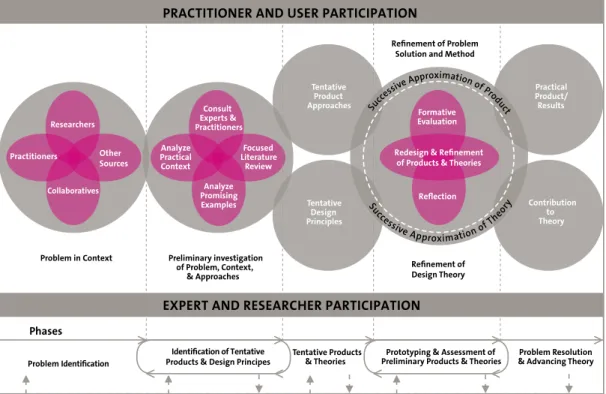
The features and characteristics of design research are nicely captured by Wademan (2005) in what he calls the Generic Design Research Model (Figure 4). His model clearly illustrates that the ‘successive approximation of practical products’ (referred to as ‘interventions’) is working hand-in-hand with the ‘successive approximation of theory’ (which he also calls ‘design principles’).
Researchers Other Sources Collaboratives Practitioners Consult Experts & Practitioners Focused Literature Review Analyze Promising Examples Analyze Practical Context Tentative Product Approaches Tentative Design Principles Formative Evaluation Practical Product/ Results Contribution to Theory Refinement of Problem Solution and Method
Refinement of Design Theory Preliminary investigation of Problem, Context, & Approaches Problem in Context Phases
Prototyping & Assessment of Preliminary Products & Theories Identification of Tentative
Products & Design Principes Tentative Products& Theories Problem Resolution
Problem Identification & Advancing Theory
Redesign & Refinement of Products & Theories
Reflection
PRACTITIONER AND USER PARTICIPATION
EXPERT AND RESEARCHER PARTICIPATION
Su ccessive A
pproximation of Th eory
Succe
ssive Approximation of Pro
duct
Figure 4: Generic design research model (Wademan, 2005)
Cobb et al. (2003, p.9) express a similar line of thought by stating: “Prototypically, design experiments entail both “engineering” particular forms of learning and systematically studying those forms of learning within the context defined by the means of supporting them. This designed context is subject to test and revision, and the successive iterations that result play a role similar to that of systematic variation in experiment.”
It is important to note that design research follows a holistic approach, and does not emphasize isolated variables. Van den Akker et al. (2006, p. 5) point out that “While design researchers do focus on specific objects and processes (interventions) in specific contexts, they try to study those as integral and meaningful phenomena. This context bound nature of much design research also explains why it usually does not strive towards context-free generalizations”. If there is a need to make a generalization, then it is an analytical generalization - in contrast to statistical generalization where the researcher strives for generalizing from sample to population. This will be further elaborated on in the section ‘Generalizability in Design Research’.
EDUCATIONAL DESIGN RESEARCH - PART A: AN INTRODUCTION
22
Differentiation in design research
The possible variations in goals of design research have already been discussed and we have differentiated between development studies versus validation studies (see also van den Akker et al., 2006; Chapter 10). However, a further differentiation of design research is conceivable. For example, one can imagine that the implementation and/or dissemination of a particular program is supported by design research – the resulting intervention is the successfully disseminated and implemented program, whilst the systematic reflection and documentation of the process leads to a set of procedures and conditions for successful dissemination and implementation (the design principles).
In this sub-section, first a closer look at the twofold yield of design research, namely, research-based interventions and theoretical yield is given. After that, the differentiation of design research in development studies and validation studies is elaborated.
Twofold yield of design research
Design research is research and therefore an appropriate yield for design research - apart from an usable and effective intervention - is contributing to the body of knowledge in the field. In other words, the challenge for design research is to capture and make explicit the implicit decisions associated with a design process, and to transform them into guidelines for addressing educational problems (see Edelson, 2006; also Barab & Squire, 2004; and many other authors). This aspect refers to theory orientation, mentioned above as one of the characteristics of design research. Van den Akker (1999; also chapter 2 in this book), Reeves (2006; see Figure 2 above) and Wademan (2005; see Figure 4 above) use the concept of ‘design principles’ when they refer to the theoretical yields of design research, where others speak of new theories (e.g. Cobb et al., 2004; Barab & Squire, 2003; Edelson, 2006; Gravemeijer & Cobb in chapter 3 of this book). This variation is schematically captured in the overview in Table 1.
Table 1: The twofold yield of design research
Type of study: Research goal: Twofold yield:
Development studies Development of
intervention:
(i) developing a research based intervention as
solution to complex problem, and
(ii) constructing (re-usable) design principles
Validation studies Theory development
and/or validation:
(i) designing learning environments with the
purpose
(ii) to develop and validate theories about learning, learning environments, or to validate design principles
Implementation studies
Implementation or up-scaling:
(i) implementing a particular program and (ii)
strategy and conditions under which implementation can happen (design principles).
On development studies
As stated, the starting point for the development studies type of design research is the identification of educational problems for which no or only a few validated principles (‘how to do’ guidelines or heuristics) are available to structure and support the design and
development activities7.
Many examples of the need for innovative interventions can be given at system level and institutional level. At system level, for example, one may want to develop a system for e-learning to serve a specific target group of students in higher education, or at the level of school or classroom, one may want, for example, to address the question of identifying effective methods for collaborative learning.
A characteristic of development studies is that - informed by prior research and review of relevant literature - researchers in collaboration with practitioners design and develop workable and effective interventions by carefully studying successive versions (or prototypes) of interventions in their target contexts, and in so doing, they reflect on their research process with the purpose of producing as a yield, design principles for developing innovative interventions that are relevant for educational practice (see also Figure 4).
EDUCATIONAL DESIGN RESEARCH - PART A: AN INTRODUCTION
24
Two main types of design principles can be distinguished (van den Akker, 1999): 1. procedural design principles: characteristics of the design approach
2. substantive design principles: characteristics of the design (= intervention) itself. Design principles are heuristic statements in the meaning of experience-based
suggestions for addressing problems (such as the ones in design research). Heuristics are always developed in a certain context and provide therefore no guarantee for success in other contexts. However, they will be increasingly powerful when validated in various contexts (see also below, the section on Generalizability in design research).
Van den Akker (1999, p.9) developed the following format for design principles:
“If you want to design <intervention X> for the <purpose/function Y> in <context Z>, then you are best advised to give <that intervention> the <characteristics A, B, and C>
[substantive emphasis], and to do that via <procedures K, L, and M> [procedural emphasis], because of <arguments P, Q, and R>.”
These heuristic principles are meant to support designers in their tasks, but cannot guarantee success. They are intended to assist (in other projects) in selecting and applying the most appropriate (procedural and substantive) knowledge for specific design and development tasks. Procedural knowledge refers to the set of design activities that are considered most promising in developing an effective and workable intervention. In comparison, substantive knowledge is knowledge about essential characteristics of an intervention and can be extracted (partly) from a resulting intervention itself.
As knowledge is incorporated in interventions, it is profitable for design researchers in the preliminary phase of their research, to search for existing interventions that (although developed in another context) could be considered useful examples or sources of inspiration for the problem at hand. Careful analysis of such examples, in combination with reviewing relevant literature, will generate ideas for the new design task. The value of knowledge resulting from a design research project will strongly increase when it is justified by theoretical arguments, well-articulated in providing directions, and convincingly backed-up with empirical evidence about the impact of those principles. It is for this reason that authors (e.g. van den Akker 1999; van den Akker et al. 2006; Reeves, 2000, 2006) state that the final stage of each (development study type of) design research project should consist of systematic reflection and documentation to produce design principles.
On validation studies
Validation studies, on the other hand, have a focus on designing for example, learning environments or trajectories with the purpose of developing and validating theories about
the process of learning and how learning environments can be designed. Gravemeijer and Cobb (in chapter 3 of this book) caution usage of the word ‘validation’ as it may be
interpreted as ‘checking’ and ‘confirming’. These “do not fit the exploratory character of our approach [of design research] that aims at creating innovative learning ecologies in order to develop local instruction theories on the one hand, and to study the forms of learning that those learning ecologies are intended to support on the other” (o.c., p.75). In this section, validation studies is used in this broad sense of design research from the learning design perspective (see Gravemeijer & Cobb, chapter 3 in this book), or – more generally and quoting Cobb et al. (2003, p.10) – as design experiments “to develop a class of theories about both the process of learning and the means that are designed to support that learning, be it the learning of individual students, of a classroom community, of a professional teaching community, or of a school or school district viewed as an organization”.
With reference to Cobb et al. (2003), validation studies (in their wording ‘design experiments’) in the learning sciences are conducted to develop theories on domain-specific learning processes. In this context, they state that “ideally, design experiments result in a greater understanding of a learning ecology – a complex, interacting system involving multiple elements of different types and levels – by designing its elements and by anticipating how these elements function together to support learning” (p.9).
Gravemeijer and Cobb (in chapter 3 of this book) build on the approach of Cobb et al. (2003) by stating that validation studies aim at the development of domain-specific instruction theories (in their case in the domain of mathematics education) at various levels:
- at the level of the instructional activities (micro theories)
- at the level of the instructional sequence (local instruction theories) - at the level of the domain-specific instruction theory.
In validation studies, researchers do not work in controlled (laboratory or simulated) settings, but choose the natural setting of classrooms as ‘test beds’ (although they tend to work with above-average numbers of teaching staff). The phases Gravemeijer and Cobb (chapter 3) distinguish in validation studies are:
- preparing for the experiment: drafting a preliminary instructional design and explicating an interpretative framework
- design experiment: trying, elaborating and improving the instructional design or local instructional theory and developing an understanding of how it works
EDUCATIONAL DESIGN RESEARCH - PART A: AN INTRODUCTION
26
- retrospective analysis: studying the entire data set to contribute to the development of a local instructional theory and more encompassing theories.
As indicated, these phases are similar to the phases that are identified in development studies.
DiSessa and Cobb (2004, p. 83) warn that “design research will not be particularly progressive in the long run if the motivation for conducting experiments is restricted to that of producing domain specific instructional theories”. The practical contribution of design research lies in developing empirically-grounded prototypical learning trajectories that may be adopted and adapted by others.
Design research often a combination of development and
validation study
It is important to note that the distinction between development and validation studies is conceptually important; however, in practice design researchers may combine the two orientations in their research. For example, starting from a complex and persistent problem for example in mathematics education, the research group may decide to apply the design principles (local theories) resulting from other studies in their research. In doing so, they are not only developing an intervention, but at the same time investigating the validity of design principles (theory) developed in another context for their own problem context.
A nice example of this is the research by Fauzan (2002; see also Fauzan, Plomp,&
Gravemeijer, 2013; Part B - chapter 8), whose research can be categorized as a development study type of design research as it aimed at developing a high quality geometry course based on the principles of realistic mathematics education (a constructivist approach to the teaching and learning of mathematics). However, as his research also aimed at validating whether the constructivist approach of realistic mathematics education could be successfully applied in the context of Indonesian mathematics education, this research was a validation study type of design research as well.
The remaining of this chapter discusses a number of aspects important in conducting design research without explicitly referring to the differentiation in design research as discussed in this section. Where Gravemeijer and Cobb discuss design research from the learning perspective (see chapter 3), i.e. aimed at developing and validating local
instruction theories by applying design experiments, the remaining of this chapter takes the broad perspective of design research aimed at both developing innovative
A closer look at design research
In this section, a closer look is taken at design research by discussing three specific aspects, namely, the overall research question in design research, a set of quality criteria for interventions developed in design research, and a simplified research model for design research.
The overall research question in design research
By now it is clear that designing and developing an intervention is in itself not yet design research. But one may conduct a design/development project as a research project by rigorously employing social science research methodology.
If the research goal is the development of an innovative intervention, then the researcher is striving to find design principles (or an intervention theory) that are valid in a certain context, and the overall research question can be phrased as:
What are the characteristics of an <intervention X> for the purpose/outcome Y in context Z?
Examples of research questions are:
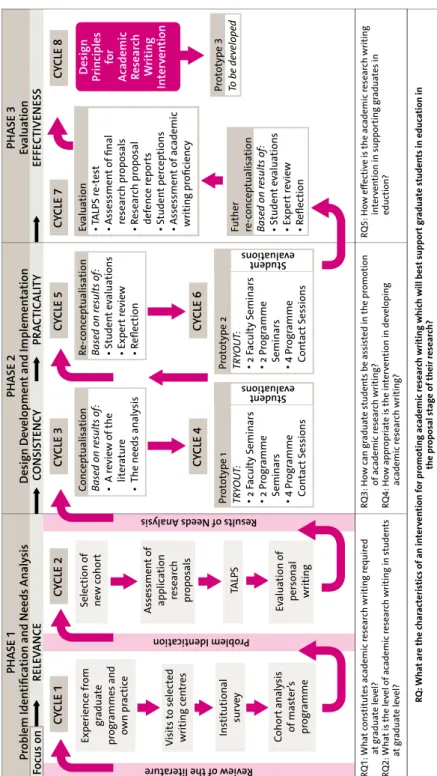
(i) What are the characteristics of an intervention for promoting academic research
writing which will best support graduates in education in the proposal stage of their research? (Dowse & Howie, 2013; Part B – chapter 40), and
(ii) What are the characteristics of micro-scale chemistry curriculum materials so that
they contribute to the implementation of effective practical work in chemistry teaching in Tanzania schools? (Mafumiko, Voogt, & van den Akker, 2013; Part B – Chapter 28).
Of course, not all researchers use this type of phrasing, but the wording of the main research question in design research always implies a search for characteristics.
If design research aims to develop theory or seeks validation, the main research question also has to express this search for characteristics.
An example is:
What is an adequate learning and teaching strategy for genetics in upper secondary biology education in order to cope with the main difficulties in learning and teaching genetics, and to promote the acquisition of a meaningful and coherent understanding of hereditary phenomena? (Knippels, 2002).
One comment has to made about the need for the phrasing of the research question. Gravemeijer and Cobb (in chapter 3 of this book) argue that the goal of their approach to
EDUCATIONAL DESIGN RESEARCH - PART A: AN INTRODUCTION
28
design research cannot be captured in a one-sentence research question of the type ‘How can we teach a certain topic effectively?’ as “such a one-sentence question would have to be complemented with a series of assumptions about what requirements the answer should meet, and would also have to be embedded in an exposition of what is aimed for with the innovation.” (o.c., p.75).
Indeed, the goals of design research can be phrased in terms of the outcome the researcher is aiming for. However, the example from Knippels (2002) illustrates that it is possible to phrase a research question that is sufficiently specific for design research that is aimed at theory development or validation.
Quality criteria for interventions
Design researchers aim at interventions of good quality. An obvious criterion for quality is the effectiveness of the intervention: are the intended outcomes attained? However, where effectiveness is the ultimate goal, some other criteria may assist the researchers to optimize the design and development trajectory.
Based on prior work, Nieveen (1999) proposes a number of generic criteria for high quality interventions, namely validity, practicality and effectiveness (see Table 2). She explains these criteria as follows (paraphrased by author):
The intervention should address a need, and its components should be based on state-of-the- art knowledge (content validity, also called relevance) and all components should be consistently linked to each other (construct validity, also called consistency). If the intervention meets these requirements, it is considered to be valid. A second characteristic of high-quality interventions is that teachers (or more general,
representatives of the target group of users) consider the intervention to be usable and that it is easy for them to use the intervention in a way that is largely compatible with the developers’ intentions. … If these conditions are met, we call these interventions practical. A third characteristic of high quality interventions is that they result in the desired outcomes, i.e. that the intervention is effective” (o.c., p.127).
In addition, Nieveen and Folmer (chapter 6) indicate the importance of the distinction between expected and actual practicality and effectiveness. Only when the target users have had practical experience with using the intervention, should one be able to get data on the actual practicality of the prototype. Similarly, only when target users have had the opportunity to use the intervention in the target setting, should the evaluator get data on the actual effectiveness. In all other instances, such as expert appraisals or a group
discussions based on the materials, the researcher should only get data on the expected practicality and/or expected effectiveness (o.c., p.161). More evaluation will then be needed to demonstrate the actual practicality and the actual effectiveness.
These (amended) criteria are presented in Table 2 – and further details can be found in chapter 6 (by Nieveen & Folmer).
Table 2. Criteria for high quality interventions (adapted from Nieveen, 1999; see also chapter 6)
Criterion
Relevance (also referred to as
content validity) There is a need for the intervention and its design is based on state-of-the-art (scientific) knowledge.
Consistency(also referred to as
construct validity) The intervention is ‘logically’ designed.
Practicality Expected
The intervention is expected to be usable in the settings for which it has been designed and developed.
Actual
The intervention is usable in the settings for which it has been designed and developed.
Effectiveness Expected
Using the intervention is expected to result in desired outcomes.
Actual
Using the intervention results in desired outcomes.
Given the character of design research, these four criteria suggest a logical hierarchy as can be illustrated by ‘rhetoric’ questions like:
·
if an intervention is not practical, why would it make sense to investigate itseffectiveness?
·
if an intervention is not well designed (i.e. not consistent), why would it make sense toinvestigate its practicality?
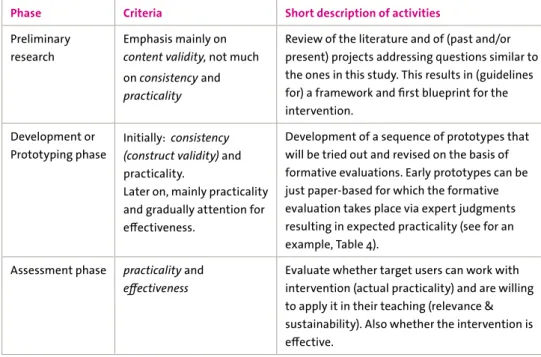
This logical hierarchy implies that the criteria may have different emphases in different phases of the research as is illustrated by Table 3.
For example, during the preliminary research (with the emphasis on analyzing the problem and reviewing the literature), the criterion of relevance (content validity) is the most dominant, with some attention for consistency (construct validity) and practicality, whilst no (or very little) attention is given to effectiveness.
EDUCATIONAL DESIGN RESEARCH - PART A: AN INTRODUCTION
30
On the other hand, in the initial iterations of the development phase the formative evaluation of the prototypes should focus on consistency and practicality, whilst the criterion of effectiveness will only become increasingly important in later iterations. Finally, in the assessment phase of summative evaluation, the focus will be on practicality and effectiveness.
This shift in emphasis on the quality criteria during the research is summarized in Table 3 (see also chapter 6, Table 1).
Table 3: Evaluation criteria related to phases in design research
Phase Criteria Short description of activities
Preliminary research
Emphasis mainly on
content validity, not much on consistencyand
practicality
Review of the literature and of (past and/or present) projects addressing questions similar to the ones in this study. This results in (guidelines for) a framework and first blueprint for the intervention.
Development or Prototyping phase
Initially: consistency
(construct validity) and practicality.
Later on, mainly practicality and gradually attention for effectiveness.
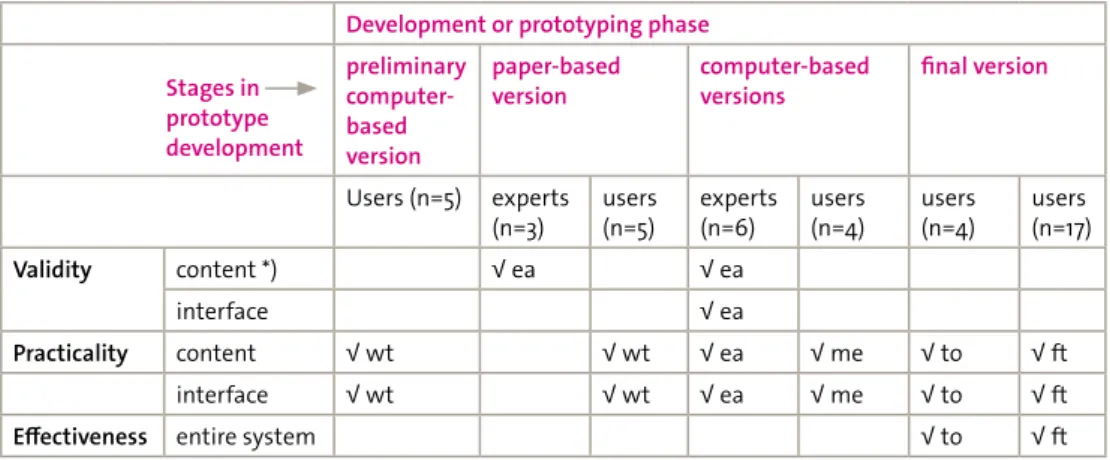
Development of a sequence of prototypes that will be tried out and revised on the basis of formative evaluations. Early prototypes can be just paper-based for which the formative evaluation takes place via expert judgments resulting in expected practicality (see for an example, Table 4).
Assessment phase practicality and
effectiveness
Evaluate whether target users can work with intervention (actual practicality) and are willing to apply it in their teaching (relevance & sustainability). Also whether the intervention is effective.
Simplified research model
It is not self-evident how in design research the design of interventions contribute to design principles or theory building. With reference to Wademan’s generic model (1995; see also Figure 4), Reeves’s exemplary schemes (2006) in Figure 2 and McKenney’s display (2001) in Figure 3, we know that the researcher (or the collective of researchers and practitioners) designs and develops (in an iterative way) the intervention with the aim that, after a number of cycles, the intended outcomes are realized, or a well-grounded ‘local’ theory is developed. Each iteration or cycle is a micro-cycle of research, i.e. a step in the process of doing research and will include systematic reflection on the theoretical aspects or design principles in relationship to the status of the intervention, ultimately resulting in design principles or theoretical statements.
In other words and with reference to the overall research question presented above, the researcher (or research group) will conclude the following about his intervention:
Given my context Z, if I do <intervention (theory based) X > then I expect <intended outcomes Y>.
This can be displayed schematically as:
Intervention X
Input Process Y1, YOutcomes2, ...., Yn
Context Z:
It is important to point out a few key aspects in this scheme. At first, the outcomes of the
intervention are indicated as Y1, Y2, …,Yn, because often an intervention is designed to realize
multiple outcomes, for example better achievement, improved student attitude, increased teacher satisfaction.
Another key aspect is that the intervention is presented as ‘input →process’. It is crucial that
design researchers (or the research group) realize that when designing an innovative process (for example, learning environment) one has to take into account also the inputs or
conditions necessary to make the process function (for example, availability of infrastructure, a change in organization of the teaching-learning processes, teacher development). Van den Akker (chapter 2) argues and illustrates that in curriculum design research all the inter-related components of a curriculum need to be taken into account when developing an innovative curriculum. In addition, he shows the importance of a careful implementation of the intended curriculum to ascertain that there will be a good match of the intended curriculum with the implemented curriculum (‘what and how it is taught’) and the attained curriculum (‘learning experiences and outcomes’).
EDUCATIONAL DESIGN RESEARCH - PART A: AN INTRODUCTION
32
The teacher development part (or more general, attention for the user) can be particularly a crucial factor in a successful implementation of an innovative intervention. With
reference to the display above, it is suggested that in the early stages of design research the focus is on designing the process with the active involvement of practitioners (i.e.
representatives of the future users) involved in or familiar with the vision and ideas underlying the intervention.
And only after it has been proven that it is possible to design an intervention resulting in the desired outcomes, the focus of the research may shift to inputs or conditions necessary for the interventions to function in the intended context. In other words, first a ‘proof of existence’ should be given, before the focus of the design research shifts to dissemination and implementation, i.e. to preparing and training the intended users of the innovative intervention and assuring that other conditions be fullfilled.
So in the end, the research group has at its disposal not only the intervention resulting in the desired outcomes, but also (based on a systematic reflection and analysis of the data collected during this cyclical process) an understanding of the ‘how and why’ of the functioning of the intervention in the particular context within which it was developed. The design researcher will summarize this understanding of the ‘how and why’ of the intervention in one or more ‘design principles’, using the terminology developed by van den Akker (1999), Nieveen et al. (2006) and Reeves (2000, 2006). As other authors, e.g. Barak and Squire (2004 ) and Edelson (2006), use ‘theory’ as the yield of design research, one may also speak of ‘intervention theory’ or ‘design theory’ (Wademan, 2005; Figure 4) or – in the case of validation studies – of local instruction theory (see e.g. Gravemeijer & Cobb in chapter 3 in this book).
Schematically this can be represented as:
Context Z: Intervention X
Input Process Y1, YOutcomes2, ...., Yn
design principles or intervention theory or design theory or local instruction theory
In design research, interventions are developed in a cyclical process of successive prototypes developed in a number of iterations (see Figure 1).
In the previous section, a set of criteria for good quality interventions has been presented. We argued that these criteria may need different emphases in different phases of the research (see Table 3, above).
A key idea is that when the prototype of the intervention in a certain iteration does not result in the desired outcomes for that iteration, the conclusion is that the intervention is not yet good enough – in other words, the asserted design principles (or intervention theory) for that iteration are not (yet) good enough or not yet emerging. This has to result in a re-design or refinement of the intervention, which goes hand-in-hand with the refinement of the intervention theory or design theory (as is illustrated in Figure 4, the Generic Design Research Model, Wademan, 1995).
After a number of iterations with shifting criteria (see Table 3 above), the researcher (or research group) may conclude that based on the analysis of the evaluation data, the ‘realized outcomes’ are close enough to the ‘intended outcomes’ after which he/she may conclude that the design principles appear to be effective. Or, in other words, the researcher (or research group) has developed design principles or a ‘local’ (intervention) theory for the context in which he/she works:
in context Z the intervention X (with certain characteristics) leads to outcomes Y1, Y2, …, Yn.
Two examples are given to illustrate this – rather abstract – phrasing of the yield of design research. The Design-Based Learning Research Collective (2003, p. 5) states that “the design of innovations enables us to create learning conditions that learning theory suggests are productive, but that are not commonly practiced or are not well understood”.
In other words included in the intervention is knowledge about how to create conditions for learning (the outcomes aimed for).
The second example is taken from science education. Lijnse (1995, p. 192) argues that design research (he calls it developmental research) is “a cyclic process of theoretical reflections, conceptual analysis, small-scale curriculum development, and classroom research of the interaction of teaching-learning processes. The final, empirically based description and justification of these interrelated processes and activities constitutes what we call a possible “didactical structure” for the topic under consideration.”
In other words, the local theory consists of a didactical structure for the teaching-learning processes for a certain topic.
EDUCATIONAL DESIGN RESEARCH - PART A: AN INTRODUCTION
34
Generalizability in design research
Design principles and local (instruction) theories will be additionally powerful if they have been validated in the successful design of more similar interventions in various contexts. Chances for such knowledge growth will increase when design research is conducted in the framework of research programs, because then projects can build upon one another.
Here the question to what extent design principles can be generalized from one context to others is touched on. It is in this context that Edelson (2006) states that design research should result in generalizable theory. Examples have already been mentioned earlier, such as the substantive and procedural design principles in development studies and theories about, for example, learning processes and learning environments in validation studies. In design research, just as in case studies and experimental studies, the findings cannot be generalized to a larger universe – there is no statistical generalization from sample to population as in the case of survey research. Yin (2003) points out that in case studies and experimental studies, the investigator strives to generalize a particular set of findings or results to a broader theory. This is also the case in design research where the researcher should strive to generalize ‘design principles’ to some broader theory or widen the domain of validity of the local instruction theory.
Yin (2003) indicates that this generalization is not automatic. Paraphrasing Yin (2003, p.37), design principles and local (instruction theories) must be tested through replications of the findings in a second, third or more cases in various contexts with the purpose of ensuring that the same results should occur. Once such replications have been made, the results might be accepted for a much larger number of similar contexts, even though further
replications have not been performed. This replication logic is identical to that underlying
the use of experiments and allows experimental scientists to generalize from one
experiment to another. Yin (2003) calls this analytical generalizability.
But a warning should be given here. Where design principles may have been supported by a number of replications, and a new context may be similar to the ones from which design principles have emerged, each context has unique characteristics that justify the use of design principles as ‘heuristic’ statements: these statements provide guidance and direction, but do not give ‘certainties’. The same applies for local theories. It is in this context that Reeves (2006) cites Lee Cronbach one of the most influential educational
researchers of the 20th century: “When we give proper weight to local conditions, any
Some aspects of conducting design research
This section discusses some aspects of conducting design research focusing mainly at a conceptual level. Please refer to Nieveen and Folmer (chapter 6) for a more in-depth and elaborate discussion.
Design research is conducted iteratively in collaboration with researchers and
practitioners in a real-world setting. The two principle outputs (design principles or local theories, and empirically underpinned innovative interventions) can be realized if the research comprises the relevant phases of preliminary research, development or
prototyping phase and assessment phase. Doing research in such a setting is challenging and demands a careful research design. It is therefore important to reflect not only on the cyclical, iterative character of the systematic design of the intervention, but also – because it is research – to follow the guiding principles for scientific research as stated by
Shavelson and Towne (2002 – see above).
It is beyond the scope of this chapter to discuss how to conduct the research in these phases in detail – this is the focus of chapter 6 by Nieveen and Folmer; but an exception is made for two conceptually important topics, namely, formative evaluation as the key research activity in design research, and how cycles (or iterations) in design research can become micro-cycles of research.
Formative evaluation in design research
Formative evaluation, that is evaluation aimed at improvement, takes place in all phases and iterative cycles of design research. As illustrated in Table 3 (above), formative
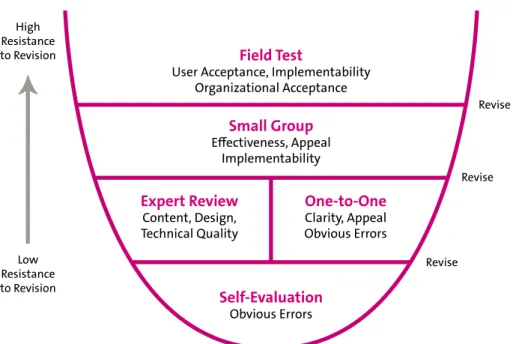
evaluation serves different functions, or – in other words – is aimed at different quality criteria (or combinations of these) in the various development cycles, each being a micro-cycle of research with its specific research/evaluation question and related research/ evaluation design. One may say that formative evaluation has various layers in a design research project which is illustrated in Figure 5, taken from Tessmer (1993): from more informal in the early stages of a project (self-evaluation, one-to-one evaluation, expert review) to small group evaluation aimed at testing the practicality and effectiveness, to a full field test (if possible). The research/evaluation design for each cycle should reflect the specific focus and character of the cycle – see next sub-section for examples and chapter 6 by Nieveen and Folmer for more details.
EDUCATIONAL DESIGN RESEARCH - PART A: AN INTRODUCTION
36
High Resistance to Revision Low Resistance to Revision Revise Revise ReviseField Test
User Acceptance, Implementability Organizational Acceptance
Small Group
Effectiveness, Appeal ImplementabilityExpert Review
Content, Design, Technical QualityOne-to-One
Clarity, Appeal Obvious ErrorsSelf-Evaluation
Obvious ErrorsFigure 5: Layers of formative evaluation (taken from Tessmer, 1993)
Figure 5 also illustrates that many possible methods of formative evaluation can be
chosen, such as8
·
expert review and/or focus groups (important to consider ‘experts in what’)·
self-evaluation or screening (using check list of important characteristics or designspecifications)
·
one-to-one evaluation or walk through (with a representative of target audience)·
small group or micro evaluation·
field test or try-out.Of course, dependent on their specific research goals, design researchers should choose formative evaluation designs and approaches that are suitable for the purpose of that particular stage of the research for each phase and for each prototype of their intervention – as is illustrated in the first example in the next sub-section.
Design stages as micro-cycles of research
As stated, design research has to meet criteria for good research. It is therefore important that for each cycle in the development phase the researcher (or research group) applies the methodological ‘rules’ for doing research. This means each cycle should begin with one or a few research/evaluation questions reflecting the quality criteria that will be emphasized in that cycle, which then leads into the design and development of an appropriate
research/evaluation design. Given the layers of formative evaluation in design research (see above, Figure 5), the evaluation design can be less rigorous in the early cycles of development with more emphasis being placed in later phases or cycles.
Nieveen and Folmer (chapter 6) present a so-called ‘evaluation matchboard’ as a tool for design researchers for designing and planning their formative evaluations. They discuss how this tool can be used to support design researchers in each of the research cycles beginning with the relevant quality criteria (see Table 2), in proper phrasing of the
research/evaluation questions, in identifying relevant respondents, in determining proper data collection methods, and so on.
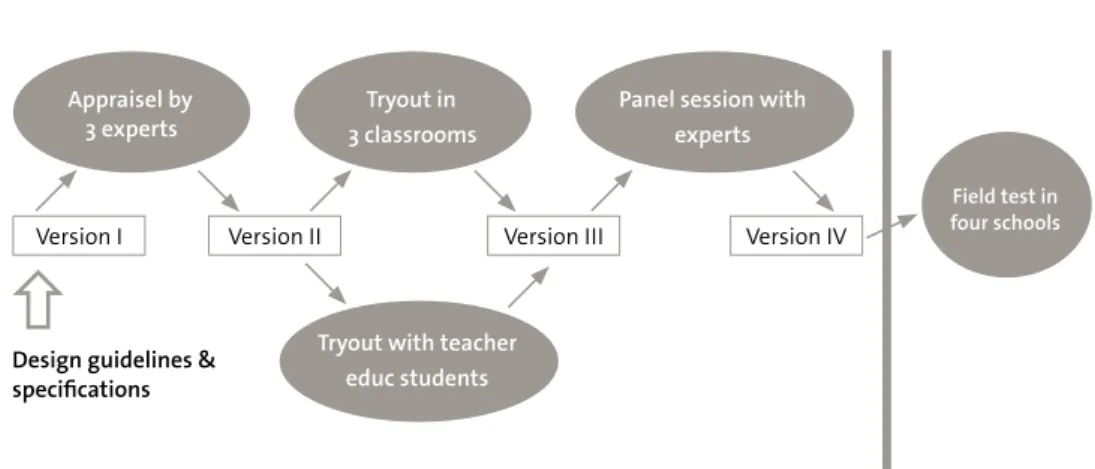
In this section just three examples of how cycles in design research have been realized are presented to illustrate various aspects of designing and structuring design research studies.
NOTE: the examples do not give prescriptions; they just illustrate aspects of the research designs that the researchers drew up to address their specific research questions.