This is the author version published as:
This is the author version published as:
Chandra, Vinesh and Chalmers, Christina (2010) Blogs, wikis and podcasts : collaborative knowledge building tools in a Design and Technology course. Journal of Learning Design, 3(2). pp. 35-49.
Blogs, wikis and podcasts – Collaborative knowledge
building tools in a Design and Technology course
Vinesh Chandra Faculty of Education
Queensland University of Technology, AUSTRALIA [email protected]
Christina Chalmers Faculty of Education
Queensland University of Technology, AUSTRALIA [email protected]
Abstract
Design and Technology has become an important part of the school curriculum. In Queensland, Australia, Technology (which encompasses Design) is one of the Key Learning Areas (KLAs) for students in the first ten years of schooling. This KLA adopts a student-centred, hands-on constructivist approach to teaching and learning. The ability to conceptualise and implement appropriate learning experiences, however, has been a challenge for some early career teachers. This paper describes how Design and Technology is being taught to pre-service primary teachers at an Australian University through their involvement in a range of authentic problem-solving activities supported by social learning tools such as wikis and blogs. An interview with a sample from this group (N=5) provides an insight into how these social software tools enhanced their knowledge and learning. This paper will describe how these social learning tools impact on the agency of learning.
Keywords
wikis, blogs, podcasts, design and technology, community of practice
Introduction
The Internet is rapidly becoming an agent which is changing how humans learn. The first generation of web design or Web 1.0 was built around web pages created by web-developers. The second generation of web design or Web 2.0 enables users to share knowledge through online communities. Ordinary people can actively participate as producers and consumers of information in an online environment. The ease of: (1) uploading and viewing podcasts (multimedia files) and (2) writing, editing, and uploading wikis (web pages) and blogs (online
journals) on the wide world web has created new possibilities for everyone including educators.
In higher education, while the use of Web 2.0 tools is still in its infancy, a report prepared for the Joint Information Systems Committee (JISC) on the impact of these tools in the U.K suggested that:
Web 2.0 will have profound implications for learners and teachers in formal, informal, work-based and life-long education. Web 2.0 will affect how universities go about the business of education, from learning, teaching and assessment, through contact with school communities, widening participation, interfacing with industry, and maintaining contact with alumni.
(Franklin & van Harmelen, 2007, p. 27)
The recommendations of the JISC report suggested further research into how student created content could be saved in repositories and accessed using Wed 2.0 technologies. This study gives an example of how these recommendations were explored further. It presents an example of how ideas on curriculum design were shared and critiqued using blogs, wikis and podcasts in a pre-service teacher unit at a large Australian university. The research questions were:
a) What evidence of learning is presented in blogs, wikis and podcasts? b) How did these social learning tools impact on the students?
Design and technology in schools
Design and technology has played a significant part in the ―evolution‖ of the human race. The ability of humans to conceive ideas and transform them into reality has been an important part of the evolution process. The economic prosperity of many nations depends upon its citizens to innovate and deliver products to fulfil human needs and wants. Yet within the schooling system in Australia, design and technology has not been a priority area until recently. In primary schools, technology was embedded in the Science curriculum, while, in high schools, it was taught as an optional specialist subject such as woodwork, metalwork and home economics. It appears that technology education has ―struggled to establish itself as an equal partner in general education and often struggled to gain recognition for the value of its instruction‖ (De Miranda, 2004, p. 61). There is also a belief amongst some researchers that teachers are not adequately prepared to implement the design and technology course in the real world (see, for example, Stein, Ginns & McRobbie, 2003).
In the U.S. and the U.K., Design and Technology has been a part of the school curriculum for some time. However, it is believed that the content covered by K-12 technology, innovation, design, and engineering (TIDE) educators in the U.S. did not encourage creativity (Starkweather, 2005). According to Starkweather, ―the mentality of educational systems in the majority of countries overlooks the attributes of a TIDE education, does not include the big picture of innovation, is
short-sighted, or does not exist at all‖ (p. 29). Starkweather (2005) also believed that the importance of TIDE subjects to demonstrate innovation and invention outcomes had diminished because teachers have not ―always been taught to explore the virtues of innovation as part of the curriculum‖ (p. 29). There are fewer examples of good teaching in design and technology than in other subjects (HMI, 2004; Stein, Ginns & McRobbie, 2003).
The existing research suggests that in order to build strong foundations for future teachers of design and technology, pre-service programs should create
opportunities for pre-service teachers to be innovative and creative. It should also encourage them to think outside the square so that once they are in their future classrooms; they are well equipped to replicate similar learning environments. More importantly pre-service teachers should be given opportunities to work collaboratively and share ideas to implement units of work that promote these attributes. This study shows how these characteristics are achieved in a pre-service program.
This study
In Queensland (one of the six states in Australia), the curriculum in the first ten years of schooling is divided into eight Key Learning Areas (KLAs). Technology (which encompasses design) is one of the KLAs. Curriculum planning is guided by the Essential Learnings which is driven by essential processes of Ways of Working and Knowledge and Understanding (Queensland Studies Authority, 2007).
Essential Learnings and the Queensland Technology Syllabus (Queensland Studies Authority, 2003) were the guiding documents of the pre-service teacher training unit. Lectures, workshops, and assessment tasks were geared towards giving the pre-service teachers an understanding of design and technology concepts and the skills needed to unpack and implement the requirements of the course in their future classrooms. One of the key aspects of the unit was to enable the pre-service teachers to have a thorough understanding of the four phases of
Ways of working. This was achieved through a hands-on constructivist approach where the pre-service teachers developed their products and artefacts. All three assessment tasks (Portfolio, Project and Online Quizzes) were designed to enable students to demonstrate their learning from different perspectives.
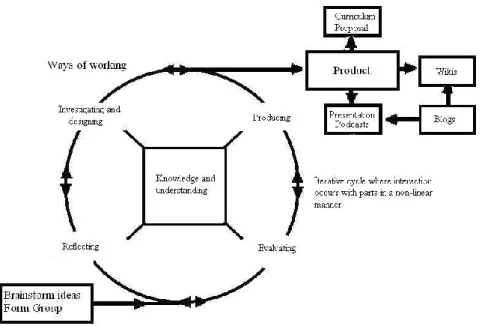
In the project assignment the pre-service teachers worked in groups and created their own products. The development of this product had to be viable as an activity in their future classrooms. The groups had four weeks to decide on an idea and then design and construct their product. During product construction the groups were engaged in Ways of working to demonstrate their Knowledge and Understanding. An iterative cycle formed the basis of product construction where interactions occurred in a non-linear manner between the four dimensions of Ways of working – investigating and designing, producing, evaluating and reflecting (Figure 1).
Figure 1. The layout of the project assignment
There were four key objectives of the assessment associated with this task: (1) backwards plan a curriculum proposal associated with their task; (2) do a class presentation demonstrating the product and highlighting the learning experience (this presentation was uploaded as a podcast); (3) upload a Wiki in which they had to reflect on six critical stages of product development together with at least three strengths and weakness of their projects from a classroom perspective, and (4) critique another group’s project as a blog.
Research Methodology
This section describes the context, research framework, participants, data collection and analysis.
The first part of the assignment was product development. It was guided by the principles of project-based learning. The pre-service teachers decided on which product they wanted to create and in doing so immersed themselves in a context which was relevant, challenging, motivating but most importantly promoted knowledge building and critical thinking (Howard, 2002). It was an open-ended authentic task without a prescribed method and as a consequence the learners not only generated their own questions, plans and solutions but they also had
ownership of their products. Such an approach has the potential to engage
students in a sustained and cooperative investigation (Bransford & Stein, 1993). It was well aligned with a constructivist approach where students are ―active agents in a learning process characterised by recurrent cycles of analysis and synthesis, action and reflection‖ (Mioduser & Betzer, 2007, p. 61). It paralleled the Ways of Working philosophy of the Design and Technology syllabus where the focus is on the cycle of investigate, design, produce, evaluate and reflect (see Figure 1). The uploading of wikis, podcasts and writing of blogs led to the creation of a repository of design and technology activity ideas. Students in the cohort had the option of accessing any of these files. These options mirror the characteristics of a community of practice (Wenger, 2001). According to Wenger, a community of practice should demonstrate three characteristics. First, the membership of should have a ―minimum level of knowledge of that domain—a shared competence that distinguishes members from other people‖ (p. 2). In this instance, the domain was overarched by project ideas of the students in design and technology course. Second, communities formed from domains through the engagement of the members in discussions, joint activities and knowledge sharing. To participate in this community, the members had to contribute their wikis, blogs and podcasts which were created using basic guidelines. These virtual tools also created
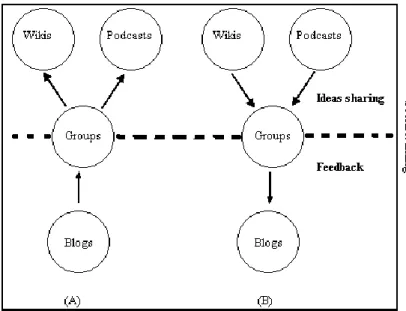
undocumented opportunities for both face to face and online interactions. Third, a community of practice is evident when there is evidence of ―a shared repertoire of resources‖ (p. 2) which documents their experiences, stories and ways in which problems were solved. In this study all the resources were uploaded for this purpose and were available to the community at all times, even after students completed their courses. Through this collaborative sharing of knowledge they have the potential to ―shape each other‖ while still maintaining their own. Engagement in this community was in two different ways (Figure 2): (a) the groups were sharing their ideas to the community through wikis and podcasts. Blogs (written by others in the community) on the other hand were giving them feedback and, (b) they were also analysing the contributions (wikis and podcasts) made by other groups and giving these groups feedback through blogs. Through these interactions, there was potential for the members of this community to learn and enhance their understanding of the projects they had undertaken.
Figure 2: Social learning with wikis, blogs and podcasts
These tools also create opportunities to shift the agency of learning from the individual learner to one that is shaped by their community (Kozulin, 2003). Such an approach is attributed to Vygotsky who believed that sociocultural forces (eg. teachers, parents, peers and the community) played a significant role in shaping learners. Blogs, wikis and podcasts can act as social ―mediation tools‖ in the learning process (Kozulin, 2003). Wikis and podcasts enable sharing of ideas while the blogs provide feedback.
Participants
The participants in this study (n = 200) were students in a Design and Technology unit at a large Australian University. The pre-service teachers complete this compulsory unit as part of their four year Bachelor of Education (primary) degree program. This unit ran for ten weeks.
The project assignment was done in groups. There were 52 groups in this cohort and each group comprised of 3-4 students. Students chose their groups on their own. Students in this course had access to a learning management system (LMS) which was the interface for uploading wikis, blogs and podcasts. Wikis were created by the groups over the four weeks. During this period only the groups and their instructor had access to the wiki pages. There was a release date (to the cohort) for the Wikis. This occurred after the assignments were handed in. Each group engaged in a class presentation where they focussed on their products and reflected on their experiences. These presentations were recorded digitally and uploaded as podcasts. Both podcasts and wikis were saved to a repository and made available to the entire cohort. Podcasts and wikis were then used by groups to critique another group’s project. A blog page was created to enable students to post their comments.
The judgement sampling technique was used to identify the groups which had effectively fulfilled all aspects of the assessment were identified (Charles, 1998). The wiki and podcast of one of the groups were analysed for its digital content in terms of the extent to which they fulfilled the intended purpose i.e. created knowledge sharing opportunities. In order to minimize the risk of bias, Group X was selected randomly from the identified groups (Kalton, 1998). The wiki and podcast of this group was analysed for evidence of learning. Similarly, the blog written by another group critiquing Group X’s project was also analysed. The convenience sampling method was adopted to identify participants for interviews (Henry, 1998). Five pre-service teachers (PST1, PST2, PST3, PST4, PST5) volunteered to be involved in focus group interviews that were conducted to further elicit pre-service teachers’ attitudes and ideas about the use of the Web 2.0 tools, including the wikis, blogs, and podcasts within the Design and
Technology unit. Focus group interviews essentially involve a group discussion focussed around a topic or issue (Vaughn, Schumm, & Sinagub, 1996; Wilkinson, 2004). The focus group interviews and the wikis, blogs, and podcasts were the main data sources.
Data collection and analysis
Due to the availability of participants there were two focus group interviews. One interview was conducted that included three students (PST1, PST2, PST3) while two students (PST4, PST5) were involved in the second interview. The focus group interviews took approximately an hour and were recorded. The interviews for this study were guided by four prepared interview questions. Additional questions were asked where seen as necessary. The following questions guided the focus group interview:
Do you feel that uploading wikis, blogs and podcasts was a good idea in this unit? Why?
How did they impact on you?
How did wikis, blogs and videos help you with your learning?
Can you think of any reasons why these should not be used?
Data analysis was qualitative. The interviews were transcribed and collated and important issues were identified. We analysed the wiki, podcast and blog
associated with Group X were for evidence of learning. This is explained further in the results and discussion section.
Results and discussion
In this community of practice (see the research framework), wikis and podcasts enabled members to present their knowledge to the group. Blogs on the other hand enabled members to receive feedback from the community which in turn further refined their knowledge. Through this collaborative sharing of knowledge they had opportunities to ―shape each other‖ (Wenger, 1998, p. 17). There were two research questions in this study and each will be considered in this section:
Research Question 1: What evidence of learning is presented in blogs, wikis and podcasts?
Wikis
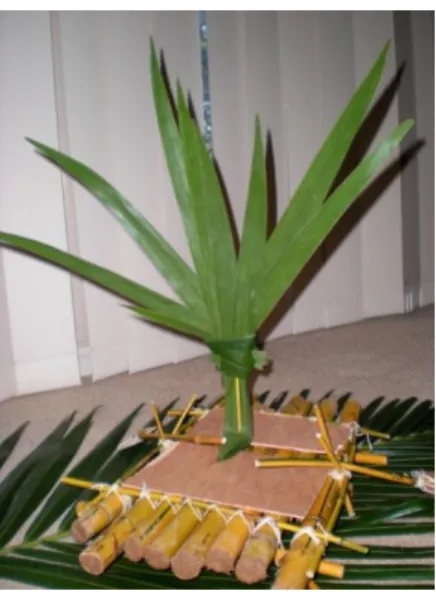
Wikis offer an online space for collaborative authorship and writing and allow for the capacity to create, edit and restructure online content (Choy & Ng, 2007). The wikis served as a summary of the group’s learning experience. It was meant to give anyone within the community a quick overview of the group’s project in terms of ―what was done‖, ―how it was done‖ and ―why it should be done‖. Groups were asked to identify six critical stages and highlight the strengths and weaknesses of their project for classroom use. For the purposes of this paper, one of the projects was chosen to show how these questions were addressed. In this example Group X built a model of a raft (Figure 3).
Figure 3. The finished ―raft‖
Group X outlined that they would use Bruce Treloar’s (1984) book Mr Bumble to set the scene for their technology activity. They addressed the ―what was done question‖ by outlining the task as follows:
As evident in the brief overview of the book, Mr Bumble is trapped on the island … Our group decided that Mr Bumble had to construct a raft to get off the island. A raft not only seemed like the most practical but also the most reliable in a real life situation. Bamboo is very strong …and float(s). Hence it was an excellent choice for the base and oars. The sail pole and paddle holders were also made of bamboo as it was relatively straight and strong for the purpose. String was used to tie the entire raft together as it is the strongest fastening material and most reliable…
The six critical stages identified by the group in product development were a critical analysis of their experience – they addressed the ―how it was done‖ question by focusing on the key stages. The pre-service teachers explained the
importance of each stage by supporting it with a digital image or video clip. In Stage Two, for instance, Group X highlighted the technicalities associated with constructing the base of the raft (Figure 4).
Firstly two bamboo pieces were tied together to make an X
Two more pieces of bamboo were cut and placed along two opposite sides and tied to the X to create a frame for the base
Then eight pieces of thicker bamboo were cut for the base of the raft and attached on top of this frame
Figure 4. Critical stage two of product construction
Here the group is sharing with the others in the community that an understanding of the procedures associated with the construction on the base would be critical. In this instance, the group is explaining the steps they followed to make the base. Making an ―X‖ out of two bamboo pieces and securing it on top of two parallel pieces of this material is crucial to the development of a steady frame. What is important is that the group came up with this idea themselves; through their own investigations and design ideas they constructed a product and then created a unit of work around the investigating and designing, producing, evaluating, and reflecting cycle (see Figure 1).
The ―why should it be done‖ question was answered by outlining not only the strengths of the project but also the weakness associated with it. Given that the group had worked on it for four weeks, each group had numerous opportunities to discover the strengths and weaknesses of their projects. Group X outlined the strengths of their project as follows:
It encourages teamwork and group communication skills, problem solving strategies and challenges to all group members.
It enables a range of different design ideas and levels of thinking to be incorporated in the design and construction of the model.
It is an activity that is derived from a text, links to students’ interests, provides a challenging task and most importantly enables students to show their
creativity through completion of the task.
Here, the group has identified the key attributes of project based learning – problem solving, range of design ideas, varying levels of challenges which draw on different levels of thinking (Howard, 2002). They have also identified qualities such as teamwork and collaborative learning as significant part of the activity – these are also important attributes of project based learning (Bransford & Stein, 1993). They also highlight interest which is a crucial factor in learning activities. They identified the weakness of their concept as follows:
Some of the materials needed might be difficult to obtain but this will depend upon the final design.
It is possible that this activity may need to be completed with additional support from another teacher or a teacher aid as extra supervision and help may be required.
Materials could be an issue especially bamboo stalks. In this instance additional supervision is warranted given that the bamboo pieces need to be cut and handling bamboo could be problematic. Substituting the materials could be an option –the bamboo could be replaced by PVC pipes but costs could become an issue.
Additional support would be vital in this project. Collectively these points paint a meaningful picture of the raft project to anyone in the community who may have an interest in pursuing this activity.
Podcasts
Group presentations were captured digitally and uploaded as podcasts on the LMS. The presentations give the community an additional opportunity to understand the ―what was done, how it was done and why it should be done.‖ It addresses some of the fine grained issues which cannot be captured through text or digital images on a wiki and enables group members to pinpoint crucial aspects of product development. On their podcast, members of Group X explained how the project would be implemented in their targeted classroom. They used their wiki to elaborate on the significance of each critical stage and how they solved problems and addressed challenges. For instance, they explained how they prevented the raft from sinking by filling all the holes with mud. In the podcast, they tested their raft by putting it in a trough of water. The raft floats and they do further tests by putting weights on the raft until it just starts to sink.
The wikis give an overview of the project while the podcasts present another perspective which cannot be captured by wiki. Both these tools have the potential to complement each other in the knowledge building and sharing process. It also gives a good understanding of this project for the pre-service teachers in this investigation.
Blogs
The blogs enabled the community to provide feedback. In this instance, one group had to provide feedback on another group’s project. In writing their blogs they had to provide constructive comments – they had to identify some of the strengths of the project and also provide ideas on ways to improve it. Group X was
critiqued by another group which listed the following points as strengths of their project:
The pretext (Bumble’s Island) used for this unit is engaging and would gain students attention.
The use of a pretext is an interesting way to begin the unit - it is stimulating and engages students in thinking.
The unit promotes the idea of intrinsic motivation through challenging students and creating a group challenge.
The appendices are great and well thought out with a clear structure and purpose.
The unit is easy to pick up and run with - it would be very easy to implement even if you had not had any exposure to it.
The task is definitely suitable for a Year 5 class. It could also be applied to many other year levels by simplifying the task or making it more complex. The critique appropriately recognised the strengths of this project, namely, that it is engaging, challenging, well thought-out and age-appropriate. Collectively, the project can promote intrinsic motivation. The blog notes the following points which Group X can focus on to enhance the quality of their project. They identified the following aspects:
The design challenge may be more effective if there were fewer restrictions placed on it.
Some aspects of the challenge can be confusing for the age group. If the design sheet is going to be given to the students it needs to be very clear.
Where are the resources coming from? Do the students bring their own? Research Question 2: How did these social learning tools impact on the students?
This investigation is based on an assumption that wikis, blogs and podcasts can potentially add value to student work. By using these collaborative tools and sharing experiences and ideas, students build their knowledge. But do they? The five pre-service teachers involved in the focus group interviews confirmed that they had used the tools for collaborative knowledge building.
Wikis were seen as a good tool for group work. It enabled group members in remote locations to work on their pages at a time and place of their choosing. Showing this, one pre-service teacher (PST 1) stated that:
Wikis definitely. I think that it’s a good way of having a group being able to contribute to a project without being in the same vicinity. You know you can upload certain pages, go in and edit them at certain times. You know it’s not concrete until a set date,… so yeah, I think there’s some definite advantages to having a wiki with assignments.
The blogs were used by groups of pre-service teachers to give constructive feedback about another group’s product. The pre-service teachers interviewed acknowledged the usefulness of this process. The following conversation took place when the pre-service teachers were asked to comment on the use of the group blogs in the unit:
PST2: Gives you the ability to critically examine something that’s not your own
and then evaluate it, which we will be doing for students…so we need to be able to this ourselves.
PST1 Basically it’s an electronic form of critiquing which we’ve done we
critique everything, you watch a movie you critique it you know, you critique your friends even.
PST2: You’re also learning those skills of critiquing in a positive manner too to
do it tactfully.
PST1: … constructively.
PST3 With constructive criticism and not just pulling apart.
PST1: Critiquing is not just “do this better”, “no, I don’t like that”. It’s finding
the good and suggesting improvements to make the not so good better you know it’s not putting the focus on the negative. That’s something we need to be learning as teachers as well - finding the positive in everything, you’re going to have some students that can’t produce the same sort of work as other students but you still need to find the positives for them.
One pre-service teacher (PST2) explained the usefulness of the podcasts as follows:
I think that the video [podcast] was good though too to show the product working, so that you could visually see the product working, so as well as their evaluation you’re looking at it and making evaluations of the product and how it works.
For another pre-service teacher (PST3) the access to the podcasts of Design and Technology activities was important:
I think the videos [podcasts] are good because I think we have access to now – more than 50 different learning activities to do with technology. … that’ll be beneficial down the track.
The findings from the interview data indicates that pre-service teachers confidence in using the Web 2.0 tools gives them more confidence in incorporating these technologies in their future teaching practice. This is important as it demonstrates their appreciation of the effectiveness and value of these tools in learning environments. It probably impacts on their attitudes as well. This is consistent with findings from a study conducted by Wozney, Venkatesh, and Abrami (2006) of 764 elementary and secondary teachers where it was found that the expectancy of success and perceived value were the most important issues in differentiating levels of computer use. That study’s participants were positive in their attitude toward the Web 2.0 tools and they expressed the importance of these tools to their future teaching. The pre-service teachers interviewed in this study found the wikis, blogs, and podcasts easy to use. They appreciated the access to the videos, the ease of group editing of the wiki, and the use of constructive criticism with the blogs.
The pre-service teachers interviewed commented on their increased knowledge and confidence using the Web 2.0 tools. One student (PST4) commented specifically on the wiki and the potential for the classroom.
I feel that my knowledge of what a wiki is, how it works, how to find files that are old versions of things and revert to old versions I think that’s really valuable. I would use that in the classroom if I could.
Another student (PST 2) also discussed the increased confidence with using the Web 2.0 tools in the classroom:
Before I came to uni, I couldn’t even put a CD in the computer and now I’m doing wikis and blogs and it’s extending me personally in my ICT skills, but apart from that the wikis and blogs helped… it’s just a new way of learning that’s extended me and I’ll be able to go out and use these technologies with confidence now.
Conclusion
This investigation has demonstrated one way in which ―universities [can] go about the business of education‖ using some of the Web 2.0 tools (Franklin & van Harmelen, 2007, p. 27). In this study wikis and podcasts were used to share ideas while blogs created an opportunity to give feedback. In doing so it created numerous opportunities for social learning. Such an approach also shifts the agency of learning from the individual learner to one that is shaped by their community (Kozulin, 2003). The feedback received through student interviews demonstrates these social learning tools can be used effectively in learning environments in higher education.
References
Bransford, J.D., & Stein, B.S. (1993). The ideal problem solver (2nd ed). New York: Freeman.
Charles, CM. 1998. Introduction to educational research (2nd Edition). White Plains, NY: Longmans Publishers.
Choy, O. S., & Ng, C. K. (2007). Implementing wiki software for supplementing online learning. Australasian Journal of Educational Technology, 23(2), 209-226.
De Miranda, M. A. (2004). The Grounding of a Discipline: Cognition and
Instruction in Technology Education. International Journal of Technology and Design Education, 14(1), 61-77.
Franklin, T., & van Harmelen, M. (2007). Web 2.0 for content for learning and teaching in higher education. London: JISC.
Henry, G.T. (1998). Practical sampling. In L.Bickman, & D.J.Rog (Eds.),
Handbook of applied social research methods (pp. 101-126). Thousand Oaks, CA: Sage
HMI. (2004). Ofsted Subject Reports 2002/03: Design and technology in primary schools. London: Routledge Falmer.
Howard, J. (2002). Technology-enhanced project-based learning in teacher education: Addressing the goals of transfer. Journal of Technology and Teacher Education,10(3), 343-364.
Kalton, G. (1983). Introduction to survey sampling. Newbury Park, CA: Sage Kozulin, A. (2003). Vygotsky's Educational Theory in Cultural Context:
Cambridge University Press.
Mioduser, D., & Betzer, N. (2007). The contribution of project-based learning to high-achievers' acquisition of technological knowledge and skills.
International Journal of Technology and Design Education, 18(1), 59-77. Queensland Studies Authority. (2003). Technology years 1 to 10 syllabus.
Brisbane: The State of Queensland (The Office of the Queensland Studies Authority).
Queensland Studies Authority. (2007). Queensland Curriculum, Assessment and Reporting Framework. (2007). Retrieved July 31, 2008, from
http://www.qsa.qld.edu.au/downloads/assessment/qcar_el_technology_yr9.pdf Starkweather, K. N. (2005). Innovation, TIDE teachers, and the global economy.
The Technology Teacher, 65(2), 28-30.
Stein, S. J., Ginns, I. S., & McRobbie, C. J. (2003). Grappling with teaching design and technology: A beginning teacher's experience. Research in Science & Technological Education, 21(2), 142-157.
Treloar, R. (1998). Bumble’s Island. London: Bodley Head
Vaughn, S., Schumm, J., & Sinagub, J. (1996). Focus group interviews in education and psychology. Thousand Oaks, CA: Sage.
Wenger, E. (1998). Communities of practice: Learning, meaning, identity.
Cambridge, England: Cambridge University Press
Wenger, E. (2001). Supporting communities of practice: A survey of community-oriented technologies. Retrieved October 10, 2008, from
http:/www.ewenger.com/tech
Wilkinson, S. (2004). Focus group research. In D. Silverman (Ed.), Qualitative research: theory, method and practice. (2nd ed., pp. 177-199). London: Sage. Wozney, L., Venkatesh, V., & Abrami, P. (2006). Implementing computer
technologies: Teachers' perceptions and practices. Journal of Technology and Teacher Education, 14(1), 173-207.
Wright, G. (2008, September 6-7). Planet Google. The Weekend Australian Magazine, 14 - 19.
Acknowledgments
The authors are grateful to the pre-service teachers who participated in this study.