SmartEdge: An End-to-End Encryption Framework for an
Edge-enabled Smart City Application
Mian Ahmad Jana,∗, Wenjing Zhangb,2,∗, Muhammad Usmanc,∗, Zhiyuan Tand,∗, Fazlullah Khana, Entao Luoe
aDepartment of Computer Science, Abdul Wali Khan University Mardan, Pakistan bSchool of Information Science and Technology, Hebei Agricultural University, China cDepartment of Computer Science and Software Engineering, Swinburne University of Technology,
Australia
dSchool of Computing, Edinburgh Napier University, United Kingdom
eSchool of Electronics and Information Engineering, Hunan University of Science and Engineering, China
Abstract
The Internet of Things (IoT) has the potential to transform communities around the globe into smart cities. The massive deployment of sensor-embedded devices in the smart cities generates voluminous amounts of data that need to be stored and pro-cessed in an efficient manner. Long-haul data transmission to the remote cloud data centers leads to higher delay and bandwidth consumption. In smart cities, the delay-sensitive applications have stringent requirements in term of response time. To re-duce latency and bandwidth consumption, edge computing plays a pivotal role. The resource-constrained smart devices at the network core need to offload computationally complex tasks to the edge devices located in their vicinity and have relatively higher resources. In this paper, we propose an end-to-end encryption framework, SmartEdge, for a smart city application by executing computationally complex tasks at the network edge and cloud data centers. Using a lightweight symmetric encryption technique, we establish a secure connection among the smart core devices for multimedia streaming towards the registered and verified edge devices. Upon receiving the data, the edge de-vices encrypts the multimedia streams, encodes them, and broadcast to the cloud data
∗Corresponding Authors
centers. Prior to the broadcasting, each edge device establishes a secured connection with a data center that relies on the combination of symmetric and asymmetric encryp-tion techniques. In SmartEdge, the execuencryp-tion of a lightweight encrypencryp-tion technique at the resource-constrained smart devices, and relatively complex encryption techniques at the network edge and cloud data centers reduce the resource utilization of the en-tire network. The proposed framework reduces the response time, security overhead, computational and communication costs, and has a lower end-to-end encryption delay for participating entities. Moreover, the proposed scheme is highly resilient against various adversarial attacks.
Keywords: Internet of Things, Smart City, End-to-End Encryption, Smart Devices, Network Edge, Cloud Data Centers.
1. Introduction
The Internet of Things (IoT) bridges the gap between the real-world ubiquitous de-vices and the virtual world of Internet [1]. This technological growth has the potential to transform communities around the globe into smart cities by creating a new era of urban life [2]. The vast deployment of heterogeneous sensors in smart cities generates huge volumes of real-time uninterrupted data streams [3]. These streams need to be ef-ficiently analyzed to provide seamless delivery of various services to the inhabitants of smart cities [4]. To extend their lifetime, the resource-constrained sensors, also known as smart devices, need to offload computationally complex operations to the cloud data centers [5].
The delay-sensitive smart cities’ applications have strict requirements in term of response time [6, 7]. These applications expect the responses to be received within the pre-defined deadlines. The conventional cloud computing is unable to meet such demands due to the presence of unreliable public networks between the smart devices and cloud data centers. The massive amount of data generated by smart devices su-persede the storage and bandwidth capabilities of the cloud data centers. Processing huge volumes of data at the cloud results in a much higher latency and response time for smart devices, which is unacceptable for delay-sensitive applications [8]. In these
applications, edge computing plays a crucial role by bridging the gap among the smart devices and cloud data centers [9, 10]. The resource-constrained nature of these de-vices means that computationally complex and resource-consuming operations need to be offloaded to the edge devices and cloud data centers. The migration of computa-tionally complex tasks ensures that applications experience lower latency and are able to provide high-quality services to the inhabitants of smart cities. The edge devices at the network edge are in proximity to smart devices and perform resource-intensive operations by prioritizing the processing of delay-sensitive services. Moreover, they offload the delay-tolerant services to the cloud data centers [11].
The massive deployment of smart devices and the presence of network edge in smart cities increases the reliability and scalability of services. However, as the number of connected devices increases, management of security credentials becomes a chal-lenging issue [12]. It becomes impractical for each device to connect to a cloud data center to update its security credentials. In an end-to-end smart cities’ application, all the participating entities need to be secured against various malicious threats. For example, the smart surveillance cameras ensure safety and security of inhabitants by reducing the overall criminal activities [3]. An adversary may eavesdrop on the im-ages, audio and video clips, captured by these cameras to infer trajectories of smart cities’ residents and inherently endanger their privacy. In smart cities, the network edge perform various tasks such as malware scanning and software updates, on behalf of resource-constrained smart devices. Unlike the smart devices, the network edge has abundant of resources and are often the target of various adversarial attacks [13]. A spyware-infected server in a cloud data center may steal security credentials that may allow an adversary to steal mission-critical data. The download of maliciously injected data from the cloud may further expose the residents to various vulnerabilities [14].
Although off-the-shelf encryption, authentication and anonymity algorithms might be applied directly to address these security and privacy challenges, the adversaries may still infiltrate a smart city environment. Most of these algorithms involve com-putationally complex cipher suites that require abundant of storage and computational power [15]. However, these smart devices are either battery-powered or rely on energy harvesting techniques [9]. To alleviate the escalation in resource congestion,
computa-tionally complex and resource-intensive operations need to be offloaded to the network edge [8]. Each edge device, enacting the role of a gateway, ensures an efficient utiliza-tion of the cloud data centers’ bandwidth.
To protect the communication among smart core devices, edge devices, and cloud data centers, we propose an end-to-end encryption framework, SmartEdge, for seam-less and reliable transmission of multimedia streams. The smart devices forward mul-timedia streams to edge devices for resource-intensive operations, i.e., encoding and encryption. The encoded and encrypted data are uploaded to the cloud for partial de-cryption that can be downloaded and fully decrypted by the end users, upon estab-lishing a secured session. In view of limited resources of smart devices, most of the resource-intensive operations are performed at the edge and cloud data centers. The major contributions of SmartEdge are as follow.
1. A lightweight authentication framework is proposed to secure the transmission of multimedia streams among the smart devices, located at the network core. This framework relies on symmetric encryption, i.e., advanced encryption stan-dard (AES) [16] with a key length of128bits, for establishing a secured session among the smart devices.
2. To verify the authenticity of edge devices, we propose a simple registration pro-cedure. Prior to data collection from smart devices, each edge device registers itself with a base station that maintains a database of legitimate smart devices in a smart city application.
3. A relatively complex authentication framework is proposed to allow the edge devices to exchange data with cloud data centers. Using high efficiency video coding (HEVC) [17], each edge device encodes the data, and uploads to the cloud upon encryption, that can be downloaded by the end users. This framework executes an AES-256bit at the network edge and an asymmetric algorithm, i.e., RSA2048-bit, at the cloud end.
The rest of this paper is organized as follows. In Section 2, related works from the literature are provided. In Section 3, we provide the network model of our proposed SmartEdge framework. In Section 4, we present a lightweight authentication approach
adopted by SmartEdge at the network core. In Section 5, the registration and verifi-cation of SmartEdge at the network edge is presented. In Section 6, a secured data transmission and storage approach adopted by SmartEdge is presented. In Section 7, we provide the experimental results of our framework. Finally, the paper is concluded in Section 8.
2. Related Work
The use of IPv6over Low-power Wireless Personal Area Networks (6LoWPAN) makes it possible to interconnect real-world physical devices with the Internet hosts, e.g. smartphones, laptops, desktops and computing clouds, to form the Internet of Things [18]. The Constrained Application Protocol (CoAP) is used as the de-facto application layer protocol for sensor-embedded smart devices of an IoT network [15]. These resource-constrained smart devices are connected to the cloud data centers to avail their computational and storage capabilities. To secure the exchange of data among the smart devices and data centers, CoAP mandates the use of Datagram Trans-port Layer Security (DTLS) protocol at the transTrans-port layer of each smart device [19]. However, the handshake and record layers of DTLS incur 25 bytes of overhead for each datagram header. The IEEE 802.15.4, on the other hand, specifies a physical layer Maximum Transmission Unit (MTU) of only 127 bytes. As a result, only60-75bytes are left for the payload after the addition of DTLS, Medium Access Control (MAC), and upper layers headers. The cloud data centers allow the smart devices to broadcast and store their measurements in a centralized location accessible by multiple hand-held devices. With an increase in urbanization, it is expected that a massive number of such devices will be connected to the Internet. The presence of these devices makes a city smarter by generating a huge amount of data that can be leveraged for various services such as, safety and privacy, infotainment, better health facilities, greener environment and better waste management [3, 20]. To realize these services, the voluminous data generated by smart devices need to be managed in an efficient manner at the edge of
the network. The resource-starving smart devices at the network core5need to offload the computational tasks to the network edge [8, 11, 9]. Once the data is processed at the edge, it is forwarded to the cloud for storage that can be used to provide better facilities to the residents of smart cities.
In literature, there exist various smart applications, such as CloudAware [21], Fem-toclouds [22], EdgeIoT [23], ParaDrop [24] and HomeCloud [25] that offload com-putationally complex tasks to nearby edge devices. CloudAware and FemtoClouds monitor the usage of edge devices for offloading resource-intensive operations by rely-ing on some specific application programmrely-ing interfaces (APIs) and schedulrely-ing algo-rithms. EdgeIoT configures the neighboring mobile base stations by deploying virtual machines (VMs) for migrating various tasks from smart devices to the network edge. ParaDrop configures the neighboring wireless access points to offload various tasks to the edge. HomeCloud relies on Software Defined Networking (SDN) for scheduling its Network Function Virtualization (NFV) capabilities.
The aforementioned solutions [21, 22, 23, 24, 25, 8, 11, 9] for offloading computa-tional tasks to the network edge focus mainly on scalar data. They lack the support for processing real-time multimedia streams such as video analysis. The existing works on video analytics support the offloading of streams directly to the cloud data centers that incur excessive burden on smart devices. Besides, most of the existing schemes for offloading computational tasks to the edge lack any support for security and privacy. The inclusion of edge computing in cloud-enabled IoT platforms raises new and un-foreseen challenges such as, the interaction among heterogeneous edge devices, their interoperability with smart devices and the migration of tasks across global and local scales in smart cities. These challenges enable an adversary to launch various threats on the network’s core, edge and cloud data centers. There exist very few studies in this context to combat such threats. In [26, 13, 14, 27], the authors conclude that data streams stored at the network edge are more vulnerable to threats in comparison to their storage at the cloud. To prevent such threats, differential privacy need to be used to protect users’ privacy at the edge.
3. Network Model
In a typical smart city, heterogeneous sensors, wired/wireless and cellular devices, edge devices, and cloud data centers are the essential components. The resource-constrained multimedia sensor nodes (MSNs) sense and collect the critical data streams pertaining to various applications. Using the IEEE802.15.4standard, the MSNs trans-mit these data streams to the nearby cluster heads. One or more authorized edge devices collect these streams from cluster heads using the IEEE802.11standard. Finally, the data is uploaded to the cloud data centers that enable various organizations to provide reliable and timely services to the inhabitants of a smart city.
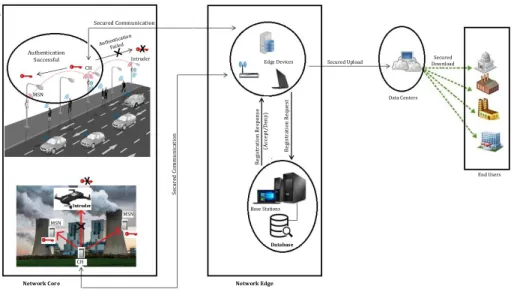
In our proposed SmartEdge framework, each participating device needs to be au-thorized for a seamless and reliable transmission of gathered data. In each application at the network core, the MSNs and their respective cluster head communicate with each other for mutual authentication. If the authentication is successful, a session key is shared with the MSN to enable it for secured transmission of its data to the clus-ter head. The mutual authentication at the network core prevents the intruders from accessing the session keys generated by the cluster heads. As a result, the intruders are no longer capable to inject their malicious data into the network. In our proposed framework, the base stations located at the network edge maintain a shared database of all the authorized cluster heads. Each base station is a conventional computing plat-form that has abundant of computational and storage resources. To communicate with the cluster heads, each edge device needs to be authorized by the base station. Each edge device broadcasts a registration request to a base station to retrieve the database of nominated cluster heads. If the registration request is authorized, the database of nom-inated cluster heads is provided to the edge device. In SmartEdge, only the authorized edge devices can communicate with the cluster heads for secured transmission of their data streams toward the cloud data centers. Each edge device establishes a secured connection with the data centers for the upload of data gathered from cluster heads. The end users at different enterprises and organizations can download the data using an asymmetric encryption approach. In Fig. 1, the network model of our proposed framework is shown.
Authentication Successful MSN CH Intruder Secured Communication CH MSN MSN Intruder
Network Core Network Edge
Se cu re d C om m u ni ca ti on Edge Devices R eg is tr at io n R eq ue st R eg is tr at io n R es po ns e (A cc ep t/ D en y) Base Stations Database Secured Upload Data Centers End Users Secured Download
Figure 1: Network Model of SmartEdge
In SmartEdge, we focus on the multimedia data collection. Unlike the conventional computing platforms, the MSNs and cluster heads are relatively low-energy nodes that are unable to execute computationally complex cryptographic algorithms. In view of their resource limitations, we propose an extremely lightweight symmetric encryption for establishing secured connections among them. The edge devices and cloud data centers, on the other hand, have ample resources and are capable to perform resource-intensive operations. As a result, we migrate computationally complex cryptographic tasks to these entities by using an asymmetric encryption approach.
4. SmartEdge: A Lightweight Authentication at the Network Core
At the network core, we use a lightweight mutual authentication approach to estab-lish a secured connection between each MSN and its respective cluster head of Fig. 1. The authentication is performed using four handshake messages. Each message corre-sponds to an authentication phase. These messages are encrypted using AES-128 bit. The four phases are as follow.
1. MSN Connection Request 2. Cluster Head Challenge
3. MSN Response and Challenge 4. Cluster Head Response
The MSN connection request is preceded by a provisioning phase, a prerequisite of-fline phase during which the MSNs share a128-bit secret key (λi) with their respective
cluster heads. For each application of a smart city, this prerequisite phase is initiated at the time of nodes deployment. Here, theλi is known only to the cluster head and the
MSN to whom it belongs. Each cluster head maintains a table of all theλifor a given
application. In this table, the unique identity (αi) of an MSN is associated with λi.
This association enables a cluster head to perform the identity verification. Upon suc-cessful verification, both the MSN and cluster head communicate with each other for the exchange of a session key. The session key allows an MSN to transmit the gathered data to its respective cluster head. It is assumed that the MSNs are tamper-safe to avoid the compromise of security primitives in accordance with the Internet Threat Model [28]. This model assumes thatλiare hardcoded at the time of node deployment. In case, if an attacker attempts to tamper with the hardware of an MSN, an alarm is raised to notify about any security breach. The provisioning phase prevents the intruders from registering their fabricatedλiinside the table of any cluster head.
During the connection request phase, each MSN broadcasts a join-request mes-sage (Jreq) to its respective cluster head. The payload of Jreq contains αi, where
i ∈ {1,2,3, ..., N}, and its header contains the identity of a potential cluster head (IDCHn), wheren N. Eachαi andIDCHn are16bits long. An intruder may eavesdrop onJreq and retrieveλi from it. However, it is unable to generate a
legiti-mate session key for the MSN as it was barred from communication with the cluster head during the provisioning phase.
Upon receivingJreq, each cluster head retrievesαiandIDCHnfrom it. IfIDCHn matches with the identity of a receiving cluster head andαi matches with an entry
within the cluster head’s table, a search for a matchingλi is made. If a match is
found, it means that theJreqwas received from a legitimate MSN and the cluster head
responds with an encrypted challenge (CHchallenge). This challenge is created by
λi. The resultant is encrypted withλiand transmitted toαias a256-bit challenge, as
shown in Eq. 1.
CHchallenge=AES{λi,(λi⊕µ|ηCH)}. (1)
Here,ηCH is a temporary random number that is used only once by a given
clus-ter head, and⊕is an extremely lightweight operation found as a component in various complex cipher suites because it does not leak any information about the original plain-text. The use ofηCH inCHchallengemakes the latter highly unpredictable.
During the third phase,αineeds to successfully decryptCHchallenge in order to
retrieveµandηCH. Only a legitimateαithat possesses the requiredλi can decrypt
CHchallenge. Upon decryption, αi will have access to µ, that is required for data
exchange with its respective cluster head. Upon successful decryption,αihas
authen-ticated itself. However, for data exchange, the cluster head also needs to authenticate itself. In response toCHchallenge,αi creates its own challenge (αchallenge) by
ap-pendingλiwith its own generated nonceηi and⊕withηCH. The resultant cipher is
encrypted withµto generate a256-bitαchallenge, as shown in Eq. 2.
αchallenge=AES{µ,(ηCH⊕λi|ηi)}. (2)
In our authentication approach, theηclientandηserverare generated using a
pseudo-random number (Ri). TheRiis appended to a timer (Ti) to make sure that the intruders
find it extremely difficult to replay their malicious messages. TheTiassures thatηclient
andηserverare non-reproducible, whereas, theRiassures thatηclientandηserverare
non-predictable. The non-predictable nature ofRi and the non-reproducible nature
ofTimake it extremely difficult for the intruders to replay maliciously injected data
streams.
During the final phase, a cluster head receivesαchallenge and deciphers it to
ob-serve the presence ofηCH. IfηCHis present, the cluster head retrievesηiand creates
a256-bit encrypted response of its own, using Eq. 3. This encrypted response is trans-mitted toαi and at this stage, the status ofαi at the given cluster head changes to Authenticated.
CHresponse=AES{λi,(ηi|µ)}. (3)
Upon reception ofCHresponse,αi verifies the presence ofηi inCHresponse. If
present, it means that the cluster head had authenticated itself as well, and its status at the MSN changes toAuthenticated. Upon successful verification, the mutual au-thentication process is completed, and the MSN is now permitted to forward its data to the cluster head. The detailed operational mechanism of our payload-based mutual authentication approach is highlighted in Algorithm 1.
Algorithm 1Authentication at the Network Core
1: Initialization:
• α←−[i, λi], wherei∈ {1,2,3, ..., N} • CH←−[n, λi], wherenN
• Input [λi=ηi=ηCH=2128]
2: αi→CHn: {Jreq, containingIDCHnandαi}
3: ifIDCHnandαimatchesthen
4: CHn→αi: {CHchallenge, containingµandηr}
5: else
6: DiscardJreq .MSN is unauthorized.
7: end if
8: ifλimatchesthen
9: αi→CHn: {αchallenge, containingηiandηCH}
10: else 11: DiscardCHchallenge. 12: end if 13: ifηrexiststhen 14: αiis authenticated 15: CHn→αi: {CHresponse, containingηi} 16: else
17: Discardαchallenge. .MSN is unauthentic.
18: end if
19: ifηiexiststhen
20: CHnis authenticated
21: αi→CHn: {Dαi→CH, data exchanges}
22: else
23: DiscardCHresponse. .Cluster Head is unauthentic
5. Smart Edge: Registration and Verification at the Network Edge
Upon successful authentication at the network core, each MSN transmits its gath-ered data streams towards its respective cluster head. For example in Fig. 1, the MSNs at the roadside of smart traffic monitoring application gather the happening events, i.e., data streams, and transmit to their cluster head. The devices at the network edge col-lect these streams and broadcast to the cloud data centers. Prior to the broadcast, the edge devices need to be registered with and verified by the base stations, co-located at the network edge. Once registered, an edge device attains access to the database of verified cluster heads and communicate with them for secured data transmission. The registration process is completed in four simple phases.
1. Registration Request 2. Encrypted Challenge 3. Encrypted Response 4. Registration Response
During the first phase, each edge device (βk) transmits a registration request
mes-sage (Rk) to the base station. Theβk generates a 256-bit session key (µk) and XOR
with a 256-bitηk. The 256-bit resultant is encrypted withkto generate a 256-bitRk,
as shown in Eq. 4.
Rk =AES{k,(ηk⊕µk)}. (4)
Here,kis a 256-bit identity of a requestingβk,ηk is a256-bit nonce, andµk is
a potential session key of256-bit, all generated byβk. In our scheme, there are only
three edge devices, i.e.,k ∈ {k1, k2, k3}, as we have a limited number of smart city applications. However, it can be extended up toKedge devices for a very large-scale multi-application smart city deployment. We have used AES-256 bit at the network edge because the edge devices and the base stations have ample resources and are capable to process computationally complex cipher suites. Similar to the network core, the AES used at the network edge relies on block cipher mode of operation to provide authenticity and confidentiality of messages.
OnceRk is received by the base station, it decrypts and extracts all the embedded
values, i.e.,k, ηk andµk. At this point, the base station uses the extracted values
to generate an encrypted challenge (BSchallenge). This challenge is composed of a
registration certificate (Ωk), a time-stamp (δk) and an authentication value (Ψk). To
generateΩk, the base station performs XOR operation onηk andµk, both received
fromβk. Next, an OR operation (||) is performed using the resultant (ηk ⊕µk) and
the identity ofβk, i.e.,k. Finally, the end product is operated by an AND (.) operator
usingηb1 to generate a256-bitΩkas shown in Eq. 5.
Ωk=ηb1.(k||(ηk⊕µk)). (5)
Here,ηb1is a 256-bit nonce generated by the base station. IfRkwas received from
a legitimate edge device, the latter will be able to decryptΩkusing its identityk. The base station generates two copies ofΩk, one copy is kept for the future communication and the second copy is used inBSchallenge.
Next, the base station generates a time-stamp (δk) usingkand a 256-bitηb2. Both
these primitives are operated by an OR operation to generate a 256-bitδkas shown in
Eq. 6. δkrepresents the total amount of time required byβk to collect the data from
one or more cluster heads.
δk = (k||ηb2). (6)
Finally, the base station generates an authentication value (Ψk) for theβk. TheΨk
is a 256-bit security primitive that is generated by applying XOR operation onk,ηkand
ηb2, as shown in Eq. 7. TheΨkenables theβkto generate a response forBSchallenge.
Ψk= (k||ηk ||ηb2). (7)
OnceΩk,δk andΨkare generated by the base station, they are transmitted toβk
as a challenge using Eq. 8. At this point, the base station uses the identity k ofβk to
encrypt the three security primitives. The encrypted security primitives are embedded in a single message, i.e.,BSchallenge, that has an accumulative size of768bits and is
transmitted toβk.
BSchallenge =AES{k,(Ωk, δk,Ψk)}. (8)
Upon reception ofBSchallenge,βk checks for the presence ofkandµkin it. Ask
andµkwere generated byβk, it means that the challenge was received from a legitimate
base station. For the verification ofβk and its registration with the base station, βk
needs to successfully decrypt the challenge using its identity (k) to extractΩk,δk, and Ψk. βk checks for the presence ofµk andkin the challenge. If these primitives are
present, it means that the challenge was received from a legitimate base station and the latter has access to the session key (µk) ofβk. Theβk storesΩk andδk, and usesΨk
to generate an encrypted response (βresponse) for the base station, as shown in Eq. 9.
In this equation, the resultant of 256-bit security primitives, i.e.,Ψk,ηk, andηb2, is
encrypted withµk. TheRk generated byβkin Eq. 5 enables the base station to have
access toµkthat can be used to decryptβresponse.
βresponse=AES{µk,(Ψk||(ηk⊕ηb2)}. (9)
Upon reception ofβresponse, the base station usesµk to decrypt it. The presence
ofΨkmeans that the response was received from a legitimateβk and the latter is
reg-istered by the base station. After the decryption ofβresponse, the base station performs
two operations, a) sharesΩkandδkof the verifiedβkwith all the cluster heads, and b)
forwards the database of cluster heads to the verifiedβk. At this stage, the base station
generates a registration response (Rresponse) forβk that contains the database having
the identities of all the legitimate cluster heads, as shown in Eq. 10.
Rresponse=AES{IDCHn}. (10)
Here, AES is used only to encrypt the identities (IDCHn) of legitimate cluster heads by appending them in theRresponsemessage. The AES neither compress nor
affect the size ofRresponse. In Algorithm 2, the registration and verification procedure
Algorithm 2Registration and Verification at the Network Edge
1: Initialization:
• β←−k, wherek∈ {1,2,3, ..., K}
• β←−[µk,ηk]
• BS←−[ηb1,ηb2, IDCHn]
.BS represents the base station
• Input [k= 2256, µ
k = 2256, ηk=ηb1 =ηb2=2
256]
2: βk→BS:{Rk, Registration Request}
3: BS→βk:{BSchallenge, Encrypted challenge of BS}
4: βk→BS:{βresponse, Encrypted response ofβk}
5: ifΨkexiststhen
6: βkis authentic .Edge device verified
7: BS →CHn:{Ωkandδk, share them withCHn} 8: BS →βk :{IDCHn, share database withβk}
9: else
10: βkis unauthentic 11: end if
6. SmartEdge: Secured Data Storage and Sharing
Upon data collection from the cluster heads, eachβkencrypts and encodes the
mul-timedia streams to generate HEVC-Encoded Video Streams (HEVS). For this purpose, a High Efficiency Video Coding (HEVC) standard is used at the network edge [17]. For encryption of HEVS,βk executes an AES-256bit algorithm, while at the cloud
data centers, RSA-2048bit algorithm is used for decryption. Using RSA, a pair of private key (kpri) and public key (kpub) is generated at the cloud data center. The latter
is transmitted toβkfor video encryption. The AES generates a 256-bit secret key (Sk)
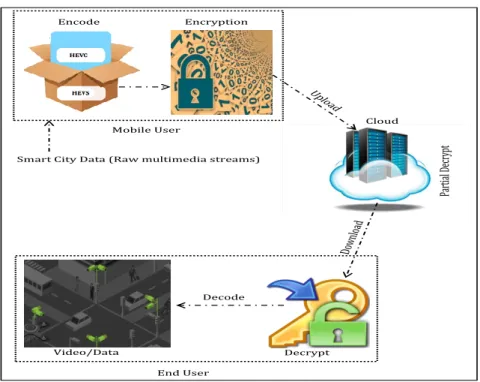
for data encryption. The secured data sharing and storage between the network edge and the cloud data center is accomplished in three steps, as shown in Fig. 2. In this section, we discuss these three steps.
1. Encoding and Encryption 2. Partial Decryption 3. Full Decryption
Encode Encryption Cloud Decrypt Decode Video/Data Mobile User End User
Smart City Data (Raw multimedia streams)
Part
ial D
ecry
pt
Figure 2: Secured Data Storage and Sharing
6.1. Encoding and Encryption
In this step, each βk receives the multimedia data streams (Dstream) from the
cluster heads and encrypts them using itsSk as shown in Eq. 11. The encrypted
streams (Dencrypt) are then embedded into the encoded videos (f(1)....f(N)). Finally,
these videos are encrypted usingkpubto generate HEVS.
Dencrypt=AES{Sk, Dstream}. (11)
The data streams generated by MSNs containNframes. It is impractical to process and encode an entire video sequence at a time [17]. Furthermore, abundant of hardware and computing resources are required for executing HEVC standard and high definition (HD) videos at the network edge. These limitations restrict the encoding of an entire video sequence ofNframes at the network edge. A simple solution to this problem is to reduce the number of frames tonfor encoding, wheren < N. Moreover, it is not mandatory to encrypt an entire HEVS because that incurs extra computational burden
and time complexity. The encryption of an entire HEVS affects its format as well. To reduce the computational cost, time complexity, and to preserve the video format, a part of HEVS is nominated for encryption to enhance the security level. To intact the contents of a video, i.e., its format, spatial information (SI), motion vectors (MVs) and intra prediction mode information (IPMI) are used [29]. Once the multimedia streams are encoded and encrypted, βk uploads these videos, i.e., HEVS, to the cloud data
centers.
6.2. Partial Decryption
At the cloud end, the application system provides three major services, i.e., a key generator (KG), a secured storage space (SSS), and a partial decryption function (PDF). During the second step, the KG enablesβkto upload the encrypted HEVS which are
stored in SSS. However, prior to this storage, HEVS are decrypted by PDF. To run such an application system over the cloud, we make certain assumptions.
1. Public clouds allow the users to upload/download their data freely with a trust factor. The cloud owners can only view the uploaded contents but are unable to alter them. A robust encryption scheme needs to ensure the security of data in these environments.
2. Eachβkpossesses the sameSk.
3. A secured protocol, i.e., Secure Shell (SSH) [30], is used to protect data trans-mission over wireless channels betweenβkand the cloud data centers.
These assumptions are crucial and need to be strictly followed to prevent an adver-sary from uploading malicious videos/data to the clouds. If the encryption scheme is not robust, an adversary may capture the in-transit video streams, maliciously manipu-late them, and replay to the cloud data centers. A weak encryption scheme may allow an adversary to upload an infected or fabricated video in order to control the applica-tion system that runs over the public clouds. The presence of a singleSksynchronizes
βk with each other. In case of multipleSk, the encryption and decryption schemes
become complicated. Wireless channels are vulnerable to various threats and as such, secured protocols need to be in place to validate the authenticity of exchanged data.
Using RSA, the KG generates a pair ofkpri andkpub. However, it is unable to
determineSk which is associated with a givenβk. Usingkpub andSk, aβk encrypts
HEVS videos and upload to the cloud data centers. Using the samekpub and itskpri,
each data center partially decrypts these videos. In our proposed scheme, partial de-cryption is the responsibility of PDF. For proper functioning of the application system,
βk needs to register itself with KG by transmitting its identityk. Upon reception of
k, KG responds back with kpub, that is used byβk to encrypt its identity and
pass-word. The encrypted cipher is forwarded to the application system for secured login session request. In response, the application system provides session information (Si)
for encrypting a video withkpub.
6.3. Full Decryption
Finally, ifβkwants to download specific data/videos from the cloud, it first needs to
send a secured session request (Sreq). KG has a list of authenticβkthat are authorized
to download/upload the data from/to the cloud. Recall that KG had providedkpub to
eachβkinterested in uploading/downloading a video to/from the cloud. KG compares
the list of authentic users’ identities (K) against the identity (k) of the requestingβk,
wherek ∈ {1,2,3, ..., K}. If a match is found, KG creates a login session forβk
and forwardsSreq to SSS for checking the requested data on cloud data centers. If
the requested data is found, SSS forwards the decoded data toβk. Upon reception, it
decrypts the data using itsSk. If in case, βk has stolenk from a legitimate user, it
can only decrypt the data, but is unable to extract hidden information. This is because, it does not possesses a validSk. The detailed operational mechanism of secured data
storage and sharing over the cloud is highlighted in Algorithm 3.
7. Performance Evaluation
For our experiments, we use RaspberryPi Zero Wboards6with raspbian jessie OS and512MB RAM. Our setup is based on five neighboring homes, each one having5 Piboards. Among them,4P iworks as MSN and are deployed inside the home. At the
Algorithm 3Secured Data Storage and Sharing
Initialization:
• βk ←−Sk, wherek∈ {1,2,3, ..., k}
• KG←−[kpub, kpri]
• Input [Sk = 2256, kpub =kpri=22048]
KG→βk : {kpub, for upload/download of data}
βk:f(1....N)→(f(1)....f(N)): {f(), encoded video}
. βkencodesNsequences of a video
βk:Sk→Dstream: {Cencrypted, encrypted data}
.Encrypting the dataDto createC βkstoresCinf()
.Embedding the encrypted data in encoded video
βk:kpub →f(): {HEVS, a binary file}
βk→KG: {SReq, secured session request}
.Transmitting an encrypted login request to Cloud
KG→βk : {Si, session information}
βk→KG: {HEVS}
KG: [kpub, kpri]→f(): {HEV S, Partial deecryption}
SSS←−KG:{HEVS}
.KG forwards the encoded video to cloud’s SSS
βk→KG: {SReq, secured session request for HEVS}
KGretrieveskfromSReq .k is the identity ofβk
ifkmatchesthen
KG→βk: {Si, session information}
SSSchecks for the requested data, i.e., HEVS.
ifSReq== Truethen
KG→βk: {HEVS, transmit toβk}
βkretrieves HEVS usingSk
.Video data successfully downloaded
else KG→βk: {HEVS Unavailable } end if else βkunauthorized end if
main gate in each home, a singleP ioperates as a cluster head. Inside the home, eachPi
is connected to a Spy camera that is capable to support2592×1944pixel static images,
720p60,1080p30, and640×480p60/90videos. We use motionEyeOS, a Linux distri-bution to monitor the video signals from these cameras. In the SmartEdge framework, we used cipher block chaining (CBC) for message authentication (integrity) and
SHA-1for HMAC operation [31]. An edge device, i.e., a core i5 laptop with 64-bit OS, a2.5GHz processor and4GB RAM collects data from cluster heads and uploads to Azure Virtual Machines (VMs) located in a public cloud. We analyze the performance of our scheme by comparing it against Lithe [18] and MicroCoAP [15]. We evaluate its efficiency in term of resilience against attacks, security overhead, computation and communication costs, end-to-end encryption delay, and response time.
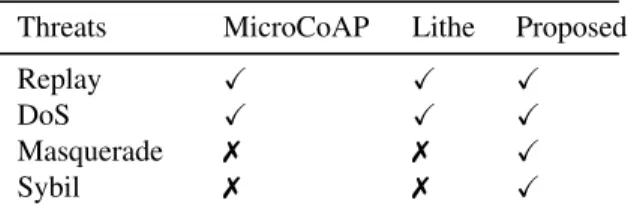
In Table 1, we analyze the resilience of SmartEdge against various malicious threats. In SmartEdge,ηiandηCHwere generated by a random number (randi) and appended
to a timer (Ti). This combination ofTi andrandi assures that an adversary finds it
extremely difficult to launch a replay attack. An adversary may eavesdrop on ciphers, i.e.,λi⊕µ|ηCH,ηCH⊕λi|ηi, andηi |µ, but is unable to decrypt them in absence
ofλi,ηCH, andηi, respectively. The absence of these secret primitives prevents an
ad-versary from launching masquerade attacks. For an adad-versary to launch a Sybil attack, it needs to stealλifrom multiple MSNs. However, the MSNs are tamper-safe in view
of Internet Threat model [28]. Moreover, the base station maintainsαiof MSNs and
IDCHnof cluster heads that restricts an adversary from fabricating multiple identities. In SmartEdge, each cluster head allows up to fourJreq attempts. This limitation
re-stricts a node, be it a legitimate one or a malicious one, from launching DoS attacks. The security mechanism deployed by edge devices and VMs is even more resilient to various attacks in presence of RSA algorithm and AES-256. The presence ofkpuband
kpriat VMs requires22048attempts from an adversary to decrypt these keys. The same
adversary would require2256attempts to decryptS
k. In comparison, the absence of a
centralized base station exposes Lithe [18] and MicroCoAP [15] to Sybil attacks. Be-sides, both these approaches have no defined policy for the prevention of masquerade attacks.
Table 1: Resilience against various Attacks
Threats MicroCoAP Lithe Proposed
Replay X X X
DoS X X X
Masquerade 7 7 X
Sybil 7 7 X
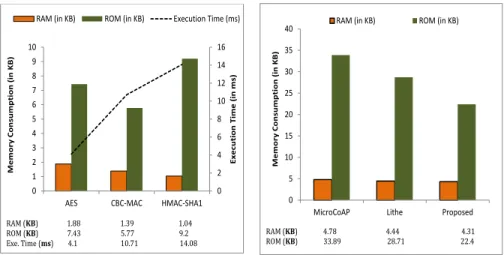
while considering the messages of the following sizes, IDs as2bytes, MAC as4bytes, nonces as16bytes, key size as 16bytes, and HMAC as16bytes, respectively. The MSNs and cluster heads are battery-powered smart devices. For this reason, we deter-mine the price of security overhead, i.e., memory consumption and execution time, for these deployed nodes. In Fig. 3(a), the memory consumption, and the execution time required by each operation, i.e., AES, CBC, and HMAC, on a smart device, are shown. These operations occupy a significantly lower RAM and ROM, allowing these smart devices to perform vital smart home services. Moreover, the symmetric encryption, lightweight MAC and SHA-1of our scheme have a significantly lower execution time (TE) on a given smart device. In Fig. 3(b), we compare our scheme against Lithe and
MicroCoAP in term of memory consumption. Both these schemes use complex cipher suites and DTLS handshake messages that consume a considerable amount of RAM and ROM.
To determine the lightweightness of our scheme, we evaluate the energy consump-tion of the cryptographic operaconsump-tions performed by MSNs and cluster heads. The com-putation and communication costs incurred by these operations in term of energy are shown in Table 2. The computational energy consumed by these cryptographic opera-tions can be calculated using the formulaV ×I×TE[32]. The value of the voltage
(V) is 5V and current (I) is160 mA, derived from Pi Zero W datasheet7 in active mode. Using Fig. 3(a), the value ofTE is28.89ms. Upon evaluation,V ×I×TE
yields a computational cost of23.11mJ. The communication cost is the amounts of energy spent by an MSN or cluster head to exchange, i.e., transmit or receive, a cipher
0 2 4 6 8 10 12 14 16 0 1 2 3 4 5 6 7 8 9 10
AES CBC-MAC HMAC-SHA1
E xec u tion Ti m e ( in m s) M e m o ry Co n su m p tion (i n KB )
RAM (in KB) ROM (in KB) Execution Time (ms)
RAM (KB) 1.88 1.39 1.04 ROM (KB) 7.43 5.77 9.2 Exe. Time (ms) 4.1 10.71 14.08
(a) Memory Consumption and Execution Time
0 5 10 15 20 25 30 35 40
MicroCoAP Lithe Proposed
M e m o ry Co n su m p tion (i n KB )
RAM (in KB) ROM (in KB)
RAM (KB) 4.78 4.44 4.31 ROM (KB) 33.89 28.71 22.4
(b) Comparison with Existing Schemes
Figure 3: Security Overhead
message. During the authentication operation, four cryptographic messages, i.e.,Jreq,
CHchallenge,αchallengeandCHresponse, are exchanged between an MSN and a
clus-ter head. Among them,Jreqis32bits andCHchallenge,αchallenge, andCHresponse
are256bits each, respectively. According to [33], the transmission and reception of a single bit require0.72µJ and0.81µJ, respectively. Hence, the overall communication cost incurred by each MSN of our scheme for exchanging these cipher messages is
0.622mJ, only. In comparison, Lithe and MicroCoAP use large-sized record headers and client certificate requests. These primitives incur an excessive burden in term of computation and communication on a given node. In case of Lithe and MicroCoAP, a node requires14.3%and41.8%, more computational energy, respectively. These schemes require75.2%and121%more energy in term of communication, in compar-ison to our scheme.
Table 2: Computation and Communication Cost
Energy (inmJ) MicroCoAP Lithe Proposed Computation 32.76 26.41 23.11
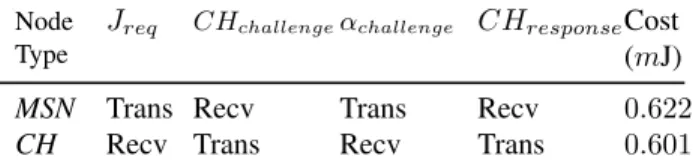
In Table 2, we derive the communication cost incurred by an MSN, only. In case of a cluster head, the communication cost is even lower. Based on the mode of operation (transmit/receive) and node type, we derive the communication cost in Table 3. Similar to Table 2, Table 3 is derived based on the operational mode and size of each cipher message.
Table 3: Communication Cost: MSN (α)←→CH
Node Type
Jreq CHchallengeαchallenge CHresponseCost
(mJ)
MSN Trans Recv Trans Recv 0.622
CH Recv Trans Recv Trans 0.601
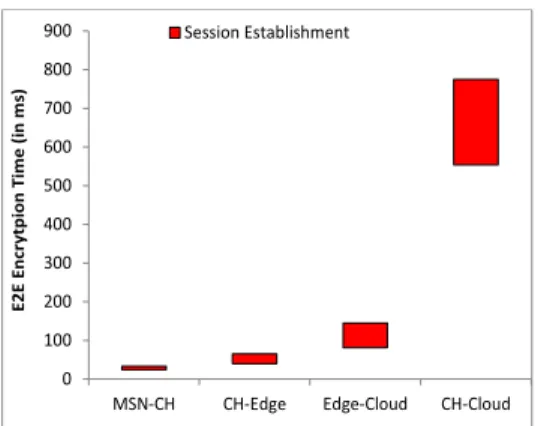
To establish secured sessions among various entities of a smart home, we calculated the end-to-end encryption delay in Fig. 4. In SmartEdge, encryption is achieved at three levels, i.e., MSN to cluster head, cluster head to the edge, and edge to VMs. The average session establishment time between the smart devices, i.e., MSN and its respective cluster head, range from24to33ms. The average session time for cluster head to edge ranges from40to65ms, and for edge to VMs ranges from81to145
ms, respectively. Based on these calculations, the end-to-end encryption delay for a complete session ranges from243to699ms. In Fig. 4, cluster heads to clouds/VMs mean that there is no edge device involved, which is not the case with SmartEdge. In absence of an edge device, it requires 554 to775 ms for establishing a session between a cluster head (a smart device) and VMs. In absence of network edge, a smart device communicates directly with VMs and experiences a significantly higher delay for establishing a secured session.
To analyze the round trip time (RTT), we configure the general-purpose input/output (GPIO) pins of MSNs and cluster heads to operate with enabled radio duty cycling (RDC) and disabled RDC. The radio remains off most of the time and is turned on at certain intervals to check the medium for any incoming or outgoing packet. In Fig. 5(a), we evaluate SmartEdge with enabled RDC. In this figure, the data packets have varying payload sizes (in bytes). SmartEdge has a smaller RTT in comparison to the existing schemes. RTT is measured as the length of time it takes for a request to be
0 100 200 300 400 500 600 700 800 900
MSN-CH CH-Edge Edge-Cloud CH-Cloud
E 2E E n cr ytp io n Ti m e ( in m s) Session Establishment
Figure 4: End-to-End Encryption
sent and its response be received [15]. In Fig. 5(b), the RTT is calculated for a dis-abled RDC. In comparison to Fig. 5(a), Fig. 5(b) has a relatively lower RTT for all the three schemes. In RDC, energy consumption of a node is reduced by keeping the radio in sleep mode for most of the time. However, RDC achieves energy conservation at the expense of higher latency because a transmitter node needs to wait until a receiver node wakes up. It may happen that the waiting interval of a transmitter overlaps with the sleeping interval of a receiver. Therefore, the overall RTT is much higher for data packets with enabled RDC. Irrespective of RDC-enabled or RDC-disabled, our scheme has significantly lower RTT values in comparison to Lithe and MicroCoAP. In Fig. 5(a) and Fig. 5(b), the response time is calculated as12×RTT.
180 190 200 210 220 230 240 250 1 4 8 16 32 48 64 R o u n d Tr ip Ti m e ( m s)
No. of Data Bytes
CoAPMicro Lithe Proposed
(a) With RDC 30 31 32 33 34 35 1 4 8 16 32 48 64 R o u n d Tr ip Ti m e ( m s)
No. of Data Bytes CoAPMicro Lithe Proposed
(b) Without RDC
8. Conclusion
In this paper, we propose a SmartEdge framework to secure the transmission of multimedia data in smart homes. SmartEdge offloads computationally complex and resource-intensive operations to the network edge and cloud data centers. Using a lightweight symmetric encryption, each multimedia sensor node (MSN) establishes a secured connection with its respective cluster head for the transmission of its raw data streams. At the network edge, one or more verified edge devices collect these streams from cluster heads, manipulate them, and transmit to the cloud. Prior to the data trans-mission, each edge device encrypts the streams, encodes them and establishes a se-cured connection with the cloud data centers. Each edge device executes a relatively complex symmetric encryption while the cloud data centers execute resource-intensive asymmetric encryption. Upon establishing a secured session, the multimedia data is uploaded to the cloud that can be downloaded and decrypted by the end users for pro-visioning of various services in a smart home environment. In comparison with the existing schemes, security overhead is reduced by up to10% in case of RAM con-sumption and51% in case of ROM consumption. In term of energy consumption, the computational cost is reduced by up to42% and communication cost is reduced by up to21%. In term of end-to-end encryption, our scheme has a significantly lower session establishment delay. It is highly resilient against various adversarial attacks and has a lower response time for a payload of various sizes. In future, we aim to configure our scheme by incorporating mobility of smart devices and scalability of the network edge.
References
[1] Y. Qin, Q. Z. Sheng, N. J. Falkner, S. Dustdar, H. Wang, A. V. Vasilakos, When things matter: A survey on data-centric internet of things, Journal of Network and Computer Applications 64 (2016) 137–153.
[2] J. Jin, J. Gubbi, S. Marusic, M. Palaniswami, An information framework for creating a smart city through internet of things, IEEE Internet of Things Journal 1 (2014) 112–121.
[3] A. Gharaibeh, M. A. Salahuddin, S. J. Hussini, A. Khreishah, I. Khalil, M. Guizani, A. Al-Fuqaha, Smart cities: A survey on data management, se-curity, and enabling technologies, IEEE Communications Surveys & Tutorials 19 (2017) 2456–2501.
[4] H. Cai, B. Xu, L. Jiang, A. V. Vasilakos, Iot-based big data storage systems in cloud computing: perspectives and challenges, IEEE Internet of Things Journal 4 (2017) 75–87.
[5] M. Díaz, C. Martín, B. Rubio, State-of-the-art, challenges, and open issues in the integration of internet of things and cloud computing, Journal of Network and Computer Applications 67 (2016) 99–117.
[6] N. Mohamed, J. Al-Jaroodi, I. Jawhar, S. Lazarova-Molnar, S. Mahmoud, Smartcityware: A service-oriented middleware for cloud and fog enabled smart city services, Ieee Access 5 (2017) 17576–17588.
[7] M. Dalla Cia, F. Mason, D. Peron, F. Chiariotti, M. Polese, T. Mahmoodi, M. Zorzi, A. Zanella, Using smart city data in 5g self-organizing networks, IEEE Internet of Things Journal 5 (2018) 645–654.
[8] W. Yu, F. Liang, X. He, W. G. Hatcher, C. Lu, J. Lin, X. Yang, A survey on the edge computing for the internet of things, IEEE Access 6 (2018) 6900–6919. [9] S. Li, N. Zhang, S. Lin, L. Kong, A. Katangur, M. K. Khan, M. Ni, G. Zhu,
Joint admission control and resource allocation in edge computing for internet of things, IEEE Network 32 (2018) 72–79.
[10] T. Wang, G. Zhang, A. Liu, M. Z. A. Bhuiyan, Q. Jin, A secure iot service archi-tecture with an efficient balance dynamics based on cloud and edge computing, IEEE Internet of Things Journal (2018).
[11] X. Lyu, H. Tian, L. Jiang, A. Vinel, S. Maharjan, S. Gjessing, Y. Zhang, Selec-tive offloading in mobile edge computing for the green internet of things, IEEE Network 32 (2018) 54–60.
[12] P. Hu, S. Dhelim, H. Ning, T. Qiu, Survey on fog computing: architecture, key technologies, applications and open issues, Journal of Network and Computer Applications (2017).
[13] X. Huang, N. Ansari, Secure multi-party data communications in cloud aug-mented iot environment, in: Communications (ICC), 2017 IEEE International Conference on, IEEE, 2017, pp. 1–6.
[14] J. Shen, D. Liu, J. Shen, Q. Liu, X. Sun, A secure cloud-assisted urban data sharing framework for ubiquitous-cities, Pervasive and mobile Computing 41 (2017) 219–230.
[15] M. A. Jan, F. Khan, M. Alam, M. Usman, A payload-based mutual authentication scheme for internet of things, Future Generation Computer Systems (2017). [16] J. Daemen, V. Rijmen, The design of Rijndael: AES-the advanced encryption
standard, Springer Science & Business Media, 2013.
[17] M. Usman, M. A. Jan, X. He, Cryptography-based secure data storage and sharing using hevc and public clouds, Information Sciences 387 (2017) 90–102.
[18] S. Raza, H. Shafagh, K. Hewage, R. Hummen, T. Voigt, Lithe: Lightweight secure coap for the internet of things, IEEE Sensors Journal 13 (2013) 3711– 3720.
[19] T. Kothmayr, C. Schmitt, W. Hu, M. Brünig, G. Carle, Dtls based security and two-way authentication for the internet of things, Ad Hoc Networks 11 (2013) 2710–2723.
[20] H. Tao, M. Z. A. Bhuiyan, A. N. Abdalla, M. M. Hassan, J. M. Zain, T. Haya-jneh, Secured data collection with hardware-based ciphers for iot-based health-care, IEEE Internet of Things Journal (2018).
[21] G. Orsini, D. Bade, W. Lamersdorf, Cloudaware: A context-adaptive middle-ware for mobile edge and cloud computing applications, in: Foundations and
Applications of Self* Systems, IEEE International Workshops on, IEEE, 2016, pp. 216–221.
[22] K. Habak, M. Ammar, K. A. Harras, E. Zegura, Femto clouds: Leveraging mobile devices to provide cloud service at the edge, in: Cloud Computing (CLOUD), 2015 IEEE 8th International Conference on, IEEE, 2015, pp. 9–16.
[23] X. Sun, N. Ansari, Edgeiot: Mobile edge computing for the internet of things, IEEE Communications Magazine 54 (2016) 22–29.
[24] P. Liu, D. Willis, S. Banerjee, Paradrop: Enabling lightweight multi-tenancy at the network’s extreme edge, in: Edge Computing (SEC), IEEE/ACM Symposium on, IEEE, 2016, pp. 1–13.
[25] J. Pan, L. Ma, R. Ravindran, P. TalebiFard, Homecloud: An edge cloud frame-work and testbed for new application delivery, in: Telecommunications (ICT), 2016 23rd International Conference on, IEEE, 2016, pp. 1–6.
[26] J. Son, D. Kim, M. Z. A. Bhuiyan, R. Hussain, H. Oh, A new outsourcing condi-tional proxy re-encryption suitable for mobile cloud environment, Concurrency and Computation: Practice and Experience 29 (2017) e3946.
[27] Z. Qin, Y. Yang, T. Yu, I. Khalil, X. Xiao, K. Ren, Heavy hitter estimation over set-valued data with local differential privacy, in: Proceedings of the 2016 ACM SIGSAC Conference on Computer and Communications Security, ACM, 2016, pp. 192–203.
[28] E. Rescorla, B. Korver, Guidelines for writing RFC text on security considera-tions, Technical Report, 2003.
[29] G. J. Sullivan, J. Ohm, W.-J. Han, T. Wiegand, Overview of the high efficiency video coding (hevc) standard, IEEE Transactions on circuits and systems for video technology 22 (2012) 1649–1668.
[31] D. Eastlake 3rd, P. Jones, US secure hash algorithm 1 (SHA1), Technical Report, 2001.
[32] D. He, S. Chan, S. Tang, M. Guizani, Secure data discovery and dissemination based on hash tree for wireless sensor networks, IEEE transactions on wireless communications 12 (2013) 4638–4646.
[33] G. De Meulenaer, F. Gosset, F.-X. Standaert, O. Pereira, On the energy cost of communication and cryptography in wireless sensor networks, in: Network-ing and Communications, 2008. WIMOB’08. IEEE International Conference on Wireless and Mobile Computing„ IEEE, 2008, pp. 580–585.